
- Market Size (2026)
- USD 70.7 Bn
- Forecast (2036)
- USD 165.9 Bn
- CAGR (2026 to 2036)
- 8.9%
How big is the Dispatchable Renewables Market in 2026?
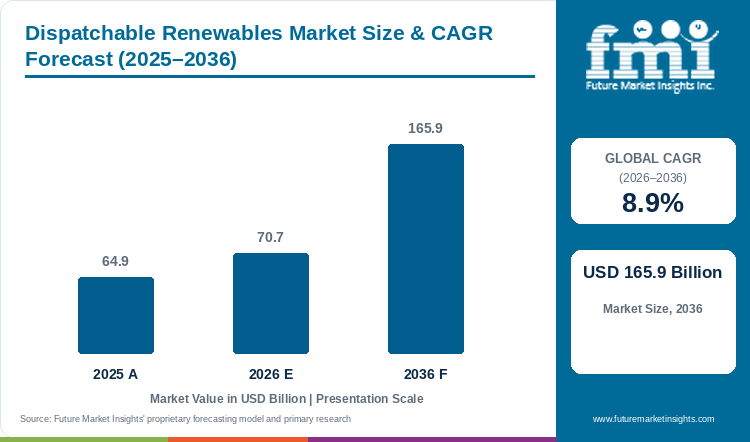
The Dispatchable Renewables Market is projected to reach USD 165.9 billion by 2036, growing at an 8.9% CAGR from 2026 to 2036. The market is estimated at USD 70.7 billion in 2026. The market was valued at USD 64.9 billion in 2025. The clearest near-term demand signal is enhanced geothermal in the United States. Fervo Energy synchronised its Cape Station in Utah to the grid on 24 September 2026 and declared commercial operation on 30 September. The first 33 MW GeoBlock produces net power. The other two blocks of the roughly 100 MW first phase are due for contractual operation by 1 January 2027 [2].
Value depends on when a plant can deliver power, as much as on how much it produces. Statkraft reported on 29 October 2026 that third-quarter generation fell to 14.7 TWh from 15.8 TWh, with 1.4 TWh of the drop in Norway. Its underlying EBITDA rose to NOK 5.2 billion from NOK 3.1 billion on significantly higher Nordic power prices [6]. Markets including Germany and France recorded more than 500 hours of negative pricing in 2025 [9]. Plants that release energy in scarce hours earn more per megawatt-hour than plants that must run when supply is abundant. That is why steam turbines, storage-backed solar and pumped storage are central to procurement.
Key Market Trends & Insights
- Next-generation geothermal reached commercial scale in 2026. Fervo declared commercial operation at Cape Station on 30 September [2]. On 4 November 2026, Ormat said its enhanced geothermal land position of about 170,000 acres could support 5 to 6 GW [1].
- Concentrated solar capacity is moving to China. SolarPACES reported on 5 November 2026 that China's cumulative installed capacity reached 2,438 MW, passing Spain [14].
- Pumped storage holds the largest development pipeline. The International Hydropower Association reported on 24 June 2026 that 28 GW of hydropower was added in 2025, including a record volume of pumped storage. The pipeline holds 621 GW of pumped storage projects across all stages [9].
Regional Highlights
- North America: Hydro supplied 57.7% of Canada's electricity in 2023, and the Canada Energy Regulator describes that hydro as largely dispatchable [21].
- Continental Europe: Germany's Bundesnetzagentur awarded 318,676 kW of the 617,326 kW offered in its biomass tender with the 1 October 2026 bid date [16][17]. ENGIE reported low hydropower output across Europe in the third quarter of 2026 [19].
- United Kingdom: Ofgem published minded-to decisions for the first window of its long-duration storage cap and floor scheme on 26 June 2026 [11]. Drax reported on 30 July 2026 that a new Contract for Difference for biomass starts in April 2027 [18].
Dispatchable Renewables Market Size and Forecast
Table 1: Dispatchable Renewables Market Size and Forecast
| Market size and forecast | Value |
|---|---|
| Market size in 2025 | USD 64.9 billion |
| Estimated market size in 2026 | USD 70.7 billion |
| Projected market size by 2036 | USD 165.9 billion |
| CAGR from 2026 to 2036 | 8.9% |
Source: Future Market Insights analysis of the dispatchable renewables market, 2026.
Analyst Perspective
“Dispatchable renewables are bought for timing, and the price of timing is rising. Negative-price hours in Europe and record storage pipelines show the same trend. A plant that can choose when to deliver is worth more than one that cannot. Buyers should compare offers on firm output in scarce hours, contracted support and outage history, instead of nameplate capacity. The weakest links are grid connection delays and hydrology, as Statkraft's lower third-quarter output and Drax's Cruachan outage show.”
- Nikhil Kaitwade, Principal Consultant, FMI
How is the Dispatchable Renewables Market segmented?
- By technology: Hydropower, Biomass, Geothermal, Concentrated Solar Power and Others
- By end use: Utilities, Industrial, Commercial and Residential
- By region: North America and Europe
Why does Hydropower lead by Technology in the Dispatchable Renewables Market in 2026?
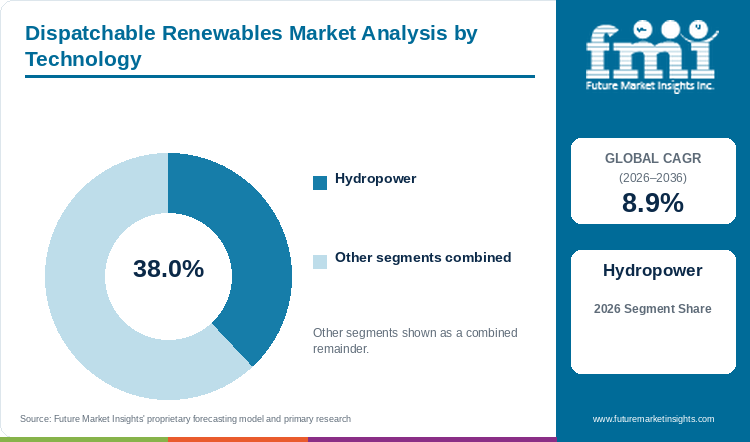
Hydropower, including pumped storage, is estimated to account for 38.0% of the Dispatchable Renewables Market by technology in 2026. The International Hydropower Association reported 28 GW of hydropower added in 2025, with record pumped storage additions [9]. Its pipeline holds 621 GW of pumped storage projects across all stages [9]. GE Vernova says pumped-storage plants can ramp up to 400 MW in less than 60 seconds [8]. Existing fleets add refurbishment demand. GE Vernova says upgrades can raise a plant's efficiency by up to 7% and output by up to 50% [8]. On 9 April 2026, Voith agreed to supply two 70 MW variable-speed pump turbines for Grimsel 4 in Switzerland [5]. Utility fleets are large. Enel's pro forma flexible capacity includes 12.8 GW of basin hydro and 8.1 GW of pumped hydro [20]. Hydropower leads because new pumped storage, refurbishment and turbine replacement draw on the same equipment base.
Table 2: Technology, 2026 Share
| Leading Share | 2026 market share |
|---|---|
| Hydropower | 38.0% |
| All Other Segments Combined Share | 62.0% |
Source: Future Market Insights analysis of the dispatchable renewables market, 2026.
Why do Utilities lead by End Use in the Dispatchable Renewables Market in 2026?
Utilities is estimated to account for 42.0% of the Dispatchable Renewables Market by end use in 2026. Utilities own and operate the fleets that supply on-demand renewable power. Enel's H1 2026 bulletin lists 26,961 MW of hydro and 860 MW of geothermal capacity. Its renewable flexible capacity on a pro forma basis is 12.8 GW of basin hydro, 8.1 GW of pumped hydro and 3.5 GW of batteries [20]. ENGIE said on 5 November 2026 that earnings from its renewables and storage business rose 5.5% organically in the first nine months [19]. Low hydropower output and lower captured prices partly offset that gain, and ENGIE reported more than 10 GW of storage in operation and under construction at the end of September 2026. Statkraft generated 14.7 TWh in the third quarter of 2026 [6]. Revenue mechanisms are written for utilities as well. Drax says its biomass units can dispatch up to 2.6 GW under the Contract for Difference that starts in April 2027 [18]. Ofgem's cap and floor scheme for long-duration electricity storage reached minded-to decisions in its first window on 26 June 2026 [11]. Industrial demand is narrower. Babcock & Wilcox lists biomass boilers and pulp and paper recovery boilers among its renewable products [24], so industrial demand appears in boiler equipment.
Table 3: End Use, 2026 Share
| Leading Share | 2026 market share |
|---|---|
| Utilities | 42.0% |
| All Other Segments Combined Share | 58.0% |
Source: Future Market Insights analysis of the dispatchable renewables market, 2026.
What are the key drivers, restraints and opportunities?
Driver
Price signals for flexibility. Negative pricing for more than 500 hours in 2025 in markets including Germany and France [9] widens the spread between the cheapest and most expensive hours. Dispatchable plants sell into that spread. ENGIE has also continued to develop 24/7 renewable supply. Its contract with Legrand covers its French operations over 2029 to 2031 and targets 70% hourly matching between renewable generation and consumption [19]. Buyers that match consumption hour by hour need sources that can fill the evening.
Public support for firm output. Governments are building revenue schemes around storage and biomass capacity. Ofgem published minded-to decisions on 26 June 2026 for the first window of its long-duration storage cap and floor scheme [11]. In Germany, the maximum bid in the 2026 biomass tender is 19.43 cents per kWh for new plants and 19.83 cents for existing plants [16]. Drax will move to a new biomass Contract for Difference in April 2027 [18].
Restraint
Weather and outages. Hydro and geothermal output can fall for reasons the operator does not control. Statkraft's third-quarter 2026 generation was 14.7 TWh against 15.8 TWh a year earlier [6]. Ormat's electricity segment revenue fell 2.1% in the third quarter of 2026, mainly on lower generation at Puna after a hurricane-related forced outage [1]. Drax reported that Cruachan units 3 and 4 have been offline since a grid connection failure in December 2025, with restoration expected in 2027 [18].
Support that does not fill. A tender helps only when enough bids arrive. In Germany's biomass round with the 1 October 2026 bid date, 318,676 kW was awarded against 617,326 kW offered, at an average of 18.75 cents per kWh [17]. Lower power prices also weigh on earnings. Drax's adjusted EBITDA fell to GBP 279.0 million in the first half of 2026 from GBP 460.0 million, as achieved power prices fell [18]. Projects in Mexico still need Ministry of Energy permits before building, as the ENAL geothermal plan in Guanajuato shows [22].
Opportunity
Enhanced geothermal and round-the-clock contracts. Fervo's Google agreement is for 396 MW, with an option for about 600 MW more by June 2030 [3]. Ormat is negotiating power purchase agreements for Dixie Valley, Nevada, which it plans as its first commercial enhanced geothermal project. Ormat was also selected by the US Department of Energy for up to USD 35.0 million in funding [1]. The department also announced 21 projects for enhanced geothermal field tests and exploration drilling on 21 September 2026 [4]. Equipment suppliers that package organic Rankine cycle units for plants of this kind can follow each project.
Refurbishment and variable-speed pumped storage. Existing hydro fleets need new equipment. GE Vernova says upgrades can raise a plant's efficiency by up to 7% and output by up to 50% [8]. Voith signed with Kraftwerke Oberhasli on 9 April 2026 to supply two variable-speed pump turbines of 70 MW each for the Grimsel 4 project in Switzerland [5]. ANDRITZ's news listing records that New Brunswick Power signed a contract on 27 August 2026 to move into the next planning phase of modernising six units totalling 666 MW at Mactaquac in Canada [7].
Dispatchable Renewables Market by Country (2026 to 2036)
Table 4: Dispatchable Renewables Market Country Growth Forecast
| Country | CAGR, 2026 to 2036 |
|---|---|
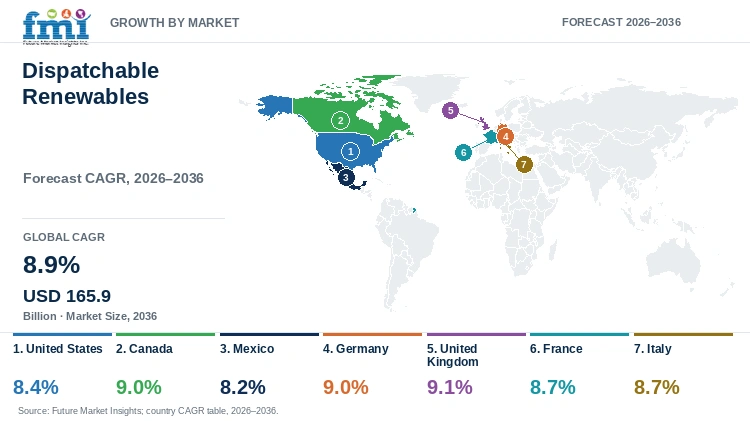
| United States | 8.4% |
| Canada | 9.0% |
| Mexico | 8.2% |
| Germany | 9.0% |
| United Kingdom | 9.1% |
| France | 8.7% |
| Italy | 8.7% |
Source: Future Market Insights analysis of the dispatchable renewables market, 2026.
United States
Fervo's Cape Station is the most visible new asset. The first GeoBlock delivered 33 MW of net power, and commercial operation was declared on 30 September 2026. A further 400 MW phase is targeted for 2028 [2]. The 396 MW agreement with Google, signed on 1 September 2026, is described as supporting 24/7 carbon-free power from the Cape Station GeoCluster. It also refers to flexible delivery pathways under Utah's SB132 [3].
Ormat reported third-quarter 2026 revenue of USD 275.1 million, up 10.2%, and a global portfolio of 1,853 MW, of which 495 MW is US energy storage. Its energy storage segment revenue grew 145.2% to USD 49.9 million, and Ormat decided to build the 100 MW, 400 MWh Denali storage facility in California under a 20-year tolling agreement with Clean Power Alliance, due by the end of 2028 [1]. The company raised the midpoint of its 2026 revenue guidance, which now stands at USD 1,170 million to USD 1,200 million [1].
Hydro is the other US pillar. The International Hydropower Association counts more than 60 GW of pumped storage projects in development across the USA [9]. The US Department of Energy lists geothermal research, development and demonstration, including the FORGE field site, and an Enhanced Geothermal Shot analysis that points to at least 90 GW of geothermal capacity by 2050 [4]. Suppliers of turbines and generators with existing US references hold the advantage as licences and financing progress.
Canada
Hydro defines Canadian supply. The Canada Energy Regulator reports that hydro provided 57.7% of Canada's electricity in 2023 and describes it as largely dispatchable [21]. Growth in dispatchable capacity therefore comes mostly from keeping the fleet running and adding storage, not from new technology types.
ANDRITZ's agreement with New Brunswick Power for Mactaquac covers the planning phase, not a final investment decision, so equipment orders are still ahead [7]. GE Vernova is a potential supplier for Canadian refurbishment work, because its turbines and generators make up more than 25% of installed hydro capacity worldwide [8].
Industrial demand shows up in boiler work. Babcock & Wilcox lists a December 2025 contract of more than USD 10.0 million for B&W Canada to install boiler equipment in a USD 20.0 million upgrade of a power boiler at Irving Pulp & Paper's Saint John mill in New Brunswick [24]. The contract shows industrial plants in Canada still spending on steam and power equipment.
Mexico
The Comision Federal de Electricidad has led geothermal development in Mexico and developed and operates the Cerro Prieto, Los Azufres and Los Humeros plants [23]. A proposal for a new Geothermal Law was published in the Senate's Official Gazette on 5 February 2025, with a 'Various Uses' permit for non-electric applications and simpler registration and exploration permits [23].
Private entry is starting at small scale. ENAL, a Grupo Carso subsidiary, announced on 17 February 2026 an investment of MXN 80.0 million, about USD 4.6 million, in a 12.5 MW binary geothermal plant in the Laja-Bajio region of Guanajuato. That would make Guanajuato the sixth Mexican state with geothermal generation. The project still needs permits from the Ministry of Energy [22].
Binary plants of that size fall within the range of package units on offer. Siemens Energy says its organic Rankine cycle units can generate power from waste heat or geothermal sources up to 60 MW [13]. Mexico offers equipment suppliers small, permit-dependent projects, so timing depends more on approvals than on demand.
Germany
Biomass is the dispatchable technology Germany regulates most closely. The Bundesnetzagentur's tender with a bid date of 1 October 2026 offered 617,326 kW with maximum values of 19.43 cents per kWh for new plants and 19.83 cents for existing plants under section 85a of the Renewable Energy Sources Act [16]. It awarded 318,676 kW across 244 awards at a quantity-weighted average of 18.75 cents per kWh [17].
Roughly half of the offered volume was awarded. Suppliers of biomass boilers and steam equipment depend on the accepted bids. Babcock & Wilcox lists biomass and bioenergy boilers among its renewable products [24].
ENGIE signed an agreement extending its partnership with Return to cover an additional 300 MW of battery storage in Germany [19]. The International Hydropower Association counted Germany among markets with more than 500 hours of negative pricing in 2025 [9]. Those hours raise the value of any asset that can store energy and release it later.
United Kingdom
Drax is the UK's reference case for dispatchable biomass. Its first-half 2026 results, published on 30 July 2026, show biomass generation of 7.0 TWh and adjusted EBITDA of GBP 279.0 million, against GBP 460.0 million a year earlier. A new biomass Contract for Difference starts in April 2027, and up to 2.6 GW can be dispatched under it [18].
Pumped storage comes next. Ofgem published minded-to decisions for window 1 of its long-duration storage cap and floor scheme on 26 June 2026, and its page lists the window as closed and awaiting a decision [11]. Of 16 projects provisionally selected, three are pumped storage projects that together account for about two-thirds of the roughly 88 GWh of storage procured and nearly 4 GW of power [10].
Drax's Cruachan pumped storage station shows the grid risk. Units 3 and 4 have been offline since a grid connection failure in December 2025. A refurbishment of about GBP 80.0 million is planned through 2027, and restoration of the connection is expected in 2027 [18]. ENGIE commissioned its first two battery systems in the United Kingdom, 100 MW and 200 MWh in total, during the third quarter of 2026 [19]. Storage and biomass owners now have visible revenue routes, but grid access decides whether they can use them.
France
Hydropower dominates the French flexible fleet, and 2026 has been a weak water year. ENGIE reported low hydropower generation in Europe in the third quarter of 2026, and a cut in the French hydropower tax cushioned the effect in France [19]. French hydro owners therefore saw output and tax move in opposite directions this year.
ANDRITZ lists a July 2026 award from EDF for a new pump turbine and related equipment for the Vouglans and Saut-Mortier plants [7]. The order shows hydro owners in France investing in pumped-storage units instead of only maintaining existing ones.
Buyers also contract for matched supply. ENGIE signed a contract with Legrand covering all of its French operations over 2029 to 2031, targeting 70% hourly matching between renewable generation and consumption [19]. The International Hydropower Association counts France among markets with more than 500 hours of negative pricing in 2025 [9]. That negative pricing strengthens the case for storage-backed supply.
Italy
Italy has the most diverse dispatchable fleet in the group. Enel's consolidated capacity in Italy at the end of June 2026 was 12,963 MW of hydro and 776 MW of geothermal, out of a group geothermal total of 860 MW [20].
Batteries sit next to those plants. Enel reports 1,767 MW of battery storage in Italy, up 4.7% from a year earlier. Italian hydro capacity was essentially flat at 12,963 MW [20]. Enel's pro forma flexible capacity for the group includes 8.1 GW of pumped hydro, unchanged on the year [20].
Italy's forecast rate of 8.7% trails Canada, Germany and the United Kingdom. With a hydro and geothermal fleet already in place, the commercial opening for suppliers is in storage and refurbishment instead of new fleets.
Who are the notable companies in the Dispatchable Renewables Market?
Notable companies in the Dispatchable Renewables Market include Siemens Energy, Voith Hydro, ANDRITZ Hydro, GE Vernova, China Three Gorges Corporation and Statkraft.
The market separates companies that sell equipment from companies that earn money by dispatching assets. Voith, ANDRITZ and GE Vernova sell turbines, generators and refurbishment for hydro. Siemens Energy sells steam turbines for solar thermal plants and organic Rankine cycle units for geothermal heat, and Babcock & Wilcox sells biomass boilers [8][13][24]. Revenue follows project orders. Voith won the Grimsel 4 turbines on 9 April 2026 [5], and ANDRITZ announced four turbine-generator units for the 600 MW Khorlochhu project in Bhutan on 1 October 2026 [7]. Siemens Energy reported record orders of EUR 17.9 billion, group-wide, for the third quarter of its 2026 fiscal year, and set 11 November 2026 for its fourth-quarter release [12].
Operators compete on when they deliver and what price they capture. Statkraft, Enel, ENGIE and China Three Gorges run large hydro fleets. Their results move with water and price, as Statkraft's lower generation and higher Nordic prices show [6]. China Three Gorges describes itself as the world's largest hydropower development and operating enterprise [25]. Enel holds 26,961 MW of hydro and 860 MW of geothermal [20]. Ormat and Fervo compete in geothermal, where Ormat reports a global portfolio of 1,853 MW and Fervo has declared its first commercial plant [1][2].
Contract terms shape earnings in each region. Fervo's 396 MW agreement with Google covers 24/7 power [3]. Ormat's Denali storage project carries a 20-year tolling agreement [1]. Drax's biomass Contract for Difference starts in April 2027 [18], and Ofgem's cap and floor scheme is designed to underwrite long-duration storage [11]. A long contract keeps earnings steady when water levels or spot prices move.
Key Developments in the Dispatchable Renewables Market
- On 30 September 2026, Fervo Energy declared commercial operation at Cape Station in Utah. The first 33 MW GeoBlock is producing net power, and the other two blocks of the roughly 100 MW first phase are due for contractual operation by 1 January 2027 [2].
- On 4 November 2026, Ormat reported third-quarter revenue of USD 275.1 million and raised the midpoint of its 2026 revenue and adjusted EBITDA guidance [1]. It also decided to build the 100 MW, 400 MWh Denali storage facility in California, for completion by the end of 2028.
- On 30 October 2026, the 100 MW tower section of the Fukang concentrated solar project in Xinjiang was connected to the grid, lifting China's cumulative capacity to 2,438 MW and past Spain [14].
- On 1 October 2026, ANDRITZ announced it will supply four turbine-generator units for the 600 MW Khorlochhu hydropower project in Bhutan [7].
Key Players in the Dispatchable Renewables Market
- Siemens Energy
- Voith Hydro
- ANDRITZ Hydro
- GE Vernova
- China Three Gorges Corporation
- Statkraft
- Enel Green Power
- ENGIE
- Babcock & Wilcox Enterprises
- Ormat Technologies
Dispatchable Renewables Market Report Scope
Table 5: Dispatchable Renewables Market Report Scope
| Coverage field | Report scope |
|---|---|
| Market definition | Renewable electricity sources that can be scheduled on demand: concentrated solar power with thermal storage, biomass, geothermal and hydropower including pumped storage. Measured by value of equipment, engineering and construction sales for new and refurbished plants, with integrated storage included and electricity sales and stand-alone batteries excluded |
| Technology | Hydropower, Biomass, Geothermal, Concentrated Solar Power, Others |
| End Use | Utilities, Industrial, Commercial, Residential |
| Regions and profiled countries | Regions: North America and Europe. Countries: United States, Canada, Mexico, Germany, United Kingdom, France, Italy. |
| Companies covered | Siemens Energy, Voith Hydro, ANDRITZ Hydro, GE Vernova, China Three Gorges Corporation, Statkraft, Enel Green Power, ENGIE, Babcock & Wilcox Enterprises, Ormat Technologies |
| Forecast period | 2026 to 2036, with 2025 as the historical base year |
| Quantitative Units | USD billion |
Source: Future Market Insights analysis of the dispatchable renewables market, 2026.
Dispatchable Renewables Market by Segments
Dispatchable Renewables Market segmented by Technology:
- Hydropower
- Biomass
- Geothermal
- Concentrated Solar Power
- Others
Dispatchable Renewables Market segmented by End Use:
- Utilities
- Industrial
- Commercial
- Residential
Dispatchable Renewables Market by Region
- North America
- Europe
- United States
- Canada
- Mexico
- Germany
- United Kingdom
- France
- Italy
Research Sources and Bibliography
- [1] Ormat Technologies, Inc. (2026, November 4). Ormat Technologies Reports Third Quarter 2026 Financial Results (Form 8-K, Exhibit 99.1). https://www.sec.gov/Archives/edgar/data/0001296445/000143774926034968/ex_1038582.htm
- [2] Fervo Energy. (2026, October). Fervo Energy Declares Commercial Operation at Cape Station Ahead of Schedule. https://fervoenergy.com/fervo-energy-declares-commercial-operation-at-cape-station-ahead-of-schedule-leading-the-race-for-next-generation-geothermal-energy/
- [3] Fervo Energy. (2026, September). Fervo Energy and Google Sign 396 MW PPA. https://fervoenergy.com/fervo-energy-and-google-sign-396-mw-ppa/
- [4] U.S. Department of Energy. (n.d.). Geothermal. https://www.energy.gov/topics/geothermal
- [5] Voith. (2026, April 9). Voith Awarded Contract for Grimsel 4 Pumped Storage Project. https://www.voith.com/corp-en/news-room/press-releases/2026-04-09_vh-voith-awarded-contract-for-grimsel-4.html
- [6] Statkraft. (2026, October 29). Strong results despite lower generation. https://www.statkraft.com/IR/stock-exchange-notices/2026/strong-results-despite-lower-generation/
- [7] ANDRITZ. (n.d.). Hydropower. https://www.andritz.com/hydro-en
- [8] GE Vernova. (n.d.). Hydro. https://www.gevernova.com/hydro
- [9] International Hydropower Association. (2026, June 24). The year of the 'water battery': global pumped storage capacity surpasses 200 GW. https://www.hydropower.org/news/year-of-the-water-battery-global-pumped-storage-capacity-surpasses-200-gw
- [10] International Hydropower Association. (2026, July 16). Portugal and UK charging ahead on electricity storage and global data point to pumped storage boom. https://www.hydropower.org/news/europe-charges-ahead-on-electricity-storage-as-portugal-uk-and-global-data-point-to-pumped-storage-boom
- [11] Ofgem. (n.d.). Long duration electricity storage. https://www.ofgem.gov.uk/energy-policy-and-regulation/policy-and-regulatory-programmes/long-duration-electricity-storage
- [12] Siemens Energy. (2026, August 5). Siemens Energy accelerates profitable growth, Siemens Gamesa delivers a positive quarterly result. https://www.siemens-energy.com/global/en/home/investor-relations.html
- [13] Siemens Energy. (n.d.). Steam turbines. https://www.siemens-energy.com/global/en/home/products-services/product-offerings/steam-turbines.html
- [14] SolarPACES. (2026, November 5). China is now the world leader in CSP deployment. https://www.solarpaces.org/china-is-now-the-world-leader-in-csp-deployment/
- [15] SolarPACES. (2026, October 20). WRBC confirms DEWA CSP record, running round the clock for 39 days in 2024. https://www.solarpaces.org/wrbc-confirms-dewa-csp-record-running-round-the-clock-for-39-days-in-2024/
- [16] Bundesnetzagentur. (2026, November 3). Biomasse: Gebotstermin 1. Oktober 2026. https://www.bundesnetzagentur.de/DE/Fachthemen/ElektrizitaetundGas/Ausschreibungen/Biomasse/Okt2026/start.html
- [17] Bundesnetzagentur. (n.d.). Biomasse: Beendete Ausschreibungen und Statistiken. https://www.bundesnetzagentur.de/DE/Fachthemen/ElektrizitaetundGas/Ausschreibungen/Biomasse/BeendeteAusschreibungen/start.html
- [18] Drax Group plc. (2026, July 30). Half year results for the six months ended 30 June 2026. https://www.drax.com/financial-news/half-year-results-for-the-six-months-ended-30-june-2026/
- [19] ENGIE. (2026, November 5). ENGIE 9M 2026 Results (press release). https://www.engie.com/app/uploads/2026/11/PR-ENGIE-9M-2026-results.pdf
- [20] Enel. (2026, July 30). Enel Quarterly Bulletin, H1 2026. https://www.enel.com/content/dam/enel-com/documenti/investitori/informazioni-finanziarie/2026/trimestrali/1h-2026-quarterly-bulletin.pdf
- [21] Canada Energy Regulator. (n.d.). Canada's renewable power. https://www.cer-rec.gc.ca/en/data-analysis/energy-commodities/electricity/report/canadas-renewable-power/
- [22] ThinkGeoEnergy. (2026, February 17). 12.5-MW geothermal development in Guanajuato, Mexico receives MXN 80m investment. https://www.thinkgeoenergy.com/12-5-mw-geothermal-development-in-guanajuato-mexico-receives-mxn-80m-investment/
- [23] ThinkGeoEnergy. (2025, February 12). Mexican President proposes revamped geothermal law as part of energy reforms. https://www.thinkgeoenergy.com/mexican-president-proposes-revamped-geothermal-law-as-part-of-energy-reforms/
- [24] Babcock & Wilcox Enterprises, Inc. (n.d.). Renewable. https://www.babcock.com/renewable
- [25] China Three Gorges Corporation. (n.d.). Company profile. https://www.ctg.com.cn/sxjt/index.html
- [26] U.S. Department of Energy. (n.d.). Concentrating solar-thermal power basics. https://www.energy.gov/eere/solar/concentrating-solar-thermal-power-basics
Table of Content
Table of Content
- Key Takeaways
- Market Size and CAGR
- Top Growth Driver
- Fastest Growing Segment
- Leading Region
- Key Companies
- Emerging Opportunities
- Executive Summary
- Global Market Outlook
- Demand-side Trends
- Supply-side Trends
- Technology Roadmap Analysis
- Analysis and Recommendations
- Analyst Perspective (What is happening? Why now? What should investors know?)
- Key Questions Answered
- How large is the market?
- What is the CAGR?
- What are key trends?
- Which region dominates?
- Who are the leaders?
Read More...
- Market Overview
- Market Coverage / Taxonomy
- Market Definition / Scope / Limitations
- Research Methodology
- Chapter Orientation
- Analytical Lens and Working Hypotheses
- Market Structure, Signals, and Trend Drivers
- Benchmarking and Cross-market Comparability
- Market Sizing, Forecasting, and Opportunity Mapping
- Research Design and Evidence Framework
- Desk Research Programme (Secondary Evidence)
- Expert Input and Fieldwork (Primary Evidence)
- Tooling, Models, and Reference Databases
- Data Engineering and Model Build
- Quality Assurance and Audit Trail
- Market Background
- Market Dynamics (Drivers, Restraints, Opportunity, Trends)
- Scenario Forecast (Optimistic, Likely, Conservative)
- Impact Analysis
- AI Impact
- Sustainability Impact
- Regulatory Impact
- Technology Impact
- Consumer / Buyer Analysis
- Purchase Drivers
- Adoption Barriers
- Buyer Journey
- Opportunity Map Analysis
- Product Life Cycle Analysis
- Supply Chain Analysis
- Investment Feasibility Matrix
- Value Chain Analysis
- PESTLE and Porter's Analysis
- Regulatory Landscape
- Regional Parent Market Outlook
- Production and Consumption Statistics
- Import and Export Statistics
- Global Market Analysis and Forecast, 2021 to 2036
- Historical Market Size Value (USD Billion) Analysis, 2021 to 2025
- Current and Future Market Size Value (USD Billion) Projections, 2026 to 2036
- Y-o-Y Growth Trend Analysis
- Absolute $ Opportunity Analysis
- Global Market Pricing Analysis, 2021 to 2036
- Global Market Analysis and Forecast, By Technology, 2021 to 2036
- Introduction / Key Findings
- Historical Market Size Value (USD Billion) Analysis By Technology, 2021 to 2025
- Current and Future Market Size Value (USD Billion) Analysis and Forecast By Technology, 2026 to 2036
- Hydropower
- Biomass
- Geothermal
- Concentrated Solar Power
- Others
- Y-o-Y Growth Trend Analysis By Technology, 2021 to 2025
- Absolute $ Opportunity Analysis By Technology, 2026 to 2036
- Global Market Analysis and Forecast, By End Use, 2021 to 2036
- Introduction / Key Findings
- Historical Market Size Value (USD Billion) Analysis By End Use, 2021 to 2025
- Current and Future Market Size Value (USD Billion) Analysis and Forecast By End Use, 2026 to 2036
- Utilities
- Industrial
- Commercial
- Residential
- Y-o-Y Growth Trend Analysis By End Use, 2021 to 2025
- Absolute $ Opportunity Analysis By End Use, 2026 to 2036
- Global Market Analysis and Forecast, By Region, 2021 to 2036
- Introduction
- Historical Market Size Value (USD Billion) Analysis By Region, 2021 to 2025
- Current Market Size Value (USD Billion) Analysis and Forecast By Region, 2026 to 2036
- North America
- Europe
- Market Attractiveness Analysis By Region
- North America Market Analysis and Forecast, By Country, 2021 to 2036
- Historical Market Size Value (USD Billion) Trend Analysis By Market Taxonomy, 2021 to 2025
- Market Size Value (USD Billion) Forecast By Market Taxonomy, 2026 to 2036
- By Country
- By Technology
- By End Use
- Market Attractiveness Analysis
- By Country
- By Technology
- By End Use
- Key Takeaways
- Europe Market Analysis and Forecast, By Country
- Historical Market Size Value (USD Billion) Trend Analysis By Market Taxonomy, 2021 to 2025
- Market Size Value (USD Billion) Forecast By Market Taxonomy, 2026 to 2036
- By Country
- United States
- Canada
- Mexico
- Germany
- United Kingdom
- France
- Italy
- By Technology
- By End Use
- By Country
- Market Attractiveness Analysis
- By Country
- By Technology
- By End Use
- Key Takeaways
- Key Countries Market Analysis
- United States
- Pricing Analysis
- Market Share Analysis, 2025
- By Technology
- By End Use
- Canada
- Pricing Analysis
- Market Share Analysis, 2025
- By Technology
- By End Use
- Mexico
- Pricing Analysis
- Market Share Analysis, 2025
- By Technology
- By End Use
- Germany
- Pricing Analysis
- Market Share Analysis, 2025
- By Technology
- By End Use
- United Kingdom
- Pricing Analysis
- Market Share Analysis, 2025
- By Technology
- By End Use
- Italy
- Pricing Analysis
- Market Share Analysis, 2025
- By Technology
- By End Use
- France
- Pricing Analysis
- Market Share Analysis, 2025
- By Technology
- By End Use
- United States
- Market Structure Analysis
- Competition Dashboard
- Competition Benchmarking
- Market Share Analysis of Top Players
- By Regional
- By Technology
- By End Use
- Emerging Startups
- Innovation Benchmarking
- Competition Analysis
- Competition Deep Dive
- Siemens Energy
- Overview
- Product Portfolio
- Profitability by Market Segments
- Sales Footprint
- Strategy Overview
- Marketing Strategy
- Product Strategy
- Channel Strategy
- Voith Hydro
- ANDRITZ Hydro
- GE Vernova
- Statkraft
- Enel Green Power
- ENGIE
- Ormat Technologies
- China Three Gorges Corporation
- Babcock & Wilcox Enterprises
- Siemens Energy
- Case Studies
- Success Stories
- Recent Developments
- Competition Deep Dive
- Assumptions & Acronyms Used
List of Tables
- Table 1: Global Market Value (USD Billion) Forecast by Region, 2021 to 2036
- Table 2: Global Market Value (USD Billion) Forecast by Technology, 2021 to 2036
- Table 3: Global Market Value (USD Billion) Forecast by End Use, 2021 to 2036
- Table 4: North America Market Value (USD Billion) Forecast by Country, 2021 to 2036
- Table 5: North America Market Value (USD Billion) Forecast by Technology, 2021 to 2036
- Table 6: North America Market Value (USD Billion) Forecast by End Use, 2021 to 2036
- Table 7: Europe Market Value (USD Billion) Forecast by Country, 2021 to 2036
- Table 8: Europe Market Value (USD Billion) Forecast by Technology, 2021 to 2036
- Table 9: Europe Market Value (USD Billion) Forecast by End Use, 2021 to 2036
List of Figures
- Figure 1: Global Market Pricing Analysis
- Figure 2: Global Market Value (USD Billion) Forecast 2021-2036
- Figure 3: Global Market Value Share and BPS Analysis by Technology, 2026 and 2036
- Figure 4: Global Market Y-o-Y Growth Comparison by Technology, 2026-2036
- Figure 5: Global Market Attractiveness Analysis by Technology
- Figure 6: Global Market Value Share and BPS Analysis by End Use, 2026 and 2036
- Figure 7: Global Market Y-o-Y Growth Comparison by End Use, 2026-2036
- Figure 8: Global Market Attractiveness Analysis by End Use
- Figure 9: Global Market Value (USD Billion) Share and BPS Analysis by Region, 2026 and 2036
- Figure 10: Global Market Y-o-Y Growth Comparison by Region, 2026-2036
- Figure 11: Global Market Attractiveness Analysis by Region
- Figure 12: North America Market Incremental Dollar Opportunity, 2026-2036
- Figure 13: Europe Market Incremental Dollar Opportunity, 2026-2036
- Figure 14: North America Market Value Share and BPS Analysis by Country, 2026 and 2036
- Figure 15: North America Market Value Share and BPS Analysis by Technology, 2026 and 2036
- Figure 16: North America Market Y-o-Y Growth Comparison by Technology, 2026-2036
- Figure 17: North America Market Attractiveness Analysis by Technology
- Figure 18: North America Market Value Share and BPS Analysis by End Use, 2026 and 2036
- Figure 19: North America Market Y-o-Y Growth Comparison by End Use, 2026-2036
- Figure 20: North America Market Attractiveness Analysis by End Use
- Figure 21: Europe Market Value Share and BPS Analysis by Country, 2026 and 2036
- Figure 22: Europe Market Value Share and BPS Analysis by Technology, 2026 and 2036
- Figure 23: Europe Market Y-o-Y Growth Comparison by Technology, 2026-2036
- Figure 24: Europe Market Attractiveness Analysis by Technology
- Figure 25: Europe Market Value Share and BPS Analysis by End Use, 2026 and 2036
- Figure 26: Europe Market Y-o-Y Growth Comparison by End Use, 2026-2036
- Figure 27: Europe Market Attractiveness Analysis by End Use
- Figure 28: Global Market - Tier Structure Analysis
- Figure 29: Global Market - Company Share Analysis
Frequently Asked Questions
How big is the dispatchable renewables market in 2026?
The Dispatchable Renewables Market is estimated at USD 70.7 billion in 2026, up from USD 64.9 billion in 2025. It is projected to reach USD 165.9 billion by 2036, an 8.9% CAGR from 2026 to 2036.
Which technology leads the dispatchable renewables market?
Hydropower, including pumped storage, leads with 38.0% of the market in 2026. The International Hydropower Association reported 28 GW of hydropower added in 2025, with record pumped storage additions [9]. Its pipeline holds 621 GW of pumped storage projects [9].
Which other technologies matter?
Biomass holds 22.0%, Geothermal 16.0%, Concentrated Solar Power 13.0% and Others 11.0%. Drax generated 7.0 TWh from biomass in the first half of 2026 [18]. Fervo declared commercial operation at its Utah geothermal plant on 30 September 2026 [2]. China's cumulative concentrated solar capacity reached 2,438 MW in 2026, passing Spain [14].
Which profiled country is forecast to grow fastest?
The United Kingdom has the highest forecast CAGR of the seven profiled countries at 9.1% from 2026 to 2036, just ahead of Canada and Germany at 9.0% each. Ofgem published minded-to decisions for long-duration storage on 26 June 2026 [11], and Drax's new biomass Contract for Difference starts in April 2027 [18].
Which rules and support schemes are shaping demand?
In Germany, the biomass tender with a bid date of 1 October 2026 set maximum values of 19.43 cents per kWh for new plants and 19.83 cents for existing plants under section 85a of the Renewable Energy Sources Act [16]. In Great Britain, Ofgem's long-duration storage cap and floor scheme had reached the minded-to stage for window 1 on 26 June 2026, and its page lists the window as awaiting a decision [11].
What should a buyer check when choosing a supplier?
Check which technology the supplier delivers. Voith, ANDRITZ and GE Vernova supply hydro equipment, Siemens Energy lists steam turbines and organic Rankine cycle units, and Babcock & Wilcox lists biomass boilers [5][7][8][13][24]. Then check contract terms, outage history and grid connection status, since Drax's Cruachan units 3 and 4 have been offline since December 2025 [18].
Preview the report firsthand - request a free sample
Get SampleGet the brochure for pricing and purchase details.
Get PDF
