

- Industry Size (2025)
- USD 2.2 Bn
- Forecast (2035)
- USD 8.1 Bn
- CAGR (2025 to 2035)
- 13.8%
Dispensing Robots Market Size and Share Forecast Outlook 2025 to 2035
The dispensing robots market is valued at USD 2.2 billion in 2025 and is set to reach USD 8.1 billion by 2035 at a CAGR of 13.8%. Growth is fuelled by the rising need for automated fluid-handling systems across electronics, automotive, pharmaceutical, and chemical manufacturing. Industries are prioritising accuracy, repeatability, and process stability, which strengthens the transition from manual dispensing to robotic dispensing platforms. Increasing labour shortages, high demand for micro-assembly, and the rapid expansion of smart production environments are further elevating the relevance of dispensing automation globally. Continuous advancements in motion control, vision-guided dispensing, and software automation are positioning dispensing robots as essential assets in precision-driven manufacturing.
Quick Stats for Dispensing Robots Market
- Dispensing Robots Market Industry Value (2025): USD 2.2 billion
- Dispensing Robots Market Forecast Value (2035): USD 8.1 billion
- Dispensing Robots Market Forecast CAGR: 13.8%
- Leading Segment in Dispensing Robots Market in 2025: 6-axis robots (48.9%)
- Key Growth Region in Dispensing Robots Market: North America, Asia-Pacific, Europe
- Top Key Players in Dispensing Robots Market: Dispense Works, Inc., Fanuc, Mitsubishi Electric, Kawasaki Robotics, ABB, ESYS Automation, Yaskawa Motoman, Nordson Corporation, Simplimatic Engineering Holdings LLC.
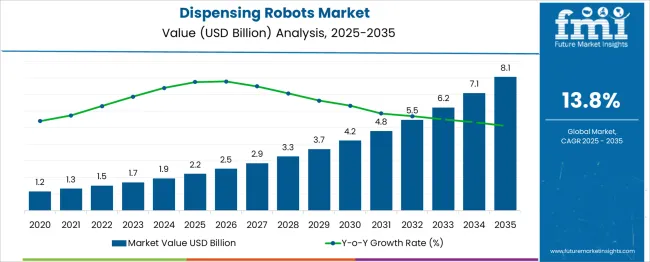
| Metric | Value |
|---|---|
| Dispensing Robots Market Estimated Value in (2025 E) | USD 2.2 billion |
| Dispensing Robots Market Forecast Value in (2035 F) | USD 8.1 billion |
| Forecast CAGR (2025 to 2035) | 13.8% |
Rationale for Segmental Growth in the Dispensing Robots Market
Insights into the 6-Axis Robots Segment
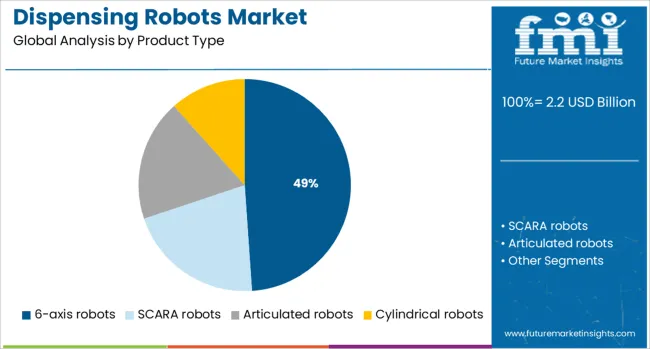
The prominence of 6-axis robots is reinforced by their capability to execute complex dispensing trajectories across multi-directional planes. Their flexibility supports intricate adhesive application, conformal coating, and sealant dispensing required in electronics, automotive components, aerospace assemblies, and medical devices. Production lines benefit from the extended motion range and repeatability that enable consistent material application on curved, angled, or irregular surfaces. Increasing integration with vision systems and smart sensors enhances accuracy and reduces operator intervention, improving throughput and reducing wastage. As factories intensify automation adoption to address labour gaps and ensure uninterrupted operations, the reliability and adaptability of 6-axis configurations continue to make them the preferred choice across major manufacturing hubs in Asia Pacific, North America, and Europe.
Insights into the 200×200 mm Operational Range Segment
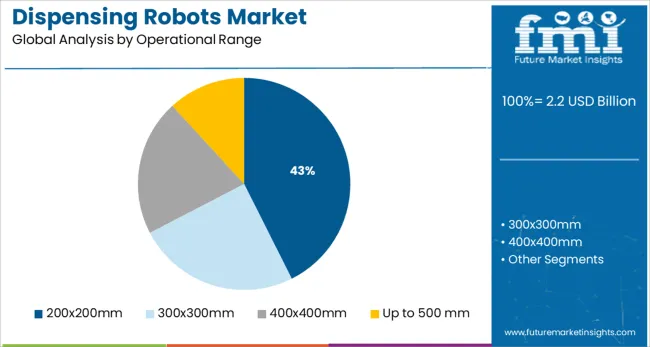
The 200×200 mm operational range remains a critical configuration for industries focused on compact and mid-scale automation. Electronics assembly, PCB production, precision component manufacturing, and small-part automotive operations prefer this format due to its balance between workspace efficiency and accurate material placement. Its suitability for benchtop systems and modular production cells enables easy integration into existing manufacturing layouts. With the steady miniaturisation of electronic devices and rising demand for tightly controlled dispensing of adhesives, sealants, solder pastes, and epoxies, this operational range delivers the precision required for fine-geometry assemblies. The growing emphasis on space-efficient automation, cost management, and flexible robotic deployment continues to strengthen the appeal of the 200×200 mm configuration.
What are the Key Drivers to the Dispensing Robots Market Share?
The changing nature of manufacturing and labor, in conjunction with varying consumer views, has significantly contributed to the development of dispensing robots.
Automation, logistics, and pharmaceutical industries are facing an acute shortage of skilled and efficient labours. Also, dispensing robots are extensively adopted in places where safety concerns are important issues.
Another factor driving the growth of the dispensing robots market is the increasing focus on workplace safety. Furthermore, simplicity in robots, ease of installation and operation, and improvements in machine learning will generate many robotic developments in the coming years.
In addition, the advent of big data, the expansion of the (IoT), and advances in connectivity are factors that have opened doors for the new breed of intelligent technology. The aforementioned factors are likely to push the dispensing robots market growth over the forecast period.
However, a lack of knowledge regarding robotic integration, and expertise in programming, along with complexity in automation and the unpredictable nature of the machine may obstruct the growth of the dispensing robots market.
Which Region holds the Highest Growth Potential in the Dispensing Robots Market?
The Asia Pacific dispensing robots market is expected to gain the most market share. Many manufacturers in the region use smart sensors to integrate existing equipment so that they can provide robust visibility in their operations across the region.
In addition, North America is home to a large number of manufacturers who are utilizing cloud technologies and investing heavily in research and development in an effort to reduce labour costs.
Moreover, APAC has showcased a high adoption rate towards the promotion and marketing of dispensing robots in the recent past, which is expected to boost the growth of the global market. Europe is expected to hold a significant share in the dispensing robots market due to the adoption of these robots in the e-commerce and hospitality industries across the region.
How is the Competitive Landscape in the Dispensing Robots Market?
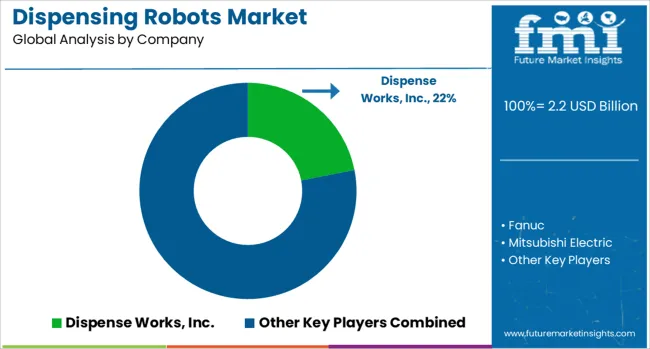
Dispensing Robots offer numerous benefits and superior control over fluid placements, placements of arcs, beads, repeated timed dots, and others. Dispensing robots are extensively used for fluid dispensing purposes.
Dispensing robots are easily programmed using smart PC-based software and are simple to operate. Technical innovations such as touch screen programming and CAD/DXF file imports in intuitive software of dispensing robots allow the robots to automatically correct part misalignments, improve pattern recognition, and shorten lengthy programming.
Dispensing robots are likely to occupy many work areas in the coming years owing to factors such as software advancements along with developments and improvements in grippers, sensors, and accessories that are deployed in the systems.
The global dispensing robots market has numerous small-scale and international manufacturers at the regional level. A few industry players are identified across the value chain of the global dispensing robots market, which is Techcon. Dispense Works, Inc., Fanuc, Mitsubishi Electric, Kawasaki Robotics, ABB, ESYS Automation, Yaskawa Motoman, Nordson Corporation, Simplimatic Engineering Holdings LLC.
Scope Of Report
| Report Attribute | Details |
|---|---|
| Growth rate | CAGR of 13.8% from 2025 to 2035 |
| Base year for estimation | 2024 |
| Historical data | 2025 to 2035 |
| Forecast period | 2025 to 2035 |
| Quantitative units | Revenue in USD Million/Billion and CAGR from 2025 to 2035 |
| Report coverage | Revenue forecast, volume forecast, company ranking, competitive landscape, growth factors, and trends, Pricing Analysis |
| Segments covered | Product Type, Operational Range, End Use Industry & Region |
| Regional scope | North America (USA, Canada); Latin America (Mexico, Brazil); Latin America (Mexico, Brazil); Western Europe (Germany, Italy, France, UK Spain); Eastern Europe (Poland, Russia); Asia Pacific (China, India, ASEAN, Australia & New Zealand); Japan; Middle East and Africa (GCC Countries, S. Africa, Northern Africa) |
| Country scope | USA, Canada, Mexico, Brazil, Canada, Mexico, Brazil, Germany, Italy, France, UK, Spain, Poland, Russia, China, India, ASEAN, Australia & New Zealand, Japan, GCC Countries, S. Africa, Northern Africa |
| Key companies profiled | Techcon.; Dispense Works, Inc.; Fanuc; Mitsubishi Electric; Kawasaki Robotics; ABB; ESYS Automation; Yaskawa Motoman; Nordson Corporation; Simplimatic Engineering Holdings LLC. |
| Customization scope | Free report customization (equivalent to up to 8 analysts working days) with purchase. Addition or alteration to country, regional & segment scope. |
| Pricing and purchase options | Avail customized purchase options to meet your exact research needs. |
Key Segments Profiled in Dispensing Robots Market
By Product Type:
- 6-axis robots
- SCARA robots
- Articulated robots
- Cylindrical robots
By Operational Range:
- 200x200mm
- 300x300mm
- 400x400mm
- Up to 500 mm
By End Use Industry:
- Pharmaceutical
- Healthcare
- Automotive
- Chemical
- Electronics and Electrical
By Region:
- North America
- Latin America
- Western Europe
- Eastern Europe
- Asia Pacific
- Japan
- Middle East & Africa
Frequently Asked Questions
How big is the dispensing robots market in 2025?
The global dispensing robots market is estimated to be valued at USD 2.2 billion in 2025.
What will be the size of dispensing robots market in 2035?
The market size for the dispensing robots market is projected to reach USD 8.1 billion by 2035.
How much will be the dispensing robots market growth between 2025 and 2035?
The dispensing robots market is expected to grow at a 13.8% CAGR between 2025 and 2035.
What are the key product types in the dispensing robots market?
The key product types in dispensing robots market are 6-axis robots, scara robots, articulated robots and cylindrical robots.
Which operational range segment to contribute significant share in the dispensing robots market in 2025?
In terms of operational range, 200x200mm segment to command 42.6% share in the dispensing robots market in 2025.
Preview the report firsthand - request a free sample
Get SampleGet the brochure for pricing and purchase details.
Get PDFTable of Content
- Executive Summary
- Global Market Outlook
- Demand-side Trends
- Supply-side Trends
- Technology Roadmap Analysis
- Analysis and Recommendations
- Market Overview
- Market Coverage / Taxonomy
- Market Definition / Scope / Limitations
- Market Background
- Market Dynamics
- Drivers
- Restraints
- Opportunity
- Trends
- Scenario Forecast
- Demand in Optimistic Scenario
- Demand in Likely Scenario
- Demand in Conservative Scenario
- Opportunity Map Analysis
- Product Life Cycle Analysis
- Supply Chain Analysis
- Investment Feasibility Matrix
- Value Chain Analysis
- PESTLE and Porter’s Analysis
- Regulatory Landscape
- Regional Parent Market Outlook
- Production and Consumption Statistics
- Import and Export Statistics
- Market Dynamics
- Global Market Analysis 2020 to 2024 and Forecast, 2025 to 2035
- Historical Market Size Value (USD Million) Analysis, 2020 to 2024
- Current and Future Market Size Value (USD Million) Projections, 2025 to 2035
- Y-o-Y Growth Trend Analysis
- Absolute $ Opportunity Analysis
- Global Market Pricing Analysis 2020 to 2024 and Forecast 2025 to 2035
- Global Market Analysis 2020 to 2024 and Forecast 2025 to 2035, By Product Type
- Introduction / Key Findings
- Historical Market Size Value (USD Million) Analysis By Product Type , 2020 to 2024
- Current and Future Market Size Value (USD Million) Analysis and Forecast By Product Type , 2025 to 2035
- 6-axis robots
- SCARA robots
- Articulated robots
- Cylindrical robots
- Y-o-Y Growth Trend Analysis By Product Type , 2020 to 2024
- Absolute $ Opportunity Analysis By Product Type , 2025 to 2035
- Global Market Analysis 2020 to 2024 and Forecast 2025 to 2035, By Operational Range
- Introduction / Key Findings
- Historical Market Size Value (USD Million) Analysis By Operational Range, 2020 to 2024
- Current and Future Market Size Value (USD Million) Analysis and Forecast By Operational Range, 2025 to 2035
- 200x200mm
- 300x300mm
- 400x400mm
- Up to 500 mm
- Y-o-Y Growth Trend Analysis By Operational Range, 2020 to 2024
- Absolute $ Opportunity Analysis By Operational Range, 2025 to 2035
- Global Market Analysis 2020 to 2024 and Forecast 2025 to 2035, By End Use Industry
- Introduction / Key Findings
- Historical Market Size Value (USD Million) Analysis By End Use Industry, 2020 to 2024
- Current and Future Market Size Value (USD Million) Analysis and Forecast By End Use Industry, 2025 to 2035
- Pharmaceutical
- Healthcare
- Automotive
- Chemical
- Electronics and Electrical
- Y-o-Y Growth Trend Analysis By End Use Industry, 2020 to 2024
- Absolute $ Opportunity Analysis By End Use Industry, 2025 to 2035
- Global Market Analysis 2020 to 2024 and Forecast 2025 to 2035, By Region
- Introduction
- Historical Market Size Value (USD Million) Analysis By Region, 2020 to 2024
- Current Market Size Value (USD Million) Analysis and Forecast By Region, 2025 to 2035
- North America
- Latin America
- Western Europe
- Eastern Europe
- East Asia
- South Asia and Pacific
- Middle East & Africa
- Market Attractiveness Analysis By Region
- North America Market Analysis 2020 to 2024 and Forecast 2025 to 2035, By Country
- Historical Market Size Value (USD Million) Trend Analysis By Market Taxonomy, 2020 to 2024
- Market Size Value (USD Million) Forecast By Market Taxonomy, 2025 to 2035
- By Country
- USA
- Canada
- Mexico
- By Product Type
- By Operational Range
- By End Use Industry
- By Country
- Market Attractiveness Analysis
- By Country
- By Product Type
- By Operational Range
- By End Use Industry
- Key Takeaways
- Latin America Market Analysis 2020 to 2024 and Forecast 2025 to 2035, By Country
- Historical Market Size Value (USD Million) Trend Analysis By Market Taxonomy, 2020 to 2024
- Market Size Value (USD Million) Forecast By Market Taxonomy, 2025 to 2035
- By Country
- Brazil
- Chile
- Rest of Latin America
- By Product Type
- By Operational Range
- By End Use Industry
- By Country
- Market Attractiveness Analysis
- By Country
- By Product Type
- By Operational Range
- By End Use Industry
- Key Takeaways
- Western Europe Market Analysis 2020 to 2024 and Forecast 2025 to 2035, By Country
- Historical Market Size Value (USD Million) Trend Analysis By Market Taxonomy, 2020 to 2024
- Market Size Value (USD Million) Forecast By Market Taxonomy, 2025 to 2035
- By Country
- Germany
- UK
- Italy
- Spain
- France
- Nordic
- BENELUX
- Rest of Western Europe
- By Product Type
- By Operational Range
- By End Use Industry
- By Country
- Market Attractiveness Analysis
- By Country
- By Product Type
- By Operational Range
- By End Use Industry
- Key Takeaways
- Eastern Europe Market Analysis 2020 to 2024 and Forecast 2025 to 2035, By Country
- Historical Market Size Value (USD Million) Trend Analysis By Market Taxonomy, 2020 to 2024
- Market Size Value (USD Million) Forecast By Market Taxonomy, 2025 to 2035
- By Country
- Russia
- Poland
- Hungary
- Balkan & Baltic
- Rest of Eastern Europe
- By Product Type
- By Operational Range
- By End Use Industry
- By Country
- Market Attractiveness Analysis
- By Country
- By Product Type
- By Operational Range
- By End Use Industry
- Key Takeaways
- East Asia Market Analysis 2020 to 2024 and Forecast 2025 to 2035, By Country
- Historical Market Size Value (USD Million) Trend Analysis By Market Taxonomy, 2020 to 2024
- Market Size Value (USD Million) Forecast By Market Taxonomy, 2025 to 2035
- By Country
- China
- Japan
- South Korea
- By Product Type
- By Operational Range
- By End Use Industry
- By Country
- Market Attractiveness Analysis
- By Country
- By Product Type
- By Operational Range
- By End Use Industry
- Key Takeaways
- South Asia and Pacific Market Analysis 2020 to 2024 and Forecast 2025 to 2035, By Country
- Historical Market Size Value (USD Million) Trend Analysis By Market Taxonomy, 2020 to 2024
- Market Size Value (USD Million) Forecast By Market Taxonomy, 2025 to 2035
- By Country
- India
- ASEAN
- Australia & New Zealand
- Rest of South Asia and Pacific
- By Product Type
- By Operational Range
- By End Use Industry
- By Country
- Market Attractiveness Analysis
- By Country
- By Product Type
- By Operational Range
- By End Use Industry
- Key Takeaways
- Middle East & Africa Market Analysis 2020 to 2024 and Forecast 2025 to 2035, By Country
- Historical Market Size Value (USD Million) Trend Analysis By Market Taxonomy, 2020 to 2024
- Market Size Value (USD Million) Forecast By Market Taxonomy, 2025 to 2035
- By Country
- Kingdom of Saudi Arabia
- Other GCC Countries
- Turkiye
- South Africa
- Other African Union
- Rest of Middle East & Africa
- By Product Type
- By Operational Range
- By End Use Industry
- By Country
- Market Attractiveness Analysis
- By Country
- By Product Type
- By Operational Range
- By End Use Industry
- Key Takeaways
- Key Countries Market Analysis
- USA
- Pricing Analysis
- Market Share Analysis, 2024
- By Product Type
- By Operational Range
- By End Use Industry
- Canada
- Pricing Analysis
- Market Share Analysis, 2024
- By Product Type
- By Operational Range
- By End Use Industry
- Mexico
- Pricing Analysis
- Market Share Analysis, 2024
- By Product Type
- By Operational Range
- By End Use Industry
- Brazil
- Pricing Analysis
- Market Share Analysis, 2024
- By Product Type
- By Operational Range
- By End Use Industry
- Chile
- Pricing Analysis
- Market Share Analysis, 2024
- By Product Type
- By Operational Range
- By End Use Industry
- Germany
- Pricing Analysis
- Market Share Analysis, 2024
- By Product Type
- By Operational Range
- By End Use Industry
- UK
- Pricing Analysis
- Market Share Analysis, 2024
- By Product Type
- By Operational Range
- By End Use Industry
- Italy
- Pricing Analysis
- Market Share Analysis, 2024
- By Product Type
- By Operational Range
- By End Use Industry
- Spain
- Pricing Analysis
- Market Share Analysis, 2024
- By Product Type
- By Operational Range
- By End Use Industry
- France
- Pricing Analysis
- Market Share Analysis, 2024
- By Product Type
- By Operational Range
- By End Use Industry
- India
- Pricing Analysis
- Market Share Analysis, 2024
- By Product Type
- By Operational Range
- By End Use Industry
- ASEAN
- Pricing Analysis
- Market Share Analysis, 2024
- By Product Type
- By Operational Range
- By End Use Industry
- Australia & New Zealand
- Pricing Analysis
- Market Share Analysis, 2024
- By Product Type
- By Operational Range
- By End Use Industry
- China
- Pricing Analysis
- Market Share Analysis, 2024
- By Product Type
- By Operational Range
- By End Use Industry
- Japan
- Pricing Analysis
- Market Share Analysis, 2024
- By Product Type
- By Operational Range
- By End Use Industry
- South Korea
- Pricing Analysis
- Market Share Analysis, 2024
- By Product Type
- By Operational Range
- By End Use Industry
- Russia
- Pricing Analysis
- Market Share Analysis, 2024
- By Product Type
- By Operational Range
- By End Use Industry
- Poland
- Pricing Analysis
- Market Share Analysis, 2024
- By Product Type
- By Operational Range
- By End Use Industry
- Hungary
- Pricing Analysis
- Market Share Analysis, 2024
- By Product Type
- By Operational Range
- By End Use Industry
- Kingdom of Saudi Arabia
- Pricing Analysis
- Market Share Analysis, 2024
- By Product Type
- By Operational Range
- By End Use Industry
- Turkiye
- Pricing Analysis
- Market Share Analysis, 2024
- By Product Type
- By Operational Range
- By End Use Industry
- South Africa
- Pricing Analysis
- Market Share Analysis, 2024
- By Product Type
- By Operational Range
- By End Use Industry
- USA
- Market Structure Analysis
- Competition Dashboard
- Competition Benchmarking
- Market Share Analysis of Top Players
- By Regional
- By Product Type
- By Operational Range
- By End Use Industry
- Competition Analysis
- Competition Deep Dive
- Dispense Works, Inc.
- Overview
- Product Portfolio
- Profitability by Market Segments (Product/Age /Sales Channel/Region)
- Sales Footprint
- Strategy Overview
- Marketing Strategy
- Product Strategy
- Channel Strategy
- Fanuc
- Mitsubishi Electric
- Kawasaki Robotics
- ABB
- ESYS Automation
- Yaskawa Motoman
- Nordson Corporation
- Simplimatic Engineering Holdings LLC.
- Dispense Works, Inc.
- Competition Deep Dive
- Assumptions & Acronyms Used
- Research Methodology


