- Market Size (2026)
- USD 106.8 Bn
- Forecast (2036)
- USD 174.0 Bn
- CAGR (2026 to 2036)
- 5.0%
How big is Doypack Market in 2026?
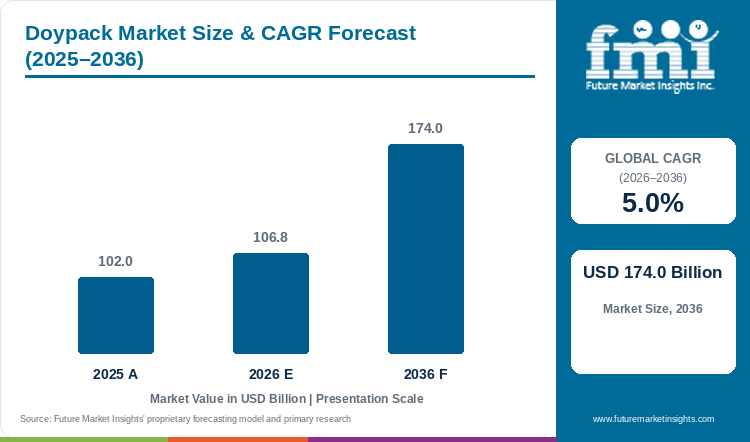
Assessed at USD 102.0 billion in 2025 and progressing to USD 106.8 billion in 2026, the doypack market valuation is on course to reach USD 174.0 billion by 2036, supported by a forecast-period CAGR of 5.0%.
The global doypack market was valued at USD 102.0 billion in 2025 and is estimated to reach USD 106.8 billion in 2026. The market is projected to reach USD 174.0 billion by 2036, expanding at a compound annual growth rate (CAGR) of 5.0% between 2026 and 2036. Retail channel analysis by FMI suggests that multi-layer polyolefin plastic film structures are projected to capture 46.5% of substrate demand in 2026, given that machine-direction-oriented polyethylene and polypropylene laminates run at high speeds on form-fill-seal lines while meeting store-drop and municipal recycling rules. Food, pet-care, and home-care brands are switching from rigid glass jars and high-density polyethylene canisters to bottom-gusseted stand-up pouches to cut empty inbound freight volume and maximize upright supermarket billboard space. That broad rigid-to-flexible conversion baseline separates the sector from specialized mono-material pouches at 8.3% CAGR, since total doypack demand spans both legacy foil retort packs and recycle-ready polyolefin conversions. The demand for recyclable stand-up laminates is supported by European compliance rules, with the European Circular Economy Stakeholder Platform reporting in April 2026 at MeetingPack 2026 that new extrusion barrier films are replacing non-recyclable structures ahead of August 2026 EU Packaging and Packaging Waste Regulation deadlines. Manufacturers are also investing in mono-material pet and snack lines to capture brand tenders, as seen when Mondi showcased its pre-made re/cycle FlexiBag and FunctionalBarrier Paper formats for PACK EXPO in September 2026. Packaged consumer goods producers renew converter contracts on puncture-free bottom gussets and verified recyclability grades through 2036.
Key Market Trends & Insights
- By substrate structure: Multi-Layer Polyolefin Plastic Film holds an estimated 46.5% share in 2026 since co-extruded PE and PP webs deliver stiff upright shelf stability and recyclable sorting compliance.
- By functional closure: Press-to-Close Resealable Zipper formats represent an anticipated 50.2% share in 2026 owing to multi-serve household consumption habits that require airtight pantry re-closure.
- By volumetric capacity: 250 ml to 500 ml Standard pouches account for a projected 54.0% share in 2026 driven by core supermarket shelf facings across snacks, coffee, and sauces.
- By end-use application: Dry Snacks Confectionery and Dried Fruit secure an estimated 49.4% share in 2026 given high unit velocity and moisture-barrier protection across retail aisles.
- By supply and filling format: Pre-Made Ready-to-Fill Doypacks command a forecast 56.4% share in 2026 through rapid SKU changeovers on rotary pouch-filling carousels.
Regional Highlights
- Top national expansion: India leads national growth projections at a 6.2% CAGR through 2036 ahead of Brazil at 5.5% and the United Kingdom at 5.2% under rapid modern-trade pouch conversion.
- Broader country progression: The United States tracks at a 5.1% CAGR and Canada advances at 4.8% ahead of Japan at 4.7%, while Germany registers 4.5% and France records 4.3%.
Market Size & Forecast
Table 1: Market Size and Forecast for the Doypack Market (USD billion and CAGR percentage), 2025 to 2036
| Metric | Value |
|---|---|
| 2025 Market Size | USD 102.0 billion |
| Estimated Market Size in 2026 | USD 106.8 billion |
| Projected Market Size by 2036 | USD 174.0 billion |
| CAGR, 2026 to 2036 | 5.0% |
| Added Revenue, 2026 to 2036 | USD 67.2 billion |
Flexible packaging converters and dry-food processors are re-engineering traditional polyester-aluminum-polyethylene trilaminates, owing to multi-material webs cannot be separated in mechanical recycling plants. When brands replace unrecyclable foil or metallized PET layers with thin ethylene-vinyl alcohol or cellulose barrier co-extrusions, pouch walls must retain drop-impact strength and low oxygen transmission across humid distribution lanes. Life-cycle and barrier research published in MDPI Polymers in May 2026 demonstrated that redesigning conventional trilaminate Doypack stand-up pouches into hybrid EVOH barrier structures lowers oxygen transmission from 35.38 to 0.56 cm3/m2/day, cuts virgin resin use by 37%, and reduces environmental impact by 47%. Brand engineers consequently pair high-barrier webs with doypack packaging machine upgrades to maintain hermetic seal integrity.
Converted Pouch Volume and Substrate Web Sizing
Table 2: Converted Pouch Volume and Web Sizing for the Doypack Market (USD billion and operational ranges), 2025 to 2036
| Metric | 2025 | 2026 | 2036 |
|---|---|---|---|
| Market size (USD billion) | 102.0 | 106.8 | 174.0 |
| Global converted Doypack shipments (billion units) | 680.0 to 745.0 | 712.0 to 780.0 | 1,120.0 to 1,230.0 |
| Converted flexible laminate web volume (million metric tons) | 9.8 to 10.7 | 10.3 to 11.2 | 16.2 to 17.8 |
| Average converter realization per 1,000 pouches (USD) | 138.0 to 152.0 | 140.0 to 154.0 | 144.0 to 158.0 |
Operational note: Volume ranges reflect converted W-gusset, K-seal, and round-bottom Doypack units across dry food and liquid home-care filling lines.
Personal care and household cleaning brands are shifting liquid soap, haircare, and detergent volume from blow-molded bottles into spouted 1-liter and 2-liter refill Doypacks to cut plastic weight by up to 70%. Consumer survey data released by Amcor in June 2026 across 2,749 shoppers in six major European countries revealed that 66% of consumers purchased a refill pouch within the prior 12 months to replenish reusable primary bottles at home. This repeat refill habit drives contract packers to expand spout pouches capacity with ultrasonic spout-welding fitments.
Filling-Line Speed & Rigid-Replacement Logistics Indicators
Table 3: Filling-Line and Rigid-Replacement Indicators for the Doypack Market (USD and operational shares), 2025 to 2036
| Metric | 2025 | 2026 | 2036 |
|---|---|---|---|
| High-speed HFFS, VFFS & rotary pouch lines globally (units) | 142,000 | 148,500 | 228,000 |
| Annual Doypack laminate spend per filling line (USD thousand) | 718.3 | 719.2 | 763.2 |
| Recycle-ready mono-PE, mono-PP & barrier paper share (%) | 38.5% to 42.0% | 41.5% to 45.0% | 66.0% to 71.0% |
| Reclosable zipper & spout-fitment equipped share (%) | 71.0% to 74.5% | 72.5% to 76.0% | 81.0% to 85.0% |
Table 4: Barrier Engineering & Circularity Reference Indicators for the Doypack Market (metrics and institutional basis), 2026
| Metric | Value | Institutional Reference Basis |
|---|---|---|
| Market size, 2026 | USD 106.8 billion | 2026 global Doypack & stand-up pouch valuation baseline |
| Hybrid EVOH Doypack virgin resin & LCA reduction | 37% less virgin resin; 47% LCA drop | MDPI Polymers 18(10):1197 stand-up pouch LCA benchmark |
| European consumer 12-month refill pouch adoption | 66% of surveyed shoppers | Amcor June 2026 6-country European personal care survey |
| Pre-Made Ready-to-Fill Doypacks share, 2026 | 56.4% (USD 60.2 billion) | Primary supply format allocation across rotary pouch fillers |
Ambient ready-meal, wet pet-food, and soup processors are replacing tinplate steel cans and glass jars with autoclave-sterilizable retort Doypacks that shorten thermal cook times and preserve food texture. As reported by Gualapack in March 2026 citing Western European shelf-stable ready-meal data, flexible retort pouches expanded at a 7.2% CAGR between 2018 and 2025 while metal cans declined by 0.5% annually and flexible packs delivered a 5-to-10-times higher product-to-package ratio. Food processors scaling retort pouches therefore lock in high-barrier polypropylene and aluminum-free laminate contracts.
Analyst Perspective
"Brand owners no longer view the Doypack merely as a low-cost alternative to rigid jars; they buy 360-degree shelf billboard visibility, a 70% reduction in empty packaging weight, and PPWR-compliant mono-material recyclability. Converters that master low-temperature zipper sealing on high-barrier mono-PE and mono-PP webs without sacrificing filling-line speed will capture multinational food and home-care tenders through 2036."
- Nandini Roy Choudhury, Principal Consultant, Future Market Insights.
How is the doypack market segmented?
The doypack market is segmented by substrate structure, functional closure, volumetric capacity, end-use application, and supply and filling format. In 2026, Multi-Layer Polyolefin Plastic Film is projected at 46.5%, Press-to-Close Resealable Zipper at 50.2%, 250 ml to 500 ml Standard at 54.0%, Dry Snacks Confectionery and Dried Fruit at 49.4%, and Pre-Made Ready-to-Fill Doypacks at 56.4%.
By substrate structure: Multi-Layer Polyolefin Plastic Film, Aluminum Foil Barrier Laminate, Kraft Paper Coated Barrier Laminate, and Mono-Material Recycle-Ready PE and PP.
By functional closure: Press-to-Close Resealable Zipper, Spouted Pouring Fitment, Tear Notch Ultrasonic Heat Sealed, and Slider and Child-Resistant Zipper.
By volumetric capacity: 250 ml to 500 ml Standard, 500 ml to 1000 ml Family Size, Under 250 ml Single-Serve Pocket Size, and Above 1000 ml Bulk Refill Format.
By end-use application: Dry Snacks Confectionery and Dried Fruit, Beverages Sauces and Liquid Condiments, Pet Food Wet and Dry Kibble, and Liquid Laundry Detergent and Home Care.
By supply and filling format: Pre-Made Ready-to-Fill Doypacks, Horizontal Form-Fill-Seal Rollstock, Vertical Form-Fill-Seal Webs, and Contract Co-Packing Supply.
Why does Multi-Layer Polyolefin Plastic Film lead the substrate structure category?
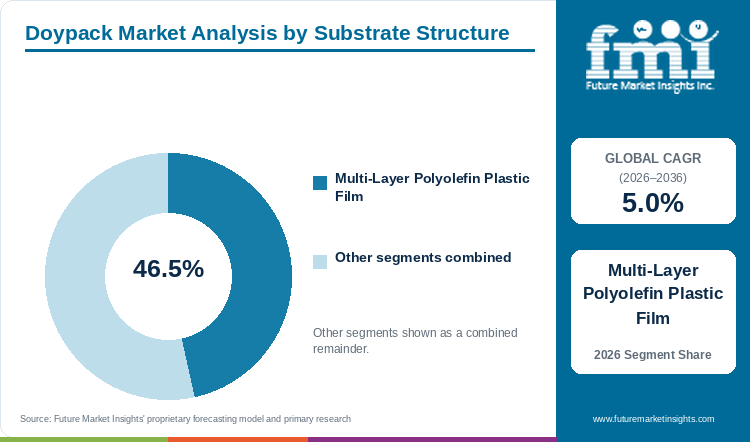
Multi-Layer Polyolefin Plastic Film holds an estimated 46.5% of substrate structure demand in 2026, anchored by hermetic gusset sealing and mono-material recycling compatibility.
Table 5: Substrate Structure Share for the Doypack Market (percentage share), 2026
| Substrate Structure | Share (2026) |
|---|---|
| Multi-Layer Polyolefin Plastic Film | 46.5% |
| Other Segments Combined | 53.5%* |
| Total | 100.0% |
*Note: Remaining substrate structure categories account for the balance of 2026 global doypack demand.
Table 6: Substrate Structure Leadership and Market Growth for the Doypack Market (segment and CAGR percentage), 2026 to 2036
| Metric | Value |
|---|---|
| Global CAGR (2026 to 2036) | 5.0% |
| Leading Segment | Multi-Layer Polyolefin Plastic Film |
Co-extruded multi-layer polyolefin plastic films combining biaxially oriented polyolefin outer webs with low-temperature inner sealant layers anchor global Doypack production. Converters supplying flexible plastic packaging lines favor polyolefin structures, owing to single-polymer-family laminates eliminate the cross-linked adhesive and aluminum separation bottlenecks that disqualify legacy trilaminates from municipal recycling. Active commercial launches reinforce this substrate shift, as Coveris unveiled its PFAS-free MonoFlexBE metallized and MonoFlexE Lite polyethylene monomaterial stand-up pouches for pet food in April 2026.
- Within the substrate structure segment, Multi-Layer Polyolefin Plastic Film is projected to account for a leading 46.5% share in 2026, driven by high puncture strength and alignment across European and North American recycling streams.
- Aluminum foil barrier laminates retain essential volume in long-shelf-life sterilized rations and coffee, while kraft paper coated barrier laminates expand in natural dry snacks despite lower moisture-barrier thresholds.
What sustains Press-to-Close Resealable Zipper leadership in the functional closure segment?
Press-to-Close Resealable Zipper formats represent an anticipated 50.2% of the functional closure category in 2026, supported by multi-serve pantry freshness and low unit weight.
Extruded polyethylene and polypropylene press-to-close zipper profiles dominate closure demand since multi-serving snack, grated cheese, and pet-treat pouches require repeatable airtight resealing in household pantries. Unlike rigid canisters that need separate injection-molded lids, flange and rib zippers weld directly between the front and back pouch webs on high-speed converting lines at minimal unit cost and weight. Brands pairing zippers with monomaterial pe dry food pouches specify mono-polyolefin zipper flanges so the entire pouch and closure recycle together without consumer disassembly.
- In 2026, Press-to-Close Resealable Zipper is anticipated to capture 50.2% of global functional closure demand, reflecting consumer preference for freshness retention and portion control across dry food and pet-care aisles.
- In September 2026, Amcor highlighted its 2026 AmeriStar Award-winning AmPrima recycle-ready refill pouch and Amcor HealthCare reclosable pouch systems ahead of PACK EXPO International.
How does 250 ml to 500 ml Standard lead the volumetric capacity category?
250 ml to 500 ml Standard pouches account for a projected 54.0% of volumetric capacity demand in 2026, driven by core grocery gondola shelf facings.
Standard 250 ml to 500 ml pouches capture the largest share of global production given that this mid-size footprint matches core supermarket shelf height and weekly consumption across nuts, granola, and wet pet meals. A 250 ml to 500 ml bottom-gusseted Doypack stands upright on retail gondola shelves without secondary display trays while fitting standard rotary pre-made pouch grippers and horizontal form-fill-seal jaw widths. Award recognitions announced by Gualapack in 2025 at the Ukrainian Packaging Star Awards demonstrated how standard retail stand-up pouches with patented Baby Cap spouts for Econia baby purée and Eco Star monomaterial zip-lock pouches for Kormotech dry cat food dominate shelf facings.
- By volumetric capacity, demand for 250 ml to 500 ml Standard is estimated to reach 54.0% of total category share in 2026 as grocery retailers standardize shelf-ready flexible facings.
- Family-size 500 ml to 1000 ml pouches and bulk 2-liter home-care refill packs post rapid growth in club stores and e-commerce, whereas under-250 ml pouches serve single-serve baby purees and energy gels.
Why do Dry Snacks Confectionery and Dried Fruit lead the end-use application category?
Dry Snacks Confectionery and Dried Fruit secure an estimated 49.4% of end-use application volume in 2026, supported by upright billboard visibility and moisture protection.
Roasted nuts, trail mixes, and savory crisps represent the primary volume engine for Doypack converters. Unlike flat pillow bags that slump on retail shelves and tear down the side seam after opening, stand-up Doypacks with laser-scored tear notches and press-to-close zippers stand upright at eye level and keep hygroscopic snacks crisp for weeks. Snack brands integrating stand up paper pouches and metallized polyolefin webs also utilize wide front panels for high-definition rotogravure and digital promotional graphics.
- Strong repeat ordering across supermarket snack aisles places Dry Snacks Confectionery and Dried Fruit on course to hold an estimated 49.4% share of the end-use application category in 2026.
- In October 2026, ProAmpac detailed how its PRO-POUCH premade stand-up pouches and R-2300 recycle-ready films support moisture barrier protection and reclosable convenience across dry food and snack categories.
What gives Pre-Made Ready-to-Fill Doypacks the leading position in supply and filling format?
Pre-Made Ready-to-Fill Doypacks command a forecast 56.4% of supply and filling format share in 2026, anchored by rapid SKU changeovers on rotary filling carousels.
Pre-made ready-to-fill Doypacks supplied in magazine stacks lead filling format revenue as food, pet-treat, and nutritional supplement co-packers run dozens of short-run flavor SKUs that cannot justify dedicated rollstock forming tooling. Rotary pre-made pouch filling carousels allow operators to adjust gripper width in minutes and guarantee pre-inspected bottom gusset seals and pre-welded corner spouts before product filling begins. Converter capacity investments reinforce pre-made pouch supply, evidenced when Coveris invested 1.8 million euros in Poland in April 2026 to expand high-volume bag-making and laser-scored stand-up pouch production.
- Pre-Made Ready-to-Fill Doypacks are predicted to secure 56.4% of supply and filling format demand in 2026, supported by low filling-line capex and zero web-forming scrap at co-packing plants.
- Horizontal and vertical form-fill-seal rollstock webs account for the remaining volume across ultra-high-speed multinational beverage, detergent, and wet pet-food factories running over 150 pouches per minute.
What are the drivers, restraints, and opportunities in the doypack market?
In the doypack market, rigid-to-flexible freight cube savings and EU PPWR mono-material mandates are projected to drive adoption, while narrow polyolefin heat-sealing windows restrain line speeds and deinkable films plus 2-liter refill pouches unlock new demand.
- Driver: Freight cube reduction of up to 90% on empty packaging and mandatory EU PPWR recyclability targets accelerate brand conversion from rigid jars and cans to stand-up pouches.
- Restraint: Narrow heat-sealing temperature windows and shorter oxidative shelf life on un-metallized mono-material polyolefin films create line-speed and barrier hurdles.
- Opportunity: Chemical deinking coatings, laser-marked outer webs, and 2-liter spouted home-care refill pouches open circular retail and e-commerce revenue streams.
Growth Analysis and Future Potential: Qualitative Demand Catalysts
Consumer packaged goods manufacturers are replacing rigid plastic bottles, metal cans, and glass jars with stand-up Doypacks to cut inbound warehouse storage and outbound scope-3 transport emissions. One truckload of flat unfilled stand-up pouches replaces up to 15 truckloads of empty rigid containers, while flexible pouch walls evacuate nearly 99% of viscous sauces and lotions without product waste. In February 2026, flexible converter Glenroy documented that spouted refill stand-up pouches cut plastic consumption by up to 70% compared with traditional rigid bottles while lowering fossil-fuel and landfill impacts across personal care and household cleaner lines. This freight and material cost savings sustains rapid adoption across premade pouch packaging and contract filling operations.
Risk Assessment of the Doypack Market: Operational and Formulation Friction
Narrow thermal sealing tolerances and reduced oxygen-barrier shelf life when transitioning from PET-foil trilaminates to mono-material polyolefin films represent the primary technical friction restraining rapid line conversion. Since both the outer print web and inner sealant layer of a mono-PE pouch melt within a narrow temperature band, excessive sealing-bar heat distorts the zipper flange or causes gusset leaks on horizontal form-fill-seal machines. In June 2026, kinetic shelf-life research published in MDPI Processes demonstrated that monomaterial flexible packaging exhibited shorter accelerated oxidative shelf life of 63 to 179 days at 50 degrees Celsius compared with 79 to 466 days in multimaterial PET-aluminum-PE laminates. Food brands formulating retortable mono-material pouches for wet foods therefore require specialized AlOx, SiOx, or EVOH barrier coatings before retiring foil webs.
Commercial Opportunity Analysis: Formulation Differentiation and Value-Add Formats
Flexible converters are unlocking high-margin European and North American contracts by commercializing deinkable mono-material laminates and high-barrier recyclable paper Doypacks. Inside mechanical plastic recycling plants, conventional printed inks discolor recycled polyethylene and polypropylene pellets, preventing closed-loop reuse in white or transparent consumer packaging. In September 2026, Constantia Flexibles and Evonik won the German Packaging Award 2026 for a deinking ink system on EcoLamPlus mono-PE and EcoVer mono-PP pouch laminates that strips ink cleanly during washing while preserving seal strength and abrasion resistance. Integration of deinkable polyolefin films with ppwr-compliant recyclable pe-pp stand-up pouch recycling systems positions converters to capture circular brand tenders through 2036.
Doypack Market by Country (2026 to 2036)
FMI country modeling indicates that India leads national doypack expansion at a 6.2% CAGR through 2036 ahead of Brazil at 5.5% and the United Kingdom at 5.2%. Adoption across Western European retail chains, North American club stores, and East Asian convenience channels tracks mono-material recycling rules and ready-meal pouch conversion.
Table 7: Country CAGR and Primary Growth Levers for the Doypack Market (CAGR percentage and operational drivers), 2026 to 2036
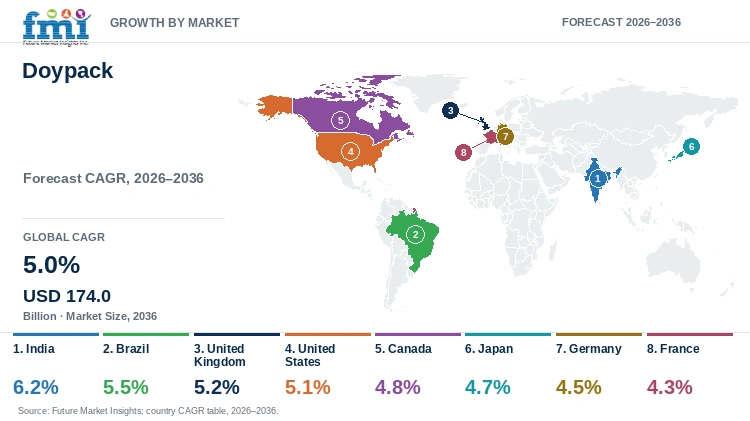
| Country | CAGR (2026 to 2036) | Primary Growth Lever |
|---|---|---|
| India | 6.2% | Food processing growth toward USD 535B and urban quick-commerce pouch conversion |
| Brazil | 5.5% | Atacarejo cash-and-carry retail growth and soluble coffee and liquid detergent refills |
| United Kingdom | 5.2% | Record 52.2% private-label grocery share and front-of-store soft-plastics recycling |
| United States | 5.1% | State EPR laws, club-store zipper packs, and integrated Amcor-Berry pouch converting |
| Canada | 4.8% | Provincial EPR mono-PE incentives across USD 125B domestic food processing sector |
| Japan | 4.7% | Universal home-care spouted refill pouches and AlOx/SiOx microwaveable retort meals |
| Germany | 4.5% | Dual-system EPR fee modulation and cyclos-HTP certified mono-polyolefin pouches |
| France | 4.3% | AGEC single-use plastic reduction compliance and fruit-compote and cosmetic refills |
Source: Future Market Insights analysis
Germany Doypack Market Outlook (2026 to 2036)
Demand for doypacks in Germany is estimated to advance at a 4.5% CAGR between 2026 and 2036 across discount grocery private-label packers, pet-food processors, and home-care refill brands. What distinguishes Germany from less regulated markets is the Central Agency Packaging Register (ZSVR) and dual-system recycling fee structure, which rewards cyclos-HTP certified mono-PE and mono-PP stand-up pouches over multi-layer composites. In July 2026, the USDA Foreign Agricultural Service reported in its Berlin Exporter Guide that German agricultural and food imports from the United States reached nearly 3.1 billion dollars in 2025 across tree nuts, sauces, snacks, and confectionery. German converters actively commercialize deinkable polyolefin and high-barrier paper Doypacks for domestic supermarket chains.
Key takeaway: In Germany, dual-system recycling fee modulation and private-label grocery scale are projected to drive conversion toward mono-material Doypacks.
United Kingdom Doypack Market Outlook (2026 to 2036)
In the United Kingdom, doypack market sales are anticipated to advance at a 5.2% CAGR from 2026 to 2036 as supermarket chains expand front-of-store and curbside soft-plastics collection and private-label pouch lines. British demand outpaces continental European averages since price-conscious households and discounters favor lightweight stand-up pouches for chilled soups, pet kibble, and laundry refills. In January 2026, the U.S. International Trade Administration reported that the revised UK Extended Producer Responsibility regulation requires businesses with over 1.3 million dollars in turnover supplying more than 25 tons of packaging to pay recyclability-modulated fees from 2026 onward. Supermarket private-label charters compel British co-packers to adopt recycle-ready mono-PE zipper pouches.
Key takeaway: In the United Kingdom, revised EPR fee modulation on 25-ton packaging suppliers and soft-plastics recycling rollouts are anticipated to sustain strong pouch growth.
Brazil Doypack Market Outlook (2026 to 2036)
Brazil's doypack market is forecast to grow at a 5.5% CAGR over the 2026 to 2036 horizon across soluble coffee, dry pet food, and liquid detergent refills. Compared with North American markets dominated by large club-store packs, Brazilian food and home-care producers rely on economical 200 ml to 500 ml gusseted pouches to serve cash-and-carry atacarejo stores and neighborhood retailers. In June 2026, USDA exporter guide records documented continued expansion across Brazil's food and feed manufacturing industries serving 40 million high-income consumers and broad mass-retail channels. Domestic rotogravure converters are adding high-speed pouch-making lines to supply regional coffee and pet-care exporters.
Key takeaway: In Brazil, cash-and-carry atacarejo retail expansion and liquid detergent and coffee refill habits are forecast to propel 5.5% annual growth.
France Doypack Market Outlook (2026 to 2036)
Procurement of doypacks in France is estimated to progress at a 4.3% CAGR through 2036 across fruit-compote spouted pouches, organic dry grocery aisles, and dermo-cosmetic eco-refills. French demand diverges from standard global markets, owing to the national AGEC anti-waste law enforces strict single-use plastic reduction targets, compelling brands to replace rigid bottles with lightweight 70%-less-plastic refill Doypacks or paper-based barrier pouches. In July 2026, Paris agricultural attaché analysts at the USDA documented in the France Exporter Guide Annual that French imports of consumer-oriented food and agricultural products reached approximately 1 billion dollars in 2025 across retail channels. French dairy, compote, and personal care fillers prioritize mono-PP spouted pouches and bulk refill stations.
Key takeaway: In France, AGEC single-use plastic reduction mandates and compote and personal-care eco-refills are estimated to anchor recyclable Doypack demand.
Japan Doypack Market Outlook (2026 to 2036)
Japan's doypack sector is slated to expand at a 4.7% CAGR from 2026 to 2036 across microwaveable retort curry pouches, functional jelly-drink spout pouches, and precision home-care refills. What sets Japan apart from Western markets is its decades-long standardization of thin-wall refill Doypacks with laser-cut pour spouts for shampoo, dish soap, and fabric softener across every drugstore and convenience chain. In April 2026, Tokyo agricultural attaché reports from the USDA showed that Japan's food processing sector generated 174 billion dollars in 2025 with sustained demand for convenient single-serve and elderly-friendly packaged meals. Japanese converters lead in transparent AlOx and SiOx vapor-deposited retort barrier films that permit microwave heating directly inside the stand-up pouch.
Key takeaway: In Japan, universal home-care refill pouch adoption and transparent AlOx/SiOx microwaveable retort meals are slated to sustain steady expansion.
Canada Doypack Market Outlook (2026 to 2036)
Sales of doypacks in Canada are projected to register a 4.8% CAGR between 2026 and 2036 across roasted coffee, pet treats, and natural household cleaners. Canadian packaging specifications reflect provincial extended producer responsibility programs in Ontario, British Columbia, and Quebec that incentivize transition from multi-material laminates to recycle-ready mono-polyethylene and fiber stand-up pouches. In March 2026, ProAmpac won Best in Class Gold at the 2026 PAC Global Awards for its PRO-EVO recyclable multi-wall flexible bag and pouch platform engineered for North American retail brands. Canadian co-packers actively source pre-made zipper Doypacks to serve cross-border North American private-label contracts.
Key takeaway: In Canada, provincial EPR recycling rules and PAC Global Award-winning recyclable pouch designs are projected to support mono-material Doypack adoption.
United States Doypack Market Outlook (2026 to 2036)
The United States doypack market is predicted to grow at a 5.1% CAGR through 2036 across high-speed horizontal form-fill-seal snack, pet-food, and club-store beverage lines. Compared with smaller European retail formats, American demand favors wide-gusset family-size zipper pouches and How2Recycle store-drop-off certified mono-polyethylene structures that comply with California SB 54 and state EPR laws. In April 2025, Amcor finalized its merger with Berry Global to create a 70,000-employee global packaging leader combining flexible stand-up pouch webs with precision injection-molded spouts and closures. US converters in Wisconsin, Ohio, and Illinois are expanding digital and wide-web flexo capacity for rapid brand launches.
Key takeaway: In the United States, state EPR laws and integrated pouch-and-fitment converting scale are predicted to drive 5.1% annual expansion.
India Doypack Market Outlook (2026 to 2036)
Doypack sales in India are anticipated to post a leading 6.2% CAGR from 2026 to 2036 across loose unbranded spices, edible oils, and snacks converting into branded stand-up pouches. National growth outpaces all mature regions since urban nuclear households and 10-minute grocery delivery apps demand upright tamper-evident zipper and spouted pouches that survive motorcycle courier transit without leaking. Circular economy research published in MDPI Sustainability in October 2026 documented that India migrated brand owners to its unified Common EPR Portal in June 2026 with QR barcode traceability and 30% to 60% recycled plastic mandates. Domestic flexible converters are scaling mono-material PE and metallized BOPP stand-up pouch lines to serve FMCG brands.
Key takeaway: In India, June 2026 Common EPR Portal traceability rules and urban quick-commerce grocery delivery are projected to propel the fastest national CAGR.
Full report country CAGRs cover: North America; Latin America; Western Europe; Eastern Europe; East Asia; South Asia and Pacific; Middle East and Africa.
Who are the notable companies in the doypack market?
Amcor plc, Berry Global Group, Inc., Mondi plc, Huhtamaki Oyj, Sonoco Products Company, ProAmpac LLC, Constantia Flexibles GmbH, Coveris Management GmbH, Gualapack S.p.A., and Glenroy, Inc. are the notable companies in the doypack market.
Competitive positioning in the doypack industry spans global multi-billion-dollar flexible and rigid packaging groups, European circular paper converters, and specialized spouted pouch producers. Amcor plc, Berry Global Group, Inc., Mondi plc, Huhtamaki Oyj, and Sonoco Products Company operate multi-continent film extrusion, printing, and spout-molding networks. ProAmpac LLC, Constantia Flexibles GmbH, and Coveris Management GmbH engineer recycle-ready mono-polyolefin, deinkable, and PFAS-free pouch structures. Gualapack S.p.A. and Glenroy, Inc. lead in integrated spouted retort pouches and high-barrier pre-made stand-up formats.
- Global Multi-Format Flexible & Closure Leaders: Amcor plc, Berry Global Group, Inc., Mondi plc, Huhtamaki Oyj, and Sonoco Products Company combine film extrusion, barrier lamination, and injection-molded spouts across 30+ countries.
- Mono-Material, Deinkable & Circular Pouch Specialists: ProAmpac LLC, Constantia Flexibles GmbH, and Coveris Management GmbH commercialize PPWR-ready mono-PE, mono-PP, and PFAS-free barrier stand-up pouches.
- Spouted Retort & High-Barrier Pre-Made Pouch Converters: Gualapack S.p.A. and Glenroy, Inc. manufacture pre-made spouted pouches, Pouch5 mono-PP retort systems, and custom refill stand-up pouches.
Competitive Benchmarking: Doypack Market
Table 8: Competitive Benchmarking for the Doypack Market (qualitative capability ratings), 2026
| Company | Mono-Material & Barrier Engineering | Pre-Made & FFS Machine Compatibility | PPWR & Deinking Circularity Fit | Geographic Reach |
|---|---|---|---|---|
| Amcor plc | High | High | High | 400+ global sites across 40+ countries; AmPrima and HealthCare reclosable pouches |
| Berry Global Group, Inc. | High | High | High | Combined with Amcor in April 2025; global PE film, spout, and closure manufacturing |
| Mondi plc | High | High | High | European and global flexible plants; re/cycle FlexiBag, StripPouch, and FunctionalBarrier Paper |
| Huhtamaki Oyj | High | High | High | 105 locations across 35 countries; EUR 4.0B 2025 sales with blueloop mono-material pouches |
| Sonoco Products Company | Medium | High | High | Global consumer flexibles and stand-up pouch converting across Americas and Europe |
| ProAmpac LLC | High | High | High | North American and European plants; PRO-POUCH premade and R-2300 recycle-ready films |
| Constantia Flexibles GmbH | High | High | High | Global pharma and consumer plants; EcoLamPlus deinking award and PERPETUA mono-PP |
| Coveris Management GmbH | High | High | High | 30 European sites; invested EUR 1.8M in Poland and launched PFAS-free MonoFlex in April 2026 |
| Gualapack S.p.A. | High | High | High | Global leader in premade spouted pouches, Pouch5 mono-PP retort, and MF filling lines |
| Glenroy, Inc. | High | High | High | US converter in Wisconsin specializing in premade stand-up pouches and TruRenu sustainable films |
Evaluation criteria: Mono-Material & Barrier Engineering assesses documented oxygen and moisture barrier performance on recycle-ready polyolefin and paper Doypacks, while Pre-Made & FFS Machine Compatibility rates high-speed zipper and spout sealing. PPWR & Deinking Circularity Fit measures cyclos-HTP, RecyClass, and PCR certifications.
Key Developments in the Doypack Market
- Constantia Flexibles GmbH showcased its cyclos-HTP and RecyClass certified PERPETUA and PERPETUA ALTA mono-material polypropylene barrier packaging platforms in August 2026 ahead of PACK EXPO International.
- Mondi plc won a German Packaging Award in August 2026 for a recyclable laser-marked flexible packaging concept that eliminates conventional ink printing changes for e-commerce and pet-food brands.
- Amcor plc and Slovenian ecological brand Mediacor launched a recycle-ready 2-liter spouted stand-up refill pouch for Nana liquid laundry and cleaning products across Italy, Germany, and Austria in July 2025.
Key Players in the Doypack Market
Global Multi-Format Flexible & Closure Leaders
- Amcor plc
- Berry Global Group, Inc.
- Mondi plc
- Huhtamaki Oyj
Sonoco Products Company
- Mono-Material, Deinkable & Circular Pouch Specialists
- ProAmpac LLC
- Constantia Flexibles GmbH
- Coveris Management GmbH
Spouted Retort & High-Barrier Pre-Made Pouch Converters
- Gualapack S.p.A.
- Glenroy, Inc.
Doypack Market - Report Scope
Table 9: Report Scope for the Doypack Market (coverage fields and definitions), 2026 to 2036
| Coverage field | Report scope |
|---|---|
| Market breakdown | Substrate Structure; Functional Closure; Volumetric Capacity; End-Use Application; Supply and Filling Format |
| Quantitative Units | USD Billion |
| Market Definition | Includes converter and manufacturer revenue from stand-up Doypack pouches (W-gusset, K-seal, and round-bottom configurations) and dedicated laminated rollstock webs equipped with zippers, tear notches, or pouring spouts. Represents 6.5% of the parent Global Industrial and Consumer Packaging Market. Excludes flat three-side-seal sachets, open-mouth heavy-duty industrial sacks, and rigid plastic tubs. |
| Regions Covered | North America; Latin America; Western Europe; Eastern Europe; East Asia; South Asia and Pacific; Middle East and Africa |
| Countries Covered | Germany, United Kingdom, Brazil, France, Japan, Canada, United States, India, and additional countries in the full report |
| Key Companies Covered | Amcor plc, Berry Global Group, Inc., Mondi plc, Huhtamaki Oyj, Sonoco Products Company, ProAmpac LLC, Constantia Flexibles GmbH, Coveris Management GmbH, Gualapack S.p.A., Glenroy, Inc. |
| Forecast Period | 2026 to 2036 |
| Approach | Primary and secondary research triangulated via physical volume shipments, manufacturer ASP realizations, and published industry benchmarks. |
Doypack Market - Research Methodology
Table 10: Research Methodology for the Doypack Market (research methods and approach), 2026 edition
| Method | Approach |
|---|---|
| Primary Research | Structured interviews with flexible packaging converters, MDO-PE and BOPP film extruders, zipper/spout fitment engineers, and FMCG brand procurement heads to validate web pricing and line speeds. |
| Secondary Research | Analysis of EU Circular Economy Platform PPWR dockets, USDA FAS Retail Foods and Food Processing Ingredients Annual reports across eight countries, MDPI Polymers and Processes studies, and corporate filings. |
| Market Sizing and Forecasting | Top-down parent packaging baselines (child market representing 6.5% share) reconciled against bottom-up converted Doypack shipments (712B to 780B units in 2026) and converter realizations from 2026 to 2036. |
| Country Forecasting Model | Econometric national models weight packaged food processing output, private-label grocery shares, EU PPWR and state EPR fee modulation, and quick-commerce retail penetration across eight countries. |
| Operational Benchmark Traceability | Virgin resin reductions, refill pouch consumer adoption rates, and retort pouch growth differentials in Tables 2, 3, and 4 trace to MDPI Polymers 18(10):1197, Amcor June 2026 survey data, and Gualapack 2026 benchmarks. |
| Data Triangulation and Validation | Compounding validated at a 5.0% CAGR from USD 106.8 billion in 2026 to USD 174.0 billion by 2036 with zero hierarchy anomalies across segment and regional totals. |
Doypack Market by Segments
Doypack Market segmented by Substrate Structure:
- Multi-Layer Polyolefin Plastic Film
- Aluminum Foil Barrier Laminate
- Kraft Paper Coated Barrier Laminate
- Mono-Material Recycle-Ready PE and PP
Doypack Market segmented by Functional Closure:
- Press-to-Close Resealable Zipper
- Spouted Pouring Fitment with Screw Cap
- Tear Notch Ultrasonic Heat Sealed
- Slider and Child-Resistant Zipper
Doypack Market segmented by Volumetric Capacity:
- 250 ml to 500 ml Standard
- 500 ml to 1000 ml Family Size
- Under 250 ml Single-Serve Pocket Size
- Above 1000 ml Bulk Refill Format
- 2000 ml Institutional & Club-Store Pack
Doypack Market segmented by End-Use Application:
- Dry Snacks Confectionery and Dried Fruit
- Beverages Sauces and Liquid Condiments
- Pet Food Wet and Dry Kibble
- Liquid Laundry Detergent and Home Care
Doypack Market segmented by Supply and Filling Format:
- Pre-Made Ready-to-Fill Doypacks
- Horizontal Form-Fill-Seal Rollstock
- Vertical Form-Fill-Seal Webs
- Contract Co-Packing Supply
Doypack Market by Region
- North America
- United States
- Canada
- Latin America
- Brazil
- Mexico
- Argentina
- Chile
- Western Europe
- Germany
- France
- United Kingdom
- Italy
- Spain
- Benelux
- Nordics
- Eastern Europe
- Poland
- Czech Republic
- Romania
- Hungary
- East Asia
- China
- Japan
- South Korea
- South Asia and Pacific
- India
- ASEAN
- Australia and New Zealand
- Middle East and Africa
- GCC Countries
- South Africa
- Türkiye
- Israel
Research Sources and Bibliography
- [1] Stora Enso Oyj. (2026, April 29). Stora Enso launches Trayforma Brown and reduces basis weight across the Trayforma range. Stora Enso Corporate Newsroom.
- [2] Pettersen, M. K., Grøvlen, M. S., Evje, N., & Radusin, T. (2025, September 1). Suitability of Cellulose-Based Trays With PE/EVOH Coating for Modified Atmosphere Packaging of Salmon, Chicken, and Beef. Food Packaging and Shelf Life (PMC12400135).
- [3] Plastics Europe. (2026, May 18). The Circular Economy for Plastics: A European Analysis 2026. Plastics Europe AISBL Knowledge Hub.
- [4] UNIDO. (2026, June 30). UNIDO World Manufacturing Production and Trade Report Q1 2026. United Nations Industrial Development Organization Statistics Portal.
- [5] York, N., Nahar, S., Woolley, E., Larder, R., Eland, A., White, J., & Wilson, G. T. (2026, June 3). Return for Reuse Plastic Food Packaging: Simulated Wear, Scuffing, Hygiene Processes and Assessment Techniques. MDPI Sustainability, 18(11), 5657.
- [6] Plastics Europe. (2025, November 12). Plastics the Fast Facts 2025: European Production and Conversion Indicators. Plastics Europe AISBL.
- [7] Graphic Packaging International. (2025, April 10). Advancing Circularity, Functionality and Convenience in Fresh Protein Packaging: The Sainsbury's PaperSeal Shape Tray. Graphic Packaging Holding Company Resource Library.
- [8] McMillin, K. W. (2025, December 18). New technologies in processed meat packaging. Animal Frontiers, 16(1), 36-42 (PMC13070364).
- [9] U.S. Environmental Protection Agency. (2025, August 28). Meat and Poultry Products Effluent Guidelines: Final Regulatory Action. United States Environmental Protection Agency.
- [10] Smurfit Westrock plc. (2025, October 14). Replacing plastic trays for JR Foods ready-made meals with TruServ pressed board trays. Smurfit Westrock Innovation Case Studies.
- [11] Amcor plc. (2026, April 21). Amcor Advances Fiber Packaging Innovation with Metsä Group and G. Mondini Strategic Collaboration. Amcor Corporate Media Releases.
- [12] Fernandes, L., & Pejanovic, I. (2026, June 4). Edible and Food-Contact Packaging Hygiene: A Lifecycle Framework for the Safety of Polymer and Fiber Containers. MDPI Hygiene, 6(3), 65.
- [13] Stora Enso Oyj. (2026, May 5). Heiber + Schröder and Stora Enso combine machine design and CKB performance for adhesive-free trays. Stora Enso Packaging News.
- [14] USDA Foreign Agricultural Service. (2026, March 31). Brazil: Food Processing Ingredients Annual. U.S. Department of Agriculture GAIN Report BR2026-0011.
- [15] Sonoco Products Company. (2026, October 21). Sonoco Reports Third Quarter 2026 Results and Consumer Packaging Performance. Sonoco Investor Relations.
- [16] Statistics Canada. (2026, October 15). The Daily: Monthly Survey of Manufacturing, August 2026. Government of Canada Official Statistics.
- [17] USDA Foreign Agricultural Service. (2026, April 15). Japan: Food Processing Ingredients Annual. U.S. Department of Agriculture GAIN Report JA2026-0012.
- [18] USDA Foreign Agricultural Service. (2026, September 25). Germany: Retail Foods Annual. U.S. Department of Agriculture GAIN Report GM2026-0016.
- [19] Office for National Statistics. (2026, October 23). Retail sales, Great Britain: September 2026. UK Office for National Statistics Statistical Bulletins.
- [20] USDA Foreign Agricultural Service. (2026, September 30). France: Retail Foods Annual. U.S. Department of Agriculture GAIN Report FR2026-0010.
- [21] USDA Foreign Agricultural Service. (2026, October 5). Italy: Retail Foods Annual. U.S. Department of Agriculture GAIN Report IT2026-0005.
- [22] DS Smith plc. (2026, November 4). Sokołów and DS Smith Safe Tray: Lower Grammage and Higher Line Stability. DS Smith Media Releases.
- [23] Huhtamäki Oyj. (2025, February 14). Huhtamaki to separate Fiber Foodservice business segment into two distinct segments: Fiber Packaging and Foodservice Europe-Asia-Oceania. Huhtamäki Oyj Corporate Releases.
- [24] Amcor plc. (2025, December 15). Streamlined Medical Device Packaging: Integrated Thermoformed Tray and Lid Solutions. Amcor Technical Insights.
This bibliography is provided for reader reference and is not exhaustive. The full report contains the complete reference list and detailed citations.
This Report Answers
- How large is the doypack market in 2026 and what is forecast for 2036?
- Which rigid-to-flexible freight savings and PPWR recyclability rules support demand for doypacks?
- Why does Multi-Layer Polyolefin Plastic Film lead the substrate structure category?
- Why does Press-to-Close Resealable Zipper lead the functional closure category globally?
- How do growth rates differ across India, Brazil, the United Kingdom, and the United States?
- Which leading companies supply global rollstock laminates versus pre-made spouted pouches?
- What sealing-window and oxidative shelf-life hurdles affect mono-material doypacks?
- What should food and home-care brands evaluate before switching from trilaminates to mono-PE pouches?
Table of Content
- Key Takeaways
- Market Size and CAGR
- Top Growth Driver
- Fastest Growing Segment
- Leading Region
- Key Companies
- Emerging Opportunities
- Executive Summary
- Global Market Outlook
- Demand-side Trends
- Supply-side Trends
- Technology Roadmap Analysis
- Analysis and Recommendations
- Analyst Perspective (What is happening? Why now? What should investors know?)
- Key Questions Answered
- How large is the market?
- What is the CAGR?
- What are key trends?
- Which region dominates?
- Who are the leaders?
Read More...
- Market Overview
- Market Coverage / Taxonomy
- Market Definition / Scope / Limitations
- Research Methodology
- Chapter Orientation
- Analytical Lens and Working Hypotheses
- Market Structure, Signals, and Trend Drivers
- Benchmarking and Cross-market Comparability
- Market Sizing, Forecasting, and Opportunity Mapping
- Research Design and Evidence Framework
- Desk Research Programme (Secondary Evidence)
- Expert Input and Fieldwork (Primary Evidence)
- Tooling, Models, and Reference Databases
- Data Engineering and Model Build
- Quality Assurance and Audit Trail
- Market Background
- Market Dynamics (Drivers, Restraints, Opportunity, Trends)
- Scenario Forecast (Optimistic, Likely, Conservative)
- Impact Analysis
- AI Impact
- Sustainability Impact
- Regulatory Impact
- Technology Impact
- Consumer / Buyer Analysis
- Purchase Drivers
- Adoption Barriers
- Buyer Journey
- Opportunity Map Analysis
- Product Life Cycle Analysis
- Supply Chain Analysis
- Investment Feasibility Matrix
- Value Chain Analysis
- PESTLE and Porter's Analysis
- Regulatory Landscape
- Regional Parent Market Outlook
- Production and Consumption Statistics
- Import and Export Statistics
- Global Market Analysis and Forecast, 2021 to 2036
- Historical Market Size Value (USD Billion) Analysis, 2021 to 2025
- Current and Future Market Size Value (USD Billion) Projections, 2026 to 2036
- Y-o-Y Growth Trend Analysis
- Absolute $ Opportunity Analysis
- Global Market Pricing Analysis, 2021 to 2036
- Global Market Analysis and Forecast, By Substrate Structure, 2021 to 2036
- Introduction / Key Findings
- Historical Market Size Value (USD Billion) Analysis By Substrate Structure, 2021 to 2025
- Current and Future Market Size Value (USD Billion) Analysis and Forecast By Substrate Structure, 2026 to 2036
- Multi-Layer Polyolefin Plastic Film
- Aluminum Foil Barrier Laminate
- Kraft Paper Coated Barrier Laminate
- Mono-Material Recycle-Ready PE and PP
- Y-o-Y Growth Trend Analysis By Substrate Structure, 2021 to 2025
- Absolute $ Opportunity Analysis By Substrate Structure, 2026 to 2036
- Global Market Analysis and Forecast, By Functional Closure, 2021 to 2036
- Introduction / Key Findings
- Historical Market Size Value (USD Billion) Analysis By Functional Closure, 2021 to 2025
- Current and Future Market Size Value (USD Billion) Analysis and Forecast By Functional Closure, 2026 to 2036
- Press-to-Close Resealable Zipper
- Spouted Pouring Fitment with Screw Cap
- Tear Notch Ultrasonic Heat Sealed
- Slider and Child-Resistant Zipper
- Y-o-Y Growth Trend Analysis By Functional Closure, 2021 to 2025
- Absolute $ Opportunity Analysis By Functional Closure, 2026 to 2036
- Global Market Analysis and Forecast, By Volumetric Capacity, 2021 to 2036
- Introduction / Key Findings
- Historical Market Size Value (USD Billion) Analysis By Volumetric Capacity, 2021 to 2025
- Current and Future Market Size Value (USD Billion) Analysis and Forecast By Volumetric Capacity, 2026 to 2036
- 250 ml to 500 ml Standard
- 500 ml to 1000 ml Family Size
- Under 250 ml Single-Serve Pocket Size
- Above 1000 ml Bulk Refill Format
- 2000 ml Institutional & Club-Store Pack
- Y-o-Y Growth Trend Analysis By Volumetric Capacity, 2021 to 2025
- Absolute $ Opportunity Analysis By Volumetric Capacity, 2026 to 2036
- Global Market Analysis and Forecast, By End-Use Application, 2021 to 2036
- Introduction / Key Findings
- Historical Market Size Value (USD Billion) Analysis By End-Use Application, 2021 to 2025
- Current and Future Market Size Value (USD Billion) Analysis and Forecast By End-Use Application, 2026 to 2036
- Dry Snacks Confectionery and Dried Fruit
- Beverages Sauces and Liquid Condiments
- Pet Food Wet and Dry Kibble
- Liquid Laundry Detergent and Home Care
- Y-o-Y Growth Trend Analysis By End-Use Application, 2021 to 2025
- Absolute $ Opportunity Analysis By End-Use Application, 2026 to 2036
- Global Market Analysis and Forecast, By Supply and Filling Format, 2021 to 2036
- Introduction / Key Findings
- Historical Market Size Value (USD Billion) Analysis By Supply and Filling Format, 2021 to 2025
- Current and Future Market Size Value (USD Billion) Analysis and Forecast By Supply and Filling Format, 2026 to 2036
- Pre-Made Ready-to-Fill Doypacks
- Horizontal Form-Fill-Seal Rollstock
- Vertical Form-Fill-Seal Webs
- Contract Co-Packing Supply
- Y-o-Y Growth Trend Analysis By Supply and Filling Format, 2021 to 2025
- Absolute $ Opportunity Analysis By Supply and Filling Format, 2026 to 2036
- Global Market Analysis and Forecast, By Region, 2021 to 2036
- Introduction
- Historical Market Size Value (USD Billion) Analysis By Region, 2021 to 2025
- Current Market Size Value (USD Billion) Analysis and Forecast By Region, 2026 to 2036
- North America
- Latin America
- Western Europe
- Eastern Europe
- East Asia
- South Asia and Pacific
- Middle East and Africa
- Market Attractiveness Analysis By Region
- North America Market Analysis and Forecast, By Country, 2021 to 2036
- Historical Market Size Value (USD Billion) Trend Analysis By Market Taxonomy, 2021 to 2025
- Market Size Value (USD Billion) Forecast By Market Taxonomy, 2026 to 2036
- By Country
- United States
- Canada
- By Substrate Structure
- By Functional Closure
- By Volumetric Capacity
- By End-Use Application
- By Supply and Filling Format
- By Country
- Market Attractiveness Analysis
- By Country
- By Substrate Structure
- By Functional Closure
- By Volumetric Capacity
- By End-Use Application
- By Supply and Filling Format
- Key Takeaways
- Latin America Market Analysis and Forecast, By Country
- Historical Market Size Value (USD Billion) Trend Analysis By Market Taxonomy, 2021 to 2025
- Market Size Value (USD Billion) Forecast By Market Taxonomy, 2026 to 2036
- By Country
- Brazil
- Mexico
- Argentina
- Chile
- By Substrate Structure
- By Functional Closure
- By Volumetric Capacity
- By End-Use Application
- By Supply and Filling Format
- By Country
- Market Attractiveness Analysis
- By Country
- By Substrate Structure
- By Functional Closure
- By Volumetric Capacity
- By End-Use Application
- By Supply and Filling Format
- Key Takeaways
- Western Europe Market Analysis and Forecast, By Country
- Historical Market Size Value (USD Billion) Trend Analysis By Market Taxonomy, 2021 to 2025
- Market Size Value (USD Billion) Forecast By Market Taxonomy, 2026 to 2036
- By Country
- Germany
- France
- United Kingdom
- Italy
- Spain
- Benelux
- Nordics
- By Substrate Structure
- By Functional Closure
- By Volumetric Capacity
- By End-Use Application
- By Supply and Filling Format
- By Country
- Market Attractiveness Analysis
- By Country
- By Substrate Structure
- By Functional Closure
- By Volumetric Capacity
- By End-Use Application
- By Supply and Filling Format
- Key Takeaways
- Eastern Europe Market Analysis and Forecast, By Country
- Historical Market Size Value (USD Billion) Trend Analysis By Market Taxonomy, 2021 to 2025
- Market Size Value (USD Billion) Forecast By Market Taxonomy, 2026 to 2036
- By Country
- Poland
- Czech Republic
- Romania
- Hungary
- By Substrate Structure
- By Functional Closure
- By Volumetric Capacity
- By End-Use Application
- By Supply and Filling Format
- By Country
- Market Attractiveness Analysis
- By Country
- By Substrate Structure
- By Functional Closure
- By Volumetric Capacity
- By End-Use Application
- By Supply and Filling Format
- Key Takeaways
- East Asia Market Analysis and Forecast, By Country
- Historical Market Size Value (USD Billion) Trend Analysis By Market Taxonomy, 2021 to 2025
- Market Size Value (USD Billion) Forecast By Market Taxonomy, 2026 to 2036
- By Country
- China
- Japan
- South Korea
- By Substrate Structure
- By Functional Closure
- By Volumetric Capacity
- By End-Use Application
- By Supply and Filling Format
- By Country
- Market Attractiveness Analysis
- By Country
- By Substrate Structure
- By Functional Closure
- By Volumetric Capacity
- By End-Use Application
- By Supply and Filling Format
- Key Takeaways
- South Asia and Pacific Market Analysis and Forecast, By Country
- Historical Market Size Value (USD Billion) Trend Analysis By Market Taxonomy, 2021 to 2025
- Market Size Value (USD Billion) Forecast By Market Taxonomy, 2026 to 2036
- By Country
- India
- ASEAN
- Australia and New Zealand
- By Substrate Structure
- By Functional Closure
- By Volumetric Capacity
- By End-Use Application
- By Supply and Filling Format
- By Country
- Market Attractiveness Analysis
- By Country
- By Substrate Structure
- By Functional Closure
- By Volumetric Capacity
- By End-Use Application
- By Supply and Filling Format
- Key Takeaways
- Middle East and Africa Market Analysis and Forecast, By Country
- Historical Market Size Value (USD Billion) Trend Analysis By Market Taxonomy, 2021 to 2025
- Market Size Value (USD Billion) Forecast By Market Taxonomy, 2026 to 2036
- By Country
- GCC Countries
- South Africa
- Türkiye
- Israel
- By Substrate Structure
- By Functional Closure
- By Volumetric Capacity
- By End-Use Application
- By Supply and Filling Format
- By Country
- Market Attractiveness Analysis
- By Country
- By Substrate Structure
- By Functional Closure
- By Volumetric Capacity
- By End-Use Application
- By Supply and Filling Format
- Key Takeaways
- Key Countries Market Analysis
- United States
- Pricing Analysis
- Market Share Analysis, 2025
- By Substrate Structure
- By Functional Closure
- By Volumetric Capacity
- By End-Use Application
- By Supply and Filling Format
- Canada
- Pricing Analysis
- Market Share Analysis, 2025
- By Substrate Structure
- By Functional Closure
- By Volumetric Capacity
- By End-Use Application
- By Supply and Filling Format
- Mexico
- Pricing Analysis
- Market Share Analysis, 2025
- By Substrate Structure
- By Functional Closure
- By Volumetric Capacity
- By End-Use Application
- By Supply and Filling Format
- Brazil
- Pricing Analysis
- Market Share Analysis, 2025
- By Substrate Structure
- By Functional Closure
- By Volumetric Capacity
- By End-Use Application
- By Supply and Filling Format
- Chile
- Pricing Analysis
- Market Share Analysis, 2025
- By Substrate Structure
- By Functional Closure
- By Volumetric Capacity
- By End-Use Application
- By Supply and Filling Format
- Germany
- Pricing Analysis
- Market Share Analysis, 2025
- By Substrate Structure
- By Functional Closure
- By Volumetric Capacity
- By End-Use Application
- By Supply and Filling Format
- United Kingdom
- Pricing Analysis
- Market Share Analysis, 2025
- By Substrate Structure
- By Functional Closure
- By Volumetric Capacity
- By End-Use Application
- By Supply and Filling Format
- Italy
- Pricing Analysis
- Market Share Analysis, 2025
- By Substrate Structure
- By Functional Closure
- By Volumetric Capacity
- By End-Use Application
- By Supply and Filling Format
- Spain
- Pricing Analysis
- Market Share Analysis, 2025
- By Substrate Structure
- By Functional Closure
- By Volumetric Capacity
- By End-Use Application
- By Supply and Filling Format
- France
- Pricing Analysis
- Market Share Analysis, 2025
- By Substrate Structure
- By Functional Closure
- By Volumetric Capacity
- By End-Use Application
- By Supply and Filling Format
- India
- Pricing Analysis
- Market Share Analysis, 2025
- By Substrate Structure
- By Functional Closure
- By Volumetric Capacity
- By End-Use Application
- By Supply and Filling Format
- ASEAN
- Pricing Analysis
- Market Share Analysis, 2025
- By Substrate Structure
- By Functional Closure
- By Volumetric Capacity
- By End-Use Application
- By Supply and Filling Format
- Australia and New Zealand
- Pricing Analysis
- Market Share Analysis, 2025
- By Substrate Structure
- By Functional Closure
- By Volumetric Capacity
- By End-Use Application
- By Supply and Filling Format
- China
- Pricing Analysis
- Market Share Analysis, 2025
- By Substrate Structure
- By Functional Closure
- By Volumetric Capacity
- By End-Use Application
- By Supply and Filling Format
- Japan
- Pricing Analysis
- Market Share Analysis, 2025
- By Substrate Structure
- By Functional Closure
- By Volumetric Capacity
- By End-Use Application
- By Supply and Filling Format
- South Korea
- Pricing Analysis
- Market Share Analysis, 2025
- By Substrate Structure
- By Functional Closure
- By Volumetric Capacity
- By End-Use Application
- By Supply and Filling Format
- Poland
- Pricing Analysis
- Market Share Analysis, 2025
- By Substrate Structure
- By Functional Closure
- By Volumetric Capacity
- By End-Use Application
- By Supply and Filling Format
- Hungary
- Pricing Analysis
- Market Share Analysis, 2025
- By Substrate Structure
- By Functional Closure
- By Volumetric Capacity
- By End-Use Application
- By Supply and Filling Format
- Türkiye
- Pricing Analysis
- Market Share Analysis, 2025
- By Substrate Structure
- By Functional Closure
- By Volumetric Capacity
- By End-Use Application
- By Supply and Filling Format
- South Africa
- Pricing Analysis
- Market Share Analysis, 2025
- By Substrate Structure
- By Functional Closure
- By Volumetric Capacity
- By End-Use Application
- By Supply and Filling Format
- United States
- Market Structure Analysis
- Competition Dashboard
- Competition Benchmarking
- Market Share Analysis of Top Players
- By Regional
- By Substrate Structure
- By Functional Closure
- By Volumetric Capacity
- By End-Use Application
- By Supply and Filling Format
- Emerging Startups
- Innovation Benchmarking
- Competition Analysis
- Competition Deep Dive
- Amcor plc
- Overview
- Product Portfolio
- Profitability by Market Segments
- Sales Footprint
- Strategy Overview
- Marketing Strategy
- Product Strategy
- Channel Strategy
- Berry Global Group, Inc.
- Mondi plc
- Huhtamaki Oyj
- Sonoco Products Company
- ProAmpac LLC
- Constantia Flexibles GmbH
- Coveris Management GmbH
- Gualapack S.p.A.
- Glenroy, Inc.
- Mono-Material, Deinkable & Circular Pouch Specialists
- Amcor plc
- Case Studies
- Success Stories
- Recent Developments
- Competition Deep Dive
- Assumptions & Acronyms Used
List of Tables
- Table 1: Global Market Value (USD Billion) Forecast by Region, 2021 to 2036
- Table 2: Global Market Value (USD Billion) Forecast by Substrate Structure, 2021 to 2036
- Table 3: Global Market Value (USD Billion) Forecast by Functional Closure, 2021 to 2036
- Table 4: Global Market Value (USD Billion) Forecast by Volumetric Capacity, 2021 to 2036
- Table 5: Global Market Value (USD Billion) Forecast by End-Use Application, 2021 to 2036
- Table 6: Global Market Value (USD Billion) Forecast by Supply and Filling Format, 2021 to 2036
- Table 7: North America Market Value (USD Billion) Forecast by Country, 2021 to 2036
- Table 8: North America Market Value (USD Billion) Forecast by Substrate Structure, 2021 to 2036
- Table 9: North America Market Value (USD Billion) Forecast by Functional Closure, 2021 to 2036
- Table 10: North America Market Value (USD Billion) Forecast by Volumetric Capacity, 2021 to 2036
- Table 11: North America Market Value (USD Billion) Forecast by End-Use Application, 2021 to 2036
- Table 12: North America Market Value (USD Billion) Forecast by Supply and Filling Format, 2021 to 2036
- Table 13: Latin America Market Value (USD Billion) Forecast by Country, 2021 to 2036
- Table 14: Latin America Market Value (USD Billion) Forecast by Substrate Structure, 2021 to 2036
- Table 15: Latin America Market Value (USD Billion) Forecast by Functional Closure, 2021 to 2036
- Table 16: Latin America Market Value (USD Billion) Forecast by Volumetric Capacity, 2021 to 2036
- Table 17: Latin America Market Value (USD Billion) Forecast by End-Use Application, 2021 to 2036
- Table 18: Latin America Market Value (USD Billion) Forecast by Supply and Filling Format, 2021 to 2036
- Table 19: Western Europe Market Value (USD Billion) Forecast by Country, 2021 to 2036
- Table 20: Western Europe Market Value (USD Billion) Forecast by Substrate Structure, 2021 to 2036
- Table 21: Western Europe Market Value (USD Billion) Forecast by Functional Closure, 2021 to 2036
- Table 22: Western Europe Market Value (USD Billion) Forecast by Volumetric Capacity, 2021 to 2036
- Table 23: Western Europe Market Value (USD Billion) Forecast by End-Use Application, 2021 to 2036
- Table 24: Western Europe Market Value (USD Billion) Forecast by Supply and Filling Format, 2021 to 2036
- Table 25: Eastern Europe Market Value (USD Billion) Forecast by Country, 2021 to 2036
- Table 26: Eastern Europe Market Value (USD Billion) Forecast by Substrate Structure, 2021 to 2036
- Table 27: Eastern Europe Market Value (USD Billion) Forecast by Functional Closure, 2021 to 2036
- Table 28: Eastern Europe Market Value (USD Billion) Forecast by Volumetric Capacity, 2021 to 2036
- Table 29: Eastern Europe Market Value (USD Billion) Forecast by End-Use Application, 2021 to 2036
- Table 30: Eastern Europe Market Value (USD Billion) Forecast by Supply and Filling Format, 2021 to 2036
- Table 31: East Asia Market Value (USD Billion) Forecast by Country, 2021 to 2036
- Table 32: East Asia Market Value (USD Billion) Forecast by Substrate Structure, 2021 to 2036
- Table 33: East Asia Market Value (USD Billion) Forecast by Functional Closure, 2021 to 2036
- Table 34: East Asia Market Value (USD Billion) Forecast by Volumetric Capacity, 2021 to 2036
- Table 35: East Asia Market Value (USD Billion) Forecast by End-Use Application, 2021 to 2036
- Table 36: East Asia Market Value (USD Billion) Forecast by Supply and Filling Format, 2021 to 2036
- Table 37: South Asia and Pacific Market Value (USD Billion) Forecast by Country, 2021 to 2036
- Table 38: South Asia and Pacific Market Value (USD Billion) Forecast by Substrate Structure, 2021 to 2036
- Table 39: South Asia and Pacific Market Value (USD Billion) Forecast by Functional Closure, 2021 to 2036
- Table 40: South Asia and Pacific Market Value (USD Billion) Forecast by Volumetric Capacity, 2021 to 2036
- Table 41: South Asia and Pacific Market Value (USD Billion) Forecast by End-Use Application, 2021 to 2036
- Table 42: South Asia and Pacific Market Value (USD Billion) Forecast by Supply and Filling Format, 2021 to 2036
- Table 43: Middle East and Africa Market Value (USD Billion) Forecast by Country, 2021 to 2036
- Table 44: Middle East and Africa Market Value (USD Billion) Forecast by Substrate Structure, 2021 to 2036
- Table 45: Middle East and Africa Market Value (USD Billion) Forecast by Functional Closure, 2021 to 2036
- Table 46: Middle East and Africa Market Value (USD Billion) Forecast by Volumetric Capacity, 2021 to 2036
- Table 47: Middle East and Africa Market Value (USD Billion) Forecast by End-Use Application, 2021 to 2036
- Table 48: Middle East and Africa Market Value (USD Billion) Forecast by Supply and Filling Format, 2021 to 2036
List of Figures
- Figure 1: Global Market Pricing Analysis
- Figure 2: Global Market Value (USD Billion) Forecast 2021-2036
- Figure 3: Global Market Value Share and BPS Analysis by Substrate Structure, 2026 and 2036
- Figure 4: Global Market Y-o-Y Growth Comparison by Substrate Structure, 2026-2036
- Figure 5: Global Market Attractiveness Analysis by Substrate Structure
- Figure 6: Global Market Value Share and BPS Analysis by Functional Closure, 2026 and 2036
- Figure 7: Global Market Y-o-Y Growth Comparison by Functional Closure, 2026-2036
- Figure 8: Global Market Attractiveness Analysis by Functional Closure
- Figure 9: Global Market Value Share and BPS Analysis by Volumetric Capacity, 2026 and 2036
- Figure 10: Global Market Y-o-Y Growth Comparison by Volumetric Capacity, 2026-2036
- Figure 11: Global Market Attractiveness Analysis by Volumetric Capacity
- Figure 12: Global Market Value Share and BPS Analysis by End-Use Application, 2026 and 2036
- Figure 13: Global Market Y-o-Y Growth Comparison by End-Use Application, 2026-2036
- Figure 14: Global Market Attractiveness Analysis by End-Use Application
- Figure 15: Global Market Value Share and BPS Analysis by Supply and Filling Format, 2026 and 2036
- Figure 16: Global Market Y-o-Y Growth Comparison by Supply and Filling Format, 2026-2036
- Figure 17: Global Market Attractiveness Analysis by Supply and Filling Format
- Figure 18: Global Market Value (USD Billion) Share and BPS Analysis by Region, 2026 and 2036
- Figure 19: Global Market Y-o-Y Growth Comparison by Region, 2026-2036
- Figure 20: Global Market Attractiveness Analysis by Region
- Figure 21: North America Market Incremental Dollar Opportunity, 2026-2036
- Figure 22: Latin America Market Incremental Dollar Opportunity, 2026-2036
- Figure 23: Western Europe Market Incremental Dollar Opportunity, 2026-2036
- Figure 24: Eastern Europe Market Incremental Dollar Opportunity, 2026-2036
- Figure 25: East Asia Market Incremental Dollar Opportunity, 2026-2036
- Figure 26: South Asia and Pacific Market Incremental Dollar Opportunity, 2026-2036
- Figure 27: Middle East and Africa Market Incremental Dollar Opportunity, 2026-2036
- Figure 28: North America Market Value Share and BPS Analysis by Country, 2026 and 2036
- Figure 29: North America Market Value Share and BPS Analysis by Substrate Structure, 2026 and 2036
- Figure 30: North America Market Y-o-Y Growth Comparison by Substrate Structure, 2026-2036
- Figure 31: North America Market Attractiveness Analysis by Substrate Structure
- Figure 32: North America Market Value Share and BPS Analysis by Functional Closure, 2026 and 2036
- Figure 33: North America Market Y-o-Y Growth Comparison by Functional Closure, 2026-2036
- Figure 34: North America Market Attractiveness Analysis by Functional Closure
- Figure 35: North America Market Value Share and BPS Analysis by Volumetric Capacity, 2026 and 2036
- Figure 36: North America Market Y-o-Y Growth Comparison by Volumetric Capacity, 2026-2036
- Figure 37: North America Market Attractiveness Analysis by Volumetric Capacity
- Figure 38: North America Market Value Share and BPS Analysis by End-Use Application, 2026 and 2036
- Figure 39: North America Market Y-o-Y Growth Comparison by End-Use Application, 2026-2036
- Figure 40: North America Market Attractiveness Analysis by End-Use Application
- Figure 41: North America Market Value Share and BPS Analysis by Supply and Filling Format, 2026 and 2036
- Figure 42: North America Market Y-o-Y Growth Comparison by Supply and Filling Format, 2026-2036
- Figure 43: North America Market Attractiveness Analysis by Supply and Filling Format
- Figure 44: Latin America Market Value Share and BPS Analysis by Country, 2026 and 2036
- Figure 45: Latin America Market Value Share and BPS Analysis by Substrate Structure, 2026 and 2036
- Figure 46: Latin America Market Y-o-Y Growth Comparison by Substrate Structure, 2026-2036
- Figure 47: Latin America Market Attractiveness Analysis by Substrate Structure
- Figure 48: Latin America Market Value Share and BPS Analysis by Functional Closure, 2026 and 2036
- Figure 49: Latin America Market Y-o-Y Growth Comparison by Functional Closure, 2026-2036
- Figure 50: Latin America Market Attractiveness Analysis by Functional Closure
- Figure 51: Latin America Market Value Share and BPS Analysis by Volumetric Capacity, 2026 and 2036
- Figure 52: Latin America Market Y-o-Y Growth Comparison by Volumetric Capacity, 2026-2036
- Figure 53: Latin America Market Attractiveness Analysis by Volumetric Capacity
- Figure 54: Latin America Market Value Share and BPS Analysis by End-Use Application, 2026 and 2036
- Figure 55: Latin America Market Y-o-Y Growth Comparison by End-Use Application, 2026-2036
- Figure 56: Latin America Market Attractiveness Analysis by End-Use Application
- Figure 57: Latin America Market Value Share and BPS Analysis by Supply and Filling Format, 2026 and 2036
- Figure 58: Latin America Market Y-o-Y Growth Comparison by Supply and Filling Format, 2026-2036
- Figure 59: Latin America Market Attractiveness Analysis by Supply and Filling Format
- Figure 60: Western Europe Market Value Share and BPS Analysis by Country, 2026 and 2036
- Figure 61: Western Europe Market Value Share and BPS Analysis by Substrate Structure, 2026 and 2036
- Figure 62: Western Europe Market Y-o-Y Growth Comparison by Substrate Structure, 2026-2036
- Figure 63: Western Europe Market Attractiveness Analysis by Substrate Structure
- Figure 64: Western Europe Market Value Share and BPS Analysis by Functional Closure, 2026 and 2036
- Figure 65: Western Europe Market Y-o-Y Growth Comparison by Functional Closure, 2026-2036
- Figure 66: Western Europe Market Attractiveness Analysis by Functional Closure
- Figure 67: Western Europe Market Value Share and BPS Analysis by Volumetric Capacity, 2026 and 2036
- Figure 68: Western Europe Market Y-o-Y Growth Comparison by Volumetric Capacity, 2026-2036
- Figure 69: Western Europe Market Attractiveness Analysis by Volumetric Capacity
- Figure 70: Western Europe Market Value Share and BPS Analysis by End-Use Application, 2026 and 2036
- Figure 71: Western Europe Market Y-o-Y Growth Comparison by End-Use Application, 2026-2036
- Figure 72: Western Europe Market Attractiveness Analysis by End-Use Application
- Figure 73: Western Europe Market Value Share and BPS Analysis by Supply and Filling Format, 2026 and 2036
- Figure 74: Western Europe Market Y-o-Y Growth Comparison by Supply and Filling Format, 2026-2036
- Figure 75: Western Europe Market Attractiveness Analysis by Supply and Filling Format
- Figure 76: Eastern Europe Market Value Share and BPS Analysis by Country, 2026 and 2036
- Figure 77: Eastern Europe Market Value Share and BPS Analysis by Substrate Structure, 2026 and 2036
- Figure 78: Eastern Europe Market Y-o-Y Growth Comparison by Substrate Structure, 2026-2036
- Figure 79: Eastern Europe Market Attractiveness Analysis by Substrate Structure
- Figure 80: Eastern Europe Market Value Share and BPS Analysis by Functional Closure, 2026 and 2036
- Figure 81: Eastern Europe Market Y-o-Y Growth Comparison by Functional Closure, 2026-2036
- Figure 82: Eastern Europe Market Attractiveness Analysis by Functional Closure
- Figure 83: Eastern Europe Market Value Share and BPS Analysis by Volumetric Capacity, 2026 and 2036
- Figure 84: Eastern Europe Market Y-o-Y Growth Comparison by Volumetric Capacity, 2026-2036
- Figure 85: Eastern Europe Market Attractiveness Analysis by Volumetric Capacity
- Figure 86: Eastern Europe Market Value Share and BPS Analysis by End-Use Application, 2026 and 2036
- Figure 87: Eastern Europe Market Y-o-Y Growth Comparison by End-Use Application, 2026-2036
- Figure 88: Eastern Europe Market Attractiveness Analysis by End-Use Application
- Figure 89: Eastern Europe Market Value Share and BPS Analysis by Supply and Filling Format, 2026 and 2036
- Figure 90: Eastern Europe Market Y-o-Y Growth Comparison by Supply and Filling Format, 2026-2036
- Figure 91: Eastern Europe Market Attractiveness Analysis by Supply and Filling Format
- Figure 92: East Asia Market Value Share and BPS Analysis by Country, 2026 and 2036
- Figure 93: East Asia Market Value Share and BPS Analysis by Substrate Structure, 2026 and 2036
- Figure 94: East Asia Market Y-o-Y Growth Comparison by Substrate Structure, 2026-2036
- Figure 95: East Asia Market Attractiveness Analysis by Substrate Structure
- Figure 96: East Asia Market Value Share and BPS Analysis by Functional Closure, 2026 and 2036
- Figure 97: East Asia Market Y-o-Y Growth Comparison by Functional Closure, 2026-2036
- Figure 98: East Asia Market Attractiveness Analysis by Functional Closure
- Figure 99: East Asia Market Value Share and BPS Analysis by Volumetric Capacity, 2026 and 2036
- Figure 100: East Asia Market Y-o-Y Growth Comparison by Volumetric Capacity, 2026-2036
- Figure 101: East Asia Market Attractiveness Analysis by Volumetric Capacity
- Figure 102: East Asia Market Value Share and BPS Analysis by End-Use Application, 2026 and 2036
- Figure 103: East Asia Market Y-o-Y Growth Comparison by End-Use Application, 2026-2036
- Figure 104: East Asia Market Attractiveness Analysis by End-Use Application
- Figure 105: East Asia Market Value Share and BPS Analysis by Supply and Filling Format, 2026 and 2036
- Figure 106: East Asia Market Y-o-Y Growth Comparison by Supply and Filling Format, 2026-2036
- Figure 107: East Asia Market Attractiveness Analysis by Supply and Filling Format
- Figure 108: South Asia and Pacific Market Value Share and BPS Analysis by Country, 2026 and 2036
- Figure 109: South Asia and Pacific Market Value Share and BPS Analysis by Substrate Structure, 2026 and 2036
- Figure 110: South Asia and Pacific Market Y-o-Y Growth Comparison by Substrate Structure, 2026-2036
- Figure 111: South Asia and Pacific Market Attractiveness Analysis by Substrate Structure
- Figure 112: South Asia and Pacific Market Value Share and BPS Analysis by Functional Closure, 2026 and 2036
- Figure 113: South Asia and Pacific Market Y-o-Y Growth Comparison by Functional Closure, 2026-2036
- Figure 114: South Asia and Pacific Market Attractiveness Analysis by Functional Closure
- Figure 115: South Asia and Pacific Market Value Share and BPS Analysis by Volumetric Capacity, 2026 and 2036
- Figure 116: South Asia and Pacific Market Y-o-Y Growth Comparison by Volumetric Capacity, 2026-2036
- Figure 117: South Asia and Pacific Market Attractiveness Analysis by Volumetric Capacity
- Figure 118: South Asia and Pacific Market Value Share and BPS Analysis by End-Use Application, 2026 and 2036
- Figure 119: South Asia and Pacific Market Y-o-Y Growth Comparison by End-Use Application, 2026-2036
- Figure 120: South Asia and Pacific Market Attractiveness Analysis by End-Use Application
- Figure 121: South Asia and Pacific Market Value Share and BPS Analysis by Supply and Filling Format, 2026 and 2036
- Figure 122: South Asia and Pacific Market Y-o-Y Growth Comparison by Supply and Filling Format, 2026-2036
- Figure 123: South Asia and Pacific Market Attractiveness Analysis by Supply and Filling Format
- Figure 124: Middle East and Africa Market Value Share and BPS Analysis by Country, 2026 and 2036
- Figure 125: Middle East and Africa Market Value Share and BPS Analysis by Substrate Structure, 2026 and 2036
- Figure 126: Middle East and Africa Market Y-o-Y Growth Comparison by Substrate Structure, 2026-2036
- Figure 127: Middle East and Africa Market Attractiveness Analysis by Substrate Structure
- Figure 128: Middle East and Africa Market Value Share and BPS Analysis by Functional Closure, 2026 and 2036
- Figure 129: Middle East and Africa Market Y-o-Y Growth Comparison by Functional Closure, 2026-2036
- Figure 130: Middle East and Africa Market Attractiveness Analysis by Functional Closure
- Figure 131: Middle East and Africa Market Value Share and BPS Analysis by Volumetric Capacity, 2026 and 2036
- Figure 132: Middle East and Africa Market Y-o-Y Growth Comparison by Volumetric Capacity, 2026-2036
- Figure 133: Middle East and Africa Market Attractiveness Analysis by Volumetric Capacity
- Figure 134: Middle East and Africa Market Value Share and BPS Analysis by End-Use Application, 2026 and 2036
- Figure 135: Middle East and Africa Market Y-o-Y Growth Comparison by End-Use Application, 2026-2036
- Figure 136: Middle East and Africa Market Attractiveness Analysis by End-Use Application
- Figure 137: Middle East and Africa Market Value Share and BPS Analysis by Supply and Filling Format, 2026 and 2036
- Figure 138: Middle East and Africa Market Y-o-Y Growth Comparison by Supply and Filling Format, 2026-2036
- Figure 139: Middle East and Africa Market Attractiveness Analysis by Supply and Filling Format
- Figure 140: Global Market - Tier Structure Analysis
- Figure 141: Global Market - Company Share Analysis
Frequently Asked Questions
How big is the doypack market in 2026, and what is forecast for 2036?
FMI estimates that global demand for stand-up doypacks stood at USD 102.0 billion in 2025 and reached USD 106.8 billion in 2026. Overall sales are forecast to hit USD 174.0 billion by 2036 as consumer brands replace rigid containers with flexible pouches.
What is the CAGR for the doypack market from 2026 to 2036?
The doypack sector is projected to expand at a 5.0% CAGR over the 2026 to 2036 forecast window, adding USD 67.2 billion in incremental valuation across dry and liquid pouch lines.
Which substrate structure segment leads the doypack market?
Multi-Layer Polyolefin Plastic Film holds an estimated 46.5% share of substrate structure demand in 2026 since oriented PE and PP laminates combine upright shelf stiffness with recycling compatibility.
Which volumetric capacity segment leads the doypack market?
Standard 250 ml to 500 ml pouches represent a projected 54.0% of the volumetric capacity category in 2026 driven by core grocery shelf facings across snacks, coffee, and wet pet food.
Which country has a notable growth outlook during the assessment period?
India leads national expansion projections at a 6.2% CAGR through 2036, supported by rapid food processing growth toward USD 535 billion and quick-commerce packaged grocery adoption.
Who are the key players in the market?
Amcor plc, Berry Global Group, Inc., Mondi plc, Huhtamaki Oyj, Sonoco Products Company, ProAmpac LLC, Constantia Flexibles GmbH, Coveris Management GmbH, Gualapack S.p.A., and Glenroy, Inc. lead global supply.
Preview the report firsthand - request a free sample
Get SampleGet the brochure for pricing and purchase details.
Get PDF