

- Market Size (2026)
- USD 1020.6 Mn
- Forecast (2036)
- USD 2084.0 Mn
- CAGR (2026 to 2036)
- 7.4%
Dry Gas Seal Market Size, Market Forecast and Outlook By FMI
USD 1,020.6 million in 2026 and USD 2,084.0 million by 2036 at a 7.4% CAGR.
The dry gas seal industry value is forecast to grow from USD 950.3 million in 2025 to USD 2,084.0 million by 2036 at 7.4% CAGR. Aftermarket demand is expected to represent 55.0% share in 2026 because installed compressor fleets need seal refurbishment and control panel upgrades. Centrifugal compressors are projected to hold 72.0% share in 2026 due to high-speed gas duty and established non-contacting seal use.
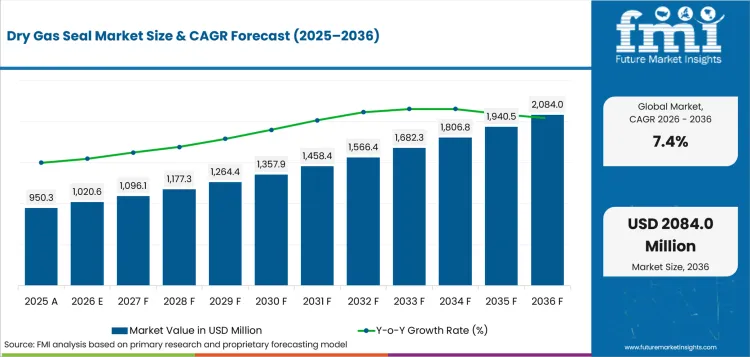
Dry Gas Seal Market Overview: Size and Forecast
- 2025 Market Size: USD 950.3 million
- 2026 Market Size: USD 1,020.6 million
- 2036 Market Size: USD 2,084.0 million
- Forecast CAGR: 7.4% from 2026 to 2036
- Leading Seal Configuration: Tandem Dry Gas Seals
- Tandem Dry Gas Seals Share in 2026: 54.0%
- Leading Compressor Type: Centrifugal Compressors
- Centrifugal Compressors Share in 2026: 72.0%
- Leading End Use: Natural Gas & LNG
- Natural Gas & LNG Share in 2026: 46.0%
- Leading Pressure Class: 100–250 bar
- 100-250 bar Share in 2026: 44.0%
- Leading Sales Mix: Aftermarket
- Aftermarket Share in 2026: 55.0%
- Fastest-growing Country: India
- India CAGR: 8.6% by 2036
Summary of the Dry Gas Seal Market
- Demand and Growth Drivers
- LNG compressor trains are expected to lift tandem dry gas seal demand because high-speed service needs backup containment.
- Methane compliance is anticipated to raise retrofit interest in compressors that still use wet oil sealing systems.
- Hydrogen and CCUS projects are expected to widen the need for seals tested under lighter gases and CO₂-rich streams.
- Product and Segment View
- Centrifugal Compressors are projected to hold 72.0% share in 2026 because dry gas seals match high-speed shaft duty.
- Aftermarket is estimated to account for 55.0% share in 2026 as turnaround work supports repeat revenue.
- Tandem Dry Gas Seals are expected to secure 54.0% share in 2026 due to secondary containment value.
- Geography and Competitive Outlook
- India is projected to record 8.6% CAGR by 2036 with gas grid expansion and LNG terminal activity.
- China is forecast to grow at 8.3% CAGR by 2036 as LNG terminals and long-distance gas networks sustain compressor demand.
- John Crane and Flowserve compete through dry gas seal portfolios and documented LNG or CCUS project evidence.
- EagleBurgmann and AESSEAL compete through compressor seal engineering and service-led refurbishment capability.
- Analyst Opinion
- Nikhil Kaitwade, Principal Consultant at Future Market Insights for the oil and gas domain, says, “Dry gas seals are moving from a replacement part decision to a compressor reliability decision. Buyers are asking whether the seal can handle dirty seal gas and long standby periods without creating methane or process gas losses. LNG plants need uptime first. Hydrogen and CCUS buyers need material confidence. Suppliers with testing capability and API 692 panel experience are best placed for higher-value work.”
Natural gas infrastructure is the clearest growth anchor for dry gas seal suppliers. The U.S. Energy Information Administration reported in October 2025 that North American LNG export capacity could rise from 11.4 Bcf/d at the start of 2024 to 28.7 Bcf/d by 2029. That capacity growth raises the need for compressor reliability in liquefaction and pipeline service. The International Energy Agency reported in June 2026 that around 345 bcm/yr of new LNG export capacity is expected online between 2025 and 2030 from projects already under construction at the start of 2025. This supports demand for tested seal cartridges and support systems.
Which factors support expansion in the dry gas seal market?
LNG buildout, methane control, hydrogen readiness, and aftermarket service discipline support dry gas seal revenue across regulated compressor applications.
- Market value is supported by dry gas seal cartridges and support systems used in compressor packages.
- Supplier pricing reflects seal face materials and control panel depth before channel margins affect buyer comparison.
- Revenue improves when operators convert wet oil seals into dry gas packages during planned turnarounds.
- Buyer trust rises when vendors document seal gas cleanliness and failure analysis procedures.
Why is the Dry Gas Seal Market Growing?
Growth outlook has become more structured as LNG and pipeline operators treat compressor sealing as an uptime issue linked to mechanical seals demand.
The USA Energy Information Administration reported in October 2025 that North American LNG export capacity could reach 28.7 Bcf/d by 2029. LNG assets use multiple high-speed compressors across feedgas and refrigerant duty. This creates a larger pool for tandem seal packages and local service teams. Methane rules make leakage control more visible during retrofit planning and connect dry gas seal decisions with adjacent seals market replacement work.
The Federal Register published the final oil and gas methane rule in March 2024. Operators do not buy dry gas seals directly because of that rule. They do review vents and compressor leakage more closely during maintenance events. Hydrogen and CCUS compressors add material and seal gas concerns that are also visible in high pressure seals applications. Flowserve said in January 2025 that it would supply dry gas seals and dry gas seal systems for high-pressure CO₂ injection packages. That development supports the role of qualified seal designs in early carbon capture projects.
How is the dry gas seal market segmented?
The dry gas seal industry is segmented by seal configuration, compressor type, end use, pressure class, and sales mix.
- Centrifugal Compressors are projected to represent 72.0% share in 2026 because high-speed gas duty remains the main application base.
- Aftermarket is estimated to account for 55.0% share in 2026 as service intervals and retrofit programs support recurring demand.
- Tandem Dry Gas Seals are expected to hold 54.0% share in 2026 because operators need a secondary leakage path.
- Natural Gas & LNG is anticipated to hold 46.0% share in 2026 due to liquefaction and pipeline compression density.
- The 100–250 bar class is projected to account for 44.0% share in 2026 since pipeline and process gas compressors cluster in this duty range.
Why do tandem dry gas seals lead the market?
Tandem Dry Gas Seals are projected to account for 54.0% share in 2026 because secondary containment helps operators manage leakage before shutdown decisions affect throughput.
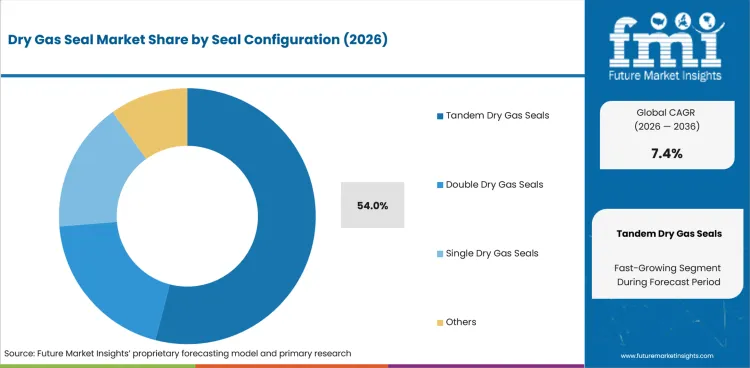
- Tandem designs suit methane and LNG service because the secondary seal supports controlled vent routing.
- Single dry gas seals remain useful in lower-risk duties where process gas hazards are easier to manage.
Which compressor type leads demand?
Centrifugal Compressors are expected to represent 72.0% share in 2026 since dry gas seals match high-speed shaft duty and continuous gas flow.
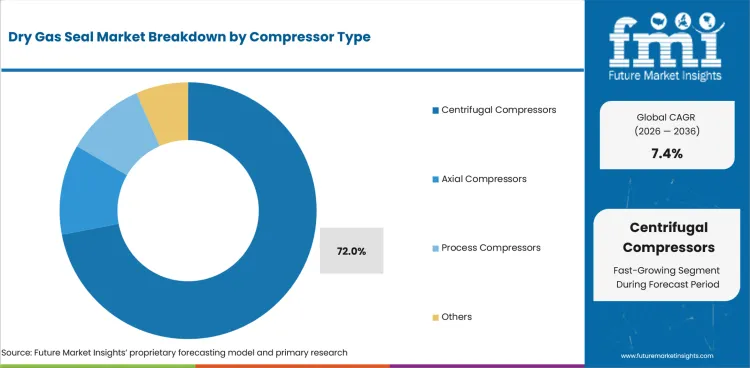
- Axial compressors hold a smaller pool because their use is concentrated in selected process and energy applications.
- Process compressors create additional demand when buyers specify dry gas systems around critical gas containment.
Which end use leads the dry gas seal market?
Natural Gas & LNG is anticipated to hold 46.0% share in 2026 as liquefaction and pipeline assets use seals as uptime-critical components.
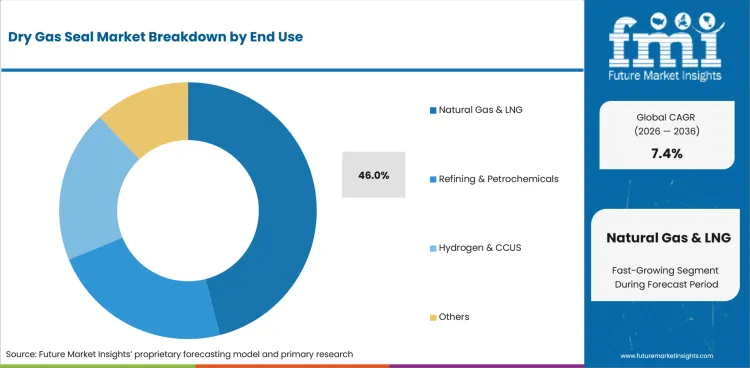
- Refining and petrochemicals support aftermarket revenue through planned turnaround work.
- Hydrogen and CCUS demand is expected to grow faster because gas composition creates new qualification work.
Which pressure class leads the market?
The 100–250 bar class is projected to account for 44.0% share in 2026 because midstream and process compressors cluster around this duty range.
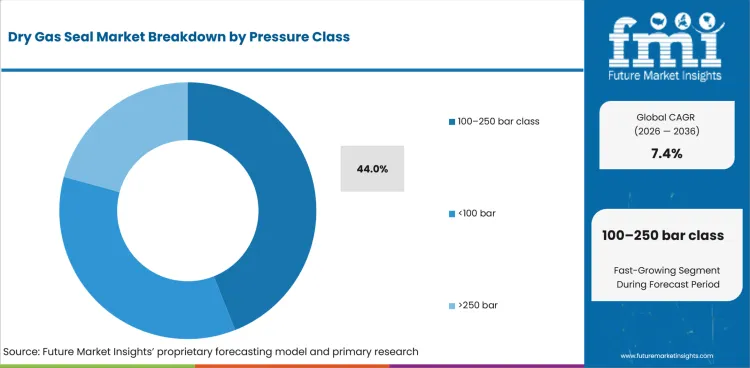
- The below 100 bar class fits lower-pressure plant service where replacement cycles drive revenue.
- The above 250 bar class remains a specialized pool for high-specification hydrogen and CO₂ systems.
Which sales mix leads the market?
Aftermarket is estimated to represent 55.0% share in 2026 as refineries and gas pipelines refurbish seals during planned turnarounds.
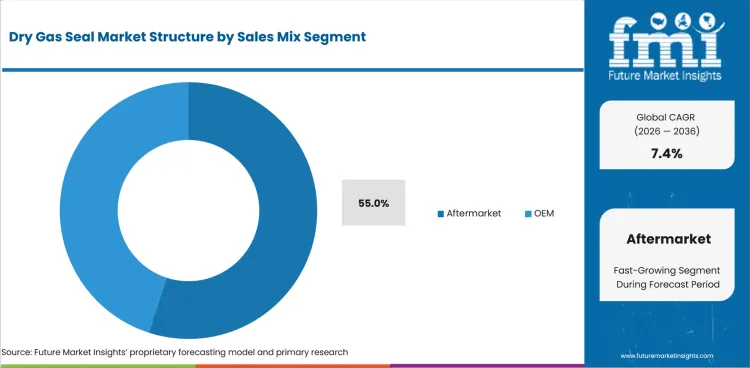
- OEM sales remain tied to new LNG trains and compressor packages.
- Service-led revenue is expected to strengthen where buyers need root-cause analysis and short repair lead times.
What are the drivers, restraints, and opportunities in the dry gas seal market?
Compressor reliability supports growth while seal gas contamination and qualification risk limit faster conversion.
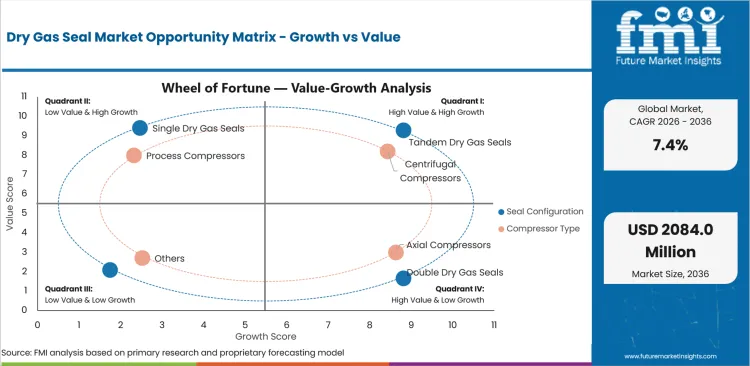
- Driver: LNG train buildout is expected to raise demand for tandem dry gas seal packages that can handle continuous compressor service.
- Driver: Methane compliance pressure is anticipated to increase retrofit interest in seals with lower vent losses.
- Restraint: Seal gas contamination can damage face grooves and shorten service life if filtration is poorly maintained.
- Opportunity: Digital monitoring creates a route for suppliers that link seal health data with compressor controls.
Dry Gas Seal Market Demand Outlook
Demand outlook is moving toward compressor packages that prove leakage control and service certainty before channel expansion. The International Energy Agency reported in June 2026 that around 345 bcm/yr of LNG export capacity is expected online between 2025 and 2030 from projects already under construction. Compressor OEMs and seal suppliers should qualify early for liquefaction packages and pipeline stations. Methane and VOC controls raise the value of documented retrofit work. The final oil and gas methane rule published in March 2024 increases operator attention on emissions from compressor systems. Suppliers that can quantify leakage reduction and support audit documentation are better positioned during planned outages.
Consumer Segmentation and Purchase Behavior Analysis
Dry gas seal buyers are compressor OEMs, LNG operators, refinery maintenance teams, pipeline operators, and industrial gas asset owners. Purchase decisions are tied to downtime risk rather than catalog price. Buyers compare seal configuration, control panel capability, service access, and documented field references as one package. This behavior is similar to the way operators buy rotating shaft seals where failure cost is higher than part cost.
Voice of Customer and Decision-driver Analysis
Operators prioritize seal gas cleanliness, response time, retrofit fit, and failure analysis. LNG plants value uptime during commissioning and peak export periods. Refineries value turnaround predictability. Hydrogen and CCUS projects value material compatibility and pressure-window evidence before they approve broader deployment.
Which countries are growing fastest in the dry gas seal market?
India 8.6% CAGR, China 8.3% CAGR, Germany 8.0% CAGR, United States 7.6% CAGR, United Kingdom 7.2% CAGR, France 7.1% CAGR, South Korea 6.8% CAGR, and Japan 6.4% CAGR through 2036.
.webp "Top Country Growth Comparison Dry Gas Seal Market Cagr (2026 2036)")
| Country | CAGR |
|---|---|
| United States | 7.6% |
| United Kingdom | 7.2% |
| Germany | 8.0% |
| France | 7.1% |
| Japan | 6.4% |
| China | 8.3% |
| South Korea | 6.8% |
| India | 8.6% |
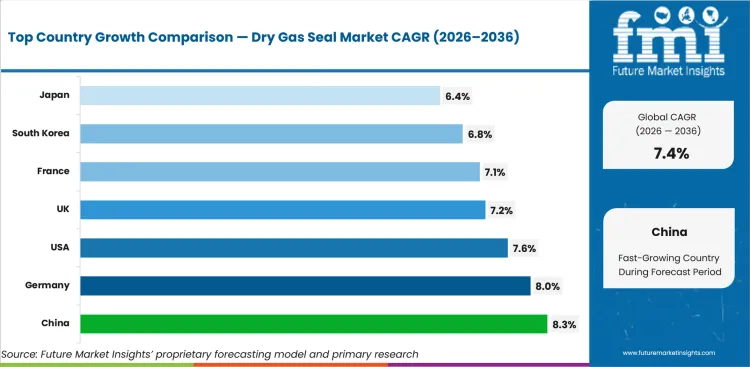
Source: Future Market Insights, 2026.
How do country-level CAGRs compare in the dry gas seal market?
India leads country growth while Japan records the most cautious expansion outlook among the selected markets.
- United States is projected to record 7.6% CAGR by 2036 as LNG export scale and methane compliance support retrofit demand.
- United Kingdom is projected to record 7.2% CAGR by 2036 as CCUS cluster policy and service capability create focused project demand.
- Germany is projected to record 8.0% CAGR by 2036 as hydrogen pipeline conversion creates a specialized retrofit pool.
- France is projected to record 7.1% CAGR by 2036 as CCUS planning and refinery decarbonisation support selective compressor upgrades.
- Japan is projected to record 6.4% CAGR by 2036 as LNG asset reliability and OEM upgrade routes support gradual replacement demand.
- China is projected to record 8.3% CAGR by 2036 as LNG imports and long-distance gas networks keep equipment demand high.
- South Korea is projected to record 6.8% CAGR by 2036 as LNG terminal service and petrochemical reliability keep procurement steady.
- India is projected to record 8.6% CAGR by 2036 as gas grid expansion and LNG terminal activity support compressor service needs.
How fast is the dry gas seal market growing in the United States?
The United States outlook at 7.6% CAGR through 2036 is supported by LNG export growth and methane compliance.
Country Market Snapshot Table
| Parameter | Value |
|---|---|
| Market Size in 2025 (Value) | USD 223.0 million |
| Market Size in 2026 (Value) | USD 240.0 million |
| Market Forecast in 2036 (Value) | USD 499.3 million |
| CAGR (2026 to 2036) | 7.6% |
| Years Considered | 2021 to 2036 |
| Base Year | 2025 |
| Forecast Period | 2026 to 2036 |
| Units Considered | Value (USD million) |
| Leading Sub-Region | Gulf Coast LNG and national refinery corridors |
United States Dry Gas Seal Market Outlook
United States dry gas seal demand is shaped by LNG export growth and methane compliance. EIA reported in October 2025 that North American LNG export capacity could reach 28.7 Bcf/d by 2029.
Operators are expected to prioritize proven LNG references and local field response. Retrofit decisions are increasingly tied to leakage measurement and compressor cycling during planned maintenance windows.
Key Growth Drivers
- Gulf Coast liquefaction projects are expected to increase demand for API 692-ready seal packages. EIA reported North American LNG export capacity could reach 28.7 Bcf/d by 2029.
- Hydrogen hub development is expected to widen demand beyond conventional gas pipelines. The USA Department of Energy selected seven H2Hubs for up to USD 7.0 billion in federal funding.
- Refinery and petrochemical assets are expected to support aftermarket seal refurbishment during planned turnarounds.
- Local testing capacity is expected to improve buyer confidence because USA operators need fast inspection and failure analysis.
Key Restraints
- Methane documentation requirements can raise retrofit workload. The March 2024 final rule is designed to avoid 58.0 million short tons of methane emissions from 2024 to 2038.
- Qualification cycles are expected to stay slow for critical centrifugal compressors with limited tolerance for seal failure.
- Skilled service labor can remain tight during refinery and LNG turnaround windows.
What Makes United States Unique
The United States is unique because LNG export scale and emissions scrutiny turn seal purchases into both uptime and compliance decisions.
Key Companies
- John Crane Inc.
- Flowserve Corporation
- EagleBurgmann USA
- A.W. Chesterton Company
- Siemens Energy USA
- Parker Hannifin Corporation
Sales & Marketing Channels
- Direct LNG operator sales remain the primary route.
- Compressor OEM approvals shape high-value project specifications.
- Refinery maintenance contracts support repeat aftermarket work.
- Authorized service centers handle inspection and repair demand.
- EPC vendor lists guide new liquefaction and hydrogen packages.
- Turnaround contractor networks influence urgent replacement orders.
Country Segment Breakdown Table
| Segment | Sub-Segments |
|---|---|
| By Seal Configuration | Tandem Dry Gas Seals · Double Dry Gas Seals · Single Dry Gas Seals · Other |
| By Compressor Type | Centrifugal Compressors · Axial Compressors · Process Compressors / Other |
| By End Use | Natural Gas & LNG · Refining & Petrochemicals · Hydrogen & CCUS · Other |
| By Pressure Class | <100 bar · 100–250 bar · >250 bar |
| By Sales Mix | OEM · Aftermarket |
| Key Sub-Regions Covered, Industrial and Energy Corridors | Texas Gulf Coast · Louisiana · Pennsylvania · Ohio · California · Rocky Mountain gas corridors |
Frequently Asked Questions
How fast is United States dry gas seal market growing?
United States dry gas seal demand is projected to expand at 7.6% CAGR through 2036.
Who leads United States dry gas seal market?
John Crane and Flowserve lead through dry gas seal portfolios and USA service access.
What is driving adoption in United States dry gas seal market?
LNG export growth and methane compliance are expected to drive USA adoption.
What is the dry gas seal market outlook in the United Kingdom?
The United Kingdom outlook at 7.2% CAGR through 2036 is supported by CCUS cluster development and refinery service requirements.
Country Market Snapshot Table
| Parameter | Value |
|---|---|
| Market Size in 2025 (Value) | USD 74.6 million |
| Market Size in 2026 (Value) | USD 80.0 million |
| Market Forecast in 2036 (Value) | USD 160.3 million |
| CAGR (2026 to 2036) | 7.2% |
| Years Considered | 2021 to 2036 |
| Base Year | 2025 |
| Forecast Period | 2026 to 2036 |
| Units Considered | Value (USD million) |
| Leading Sub-Region | Teesside and North West CCUS clusters |
United Kingdom Dry Gas Seal Market Outlook
United Kingdom dry gas seal demand is focused on CCUS clusters and refinery service work. CCUS policy is expected to create a concentrated project route for CO₂ compressor sealing.
Local refurbishment capability is expected to support repeat service revenue. Buyers are likely to evaluate dry gas seal packages through cluster EPCs and existing refinery maintenance relationships.
Key Growth Drivers
- CCUS cluster funding is expected to create future CO₂ compressor sealing demand. Parliament reported that the government announced £21.7 billion of funding over 25 years for early CCUS projects.
- Carbon storage permitting is expected to support compressor packages. The North Sea Transition Authority said the Endurance site could store up to 100 million tonnes of CO₂.
- Rotherham-based refurbishment capability is expected to strengthen aftermarket access for operators with urgent turnaround needs.
- Offshore gas engineering knowledge is expected to keep buyers familiar with rotating equipment risk and seal qualification.
Key Restraints
- Cluster timing can delay OEM orders because Parliament noted that three more CCUS projects were still under negotiation in February 2025.
- A smaller installed gas compression fleet limits repeat volume compared with the United States and China.
- Public funding scrutiny can make project-specific supplier awards slower.
What Makes United Kingdom Unique
The United Kingdom is unique because CCUS clusters create focused demand rather than broad pipeline-scale seal replacement.
Key Companies
- AESSEAL plc
- John Crane UK
- EagleBurgmann UK
- Flowserve GB Ltd.
- Howden UK
- Sulzer UK
Sales & Marketing Channels
- Direct sales to CCUS cluster developers shape early specifications.
- Refinery turnaround contractors support replacement activity.
- OEM compressor packages carry dry gas seal approvals into projects.
- Authorized service centres manage refurbishment and emergency repairs.
- EPC channels influence carbon transport compressor selection.
- Industrial gas operators support specialized retrofit demand.
Country Segment Breakdown Table
| Segment | Sub-Segments |
|---|---|
| By Seal Configuration | Tandem Dry Gas Seals · Double Dry Gas Seals · Single Dry Gas Seals · Other |
| By Compressor Type | Centrifugal Compressors · Axial Compressors · Process Compressors / Other |
| By End Use | Natural Gas & LNG · Refining & Petrochemicals · Hydrogen & CCUS · Other |
| By Pressure Class | <100 bar · 100–250 bar · >250 bar |
| By Sales Mix | OEM · Aftermarket |
| Key Sub-Regions Covered, Industrial and Energy Corridors | Teesside · Humberside · North West England · Scotland · South Wales · Fawley corridor |
Frequently Asked Questions
How fast is United Kingdom dry gas seal market growing?
United Kingdom demand is projected at 7.2% CAGR through 2036.
Who leads United Kingdom dry gas seal market?
AESSEAL and John Crane UK lead through service capability and dry gas seal references.
What is driving adoption in United Kingdom dry gas seal market?
CCUS clusters and refinery maintenance are expected to support adoption.
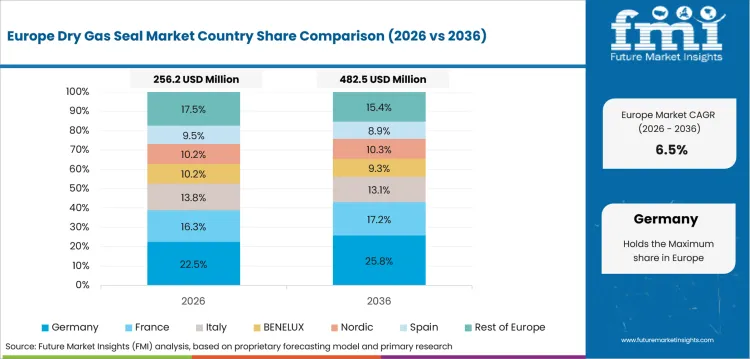
How is the dry gas seal market performing in Germany?
The Germany outlook at 8.0% CAGR through 2036 is supported by hydrogen network conversion and qualified dry gas seal demand.
Country Market Snapshot Table
| Parameter | Value |
|---|---|
| Market Size in 2025 (Value) | USD 88.9 million |
| Market Size in 2026 (Value) | USD 96.0 million |
| Market Forecast in 2036 (Value) | USD 207.3 million |
| CAGR (2026 to 2036) | 8.0% |
| Years Considered | 2021 to 2036 |
| Base Year | 2025 |
| Forecast Period | 2026 to 2036 |
| Units Considered | Value (USD million) |
| Leading Sub-Region | North Rhine-Westphalia and hydrogen backbone corridors |
Germany Dry Gas Seal Market Outlook
Germany dry gas seal demand is shaped by hydrogen core-network conversion and chemical industry service needs. Converted pipeline assets create a retrofit route for dry gas seal suppliers.
Buyers are expected to test material compatibility and seal behavior before approving wider hydrogen service. Local engineering access gives German suppliers and service teams a stronger specification role.
Key Growth Drivers
- Hydrogen core-network approval is expected to raise compressor seal retrofit demand. Bundesnetzagentur approved 9,040 km of hydrogen pipelines in October 2024.
- Pipeline conversion is expected to create seal compatibility checks. The federal ministry stated that around 60.0% of core-network pipelines would be converted natural gas pipelines.
- Chemical and refinery buyers are expected to value documented API-style sealing support for hydrogen and process gas service.
- Local engineering presence is expected to shorten qualification work for complex compressor packages.
Key Restraints
- Gas market uncertainty can delay retrofit budgets. Bundesnetzagentur reported Germany consumed 864 TWh of gas in 2025.
- Hydrogen pipeline phasing can push seal orders beyond near-term service windows.
- Material compatibility proof can lengthen approval for lighter gas service.
What Makes Germany Unique
Germany is unique because hydrogen pipeline conversion gives dry gas seal suppliers a retrofit-led growth path.
Key Companies
- EagleBurgmann Germany
- Siemens Energy AG
- John Crane Germany
- Flowserve Essen GmbH
- KSB SE & Co. KGaA
- Burckhardt Compression Germany
Sales & Marketing Channels
- Direct hydrogen network project sales shape future specifications.
- Chemical plant maintenance contracts support recurring service.
- Compressor OEM approvals influence seal selection.
- Regional service centers support inspection and refurbishment.
- EPCs guide hydrogen and CCUS package sourcing.
- Industrial gas buyers support high-specification trials.
Country Segment Breakdown Table
| Segment | Sub-Segments |
|---|---|
| By Seal Configuration | Tandem Dry Gas Seals · Double Dry Gas Seals · Single Dry Gas Seals · Other |
| By Compressor Type | Centrifugal Compressors · Axial Compressors · Process Compressors / Other |
| By End Use | Natural Gas & LNG · Refining & Petrochemicals · Hydrogen & CCUS · Other |
| By Pressure Class | <100 bar · 100–250 bar · >250 bar |
| By Sales Mix | OEM · Aftermarket |
| Key Sub-Regions Covered, Industrial and Energy Corridors | North Rhine-Westphalia · Bavaria · Lower Saxony · Hamburg · Saxony-Anhalt · Rhine-Ruhr industrial corridor |
Frequently Asked Questions
How fast is Germany dry gas seal market growing?
Germany demand is projected to rise at 8.0% CAGR through 2036.
Who leads Germany dry gas seal market?
EagleBurgmann and Siemens Energy lead through local engineering and turbomachinery access.
What is driving adoption in Germany dry gas seal market?
Hydrogen backbone conversion is expected to drive dry gas seal retrofit demand.
What is the dry gas seal market forecast for France?
The France outlook at 7.1% CAGR through 2036 is supported by CCUS planning and refinery decarbonisation.
Country Market Snapshot Table
| Parameter | Value |
|---|---|
| Market Size in 2025 (Value) | USD 67.2 million |
| Market Size in 2026 (Value) | USD 72.0 million |
| Market Forecast in 2036 (Value) | USD 143.0 million |
| CAGR (2026 to 2036) | 7.1% |
| Years Considered | 2021 to 2036 |
| Base Year | 2025 |
| Forecast Period | 2026 to 2036 |
| Units Considered | Value (USD million) |
| Leading Sub-Region | Normandy and industrial decarbonisation corridors |
France Dry Gas Seal Market Outlook
France dry gas seal demand is shaped by CCUS planning and refinery decarbonisation. Industrial clusters can create selective compressor upgrades tied to CO₂ transport and gas processing.
Demand is expected to remain project-led rather than broad-based. Suppliers with EPC access and rotating equipment service capability should gain stronger specification visibility.
Key Growth Drivers
- CCUS strategy is expected to create future CO₂ compressor sealing requirements. France’s environment ministry described a 4.0 MtCO₂ to 8.0 MtCO₂ annual capture path by 2030.
- Gas infrastructure service remains relevant for compressor maintenance. SDES reported French natural gas imports of 481 TWh PCS in 2024.
- Refinery and petrochemical assets in Normandy and southern corridors are expected to support aftermarket seal refurbishment.
- EPC-led project buying is expected to give qualified suppliers early specification access.
Key Restraints
- Lower gas use can restrain compressor service volume. SDES reported French natural gas imports declined 9.7% in 2024.
- CCUS project schedules remain uncertain and depend on transport and storage decisions.
- Public evidence on country-specific dry gas seal supplier activity remains limited.
What Makes France Unique
France is unique because CCUS planning is concentrated around industrial clusters rather than broad national pipeline conversion.
Key Companies
- John Crane France
- EagleBurgmann France
- Flowserve France
- Technip Energies
- TotalEnergies service networks
- Sulzer France
Sales & Marketing Channels
- EPC packages guide CCUS compressor specifications.
- Refinery maintenance channels support aftermarket seal work.
- Industrial gas buyers evaluate high-pressure seal references.
- Authorized repair centers manage refurbishment demand.
- OEM compressor channels define new package approvals.
- Cluster developers influence early supplier shortlists.
Country Segment Breakdown Table
| Segment | Sub-Segments |
|---|---|
| By Seal Configuration | Tandem Dry Gas Seals · Double Dry Gas Seals · Single Dry Gas Seals · Other |
| By Compressor Type | Centrifugal Compressors · Axial Compressors · Process Compressors / Other |
| By End Use | Natural Gas & LNG · Refining & Petrochemicals · Hydrogen & CCUS · Other |
| By Pressure Class | <100 bar · 100–250 bar · >250 bar |
| By Sales Mix | OEM · Aftermarket |
| Key Sub-Regions Covered, Industrial and Energy Corridors | Normandy · Hauts-de-France · Fos-sur-Mer · Dunkirk · Grand Est · Île-de-France service corridors |
Frequently Asked Questions
How fast is France dry gas seal market growing?
France demand is projected to grow at 7.1% CAGR through 2036.
Who leads France dry gas seal market?
John Crane France and EagleBurgmann France lead through service access and compressor references.
What is driving adoption in France dry gas seal market?
CCUS planning and refinery decarbonisation are expected to support adoption.
How is the dry gas seal market performing in Japan?
The Japan outlook at 6.4% CAGR through 2036 is supported by LNG reliability and OEM-led retrofit routes.
Country Market Snapshot Table
| Parameter | Value |
|---|---|
| Market Size in 2025 (Value) | USD 77.1 million |
| Market Size in 2026 (Value) | USD 82.0 million |
| Market Forecast in 2036 (Value) | USD 152.5 million |
| CAGR (2026 to 2036) | 6.4% |
| Years Considered | 2021 to 2036 |
| Base Year | 2025 |
| Forecast Period | 2026 to 2036 |
| Units Considered | Value (USD million) |
| Leading Sub-Region | Tokyo Bay and LNG utility corridors |
Japan Dry Gas Seal Market Outlook
Japan dry gas seal demand is shaped by LNG reliability and conservative utility procurement. CCS planning adds a future route for specialty compressor sealing beyond conventional LNG assets.
OEM-led upgrade routes are expected to matter more than standalone supplier switching. Buyers are likely to favor proven operating references and local technical support.
Key Growth Drivers
- CCS planning is expected to add future specialty gas sealing needs. METI stated that Japan aims to secure 6 to 12 million tons of annual CO₂ storage capacity by 2030.
- LNG energy security is expected to sustain utility maintenance spending. JOGMEC reported power-sector LNG inventories of 1.80 million tonnes on June 7, 2026.
- OEM-led upgrade routes are expected to create repeat business for proven seal systems.
- Conservative procurement is expected to favor suppliers with long operating references.
Key Restraints
- Import exposure keeps procurement conservative. ANRE reported Japan’s energy self-sufficiency rate at 15.3% in the 2025 Energy White Paper.
- Conservative approval cycles slow supplier switching in critical compressor assets.
- Domestic gas demand remains exposed to nuclear restarts and efficiency policy.
What Makes Japan Unique
Japan is unique because LNG asset reliability and OEM-led approval routes shape dry gas seal replacement decisions.
Key Companies
- Mitsubishi Heavy Industries Compressor Corporation
- EagleBurgmann Japan
- John Crane Japan
- Flowserve Japan
- Torishima Pump Mfg. Co. Ltd.
- Nippon Pillar Packing Co. Ltd.
Sales & Marketing Channels
- Compressor OEM packages guide seal selection.
- Utility maintenance programs support repeat replacement.
- LNG terminal service providers influence technical approvals.
- Authorized repair centers manage inspection work.
- Industrial gas buyers test specialty gas compatibility.
- EPC firms shape CCS compressor packages.
Country Segment Breakdown Table
| Segment | Sub-Segments |
|---|---|
| By Seal Configuration | Tandem Dry Gas Seals · Double Dry Gas Seals · Single Dry Gas Seals · Other |
| By Compressor Type | Centrifugal Compressors · Axial Compressors · Process Compressors / Other |
| By End Use | Natural Gas & LNG · Refining & Petrochemicals · Hydrogen & CCUS · Other |
| By Pressure Class | <100 bar · 100–250 bar · >250 bar |
| By Sales Mix | OEM · Aftermarket |
| Key Sub-Regions Covered, Industrial and Energy Corridors | Tokyo Bay · Osaka-Kobe industrial belt · Chiba · Yokohama · Nagoya · Kitakyushu |
Frequently Asked Questions
How fast is Japan dry gas seal market growing?
Japan demand is projected at 6.4% CAGR through 2036.
Who leads Japan dry gas seal market?
Mitsubishi Heavy Industries Compressor and John Crane Japan lead through compressor and service links.
What is driving adoption in Japan dry gas seal market?
LNG reliability and CCS planning are expected to support adoption.
What is driving dry gas seal growth in China?
The China outlook at 8.3% CAGR through 2036 is supported by LNG terminals and long-distance gas networks.
Country Market Snapshot Table
| Parameter | Value |
|---|---|
| Market Size in 2025 (Value) | USD 147.7 million |
| Market Size in 2026 (Value) | USD 160.0 million |
| Market Forecast in 2036 (Value) | USD 355.1 million |
| CAGR (2026 to 2036) | 8.3% |
| Years Considered | 2021 to 2036 |
| Base Year | 2025 |
| Forecast Period | 2026 to 2036 |
| Units Considered | Value (USD million) |
| Leading Sub-Region | Coastal LNG terminals and petrochemical provinces |
China Dry Gas Seal Market Outlook
China dry gas seal demand is supported by LNG terminals, domestic gas development, and petrochemical compressor needs. Large gas assets create service demand for tandem seals and control panels.
Domestic suppliers can compete strongly on price. Imported and global suppliers need application references, hydrogen capability, and local repair access to defend higher-value work.
Key Growth Drivers
- Domestic gas output growth is expected to expand compressor service demand. NBS reported 261.9 billion cubic meters of natural gas production in 2025.
- Offshore gas development is expected to add high-specification compression needs. The State Council reported Deep Sea No. 1 reached 4.5 billion cubic meters of designed annual capacity in 2025.
- Long-distance gas pipelines are expected to increase dry gas seal maintenance demand.
- Petrochemical complexes are expected to support high-pressure compressor seal replacement.
Key Restraints
- Macro gas growth can moderate order timing. NBS reported January to February 2026 natural gas output grew 2.9% year over year.
- Localization policy and domestic suppliers can create price pressure for imported seal systems.
- Public evidence on niche dry gas seal company activity remains fragmented.
What Makes China Unique
China is unique because LNG, domestic gas production, and petrochemical capacity create a broad compressor service base.
Key Companies
- Sichuan Sunny Seal Co. Ltd.
- Sinoseal Holding Co. Ltd.
- John Crane China
- EagleBurgmann China
- Flowserve China
- Shenyang Blower Works Group Corporation
Sales & Marketing Channels
- State-owned energy companies influence project approvals.
- Compressor OEMs shape high-pressure package decisions.
- Petrochemical EPCs guide supplier shortlists.
- Local service centers support maintenance speed.
- Pipeline operators create repeat retrofit demand.
- Hydrogen demonstration projects support specialty trials.
Country Segment Breakdown Table
| Segment | Sub-Segments |
|---|---|
| By Seal Configuration | Tandem Dry Gas Seals · Double Dry Gas Seals · Single Dry Gas Seals · Other |
| By Compressor Type | Centrifugal Compressors · Axial Compressors · Process Compressors / Other |
| By End Use | Natural Gas & LNG · Refining & Petrochemicals · Hydrogen & CCUS · Other |
| By Pressure Class | <100 bar · 100–250 bar · >250 bar |
| By Sales Mix | OEM · Aftermarket |
| Key Sub-Regions Covered, Industrial and Energy Corridors | Guangdong · Shanghai · Jiangsu · Zhejiang · Sichuan · Xinjiang pipeline corridors |
Frequently Asked Questions
How fast is China dry gas seal market growing?
China demand is projected to rise at 8.3% CAGR through 2036.
Who leads China dry gas seal market?
Sinoseal and Sichuan Sunny Seal compete with John Crane China and EagleBurgmann China.
What is driving adoption in China dry gas seal market?
LNG terminals and domestic gas networks are expected to support adoption.
What is the dry gas seal market outlook in South Korea?
The South Korea outlook at 6.8% CAGR through 2036 is supported by LNG import dependence and petrochemical reliability.
Country Market Snapshot Table
| Parameter | Value |
|---|---|
| Market Size in 2025 (Value) | USD 61.8 million |
| Market Size in 2026 (Value) | USD 66.0 million |
| Market Forecast in 2036 (Value) | USD 127.4 million |
| CAGR (2026 to 2036) | 6.8% |
| Years Considered | 2021 to 2036 |
| Base Year | 2025 |
| Forecast Period | 2026 to 2036 |
| Units Considered | Value (USD million) |
| Leading Sub-Region | LNG terminal and petrochemical corridors |
South Korea Dry Gas Seal Market Outlook
South Korea dry gas seal demand is linked to LNG terminals, power generation reliability, and petrochemical complexes. The country needs proven sealing packages for high-availability compressor duty.
Procurement is expected to remain selective because utility and petrochemical buyers favor verified references. Suppliers with local service partners should gain stronger access during outages.
Key Growth Drivers
- Energy system scale is expected to sustain service demand for rotating equipment. KESIS reported total primary energy supply of 24,203 thousand toe in March 2026.
- Long-term LNG portfolios are expected to support terminal reliability work. KOGAS lists its Canada LNG project with 14.0 million tons per year of LNG capacity.
- Petrochemical complexes are expected to create recurring seal replacement and refurbishment needs.
- Utility procurement is expected to support qualified suppliers with proven outage performance.
Key Restraints
- Lower LNG-linked revenue can restrain maintenance budgets. KOGAS revenue declined from KRW 38,388,740 million in 2024 to KRW 35,727,336 million in 2025.
- Nuclear and renewable policy can reduce long-term fossil generation additions.
- Country-specific supplier evidence is limited outside major OEM channels.
What Makes South Korea Unique
South Korea is unique because LNG terminal reliability and petrochemical uptime guide dry gas seal buying.
Key Companies
- EagleBurgmann Korea
- John Crane Korea
- Flowserve Korea
- Korea Gas Corporation vendor networks
- Hyundai Engineering service channels
- Hanwha Power Systems service networks
Sales & Marketing Channels
- LNG terminal maintenance teams shape service demand.
- Petrochemical plant contractors influence aftermarket orders.
- Compressor OEM packages guide high-value specifications.
- Authorized service partners handle refurbishment.
- Utility procurement systems set technical thresholds.
- Industrial gas operators support specialty service work.
Country Segment Breakdown Table
| Segment | Sub-Segments |
|---|---|
| By Seal Configuration | Tandem Dry Gas Seals · Double Dry Gas Seals · Single Dry Gas Seals · Other |
| By Compressor Type | Centrifugal Compressors · Axial Compressors · Process Compressors / Other |
| By End Use | Natural Gas & LNG · Refining & Petrochemicals · Hydrogen & CCUS · Other |
| By Pressure Class | <100 bar · 100–250 bar · >250 bar |
| By Sales Mix | OEM · Aftermarket |
| Key Sub-Regions Covered, Industrial and Energy Corridors | Incheon · Pyeongtaek · Ulsan · Yeosu · Daesan · Busan industrial corridor |
Frequently Asked Questions
How fast is South Korea dry gas seal market growing?
South Korea demand is projected at 6.8% CAGR through 2036.
Who leads South Korea dry gas seal market?
EagleBurgmann Korea and John Crane Korea lead through service access and compressor references.
What is driving adoption in South Korea dry gas seal market?
LNG terminal reliability and petrochemical maintenance are expected to support adoption.
How fast is India dry gas seal market growing?
The India outlook at 8.6% CAGR through 2036 is supported by gas pipeline expansion and LNG infrastructure.
Country Market Snapshot Table
| Parameter | Value |
|---|---|
| Market Size in 2025 (Value) | USD 53.4 million |
| Market Size in 2026 (Value) | USD 58.0 million |
| Market Forecast in 2036 (Value) | USD 132.4 million |
| CAGR (2026 to 2036) | 8.6% |
| Years Considered | 2021 to 2036 |
| Base Year | 2025 |
| Forecast Period | 2026 to 2036 |
| Units Considered | Value (USD million) |
| Leading Sub-Region | Gujarat and western pipeline corridors |
India Dry Gas Seal Market Outlook
India dry gas seal demand is supported by gas pipeline expansion, LNG infrastructure, and refinery modernization. Pipeline additions are expected to widen the installed base for compressor maintenance.
Local service access matters because shutdown windows are short and imported components can face lead-time pressure. Suppliers with Indian repair capability should gain stronger aftermarket positions.
Key Growth Drivers
- Gas grid expansion is expected to increase compressor station and pipeline-related seal demand. The Ministry of Petroleum and Natural Gas reported 24,945 km of operational natural gas pipelines as of September 30, 2024.
- Pipeline execution is expected to expand the future service base. PNGRB projected India’s natural gas pipeline network to reach 34,769 km by 2035.
- Refinery and petrochemical clusters in Gujarat and Maharashtra are expected to support aftermarket growth.
- Local service centers are expected to reduce downtime risk during maintenance shutdowns.
Key Restraints
- Gas demand volatility can delay sealing upgrades outside critical compressor corridors. PPAC reported total natural gas consumption of 4,703 MMSCM in April 2026, down 16.7% from April 2025.
- Price sensitivity can keep some buyers on repair-first plans outside critical assets.
- Imported high-specification components can face lead-time pressure during urgent turnarounds.
What Makes India Unique
India is unique because pipeline expansion and refinery modernization create both OEM and aftermarket demand for dry gas seals.
Key Companies
- EagleBurgmann India Pvt. Ltd.
- John Crane Sealing Systems India Pvt. Ltd.
- Flowserve India Controls Pvt. Ltd.
- AESSEAL India Pvt. Ltd.
- Paharpur 3P service networks
- Kirloskar Brothers service networks
Sales & Marketing Channels
- Gas pipeline operators influence retrofit demand.
- Refinery turnaround contractors drive aftermarket orders.
- Compressor OEMs shape specification approvals.
- Local service centers support inspection and repair.
- EPCs influence LNG and petrochemical packages.
- Industrial gas suppliers support specialty compressor service.
Country Segment Breakdown Table
| Segment | Sub-Segments |
|---|---|
| By Seal Configuration | Tandem Dry Gas Seals · Double Dry Gas Seals · Single Dry Gas Seals · Other |
| By Compressor Type | Centrifugal Compressors · Axial Compressors · Process Compressors / Other |
| By End Use | Natural Gas & LNG · Refining & Petrochemicals · Hydrogen & CCUS · Other |
| By Pressure Class | <100 bar · 100–250 bar · >250 bar |
| By Sales Mix | OEM · Aftermarket |
| Key Sub-Regions Covered, Industrial and Energy Corridors | Gujarat · Maharashtra · Andhra Pradesh · Tamil Nadu · Rajasthan · Assam pipeline corridors |
Frequently Asked Questions
How fast is India dry gas seal market growing?
India demand is projected to scale at 8.6% CAGR through 2036.
Who leads India dry gas seal market?
EagleBurgmann India and John Crane India lead through local service and compressor references.
What is driving adoption in India dry gas seal market?
Gas grid expansion and refinery modernization are expected to drive adoption.
Who are the leading companies in the dry gas seal market?
John Crane, EagleBurgmann, Flowserve, AESSEAL, Siemens Energy, Mitsubishi Heavy Industries Compressor Corporation, Chesterton, and Parker Hannifin are key companies in the dry gas seal market.
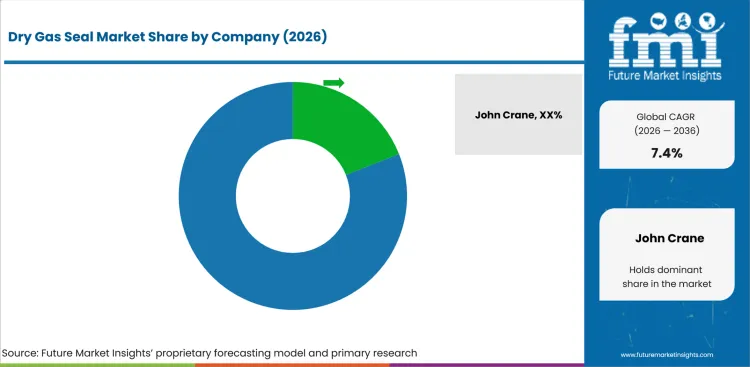
- John Crane competes through LNG references, dry gas seal engineering history, and compressor seal service depth.
- EagleBurgmann competes through compressor seal engineering, CobaDGS positioning, and global field support.
- Flowserve competes through Gaspac dry gas seals, support systems, and carbon capture project evidence.
- AESSEAL competes through compressor dry gas seals, refurbishment capability, and aftermarket support.
- Siemens Energy and Mitsubishi Heavy Industries Compressor influence specifications through compressor packages, upgrade studies, and OEM engineering support.
Competition starts with compressor risk. Buyers evaluate dry gas seals as reliability assets rather than simple consumables. They review pressure capability, face geometry, gas conditioning, control panels, API 692 support system capability, and field history before price. John Crane marked 50 years of dry gas seals in January 2026 and framed the technology around energy applications. Flowserve stated in January 2025 that it would supply dry gas seals and systems for high-pressure CO₂ injection packages. These references show how leading suppliers use LNG, CCUS, and high-pressure compression projects to support buyer confidence.
Aftermarket positioning also matters because dry gas seal failures can affect compressor uptime, emissions control, and maintenance cost. Suppliers with retrofit engineering, spare-part availability, field service reach, and seal support system experience are better positioned in LNG, refining, petrochemicals, pipeline compression, and carbon capture applications.
How do top dry gas seal companies compare?
John Crane, EagleBurgmann, and Flowserve lead through compressor seal portfolio depth and global service reach, while AESSEAL, Siemens Energy, and Mitsubishi Heavy Industries Compressor compete through refurbishment, compressor OEM access, and upgrade support.
| Company | Compressor Seal Portfolio Depth | API 692 Support System Capability | Retrofit and Service Reach | Geographic Footprint | Positioning |
| John Crane | High | High | Strong | Global | Integrated dry gas seal leader |
| EagleBurgmann | High | Strong | Strong | Global | Compressor sealing specialist |
| Flowserve | High | Strong | Strong | Global | Dry gas seal and system supplier |
| AESSEAL | High | Medium | Strong | Global | Seal refurbishment and aftermarket specialist |
| Siemens Energy | Medium | Strong | Strong | Global | Compressor OEM and upgrade specialist |
| Mitsubishi Heavy Industries Compressor Corporation | Medium | Medium | Strong | Japan and global projects | Compressor OEM and project specialist |
| Chesterton | Medium | Medium | Moderate | Global | Specialist seal and component supplier |
| Parker Hannifin | Medium | Medium | Moderate | Global | Industrial sealing and component supplier |
Source: Future Market Insights competitive analysis, 2026.
Key Developments in Dry Gas Seal Market
- In January 2026, John Crane marked 50 years of dry gas seal technology and announced technical papers and customer stories across 2026. The milestone reinforced its position in compressor sealing for energy and process applications.
- In January 2025, Flowserve stated that it would supply dry gas seals and dry gas seal systems for high-pressure CO₂ injection packages linked to ADNOC’s Habshan carbon capture project. The award supports its role in CCUS-linked compressor sealing.
- In June 2026, the International Energy Agency updated its Global LNG Capacity Tracker and reported around 345 bcm per year of new LNG export capacity expected online between 2025 and 2030. The expansion supports future demand for compressor seals in LNG trains and associated gas-handling systems.
Who are the key players in the dry gas seal market?
Key companies participating in the dry gas seal market include:
Integrated Dry Gas Seal Leaders
- John Crane
- EagleBurgmann
- Flowserve
- AESSEAL
Compressor OEM and Upgrade Specialists
- Siemens Energy
- Mitsubishi Heavy Industries Compressor Corporation
Specialist Seal and Component Suppliers
- Chesterton
- Parker Hannifin
Dry Gas Seal Market - Report Scope
| Parameter | Details |
|---|---|
| Forecast period | 2026 to 2036 |
| Historical period | 2021 to 2025 |
| Quantitative unit | Revenue in USD million |
| By seal configuration | Tandem Dry Gas Seals, Double Dry Gas Seals, Single Dry Gas Seals, Other |
| By compressor type | Centrifugal Compressors, Axial Compressors, Process Compressors / Other |
| By end use | Natural Gas & LNG, Refining & Petrochemicals, Hydrogen & CCUS, Other |
| By pressure class | <100 bar, 100–250 bar, >250 bar |
| By sales mix | OEM, Aftermarket |
| Regions covered | North America, Western Europe, East Asia, South Asia and Pacific |
| Countries covered | United States, United Kingdom, Germany, France, Japan, China, South Korea, India |
| Key companies profiled | John Crane, EagleBurgmann, Flowserve, AESSEAL, Siemens Energy, Chesterton, Parker Hannifin, Mitsubishi Heavy Industries Compressor |
Dry Gas Seal Market - Scope & Definition
| Attribute | Detail |
|---|---|
| Market Definition | Non-contacting mechanical face seals used mainly on centrifugal and high-speed process gas compressors. |
| Functions Covered | Process gas containment, leakage control, oil-free sealing, compressor reliability, and vent management. |
| Applications Covered | LNG trains, gas transmission compressors, refinery compressors, petrochemical compressors, hydrogen compressors, and CO₂ compression. |
| End-Use Industries | Natural gas and LNG, refining and petrochemicals, hydrogen, CCUS, industrial gases, and process industries. |
| Pressure Classes Covered | <100 bar, 100–250 bar, and >250 bar dry gas compressor service. |
| Inclusions | Dry gas seal cartridges, tandem and double configurations, controls, filtration, support systems, refurbishment, retrofit engineering, and service programs. |
| Exclusions | Static gaskets, elastomer-only O-rings, pump packing, wet oil seals sold without dry gas retrofit scope, hydraulic cylinder seals, and non-compressor shaft seals. |
Dry Gas Seal Market - Research Methodology
| Method | Description |
|---|---|
| Primary Research | FMI analyst interviews with compressor package buyers, refinery maintenance teams, LNG asset managers, seal service providers, and rotating equipment engineers. |
| Desk Research | Review of regulator material, LNG capacity data, gas infrastructure data, company product evidence, and industry standard references. |
| Market Sizing & Forecasting | Bottom-up compressor population modeling using seal replacement frequency, new compressor additions, pressure class mix, country infrastructure signals, and retrofit penetration. |
| Data Validation | Cross-verification using LNG capacity additions, hydrogen pipeline plans, CCUS cluster funding, official energy data, and supplier portfolio evidence. |
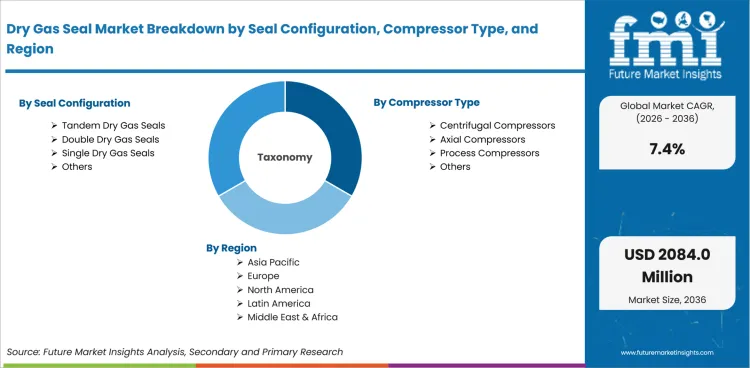
Dry Gas Seal Market Breakdown by Seal Configuration, Compressor Type, End Use, Pressure Class, Sales Mix, and Region
Dry Gas Seal Market Segmented by Seal Configuration
- Tandem Dry Gas Seals
- Double Dry Gas Seals
- Single Dry Gas Seals
- Other
Dry Gas Seal Market Segmented by Compressor Type
- Centrifugal Compressors
- Axial Compressors
- Process Compressors / Other
Dry Gas Seal Market Segmented by End Use
- Natural Gas & LNG
- Refining & Petrochemicals
- Hydrogen & CCUS
- Other
Dry Gas Seal Market Segmented by Pressure Class
- Below 100 bar
- 100-250 bar
- Above 250 bar
Dry Gas Seal Market Segmented by Sales Mix
- OEM
- Aftermarket
Dry Gas Seal Market by Region
- North America
- Latin America
- Europe
- East Asia
- South Asia and Pacific
- Middle East and Africa
Research Sources and Bibliography
- 1. USA Energy Information Administration. (2025, October 16). North America’s LNG export capacity could more than double by 2029. USA Energy Information Administration.
- 2. Federal Register. (2024, March 8). Standards of Performance for New, Reconstructed, and Modified Sources and Emissions Guidelines for Existing Sources: Oil and Natural Gas Sector Climate Review. Federal Register.
- 3. USA Department of Energy. (2024, July 17). Award Wednesdays: Regional Clean Hydrogen Hubs. USA Department of Energy.
- 4. International Energy Agency. (2026, June 12). Global LNG Capacity Tracker. International Energy Agency.
- 5. North Sea Transition Authority. (2024, December 10). NSTA awards Endurance first ever UK carbon storage permit. North Sea Transition Authority.
- 6. House of Commons Committee of Public Accounts. (2025, February 7). Carbon Capture, Usage and Storage. UK Parliament.
- 7. Bundesnetzagentur. (2024, October 22). Bundesnetzagentur approves hydrogen core network. Bundesnetzagentur.
- 8. Bundesnetzagentur. (2026, January 12). Bundesnetzagentur publishes gas supply figures for 2025. Bundesnetzagentur.
- 9. Federal Ministry for Economic Affairs and Climate Action. (2024, October 22). The German government approves hydrogen core network. BMWK.
- 10. Ministry for Ecological Transition. (2024, July). Carbon capture, utilisation and storage strategy. Government of France.
- 11. Service des données et études statistiques. (2025, April). Natural gas supply and consumption in France in 2024. Government of France.
- 12. Japan Organization for Metals and Energy Security. (2026, June). Natural gas and LNG related information. JOGMEC Journal.
- 13. Agency for Natural Resources and Energy. (2024, March). 10 questions for understanding the current energy situation. Ministry of Economy, Trade and Industry.
- 14. Agency for Natural Resources and Energy. (2025, June). Japan’s energy 2025: 10 questions for understanding the current energy situation. Ministry of Economy, Trade and Industry.
- 15. National Bureau of Statistics of China. (2026, March 17). Energy production in January and February 2026. National Bureau of Statistics of China.
- 16. National Bureau of Statistics of China. (2026, January 17). Energy production in December 2025. National Bureau of Statistics of China.
- 17. The State Council of the People’s Republic of China. (2025, April 30). CNOOC’s Deep Sea No. 1 gas field produces over 10 billion cubic meters of natural gas. The State Council.
- 18. Korea Energy Statistical Information System. (2026, March). Energy statistics. Korea Energy Statistical Information System.
- 19. Korea Gas Corporation. (2026, March). Financial information. Korea Gas Corporation.
- 20. Korea Gas Corporation. (2025, December). Major LNG projects. Korea Gas Corporation.
- 21. Ministry of Petroleum and Natural Gas. (2025, January 7). Year End Review 2024: Ministry of Petroleum and Natural Gas. Press Information Bureau.
- 22. Petroleum and Natural Gas Regulatory Board. (2026, May). Zonal study for natural gas pipeline network in India. PNGRB.
- 23. Petroleum Planning and Analysis Cell. (2026, April). Industry consumption report: POL and natural gas. PPAC.
- 24. John Crane. (2026, January 19). 50 years of dry gas seals (1976–2026). John Crane.
- 25. Flowserve. (2025, January 14). Flowserve to supply dry gas seals for groundbreaking carbon capture initiative. Flowserve.
- 26. International Gas Union. (2025, May 22). 2025 World LNG Report. International Gas Union.
This Report Answers
- The report estimates market size for 2026 and forecasts demand through 2036 for dry gas seals.
- The report explains how LNG buildout and methane control influence compressor sealing procurement.
- The report evaluates tandem dry gas seals and double dry gas seals. Single dry gas seals and other configurations are also reviewed.
- The report assesses centrifugal compressor demand across high-speed gas service. Axial compressors and process compressor applications are also covered.
- The report reviews natural gas and LNG demand. Refining and petrochemicals are included. Hydrogen and CCUS compressor sealing needs are also covered.
- The report analyzes below 100 bar and 100-250 bar pressure classes. Above 250 bar dry gas compressor service is also reviewed.
- The report identifies competitive positioning among dry gas seal suppliers and compressor service providers. OEM approvals and aftermarket service routes are also assessed.
- The report details scope and inclusions for the market estimate. Exclusions and research methodology are also stated.
Frequently Asked Questions
What is the global market demand for Dry Gas Seal Market in 2026?
In 2026, the global Dry Gas Seal Market is expected to be worth USD 1,020.6 million with LNG and retrofit demand supporting revenue.
What will be the value of Dry Gas Seal Market by 2036?
By 2036, the Dry Gas Seal Market is forecast to reach USD 2,084.0 million as compressor sealing needs expand across gas and CCUS assets.
What CAGR is expected for Dry Gas Seal Market from 2026 to 2036?
The Dry Gas Seal Market is projected to expand at 7.4% CAGR during the 2026 to 2036 forecast period.
Which seal configuration holds the leading share in Dry Gas Seal Market?
Tandem Dry Gas Seals are projected to account for 54.0% share in 2026 due to backup leakage control needs.
Which compressor type leads demand for dry gas seals?
Centrifugal Compressors are projected to account for 72.0% share in 2026 as high-speed gas compression requires non-contacting seal faces.
Which country is forecast to grow fastest in Dry Gas Seal Market?
India is projected to record an 8.6% CAGR through 2036 due to gas pipeline expansion and LNG infrastructure growth.
What does the Dry Gas Seal Market include?
The market includes dry gas seal cartridges, tandem seals, double seals, support systems, controls, filtration, refurbishment, and retrofit services.
How is the Dry Gas Seal Market forecast calculated?
The forecast combines compressor population, seal replacement timing, country gas infrastructure, pressure class mix, and verified supplier portfolio evidence.
Which dry gas seal is best for natural gas compressors?
Tandem Dry Gas Seals are generally preferred for natural gas centrifugal compressors because they provide primary sealing and backup containment during leakage events.
How does a dry gas seal work in a compressor?
A dry gas seal uses clean pressurized gas to lift the seal faces apart. That thin gas film reduces contact, wear, heat, and process gas leakage.
What is the difference between tandem and double dry gas seals?
Tandem seals use two seals in series for backup containment. Double seals use opposed sealing with barrier gas and suit toxic or challenging gas service.
Why are dry gas seals replacing wet oil seals?
Dry gas seals reduce oil system complexity, lower emissions, and cut process gas contamination risk. The best retrofit cases occur when downtime savings justify engineering work.
What are the disadvantages of dry gas seals?
Dry gas seals need clean dry seal gas, careful controls, and skilled service. Contamination by liquids or particles can damage seal faces and shorten service life.
Preview the report firsthand - request a free sample
Get SampleGet the brochure for pricing and purchase details.
Get PDFTable of Content
- Executive Summary
- Global Market Outlook
- Demand-side Trends
- Supply-side Trends
- Technology Roadmap Analysis
- Analysis and Recommendations
- Market Overview
- Market Coverage / Taxonomy
- Market Definition / Scope / Limitations
- Research Methodology
- Research Design
- Primary Research
- Desk Research
- Market Sizing and Forecasting
- Data Validation
- Global Market Analysis 2021 to 2025 and Forecast, 2026 to 2036
- Historical Market Size Value (USD Million) Analysis, 2021 to 2025
- Current and Future Market Size Value (USD Million) Projections, 2026 to 2036
- Y-o-Y Growth Trend Analysis
- Absolute $ Opportunity Analysis
- Global Market Pricing Analysis 2021 to 2025 and Forecast 2026 to 2036
- Global Market Analysis 2021 to 2025 and Forecast 2026 to 2036, By Seal Configuration
- Introduction / Key Findings
- Historical Market Size Value (USD Million) Analysis By Seal Configuration, 2021 to 2025
- Current and Future Market Size Value (USD Million) Analysis By Seal Configuration, 2026 to 2036
- Global Market Analysis 2021 to 2025 and Forecast 2026 to 2036, By Compressor Type
- Introduction / Key Findings
- Historical Market Size Value (USD Million) Analysis By Compressor Type, 2021 to 2025
- Current and Future Market Size Value (USD Million) Analysis By Compressor Type, 2026 to 2036
- Global Market Analysis 2021 to 2025 and Forecast 2026 to 2036, By End Use
- Introduction / Key Findings
- Historical Market Size Value (USD Million) Analysis By End Use, 2021 to 2025
- Current and Future Market Size Value (USD Million) Analysis By End Use, 2026 to 2036
- Global Market Analysis 2021 to 2025 and Forecast 2026 to 2036, By Pressure Class
- Introduction / Key Findings
- Historical Market Size Value (USD Million) Analysis By Pressure Class, 2021 to 2025
- Current and Future Market Size Value (USD Million) Analysis By Pressure Class, 2026 to 2036
- Global Market Analysis 2021 to 2025 and Forecast 2026 to 2036, By Sales Mix
- Introduction / Key Findings
- Historical Market Size Value (USD Million) Analysis By Sales Mix, 2021 to 2025
- Current and Future Market Size Value (USD Million) Analysis By Sales Mix, 2026 to 2036
- Global Market Analysis 2021 to 2025 and Forecast 2026 to 2036, By Region
- Introduction / Key Findings
- Historical Market Size Value (USD Million) Analysis By Region, 2021 to 2025
- Current and Future Market Size Value (USD Million) Analysis By Region, 2026 to 2036
- North America Market Analysis 2021 to 2025 and Forecast 2026 to 2036
- Pricing Analysis
- Market Share Analysis, 2025
- By Country
- By Seal Configuration
- By Compressor Type
- By End Use
- By Pressure Class
- By Sales Mix
- Country-level Analysis
- United States
- Canada
- Latin America Market Analysis 2021 to 2025 and Forecast 2026 to 2036
- Pricing Analysis
- Market Share Analysis, 2025
- By Country
- By Seal Configuration
- By Compressor Type
- By End Use
- By Pressure Class
- By Sales Mix
- Country-level Analysis
- Brazil
- Mexico
- Rest of Latin America
- Western Europe Market Analysis 2021 to 2025 and Forecast 2026 to 2036
- Pricing Analysis
- Market Share Analysis, 2025
- By Country
- By Seal Configuration
- By Compressor Type
- By End Use
- By Pressure Class
- By Sales Mix
- Country-level Analysis
- Germany
- France
- United Kingdom
- Italy
- Spain
- BENELUX
- Nordics
- Rest of Western Europe
- Eastern Europe Market Analysis 2021 to 2025 and Forecast 2026 to 2036
- Pricing Analysis
- Market Share Analysis, 2025
- By Country
- By Seal Configuration
- By Compressor Type
- By End Use
- By Pressure Class
- By Sales Mix
- Country-level Analysis
- Russia
- Poland
- Rest of Eastern Europe
- East Asia Market Analysis 2021 to 2025 and Forecast 2026 to 2036
- Pricing Analysis
- Market Share Analysis, 2025
- By Country
- By Seal Configuration
- By Compressor Type
- By End Use
- By Pressure Class
- By Sales Mix
- Country-level Analysis
- China
- Japan
- South Korea
- South Asia and Pacific Market Analysis 2021 to 2025 and Forecast 2026 to 2036
- Pricing Analysis
- Market Share Analysis, 2025
- By Country
- By Seal Configuration
- By Compressor Type
- By End Use
- By Pressure Class
- By Sales Mix
- Country-level Analysis
- India
- ASEAN
- Australia & New Zealand
- Rest of South Asia and Pacific
- Middle East & Africa Market Analysis 2021 to 2025 and Forecast 2026 to 2036
- Pricing Analysis
- Market Share Analysis, 2025
- By Country
- By Seal Configuration
- By Compressor Type
- By End Use
- By Pressure Class
- By Sales Mix
- Country-level Analysis
- GCC Countries
- South Africa
- Turkey
- Rest of Middle East & Africa
- Market Structure Analysis
- Competition Dashboard
- Competition Benchmarking
- Market Share Analysis of Top Players
- By Region
- By Seal Configuration
- By Compressor Type
- By End Use
- By Pressure Class
- By Sales Mix
- Emerging Startups
- Innovation Benchmarking
- Competition Analysis
- Competition Deep Dive
- Company Profiles
- Case Studies
- Success Stories
- Recent Developments
- Assumptions & Acronyms Used
- List of Tables: Dry Gas Seal Market
- List of Figures: Dry Gas Seal Market


