

- Market Size (2026)
- USD 380.6 Mn
- Forecast (2036)
- USD 644.0 Mn
- CAGR (2026 to 2036)
- 5.4%
How big is Flare Gas Nozzles Market in 2026?
USD 380.6 million in 2026 and USD 644.0 million by 2036 at a 5.4% CAGR.
Demand for flare gas nozzles is projected to expand at a 5.4% CAGR between 2026 and 2036, raising valuation from USD 380.6 million to USD 644.0 million. The World Bank reported in June 2026 that global flaring reached 167 billion cubic meters during 2025, which keeps flare performance and emergency disposal commercially relevant. Operators investing in flare gas recovery still retain safety systems for credible relief events and require nozzle designs matched to changing gas pressure.
Qatar and KSA are forecast to post higher growth as gas and LNG projects combine with demanding operator qualification. The United States directs more spending toward retrofit and replacement work across its mature installed flare base. The USA EIA forecast in April 2026 that five export projects would start or ramp by 2027, lifting 2026 LNG exports to 17.0 Bcf/d. That buildout increases LNG liquefaction equipment duties and associated relief engineering even as the United States records the lowest profiled CAGR.
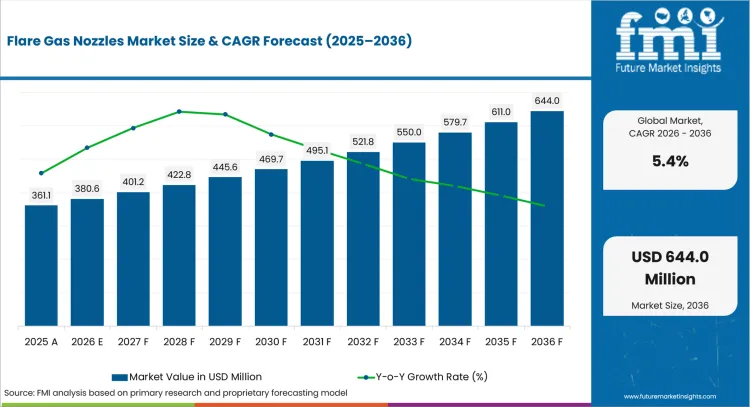
Key Takeaways of Flare Gas Nozzles Market
- Safety-critical relief duties and tighter emissions controls sustain demand for flare gas nozzles across new projects and installed systems.
- Sonic flare tips are projected to hold 28.0% share in 2026 owing to pressure-driven air entrainment that reduces continuous assist requirements.
- The flare system category is forecast to be led by elevated flares at 39.0% share in 2026 due to thermal separation needs.
- The stainless steel segment is likely to capture 36.0% share in 2026 attributable to oxidation resistance and practical fabrication economics.
- Zero-routine-flaring programs and outage-bound replacement lengthen purchase intervals even though emergency flare capacity remains necessary.
- John Zink Hamworthy, Zeeco, Honeywell UOP Callidus, Fives ITAS, Cimarron (Aereon), NAO Inc., MRW Technologies and GBA Flare Systems serve the market.
Analyst Perspective
"Process engineers should size a flare nozzle against the full relief envelope before comparing assist demand, metallurgy or purchase price. The strongest aftermarket position comes from proving stable combustion on the existing stack and completing replacement work inside the operator’s outage window."
- Nikhil Kaitwade, Principal Consultant, Future Market Insights
How is the flare gas nozzles market segmented?
The flare gas nozzles market is segmented by nozzle type, flare system, material, end use, sales channel and region.
Nozzle type covers sonic flare tips, steam-assisted nozzles, air-assisted nozzles, pressure-assisted gas nozzles and low-NOx flare nozzles. Flare system covers elevated flares, ground flares, enclosed flares and offshore flare systems. Material includes stainless steel, high nickel alloys, refractory-lined assemblies and duplex / super duplex. End use covers oil & gas production, refineries, petrochemicals, LNG / gas processing and biogas / waste gas. Sales channel includes flare system OEMs, EPC project supply, aftermarket retrofit and direct specialty fabrication.
What makes sonic flare tips central to the nozzle type category?
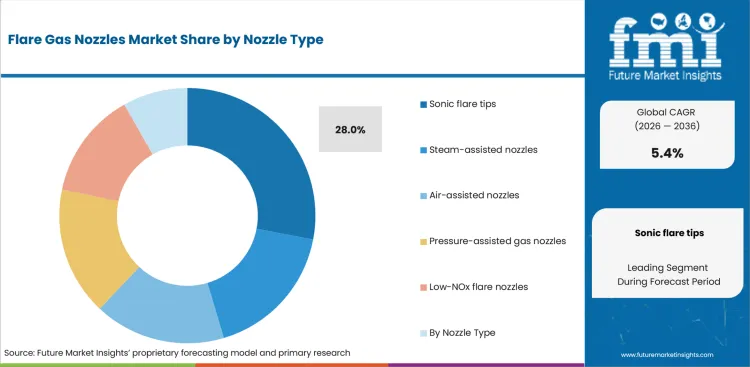
Sonic flare tips use available gas pressure to raise exit velocity and entrain surrounding air without continuous steam or blower assistance. Process engineers compare that behavior with wider air pollution control equipment goals and the credible relief envelope across each operating case.
- By nozzle type, sonic flare tips are estimated to hold 28.0% in 2026 owing to pressure-driven mixing that reduces continuous assist demand.
- EPA’s January 2025 reconsideration proposal referenced an 800 Btu/scf net-heating-value threshold for pressure-assisted flares. The threshold makes stable combustion across qualified high-pressure gas cases a practical design test for sonic flare tips.
Why do elevated flares lead the flare system category?
Elevated flares use stack height to separate major relief flames from personnel and process equipment during high-release events while retaining direct atmospheric discharge. Maintenance planning therefore combines combustion controls with riser access because tip inspection can otherwise require a full flare shutdown.
- In 2026, elevated flares are expected to lead the flare system category with 39.0% share because stack height provides practical radiation separation for large relief loads.
- Zeeco documented a North American LNG installation in March 2025 where a demountable structure lowered flare risers to grade for maintenance. That arrangement reduces maintenance shutdown exposure without removing the high-capacity elevated relief path.
What supports oil & gas production within the end use category?
Upstream facilities retain flare nozzles for start-up, upset and emergency gas even as operators recover more associated production. Changing separator pressure exposes tips to wide flow ranges and makes oil and gas field services important during shutdown execution and retrofit work.
- By end use, oil & gas production is forecast to represent 29.0% in 2026 driven by repeated relief duties across a broad installed upstream base.
- The USA EIA reported in November 2025 that associated natural gas output averaged 18.5 Bcf/d in 2024. That volume keeps upstream relief systems exposed to substantial gas-handling duty during equipment upsets and maintenance.
What drives flare system OEMs within the sales channel category?
Flare system OEMs coordinate nozzle geometry with pilots, risers and ignition hardware during project engineering so one organization retains responsibility for the complete relief design. Process studies connect nozzle sizing with oil and gas flow control before final relief cases receive approval.
- Flare system OEMs are set to lead the sales channel category with 38.0% share in 2026 due to single-point engineering responsibility.
- John Zink’s 2026 flare training program covers selection, operation and maintenance with dedicated courses for onshore and offshore flare systems. That training route reinforces the OEM role in technical validation before replacement or retrofit decisions.
What are the drivers, restraints and opportunities in the Flare Gas Nozzles Market?
New gas-processing projects sustain nozzle demand while lower routine flaring extends replacement cycles, leaving retrofit engineering as the strongest route for higher-value work.
- Driver: New gas-processing capacity adds relief duties that require engineered flare nozzles during commissioning and emergency operation.
- Restraint: Zero-routine-flaring programs reduce normal operating hours and lengthen replacement intervals for mechanically sound tips across mature assets.
- Opportunity: Compliance-driven retrofits reward nozzle packages that pair stable combustion with monitoring upgrades and planned field testing.
New gas-processing capacity adds flare-nozzle demand because each pressure system needs a qualified path for credible emergency gas. ADNOC Gas took FID on the first Rich Gas Development phase in June 2025 and awarded work across several UAE processing assets. That project pipeline favors firms that can model nozzle exit velocity and radiation while coordinating packages with LNG terminal equipment during EPC commissioning.
Lower routine flaring reduces sustained thermal exposure and can extend service life for mechanically sound tips across mature assets. The UK government reported in October 2025 that NSTA policy requires zero routine flaring and venting by 2030. Replacement orders therefore concentrate around inspections and process changes as operators align flare duty with VOC control systems and planned outage schedules.
Compliance retrofits become valuable when older flare systems lack monitoring hardware or test access required under current operating rules. In July 2025, EPA extended net-heating-value monitoring deadlines by 120 days because supply constraints and specialized retrofit work limited timely compliance. That delay makes field assessment and planned retrofit execution commercially relevant for firms able to coordinate monitoring upgrades with existing flare equipment.
Which country CAGRs are profiled in the Flare Gas Nozzles Market?
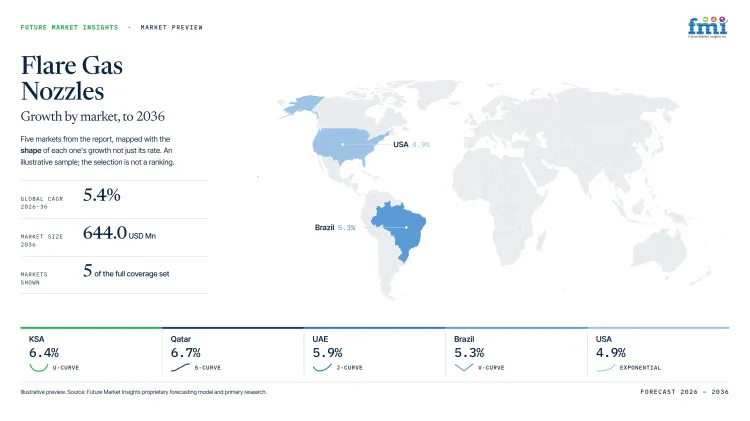
| Country | CAGR |
|---|---|
| Qatar | 6.7% |
| KSA | 6.4% |
| UAE | 5.9% |
| Brazil | 5.3% |
| USA | 4.9% |
How do country-level CAGRs compare in the Flare Gas Nozzles Market?
The 1.8-point CAGR range separates Gulf projects from mature service-led markets. Qatar and KSA form the upper group because gas developments concentrate new relief packages inside EPC programs. The UAE occupies the middle as processing expansion meets stricter low-flaring practice. Brazil and the USA depend more heavily on maintenance cycles.
- Qatar’s North Field program concentrates LNG relief packages around Ras Laffan qualification.
- KSA’s Jafurah buildout combines gas-processing relief duty with Aramco localization requirements for vendors.
- The UAE’s Rich Gas Development shifts nozzle demand toward emergency relief cases.
- Brazil’s deepwater platforms make marine metallurgy and shutdown logistics central to replacements.
- The USA combines mature flare assets with stricter federal associated-gas operating rules.
Similar rates conceal different qualification routes and service burdens across these markets.
The full report provides country-level CAGR analysis across North America, Latin America, Europe, East Asia, South Asia, Oceania and the Middle East and Africa.
Country-wise Analysis
- Adoption of flare gas nozzles in Qatar is estimated to expand at 6.7% CAGR through 2036, supported by high-pressure LNG relief packages and concentrated project engineering. QatarEnergy’s North Field program concentrates flare-nozzle purchasing in large Ras Laffan EPC packages that require sour-gas metallurgy and validated relief performance before installation across liquefaction trains and storage interfaces linked to marine export systems. QatarEnergy stated in May 2025 that North Field East production would start in mid-2026, making local engineering and outage coordination essential for approved nozzle orders where acid-gas composition and shutdown sequencing narrow acceptable replacement designs across operating trains and jetties.
- KSA is estimated to post 6.4% CAGR over the forecast period, but demanding combustion specifications and outage timing favor manufacturers that document performance and maintain responsive Saudi field engineering during turnaround execution across gas-processing assets nationwide. Aramco’s gas expansion places flare-nozzle decisions inside qualified operator and EPC packages that also carry in-Kingdom fabrication and service requirements across major projects where Aramco standards govern metallurgy plus pilot reliability and service documentation. Aramco reported in March 2026 that Jafurah production and Tanajib operations had started while iktva reached 70% localization in procurement, giving qualified domestic support a direct role in project access.
- UAE operators separate routine gas recovery from safety flare duty at Abu Dhabi processing sites and therefore purchase nozzles mainly for start-up or emergency cases across Habshan and Ruwais facilities. The UAE flare gas nozzles sector is projected to record 5.9% CAGR during the assessment period, reinforced by large processing additions and established low-flaring practice inside mature Abu Dhabi operating procedures. ADNOC Gas approved Rich Gas Development phases two and three in August 2026 with new Habshan and Ruwais capacity, but strict EPC qualification and outage planning favor firms that combine stable low-flow combustion with responsive terminal automation support locally.
- Brazilian offshore assets make nozzle durability and maintainability central because marine exposure narrows metallurgy choices while remote platform access limits practical maintenance windows where crane access and marine logistics make unscheduled tip work costly. Flare gas nozzle demand in Brazil is forecast to rise at 5.3% CAGR over the forecast period, supported by continued deepwater production and replacement work across mature pre-salt assets. Petrobras reported in January 2026 that Tupi and Iracema returned to one million barrels per day after eleven wells were connected during 2025, so firms must stage subsea equipment coordination and flare service inside tightly controlled platform shutdowns.
- United States operators manage a large installed flare base under federal rules that distinguish routine associated-gas disposal from emergency or process safety duty across production fields and refineries. EPA clarified in May 2026 that covered new oil wells faced a May 7 phase-out deadline for routine associated-gas flaring under OOOOb/c, leaving temporary flexibility only for specified operating constraints. Flare gas nozzle sales in the United States are forecast to expand at 4.9% CAGR by 2036, but mature equipment and changing compliance requirements concentrate orders on documented retrofits around inspections and operator-approved outage windows at mature field and refinery assets nationally.
Who are the notable companies in the Flare Gas Nozzles Market?
John Zink Hamworthy, Zeeco, Honeywell UOP Callidus, Fives ITAS, Cimarron (Aereon), NAO Inc., MRW Technologies and GBA Flare Systems are the notable companies serving this market.
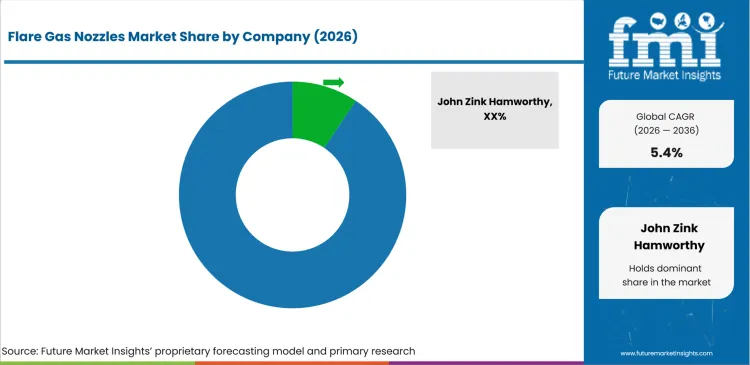
Competition is split between integrated combustion OEMs and specialist flare engineers serving new projects plus brownfield replacements. Large EPC packages favor firms that control combustion design, stack interfaces and commissioning responsibility. Brownfield entry depends on validated retrofit performance plus operator qualification and field service during planned outages.
- John Zink Hamworthy and Zeeco combine broad high-pressure flare portfolios with global engineering and lifecycle support networks.
- Honeywell UOP Callidus and Fives ITAS pair flare systems with broader refinery combustion engineering and international project execution.
- Cimarron (Aereon), NAO Inc., MRW Technologies and GBA Flare Systems focus on custom flare design plus field service for specialized operating cases.
Competitive Benchmarking: Flare Gas Nozzles Market
| Company | Flare Architecture Breadth | Lifecycle / Retrofit Support | Performance Engineering Depth | Geographic Reach |
|---|---|---|---|---|
| John Zink Hamworthy | High | High | High | Global with presence in 50+ countries |
| Zeeco | High | High | High | Global with 30+ operating locations |
| Honeywell UOP Callidus | High | High | High | Global Honeywell UOP network |
| Fives ITAS | High | Medium | High | Europe, Middle East and international projects |
| Cimarron (Aereon) | High | High | Medium | Americas, Europe, Middle East and Asia |
| NAO Inc. | High | Medium | Medium | North America with worldwide project history |
| MRW Technologies | High | High | Medium | United States with worldwide installations |
| GBA Flare Systems | High | High | Medium | Europe and international project delivery |
Scoring basis: High architecture breadth requires three verified flare formats while Medium requires two and Low requires one. High lifecycle support requires inspection, retrofit and field service while Medium requires two functions and Low requires one. High performance engineering requires testing and modeling while Medium requires one resource and Low requires documented application engineering. Geographic reach records verified service regions and is not scored across the reviewed company set.
Key Developments in the Flare Gas Nozzles Market
- In September 2025, Fives ITAS presented flare and combustion systems for oil and gas applications during an Iraqi ministry technical visit in Marseille.
- In February 2025, Zeeco opened its Advanced Research Complex with industrial-scale flaring platforms and fuel-blending infrastructure for equipment testing.
- In January 2025, Cimarron Energy documented a SyteLink360 deployment that monitored flare destruction performance and pilot status under an EPA compliance settlement.
Key Players in the Flare Gas Nozzles Market
Integrated Combustion and Major-Project OEMs
- John Zink Hamworthy
- Zeeco
- Honeywell UOP Callidus
- Fives ITAS
Flare-Specialist Engineering and Service Firms
- Cimarron (Aereon)
- NAO Inc.
- MRW Technologies
- GBA Flare Systems
Flare Gas Nozzles Market - Report Scope
| Coverage field | Report scope |
|---|---|
| Market breakdown | By nozzle type, flare system, material, end use, sales channel and region. |
| Quantitative Units | USD million. |
| Market Definition | Commercial revenue from flare gas nozzles, flare tips and nozzle assemblies supplied through OEM, EPC, aftermarket and specialty-fabrication channels. |
| Regions Covered | North America, Latin America, Europe, East Asia, South Asia and Pacific, and Middle East and Africa. |
| Countries Covered | Qatar, KSA, UAE, Brazil, USA, and 20+ countries included in the full report. |
| Key Companies Profiled | John Zink Hamworthy, Zeeco, Honeywell UOP Callidus, Fives ITAS, Cimarron (Aereon), NAO Inc., MRW Technologies, GBA Flare Systems. |
| Forecast Period | 2026 to 2036. |
| Approach | Primary and secondary research with market triangulation. |
Flare Gas Nozzles Market - Research Methodology
| Method | Approach |
|---|---|
| Primary Research | FMI analysts gathered input from manufacturers, service providers, technology developers, distributors, end users, procurement teams, and subject-matter experts. Interviews examined purchasing decisions, product or service evaluation, adoption barriers, approval requirements, pricing considerations, and expectations for technical or commercial support. Respondents were also asked what evidence is required before a trial, pilot, or initial order develops into regular purchasing. |
| Desk Research | Desk research covered government statistics, regulatory publications, trade data, industry associations, technical literature, standards, company filings, product information, and official corporate announcements. Sources were reviewed for relevance, publication date, geographic coverage, and consistency with the defined market scope. Claims relating to performance, applications, approvals, capacity, investment, and commercial activity were retained only when supported by credible public evidence. |
| Market Sizing and Forecasting | The market model combined the baseline value with historical performance, segment structure, pricing and volume indicators, adoption levels, company participation, and country-level demand conditions. Forecast assumptions considered economic activity, investment trends, regulatory developments, technology adoption, purchasing cycles, supply availability, and barriers to wider market use. Segment and regional estimates were reconciled before the final market total was calculated. |
| Data Validation | Estimates were checked against multiple independent indicators, including public data, company activity, trade patterns, industry developments, and findings from primary interviews. Validation also tested whether products, services, applications, and company revenues fell within the defined market boundaries. Adjacent categories, unsupported claims, overlapping revenues, and activities without direct market relevance were excluded to reduce double counting and maintain consistency across segments and countries. |
Flare Gas Nozzles Market by Segments
Flare Gas Nozzles Market segmented by Nozzle Type:
- Sonic flare tips
- Steam-assisted nozzles
- Air-assisted nozzles
- Pressure-assisted gas nozzles
- Low-NOx flare nozzles
Flare Gas Nozzles Market segmented by Flare System:
- Elevated flares
- Ground flares
- Enclosed flares
- Offshore flare systems
Flare Gas Nozzles Market segmented by Material:
- Stainless steel
- High nickel alloys
- Refractory-lined assemblies
- Duplex / super duplex
Flare Gas Nozzles Market segmented by End Use:
- Oil & gas production
- Refineries
- Petrochemicals
- LNG / gas processing
- Biogas / waste gas
Flare Gas Nozzles Market segmented by Sales Channel:
- Flare system OEMs
- EPC project supply
- Aftermarket retrofit
- Direct specialty fabrication
Flare Gas Nozzles Market by Region:
- North America
- United States
- Canada
- Latin America
- Brazil
- Mexico
- Chile
- Rest of Latin America
- Western Europe
- Germany
- United Kingdom
- Italy
- Spain
- France
- Nordics
- Benelux
- Rest of Western Europe
- Eastern Europe
- Russia
- Poland
- Hungary
- Balkan and Baltic States
- Rest of Eastern Europe
- East Asia
- China
- Japan
- South Korea
- South Asia and Pacific
- India
- ASEAN
- Australia and New Zealand
- Rest of South Asia and Pacific
- Middle East and Africa
- Kingdom of Saudi Arabia
- Other GCC Countries
- Türkiye
- South Africa
- Other African Union Countries
- Rest of Middle East and Africa
Research Sources and Bibliography
- World Bank. (2026, June 23). Global Flaring Rises Three Years in a Row, Undermining Energy Security.
- USA Energy Information Administration. (2026, April 16). USA natural gas exports to grow nearly 30% by 2027 as LNG facilities ramp up.
- USA Environmental Protection Agency. (2025, January 15). Reconsideration of Standards of Performance for New, Reconstructed, and Modified Sources and Emissions Guidelines for Existing Sources: Oil and Natural Gas Sector Climate Review.
- Zeeco. (2025, March 24). Demountable Flare Stack Systems in North America.
- USA Energy Information Administration. (2025, November 21). USA associated natural gas production increased 6% in 2024.
- John Zink. (2026). Course Schedule & Registration.
- ADNOC Gas. (2025, June 10). ADNOC Gas Takes Final Investment Decision and Awards $5 Billion in Contracts for First Phase of its Rich Gas Development Project.
- UK Government. (2025, October 29). UK methane action plan (accessible webpage).
- USA Environmental Protection Agency. (2025, July 31). Extension of Deadlines in Standards of Performance for New, Reconstructed, and Modified Sources and Emissions Guidelines for Existing Sources: Oil and Natural Gas Sector Climate Review Final Rule.
- Saudi Aramco. (2026, March 10). Aramco announces fourth quarter and full-year 2025 results.
- ADNOC Gas. (2026, August 10). ADNOC Gas Delivers Resilient Q2 Net Income, Takes FID on Major Growth Projects.
- QatarEnergy. (2025, May 20). H.E. Minister Saad Sherida Al-Kaabi: “Our LNG project in the USA will start production end of this year, and our North Field East expansion project in Qatar will start production Mid 2026”.
- Petrobras. (2026, January 13). Tupi/Iracema Field Returns to Reaching Production of 1 Million Barrels per Day.
- USA Environmental Protection Agency. (2026, May 1). EPA Clarifies When Oil and Natural Gas Producers Can Flare After Phase Out Deadline.
- Fives. (2025, September 5). The Deputy Minister of Industry and Minerals of Iraq visits Fives in Marseille.
- Zeeco. (2025, February 11). Zeeco Announces the Advanced Research Complex - Offering Global Clients Comprehensive Industrial-Scale Pilot Plant Solutions.
- Cimarron Energy. (2025, January 29). Cimarron’s SyteLink360® Performance Monitoring Technologies Deliver Emissions Compliance Solution to Operator’s EPA Consent Decree and Final Settlement.
- Honeywell UOP. (2026). UOP Home. Retrieved August 14, 2026.
- Fives. (2025, September 22). Fives expands combustion activity in India with a new office in Kolkata.
- NAO Inc. (2026). Combustion, Energy, Environmental and Safety Solutions Since 1912. Retrieved August 14, 2026.
- MRW Technologies. (2026). Thermal Oxidizer, Combustion and Flare Systems. Retrieved August 14, 2026.
- GBA Flare Systems. (2026). GBA Flare Systems. Retrieved August 14, 2026.
This bibliography is provided for reader reference and is not exhaustive. The full report contains the complete reference list and detailed citations
This Report Answers
- What is the flare gas nozzles market size in 2026 and how large is it forecast to become by 2036?
- Which safety and process-investment conditions sustain demand for flare gas nozzles as routine flaring declines?
- Why do sonic flare tips hold the leading share within the nozzle type category?
- How do elevated flares shape maintenance access and relief-system design within the flare system category?
- How do zero-routine-flaring programs affect replacement timing and retrofit priorities for installed flare tips?
- Why do growth conditions differ across Qatar, KSA, UAE, Brazil and the USA?
- How are John Zink Hamworthy, Zeeco and other profiled companies positioned across engineering and lifecycle support?
- What should process safety teams evaluate before approving a new flare nozzle or replacement tip?
Frequently Asked Questions
How big is the Flare Gas Nozzles Market in 2026?
The flare gas nozzles market is expected to be valued at USD 380.6 million in 2026 and reach USD 644.0 million by 2036. Safety-critical relief duties and tighter emissions requirements sustain spending across new installations and replacement flare tips.
What is the CAGR of the Flare Gas Nozzles Market from 2026 to 2036?
The flare gas nozzles market is projected to grow at a 5.4% CAGR between 2026 and 2036. Gas-processing investment and recurring replacement needs maintain demand even as operators reduce routine gas flaring.
Which nozzle type leads the flare gas nozzles market?
Sonic flare tips are projected to account for 28.0% of the market in 2026. Their leading share is supported by efficient air entrainment and suitability for high-pressure relief applications across oil, gas, and process facilities.
How much value will the Flare Gas Nozzles Market add between 2026 and 2036?
The flare gas nozzles market is expected to add USD 263.4 million in value between 2026 and 2036. Expansion reflects new gas-processing relief duties plus retrofit demand from installed flare systems that require qualified replacement nozzles.
Which companies are active in the Flare Gas Nozzles Market?
The flare gas nozzles market includes John Zink Hamworthy, Zeeco, Honeywell UOP Callidus, Fives ITAS, Aereon (Cimarron Energy), NAO Inc., MRW Technologies and GBA Flare Systems. These companies compete across integrated flare engineering and specialist retrofit or lifecycle-service models for industrial operators worldwide.
Preview the report firsthand - request a free sample
Get SampleGet the brochure for pricing and purchase details.
Get PDFTable of Content
- Key Takeaways
- Market Size and CAGR
- Top Growth Driver
- Fastest Growing Segment
- Leading Region
- Key Companies
- Emerging Opportunities
- Executive Summary
- Global Market Outlook
- Demand-side Trends
- Supply-side Trends
- Technology Roadmap Analysis
- Analysis and Recommendations
- Analyst Perspective (What is happening? Why now? What should investors know?)
- Key Questions Answered
- How large is the market?
- What is the CAGR?
- What are key trends?
- Which region dominates?
- Who are the leaders?
- Market Overview
- Market Coverage / Taxonomy
- Market Definition / Scope / Limitations
- Research Methodology
- Chapter Orientation
- Analytical Lens and Working Hypotheses
- Market Structure, Signals, and Trend Drivers
- Benchmarking and Cross-market Comparability
- Market Sizing, Forecasting, and Opportunity Mapping
- Research Design and Evidence Framework
- Desk Research Programme (Secondary Evidence)
- Expert Input and Fieldwork (Primary Evidence)
- Tooling, Models, and Reference Databases
- Data Engineering and Model Build
- Quality Assurance and Audit Trail
- Market Background
- Market Dynamics (Drivers, Restraints, Opportunity, Trends)
- Scenario Forecast (Optimistic, Likely, Conservative)
- Impact Analysis
- AI Impact
- Sustainability Impact
- Regulatory Impact
- Technology Impact
- Consumer / Buyer Analysis
- Purchase Drivers
- Adoption Barriers
- Buyer Journey
- Opportunity Map Analysis
- Product Life Cycle Analysis
- Supply Chain Analysis
- Investment Feasibility Matrix
- Value Chain Analysis
- PESTLE and Porter's Analysis
- Regulatory Landscape
- Regional Parent Market Outlook
- Production and Consumption Statistics
- Import and Export Statistics
- Global Market Analysis and Forecast, 2021 to 2036
- Historical Market Size Value (USD Million) Analysis, 2021 to 2025
- Current and Future Market Size Value (USD Million) Projections, 2026 to 2036
- Y-o-Y Growth Trend Analysis
- Absolute $ Opportunity Analysis
- Global Market Pricing Analysis, 2021 to 2036
- Global Market Analysis and Forecast, By Nozzle Type, 2021 to 2036
- Introduction / Key Findings
- Historical Market Size Value (USD Million) Analysis By Nozzle Type, 2021 to 2025
- Current and Future Market Size Value (USD Million) Analysis and Forecast By Nozzle Type, 2026 to 2036
- Sonic flare tips
- Steam-assisted nozzles
- Air-assisted nozzles
- Pressure-assisted gas nozzles
- Low-NOx flare nozzles
- By Nozzle Type
- Sonic flare tips
- Y-o-Y Growth Trend Analysis By Nozzle Type, 2021 to 2025
- Absolute $ Opportunity Analysis By Nozzle Type, 2026 to 2036
- Global Market Analysis and Forecast, By Flare System, 2021 to 2036
- Introduction / Key Findings
- Historical Market Size Value (USD Million) Analysis By Flare System, 2021 to 2025
- Current and Future Market Size Value (USD Million) Analysis and Forecast By Flare System, 2026 to 2036
- Elevated flares
- Ground flares
- Enclosed flares
- Offshore flare systems
- By Frequency
- Elevated flares
- Y-o-Y Growth Trend Analysis By Flare System, 2021 to 2025
- Absolute $ Opportunity Analysis By Flare System, 2026 to 2036
- Global Market Analysis and Forecast, By Material, 2021 to 2036
- Introduction / Key Findings
- Historical Market Size Value (USD Million) Analysis By Material, 2021 to 2025
- Current and Future Market Size Value (USD Million) Analysis and Forecast By Material, 2026 to 2036
- Stainless steel
- High nickel alloys
- Refractory-lined assemblies
- Duplex / super duplex
- By Application
- Stainless steel
- Y-o-Y Growth Trend Analysis By Material, 2021 to 2025
- Absolute $ Opportunity Analysis By Material, 2026 to 2036
- Global Market Analysis and Forecast, By End Use, 2021 to 2036
- Introduction / Key Findings
- Historical Market Size Value (USD Million) Analysis By End Use, 2021 to 2025
- Current and Future Market Size Value (USD Million) Analysis and Forecast By End Use, 2026 to 2036
- Oil & gas production
- Refineries
- Petrochemicals
- LNG / gas processing
- Biogas / waste gas
- By End Use
- Oil & gas production
- Y-o-Y Growth Trend Analysis By End Use, 2021 to 2025
- Absolute $ Opportunity Analysis By End Use, 2026 to 2036
- Global Market Analysis and Forecast, By Sales Channel, 2021 to 2036
- Introduction / Key Findings
- Historical Market Size Value (USD Million) Analysis By Sales Channel, 2021 to 2025
- Current and Future Market Size Value (USD Million) Analysis and Forecast By Sales Channel, 2026 to 2036
- Flare system OEMs
- EPC project supply
- Aftermarket retrofit
- Direct specialty fabrication
- By Sales Channel
- Flare system OEMs
- Y-o-Y Growth Trend Analysis By Sales Channel, 2021 to 2025
- Absolute $ Opportunity Analysis By Sales Channel, 2026 to 2036
- Global Market Analysis and Forecast, By Region, 2021 to 2036
- Introduction
- Historical Market Size Value (USD Million) Analysis By Region, 2021 to 2025
- Current Market Size Value (USD Million) Analysis and Forecast By Region, 2026 to 2036
- North America
- Latin America
- Western Europe
- Eastern Europe
- East Asia
- South Asia and Pacific
- Middle East & Africa
- Market Attractiveness Analysis By Region
- North America Market Analysis and Forecast, By Country, 2021 to 2036
- Historical Market Size Value (USD Million) Trend Analysis By Market Taxonomy, 2021 to 2025
- Market Size Value (USD Million) Forecast By Market Taxonomy, 2026 to 2036
- By Country
- USA
- Canada
- By Nozzle Type
- By Flare System
- By Material
- By End Use
- By Sales Channel
- By Country
- Market Attractiveness Analysis
- By Country
- By Nozzle Type
- By Flare System
- By Material
- By End Use
- By Sales Channel
- Key Takeaways
- Latin America Market Analysis and Forecast, By Country
- Historical Market Size Value (USD Million) Trend Analysis By Market Taxonomy, 2021 to 2025
- Market Size Value (USD Million) Forecast By Market Taxonomy, 2026 to 2036
- By Country
- Brazil
- Mexico
- Chile
- Rest of Latin America
- By Nozzle Type
- By Flare System
- By Material
- By End Use
- By Sales Channel
- By Country
- Market Attractiveness Analysis
- By Country
- By Nozzle Type
- By Flare System
- By Material
- By End Use
- By Sales Channel
- Key Takeaways
- Western Europe Market Analysis and Forecast, By Country
- Historical Market Size Value (USD Million) Trend Analysis By Market Taxonomy, 2021 to 2025
- Market Size Value (USD Million) Forecast By Market Taxonomy, 2026 to 2036
- By Country
- Germany
- UK
- Italy
- Spain
- France
- Nordic
- BENELUX
- Rest of Western Europe
- By Nozzle Type
- By Flare System
- By Material
- By End Use
- By Sales Channel
- By Country
- Market Attractiveness Analysis
- By Country
- By Nozzle Type
- By Flare System
- By Material
- By End Use
- By Sales Channel
- Key Takeaways
- Eastern Europe Market Analysis and Forecast, By Country
- Historical Market Size Value (USD Million) Trend Analysis By Market Taxonomy, 2021 to 2025
- Market Size Value (USD Million) Forecast By Market Taxonomy, 2026 to 2036
- By Country
- Russia
- Poland
- Hungary
- Balkan & Baltic
- Rest of Eastern Europe
- By Nozzle Type
- By Flare System
- By Material
- By End Use
- By Sales Channel
- By Country
- Market Attractiveness Analysis
- By Country
- By Nozzle Type
- By Flare System
- By Material
- By End Use
- By Sales Channel
- Key Takeaways
- East Asia Market Analysis and Forecast, By Country
- Historical Market Size Value (USD Million) Trend Analysis By Market Taxonomy, 2021 to 2025
- Market Size Value (USD Million) Forecast By Market Taxonomy, 2026 to 2036
- By Country
- China
- Japan
- South Korea
- By Nozzle Type
- By Flare System
- By Material
- By End Use
- By Sales Channel
- By Country
- Market Attractiveness Analysis
- By Country
- By Nozzle Type
- By Flare System
- By Material
- By End Use
- By Sales Channel
- Key Takeaways
- South Asia and Pacific Market Analysis and Forecast, By Country
- Historical Market Size Value (USD Million) Trend Analysis By Market Taxonomy, 2021 to 2025
- Market Size Value (USD Million) Forecast By Market Taxonomy, 2026 to 2036
- By Country
- India
- ASEAN
- Australia & New Zealand
- Rest of South Asia and Pacific
- By Nozzle Type
- By Flare System
- By Material
- By End Use
- By Sales Channel
- By Country
- Market Attractiveness Analysis
- By Country
- By Nozzle Type
- By Flare System
- By Material
- By End Use
- By Sales Channel
- Key Takeaways
- Middle East & Africa Market Analysis and Forecast, By Country
- Historical Market Size Value (USD Million) Trend Analysis By Market Taxonomy, 2021 to 2025
- Market Size Value (USD Million) Forecast By Market Taxonomy, 2026 to 2036
- By Country
- Kingdom of Saudi Arabia
- Other GCC Countries
- Türkiye
- South Africa
- Other African Union
- Rest of Middle East & Africa
- By Nozzle Type
- By Flare System
- By Material
- By End Use
- By Sales Channel
- By Country
- Market Attractiveness Analysis
- By Country
- By Nozzle Type
- By Flare System
- By Material
- By End Use
- By Sales Channel
- Key Takeaways
- Key Countries Market Analysis
- USA
- Pricing Analysis
- Market Share Analysis, 2025
- By Nozzle Type
- By Flare System
- By Material
- By End Use
- By Sales Channel
- Canada
- Pricing Analysis
- Market Share Analysis, 2025
- By Nozzle Type
- By Flare System
- By Material
- By End Use
- By Sales Channel
- Mexico
- Pricing Analysis
- Market Share Analysis, 2025
- By Nozzle Type
- By Flare System
- By Material
- By End Use
- By Sales Channel
- Brazil
- Pricing Analysis
- Market Share Analysis, 2025
- By Nozzle Type
- By Flare System
- By Material
- By End Use
- By Sales Channel
- Chile
- Pricing Analysis
- Market Share Analysis, 2025
- By Nozzle Type
- By Flare System
- By Material
- By End Use
- By Sales Channel
- Germany
- Pricing Analysis
- Market Share Analysis, 2025
- By Nozzle Type
- By Flare System
- By Material
- By End Use
- By Sales Channel
- UK
- Pricing Analysis
- Market Share Analysis, 2025
- By Nozzle Type
- By Flare System
- By Material
- By End Use
- By Sales Channel
- Italy
- Pricing Analysis
- Market Share Analysis, 2025
- By Nozzle Type
- By Flare System
- By Material
- By End Use
- By Sales Channel
- Spain
- Pricing Analysis
- Market Share Analysis, 2025
- By Nozzle Type
- By Flare System
- By Material
- By End Use
- By Sales Channel
- France
- Pricing Analysis
- Market Share Analysis, 2025
- By Nozzle Type
- By Flare System
- By Material
- By End Use
- By Sales Channel
- India
- Pricing Analysis
- Market Share Analysis, 2025
- By Nozzle Type
- By Flare System
- By Material
- By End Use
- By Sales Channel
- ASEAN
- Pricing Analysis
- Market Share Analysis, 2025
- By Nozzle Type
- By Flare System
- By Material
- By End Use
- By Sales Channel
- Australia & New Zealand
- Pricing Analysis
- Market Share Analysis, 2025
- By Nozzle Type
- By Flare System
- By Material
- By End Use
- By Sales Channel
- China
- Pricing Analysis
- Market Share Analysis, 2025
- By Nozzle Type
- By Flare System
- By Material
- By End Use
- By Sales Channel
- Japan
- Pricing Analysis
- Market Share Analysis, 2025
- By Nozzle Type
- By Flare System
- By Material
- By End Use
- By Sales Channel
- South Korea
- Pricing Analysis
- Market Share Analysis, 2025
- By Nozzle Type
- By Flare System
- By Material
- By End Use
- By Sales Channel
- Russia
- Pricing Analysis
- Market Share Analysis, 2025
- By Nozzle Type
- By Flare System
- By Material
- By End Use
- By Sales Channel
- Poland
- Pricing Analysis
- Market Share Analysis, 2025
- By Nozzle Type
- By Flare System
- By Material
- By End Use
- By Sales Channel
- Hungary
- Pricing Analysis
- Market Share Analysis, 2025
- By Nozzle Type
- By Flare System
- By Material
- By End Use
- By Sales Channel
- Kingdom of Saudi Arabia
- Pricing Analysis
- Market Share Analysis, 2025
- By Nozzle Type
- By Flare System
- By Material
- By End Use
- By Sales Channel
- Türkiye
- Pricing Analysis
- Market Share Analysis, 2025
- By Nozzle Type
- By Flare System
- By Material
- By End Use
- By Sales Channel
- South Africa
- Pricing Analysis
- Market Share Analysis, 2025
- By Nozzle Type
- By Flare System
- By Material
- By End Use
- By Sales Channel
- USA
- Market Structure Analysis
- Competition Dashboard
- Competition Benchmarking
- Market Share Analysis of Top Players
- By Regional
- By Nozzle Type
- By Flare System
- By Material
- By End Use
- By Sales Channel
- Emerging Startups
- Innovation Benchmarking
- Competition Analysis
- Competition Deep Dive
- John Zink Hamworthy
- Overview
- Product Portfolio
- Profitability by Market Segments
- Sales Footprint
- Strategy Overview
- Marketing Strategy
- Product Strategy
- Channel Strategy
- Zeeco
- Honeywell UOP Callidus
- Fives ITAS
- Aereon
- NAO Inc.
- MRW Technologies
- GBA Flare Systems
- Flare Industries
- Argo Flare
- John Zink Hamworthy
- Case Studies
- Success Stories
- Recent Developments
- Competition Deep Dive
- Assumptions & Acronyms Used


