

- Market Size (2026)
- USD 1.7 Bn
- Forecast (2036)
- USD 2.9 Bn
- CAGR (2026 to 2036)
- 5.6%
How big is Fuel Gas Skids Market in 2026?
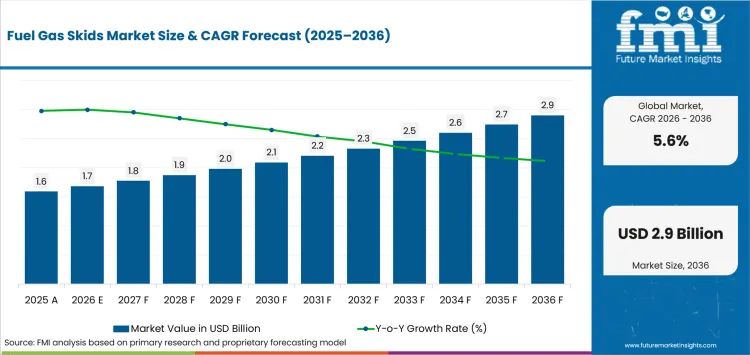
USD 1.7 billion in 2026 and USD 2.9 billion by 2036 at a 5.6% CAGR.
Demand for fuel gas skids is projected to grow from USD 1.7 billion in 2026 to USD 2.9 billion by 2036, reflecting a 5.6% CAGR. Expansion of LNG infrastructure continues to create demand for gas-conditioning and pressure-control equipment across liquefaction, storage, and distribution facilities. The International Energy Agency reported in June 2026 that about 345 bcm per year of new LNG export capacity is expected online between 2025 and 2030 from projects already under construction at the start of 2025. Each completed train expands potential package scope for regulation and conditioning, while project timing depends on construction progress and commissioning schedules.
US power demand provides a different commercial route through a large installed gas fleet that sustains replacement work alongside new capacity. In January 2026 the US Energy Information Administration forecast natural-gas-fired generation of 1,696 BkWh for 2026 and 1,711 BkWh for 2027. Regional growth is concentrated in ERCOT and PJM, so industrial gas turbine and power generation gas turbine upgrades can generate skid orders despite slow national gas-generation change.
Key Takeaways of Fuel Gas Skids Market
- LNG liquefaction trains and gas-fired power projects increase the number of pressure-control interfaces that need engineered fuel conditioning for startup.
- By skid type, pressure regulating skids are estimated to hold 27.0% in 2026 owing to pressure reduction being common to most fuel-gas delivery trains.
- In 2026, regulators - control valves are expected to lead the component category with 26.0% share because active flow control is required during routine operation.
- Medium pressure is set to lead the pressure rating category with 39.0% share in 2026 due to repeatable equipment serving many industrial and turbine interfaces.
- Project-specific gas composition and approval requirements can extend engineering cycles as each package must match plant safety logic and tie-in conditions.
- Some of the key players in this market include Emerson, Honeywell, Siemens Energy, Pietro Fiorentini, Enerflex, Baker Hughes, Flowserve, and GE Vernova.
Analyst Perspective
"Fuel gas skid economics depend on who owns the pressure-control and turbine-interface risk during commissioning. Packages earn margin if one engineering team can troubleshoot controls and replace critical valves without reopening the full skid design."
- Nikhil Kaitwade, Principal Consultant, Future Market Insights
How is the Fuel Gas Skids Market segmented?
The fuel gas skids market is segmented by skid type, component, pressure rating, end use, sales channel and region.
Skid type includes pressure regulating skids and fuel gas conditioning skids plus metering, filtration / knockout and heating / dew point control skids. Components comprise regulators - control valves and filters / coalescers plus flow meters, heaters and PLC / safety controls. Pressure rating covers low pressure and medium pressure plus high pressure and custom engineered packages. End use covers gas turbines and industrial boilers plus refineries, petrochemical plants and LNG / gas processing. Sales channels include direct skid OEM sales and turbine package supply plus EPC project supply and aftermarket retrofit.
How do Gas Turbines set the pace in the End Use category?
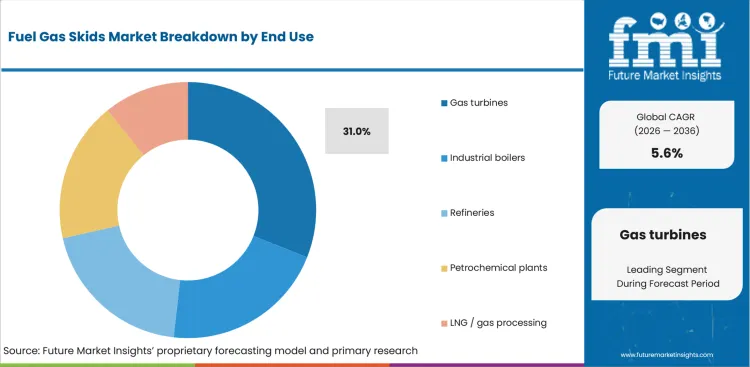
Gas turbine packages impose a narrow operating window on fuel pressure because combustion hardware responds quickly to flow changes during ramping. The dedicated turbine interface must also coordinate fuel permissives with startup sequencing and trip logic.
- By end use, gas turbines are forecast to represent 31.0% in 2026 driven by dedicated fuel-gas conditioning and safety interfaces within turbine islands.
- Turbine orders reveal package scope most clearly through supporting fuel equipment shipped directly with the prime mover. GE Vernova announced in July 2025 that 29 LM2500XPRESS turbine packages for Crusoe would each include a gas compressor.
What makes Pressure Regulating skids central to the Skid type category?
Pressure regulating skids define the control boundary between upstream supply pressure and the delivery condition required by downstream burners or turbines. EPC engineers can place gas pressure regulators and overpressure protection inside one package, reducing interface ambiguity during commissioning.
- By skid type, pressure regulating skids are estimated to hold 27.0% in 2026 owing to pressure reduction being common to most fuel-gas delivery trains.
- Network qualification also requires verified control behavior under changing operating conditions before a package reaches final acceptance. In June 2025 Pietro Fiorentini reported five BiRemi plants designed and installed in Italy, including dynamic pressure control at Motta Baluffi.
Why do Regulators - control valves lead the Component category?
Regulators and control valves stay in the fuel path during normal operation since load changes require continuous pressure and flow adjustment. Filters and meters address narrower duties, leaving industrial valves active for more of the operating cycle.
- In 2026, regulators - control valves are expected to lead the component category with 26.0% share because active flow control is required during routine operation.
- Manufacturing qualification carries direct cost as regulator calibration and leak checks must be repeated consistently prior to shipment. Pietro Fiorentini reported in April 2025 that its CE-certified MaCoReFe testing machine raised productivity by 31% while automating those checks.
What supports Medium Pressure in the Pressure rating category?
Medium-pressure packages occupy the practical middle of fuel-gas duty since many plants receive gas above final burner or turbine requirements without entering extreme pressure classes. Pressure reducing valves can use repeatable designs while engineers still size each train for inlet variation.
- Medium pressure is set to lead the pressure rating category with 39.0% share in 2026 due to repeatable equipment serving many industrial and turbine interfaces.
- Higher-pressure projects require narrower engineering choices and therefore define the upper boundary of this repeatable package core. In June 2025 Pietro Fiorentini documented a station that reduces pressure from 200 bar to 20 mbar while handling hydrogen blends.
What are the drivers, restraints and opportunities in the Fuel Gas Skids Market?
New LNG and gas-fired power projects expand package demand, while qualification work slows orders and installed-base modernization expands retrofit revenue.
- Driver: Executed LNG and gas-fired power projects increase the number of fuel-gas interfaces that require controlled pressure for equipment startup.
- Restraint: Safety codes and owner specifications can extend approval as package materials and trip logic must match project-specific gas conditions.
- Opportunity: Brownfield plants can replace measurement and control subsystems without funding a complete skid replacement during every maintenance cycle.
Executed LNG Projects Increase Fuel-Gas Interface Count
Large LNG awards place compression and turbine equipment inside an integrated project package. Baker Hughes announced in October 2025 that Bechtel awarded it liquefaction equipment for Port Arthur LNG Phase 2, including four Frame 7 gas turbines and eight centrifugal compressors. Comparable process plant gas turbines require controlled fuel interfaces for commissioning and final performance testing under the EPC acceptance schedule.
Specification Density Extends Approval Cycles
Safety hardware must satisfy formal pressure and leakage requirements to clear the owner's specification. Emerson introduced the Anderson Greenwood Type 84 pressure relief valve in February 2025 for high-pressure gas service, with compliance to ASME Sections VIII and XIII plus API 527. Each additional code check increases documentation work for custom inlet conditions and brownfield tie-ins during final owner review.
Installed Equipment Expands Retrofit Scope
A full skid replacement is unnecessary for many brownfield upgrades because operators can isolate obsolete controls or rotating equipment during planned outages. Honeywell completed its Sundyne acquisition in June 2025, bringing engineered gas compressors and a large aftermarket installed base into its process portfolio. Skid specialists can pursue flow meter devices and control upgrades against the same brownfield logic without waiting for a new plant.
Which country CAGRs are profiled in the Fuel Gas Skids Market?
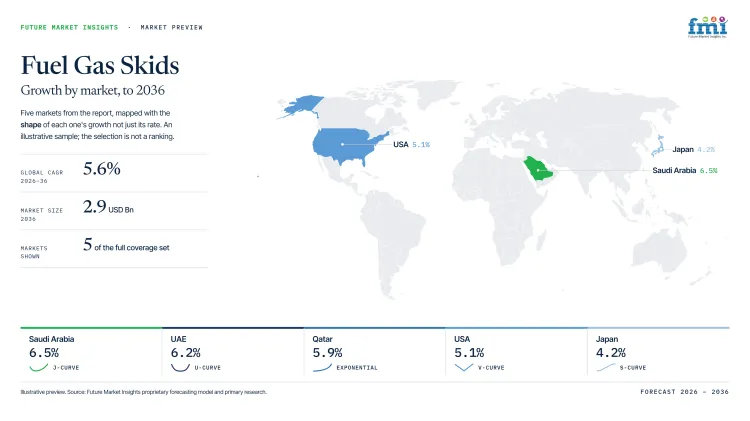
| Country | CAGR |
|---|---|
| Saudi Arabia | 6.5% |
| UAE | 6.2% |
| Qatar | 5.9% |
| USA | 5.1% |
| Japan | 4.2% |
How do country-level CAGRs compare in the Fuel Gas Skids Market?
The profiled countries span 1.4 percentage points from Saudi Arabia at 6.5% to the USA at 5.1%. Saudi Arabia, UAE and Qatar form the upper group as major gas and power projects concentrate package awards inside EPC schedules. Brazil and the USA sit lower since replacement work and thermal dispatch spread orders over more assets.
- Saudi Arabia places more package scope inside domestic manufacturing plans.
- UAE project sequencing rewards controls documentation ready for fixed commissioning windows.
- Qatar concentrates addressable orders inside LNG programs with strict vendor qualification.
- US demand spreads through a large installed base replacing individual control subsystems.
- Japan demand spreads through a mature installed base, with operators replacing individual control subsystems during planned maintenance.
Comparable CAGRs therefore produce different order timing and qualification risk. The full report provides country-level CAGR analysis across North America, Latin America, Europe, East Asia, South Asia, Oceania and the Middle East and Africa.
Country-wise Analysis
- Saudi Arabia: At 6.5% CAGR through 2036, Saudi Arabia represents one of the stronger growth markets for fuel-gas skids. Expansion of gas-fired generation and industrial facilities is increasing the need for dependable packaged fuel-gas solutions. EPC contractors are also seeking suppliers that can handle engineering and site commissioning requirements. After-sales coverage and access to replacement parts are becoming increasingly relevant for long-term project support.
- UAE: The UAE fuel-gas skid market is expected to reach a 6.2% CAGR through 2036, with demand closely linked to ongoing energy infrastructure development. Short project execution windows are encouraging greater use of pre-engineered and standardized skid packages. Supplier selection is increasingly influenced by the ability to coordinate installation and testing alongside EPC activities. Companies with established local technical teams can therefore strengthen their position in the market.
- Qatar: Qatar is forecast to record 5.9% CAGR through 2036, primarily reflecting continued investment across LNG and natural-gas infrastructure. The scale of these projects places greater emphasis on equipment reliability, documentation, and compliance with operator requirements. Vendor qualification often needs to be completed early so that skid specifications align with project standards. Inspection and commissioning preparedness can consequently affect supplier approval and procurement timelines.
- USA: With demand projected to grow at 5.1% CAGR through 2036, the U.S. market combines new-build requirements with a substantial replacement opportunity. LNG facilities, gas power plants, pipelines, and older industrial assets are supporting demand from both greenfield and brownfield applications. While new projects favor complete packaged systems, existing facilities often require targeted modernization of aging equipment. Strong regional support infrastructure and quick access to spare parts can improve supplier competitiveness.
- Japan: Japan's fuel-gas skid demand is estimated to increase at 4.2% CAGR through 2036, reflecting investment in LNG facilities and the modernization of established gas-based energy assets. Unlike markets dominated by large greenfield projects, demand is also emerging from upgrades where new equipment must work within existing plant configurations. Compact designs and integration flexibility are therefore valuable attributes. Operators are likely to favor suppliers offering dependable lifecycle support without creating significant operational disruption.
Who are the notable companies in the Fuel Gas Skids Market?
Emerson, Honeywell, Siemens Energy, Pietro Fiorentini, Enerflex, Baker Hughes, Flowserve, and GE Vernova.
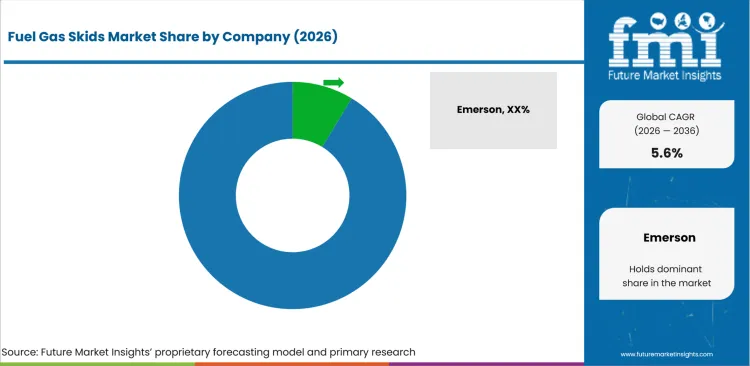
Competition spans automation groups and turbine OEMs plus specialists in gas pressure control and modular processing. Emerson and Honeywell cover control and measurement functions while Siemens Energy and GE Vernova influence turbine auxiliary boundaries through OEM contracts. Pietro Fiorentini and Enerflex supply pressure-control or modular gas-processing packages, while Baker Hughes and Flowserve bring turbomachinery or valve depth. Entry barriers come from qualification history and local service reach plus the ability to commission interfaces inside an EPC schedule.
- Emerson and Honeywell compete with Pietro Fiorentini on projects in which regulation and measurement depth determine package acceptance.
- Siemens Energy and GE Vernova influence fuel-system boundaries through turbine supply and long-term service relationships.
- Enerflex and Baker Hughes cover packaged gas processing or compression while Flowserve brings critical valve and aftermarket support.
Competitive Benchmarking: Fuel Gas Skids Market
| Company | Gas-Handling Scope | Measurement / Control Integration | Turbine / Process Integration | Geographic Reach |
|---|---|---|---|---|
| Emerson | High | High | Medium | Global |
| Honeywell | High | High | High | Global |
| Siemens Energy | Medium | High | High | Global |
| Pietro Fiorentini | High | High | Medium | Europe, Asia and Americas |
| Enerflex | High | Medium | High | Americas, Middle East and international projects |
| Baker Hughes | High | Medium | High | Global |
| Flowserve | Medium | Medium | Medium | Global |
| GE Vernova | Medium | Medium | High | Global |
Scoring basis: High gas-handling scope requires at least three documented functions among pressure control and compression plus conditioning or protection. Medium requires two documented functions while Low identifies one. High measurement / control integration requires measurement plus process or safety control in the assessed portfolio. Medium documents one integration layer while Low identifies limited automation evidence. High turbine / process integration requires full turbine or modular process-package scope. Medium identifies equipment regularly integrated inside those boundaries while Low is component-only. Geographic reach describes active operating regions and is not scored.
Source basis: ratings use official 2025-2026 company annual reports, filings, investor materials, newsroom releases and documented operating-region evidence for the assessed fuel-gas package functions.
Key Developments in the Fuel Gas Skids Market
- In June 2026, Flowserve completed its acquisition of Trillium Flow Technologies' valves division and expanded its portfolio of mission-critical flow-control equipment for power and industrial infrastructure.
- In June 2026, Siemens Energy announced turbine and auxiliary-system supply for the 2.6 GW Taweelah C combined-cycle project in Abu Dhabi under a multi-party EPC structure.
- In September 2025, Honeywell announced that its LNG process technology and integrated control system would support up to 7.8 MTPA of production at the AMIGO LNG export terminal in Mexico.
Key Players in the Fuel Gas Skids Market
Integrated Automation and Control
- Emerson
- Honeywell
Turbine and Gas-Handling Systems
- Siemens Energy
- Pietro Fiorentini
Modular Process and Flow Equipment
- Enerflex
- Baker Hughes
- Flowserve
- GE Vernova
Fuel Gas Skids Market - Report Scope
| Coverage field | Report scope |
|---|---|
| Market breakdown | By skid type, component, pressure rating, end use, sales channel and region. |
| Quantitative Units | USD Billion. |
| Market Definition | Revenue includes engineered fuel gas skid packages and skid-integrated equipment used to regulate, condition, filter, heat, meter or safety-control gaseous fuel before downstream equipment. Standalone components and complete process plants are excluded. |
| Forecast Period | 2026 to 2036. |
| Historical Data | 2025. |
| Key Countries | Saudi Arabia, UAE, Qatar, Brazil and USA. |
| Key Segments | Pressure regulating skids, regulators - control valves, medium pressure and gas turbines. |
| Key Companies Profiled | Emerson, Honeywell, Siemens Energy, Pietro Fiorentini, Enerflex, Baker Hughes, Flowserve, GE Vernova. |
Fuel Gas Skids Market - Research Methodology
| Method | Approach |
|---|---|
| Primary Research | FMI analysts gathered input from manufacturers, service providers, technology developers, distributors, end users, procurement teams, and subject-matter experts. Interviews examined purchasing decisions, product or service evaluation, adoption barriers, approval requirements, pricing considerations, and expectations for technical or commercial support. Respondents were also asked what evidence is required before a trial, pilot, or initial order develops into regular purchasing. |
| Desk Research | Desk research covered government statistics, regulatory publications, trade data, industry associations, technical literature, standards, company filings, product information, and official corporate announcements. Sources were reviewed for relevance, publication date, geographic coverage, and consistency with the defined market scope. Claims relating to performance, applications, approvals, capacity, investment, and commercial activity were retained only when supported by credible public evidence. |
| Market Sizing and Forecasting | The market model combined the baseline value with historical performance, segment structure, pricing and volume indicators, adoption levels, company participation, and country-level demand conditions. Forecast assumptions considered economic activity, investment trends, regulatory developments, technology adoption, purchasing cycles, supply availability, and barriers to wider market use. Segment and regional estimates were reconciled before the final market total was calculated. |
| Data Validation | Estimates were checked against multiple independent indicators, including public data, company activity, trade patterns, industry developments, and findings from primary interviews. Validation also tested whether products, services, applications, and company revenues fell within the defined market boundaries. Adjacent categories, unsupported claims, overlapping revenues, and activities without direct market relevance were excluded to reduce double counting and maintain consistency across segments and countries. |
Fuel Gas Skids Market by Segments
Fuel Gas Skids Market segmented by Skid Type:
- Pressure regulating skids
- Fuel gas conditioning skids
- Metering skids
- Filtration / knockout skids
- Heating / dew point control skids
Fuel Gas Skids Market segmented by Component:
- Regulators - control valves
- Filters / coalescers
- Flow meters
- Heaters
- PLC / safety controls
Fuel Gas Skids Market segmented by Pressure Rating:
- Medium pressure
- Low pressure
- High pressure
- Custom engineered
Fuel Gas Skids Market segmented by End Use:
- Gas turbines
- Industrial boilers
- Refineries
- Petrochemical plants
- LNG / gas processing
Fuel Gas Skids Market segmented by Sales Channel:
- Direct skid OEM sales
- Turbine package supply
- EPC project supply
- Aftermarket retrofit
Fuel Gas Skids Market by Region:
- North America
- USA
- Canada
- Latin America
- Brazil
- Mexico
- Rest of Latin America
- Western Europe
- Germany
- France
- UK
- Italy
- Spain
- Benelux
- Nordic Countries
- Rest of Western Europe
- Eastern Europe
- Russia
- Poland
- Czech Republic
- Romania
- Hungary
- Rest of Eastern Europe
- East Asia
- China
- Japan
- South Korea
- South Asia and Pacific
- India
- ASEAN
- Australia and New Zealand
- Rest of South Asia and Pacific
- Middle East and Africa
- GCC Countries
- South Africa
- Türkiye
- Israel
- Rest of Middle East and Africa
Research Sources and Bibliography
- International Energy Agency. (2026, June 12). Global LNG Capacity Tracker.
- USA Energy Information Administration. (2026, January 16). Solar power generation drives electricity generation growth over the next two years.
- Pietro Fiorentini. (2025, June 11). BiRemi: five new plants by Pietro Fiorentini.
- Pietro Fiorentini. (2025, April 10). MaCoReFe project: a testing machine for our gas regulators for low pressure.
- Pietro Fiorentini. (2025, June 17). GEDRA: the advanced meter for tomorrow's networks is Hydrogen Ready.
- GE Vernova. (2025, July 22). GE Vernova and Crusoe announce major 29-unit aeroderivative gas turbine deal to deliver power to AI data centers.
- Baker Hughes. (2025, October 1). Baker Hughes to supply liquefaction train equipment for Sempra Infrastructure Port Arthur LNG Phase 2 project.
- Emerson. (2025, February 6). New Emerson pressure relief valve optimizes safety and performance in critical gas applications.
- Honeywell. (2025, June 9). Honeywell completes acquisition of Sundyne to expand process industry capabilities.
- General Authority for Statistics. (2025, December 7). Electrical Energy Statistics 2024.
- Ministry of Energy and Infrastructure. (2026, July 9). Ministry of Energy and Infrastructure inaugurates Emirates Monitoring Center to strengthen national power grid resilience.
- National Planning Council. (2026, February 19). National Planning Council releases the Industrial Production Index of December 2025.
- Empresa de Pesquisa Energética. (2026, June 3). EPE publica o Relatório Síntese do Balanço Energético Nacional 2026.
- Federal Energy Regulatory Commission. (2025, July 23). Summer Assessment 2025.
- Emerson. (2025, November 10). Annual report 2025.
- Honeywell. (2026, June). 2026 Honeywell Technologies Investor Day Presentation.
- Siemens Energy. (2025, December). Annual Report 2025.
- Pietro Fiorentini. (2025, June 25). Building the future: Pietro Fiorentini Sustainability Report 2024 is online.
- Enerflex. (2026). Financial reports: 2025 Annual Information Form.
- Baker Hughes. (2025). 2025 Annual Meeting.
- Flowserve. (2025, December 16). Flowserve acquires Greenray Turbine Solutions, expanding aftermarket capabilities in industrial gas turbines.
- GE Vernova. (2025, December 9). 2025 Investor Update Presentation.
- Flowserve. (2026, June 30). Flowserve completes acquisition of Trillium Flow Technologies valves division.
- Siemens Energy. (2026, June 16). Siemens Energy delivers turbines and advanced power plant technology to the 2.6 GW Taweelah C project in Abu Dhabi.
- Honeywell. (2025, September 2). Honeywell technology and automation to optimize production at AMIGO LNG export terminal in Mexico.
- Emerson. (2025, April 9). Emerson launches Global LNG Solutions Center in Qatar.
- Enerflex. (2025, November 6). Enerflex Ltd. announces third quarter 2025 financial and operational results and increased dividend.
- Honeywell. (2025, April 22). Honeywell and Argent LNG collaborate to support the development of facility in Louisiana.
- Baker Hughes. (2025, November 6). Baker Hughes secures additional order for Rio Grande LNG expansion.
- GE Vernova. (2025, November 3). GE Vernova announces start of operations at Jafurah Cogeneration ISPP in Saudi Arabia at ADIPEC 2025.
- Emerson. (2025, November 13). New Emerson gas grid monitoring device protects critical assets with actionable insights.
- Siemens Energy. (2025, March 12). Siemens Energy secures USD 1.6 billion project to advance Saudi Arabia energy transition with new power plants.
- Pietro Fiorentini. (2026, January 12). Biokomp and CRYO INOX are now 100% part of the Pietro Fiorentini Group.
- Pietro Fiorentini. (2025, July 10). ISO 50001: Rosate and Desenzano del Garda plants are certified, and Arcugnano is confirmed.
- Honeywell. (2025, September 24). Honeywell to collaborate with Energy Assets on UK gas meter upgrade.
This bibliography contains the original sources used for retained market evidence and company verification.
This Report Answers
- How large is the fuel gas skids market in 2026 and what value is forecast for 2036?
- Which LNG and gas-fired power conditions increase demand for engineered fuel gas packages?
- Why do pressure regulating skids hold the largest skid type share in 2026?
- Why do regulators - control valves hold the largest component share in 2026?
- Why does medium pressure account for the largest pressure rating share in 2026?
- How do growth rates differ among Saudi Arabia, UAE, Qatar, Brazil and USA?
- Which companies cover pressure control, measurement, gas processing and turbine-linked package interfaces?
- Which specification and qualification conditions can slow fuel gas skid orders?
- Which brownfield modernization routes generate aftermarket revenue for package and component providers?
Frequently Asked Questions
How big is the Fuel Gas Skids Market in 2026?
The fuel gas skids market is valued at USD 1.7 billion in 2026 and is projected to reach USD 2.9 billion by 2036. Growth follows LNG and gas-fired power projects that require controlled fuel delivery at turbine or process-equipment startup.
What is the CAGR of the Fuel Gas Skids Market from 2026 to 2036?
The fuel gas skids market is projected to grow at a CAGR of 5.6% between 2026 and 2036. Expansion is tied to new LNG capacity plus brownfield modernization of pressure-control and conditioning equipment.
Which skid type leads the Fuel Gas Skids Market?
The pressure regulating skids segment is expected to hold 27.0% of the skid type category in 2026, driven by pressure reduction requirements at most fuel-gas delivery interfaces. EPC contractors can standardize this core function while tailoring protection and instrumentation for each project.
How much value will the Fuel Gas Skids Market add between 2026 and 2036?
The fuel gas skids market is expected to add USD 1.2 billion in value between 2026 and 2036. The increase follows LNG construction and gas-fired power investment plus retrofit work on aging pressure-control equipment.
Which countries are projected to record the highest growth in the Fuel Gas Skids Market?
Saudi Arabia is projected to grow at 6.5% CAGR followed by the UAE at 6.2% and Qatar at 5.9% through 2036. Large gas and power projects keep package awards tied to EPC schedules in these Gulf markets.
Which companies are active in the Fuel Gas Skids Market?
Key companies operating in the market include Emerson, Honeywell, Siemens Energy, Pietro Fiorentini, Enerflex, Baker Hughes, Flowserve, and GE Vernova. Their positions differ through control depth and turbine or process-package integration plus regional service access.
Preview the report firsthand - request a free sample
Get SampleGet the brochure for pricing and purchase details.
Get PDFTable of Content
- Key Takeaways
- Market Size and CAGR
- Top Growth Driver
- Fastest Growing Segment
- Leading Region
- Key Companies
- Emerging Opportunities
- Executive Summary
- Global Market Outlook
- Demand-side Trends
- Supply-side Trends
- Technology Roadmap Analysis
- Analysis and Recommendations
- Analyst Perspective (What is happening? Why now? What should investors know?)
- Key Questions Answered
- How large is the market?
- What is the CAGR?
- What are key trends?
- Which region dominates?
- Who are the leaders?
- Market Overview
- Market Coverage / Taxonomy
- Market Definition / Scope / Limitations
- Research Methodology
- Chapter Orientation
- Analytical Lens and Working Hypotheses
- Market Structure, Signals, and Trend Drivers
- Benchmarking and Cross-market Comparability
- Market Sizing, Forecasting, and Opportunity Mapping
- Research Design and Evidence Framework
- Desk Research Programme (Secondary Evidence)
- Expert Input and Fieldwork (Primary Evidence)
- Tooling, Models, and Reference Databases
- Data Engineering and Model Build
- Quality Assurance and Audit Trail
- Market Background
- Market Dynamics (Drivers, Restraints, Opportunity, Trends)
- Scenario Forecast (Optimistic, Likely, Conservative)
- Impact Analysis
- AI Impact
- Sustainability Impact
- Regulatory Impact
- Technology Impact
- Consumer / Buyer Analysis
- Purchase Drivers
- Adoption Barriers
- Buyer Journey
- Opportunity Map Analysis
- Product Life Cycle Analysis
- Supply Chain Analysis
- Investment Feasibility Matrix
- Value Chain Analysis
- PESTLE and Porter's Analysis
- Regulatory Landscape
- Regional Parent Market Outlook
- Production and Consumption Statistics
- Import and Export Statistics
- Global Market Analysis and Forecast, 2021 to 2036
- Historical Market Size Value (USD Billion) Analysis, 2021 to 2025
- Current and Future Market Size Value (USD Billion) Projections, 2026 to 2036
- Y-o-Y Growth Trend Analysis
- Absolute $ Opportunity Analysis
- Global Market Pricing Analysis, 2021 to 2036
- Global Market Analysis and Forecast, By Skid Type, 2021 to 2036
- Introduction / Key Findings
- Historical Market Size Value (USD Billion) Analysis By Skid Type, 2021 to 2025
- Current and Future Market Size Value (USD Billion) Analysis and Forecast By Skid Type, 2026 to 2036
- Pressure regulating skids
- Fuel gas conditioning skids
- Metering skids
- Filtration / knockout skids
- Heating / dew point control skids
- Pressure regulating skids
- Y-o-Y Growth Trend Analysis By Skid Type, 2021 to 2025
- Absolute $ Opportunity Analysis By Skid Type, 2026 to 2036
- Global Market Analysis and Forecast, By Component, 2021 to 2036
- Introduction / Key Findings
- Historical Market Size Value (USD Billion) Analysis By Component, 2021 to 2025
- Current and Future Market Size Value (USD Billion) Analysis and Forecast By Component, 2026 to 2036
- Regulators / control valves
- Filters / coalescers
- Flow meters
- Heaters
- PLC / safety controls
- Regulators / control valves
- Y-o-Y Growth Trend Analysis By Component, 2021 to 2025
- Absolute $ Opportunity Analysis By Component, 2026 to 2036
- Global Market Analysis and Forecast, By Pressure Rating, 2021 to 2036
- Introduction / Key Findings
- Historical Market Size Value (USD Billion) Analysis By Pressure Rating, 2021 to 2025
- Current and Future Market Size Value (USD Billion) Analysis and Forecast By Pressure Rating, 2026 to 2036
- Medium pressure
- Low pressure
- High pressure
- Custom engineered
- Medium pressure
- Y-o-Y Growth Trend Analysis By Pressure Rating, 2021 to 2025
- Absolute $ Opportunity Analysis By Pressure Rating, 2026 to 2036
- Global Market Analysis and Forecast, By End Use, 2021 to 2036
- Introduction / Key Findings
- Historical Market Size Value (USD Billion) Analysis By End Use, 2021 to 2025
- Current and Future Market Size Value (USD Billion) Analysis and Forecast By End Use, 2026 to 2036
- Gas turbines
- Industrial boilers
- Refineries
- Petrochemical plants
- LNG / gas processing
- Gas turbines
- Y-o-Y Growth Trend Analysis By End Use, 2021 to 2025
- Absolute $ Opportunity Analysis By End Use, 2026 to 2036
- Global Market Analysis and Forecast, By Sales Channel, 2021 to 2036
- Introduction / Key Findings
- Historical Market Size Value (USD Billion) Analysis By Sales Channel, 2021 to 2025
- Current and Future Market Size Value (USD Billion) Analysis and Forecast By Sales Channel, 2026 to 2036
- EPC project supply
- Direct skid OEM
- Turbine package supply
- Aftermarket retrofit
- EPC project supply
- Y-o-Y Growth Trend Analysis By Sales Channel, 2021 to 2025
- Absolute $ Opportunity Analysis By Sales Channel, 2026 to 2036
- Global Market Analysis and Forecast, By Region, 2021 to 2036
- Introduction
- Historical Market Size Value (USD Billion) Analysis By Region, 2021 to 2025
- Current Market Size Value (USD Billion) Analysis and Forecast By Region, 2026 to 2036
- North America
- Latin America
- Western Europe
- Eastern Europe
- East Asia
- South Asia and Pacific
- Middle East & Africa
- Market Attractiveness Analysis By Region
- North America Market Analysis and Forecast, By Country, 2021 to 2036
- Historical Market Size Value (USD Billion) Trend Analysis By Market Taxonomy, 2021 to 2025
- Market Size Value (USD Billion) Forecast By Market Taxonomy, 2026 to 2036
- By Country
- USA
- Canada
- By Skid Type
- By Component
- By Pressure Rating
- By End Use
- By Sales Channel
- By Country
- Market Attractiveness Analysis
- By Country
- By Skid Type
- By Component
- By Pressure Rating
- By End Use
- By Sales Channel
- Key Takeaways
- Latin America Market Analysis and Forecast, By Country
- Historical Market Size Value (USD Billion) Trend Analysis By Market Taxonomy, 2021 to 2025
- Market Size Value (USD Billion) Forecast By Market Taxonomy, 2026 to 2036
- By Country
- Brazil
- Mexico
- Chile
- Rest of Latin America
- By Skid Type
- By Component
- By Pressure Rating
- By End Use
- By Sales Channel
- By Country
- Market Attractiveness Analysis
- By Country
- By Skid Type
- By Component
- By Pressure Rating
- By End Use
- By Sales Channel
- Key Takeaways
- Western Europe Market Analysis and Forecast, By Country
- Historical Market Size Value (USD Billion) Trend Analysis By Market Taxonomy, 2021 to 2025
- Market Size Value (USD Billion) Forecast By Market Taxonomy, 2026 to 2036
- By Country
- Germany
- UK
- Italy
- Spain
- France
- Nordic
- BENELUX
- Rest of Western Europe
- By Skid Type
- By Component
- By Pressure Rating
- By End Use
- By Sales Channel
- By Country
- Market Attractiveness Analysis
- By Country
- By Skid Type
- By Component
- By Pressure Rating
- By End Use
- By Sales Channel
- Key Takeaways
- Eastern Europe Market Analysis and Forecast, By Country
- Historical Market Size Value (USD Billion) Trend Analysis By Market Taxonomy, 2021 to 2025
- Market Size Value (USD Billion) Forecast By Market Taxonomy, 2026 to 2036
- By Country
- Russia
- Poland
- Hungary
- Balkan & Baltic
- Rest of Eastern Europe
- By Skid Type
- By Component
- By Pressure Rating
- By End Use
- By Sales Channel
- By Country
- Market Attractiveness Analysis
- By Country
- By Skid Type
- By Component
- By Pressure Rating
- By End Use
- By Sales Channel
- Key Takeaways
- East Asia Market Analysis and Forecast, By Country
- Historical Market Size Value (USD Billion) Trend Analysis By Market Taxonomy, 2021 to 2025
- Market Size Value (USD Billion) Forecast By Market Taxonomy, 2026 to 2036
- By Country
- China
- Japan
- South Korea
- By Skid Type
- By Component
- By Pressure Rating
- By End Use
- By Sales Channel
- By Country
- Market Attractiveness Analysis
- By Country
- By Skid Type
- By Component
- By Pressure Rating
- By End Use
- By Sales Channel
- Key Takeaways
- South Asia and Pacific Market Analysis and Forecast, By Country
- Historical Market Size Value (USD Billion) Trend Analysis By Market Taxonomy, 2021 to 2025
- Market Size Value (USD Billion) Forecast By Market Taxonomy, 2026 to 2036
- By Country
- India
- ASEAN
- Australia & New Zealand
- Rest of South Asia and Pacific
- By Skid Type
- By Component
- By Pressure Rating
- By End Use
- By Sales Channel
- By Country
- Market Attractiveness Analysis
- By Country
- By Skid Type
- By Component
- By Pressure Rating
- By End Use
- By Sales Channel
- Key Takeaways
- Middle East & Africa Market Analysis and Forecast, By Country
- Historical Market Size Value (USD Billion) Trend Analysis By Market Taxonomy, 2021 to 2025
- Market Size Value (USD Billion) Forecast By Market Taxonomy, 2026 to 2036
- By Country
- Kingdom of Saudi Arabia
- Other GCC Countries
- Türkiye
- South Africa
- Other African Union
- Rest of Middle East & Africa
- By Skid Type
- By Component
- By Pressure Rating
- By End Use
- By Sales Channel
- By Country
- Market Attractiveness Analysis
- By Country
- By Skid Type
- By Component
- By Pressure Rating
- By End Use
- By Sales Channel
- Key Takeaways
- Key Countries Market Analysis
- USA
- Pricing Analysis
- Market Share Analysis, 2025
- By Skid Type
- By Component
- By Pressure Rating
- By End Use
- By Sales Channel
- Canada
- Pricing Analysis
- Market Share Analysis, 2025
- By Skid Type
- By Component
- By Pressure Rating
- By End Use
- By Sales Channel
- Mexico
- Pricing Analysis
- Market Share Analysis, 2025
- By Skid Type
- By Component
- By Pressure Rating
- By End Use
- By Sales Channel
- Brazil
- Pricing Analysis
- Market Share Analysis, 2025
- By Skid Type
- By Component
- By Pressure Rating
- By End Use
- By Sales Channel
- Chile
- Pricing Analysis
- Market Share Analysis, 2025
- By Skid Type
- By Component
- By Pressure Rating
- By End Use
- By Sales Channel
- Germany
- Pricing Analysis
- Market Share Analysis, 2025
- By Skid Type
- By Component
- By Pressure Rating
- By End Use
- By Sales Channel
- UK
- Pricing Analysis
- Market Share Analysis, 2025
- By Skid Type
- By Component
- By Pressure Rating
- By End Use
- By Sales Channel
- Italy
- Pricing Analysis
- Market Share Analysis, 2025
- By Skid Type
- By Component
- By Pressure Rating
- By End Use
- By Sales Channel
- Spain
- Pricing Analysis
- Market Share Analysis, 2025
- By Skid Type
- By Component
- By Pressure Rating
- By End Use
- By Sales Channel
- France
- Pricing Analysis
- Market Share Analysis, 2025
- By Skid Type
- By Component
- By Pressure Rating
- By End Use
- By Sales Channel
- India
- Pricing Analysis
- Market Share Analysis, 2025
- By Skid Type
- By Component
- By Pressure Rating
- By End Use
- By Sales Channel
- ASEAN
- Pricing Analysis
- Market Share Analysis, 2025
- By Skid Type
- By Component
- By Pressure Rating
- By End Use
- By Sales Channel
- Australia & New Zealand
- Pricing Analysis
- Market Share Analysis, 2025
- By Skid Type
- By Component
- By Pressure Rating
- By End Use
- By Sales Channel
- China
- Pricing Analysis
- Market Share Analysis, 2025
- By Skid Type
- By Component
- By Pressure Rating
- By End Use
- By Sales Channel
- Japan
- Pricing Analysis
- Market Share Analysis, 2025
- By Skid Type
- By Component
- By Pressure Rating
- By End Use
- By Sales Channel
- South Korea
- Pricing Analysis
- Market Share Analysis, 2025
- By Skid Type
- By Component
- By Pressure Rating
- By End Use
- By Sales Channel
- Russia
- Pricing Analysis
- Market Share Analysis, 2025
- By Skid Type
- By Component
- By Pressure Rating
- By End Use
- By Sales Channel
- Poland
- Pricing Analysis
- Market Share Analysis, 2025
- By Skid Type
- By Component
- By Pressure Rating
- By End Use
- By Sales Channel
- Hungary
- Pricing Analysis
- Market Share Analysis, 2025
- By Skid Type
- By Component
- By Pressure Rating
- By End Use
- By Sales Channel
- Kingdom of Saudi Arabia
- Pricing Analysis
- Market Share Analysis, 2025
- By Skid Type
- By Component
- By Pressure Rating
- By End Use
- By Sales Channel
- Türkiye
- Pricing Analysis
- Market Share Analysis, 2025
- By Skid Type
- By Component
- By Pressure Rating
- By End Use
- By Sales Channel
- South Africa
- Pricing Analysis
- Market Share Analysis, 2025
- By Skid Type
- By Component
- By Pressure Rating
- By End Use
- By Sales Channel
- USA
- Market Structure Analysis
- Competition Dashboard
- Competition Benchmarking
- Market Share Analysis of Top Players
- By Regional
- By Skid Type
- By Component
- By Pressure Rating
- By End Use
- By Sales Channel
- Emerging Startups
- Innovation Benchmarking
- Competition Analysis
- Competition Deep Dive
- Emerson
- Overview
- Product Portfolio
- Profitability by Market Segments
- Sales Footprint
- Strategy Overview
- Marketing Strategy
- Product Strategy
- Channel Strategy
- Honeywell
- Siemens Energy
- CIRCOR
- Pietro Fiorentini
- Kimray
- Frames Group / Plug Power
- Tormene Group
- Exterran
- Proserv
- Emerson
- Case Studies
- Success Stories
- Recent Developments
- Competition Deep Dive
- Assumptions & Acronyms Used


