

- Market Size (2026)
- USD 1160.7 Mn
- Forecast (2036)
- USD 2697.8 Mn
- CAGR (2026 to 2036)
- 8.8%
How big is the Portable Gas Conditioning Skids Market?
The Portable Gas Conditioning Skids Market is projected to grow from USD 1160.7 million in 2026 to USD 2697.8 million by 2036, at a CAGR of 8.8%.
The Portable Gas Conditioning Skids Market was valued at USD 1066.8199 million in 2025 and is expected to reach USD 1160.7 million in 2026. The market is projected to reach USD 2697.8 million by 2036 at a CAGR of 8.8% during 2026 to 2036.
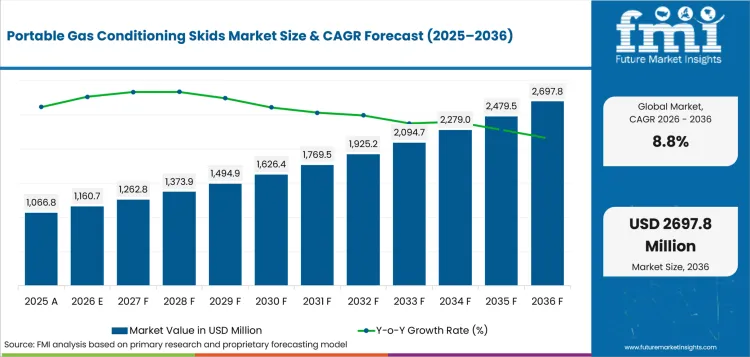
| 2025 Market Size | USD 1066.8199 million. |
|---|---|
| 2026 Market Size | USD 1160.7 million. |
| 2036 Market Size | USD 2697.8 million. |
| Forecast CAGR | 8.8% from 2026 to 2036. |
| Featured Function | Dehydration. |
| Dehydration Share in 2026 | 34.0%. |
| Featured Gas Type | Natural Gas. |
| Natural Gas Share in 2026 | 58.0%. |
| Country CAGR Highlight | China. |
| China CAGR | 9.6% by 2036. |
Summary of the Portable Gas Conditioning Skids Market
| Market Signal | Commercial Impact |
|---|---|
| Demand and Growth Drivers | Growing gas production and infrastructure projects are increasing demand for gas conditioning systems.
|
| Product and Segment View | Dehydration systems, natural gas applications, and skid-mounted configurations continue to dominate market demand.
|
| Geography and Competitive Outlook | The United States and Asia are expected to remain key growth markets for gas conditioning equipment.
|
| Analyst Perspective | Gas conditioning systems are increasingly valued for operational reliability rather than standalone equipment performance.
— Nikhil Kaitwade, Principal Consultant, Oil & Gas Domain, Future Market Insights |
In June 2026, Expro secured a two-year UAE contract for well testing and flowback services. The award supports demand for mobile surface testing equipment and operating crews. In June 2025, Expro won a UK CCS well testing contract for the Northern Endurance Partnership. The project shows how well testing capability is moving into carbon storage appraisal.
USA marketed natural gas production reached a record 118.5 Bcf per day in 2025, and Expro secured a two-year UAE well-testing and flowback contract in June 2026.
Why is the Portable Gas Conditioning Skids Market growing?
Well testing teams need cleaner gas streams as high-rate wells create more condensate, solids, and water-handling risk. Early production packages need conditioning units so temporary facilities can send gas to a pipeline or local fuel system.
- Well testing teams need cleaner gas streams as high-rate wells create more condensate, solids, and water-handling risk.
- Early production packages need conditioning units so temporary facilities can send gas to a pipeline or local fuel system.
- Pipeline commissioning drives demand as operators must prove dry and filtered gas before accepting steady flow.
Portable gas conditioning skids grow comparatively rapid when operators face gas quality uncertainty before permanent facilities are ready. In March 2026, the USA Energy Information Administration said USA marketed natural gas production reached 118.5 Bcf per day in 2025. That record volume raises the number of field points where raw gas needs temporary handling before it enters a pipeline or fuel system. Skid suppliers benefit when operators need a fast bridge between drilling success and full processing capacity. Buyers respond by asking for packages with filtration, heating, and pressure control that can be installed quickly. Field testing creates a second demand route because accurate reservoir data depends on controlled surface flow.
How is the Portable Gas Conditioning Skids Market segmented?
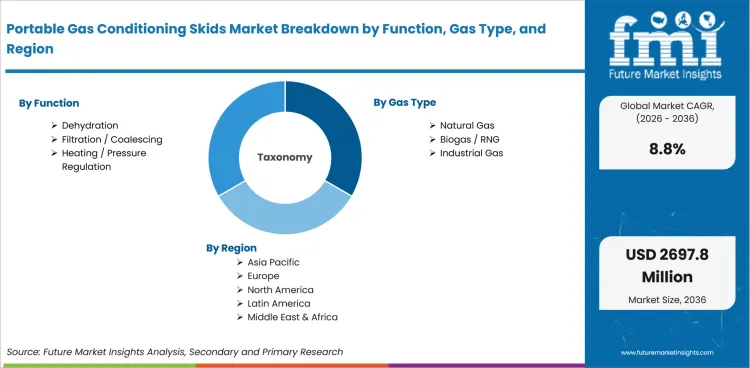
The Portable Gas Conditioning Skids Market is segmented by function, gas type, configuration, end use, sales model, and region.
- With an estimated 34.0% share in 2026, Dehydration is expected to support By Function demand as water control lowers hydrate and corrosion risk.
- Natural Gas buyers are projected to account for 58.0% of By Gas Type demand in 2026 with upstream and pipeline users driving package orders.
- Skid-mounted units are anticipated to hold 54.0% of By Configuration demand in 2026 as fixed pads need quick installation and crane access.
How does Dehydration contribute to the function category?
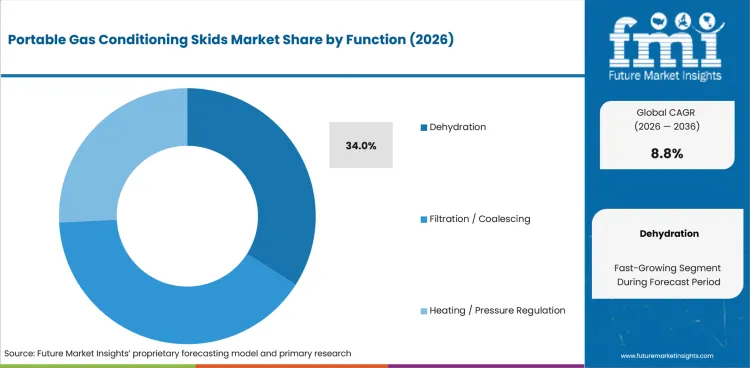
- Dehydration is projected to account for 34.0% of By Function demand in 2026 as raw gas streams often need water removal before pipeline entry or turbine fuel use.
- Buyers compare dehydration performance against dew point guarantees since a unit that misses water targets can create hydrate risk during pressure drop and cooling.
What supports demand for Natural Gas?
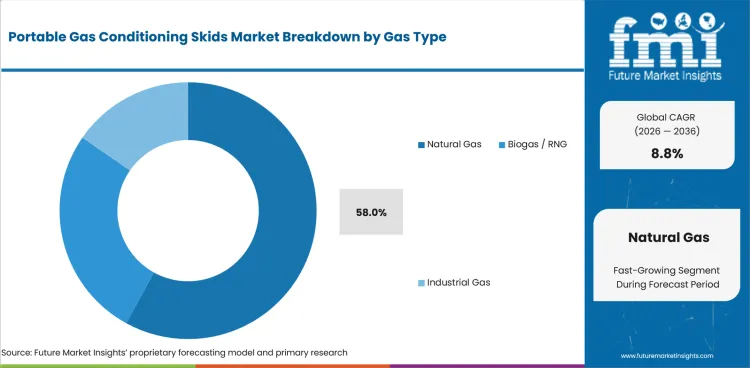
- Natural Gas is estimated to account for 58.0% of By Gas Type demand in 2026 as upstream and midstream operators form the substantial buyer group.
- Associated gas and biogas packages often need more site tuning since inlet composition changes faster than conventional natural gas gathering streams.
How do buyers evaluate Skid-mounted within the configuration category?
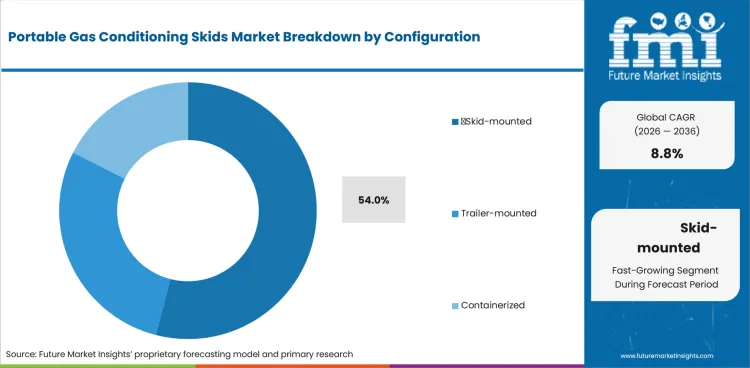
- Skid-mounted units are anticipated to account for 54.0% of By Configuration demand in 2026 as operators value compact packages for field pads and compressor stations.
- Trailer-mounted units serve short campaigns well, but skid-mounted packages win when buyers need sturdier piping, larger vessels, and repeated tie-ins.
What market factors influence demand for Well Testing?
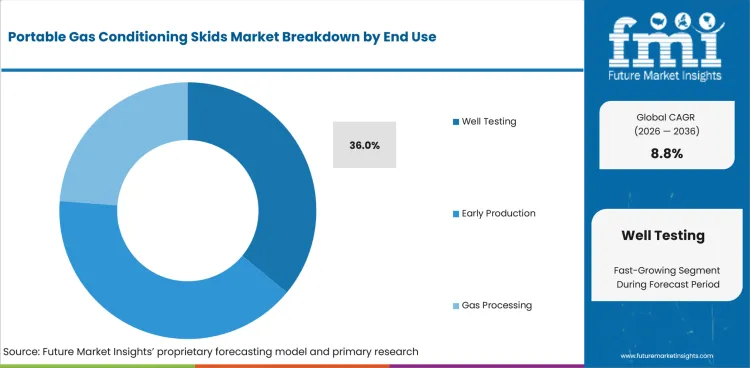
- Well Testing is expected to account for 36.0% of By End Use demand in 2026 as test crews need gas quality control before measurement.
- Test packages are judged on mobilization speed and flow stability since poor conditioning can distort gas rate readings and delay reservoir decisions.
How does Rental / Service affect the sales model outlook?
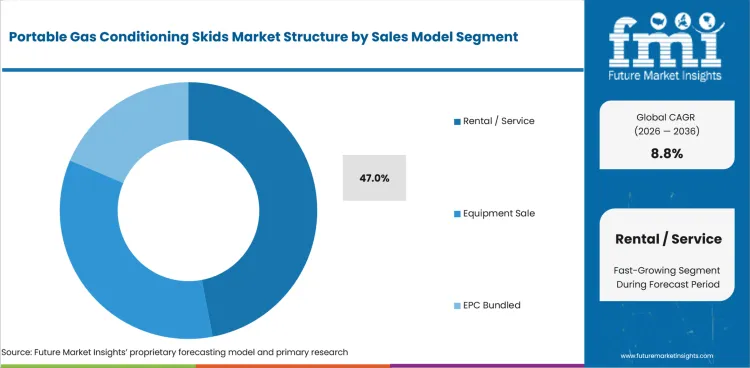
- Rental / Service is projected to account for 47.0% of By Sales Model demand in 2026 as operators avoid owning equipment for short jobs.
- Rental suppliers need spares and technicians near basins since a skid failure can stop testing faster than many downhole issues.
What drives and restrains the market?
The market reflects a balance between the identified demand driver, adoption constraints, and the supplier opportunity outlined below.
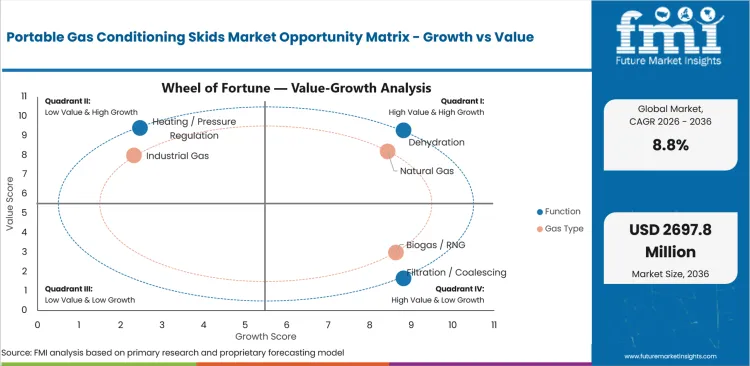
Driver: High-rate gas testing drives equipment demand as test packages need clean gas before accurate measurement; restraint: Complex gas composition restrains adoption as H2S, CO2, water, and condensate raise design cost; opportunity: early production creates a time-based opportunity as operators monetize gas before permanent plant completion.
- Driver: High-rate gas testing drives equipment demand as test packages need clean gas before accurate measurement.
- Restraint: Complex gas composition restrains adoption as H2S, CO2, water, and condensate raise design cost.
- Opportunity: early production creates a time-based opportunity as operators monetize gas before permanent plant completion.
High-Rate Well Test Conditioning High-rate gas wells create demand for packages that remove contaminants without adding major pressure drop. Expro’s high-rate well testing case history noted expected flow capacity of 150 MMscf per day and the need for solids removal equipment during testing. This shows why gas conditioning packages must protect both measurement integrity and downstream acceptance. Test contractors choose suppliers with large separator knowledge, coalescing depth, and field controls. The practical result is a premium for packages that combine conditioning with fast setup and reliable flow measurement.
Its standard early production designs show the scale of modular field systems used around temporary production assets. Gas conditioning skids fit this same temporary production logic when operators need dehydration, filtration, heating, pressure regulation, or contaminant removal before gas use or transfer. Suppliers with modular process design and field operations support are better placed than vendors selling stand-alone vessels. Sour Gas Design Pressure: Sour or acid gas service raises package complexity and limits low-cost supplier participation. API notes that it has created more than 800 standards for oil and gas operations, and its international usage material includes API RP 55 for H2S in producing and gas processing plants.
Which factors support expansion?
Commercial expansion is reinforced by the value, workflow, and recurring-demand factors below.
- Market value is rising as operators need movable gas treatment packages before permanent processing plants are built.
- Testing contractors are buying larger modular units since high-rate gas wells need separation and conditioning before measurement.
- Rental fleets are gaining share as short campaigns make ownership less useful for many smaller operators.
Which country markets are included in the CAGR comparison?
The selected CAGR comparison covers China (9.6%), India (9.2%), United States (8.6%), Germany (8.2%), and South Korea (8.1%) through 2036.
.webp "Top Country Growth Comparison Portable Gas Conditioning Skids Market Cagr (2026 2036)")
| Country | CAGR |
|---|---|
| China | 9.6% |
| India | 9.2% |
| United States | 8.6% |
| Germany | 8.2% |
| South Korea | 8.1% |
Source: Future Market Insights analysis based on the supplied country forecast table.
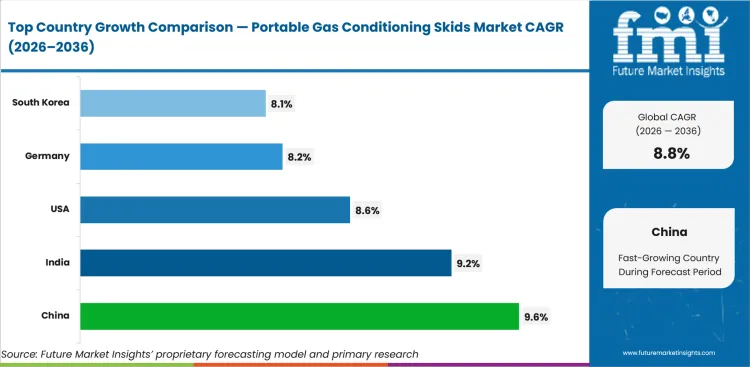
How do country-level CAGRs compare?
- China (CAGR: 9.6%): China is the higher-CAGR selected country in this report.
- India (CAGR: 9.2%): India’s gas grid expansion supports commissioning and distributed conditioning needs.
- United States (CAGR: 8.6%): Permian and Haynesville gas output keeps field conditioning tied to associated gas and unconventional production.
- Germany (CAGR: 8.2%): Germany’s gas demand is tied to industrial users and network security.
- South Korea (CAGR: 8.1%): South Korea’s gas demand is linked to LNG imports and power generation.
The global Portable Gas Conditioning Skids Market is forecast to record a CAGR of 8.8% from 2026 to 2036. The supplied study covers 8 named country forecasts across the report regions.
How is the Portable Gas Conditioning Skids Market developing in China?
China is projected to record a CAGR of 9.6% through 2036. The country outlook identifies this demand signal: China is the higher-CAGR selected country in this report.
Country Market Snapshot
| Country | China |
|---|---|
| Forecast CAGR | 9.6% |
| Demand anchor | China is the higher-CAGR selected country in this report. |
| Local proof | IEA reported China’s natural gas demand increased by over 7% in 2024. |
| Application mix | Domestic gas production, LNG receiving, and industrial fuel systems support demand. |
| Channel route | State energy companies and EPC firms guide many large purchases. |
| Restraint | Local fabrication competition puts pressure on imported package pricing. |
| Primary demand signal | China is the higher-CAGR selected country in this report. |
| Market context | China is unique because demand scale is large, but pricing pressure is stronger than in most selected markets. |
Market Outlook
China creates the notable volume-based demand signal among selected countries. The International Energy Agency reported that China’s natural gas demand increased by over 7% in 2024. This supports portable conditioning demand across domestic gas fields, industrial users, LNG-linked networks, and temporary commissioning work. Buyers often ask for price-competitive packages but also need designs that handle water, liquids, and variable inlet pressure.
Key Growth Drivers
- Industrial gas use supports conditioning packages for fuel and process systems.
- Domestic gas field development creates demand for early output and testing packages.
- LNG and pipeline buildout supports temporary commissioning and network conditioning.
- China is the higher-CAGR selected country in this report.
Key Restraints
- Local fabrication lowers price tolerance for imported skids.
- Project approvals and state procurement processes can slow buying cycles.
- Local fabrication competition puts pressure on imported package pricing.
Country Market FAQs
Why should executives monitor Portable Gas Conditioning Skids Market demand in China?
Executives should monitor China because local buyer readiness, china is the fastest-growing selected country in this report, and service capacity can influence account timing and market-entry priorities.
What should suppliers localize for China?
Suppliers should localize proof points, pricing logic, partner coverage, and training support around state energy companies and EPC firms guide many large purchases.
What adoption risk needs attention in China?
Executive teams should watch adoption risk because local fabrication lowers price tolerance for imported skids can delay conversion from evaluation to commercial deployment.
How is the Portable Gas Conditioning Skids Market developing in India?
India is projected to record a CAGR of 9.2% through 2036. The country outlook identifies this demand signal: India’s gas grid expansion supports commissioning and distributed conditioning needs.
Country Market Snapshot
| Country | India |
|---|---|
| Forecast CAGR | 9.2% |
| Demand anchor | India’s gas grid expansion supports commissioning and distributed conditioning needs. |
| Local proof | India’s natural gas demand increased by more than 10% in both 2023 and 2024. |
| Infrastructure signal | PNGRB reported around 33,500 km of authorized natural gas pipeline networks in 2025. |
| Application mix | Pipeline commissioning, city gas, industrial fuel gas, and upstream testing drive demand. |
| Restraint | Price sensitivity limits adoption of high-spec imported packages. |
| Primary demand signal | India’s gas grid expansion supports commissioning and distributed conditioning needs. |
| Market context | India combines fast gas infrastructure expansion with strong price sensitivity, which rewards suppliers offering local assembly and service. |
Market Outlook
India is a pipeline expansion and industrial gas-use market with selective upstream demand. The International Energy Agency said India’s natural gas demand increased by more than 10% in both 2023 and 2024. The Petroleum and Natural Gas Regulatory Board reported around 33,500 km of authorized natural gas pipeline networks and around 25,000 km operationalized in 2025. This creates commissioning demand and smaller conditioning needs across industrial clusters.
Key Growth Drivers
- Gas pipeline expansion creates commissioning demand across new industrial corridors.
- City gas and industrial users need pressure regulation and filtration packages.
- LNG import expansion supports gas quality control for downstream users.
- India’s gas grid expansion supports commissioning and distributed conditioning needs.
Key Restraints
- High import cost can delay purchase decisions for small industrial buyers.
- Local service gaps can make operators prefer simpler package designs.
- Price sensitivity limits adoption of high-spec imported packages.
Country Market FAQs
Why should executives monitor Portable Gas Conditioning Skids Market demand in India?
Executives should monitor India because local buyer readiness, india’s gas grid expansion supports commissioning and distributed conditioning needs, and service capacity can influence account timing and market-entry priorities.
What should suppliers localize for India?
Suppliers should localize proof points, pricing logic, partner coverage, and training support around buyer access and account ownership and local support coverage.
What adoption risk needs attention in India?
Executive teams should watch adoption risk because high import cost can delay purchase decisions for small industrial buyers can delay conversion from evaluation to commercial deployment.
How is the Portable Gas Conditioning Skids Market developing in the United States?
The United States is projected to record a CAGR of 8.6% through 2036. The country outlook identifies this demand signal: Permian and Haynesville gas output keeps field conditioning tied to associated gas and unconventional production.
Country Market Snapshot
| Country | United States |
|---|---|
| Forecast CAGR | 8.6% |
| Demand anchor | Permian and Haynesville gas output keeps field conditioning tied to associated gas and unconventional production. |
| Channel route | Operators often buy through oilfield service firms and engineered package suppliers. |
| Application mix | Well testing, compressor fuel gas, and pipeline commissioning form the main demand pool. |
| Policy context | Methane and flaring attention raises interest in conditioning packages that support gas capture. |
| Supplier base | CECO Peerless, Parker Hannifin, SLB, Enerflex, Expro, and Croft Production Systems have relevant USA activity. |
| Primary demand signal | Permian and Haynesville gas output keeps field conditioning tied to associated gas and unconventional production. |
| Market context | The United States combines large gas output with dense rental fleets, which makes speed and service coverage central to supplier selection. |
Market Outlook
The United States market is shaped by scale and short-cycle field work. USA marketed natural gas production reached 118.5 Bcf per day in 2025, which keeps conditioning needs close to gathering points and temporary field packages. This supports rental fleets and engineered skids used during testing and early output. Buyers in Texas, New Mexico, and Louisiana focus on uptime, rapid mobilization, and compatibility with compressor stations.
Key Growth Drivers
- Permian associated gas creates demand for portable packages near remote gathering points.
- Gulf Coast LNG and pipeline projects increase commissioning needs for temporary gas handling.
- USA rental fleets support operators that avoid ownership for short well campaigns.
- Permian and Haynesville gas output keeps field conditioning tied to associated gas and unconventional production.
Key Restraints
- Permitting and emissions scrutiny can delay field tests and equipment movement.
- High-spec sour gas packages raise project cost for smaller operators.
- The notable orders are expected from operators needing filtration, coalescing, heating, and pressure control in one movable package.
Country Market FAQs
Why should executives monitor Portable Gas Conditioning Skids Market demand in the United States?
Executives should monitor the United States because local buyer readiness, permian and haynesville gas output keeps field conditioning tied to associated gas and unconventional production, and service capacity can influence account timing and market-entry priorities.
What should suppliers localize for the United States?
Suppliers should localize proof points, pricing logic, partner coverage, and training support around operators often buy through oilfield service firms and engineered package suppliers and operators often buy through oilfield service firms and engineered package suppliers.
What adoption risk needs attention in the United States?
Executive teams should watch adoption risk because permitting and emissions scrutiny can delay field tests and equipment movement can delay conversion from evaluation to commercial deployment.
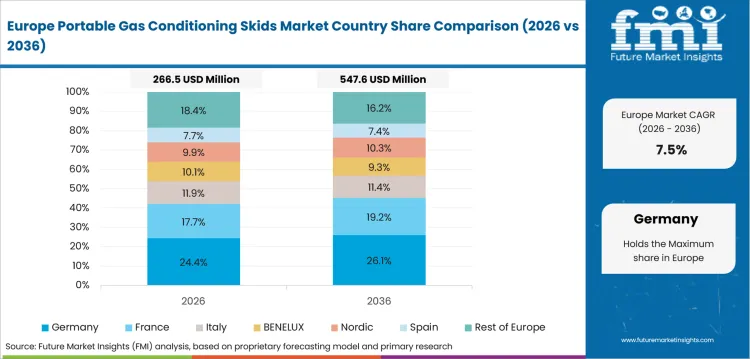
How is the Portable Gas Conditioning Skids Market developing in Germany?
Germany is projected to record a CAGR of 8.2% through 2036. The country outlook identifies this demand signal: Germany’s gas demand is tied to industrial users and network security.
Country Market Snapshot
| Country | Germany |
|---|---|
| Forecast CAGR | 8.2% |
| Demand anchor | Germany’s gas demand is tied to industrial users and network security. |
| Local proof | Germany consumed 864 TWh of gas in 2025 after 845 TWh in 2024. |
| Channel route | Utility and industrial buyers often use EPC and approved supplier routes. |
| Application mix | Pipeline commissioning and industrial fuel gas conditioning dominate the market. |
| Restraint | Limited domestic production means field oilfield demand is smaller than network demand. |
| Primary demand signal | Germany’s gas demand is tied to industrial users and network security. |
| Market context | Germany is distinct because its demand is driven by network reliability and industrial fuel use rather than new upstream gas wells. |
Market Outlook
Germany is a network and industrial reliability market rather than a large upstream gas production market. The federal network regulator reported 864 TWh of gas consumption in 2025 and 845 TWh in 2024. Industrial customers accounted for 60% of total consumption in 2025. This makes conditioning demand more tied to pipeline nodes, industrial fuel gas systems, and commissioning packages than well testing.
Key Growth Drivers
- Industrial gas consumption supports demand for packaged pressure control and filtration.
- Pipeline network changes create commissioning needs for temporary gas handling.
- Hydrogen network planning increases interest in gas quality monitoring and compatible regulators.
- Germany’s gas demand is tied to industrial users and network security.
Key Restraints
- Limited upstream field activity reduces direct oilfield skid demand.
- Strict documentation needs can lengthen supplier approval for engineered packages.
- Limited domestic production means field oilfield demand is smaller than network demand.
Country Market FAQs
Why should executives monitor Portable Gas Conditioning Skids Market demand in Germany?
Executives should monitor Germany because local buyer readiness, germany’s gas demand is tied to industrial users and network security, and service capacity can influence account timing and market-entry priorities.
What should suppliers localize for Germany?
Suppliers should localize proof points, pricing logic, partner coverage, and training support around utility and industrial buyers often use epc and approved supplier routes and utility and industrial buyers often use epc and approved supplier routes.
What adoption risk needs attention in Germany?
Executive teams should watch adoption risk because limited upstream field activity reduces direct oilfield skid demand can delay conversion from evaluation to commercial deployment.
How is the Portable Gas Conditioning Skids Market developing in South Korea?
South Korea is projected to record a CAGR of 8.1% through 2036. The country outlook identifies this demand signal: South Korea’s gas demand is linked to LNG imports and power generation.
Country Market Snapshot
| Country | South Korea |
|---|---|
| Forecast CAGR | 8.1% |
| Demand anchor | South Korea’s gas demand is linked to LNG imports and power generation. |
| Local proof | IEA Gas 2025 projects South Korea’s natural gas demand to increase by 13% between 2024 and 2030. |
| Channel route | Utility and power buyers use formal procurement and EPC channels. |
| Application mix | LNG terminal support, power fuel gas conditioning, and industrial gas systems dominate. |
| Restraint | Nuclear expansion can reduce gas burn and soften some demand. |
| Primary demand signal | South Korea’s gas demand is linked to LNG imports and power generation. |
| Market context | South Korea is distinct because LNG security and power planning shape demand more than upstream oilfield activity. |
Market Outlook
South Korea is a gas import and power reliability market. IEA Gas 2025 projects South Korea’s natural gas demand to increase by 13% between 2024 and 2030 in its base case. This supports demand for conditioning packages near LNG terminals, power facilities, and industrial gas users. The buying focus is safe operation, uptime, and package qualification. South Korea is forecast to grow at a CAGR of 8.1% through 2036 as gas-fired generation and LNG infrastructure keep gas quality equipment relevant.
Key Growth Drivers
- LNG import reliance supports fuel gas conditioning and pressure regulation packages.
- Power-sector demand supports clean gas supply for turbines and industrial boilers.
- EPC-led projects create demand for documented skids with clear safety certifications.
- South Korea’s gas demand is linked to LNG imports and power generation.
Key Restraints
- Nuclear expansion can reduce gas-fired generation in some years.
- Utility procurement can favor proven suppliers over new entrants.
- The main restraint is competition from nuclear and renewables, which can reduce gas burn at certain times.
Country Market FAQs
Why should executives monitor Portable Gas Conditioning Skids Market demand in South Korea?
Executives should monitor South Korea because local buyer readiness, south korea’s gas demand is linked to lng imports and power generation, and service capacity can influence account timing and market-entry priorities.
What should suppliers localize for South Korea?
Suppliers should localize proof points, pricing logic, partner coverage, and training support around utility and power buyers use formal procurement and epc channels and utility and power buyers use formal procurement and epc channels.
What adoption risk needs attention in South Korea?
Executive teams should watch adoption risk because nuclear expansion can reduce gas-fired generation in some years can delay conversion from evaluation to commercial deployment.
Which companies are discussed in the Portable Gas Conditioning Skids Market?
The preview discusses SLB, Expro, CECO Peerless, Enerflex, and Parker Hannifin among the companies active in this market.
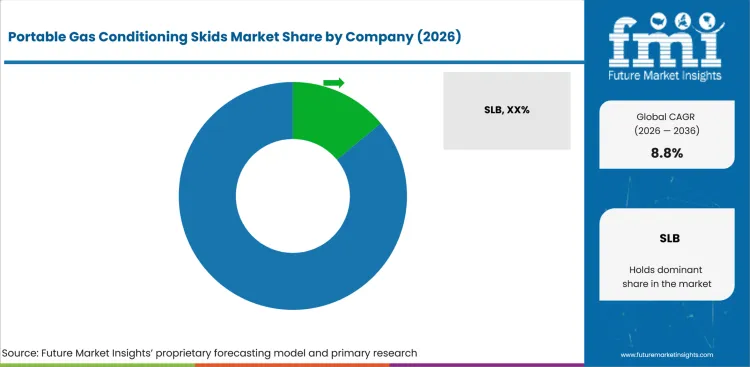
The market is moderately fragmented as global oilfield service firms compete with specialist skid fabricators and filtration suppliers. established firms stand out through process design, field crews, safety documentation, and component depth. Smaller suppliers win short-cycle jobs when they can assemble fast and support the site locally.
Entry barriers include pressure vessel compliance, hazardous gas design, controls integration, and proven service response. Competitive advantage in this market starts with field trust rather than catalog breadth. Buyers want a package that can handle changing inlet gas without causing pressure loss or downstream damage.
How is competition structured?
The competitive structure is suitable viewed by supplier role because buyers combine process packages, service contracts, and component supply.
- Integrated Field Service Providers: SLB and Expro compete through well testing, early production, and field operations depth. SLB supports surface well testing and modular early production facilities. Expro offers surface well testing and flow management services with field crews.
- Packaged Gas Treatment Suppliers: CECO Peerless, Enerflex, Pietro Fiorentini, Integrated Flow Solutions, ERGIL, and Kilburn Engineering compete through engineered gas handling packages. Their strengths include dehydration, filtration, pressure regulation, heating, and modular fabrication.
- Filtration and Component Specialists: Parker Hannifin, Honeywell UOP, and Cimarron Energy support the value chain through filtration, separation, adsorbents, controls, and treatment technologies. These suppliers are important when skid makers need proven internals or gas cleanup components.
How do selected companies compare?
The selected companies differ in portfolio focus, geographic reach, evidence depth, and channel strength.
| Company | Competitive position |
|---|---|
| SLB | SLB supports surface well testing and modular early production facilities. |
| Expro | Expro offers surface well testing and flow management services with field crews. |
| CECO Peerless | CECO Peerless states that its fuel gas conditioning package can remove liquid droplets above 0.3 microns at 99.99% efficiency. |
| Enerflex | Enerflex reported engineered systems backlog of USD 1.1 billion at December 31, 2025, and said Q4 2025 bookings were USD 377 million. |
| Parker Hannifin | Parker Hannifin supports natural gas filtration and coalescing applications. |
What are the key developments in the Portable Gas Conditioning Skids Market?
- In June 2026, Expro secured a two-year UAE contract for well testing and flowback services. The award supports demand for mobile surface testing equipment and operating crews.
- In June 2025, Expro won a UK CCS well testing contract for the Northern Endurance Partnership. The project shows how well testing capability is moving into carbon storage appraisal.
- In December 2024, Expro won a contract valued at over USD 10 million for a well decommissioning solution. This is referenced as adjacent field-service context for modular oilfield execution, not as a direct portable gas-conditioning skid launch.
Selected Companies in the Portable Gas Conditioning Skids Market
Companies referenced in this preview
- SLB.
- Expro.
- CECO Peerless.
- Enerflex.
- Parker Hannifin.
- Pietro Fiorentini.
- Integrated Flow Solutions.
- Croft Production Systems.
- ERGIL.
- Kilburn Engineering.
Market Scope & Definition
| Market definition | Portable gas conditioning skids are movable packaged systems that prepare gas for safe use, measurement, transport, or processing. They include dehydration, filtration, coalescing, heating, pressure regulation, and acid gas removal modules used during field operations. |
|---|---|
| Functions covered | Dehydration, Filtration / Coalescing, Heating / Pressure Regulation, H2S / CO2 Removal |
| Applications covered | Well Testing, Early Production, Pipeline Commissioning, Gas Processing |
| End-use industries | Well Testing, Early Production, Pipeline Commissioning, Gas Processing |
| Inclusions | Market scope covers portable gas conditioning systems by function, including dehydration, filtration / coalescing, heating / pressure regulation, and H2S / CO2 removal; gas types, including natural gas, biogas / RNG, associated gas, and industrial gas; configurations, including skid-mounted, trailer-mounted, and containerized; end uses. |
| Exclusions | The market excludes fixed gas processing plants, LNG liquefaction trains, large amine units, permanent refinery gas systems, standalone compressors, fuel gas valves sold without conditioning packages, and general laboratory gas analyzers. |
Research Methodology
| Primary Research | FMI analysts reviewed inputs from oilfield service firms, skid fabricators, gas processing engineers, rental fleet operators, and procurement teams buying surface production equipment. The research focused on field package selection, project duration, contamination profiles, and service response expectations. |
|---|---|
| Desk Research | covered official gas production data, pipeline and LNG infrastructure indicators, standards bodies, company product information, and public energy agency reports. These sources helped define the addressable package pool and the boundary between temporary field systems and permanent gas plants. |
| Market Sizing and Forecasting | The model combined estimated skid demand, replacement cycles, rental fleet use, average package pricing, country gas activity, and end-use mix. Forecasts were adjusted for gas development intensity, short-cycle field programs, and commissioning demand. |
| Data Validation | Forecasts were checked against gas production trends, well testing activity, modular processing portfolios, and company order signals. Segment estimates were validated through supplier capability mapping and buyer-use logic. |
What does the report cover?
The report covers function, gas type, configuration, end use, sales model, and region across the 2026-2036 forecast period in 30+ countries.
| Periods | Base year 2025; estimated year 2026; forecast period 2026-2036 |
|---|---|
| Quantitative units | USD 1160.7 million in 2026 to USD 2697.8 million by 2036, at a CAGR of 8.8% |
| Segment axes | function, gas type, configuration, end use, sales model, and region |
| Regions | North America, Latin America, Europe, East Asia, South Asia and Pacific, Middle East and Africa |
| Countries | United States, United Kingdom, Germany, France, Japan, China, South Korea, India and 30+ |
| Companies | SLB, Expro, CECO Peerless, Enerflex, Parker Hannifin, Pietro Fiorentini, Integrated Flow Solutions, Croft Production Systems, ERGIL, Kilburn Engineering |
| Approach | Hybrid bottom-up and selected-down methodology using transaction signals, equipment pricing, country activity, segment use rates, and supplier portfolio validation. |
Market Segmentation Analysis
Segmented by Function
- Dehydration.
- Filtration / Coalescing.
- Heating / Pressure Regulation.
- H2S / CO2 Removal.
Segmented by Gas Type
- Natural Gas.
- Biogas / RNG.
- Associated Gas.
- Industrial Gas.
Segmented by Configuration
- Skid-mounted.
- Trailer-mounted.
- Containerized.
Segmented by End Use
- Well Testing.
- Early Production.
- Pipeline Commissioning.
- Gas Processing.
Segmented by Sales Model
- Rental / Service.
- Equipment Sale.
- EPC Bundled.
Research Sources and Bibliography
- 1. USA Energy Information Administration. (2026, March 13). USA natural gas production reached a new record in 2025. USA Energy Information Administration.
- 2. USA Energy Information Administration. (2025, November 28). Natural Gas Annual. USA Energy Information Administration.
- 3. International Energy Agency. (2025). Global Energy Review 2025: Natural gas. International Energy Agency.
- 4. International Energy Agency. (2026). Global Energy Review 2026: Natural gas. International Energy Agency.
- 5. International Energy Agency. (2025, February 12). India’s natural gas demand set for 60% rise by 2030. International Energy Agency.
- 6. International Energy Agency. (2025, October 24). Gas 2025. International Energy Agency.
- 7. Bundesnetzagentur. (2026, January 12). Bundesnetzagentur publishes gas supply figures for 2025. Bundesnetzagentur.
- 8. Eurostat. (2025). Natural gas supply statistics. European Commission.
- 9. North Sea Transition Authority. (2025, August 7). 2024 benchmarking dashboards: Production efficiency and unit operating cost. North Sea Transition Authority.
- 10. Ministry of Economy, Trade and Industry. (2025). Strategic Energy Plan. Government of Japan.
- 11. Petroleum and Natural Gas Regulatory Board. (2025). Natural Gas Projections 2030 Base Case. Petroleum and Natural Gas Regulatory Board.
- 12. American Petroleum Institute. (2025). API Standards: International Usage Report. American Petroleum Institute.
- 13. Expro. (2026, June 11). Expro secures two-year contract for unconventional well testing in the UAE. Expro.
- 14. Expro. (2025, June 19). Expro wins well test contract for major UK CCS project. Expro.
- 15. Expro. (2024, December 16). Expro wins contract to support plug and abandonment campaign. Expro.
- 16. Expro. (2024, February 13). Expro to enhance well construction and well intervention integrity offerings with acquisition of Coretrax. Expro.
The bibliography is provided for reader reference, and all sources are primary government, regulatory, official trade body, or direct company publications.
This Report Answers
- What is the projected value of the Portable Gas Conditioning Skids Market in 2026?
- What value is forecast for the Portable Gas Conditioning Skids Market by 2036?
- What CAGR is forecast for the Portable Gas Conditioning Skids Market from 2026 to 2036?
- What 2026 share is projected for Dehydration within the function category?
- What 2026 share is projected for Natural Gas within the gas type category?
- Which demand factors support the Portable Gas Conditioning Skids Market outlook?
- Which restraints and opportunities affect adoption in the Portable Gas Conditioning Skids Market?
- How are country CAGR outlooks, including China at 9.6%, compared?
- Which companies and product developments are covered in the competitive analysis?
- What is included in the market scope, and how is the forecast validated?
Frequently Asked Questions
Why should executives track the Portable Gas Conditioning Skids Market?
Executives should track this market because it can affect capital allocation, supplier strategy, operating risk, and competitive positioning across end-use settings.
What business problem does the Portable Gas Conditioning Skids Market address?
It helps executive teams judge where customer pain, supplier capability, compliance exposure, and implementation economics justify investment, procurement, or market-entry decisions.
What should procurement leaders evaluate before selecting suppliers?
Procurement leaders should assess evidence quality, integration fit, service coverage, compliance readiness, total cost of ownership, and supplier execution capability.
What can limit return on investment for buyers?
Return on investment can be limited by low utilization, integration delays, training gaps, unclear ownership, pricing pressure, or weak fit with existing workflows.
How can suppliers build executive confidence?
Suppliers can build confidence by proving implementation speed, risk reduction, support depth, reference use cases, and measurable outcomes for budget owners.
Preview the report firsthand - request a free sample
Get SampleGet the brochure for pricing and purchase details.
Get PDFTable of Content
- Key Takeaways
- Market Size and CAGR
- Top Growth Driver
- Fastest Growing Segment
- Leading Region
- Key Companies
- Emerging Opportunities
- Executive Summary
- Global Market Outlook
- Demand-side Trends
- Supply-side Trends
- Technology Roadmap Analysis
- Analysis and Recommendations
- Analyst Perspective (What is happening? Why now? What should investors know?)
- Key Questions Answered
- How large is the market?
- What is the CAGR?
- What are key trends?
- Which region dominates?
- Who are the leaders?
- Market Overview
- Market Coverage / Taxonomy
- Market Definition / Scope / Limitations
- Research Methodology
- Chapter Orientation
- Analytical Lens and Working Hypotheses
- Market Structure, Signals, and Trend Drivers
- Benchmarking and Cross-market Comparability
- Market Sizing, Forecasting, and Opportunity Mapping
- Research Design and Evidence Framework
- Desk Research Programme (Secondary Evidence)
- Expert Input and Fieldwork (Primary Evidence)
- Tooling, Models, and Reference Databases
- Data Engineering and Model Build
- Quality Assurance and Audit Trail
- Market Background
- Market Dynamics (Drivers, Restraints, Opportunity, Trends)
- Scenario Forecast (Optimistic, Likely, Conservative)
- Impact Analysis
- AI Impact
- Sustainability Impact
- Regulatory Impact
- Technology Impact
- Consumer / Buyer Analysis
- Purchase Drivers
- Adoption Barriers
- Buyer Journey
- Opportunity Map Analysis
- Product Life Cycle Analysis
- Supply Chain Analysis
- Investment Feasibility Matrix
- Value Chain Analysis
- PESTLE and Porter's Analysis
- Regulatory Landscape
- Regional Parent Market Outlook
- Production and Consumption Statistics
- Import and Export Statistics
- Global Market Analysis and Forecast, 2021 to 2036
- Historical Market Size Value (USD Million) Analysis, 2021 to 2025
- Current and Future Market Size Value (USD Million) Projections, 2026 to 2036
- Y-o-Y Growth Trend Analysis
- Absolute $ Opportunity Analysis
- Global Market Pricing Analysis, 2021 to 2036
- Global Market Analysis and Forecast, By Function, 2021 to 2036
- Introduction / Key Findings
- Historical Market Size Value (USD Million) Analysis By Function, 2021 to 2025
- Current and Future Market Size Value (USD Million) Analysis and Forecast By Function, 2026 to 2036
- Dehydration
- Filtration / Coalescing
- Heating / Pressure Regulation
- Dehydration
- Y-o-Y Growth Trend Analysis By Function, 2021 to 2025
- Absolute $ Opportunity Analysis By Function, 2026 to 2036
- Global Market Analysis and Forecast, By Gas Type, 2021 to 2036
- Introduction / Key Findings
- Historical Market Size Value (USD Million) Analysis By Gas Type, 2021 to 2025
- Current and Future Market Size Value (USD Million) Analysis and Forecast By Gas Type, 2026 to 2036
- Natural Gas
- Biogas / RNG
- Industrial Gas
- Natural Gas
- Y-o-Y Growth Trend Analysis By Gas Type, 2021 to 2025
- Absolute $ Opportunity Analysis By Gas Type, 2026 to 2036
- Global Market Analysis and Forecast, By Configuration, 2021 to 2036
- Introduction / Key Findings
- Historical Market Size Value (USD Million) Analysis By Configuration, 2021 to 2025
- Current and Future Market Size Value (USD Million) Analysis and Forecast By Configuration, 2026 to 2036
- Skid-mounted
- Trailer-mounted
- Containerized
- Skid-mounted
- Y-o-Y Growth Trend Analysis By Configuration, 2021 to 2025
- Absolute $ Opportunity Analysis By Configuration, 2026 to 2036
- Global Market Analysis and Forecast, By End Use, 2021 to 2036
- Introduction / Key Findings
- Historical Market Size Value (USD Million) Analysis By End Use, 2021 to 2025
- Current and Future Market Size Value (USD Million) Analysis and Forecast By End Use, 2026 to 2036
- Well Testing
- Early Production
- Gas Processing
- Well Testing
- Y-o-Y Growth Trend Analysis By End Use, 2021 to 2025
- Absolute $ Opportunity Analysis By End Use, 2026 to 2036
- Global Market Analysis and Forecast, By Sales Model, 2021 to 2036
- Introduction / Key Findings
- Historical Market Size Value (USD Million) Analysis By Sales Model, 2021 to 2025
- Current and Future Market Size Value (USD Million) Analysis and Forecast By Sales Model, 2026 to 2036
- Rental / Service
- Equipment Sale
- EPC Bundled
- Rental / Service
- Y-o-Y Growth Trend Analysis By Sales Model, 2021 to 2025
- Absolute $ Opportunity Analysis By Sales Model, 2026 to 2036
- Global Market Analysis and Forecast, By Region, 2021 to 2036
- Introduction
- Historical Market Size Value (USD Million) Analysis By Region, 2021 to 2025
- Current Market Size Value (USD Million) Analysis and Forecast By Region, 2026 to 2036
- North America
- Latin America
- Western Europe
- Eastern Europe
- East Asia
- South Asia and Pacific
- Middle East & Africa
- Market Attractiveness Analysis By Region
- North America Market Analysis and Forecast, By Country, 2021 to 2036
- Historical Market Size Value (USD Million) Trend Analysis By Market Taxonomy, 2021 to 2025
- Market Size Value (USD Million) Forecast By Market Taxonomy, 2026 to 2036
- By Country
- USA
- Canada
- Mexico
- By Function
- By Gas Type
- By Configuration
- By End Use
- By Sales Model
- By Country
- Market Attractiveness Analysis
- By Country
- By Function
- By Gas Type
- By Configuration
- By End Use
- By Sales Model
- Key Takeaways
- Latin America Market Analysis and Forecast, By Country
- Historical Market Size Value (USD Million) Trend Analysis By Market Taxonomy, 2021 to 2025
- Market Size Value (USD Million) Forecast By Market Taxonomy, 2026 to 2036
- By Country
- Brazil
- Chile
- Rest of Latin America
- By Function
- By Gas Type
- By Configuration
- By End Use
- By Sales Model
- By Country
- Market Attractiveness Analysis
- By Country
- By Function
- By Gas Type
- By Configuration
- By End Use
- By Sales Model
- Key Takeaways
- Western Europe Market Analysis and Forecast, By Country
- Historical Market Size Value (USD Million) Trend Analysis By Market Taxonomy, 2021 to 2025
- Market Size Value (USD Million) Forecast By Market Taxonomy, 2026 to 2036
- By Country
- Germany
- UK
- Italy
- Spain
- France
- Nordic
- BENELUX
- Rest of Western Europe
- By Function
- By Gas Type
- By Configuration
- By End Use
- By Sales Model
- By Country
- Market Attractiveness Analysis
- By Country
- By Function
- By Gas Type
- By Configuration
- By End Use
- By Sales Model
- Key Takeaways
- Eastern Europe Market Analysis and Forecast, By Country
- Historical Market Size Value (USD Million) Trend Analysis By Market Taxonomy, 2021 to 2025
- Market Size Value (USD Million) Forecast By Market Taxonomy, 2026 to 2036
- By Country
- Russia
- Poland
- Hungary
- Balkan & Baltic
- Rest of Eastern Europe
- By Function
- By Gas Type
- By Configuration
- By End Use
- By Sales Model
- By Country
- Market Attractiveness Analysis
- By Country
- By Function
- By Gas Type
- By Configuration
- By End Use
- By Sales Model
- Key Takeaways
- East Asia Market Analysis and Forecast, By Country
- Historical Market Size Value (USD Million) Trend Analysis By Market Taxonomy, 2021 to 2025
- Market Size Value (USD Million) Forecast By Market Taxonomy, 2026 to 2036
- By Country
- China
- Japan
- South Korea
- By Function
- By Gas Type
- By Configuration
- By End Use
- By Sales Model
- By Country
- Market Attractiveness Analysis
- By Country
- By Function
- By Gas Type
- By Configuration
- By End Use
- By Sales Model
- Key Takeaways
- South Asia and Pacific Market Analysis and Forecast, By Country
- Historical Market Size Value (USD Million) Trend Analysis By Market Taxonomy, 2021 to 2025
- Market Size Value (USD Million) Forecast By Market Taxonomy, 2026 to 2036
- By Country
- India
- ASEAN
- Australia & New Zealand
- Rest of South Asia and Pacific
- By Function
- By Gas Type
- By Configuration
- By End Use
- By Sales Model
- By Country
- Market Attractiveness Analysis
- By Country
- By Function
- By Gas Type
- By Configuration
- By End Use
- By Sales Model
- Key Takeaways
- Middle East & Africa Market Analysis and Forecast, By Country
- Historical Market Size Value (USD Million) Trend Analysis By Market Taxonomy, 2021 to 2025
- Market Size Value (USD Million) Forecast By Market Taxonomy, 2026 to 2036
- By Country
- Kingdom of Saudi Arabia
- Other GCC Countries
- Türkiye
- South Africa
- Other African Union
- Rest of Middle East & Africa
- By Function
- By Gas Type
- By Configuration
- By End Use
- By Sales Model
- By Country
- Market Attractiveness Analysis
- By Country
- By Function
- By Gas Type
- By Configuration
- By End Use
- By Sales Model
- Key Takeaways
- Key Countries Market Analysis
- USA
- Pricing Analysis
- Market Share Analysis, 2025
- By Function
- By Gas Type
- By Configuration
- By End Use
- By Sales Model
- Canada
- Pricing Analysis
- Market Share Analysis, 2025
- By Function
- By Gas Type
- By Configuration
- By End Use
- By Sales Model
- Mexico
- Pricing Analysis
- Market Share Analysis, 2025
- By Function
- By Gas Type
- By Configuration
- By End Use
- By Sales Model
- Brazil
- Pricing Analysis
- Market Share Analysis, 2025
- By Function
- By Gas Type
- By Configuration
- By End Use
- By Sales Model
- Chile
- Pricing Analysis
- Market Share Analysis, 2025
- By Function
- By Gas Type
- By Configuration
- By End Use
- By Sales Model
- Germany
- Pricing Analysis
- Market Share Analysis, 2025
- By Function
- By Gas Type
- By Configuration
- By End Use
- By Sales Model
- UK
- Pricing Analysis
- Market Share Analysis, 2025
- By Function
- By Gas Type
- By Configuration
- By End Use
- By Sales Model
- Italy
- Pricing Analysis
- Market Share Analysis, 2025
- By Function
- By Gas Type
- By Configuration
- By End Use
- By Sales Model
- Spain
- Pricing Analysis
- Market Share Analysis, 2025
- By Function
- By Gas Type
- By Configuration
- By End Use
- By Sales Model
- France
- Pricing Analysis
- Market Share Analysis, 2025
- By Function
- By Gas Type
- By Configuration
- By End Use
- By Sales Model
- India
- Pricing Analysis
- Market Share Analysis, 2025
- By Function
- By Gas Type
- By Configuration
- By End Use
- By Sales Model
- ASEAN
- Pricing Analysis
- Market Share Analysis, 2025
- By Function
- By Gas Type
- By Configuration
- By End Use
- By Sales Model
- Australia & New Zealand
- Pricing Analysis
- Market Share Analysis, 2025
- By Function
- By Gas Type
- By Configuration
- By End Use
- By Sales Model
- China
- Pricing Analysis
- Market Share Analysis, 2025
- By Function
- By Gas Type
- By Configuration
- By End Use
- By Sales Model
- Japan
- Pricing Analysis
- Market Share Analysis, 2025
- By Function
- By Gas Type
- By Configuration
- By End Use
- By Sales Model
- South Korea
- Pricing Analysis
- Market Share Analysis, 2025
- By Function
- By Gas Type
- By Configuration
- By End Use
- By Sales Model
- Russia
- Pricing Analysis
- Market Share Analysis, 2025
- By Function
- By Gas Type
- By Configuration
- By End Use
- By Sales Model
- Poland
- Pricing Analysis
- Market Share Analysis, 2025
- By Function
- By Gas Type
- By Configuration
- By End Use
- By Sales Model
- Hungary
- Pricing Analysis
- Market Share Analysis, 2025
- By Function
- By Gas Type
- By Configuration
- By End Use
- By Sales Model
- Kingdom of Saudi Arabia
- Pricing Analysis
- Market Share Analysis, 2025
- By Function
- By Gas Type
- By Configuration
- By End Use
- By Sales Model
- Türkiye
- Pricing Analysis
- Market Share Analysis, 2025
- By Function
- By Gas Type
- By Configuration
- By End Use
- By Sales Model
- South Africa
- Pricing Analysis
- Market Share Analysis, 2025
- By Function
- By Gas Type
- By Configuration
- By End Use
- By Sales Model
- USA
- Market Structure Analysis
- Competition Dashboard
- Competition Benchmarking
- Market Share Analysis of Top Players
- By Regional
- By Function
- By Gas Type
- By Configuration
- By End Use
- By Sales Model
- Emerging Startups
- Innovation Benchmarking
- Competition Analysis
- Competition Deep Dive
- SLB
- Overview
- Product Portfolio
- Profitability by Market Segments (Product/Region/Sales Channel)
- Sales Footprint
- Strategy Overview
- Marketing Strategy
- Product Strategy
- Channel Strategy
- Expro
- CECO Peerless
- Enerflex.
- Parker Hannifin.
- Pietro Fiorentini.
- Integrated Flow Solutions.
- Croft Production Systems.
- SLB
- Case Studies
- Success Stories
- Recent Developments
- Competition Deep Dive
- Assumptions & Acronyms Used


