

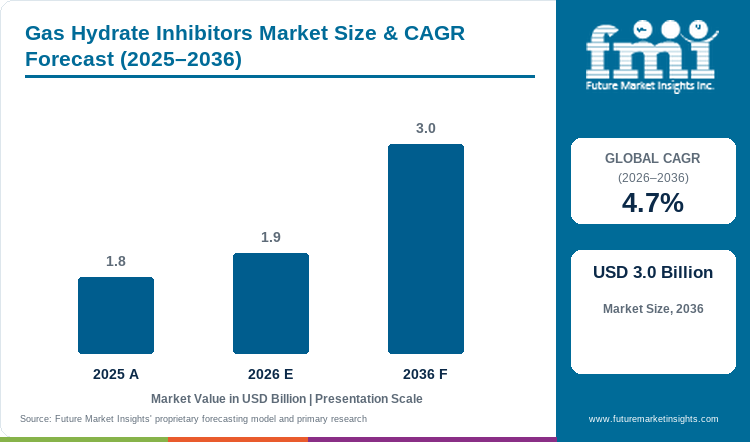
- Market Size (2026)
- USD 1.9 Bn
- Forecast (2036)
- USD 3.0 Bn
- CAGR (2026 to 2036)
- 4.7%
How big is Gas Hydrate Inhibitors Market in 2026?
USD 1.9 billion in 2026 and USD 3.0 billion by 2036, expanding at a 4.7% CAGR.
Demand for gas hydrate inhibitors is projected to expand at 4.7% CAGR between 2026 and 2036. Valuation rose from USD 1.8 billion in 2025 to USD 1.9 billion in 2026 and is projected to reach USD 3.0 billion by 2036. Offshore tiebacks are extending production reach from existing host facilities while increasing exposure to hydrate-management requirements across long subsea flow paths. The USA Energy Information Administration reported in June 2025 that eight of thirteen Federal Offshore Gulf fields expected to start during 2025 and 2026 use subsea tiebacks or underwater extensions. Each additional connection requires a defined prevention program so production can restart reliably through existing host facilities.
Country demand is diverging because hydrate exposure concentrates at different interfaces within national gas systems. German gas operators are concentrating inhibitor use near LNG terminals and transmission assets instead of new offshore production systems. Bundesnetzagentur reported in January 2026 that German LNG terminals supplied 106 TWh during 2025 and represented 10.3% of national gas imports. German terminal exposure is keeping inhibitor selection tied to cold handling points and established operating procedures. New gas developments in Saudi Arabia and the UAE are adding upstream treatment points during production ramp-up. Field qualification and injection logistics carry greater weight in high-pressure upstream systems with new treatment interfaces.
Key Takeaways
- Longer subsea tiebacks and gas-system additions are increasing the number of operating points that require planned hydrate prevention during normal production and restart conditions.
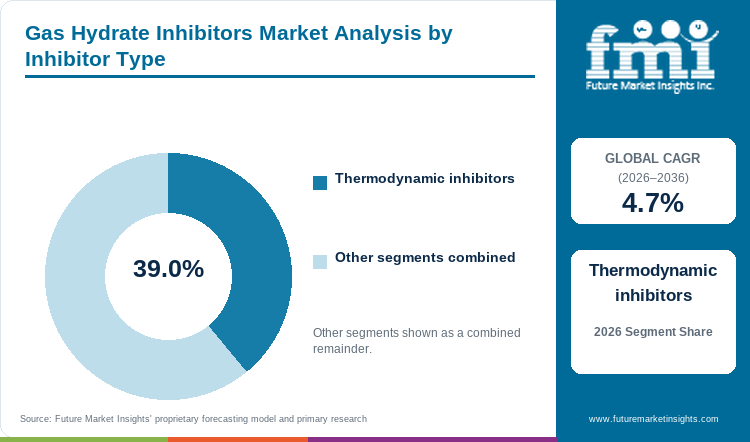
- By inhibitor type, thermodynamic inhibitors are projected to account for 39.0% in 2026 owing to predictable equilibrium suppression under high-consequence operating conditions.
- Methanol is estimated to represent 32.0% of chemistry demand in 2026, supported by straightforward field injection without dedicated glycol-regeneration equipment.
- Subsea flowlines are expected to account for 33.0% of application demand in 2026, driven by repeated shutdown and restart exposure along cold pressurized transport routes.
- Fluid-specific qualification and injection-system compatibility are constraining chemistry switching even as lower-dose programs reduce storage and transport requirements.
- Some of the key players in this market include SLB, ChampionX (an SLB company), Halliburton, Baker Hughes, Clariant, Innospec, Sterling Specialty Chemicals, BASF, Stepan Company, and Dorf Ketal Chemicals India Limited.
Analyst Perspective
"Hydrate-control programs are purchased against a defined operating envelope instead of a catalog claim. Suppliers win repeat work when laboratory qualification and field support prove that a treatment survives shutdowns without creating a second production-chemistry problem."
- Nikhil Kaitwade, Principal Consultant, Future Market Insights
How is the gas hydrate inhibitors market segmented?
By Inhibitor Type, Chemistry, Application, End Use, Sales Channel and Region.
The gas hydrate inhibitors market is segmented by inhibitor type, chemistry, application, end use, sales channel and region. Inhibitor types include thermodynamic inhibitors, low-dosage hydrate inhibitors, kinetic hydrate inhibitors, anti-agglomerants and hybrid packages. Chemistry covers methanol, MEG, polymeric KHIs, quaternary ammonium blends and specialty solvent blends used in field programs. Applications include subsea flowlines, gas gathering systems, deepwater wells, LNG/feed gas handling and tiebacks. End uses and sales channels follow the exact classifications reproduced in the taxonomy section below.
How do thermodynamic inhibitors support conservative hydrate-control programs?
Production teams are using thermodynamic treatment to shift hydrate equilibrium and maintain a calculable safety margin during cold starts or extended shut-ins. Large offshore systems are recovering MEG because regeneration infrastructure can offset repeated solvent purchases and high transport volumes. Those systems are comparing ethylene glycol economics with regeneration energy and equipment requirements during long-term MEG approval. Equinor confirmed in November 2025 that Hammerfest LNG receives and regenerates MEG before reinjecting it into field pipelines to prevent hydrate formation. Lower-dose inhibitors must reduce logistics without weakening restart protection or injection reliability in established MEG systems.
- Thermodynamic inhibitors are estimated to hold 39.0% of inhibitor type demand in 2026, attributable to predictable equilibrium suppression under demanding flow-assurance conditions.
- High treatment rates are increasing storage and delivery requirements, so project economics determine whether conventional THI certainty justifies the chemical-volume burden.
What makes methanol practical without regeneration infrastructure?
Methanol remains practical because rapid dissolution and simple injection can outweigh the cost of recovering solvent from intermittent treatment points. Remote gathering systems can avoid dedicated regeneration equipment by using a consumable chemical program. Changing field conditions are increasing the need for dosage guidance and compatibility support from oilfield chemicals suppliers. OPRED reminded permit holders in February 2026 that offshore chemicals used in open systems must appear on the associated chemical permit. Simpler injection hardware is keeping methanol commercially relevant in treatment points that do not recover solvent.
- Methanol is set to lead the chemistry category with 32.0% share in 2026, supported by straightforward field injection without recovery infrastructure.
- Lower-dose chemistry becomes a credible replacement once transport burden falls without weakening materials compatibility or restart performance in the actual fluid system.
What operating conditions keep subsea flowlines chemistry-intensive?
Produced fluids are cooling toward seabed temperature while pressure remains within the hydrate stability region along long subsea transport paths. Shut-in periods intensify exposure because flow stops even though water and pressure remain inside the production system. The USA Energy Information Administration reported in June 2025 that eight of thirteen Federal Offshore Gulf fields expected to start during 2025 and 2026 use subsea tiebacks or underwater extensions. Those tiebacks are increasing dependence on subsea equipment that must deliver inhibitor during normal flow and cold restart conditions. Qualification must reproduce steady production and transient cases that carry the highest blockage risk.
- In 2026, subsea flowlines are expected to lead application demand with 33.0% share driven by repeated hydrate-control needs along cold pressurized transport routes.
- Chemical programs are being qualified against water cut and residence time before operators approve dosing through existing subsea injection infrastructure.
How does offshore oil and gas change the inhibitor qualification burden?
Offshore operators are protecting wellheads and jumpers as well as flowlines and risers under tight storage and delivery limits. Deepwater assets are placing greater value on concentrated chemistry that preserves cold-restart protection with lower treatment volumes. Baker Hughes received a February 2025 ExxonMobil Guyana award covering topsides and subsea production chemicals for two FPSO developments. Offshore field services are coordinating chemical supply with operating support under one production program. Suppliers are evaluating hydrate inhibitors as part of the production-chemistry package instead of stand-alone commodity chemicals.
- Offshore oil and gas is forecast to represent 46.0% of end-use demand in 2026, influenced by hydrate prevention integrated with production-assurance planning.
- Platform storage and subsea delivery limits are increasing the value of concentrated treatments once laboratory evidence confirms equivalent shutdown and restart protection.
Why do oilfield chemical suppliers retain a service-led sales role?
Hydrate-control purchases usually include fluid sampling and laboratory screening before a field treatment program receives operating approval. Suppliers are providing dosage guidance and troubleshooting because changes in water cut or gas composition alter hydrate risk. Innospec launched the LaZuli deepwater line in March 2025 with subsea-certified solutions and a hydrate anti-agglomerant. The supplier relationship now combines oilfield production chemicals with hydrate-control support and technical service. Distributor supply remains practical for routine replenishment, but complex LDHI programs require direct application expertise during qualification and field use.
- Oilfield chemical suppliers are likely to capture 39.0% of sales-channel demand in 2026, reinforced by qualification services delivered with the treatment program.
- Direct operator contracts are becoming more important as field volume and dedicated technical support justify longer commitments with formulation suppliers.
What are the drivers, restraints and opportunities in the Gas Hydrate Inhibitors Market?
Subsea project additions expand hydrate-control points while field qualification slows chemistry changes and lower-dose programs can reduce chemical logistics.
- Driver: New tiebacks are adding cold pressurized flow paths that require qualified hydrate-control strategies during startup and planned restart operations.
- Restraint: Operators must confirm pumpability and fluid compatibility before replacing proven treatment within an existing production-chemistry program.
- Opportunity: Field-validated lower-dose and hybrid treatments can reduce stored chemical volume without sacrificing restart protection under the same operating envelope.
Subsea Project Additions Increase Hydrate-Control Points
Deepwater additions are expanding purchases because each subsea connection introduces another cold pressurized flow path with hydrate-forming conditions. The USA Energy Information Administration reported in June 2025 that eight of thirteen Federal Offshore Gulf fields expected to start during 2025 and 2026 use subsea tiebacks or underwater extensions. Each connection requires hydrate modeling during startup planning and a reliable treatment route during shutdown recovery. Tieback projects are making flow assurance planning more asset-specific because host facilities have fixed injection limits. Suppliers gain recurring work by proving that their chemistry operates within the host facility and installed injection system during production and restart.
Field Qualification Slows Chemistry Switching
A lower dosage does not justify replacement until the formulation performs reliably in field fluids and available injection hardware. Offshore operators are testing interactions with corrosion inhibitors and separation chemistry already in service. Clariant reported in June 2026 that HYTREAT ECO completed North Sea deployment under demanding restart and environmental conditions. Field qualification costs can protect incumbent programs even as lower chemical volume improves logistics. Replacement programs are advancing with laboratory and field evidence that confirms the operating envelope and compatibility with the existing production-chemistry program.
Lower-Dose Programs Can Reduce Chemical Logistics
Verified shut-in and restart performance allows lower-dose inhibitors to reduce transport and storage requirements. The commercial case is strengthening because conventional methanol or MEG programs consume deck space and replenishment capacity. ChampionX reported in April 2025 that it started initial deliveries of a significant hydrate-inhibitor volume for a major new FPSO serving an Australian operator. Accurate dosing still depends on chemical injection pumps because concentration gains do not remove injection-control requirements. Suppliers can win conversion work by quantifying total treatment burden and proving that lower chemical volume avoids new separation or materials-compatibility problems.
Which country CAGRs are profiled in the Gas Hydrate Inhibitors Market?
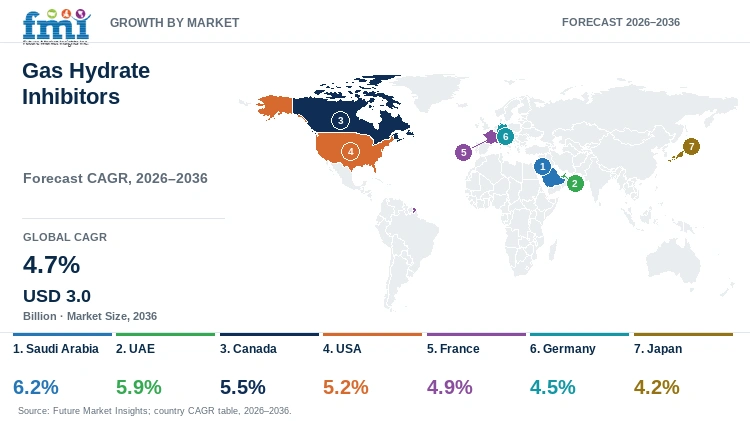
| Country | CAGR |
|---|---|
| Saudi Arabia | 6.2% |
| UAE | 5.9% |
| Canada | 5.5% |
| USA | 5.2% |
| France | 4.9% |
| Germany | 4.5% |
| Japan | 4.2% |
How do country-level CAGRs compare in the Gas Hydrate Inhibitors Market?
The seven country forecasts span 2.0 percentage points from Saudi Arabia at 6.2% to Japan at 4.2%. Saudi Arabia and the UAE form an upper group influenced by new gas projects. Canada and the USA retain substantial production-system exposure tied to active upstream and offshore systems. France and Germany depend more on gas-handling infrastructure, while Japan remains closely linked to LNG supply operations.
- Saudi Arabia is adding gathering and processing interfaces as the Jafurah program moves from construction into production operations.
- UAE demand is concentrated in offshore gas projects, influenced by remote production and central processing that increase chemical-delivery requirements.
- Canada combines cold gathering conditions with rising western gas output and the new LNG export route from British Columbia.
- USA demand retains a deepwater tieback component, driven by Gulf developments that connect additional subsea flow paths to existing hosts.
- France relies on LNG terminals and gas-network operations, shaped by cold handling points that create targeted inhibitor requirements.
- Germany has a terminal-led requirement, supported by LNG imports that now form a measurable share of the national gas-entry system.
- Japan emphasizes LNG handling and terminal continuity, attributable to import dependence that outweighs domestic upstream activity.
Comparable CAGRs can still produce different purchasing conditions because hydrate exposure appears in different assets and operating cycles. The full report provides country-level CAGR analysis across North America, Latin America, Western Europe, Eastern Europe, East Asia, South Asia and Pacific, and the Middle East and Africa.
Country-wise Analysis
- Saudi Arabia is adding non-associated gas production and processing capacity to an already large domestic gas system. Gas hydrate inhibitor demand in Saudi Arabia is forecast to rise at 6.2% CAGR over the forecast period, driven by new gathering routes that add treatment points. The International Energy Agency reported in April 2026 that Saudi Arabia produced close to 120 bcm of natural gas during 2025. Local chemistry programs are coordinating hydrate protection with oilfield scale inhibitors and other treatments used in the same production system. New inhibitor programs require local testing and dependable field support to enter routine service in high-pressure gathering and processing assets.
- UAE hydrate-control purchasing is concentrated in offshore gas production and major processing facilities handling sour high-pressure streams. Gas hydrate inhibitor sales in the UAE are forecast to expand at 5.9% CAGR by 2036, influenced by offshore capacity additions. The International Energy Agency reported in April 2026 that the Shah field can process about 20% of national gas production. Long offshore delivery paths are raising switching costs because uncertain pumpability or materials compatibility can disrupt treatment delivery. Sour-service qualification and regional technical support are becoming essential for sustained use within established injection systems during commissioning and routine operations.
- Western Canadian gas systems combine cold gathering conditions with rising production and a new LNG export route. Adoption of gas hydrate inhibitors in Canada is estimated to expand at 5.5% CAGR through 2036, supported by rising western gas production and coastal LNG exports. The Canada Energy Regulator reported in May 2026 that natural gas output averaged about 19.0 Bcf/d during 2025. LNG Canada began exports in June 2025 and added a new outlet for western supply. Remote treatment points and LNG storage tanks are increasing the need for predictable inhibitor replenishment during winter logistics. Service teams are adapting cold-weather dosing plans to long distances between producing assets and coastal facilities.
- Federal offshore development keeps hydrate management tied to long subsea connections and existing host facilities in the US Gulf. The USA gas hydrate inhibitors sector is projected to record 5.2% CAGR during the assessment period, reinforced by new Gulf tiebacks that add treatment points. The USA Energy Information Administration reported in June 2025 that eight of thirteen Gulf fields expected to start during 2025 and 2026 use subsea tiebacks or underwater extensions. Those projects are adding shutdown and restart cases that must stay within existing host injection limits. New treatment programs must reproduce the asset operating envelope to displace established production chemistry in mature host facilities.
- French hydrate-control demand is concentrated at LNG receipt and gas-network operations instead of a large domestic upstream production base. France's gas hydrate inhibitors outlook is anticipated to advance at 4.9% CAGR over the assessment period, tied to LNG terminals that remain important national gas-entry points. The Commission de régulation de l’énergie reported in June 2026 that LNG represented 56% of French gas imports during 2025. Mature terminal procedures are slowing chemistry changes because unplanned process interruptions carry high operating costs. Different inhibitors require documented cold-service performance and materials compatibility to enter regular use within established terminal procedures.
- German gas operators are purchasing hydrate-control chemistry mainly for LNG import and transmission infrastructure because domestic upstream production remains comparatively limited. Germany is estimated to post 4.5% CAGR over the forecast period, shaped by terminal handling requirements. Bundesnetzagentur reported in January 2026 that LNG terminals supplied 106 TWh during 2025 and accounted for 10.3% of national gas imports. Treatment opportunities are concentrating at specific cold or pressurized interfaces instead of following national gas throughput automatically. Suppliers need formulations compatible with established terminal procedures and local technical support near processing interfaces.
- Japan depends heavily on imported LNG and places high operating value on terminal continuity within its national gas system. In Japan, gas hydrate inhibitor demand is predicted to advance at 4.2% CAGR through 2036, attributable to supply-security planning that keeps LNG infrastructure commercially important. METI announced in February 2026 that Japan signed an emergency LNG-supply cooperation memorandum with QatarEnergy and JERA. Mature terminals apply conservative change controls because unexpected process interruptions can affect established gas-delivery commitments. Local teams require documented materials compatibility and a clear operating case to approve treatment changes within existing LNG handling systems. Technical support must match the documentation standards used by established terminal operators during treatment qualification.
Who are the notable companies in the Gas Hydrate Inhibitors Market?
SLB, ChampionX (an SLB company), Halliburton, Baker Hughes, Clariant, Innospec, Sterling Specialty Chemicals, BASF, Stepan Company, and Dorf Ketal Chemicals India Limited are the notable companies serving this market.
Competition is separating integrated production-chemistry service platforms from specialist formulation suppliers and diversified chemical manufacturers. ChampionX is operating within SLB’s combined production-chemistry platform with access to global laboratory and field-service resources. Sterling Specialty Chemicals is carrying Multi-Chem field-service capability alongside thermodynamic hydrate inhibitor supply for production assets. Stepan Company and Dorf Ketal Chemicals India Limited are documenting direct hydrate-inhibitor offerings within broader oilfield chemical portfolios.
- SLB and ChampionX operate as one corporate platform with production chemistry supported by global laboratory and field-service resources.
- Clariant and Innospec provide direct LDHI formulations, while Sterling Specialty Chemicals supplies thermodynamic treatment through a broader production-chemistry service route.
- BASF supplies documented low-dosage hydrate-inhibitor chemistry, while Stepan Company and Dorf Ketal Chemicals India Limited add specialist formulation routes.
Competitive Benchmarking: Gas Hydrate Inhibitors Market
| Company | Hydrate-Control Chemistry Breadth | Subsea Qualification & Application Support | Formulation & Service Integration | Geographic Reach |
|---|---|---|---|---|
| SLB | High | High | High | Global |
| ChampionX (an SLB company) | High | High | High | Integrated within SLB global production-chemistry operations |
| Halliburton | High | Medium | High | Global |
| Baker Hughes | High | High | High | Global |
| Clariant | High | High | High | Europe, North America, Middle East and Asia-Pacific |
| Innospec | High | High | Medium | Americas, Europe, Middle East and Asia-Pacific |
| Sterling Specialty Chemicals | Medium | Low | High | North America, Middle East and international service coverage |
| BASF | Medium | Low | Low | Global |
| Stepan Company | Medium | Low | Medium | North America, Middle East and international sales |
| Dorf Ketal Chemicals India Limited | Medium | Low | High | Americas, Europe, Middle East and Asia-Pacific |
Scoring basis: High chemistry breadth requires multiple documented hydrate-control routes or finished programs for production use. Medium requires one direct finished treatment route and Low marks no current finished inhibitor offering. High subsea support requires public deepwater qualification or field-deployment evidence for the company’s current chemistry. Medium reflects offshore application support without equivalent public qualification depth and Low marks no current direct subsea qualification evidence. High integration requires chemistry plus laboratory or field-service capability within the same operating program. Medium reflects formulation or manufacturing support without comparable field-service depth and Low reflects chemistry supply without documented application support.
Key Developments in the Gas Hydrate Inhibitors Market
- In June 2026, Clariant announced successful offshore deployment of HYTREAT ECO low-dosage hydrate inhibitor technology in Norway and the United Kingdom under North Sea environmental requirements.
- In March 2025, Innospec launched the LaZuli deepwater subsea production line with a low-dose hydrate anti-agglomerant included among the certified chemical solutions.
- In February 2025, Baker Hughes received an ExxonMobil Guyana award covering topsides and subsea production chemicals for the Uaru and Whiptail developments with first production targeted from 2026 and 2027.
Key Players in the Gas Hydrate Inhibitors Market
Integrated Production Chemistry and Service Platforms
- SLB
- ChampionX (an SLB company)
- Halliburton
- Baker Hughes
Specialty Hydrate Chemistry and Formulation Suppliers
- Clariant
- Innospec
- Sterling Specialty Chemicals
Broader Chemical and Energy-Service Suppliers
- BASF
- Stepan Company
- Dorf Ketal Chemicals India Limited
Gas Hydrate Inhibitors Market - Report Scope
| Coverage field | Report scope |
|---|---|
| Market breakdown | By inhibitor type, chemistry, application, end use, sales channel and region. |
| Quantitative Units | USD billion. |
| Market Definition | Commercial gas hydrate inhibitor chemistries used to prevent or manage hydrate formation in upstream, midstream and LNG gas systems. |
| Regions Covered | North America, Latin America, Western Europe, Eastern Europe, East Asia, South Asia and Pacific, and Middle East and Africa. |
| Countries Covered | Saudi Arabia, UAE, Canada, USA, France, Germany, Japan, and 30+ countries included in the full report. |
| Key Companies Profiled | SLB, ChampionX (an SLB company), Halliburton, Baker Hughes, Clariant, Innospec, Sterling Specialty Chemicals, BASF, Stepan Company, and Dorf Ketal Chemicals India Limited. |
| Forecast Period | 2026 to 2036. |
| Approach | Primary and secondary research with market triangulation. |
Gas Hydrate Inhibitors Market - Research Methodology
| Method | Approach |
|---|---|
| Primary Research | FMI analysts gathered input from manufacturers, service providers, technology developers, distributors, end users, procurement teams, and subject-matter experts. Interviews examined purchasing decisions, product or service evaluation, adoption barriers, approval requirements, pricing considerations, and expectations for technical or commercial support. Respondents were also asked what evidence is required before a trial, pilot, or initial order develops into regular purchasing. |
| Desk Research | Desk research covered government statistics, regulatory publications, trade data, industry associations, technical literature, standards, company filings, product information, and official corporate announcements. Sources were reviewed for relevance, publication date, geographic coverage, and consistency with the defined market scope. Claims relating to performance, applications, approvals, capacity, investment, and commercial activity were retained only when supported by credible public evidence. |
| Market Sizing and Forecasting | The market model combined the baseline value with historical performance, segment structure, pricing and volume indicators, adoption levels, company participation, and country-level demand conditions. Forecast assumptions considered economic activity, investment trends, regulatory developments, technology adoption, purchasing cycles, supply availability, and barriers to wider market use. Segment and regional estimates were reconciled before the final market total was calculated. |
| Data Validation | Estimates were checked against multiple independent indicators, including public data, company activity, trade patterns, industry developments, and findings from primary interviews. Validation also tested whether products, services, applications, and company revenues fell within the defined market boundaries. Adjacent categories, unsupported claims, overlapping revenues, and activities without direct market relevance were excluded to reduce double counting and maintain consistency across segments and countries. |
Gas Hydrate Inhibitors Market by Segments
Gas Hydrate Inhibitors Market segmented by Inhibitor Type:
- Thermodynamic inhibitors
- Low-dosage hydrate inhibitors
- Kinetic hydrate inhibitors
- Anti-agglomerants
- Hybrid inhibitor packages
Gas Hydrate Inhibitors Market segmented by Chemistry:
- Methanol
- MEG
- Polymeric KHIs
- Quaternary ammonium blends
- Specialty solvent blends
Gas Hydrate Inhibitors Market segmented by Application:
- Subsea flowlines
- Gas gathering systems
- Deepwater wells
- LNG/feed gas handling
- Tiebacks
Gas Hydrate Inhibitors Market segmented by End Use:
- Offshore oil and gas
- Onshore gas production
- LNG projects
- Pipeline operators
- Gas processing plants
Gas Hydrate Inhibitors Market segmented by Sales Channel:
- Oilfield chemical suppliers
- Integrated service companies
- Direct operator contracts
- Chemical distributors
Gas Hydrate Inhibitors Market by Region:
- North America
- United States
- Canada
- Latin America
- Brazil
- Mexico
- Argentina
- Chile
- Western Europe
- Germany
- France
- United Kingdom
- Italy
- Spain
- Benelux
- Nordics
- Eastern Europe
- Poland
- Czech Republic
- Romania
- Hungary
- East Asia
- China
- Japan
- South Korea
- South Asia and Pacific
- India
- ASEAN
- Australia and New Zealand
- Middle East and Africa
- GCC Countries
- South Africa
- Türkiye
- Israel
Research Sources and Bibliography
- USA Energy Information Administration. (2025, June 6). Gulf of America oil and natural gas production expected to remain stable through 2026.
- Bundesnetzagentur. (2026, January 12). Bundesnetzagentur publishes gas supply figures for 2025.
- Equinor. (2025, November 18). The investigation of exposure incidents at Hammerfest LNG is completed.
- Offshore Petroleum Regulator for Environment and Decommissioning. (2026, February 16). Requirement to include offshore chemicals used in “Open systems” in the associated chemical permit.
- Baker Hughes. (2025, February 3). Baker Hughes secures major chemicals award from ExxonMobil Guyana for FPSOs.
- Innospec. (2025, March 24). Innospec announces LaZuli product line for deepwater subsea production.
- Clariant. (2026, June 24). Clariant achieves North Sea breakthrough with OSPAR-compliant low-dosage hydrate inhibitor technology.
- ChampionX. (2025, April 29). ChampionX reports first quarter 2025 results.
- International Energy Agency. (2026, April 24). Gas Market Report, Q2-2026.
- Canada Energy Regulator. (2026, May 20). Market Snapshot: Canada’s natural gas production kept climbing in 2025.
- Commission de régulation de l’énergie. (2026, June 25). La CRE publie son rapport de surveillance des marchés de gros 2025.
- Ministry of Economy, Trade and Industry, Japan. (2026, February 4). METI, QatarEnergy, and JERA sign MOU on cooperation for emergency additional LNG supply to Japan.
- SLB. (n.d.). Flow assurance. Retrieved September 17, 2026.
- Halliburton. (n.d.). Flow assurance. Retrieved September 17, 2026.
- Baker Hughes. (n.d.). Hydrate control. Retrieved September 17, 2026.
- Clariant. (n.d.). Redefining hydrate management with HYTREAT ECO. Retrieved September 17, 2026.
- BASF. (n.d.). Oilfield chemicals. Retrieved September 17, 2026.
- SLB. (n.d.). ChampionX. Retrieved September 17, 2026.
- Innospec. (n.d.). Deepwater & subsea production chemicals. Retrieved September 17, 2026.
- Sterling Specialty Chemicals. (n.d.). Production. Retrieved September 17, 2026.
- Stepan Company. (2025). Meet Stepan Oilfield Solutions at ADIPEC 2025.
- Dorf Ketal Chemicals India Limited. (n.d.). Energy. Retrieved September 17, 2026.
- Sterling Specialty Chemicals. (2025, November 21). Sterling Specialty Chemicals enters into an agreement to acquire a portion of Halliburton’s Multi-Chem business.
- Stepan Company. (2025, April 28). Stepan Company starts production at new alkoxylation hub in Pasadena, Texas.
- Baker Hughes. (2025, July 22). Baker Hughes Company announces second-quarter 2025 results.
- Clariant. (2025, September 8). Clariant Oil Services launches customer portal for seamless digital access.
- Clariant. (2025, September 2). Clariant Oil Services and Swire Energy Services open new supply base in Norway supporting European energy production.
- Dorf-Ketal Chemicals India Limited. (2025, January 23). Draft Red Herring Prospectus.
- SLB. (2025, July 16). SLB completes acquisition of ChampionX.
- Baker Hughes. (2025, September 17). Baker Hughes secures multi-year contract with Petrobras for offshore stimulation vessels.
- ChampionX. (2025, February 4). ChampionX reports fourth quarter and full-year 2024 results.
- Innospec Inc. (2025, April 9). Innospec Oilfield Services’ OKC manufacturing center has earned ISO 9001 certification!
- Sterling Specialty Chemicals. (2026, May 4). Sterling Specialty Chemicals acquires Multi-Chem.
- Stepan Company. (2025, December 19). Stepan celebrates Pasadena site ribbon cutting: A new era of growth and enablement.
- SLB. (2026, January 23). SLB announces fourth-quarter and full-year 2025 results, increases dividend and commits to return more than $4 billion to shareholders in 2026.
This bibliography is provided for reader reference and is not exhaustive. The full report contains the complete reference list and detailed citations.
This Report Answers
- How large is the gas hydrate inhibitors market in 2026 and 2036?
- Which operating conditions increase purchases of gas hydrate inhibitor chemistry?
- Which inhibitor type holds the largest verified 2026 category share?
- Why does methanol remain important within hydrate-control chemistry selection?
- How do subsea flowlines change qualification and chemical-delivery requirements?
- Which companies supply chemistry and field services for gas hydrate control?
- Which qualification constraints can delay replacement of an established treatment program?
Frequently Asked Questions
How big is the Gas Hydrate Inhibitors Market in 2026?
The gas hydrate inhibitors market is estimated at USD 1.9 billion in 2026 and is projected to reach USD 3.0 billion by 2036. New subsea connections and gas-system additions are increasing the number of assets requiring planned hydrate prevention.
What is the CAGR of the Gas Hydrate Inhibitors Market from 2026 to 2036?
The gas hydrate inhibitors market is projected to expand at a 4.7% CAGR from 2026 to 2036. Additional hydrate-prone transport points and replacement work are supporting demand within established production-chemistry programs serving gas assets.
Which inhibitor type leads the Gas Hydrate Inhibitors Market?
Thermodynamic inhibitors are estimated to hold 39.0% of the inhibitor type category in 2026. Operators are retaining equilibrium suppression for conservative protection during shutdown and restart conditions with high blockage consequences.
How much value will the Gas Hydrate Inhibitors Market add through 2036?
The gas hydrate inhibitors market is expected to add about USD 1.1 billion in value between 2026 and 2036. New treatment points and continuing chemical service are increasing value within installed gas-production infrastructure.
Which companies are active in the Gas Hydrate Inhibitors Market?
Key companies include SLB, ChampionX as an SLB company, Halliburton, Baker Hughes, Clariant, Innospec, Sterling Specialty Chemicals, BASF, Stepan Company and Dorf Ketal Chemicals India Limited. Their roles span integrated production chemistry and finished inhibitor formulations as well as specialist oilfield chemical supply.
Preview the report firsthand - request a free sample
Get SampleGet the brochure for pricing and purchase details.
Get PDFTable of Content
- Key Takeaways
- Market Size and CAGR
- Top Growth Driver
- Fastest Growing Segment
- Leading Region
- Key Companies
- Emerging Opportunities
- Executive Summary
- Global Market Outlook
- Demand-side Trends
- Supply-side Trends
- Technology Roadmap Analysis
- Analysis and Recommendations
- Analyst Perspective (What is happening? Why now? What should investors know?)
- Key Questions Answered
- How large is the market?
- What is the CAGR?
- What are key trends?
- Which region dominates?
- Who are the leaders?
- Market Overview
- Market Coverage / Taxonomy
- Market Definition / Scope / Limitations
- Research Methodology
- Chapter Orientation
- Analytical Lens and Working Hypotheses
- Market Structure, Signals, and Trend Drivers
- Benchmarking and Cross-market Comparability
- Market Sizing, Forecasting, and Opportunity Mapping
- Research Design and Evidence Framework
- Desk Research Programme (Secondary Evidence)
- Expert Input and Fieldwork (Primary Evidence)
- Tooling, Models, and Reference Databases
- Data Engineering and Model Build
- Quality Assurance and Audit Trail
- Market Background
- Market Dynamics (Drivers, Restraints, Opportunity, Trends)
- Scenario Forecast (Optimistic, Likely, Conservative)
- Impact Analysis
- AI Impact
- Sustainability Impact
- Regulatory Impact
- Technology Impact
- Consumer / Buyer Analysis
- Purchase Drivers
- Adoption Barriers
- Buyer Journey
- Opportunity Map Analysis
- Product Life Cycle Analysis
- Supply Chain Analysis
- Investment Feasibility Matrix
- Value Chain Analysis
- PESTLE and Porter's Analysis
- Regulatory Landscape
- Regional Parent Market Outlook
- Production and Consumption Statistics
- Import and Export Statistics
- Global Market Analysis and Forecast, 2021 to 2036
- Historical Market Size Value (USD Billion) Analysis, 2021 to 2025
- Current and Future Market Size Value (USD Billion) Projections, 2026 to 2036
- Y-o-Y Growth Trend Analysis
- Absolute $ Opportunity Analysis
- Global Market Pricing Analysis, 2021 to 2036
- Global Market Analysis and Forecast, By Inhibitor Type, 2021 to 2036
- Introduction / Key Findings
- Historical Market Size Value (USD Billion) Analysis By Inhibitor Type, 2021 to 2025
- Current and Future Market Size Value (USD Billion) Analysis and Forecast By Inhibitor Type, 2026 to 2036
- Thermodynamic inhibitors
- Low-dosage hydrate inhibitors
- Kinetic hydrate inhibitors
- Anti-agglomerants
- Hybrid inhibitor packages
- Y-o-Y Growth Trend Analysis By Inhibitor Type, 2021 to 2025
- Absolute $ Opportunity Analysis By Inhibitor Type, 2026 to 2036
- Global Market Analysis and Forecast, By Chemistry, 2021 to 2036
- Introduction / Key Findings
- Historical Market Size Value (USD Billion) Analysis By Chemistry, 2021 to 2025
- Current and Future Market Size Value (USD Billion) Analysis and Forecast By Chemistry, 2026 to 2036
- Methanol
- MEG
- Polymeric KHIs
- Quaternary ammonium blends
- Specialty solvent blends
- Y-o-Y Growth Trend Analysis By Chemistry, 2021 to 2025
- Absolute $ Opportunity Analysis By Chemistry, 2026 to 2036
- Global Market Analysis and Forecast, By Application, 2021 to 2036
- Introduction / Key Findings
- Historical Market Size Value (USD Billion) Analysis By Application, 2021 to 2025
- Current and Future Market Size Value (USD Billion) Analysis and Forecast By Application, 2026 to 2036
- Subsea flowlines
- Gas gathering systems
- Deepwater wells
- LNG/feed gas handling
- Tiebacks
- Y-o-Y Growth Trend Analysis By Application, 2021 to 2025
- Absolute $ Opportunity Analysis By Application, 2026 to 2036
- Global Market Analysis and Forecast, By End Use, 2021 to 2036
- Introduction / Key Findings
- Historical Market Size Value (USD Billion) Analysis By End Use, 2021 to 2025
- Current and Future Market Size Value (USD Billion) Analysis and Forecast By End Use, 2026 to 2036
- Offshore oil and gas
- Onshore gas production
- LNG projects
- Pipeline operators
- Gas processing plants
- Y-o-Y Growth Trend Analysis By End Use, 2021 to 2025
- Absolute $ Opportunity Analysis By End Use, 2026 to 2036
- Global Market Analysis and Forecast, By Sales Channel, 2021 to 2036
- Introduction / Key Findings
- Historical Market Size Value (USD Billion) Analysis By Sales Channel, 2021 to 2025
- Current and Future Market Size Value (USD Billion) Analysis and Forecast By Sales Channel, 2026 to 2036
- Oilfield chemical suppliers
- Integrated service companies
- Direct operator contracts
- Chemical distributors
- Y-o-Y Growth Trend Analysis By Sales Channel, 2021 to 2025
- Absolute $ Opportunity Analysis By Sales Channel, 2026 to 2036
- Global Market Analysis and Forecast, By Region, 2021 to 2036
- Introduction
- Historical Market Size Value (USD Billion) Analysis By Region, 2021 to 2025
- Current Market Size Value (USD Billion) Analysis and Forecast By Region, 2026 to 2036
- North America
- Latin America
- Western Europe
- Eastern Europe
- East Asia
- South Asia and Pacific
- Middle East and Africa
- Market Attractiveness Analysis By Region
- North America Market Analysis and Forecast, By Country, 2021 to 2036
- Historical Market Size Value (USD Billion) Trend Analysis By Market Taxonomy, 2021 to 2025
- Market Size Value (USD Billion) Forecast By Market Taxonomy, 2026 to 2036
- By Country
- United States
- Canada
- By Inhibitor Type
- By Chemistry
- By Application
- By End Use
- By Sales Channel
- By Country
- Market Attractiveness Analysis
- By Country
- By Inhibitor Type
- By Chemistry
- By Application
- By End Use
- By Sales Channel
- Key Takeaways
- Latin America Market Analysis and Forecast, By Country
- Historical Market Size Value (USD Billion) Trend Analysis By Market Taxonomy, 2021 to 2025
- Market Size Value (USD Billion) Forecast By Market Taxonomy, 2026 to 2036
- By Country
- Brazil
- Mexico
- Argentina
- Chile
- By Inhibitor Type
- By Chemistry
- By Application
- By End Use
- By Sales Channel
- By Country
- Market Attractiveness Analysis
- By Country
- By Inhibitor Type
- By Chemistry
- By Application
- By End Use
- By Sales Channel
- Key Takeaways
- Western Europe Market Analysis and Forecast, By Country
- Historical Market Size Value (USD Billion) Trend Analysis By Market Taxonomy, 2021 to 2025
- Market Size Value (USD Billion) Forecast By Market Taxonomy, 2026 to 2036
- By Country
- Germany
- France
- United Kingdom
- Italy
- Spain
- Benelux
- Nordics
- By Inhibitor Type
- By Chemistry
- By Application
- By End Use
- By Sales Channel
- By Country
- Market Attractiveness Analysis
- By Country
- By Inhibitor Type
- By Chemistry
- By Application
- By End Use
- By Sales Channel
- Key Takeaways
- Eastern Europe Market Analysis and Forecast, By Country
- Historical Market Size Value (USD Billion) Trend Analysis By Market Taxonomy, 2021 to 2025
- Market Size Value (USD Billion) Forecast By Market Taxonomy, 2026 to 2036
- By Country
- Poland
- Czech Republic
- Romania
- Hungary
- By Inhibitor Type
- By Chemistry
- By Application
- By End Use
- By Sales Channel
- By Country
- Market Attractiveness Analysis
- By Country
- By Inhibitor Type
- By Chemistry
- By Application
- By End Use
- By Sales Channel
- Key Takeaways
- East Asia Market Analysis and Forecast, By Country
- Historical Market Size Value (USD Billion) Trend Analysis By Market Taxonomy, 2021 to 2025
- Market Size Value (USD Billion) Forecast By Market Taxonomy, 2026 to 2036
- By Country
- China
- Japan
- South Korea
- By Inhibitor Type
- By Chemistry
- By Application
- By End Use
- By Sales Channel
- By Country
- Market Attractiveness Analysis
- By Country
- By Inhibitor Type
- By Chemistry
- By Application
- By End Use
- By Sales Channel
- Key Takeaways
- South Asia and Pacific Market Analysis and Forecast, By Country
- Historical Market Size Value (USD Billion) Trend Analysis By Market Taxonomy, 2021 to 2025
- Market Size Value (USD Billion) Forecast By Market Taxonomy, 2026 to 2036
- By Country
- India
- ASEAN
- Australia and New Zealand
- By Inhibitor Type
- By Chemistry
- By Application
- By End Use
- By Sales Channel
- By Country
- Market Attractiveness Analysis
- By Country
- By Inhibitor Type
- By Chemistry
- By Application
- By End Use
- By Sales Channel
- Key Takeaways
- Middle East and Africa Market Analysis and Forecast, By Country
- Historical Market Size Value (USD Billion) Trend Analysis By Market Taxonomy, 2021 to 2025
- Market Size Value (USD Billion) Forecast By Market Taxonomy, 2026 to 2036
- By Country
- GCC Countries
- South Africa
- Türkiye
- Israel
- By Inhibitor Type
- By Chemistry
- By Application
- By End Use
- By Sales Channel
- By Country
- Market Attractiveness Analysis
- By Country
- By Inhibitor Type
- By Chemistry
- By Application
- By End Use
- By Sales Channel
- Key Takeaways
- Key Countries Market Analysis
- United States
- Pricing Analysis
- Market Share Analysis, 2025
- By Inhibitor Type
- By Chemistry
- By Application
- By End Use
- By Sales Channel
- Canada
- Pricing Analysis
- Market Share Analysis, 2025
- By Inhibitor Type
- By Chemistry
- By Application
- By End Use
- By Sales Channel
- Mexico
- Pricing Analysis
- Market Share Analysis, 2025
- By Inhibitor Type
- By Chemistry
- By Application
- By End Use
- By Sales Channel
- Brazil
- Pricing Analysis
- Market Share Analysis, 2025
- By Inhibitor Type
- By Chemistry
- By Application
- By End Use
- By Sales Channel
- Chile
- Pricing Analysis
- Market Share Analysis, 2025
- By Inhibitor Type
- By Chemistry
- By Application
- By End Use
- By Sales Channel
- Germany
- Pricing Analysis
- Market Share Analysis, 2025
- By Inhibitor Type
- By Chemistry
- By Application
- By End Use
- By Sales Channel
- United Kingdom
- Pricing Analysis
- Market Share Analysis, 2025
- By Inhibitor Type
- By Chemistry
- By Application
- By End Use
- By Sales Channel
- Italy
- Pricing Analysis
- Market Share Analysis, 2025
- By Inhibitor Type
- By Chemistry
- By Application
- By End Use
- By Sales Channel
- Spain
- Pricing Analysis
- Market Share Analysis, 2025
- By Inhibitor Type
- By Chemistry
- By Application
- By End Use
- By Sales Channel
- France
- Pricing Analysis
- Market Share Analysis, 2025
- By Inhibitor Type
- By Chemistry
- By Application
- By End Use
- By Sales Channel
- India
- Pricing Analysis
- Market Share Analysis, 2025
- By Inhibitor Type
- By Chemistry
- By Application
- By End Use
- By Sales Channel
- ASEAN
- Pricing Analysis
- Market Share Analysis, 2025
- By Inhibitor Type
- By Chemistry
- By Application
- By End Use
- By Sales Channel
- Australia and New Zealand
- Pricing Analysis
- Market Share Analysis, 2025
- By Inhibitor Type
- By Chemistry
- By Application
- By End Use
- By Sales Channel
- China
- Pricing Analysis
- Market Share Analysis, 2025
- By Inhibitor Type
- By Chemistry
- By Application
- By End Use
- By Sales Channel
- Japan
- Pricing Analysis
- Market Share Analysis, 2025
- By Inhibitor Type
- By Chemistry
- By Application
- By End Use
- By Sales Channel
- South Korea
- Pricing Analysis
- Market Share Analysis, 2025
- By Inhibitor Type
- By Chemistry
- By Application
- By End Use
- By Sales Channel
- Poland
- Pricing Analysis
- Market Share Analysis, 2025
- By Inhibitor Type
- By Chemistry
- By Application
- By End Use
- By Sales Channel
- Hungary
- Pricing Analysis
- Market Share Analysis, 2025
- By Inhibitor Type
- By Chemistry
- By Application
- By End Use
- By Sales Channel
- Türkiye
- Pricing Analysis
- Market Share Analysis, 2025
- By Inhibitor Type
- By Chemistry
- By Application
- By End Use
- By Sales Channel
- South Africa
- Pricing Analysis
- Market Share Analysis, 2025
- By Inhibitor Type
- By Chemistry
- By Application
- By End Use
- By Sales Channel
- Saudi Arabia
- Pricing Analysis
- Market Share Analysis, 2025
- By Inhibitor Type
- By Chemistry
- By Application
- By End Use
- By Sales Channel
- UAE
- Pricing Analysis
- Market Share Analysis, 2025
- By Inhibitor Type
- By Chemistry
- By Application
- By End Use
- By Sales Channel
- United States
- Market Structure Analysis
- Competition Dashboard
- Competition Benchmarking
- Market Share Analysis of Top Players
- By Regional
- By Inhibitor Type
- By Chemistry
- By Application
- By End Use
- By Sales Channel
- Emerging Startups
- Innovation Benchmarking
- Competition Analysis
- Competition Deep Dive
- SLB
- Overview
- Product Portfolio
- Profitability by Market Segments
- Sales Footprint
- Strategy Overview
- Marketing Strategy
- Product Strategy
- Channel Strategy
- ChampionX (an SLB company)
- Halliburton
- Baker Hughes
- Clariant
- Innospec
- Sterling Specialty Chemicals
- BASF
- Stepan Company
- Dorf Ketal Chemicals India Limited
- SLB
- Case Studies
- Success Stories
- Recent Developments
- Competition Deep Dive
- Assumptions & Acronyms Used


