

- Market Size (2026)
- USD 5.7 Bn
- Forecast (2036)
- USD 10.8 Bn
- CAGR (2026 to 2036)
- 6.6%
How big is the Flow Assurance in Oil and Gas Market in 2026?
USD 5.7 billion in 2026 and USD 10.8 billion by 2036 at a 6.6% CAGR.
Sales in the flow assurance in oil and gas market are projected to rise from USD 5.7 billion in 2026 to USD 10.8billion by 2036 at 6.6% CAGR. Operators combine digital oilfield models with treatment and surveillance across producing assets that carry material interruption exposure. In February 2025 Baker Hughes received an ExxonMobil Guyana award covering production chemicals and related FPSO services for two developments. The contract connects chemical selection with operating support under one coordinated service scope for offshore production teams.
Remote tiebacks concentrate thermal and pressure uncertainty across subsea equipment that offers limited access for offshore intervention. In June 2025 the USA Energy Information Administration reported that eight of thirteen Gulf fields starting during 2025 and 2026 would use subsea tiebacks. Operators must complete shutdown analysis and restart plans ahead of approving insulation or chemical programs for each connection.
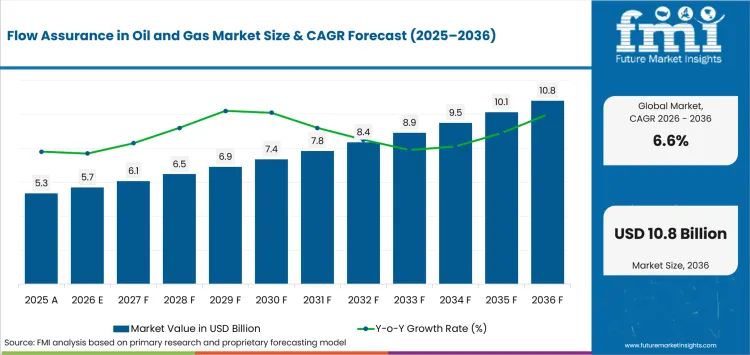
Key Takeaways of Flow Assurance In Oil And Gas Market
- Remote tiebacks increase spending as interrupted flow defers production across assets with limited intervention access.
- Flow assurance engineering services are projected to represent 41.0% of service demand in 2026 as modeling governs treatment and monitoring.
- Offshore oil and gas is estimated at 47.0% of application demand in 2026 due to restricted subsea access.
- Hydrate management is forecast at 36.0% by challenge-type in 2026 as shutdown conditions increase plugging risk.
- Changing fluid composition prolongs validation for revised chemistry and restart procedures across mature production systems.
- SLB, Halliburton Company, Baker Hughes Company and TechnipFMC plc serve integrated technology and subsea project requirements. Wood, Weatherford International plc, Worley Limited and KBR, Inc. complete the verified competitive set across engineering and monitoring roles.
Analyst Perspective
“Deepwater flow assurance decisions begin with the shutdown duration and fluid conditions that determine plug or restart exposure. Operators improve commercial control by linking transient models with chemical-response data and field limits applied by production teams.”
- Nikhil Kaitwade, Principal Consultant, Future Market Insights
How is the Flow Assurance in Oil and Gas Market segmented?
The flow assurance in oil and gas industry is segmented by service, application, challenge type, end user, deployment and region.
The flow assurance in oil and gas market is segmented by service, application, challenge type, end user, deployment and region. Service includes engineering, chemical programs, monitoring, inspection and software, and applications cover offshore production, onshore production, pipelines and LNG operations. Challenge types include hydrates, wax, scale and corrosion, and end users include operators, pipeline companies and oilfield service providers. Deployment covers offshore facilities, onshore facilities and digital monitoring systems across global production networks worldwide.
How do project teams evaluate flow assurance engineering services?
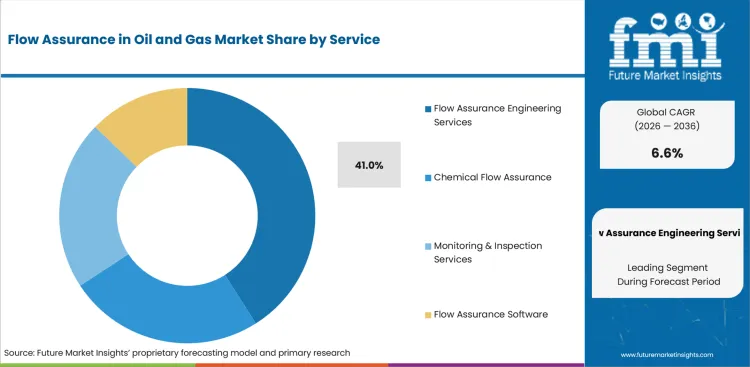
Project teams use engineering studies to define pressure-temperature limits across connected wells and receiving facilities. Representative fluid samples become model cases that guide insulation, operating procedures and oilfield production chemicals across planned field-life conditions.
- Flow assurance engineering services are set to lead the service category with 41.0% share in 2026 due to design work that governs later treatment and surveillance.
- Concept-stage engineering lets project teams adjust layouts and test representative fluids across production and restart cases. Late sampling weakens confidence as reservoir composition and water cut shift ahead of final operating approval.
What makes offshore oil and gas central to the application category?
Offshore systems cool produced fluids across long routes that combine high pressure with restricted intervention access. Deepwater subsea flowlines therefore require insulation, chemical delivery and restart procedures designed as one coordinated operating system.
- By application, offshore oil and gas is estimated to hold 47.0% in 2026 owing to long tiebacks and costly vessel-based intervention.
- Subsea project teams select integrated subsea manifolds to connect several wells with existing hosts and reduce duplicated export infrastructure. Host capacity and vessel access limit later changes once remote hardware enters production and the approved operating envelope narrows.
What role does hydrate management play within the challenge type category?
Hydrate risk develops as water and light hydrocarbons enter low-temperature high-pressure conditions during production or shutdown. A single plug isolates remote wells, so pipeline integrity planning must assess steady flow and restart behavior across the connected system.
- The challenge type category is forecast to be led by hydrate management at 36.0% share in 2026 due to shutdown exposure inside cold pressurized lines.
- Operators revise inhibitor dosage as water production changes and earlier fluid models lose accuracy across mature assets. Current samples and cooling profiles support depressurization plans that protect restart margins without extending treatment across the entire production period.
Why do oil and gas operators lead the end user category?
Oil and gas operators approve production targets and operating limits across wells, pipelines and receiving facilities. Oil and gas analytics help engineering teams compare measured conditions with the approved envelope during daily production planning.
- The oil and gas operators segment is likely to capture 45.0% share in 2026 attributable to direct responsibility for throughput losses and integrity events.
- Operators favor integrated assurance programs that maintain one decision record across reservoir engineering and facility operations. Approval slows if disciplines use conflicting fluid assumptions or contracts divide responsibility for restart performance across complex offshore asset networks.
What are the drivers, restraints and opportunities in the Flow Assurance in Oil and Gas Market?
Remote tiebacks raise interruption exposure as fluid changes extend qualification and field measurements guide operating decisions.
- Driver: Subsea routes raise lost-production costs as hydrates or wax isolate wells from host facilities.
- Restraint: Shifting water cut and reservoir pressure require renewed validation across chemical programs and restart procedures.
- Opportunity: Integrated models and field measurements direct intervention toward assets approaching verified pressure-temperature operating limits.
Deepwater tiebacks cool multiphase fluids across long offshore routes with limited access during unplanned operating changes. Pipeline monitoring systems compare field conditions with validated limits so production teams address drift inside operating windows.
Changing water cut and reservoir pressure weaken models built from earlier fluid samples during later field life. Chemical programs require delivery qualification using umbilicals and flowlines ahead of revised restart approval by production teams.
Operational digital oilfield workflows align engineering models with measured field conditions across complex offshore assets. In October 2025 Weatherford launched Industrial Intelligence with distributed surveillance and real-time virtual flow measurement. The platform lets production teams test model assumptions against operating data during intervention planning and treatment selection.
Which country CAGRs are profiled in the Flow Assurance in Oil and Gas Market?
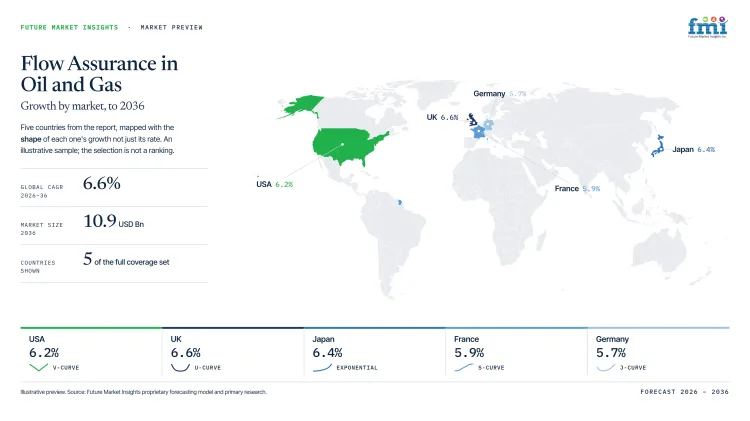
| Country | CAGR |
|---|---|
| United Kingdom | 6.6% |
| Japan | 6.4% |
| United States | 6.2% |
| France | 5.9% |
| Germany | 5.7% |
How do country-level CAGRs compare in the Flow Assurance in Oil and Gas Market?
The displayed rates span 0.9 percentage point and describe forecast pace instead of current market size. Rate spacing reflects different mixes of offshore tieback work, LNG infrastructure and mature network maintenance.
- United Kingdom growth reflects mature offshore hubs that require tieback integration and late-life engineering across aging host facilities.
- The 0.2-point gap between Japan and the United Kingdom reflects Japan’s emphasis on LNG terminals instead of mature offshore hubs.
- Growth outlook in Japan and the United States reflects Gulf tieback activity and broader domestic service capacity.
- France is separated from the United States by 0.3 percentage point as terminal throughput and cross-border flows shape demand.
- The remaining 0.2-point gap reflects Germany’s focus on terminal integration and storage-network surveillance across divided operating responsibilities.
Comparable forecast rates produce different entry conditions across national operating systems and established service networks. The full report covers country performance across six global regions and more than 20 countries.
Country-wise Analysis
- United Kingdom operators connect smaller North Sea resources to mature hubs using Aberdeen engineering and vessel networks, although aging infrastructure and weather-sensitive campaign windows restrict brownfield modifications across dispersed offshore assets. The Department for Energy Security and Net Zero reported in July 2026 that 2025 gas output fell 3.3% to a record low and oil output rose 2.6%, which sustains late-life engineering needs across existing hosts. Flow assurance demand in the United Kingdom is forecast to rise at 6.6% CAGR over the forecast period, supported by tieback integration despite access constraints and shared responsibility across aging production systems and host facilities.
- Japanese energy companies operate large LNG import terminals using specialized engineering and maintenance networks, yet limited domestic upstream activity restricts opportunities to establish offshore qualification records across coastal industrial centers. The Agency for Natural Resources and Energy reported in June 2025 that Japan imported 16.4% of globally traded LNG during 2023 and ranked second, giving local teams repeated gas-handling experience across terminal operations. Japan is estimated to post 6.4% CAGR over the forecast period, reinforced by terminal expertise despite detailed approvals and limited offshore deployments that extend qualification schedules for new services within domestic operating teams and coastal operating centers.
- United States operators use Gulf Coast service hubs for vessel access and chemical logistics across dispersed deepwater fields, although congestion restricts campaign flexibility and specialist support during narrow intervention windows. The Bureau of Ocean Energy Management reported in August 2025 that federal offshore assets produced 667.5 million barrels during fiscal 2024, sustaining repeated assurance work across active leases and tieback corridors. The United States flow assurance sector is projected to record 6.2% CAGR during the assessment period, supported by deepwater engineering despite vessel competition and limited access to specialist crews during peak offshore campaigns across active Gulf production corridors worldwide.
- French gas operators connect Atlantic and Mediterranean LNG terminals with transmission and storage networks using established maintenance routes, although seasonal import shifts divide responsibility across national entry points and operating interfaces. The Commission de régulation de l’énergie reported in June 2026 that LNG imports reached 249 TWh during 2025 and represented 56% of national gas imports, confirming substantial terminal throughput. Flow assurance services in France are estimated to expand at 5.9% CAGR through 2036, influenced by cross-border gas movements despite fragmented ownership and approval duties across transmission and storage systems during seasonal gas nominations across terminal and storage interfaces nationwide.
- German gas operators coordinate four LNG entry points with dense transmission and storage networks, although divided ownership complicates treatment responsibility during seasonal flow changes across connected operating zones. Bundesnetzagentur reported in January 2026 that German LNG terminals imported 106 TWh during 2025 and supplied 10.3% of total gas imports, supporting repeated monitoring and integration work. Germany’s flow assurance outlook is anticipated to advance at 5.7% CAGR over the assessment period, shaped by terminal integration despite variable import routes and shared operating duties that lengthen approval across storage operations and seasonal gas routing changes within several national operating zones each year.
Who are the notable companies in the Flow Assurance in Oil and Gas Market?
SLB, Halliburton Company, Baker Hughes Company, TechnipFMC plc, Wood, Weatherford International plc, Worley Limited and KBR, Inc. are the notable companies in the active competitive set.
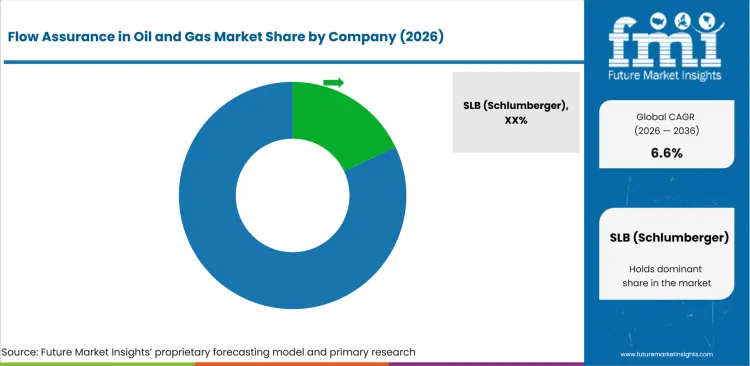
Integrated oilfield groups and engineering firms hold the broadest contract coverage because offshore programs require modeling, chemistry qualification and field support across project stages. Entry also depends on verified operating data and access to subsea engineering records. Smaller specialists compete in simulation or monitoring roles that fit defined work packages.
- SLB and Baker Hughes Company combine engineering with production chemistry and digital operating support across global asset portfolios. Halliburton sold a portion of its Multi-Chem production-chemicals business in 2026 and now concentrates its flow assurance role in engineering, monitoring and pipeline services.
- TechnipFMC plc and Worley Limited compete in subsea design and pipeline integration. Wood operates within Sidara and supplies engineering for offshore brownfield programs across mature production hubs.
- Weatherford International plc emphasizes measurement and digital surveillance across producing assets and remote operating centers globally. KBR, Inc. connects offshore project engineering with standardized long-distance tieback concepts for complex field developments worldwide.
Competitive Benchmarking: Flow Assurance in Oil and Gas Market
| Company | Engineering & Modeling | Operations & Monitoring | Subsea & Pipeline Integration | Geographic Reach |
|---|---|---|---|---|
| SLB | High | High | High | Global |
| Halliburton Company | High | High | Medium | Global |
| Baker Hughes Company | High | High | High | Global |
| TechnipFMC plc | High | Medium | High | Global |
| Wood | High | Medium | High | Global |
| Weatherford International plc | Medium | High | Medium | Global |
| Worley Limited | High | Medium | High | Global |
| KBR, Inc. | High | Medium | Medium | Global |
Key Developments in the Flow Assurance in Oil and Gas Market
- In July 2026, TechnipFMC plc received Equinor contracts for subsea production systems and rigid-pipe installation across Norwegian brownfield tiebacks. The work covers Omega Sør, Brime, Tyrihans Nord and TWIN projects where integrated system design reduces interface risk across host-connected developments. The awards reinforce demand for engineering that aligns flowline routing with production controls and installation schedules.
- In January 2026, Worley Limited received an engineering, procurement and fabrication contract for a subsea Flow Conditioning Unit on Equinor’s Mikkel Late Life project. The unit controls pressure and temperature at pipeline entry and connects flow assurance design with fabricated equipment and planned offshore installation. Worley began project work in December 2025 and plans delivery during the second quarter of 2027.
- In July 2025, SLB completed its ChampionX acquisition and added production chemicals, artificial lift, digital technology and emissions capabilities to its portfolio. The combined offering broadens support across production optimization and flow assurance programs for mature and offshore assets. Integration also gives operators one supplier route for chemical treatment and field surveillance across global production networks.
Key Players in the Flow Assurance in Oil and Gas Market
Integrated Production Technology Platforms
- SLB
- Halliburton Company
- Baker Hughes Company
- Weatherford International plc
Subsea and Pipeline Systems Providers
- TechnipFMC plc
- Worley Limited
Engineering and Project Design Providers
- Wood
- KBR, Inc.
Flow Assurance in Oil and Gas Market - Report Scope
| Coverage field | Report scope |
|---|---|
| Market breakdown | By service, application, challenge type, end user, deployment and region. |
| Quantitative Units | Revenue in USD billion and CAGR in %. |
| Market Definition | Engineering, chemicals, monitoring systems and software used to control multiphase flow risks across oil and gas assets. |
| Regions Covered | North America, Latin America, Europe, East Asia, South Asia and Pacific, and Middle East and Africa. |
| Countries Covered | United Kingdom, Japan, United States, France, Germany, and 20+ countries included in the full report. |
| Key Companies Profiled | SLB, Halliburton Company, Baker Hughes Company, TechnipFMC plc, Wood, Weatherford International plc, Worley Limited and KBR, Inc. |
| Forecast Period | 2026 to 2036. |
| Approach | Primary and secondary research with market triangulation. |
Flow Assurance in Oil and Gas Market - Research Methodology
| Method | Approach |
|---|---|
| Primary Research | FMI analysts gathered input from manufacturers, service providers, technology developers, distributors, end users, procurement teams, and subject-matter experts. Interviews examined purchasing decisions, product or service evaluation, adoption barriers, approval requirements, pricing considerations, and expectations for technical or commercial support. Respondents were also asked what evidence is required before a trial, pilot, or initial order develops into regular purchasing. |
| Desk Research | Desk research covered government statistics, regulatory publications, trade data, industry associations, technical literature, standards, company filings, product information, and official corporate announcements. Sources were reviewed for relevance, publication date, geographic coverage, and consistency with the defined market scope. Claims relating to performance, applications, approvals, capacity, investment, and commercial activity were retained only when supported by credible public evidence. |
| Market Sizing and Forecasting | The market model combined the baseline value with historical performance, segment structure, pricing and volume indicators, adoption levels, company participation, and country-level demand conditions. Forecast assumptions considered economic activity, investment trends, regulatory developments, technology adoption, purchasing cycles, supply availability, and barriers to wider market use. Segment and regional estimates were reconciled before the final market total was calculated. |
| Data Validation | Estimates were checked against multiple independent indicators, including public data, company activity, trade patterns, industry developments, and findings from primary interviews. Validation also tested whether products, services, applications, and company revenues fell within the defined market boundaries. Adjacent categories, unsupported claims, overlapping revenues, and activities without direct market relevance were excluded to reduce double counting and maintain consistency across segments and countries. |
Flow Assurance in Oil and Gas Market by Segments
Flow Assurance in Oil and Gas Market segmented by Service:
- Flow Assurance Engineering Services
- Flow Modeling & Simulation
- Hydrate Risk Assessment
- Production Optimization
- Chemical Flow Assurance
- Hydrate Inhibitors
- Paraffin Inhibitors
- Scale Inhibitors
- Monitoring & Inspection Services
- Pipeline Monitoring
- Integrity Inspection
- Remote Flow Monitoring
- Flow Assurance Software
- Simulation Software
- Digital Twin Platforms
- Predictive Analytics Solutions
Flow Assurance in Oil and Gas Market segmented by Application:
- Offshore Oil & Gas
- Deepwater Production
- Ultra-deepwater Production
- Subsea Tiebacks
- Onshore Oil & Gas
- Crude Oil Pipelines
- Natural Gas Gathering Systems
- Shale Oil Production
- Pipeline Transportation
- Crude Oil Transmission
- Natural Gas Transmission
- Multiphase Pipelines
- LNG & Gas Processing
- Gas Processing Plants
- LNG Export Facilities
- Gas Storage Facilities
Flow Assurance in Oil and Gas Market segmented by Challenge Type:
- Hydrate Management
- Hydrate Prevention
- Hydrate Remediation
- Thermodynamic Analysis
- Wax & Paraffin Control
- Wax Deposition Monitoring
- Paraffin Removal
- Chemical Treatment
- Scale Management
- Carbonate Scale Control
- Sulfate Scale Control
- Scale Monitoring
- Corrosion Control
- Internal Corrosion Monitoring
- Corrosion Inhibitors
- Integrity Management
Flow Assurance in Oil and Gas Market segmented by End User:
- Oil & Gas Operators
- Integrated Oil Companies
- Independent Exploration Companies
- National Oil Companies
- Pipeline Operators
- Crude Oil Pipeline Companies
- Natural Gas Pipeline Companies
- Midstream Operators
- Oilfield Service Companies
- Engineering Contractors
- Production Service Providers
- Inspection Companies
Flow Assurance in Oil and Gas Market segmented by Deployment:
- Offshore Facilities
- Floating Production Storage and Offloading Units
- Subsea Production Systems
- Offshore Platforms
- Onshore Facilities
- Refineries
- Processing Plants
- Terminal Facilities
- Digital Monitoring Systems
- Cloud-based Monitoring
- Edge Monitoring
- Remote Operations Centers
Flow Assurance in Oil and Gas Market by Region:
- North America
- United States
- Canada
- Latin America
- Brazil
- Chile
- Mexico
- Rest of Latin America
- Western Europe
- Germany
- United Kingdom
- Italy
- Spain
- France
- Nordics
- Benelux
- Rest of Western Europe
- Eastern Europe
- Russia
- Poland
- Hungary
- Balkan and Baltic States
- Rest of Eastern Europe
- East Asia
- China
- Japan
- South Korea
- South Asia and Pacific
- India
- ASEAN
- Australia and New Zealand
- Rest of South Asia and Pacific
- Middle East and Africa
- Kingdom of Saudi Arabia
- Other GCC Countries
- Türkiye
- South Africa
- Other African Union Countries
- Rest of Middle East and Africa
Research Sources and Bibliography
- Baker Hughes Company. (2025, February 3). Baker Hughes secures major chemicals award from ExxonMobil Guyana for FPSOs.
- USA Energy Information Administration. (2025, June 6). Gulf of America oil and natural gas production expected to remain stable through 2026.
- Weatherford International plc. (2025, October 1). Weatherford launches Industrial Intelligence at FWRD 2025.
- Department for Energy Security and Net Zero. (2026, July 16). DESNZ annual report 2025 to 2026: Performance report.
- Agency for Natural Resources and Energy. (2025, June).
- Bureau of Ocean Energy Management. (2025, August 22). BOEM finalizes environmental review for Gulf of America offshore energy development.
- Commission de régulation de l’énergie. (2026, June). La Commission de régulation de l’énergie publie son rapport de surveillance des marchés de gros 2025.
- Bundesnetzagentur. (2026, January 12). Bundesnetzagentur publishes gas supply figures for 2025.
- SLB. (2026, January 23). Annual report on Form 10-K for the fiscal year ended December 31, 2025.
- Halliburton Company. (2026, February 6). Annual report on Form 10-K for the year ended December 31, 2025.
- Baker Hughes Company. (2026, February 5). Annual report on Form 10-K for the fiscal year ended December 31, 2025.
- TechnipFMC plc. (2026, February 19). Annual report on Form 10-K for the fiscal year ended December 31, 2025.
- Wood. (2024, January 10). Wood secures major topside modifications contract with bp in the North Sea.
- Financial Conduct Authority. (2026, March 10). Scheme of arrangement becomes effective.
- Weatherford International plc. (2026, February 4). Annual report on Form 10-K for the fiscal year ended December 31, 2025.
- Worley Limited. (2025, August 27). 2025 full year annual report.
- Kärrsten, T. (2026, May 11). From scale to standardization: How floating systems are evolving offshore.
- KBR, Inc. (2025, January 13). KBR awarded global agreement by bp for engineering, procurement and construction management services.
- KBR, Inc. (2026, March 17). KBR launches INSITE 3.0, expanding digital platform and advancing AI-driven growth strategy.
- TechnipFMC plc. (2026, July 7). TechnipFMC awarded subsea contracts by Equinor for multiple projects in Norway.
- Worley Limited. (2026, January 22). Worley Rosenberg secures EPF contract on Mikkel Late Life project.
- SLB. (2025, July 16). SLB completes acquisition of ChampionX.
- Falkor. (2026, April 24). Releasing LedaFlow 2.14.
- Falkor. (2026, June 1). Kongsberg Digital rebrands as Falkor, a KONGSBERG company.
- Subsea7. (2025, July 4). Subsea7 awarded contract offshore Egypt.
The full report contains the complete reference list and detailed citations supporting every retained market claim.
This Report Answers
- How large is the Flow Assurance in Oil and Gas Market by 2036?
- Which operating conditions support flow assurance demand across offshore and mature assets?
- Which service category holds the largest authorized 2026 share?
- How do offshore applications shape modeling and chemical-delivery requirements?
- Which challenge type holds the largest authorized 2026 share?
- How do growth rates differ across the five profiled countries?
- Which companies provide engineering and monitoring capability?
- Which constraints delay solution changes across mature and offshore assets?
Frequently Asked Questions
How big is the Flow Assurance in Oil and Gas Market in 2026?
The Flow Assurance in Oil and Gas Market is valued at USD 5.7 billion during 2026 within the defined service and technology scope. Remote tiebacks and mature assets support the projected increase to USD 10.8billion by 2036 as operators fund modeling, treatment and surveillance across connected production systems.
What is the CAGR of the Flow Assurance in Oil and Gas Market from 2026 to 2036?
The Flow Assurance in Oil and Gas Market is projected to expand at 6.6% CAGR from 2026 to 2036. Forecast performance depends on preventing interruption as fluid changes extend qualification for treatment programs and restart procedures across complex offshore assets and mature systems.
Which service category leads the Flow Assurance in Oil and Gas Market?
Flow assurance engineering services are projected to account for 41.0% of service demand in the Flow Assurance in Oil and Gas Market during 2026. Representative fluid models define pressure-temperature limits that guide insulation, chemical treatment and monitoring plans across connected production systems.
Which application category dominates the Flow Assurance in Oil and Gas Market?
Offshore oil and gas is estimated to account for 47.0% of application demand in the Flow Assurance in Oil and Gas Market during 2026. Long tiebacks and restricted access require coordinated insulation, chemical delivery and restart procedures across validated production and shutdown cases.
Which companies are active in the Flow Assurance in Oil and Gas Market?
Verified companies are profiled in the Flow Assurance in Oil and Gas Market across technology and engineering roles. SLB, Halliburton Company, Baker Hughes Company, TechnipFMC plc, Wood, Weatherford International plc, Worley Limited and KBR, Inc. form the reconciled competitive set.
Preview the report firsthand - request a free sample
Get SampleGet the brochure for pricing and purchase details.
Get PDFTable of Content
- Key Takeaways
- Market Size and CAGR
- Top Growth Driver
- Fastest Growing Segment
- Leading Region
- Key Companies
- Emerging Opportunities
- Executive Summary
- Global Market Outlook
- Demand-side Trends
- Supply-side Trends
- Technology Roadmap Analysis
- Analysis and Recommendations
- Analyst Perspective (What is happening? Why now? What should investors know?)
- Key Questions Answered
- How large is the market?
- What is the CAGR?
- What are key trends?
- Which region dominates?
- Who are the leaders?
- Market Overview
- Market Coverage / Taxonomy
- Market Definition / Scope / Limitations
- Research Methodology
- Chapter Orientation
- Analytical Lens and Working Hypotheses
- Market Structure, Signals, and Trend Drivers
- Benchmarking and Cross-market Comparability
- Market Sizing, Forecasting, and Opportunity Mapping
- Research Design and Evidence Framework
- Desk Research Programme (Secondary Evidence)
- Expert Input and Fieldwork (Primary Evidence)
- Tooling, Models, and Reference Databases
- Data Engineering and Model Build
- Quality Assurance and Audit Trail
- Market Background
- Market Dynamics (Drivers, Restraints, Opportunity, Trends)
- Scenario Forecast (Optimistic, Likely, Conservative)
- Impact Analysis
- AI Impact
- Sustainability Impact
- Regulatory Impact
- Technology Impact
- Consumer / Buyer Analysis
- Purchase Drivers
- Adoption Barriers
- Buyer Journey
- Opportunity Map Analysis
- Product Life Cycle Analysis
- Supply Chain Analysis
- Investment Feasibility Matrix
- Value Chain Analysis
- PESTLE and Porter's Analysis
- Regulatory Landscape
- Regional Parent Market Outlook
- Production and Consumption Statistics
- Import and Export Statistics
- Global Market Analysis and Forecast, 2021 to 2036
- Historical Market Size Value (USD Billion) Analysis, 2021 to 2025
- Current and Future Market Size Value (USD Billion) Projections, 2026 to 2036
- Y-o-Y Growth Trend Analysis
- Absolute $ Opportunity Analysis
- Global Market Pricing Analysis, 2021 to 2036
- Global Market Analysis and Forecast, By Service, 2021 to 2036
- Introduction / Key Findings
- Historical Market Size Value (USD Billion) Analysis By Service, 2021 to 2025
- Current and Future Market Size Value (USD Billion) Analysis and Forecast By Service, 2026 to 2036
- Flow Assurance Engineering Services
- Flow Modeling & Simulation
- Hydrate Risk Assessment
- Production Optimization
- Chemical Flow Assurance
- Hydrate Inhibitors
- Paraffin Inhibitors
- Scale Inhibitors
- Monitoring & Inspection Services
- Pipeline Monitoring
- Integrity Inspection
- Remote Flow Monitoring
- Flow Assurance Software
- Simulation Software
- Digital Twin Platforms
- Predictive Analytics Solutions
- Flow Assurance Engineering Services
- Y-o-Y Growth Trend Analysis By Service, 2021 to 2025
- Absolute $ Opportunity Analysis By Service, 2026 to 2036
- Global Market Analysis and Forecast, By Application, 2021 to 2036
- Introduction / Key Findings
- Historical Market Size Value (USD Billion) Analysis By Application, 2021 to 2025
- Current and Future Market Size Value (USD Billion) Analysis and Forecast By Application, 2026 to 2036
- Offshore Oil & Gas
- Deepwater Production
- Ultra-deepwater Production
- Subsea Tiebacks
- Onshore Oil & Gas
- Crude Oil Pipelines
- Natural Gas Gathering Systems
- Shale Oil Production
- Pipeline Transportation
- Crude Oil Transmission
- Natural Gas Transmission
- Multiphase Pipelines
- LNG & Gas Processing
- Gas Processing Plants
- LNG Export Facilities
- Gas Storage Facilities
- Offshore Oil & Gas
- Y-o-Y Growth Trend Analysis By Application, 2021 to 2025
- Absolute $ Opportunity Analysis By Application, 2026 to 2036
- Global Market Analysis and Forecast, By Challenge Type, 2021 to 2036
- Introduction / Key Findings
- Historical Market Size Value (USD Billion) Analysis By Challenge Type, 2021 to 2025
- Current and Future Market Size Value (USD Billion) Analysis and Forecast By Challenge Type, 2026 to 2036
- Hydrate Management
- Hydrate Prevention
- Hydrate Remediation
- Thermodynamic Analysis
- Wax & Paraffin Control
- Wax Deposition Monitoring
- Paraffin Removal
- Chemical Treatment
- Scale Management
- Carbonate Scale Control
- Sulfate Scale Control
- Scale Monitoring
- Corrosion Control
- Internal Corrosion Monitoring
- Corrosion Inhibitors
- Integrity Management
- Hydrate Management
- Y-o-Y Growth Trend Analysis By Challenge Type, 2021 to 2025
- Absolute $ Opportunity Analysis By Challenge Type, 2026 to 2036
- Global Market Analysis and Forecast, By End User, 2021 to 2036
- Introduction / Key Findings
- Historical Market Size Value (USD Billion) Analysis By End User, 2021 to 2025
- Current and Future Market Size Value (USD Billion) Analysis and Forecast By End User, 2026 to 2036
- Oil & Gas Operators
- Integrated Oil Companies
- Independent Exploration Companies
- National Oil Companies
- Pipeline Operators
- Crude Oil Pipeline Companies
- Natural Gas Pipeline Companies
- Midstream Operators
- Oilfield Service Companies
- Engineering Contractors
- Production Service Providers
- Inspection Companies
- Oil & Gas Operators
- Y-o-Y Growth Trend Analysis By End User, 2021 to 2025
- Absolute $ Opportunity Analysis By End User, 2026 to 2036
- Global Market Analysis and Forecast, By Deployment, 2021 to 2036
- Introduction / Key Findings
- Historical Market Size Value (USD Billion) Analysis By Deployment, 2021 to 2025
- Current and Future Market Size Value (USD Billion) Analysis and Forecast By Deployment, 2026 to 2036
- Offshore Facilities
- Floating Production Storage and Offloading Units
- Subsea Production Systems
- Offshore Platforms
- Onshore Facilities
- Refineries
- Processing Plants
- Terminal Facilities
- Digital Monitoring Systems
- Cloud-based Monitoring
- Edge Monitoring
- Remote Operations Centers
- Offshore Facilities
- Y-o-Y Growth Trend Analysis By Deployment, 2021 to 2025
- Absolute $ Opportunity Analysis By Deployment, 2026 to 2036
- Global Market Analysis and Forecast, By Region, 2021 to 2036
- Introduction
- Historical Market Size Value (USD Billion) Analysis By Region, 2021 to 2025
- Current Market Size Value (USD Billion) Analysis and Forecast By Region, 2026 to 2036
- North America
- Latin America
- Western Europe
- Eastern Europe
- East Asia
- South Asia and Pacific
- Middle East & Africa
- Market Attractiveness Analysis By Region
- North America Market Analysis and Forecast, By Country, 2021 to 2036
- Historical Market Size Value (USD Billion) Trend Analysis By Market Taxonomy, 2021 to 2025
- Market Size Value (USD Billion) Forecast By Market Taxonomy, 2026 to 2036
- By Country
- USA
- Canada
- By Service
- By Application
- By Challenge Type
- By End User
- By Deployment
- By Country
- Market Attractiveness Analysis
- By Country
- By Service
- By Application
- By Challenge Type
- By End User
- By Deployment
- Key Takeaways
- Latin America Market Analysis and Forecast, By Country
- Historical Market Size Value (USD Billion) Trend Analysis By Market Taxonomy, 2021 to 2025
- Market Size Value (USD Billion) Forecast By Market Taxonomy, 2026 to 2036
- By Country
- Brazil
- Mexico
- Chile
- Rest of Latin America
- By Service
- By Application
- By Challenge Type
- By End User
- By Deployment
- By Country
- Market Attractiveness Analysis
- By Country
- By Service
- By Application
- By Challenge Type
- By End User
- By Deployment
- Key Takeaways
- Western Europe Market Analysis and Forecast, By Country
- Historical Market Size Value (USD Billion) Trend Analysis By Market Taxonomy, 2021 to 2025
- Market Size Value (USD Billion) Forecast By Market Taxonomy, 2026 to 2036
- By Country
- Germany
- UK
- Italy
- Spain
- France
- Nordic
- BENELUX
- Rest of Western Europe
- By Service
- By Application
- By Challenge Type
- By End User
- By Deployment
- By Country
- Market Attractiveness Analysis
- By Country
- By Service
- By Application
- By Challenge Type
- By End User
- By Deployment
- Key Takeaways
- Eastern Europe Market Analysis and Forecast, By Country
- Historical Market Size Value (USD Billion) Trend Analysis By Market Taxonomy, 2021 to 2025
- Market Size Value (USD Billion) Forecast By Market Taxonomy, 2026 to 2036
- By Country
- Russia
- Poland
- Hungary
- Balkan & Baltic
- Rest of Eastern Europe
- By Service
- By Application
- By Challenge Type
- By End User
- By Deployment
- By Country
- Market Attractiveness Analysis
- By Country
- By Service
- By Application
- By Challenge Type
- By End User
- By Deployment
- Key Takeaways
- East Asia Market Analysis and Forecast, By Country
- Historical Market Size Value (USD Billion) Trend Analysis By Market Taxonomy, 2021 to 2025
- Market Size Value (USD Billion) Forecast By Market Taxonomy, 2026 to 2036
- By Country
- China
- Japan
- South Korea
- By Service
- By Application
- By Challenge Type
- By End User
- By Deployment
- By Country
- Market Attractiveness Analysis
- By Country
- By Service
- By Application
- By Challenge Type
- By End User
- By Deployment
- Key Takeaways
- South Asia and Pacific Market Analysis and Forecast, By Country
- Historical Market Size Value (USD Billion) Trend Analysis By Market Taxonomy, 2021 to 2025
- Market Size Value (USD Billion) Forecast By Market Taxonomy, 2026 to 2036
- By Country
- India
- ASEAN
- Australia & New Zealand
- Rest of South Asia and Pacific
- By Service
- By Application
- By Challenge Type
- By End User
- By Deployment
- By Country
- Market Attractiveness Analysis
- By Country
- By Service
- By Application
- By Challenge Type
- By End User
- By Deployment
- Key Takeaways
- Middle East & Africa Market Analysis and Forecast, By Country
- Historical Market Size Value (USD Billion) Trend Analysis By Market Taxonomy, 2021 to 2025
- Market Size Value (USD Billion) Forecast By Market Taxonomy, 2026 to 2036
- By Country
- Kingdom of Saudi Arabia
- Other GCC Countries
- Türkiye
- South Africa
- Other African Union
- Rest of Middle East & Africa
- By Service
- By Application
- By Challenge Type
- By End User
- By Deployment
- By Country
- Market Attractiveness Analysis
- By Country
- By Service
- By Application
- By Challenge Type
- By End User
- By Deployment
- Key Takeaways
- Key Countries Market Analysis
- USA
- Pricing Analysis
- Market Share Analysis, 2025
- By Service
- By Application
- By Challenge Type
- By End User
- By Deployment
- Canada
- Pricing Analysis
- Market Share Analysis, 2025
- By Service
- By Application
- By Challenge Type
- By End User
- By Deployment
- Mexico
- Pricing Analysis
- Market Share Analysis, 2025
- By Service
- By Application
- By Challenge Type
- By End User
- By Deployment
- Brazil
- Pricing Analysis
- Market Share Analysis, 2025
- By Service
- By Application
- By Challenge Type
- By End User
- By Deployment
- Chile
- Pricing Analysis
- Market Share Analysis, 2025
- By Service
- By Application
- By Challenge Type
- By End User
- By Deployment
- Germany
- Pricing Analysis
- Market Share Analysis, 2025
- By Service
- By Application
- By Challenge Type
- By End User
- By Deployment
- UK
- Pricing Analysis
- Market Share Analysis, 2025
- By Service
- By Application
- By Challenge Type
- By End User
- By Deployment
- Italy
- Pricing Analysis
- Market Share Analysis, 2025
- By Service
- By Application
- By Challenge Type
- By End User
- By Deployment
- Spain
- Pricing Analysis
- Market Share Analysis, 2025
- By Service
- By Application
- By Challenge Type
- By End User
- By Deployment
- France
- Pricing Analysis
- Market Share Analysis, 2025
- By Service
- By Application
- By Challenge Type
- By End User
- By Deployment
- India
- Pricing Analysis
- Market Share Analysis, 2025
- By Service
- By Application
- By Challenge Type
- By End User
- By Deployment
- ASEAN
- Pricing Analysis
- Market Share Analysis, 2025
- By Service
- By Application
- By Challenge Type
- By End User
- By Deployment
- Australia & New Zealand
- Pricing Analysis
- Market Share Analysis, 2025
- By Service
- By Application
- By Challenge Type
- By End User
- By Deployment
- China
- Pricing Analysis
- Market Share Analysis, 2025
- By Service
- By Application
- By Challenge Type
- By End User
- By Deployment
- Japan
- Pricing Analysis
- Market Share Analysis, 2025
- By Service
- By Application
- By Challenge Type
- By End User
- By Deployment
- South Korea
- Pricing Analysis
- Market Share Analysis, 2025
- By Service
- By Application
- By Challenge Type
- By End User
- By Deployment
- Russia
- Pricing Analysis
- Market Share Analysis, 2025
- By Service
- By Application
- By Challenge Type
- By End User
- By Deployment
- Poland
- Pricing Analysis
- Market Share Analysis, 2025
- By Service
- By Application
- By Challenge Type
- By End User
- By Deployment
- Hungary
- Pricing Analysis
- Market Share Analysis, 2025
- By Service
- By Application
- By Challenge Type
- By End User
- By Deployment
- Kingdom of Saudi Arabia
- Pricing Analysis
- Market Share Analysis, 2025
- By Service
- By Application
- By Challenge Type
- By End User
- By Deployment
- Türkiye
- Pricing Analysis
- Market Share Analysis, 2025
- By Service
- By Application
- By Challenge Type
- By End User
- By Deployment
- South Africa
- Pricing Analysis
- Market Share Analysis, 2025
- By Service
- By Application
- By Challenge Type
- By End User
- By Deployment
- USA
- Market Structure Analysis
- Competition Dashboard
- Competition Benchmarking
- Market Share Analysis of Top Players
- By Regional
- By Service
- By Application
- By Challenge Type
- By End User
- By Deployment
- Emerging Startups
- Innovation Benchmarking
- Competition Analysis
- Competition Deep Dive
- SLB (Schlumberger)
- Overview
- Product Portfolio
- Profitability by Market Segments
- Sales Footprint
- Strategy Overview
- Marketing Strategy
- Product Strategy
- Channel Strategy
- Halliburton Company
- Baker Hughes Company
- TechnipFMC plc
- Wood plc
- Weatherford International plc
- ChampionX Corporation
- Nalco Water (Ecolab)
- Worley Limited
- KBR Inc.
- SLB (Schlumberger)
- Case Studies
- Success Stories
- Recent Developments
- Competition Deep Dive
- Assumptions & Acronyms Used


