

- Market Size (2026)
- USD 2180.6 Mn
- Forecast (2036)
- USD 3832.1 Mn
- CAGR (2026 to 2036)
- 5.8%
How big is the gas and air pressure switches market in 2026?
USD 2,180.6 million in 2026 and USD 3,832.1 million by 2036 at a 5.8% CAGR.
The gas and air pressure switches market is forecast to grow from USD 2,061.1 million in 2025 to USD 3,832.1 million by 2036 as HVAC service teams, gas-system operators and compressor OEMs keep pressure cut-out devices inside safety routines. Mechanical pressure switches are forecast to represent 47.5% share in 2026 because buyers still value direct contact action and simple field replacement. Air is expected to hold 43.0% share by media, led by duct proving and compressed-air packages.
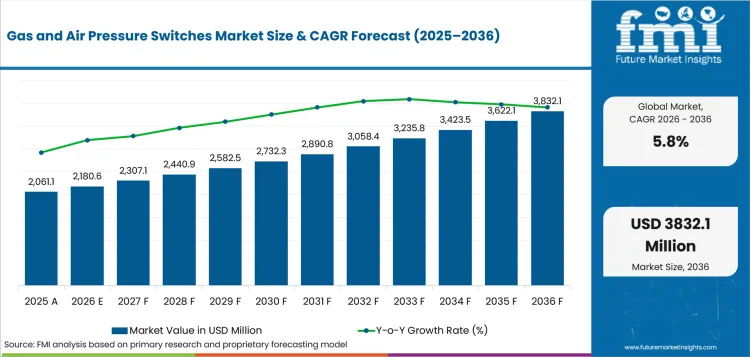
Gas and Air Pressure Switches Market Overview: Size and Forecast
- 2025 Market Size: USD 2,061.1 million
- 2026 Market Size: USD 2,180.6 million
- 2036 Market Size: USD 3,832.1 million
- Forecast CAGR: 5.8% from 2026 to 2036
- Leading Switch Type: Mechanical Pressure Switches
- Mechanical Pressure Switches Share in 2026: 47.5%
- Leading Media: Air
- Air Share in 2026: 43.0%
- Fastest-growing Country: India
- India CAGR: 6.8% by 2036
Summary of the Gas and Air Pressure Switches MarketDemand and Growth Drivers
- Demand and Growth Drivers
- HVAC and refrigeration service keeps replacement demand active because pressure switches protect compressors from unsafe suction and discharge states.
- Gas equipment suppliers need devices with verified media compatibility before switches are placed near combustible gases.
- OEMs are specifying switches earlier in compressor and burner design to reduce field wiring and replacement risk.
- Product and Segment View
- Mechanical Pressure Switches are forecast to represent 47.5% share in 2026, led by simple reset behavior and low service cost.
- Air is projected to hold 43.0% media share in 2026 because duct proving and compressed-air systems create repeat unit demand.
- Direct OEM is expected to secure 46.0% sales-channel share in 2026 as switches enter bills of material before equipment shipment.
- Geography and Competitive Outlook
- India is projected to record a 6.8% CAGR through 2036, supported by city gas expansion and industrial equipment output.
- China is expected to expand at a 6.6% CAGR through 2036 as machinery output and gas production support local demand.
- Honeywell, Danfoss, WIKA, Ashcroft, Saginomiya, Kobold Messring and Schneider Electric compete on pressure range depth and documentation.
- Specialist suppliers are best placed where they combine technical approvals with local distributor access.
- Analyst Opinion
- Nikhil Kaitwade, Principal Consultant at FMI says, "This market is a reliability purchase before it is a controls purchase. Buyers are looking for a device that avoids compressor damage, prevents gas-line unsafe states and keeps maintenance simple for technicians. Supplier advantage depends on pressure range documentation, enclosure rating, differential behavior and media compatibility."
Specification depth is still central to supplier selection. Adjacent demand in the air pressure sensor market shows how pressure monitoring is moving toward more measured control. Electronic switch designs also draw from the MEMS pressure sensor as OEMs add compact sensing and display functions.
Gas handling is a second demand route because switching devices sit beside valves, burners and pressure regulators. The International Energy Agency reported in March 2025 that global natural gas demand rose by 2.7% in 2024. This adds context to pressure control procurement across gas skids and compressor packages.
The gas and air pressure switches market is expected to expand through 2036 as switching devices remain necessary for compressor protection, air-flow proving and gas-system limit control. Demand is not shifting away from mechanical devices. It is separating into low-cost replacement work and specification-led OEM packages.
Which factors support expansion in the gas and air pressure switches market?
Finished switch revenue is supported by compressor protection, gas safety circuits and replacement buying across HVAC service channels.
- Market value is supported by switch revenue from OEM installation and field replacement before software controls add service revenue.
- Supplier pricing reflects pressure range, enclosure rating and reset type before distributors apply local discounts.
- Revenue improves as electronic models gain use in equipment that already includes digital controllers.
- Replacement demand remains visible because service technicians often match threaded connection and set point before brand preference.
Why is the gas and air pressure switches market growing?
HVAC and refrigeration remain the most visible use case because pressure switches protect compressors from operating outside safe pressure ranges. Growth in the HVAC control system market is widening the control environment around these switches. Mechanical switch demand still holds because local field protection remains necessary even when supervisory controls are digital.
Gas infrastructure adds a second demand channel because pressure switches act as hardwired limit devices in fuel gas and process gas systems. The IEA reported that global natural gas demand rose by 115 billion cubic meters in 2024. That expansion does not convert directly into switch sales. It expands the equipment pool that needs pressure monitoring across compressors, burners and skids.
The market also benefits from service-led retrofit work in the HVAC market. Commercial buildings can keep mechanical switches in local panels even when automation platforms expand. This split supports repeat orders for air switches and adjacent pull for liquid filled pressure gauges where technicians inspect pressure status during maintenance.
How is the gas and air pressure switches market segmented?
The gas and air pressure switches industry is segmented by switch type, media, end use, pressure range and sales channel.
- Mechanical Pressure Switches are projected to account for 47.5% share in 2026, led by simple trip behavior and direct field replacement.
- Air is forecast to secure 43.0% media share in 2026 as duct proving and compressed-air systems generate broad unit demand.
- HVAC and Refrigeration is expected to represent 34.0% end-use share in 2026 because compressor protection anchors repeat orders.
- Low Pressure products are anticipated to hold 41.0% pressure-range share in 2026 as airflow and burner proving use lower set points.
- Direct OEM channels are forecast to represent 46.0% sales in 2026 because pressure switches are designed into packaged equipment.
Why do Mechanical Pressure Switches lead the market?
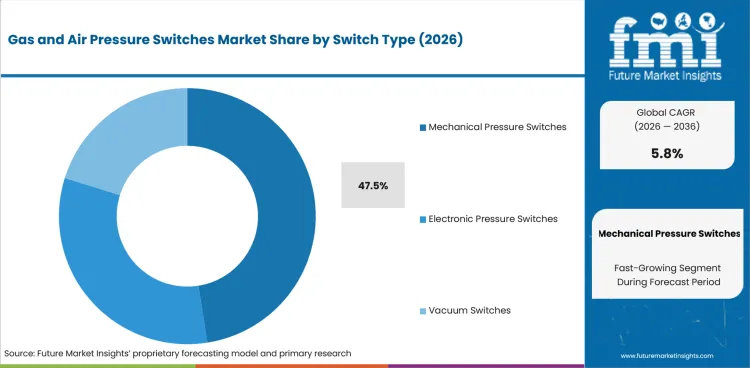
- Mechanical Pressure Switches are projected to account for 47.5% share in 2026, supported by snap-action contacts and simple diagnosis.
- Electronic Pressure Switches gain value where OEMs need display screens, programmable set points and controller-friendly outputs.
Which media leads the gas and air pressure switches market?
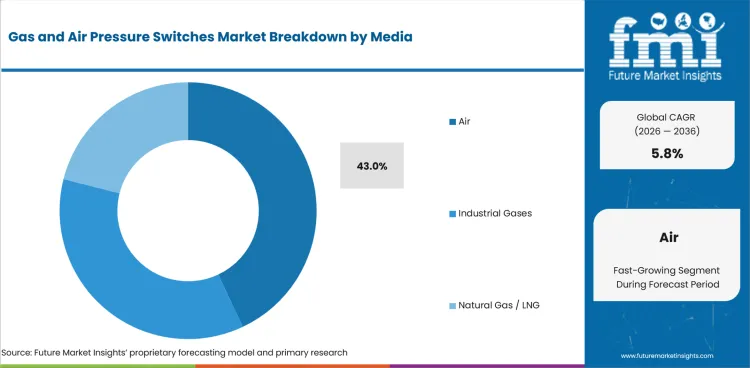
- Air is expected to represent 43.0% share in 2026, led by duct pressure, fan proving and compressed-air package demand.
- Natural Gas / LNG gains value where operators require media-compatible housings and documented pressure-limit action.
Which end use leads the gas and air pressure switches market?
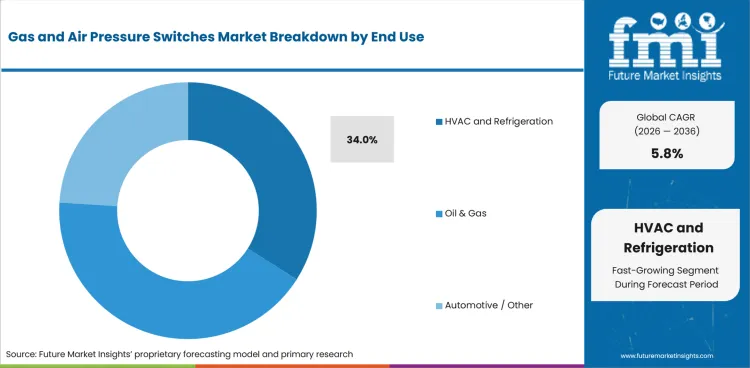
- HVAC and Refrigeration is forecast to hold 34.0% share in 2026, reflected in compressor start-stop protection and condenser fan control.
- Oil and Gas demand is shaped by gas-handling systems that need defined pressure cut-outs in safety loops.
Which pressure range leads the gas and air pressure switches market?
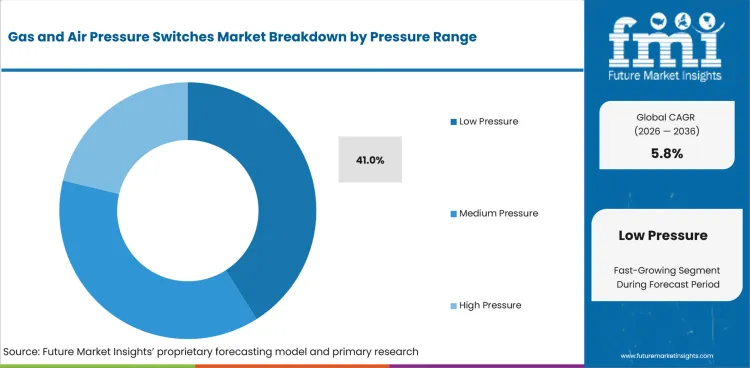
- Low Pressure products are projected to account for 41.0% share in 2026, driven by airflow proving and burner safety applications.
- Medium Pressure products gain use in compressor packages and industrial gas equipment that need stronger enclosure documentation.
Which sales channel leads the gas and air pressure switches market?
- Direct OEM is expected to represent 46.0% share in 2026, supported by compressor and burner makers locking switches into designs.
- Distributor demand stays important because technicians often match threaded connection, set point and enclosure before placing replacement orders.
What are the driver, restraints, and opportunities in the gas and air pressure switches market?
Compressor protection and gas safety circuits support demand while price pressure limits premium mechanical switch replacement.
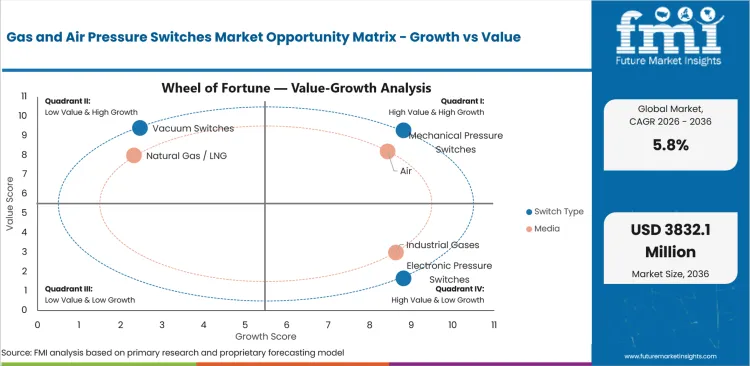
- Driver: Compressor trip protection is expected to support demand because HVAC and refrigeration systems need low suction and high discharge cut-outs.
- Restraint: Price pressure is expected to limit premium suppliers when distributors offer low-cost mechanical replacements for standard air applications.
- Opportunity: Retrofit demand is expected to be strongest where old mechanical switches fail in buildings that still need hardwired protection.
Gas and Air Pressure Switches Market Demand Outlook
Demand outlook is moving toward application-qualified switching rather than simple pressure-point buying. Mechanical products remain important because field crews need fast diagnosis. Electronic products gain use where equipment makers need digital output and display functions. This places the market between the pressure transmitter market and the mechanical switch replacement base.
Buyer Segmentation and Purchase Behavior Analysis
OEM engineers, HVAC contractors, gas utility contractors and industrial MRO buyers form the main purchase groups. OEMs evaluate contact rating, enclosure and reset behavior before approving a part. Service buyers often choose replacement speed and connection fit first. Gas buyers need more evidence on diaphragm material and media compatibility.
Which countries are growing fastest in the gas and air pressure switches market?
India 6.8% CAGR, China 6.6% CAGR, South Korea 5.9% CAGR, United States 5.5% CAGR, Germany 5.4% CAGR, France 5.2% CAGR, United Kingdom 5.1% CAGR and Japan 4.8% CAGR through 2036.
.webp "Top Country Growth Comparison Gas And Air Pressure Switches Market Cagr (2026 2036)")
| Country | CAGR |
| India | 6.8% |
| China | 6.6% |
| South Korea | 5.9% |
| United States | 5.5% |
| Germany | 5.4% |
| France | 5.2% |
| United Kingdom | 5.1% |
| Japan | 4.8% |
Source: Future Market Insights, 2026.
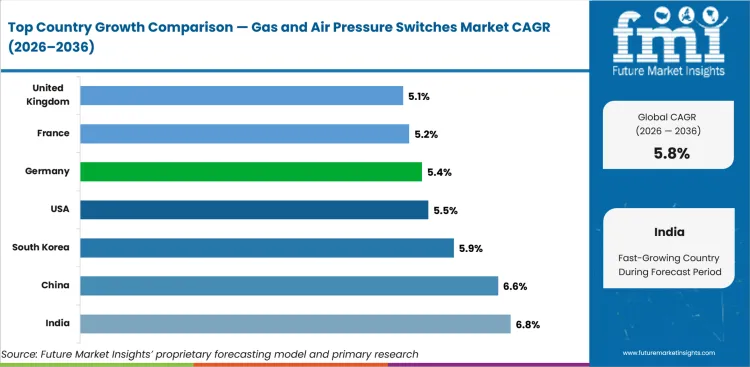
How do country-level CAGRs compare in the gas and air pressure switches market?
- India is forecast to record a 6.8% CAGR by 2036, guided by city gas buildout and stronger factory equipment production.
- China is forecast to record a 6.6% CAGR by 2036, guided by machinery production and gas-system equipment demand.
- South Korea is forecast to record a 5.9% CAGR by 2036, guided by electronics facilities and industrial gas control demand.
- United States is forecast to record a 5.5% CAGR by 2036, guided by gas throughput and a broad hvac service base.
- Germany is forecast to record a 5.4% CAGR by 2036, guided by machinery backlogs and specification-led industrial buying.
- France is forecast to record a 5.2% CAGR by 2036, guided by gas-network service and building hvac replacement demand.
- United Kingdom is forecast to record a 5.1% CAGR by 2036, guided by hvac repair and industrial maintenance demand.
- Japan is forecast to record a 4.8% CAGR by 2036, guided by mature refrigeration and compact equipment demand.
What is the gas and air pressure switches market outlook in India?
A 6.8% CAGR through 2036 reflects city gas buildout and stronger factory equipment production.
Country Market Snapshot Table
| Parameter | Value |
| Market Size in 2025 (Value) | USD 144.2 million |
| Market Size in 2026 (Value) | USD 154.0 million |
| Market Forecast in 2036 (Value) | USD 297.3 million |
| CAGR (2026 to 2036) | 6.8% |
| Years Considered | 2021 to 2036 |
| Base Year | 2025 |
| Forecast Period | 2026 to 2036 |
| Units Considered | Value (USD million) |
| Leading Sub-Region | Western industrial and city gas corridors |
India Gas and Air Pressure Switches Market Outlook
- India gas and air pressure switch demand is shaped by city gas expansion and domestic equipment manufacturing. Buyers need low-pressure air switches for HVAC service and gas-compatible switches for distribution skids.
- Direct OEM channels are expected to gain share as compressor and burner makers specify switches during equipment design. Local distributors remain important for plant maintenance and utility replacement work.
Key Growth Drivers
- India factory output is supporting OEM pressure control demand. MoSPI reported 4.9% IIP growth in April 2026.
- India gas equipment demand is tied to larger network flows. PPAC placed natural gas consumption at 5,014 MMSCM in May 2026.
- Domestic HVAC service firms are expected to keep low-pressure air switch replacement active across commercial buildings.
- City gas contractors are expected to prefer switches with clear reset behavior and local service access.
Key Restraints
- Price pressure is expected to remain visible because DPIIT reported 30.33% fuel and power WPI inflation in May 2026.
- Imported electronic switches can face longer lead times when buyers need approvals for gas-network projects.
- Smaller distributors can slow premium product adoption when standard mechanical switches satisfy routine maintenance needs.
What makes India unique
India is unique because gas distribution and industrial equipment orders are expanding together.
Key Companies
- Switzer Process Instruments
- General Instruments Consortium
- Honeywell Automation India
- Danfoss India
- WIKA India
- Baumer India
- Rotex Automation
Sales & Marketing Channels
- City gas contractors
- Industrial distributors
- HVAC service wholesalers
- Compressor OEMs
- Panel builders
- Aftermarket catalogs
Country Segment Breakdown Table
| Segment | Sub-Segments |
| By Switch Type | Mechanical Pressure Switches · Electronic Pressure Switches · Differential Pressure Switches · Vacuum Switches |
| By Media | Air · Industrial Gases · Natural Gas / LNG · Other |
| By End Use | HVAC & Refrigeration · Oil & Gas · Industrial Equipment · Automotive / Other |
| By Pressure Range | Low Pressure · Medium Pressure · High Pressure |
| By Sales Channel | Direct OEM · Distributors · Aftermarket |
| Key Sub-Regions Covered, Manufacturing and automation corridors | Gujarat · Maharashtra · Delhi NCR · Tamil Nadu · Karnataka · Uttar Pradesh |
Frequently Asked Questions
How fast is India gas and air pressure switches market growing?
Sales in India are forecast to scale at 6.8% CAGR from 2026 to 2036.
Who leads India gas and air pressure switches market?
Switzer Process Instruments, General Instruments Consortium, Honeywell Automation India, Danfoss India compete based on local channel access and technical documentation.
What is driving adoption in India gas and air pressure switches market?
Adoption is supported by gas handling, HVAC replacement and OEM compressor integration.
What is the gas and air pressure switches market outlook in China?
A 6.6% CAGR through 2036 is supported by machinery production and gas-system equipment demand.
Country Market Snapshot Table
| Parameter | Value |
| Market Size in 2025 (Value) | USD 384.6 million |
| Market Size in 2026 (Value) | USD 410.0 million |
| Market Forecast in 2036 (Value) | USD 776.9 million |
| CAGR (2026 to 2036) | 6.6% |
| Years Considered | 2021 to 2036 |
| Base Year | 2025 |
| Forecast Period | 2026 to 2036 |
| Units Considered | Value (USD million) |
| Leading Sub-Region | Yangtze River Delta and coastal industrial clusters |
China Gas and Air Pressure Switches Market Outlook
- China demand is supported by machinery output and large gas-system equipment pools. Domestic OEMs need switches for compressor packages, HVAC equipment, gas skids and pneumatic machinery.
- Local suppliers compete on price and availability. Imported brands retain value where gas compatibility and documentation are required.
Key Growth Drivers
- China gas applications are supported by upstream activity. The National Bureau of Statistics reported petroleum and natural gas extraction value added up 9.4% in March 2026.
- China equipment production supports switch attachment in OEM packages. The State Council reported equipment manufacturing value added up 7.7% in 2024.
- Large HVAC and appliance manufacturing clusters are expected to keep unit demand high for air pressure switches.
- Domestic OEM purchasing is expected to favor suppliers that can support fast samples and local technical documentation.
Key Restraints
- Investment caution can restrain new equipment orders. The State Council reported fixed-asset investment down 1.6% year over year in the first four months of 2026.
- Local price competition can reduce margins for imported mechanical pressure switches in standard air applications.
- Qualification cycles can slow supplier switching when switches are used near combustible gas systems.
What makes China unique
China is unique because large OEM output and domestic supplier breadth create both scale and price pressure.
Key Companies
- LEFOO Industrial
- Shanghai LEEG Instruments
- Nanjing Wotian Technology
- SUPMEA Automation
- XIDIBEI Sensors
- Holykell Technology
- WIKA China
Sales & Marketing Channels
- Machinery OEMs
- HVAC equipment makers
- Industrial distributors
- Gas skid fabricators
- Online B2B catalogs
- Aftermarket service firms
Country Segment Breakdown Table
| Segment | Sub-Segments |
| By Switch Type | Mechanical Pressure Switches · Electronic Pressure Switches · Differential Pressure Switches · Vacuum Switches |
| By Media | Air · Industrial Gases · Natural Gas / LNG · Other |
| By End Use | HVAC & Refrigeration · Oil & Gas · Industrial Equipment · Automotive / Other |
| By Pressure Range | Low Pressure · Medium Pressure · High Pressure |
| By Sales Channel | Direct OEM · Distributors · Aftermarket |
| Key Sub-Regions Covered, Manufacturing and automation corridors | Shanghai · Jiangsu · Zhejiang · Guangdong · Shandong · Sichuan |
Frequently Asked Questions
How fast is China gas and air pressure switches market growing?
Sales in China are forecast to scale at 6.6% CAGR from 2026 to 2036.
Who leads China gas and air pressure switches market?
LEFOO Industrial, Shanghai LEEG Instruments, Nanjing Wotian Technology, SUPMEA Automation compete based on local channel access and technical documentation.
What is driving adoption in China gas and air pressure switches market?
Adoption is supported by gas handling, HVAC replacement and OEM compressor integration.
What is the gas and air pressure switches market outlook in South Korea?
A 5.9% CAGR through 2036 is supported by electronics facilities and industrial gas control demand.
Country Market Snapshot Table
| Parameter | Value |
| Market Size in 2025 (Value) | USD 109.5 million |
| Market Size in 2026 (Value) | USD 116.0 million |
| Market Forecast in 2036 (Value) | USD 205.8 million |
| CAGR (2026 to 2036) | 5.9% |
| Years Considered | 2021 to 2036 |
| Base Year | 2025 |
| Forecast Period | 2026 to 2036 |
| Units Considered | Value (USD million) |
| Leading Sub-Region | Seoul capital region and southeast industrial corridor |
South Korea Gas and Air Pressure Switches Market Outlook
- South Korea demand is linked to electronics manufacturing, industrial gas systems and compact equipment OEMs. Switch buyers often require compact housings and reliable electrical ratings for panel integration.
- Distributors are expected to keep aftermarket demand active in HVAC and light industrial repair. OEMs remain the stronger channel for process and electronics-linked applications.
Key Growth Drivers
- South Korea gas utility scale supports pressure control service. KOGAS stated that it operated 5,346 km of pipelines as of December 2025.
- South Korea industry activity supports control-component replacement. MOEF reported overall industrial production up 2.4% year over year in April 2026.
- Electronics and semiconductor facilities are expected to use gas-compatible switches in plant utility and safety-support systems.
- Compact equipment makers are expected to prefer switches that fit tight panels and support clear replacement logic.
Key Restraints
- Project financing caution can slow plant upgrades. Bank of Korea kept the Base Rate at 2.50% in May 2026.
- Local distributors can favor lower-cost standard switches when application risk is limited to air service.
- High-specification gas applications can require longer approvals before new suppliers are accepted.
What makes South Korea unique
South Korea is unique because electronics facilities and compact OEM equipment shape specification demand.
Key Companies
- Autonics
- Hanjin Instrument
- Korea SMC Pneumatics
- WIKA Korea
- Honeywell Korea
- Danfoss Korea
- Saginomiya Korea
Sales & Marketing Channels
- Electronics facility contractors
- Industrial automation distributors
- HVAC service wholesalers
- OEM engineering teams
- Gas utility contractors
- MRO catalogs
Country Segment Breakdown Table
| Segment | Sub-Segments |
| By Switch Type | Mechanical Pressure Switches · Electronic Pressure Switches · Differential Pressure Switches · Vacuum Switches |
| By Media | Air · Industrial Gases · Natural Gas / LNG · Other |
| By End Use | HVAC & Refrigeration · Oil & Gas · Industrial Equipment · Automotive / Other |
| By Pressure Range | Low Pressure · Medium Pressure · High Pressure |
| By Sales Channel | Direct OEM · Distributors · Aftermarket |
| Key Sub-Regions Covered, Manufacturing and automation corridors | Seoul · Gyeonggi · Incheon · Ulsan · Busan · Daegu |
Frequently Asked Questions
How fast is South Korea gas and air pressure switches market growing?
Sales in South Korea are forecast to scale at 5.9% CAGR from 2026 to 2036.
Who leads South Korea gas and air pressure switches market?
Autonics, Hanjin Instrument, Korea SMC Pneumatics, WIKA Korea compete based on local channel access and technical documentation.
What is driving adoption in South Korea gas and air pressure switches market?
Adoption is supported by gas handling, HVAC replacement and OEM compressor integration.
What is the gas and air pressure switches market outlook in United States?
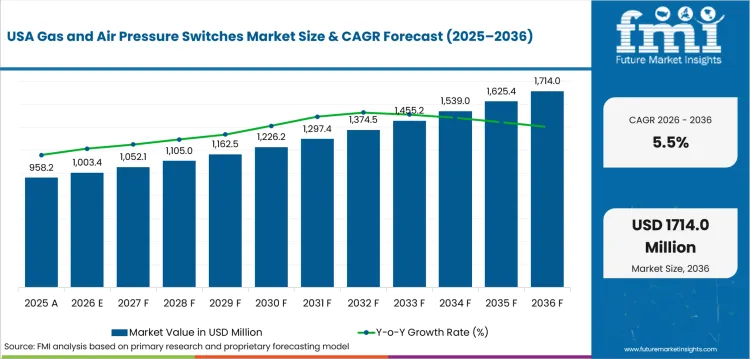
A 5.5% CAGR through 2036 is supported by gas throughput and a broad HVAC service base.
Country Market Snapshot Table
| Parameter | Value |
| Market Size in 2025 (Value) | USD 492.9 million |
| Market Size in 2026 (Value) | USD 520.0 million |
| Market Forecast in 2036 (Value) | USD 888.2 million |
| CAGR (2026 to 2036) | 5.5% |
| Years Considered | 2021 to 2036 |
| Base Year | 2025 |
| Forecast Period | 2026 to 2036 |
| Units Considered | Value (USD million) |
| Leading Sub-Region | Gulf Coast and Midwest industrial service corridors |
United States Gas and Air Pressure Switches Market Outlook
- United States demand is shaped by large HVAC replacement activity and extensive gas handling infrastructure. Buyers balance quick replacement access with strict media compatibility requirements.
- Distributor availability matters for field service. Engineered applications still move through OEM and project channels when enclosure rating and reset behavior must be documented.
Key Growth Drivers
- United States gas throughput supports switch use in compressors and burner systems. EIA reported dry natural gas production at 3,438 Bcf in March 2026.
- United States industrial output supports equipment attachment. The Federal Reserve reported industrial production 1.7% above the prior year in May 2026.
- HVAC contractors are expected to keep air-pressure switch replacement active across rooftop units and refrigeration service.
- OEM compressor and burner makers are expected to specify approved switches before shipment.
Key Restraints
- Cost pass-through can slow standard replacement orders. BLS reported final demand producer prices up 1.1% in May 2026.
- Distributors can substitute lower-cost mechanical switches when buyers do not need gas-rated approvals.
- Hazardous gas applications can extend qualification timelines for new switch models.
What makes United States unique
The United States is unique because engineered gas demand and fast MRO replacement coexist at large scale.
Key Companies
- Honeywell
- Ashcroft
- Barksdale Inc.
- United Electric Controls
- Gems Sensors
- DwyerOmega
- Custom Control Sensors
Sales & Marketing Channels
- MRO distributors
- HVAC wholesalers
- Compressor OEMs
- Gas utility contractors
- Industrial catalogs
- Aftermarket service firms
Country Segment Breakdown Table
| Segment | Sub-Segments |
| By Switch Type | Mechanical Pressure Switches · Electronic Pressure Switches · Differential Pressure Switches · Vacuum Switches |
| By Media | Air · Industrial Gases · Natural Gas / LNG · Other |
| By End Use | HVAC & Refrigeration · Oil & Gas · Industrial Equipment · Automotive / Other |
| By Pressure Range | Low Pressure · Medium Pressure · High Pressure |
| By Sales Channel | Direct OEM · Distributors · Aftermarket |
| Key Sub-Regions Covered, Manufacturing and automation corridors | Texas Gulf Coast · Midwest · California · Northeast · Southeast · Rocky Mountain region |
Frequently Asked Questions
How fast is United States gas and air pressure switches market growing?
Sales in United States are forecast to scale at 5.5% CAGR from 2026 to 2036.
Who leads United States gas and air pressure switches market?
Honeywell, Ashcroft, Barksdale Inc., United Electric Controls compete based on local channel access and technical documentation.
What is driving adoption in United States gas and air pressure switches market?
Adoption is supported by gas handling, HVAC replacement and OEM compressor integration.
What is the gas and air pressure switches market outlook in Germany?
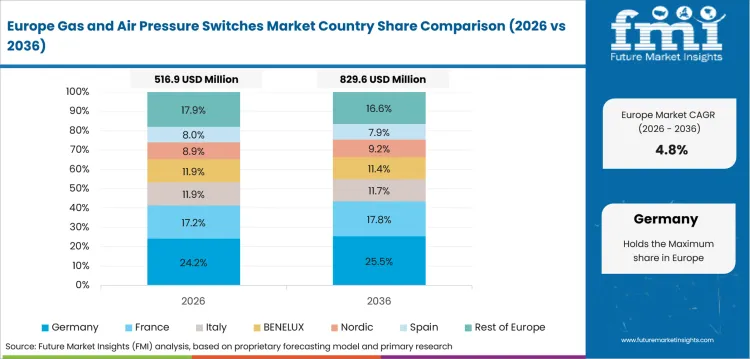
A 5.4% CAGR through 2036 reflects machinery backlogs and specification-led industrial buying.
Country Market Snapshot Table
| Parameter | Value |
| Market Size in 2025 (Value) | USD 168.9 million |
| Market Size in 2026 (Value) | USD 178.0 million |
| Market Forecast in 2036 (Value) | USD 301.2 million |
| CAGR (2026 to 2036) | 5.4% |
| Years Considered | 2021 to 2036 |
| Base Year | 2025 |
| Forecast Period | 2026 to 2036 |
| Units Considered | Value (USD million) |
| Leading Sub-Region | Bavaria and North Rhine-Westphalia machinery clusters |
Germany Gas and Air Pressure Switches Market Outlook
- Germany demand is driven by machinery, refrigeration and process equipment. Buyers place strong weight on repeatability, certifications and documented pressure ranges.
- Local instrumentation depth supports premium switching products. Service replacement remains active in refrigeration and compressor systems where approved models are reused.
Key Growth Drivers
- German machinery backlogs support OEM component buying. Destatis reported manufacturing order stock up 8.4% year over year in April 2026.
- Gas-linked equipment demand remains relevant. Bundesnetzagentur reported German gas consumption at 864 TWh in 2025.
- Local instrumentation expertise is expected to improve acceptance of electronic pressure switches in OEM systems.
- HVAC and refrigeration service routes are expected to sustain mechanical switch replacement demand.
Key Restraints
- Industrial energy cost can delay process-plant refresh work. Eurostat reported Germany non-household gas prices at €0.0713 per kWh in the second half of 2025.
- Strict qualification standards can slow supplier changes for safety-related gas applications.
- Premium suppliers can face price checks when distributors offer standard mechanical replacements.
What makes Germany unique
Germany is unique because it is both a pressure-instrument supplier base and a high-specification buyer market.
Key Companies
- WIKA
- Kobold Messring
- SUCO Robert Scheuffele
- BD Sensors
- Fischer Mess- und Regeltechnik
- EGE Elektronik
- JUMO
Sales & Marketing Channels
- Machinery OEMs
- Technical distributors
- Refrigeration wholesalers
- Process instrumentation channels
- Panel builders
- Service catalogs
Country Segment Breakdown Table
| Segment | Sub-Segments |
| By Switch Type | Mechanical Pressure Switches · Electronic Pressure Switches · Differential Pressure Switches · Vacuum Switches |
| By Media | Air · Industrial Gases · Natural Gas / LNG · Other |
| By End Use | HVAC & Refrigeration · Oil & Gas · Industrial Equipment · Automotive / Other |
| By Pressure Range | Low Pressure · Medium Pressure · High Pressure |
| By Sales Channel | Direct OEM · Distributors · Aftermarket |
| Key Sub-Regions Covered, Manufacturing and automation corridors | Bavaria · Baden-Württemberg · North Rhine-Westphalia · Hesse · Saxony · Lower Saxony |
Frequently Asked Questions
How fast is Germany gas and air pressure switches market growing?
Sales in Germany are forecast to scale at 5.4% CAGR from 2026 to 2036.
Who leads Germany gas and air pressure switches market?
WIKA, Kobold Messring, SUCO Robert Scheuffele, BD Sensors compete based on local channel access and technical documentation.
What is driving adoption in Germany gas and air pressure switches market?
Adoption is supported by gas handling, HVAC replacement and OEM compressor integration.
What is the gas and air pressure switches market outlook in France?
A 5.2% CAGR through 2036 reflects gas-network service and building HVAC replacement demand.
Country Market Snapshot Table
| Parameter | Value |
| Market Size in 2025 (Value) | USD 135.0 million |
| Market Size in 2026 (Value) | USD 142.0 million |
| Market Forecast in 2036 (Value) | USD 235.7 million |
| CAGR (2026 to 2036) | 5.2% |
| Years Considered | 2021 to 2036 |
| Base Year | 2025 |
| Forecast Period | 2026 to 2036 |
| Units Considered | Value (USD million) |
| Leading Sub-Region | Paris Basin and Auvergne-Rhone-Alpes industrial corridors |
France Gas and Air Pressure Switches Market Outlook
- France demand is shaped by gas network maintenance and building HVAC service. Pressure switches are used where technicians need clear trip behavior and reliable replacement data.
- Biomethane integration is adding control attention across gas networks. Building service channels continue to support low-pressure air switch demand.
Key Growth Drivers
- French gas-network change supports gas-compatible controls. NaTran reported biomethane production at 13.5 TWh in 2025.
- Electricity-system decarbonization keeps building controls under review. RTE reported low-carbon generation at 95.2% of mainland output in 2025.
- HVAC service firms are expected to support low-pressure air switch replacement in public and commercial buildings.
- Industrial gas users are expected to require documented switch materials for safety checks.
Key Restraints
- Construction softness can slow new HVAC control orders. INSEE reported construction output 2.8% lower in the first quarter of 2026.
- Public-sector and utility qualification can lengthen buying cycles for gas-network components.
- Lower industrial gas use can reduce urgency for process-sector replacement programs.
What makes France unique
France is unique because gas-network transition and building-efficiency service demand overlap.
Key Companies
- Schneider Electric
- Georgin
- Sauermann Group
- Crouzet
- Air Liquide Electronics
- WIKA France
- Danfoss France
Sales & Marketing Channels
- Utility contractors
- HVAC service distributors
- Industrial control wholesalers
- Building automation integrators
- OEM equipment channels
- Gas network maintenance firms
Country Segment Breakdown Table
| Segment | Sub-Segments |
| By Switch Type | Mechanical Pressure Switches · Electronic Pressure Switches · Differential Pressure Switches · Vacuum Switches |
| By Media | Air · Industrial Gases · Natural Gas / LNG · Other |
| By End Use | HVAC & Refrigeration · Oil & Gas · Industrial Equipment · Automotive / Other |
| By Pressure Range | Low Pressure · Medium Pressure · High Pressure |
| By Sales Channel | Direct OEM · Distributors · Aftermarket |
| Key Sub-Regions Covered, Manufacturing and automation corridors | Ile-de-France · Auvergne-Rhone-Alpes · Hauts-de-France · Grand Est · Nouvelle-Aquitaine · Provence-Alpes-Cote d Azur |
Frequently Asked Questions
How fast is France gas and air pressure switches market growing?
Sales in France are forecast to scale at 5.2% CAGR from 2026 to 2036.
Who leads France gas and air pressure switches market?
Schneider Electric, Georgin, Sauermann Group, Crouzet compete based on local channel access and technical documentation.
What is driving adoption in France gas and air pressure switches market?
Adoption is supported by gas handling, HVAC replacement and OEM compressor integration.
What is the gas and air pressure switches market outlook in United Kingdom?
A 5.1% CAGR through 2036 is supported by HVAC repair and industrial maintenance demand.
Country Market Snapshot Table
| Parameter | Value |
| Market Size in 2025 (Value) | USD 118.0 million |
| Market Size in 2026 (Value) | USD 124.0 million |
| Market Forecast in 2036 (Value) | USD 203.9 million |
| CAGR (2026 to 2036) | 5.1% |
| Years Considered | 2021 to 2036 |
| Base Year | 2025 |
| Forecast Period | 2026 to 2036 |
| Units Considered | Value (USD million) |
| Leading Sub-Region | Midlands and Greater London service corridors |
United Kingdom Gas and Air Pressure Switches Market Outlook
- United Kingdom demand is replacement-led across HVAC, refrigeration and industrial maintenance. Switch buyers often need quick distributor access more than extensive customization.
- Gas-system replacement remains relevant for burners and service panels. New upstream equipment demand is more cautious due to lower domestic production.
Key Growth Drivers
- UK building repair activity supports air switch replacement. ONS reported repair and maintenance output up 3.4% in the first quarter of 2026.
- UK gas-system maintenance remains relevant for burner and safety-loop service. DESNZ reported gas demand down only 0.9% in 2025.
- Refrigeration service routes are expected to keep mechanical switch replacement active in retail and cold-chain sites.
- Gas maintenance contractors are expected to favor known switch models for burner and safety-loop work.
Key Restraints
- Upstream equipment demand is restrained by basin decline. UK Parliament reported 2025 production near 20% of 2000 levels.
- Price-led distribution can limit uptake of higher-specification electronic switches in standard air service.
- Project approvals can slow purchasing when public estates require framework procurement.
What makes United Kingdom unique
The United Kingdom is unique because service replacement demand outweighs new equipment expansion.
Key Companies
- Rototherm Group
- Pyropress Engineering
- Sontay
- Sensata Technologies UK
- Trafag UK
- Danfoss UK
- Schneider Electric UK
Sales & Marketing Channels
- HVAC wholesalers
- Industrial MRO distributors
- Gas utility contractors
- Refrigeration service firms
- Building controls integrators
- OEM replacement channels
Country Segment Breakdown Table
| Segment | Sub-Segments |
| By Switch Type | Mechanical Pressure Switches · Electronic Pressure Switches · Differential Pressure Switches · Vacuum Switches |
| By Media | Air · Industrial Gases · Natural Gas / LNG · Other |
| By End Use | HVAC & Refrigeration · Oil & Gas · Industrial Equipment · Automotive / Other |
| By Pressure Range | Low Pressure · Medium Pressure · High Pressure |
| By Sales Channel | Direct OEM · Distributors · Aftermarket |
| Key Sub-Regions Covered, Manufacturing and automation corridors | Greater London · West Midlands · North West England · Yorkshire · Scotland Central Belt · South East England |
Frequently Asked Questions
How fast is United Kingdom gas and air pressure switches market growing?
Sales in United Kingdom are forecast to scale at 5.1% CAGR from 2026 to 2036.
Who leads United Kingdom gas and air pressure switches market?
Rototherm Group, Pyropress Engineering, Sontay, Sensata Technologies UK compete based on local channel access and technical documentation.
What is driving adoption in United Kingdom gas and air pressure switches market?
Adoption is supported by gas handling, HVAC replacement and OEM compressor integration.
What is the gas and air pressure switches market outlook in Japan?
A 4.8% CAGR through 2036 is supported by mature refrigeration and compact equipment demand.
Country Market Snapshot Table
| Parameter | Value |
| Market Size in 2025 (Value) | USD 160.3 million |
| Market Size in 2026 (Value) | USD 168.0 million |
| Market Forecast in 2036 (Value) | USD 268.5 million |
| CAGR (2026 to 2036) | 4.8% |
| Years Considered | 2021 to 2036 |
| Base Year | 2025 |
| Forecast Period | 2026 to 2036 |
| Units Considered | Value (USD million) |
| Leading Sub-Region | Kanto and Kansai OEM clusters |
Japan Gas and Air Pressure Switches Market Outlook
- Japan demand is shaped by compact equipment design and long supplier qualification cycles. Refrigeration, air conditioning and industrial machinery remain the most visible demand channels.
- Local OEMs often prefer repeat-approved switches. Electronic switches gain use where display and digital output reduce panel work.
Key Growth Drivers
- Japanese industrial output supports component replacement. METI reported production up 2.0% year over year in April 2026.
- Machinery orders support OEM specification demand. The Cabinet Office reported private-sector machinery orders up 8.7% in April 2026.
- CO2 refrigeration and compact air conditioning are expected to support specialized pressure control demand.
- OEM qualification is expected to create stable repeat buying for approved switch models.
Key Restraints
- Gas supply caution can slow project timing. JOGMEC reported power-generation LNG inventories at 2.04 million tonnes on June 14 2026.
- Mature HVAC equipment demand can limit faster unit expansion outside replacement channels.
- Long qualification cycles can delay entry for new suppliers in refrigeration and gas applications.
What makes Japan unique
Japan is unique because compact design needs and supplier qualification discipline shape product selection.
Key Companies
- Saginomiya Seisakusho
- Azbil
- CKD Corporation
- Nagano Keiki
- Panasonic Industry
- SMC Corporation
- Danfoss Japan
Sales & Marketing Channels
- Refrigeration OEMs
- Air conditioning suppliers
- Industrial equipment distributors
- Gas utility contractors
- Panel builders
- Aftermarket service firms
Country Segment Breakdown Table
| Segment | Sub-Segments |
| By Switch Type | Mechanical Pressure Switches · Electronic Pressure Switches · Differential Pressure Switches · Vacuum Switches |
| By Media | Air · Industrial Gases · Natural Gas / LNG · Other |
| By End Use | HVAC & Refrigeration · Oil & Gas · Industrial Equipment · Automotive / Other |
| By Pressure Range | Low Pressure · Medium Pressure · High Pressure |
| By Sales Channel | Direct OEM · Distributors · Aftermarket |
| Key Sub-Regions Covered, Manufacturing and automation corridors | Kanto · Kansai · Chubu · Kyushu · Tohoku · Hokkaido |
Frequently Asked Questions
How fast is Japan gas and air pressure switches market growing?
Sales in Japan are forecast to scale at 4.8% CAGR from 2026 to 2036.
Who leads Japan gas and air pressure switches market?
Saginomiya Seisakusho, Azbil, CKD Corporation, Nagano Keiki compete based on local channel access and technical documentation.
What is driving adoption in Japan gas and air pressure switches market?
Adoption is supported by gas handling, HVAC replacement and OEM compressor integration.
Who are the leading companies in the gas and air pressure switches market?
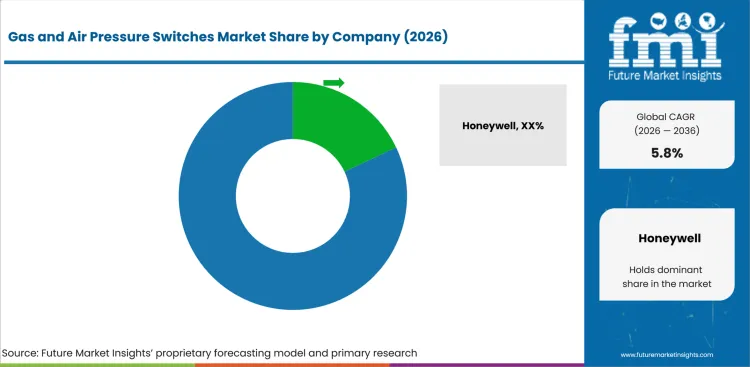
Honeywell, Danfoss, WIKA, Ashcroft, and Saginomiya are positioned strongly in pressure-switch applications requiring documented pressure range and broad channel reach.
Global controls suppliers compete on pressure range, media compatibility, enclosure rating, certification depth, and replacement availability. Mechanical switch suppliers retain value in service-heavy applications where replacement access remains important. Electronic switch suppliers gain share in OEM systems where display and digital output reduce panel work.
Schneider Electric and Siemens benefit from building automation routes and integrated controls access. Local specialists are best positioned where fast replacement access is combined with application-specific approvals.
How do top gas and air pressure switch companies compare?
Honeywell and Danfoss lead on channel reach while WIKA and Ashcroft remain stronger in industrial instrumentation.
| Company | Positioning | Relevant Strength | Channel Reach | Geographic Footprint |
| Honeywell | Broad pressure switch supplier | Air and hydrocarbon media coverage in industrial and mobile equipment. | Very Strong | Global |
| Danfoss | HVAC and refrigeration control supplier | Refrigeration pressure switches and compressor protection channels. | Very Strong | Global |
| WIKA | Instrumentation specialist | Pressure switches and electronic pressure switch portfolios for industrial users. | Strong | Global |
| Ashcroft | Industrial pressure control supplier | Differential and explosion-proof switch coverage for process applications. | Strong | North America and Europe |
| Saginomiya | Refrigeration pressure control supplier | Cooling and air conditioning pressure controls for OEM channels. | Strong | Japan and Asia Pacific |
| Kobold Messring | Instrumentation specialist | Compact process instrumentation and technical distribution reach. | Moderate | Europe and global distributors |
| Schneider Electric | Automation and controls supplier | Building and industrial control access through integrated channels. | Very Strong | Global |
Source: Future Market Insights competitive analysis, 2026.
Key Developments in Gas and Air Pressure Switches Market
- In November 2024, ABB previewed its P-Series pressure transmitter portfolio at CIIE with P-100, P-300, and P-500 models for industrial and utility applications.
- In June 2024, Emerson issued Rosemount 2088 pressure transmitter documentation covering gauge and absolute pressure measurement for compact industrial use.
- In October 2025, Emerson updated the Rosemount 3051 pressure transmitter data sheet with device-platform and diagnostics details for process applications.
Key Players in the Gas and Air Pressure Switches Market
Global Controls and Automation Suppliers
- Honeywell
- Danfoss
- Schneider Electric
- Siemens
Industrial Pressure Instrumentation Suppliers
- WIKA
- Ashcroft
- Kobold Messring
- United Electric Controls
Refrigeration and Specialty Switch Suppliers
- Saginomiya
- Barksdale Inc.
- Gems Sensors
- SUCO Robert Scheuffele
Gas and Air Pressure Switches Market - Scope & Definition
| Attribute | Detail |
| Market Definition | Devices that open or close an electrical contact when air or gas pressure reaches a set point, including mechanical, electronic, differential, and vacuum switch formats used in equipment protection and process control |
| Functions Covered | Pressure limit switching, compressor protection, fan proving, filter monitoring, gas safety cut-out, burner safety support, and equipment status signaling |
| Applications Covered | HVAC and refrigeration systems, compressed-air packages, natural gas and LNG equipment, industrial gas skids, compressor assemblies, burner systems, and pneumatic equipment |
| End-Use Industries | HVAC and refrigeration, oil and gas, industrial equipment manufacturing, building services, industrial automation, and automotive or other equipment uses |
| Grades Covered | Low-pressure, medium-pressure, and high-pressure switch formats across air, industrial gas, natural gas / LNG, and other gas media |
| Inclusions | Commercial gas and air pressure switches across switch types, media, end uses, pressure ranges, sales channels, and country-level markets covered in this report |
| Exclusions | Pressure gauges without switching contacts, pressure transmitters sold only for continuous measurement, liquid-only hydraulic switches, flow switches, level switches, gas leak detectors, and software-only control platforms |
Gas and Air Pressure Switches Market - Research Methodology
| Method | Description |
| Primary Research | FMI analyst interviews with HVAC contractors, refrigeration service firms, compressor OEMs, burner suppliers, gas utility contractors, industrial equipment buyers, and instrumentation distributors across key markets |
| Desk Research | Review of official industrial output data, gas infrastructure statistics, manufacturer product literature, regulatory sources, equipment documentation, and company disclosures related to pressure switching and controls |
| Market Sizing & Forecasting | Bottom-up equipment-boundary approach using installed equipment pools, replacement intervals, OEM attachment rates, average switch pricing, application shares, and country-level end-use weights |
| Data Validation | Cross-verification using pressure instrumentation portfolios, compressor control specifications, gas-system activity, HVAC service demand, distributor evidence, and country-level manufacturing indicators |
Gas and Air Pressure Switches Market - Report Scope
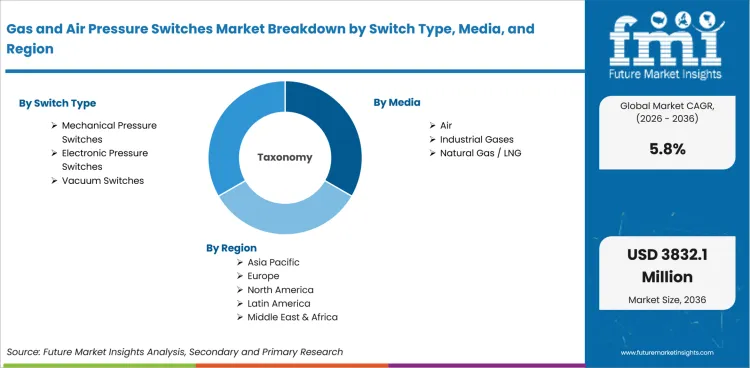
| Parameter | Details |
| Forecast period | 2026 to 2036 |
| Historical period | 2021 to 2025 |
| Quantitative unit | Revenue in USD million |
| By switch type | Mechanical Pressure Switches, Electronic Pressure Switches, Differential Pressure Switches, Vacuum Switches |
| By media | Air, Industrial Gases, Natural Gas / LNG, Other |
| By end use | HVAC & Refrigeration, Oil & Gas, Industrial Equipment, Automotive / Other |
| By pressure range | Low Pressure, Medium Pressure, High Pressure |
| By sales channel | Direct OEM, Distributors, Aftermarket |
| Regions covered | North America, Latin America, Europe, East Asia, South Asia and Pacific, Middle East and Africa |
| Countries covered | India, China, South Korea, United States, Germany, France, United Kingdom, Japan |
| Key companies profiled | Honeywell, Danfoss, WIKA, Ashcroft, Saginomiya, Kobold Messring, Schneider Electric, Siemens |
| Approach | Bottom-up equipment-boundary approach using switch revenue, OEM attachment, replacement demand, channel presence, and country-level application weights. |
Gas and Air Pressure Switches Market Breakdown by Switch Type, Media, End Use, Pressure Range, Sales Channel, and Region
Gas and Air Pressure Switches Market Segmented by Switch Type
- Mechanical Pressure Switches
- Electronic Pressure Switches
- Differential Pressure Switches
- Vacuum Switches
Gas and Air Pressure Switches Market Segmented by Media
- Air
- Industrial Gases
- Natural Gas / LNG
- Other
Gas and Air Pressure Switches Market Segmented by End Use
- HVAC & Refrigeration
- Oil & Gas
- Industrial Equipment
- Automotive / Other
Gas and Air Pressure Switches Market Segmented by Pressure Range
- Low Pressure
- Medium Pressure
- High Pressure
Gas and Air Pressure Switches Market Segmented by Sales Channel
- Direct OEM
- Distributors
- Aftermarket
Gas and Air Pressure Switches Market by Region
- North America
- Latin America
- Europe
- East Asia
- South Asia and Pacific
- Middle East and Africa
Bibliography
- ABB. (2024, November 6). ABB introduces new high performance pressure transmitter portfolio at CIIE. ABB News.
- Board of Governors of the Federal Reserve System. (2026, June 15). Industrial production and capacity utilization. Federal Reserve Statistical Release G.17.
- Bundesnetzagentur. (2026, January 12). Bundesnetzagentur publishes gas supply figures for 2025. Federal Network Agency.
- Cabinet Office of Japan. (2026, June 17). Machinery orders in April 2026. Government of Japan.
- Destatis. (2026, June 18). Stock of orders in manufacturing in April 2026. Federal Statistical Office of Germany.
- Destatis. (2026, June 9). Production in April 2026. Federal Statistical Office of Germany.
- Eurostat. (2026, May 8). Non-household gas prices in second half of 2025. European Commission.
- Department for Energy Security and Net Zero. (2026, March). Energy trends: March 2026. Government of the United Kingdom.
- DPIIT. (2026, June 15). Press release on new series of Wholesale Price Index and Producer Price Index. Government of India.
- Emerson. (2024, June). Rosemount 2088 absolute and gauge pressure transmitter product data sheet. Emerson Electric Co.
- International Energy Agency. (2025, March). Global energy review 2025: Natural gas. IEA.
- INSEE. (2026, May 6). In March 2026 manufacturing output increased by 1.2%. National Institute of Statistics and Economic Studies.
- Japan Ministry of Economy, Trade and Industry. (2026, June 12). Indices of industrial production: April 2026 revised report. Government of Japan.
- JOGMEC. (2026, June 17). Natural gas and LNG related information. Japan Organization for Metals and Energy Security.
- Ministry of Data and Statistics. (2026, May 29). Monthly industrial statistics: April 2026. Government of the Republic of Korea.
- Ministry of Economy and Finance. (2026, June 12). Current economic situation: June 2026. Government of the Republic of Korea.
- Bank of Korea. (2026, May 28). Monetary policy decision. Bank of Korea.
- Korea Gas Corporation. (2026, May 13). KOGAS corporate overview. Korea Gas Corporation.
- Ministry of Statistics and Programme Implementation. (2026, June 1). Quick estimates of Index of Industrial Production for April 2026. Government of India.
- NaTran. (2026, January 28). 2025 overview. French gas transmission network operator.
- State Council Information Office of the People's Republic of China. (2025, February 25). SCIO briefing on China economic performance in 2024. Government of China.
- National Bureau of Statistics of China. (2026, March 16). National economy got off to a steady start in the first two months of 2026. Government of China.
- National Bureau of Statistics of China. (2026, April 17). Industrial production operation in March 2026. Government of China.
- State Council of the People's Republic of China. (2026, May 18). China's fixed-asset investment down 1.6 pct in first 4 months. Government of China.
- Office for National Statistics. (2026, April 16). Index of Production, UK: February 2026. Government of the United Kingdom.
- Office for National Statistics. (2026, May 14). Construction output in Great Britain: March 2026. Government of the United Kingdom.
- Petroleum Planning and Analysis Cell. (2026, June 19). Natural gas consumption. Ministry of Petroleum and Natural Gas, Government of India.
- RTE. (2026, February). 2025 review: Key findings. Reseau de Transport d Electricite.
- USA Bureau of Labor Statistics. (2026, June 11). Producer Price Indexes: May 2026. USA Department of Labor.
- USA Energy Information Administration. (2026, April 30). Natural Gas Monthly. USA Department of Energy.
- UK Parliament POST. (2026, March 11). North Sea oil and gas. Parliamentary Office of Science and Technology.
This Report Answers
- How large is the gas and air pressure switches market in 2026?
- Which switch type leads demand through 2036?
- Why does air remain the leading media segment?
- How do HVAC and gas applications shape replacement demand?
- Which countries are forecast to grow fastest through 2036?
- Which companies compete in pressure switch specification and replacement channels?
Frequently Asked Questions
How big is the gas and air pressure switches market in 2026?
The market is estimated at USD 2,180.6 million in 2026 and USD 3,832.1 million by 2036.
What is the expected CAGR for the gas and air pressure switches market?
The market is forecast to grow at a 5.8% CAGR from 2026 to 2036.
Which switch type leads the market?
Mechanical Pressure Switches lead because field technicians value direct trip action and easy replacement.
Which media segment leads the market?
Air leads because duct proving and compressed-air systems create broad unit demand.
Which sales channel leads the market?
Direct OEM leads as compressor and burner makers specify switches inside equipment designs.
Which country is growing fastest?
India is forecast to grow fastest through 2036 due to city gas expansion and industrial equipment output.
Who are the main companies in the market?
Honeywell, Danfoss, WIKA, Ashcroft, Saginomiya and Schneider Electric are major suppliers in the market.
Preview the report firsthand - request a free sample
Get SampleGet the brochure for pricing and purchase details.
Get PDFTable of Content
- Executive Summary
- Global Market Outlook
- Demand-side Trends
- Supply-side Trends
- Technology Roadmap Analysis
- Analysis and Recommendations
- Market Overview
- Market Coverage / Taxonomy
- Market Definition / Scope / Limitations
- Research Methodology
- Research Design
- Primary Research
- Desk Research
- Market Sizing and Forecasting
- Data Validation
- Global Market Analysis 2021 to 2025 and Forecast, 2026 to 2036
- Historical Market Size Value (USD Million) Analysis, 2021 to 2025
- Current and Future Market Size Value (USD Million) Projections, 2026 to 2036
- Y-o-Y Growth Trend Analysis
- Absolute $ Opportunity Analysis
- Global Market Pricing Analysis 2021 to 2025 and Forecast 2026 to 2036
- Global Market Analysis 2021 to 2025 and Forecast 2026 to 2036, By Switch Type
- Introduction / Key Findings
- Historical Market Size Value (USD Million) Analysis By Switch Type, 2021 to 2025
- Current and Future Market Size Value (USD Million) Analysis By Switch Type, 2026 to 2036
- Global Market Analysis 2021 to 2025 and Forecast 2026 to 2036, By Media
- Introduction / Key Findings
- Historical Market Size Value (USD Million) Analysis By Media, 2021 to 2025
- Current and Future Market Size Value (USD Million) Analysis By Media, 2026 to 2036
- Global Market Analysis 2021 to 2025 and Forecast 2026 to 2036, By End Use
- Introduction / Key Findings
- Historical Market Size Value (USD Million) Analysis By End Use, 2021 to 2025
- Current and Future Market Size Value (USD Million) Analysis By End Use, 2026 to 2036
- Global Market Analysis 2021 to 2025 and Forecast 2026 to 2036, By Pressure Range
- Introduction / Key Findings
- Historical Market Size Value (USD Million) Analysis By Pressure Range, 2021 to 2025
- Current and Future Market Size Value (USD Million) Analysis By Pressure Range, 2026 to 2036
- Global Market Analysis 2021 to 2025 and Forecast 2026 to 2036, By Sales Channel
- Introduction / Key Findings
- Historical Market Size Value (USD Million) Analysis By Sales Channel, 2021 to 2025
- Current and Future Market Size Value (USD Million) Analysis By Sales Channel, 2026 to 2036
- Global Market Analysis 2021 to 2025 and Forecast 2026 to 2036, By Region
- Introduction / Key Findings
- Historical Market Size Value (USD Million) Analysis By Region, 2021 to 2025
- Current and Future Market Size Value (USD Million) Analysis By Region, 2026 to 2036
- North America Market Analysis 2021 to 2025 and Forecast 2026 to 2036
- Pricing Analysis
- Market Share Analysis, 2025
- By Country
- By Switch Type
- By Media
- By End Use
- By Pressure Range
- By Sales Channel
- Country-level Analysis
- United States
- Canada
- Latin America Market Analysis 2021 to 2025 and Forecast 2026 to 2036
- Pricing Analysis
- Market Share Analysis, 2025
- By Country
- By Switch Type
- By Media
- By End Use
- By Pressure Range
- By Sales Channel
- Country-level Analysis
- Brazil
- Mexico
- Rest of Latin America
- Western Europe Market Analysis 2021 to 2025 and Forecast 2026 to 2036
- Pricing Analysis
- Market Share Analysis, 2025
- By Country
- By Switch Type
- By Media
- By End Use
- By Pressure Range
- By Sales Channel
- Country-level Analysis
- Germany
- France
- United Kingdom
- Italy
- Spain
- BENELUX
- Nordics
- Rest of Western Europe
- Eastern Europe Market Analysis 2021 to 2025 and Forecast 2026 to 2036
- Pricing Analysis
- Market Share Analysis, 2025
- By Country
- By Switch Type
- By Media
- By End Use
- By Pressure Range
- By Sales Channel
- Country-level Analysis
- Russia
- Poland
- Rest of Eastern Europe
- East Asia Market Analysis 2021 to 2025 and Forecast 2026 to 2036
- Pricing Analysis
- Market Share Analysis, 2025
- By Country
- By Switch Type
- By Media
- By End Use
- By Pressure Range
- By Sales Channel
- Country-level Analysis
- China
- Japan
- South Korea
- South Asia and Pacific Market Analysis 2021 to 2025 and Forecast 2026 to 2036
- Pricing Analysis
- Market Share Analysis, 2025
- By Country
- By Switch Type
- By Media
- By End Use
- By Pressure Range
- By Sales Channel
- Country-level Analysis
- India
- ASEAN
- Australia & New Zealand
- Rest of South Asia and Pacific
- Middle East & Africa Market Analysis 2021 to 2025 and Forecast 2026 to 2036
- Pricing Analysis
- Market Share Analysis, 2025
- By Country
- By Switch Type
- By Media
- By End Use
- By Pressure Range
- By Sales Channel
- Country-level Analysis
- GCC Countries
- South Africa
- Turkey
- Rest of Middle East & Africa
- Market Structure Analysis
- Competition Dashboard
- Competition Benchmarking
- Market Share Analysis of Top Players
- By Region
- By Switch Type
- By Media
- By End Use
- By Pressure Range
- By Sales Channel
- Emerging Startups
- Innovation Benchmarking
- Competition Analysis
- Competition Deep Dive
- Company Profiles
- Case Studies
- Success Stories
- Recent Developments
- Assumptions & Acronyms Used
- List of Tables: Gas and Air Pressure Switches Market
- List of Figures: Gas and Air Pressure Switches Market


