

- Market Size (2026)
- USD 96.0 Mn
- Forecast (2036)
- USD 594.0 Mn
- CAGR (2026 to 2036)
- 20.0%
How big is Live Gas-Main Repair Robotics Market in 2026?
USD 96.0 million in 2026 and USD 594.0 million by 2036 at a 20.0% CAGR.
Demand in live gas-main repair robotics market is projected to grow at a 20.0% CAGR by 2036, expanding valuation from USD 96.0 million in 2026 to USD 594.0 million by 2036. The adoption case is driven by a simple operational problem: repairing each leaking joint typically requires excavating the street above the affected location, resulting in high costs and lengthy project timelines. The International Energy Agency reported in May 2025 that around 35 million tonnes of methane from fossil fuel operations could be avoided at no net cost. The finding strengthens the case for repair methods that limit gas loss and shorten maintenance work on active networks. Pipeline monitoring systems help utilities connect each repair decision with current pipe condition.
Growth in the industry is expected to differ between the United States and the European Union because utilities do not qualify new methods at the same pace. USA operators have a longer record of using CISBOT on older cast-iron networks in dense northeastern cities. In October 2024, the USA Department of Transportation announced USD 196 million for 60 gas-pipeline modernization projects across 20 states. The funding confirms the scale of the aging-pipe problem although most awards support replacement instead of robotic repair. Live repair gains value on pipe sections that remain fit for service and are costly to excavate. European operators face a wider mix of network designs and national approval rules across member states.
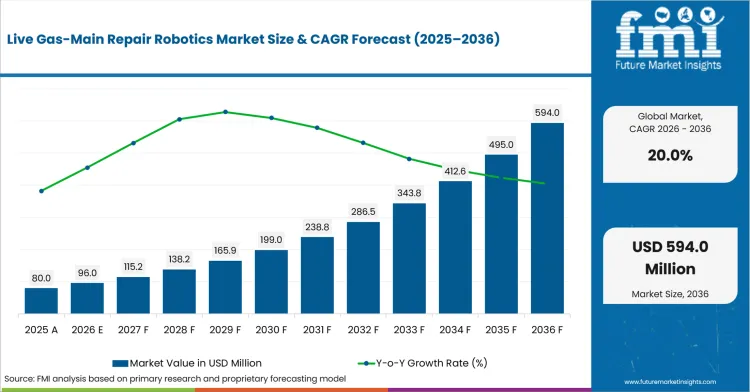
Key Takeaways of Live Gas-Main Repair Robotics Market
- Demand for live gas-main repair robotics is driven by aging gas networks needing frequent repairs without full replacement, with internal repair reducing excavation, disruption, and restoration work.
- By component, robots are expected to lead with 48.0% share in 2026, as equipment drives spending while field services remain essential for project delivery.
- Cast-iron joint sealing is the dominant application segment, projected to hold 54.0% share in 2026, driven by recurring joint repair needs across aging cast-iron networks.
- In-Pipe Sealing Robots (CISBOT-Class) are estimated to lead the product category with 58.0% share in 2026, creating the clearest value by completing repairs instead of ending with inspection evidence alone.
- Live-line repair capability and operator training remain critical adoption factors, helping utilities keep gas flowing during maintenance while building confidence in a less familiar repair approach.
- Northeastern US cities remain an important market due to their concentration of aging cast-iron distribution mains, while demand across Europe is more varied, reflecting differences in replacement strategies and network regulations.
- Competition centers on ULC Technologies, Synthotech, and SGN, with vendors differentiating through internal joint repair capabilities, inspection and targeted robotic repair applications, and validation testing on operating gas infrastructure.
Analyst Perspective
"The live gas-main repair robotics market is moving from technical validation to operational qualification as utilities seek solutions that can be deployed safely across active distribution networks. Investment decisions are influenced by proven field performance, compatibility with diverse pipeline conditions, and the ability to complete repairs with minimal disruption to gas service. Suppliers that demonstrate consistent execution, support operator training, and build a strong record of successful in-service repairs will earn greater confidence as utilities expand robotic maintenance programs."
- Nikhil Kaitwade, Principal Analyst at Future Market Insights
Source: FMI's proprietary forecasting model and primary research
How is the live Gas-Main Repair Robotics Market segmented?
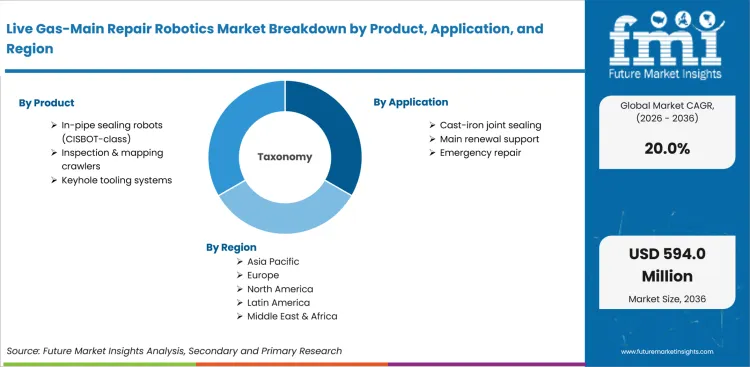
The live gas-main repair robotics industry is segmented by product, application, component, end user, business model, and region.
The market is segmented by product, application, component, end user, business model, and region. Product covers in-pipe sealing robots alongside inspection crawlers and keyhole tools. Application separates cast-iron joint sealing from main-renewal support and emergency repair. Component splits spending across robots, tooling and consumables, and field services. End users include gas utilities, contractors, and municipal networks. Business models cover service contracts, equipment leases, and direct sales. The regional view compares North America and Europe with the remaining global markets.
How does in-pipe sealing robotics shape demand within the product category?
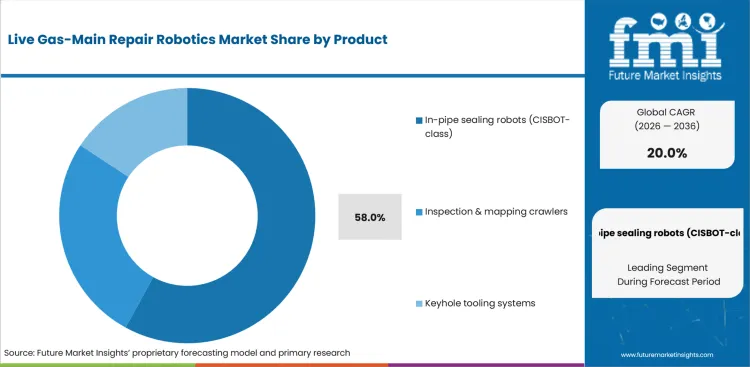
A leaking cast-iron joint creates an urgent repair problem without making full main replacement the best answer for every street. In-pipe sealing robots fill this gap by reaching several joints from one access excavation. Their value depends on pipe size and joint geometry as well as trained field execution. CISBOT seals mechanical joints from inside a live main and keeps the surrounding network in service. The product is most useful on planned campaigns that contain several reachable joints within one street section.
- By product, in-pipe sealing robots are projected to account for 58.0% in 2026 because they complete internal joint repair instead of stopping at inspection. CISBOT reaches jute and mechanical joints from inside a live cast-iron main. That capability gives repair systems more commercial value than crawlers that only record pipe condition.
- Gas utilities are expected to select in-pipe sealing robots where one access excavation can reach several leaking joints. Engineers first check pipe diameter and bends. They then confirm joint type and approved sealant practice. The pipeline integrity analysis places robotic repair within a wider plan for inspection, repair, and eventual main replacement.
What supports demand for cast-iron joint sealing within the application category?
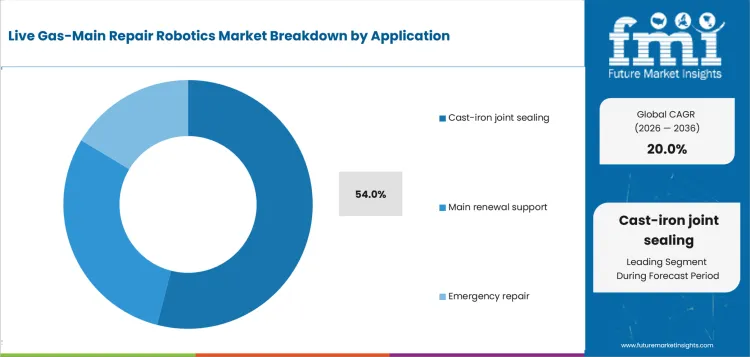
Cast-iron distribution mains often leak at mechanical joints instead of across the full pipe barrel. This pattern makes targeted sealing commercially different from replacing an entire street section. Cold weather and ground movement can disturb dry joint packing in older networks. Utilities need a repair method that restores joint tightness without opening the road at every location. The application creates value on pipe sections that remain structurally fit for continued service.
- In 2026, cast-iron joint sealing is expected to hold 54.0% as many leaks form at aging mechanical joints. ULC Technologies reported in January 2026 that cold weather can shrink dry joint packing and increase leakage. The evidence supports planned winter repair capacity instead of a purely reactive response.
- Urban utilities are expected to use joint sealing where excavation would disrupt traffic and property access. Engineers use non-destructive testing equipment to confirm that the pipe barrel can remain in service. A sound work plan records the defect and approved sealant method before the robot enters the live main.
How do utilities evaluate robots within the component category?
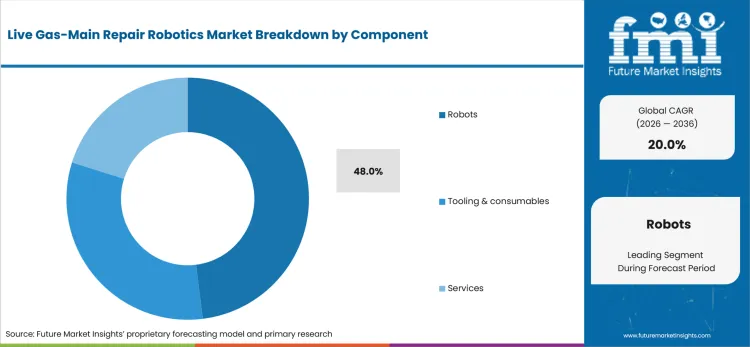
The robot carries the primary equipment value because it controls movement and repair tools inside a pressurized main. Consumables support each joint repair but cannot replace controlled access inside the pipe. Field service adds another cost because utilities need qualified operators and detailed job planning. The commercial offer is therefore a complete working method rather than a machine sold on its own.
- Robots are forecast to represent 48.0% of component spending in 2026 highlighting their importance as the primary tool used to access and repair live gas mains. ULC Technologies combines the machine with qualified operators and field support. The full service becomes more valuable after a utility approves the method for repeat use on suitable networks.
- Utilities with occasional projects often buy a specialist service instead of owning a robot and maintaining a permanent crew. Repeat campaigns create revenue from tooling and sealant after the platform passes network approval. The asset integrity management outlook helps planners decide which joints should be repaired now and which mains should enter a replacement plan.
What are the drivers, restraints, and opportunities in the Live Gas-Main Repair Robotics Market?
Excavation avoidance is expected to support demand, pipe-specific operating limits are anticipated to restrain adoption, and service-led access is projected to widen commercial use.
- Driver: Utilities are expected to adopt live-line repair when one access point can reach several joints and avoid repeated street excavation.
- Restraint: Adoption is anticipated to slow when pipe diameter or bends block safe access to the leaking joint.
- Opportunity: Service contracts are projected to widen access for utilities that need specialist robots but cannot support a permanent crew.
Urban utilities face a recurring cost problem when every leaking joint needs a separate excavation. Internal sealing changes the work sequence by reaching several joints from one access point. ULC Technologies reported in March 2025 that CISBOT had remediated more than 142 miles of infrastructure since 2009. The company completed its first commercial work on 12-inch and 48-inch mains during 2024. Wider pipe coverage expands the number of streets that can be screened for internal repair. Commercial growth therefore depends on proven operating range and repeat field results.
Technical fit remains one of the notable restraints as a robot must pass through bends and access points without losing control. CISBOT and Synthotech tools do not perform the same job. One focuses on internal joint repair while the other supports a wider mix of inspection and robotic work. Engineers need reliable pipe records and a clear view of joint geometry before work begins. These checks lengthen project review but reduce failed mobilizations and protect the repair budget.
The commercial opportunity extends beyond the repair robot because inspection and gas recovery can be combined within one maintenance program. ULC Technologies launched the Mini DDC drawdown compressor in April 2025 for smaller gas-network projects. The unit transfers gas into a nearby live main before work begins on the isolated section. This method limits venting and simplifies pressure management around the repair site. Service providers can create more value by joining targeted repair with leak detection technologies under one work plan.
Which country CAGRs are profiled in the live Gas-Main Repair Robotics Market?
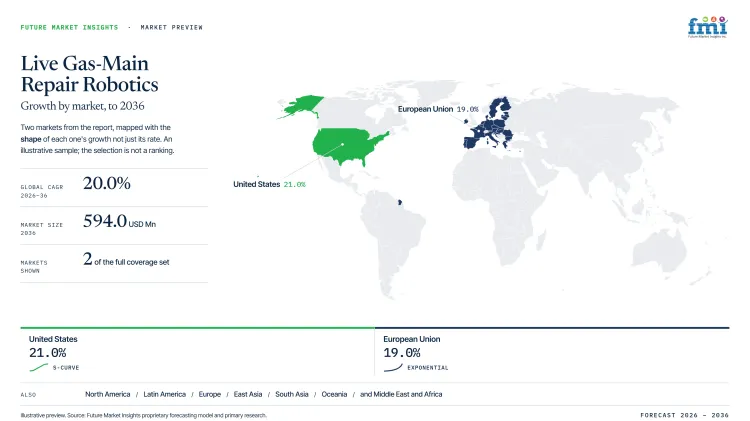
| Country | CAGR |
|---|---|
| United States | 21.0% |
| European Union | 19.0% |
Source: FMI's proprietary forecasting model and primary research
How do country-level CAGRs compare in the Live Gas-Main Repair Robotics Market?
The comparison spans 2.0 percentage points, reflecting a closely aligned growth outlook across the live gas-main repair robotics market. The United States leads with a CAGR of 21.0%, while the European Union follows at 19.0%. Both markets are increasing investment in robotic technologies for gas network maintenance, although utility asset profiles, pipeline replacement strategies and regulatory practices shape adoption differently.
- The United States records the higher CAGR at 21.0%. Gas utilities are placing greater emphasis on robotic systems capable of inspecting and repairing live gas mains while minimizing service interruptions. Interest is particularly strong in technologies that reduce excavation requirements, improve worker safety and extend the operational life of aging distribution networks.
- The European Union posts a CAGR of 19.0%, remaining 2.0 percentage points below the United States. Utility operators are evaluating robotic repair platforms as part of broader gas infrastructure modernization programs, especially where maintaining network continuity and reducing disruption during maintenance are key operational objectives. Adoption varies across member states because pipeline conditions, regulatory requirements and investment priorities are not uniform.
Comparable CAGRs do not necessarily produce identical commercial opportunities. Differences in gas distribution infrastructure, utility maintenance practices, regulatory compliance requirements and capital investment strategies influence deployment timelines and long-term supplier positioning. The full report provides country-level CAGR analysis across North America, Latin America, Europe, East Asia, South Asia, Oceania and the Middle East and Africa.
Country-wise Analysis
The geographic comparison covers the United States and a European Union regional benchmark. USA growth reflects earlier qualification of internal repair and visible service capacity across northeastern gas networks. European growth reflects different national rules and asset-replacement programs across member states. Both regions manage aging mains and costly street disruption but they do not approve new methods in the same way.
- Dense northeastern cities give internal repair a clear use case because older mains often run below busy roads. USA demand is forecast to grow at a 21.0% CAGR from 2026 to 2036. Utilities have a longer record of using CISBOT on cast-iron networks and can compare new projects with earlier field work. The commercial opening is strongest on pipe sections that remain fit for service but are expensive to excavate. Contractors therefore need to show pipe-range limits and results from similar joints before a utility approves repeat work.
- European operators place greater weight on methane control and local proof during planned maintenance. The European Union regional benchmark is estimated to grow at a 19.0% CAGR by 2036. Regulation (EU) 2024/1787 entered force on August 4, 2024 and requires frequent leak surveys. Identified leaks usually need repair within 5 or 15 working days. The rule raises the value of methods that locate defects quickly and confirm the repair without prolonged street work. Commercial entry remains country-specific because network design and approval practice differ across member states.
Who are the notable companies in the Live Gas-Main Repair Robotics Market?
ULC Technologies and Synthotech Limited are notable technology suppliers serving this specialized market for gas utilities. SGN shapes market adoption as a utility operator and development partner under live network conditions.
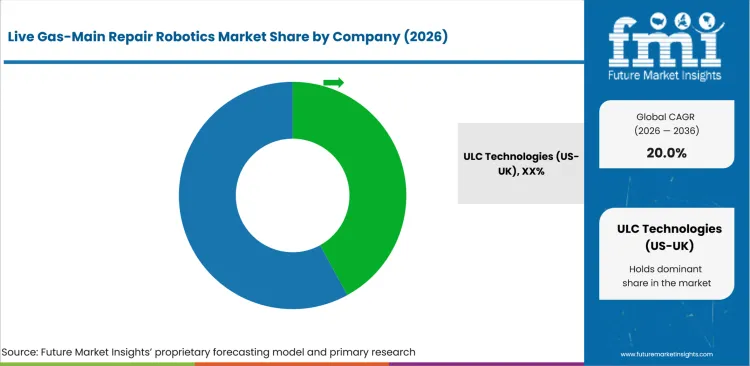
Competition is narrow because the market requires both robotic engineering and utility-approved field work. ULC Technologies competes on internal joint sealing and service delivery across the United States and United Kingdom. Synthotech Limited supplies cameras and robotic tools that support inspection before intervention. SGN influences adoption by testing new methods on an operating gas network. Utilities compare pipe range and field support before they consider price. The gas pipeline infrastructure outlook explains why access planning and service continuity shape every project
- ULC Technologies combines CISBOT repair with qualified field crews and responsibility for the complete live-line procedure. This position reflects utility demand for one accountable service team during planning and execution.
- Synthotech Limited supplies cameras and in-pipe robotic tools that support condition assessment before intervention. Its role reflects the value of reliable pipe evidence before a utility approves repair or replacement.
- SGN is a utility adopter and development partner rather than a robotics supplier. Its field evidence helps technology providers prove whether a method reduces disruption on an operating gas network.
Competitive Benchmarking: Live Gas-Main Repair Robotics Market
| Company | Internal Repair Depth | Inspection and Mapping | Field Service Support | Geographic Reach |
|---|---|---|---|---|
| ULC Technologies | High | High | High | United States and United Kingdom |
| Synthotech Limited | Low | High | Medium | United Kingdom with distributor support |
Scoring basis: High indicates substantial direct capability in the stated dimension. Medium indicates relevant but partial capability. Low indicates limited direct evidence for the stated dimension.
Source: Future Market Insights competitive analysis, 2026. Ratings reflect relative portfolio relevance and workflow fit. Service capability and geographic reach shape the remaining comparison.
Key Developments in the Live Gas-Main Repair Robotics Market
- In March 2026, ULC Technologies announced CISBOT operator qualification OQ 29/30G with the Northeast Gas Association. The qualification sets training and safety requirements for internal joint repair in live gas distribution mains. Its introduction reflects utility demand for auditable competence as robotic work enters routine maintenance programs.
- In September 2025, SGN reported use of the DDC-125 drawdown compressor in its Annual Environmental Report 2024/25. A London project recovered 17,712 cubic feet of gas and avoided 28.7 tonnes of CO2e. The same method cut an onsite process from up to 14 hours to 90 minutes. The result shows how gas recovery can lower emissions and shorten live-network maintenance.
- In August 2025, ULC Technologies reported the first commercial contract for its X-ID acoustic cross-bore detection system. The system uses sound inside gas mains to identify hidden utility conflicts before excavation or internal work begins. The contract reflects demand for better underground evidence at the start of a repair program.
Key Players in the Live Gas-Main Repair Robotics Market
Internal repair and field-service specialist
- ULC Technologies
In-pipe inspection and robotic tooling specialist
- Synthotech Limited
Utility adopters and development partner
- SGN
Live Gas-Main Repair Robotics Market - Report Scope
| Coverage field | Report scope |
|---|---|
| Market breakdown | Product, Application, Component, End User, Business Model, and Region |
| Quantitative Units | Revenue in USD Million and CAGR in % |
| Market Definition | Robotic products and field services used to inspect or repair live gas distribution mains without a full shutdown and repeated excavation. |
| Regions Covered | North America, Latin America, Europe, East Asia, South Asia, Oceania, and Middle East and Africa |
| Countries Covered | United States and European Union benchmark within a model covering 30+ countries |
| Key Companies Profiled | ULC Technologies, Synthotech Limited, and SGN as a utility adopter |
| Forecast Period | 2026 to 2036 |
| Approach | Hybrid bottom-up and top-down analysis combines supplier evidence, utility interviews, and project-level cost checks. |
Source: Future Market Insights - analysis driven by proprietary forecasting models and primary research
Live Gas-Main Repair Robotics Market - Research Methodology
| Method | Approach |
|---|---|
| Primary Research | FMI analysts gathered input from manufacturers, service providers, technology developers, distributors, end users, procurement teams, and subject-matter experts. Interviews examined purchasing decisions, product or service evaluation, adoption barriers, approval requirements, pricing considerations, and expectations for technical or commercial support. Respondents were also asked what evidence is required before a trial, pilot, or initial order develops into regular purchasing. |
| Desk Research | Desk research covered government statistics, regulatory publications, trade data, industry associations, technical literature, standards, company filings, product information, and official corporate announcements. Sources were reviewed for relevance, publication date, geographic coverage, and consistency with the defined market scope. Claims relating to performance, applications, approvals, capacity, investment, and commercial activity were retained only when supported by credible public evidence. |
| Market Sizing and Forecasting | The market model combined the baseline value with historical performance, segment structure, pricing and volume indicators, adoption levels, company participation, and country-level demand conditions. Forecast assumptions considered economic activity, investment trends, regulatory developments, technology adoption, purchasing cycles, supply availability, and barriers to wider market use. Segment and regional estimates were reconciled before the final market total was calculated. |
| Data Validation | Estimates were checked against multiple independent indicators, including public data, company activity, trade patterns, industry developments, and findings from primary interviews. Validation also tested whether products, services, applications, and company revenues fell within the defined market boundaries. Adjacent categories, unsupported claims, overlapping revenues, and activities without direct market relevance were excluded to reduce double counting and maintain consistency across segments and countries. |
Source: Future Market Insights (FMI) analysis, based on proprietary forecasting model and primary research
Live Gas-Main Repair Robotics Market by Segments
Live Gas-Main Repair Robotics Market segmented by Product:
- In-pipe sealing robots (CISBOT-class)
- Inspection and mapping crawlers
- Keyhole tooling systems
Live Gas-Main Repair Robotics Market segmented by Application:
- Cast-iron joint sealing
- Main renewal support
- Emergency repair
Live Gas-Main Repair Robotics Market segmented by Component:
- Robots
- Tooling and consumables
- Services
Live Gas-Main Repair Robotics Market segmented by End User:
- Gas utilities
- Contractors
- Municipal networks
Live Gas-Main Repair Robotics Market segmented by Business Model:
- Service contracts
- Equipment lease
- Direct sale
Live Gas-Main Repair Robotics Market by Region:
- North America
- United States
- Canada
- Latin America
- Brazil
- Mexico
- Argentina
- Europe
- Germany
- United Kingdom
- France
- Italy
- Spain
- East Asia
- China
- Japan
- South Korea
- South Asia
- India
- Thailand
- Indonesia
- Oceania
- Australia
- New Zealand
- Middle East and Africa
- GCC countries
- South Africa
- Turkey
Research Sources and Bibliography
- European Commission. (2024, August 4). Regulation (EU) 2024/1787 on reducing methane emissions in the energy sector. European Commission.
- Future Market Insights. (2026). Live Gas-Main Repair Robotics Market forecast and segmentation analysis. Future Market Insights.
- International Energy Agency. (2025, May 7). Global Methane Tracker 2025. International Energy Agency.
- SGN. (2025, September). Annual Environmental Report 2024/25. SGN.
- Synthotech Limited. (2026, May 27). How is trenchless technology changing the utility industry? Synthotech Limited.
- USA Department of Transportation. (2024, October 22). Nearly USD 196 million awarded for 60 natural gas-pipeline modernization projects across 20 states. USA Department of Transportation.
- ULC Technologies. (2025, March 18). ULC Technologies Named to Fast Company’s Annual List of the World’s Most Innovative Companies of 2025. ULC Technologies.
- ULC Technologies. (2025, April 30). ULC Technologies launches Mini DDC drawdown compressor. ULC Technologies.
- ULC Technologies. (2026, January 14). Cast iron joint leaks in winter: Causes, challenges, and a smarter approach to reactive leak response. ULC Technologies.
- ULC Technologies. (2026, March 17). ULC Technologies announces CISBOT operator qualification in collaboration with the Northeast Gas Association. ULC Technologies.
This bibliography is provided for reader reference and uses primary company and utility sources. Trade-body and FMI material provide added context for the market analysis.
This Report Answers
- What value is the live gas-main repair robotics market estimated to reach in 2026 and 2036?
- What CAGR is projected for the market from 2026 to 2036?
- Which product and application segments shape the disclosed 2026 demand view?
- Which operating pressures support adoption of live-line robotic repair?
- How do the United States and European Union growth benchmarks differ?
- Which capabilities separate repair specialists from inspection suppliers?
- How does FMI validate segment shares and country forecasts?
Frequently Asked Questions
What is driving growth in the Live Gas-Main Repair Robotics Market?
Utilities need repair methods that reduce excavation and keep gas service available during selected joint work. Qualified internal robots support planned campaigns on cast-iron mains that remain structurally suitable.
Who are the key players in the Live Gas-Main Repair Robotics Market?
ULC Technologies provides internal repair and field service while Synthotech Limited supplies inspection and robotic tools. SGN influences adoption by testing methods on an operating gas network.
What is a notable restraint in the Live Gas-Main Repair Robotics Market?
Pipe diameter and joint geometry can prevent a robot from reaching a defect safely. Project approval therefore depends on accurate pipe records and evidence from similar network sections.
Why should executives track the Live Gas-Main Repair Robotics Market?
Robotic repair changes the cost and street disruption linked to maintaining older distribution mains. Executives should track qualification progress because approval controls how quickly utilities can repeat the method.
What business problem does the Live Gas-Main Repair Robotics Market address?
The market addresses repeated excavation and service interruption during joint repair. Internal systems reach several suitable joints from one access point and reduce the work required above ground.
What should procurement leaders evaluate before selecting suppliers?
Selection should compare pipe range, operator qualification, and responsibility for the live-line procedure. Evidence from similar joints should be required before a service contract or lease is approved.
What limits return on investment for purchasers?
Low campaign frequency weakens the financial case for direct equipment ownership. A failed mobilization adds cost without completing the planned repair and can delay later approval.
How do suppliers build long-term account confidence?
Long-term trust comes from clear operating limits and repeat results on comparable networks. Utilities retain service partners that respond quickly when pipe records or access conditions change.
How do suppliers build long-term account confidence?
Service providers build confidence by stating operating limits and documenting repeat performance across comparable field projects. Utilities retain partners that respond quickly when pipe records or access conditions change during work.
Preview the report firsthand - request a free sample
Get SampleGet the brochure for pricing and purchase details.
Get PDFTable of Content
- Key Takeaways
- Market Size and CAGR
- Top Growth Driver
- Fastest Growing Segment
- Leading Region
- Key Companies
- Emerging Opportunities
- Executive Summary
- Global Market Outlook
- Demand-side Trends
- Supply-side Trends
- Technology Roadmap Analysis
- Analysis and Recommendations
- Analyst Perspective (What is happening? Why now? What should investors know?)
- Key Questions Answered
- How large is the market?
- What is the CAGR?
- What are key trends?
- Which region dominates?
- Who are the leaders?
- Market Overview
- Market Coverage / Taxonomy
- Market Definition / Scope / Limitations
- Research Methodology
- Chapter Orientation
- Analytical Lens and Working Hypotheses
- Market Structure, Signals, and Trend Drivers
- Benchmarking and Cross-market Comparability
- Market Sizing, Forecasting, and Opportunity Mapping
- Research Design and Evidence Framework
- Desk Research Programme (Secondary Evidence)
- Expert Input and Fieldwork (Primary Evidence)
- Tooling, Models, and Reference Databases
- Data Engineering and Model Build
- Quality Assurance and Audit Trail
- Market Background
- Market Dynamics (Drivers, Restraints, Opportunity, Trends)
- Scenario Forecast (Optimistic, Likely, Conservative)
- Impact Analysis
- AI Impact
- Sustainability Impact
- Regulatory Impact
- Technology Impact
- Consumer / Buyer Analysis
- Purchase Drivers
- Adoption Barriers
- Buyer Journey
- Opportunity Map Analysis
- Product Life Cycle Analysis
- Supply Chain Analysis
- Investment Feasibility Matrix
- Value Chain Analysis
- PESTLE and Porter's Analysis
- Regulatory Landscape
- Regional Parent Market Outlook
- Production and Consumption Statistics
- Import and Export Statistics
- Global Market Analysis and Forecast, 2021 to 2036
- Historical Market Size Value (USD Million) Analysis, 2021 to 2025
- Current and Future Market Size Value (USD Million) Projections, 2026 to 2036
- Y-o-Y Growth Trend Analysis
- Absolute $ Opportunity Analysis
- Global Market Pricing Analysis, 2021 to 2036
- Global Market Analysis and Forecast, By Product, 2021 to 2036
- Introduction / Key Findings
- Historical Market Size Value (USD Million) Analysis By Product, 2021 to 2025
- Current and Future Market Size Value (USD Million) Analysis and Forecast By Product, 2026 to 2036
- In-pipe sealing robots (CISBOT-class)
- Inspection & mapping crawlers
- Keyhole tooling systems
- In-pipe sealing robots (CISBOT-class)
- Y-o-Y Growth Trend Analysis By Product, 2021 to 2025
- Absolute $ Opportunity Analysis By Product, 2026 to 2036
- Global Market Analysis and Forecast, By Application, 2021 to 2036
- Introduction / Key Findings
- Historical Market Size Value (USD Million) Analysis By Application, 2021 to 2025
- Current and Future Market Size Value (USD Million) Analysis and Forecast By Application, 2026 to 2036
- Cast-iron joint sealing
- Main renewal support
- Emergency repair
- Cast-iron joint sealing
- Y-o-Y Growth Trend Analysis By Application, 2021 to 2025
- Absolute $ Opportunity Analysis By Application, 2026 to 2036
- Global Market Analysis and Forecast, By Component, 2021 to 2036
- Introduction / Key Findings
- Historical Market Size Value (USD Million) Analysis By Component, 2021 to 2025
- Current and Future Market Size Value (USD Million) Analysis and Forecast By Component, 2026 to 2036
- Robots
- Tooling & consumables
- Services
- Robots
- Y-o-Y Growth Trend Analysis By Component, 2021 to 2025
- Absolute $ Opportunity Analysis By Component, 2026 to 2036
- Global Market Analysis and Forecast, By End User, 2021 to 2036
- Introduction / Key Findings
- Historical Market Size Value (USD Million) Analysis By End User, 2021 to 2025
- Current and Future Market Size Value (USD Million) Analysis and Forecast By End User, 2026 to 2036
- Gas utilities
- Contractors
- Municipal networks
- Gas utilities
- Y-o-Y Growth Trend Analysis By End User, 2021 to 2025
- Absolute $ Opportunity Analysis By End User, 2026 to 2036
- Global Market Analysis and Forecast, By Business Model, 2021 to 2036
- Introduction / Key Findings
- Historical Market Size Value (USD Million) Analysis By Business Model, 2021 to 2025
- Current and Future Market Size Value (USD Million) Analysis and Forecast By Business Model, 2026 to 2036
- Service contracts
- Equipment lease
- Direct sale
- Service contracts
- Y-o-Y Growth Trend Analysis By Business Model, 2021 to 2025
- Absolute $ Opportunity Analysis By Business Model, 2026 to 2036
- Global Market Analysis and Forecast, By Region, 2021 to 2036
- Introduction
- Historical Market Size Value (USD Million) Analysis By Region, 2021 to 2025
- Current Market Size Value (USD Million) Analysis and Forecast By Region, 2026 to 2036
- North America
- Latin America
- Western Europe
- Eastern Europe
- East Asia
- South Asia and Pacific
- Middle East & Africa
- Market Attractiveness Analysis By Region
- North America Market Analysis and Forecast, By Country, 2021 to 2036
- Historical Market Size Value (USD Million) Trend Analysis By Market Taxonomy, 2021 to 2025
- Market Size Value (USD Million) Forecast By Market Taxonomy, 2026 to 2036
- By Country
- USA
- Canada
- By Product
- By Application
- By Component
- By End User
- By Business Model
- By Country
- Market Attractiveness Analysis
- By Country
- By Product
- By Application
- By Component
- By End User
- By Business Model
- Key Takeaways
- Latin America Market Analysis and Forecast, By Country
- Historical Market Size Value (USD Million) Trend Analysis By Market Taxonomy, 2021 to 2025
- Market Size Value (USD Million) Forecast By Market Taxonomy, 2026 to 2036
- By Country
- Brazil
- Mexico
- Chile
- Rest of Latin America
- By Product
- By Application
- By Component
- By End User
- By Business Model
- By Country
- Market Attractiveness Analysis
- By Country
- By Product
- By Application
- By Component
- By End User
- By Business Model
- Key Takeaways
- Western Europe Market Analysis and Forecast, By Country
- Historical Market Size Value (USD Million) Trend Analysis By Market Taxonomy, 2021 to 2025
- Market Size Value (USD Million) Forecast By Market Taxonomy, 2026 to 2036
- By Country
- Germany
- UK
- Italy
- Spain
- France
- Nordic
- BENELUX
- Rest of Western Europe
- By Product
- By Application
- By Component
- By End User
- By Business Model
- By Country
- Market Attractiveness Analysis
- By Country
- By Product
- By Application
- By Component
- By End User
- By Business Model
- Key Takeaways
- Eastern Europe Market Analysis and Forecast, By Country
- Historical Market Size Value (USD Million) Trend Analysis By Market Taxonomy, 2021 to 2025
- Market Size Value (USD Million) Forecast By Market Taxonomy, 2026 to 2036
- By Country
- Russia
- Poland
- Hungary
- Balkan & Baltic
- Rest of Eastern Europe
- By Product
- By Application
- By Component
- By End User
- By Business Model
- By Country
- Market Attractiveness Analysis
- By Country
- By Product
- By Application
- By Component
- By End User
- By Business Model
- Key Takeaways
- East Asia Market Analysis and Forecast, By Country
- Historical Market Size Value (USD Million) Trend Analysis By Market Taxonomy, 2021 to 2025
- Market Size Value (USD Million) Forecast By Market Taxonomy, 2026 to 2036
- By Country
- China
- Japan
- South Korea
- By Product
- By Application
- By Component
- By End User
- By Business Model
- By Country
- Market Attractiveness Analysis
- By Country
- By Product
- By Application
- By Component
- By End User
- By Business Model
- Key Takeaways
- South Asia and Pacific Market Analysis and Forecast, By Country
- Historical Market Size Value (USD Million) Trend Analysis By Market Taxonomy, 2021 to 2025
- Market Size Value (USD Million) Forecast By Market Taxonomy, 2026 to 2036
- By Country
- India
- ASEAN
- Australia & New Zealand
- Rest of South Asia and Pacific
- By Product
- By Application
- By Component
- By End User
- By Business Model
- By Country
- Market Attractiveness Analysis
- By Country
- By Product
- By Application
- By Component
- By End User
- By Business Model
- Key Takeaways
- Middle East & Africa Market Analysis and Forecast, By Country
- Historical Market Size Value (USD Million) Trend Analysis By Market Taxonomy, 2021 to 2025
- Market Size Value (USD Million) Forecast By Market Taxonomy, 2026 to 2036
- By Country
- Kingdom of Saudi Arabia
- Other GCC Countries
- Türkiye
- South Africa
- Other African Union
- Rest of Middle East & Africa
- By Product
- By Application
- By Component
- By End User
- By Business Model
- By Country
- Market Attractiveness Analysis
- By Country
- By Product
- By Application
- By Component
- By End User
- By Business Model
- Key Takeaways
- Key Countries Market Analysis
- USA
- Pricing Analysis
- Market Share Analysis, 2025
- By Product
- By Application
- By Component
- By End User
- By Business Model
- Canada
- Pricing Analysis
- Market Share Analysis, 2025
- By Product
- By Application
- By Component
- By End User
- By Business Model
- Mexico
- Pricing Analysis
- Market Share Analysis, 2025
- By Product
- By Application
- By Component
- By End User
- By Business Model
- Brazil
- Pricing Analysis
- Market Share Analysis, 2025
- By Product
- By Application
- By Component
- By End User
- By Business Model
- Chile
- Pricing Analysis
- Market Share Analysis, 2025
- By Product
- By Application
- By Component
- By End User
- By Business Model
- Germany
- Pricing Analysis
- Market Share Analysis, 2025
- By Product
- By Application
- By Component
- By End User
- By Business Model
- UK
- Pricing Analysis
- Market Share Analysis, 2025
- By Product
- By Application
- By Component
- By End User
- By Business Model
- Italy
- Pricing Analysis
- Market Share Analysis, 2025
- By Product
- By Application
- By Component
- By End User
- By Business Model
- Spain
- Pricing Analysis
- Market Share Analysis, 2025
- By Product
- By Application
- By Component
- By End User
- By Business Model
- France
- Pricing Analysis
- Market Share Analysis, 2025
- By Product
- By Application
- By Component
- By End User
- By Business Model
- India
- Pricing Analysis
- Market Share Analysis, 2025
- By Product
- By Application
- By Component
- By End User
- By Business Model
- ASEAN
- Pricing Analysis
- Market Share Analysis, 2025
- By Product
- By Application
- By Component
- By End User
- By Business Model
- Australia & New Zealand
- Pricing Analysis
- Market Share Analysis, 2025
- By Product
- By Application
- By Component
- By End User
- By Business Model
- China
- Pricing Analysis
- Market Share Analysis, 2025
- By Product
- By Application
- By Component
- By End User
- By Business Model
- Japan
- Pricing Analysis
- Market Share Analysis, 2025
- By Product
- By Application
- By Component
- By End User
- By Business Model
- South Korea
- Pricing Analysis
- Market Share Analysis, 2025
- By Product
- By Application
- By Component
- By End User
- By Business Model
- Russia
- Pricing Analysis
- Market Share Analysis, 2025
- By Product
- By Application
- By Component
- By End User
- By Business Model
- Poland
- Pricing Analysis
- Market Share Analysis, 2025
- By Product
- By Application
- By Component
- By End User
- By Business Model
- Hungary
- Pricing Analysis
- Market Share Analysis, 2025
- By Product
- By Application
- By Component
- By End User
- By Business Model
- Kingdom of Saudi Arabia
- Pricing Analysis
- Market Share Analysis, 2025
- By Product
- By Application
- By Component
- By End User
- By Business Model
- Türkiye
- Pricing Analysis
- Market Share Analysis, 2025
- By Product
- By Application
- By Component
- By End User
- By Business Model
- South Africa
- Pricing Analysis
- Market Share Analysis, 2025
- By Product
- By Application
- By Component
- By End User
- By Business Model
- USA
- Market Structure Analysis
- Competition Dashboard
- Competition Benchmarking
- Market Share Analysis of Top Players
- By Regional
- By Product
- By Application
- By Component
- By End User
- By Business Model
- Emerging Startups
- Innovation Benchmarking
- Competition Analysis
- Competition Deep Dive
- ULC Technologies (US-UK)
- Overview
- Product Portfolio
- Profitability by Market Segments
- Sales Footprint
- Strategy Overview
- Marketing Strategy
- Product Strategy
- Channel Strategy
- SGN robotics (UK)
- ULC Technologies (US-UK)
- Case Studies
- Success Stories
- Recent Developments
- Competition Deep Dive
- Assumptions & Acronyms Used


