
- Market Size (2026)
- USD 3.09 Bn
- Forecast (2036)
- USD 5.44 Bn
- CAGR (2026 to 2036)
- 5.8%
How Big Is the Dry Shampoo Market in 2026?
The global dry shampoo market is valued at USD 3.09 billion in 2026, up from USD 2.93 billion in 2025, and is projected by Future Market Insights (FMI) to reach USD 5.44 billion by 2036, expanding at a 5.8% CAGR from 2026 to 2036 and generating USD 2.35 billion in incremental revenue over the 10-year forecast period.
| Market Metric | Valuation / Share / Forecast Benchmark |
|---|---|
| 2025 Market Size (Historical) | USD 2.93 billion |
| 2026 Market Size (Estimated) | USD 3.09 billion |
| 2036 Market Size (Projected) | USD 5.44 billion |
| Compound Annual Growth Rate (2026 to 2036) | 5.8% CAGR |
| Incremental Dollar Opportunity (2026 to 2036) | USD 2.35 billion |
| Dominant Product Form (2026 to 2036 Share) | Aerosol Spray (74.0% in 2026, easing to 62.0% by 2036) |
| Leading & Fastest-Growing Functions | Oil Control and Refresh (56.0% share in 2026, 4.0% CAGR) │ Scalp Care and Sensitive Scalp (10.7% CAGR) |
| Leading & Fastest-Growing Channels | Supermarkets and Mass Merchandisers (36.0% share in 2026) │ Online Retail (8.9% CAGR) |
| Largest Country Markets (2026 Global Share) | United States (38.2%), United Kingdom (10.7%), Germany (6.1%) |
| Fastest-Growing Country Markets (2026 to 2036) | South Korea (8.2% CAGR), Japan (7.4% CAGR), Brazil (7.0% CAGR) |
| Leading Tier-1 Companies | Church & Dwight (Batiste), Procter & Gamble (Aussie), Unilever (Dove, TRESemmé), Thriving Brands (COLAB) |
Source: Future Market Insights analysis of the dry shampoo market, 2026.
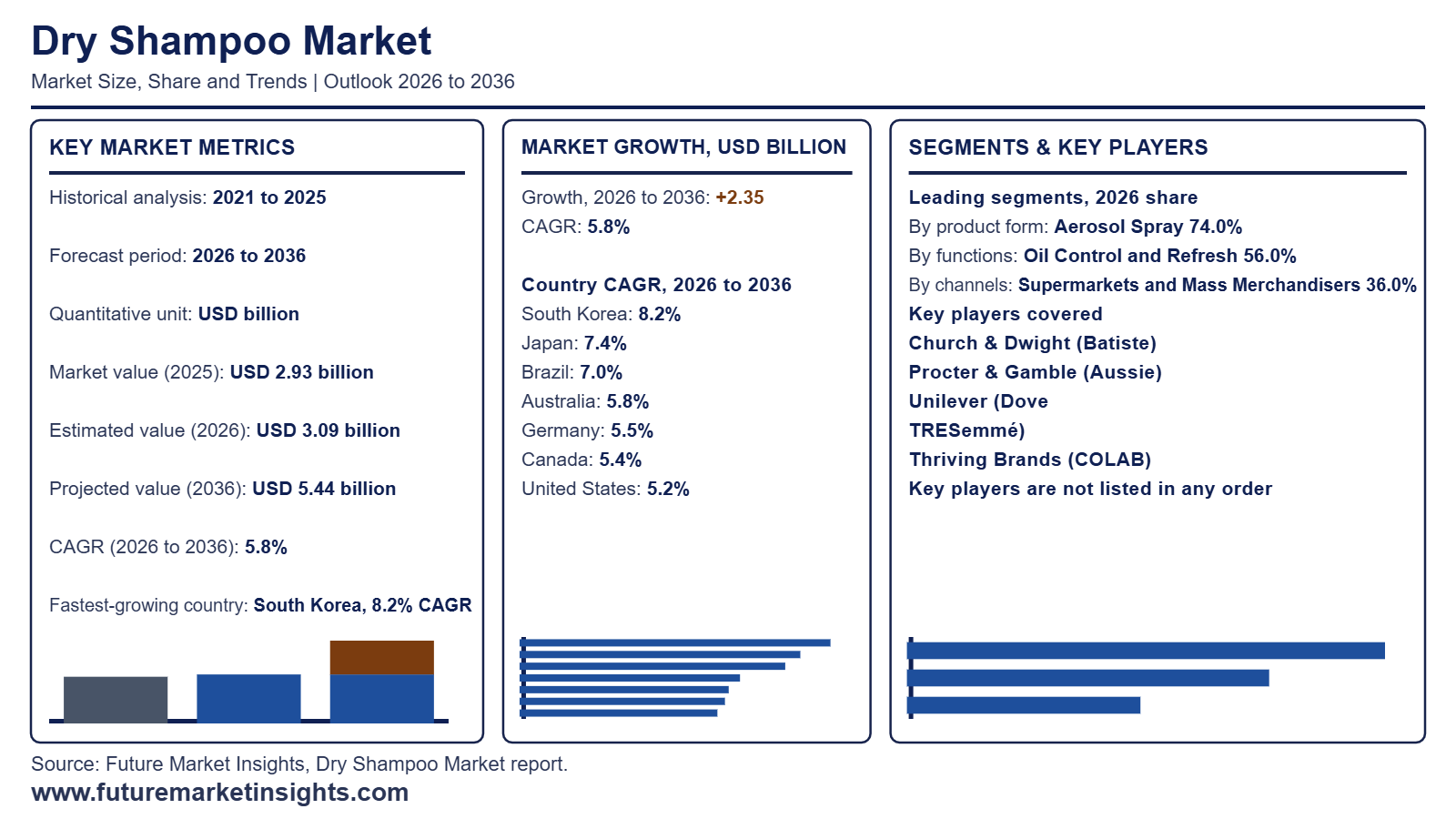
Executive Market Overview
Adoption of dry shampoo is driven by volume and styling use between washes along with new launches for hot, humid summers in Asia. FMI estimates that the United States accounts for 38.2% of global sales in 2026, with the United Kingdom next at 10.7%. Aerosol sprays are the main format with a 74.0% share, and supermarkets and mass merchandisers handle 36.0% of sales. Batiste reports that 64% of dry shampoo uses are for volume and texture, along with fragrance, beyond oil control, per MarComm News (February 2026). In Japan, WWDJAPAN (July 2026) listed new dry shampoo products from 10 brands launched from February to June 2026, including mists and sprays, along with sheets. South Korea is moving the same way, as COLAB has sold over one million units there, according to SLG Brands (February 2026). As a result, FMI expects East Asian demand to grow faster than sales in the mature US and UK markets.
Consumers buy dry shampoo to refresh hair and add volume without a full wash, especially after exercise and in hot weather. Abroad, Church & Dwight (October 2026) named Batiste among the drivers of 7.8% organic growth in the company's international business in the third quarter. Mass brands are adding lower-priced options, and Aussie launched a three-item collection at USD 7.99 each, per Happi (April 2026). FMI projects non-aerosol mists to expand at an 11.6% CAGR and scalp-care formulas at 10.7%, both faster than the 5.8% overall market CAGR. Aerosol sprays, the largest form, are set for a slower 4.0% CAGR. Market sizing covers aerosol and non-aerosol dry shampoos, along with powders, foams and sheets, for home and salon use. Regular wet shampoos and co-washes are excluded, as are dry conditioners, texturizing sprays without cleansing claims, hair perfumes and no-rinse medical cleansing caps.
Analyst Perspective
"Sales of dry shampoo are set to rise faster in value than in units as shoppers move to non-aerosol mists and scalp-care formulas, along with tinted sprays for darker hair, which sell at higher shelf prices than basic cans. Safety enforcement poses the sharpest commercial risk, as the FDA set out in December 2025 how the agency can require cosmetic recalls, which raises the cost of any contamination finding in an aerosol line."
- Rahul Pandita, Principal Consultant, Future Market Insights (FMI)
Major Market Trends and Insights
Brand Campaigns Recast Dry Shampoo as a Styling Product: Batiste launched the Pass the Batiste brand platform in the United Kingdom on 9 February 2026, the brand's most expansive campaign to date, according to MarComm News (February 2026). Batiste announced a rollout to France and Germany, along with Canada and Australia, the same report notes. Church & Dwight (February 2026) describes Batiste as the world's number one dry shampoo brand and lists Batiste among seven power brands that make up about 70% of company sales and profits.
Japanese Brands Launch Mists and Sprays for Hot Summers: Japanese launches in spring and summer 2026 included products priced from JPY 935 (USD 5.86) to JPY 3,960 (USD 24.83), per WWDJAPAN (July 2026). The trade title links the demand to hot, humid summers and the need to control sweat and odor. H2O (April 2026) released ululis dry shampoo in a 100 ml mist at JPY 1,408 (USD 8.83) and a 95 g spray at JPY 1,320 (USD 8.28) on 25 April 2026. Kao added Merit dry shampoo sheets to the same season's launches, the WWDJAPAN list shows.
Deals and Talc-Free Formulas Change the US Shelf: Thriving Brands, owner of Right Guard and Dry Idea, acquired COLAB Dry Shampoo from SLG Brands, BeautyMatter (July 2026) reports. COLAB is sold at Walmart and Target, along with CVS. Formulation claims are shifting as well, since the Aussie collection is talc-free, per Happi (April 2026). In Europe, a ban on talc in cosmetics is expected in 2027, according to Cosmetics Design Europe (January 2026). FMI expects the ban to affect dry shampoo powders that contain talc, along with suppliers in the talc market.
What Are the Main Drivers, Restraints, and Opportunities?
Styling use and hot-weather demand are broadening the dry shampoo buyer base, and brands are adding mists and scalp formulas to reach new users. Slower growth in basic cans reflects a mature aerosol market in Western Europe and closer safety oversight in the United States. East Asia and premium formats offer the clearest gains.
Driver: Styling Use, Hot Climates and Asian Retail Expansion
COLAB reported 28% annual growth and a listing at Olive Young, South Korea's leading beauty retailer, per SLG Brands (February 2026). The same release announced plans for further expansion across Asia. In Japan, hot and humid summers add demand for sweat and odor control along with a cooling feel, WWDJAPAN (July 2026) notes. Styling use broadens the occasion, since most uses now target volume, texture or scent.
Restraint: Mature Aerosol Demand and Closer Safety Oversight
UK aerosol fillings fell 2% in 2025, with deodorants down 5%, according to the British Aerosol Manufacturers' Association (April 2026). The association described the figures as a normal cycle in a very mature market. Safety oversight is rising in the United States as well. The Food and Drug Administration (December 2025) published draft guidance on the agency's mandatory recall authority for cosmetics on 18 December 2025. The agency launched a public dashboard of cosmetic adverse event reports on 12 September 2025, Foley & Lardner (March 2026) notes.
Opportunity: Scalp-Care, Tinted and Non-Aerosol Lines
Scalp-friendly and textured-hair products are reaching mass retail. The Aussie collection is designed for hair types from straight to coily, with refresh and volume versions, along with a texture version, Happi (April 2026) reports. Non-aerosol mists are gaining space in Japanese drugstores, as the ululis launch shows. FMI projects South Korea to expand at an 8.2% CAGR and Japan at 7.4%, faster than any other profiled country.
How Is the Dry Shampoo Market Segmented?
The global dry shampoo market is segmented by product form, function, distribution channel, and region, with all formats converted to 200 ml-equivalent units for volume comparison.
| Segmentation Axis | Sub-Segments Covered | 2026 Leading Segment & Share | Main Growth Benchmark (2026 to 2036) |
|---|---|---|---|
| Product Form | Aerosol Spray, Non-Aerosol Mist and Pump Spray, Loose Powder, Foam, Sheets and Other Formats | Aerosol Spray (74.0% share) | Non-Aerosol Mist and Pump Spray grows fastest at an 11.6% CAGR |
| Function | Oil Control and Refresh, Volume and Texture, Tinted and Color-Matched, Scalp Care and Sensitive Scalp | Oil Control and Refresh (56.0% share) | Scalp Care and Sensitive Scalp grows fastest at a 10.7% CAGR |
| Distribution Channel | Supermarkets and Mass Merchandisers, Drugstores and Pharmacies, Specialty Beauty Retailers, Online Retail, Salons and Professional | Supermarkets and Mass Merchandisers (36.0% share) | Online Retail grows fastest at an 8.9% CAGR |
| Region | North America, Europe, East Asia, South Asia & Pacific, Latin America, Middle East & Africa | North America (led by the United States at 38.2% global share) | South Korea and Japan grow fastest at 8.2% and 7.4% CAGR |
Source: Future Market Insights analysis of the dry shampoo market, 2026.
Why Does the Aerosol Spray Segment Lead by Product Form?
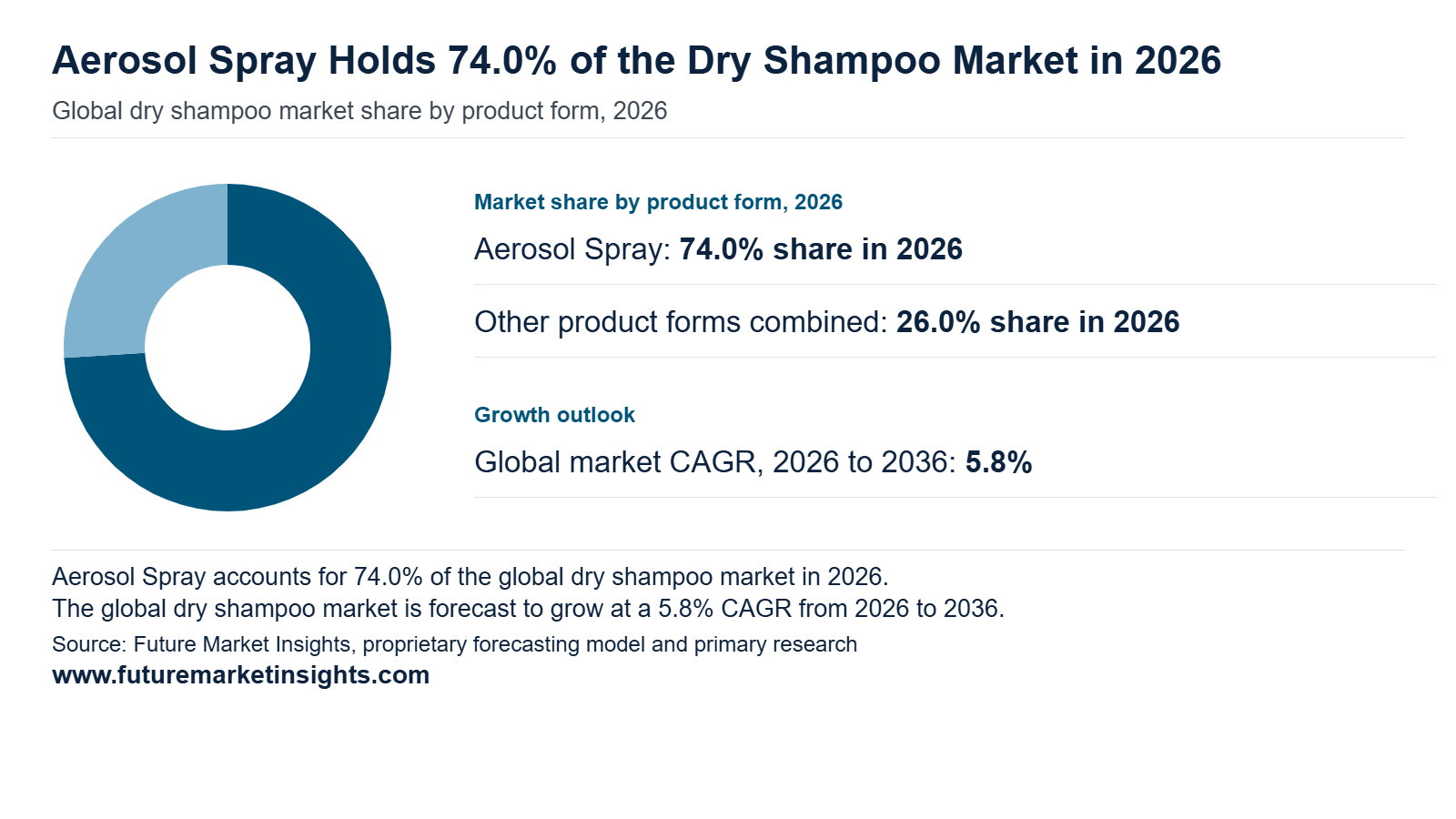
Aerosol sprays are the dominant product form in the global dry shampoo market, with 74.0% of 2026 sales, and are expected to retain 62.0% by 2036. Leading brands such as Batiste and Aussie sell aerosol cans through mass retail. Aluminum accounted for 67% of UK aerosol fillings in 2025, per the British Aerosol Manufacturers' Association (April 2026). As a result, prices in the aluminum aerosol cans market affect dry shampoo costs. Non-aerosol mist and pump sprays show the fastest form growth, an 11.6% CAGR, as Japanese launches such as ululis bring the format to more shelves. Foam, sheets and other formats are likely to post an 11.3% CAGR.
Why Does the Oil Control and Refresh Segment Lead by Function?
Oil control and refresh products account for 56.0% of 2026 sales by function and are expected to post a 4.0% CAGR through 2036. Absorbing oil at the roots between washes remains the core reason to buy. Volume and texture products are on course for a 6.7% CAGR, helped by styling-led campaigns and lines such as Aussie Instant Volume. Scalp care and sensitive scalp formulas are expected to grow fastest, at a 10.7% CAGR, as brands borrow claims from the scalp care market. Tinted and color-matched sprays are set for an 8.1% CAGR.
Why Does the Supermarkets and Mass Merchandisers Segment Lead by Distribution Channel?
Supermarkets and mass merchandisers account for 36.0% of global sales of dry shampoo in 2026. Mass retailers carry the main brands at low price points, and Aussie is sold at Walmart.com and Kroger, along with CVS and Dollar General. Drugstores and pharmacies hold 28.0%, led by pharmacy chains in Europe and drugstores in Japan. Among channels, online retail grows fastest, at an 8.9% CAGR, as indie and Korean brands sell direct and through beauty marketplaces. Salons and professional outlets are set to grow at only 1.6% per year.
Dry Shampoo Market by Region and Country (2026 to 2036)
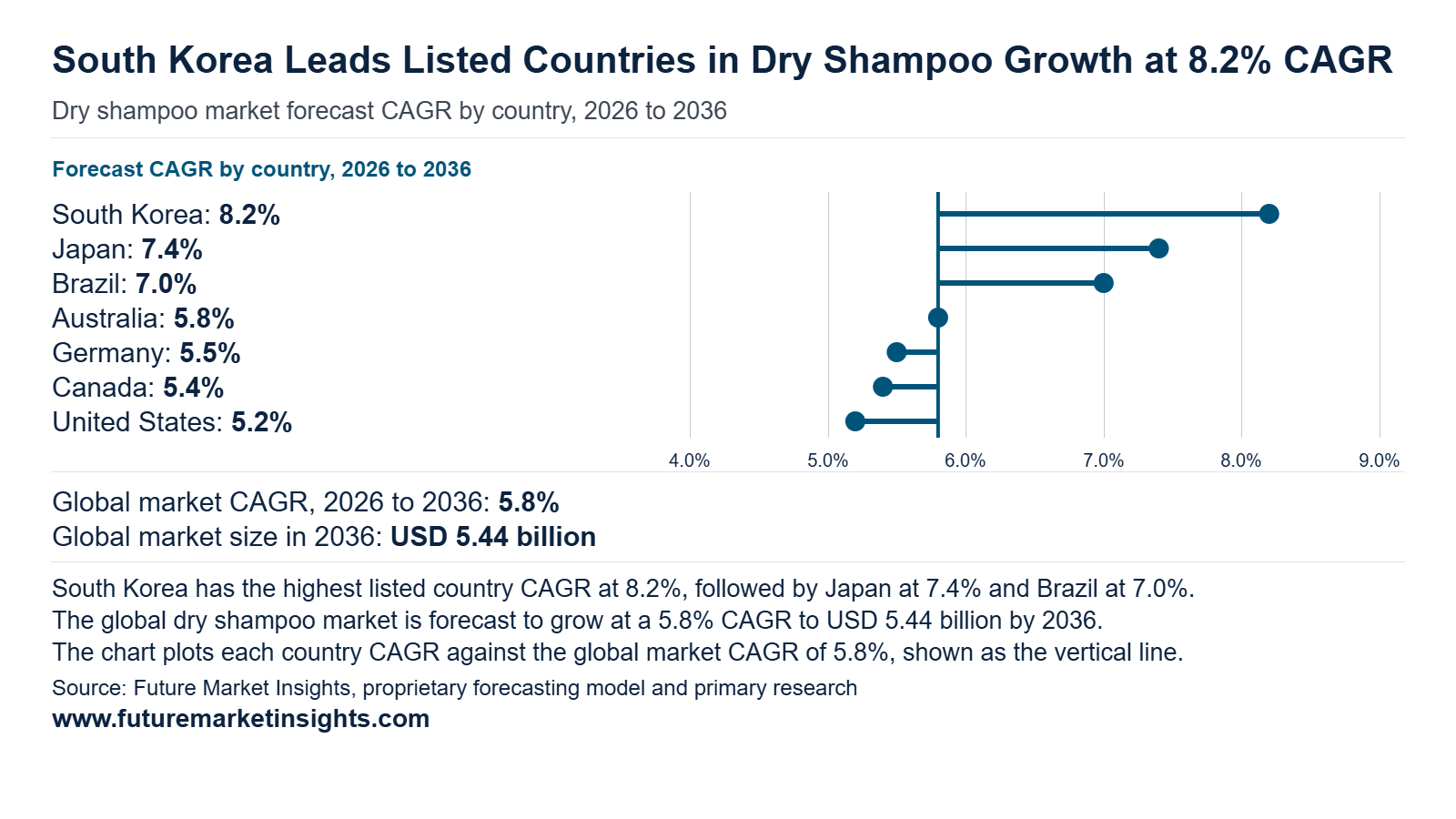
North America leads regional sales of dry shampoo through 2036, though East Asia gains share as Japanese and Korean shoppers adopt the category. The combined share of the ten profiled countries moves from 76.7% in 2026 to 74.1% in 2036, by FMI estimates. The United States' share is projected to soften from 38.2% in 2026 to 36.0% by 2036. Even so, the United States adds USD 780.0 million, or 33.2% of total global growth. Sales in Japan and South Korea are projected to rise from USD 200.0 million in 2026 to USD 419.4 million by 2036, mainly through mists and sprays sold in drugstores and online.
| Country | 2026 Revenue | 2036 Revenue | 10-Year Addition | 2026 to 2036 CAGR | Global Share (2026 → 2036) |
|---|---|---|---|---|---|
| South Korea | USD 70.0 million | USD 153.9 million | +USD 83.9 million | 8.2% | 2.3% → 2.8% |
| Japan | USD 130.0 million | USD 265.5 million | +USD 135.5 million | 7.4% | 4.2% → 4.9% |
| Brazil | USD 65.0 million | USD 127.9 million | +USD 62.9 million | 7.0% | 2.1% → 2.4% |
| Australia | USD 85.0 million | USD 149.4 million | +USD 64.4 million | 5.8% | 2.8% → 2.7% |
| Germany | USD 190.0 million | USD 324.5 million | +USD 134.5 million | 5.5% | 6.1% → 6.0% |
| Canada | USD 95.0 million | USD 160.7 million | +USD 65.7 million | 5.4% | 3.1% → 3.0% |
| United States | USD 1.18 billion | USD 1.96 billion | +USD 780.0 million | 5.2% | 38.2% → 36.0% |
| Italy | USD 75.0 million | USD 123.3 million | +USD 48.3 million | 5.1% | 2.4% → 2.3% |
| France | USD 150.0 million | USD 244.3 million | +USD 94.3 million | 5.0% | 4.9% → 4.5% |
| United Kingdom | USD 330.0 million | USD 517.4 million | +USD 187.4 million | 4.6% | 10.7% → 9.5% |
Source: Future Market Insights analysis of the dry shampoo market, 2026.
United States
The United States leads the global dry shampoo market, with sales estimated to rise from USD 1.18 billion in 2026 to USD 1.96 billion by 2036 (5.2% CAGR). The country adds USD 780.0 million, and the US global share eases from 38.2% to 36.0%. Ownership is shifting among challenger brands, as Thriving Brands bought COLAB in 2026, per BeautyMatter (July 2026). FDA oversight under the Modernization of Cosmetics Regulation Act now includes a mandatory recall process, set out in draft guidance in December 2025. FMI expects talc-free and textured-hair lines to account for a growing part of US shelf space.
United Kingdom
The United Kingdom is the second-largest dry shampoo market, growing at a 4.6% CAGR from USD 330.0 million in 2026 to USD 517.4 million by 2036. The USD 187.4 million addition comes as the national share softens from 10.7% to 9.5%. Batiste began the global Pass the Batiste campaign in the United Kingdom in February 2026. The UK aerosol market is mature, and FMI expects growth to come mainly from premium and scalp-care variants.
Germany
Germany is projected to see a 5.5% CAGR from USD 190.0 million in 2026 to USD 324.5 million by 2036, adding USD 134.5 million as the national share softens from 6.1% to 6.0%. Drugstore chains and store brands sell most dry shampoo in Germany, according to FMI estimates. Batiste's 2026 campaign rollout includes Germany, per MarComm News (February 2026).
France
France is likely to increase at a 5.0% CAGR from USD 150.0 million in 2026 to USD 244.3 million by 2036, adding USD 94.3 million. The national share softens from 4.9% to 4.5%. FMI expects pharmacy brands with plant-based powders to keep a strong position, and the expected EU talc ban to speed reformulation.
Japan
Japan is the profiled market with the second-fastest growth for dry shampoo, with sales rising 2.04-fold from USD 130.0 million in 2026 to USD 265.5 million by 2036 at a 7.4% CAGR. The national share grows from 4.2% to 4.9%. Domestic and foreign brands, from Kao's Merit to L'Occitane and Batiste, launched products for the 2026 summer, per WWDJAPAN (July 2026). FMI expects cooling mists and sheets to remain the main formats.
Canada
Canada is forecast to log a 5.4% CAGR from USD 95.0 million in 2026 to USD 160.7 million by 2036, adding USD 65.7 million. The country's share moves from 3.1% to 3.0%. FMI expects US brands and drugstore chains to account for most sales. The Pass the Batiste campaign announced in February 2026 lists Canada as a rollout country, per MarComm News (February 2026).
Australia
Australia is expected to reach a 5.8% CAGR from USD 85.0 million in 2026 to USD 149.4 million by 2036, adding USD 64.4 million as the country's share moves from 2.8% to 2.7%. Hot weather supports use between washes, according to FMI estimates. Supermarkets and pharmacy chains are the main routes to shoppers.
South Korea
South Korea records the fastest growth of any profiled market for dry shampoo, with sales rising 2.20-fold from USD 70.0 million in 2026 to USD 153.9 million by 2036 at an 8.2% CAGR. The national share grows from 2.3% to 2.8%. COLAB has passed one million units sold in South Korea, per SLG Brands (February 2026). FMI expects Olive Young and online beauty platforms to carry most category growth.
Brazil
Brazil is projected to rise at a 7.0% CAGR from USD 65.0 million in 2026 to USD 127.9 million by 2036, the third-fastest rate among the profiled countries. The USD 62.9 million addition pushes the national share from 2.1% to 2.4%. FMI expects hot weather and growing drugstore chains to support adoption.
Italy
Sales in Italy are forecast to rise at a 5.1% CAGR from USD 75.0 million in 2026 to USD 123.3 million by 2036, adding USD 48.3 million. The country's share moves from 2.4% to 2.3%. FMI expects pharmacy and drugstore chains to remain the main channels.
Competitive Environment and Notable Companies
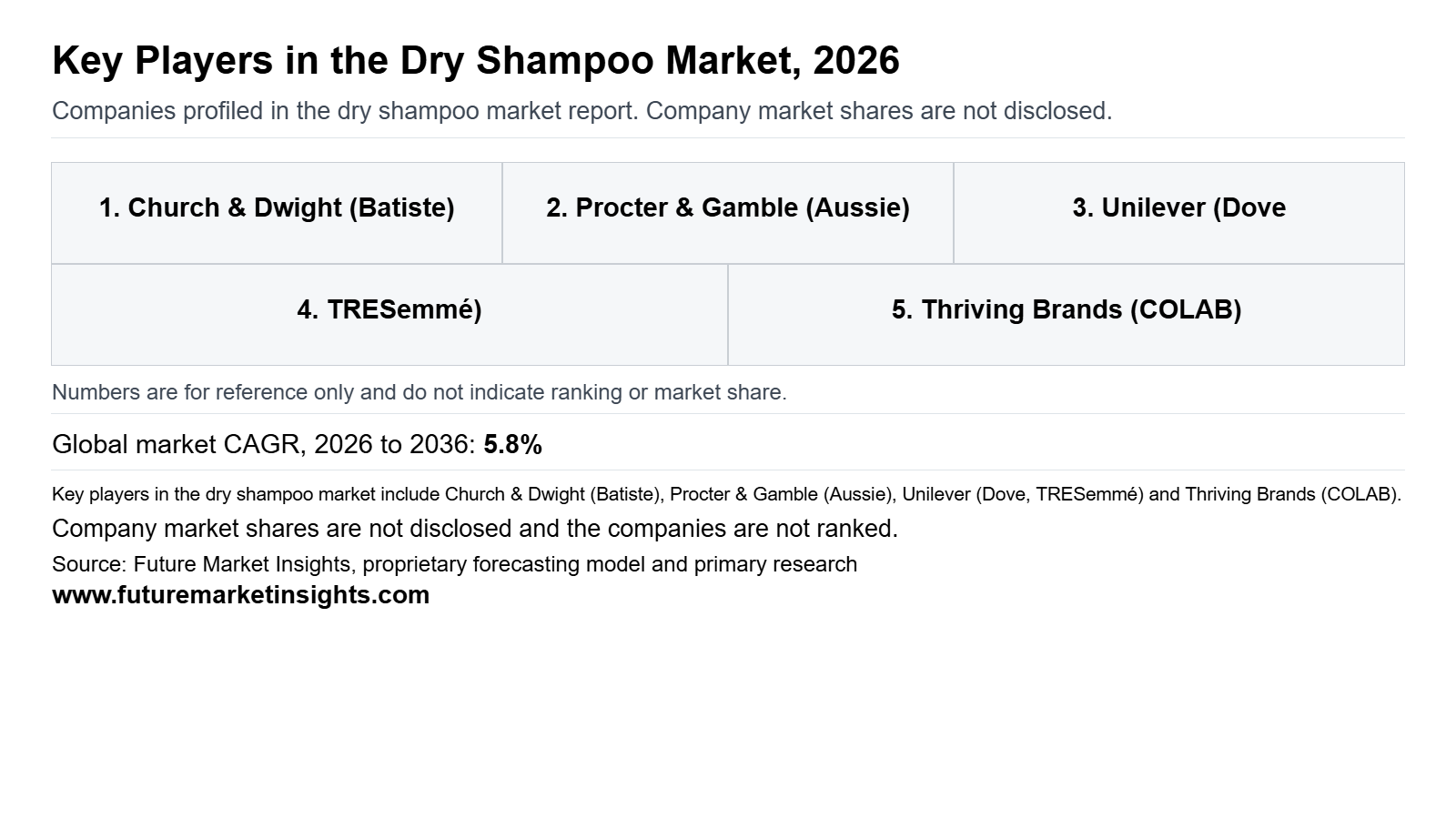
Major dry shampoo suppliers include Church & Dwight (Batiste) and Procter & Gamble (Aussie), along with Unilever (Dove, TRESemmé) and Thriving Brands (COLAB). Japanese makers such as Kao and H2O are adding mist and sheet formats. Challenger brands compete with Batiste on residue-free and talc-free claims, along with scalp-friendly formulas. Buyers in mass retail compare price per can, and specialty retailers compare scent and finish.
How Are Companies Positioned in the Dry Shampoo Market?
Church & Dwight (February 2026) lists Batiste as a power brand with a growing number of dry shampoo products. Procter & Gamble launched a three-item Aussie collection at USD 7.99 each in April 2026. Thriving Brands added COLAB to the company's deodorant brands. H2O and Kao sell mists and sheets in Japanese drugstores, and L'Occitane offers a premium mist in Japan, per WWDJAPAN (July 2026).
What Matters When a Buyer Selects a Dry Shampoo Supplier?
Retail buyers compare velocity and price per can, along with residue and safety documentation. Safety records matter more after the December 2025 FDA draft guidance on mandatory cosmetic recalls. Talc-free formulas matter for European listings ahead of the EU ban expected in 2027. Asian retailers look for cooling and sweat-control claims, along with scalp benefits.
Which Capabilities Distinguish Product Offers?
Product ranges differ by format and powder base, along with fragrance and tint. Aerosol filling capacity and can supply support large mass-market volumes. Mist and sheet formats, along with foams, need separate filling lines, which limits how fast mass brands can add them. Tinted and color-matched sprays target buyers with darker hair.
How Does Geographic Reach Affect Competition?
Batiste has wide international reach, and the 2026 campaign was announced for five countries, starting with the United Kingdom. SLG Brands (February 2026) reported a COLAB listing at Olive Young in South Korea, and BeautyMatter (July 2026) later reported the sale of the brand to Thriving Brands. Japanese brands sell mostly in Japan, and seasonal launches respond to summer heat. FMI expects East Asian brands to export mists and sheets to Southeast Asia over the forecast period.
| Verified Company Evidence (2026) | Commercial Effect | Buyer Action |
|---|---|---|
| 9 February 2026: Batiste launched the Pass the Batiste global brand platform in the United Kingdom and announced a rollout to France, Germany, Canada and Australia during 2026 (MarComm News, February 2026). | Positions dry shampoo as a styling product across major markets. | Plan secondary displays around campaign periods. |
| 16 February 2026: SLG Brands reported over one million COLAB units sold in South Korea and an Olive Young listing (SLG Brands, February 2026). | Shows demand for Western brands in Korean beauty retail. | Test Western brands in Asian beauty chains. |
| 22 April 2026: Happi reported the launch of the Aussie Dry Shampoo Collection by Procter & Gamble at USD 7.99 each, talc-free (Happi, April 2026). | Adds a low-priced talc-free option in US mass retail. | Review price tiers between store brands and premium lines. |
| 25 April 2026: H2O launched ululis dry shampoo mist and spray at JPY 1,408 (USD 8.83) and JPY 1,320 (USD 8.28) (H2O, April 2026). | Expands non-aerosol mists in Japanese drugstores. | Add mist formats to summer ranges in hot markets. |
| 1 July 2026: BeautyMatter reported that Thriving Brands completed the purchase of COLAB Dry Shampoo and Johnny's Chop Shop from SLG Brands (BeautyMatter, July 2026). | Brings COLAB under a US personal care owner with mass distribution. | Monitor range and pricing changes at Walmart, Target and CVS. |
| 30 October 2026: Church & Dwight named Batiste among drivers of 7.8% organic growth in Consumer International in the third quarter (Church & Dwight, October 2026). | Confirms Batiste growth outside the United States. | Expect continued international promotion of Batiste lines. |
Source: Verified corporate disclosures and Future Market Insights analysis, 2026.
| Company | Core Positioning | Verified Activity & Source Attribution |
|---|---|---|
| Church & Dwight | Mass and premium aerosol dry shampoo (Batiste) | Describes Batiste as the world's number one dry shampoo brand (Church & Dwight, February 2026). |
| Procter & Gamble | Mass dry shampoo (Aussie) | Launched a three-item talc-free collection at USD 7.99 each (Happi, April 2026). |
| Thriving Brands | Challenger dry shampoo (COLAB) | Acquired COLAB from SLG Brands (BeautyMatter, July 2026). COLAB passed one million units sold in South Korea under SLG Brands (SLG Brands, February 2026). |
| H2O | Japanese mist and spray dry shampoo (ululis) | Launched mist and spray types on 25 April 2026 (H2O, April 2026). |
| Kao | Dry shampoo sheets (Merit) | Launched Merit dry shampoo sheets for summer 2026 (WWDJAPAN, July 2026). |
Source: Verified corporate disclosures and Future Market Insights analysis, 2026.
Dry Shampoo Market Report Scope and Research Methodology
FMI calculates sales of dry shampoo from the number of units bought in every country and the manufacturer prices received from retailers and salons, along with online sellers. Company results and launch disclosures, along with aerosol industry statistics, are used to validate the totals. US and UK retail receive the most attention, as the two markets make up nearly half of global sales. Every format is restated as 200 ml-equivalent units so different pack sizes can be compared. Sales are assigned to the country of purchase, and the form and function splits, along with channel splits, reconcile to the global value each year. Brand news releases support statements about products and launches only.
| Coverage Field | Report Scope |
|---|---|
| Market definition | Hair products that absorb oil and refresh hair and scalp without water, applied as sprays, mists, powders, foams or sheets. |
| Product forms | Aerosol spray, non-aerosol mist and pump spray, loose powder, and foam, sheets and other formats. |
| Functions | Oil control and refresh, volume and texture, tinted and color-matched, and scalp care and sensitive scalp. |
| Distribution channels | Supermarkets and mass merchandisers, drugstores and pharmacies, specialty beauty retailers, online retail, and salons and professional. |
| Ingredients included | Starches and powders such as rice, corn and tapioca starch, along with propellants, alcohol, fragrance and tints. |
| End users | Women and men for home use, along with salons and professional stylists. |
| Exclusions | Regular wet shampoos, co-washes, dry conditioners, texturizing sprays without cleansing claims, hair perfumes, and no-rinse medical cleansing caps. |
| Quantitative units | USD million and USD billion for value, million 200 ml-equivalent units for volume. |
| Volume basis | Units converted to a 200 ml aerosol equivalent. |
| Value basis | Manufacturer selling value in the country of consumption. |
| Forecast period | 2026 to 2036, with 2025 as the historical base year and 2026 as the estimated year. |
| Regions covered | North America, Europe, East Asia, South Asia and Pacific, Latin America, and Middle East and Africa. |
| National coverage | United States, United Kingdom, Germany, France, Japan, Canada, Australia, South Korea, Brazil, and Italy. |
| Companies covered | Church & Dwight (Batiste), Procter & Gamble (Aussie), Unilever (Dove, TRESemmé), Thriving Brands (COLAB), H2O (ululis), and Kao (Merit). |
Source: Future Market Insights analysis of the dry shampoo market, 2026.
Research Sources and Bibliography
- BeautyMatter. (2026, July 1). Thriving Brands snaps up COLAB Dry Shampoo and Johnny's Chop Shop.
- British Aerosol Manufacturers' Association. (2026, April 14). Press release: BAMA aerosol filling figures 2026.
- Church & Dwight. (2026, February 12). 2025 annual report and Form 10-K.
- Church & Dwight. (2026, October 30). Church & Dwight delivers strong third quarter results.
- Cosmetics Design Europe. (2026, January 29). UK and EU regulations diverge on use of talc in cosmetics.
- Foley & Lardner. (2026, March 12). How MoCRA is reshaping FDA oversight of cosmetics in 2026. https://www.foley.com/insights/publications/2026/03/how-mocra-is-reshaping-fda-oversight-of-cosmetics-in-2026/
- Food and Drug Administration. (2025, December 18). Questions and answers regarding mandatory cosmetics recalls, draft guidance for industry, availability (Docket FDA-2025-D-2246). https://www.govinfo.gov/content/pkg/FR-2025-12-18/html/2025-23249.htm
- H2O. (2026, April 8). ululis MIZU dry shampoo in mist and spray types launches 25 April. https://resemom.jp/release/prtimes/20260408/178179.html
- Happi. (2026, April 22). Aussie launches dry shampoo collection. https://www.happi.com/?p=262780
- MarComm News. (2026, February 10). Batiste shifts dry shampoo from emergency fix to hair refresh and style staple. https://marcommnews.com/?p=88967
- SLG Brands. (2026, February 16). From London with attitude: COLAB crashes the K-beauty party and wins. https://slg-brands.prowly.com/446617-from-london-with-attitude-colab-crashes-the-k-beauty-party-and-wins
- WWDJAPAN. (2026, July 20). Dry shampoo as an etiquette item for the age of extreme heat. https://www.wwdjapan.com/articles/2451639
Table of Content
- Key Takeaways
- Market Size and CAGR
- Top Growth Driver
- Fastest Growing Segment
- Leading Region
- Key Companies
- Emerging Opportunities
- Executive Summary
- Global Market Outlook
- Demand-side Trends
- Supply-side Trends
- Technology Roadmap Analysis
- Analysis and Recommendations
- Analyst Perspective (What is happening? Why now? What should investors know?)
Read More...
- Key Questions Answered
- How large is the market?
- What is the CAGR?
- What are key trends?
- Which region dominates?
- Who are the leaders?
- Market Overview
- Market Coverage / Taxonomy
- Market Definition / Scope / Limitations
- Research Methodology
- Chapter Orientation
- Analytical Lens and Working Hypotheses
- Market Structure, Signals, and Trend Drivers
- Benchmarking and Cross-market Comparability
- Market Sizing, Forecasting, and Opportunity Mapping
- Research Design and Evidence Framework
- Desk Research Program (Secondary Evidence)
- Expert Input and Fieldwork (Primary Evidence)
- Tooling, Models, and Reference Databases
- Data Engineering and Model Build
- Quality Assurance and Audit Trail
- Market Background
- Market Dynamics (Drivers, Restraints, Opportunity, Trends)
- Scenario Forecast (Optimistic, Likely, Conservative)
- Impact Analysis
- AI Impact
- Sustainability Impact
- Regulatory Impact
- Technology Impact
- Consumer / Buyer Analysis
- Purchase Drivers
- Adoption Barriers
- Buyer Journey
- Opportunity Map Analysis
- Product Life Cycle Analysis
- Supply Chain Analysis
- Investment Feasibility Matrix
- Value Chain Analysis
- PESTLE and Porter's Analysis
- Regulatory Landscape
- Regional Parent Market Outlook
- Production and Consumption Statistics
- Import and Export Statistics
- Global Market Analysis and Forecast, 2021 to 2036
- Historical Market Size Value (USD Million) Analysis, 2021 to 2025
- Current and Future Market Size Value (USD Million) Projections, 2026 to 2036
- Y-o-Y Growth Trend Analysis
- Absolute $ Opportunity Analysis
- Global Market Pricing Analysis, 2021 to 2036
- Global Market Analysis and Forecast, By Product Form, 2021 to 2036
- Introduction / Key Findings
- Historical Market Size Value (USD Million) Analysis By Product Form, 2021 to 2025
- Current and Future Market Size Value (USD Million) Analysis and Forecast By Product Form, 2026 to 2036
- Aerosol Spray
- Non-Aerosol Mist and Pump Spray
- Loose Powder
- Foam, Sheets and Other Formats
- Y-o-Y Growth Trend Analysis By Product Form, 2021 to 2025
- Absolute $ Opportunity Analysis By Product Form, 2026 to 2036
- Global Market Analysis and Forecast, By Function, 2021 to 2036
- Introduction / Key Findings
- Historical Market Size Value (USD Million) Analysis By Function, 2021 to 2025
- Current and Future Market Size Value (USD Million) Analysis and Forecast By Function, 2026 to 2036
- Oil Control and Refresh
- Volume and Texture
- Tinted and Color-Matched
- Scalp Care and Sensitive Scalp
- Y-o-Y Growth Trend Analysis By Function, 2021 to 2025
- Absolute $ Opportunity Analysis By Function, 2026 to 2036
- Global Market Analysis and Forecast, By Distribution Channel, 2021 to 2036
- Introduction / Key Findings
- Historical Market Size Value (USD Million) Analysis By Distribution Channel, 2021 to 2025
- Current and Future Market Size Value (USD Million) Analysis and Forecast By Distribution Channel, 2026 to 2036
- Supermarkets and Mass Merchandisers
- Drugstores and Pharmacies
- Specialty Beauty Retailers
- Online Retail
- Salons and Professional
- Y-o-Y Growth Trend Analysis By Distribution Channel, 2021 to 2025
- Absolute $ Opportunity Analysis By Distribution Channel, 2026 to 2036
- Global Market Analysis and Forecast, By Region, 2021 to 2036
- Introduction
- Historical Market Size Value (USD Million) Analysis By Region, 2021 to 2025
- Current Market Size Value (USD Million) Analysis and Forecast By Region, 2026 to 2036
- North America
- Europe
- East Asia
- South Asia and Pacific
- Latin America
- Middle East and Africa
- Market Attractiveness Analysis By Region
- North America Market Analysis and Forecast, By Country, 2021 to 2036
- Historical Market Size Value (USD Million) Trend Analysis By Market Taxonomy, 2021 to 2025
- Market Size Value (USD Million) Forecast By Market Taxonomy, 2026 to 2036
- By Country
- United States
- Canada
- By Product Form
- By Function
- By Distribution Channel
- By Country
- Market Attractiveness Analysis
- By Country
- By Product Form
- By Function
- By Distribution Channel
- Key Takeaways
- Europe Market Analysis and Forecast, By Country, 2021 to 2036
- Historical Market Size Value (USD Million) Trend Analysis By Market Taxonomy, 2021 to 2025
- Market Size Value (USD Million) Forecast By Market Taxonomy, 2026 to 2036
- By Country
- United Kingdom
- Germany
- France
- Italy
- Rest of Europe
- By Product Form
- By Function
- By Distribution Channel
- By Country
- Market Attractiveness Analysis
- By Country
- By Product Form
- By Function
- By Distribution Channel
- Key Takeaways
- East Asia Market Analysis and Forecast, By Country, 2021 to 2036
- Historical Market Size Value (USD Million) Trend Analysis By Market Taxonomy, 2021 to 2025
- Market Size Value (USD Million) Forecast By Market Taxonomy, 2026 to 2036
- By Country
- Japan
- South Korea
- Rest of East Asia
- By Product Form
- By Function
- By Distribution Channel
- By Country
- Market Attractiveness Analysis
- By Country
- By Product Form
- By Function
- By Distribution Channel
- Key Takeaways
- South Asia and Pacific Market Analysis and Forecast, By Country, 2021 to 2036
- Historical Market Size Value (USD Million) Trend Analysis By Market Taxonomy, 2021 to 2025
- Market Size Value (USD Million) Forecast By Market Taxonomy, 2026 to 2036
- By Country
- Australia
- Rest of South Asia and Pacific
- By Product Form
- By Function
- By Distribution Channel
- By Country
- Market Attractiveness Analysis
- By Country
- By Product Form
- By Function
- By Distribution Channel
- Key Takeaways
- Latin America Market Analysis and Forecast, By Country, 2021 to 2036
- Historical Market Size Value (USD Million) Trend Analysis By Market Taxonomy, 2021 to 2025
- Market Size Value (USD Million) Forecast By Market Taxonomy, 2026 to 2036
- By Country
- Brazil
- Rest of Latin America
- By Product Form
- By Function
- By Distribution Channel
- By Country
- Market Attractiveness Analysis
- By Country
- By Product Form
- By Function
- By Distribution Channel
- Key Takeaways
- Key Countries Market Analysis
- United States
- Pricing Analysis
- Market Share Analysis, 2025
- By Product Form
- By Function
- By Distribution Channel
- United Kingdom
- Pricing Analysis
- Market Share Analysis, 2025
- By Product Form
- By Function
- By Distribution Channel
- Germany
- Pricing Analysis
- Market Share Analysis, 2025
- By Product Form
- By Function
- By Distribution Channel
- France
- Pricing Analysis
- Market Share Analysis, 2025
- By Product Form
- By Function
- By Distribution Channel
- Japan
- Pricing Analysis
- Market Share Analysis, 2025
- By Product Form
- By Function
- By Distribution Channel
- Canada
- Pricing Analysis
- Market Share Analysis, 2025
- By Product Form
- By Function
- By Distribution Channel
- Australia
- Pricing Analysis
- Market Share Analysis, 2025
- By Product Form
- By Function
- By Distribution Channel
- South Korea
- Pricing Analysis
- Market Share Analysis, 2025
- By Product Form
- By Function
- By Distribution Channel
- Brazil
- Pricing Analysis
- Market Share Analysis, 2025
- By Product Form
- By Function
- By Distribution Channel
- Italy
- Pricing Analysis
- Market Share Analysis, 2025
- By Product Form
- By Function
- By Distribution Channel
- United States
- Market Structure Analysis
- Competition Dashboard
- Competition Benchmarking
- Market Share Analysis of Top Players
- By Regional
- By Product Form
- By Function
- By Distribution Channel
- Emerging Startups
- Innovation Benchmarking
- Competition Analysis
- Competition Deep Dive
- Church & Dwight (Batiste)
- Overview
- Product Portfolio
- Profitability by Market Segments
- Sales Footprint
- Strategy Overview
- Marketing Strategy
- Product Strategy
- Channel Strategy
- Procter & Gamble (Aussie)
- Unilever (Dove, TRESemmé)
- Thriving Brands (COLAB)
- H2O (ululis)
- Kao (Merit)
- Church & Dwight (Batiste)
- Competition Deep Dive
- Case Studies
- Success Stories
- Recent Developments
- Assumptions & Acronyms Used
List of Tables
- Table 1: Global Market Value (USD Million) Forecast by Region, 2021 to 2036
- Table 2: Global Market Value (USD Million) Forecast by Product Form, 2021 to 2036
- Table 3: Global Market Value (USD Million) Forecast by Function, 2021 to 2036
- Table 4: Global Market Value (USD Million) Forecast by Distribution Channel, 2021 to 2036
- Table 5: Global Market Volume (Million Units) Forecast by Region, 2021 to 2036
- Table 6: North America Market Value (USD Million) Forecast by Country, 2021 to 2036
- Table 7: North America Market Value (USD Million) Forecast by Product Form, 2021 to 2036
- Table 8: North America Market Value (USD Million) Forecast by Function, 2021 to 2036
- Table 9: North America Market Value (USD Million) Forecast by Distribution Channel, 2021 to 2036
- Table 10: Europe Market Value (USD Million) Forecast by Country, 2021 to 2036
- Table 11: Europe Market Value (USD Million) Forecast by Product Form, 2021 to 2036
- Table 12: Europe Market Value (USD Million) Forecast by Function, 2021 to 2036
- Table 13: Europe Market Value (USD Million) Forecast by Distribution Channel, 2021 to 2036
- Table 14: East Asia Market Value (USD Million) Forecast by Country, 2021 to 2036
- Table 15: East Asia Market Value (USD Million) Forecast by Product Form, 2021 to 2036
- Table 16: East Asia Market Value (USD Million) Forecast by Function, 2021 to 2036
- Table 17: East Asia Market Value (USD Million) Forecast by Distribution Channel, 2021 to 2036
- Table 18: South Asia and Pacific Market Value (USD Million) Forecast by Country, 2021 to 2036
- Table 19: South Asia and Pacific Market Value (USD Million) Forecast by Product Form, 2021 to 2036
- Table 20: South Asia and Pacific Market Value (USD Million) Forecast by Function, 2021 to 2036
- Table 21: South Asia and Pacific Market Value (USD Million) Forecast by Distribution Channel, 2021 to 2036
- Table 22: Latin America Market Value (USD Million) Forecast by Country, 2021 to 2036
- Table 23: Latin America Market Value (USD Million) Forecast by Product Form, 2021 to 2036
- Table 24: Latin America Market Value (USD Million) Forecast by Function, 2021 to 2036
- Table 25: Latin America Market Value (USD Million) Forecast by Distribution Channel, 2021 to 2036
List of Figures
- Figure 1: Global Market Pricing Analysis
- Figure 2: Global Market Value (USD Million) Forecast 2021-2036
- Figure 3: Global Market Value Share and BPS Analysis by Product Form, 2026 and 2036
- Figure 4: Global Market Y-o-Y Growth Comparison by Product Form, 2026-2036
- Figure 5: Global Market Attractiveness Analysis by Product Form
- Figure 6: Global Market Value Share and BPS Analysis by Function, 2026 and 2036
- Figure 7: Global Market Y-o-Y Growth Comparison by Function, 2026-2036
- Figure 8: Global Market Attractiveness Analysis by Function
- Figure 9: Global Market Value Share and BPS Analysis by Distribution Channel, 2026 and 2036
- Figure 10: Global Market Y-o-Y Growth Comparison by Distribution Channel, 2026-2036
- Figure 11: Global Market Attractiveness Analysis by Distribution Channel
- Figure 12: Global Market Value (USD Million) Share and BPS Analysis by Region, 2026 and 2036
- Figure 13: Global Market Y-o-Y Growth Comparison by Region, 2026-2036
- Figure 14: Global Market Attractiveness Analysis by Region
- Figure 15: North America Market Incremental Dollar Opportunity, 2026-2036
- Figure 16: Europe Market Incremental Dollar Opportunity, 2026-2036
- Figure 17: East Asia Market Incremental Dollar Opportunity, 2026-2036
- Figure 18: South Asia and Pacific Market Incremental Dollar Opportunity, 2026-2036
- Figure 19: Latin America Market Incremental Dollar Opportunity, 2026-2036
- Figure 20: North America Market Value Share and BPS Analysis by Country, 2026 and 2036
- Figure 21: North America Market Value Share and BPS Analysis by Product Form, 2026 and 2036
- Figure 22: North America Market Y-o-Y Growth Comparison by Product Form, 2026-2036
- Figure 23: North America Market Attractiveness Analysis by Product Form
- Figure 24: North America Market Value Share and BPS Analysis by Function, 2026 and 2036
- Figure 25: North America Market Y-o-Y Growth Comparison by Function, 2026-2036
- Figure 26: North America Market Attractiveness Analysis by Function
- Figure 27: North America Market Value Share and BPS Analysis by Distribution Channel, 2026 and 2036
- Figure 28: North America Market Y-o-Y Growth Comparison by Distribution Channel, 2026-2036
- Figure 29: North America Market Attractiveness Analysis by Distribution Channel
- Figure 30: Europe Market Value Share and BPS Analysis by Country, 2026 and 2036
- Figure 31: Europe Market Value Share and BPS Analysis by Product Form, 2026 and 2036
- Figure 32: Europe Market Y-o-Y Growth Comparison by Product Form, 2026-2036
- Figure 33: Europe Market Attractiveness Analysis by Product Form
- Figure 34: Europe Market Value Share and BPS Analysis by Function, 2026 and 2036
- Figure 35: Europe Market Y-o-Y Growth Comparison by Function, 2026-2036
- Figure 36: Europe Market Attractiveness Analysis by Function
- Figure 37: Europe Market Value Share and BPS Analysis by Distribution Channel, 2026 and 2036
- Figure 38: Europe Market Y-o-Y Growth Comparison by Distribution Channel, 2026-2036
- Figure 39: Europe Market Attractiveness Analysis by Distribution Channel
- Figure 40: East Asia Market Value Share and BPS Analysis by Country, 2026 and 2036
- Figure 41: East Asia Market Value Share and BPS Analysis by Product Form, 2026 and 2036
- Figure 42: East Asia Market Y-o-Y Growth Comparison by Product Form, 2026-2036
- Figure 43: East Asia Market Attractiveness Analysis by Product Form
- Figure 44: East Asia Market Value Share and BPS Analysis by Function, 2026 and 2036
- Figure 45: East Asia Market Y-o-Y Growth Comparison by Function, 2026-2036
- Figure 46: East Asia Market Attractiveness Analysis by Function
- Figure 47: East Asia Market Value Share and BPS Analysis by Distribution Channel, 2026 and 2036
- Figure 48: East Asia Market Y-o-Y Growth Comparison by Distribution Channel, 2026-2036
- Figure 49: East Asia Market Attractiveness Analysis by Distribution Channel
- Figure 50: South Asia and Pacific Market Value Share and BPS Analysis by Country, 2026 and 2036
- Figure 51: South Asia and Pacific Market Value Share and BPS Analysis by Product Form, 2026 and 2036
- Figure 52: South Asia and Pacific Market Y-o-Y Growth Comparison by Product Form, 2026-2036
- Figure 53: South Asia and Pacific Market Attractiveness Analysis by Product Form
- Figure 54: South Asia and Pacific Market Value Share and BPS Analysis by Function, 2026 and 2036
- Figure 55: South Asia and Pacific Market Y-o-Y Growth Comparison by Function, 2026-2036
- Figure 56: South Asia and Pacific Market Attractiveness Analysis by Function
- Figure 57: South Asia and Pacific Market Value Share and BPS Analysis by Distribution Channel, 2026 and 2036
- Figure 58: South Asia and Pacific Market Y-o-Y Growth Comparison by Distribution Channel, 2026-2036
- Figure 59: South Asia and Pacific Market Attractiveness Analysis by Distribution Channel
- Figure 60: Latin America Market Value Share and BPS Analysis by Country, 2026 and 2036
- Figure 61: Latin America Market Value Share and BPS Analysis by Product Form, 2026 and 2036
- Figure 62: Latin America Market Y-o-Y Growth Comparison by Product Form, 2026-2036
- Figure 63: Latin America Market Attractiveness Analysis by Product Form
- Figure 64: Latin America Market Value Share and BPS Analysis by Function, 2026 and 2036
- Figure 65: Latin America Market Y-o-Y Growth Comparison by Function, 2026-2036
- Figure 66: Latin America Market Attractiveness Analysis by Function
- Figure 67: Latin America Market Value Share and BPS Analysis by Distribution Channel, 2026 and 2036
- Figure 68: Latin America Market Y-o-Y Growth Comparison by Distribution Channel, 2026-2036
- Figure 69: Latin America Market Attractiveness Analysis by Distribution Channel
- Figure 70: Global Market - Tier Structure Analysis
- Figure 71: Global Market - Company Share Analysis
Frequently Asked Questions
How big is the dry shampoo market in 2026?
Future Market Insights estimates the global dry shampoo market at USD 3.09 billion in 2026, up from USD 2.93 billion in 2025.
How fast is the dry shampoo market expected to grow through 2036?
FMI projects a 5.8% CAGR from 2026 to 2036 for the dry shampoo market, taking global sales to USD 5.44 billion by 2036 and adding USD 2.35 billion over the period.
Which product form leads the dry shampoo market?
Aerosol sprays hold the largest share of the dry shampoo market by product form, 74.0% of 2026 sales, and non-aerosol mist and pump sprays are projected to expand fastest, at an 11.6% CAGR through 2036.
Which function leads the dry shampoo market?
Oil control and refresh formulas hold 56.0% of 2026 sales of dry shampoo, growing at a 4.0% CAGR, as scalp care and sensitive scalp formulas grow fastest at 10.7% per year.
Which distribution channel leads the dry shampoo market?
Supermarkets and mass merchandisers hold 36.0% of 2026 sales of dry shampoo, and online retail is on course to grow fastest at 8.9% per year from 2026 to 2036.
Which country is the largest dry shampoo market?
The United States is the largest dry shampoo market, with 38.2% of global sales in 2026 (USD 1.18 billion), followed by the United Kingdom at 10.7% (USD 330.0 million) and Germany at 6.1% (USD 190.0 million).
Which countries are expected to grow fastest in the dry shampoo market?
South Korea is expected to expand at the quickest pace in the dry shampoo market, an 8.2% CAGR from 2026 to 2036, followed by Japan at 7.4% and Brazil at 7.0%.
What drives demand for dry shampoo?
Shoppers buy dry shampoo mainly for quick styling and volume between washes, along with hot-weather refresh in East Asia. Batiste's 2026 campaign and Japanese summer launches are bringing new users into the category.
Preview the report firsthand - request a free sample
Get SampleGet the brochure for pricing and purchase details.
Get PDF
