

- Industry Size (2025)
- USD 1.5 Bn
- Forecast (2035)
- USD 2.6 Bn
- CAGR (2025 to 2035)
- 5.8%
Dual-Channel Tactical Communication Headset Market Forecast and Outlook 2025 to 2035
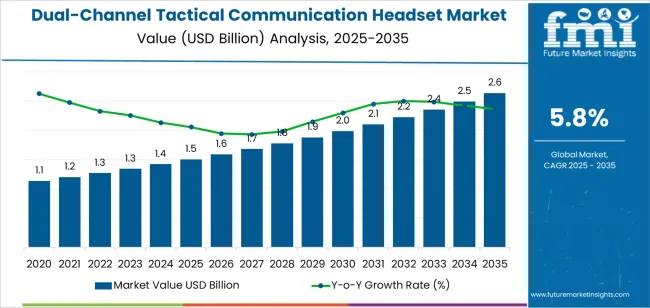
The dual-channel tactical communication headset market is valued at USD 1.5 billion in 2025 and is expected to reach USD 2.6 billion by 2035, growing at a CAGR of 5.8%. Expansion in the dual-channel tactical communication is driven by increasing defense modernization programs, the need for reliable multi-channel communication systems in mission-critical operations, and rising adoption of advanced hearing protection technologies across military and law enforcement sectors. These headsets enable personnel to communicate simultaneously across independent radio networks, enhancing coordination, situational awareness, and operational safety.
IP67-rated models dominate the market due to their high durability, environmental sealing, and performance reliability in harsh field conditions. These systems combine noise reduction, directional sound amplification, and integrated push-to-talk functionality, allowing users to maintain clear communication in high-noise environments. Developments in lightweight construction, ergonomic design, and wireless compatibility continue to improve user comfort and communication efficiency during extended missions.
Quick Stats for Dual-Channel Tactical Communication Headset Market
- Dual-Channel Tactical Communication Headset Market Value (2025): USD 1.5 billion
- Dual-Channel Tactical Communication Headset Market Forecast Value (2035): USD 2.6 billion
- Dual-Channel Tactical Communication Headset Market Forecast CAGR: 5.8%
- Leading Type in Dual-Channel Tactical Communication Headset Market: IP67
- Key Growth Regions in Dual-Channel Tactical Communication Headset Market: Asia Pacific, Europe, and North America
- Top Players in Dual-Channel Tactical Communication Headset Market: 3M, Opsmen, Setcom, Howard Leight, Recon Brothers, Sordin, Safariland, OTTO, Gentex, TEA
Asia Pacific leads market growth, supported by rising defense investments in China, India, and South Korea. Europe and North America maintain strong demand through established defense procurement frameworks and continuous upgrades in tactical communication infrastructure. Major players include 3M, Opsmen, Setcom, Howard Leight, and Recon Brothers, focusing on rugged product design, acoustic performance, and interoperability with digital radio systems.
What is the Growth Forecast for the Dual-Channel Tactical Communication Headset Market through 2035?
Growth during the early phase, from 2025 to 2029, will be driven by modernization programs in military and law enforcement communications systems. The adoption of dual-channel technology will expand as defense organizations prioritize simultaneous secure communication across multiple frequencies and networks. Rising field operations, tactical training, and interoperability requirements will maintain demand within this period.
From 2030 to 2035, the market will progress toward steady expansion as adoption reaches maturity in developed regions. Demand will increasingly come from emerging economies upgrading tactical communication infrastructure and integrating noise-cancelling and situational awareness technologies. Product innovation focusing on miniaturization, wireless connectivity, and extended operational life will strengthen competitive positioning. The trajectory reflects balanced long-term growth supported by continuous defense investments, improved communication efficiency, and broader application in paramilitary and industrial safety operations, establishing dual-channel headsets as a core component of advanced tactical communication systems.
Dual-Channel Tactical Communication Headset Market Key Takeaways
| Metric | Value |
|---|---|
| Market Value (2025) | USD 1.5 billion |
| Market Forecast Value (2035) | USD 2.6 billion |
| Forecast CAGR (2025-2035) | 5.8% |
Why is the Dual-Channel Tactical Communication Headset Market Growing?
The dual-channel tactical communication headset market is growing as modern defense, law enforcement, and emergency response operations require secure and simultaneous communication across multiple radio networks. Dual-channel headsets enable personnel to monitor and transmit on two independent communication channels, improving coordination and situational awareness in complex field environments. Rising defense modernization programs, increased spending on tactical communication systems, and greater focus on interoperability across forces are driving adoption.
Technological advances in digital signal processing, noise suppression, and radio interface design have enhanced audio clarity and reliability under extreme operational conditions. Lightweight, rugged construction and improved comfort make dual-channel headsets suitable for prolonged use during missions. Expanding use in private security, disaster response, and industrial safety applications further broadens the market. Despite these advantages, the market faces challenges from high product costs, integration complexity with legacy systems, and stringent certification requirements for defense-grade communication equipment.
Which Classification and Application Segments Lead the Dual-Channel Tactical Communication Headset Market?
The dual-channel tactical communication headset market is segmented by classification and application. By classification, the market is divided into IP67, IP68, IPX5, and IPX7 protection levels. Based on application, it is categorized into military and civil use. Regionally, the market is divided into Asia Pacific, Europe, North America, and other key regions.
By Classification, the IP67 Segment Accounts for the Largest Market Share
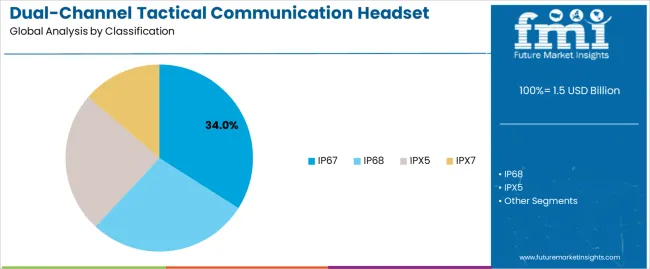
The IP67 segment holds the leading position in the dual-channel tactical communication headset market, representing an estimated 34.0% of total market share in 2025. IP67-rated headsets provide complete dust protection and can withstand temporary immersion in water, making them suitable for demanding field conditions encountered in tactical operations. These headsets are specifically designed for environments where durability, reliability, and uninterrupted communication are essential, such as in defense, law enforcement, and emergency response sectors.
The segment’s leadership is supported by its balance of ruggedness, cost efficiency, and operational versatility across diverse mission environments. IP67 headsets typically feature dual-channel connectivity, enabling simultaneous communication across multiple networks or channels. The IP68 category follows, representing approximately 29.0% of the market, favored in special operations and marine applications requiring extended water resistance. The IPX5 and IPX7 segments collectively account for the remaining 37.0%, serving civil security, aviation, and industrial users operating under moderate environmental exposure.
Key factors supporting the IP67 segment include:
- Proven performance in harsh environmental and combat conditions.
- Compatibility with dual-channel radios and tactical communication systems.
- Balance of durability and affordability for large-scale defense deployment.
- Broad use in field operations requiring waterproof and dustproof headsets.
By Application, the Military Segment Represents the Dominant Market Category
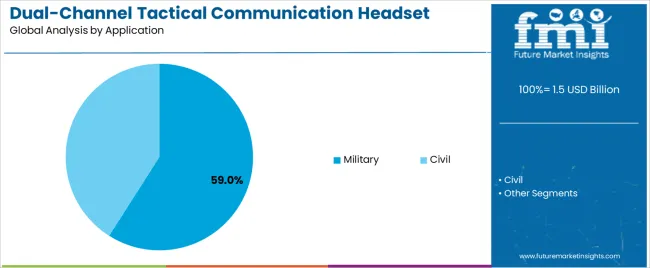
The military segment accounts for approximately 59.0% of the dual-channel tactical communication headset market in 2025. This dominance is driven by continuous defense modernization programs focusing improved communication interoperability, hearing protection, and situational awareness. Military-grade dual-channel headsets enable secure, simultaneous communication between command networks and field teams, ensuring coordinated operations in high-noise and high-stress environments.
The civil segment, representing the remaining 41.0%, includes law enforcement, firefighting, aviation, and industrial security users requiring reliable two-way communication under variable conditions. The civil segment is expanding gradually due to increased adoption of ruggedized communication devices in public safety and disaster response operations.
Primary dynamics driving demand from the military segment include:
- Expansion of defense communication systems integrating dual-channel technologies.
- Rising adoption of active noise reduction and situational awareness features.
- Global investment in soldier modernization and tactical equipment upgrades.
- Demand for interoperable communication systems across joint military operations.
What are the Drivers, Restraints, and Key Trends of the Dual-Channel Tactical Communication Headset Market?
Demand for enhanced situational awareness, secure multi-channel communication, and military modernisation fuel adoption.
Dual-channel tactical communication headsets enable users to monitor or transmit over two separate communication channels simultaneously, which supports complex mission coordination, threat response and redundant backup connectivity. Growth in defence spending and special-operations capabilities globally increases procurement of advanced headsets for armed forces, security agencies and law-enforcement units. Need for interoperability across radio systems, encrypted comms and integration with advanced combat gear drives development of rugged, feature-rich dual-channel headsets. Advances in ergonomic design, noise suppression, hearing protection and modular accessory compatibility also improve usability in harsh environments.
High unit cost, integration complexity and lifecycle-support demands restrict deployment.
Advanced dual-channel headsets command premium pricing due to specialised electronics, noise-cancelling and encryption. Organisations require extensive compatibility testing with legacy and new radio/communication systems, raising procurement complexity. Maintenance, calibration and training for secure-use protocols increase total cost of ownership. Budget constraints and procurement cycles in some regions slow widespread adoption.
Wireless and modular configurations, smart-system integration and expansion in emerging security markets shape growth.
Manufacturers are shifting toward wireless or hybrid (wired + wireless) tactical headsets with modular audio/comm modules to adapt across mission profiles. Smart features such as adaptive noise filtering, voice-activation, remote diagnostics and digital overlays are gaining traction. Emerging economies with rising security infrastructure spending are offering new demand zones. Suppliers are also collaborating with defence integrators to deliver systems that combine headset, helmet and wearable tech integration, supporting interoperability in modern combat and tactical environments.
Analysis of the Dual-Channel Tactical Communication Headset Market by Key Country
The global dual-channel tactical communication headset market is expanding consistently through 2035, driven by defense modernization, real-time communication demands, and the integration of multi-frequency transmission systems. China leads with a 7.8% CAGR, followed by India at 7.3%, reflecting defense sector expansion and domestic equipment manufacturing. Germany grows at 6.7%, supported by advancements in acoustic signal processing and system interoperability. Brazil records 6.1%, driven by law enforcement modernization and defense procurement. The United States posts 5.5%, supported by next-generation battlefield communication systems, while the United Kingdom (4.9%) and Japan (4.4%) maintain moderate growth through miniaturization and precision acoustic technology.
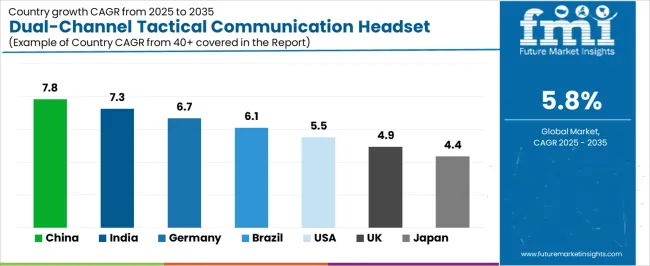
| Country | CAGR (%) |
|---|---|
| China | 7.8 |
| India | 7.3 |
| Germany | 6.7 |
| Brazil | 6.1 |
| USA | 5.5 |
| UK | 4.9 |
| Japan | 4.4 |
How is China leading the Dual-Channel Tactical Communication Headset Market?
China’s market grows at 7.8% CAGR, supported by large-scale military modernization, communication network expansion, and domestic manufacturing capacity. Local defense electronics firms are developing dual-channel headsets compatible with encrypted radio and wireless networks. The People’s Liberation Army (PLA) Modernization Plan emphasizes enhanced situational awareness and inter-unit communication, driving headset adoption. R&D efforts focus on integrating noise cancellation, adaptive voice modulation, and secure transmission. Civil defense, emergency response, and paramilitary organizations are also expanding usage, broadening the national demand base for multi-frequency tactical communication systems.
Key Market Factors:
- Expansion of indigenous defense electronics manufacturing capacity
- Integration of encrypted communication and adaptive noise reduction systems
- Government-backed modernization programs improving tactical communication efficiency
- Growing use across civil defense, law enforcement, and paramilitary units
How is India advancing the Dual-Channel Tactical Communication Headset Market?
India’s market grows at 7.3% CAGR, driven by defense procurement initiatives, communication interoperability projects, and technology localization. The Make in India defense program supports production of dual-channel headsets compatible with field radio, satellite, and digital command systems. Collaborations with international defense suppliers enhance product quality and noise suppression performance. Indian armed forces, border security, and emergency agencies are implementing multi-channel tactical headsets for real-time coordination. Increasing focus on electronic warfare capability and soldier safety supports continuous R&D in adaptive signal control and environmental hearing protection.
Market Development Factors:
- Growth in indigenous defense equipment production under Make in India initiatives
- Collaboration with international firms for advanced signal processing integration
- Rising adoption of dual-channel headsets in armed and security forces
- Focus on multi-environment performance and communication reliability
How is Germany advancing the Dual-Channel Tactical Communication Headset Market?
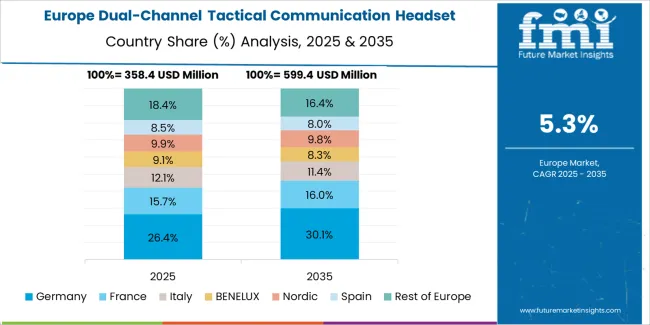
Germany’s market grows at 6.7% CAGR, supported by strong defense technology innovation, precision manufacturing, and interoperability advancements. German defense suppliers are developing lightweight dual-channel headsets with adaptive signal control and audio localization features. The Bundeswehr’s soldier modernization initiatives emphasize modular communication systems compatible with NATO standards. Integration of bone-conduction microphones and AI-based voice filtering enhances communication clarity under battlefield conditions. R&D collaborations between defense research institutes and industrial partners are improving product miniaturization and battery performance, ensuring operational endurance and safety compliance.
Key Market Characteristics:
- Integration of AI-driven voice clarity and adaptive communication filters
- Compatibility with NATO-standard soldier communication systems
- Innovation in lightweight and modular headset architectures
- Collaboration between defense research institutions and technology manufacturers
How is Brazil developing the Dual-Channel Tactical Communication Headset Market?
Brazil’s market grows at 6.1% CAGR, driven by modernization of national defense, law enforcement, and civil security operations. Domestic and regional suppliers are assembling cost-effective dual-channel headsets optimized for tropical field conditions. Government-backed military upgrade programs are expanding deployment of multi-frequency communication devices for border and urban operations. Collaboration with international defense manufacturers supports localized technology transfer and training. Rising demand from police tactical units and peacekeeping missions contributes to steady market growth. The adoption of durable, weather-resistant communication systems is central to operational readiness.
Market Development Factors:
- Government-led modernization in defense and security communication systems
- Local assembly of ruggedized headsets for multi-environment operations
- Technology transfer partnerships with global defense manufacturers
- Increased demand from police, military, and peacekeeping forces
How is the United States progressing in the Dual-Channel Tactical Communication Headset Market?
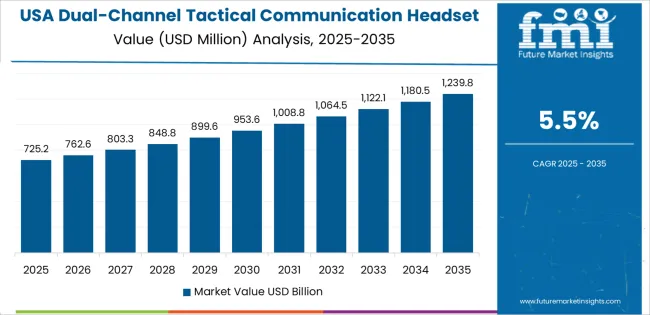
The United States grows at 5.5% CAGR, driven by innovation in battlefield communication and defense-grade acoustic technology. The Department of Defense (DoD) is deploying advanced dual-channel headsets integrated with next-generation soldier systems, including the Integrated Visual Augmentation System (IVAS). Major defense contractors are producing modular communication units featuring AI-enhanced voice recognition, low-latency signal transmission, and compatibility with multiple frequency bands. Expanding defense budgets and modernization of tactical command systems maintain long-term growth. Civil applications in law enforcement and homeland security also contribute to consistent demand.
Key Market Factors:
- Integration with the USA Army’s Integrated Visual Augmentation System (IVAS)
- Advancements in AI-enhanced voice processing and dual-channel communication
- Strong federal investment in next-generation soldier technologies
- Increasing adoption across homeland security and law enforcement sectors
How is the United Kingdom developing the Dual-Channel Tactical Communication Headset Market?
The United Kingdom’s market grows at 4.9% CAGR, supported by defense modernization, secure communication networks, and integration of acoustic protection technologies. British manufacturers are focusing on dual-channel headsets offering simultaneous radio and intercom connectivity. The Future Soldier Programme and Defence Equipment Plan encourage deployment of lightweight and ruggedized communication headsets across armed and special forces. Collaboration with European defense suppliers enhances interoperability and system standardization. Continuous development in noise attenuation and digital encryption technologies supports operational safety and mission adaptability.
Market Development Factors:
- Deployment under Future Soldier Programme and Defence Equipment Plan
- Integration of encryption-based communication and dual-channel intercom systems
- Collaboration with European defense technology suppliers
- Focus on comfort, ruggedization, and extended operational lifespan
How is Japan sustaining its Dual-Channel Tactical Communication Headset Market?
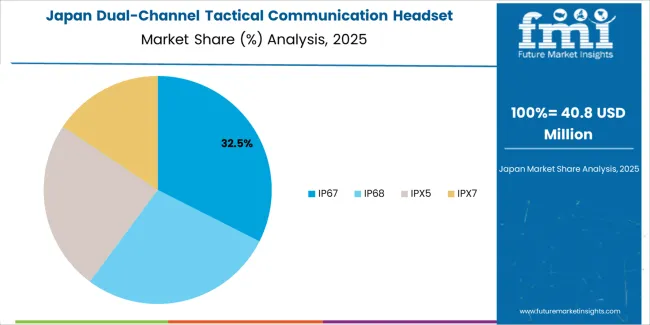
Japan’s market grows at 4.4% CAGR, reflecting advancements in defense electronics, communication precision, and acoustic innovation. Domestic firms are producing high-performance headsets integrating compact microphones, noise filters, and secure communication chips. The National Security Strategy supports modernization of tactical communication infrastructure for the Self-Defense Forces. R&D under the Green Innovation Fund promotes development of low-power and lightweight designs enhancing operational endurance. Collaboration with international defense suppliers ensures technology compatibility for joint operations. The market benefits from Japan’s precision engineering and reliability-focused manufacturing ecosystem.
Key Market Characteristics:
- R&D in compact, energy-efficient tactical headset systems
- Integration of secure communication and active noise reduction components
- Defense modernization under National Security Strategy initiatives
- Collaboration with international suppliers for interoperability and system upgrades
What is the competitive landscape of the Dual-Channel Tactical Communication Headset Market?
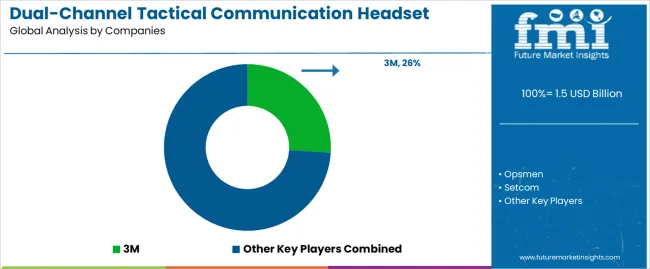
The dual-channel tactical communication headset market is moderately consolidated, comprising about ten specialized manufacturers serving defense, law enforcement, and emergency response sectors. 3M leads the market with an estimated 26.0% global share, supported by its advanced PELTOR series designed for simultaneous dual-radio connectivity, high noise attenuation, and reliable speech intelligibility in combat and industrial environments. Its leadership is reinforced by global distribution, compliance with defense communication standards, and long-term contracts with military organizations.
Opsmen, Howard Leight, and Sordin follow as mid-tier competitors, focusing on ergonomically engineered dual-channel systems with active sound localization and adaptive ambient listening features. Their competitive edge lies in user comfort, modular component design, and seamless integration with tactical radios and intercom systems. Safariland and OTTO maintain strong positions through partnerships with defense procurement agencies and specialization in interoperable communication accessories for field operations.
Gentex and TEA cater to high-performance applications, producing mission-grade headsets with enhanced digital signal processing and superior radio channel separation for aviation and ground units. Setcom and Recon Brothers serve niche tactical and training markets through rugged, compact models suited to civilian and paramilitary users. Competition is primarily defined by audio clarity, dual-channel synchronization, and system interoperability. Ongoing market growth is driven by defense modernization initiatives and the rising need for advanced communication headsets that balance situational awareness, protection, and multi-network connectivity in dynamic field environments.
Key Players in the Dual-Channel Tactical Communication Headset Market
- 3M
- Opsmen
- Setcom
- Howard Leight
- Recon Brothers
- Sordin
- Safariland
- OTTO
- Gentex
- TEA
Scope of the Report
| Items | Values |
|---|---|
| Quantitative Units | USD billion |
| Classification | IP67, IP68, IPX5, IPX7 |
| Application | Military, Civil |
| Regions Covered | Asia Pacific, Europe, North America, Latin America, Middle East & Africa |
| Countries Covered | India, China, USA, Germany, South Korea, Japan, Italy, and 40+ countries |
| Key Companies Profiled | 3M, Opsmen, Setcom, Howard Leight, Recon Brothers, Sordin, Safariland, OTTO, Gentex, TEA |
| Additional Attributes | Dollar sales by classification and application categories; regional adoption trends across Asia Pacific, Europe, and North America; competitive landscape of tactical headset and communication equipment manufacturers; advancements in dual-channel audio systems and IP-rated protection technologies; integration with military, law enforcement, and field operation communication systems. |
Dual-Channel Tactical Communication Headset Market by Segment
Classification:
- IP67
- IP68
- IPX5
- IPX7
Application:
- Military
- Civil
Region:
- Asia Pacific
- China
- Japan
- South Korea
- India
- Australia & New Zealand
- ASEAN
- Rest of Asia Pacific
- Europe
- Germany
- United Kingdom
- France
- Italy
- Spain
- Nordic
- BENELUX
- Rest of Europe
- North America
- United States
- Canada
- Mexico
- Latin America
- Brazil
- Chile
- Rest of Latin America
- Middle East & Africa
- Kingdom of Saudi Arabia
- Other GCC Countries
- Turkey
- South Africa
- Other African Union
- Rest of Middle East & Africa
Frequently Asked Questions
How big is the dual-channel tactical communication headset market in 2025?
The global dual-channel tactical communication headset market is estimated to be valued at USD 1.5 billion in 2025.
What will be the size of dual-channel tactical communication headset market in 2035?
The market size for the dual-channel tactical communication headset market is projected to reach USD 2.6 billion by 2035.
How much will be the dual-channel tactical communication headset market growth between 2025 and 2035?
The dual-channel tactical communication headset market is expected to grow at a 5.8% CAGR between 2025 and 2035.
What are the key product types in the dual-channel tactical communication headset market?
The key product types in dual-channel tactical communication headset market are ip67, ip68, ipx5 and ipx7.
Which application segment to contribute significant share in the dual-channel tactical communication headset market in 2025?
In terms of application, military segment to command 59.0% share in the dual-channel tactical communication headset market in 2025.
Preview the report firsthand - request a free sample
Get SampleGet the brochure for pricing and purchase details.
Get PDFTable of Content
- Executive Summary
- Global Market Outlook
- Demand-side Trends
- Supply-side Trends
- Technology Roadmap Analysis
- Analysis and Recommendations
- Market Overview
- Market Coverage / Taxonomy
- Market Definition / Scope / Limitations
- Market Background
- Market Dynamics
- Drivers
- Restraints
- Opportunity
- Trends
- Scenario Forecast
- Demand in Optimistic Scenario
- Demand in Likely Scenario
- Demand in Conservative Scenario
- Opportunity Map Analysis
- Product Life Cycle Analysis
- Supply Chain Analysis
- Investment Feasibility Matrix
- Value Chain Analysis
- PESTLE and Porter’s Analysis
- Regulatory Landscape
- Regional Parent Market Outlook
- Production and Consumption Statistics
- Import and Export Statistics
- Market Dynamics
- Global Market Analysis 2020 to 2024 and Forecast, 2025 to 2035
- Historical Market Size Value (USD Million) Analysis, 2020 to 2024
- Current and Future Market Size Value (USD Million) Projections, 2025 to 2035
- Y-o-Y Growth Trend Analysis
- Absolute $ Opportunity Analysis
- Global Market Pricing Analysis 2020 to 2024 and Forecast 2025 to 2035
- Global Market Analysis 2020 to 2024 and Forecast 2025 to 2035, By Classification
- Introduction / Key Findings
- Historical Market Size Value (USD Million) Analysis By Classification , 2020 to 2024
- Current and Future Market Size Value (USD Million) Analysis and Forecast By Classification , 2025 to 2035
- IP67
- IP68
- IPX5
- IPX7
- Y-o-Y Growth Trend Analysis By Classification , 2020 to 2024
- Absolute $ Opportunity Analysis By Classification , 2025 to 2035
- Global Market Analysis 2020 to 2024 and Forecast 2025 to 2035, By Application
- Introduction / Key Findings
- Historical Market Size Value (USD Million) Analysis By Application, 2020 to 2024
- Current and Future Market Size Value (USD Million) Analysis and Forecast By Application, 2025 to 2035
- Military
- Civil
- Y-o-Y Growth Trend Analysis By Application, 2020 to 2024
- Absolute $ Opportunity Analysis By Application, 2025 to 2035
- Global Market Analysis 2020 to 2024 and Forecast 2025 to 2035, By Region
- Introduction
- Historical Market Size Value (USD Million) Analysis By Region, 2020 to 2024
- Current Market Size Value (USD Million) Analysis and Forecast By Region, 2025 to 2035
- North America
- Latin America
- Western Europe
- Eastern Europe
- East Asia
- South Asia and Pacific
- Middle East & Africa
- Market Attractiveness Analysis By Region
- North America Market Analysis 2020 to 2024 and Forecast 2025 to 2035, By Country
- Historical Market Size Value (USD Million) Trend Analysis By Market Taxonomy, 2020 to 2024
- Market Size Value (USD Million) Forecast By Market Taxonomy, 2025 to 2035
- By Country
- USA
- Canada
- Mexico
- By Classification
- By Application
- By Country
- Market Attractiveness Analysis
- By Country
- By Classification
- By Application
- Key Takeaways
- Latin America Market Analysis 2020 to 2024 and Forecast 2025 to 2035, By Country
- Historical Market Size Value (USD Million) Trend Analysis By Market Taxonomy, 2020 to 2024
- Market Size Value (USD Million) Forecast By Market Taxonomy, 2025 to 2035
- By Country
- Brazil
- Chile
- Rest of Latin America
- By Classification
- By Application
- By Country
- Market Attractiveness Analysis
- By Country
- By Classification
- By Application
- Key Takeaways
- Western Europe Market Analysis 2020 to 2024 and Forecast 2025 to 2035, By Country
- Historical Market Size Value (USD Million) Trend Analysis By Market Taxonomy, 2020 to 2024
- Market Size Value (USD Million) Forecast By Market Taxonomy, 2025 to 2035
- By Country
- Germany
- UK
- Italy
- Spain
- France
- Nordic
- BENELUX
- Rest of Western Europe
- By Classification
- By Application
- By Country
- Market Attractiveness Analysis
- By Country
- By Classification
- By Application
- Key Takeaways
- Eastern Europe Market Analysis 2020 to 2024 and Forecast 2025 to 2035, By Country
- Historical Market Size Value (USD Million) Trend Analysis By Market Taxonomy, 2020 to 2024
- Market Size Value (USD Million) Forecast By Market Taxonomy, 2025 to 2035
- By Country
- Russia
- Poland
- Hungary
- Balkan & Baltic
- Rest of Eastern Europe
- By Classification
- By Application
- By Country
- Market Attractiveness Analysis
- By Country
- By Classification
- By Application
- Key Takeaways
- East Asia Market Analysis 2020 to 2024 and Forecast 2025 to 2035, By Country
- Historical Market Size Value (USD Million) Trend Analysis By Market Taxonomy, 2020 to 2024
- Market Size Value (USD Million) Forecast By Market Taxonomy, 2025 to 2035
- By Country
- China
- Japan
- South Korea
- By Classification
- By Application
- By Country
- Market Attractiveness Analysis
- By Country
- By Classification
- By Application
- Key Takeaways
- South Asia and Pacific Market Analysis 2020 to 2024 and Forecast 2025 to 2035, By Country
- Historical Market Size Value (USD Million) Trend Analysis By Market Taxonomy, 2020 to 2024
- Market Size Value (USD Million) Forecast By Market Taxonomy, 2025 to 2035
- By Country
- India
- ASEAN
- Australia & New Zealand
- Rest of South Asia and Pacific
- By Classification
- By Application
- By Country
- Market Attractiveness Analysis
- By Country
- By Classification
- By Application
- Key Takeaways
- Middle East & Africa Market Analysis 2020 to 2024 and Forecast 2025 to 2035, By Country
- Historical Market Size Value (USD Million) Trend Analysis By Market Taxonomy, 2020 to 2024
- Market Size Value (USD Million) Forecast By Market Taxonomy, 2025 to 2035
- By Country
- Kingdom of Saudi Arabia
- Other GCC Countries
- Turkiye
- South Africa
- Other African Union
- Rest of Middle East & Africa
- By Classification
- By Application
- By Country
- Market Attractiveness Analysis
- By Country
- By Classification
- By Application
- Key Takeaways
- Key Countries Market Analysis
- USA
- Pricing Analysis
- Market Share Analysis, 2024
- By Classification
- By Application
- Canada
- Pricing Analysis
- Market Share Analysis, 2024
- By Classification
- By Application
- Mexico
- Pricing Analysis
- Market Share Analysis, 2024
- By Classification
- By Application
- Brazil
- Pricing Analysis
- Market Share Analysis, 2024
- By Classification
- By Application
- Chile
- Pricing Analysis
- Market Share Analysis, 2024
- By Classification
- By Application
- Germany
- Pricing Analysis
- Market Share Analysis, 2024
- By Classification
- By Application
- UK
- Pricing Analysis
- Market Share Analysis, 2024
- By Classification
- By Application
- Italy
- Pricing Analysis
- Market Share Analysis, 2024
- By Classification
- By Application
- Spain
- Pricing Analysis
- Market Share Analysis, 2024
- By Classification
- By Application
- France
- Pricing Analysis
- Market Share Analysis, 2024
- By Classification
- By Application
- India
- Pricing Analysis
- Market Share Analysis, 2024
- By Classification
- By Application
- ASEAN
- Pricing Analysis
- Market Share Analysis, 2024
- By Classification
- By Application
- Australia & New Zealand
- Pricing Analysis
- Market Share Analysis, 2024
- By Classification
- By Application
- China
- Pricing Analysis
- Market Share Analysis, 2024
- By Classification
- By Application
- Japan
- Pricing Analysis
- Market Share Analysis, 2024
- By Classification
- By Application
- South Korea
- Pricing Analysis
- Market Share Analysis, 2024
- By Classification
- By Application
- Russia
- Pricing Analysis
- Market Share Analysis, 2024
- By Classification
- By Application
- Poland
- Pricing Analysis
- Market Share Analysis, 2024
- By Classification
- By Application
- Hungary
- Pricing Analysis
- Market Share Analysis, 2024
- By Classification
- By Application
- Kingdom of Saudi Arabia
- Pricing Analysis
- Market Share Analysis, 2024
- By Classification
- By Application
- Turkiye
- Pricing Analysis
- Market Share Analysis, 2024
- By Classification
- By Application
- South Africa
- Pricing Analysis
- Market Share Analysis, 2024
- By Classification
- By Application
- USA
- Market Structure Analysis
- Competition Dashboard
- Competition Benchmarking
- Market Share Analysis of Top Players
- By Regional
- By Classification
- By Application
- Competition Analysis
- Competition Deep Dive
- 3M
- Overview
- Product Portfolio
- Profitability by Market Segments (Product/Age /Sales Channel/Region)
- Sales Footprint
- Strategy Overview
- Marketing Strategy
- Product Strategy
- Channel Strategy
- Opsmen
- Setcom
- Howard Leight
- Recon Brothers
- Sordin
- Safariland
- OTTO
- Gentex
- TEA
- 3M
- Competition Deep Dive
- Assumptions & Acronyms Used
- Research Methodology


