

- Industry Size (2026)
- USD 788.0 Mn
- Forecast (2036)
- USD 1935.1 Mn
- CAGR (2026 to 2036)
- 9.4%
Dual Lumen ECMO Catheter Market Forecast and Outlook 2026 to 2036
The dual lumen ECMO catheter market is projected to reach USD 788.0 million in 2026 and expand to USD 1,935.1 million by 2036, registering a CAGR of 9.4%. Demand is structurally linked to growth in advanced extracorporeal life support capacity rather than general ICU expansion. Revenue formation reflects higher unit pricing, specialized clinical use, and concentration of adoption within tertiary and referral centers. Value growth is driven by preference for single-site venovenous cannulation that reduces procedural complexity, limits vascular access complications, and supports prolonged ECMO runs in severe respiratory and cardiopulmonary failure.
Utilization dynamics are governed by clinical protocol standardization, operator expertise availability, and patient eligibility constraints. Adoption increases where ECMO programs emphasize mobility, infection reduction, and simplified circuit management. Limited interchangeability with conventional cannulation methods, dependence on imaging-guided placement, and higher device cost moderate volume scalability. Purchasing behavior favors clinically validated designs with proven flow performance and training familiarity. Market expansion remains utilization-driven, anchored in outcomes optimization and procedural efficiency, rather than episodic surge deployment or broad-based critical care growth.
Quick Stats for Dual Lumen ECMO Catheter Market
- Dual Lumen ECMO Catheter Market Value (2026): USD 788.0 million
- Dual Lumen ECMO Catheter Market Forecast Value (2036): USD 1,935.1 million
- Dual Lumen ECMO Catheter Market Forecast CAGR 2026 to 2036: 9.4%
- Leading Catheter Type by Demand Share: Adult VV ECMO catheters
- Fastest-Growing Countries: India, Brazil, China, USA, Germany
- Top Players in Global Demand: Getinge (Maquet), Medtronic, LivaNova, BD, Nipro

Dual Lumen ECMO Catheter Market Key Takeaways
| Metric | Value |
|---|---|
| Market Value (2026) | USD 788.0 million |
| Market Forecast Value (2036) | USD 1,935.1 million |
| Forecast CAGR 2026 to 2036 | 9.4% |
Why is the Demand for Dual Lumen ECMO Catheter Growing?
Demand for dual lumen ECMO catheters is rising as advanced life support programs expand and clinicians seek vascular access solutions that support efficient extracorporeal membrane oxygenation (ECMO) with reduced procedural complexity. Procurement teams frequently evaluate ECMO cannulas within broader vascular access solutions portfolios to standardize materials, coatings, and training. Dual lumen catheters combine venous drainage and reinfusion pathways within a single device, enabling percutaneous placement that preserves cannulation sites and minimizes the need for multiple access points in critically ill patients with respiratory or cardiac failure. Broader growth in extracorporeal membrane oxygenation (ECMO) utilization is strengthening demand for single-site cannulation strategies.
Cardiac intensivists and perfusion teams prioritize catheters with optimized flow dynamics, trauma-resistant materials, and kink-resistant shafts because consistent blood flow and low shear stress are essential to maintain oxygen delivery and reduce hemolysis during extended ECMO runs. Procurement professionals in hospitals and specialty centers evaluate product compatibility with existing ECMO consoles, ease of bedside insertion, and documented performance in adult and pediatric populations to support reliable therapy delivery when conventional mechanical ventilation proves insufficient. Compatibility requirements are tightening as ECMO consoles standardize across hospital networks and perfusion teams aim to reduce setup variability.
Growth in indications for ECMO use, including severe acute respiratory distress syndrome and refractory cardiogenic shock, reinforces adoption of dual lumen catheters that streamline circuit configuration and reduce infection risk associated with multiple cannulation sites. Facilities with emerging ECMO programs invest in staff training on imaging-guided insertion techniques and catheter management protocols to improve placement accuracy and reduce complications. Integration of catheter performance data with perfusion monitoring systems supports informed adjustments to pump settings and oxygenator function in real time. These clinical performance, procedural efficiency, and patient comfort considerations are contributing to sustained demand growth in the dual lumen ECMO catheter market. This demand pattern is quantified in the dual lumen ECMO catheter market outlook, where uptake is concentrated in high-acuity referral centers.
How Is the Dual Lumen ECMO Catheter Industry Segmented by Catheter Type, Clinical Indication, and End User?
Demand for dual lumen ECMO catheters is shaped by rising utilization of venovenous ECMO, central cannulation preferences, and need for single-site vascular access. Rising adoption of venovenous ECMO platforms is increasing demand for cannulas that minimize recirculation while preserving mobility. Clinical teams prioritize flow efficiency, reduced recirculation, and simplified cannulation in high-acuity respiratory failure. Adoption patterns align with expansion of ECMO programs, protocol standardization, and outcomes-driven device selection. Purchasing considerations include patient size range, coating characteristics, and compatibility with imaging guidance. Segmentation explains how catheter design, therapeutic indication, and institutional capability influence utilization across advanced critical care settings.
Which Catheter Type Accounts for the Largest Share in Dual Lumen ECMO Use?
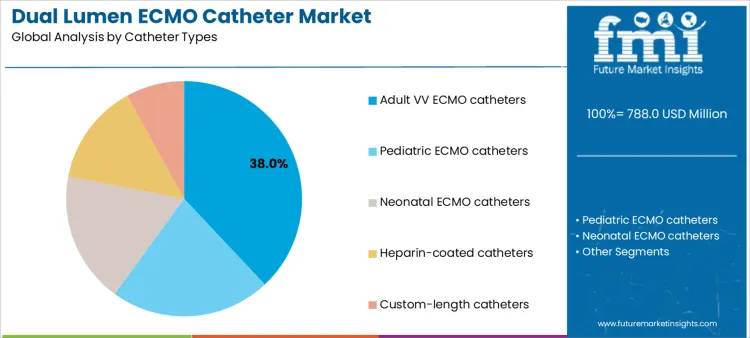
Adult VV ECMO catheters account for 38.0%, reflecting higher incidence of adult respiratory failure requiring prolonged extracorporeal support. These catheters support higher flow rates and are commonly used in severe pulmonary compromise. Pediatric ECMO catheters at 22.0% address growing adoption in specialized pediatric centers. Neonatal ECMO catheters at 18.0% focus on size-specific anatomy and low-flow precision. Heparin-coated catheters at 14.0% reduce thrombogenic risk during extended runs. Custom-length catheters at 8.0% support anatomical variability and complex access requirements. Catheter segmentation highlights emphasis on adult critical care while maintaining coverage across age groups.
Key Points:
- Adult VV catheters dominate due to higher patient volumes.
- Pediatric and neonatal designs address size-specific needs.
- Coated and custom options support complication management.
How Do Clinical Indications Shape Dual Lumen ECMO Catheter Utilization?
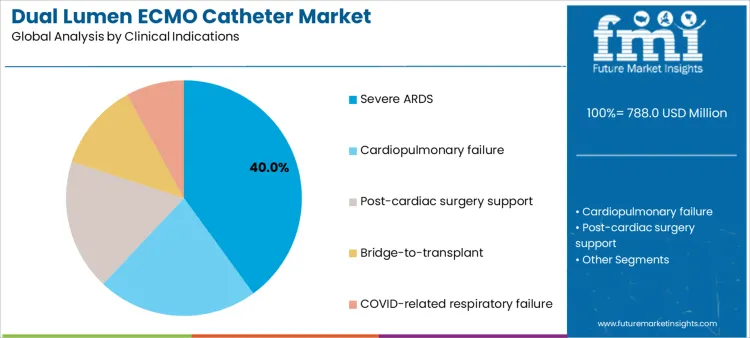
Severe ARDS represents 40.0%, driven by reliance on VV ECMO for refractory hypoxemia management. Cardiopulmonary failure at 22.0% requires efficient oxygenation and venous drainage support. Post-cardiac surgery support at 18.0% applies ECMO during recovery from complex procedures. Bridge-to-transplant at 12.0% uses dual lumen catheters to stabilize patients awaiting organ availability. COVID-related respiratory failure at 8.0% reflects episodic demand tied to outbreak-driven ICU strain. Indication-based segmentation shows stronger utilization where prolonged respiratory support and mobilization advantages are critical.
Key Points:
- ARDS drives the highest catheter utilization.
- Post-surgical support requires stable venous access.
- Bridge-to-transplant cases emphasize long-duration support.
Which End User Groups Drive Adoption of Dual Lumen ECMO Catheters?

Tertiary care hospitals account for 46.0%, reflecting concentration of advanced ICU infrastructure and ECMO expertise. Cardiac specialty centers at 22.0% integrate dual lumen catheters within cardiopulmonary support programs. Pediatric hospitals at 18.0% apply age-specific ECMO protocols supported by specialized teams. ECMO referral centers at 10.0% manage complex cases transferred from regional facilities. Military and emergency systems at 4.0% deploy ECMO in specialized rescue and trauma scenarios. End-user segmentation indicates adoption where multidisciplinary capability, case complexity, and ECMO volume are highest.
Key Points:
- Tertiary hospitals anchor ECMO catheter demand.
- Specialty centers focus on complex cardiopulmonary cases.
- Referral networks support regional ECMO access.
What are the Key Dynamics in the Dual Lumen ECMO Catheter Market?
Demand for dual lumen ECMO catheters reflects need for streamlined extracorporeal support in patients with severe cardiac or respiratory failure. In some ICUs, complementary adoption of extracorporeal CO2 removal expands how clinicians use extracorporeal support in hypercapnic respiratory failure pathways. Adoption concentrates in tertiary hospitals, transplant centers, and specialized intensive care units. Global scope aligns with growth in advanced life support capability and complex critical care. Usage centers on single-cannula devices enabling simultaneous venous drainage and reinfusion, reducing vascular access points during ECMO therapy.
How do cannulation efficiency and patient management requirements shape adoption?
Critical care teams seek to minimize procedural complexity while maintaining stable extracorporeal flow. Demand increases where dual lumen catheters reduce need for multiple cannulation sites, lowering bleeding and infection risk. Single-site access supports patient mobilization and simplifies nursing management during prolonged ECMO runs. Precise tip positioning enables effective separation of inflow and outflow streams, improving oxygenation efficiency. Cardiac and pulmonary failure cases benefit from reduced vascular trauma and improved patient comfort. Imaging-guided placement supports accurate deployment in high-acuity settings. Adoption reflects clinical preference for access solutions that balance flow performance with procedural safety and simplified bedside management.
How does placement complexity, cost exposure, and patient eligibility limits influence market scalability?
Dual lumen catheters require advanced imaging and operator expertise for correct placement. Demand sensitivity rises where malposition risk affects flow efficiency or causes recirculation. Anatomical variability limits suitability in smaller patients or those with vascular abnormalities. Device cost exceeds standard cannulation sets, influencing use in resource-constrained units. Limited size availability restricts pediatric and neonatal application breadth. Complication management requires specialized monitoring protocols. Training requirements slow adoption across lower-volume centers. Scalability remains constrained by technical skill dependence, patient selection limits, and economic justification relative to conventional multi-cannula ECMO approaches.
How Is Demand for Dual Lumen ECMO Catheters Evolving Globally?
Demand for dual lumen ECMO catheters is expanding globally as extracorporeal support becomes integral to advanced cardiopulmonary care. Clinical preference shifts toward single-site cannulation to reduce complications and streamline patient management. Expansion of ECMO programs, trained perfusion teams, and protocol-driven utilization supports steady uptake. Device design improvements addressing flow efficiency and placement accuracy influence purchasing decisions. Growth rates in India at 11.9%, Brazil at 11.4%, China at 11.0%, the USA at 7.8%, and Germany at 7.7% indicate sustained expansion driven by critical care capability buildout, procedural efficiency goals, and outcomes-focused adoption rather than episodic emergency demand.
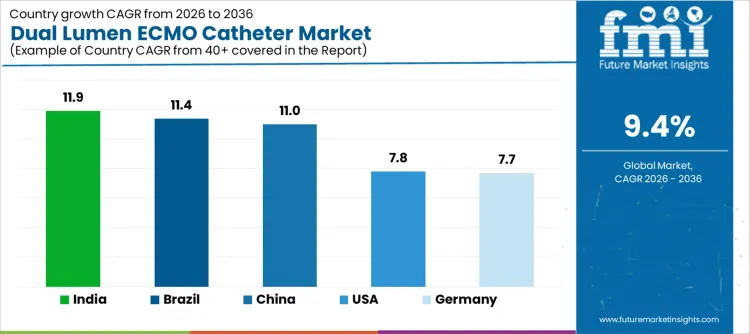
| Country | CAGR (%) |
|---|---|
| India | 11.9% |
| Brazil | 11.4% |
| China | 11.0% |
| USA | 7.8% |
| Germany | 7.7% |
What Is Driving Rapid Expansion of Dual Lumen ECMO Catheter Demand in India?
Demand for dual lumen ECMO catheters in India is growing at a CAGR of 11.9%, supported by expansion of tertiary critical care and cardiothoracic centers. Increasing use of ECMO for severe respiratory and cardiac failure elevates need for efficient cannulation strategies. Dual lumen designs reduce vascular access points, supporting mobility and nursing efficiency. Private hospitals invest in advanced ECMO setups to manage complex cases. Training initiatives improve clinician familiarity with placement techniques. Growth reflects critical care capacity expansion, procedural optimization, and institutional capability strengthening rather than short-term surge preparedness.
- Expansion of tertiary ECMO-capable hospitals
- Preference for single-site cannulation efficiency
- Investment in advanced cardiothoracic care
- Improved clinician training and proficiency
Why Is Brazil Experiencing Strong Uptake of Dual Lumen ECMO Catheters?
Dual lumen ECMO catheter demand in Brazil is expanding at a CAGR of 11.4%, driven by regionalization of high-acuity critical care. Referral centers adopt dual lumen systems to manage complex respiratory failure with reduced line management. Public and private hospitals expand ECMO availability beyond major metros. Emphasis on complication reduction supports transition from multi-cannula approaches. Supplier-supported training programs accelerate adoption. Growth reflects networked critical care delivery and procedural efficiency priorities rather than rapid increases in ECMO case volumes.
- Regional expansion of ECMO referral centers
- Focus on reducing cannulation-related complications
- Public and private sector ECMO investments
- Vendor-led training and support programs
How Is China Sustaining Growth in Dual Lumen ECMO Catheter Utilization?
Demand for dual lumen ECMO catheters in China is growing at a CAGR of 11.0%, aligned with scale of advanced hospital systems. Large tertiary centers integrate ECMO within standardized critical care pathways. Dual lumen catheters support streamlined workflows and patient stabilization. Domestic manufacturing improves access and cost efficiency. National clinical guidance strengthens appropriate use and training. Growth reflects system-wide standardization, hospital scale advantages, and domestic supply capability rather than isolated center-led adoption.
- Integration within standardized critical care pathways
- High-volume tertiary hospital utilization
- Cost-efficient domestic catheter manufacturing
- National guidance supporting ECMO practices
What Factors Are Supporting Dual Lumen ECMO Catheter Demand in United States?
Dual lumen ECMO catheter demand in the United States is expanding at a CAGR of 7.8%, supported by mature ECMO programs and evidence-based practice. High-acuity centers prefer dual lumen access to improve patient mobility and reduce infection risk. Broad reimbursement coverage sustains utilization within defined indications. Continuous device innovation enhances flow dynamics and placement safety. Replacement and upgrade cycles contribute to steady demand. Growth reflects clinical optimization and technology refinement rather than expansion of ECMO center numbers.
- Mature ECMO program infrastructure
- Emphasis on mobility and infection reduction
- Reimbursement-backed defined clinical use
- Ongoing device innovation and upgrades
Why Is Germany Showing Steady Expansion in Dual Lumen ECMO Catheters?
Dual lumen ECMO catheter demand in Germany is growing at a CAGR of 7.7%, shaped by structured critical care governance and clinical rigor. Certified centers apply ECMO within strict protocols, favoring devices that simplify cannulation. Engineering precision and quality standards guide product selection. Training requirements ensure controlled adoption across centers. Procurement discipline moderates volume growth. Expansion remains steady, reflecting outcomes-focused utilization, standard compliance, and measured technology integration rather than rapid capacity scaling.
- Certified ECMO center protocol adherence
- Preference for simplified cannulation devices
- Strong engineering and quality standards
- Disciplined procurement and training controls
What is the competitive landscape of demand for the dual lumen ECMO catheter market globally?
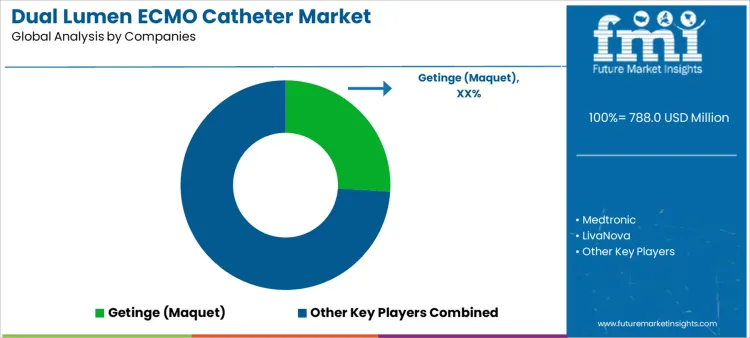
Demand for dual lumen ECMO catheters is driven by severe cardiopulmonary failure incidence and expansion of advanced life support programs. Clinicians assess flow capacity, cannula positioning stability, hemocompatibility, recirculation minimization, and insertion safety under emergent conditions. Buyer assessment includes compatibility with ECMO consoles, imaging guidance requirements, size range availability, and patient mobility considerations. Procurement behavior reflects tertiary center standardization, training familiarity, and preference for proven clinical performance. Trend in the dual lumen ECMO catheter market shows increasing adoption to simplify cannulation, reduce access sites, and support prolonged extracorporeal support strategies.
Getinge Maquet leads competitive positioning through widely adopted dual lumen cannulas supported by clinical experience in high acuity ECMO centers. Medtronic competes by aligning catheter designs with integrated extracorporeal platforms and comprehensive critical care portfolios. LivaNova supports demand with cannulation solutions emphasizing flow efficiency and compatibility with cardiopulmonary support systems. BD maintains relevance through vascular access expertise and manufacturing reliability supporting critical care applications. Nipro participates by supplying dual lumen catheters suited for select ECMO configurations in regional markets. Competitive differentiation centers on flow performance, placement reliability, clinical familiarity, and supplier support for training and protocols.
Key Players in the Dual Lumen ECMO Catheter Market
- Getinge (Maquet)
- Medtronic
- LivaNova
- BD
- Nipro
- Others
Scope of the Report
| Items | Values |
|---|---|
| Quantitative Units | USD million |
| Catheter Types | Adult VV ECMO catheters; Pediatric ECMO catheters; Neonatal ECMO catheters; Heparin-coated catheters; Custom-length catheters |
| Clinical Indications | Severe ARDS; Cardiopulmonary failure; Post-cardiac surgery support; Bridge-to-transplant; COVID-related respiratory failure |
| End Users | Tertiary care hospitals; Cardiac specialty centers; Pediatric hospitals; ECMO referral centers; Military & emergency systems |
| Regions Covered | Asia Pacific, Europe, North America, Latin America, Middle East & Africa |
| Countries Covered | India, Brazil, China, USA, Germany, and 40+ countries |
| Key Companies Profiled | Getinge (Maquet); Medtronic; LivaNova; BD; Nipro; Others |
| Additional Attributes | Dollar sales by catheter type, clinical indication, and end user; cannulation flow performance and biocompatibility characteristics across adult, pediatric, and neonatal ECMO applications; role of heparin coatings in thrombosis risk mitigation; clinical adoption linked to ARDS severity and cardiac support protocols; inventory planning influenced by ECMO center designation and surge preparedness; procurement patterns shaped by tertiary hospital purchasing and long-term supplier agreements. |
Dual Lumen ECMO Catheter Market by Segment
Catheter Types:
- Adult VV ECMO catheters
- Pediatric ECMO catheters
- Neonatal ECMO catheters
- Heparin-coated catheters
- Custom-length catheters
Clinical Indications:
- Severe ARDS
- Cardiopulmonary failure
- Post-cardiac surgery support
- Bridge-to-transplant
- COVID-related respiratory failure
End Users:
- Tertiary care hospitals
- Cardiac specialty centers
- Pediatric hospitals
- ECMO referral centers
- Military & emergency systems
Region:
- Asia Pacific
- China
- Japan
- South Korea
- India
- Australia & New Zealand
- ASEAN
- Rest of Asia Pacific
- Europe
- Germany
- United Kingdom
- France
- Italy
- Spain
- Nordic
- BENELUX
- Rest of Europe
- North America
- United States
- Canada
- Mexico
- Latin America
- Brazil
- Chile
- Rest of Latin America
- Middle East & Africa
- Kingdom of Saudi Arabia
- Other GCC Countries
- Turkey
- South Africa
- Other African Union
- Rest of Middle East & Africa
Bibliography
- Extracorporeal Life Support Organization. (2024). ELSO adult venovenous ECMO guideline update: Cannulation, flow optimization, and device selection. Extracorporeal Life Support Organization.
- Makdisi, G., Wang, I., & Ramanathan, K. (2025). Dual‑lumen ECMO cannula design evolution and clinical performance in ARDS and cardiopulmonary failure. Journal of Thoracic Disease, 17(2), 442–458.
- World Health Organization. (2024). Clinical management guidance for severe ARDS requiring extracorporeal membrane oxygenation. World Health Organization.
Frequently Asked Questions
How big is the dual lumen ecmo catheter market in 2026?
The global dual lumen ecmo catheter market is estimated to be valued at USD 788.0 million in 2026.
What will be the size of dual lumen ecmo catheter market in 2036?
The market size for the dual lumen ecmo catheter market is projected to reach USD 1,935.1 million by 2036.
How much will be the dual lumen ecmo catheter market growth between 2026 and 2036?
The dual lumen ecmo catheter market is expected to grow at a 9.4% CAGR between 2026 and 2036.
What are the key product types in the dual lumen ecmo catheter market?
The key product types in dual lumen ecmo catheter market are adult vv ecmo catheters, pediatric ecmo catheters, neonatal ecmo catheters, heparin-coated catheters and custom-length catheters.
Which clinical indications segment to contribute significant share in the dual lumen ecmo catheter market in 2026?
In terms of clinical indications, severe ards segment to command 40.0% share in the dual lumen ecmo catheter market in 2026.
Preview the report firsthand - request a free sample
Get SampleGet the brochure for pricing and purchase details.
Get PDFTable of Content
- Executive Summary
- Global Market Outlook
- Demand-side Trends
- Supply-side Trends
- Technology Roadmap Analysis
- Analysis and Recommendations
- Market Overview
- Market Coverage / Taxonomy
- Market Definition / Scope / Limitations
- Market Background
- Market Dynamics
- Drivers
- Restraints
- Opportunity
- Trends
- Scenario Forecast
- Demand in Optimistic Scenario
- Demand in Likely Scenario
- Demand in Conservative Scenario
- Opportunity Map Analysis
- Product Life Cycle Analysis
- Supply Chain Analysis
- Investment Feasibility Matrix
- Value Chain Analysis
- PESTLE and Porter’s Analysis
- Regulatory Landscape
- Regional Parent Market Outlook
- Production and Consumption Statistics
- Import and Export Statistics
- Market Dynamics
- Global Market Analysis 2021 to 2025 and Forecast, 2026 to 2036
- Historical Market Size Value (USD Million) Analysis, 2021 to 2025
- Current and Future Market Size Value (USD Million) Projections, 2026 to 2036
- Y-o-Y Growth Trend Analysis
- Absolute $ Opportunity Analysis
- Global Market Pricing Analysis 2021 to 2025 and Forecast 2026 to 2036
- Global Market Analysis 2021 to 2025 and Forecast 2026 to 2036, By Catheter Types
- Introduction / Key Findings
- Historical Market Size Value (USD Million) Analysis By Catheter Types , 2021 to 2025
- Current and Future Market Size Value (USD Million) Analysis and Forecast By Catheter Types , 2026 to 2036
- Adult VV ECMO catheters
- Pediatric ECMO catheters
- Neonatal ECMO catheters
- Heparin-coated catheters
- Custom-length catheters
- Adult VV ECMO catheters
- Y-o-Y Growth Trend Analysis By Catheter Types , 2021 to 2025
- Absolute $ Opportunity Analysis By Catheter Types , 2026 to 2036
- Global Market Analysis 2021 to 2025 and Forecast 2026 to 2036, By Clinical Indications
- Introduction / Key Findings
- Historical Market Size Value (USD Million) Analysis By Clinical Indications, 2021 to 2025
- Current and Future Market Size Value (USD Million) Analysis and Forecast By Clinical Indications, 2026 to 2036
- Severe ARDS
- Cardiopulmonary failure
- Post-cardiac surgery support
- Bridge-to-transplant
- COVID-related respiratory failure
- Severe ARDS
- Y-o-Y Growth Trend Analysis By Clinical Indications, 2021 to 2025
- Absolute $ Opportunity Analysis By Clinical Indications, 2026 to 2036
- Global Market Analysis 2021 to 2025 and Forecast 2026 to 2036, By End Users
- Introduction / Key Findings
- Historical Market Size Value (USD Million) Analysis By End Users, 2021 to 2025
- Current and Future Market Size Value (USD Million) Analysis and Forecast By End Users, 2026 to 2036
- Tertiary care hospitals
- Cardiac specialty centers
- Pediatric hospitals
- ECMO referral centers
- Military & emergency systems
- Tertiary care hospitals
- Y-o-Y Growth Trend Analysis By End Users, 2021 to 2025
- Absolute $ Opportunity Analysis By End Users, 2026 to 2036
- Global Market Analysis 2021 to 2025 and Forecast 2026 to 2036, By Region
- Introduction
- Historical Market Size Value (USD Million) Analysis By Region, 2021 to 2025
- Current Market Size Value (USD Million) Analysis and Forecast By Region, 2026 to 2036
- North America
- Latin America
- Western Europe
- Eastern Europe
- East Asia
- South Asia and Pacific
- Middle East & Africa
- Market Attractiveness Analysis By Region
- North America Market Analysis 2021 to 2025 and Forecast 2026 to 2036, By Country
- Historical Market Size Value (USD Million) Trend Analysis By Market Taxonomy, 2021 to 2025
- Market Size Value (USD Million) Forecast By Market Taxonomy, 2026 to 2036
- By Country
- USA
- Canada
- Mexico
- By Catheter Types
- By Clinical Indications
- By End Users
- By Country
- Market Attractiveness Analysis
- By Country
- By Catheter Types
- By Clinical Indications
- By End Users
- Key Takeaways
- Latin America Market Analysis 2021 to 2025 and Forecast 2026 to 2036, By Country
- Historical Market Size Value (USD Million) Trend Analysis By Market Taxonomy, 2021 to 2025
- Market Size Value (USD Million) Forecast By Market Taxonomy, 2026 to 2036
- By Country
- Brazil
- Chile
- Rest of Latin America
- By Catheter Types
- By Clinical Indications
- By End Users
- By Country
- Market Attractiveness Analysis
- By Country
- By Catheter Types
- By Clinical Indications
- By End Users
- Key Takeaways
- Western Europe Market Analysis 2021 to 2025 and Forecast 2026 to 2036, By Country
- Historical Market Size Value (USD Million) Trend Analysis By Market Taxonomy, 2021 to 2025
- Market Size Value (USD Million) Forecast By Market Taxonomy, 2026 to 2036
- By Country
- Germany
- UK
- Italy
- Spain
- France
- Nordic
- BENELUX
- Rest of Western Europe
- By Catheter Types
- By Clinical Indications
- By End Users
- By Country
- Market Attractiveness Analysis
- By Country
- By Catheter Types
- By Clinical Indications
- By End Users
- Key Takeaways
- Eastern Europe Market Analysis 2021 to 2025 and Forecast 2026 to 2036, By Country
- Historical Market Size Value (USD Million) Trend Analysis By Market Taxonomy, 2021 to 2025
- Market Size Value (USD Million) Forecast By Market Taxonomy, 2026 to 2036
- By Country
- Russia
- Poland
- Hungary
- Balkan & Baltic
- Rest of Eastern Europe
- By Catheter Types
- By Clinical Indications
- By End Users
- By Country
- Market Attractiveness Analysis
- By Country
- By Catheter Types
- By Clinical Indications
- By End Users
- Key Takeaways
- East Asia Market Analysis 2021 to 2025 and Forecast 2026 to 2036, By Country
- Historical Market Size Value (USD Million) Trend Analysis By Market Taxonomy, 2021 to 2025
- Market Size Value (USD Million) Forecast By Market Taxonomy, 2026 to 2036
- By Country
- China
- Japan
- South Korea
- By Catheter Types
- By Clinical Indications
- By End Users
- By Country
- Market Attractiveness Analysis
- By Country
- By Catheter Types
- By Clinical Indications
- By End Users
- Key Takeaways
- South Asia and Pacific Market Analysis 2021 to 2025 and Forecast 2026 to 2036, By Country
- Historical Market Size Value (USD Million) Trend Analysis By Market Taxonomy, 2021 to 2025
- Market Size Value (USD Million) Forecast By Market Taxonomy, 2026 to 2036
- By Country
- India
- ASEAN
- Australia & New Zealand
- Rest of South Asia and Pacific
- By Catheter Types
- By Clinical Indications
- By End Users
- By Country
- Market Attractiveness Analysis
- By Country
- By Catheter Types
- By Clinical Indications
- By End Users
- Key Takeaways
- Middle East & Africa Market Analysis 2021 to 2025 and Forecast 2026 to 2036, By Country
- Historical Market Size Value (USD Million) Trend Analysis By Market Taxonomy, 2021 to 2025
- Market Size Value (USD Million) Forecast By Market Taxonomy, 2026 to 2036
- By Country
- Kingdom of Saudi Arabia
- Other GCC Countries
- Turkiye
- South Africa
- Other African Union
- Rest of Middle East & Africa
- By Catheter Types
- By Clinical Indications
- By End Users
- By Country
- Market Attractiveness Analysis
- By Country
- By Catheter Types
- By Clinical Indications
- By End Users
- Key Takeaways
- Key Countries Market Analysis
- USA
- Pricing Analysis
- Market Share Analysis, 2025
- By Catheter Types
- By Clinical Indications
- By End Users
- Canada
- Pricing Analysis
- Market Share Analysis, 2025
- By Catheter Types
- By Clinical Indications
- By End Users
- Mexico
- Pricing Analysis
- Market Share Analysis, 2025
- By Catheter Types
- By Clinical Indications
- By End Users
- Brazil
- Pricing Analysis
- Market Share Analysis, 2025
- By Catheter Types
- By Clinical Indications
- By End Users
- Chile
- Pricing Analysis
- Market Share Analysis, 2025
- By Catheter Types
- By Clinical Indications
- By End Users
- Germany
- Pricing Analysis
- Market Share Analysis, 2025
- By Catheter Types
- By Clinical Indications
- By End Users
- UK
- Pricing Analysis
- Market Share Analysis, 2025
- By Catheter Types
- By Clinical Indications
- By End Users
- Italy
- Pricing Analysis
- Market Share Analysis, 2025
- By Catheter Types
- By Clinical Indications
- By End Users
- Spain
- Pricing Analysis
- Market Share Analysis, 2025
- By Catheter Types
- By Clinical Indications
- By End Users
- France
- Pricing Analysis
- Market Share Analysis, 2025
- By Catheter Types
- By Clinical Indications
- By End Users
- India
- Pricing Analysis
- Market Share Analysis, 2025
- By Catheter Types
- By Clinical Indications
- By End Users
- ASEAN
- Pricing Analysis
- Market Share Analysis, 2025
- By Catheter Types
- By Clinical Indications
- By End Users
- Australia & New Zealand
- Pricing Analysis
- Market Share Analysis, 2025
- By Catheter Types
- By Clinical Indications
- By End Users
- China
- Pricing Analysis
- Market Share Analysis, 2025
- By Catheter Types
- By Clinical Indications
- By End Users
- Japan
- Pricing Analysis
- Market Share Analysis, 2025
- By Catheter Types
- By Clinical Indications
- By End Users
- South Korea
- Pricing Analysis
- Market Share Analysis, 2025
- By Catheter Types
- By Clinical Indications
- By End Users
- Russia
- Pricing Analysis
- Market Share Analysis, 2025
- By Catheter Types
- By Clinical Indications
- By End Users
- Poland
- Pricing Analysis
- Market Share Analysis, 2025
- By Catheter Types
- By Clinical Indications
- By End Users
- Hungary
- Pricing Analysis
- Market Share Analysis, 2025
- By Catheter Types
- By Clinical Indications
- By End Users
- Kingdom of Saudi Arabia
- Pricing Analysis
- Market Share Analysis, 2025
- By Catheter Types
- By Clinical Indications
- By End Users
- Turkiye
- Pricing Analysis
- Market Share Analysis, 2025
- By Catheter Types
- By Clinical Indications
- By End Users
- South Africa
- Pricing Analysis
- Market Share Analysis, 2025
- By Catheter Types
- By Clinical Indications
- By End Users
- USA
- Market Structure Analysis
- Competition Dashboard
- Competition Benchmarking
- Market Share Analysis of Top Players
- By Regional
- By Catheter Types
- By Clinical Indications
- By End Users
- Competition Analysis
- Competition Deep Dive
- Getinge (Maquet)
- Overview
- Product Portfolio
- Profitability by Market Segments (Product/Age /Sales Channel/Region)
- Sales Footprint
- Strategy Overview
- Marketing Strategy
- Product Strategy
- Channel Strategy
- Medtronic
- LivaNova
- BD
- Nipro
- Others
- Getinge (Maquet)
- Competition Deep Dive
- Assumptions & Acronyms Used
- Research Methodology


