

- Industry Size (2026)
- USD 1.1 Bn
- Forecast (2036)
- USD 2.3 Bn
- CAGR (2026 to 2036)
- 7.60%
E-Commerce Heavy-Duty IRB Palletizing Robots Market Forecast and Outlook 2026 to 2036
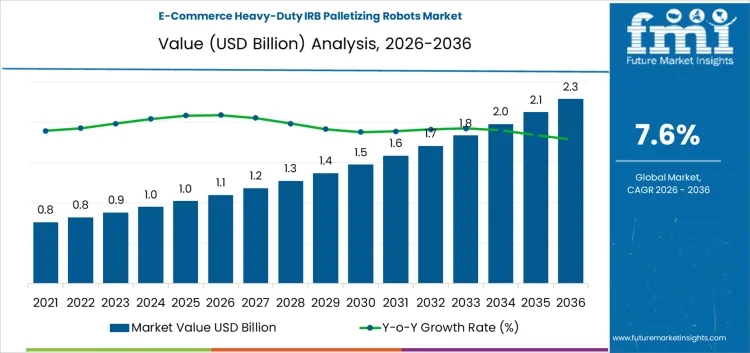
The e-commerce heavy-duty IRB palletizing robots market is valued at USD 1.1 billion in 2026 and is projected to reach USD 2.3 billion by 2036, registering a CAGR of 7.60% over the forecast period. Procurement decisions in this market are increasingly shaped by operational risk management rather than upfront system cost alone, with strong preference given to proven reliability, long service life, and predictable performance under continuous duty cycles.
Buyer risk aversion remains high, particularly among large e-commerce operators where palletizing downtime directly impacts fulfillment commitments and customer satisfaction. As a result, vendor selection is often influenced by established track records, global service coverage, and controller software stability. Vendor lock-in is reinforced through proprietary control platforms, integrated safety systems, and tight coupling with warehouse management and conveyor infrastructure. Switching costs are elevated due to retraining requirements, system revalidation, and integration complexity, favoring long-term supplier relationships. Consequently, purchasing behavior tends to prioritize lifecycle assurance and operational continuity over short-term pricing advantages.
Quick Stats for E-Commerce Heavy-Duty IRB Palletizing Robots Market
- E-Commerce Heavy-Duty IRB Palletizing Robots Market Value (2026): USD 1.1 Billion
- E-Commerce Heavy-Duty IRB Palletizing Robots Market Forecast Value (2036): USD 2.3 Billion
- E-Commerce Heavy-Duty IRB Palletizing Robots Market Forecast CAGR 2026 to 2036: 7.60%
- Leading Facility Type in E-Commerce Heavy-Duty IRB Palletizing Robots Market: Fulfilment Centers
- Leading Deployment Mode in E-Commerce Heavy-Duty IRB Palletizing Robots Market: Retrofit
- Key Growth Regions in E-Commerce Heavy-Duty IRB Palletizing Robots Market: Asia Pacific, North America
- Top Key Players in E-Commerce Heavy-Duty IRB Palletizing Robots Market: FANUC, ABB, KUKA, Yaskawa, Kawasaki Robotics, Comau
E-Commerce Heavy-Duty IRB Palletizing Robots Market Key Takeaways
| Metric | Value |
|---|---|
| Industry Value (2026) | USD 1.1 Billion |
| Forecast Value (2036) | USD 2.3 Billion |
| Forecast CAGR 2026 to 2036 | 7.60% |
How the Global E-Commerce Heavy-Duty Is IRB Palletizing Robots Market Advancing?
The global e-commerce heavy-duty IRB palletizing robots market is progressing steadily, supported by the rapid expansion of e-commerce fulfillment operations and increasing automation requirements in warehouses and distribution centers. Heavy-duty IRB palletizing robots are widely deployed to handle high payloads, repetitive stacking tasks, and large-volume order processing, enabling e-commerce operators to improve throughput, accuracy, and operational consistency.
A major driver contributing to market growth is the growing pressure on e-commerce companies to accelerate order fulfillment while managing rising labor costs and workforce availability challenges. Heavy-duty palletizing robots equipped with advanced control systems allow continuous, high-speed palletizing of cartons, crates, and bulk packages, reducing dependence on manual labor. Their ability to operate reliably in demanding warehouse environments makes them particularly suitable for large-scale fulfillment hubs and regional distribution centers.
Technological advancements in robotic payload capacity, vision systems, and control software are further strengthening market adoption. Improved motion control, integrated safety features, and compatibility with warehouse management systems enable seamless integration into automated logistics workflows. As e-commerce volumes continue to increase and fulfillment operations prioritize speed and efficiency, the heavy-duty IRB palletizing robots market is expected to maintain consistent growth throughout the forecast period.
What Is the Segment-Wise Analysis for the E-Commerce Heavy-Duty IRB Palletizing Robots Market?
The e-commerce heavy-duty IRB palletizing robots market is segmented by facility type and deployment mode, reflecting evolving logistics infrastructure and automation strategies. By facility type, fulfilment centers dominate with a 46% share, driven by high order volumes, rapid SKU handling, and the need for efficient palletizing at outbound logistics points. Sorting hubs, cross-dock facilities, and dark warehouses follow, supported by increasing demand for faster parcel movement and reduced manual handling. By deployment mode, retrofit installations lead with a 56% share, as e-commerce operators increasingly integrate palletizing robots into existing facilities to improve throughput without full site redesigns.
Why Do Fulfilment Centers Lead the E-Commerce Heavy-Duty IRB Palletizing Robots Market?
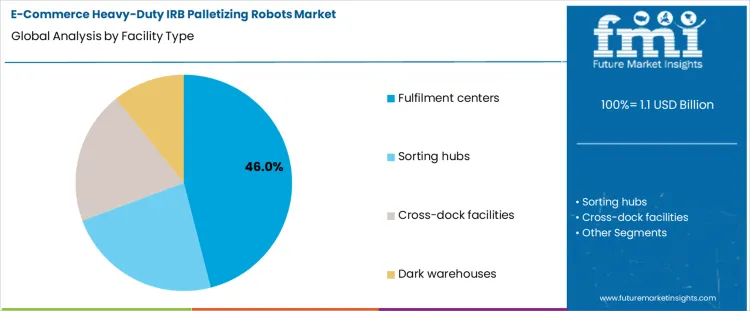
Fulfilment centers account for 46% of facility-type demand in the e-commerce heavy-duty IRB palletizing robots market due to their central role in high-volume order processing and outbound logistics. These facilities handle large SKU counts, frequent order cycles, and tight delivery timelines, creating strong demand for automated palletizing solutions that can operate continuously with minimal error rates. Heavy-duty IRB palletizing robots are widely deployed to manage bulk cartons, mixed-load pallets, and repetitive stacking tasks, improving speed and consistency while reducing labor dependency. The rapid expansion of same-day and next-day delivery models has further increased automation investments in fulfilment centers. As e-commerce operators scale operations and optimize warehouse layouts, fulfilment centers remain the primary adopters of advanced palletizing robotics.
Why Does Retrofit Deployment Dominate the E-Commerce Heavy-Duty IRB Palletizing Robots Market?
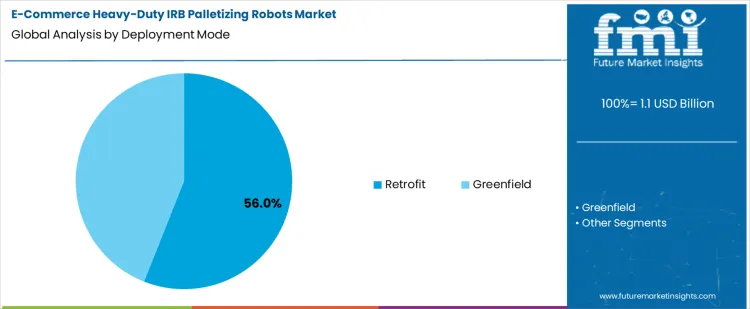
Retrofit deployments hold a 56% share of the e-commerce heavy-duty IRB palletizing robots market, driven by the need to modernize existing warehouse infrastructure without disrupting ongoing operations. Many e-commerce facilities were built before widespread robotic adoption, making retrofit solutions a practical approach for integrating palletizing robots into established layouts. Heavy-duty IRB robots can be adapted to existing conveyor systems, pallet stations, and floor plans, enabling faster deployment and lower capital expenditure compared to full greenfield projects. Retrofit installations also allow operators to scale automation incrementally based on demand fluctuations. This flexibility, combined with shorter implementation timelines and improved return on investment, continues to position retrofit deployment as the preferred automation strategy across e-commerce logistics facilities.
What Are the Key Dynamics for the E-Commerce Heavy-Duty IRB Palletizing Robots Market?
The e-commerce heavy-duty irb palletizing robots market is driven by the rapid expansion of online retail and the corresponding need to automate high-volume fulfillment operations. Heavy-duty Intelligent Robotics and Automation (IRB) palletizing robots are increasingly used to handle the intensive stacking and organization of goods in warehouses and distribution centers. Key market dynamics include the drive for operational efficiency, labor cost optimization, and the need to handle large and irregular shipment volumes accurately and at high speed. As e-commerce players focus on reducing lead times and improving throughput, the demand for advanced palletizing systems continues to rise.
Why Is the E-Commerce Heavy-Duty IRB Palletizing Robots Market Growing?
The market is growing primarily due to surging e-commerce activity worldwide, which has increased pressure on logistics networks to improve productivity while coping with labor shortages. Heavy-duty IRB palletizing robots enable companies to boost throughput, minimize errors, and reduce workplace injuries associated with manual pallet stacking. The adoption of these robots is further supported by integrated warehouse management systems, real-time data analytics, and advanced vision algorithms that improve the accuracy and flexibility of palletizing operations. As businesses strive to maintain fast order fulfillment and manage peak demand periods, investment in IRB palletizing automation has accelerated.
How Are the Key Drivers Shaping the E-Commerce Heavy-Duty IRB Palletizing Robots Market?
Key drivers shaping the market include rising labor costs and workforce constraints that make automation an attractive solution for heavy-duty tasks. The need for higher throughput and consistent performance in e-commerce distribution centers incentivizes adoption of IRB palletizing robots that can operate continuously and scale with demand. Technological advancements such as collaborative robotic systems, enhanced safety features, and integration with warehouse execution software are enabling smoother deployment and operation. Heightened focus on workplace safety and error reduction is driving companies to replace manual palletizing with robotic systems that provide predictable and reliable output.
What Is the Growth Outlook for the E-Commerce Heavy-Duty IRB Palletizing Robots Market by Country?
| Country | CAGR (%) |
|---|---|
| USA | 7.5% |
| China | 7.2% |
| Germany | 7.0% |
| Japan | 6.8% |
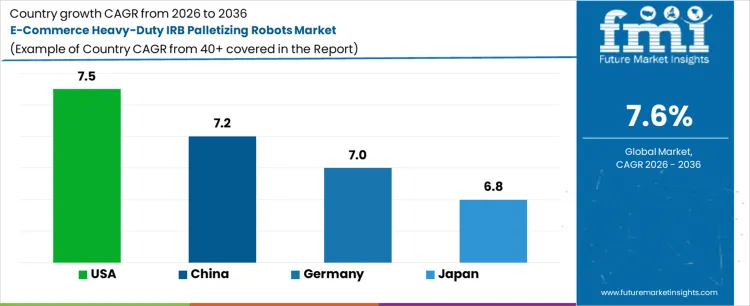
The e-commerce heavy-duty IRB palletizing robots market is witnessing steady growth across major regions as logistics operators accelerate warehouse automation. The USA leads with a 7.5% CAGR, driven by large-scale fulfillment center expansion, rising order volumes, and labor shortages in warehousing operations. China follows at 7.2%, supported by massive e-commerce activity, high-throughput distribution centers, and increasing adoption of smart logistics solutions. Germany grows at 7.0%, benefiting from its role as a key European logistics hub, high labor costs, and strong emphasis on automation and workplace safety. Japan expands at 6.8%, driven by an aging workforce, limited labor availability, and growing automation in space-constrained warehouses.
What Is Driving the Growth of the E-Commerce Heavy-Duty IRB Palletizing Robots Market in the USA?
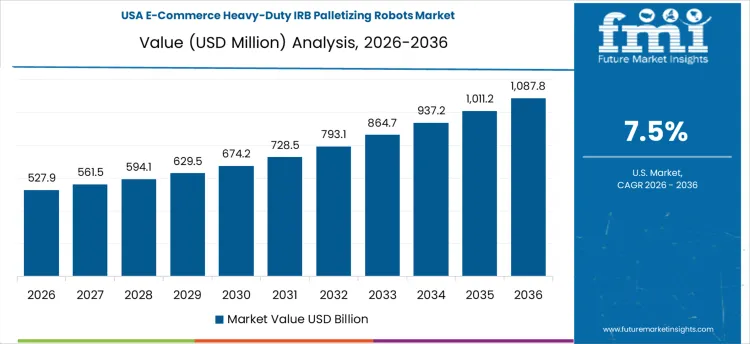
The E-Commerce Heavy-Duty IRB Palletizing Robots Market in the USA is growing at a CAGR of 7.5%, driven by the rapid scaling of large fulfillment and distribution centers to support rising online retail demand. USA e-commerce operators are handling increasing order volumes, larger SKU assortments, and tighter delivery timelines, which is intensifying the need for automated end-of-line palletizing solutions. Heavy-duty IRB palletizing robots are increasingly preferred for their ability to manage high payloads, operate continuously, and maintain consistent stacking accuracy. Labor shortages in warehousing, coupled with rising wages and safety concerns around repetitive lifting, are further accelerating automation investments. Major USA retailers and third-party logistics providers are modernizing warehouses with integrated robotic systems connected to warehouse management and conveyor platforms. As fulfillment networks expand geographically and operational efficiency becomes a priority, adoption of heavy-duty palletizing robots is expected to increase steadily.
How Is the E-Commerce Heavy-Duty IRB Palletizing Robots Market Expanding in China?
The E-Commerce Heavy-Duty IRB Palletizing Robots Market in China is expanding at a CAGR of 7.2%, supported by the country’s massive e-commerce infrastructure and high-volume logistics operations. Leading online retail platforms operate mega-scale distribution centers that process large quantities of goods daily, creating strong demand for automated palletizing systems capable of handling heavy loads at high speeds. Rising labor costs and workforce availability challenges are prompting logistics operators to reduce dependence on manual palletizing. Heavy-duty IRB robots offer consistent performance, reduced downtime, and improved safety in fast-paced warehouse environments. Government initiatives promoting smart logistics, intelligent manufacturing, and industrial automation further support adoption. The growing presence of domestic robot manufacturers and system integrators is improving access to cost-competitive palletizing solutions. As China continues to expand its e-commerce and logistics capacity, demand for heavy-duty palletizing robots is expected to grow steadily.
What Is Supporting Growth of the E-Commerce Heavy-Duty IRB Palletizing Robots Market in Germany?
The E-Commerce Heavy-Duty IRB Palletizing Robots Market in Germany is growing at a CAGR of 7.0%, driven by strong demand for automation in logistics, warehousing, and cross-border e-commerce fulfillment. Germany’s position as a major European logistics hub supports large distribution centers that require efficient handling of heavy cartons and pallet loads. High labor costs, strict workplace safety standards, and emphasis on operational reliability are encouraging adoption of robotic palletizing systems. Heavy-duty IRB robots are valued for their precision, durability, and ability to integrate seamlessly with advanced material-handling equipment. German warehouses also prioritize system interoperability and data-driven operations, aligning well with automated palletizing solutions. Industry 4.0 adoption is accelerating the deployment of connected and intelligent warehouse technologies. As e-commerce volumes increase across Europe and logistics efficiency becomes critical, demand for heavy-duty palletizing robots in Germany is expected to remain strong.
How Is the E-Commerce Heavy-Duty IRB Palletizing Robots Market Developing in Japan?
The E-Commerce Heavy-Duty IRB Palletizing Robots Market in Japan is expanding at a CAGR of 6.8%, supported by growing automation needs in logistics and fulfillment operations. Japan’s aging workforce and persistent labor shortages are major drivers encouraging logistics companies to adopt robotic palletizing solutions. Heavy-duty IRB robots are increasingly used to handle repetitive and physically demanding palletizing tasks while ensuring consistent accuracy and operational reliability. Japanese warehouses often operate in space-constrained environments, increasing demand for compact, precise robotic systems that can be efficiently integrated into existing layouts. Growth in domestic e-commerce, along with rising expectations for fast and reliable delivery, is further increasing pallet handling requirements. Japan’s strong robotics engineering base supports continuous improvements in system performance and reliability. As logistics operators modernize facilities to address workforce and efficiency challenges, adoption of heavy-duty palletizing robots is expected to grow steadily.
How Are Companies Competing in the E-Commerce Heavy-Duty IRB Palletizing Robots Market?
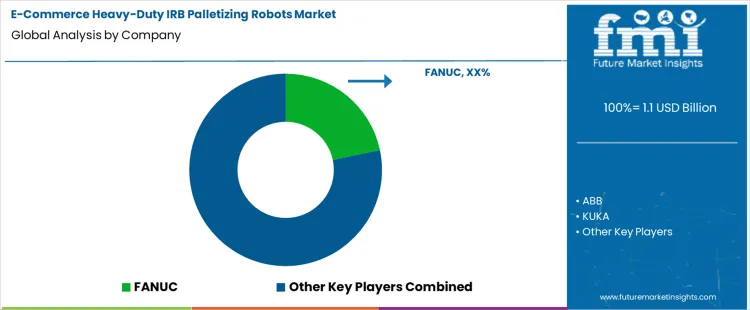
FANUC and ABB compete aggressively on high-throughput palletizing reliability, controller/software ecosystems, and uptime-focused service coverage for large fulfilment centers and sorting hubs. FANUC differentiates through proven high-speed palletizing cells, strong payload-range depth, and stable performance under continuous duty cycles typical in e-commerce warehouses. ABB competes by pairing heavy-duty palletizers with advanced control platforms, integrated safety, and digital tools that reduce commissioning time and simplify changeovers between SKU patterns. Both vendors emphasize repeatable cycle times, fast integration with conveyors/vision systems, and strong global support networks-critical where warehouse operators prioritize maximum availability and standardized deployments across multiple sites.
KUKA, Yaskawa, Kawasaki Robotics, and Comau compete through flexible cell design, line-integration partnerships, and application-specific palletizing configurations (mixed-case, layer picking, and high-payload end-of-line stacking). KUKA positions around modular automation cells and software-driven adaptability for different facility layouts, while Yaskawa emphasizes motion control precision and durability for high-cycle palletizing, often supported by strong integrator ecosystems. Kawasaki Robotics is typically differentiated by robust heavy-payload platforms and tailored palletizing solutions for demanding distribution environments. Comau competes by leveraging industrial automation expertise and turnkey cell engineering especially where customers want integrated palletizing lines with minimal operational complexity. Across all six players, competition centers on payload capability, speed under real warehouse constraints, ease of pattern change, retrofit-friendly deployment, and lifecycle service strength to keep e-commerce operations running at peak throughput.
E-Commerce Heavy-Duty IRB Palletizing Robots Market by Key Segments
- FANUC
- ABB
- KUKA
- Yaskawa
- Kawasaki Robotics
- Comau
Scope of Report
| Attributes | Description |
|---|---|
| Quantitative Unit (2026) | USD Billion |
| Facility Type | Fulfilment Centers, Sorting Hubs, Cross-Dock Facilities, Dark Warehouses |
| Deployment Mode | Retrofit, Greenfield |
| Regions Covered | Asia Pacific, Europe, North America, Latin America, Middle East & Africa |
| Countries Covered | China, Japan, South Korea, India, Australia & New Zealand, ASEAN, Rest of Asia Pacific, Germany, United Kingdom, France, Italy, Spain, Nordic, BENELUX, Rest of Europe, United States, Canada, Mexico, Brazil, Chile, Rest of Latin America, Kingdom of Saudi Arabia, Other GCC Countries, Turkey, South Africa, Other African Union, Rest of Middle East & Africa |
| Key Companies Profiled | FANUC, ABB, KUKA, Yaskawa, Kawasaki Robotics, Comau |
| Additional Attributes | Dollar sales by facility type and deployment mode; regional market size and forecast analysis; growth outlook across major regions; adoption trends of heavy-duty IRB palletizing robots in e-commerce logistics operations; evaluation of automation demand across fulfilment centers, sorting hubs, and dark warehouse environments. |
Key Players in E-Commerce Heavy-Duty IRB Palletizing Robots Market
Facility Type
- Fulfilment centers
- Sorting hubs
- Cross-dock facilities
- Dark warehouses
Deployment Mode
- Retrofit
- Greenfield
Region
- Asia Pacific
- China
- Japan
- South Korea
- India
- Australia & New Zealand
- ASEAN
- Rest of Asia Pacific
- Europe
- Germany
- United Kingdom
- France
- Italy
- Spain
- Nordic
- BENELUX
- Rest of Europe
- North America
- United States
- Canada
- Mexico
- Latin America
- Brazil
- Chile
- Rest of Latin America
- Middle East & Africa
- Kingdom of Saudi Arabia
- Other GCC Countries
- Turkey
- South Africa
- Other African Union
- Rest of Middle East & Africa
Bibliography
International Organization for Standardization. (2011). ISO 10218-1:2011: Robots and robotic devices — Safety requirements for industrial robots — Part 1: Robots. ISO. ISO
International Organization for Standardization. (2011). ISO 10218-2:2011: Robots and robotic devices — Safety requirements for industrial robots — Part 2: Robot systems and integration. ISO.
Robotic Industries Association. (2012). ANSI/RIA R15.06-2012: Industrial robots and robot systems — Safety requirements (contains corrigendum). ANSI Webstore.
International Federation of Robotics. (2024). World Robotics 2024 — Service Robots: Sources and methods. IFR.
Frequently Asked Questions
How big is the e-commerce heavy-duty irb palletizing robots market in 2026?
The global e-commerce heavy-duty irb palletizing robots market is estimated to be valued at USD 1.1 billion in 2026.
What will be the size of e-commerce heavy-duty irb palletizing robots market in 2036?
The market size for the e-commerce heavy-duty irb palletizing robots market is projected to reach USD 2.3 billion by 2036.
How much will be the e-commerce heavy-duty irb palletizing robots market growth between 2026 and 2036?
The e-commerce heavy-duty irb palletizing robots market is expected to grow at a 7.6% CAGR between 2026 and 2036.
What are the key product types in the e-commerce heavy-duty irb palletizing robots market?
The key product types in e-commerce heavy-duty irb palletizing robots market are fulfilment centers, sorting hubs, cross-dock facilities and dark warehouses.
Which deployment mode segment to contribute significant share in the e-commerce heavy-duty irb palletizing robots market in 2026?
In terms of deployment mode, retrofit segment to command 56.0% share in the e-commerce heavy-duty irb palletizing robots market in 2026.
Preview the report firsthand - request a free sample
Get SampleGet the brochure for pricing and purchase details.
Get PDFTable of Content
- Executive Summary
- Global Market Outlook
- Demand-side Trends
- Supply-side Trends
- Technology Roadmap Analysis
- Analysis and Recommendations
- Market Overview
- Market Coverage / Taxonomy
- Market Definition / Scope / Limitations
- Market Background
- Market Dynamics
- Drivers
- Restraints
- Opportunity
- Trends
- Scenario Forecast
- Demand in Optimistic Scenario
- Demand in Likely Scenario
- Demand in Conservative Scenario
- Opportunity Map Analysis
- Product Life Cycle Analysis
- Supply Chain Analysis
- Investment Feasibility Matrix
- Value Chain Analysis
- PESTLE and Porter’s Analysis
- Regulatory Landscape
- Regional Parent Market Outlook
- Production and Consumption Statistics
- Import and Export Statistics
- Market Dynamics
- Global Market Analysis 2021 to 2025 and Forecast, 2026 to 2036
- Historical Market Size Value (USD Million) Analysis, 2021 to 2025
- Current and Future Market Size Value (USD Million) Projections, 2026 to 2036
- Y-o-Y Growth Trend Analysis
- Absolute $ Opportunity Analysis
- Global Market Pricing Analysis 2021 to 2025 and Forecast 2026 to 2036
- Global Market Analysis 2021 to 2025 and Forecast 2026 to 2036, By Facility Type
- Introduction / Key Findings
- Historical Market Size Value (USD Million) Analysis By Facility Type , 2021 to 2025
- Current and Future Market Size Value (USD Million) Analysis and Forecast By Facility Type , 2026 to 2036
- Fulfilment centers
- Sorting hubs
- Cross-dock facilities
- Dark warehouses
- Fulfilment centers
- Y-o-Y Growth Trend Analysis By Facility Type , 2021 to 2025
- Absolute $ Opportunity Analysis By Facility Type , 2026 to 2036
- Global Market Analysis 2021 to 2025 and Forecast 2026 to 2036, By Deployment Mode
- Introduction / Key Findings
- Historical Market Size Value (USD Million) Analysis By Deployment Mode, 2021 to 2025
- Current and Future Market Size Value (USD Million) Analysis and Forecast By Deployment Mode, 2026 to 2036
- Retrofit
- Greenfield
- Retrofit
- Y-o-Y Growth Trend Analysis By Deployment Mode, 2021 to 2025
- Absolute $ Opportunity Analysis By Deployment Mode, 2026 to 2036
- Global Market Analysis 2021 to 2025 and Forecast 2026 to 2036, By Region
- Introduction
- Historical Market Size Value (USD Million) Analysis By Region, 2021 to 2025
- Current Market Size Value (USD Million) Analysis and Forecast By Region, 2026 to 2036
- North America
- Latin America
- Western Europe
- Eastern Europe
- East Asia
- South Asia and Pacific
- Middle East & Africa
- Market Attractiveness Analysis By Region
- North America Market Analysis 2021 to 2025 and Forecast 2026 to 2036, By Country
- Historical Market Size Value (USD Million) Trend Analysis By Market Taxonomy, 2021 to 2025
- Market Size Value (USD Million) Forecast By Market Taxonomy, 2026 to 2036
- By Country
- USA
- Canada
- Mexico
- By Facility Type
- By Deployment Mode
- By Country
- Market Attractiveness Analysis
- By Country
- By Facility Type
- By Deployment Mode
- Key Takeaways
- Latin America Market Analysis 2021 to 2025 and Forecast 2026 to 2036, By Country
- Historical Market Size Value (USD Million) Trend Analysis By Market Taxonomy, 2021 to 2025
- Market Size Value (USD Million) Forecast By Market Taxonomy, 2026 to 2036
- By Country
- Brazil
- Chile
- Rest of Latin America
- By Facility Type
- By Deployment Mode
- By Country
- Market Attractiveness Analysis
- By Country
- By Facility Type
- By Deployment Mode
- Key Takeaways
- Western Europe Market Analysis 2021 to 2025 and Forecast 2026 to 2036, By Country
- Historical Market Size Value (USD Million) Trend Analysis By Market Taxonomy, 2021 to 2025
- Market Size Value (USD Million) Forecast By Market Taxonomy, 2026 to 2036
- By Country
- Germany
- UK
- Italy
- Spain
- France
- Nordic
- BENELUX
- Rest of Western Europe
- By Facility Type
- By Deployment Mode
- By Country
- Market Attractiveness Analysis
- By Country
- By Facility Type
- By Deployment Mode
- Key Takeaways
- Eastern Europe Market Analysis 2021 to 2025 and Forecast 2026 to 2036, By Country
- Historical Market Size Value (USD Million) Trend Analysis By Market Taxonomy, 2021 to 2025
- Market Size Value (USD Million) Forecast By Market Taxonomy, 2026 to 2036
- By Country
- Russia
- Poland
- Hungary
- Balkan & Baltic
- Rest of Eastern Europe
- By Facility Type
- By Deployment Mode
- By Country
- Market Attractiveness Analysis
- By Country
- By Facility Type
- By Deployment Mode
- Key Takeaways
- East Asia Market Analysis 2021 to 2025 and Forecast 2026 to 2036, By Country
- Historical Market Size Value (USD Million) Trend Analysis By Market Taxonomy, 2021 to 2025
- Market Size Value (USD Million) Forecast By Market Taxonomy, 2026 to 2036
- By Country
- China
- Japan
- South Korea
- By Facility Type
- By Deployment Mode
- By Country
- Market Attractiveness Analysis
- By Country
- By Facility Type
- By Deployment Mode
- Key Takeaways
- South Asia and Pacific Market Analysis 2021 to 2025 and Forecast 2026 to 2036, By Country
- Historical Market Size Value (USD Million) Trend Analysis By Market Taxonomy, 2021 to 2025
- Market Size Value (USD Million) Forecast By Market Taxonomy, 2026 to 2036
- By Country
- India
- ASEAN
- Australia & New Zealand
- Rest of South Asia and Pacific
- By Facility Type
- By Deployment Mode
- By Country
- Market Attractiveness Analysis
- By Country
- By Facility Type
- By Deployment Mode
- Key Takeaways
- Middle East & Africa Market Analysis 2021 to 2025 and Forecast 2026 to 2036, By Country
- Historical Market Size Value (USD Million) Trend Analysis By Market Taxonomy, 2021 to 2025
- Market Size Value (USD Million) Forecast By Market Taxonomy, 2026 to 2036
- By Country
- Kingdom of Saudi Arabia
- Other GCC Countries
- Turkiye
- South Africa
- Other African Union
- Rest of Middle East & Africa
- By Facility Type
- By Deployment Mode
- By Country
- Market Attractiveness Analysis
- By Country
- By Facility Type
- By Deployment Mode
- Key Takeaways
- Key Countries Market Analysis
- USA
- Pricing Analysis
- Market Share Analysis, 2025
- By Facility Type
- By Deployment Mode
- Canada
- Pricing Analysis
- Market Share Analysis, 2025
- By Facility Type
- By Deployment Mode
- Mexico
- Pricing Analysis
- Market Share Analysis, 2025
- By Facility Type
- By Deployment Mode
- Brazil
- Pricing Analysis
- Market Share Analysis, 2025
- By Facility Type
- By Deployment Mode
- Chile
- Pricing Analysis
- Market Share Analysis, 2025
- By Facility Type
- By Deployment Mode
- Germany
- Pricing Analysis
- Market Share Analysis, 2025
- By Facility Type
- By Deployment Mode
- UK
- Pricing Analysis
- Market Share Analysis, 2025
- By Facility Type
- By Deployment Mode
- Italy
- Pricing Analysis
- Market Share Analysis, 2025
- By Facility Type
- By Deployment Mode
- Spain
- Pricing Analysis
- Market Share Analysis, 2025
- By Facility Type
- By Deployment Mode
- France
- Pricing Analysis
- Market Share Analysis, 2025
- By Facility Type
- By Deployment Mode
- India
- Pricing Analysis
- Market Share Analysis, 2025
- By Facility Type
- By Deployment Mode
- ASEAN
- Pricing Analysis
- Market Share Analysis, 2025
- By Facility Type
- By Deployment Mode
- Australia & New Zealand
- Pricing Analysis
- Market Share Analysis, 2025
- By Facility Type
- By Deployment Mode
- China
- Pricing Analysis
- Market Share Analysis, 2025
- By Facility Type
- By Deployment Mode
- Japan
- Pricing Analysis
- Market Share Analysis, 2025
- By Facility Type
- By Deployment Mode
- South Korea
- Pricing Analysis
- Market Share Analysis, 2025
- By Facility Type
- By Deployment Mode
- Russia
- Pricing Analysis
- Market Share Analysis, 2025
- By Facility Type
- By Deployment Mode
- Poland
- Pricing Analysis
- Market Share Analysis, 2025
- By Facility Type
- By Deployment Mode
- Hungary
- Pricing Analysis
- Market Share Analysis, 2025
- By Facility Type
- By Deployment Mode
- Kingdom of Saudi Arabia
- Pricing Analysis
- Market Share Analysis, 2025
- By Facility Type
- By Deployment Mode
- Turkiye
- Pricing Analysis
- Market Share Analysis, 2025
- By Facility Type
- By Deployment Mode
- South Africa
- Pricing Analysis
- Market Share Analysis, 2025
- By Facility Type
- By Deployment Mode
- USA
- Market Structure Analysis
- Competition Dashboard
- Competition Benchmarking
- Market Share Analysis of Top Players
- By Regional
- By Facility Type
- By Deployment Mode
- Competition Analysis
- Competition Deep Dive
- FANUC
- Overview
- Product Portfolio
- Profitability by Market Segments (Product/Age /Sales Channel/Region)
- Sales Footprint
- Strategy Overview
- Marketing Strategy
- Product Strategy
- Channel Strategy
- ABB
- KUKA
- Yaskawa
- Kawasaki Robotics
- Comau
- FANUC
- Competition Deep Dive
- Assumptions & Acronyms Used
- Research Methodology


