

- Industry Size (2025)
- USD 1.3 Bn
- Forecast (2035)
- USD 3.2 Bn
- CAGR (2025 to 2035)
- 9.2%
Edge Banders Market Size and Share Forecast Outlook 2025 to 2035
The Edge Banders Market is estimated to be valued at USD 1.3 billion in 2025 and is projected to reach USD 3.2 billion by 2035, registering a compound annual growth rate (CAGR) of 9.2% over the forecast period.
Quick Stats for Edge Banders Market
- Edge Banders Market Value (2025): USD 1.3 billion
- Edge Banders Market Forecast Value (2035): USD 3.2 billion
- Edge Banders Market Forecast CAGR: 9.2%
- Leading Segment in Edge Banders Market in 2025: Single-Side (55.0%)
- Key Growth Regions in Edge Banders Market: North America, Asia-Pacific, Europe
- Top Key Players in Edge Banders Market: SCM Group, Michael Weinig, Shree Umiya F-Tech Machines, Nihar Industries, Virutex, JAI Industries, Altendorf, CO-MATIC Machinery, Felder Group, Golden Hill Woodworking Machinery
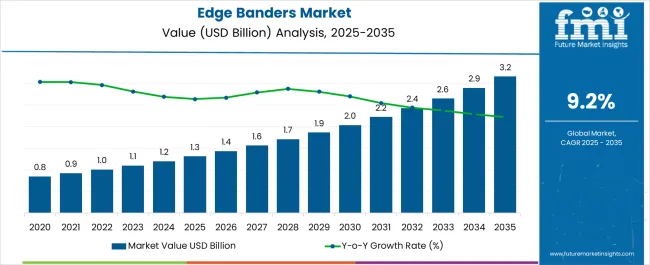
Edge Banders Market Key Takeaways
| Metric | Value |
|---|---|
| Edge Banders Market Estimated Value in (2025 E) | USD 1.3 billion |
| Edge Banders Market Forecast Value in (2035 F) | USD 3.2 billion |
| Forecast CAGR (2025 to 2035) | 9.2% |
Why is the Edge Banders Market Growing?
The Edge Banders market is experiencing substantial growth driven by the increasing demand for precision in woodworking and furniture manufacturing processes. The future outlook for this market is shaped by the rising adoption of automated and semi-automated machinery that enhances productivity, efficiency, and quality in production. Growth is further supported by investments in modern woodworking facilities, where manufacturers seek high-performance equipment to meet consumer expectations for durable and aesthetically superior furniture.
Continuous advancements in machine design and technology have enabled edge banders to handle a variety of materials and thicknesses, improving operational versatility. The demand for custom and modular furniture in both commercial and residential sectors has also contributed to market expansion.
Additionally, regulatory standards emphasizing workplace safety and operational reliability have encouraged the adoption of advanced edge banding solutions As manufacturers increasingly prioritize automation, precision, and reduced production downtime, the Edge Banders market is poised for steady growth across developed and emerging regions.
Segmental Analysis
The edge banders market is segmented by product type, application, operation, end-use, and geographic regions. By product type, edge banders market is divided into Single-Side and Double-Side. In terms of application, edge banders market is classified into Cabinet Making, Doors, Windows, Shelves, Tables, Consoles, Dressers, Chairs, Stools, and Others. Based on operation, edge banders market is segmented into Automatic and Manual. By end-use, edge banders market is segmented into Commercial, Residential, Industrial, Government, and Others. Regionally, the edge banders industry is classified into North America, Latin America, Western Europe, Eastern Europe, Balkan & Baltic Countries, Russia & Belarus, Central Asia, East Asia, South Asia & Pacific, and the Middle East & Africa.
Insights into the Single-Side Product Type Segment
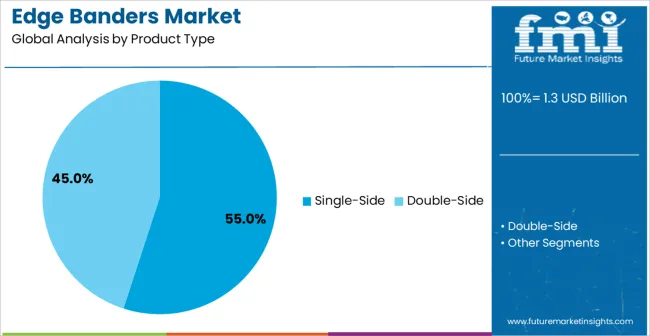
The single-side product type is projected to hold 55.00% of the Edge Banders market revenue share in 2025, establishing it as the leading product type. This dominance is attributed to the simplicity, cost-effectiveness, and efficiency of single-side edge banders, which allow operators to apply edge materials on one side of the workpiece with precision and speed.
The segment has been driven by growing demand in small to medium-scale furniture manufacturing units, where operational flexibility and ease of use are critical. Additionally, single-side edge banders require lower maintenance and provide reliable performance for high-volume production.
The ability to handle diverse edge materials, including PVC, ABS, and wood veneer, has further reinforced the adoption of this product type The focus on streamlining production processes while maintaining high-quality finishes has ensured the continued prominence of single-side edge banders in the market.
Insights into the Cabinet Making Application Segment
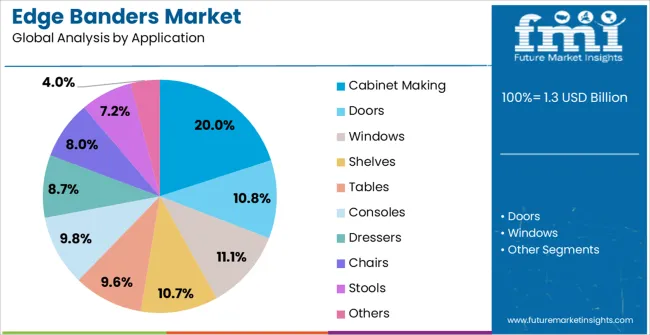
The cabinet making application segment is expected to capture 20.00% of the Edge Banders market revenue share in 2025, positioning it as the leading application. Growth in this segment is driven by the increasing demand for high-quality cabinets in residential and commercial construction projects.
Edge banders are extensively used to provide clean, durable, and aesthetically appealing edges to cabinet components, enhancing the final product quality. Automation and precision features in modern edge banders enable faster processing, reducing production time and labor costs.
The adoption of customized cabinet designs and modular units has further accelerated the demand for edge banding solutions The emphasis on efficiency, consistency, and high-quality finishes in cabinet production has reinforced the use of advanced edge banders in this application, maintaining its market leadership.
Insights into the Automatic Operation Segment
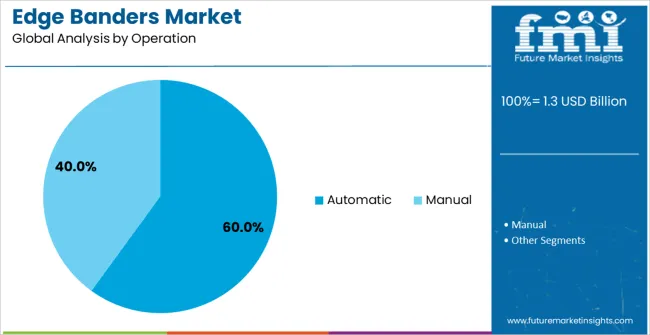
The automatic operation segment is anticipated to account for 60.00% of the Edge Banders market revenue in 2025, making it the dominant operation type. The growth of this segment is fueled by the need for higher efficiency, precision, and reduced labor dependency in woodworking operations.
Automatic edge banders offer consistent performance, faster processing speeds, and lower error rates, which are critical for large-scale production environments. The segment benefits from advancements in machine control systems, allowing seamless integration with production lines and improved workflow management.
The increasing focus on reducing production costs while maintaining high-quality outputs has further driven adoption of automatic edge banders Their ability to handle complex edge profiles and high-volume workloads has ensured continued dominance in the market, particularly among commercial and industrial furniture manufacturers.
Market Overview
Edge Banders Market Outlook (2025-2035)
The global edge banders market is estimated to exhibit growth at a robust CAGR over the forecast period 2025-2035. Rising emphasis on the introduction of advanced automatic and semi-automatic edge banders integrated with innovative technologies such as laser technology is expected to facilitate the growth in the market.
Edge banders are assistive wood trimming machines used to trim and stick side strips of furniture with the help of adhesives such as glue. They are also used to cover the exposed sides of materials such as medium density fibreboard (MDF), particleboard, or plywood,enhance the durability, and elevate the appearance of materials used in furniture.
To trim the side edged of furniture items in an efficient manner and as per the end user requirement, these trimming machines are incorporated with height adjusting and leveling pads, allowing the operator to adjust the height and level as per the furniture surface thickness. Edge banding increases the life of wooden products, by protecting them from moisture, increasing strength, and durability.
Attributed to these benefits, edge banding is gaining huge traction across the woodworking and furniture sector. It is increasingly being used for doors, kitchen furniture, windows, cabinets, and others, which is in turn, propelling the demand for edge banders.
Analysis of Edge Banders Market By Key Countries
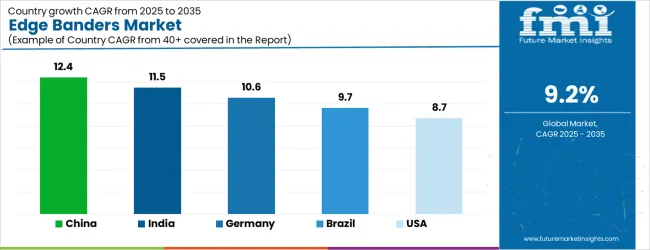
| Country | CAGR |
|---|---|
| China | 12.4% |
| India | 11.5% |
| Germany | 10.6% |
| Brazil | 9.7% |
| USA | 8.7% |
| UK | 7.8% |
| Japan | 6.9% |
Country-wise Analysis
The Edge Banders Market is expected to register a CAGR of 9.2% during the forecast period, exhibiting varied country level momentum. China leads with the highest CAGR of 12.4%, followed by India at 11.5%. Developed markets such as Germany, France, and the UK continue to expand steadily, while the USA is likely to grow at consistent rates. Japan posts the lowest CAGR at 6.9%, yet still underscores a broadly positive trajectory for the global Edge Banders Market. In 2024, Germany held a dominant revenue in the Western Europe market and is expected to grow with a CAGR of 10.6%. The USA Edge Banders Market is estimated to be valued at USD 448.9 million in 2025 and is anticipated to reach a valuation of USD 448.9 million by 2035. Sales are projected to rise at a CAGR of 0.0% over the forecast period between 2025 and 2035. While Japan and South Korea markets are estimated to be valued at USD 68.8 million and USD 40.5 million respectively in 2025.
Key Players in the Edge Banders Market
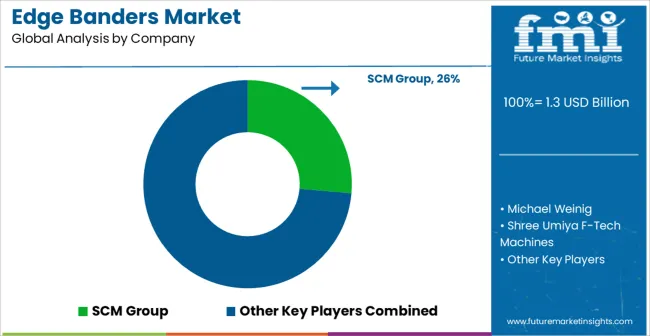
- SCM Group
- Michael Weinig
- Shree Umiya F-Tech Machines
- Nihar Industries
- Virutex
- JAI Industries
- Altendorf
- CO-MATIC Machinery
- Felder Group
- Golden Hill Woodworking Machinery
Scope of the Report
| Item | Value |
|---|---|
| Quantitative Units | USD 1.3 Billion |
| Product Type | Single-Side and Double-Side |
| Application | Cabinet Making, Doors, Windows, Shelves, Tables, Consoles, Dressers, Chairs, Stools, and Others |
| Operation | Automatic and Manual |
| End-Use | Commercial, Residential, Industrial, Government, and Others |
| Regions Covered | North America, Europe, Asia-Pacific, Latin America, Middle East & Africa |
| Country Covered | United States, Canada, Germany, France, United Kingdom, China, Japan, India, Brazil, South Africa |
| Key Companies Profiled | SCM Group, Michael Weinig, Shree Umiya F-Tech Machines, Nihar Industries, Virutex, JAI Industries, Altendorf, CO-MATIC Machinery, Felder Group, and Golden Hill Woodworking Machinery |
Edge Banders Market by Segments
Product Type:
- Single-Side
- Double-Side
Application:
- Cabinet Making
- Doors
- Windows
- Shelves
- Tables
- Consoles
- Dressers
- Chairs
- Stools
- Others
Operation:
- Automatic
- Manual
End-Use:
- Commercial
- Residential
- Industrial
- Government
- Others
Region:
- North America
- USA
- Canada
- Mexico
- Latin America
- Brazil
- Chile
- Rest of Latin America
- Western Europe
- Germany
- UK
- Italy
- Spain
- France
- Nordic
- BENELUX
- Rest of Western Europe
- Eastern Europe
- Russia
- Poland
- Hungary
- Balkan & Baltic
- Rest of Eastern Europe
- East Asia
- China
- Japan
- South Korea
- South Asia and Pacific
- India
- ASEAN
- Australia & New Zealand
- Rest of South Asia and Pacific
- Middle East & Africa
- Kingdom of Saudi Arabia
- Other GCC Countries
- Turkiye
- South Africa
- Other African Union
- Rest of Middle East & Africa
Frequently Asked Questions
How big is the edge banders market in 2025?
The global edge banders market is estimated to be valued at USD 1.3 billion in 2025.
What will be the size of edge banders market in 2035?
The market size for the edge banders market is projected to reach USD 3.2 billion by 2035.
How much will be the edge banders market growth between 2025 and 2035?
The edge banders market is expected to grow at a 9.2% CAGR between 2025 and 2035.
What are the key product types in the edge banders market?
The key product types in edge banders market are single-side and double-side.
Which application segment to contribute significant share in the edge banders market in 2025?
In terms of application, cabinet making segment to command 20.0% share in the edge banders market in 2025.
Preview the report firsthand - request a free sample
Get SampleGet the brochure for pricing and purchase details.
Get PDFTable of Content
- Executive Summary
- Global Market Outlook
- Demand-side Trends
- Supply-side Trends
- Technology Roadmap Analysis
- Analysis and Recommendations
- Market Overview
- Market Coverage / Taxonomy
- Market Definition / Scope / Limitations
- Market Background
- Market Dynamics
- Drivers
- Restraints
- Opportunity
- Trends
- Scenario Forecast
- Demand in Optimistic Scenario
- Demand in Likely Scenario
- Demand in Conservative Scenario
- Opportunity Map Analysis
- Product Life Cycle Analysis
- Supply Chain Analysis
- Investment Feasibility Matrix
- Value Chain Analysis
- PESTLE and Porter’s Analysis
- Regulatory Landscape
- Regional Parent Market Outlook
- Production and Consumption Statistics
- Import and Export Statistics
- Market Dynamics
- Global Market Analysis 2020 to 2024 and Forecast, 2025 to 2035
- Historical Market Size Value (USD Million) Analysis, 2020 to 2024
- Current and Future Market Size Value (USD Million) Projections, 2025 to 2035
- Y-o-Y Growth Trend Analysis
- Absolute $ Opportunity Analysis
- Global Market Pricing Analysis 2020 to 2024 and Forecast 2025 to 2035
- Global Market Analysis 2020 to 2024 and Forecast 2025 to 2035, By Product Type
- Introduction / Key Findings
- Historical Market Size Value (USD Million) Analysis By Product Type , 2020 to 2024
- Current and Future Market Size Value (USD Million) Analysis and Forecast By Product Type , 2025 to 2035
- Single-Side
- Double-Side
- Y-o-Y Growth Trend Analysis By Product Type , 2020 to 2024
- Absolute $ Opportunity Analysis By Product Type , 2025 to 2035
- Global Market Analysis 2020 to 2024 and Forecast 2025 to 2035, By Application
- Introduction / Key Findings
- Historical Market Size Value (USD Million) Analysis By Application, 2020 to 2024
- Current and Future Market Size Value (USD Million) Analysis and Forecast By Application, 2025 to 2035
- Cabinet Making
- Doors
- Windows
- Shelves
- Tables
- Consoles
- Dressers
- Chairs
- Stools
- Others
- Y-o-Y Growth Trend Analysis By Application, 2020 to 2024
- Absolute $ Opportunity Analysis By Application, 2025 to 2035
- Global Market Analysis 2020 to 2024 and Forecast 2025 to 2035, By Operation
- Introduction / Key Findings
- Historical Market Size Value (USD Million) Analysis By Operation, 2020 to 2024
- Current and Future Market Size Value (USD Million) Analysis and Forecast By Operation, 2025 to 2035
- Automatic
- Manual
- Y-o-Y Growth Trend Analysis By Operation, 2020 to 2024
- Absolute $ Opportunity Analysis By Operation, 2025 to 2035
- Global Market Analysis 2020 to 2024 and Forecast 2025 to 2035, By End-Use
- Introduction / Key Findings
- Historical Market Size Value (USD Million) Analysis By End-Use, 2020 to 2024
- Current and Future Market Size Value (USD Million) Analysis and Forecast By End-Use, 2025 to 2035
- Commercial
- Residential
- Industrial
- Government
- Others
- Y-o-Y Growth Trend Analysis By End-Use, 2020 to 2024
- Absolute $ Opportunity Analysis By End-Use, 2025 to 2035
- Global Market Analysis 2020 to 2024 and Forecast 2025 to 2035, By Region
- Introduction
- Historical Market Size Value (USD Million) Analysis By Region, 2020 to 2024
- Current Market Size Value (USD Million) Analysis and Forecast By Region, 2025 to 2035
- North America
- Latin America
- Western Europe
- Eastern Europe
- East Asia
- South Asia and Pacific
- Middle East & Africa
- Market Attractiveness Analysis By Region
- North America Market Analysis 2020 to 2024 and Forecast 2025 to 2035, By Country
- Historical Market Size Value (USD Million) Trend Analysis By Market Taxonomy, 2020 to 2024
- Market Size Value (USD Million) Forecast By Market Taxonomy, 2025 to 2035
- By Country
- USA
- Canada
- Mexico
- By Product Type
- By Application
- By Operation
- By End-Use
- By Country
- Market Attractiveness Analysis
- By Country
- By Product Type
- By Application
- By Operation
- By End-Use
- Key Takeaways
- Latin America Market Analysis 2020 to 2024 and Forecast 2025 to 2035, By Country
- Historical Market Size Value (USD Million) Trend Analysis By Market Taxonomy, 2020 to 2024
- Market Size Value (USD Million) Forecast By Market Taxonomy, 2025 to 2035
- By Country
- Brazil
- Chile
- Rest of Latin America
- By Product Type
- By Application
- By Operation
- By End-Use
- By Country
- Market Attractiveness Analysis
- By Country
- By Product Type
- By Application
- By Operation
- By End-Use
- Key Takeaways
- Western Europe Market Analysis 2020 to 2024 and Forecast 2025 to 2035, By Country
- Historical Market Size Value (USD Million) Trend Analysis By Market Taxonomy, 2020 to 2024
- Market Size Value (USD Million) Forecast By Market Taxonomy, 2025 to 2035
- By Country
- Germany
- UK
- Italy
- Spain
- France
- Nordic
- BENELUX
- Rest of Western Europe
- By Product Type
- By Application
- By Operation
- By End-Use
- By Country
- Market Attractiveness Analysis
- By Country
- By Product Type
- By Application
- By Operation
- By End-Use
- Key Takeaways
- Eastern Europe Market Analysis 2020 to 2024 and Forecast 2025 to 2035, By Country
- Historical Market Size Value (USD Million) Trend Analysis By Market Taxonomy, 2020 to 2024
- Market Size Value (USD Million) Forecast By Market Taxonomy, 2025 to 2035
- By Country
- Russia
- Poland
- Hungary
- Balkan & Baltic
- Rest of Eastern Europe
- By Product Type
- By Application
- By Operation
- By End-Use
- By Country
- Market Attractiveness Analysis
- By Country
- By Product Type
- By Application
- By Operation
- By End-Use
- Key Takeaways
- East Asia Market Analysis 2020 to 2024 and Forecast 2025 to 2035, By Country
- Historical Market Size Value (USD Million) Trend Analysis By Market Taxonomy, 2020 to 2024
- Market Size Value (USD Million) Forecast By Market Taxonomy, 2025 to 2035
- By Country
- China
- Japan
- South Korea
- By Product Type
- By Application
- By Operation
- By End-Use
- By Country
- Market Attractiveness Analysis
- By Country
- By Product Type
- By Application
- By Operation
- By End-Use
- Key Takeaways
- South Asia and Pacific Market Analysis 2020 to 2024 and Forecast 2025 to 2035, By Country
- Historical Market Size Value (USD Million) Trend Analysis By Market Taxonomy, 2020 to 2024
- Market Size Value (USD Million) Forecast By Market Taxonomy, 2025 to 2035
- By Country
- India
- ASEAN
- Australia & New Zealand
- Rest of South Asia and Pacific
- By Product Type
- By Application
- By Operation
- By End-Use
- By Country
- Market Attractiveness Analysis
- By Country
- By Product Type
- By Application
- By Operation
- By End-Use
- Key Takeaways
- Middle East & Africa Market Analysis 2020 to 2024 and Forecast 2025 to 2035, By Country
- Historical Market Size Value (USD Million) Trend Analysis By Market Taxonomy, 2020 to 2024
- Market Size Value (USD Million) Forecast By Market Taxonomy, 2025 to 2035
- By Country
- Kingdom of Saudi Arabia
- Other GCC Countries
- Turkiye
- South Africa
- Other African Union
- Rest of Middle East & Africa
- By Product Type
- By Application
- By Operation
- By End-Use
- By Country
- Market Attractiveness Analysis
- By Country
- By Product Type
- By Application
- By Operation
- By End-Use
- Key Takeaways
- Key Countries Market Analysis
- USA
- Pricing Analysis
- Market Share Analysis, 2024
- By Product Type
- By Application
- By Operation
- By End-Use
- Canada
- Pricing Analysis
- Market Share Analysis, 2024
- By Product Type
- By Application
- By Operation
- By End-Use
- Mexico
- Pricing Analysis
- Market Share Analysis, 2024
- By Product Type
- By Application
- By Operation
- By End-Use
- Brazil
- Pricing Analysis
- Market Share Analysis, 2024
- By Product Type
- By Application
- By Operation
- By End-Use
- Chile
- Pricing Analysis
- Market Share Analysis, 2024
- By Product Type
- By Application
- By Operation
- By End-Use
- Germany
- Pricing Analysis
- Market Share Analysis, 2024
- By Product Type
- By Application
- By Operation
- By End-Use
- UK
- Pricing Analysis
- Market Share Analysis, 2024
- By Product Type
- By Application
- By Operation
- By End-Use
- Italy
- Pricing Analysis
- Market Share Analysis, 2024
- By Product Type
- By Application
- By Operation
- By End-Use
- Spain
- Pricing Analysis
- Market Share Analysis, 2024
- By Product Type
- By Application
- By Operation
- By End-Use
- France
- Pricing Analysis
- Market Share Analysis, 2024
- By Product Type
- By Application
- By Operation
- By End-Use
- India
- Pricing Analysis
- Market Share Analysis, 2024
- By Product Type
- By Application
- By Operation
- By End-Use
- ASEAN
- Pricing Analysis
- Market Share Analysis, 2024
- By Product Type
- By Application
- By Operation
- By End-Use
- Australia & New Zealand
- Pricing Analysis
- Market Share Analysis, 2024
- By Product Type
- By Application
- By Operation
- By End-Use
- China
- Pricing Analysis
- Market Share Analysis, 2024
- By Product Type
- By Application
- By Operation
- By End-Use
- Japan
- Pricing Analysis
- Market Share Analysis, 2024
- By Product Type
- By Application
- By Operation
- By End-Use
- South Korea
- Pricing Analysis
- Market Share Analysis, 2024
- By Product Type
- By Application
- By Operation
- By End-Use
- Russia
- Pricing Analysis
- Market Share Analysis, 2024
- By Product Type
- By Application
- By Operation
- By End-Use
- Poland
- Pricing Analysis
- Market Share Analysis, 2024
- By Product Type
- By Application
- By Operation
- By End-Use
- Hungary
- Pricing Analysis
- Market Share Analysis, 2024
- By Product Type
- By Application
- By Operation
- By End-Use
- Kingdom of Saudi Arabia
- Pricing Analysis
- Market Share Analysis, 2024
- By Product Type
- By Application
- By Operation
- By End-Use
- Turkiye
- Pricing Analysis
- Market Share Analysis, 2024
- By Product Type
- By Application
- By Operation
- By End-Use
- South Africa
- Pricing Analysis
- Market Share Analysis, 2024
- By Product Type
- By Application
- By Operation
- By End-Use
- USA
- Market Structure Analysis
- Competition Dashboard
- Competition Benchmarking
- Market Share Analysis of Top Players
- By Regional
- By Product Type
- By Application
- By Operation
- By End-Use
- Competition Analysis
- Competition Deep Dive
- SCM Group
- Overview
- Product Portfolio
- Profitability by Market Segments (Product/Age /Sales Channel/Region)
- Sales Footprint
- Strategy Overview
- Marketing Strategy
- Product Strategy
- Channel Strategy
- Michael Weinig
- Shree Umiya F-Tech Machines
- Nihar Industries
- Virutex
- JAI Industries
- Altendorf
- CO-MATIC Machinery
- Felder Group
- Golden Hill Woodworking Machinery
- SCM Group
- Competition Deep Dive
- Assumptions & Acronyms Used
- Research Methodology


