

- Market Size (2026)
- USD 3.9 Bn
- Forecast (2036)
- USD 6.3 Bn
- CAGR (2026 to 2036)
- 5.0%
How big is Double Edge Banders Market in 2026?
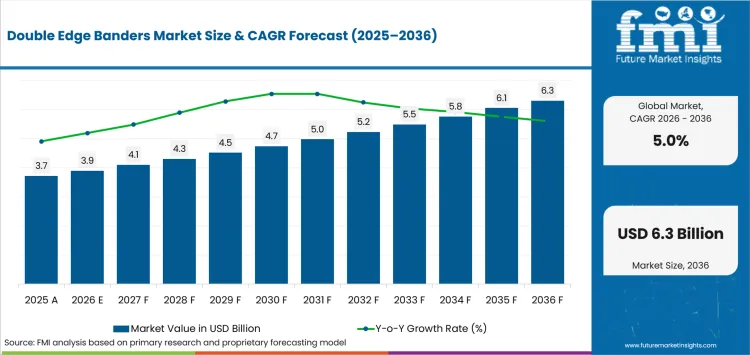
USD 3.9 billion in 2026 and USD 6.3 billion by 2036 at a 5.0% CAGR.
Sales of double edge banders are estimated to rise at 5.0% CAGR through 2036, taking valuation from USD 3.9 billion in 2026 to USD 6.3 billion by 2036. Plants justify synchronized edging where repeat panel runs keep both machining sides loaded and reduce return handling. HOMAG's May 2025 range paired digital controls with automation in several performance classes. That investment case depends on utilization and fast recovery from job changes instead of nominal feed speed alone.
Country conditions change how that investment case converts into replacement orders. The USA Census Bureau and HUD reported 1.525 million housing completions at a seasonally adjusted annual rate in December 2025. That construction base keeps cabinet production relevant to equipment planning without identifying which factories need synchronized lines. European plants face different order cycles and service structures. Double-edge projects therefore need local utilization proof plus field support that protects uptime after commissioning.
Key Takeaways
- Furniture and cabinet plants invest in double-edge processing where repeated two-side handling consumes labor and interrupts stable panel flow.
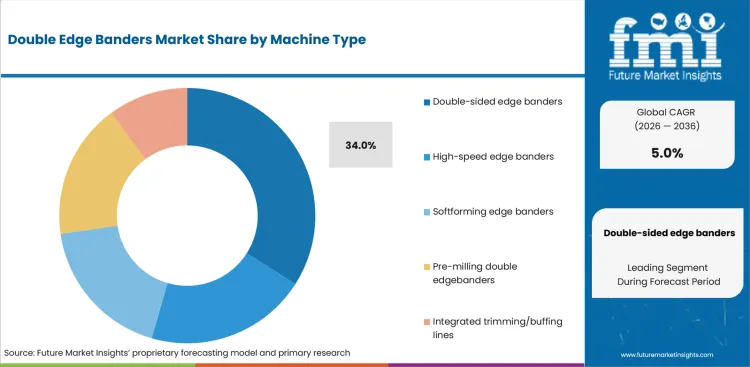
- Based on machine type, double-sided edge banders are projected to account for 34.0% in 2026 due to synchronized processing that removes a return pass from repeatable panel runs.
- By edge material, PVC is estimated to hold 31.0% in 2026 owing to roll-fed supply fitting familiar gluing and finishing routines.
- In 2026, cabinet panels are expected to lead panel type with 34.0% share because rectangular geometry supports predictable throughfeed utilization.
- High capital cost and uneven two-edge loading can delay replacement where furniture orders do not support steady production volume.
- Some of the key players in this market include HOMAG, Biesse, SCM Group, IMA Schelling, Cehisa, Felder Group, Brandt / HOMAG, KDT Machinery, Nanxing Machinery, and Casadei Busellato.
Analyst Perspective
"A double-edge line earns its return only if parallel-edge volume keeps both machining sides productive and changeovers recover quickly. Plants should weigh commissioning response and material switching against their actual cabinet or furniture mix before approving a larger synchronized system."
- Nikhil Kaitwade, Principal Consultant, Future Market Insights
How is the double edge banders market segmented?
The double edge banders market is segmented by machine type, edge material, panel type, automation level, sales channel and region.
Machine type covers double-sided, high-speed, softforming, pre-milling and integrated trimming/buffing systems. Edge materials include PVC, ABS, veneer, melamine and laser/zero-joint tape. Panel types cover cabinet, furniture, door, office furniture and kitchen components. Automation ranges from semi-automatic and CNC-controlled to fully automatic and line-integrated systems. Sales channels include machinery OEMs, furniture plant projects, dealer/distributor networks and aftermarket/service providers.
What makes double-sided edge banders central to the machine type category?
Double-sided platforms suit factories running rectangular panels at volumes that keep both machining sides productive. They remove a return loop that flexible single-sided woodworking machines still require for a second parallel edge.
- Based on machine type, double-sided edge banders are projected to account for 34.0% in 2026 due to simultaneous processing in repeatable series production.
- Nanxing Machinery's June 2025 LIGNA review documented flexible edge-banding solutions alongside nesting and drilling workstations. The event places edge processing inside a broader panel-flow offer for factories evaluating synchronized production.
Why does PVC lead the edge material category?
PVC gives industrial edging lines a familiar roll-fed input for trimming and finishing. Plants also compare glue behavior because hot melt adhesives must hold edge quality through repeated production changes without disrupting the line.
- By edge material, PVC is estimated to hold 31.0% in 2026 owing to its broad fit with roll-fed industrial glue and finishing practices.
- IMA Schelling documented an automated custom edging system in December 2025 after testing different edge materials and adhesive methods. The project confirms that material thickness and glue choice remain machine-configuration decisions and not cosmetic specifications.
How do cabinet panels shape demand within the panel type category?
Cabinet panels provide rectangular sides and shelves that suit programmed throughfeed processing. Their repeatable geometry also fits modular furniture programs that require consistent edges as dimensions change between product families.
- In 2026, cabinet panels are expected to lead panel type with 34.0% share because standardized geometry supports repeatable sequencing and line loading.
- Bureau of Labor Statistics data published in July 2025 placed production and nonsupervisory employment in wood kitchen cabinet and countertop manufacturing near 85,000. That workforce indicates a substantial operating base for panel-equipment replacement without proving the modeled share.
What supports fully automatic systems in the automation level category?
Fully automatic edging reduces manual work between panel identification and machine setup. The case strengthens in plants already using woodworking CNC tools because digital workpiece data can pass settings into edge processing with fewer operator decisions.
- By automation level, fully automatic systems are forecast to represent 43.0% in 2026 driven by programmed setup that reduces intervention during mixed production.
- Biesse demonstrated a batch-size-one line at IWF 2026 that linked CNC machining with robotic handling and edgebanding. Connected software let one operator run the workflow and gave plants a direct reference for labor and floor-space evaluation.
Why do machinery OEMs lead the sales channel category?
Double-edge installations need configuration and commissioning before regular production starts. Machinery OEMs can coordinate controls with adjacent furniture production equipment so one organisation retains accountability during ramp-up and later service.
- Machinery OEMs are set to lead the sales channel with 44.0% share in 2026 due to commissioning and lifecycle support required by integrated edge projects.
- Casadei Busellato scheduled partner-led demonstrations at Medwood in March 2026 with FLEXA edgebanders and local specialists. That route lets plants discuss production needs with the same channel that will support installation and service.
What are the drivers, restraints and opportunities in the Double Edge Banders Market?
Higher panel variety raises the value of programmable edge processing. Uneven furniture orders weaken utilization economics. Regional demonstrations and service support can reduce commissioning risk.
- Driver: Mixed panel programs increase the value of programmed settings that keep edge quality stable as jobs change.
- Restraint: Soft furniture output raises the utilization threshold required to justify a higher-capital synchronized edging line.
- Opportunity: Regional demonstrations and service coverage can shorten technical approval for plants moving from stand-alone edging to linked production.
Mixed jobs lose time if decor or thickness changes require manual reset between edge stages. Nanxing Machinery's April 2026 Tech Day placed automatic edge banding inside live Brazilian furniture factories with linked cutting and drilling. The demonstration lets plants test programmed job flow and reactive hot melt adhesive settings against their own panel mix before approving wider automation.
A synchronized line competes for capital with cutting and drilling bottlenecks in the same factory. ABIMÓVEL reported in March 2026 that Brazilian furniture and mattress output fell 1.2% in 2025. Softer volume raises underutilization risk, so plants require quantified labor savings and loading evidence before approving a higher-capital replacement.
Regional demonstrations reduce uncertainty for plants with little nearby experience of complex edge lines. Felder Group's February 2026 IndiaWood program presented the G 580 edgebander with quick-change glue options and on-site consultation. Live trials let furniture manufacturers compare automation and confirm glue changes against the actual panel mix before commissioning.
Which country CAGRs are profiled in the Double Edge Banders Market?
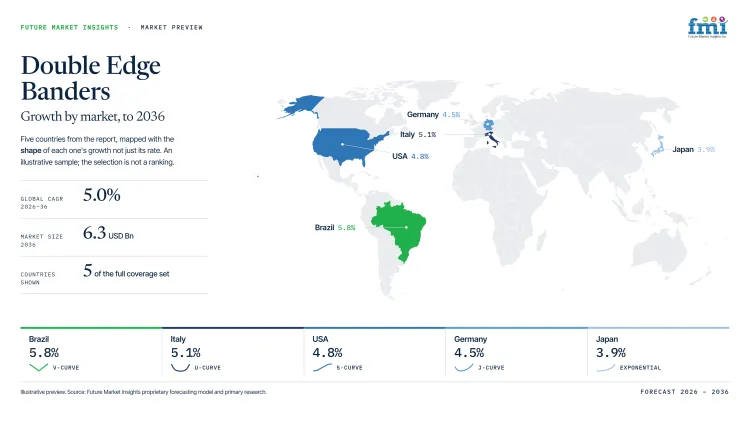
| Country | CAGR |
|---|---|
| Brazil | 5.8% |
| Mexico | 5.5% |
| Italy | 5.1% |
| USA | 4.8% |
| Germany | 4.5% |
| France | 4.2% |
| Japan | 3.9% |
How do country-level CAGRs compare in the Double Edge Banders Market?
Brazil and Mexico lead the profiled group with Italy above 5.0% CAGR. USA and Germany form the middle band. France and Japan depend more on replacement-led investment.
- Brazil faces tighter approval as machinery imports slow.
- Mexico's export clusters support larger automated furniture lines.
- Italy offers dense local access to machine engineering.
- USA replacements span widely different factory scales.
- Germany prioritizes controls compatibility during modernization.
- France compares nearby European machinery on technical fit.
- Japan's labor constraints raise the value of compact automation.
Similar CAGRs still produce different sales cycles and qualification routes. The full report provides country-level CAGR analysis across North America, Latin America, Western Europe, Eastern Europe, East Asia, South Asia and Pacific and the Middle East and Africa.
Country-wise Analysis
- Brazilian furniture production entered 2026 with selective machinery spending after a weak investment cycle, and ABIMÓVEL reported that machinery imports fell 13.2% in the first half from a year earlier. Brazil is projected to expand at 5.8% CAGR through 2036 owing to productivity investment by larger producers that can keep synchronized lines loaded and recover labor through programmed panel handling. Machinery fairs and dealer networks improve access to furniture production automation, but service distance outside southern clusters makes local parts stocking and staged financing important for companies seeking repeat orders from plants that modernize in smaller stages over time locally.
- Mexico has a large furniture base with many small establishments and a smaller group of industrial plants able to load synchronized equipment consistently through longer cabinet and case-goods runs for export orders. Data México counted 30,308 economic units in furniture and kitchen cabinet manufacturing during May 2026 and confirmed broad production depth alongside heavy fragmentation that raises selling and service costs. Double edge bander sales are forecast to rise at 5.5% CAGR through 2036 because larger factories can use automation with local service and smaller plants still require scalable machine tiers plus remote diagnostics and dealer financing for staged commissioning.
- Italian plants buy machinery within a deep woodworking engineering base, and Acimall's April 2025 release recorded a 7.1% year-over-year rise in domestic orders during the fourth quarter of 2024 after a mixed annual cycle. Adoption of double edge banders is estimated to expand at 5.1% CAGR through 2036 driven by factories that can assess automation against familiar technical benchmarks, existing particle board programs and established glue or finishing practices. Local engineering lowers qualification friction, but uneven capital timing favors modular upgrades and staged commissioning over complete line replacement because integrators can preserve conveyors and controls while adding edge capacity in steps.
- USA cabinet producers range from custom shops to industrial plants, so equipment proposals must separate flexible routing needs from repeatable volume that can justify synchronized two-edge processing and linked handling. Census and HUD reported a 745,000 seasonally adjusted annual rate for new-home sales in December 2025 and gave cabinet producers a current construction reference without identifying which factories need high-throughput equipment. The USA is anticipated to record 4.8% CAGR during the assessment period attributable to handling reduction and approval still depends on utilization screening plus regional parts coverage and compatibility with panel saw systems or drilling assets competing for the same capital.
- German furniture factories already understand integrated woodworking automation, and Destatis reported in March 2025 that domestic kitchen-furniture revenue declined 6.5% during 2024 as producers worked through a softer order base. Germany is forecast to grow at 4.5% CAGR between 2026 and 2036 aided by replacement projects that can prove labor savings, throughput gains and reliable changeover recovery against mature installed equipment during modernization programs. Dense technical service reduces installation risk, but weaker orders make retrofit compatibility and documented uptime more persuasive than maximum feed speed because plants want shorter shutdowns and reuse of existing conveyors and controls during uncertain demand.
- French panel processors can source machines from a mature European manufacturing and dealer base, but monthly furniture trade conditions still affect the timing of replacement projects and the scale of each approved installation. INSEE's August 2026 series placed June wholesale furniture sales volume at 103.25 on a 2021 base of 100, giving machinery sellers a current demand reference without proving machine purchases or synchronized-line utilization. Double edge bander demand is predicted to advance at 4.2% CAGR through 2036 shaped by mature replacement needs, with local service and mixed-material validation needed for plants using wood plastic composites under irregular investment schedules.
- Japanese furniture producers serve digital retail channels that reward assortment breadth, and METI reported a 32.58% B2C e-commerce ratio for its household goods plus furniture and interiors category in 2024 as online purchasing deepened. Japan is estimated to post 3.9% CAGR over the forecast period reinforced by flexible automation that fits smaller batches, frequent decor changes and compact production sites where floor space limits long synchronized lines. Strong engineering discipline supports qualification, but floor space and two-edge utilization make compact cells with predictable changeovers and remote diagnostics more credible than maximum-throughput equipment for factories that cannot keep both machining sides continuously loaded.
Who are the notable companies in the Double Edge Banders Market?
HOMAG, Biesse, SCM Group, IMA Schelling, Cehisa, Felder Group, Brandt / HOMAG, KDT Machinery, Nanxing Machinery and Casadei Busellato are active companies in this market.
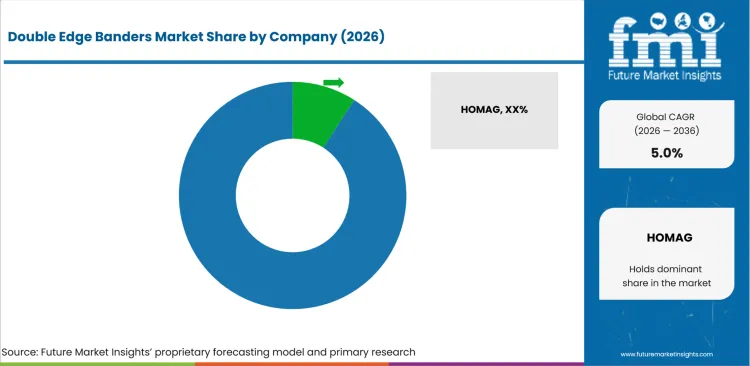
Competition separates integrated line builders from modular specialists. HOMAG and Biesse embed edging in automated factory programs. SCM Group and IMA Schelling do the same. KDT Machinery and Nanxing Machinery span broader panel lines. Cehisa, Felder Group and Brandt / HOMAG rely more on modular machines with Casadei Busellato.
- Integrated line suppliers include HOMAG and Biesse. SCM Group and IMA Schelling pair edging with CNC plus handling and controls.
- Panel automation groups: KDT Machinery and Nanxing Machinery place edge equipment inside wider furniture-production lines.
- Modular specialists include Cehisa and Felder Group. Brandt / HOMAG and Casadei Busellato serve varied output levels through dealer-led service.
Competitive Benchmarking: Double Edge Banders Market
| Company | Documented Edge-Processing Breadth | Automation and Connected Production | Service and Channel Coverage | Geographic Reach |
|---|---|---|---|---|
| HOMAG | High | High | High | Global |
| Biesse | High | High | High | Global |
| SCM Group | High | High | High | Global |
| IMA Schelling | High | High | High | Europe, North America and Asia |
| Cehisa | Medium | Medium | Medium | 60+ countries |
| Felder Group | Medium | High | High | Europe, North America and international markets |
| Brandt / HOMAG | Medium | High | High | HOMAG global network |
| KDT Machinery | High | High | High | Asia and international markets |
| Nanxing Machinery | High | High | High | Global |
| Casadei Busellato | Medium | Medium | Medium | Europe and international distributors |
Scoring basis: High breadth requires several edge routes, Medium narrower participation and Low one documented route. High automation requires connected controls or integrated production. High service coverage requires broad direct or dealer support. Medium marks multi-market support and Low restricted coverage. Geographic reach is descriptive.
Key Developments in the Double Edge Banders Market
- In March 2026, SCM Group presented the accord 500 edge during its Open House. Automated edge and glue changes reduce manual reset in mixed programs, though sufficient job volume is still required to justify the integrated CNC route.
- In October 2025, Casadei Busellato reopened its Thiene showroom with FLEXA 33 and FLEXA 53 edgebanders. Dealers gained a local setting to test connected equipment and service procedures before installation.
- In September 2025, KDT Machinery completed the acquisition of Foshan Hongmaster Numerical Control Technology. The transaction extends KDT's numerical-control base for integrated panel lines without proving double-edge sales.
Key Players in the Double Edge Banders Market
Integrated Industrial Edge and Line Specialists
- HOMAG
- Biesse
- SCM Group
- IMA Schelling
High-Throughput Panel Automation Suppliers
- KDT Machinery
- Nanxing Machinery
Modular and Channel-Led Edge Specialists
- Cehisa
- Felder Group
- Brandt / HOMAG
- Casadei Busellato
Double Edge Banders Market - Report Scope
| Coverage field | Report scope |
|---|---|
| Market breakdown | By machine type, edge material, panel type, automation level, sales channel and region. |
| Quantitative Units | USD billion. |
| Market Definition | Commercial double edge banders and directly attributable edge-processing line configurations used for synchronized panel edging within the stated segmentation boundary. |
| Regions Covered | North America, Latin America, Western Europe, Eastern Europe, East Asia, South Asia and Pacific and Middle East and Africa. |
| Countries Covered | Brazil, Mexico, Italy, USA, Germany, France, Japan, and 20+ countries included in the full report. |
| Key Companies Profiled | HOMAG, Biesse, SCM Group, IMA Schelling, Cehisa, Felder Group, Brandt / HOMAG, KDT Machinery, Nanxing Machinery, Casadei Busellato. |
| Forecast Period | 2026 to 2036. |
| Approach | Primary and secondary research with market triangulation. |
Double Edge Banders Market - Research Methodology
| Method | Approach |
|---|---|
| Primary Research | FMI analysts gathered input from manufacturers, service providers, technology developers, distributors, end users, procurement teams, and subject-matter experts. Interviews examined purchasing decisions, product or service evaluation, adoption barriers, approval requirements, pricing considerations, and expectations for technical or commercial support. Respondents were also asked what evidence is required before a trial, pilot, or initial order develops into regular purchasing. |
| Desk Research | Desk research covered government statistics, regulatory publications, trade data, industry associations, technical literature, standards, company filings, product information, and official corporate announcements. Sources were reviewed for relevance, publication date, geographic coverage, and consistency with the defined market scope. Claims relating to performance, applications, approvals, capacity, investment, and commercial activity were retained only when supported by credible public evidence. |
| Market Sizing and Forecasting | The market model combined the baseline value with historical performance, segment structure, pricing and volume indicators, adoption levels, company participation, and country-level demand conditions. Forecast assumptions considered economic activity, investment trends, regulatory developments, technology adoption, purchasing cycles, supply availability, and barriers to wider market use. Segment and regional estimates were reconciled before the final market total was calculated. |
| Data Validation | Estimates were checked against multiple independent indicators, including public data, company activity, trade patterns, industry developments, and findings from primary interviews. Validation also tested whether products, services, applications, and company revenues fell within the defined market boundaries. Adjacent categories, unsupported claims, overlapping revenues, and activities without direct market relevance were excluded to reduce double counting and maintain consistency across segments and countries. |
Double Edge Banders Market by Segments
Double Edge Banders Market segmented by Machine Type:
- Double-sided edge banders
- High-speed edge banders
- Softforming edge banders
- Pre-milling double edgebanders
- Integrated trimming/buffing lines
Double Edge Banders Market segmented by Edge Material:
- PVC
- ABS
- Veneer
- Melamine
- Laser/zero-joint edge tape
Double Edge Banders Market segmented by Panel Type:
- Cabinet panels
- Furniture panels
- Door panels
- Office furniture panels
- Kitchen components
Double Edge Banders Market segmented by Automation Level:
- Fully automatic
- Semi-automatic
- CNC-controlled
- Production-line integrated
Double Edge Banders Market segmented by Sales Channel:
- Machinery OEMs
- Furniture plant projects
- Dealer/distributor network
- Aftermarket/service
Double Edge Banders Market by Region:
- North America
- United States
- Canada
- Latin America
- Brazil
- Mexico
- Argentina
- Chile
- Western Europe
- Germany
- France
- United Kingdom
- Italy
- Spain
- Benelux
- Nordics
- Eastern Europe
- Poland
- Czech Republic
- Romania
- Hungary
- East Asia
- China
- Japan
- South Korea
- South Asia and Pacific
- India
- ASEAN
- Australia and New Zealand
- Middle East and Africa
- GCC Countries
- South Africa
- Türkiye
- Israel
Research Sources and Bibliography
- HOMAG. (2025, May 26). Future-oriented solutions for carpenters/joiners in all performance classes of edge banding machines.
- USA Census Bureau & USA Department of Housing and Urban Development. (2026, February 18). Monthly new residential construction, December 2025.
- Nanxing Machinery. (2025, June 6). LIGNA 2025 / Hannover, Germany.
- IMA Schelling Group. (2025, December 3). Automated production of handleless fronts.
- USA Bureau of Labor Statistics. (2025, July). Employment of production and nonsupervisory employees on private nonfarm payrolls by industry sector, seasonally adjusted.
- Biesse. (2026, August 25). IWF 2026.
- Casadei Busellato. (2026, March 10). Casadei Busellato together with Athanassopoulos and AGM Machines at Medwood 2026.
- SCM Group. (2026, March 16). SCM Open House Rimini 2026.
- Nanxing Machinery. (2026, April 28).Nanxing Tech Day Brazil: Advancing the Future of Woodworking Machinery.
- ABIMÓVEL. (2026, March 5). Indústria de móveis fechou 2025 com queda na produção.
- Deutsche Messe. (2025). LIGNA exhibitor 2025: CEHISA.
- ABIMÓVEL. (2026, August 3). Conjuntura ABIMÓVEL: mercado interno recuperou certo fôlego, enquanto exportações de móveis seguiram em baixa no 2º trimestre.
- Secretaría de Economía, Data México. (2026, May). Household and institutional furniture and kitchen cabinet manufacturing.
- Acimall. (2025, April 17). Wood and furniture technologies: An industry searching for a new identity?
- USA Census Bureau & USA Department of Housing and Urban Development. (2026, February 20). Monthly new residential sales, December 2025.
- Statistisches Bundesamt. (2025, March 20). Möbelindustrie verzeichnet 2024 Umsatzrückgang von 7,8 %.
- INSEE. (2026, August 21). Volume of sales index - Wholesale trade services of furniture, carpets and lighting equipment.
- Ministry of Economy, Trade and Industry. (2025, August 26). Results of FY2024 E-Commerce Market Survey Compiled.
- Casadei Busellato. (2025, October 24). Partnership, innovation, and services: Casadei Busellato's open house was a success.
- KDT Machinery. (2025, September 2). KDT Group acquires Hongmaster to accelerate deployment in high-end intelligent manufacturing.
- Felder Group. (2026, February 26). IndiaWood 2026.
- Biesse. (2026, February 2). Biesse strengthens its presence in Latin America through expansion in Mexico.
- IMA Schelling Group. (2026, May 18). Connected Manufacturing: The Edge as an Integrated System Component.
- HOMAG. (2025, July 9). HOMAG invests heavily in Schopfloch.
- Felder Group. (2025, October). Woodworking Technology Days 2025.
- Nanxing Machinery. (2026, June 23). Nanxing Machinery partners with CNC Automation to expand North American presence.
- Casadei Busellato. (2026, April 15). See you at Xylexpo 2026!
- HOMAG. (2026, February 26). Indiawood.
- IMA Schelling Group. (2025, October 7). Robots set to revolutionise furniture production.
- KDT Machinery. (2025, November 10). Empowering Global Excellence: KDT's CNC Training System Forges Your Worldwide Competitiveness.
- Nanxing Machinery. (2026, September 2). CIFF Shanghai 2026: Nanxing Machinery to Showcase Smart Furniture Manufacturing Solutions.
This bibliography is provided for reader reference and is not exhaustive. The full report contains the complete reference list and detailed citations.
This Report Answers
- What is the double edge banders market size in 2026 and 2036?
- Which production conditions justify synchronized two-edge processing?
- Why do double-sided edge banders lead machine type demand?
- How do PVC and cabinet panels affect machine configuration?
- Why do fully automatic systems matter in mixed panel production?
- How do growth rates differ among the profiled countries?
- Which companies provide integrated, automated or modular edge-processing systems?
- Which capital and service frictions delay replacement projects?
Frequently Asked Questions
How big is the double edge banders market in 2026?
The double edge banders market is valued at USD 3.9 billion in 2026 and is projected to reach USD 6.3 billion by 2036. Growth follows investment in synchronized edge processing that removes repeated panel handling.
What is the CAGR of the double edge banders market from 2026 to 2036?
The double edge banders market is projected to grow at a CAGR of 5.0% between 2026 and 2036. Expansion depends on two-edge volume and automation fitting the plant's actual production flow.
Which machine type leads the double edge banders market?
The double-sided edge banders segment is expected to hold 34.0% of the double edge banders market in 2026 due to simultaneous parallel-edge processing. Series production gives synchronized systems the clearest utilization case.
Which edge material leads the double edge banders market?
The PVC segment is estimated to hold 31.0% of the double edge banders market in 2026 because roll-fed supply fits familiar gluing and finishing routines. Familiar material handling reduces setup disruption during cabinet runs.
Which countries are projected to record the highest growth in the double edge banders market?
Brazil is projected to grow at 5.8% CAGR followed by Mexico at 5.5% and Italy at 5.1% through 2036. Their faster rates come from different automation and service conditions without implying larger installed bases.
Which companies are active in the double edge banders market?
Key companies operating in the market include HOMAG, Biesse, SCM Group, IMA Schelling, Cehisa, Felder Group, Brandt / HOMAG, KDT Machinery, Nanxing Machinery and Casadei Busellato. They compete on edge-processing breadth and service-backed automation.
Preview the report firsthand - request a free sample
Get SampleGet the brochure for pricing and purchase details.
Get PDFTable of Content
- Key Takeaways
- Market Size and CAGR
- Top Growth Driver
- Fastest Growing Segment
- Leading Region
- Key Companies
- Emerging Opportunities
- Executive Summary
- Global Market Outlook
- Demand-side Trends
- Supply-side Trends
- Technology Roadmap Analysis
- Analysis and Recommendations
- Analyst Perspective (What is happening? Why now? What should investors know?)
- Key Questions Answered
- How large is the market?
- What is the CAGR?
- What are key trends?
- Which region dominates?
- Who are the leaders?
- Market Overview
- Market Coverage / Taxonomy
- Market Definition / Scope / Limitations
- Research Methodology
- Chapter Orientation
- Analytical Lens and Working Hypotheses
- Market Structure, Signals, and Trend Drivers
- Benchmarking and Cross-market Comparability
- Market Sizing, Forecasting, and Opportunity Mapping
- Research Design and Evidence Framework
- Desk Research Programme (Secondary Evidence)
- Expert Input and Fieldwork (Primary Evidence)
- Tooling, Models, and Reference Databases
- Data Engineering and Model Build
- Quality Assurance and Audit Trail
- Market Background
- Market Dynamics (Drivers, Restraints, Opportunity, Trends)
- Scenario Forecast (Optimistic, Likely, Conservative)
- Impact Analysis
- AI Impact
- Sustainability Impact
- Regulatory Impact
- Technology Impact
- Consumer / Buyer Analysis
- Purchase Drivers
- Adoption Barriers
- Buyer Journey
- Opportunity Map Analysis
- Product Life Cycle Analysis
- Supply Chain Analysis
- Investment Feasibility Matrix
- Value Chain Analysis
- PESTLE and Porter's Analysis
- Regulatory Landscape
- Regional Parent Market Outlook
- Production and Consumption Statistics
- Import and Export Statistics
- Global Market Analysis and Forecast, 2021 to 2036
- Historical Market Size Value (USD Billion) Analysis, 2021 to 2025
- Current and Future Market Size Value (USD Billion) Projections, 2026 to 2036
- Y-o-Y Growth Trend Analysis
- Absolute $ Opportunity Analysis
- Global Market Pricing Analysis, 2021 to 2036
- Global Market Analysis and Forecast, By Machine Type, 2021 to 2036
- Introduction / Key Findings
- Historical Market Size Value (USD Billion) Analysis By Machine Type, 2021 to 2025
- Current and Future Market Size Value (USD Billion) Analysis and Forecast By Machine Type, 2026 to 2036
- Double-sided edge banders
- High-speed edge banders
- Softforming edge banders
- Pre-milling double edgebanders
- Integrated trimming/buffing lines
- Double-sided edge banders
- Y-o-Y Growth Trend Analysis By Machine Type, 2021 to 2025
- Absolute $ Opportunity Analysis By Machine Type, 2026 to 2036
- Global Market Analysis and Forecast, By Edge Material, 2021 to 2036
- Introduction / Key Findings
- Historical Market Size Value (USD Billion) Analysis By Edge Material, 2021 to 2025
- Current and Future Market Size Value (USD Billion) Analysis and Forecast By Edge Material, 2026 to 2036
- PVC
- ABS
- Veneer
- Melamine
- Laser/zero-joint edge tape
- PVC
- Y-o-Y Growth Trend Analysis By Edge Material, 2021 to 2025
- Absolute $ Opportunity Analysis By Edge Material, 2026 to 2036
- Global Market Analysis and Forecast, By Panel Type, 2021 to 2036
- Introduction / Key Findings
- Historical Market Size Value (USD Billion) Analysis By Panel Type, 2021 to 2025
- Current and Future Market Size Value (USD Billion) Analysis and Forecast By Panel Type, 2026 to 2036
- Cabinet panels
- Furniture panels
- Door panels
- Office furniture panels
- Kitchen components
- Cabinet panels
- Y-o-Y Growth Trend Analysis By Panel Type, 2021 to 2025
- Absolute $ Opportunity Analysis By Panel Type, 2026 to 2036
- Global Market Analysis and Forecast, By Automation Level, 2021 to 2036
- Introduction / Key Findings
- Historical Market Size Value (USD Billion) Analysis By Automation Level, 2021 to 2025
- Current and Future Market Size Value (USD Billion) Analysis and Forecast By Automation Level, 2026 to 2036
- Fully automatic
- Semi-automatic
- CNC-controlled
- Production-line integrated
- Fully automatic
- Y-o-Y Growth Trend Analysis By Automation Level, 2021 to 2025
- Absolute $ Opportunity Analysis By Automation Level, 2026 to 2036
- Global Market Analysis and Forecast, By Sales Channel, 2021 to 2036
- Introduction / Key Findings
- Historical Market Size Value (USD Billion) Analysis By Sales Channel, 2021 to 2025
- Current and Future Market Size Value (USD Billion) Analysis and Forecast By Sales Channel, 2026 to 2036
- Machinery OEMs
- Furniture plant projects
- Dealer/distributor network
- Aftermarket/service
- Machinery OEMs
- Y-o-Y Growth Trend Analysis By Sales Channel, 2021 to 2025
- Absolute $ Opportunity Analysis By Sales Channel, 2026 to 2036
- Global Market Analysis and Forecast, By Region, 2021 to 2036
- Introduction
- Historical Market Size Value (USD Billion) Analysis By Region, 2021 to 2025
- Current Market Size Value (USD Billion) Analysis and Forecast By Region, 2026 to 2036
- North America
- Latin America
- Western Europe
- Eastern Europe
- East Asia
- South Asia and Pacific
- Middle East & Africa
- Market Attractiveness Analysis By Region
- North America Market Analysis and Forecast, By Country, 2021 to 2036
- Historical Market Size Value (USD Billion) Trend Analysis By Market Taxonomy, 2021 to 2025
- Market Size Value (USD Billion) Forecast By Market Taxonomy, 2026 to 2036
- By Country
- USA
- Canada
- By Machine Type
- By Edge Material
- By Panel Type
- By Automation Level
- By Sales Channel
- By Country
- Market Attractiveness Analysis
- By Country
- By Machine Type
- By Edge Material
- By Panel Type
- By Automation Level
- By Sales Channel
- Key Takeaways
- Latin America Market Analysis and Forecast, By Country
- Historical Market Size Value (USD Billion) Trend Analysis By Market Taxonomy, 2021 to 2025
- Market Size Value (USD Billion) Forecast By Market Taxonomy, 2026 to 2036
- By Country
- Brazil
- Mexico
- Chile
- Rest of Latin America
- By Machine Type
- By Edge Material
- By Panel Type
- By Automation Level
- By Sales Channel
- By Country
- Market Attractiveness Analysis
- By Country
- By Machine Type
- By Edge Material
- By Panel Type
- By Automation Level
- By Sales Channel
- Key Takeaways
- Western Europe Market Analysis and Forecast, By Country
- Historical Market Size Value (USD Billion) Trend Analysis By Market Taxonomy, 2021 to 2025
- Market Size Value (USD Billion) Forecast By Market Taxonomy, 2026 to 2036
- By Country
- Germany
- UK
- Italy
- Spain
- France
- Nordic
- BENELUX
- Rest of Western Europe
- By Machine Type
- By Edge Material
- By Panel Type
- By Automation Level
- By Sales Channel
- By Country
- Market Attractiveness Analysis
- By Country
- By Machine Type
- By Edge Material
- By Panel Type
- By Automation Level
- By Sales Channel
- Key Takeaways
- Eastern Europe Market Analysis and Forecast, By Country
- Historical Market Size Value (USD Billion) Trend Analysis By Market Taxonomy, 2021 to 2025
- Market Size Value (USD Billion) Forecast By Market Taxonomy, 2026 to 2036
- By Country
- Russia
- Poland
- Hungary
- Balkan & Baltic
- Rest of Eastern Europe
- By Machine Type
- By Edge Material
- By Panel Type
- By Automation Level
- By Sales Channel
- By Country
- Market Attractiveness Analysis
- By Country
- By Machine Type
- By Edge Material
- By Panel Type
- By Automation Level
- By Sales Channel
- Key Takeaways
- East Asia Market Analysis and Forecast, By Country
- Historical Market Size Value (USD Billion) Trend Analysis By Market Taxonomy, 2021 to 2025
- Market Size Value (USD Billion) Forecast By Market Taxonomy, 2026 to 2036
- By Country
- China
- Japan
- South Korea
- By Machine Type
- By Edge Material
- By Panel Type
- By Automation Level
- By Sales Channel
- By Country
- Market Attractiveness Analysis
- By Country
- By Machine Type
- By Edge Material
- By Panel Type
- By Automation Level
- By Sales Channel
- Key Takeaways
- South Asia and Pacific Market Analysis and Forecast, By Country
- Historical Market Size Value (USD Billion) Trend Analysis By Market Taxonomy, 2021 to 2025
- Market Size Value (USD Billion) Forecast By Market Taxonomy, 2026 to 2036
- By Country
- India
- ASEAN
- Australia & New Zealand
- Rest of South Asia and Pacific
- By Machine Type
- By Edge Material
- By Panel Type
- By Automation Level
- By Sales Channel
- By Country
- Market Attractiveness Analysis
- By Country
- By Machine Type
- By Edge Material
- By Panel Type
- By Automation Level
- By Sales Channel
- Key Takeaways
- Middle East & Africa Market Analysis and Forecast, By Country
- Historical Market Size Value (USD Billion) Trend Analysis By Market Taxonomy, 2021 to 2025
- Market Size Value (USD Billion) Forecast By Market Taxonomy, 2026 to 2036
- By Country
- Kingdom of Saudi Arabia
- Other GCC Countries
- Türkiye
- South Africa
- Other African Union
- Rest of Middle East & Africa
- By Machine Type
- By Edge Material
- By Panel Type
- By Automation Level
- By Sales Channel
- By Country
- Market Attractiveness Analysis
- By Country
- By Machine Type
- By Edge Material
- By Panel Type
- By Automation Level
- By Sales Channel
- Key Takeaways
- Key Countries Market Analysis
- USA
- Pricing Analysis
- Market Share Analysis, 2025
- By Machine Type
- By Edge Material
- By Panel Type
- By Automation Level
- By Sales Channel
- Canada
- Pricing Analysis
- Market Share Analysis, 2025
- By Machine Type
- By Edge Material
- By Panel Type
- By Automation Level
- By Sales Channel
- Mexico
- Pricing Analysis
- Market Share Analysis, 2025
- By Machine Type
- By Edge Material
- By Panel Type
- By Automation Level
- By Sales Channel
- Brazil
- Pricing Analysis
- Market Share Analysis, 2025
- By Machine Type
- By Edge Material
- By Panel Type
- By Automation Level
- By Sales Channel
- Chile
- Pricing Analysis
- Market Share Analysis, 2025
- By Machine Type
- By Edge Material
- By Panel Type
- By Automation Level
- By Sales Channel
- Germany
- Pricing Analysis
- Market Share Analysis, 2025
- By Machine Type
- By Edge Material
- By Panel Type
- By Automation Level
- By Sales Channel
- UK
- Pricing Analysis
- Market Share Analysis, 2025
- By Machine Type
- By Edge Material
- By Panel Type
- By Automation Level
- By Sales Channel
- Italy
- Pricing Analysis
- Market Share Analysis, 2025
- By Machine Type
- By Edge Material
- By Panel Type
- By Automation Level
- By Sales Channel
- Spain
- Pricing Analysis
- Market Share Analysis, 2025
- By Machine Type
- By Edge Material
- By Panel Type
- By Automation Level
- By Sales Channel
- France
- Pricing Analysis
- Market Share Analysis, 2025
- By Machine Type
- By Edge Material
- By Panel Type
- By Automation Level
- By Sales Channel
- India
- Pricing Analysis
- Market Share Analysis, 2025
- By Machine Type
- By Edge Material
- By Panel Type
- By Automation Level
- By Sales Channel
- ASEAN
- Pricing Analysis
- Market Share Analysis, 2025
- By Machine Type
- By Edge Material
- By Panel Type
- By Automation Level
- By Sales Channel
- Australia & New Zealand
- Pricing Analysis
- Market Share Analysis, 2025
- By Machine Type
- By Edge Material
- By Panel Type
- By Automation Level
- By Sales Channel
- China
- Pricing Analysis
- Market Share Analysis, 2025
- By Machine Type
- By Edge Material
- By Panel Type
- By Automation Level
- By Sales Channel
- Japan
- Pricing Analysis
- Market Share Analysis, 2025
- By Machine Type
- By Edge Material
- By Panel Type
- By Automation Level
- By Sales Channel
- South Korea
- Pricing Analysis
- Market Share Analysis, 2025
- By Machine Type
- By Edge Material
- By Panel Type
- By Automation Level
- By Sales Channel
- Russia
- Pricing Analysis
- Market Share Analysis, 2025
- By Machine Type
- By Edge Material
- By Panel Type
- By Automation Level
- By Sales Channel
- Poland
- Pricing Analysis
- Market Share Analysis, 2025
- By Machine Type
- By Edge Material
- By Panel Type
- By Automation Level
- By Sales Channel
- Hungary
- Pricing Analysis
- Market Share Analysis, 2025
- By Machine Type
- By Edge Material
- By Panel Type
- By Automation Level
- By Sales Channel
- Kingdom of Saudi Arabia
- Pricing Analysis
- Market Share Analysis, 2025
- By Machine Type
- By Edge Material
- By Panel Type
- By Automation Level
- By Sales Channel
- Türkiye
- Pricing Analysis
- Market Share Analysis, 2025
- By Machine Type
- By Edge Material
- By Panel Type
- By Automation Level
- By Sales Channel
- South Africa
- Pricing Analysis
- Market Share Analysis, 2025
- By Machine Type
- By Edge Material
- By Panel Type
- By Automation Level
- By Sales Channel
- USA
- Market Structure Analysis
- Competition Dashboard
- Competition Benchmarking
- Market Share Analysis of Top Players
- By Regional
- By Machine Type
- By Edge Material
- By Panel Type
- By Automation Level
- By Sales Channel
- Emerging Startups
- Innovation Benchmarking
- Competition Analysis
- Competition Deep Dive
- HOMAG
- Overview
- Product Portfolio
- Profitability by Market Segments
- Sales Footprint
- Strategy Overview
- Marketing Strategy
- Product Strategy
- Channel Strategy
- Biesse
- SCM Group
- IMA Schelling
- Cehisa
- Felder Group
- Brandt / HOMAG
- KDT Machinery
- Nanxing Machinery
- Casadei Busellato
- HOMAG
- Case Studies
- Success Stories
- Recent Developments
- Competition Deep Dive
- Assumptions & Acronyms Used


