

- Market Size (2026)
- USD 920.7 Mn
- Forecast (2036)
- USD 1880.0 Mn
- CAGR (2026 to 2036)
- 7.4%
How big is the edge trimming equipment market in 2026?
USD 920.7 million in 2026 and USD 1,880.0 million by 2036 at a 7.4% CAGR.
The edge trimming equipment market is expected to rise from USD 857.3 million in 2025 to USD 1,880.0 million by 2036. The demand is predicted to rise at a 7.4% CAGR, driven by wafer thinning and advanced packaging lines that need edge protection before grinding. Advanced packaging is projected to hold 29.6% application share in 2026, and 300 mm formats with 52.4% share in 2026, supported by high-volume fabs using this size for cost control.
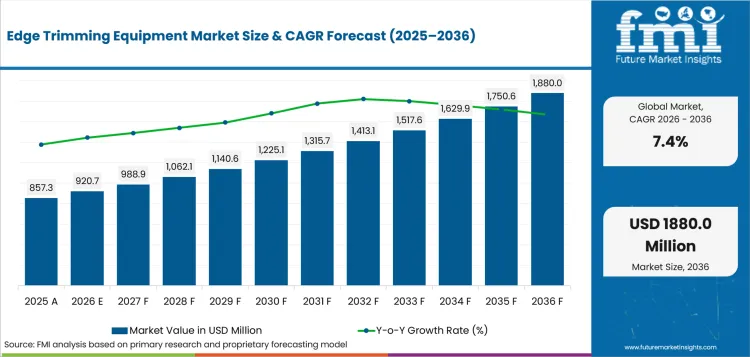
| Metric | Value |
|---|---|
| 2026 Market Size | USD 920.7 million |
| 2036 Market Size | USD 1,880.0 million |
| Forecast CAGR (2026-2036) | 7.4% |
| Leading Equipment Type | Wafer Edge Trimmers |
| Wafer Edge Trimmers Share (2026) | 45.8% |
| Leading Automation | Fully Automatic |
| Fully Automatic Share (2026) | 63.5% |
| Fastest-growing Country | China |
| China CAGR by 2036 | 8.3% |
Summary of the Edge Trimming Equipment Market
| Market Signal | Commercial Impact |
|---|---|
| Demand and Growth Drivers | Semiconductor manufacturing expansion is increasing demand for edge trimming equipment.
|
| Product and Segment View | Wafer edge trimmers, wafer thinning, fully automatic systems, and direct OEM channels dominate their respective segment categories.
|
| Geography and Growth Outlook | Japan remains the leading equipment supply hub, while China and South Korea deliver the strongest growth outlook.
|
| Competitive Landscape | Competition centers on precision automation, process qualification, and wafer handling performance.
|
| Analyst Perspective | Edge trimming equipment is becoming a yield-protection investment rather than a standalone process tool.
- Anurag Sharma, Principal Analyst at Future Market Insights |
Industry growth is supported by wafer thinning and advanced packaging lines that need edge protection before grinding. SEMI reported semiconductor manufacturing equipment sales of USD 135.1 billion in 2025 and projected 300 mm fab equipment spending at USD 133 billion in 2026. This spending signal is important because edge damage can turn a high-value wafer into a yield loss before packaging value is captured.
Which factors support expansion in the edge trimming equipment market?
Finished process-tool revenue and wafer-handling service form the value base across semiconductor fabs.
- Market value is supported by wafer edge trimmers sold into thinning lines before packaging work adds downstream demand.
- Supplier pricing reflects motion control and field service before consumables contribute to repeat revenue.
- Revenue improves when fabs use trimming to reduce edge chips before expensive back-end process steps.
- Buyer trust rises when tool data shows a clear link with lower post-grind breakage.
Why is the edge trimming equipment market growing?
Thin wafers often break first at the edge. Fabs remove rounded bevel areas before grinding to reduce that failure point.
SEMI projected 300 mm fab equipment spending of USD 133 billion in 2026. The figure shows why high-value fabs add process steps that protect yield. Edge trimming gives buyers a practical way to reduce chips before grinding and dicing.
Advanced packaging is changing how buyers evaluate edge trimming. A lost wafer late in the line costs more than a controlled trim step early in the flow. That cost difference supports demand for stable recipes and clean wafer handling.
How is the edge trimming equipment market segmented?
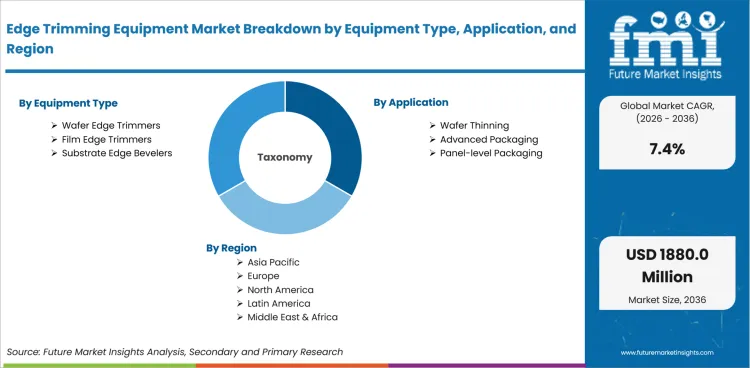
The edge trimming equipment industry is segmented by equipment type, application, wafer / panel size, automation, sales channel, region.
- Wafer edge trimmers are projected to secure 45.8% share in 2026. Buyers value their role in bevel control before grinding.
- Wafer thinning is expected to hold 41.2% share in 2026. The process creates the clearest case for breakage prevention.
- 300 mm formats are projected to hold 52.4% share in 2026. Mainstream logic and memory fabs specify this size for high-volume production.
- Fully automatic systems are anticipated to capture 63.5% share in 2026. Automation reduces operator handling risk in thin-wafer lines.
- Direct OEM channels are forecast to represent 72.8% share in 2026. Fabs qualify tools through vendor-led trials before purchase approval.
Why do wafer edge trimmers lead the edge trimming equipment market?
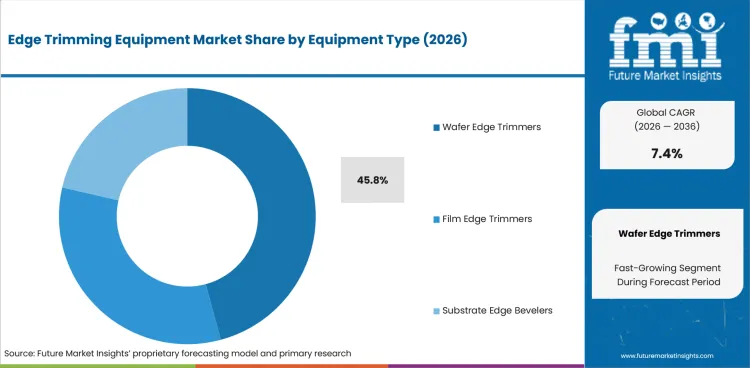
- Wafer Edge Trimmers are expected to account for 45.8% share in 2026. Their value comes from removing bevel stress before grinding.
- Film and panel trimmers gain use in packaging lines. Demand remains more project-specific than demand for wafer tools.
Which application leads the edge trimming equipment market?
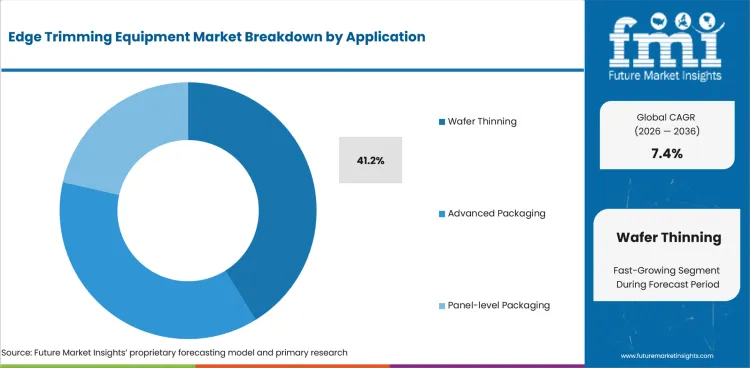
- Wafer Thinning is projected to hold 41.2% share in 2026. Thin wafers need edge protection before thickness reduction begins.
- Advanced Packaging gains value when chiplet and stacked flows increase the cost of breakage.
Which wafer or panel size leads the edge trimming equipment market?
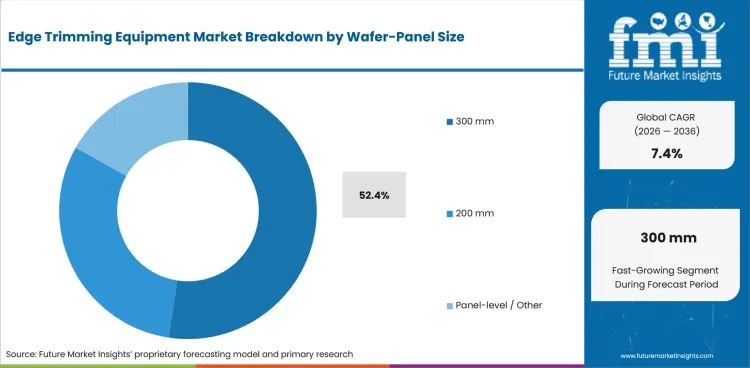
- 300 mm formats are anticipated to represent 52.4% share in 2026. Large-wafer automation raises the value of controlled edge trimming.
- Panel-level formats require different fixtures. Suppliers must solve a separate design challenge around larger substrate handling.
Which automation type leads the edge trimming equipment market?
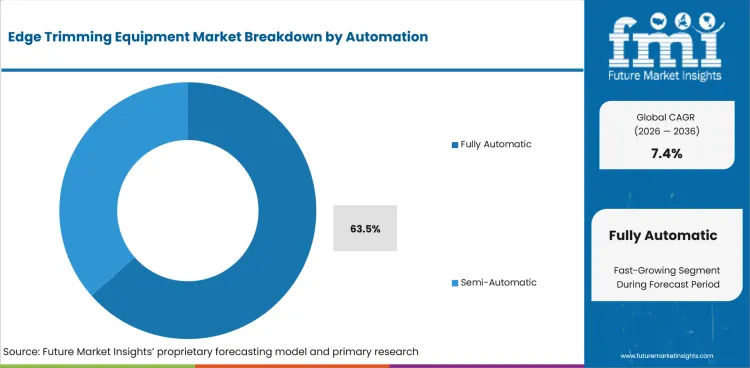
- Fully Automatic systems are projected to account for 63.5% share in 2026. Controlled loading lowers handling variation in fragile wafer flows.
- Semi-automatic tools fit older lines and smaller process trials. Their use is more limited in high-value wafer flows.
Which sales channel leads the edge trimming equipment market?
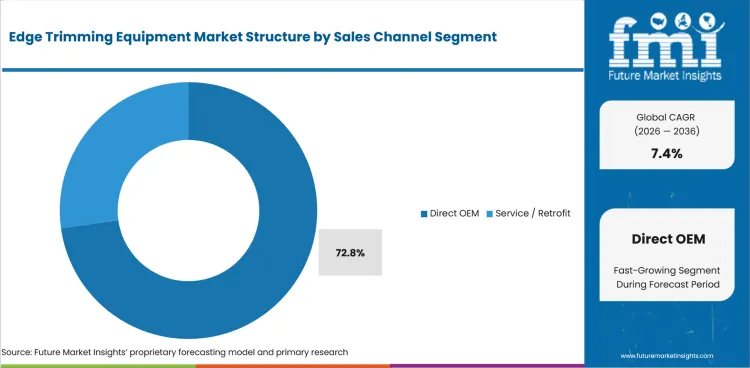
- Direct OEM channels are expected to hold 72.8% share in 2026. Fab qualification depends on supplier process support.
- Service and retrofit channels matter in older lines. Buyers use these routes when adding trimming to existing tools.
What drives the edge trimming equipment market and what limits it?
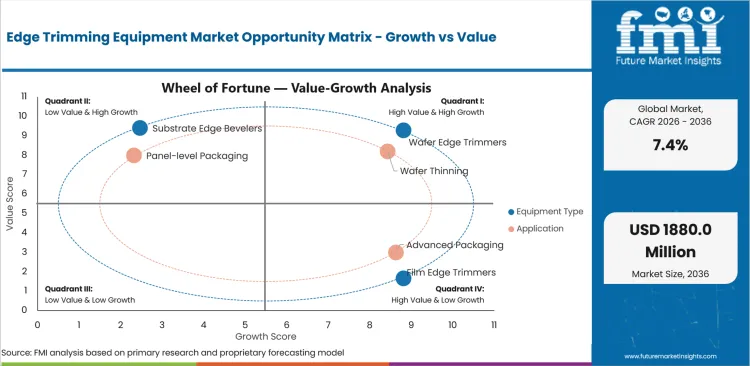
Thin-wafer breakage and panel packaging support growth. Long qualification cycles can slow supplier switching once trim recipes affect later process steps.
- Driver: Ultra-thin wafer breakage risk creates demand for edge trim steps before grinding begins.
- Driver: Panel-level packaging creates new edge shaping needs for larger substrate formats.
- Restraint: Long qualification cycles slow supplier changes once trim settings affect later grinding and dicing results.
- Opportunity: Retrofit modules can extend older lines when fabs add wafer thinning programs to existing process flows.
Edge-Safe Wafer Thinning Demand Outlook
Demand outlook is expected to be driven by wafer thinning and advanced packaging trials. NIST announced USD 1.4 billion in January 2025 for advanced packaging awards. The funding strengthens demand for tools that protect wafers before pilot lines move toward scale. DISCO developed DFD6080 in December 2025 for package dicing up to 400 x 400 mm workpieces. The launch indicates that larger package formats need edge control before singulation.
Fab Qualification and Purchase Behavior Analysis
Fab and OSAT buyers qualify trimming with grind and dicing data. BIS added controls on 24 semiconductor manufacturing equipment types in December 2024. The rule raises the value of compliant documentation during cross-border tool selection. Supplier selection is expected to be driven by process proof and service availability. Vendor engineers usually tune recipes with customers before purchasing teams approve wider tool rollout.
Tool Selection and Service Decision Analysis
Purchase decisions are expected to be driven by trim accuracy and support response. Tokyo Seimitsu and Asahi Diamond signed a January 2025 MOU to form a joint venture for cutting and grinding tools. The agreement points to stronger supplier focus on process consumables. Simple operator controls remain useful in high-value wafer lines. Recipe logs and alarms help fabs trace trim settings after yield results change.
Which countries are growing fastest in the edge trimming equipment market?
China leads at 8.3% CAGR by 2036. South Korea and India follow at 8.1% and 8.0%. Japan records 7.5% with local supplier support.
.webp "Top Country Growth Comparison Edge Trimming Equipment Market Cagr (2026 2036)")
| Country | CAGR |
|---|---|
| China | 8.3% |
| South Korea | 8.1% |
| India | 8.0% |
| Japan | 7.5% |
| United States | 7.3% |
| Germany | 6.9% |
| France | 6.5% |
| United Kingdom | 5.8% |
Source: Future Market Insights, 2026.
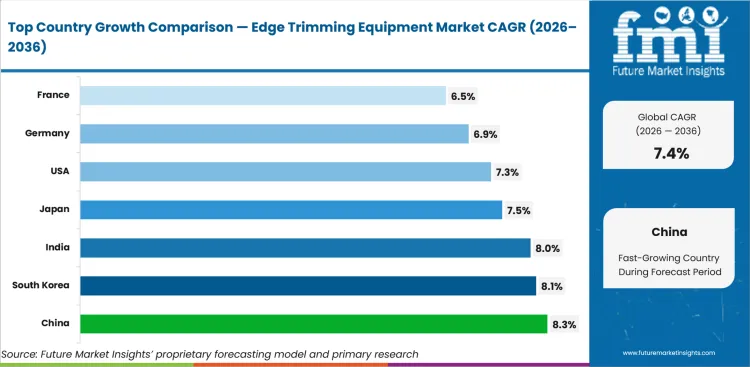
How do country-level CAGRs compare in the edge trimming equipment market?
China records the fastest country growth. The United Kingdom shows the most cautious pace among profiled markets.
- China is forecast to record an 8.3% CAGR by 2036, with continued fab purchasing driving sustained demand for edge-trimming tools.
- South Korea is expected to expand at an 8.1% CAGR by 2036, supported by memory line expansions that are adding thin-wafer processing steps.
- India is projected to grow at an 8.0% CAGR by 2036, as recently approved semiconductor projects advance into the equipment planning phase.
- Japan is estimated to rise at a 7.5% CAGR by 2036, benefiting from the depth and reliability of its domestic tool supplier ecosystem.
- The United States is forecast to grow at a 7.3% CAGR by 2036, led by government-funded fab projects and increasing wafer supply localization.
- Germany is projected to post a 6.9% CAGR by 2036, with power semiconductor trials increasing the need for safer wafer preparation processes.
- France is expected to record a 6.5% CAGR by 2036, driven by pilot lines that are testing advanced packaging workflows.
- The United Kingdom is forecast to grow at a 5.8% CAGR by 2036, supported by rising demand from compound semiconductor applications.
How fast is the edge trimming equipment market growing in United States?
A 7.3% CAGR by 2036 reflects CHIPS-funded fab projects and 300 mm wafer supply work.
Country Market Snapshot Table
| Parameter | Value |
|---|---|
| Market Size in 2025 (Value) | USD 107.0 million |
| Market Size in 2026 (Value) | USD 114.8 million |
| Market Forecast in 2036 (Value) | USD 232.6 million |
| CAGR (2026 to 2036) | 7.3% |
| Years Considered | 2021 to 2036 |
| Base Year | 2025 |
| Forecast Period | 2026 to 2036 |
| Units Considered | Value (USD million) |
| Leading Sub-Region | Arizona and Texas fab corridors |
United States Edge Trimming Equipment Market Outlook
United States demand is expected to be driven by funded fab projects and wafer supply localization. Buyers want tools that reduce wafer breakage before grinding starts.
Service coverage matters during qualification. Suppliers with U.S. field engineers can reduce trial delays once process teams begin tool testing.
Key Growth Drivers
- NIST announced up to USD 406 million in CHIPS incentives for GlobalWafers in December 2024, supporting domestic wafer supply and tool demand.
- SEMI reported North America equipment spending of USD 10.9 billion in 2025, creating an addressable pool for yield-protection tools.
- NIST reported GlobalWafers awards supporting the first U.S. high-volume 300 mm silicon wafer facility, improving the fit for edge trimming in domestic supply chains.
- Power and analog fabs are expected to need edge-safe trimming once production moves into higher-value automated 300 mm lines.
Key Restraints
- NIST states that about 90% of silicon wafers are sourced from East Asia, keeping U.S. wafer supply localization dependent on long project timelines.
- CHIPS project reviews can stretch purchase timing before final tool orders are released.
- Local service depth is needed before smaller suppliers can win fab trials, raising entry cost before revenue begins.
What makes United States unique
United States stands out through public incentives and private fab projects that create formal tool qualification routes.
Key Companies
- DISCO Corporation
- Tokyo Seimitsu Co. Ltd.
- Okamoto Machine Tool Works
- Revasum
- GlobalWafers U.S. operations
- Texas Instruments fab ecosystem
Sales & Marketing Channels
- Direct fab account selling
- CHIPS project procurement
- OEM demonstration programs
- Service and spare-part contracts
- Technology partner qualification
Country Segment Breakdown Table
| Segment | Sub-Segments |
|---|---|
| By Equipment Type | Wafer Edge Trimmers · Film Edge Trimmers · Substrate Edge Bevelers · Panel Edge Trimmers |
| By Application | Wafer Thinning · Advanced Packaging · Panel-level Packaging · Display / Other |
| By Wafer / Panel Size | 200 mm · 300 mm · Panel-level / Other |
| By Automation | Semi-automatic · Fully Automatic |
| By Sales Channel | Direct OEM · Service / Retrofit |
| Key Sub-Regions Covered | Fab corridors · Packaging clusters · Research centers · Pilot-line centers |
Frequently Asked Questions
How fast is United States edge trimming equipment market growing?
United States is forecast to grow at 7.3% from 2026 to 2036.
Who leads United States edge trimming equipment market?
DISCO and Tokyo Seimitsu compete with local service partners in United States.
What is driving adoption in United States edge trimming equipment market?
CHIPS funding and domestic wafer projects are moving fabs toward edge-safe wafer preparation.
How fast is the edge trimming equipment market growing in United Kingdom?
A 5.8% CAGR over the assessment period reflects compound semiconductor work and public test infrastructure.
Country Market Snapshot Table
| Parameter | Value |
|---|---|
| Market Size in 2025 (Value) | USD 36.4 million |
| Market Size in 2026 (Value) | USD 38.5 million |
| Market Forecast in 2036 (Value) | USD 67.6 million |
| CAGR (2026 to 2036) | 5.8% |
| Years Considered | 2021 to 2036 |
| Base Year | 2025 |
| Forecast Period | 2026 to 2036 |
| Units Considered | Value (USD million) |
| Leading Sub-Region | South Wales and compound semiconductor clusters |
United Kingdom Edge Trimming Equipment Market Outlook
United Kingdom demand is expected to be driven by compound semiconductors and packaging research. The country relies more on specialist projects than East Asian fab scale.
Public test assets are important in the United Kingdom. Pilot lines let buyers validate edge-safe processes before a larger purchase.
Key Growth Drivers
- DSIT identified 705 UK semiconductor companies in 2026, creating a wider buyer base for specialist process tools.
- GOV.UK announced GBP 16.6 million in March 2024 for equipment used to test and package chips, strengthening the pilot-line route for edge trimming.
- Compound semiconductor clusters need low-damage trimming before broad fab expansion creates repeat tool demand.
- Catapult and university projects are expected to support early tool demonstrations that give suppliers a route into technical buyers.
Key Restraints
- UKRI invested GBP 11.5 million across 16 semiconductor projects in September 2024. The funding spread keeps many orders project-based.
- Lower high-volume fab scale limits repeat purchases and keeps suppliers focused on pilot and research budgets.
- Specialist users often need custom trials before they approve standard edge trimming tools.
What makes United Kingdom unique
United Kingdom stands out through compound semiconductor clusters that create more pilot-line demand than volume-fab demand.
Key Companies
- DISCO Corporation
- Tokyo Seimitsu Co. Ltd.
- Synova S.A.
- Oxford Instruments process ecosystem
- CSA Catapult partner network
Sales & Marketing Channels
- Public research procurement
- Catapult demonstration programs
- Direct OEM demonstrations
- University pilot-line projects
- Distributor service support
Country Segment Breakdown Table
| Segment | Sub-Segments |
|---|---|
| By Equipment Type | Wafer Edge Trimmers · Film Edge Trimmers · Substrate Edge Bevelers · Panel Edge Trimmers |
| By Application | Wafer Thinning · Advanced Packaging · Panel-level Packaging · Display / Other |
| By Wafer / Panel Size | 200 mm · 300 mm · Panel-level / Other |
| By Automation | Semi-automatic · Fully Automatic |
| By Sales Channel | Direct OEM · Service / Retrofit |
| Key Sub-Regions Covered | Fab corridors · Packaging clusters · Research centers · Pilot-line centers |
Frequently Asked Questions
How fast is United Kingdom edge trimming equipment market growing?
United Kingdom is forecast to grow at 5.8% from 2026 to 2036.
Who leads United Kingdom edge trimming equipment market?
DISCO and Tokyo Seimitsu compete with local service partners in United Kingdom.
What is driving adoption in United Kingdom edge trimming equipment market?
Compound semiconductor work and funded test assets are moving buyers toward low-damage trimming trials.
How fast is the edge trimming equipment market growing in Germany?
Germany is projected to grow at 6.9% by 2036, supported by power chips and automotive electronics that require safer wafer processing.
Country Market Snapshot Table
| Parameter | Value |
|---|---|
| Market Size in 2025 (Value) | USD 78.2 million |
| Market Size in 2026 (Value) | USD 83.6 million |
| Market Forecast in 2036 (Value) | USD 162.9 million |
| CAGR (2026 to 2036) | 6.9% |
| Years Considered | 2021 to 2036 |
| Base Year | 2025 |
| Forecast Period | 2026 to 2036 |
| Units Considered | Value (USD million) |
| Leading Sub-Region | Dresden and Saxony semiconductor corridor |
Germany Edge Trimming Equipment Market Outlook
Germany demand is expected to be driven by automotive electronics and power semiconductor production. Dresden gives suppliers a concentrated route into fab and packaging buyers.
Buyers tend to require audited service and proof of process control. Suppliers that can support local trials gain a clearer qualification path.
Key Growth Drivers
- The Federal Government states that Germany has around 30% of Europe's wafer capacities, supporting service demand around domestic fab sites.
- The European Commission states that public investments under the Chips Act should exceed EUR 43 billion, improving the funding setting for German projects.
- Automotive power electronics require careful edge preparation when SiC wafers create higher brittleness risk than standard silicon.
- Saxony fab activity is expected to support process-tool qualification by reducing travel and service friction for suppliers.
Key Restraints
- SEMI reported that Europe equipment spending fell 41% in 2025, which can slow near-term purchases outside approved projects.
- State-aid timing can shift fab construction schedules and move tool purchase windows.
- German buyers often require audited service coverage before smaller suppliers can qualify without local partners.
What makes Germany unique
Germany stands out through automotive electronics and Saxony fab projects that make service quality central to supplier selection.
Key Companies
- Okamoto Europe
- ACCRETECH Europe
- DISCO Corporation
- Synova S.A.
- Siltronic supplier ecosystem
Sales & Marketing Channels
- Direct fab account selling
- European distributor channels
- Automotive semiconductor audits
- Regional process trials
- Service-level agreements
Country Segment Breakdown Table
| Segment | Sub-Segments |
|---|---|
| By Equipment Type | Wafer Edge Trimmers · Film Edge Trimmers · Substrate Edge Bevelers · Panel Edge Trimmers |
| By Application | Wafer Thinning · Advanced Packaging · Panel-level Packaging · Display / Other |
| By Wafer / Panel Size | 200 mm · 300 mm · Panel-level / Other |
| By Automation | Semi-automatic · Fully Automatic |
| By Sales Channel | Direct OEM · Service / Retrofit |
| Key Sub-Regions Covered | Fab corridors · Packaging clusters · Research centers · Pilot-line centers |
Frequently Asked Questions
How fast is Germany edge trimming equipment market growing?
Germany is forecast to grow at 6.9% from 2026 to 2036.
Who leads Germany edge trimming equipment market?
DISCO and Tokyo Seimitsu compete with local service partners in Germany.
What is driving adoption in Germany edge trimming equipment market?
Power semiconductor needs and Saxony fab activity are moving buyers toward edge-safe wafer preparation.
How fast is the edge trimming equipment market growing in France?
A 6.5% CAGR by 2036 reflects pilot-line buying and 3D integration work in Grenoble.
Country Market Snapshot Table
| Parameter | Value |
|---|---|
| Market Size in 2025 (Value) | USD 53.8 million |
| Market Size in 2026 (Value) | USD 57.3 million |
| Market Forecast in 2036 (Value) | USD 107.5 million |
| CAGR (2026 to 2036) | 6.5% |
| Years Considered | 2021 to 2036 |
| Base Year | 2025 |
| Forecast Period | 2026 to 2036 |
| Units Considered | Value (USD million) |
| Leading Sub-Region | Grenoble and pilot-line clusters |
France Edge Trimming Equipment Market Outlook
France demand is expected to come from R&D lines and advanced packaging validation. Grenoble gives suppliers access to buyers testing hybrid bonding flows.
Orders can be smaller than high-volume fab orders. The advantage is clearer access to early process windows and joint development work.
Key Growth Drivers
- The European Commission selected four pilot lines with EUR 3.3 billion in combined funding in April 2024, supporting tool evaluation in research-led flows.
- CEA-Leti presented die-to-wafer hybrid bonding at 1 micrometer pitch in June 2026, raising the need for careful wafer preparation.
- French pilot-line buyers can use edge trimming before bonding and thinning to lower edge crack risk during later handling.
- Power electronics work is expected to create specialty wafer process trials that favor suppliers with material-specific know-how.
Key Restraints
- SEMI reported Europe equipment spending of USD 2.9 billion in 2025, limiting repeat tool volume in smaller European markets.
- Project-based R&D buying can create uneven order timing between pilot orders and production orders.
- France relies on imported precision processing tools, which can slow troubleshooting when outside service teams handle qualification.
What makes France unique
France stands out through Grenoble research activity that makes pilot validation more important than broad installed capacity.
Key Companies
- DISCO Corporation
- Tokyo Seimitsu Co. Ltd.
- Synova S.A.
- CEA-Leti partner ecosystem
- Soitec wafer ecosystem
Sales & Marketing Channels
- Public research procurement
- Pilot-line partnerships
- Direct OEM demonstrations
- European distributor support
- Collaborative process development
Country Segment Breakdown Table
| Segment | Sub-Segments |
|---|---|
| By Equipment Type | Wafer Edge Trimmers · Film Edge Trimmers · Substrate Edge Bevelers · Panel Edge Trimmers |
| By Application | Wafer Thinning · Advanced Packaging · Panel-level Packaging · Display / Other |
| By Wafer / Panel Size | 200 mm · 300 mm · Panel-level / Other |
| By Automation | Semi-automatic · Fully Automatic |
| By Sales Channel | Direct OEM · Service / Retrofit |
| Key Sub-Regions Covered | Fab corridors · Packaging clusters · Research centers · Pilot-line centers |
Frequently Asked Questions
How fast is France edge trimming equipment market growing?
France is forecast to grow at 6.5% from 2026 to 2036.
Who leads France edge trimming equipment market?
DISCO and Tokyo Seimitsu compete with local service partners in France.
What is driving adoption in France edge trimming equipment market?
Hybrid bonding and pilot-line investment are moving French buyers toward controlled edge preparation.
How fast is the edge trimming equipment market growing in Japan?
Japan records a 7.5% CAGR by 2036, supported by local suppliers serving thin-wafer and grinding flows.
Country Market Snapshot Table
| Parameter | Value |
|---|---|
| Market Size in 2025 (Value) | USD 96.4 million |
| Market Size in 2026 (Value) | USD 103.6 million |
| Market Forecast in 2036 (Value) | USD 213.2 million |
| CAGR (2026 to 2036) | 7.5% |
| Years Considered | 2021 to 2036 |
| Base Year | 2025 |
| Forecast Period | 2026 to 2036 |
| Units Considered | Value (USD million) |
| Leading Sub-Region | Kumamoto and major supplier clusters |
Japan Edge Trimming Equipment Market Outlook
Japan demand is expected to be driven by domestic tool suppliers and 300 mm wafer processing. Buyers can qualify edge trimming near grinding and dicing expertise.
Supplier proximity shortens feedback during recipe tuning when edge trimming affects downstream grinding results.
Key Growth Drivers
- SEMI reported Japan equipment spending of USD 9.5 billion in 2025, supporting demand for adjacent wafer handling tools.
- METI stated that public support for AI and semiconductors will exceed JPY 10 trillion over seven years, improving the investment setting for process equipment.
- Domestic tool suppliers shorten qualification feedback by helping buyers compare grinding and edge trim results in one service loop.
- 300 mm thinning upgrades are expected to favor automatic tools that reduce operator contact with thinner substrates.
Key Restraints
- METI opened a 60-day public comment period for semiconductor factory OT security guidelines in June 2025. Equipment suppliers may face added compliance checks during tool qualification.
- Replacement buying can be more selective than greenfield buying. Suppliers need clear yield data before buyers replace older tools.
- Long supplier relationships can limit new entrant access until new vendors prove local service depth.
What makes Japan unique
Japan stands out through close proximity between precision tool suppliers and local fabs.
Key Companies
- DISCO Corporation
- Tokyo Seimitsu Co. Ltd.
- Okamoto Machine Tool Works
- Revasum Japan channels
- Synova Japan channels
Sales & Marketing Channels
- Direct OEM account teams
- Factory demonstration centers
- Service and maintenance contracts
- SEMICON Japan exhibitions
- Joint process trials
Country Segment Breakdown Table
| Segment | Sub-Segments |
|---|---|
| By Equipment Type | Wafer Edge Trimmers · Film Edge Trimmers · Substrate Edge Bevelers · Panel Edge Trimmers |
| By Application | Wafer Thinning · Advanced Packaging · Panel-level Packaging · Display / Other |
| By Wafer / Panel Size | 200 mm · 300 mm · Panel-level / Other |
| By Automation | Semi-automatic · Fully Automatic |
| By Sales Channel | Direct OEM · Service / Retrofit |
| Key Sub-Regions Covered | Fab corridors · Packaging clusters · Research centers · Pilot-line centers |
Frequently Asked Questions
How fast is Japan edge trimming equipment market growing?
Japan is forecast to grow at 7.5% from 2026 to 2036.
Who leads Japan edge trimming equipment market?
DISCO and Tokyo Seimitsu compete with local service partners in Japan.
What is driving adoption in Japan edge trimming equipment market?
Domestic tool depth and public semiconductor support are moving buyers toward automatic edge-safe processing.
How fast is the edge trimming equipment market growing in China?
China leads at 8.3% CAGR through 2036, supported by fab spending and IC output that lift tool purchases.
Country Market Snapshot Table
| Parameter | Value |
|---|---|
| Market Size in 2025 (Value) | USD 171.0 million |
| Market Size in 2026 (Value) | USD 185.2 million |
| Market Forecast in 2036 (Value) | USD 411.4 million |
| CAGR (2026 to 2036) | 8.3% |
| Years Considered | 2021 to 2036 |
| Base Year | 2025 |
| Forecast Period | 2026 to 2036 |
| Units Considered | Value (USD million) |
| Leading Sub-Region | Yangtze River Delta and major fab corridors |
China Edge Trimming Equipment Market Outlook
China demand is expected to be driven by large equipment spending and local fab expansion. Buyers need edge trimming for wafer thinning and packaging steps.
Local price pressure is stronger than in Japan or the United States. Suppliers must balance process accuracy with service cost to protect margins.
Key Growth Drivers
- SEMI reported China equipment spending of USD 49.3 billion in 2025, keeping the country central to wafer process tool demand.
- China NBS reported integrated circuit output of 386.6 billion pieces from January to October 2025, supporting demand for wafer processing capacity.
- Advanced packaging capacity is expected to raise the need for pre-grind edge control before assembly.
- Domestic SiC and power semiconductor projects are expected to need material-specific trimming for brittle substrates.
Key Restraints
- SEMI reported that China equipment spending was down 0.5% in 2025, pointing to more selective purchasing after heavy investment.
- Export controls can limit access to some foreign tool configurations and push buyers to qualify alternative suppliers for protected lines.
- Local price pressure can narrow premium margins unless suppliers prove breakage reduction.
What makes China unique
China stands out through large fab spending and local supplier programs that create both volume demand and price pressure.
Key Companies
- DISCO Corporation
- Tokyo Seimitsu Co. Ltd.
- Delta Electronics
- JG Semicon
- Local edge grinding suppliers
Sales & Marketing Channels
- Direct fab sales
- Local agent networks
- Service depot support
- Packaging-house qualification trials
- Trade fair lead generation
Country Segment Breakdown Table
| Segment | Sub-Segments |
|---|---|
| By Equipment Type | Wafer Edge Trimmers · Film Edge Trimmers · Substrate Edge Bevelers · Panel Edge Trimmers |
| By Application | Wafer Thinning · Advanced Packaging · Panel-level Packaging · Display / Other |
| By Wafer / Panel Size | 200 mm · 300 mm · Panel-level / Other |
| By Automation | Semi-automatic · Fully Automatic |
| By Sales Channel | Direct OEM · Service / Retrofit |
| Key Sub-Regions Covered | Fab corridors · Packaging clusters · Research centers · Pilot-line centers |
Frequently Asked Questions
How fast is China edge trimming equipment market growing?
China is forecast to grow at 8.3% from 2026 to 2036.
Who leads China edge trimming equipment market?
DISCO and Tokyo Seimitsu compete with local service partners in China.
What is driving adoption in China edge trimming equipment market?
Large equipment spending and IC output are moving Chinese fabs toward more edge-safe wafer preparation.
How fast is the edge trimming equipment market growing in South Korea?
South Korea is projected at 8.1% CAGR by 2036, led by memory and HBM packaging flows that require thinner wafers.
Country Market Snapshot Table
| Parameter | Value |
|---|---|
| Market Size in 2025 (Value) | USD 118.8 million |
| Market Size in 2026 (Value) | USD 128.4 million |
| Market Forecast in 2036 (Value) | USD 279.6 million |
| CAGR (2026 to 2036) | 8.1% |
| Years Considered | 2021 to 2036 |
| Base Year | 2025 |
| Forecast Period | 2026 to 2036 |
| Units Considered | Value (USD million) |
| Leading Sub-Region | Seoul metropolitan and memory fab corridors |
South Korea Edge Trimming Equipment Market Outlook
South Korea demand is expected to be driven by memory fabs and HBM packaging. These flows need thin wafers with fewer edge cracks before stacking.
Large buyers control much of the order pipeline and require proven results before suppliers enter production tool lists.
Key Growth Drivers
- SEMI reported Korea equipment spending of USD 25.8 billion in 2025, supporting orders for wafer preparation and handling tools.
- Korea MOEF announced a semiconductor ecosystem fund of up to KRW 800 billion by 2027, supporting materials and equipment suppliers.
- HBM and stacked memory flows are expected to increase thin-wafer protection needs before downstream breakage risk rises.
- High-volume memory fabs are expected to favor fully automatic handling that lowers wafer movement variation.
Key Restraints
- Korea MOEF said the ecosystem fund would expand to KRW 1.1 trillion by 2027, showing local supplier depth still needs policy support.
- Buyer concentration raises qualification barriers when a few memory makers control large production tool decisions.
- Memory cycle swings can shift order timing even when HBM demand stays visible.
What makes South Korea unique
South Korea stands out through memory makers that connect edge trimming demand to HBM and stacked packaging yield.
Key Companies
- DISCO Corporation
- Tokyo Seimitsu Co. Ltd.
- Kulicke & Soffa
- Okamoto Machine Tool Works
- Samsung supplier ecosystem
- SK hynix supplier ecosystem
Sales & Marketing Channels
- Direct sales to memory fabs
- OSAT qualification programs
- Local service engineering
- OEM spare-part contracts
- Process co-development trials
Country Segment Breakdown Table
| Segment | Sub-Segments |
|---|---|
| By Equipment Type | Wafer Edge Trimmers · Film Edge Trimmers · Substrate Edge Bevelers · Panel Edge Trimmers |
| By Application | Wafer Thinning · Advanced Packaging · Panel-level Packaging · Display / Other |
| By Wafer / Panel Size | 200 mm · 300 mm · Panel-level / Other |
| By Automation | Semi-automatic · Fully Automatic |
| By Sales Channel | Direct OEM · Service / Retrofit |
| Key Sub-Regions Covered | Fab corridors · Packaging clusters · Research centers · Pilot-line centers |
Frequently Asked Questions
How fast is South Korea edge trimming equipment market growing?
South Korea is forecast to grow at 8.1% from 2026 to 2036.
Who leads South Korea edge trimming equipment market?
DISCO and Tokyo Seimitsu compete with local service partners in South Korea.
What is driving adoption in South Korea edge trimming equipment market?
Memory and HBM packaging are moving buyers toward automatic edge-safe thinning processes.
How fast is the edge trimming equipment market growing in India?
India is forecast at 8.0% CAGR by 2036, led by approved fab and packaging projects moving into tool planning.
Country Market Snapshot Table
| Parameter | Value |
|---|---|
| Market Size in 2025 (Value) | USD 28.5 million |
| Market Size in 2026 (Value) | USD 30.8 million |
| Market Forecast in 2036 (Value) | USD 66.5 million |
| CAGR (2026 to 2036) | 8.0% |
| Years Considered | 2021 to 2036 |
| Base Year | 2025 |
| Forecast Period | 2026 to 2036 |
| Units Considered | Value (USD million) |
| Leading Sub-Region | Gujarat and Bengaluru semiconductor corridors |
India Edge Trimming Equipment Market Outlook
India demand is expected to be driven by new fab and ATMP projects. Early tool purchases will depend on technology partners and service setup.
The market is smaller today than China or Korea. Growth can improve once local qualification teams and service offices become active.
Key Growth Drivers
- PIB reported 12 approved fab and packaging projects in May 2026, giving equipment suppliers a clearer project pipeline.
- PIB reported that India approved 24 semiconductor design projects in April 2026, supporting a wider domestic chip ecosystem.
- DISCO opened an India affiliate in September 2024 for semiconductor equipment sale and maintenance, reducing service uncertainty for early buyers.
- ATMP and OSAT projects are expected to need thinning and singulation support once wafers become fragile.
Key Restraints
- PIB listed a 2026 to 2027 semiconductor programme outlay of INR 8,000 crore. The outlay shows project conversion still depends on public support.
- New fabs need process training before high-volume production stabilizes and tool settings can be validated.
- Early tool choices may rely on technology partners until domestic teams can run independent qualification.
What makes India unique
India stands out through approved projects moving into early tool planning instead of large replacement buying.
Key Companies
- DISCO India
- Tokyo Seimitsu Co. Ltd.
- Okamoto India channels
- Tata Electronics supplier ecosystem
- Micron India supplier ecosystem
Sales & Marketing Channels
- Direct OEM engagement
- Technology-partner selection
- Government project procurement
- Local service offices
- SEMICON India outreach
Country Segment Breakdown Table
| Segment | Sub-Segments |
|---|---|
| By Equipment Type | Wafer Edge Trimmers · Film Edge Trimmers · Substrate Edge Bevelers · Panel Edge Trimmers |
| By Application | Wafer Thinning · Advanced Packaging · Panel-level Packaging · Display / Other |
| By Wafer / Panel Size | 200 mm · 300 mm · Panel-level / Other |
| By Automation | Semi-automatic · Fully Automatic |
| By Sales Channel | Direct OEM · Service / Retrofit |
| Key Sub-Regions Covered | Fab corridors · Packaging clusters · Research centers · Pilot-line centers |
Frequently Asked Questions
How fast is India edge trimming equipment market growing?
India is forecast to grow at 8.0% from 2026 to 2036.
Who leads India edge trimming equipment market?
DISCO and Tokyo Seimitsu compete with local service partners in India.
What is driving adoption in India edge trimming equipment market?
Approved fab projects and local service setup are moving India toward early edge trimming purchases.
Who are the leading companies in the edge trimming equipment market?
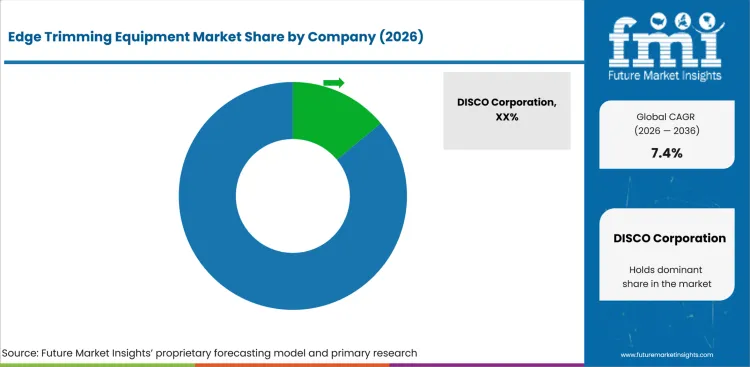
DISCO Corporation and Tokyo Seimitsu lead the competitive view. Okamoto and Synova support specialist material workflows where material behavior affects edge control.
- Competitive outlook is led by precision tool suppliers with grinding knowledge and wafer handling experience.
- Process adoption is supported by suppliers that can show lower breakage during customer trials and connect results to later grinding steps.
- Sales access is expected to be driven by local service teams that shorten recipe tuning and troubleshooting.
- Market positioning is attributable to adjacent capabilities in grinding and dicing, with metrology and package handling adding further fit.
Competition is based on process proof and service depth. Buyers compare edge trim outcomes with post-grind breakage before tool approval. DISCO and Tokyo Seimitsu hold strong positions through adjacent grinding and dicing portfolios. Supplier capability is shaped by nearby service and faster troubleshooting. China and India create openings for suppliers that support early fab projects. Japan and South Korea favor vendors with proven thin-wafer results. Capacity planning is becoming a second competitive screen. Tokyo Seimitsu completed the Nagoya Plant in August 2025 to strengthen semiconductor production equipment capacity. Buyers can use that expansion to confirm stronger supply readiness.
How do top edge trimming equipment companies compare?
DISCO and Tokyo Seimitsu score strongest on process depth. Synova and Revasum are more relevant in specialist material workflows.
| Company | Relevant Positioning | Process Support | Service Fit | Geographic Fit |
|---|---|---|---|---|
| DISCO Corporation | High relevance in cutting and grinding tools | Strong | Strong | Global |
| Tokyo Seimitsu Co. Ltd. | High relevance in wafer grinding and metrology | Strong | Strong | Global |
| Okamoto Machine Tool Works | Relevant in precision grinding systems | Moderate | Strong | Japan, Europe, India |
| Revasum | Relevant in grinding and CMP-adjacent tools | Moderate | Moderate | North America, Europe, Asia |
| Synova S.A. | Relevant in laser cutting for fragile materials | Moderate | Strong | Europe, Asia, North America |
| Kulicke & Soffa | Adjacent relevance in advanced packaging tools | Moderate | Strong | Global |
| JG Semicon | Regional relevance in China process tools | Moderate | Moderate | China, Asia |
Source: Future Market Insights competitive analysis, 2026.
Who are the key players in the edge trimming equipment market?
DISCO Corporation and Tokyo Seimitsu are listed with Okamoto and Synova among other relevant suppliers.
Key global companies leading the edge trimming equipment market include:
- DISCO Corporation
- Tokyo Seimitsu Co. Ltd.
- Okamoto Machine Tool Works
- Revasum
- Synova S.A.
- Delta Electronics
- Kulicke & Soffa
- JG Semicon
Key Developments in Edge Trimming Equipment Market
- In September 2024, DISCO established an India affiliate for sale and maintenance of DISCO-manufactured semiconductor equipment.
- In December 2025, DISCO developed DFG8561 to support fully automatic grinding for 300 mm wafers.
- In August 2025, Tokyo Seimitsu completed the Nagoya Plant to strengthen semiconductor production equipment capacity.
Key Players in the Edge Trimming Equipment Market
Precision Wafer Process Tool Suppliers
- DISCO Corporation
- Tokyo Seimitsu Co. Ltd.
- Okamoto Machine Tool Works
Specialist Material and Packaging Tool Suppliers
- Revasum
- Synova S.A.
- Kulicke & Soffa
Regional and Adjacent Equipment Suppliers
- Delta Electronics
- JG Semicon
- Local edge grinding suppliers
Edge Trimming Equipment Market - Report Scope
| Parameter | Details |
|---|---|
| Forecast period | 2026 to 2036 |
| Historical period | 2021 to 2025 |
| Quantitative unit | Revenue in USD million |
| By equipment type | Wafer Edge Trimmers, Film Edge Trimmers, Substrate Edge Bevelers, Panel Edge Trimmers |
| By application | Wafer Thinning, Advanced Packaging, Panel-level Packaging, Display / Other |
| By wafer / panel size | 200 mm, 300 mm, Panel-level / Other |
| By automation | Semi-automatic, Fully Automatic |
| By sales channel | Direct OEM, Service / Retrofit |
| Regions covered | North America, Latin America, Europe, East Asia, South Asia and Pacific, Middle East and Africa |
| Countries covered | United States, United Kingdom, Germany, France, Japan, China, South Korea, India |
| Key companies profiled | DISCO, Tokyo Seimitsu, Okamoto, Revasum, Synova, Kulicke & Soffa |
| Approach | Bottom-up product-boundary approach using tool revenue, channel presence, service support, country-level investment |
Source: Future Market Insights, 2026.
Edge Trimming Equipment Market - Scope & Definition
| Attribute | Detail |
|---|---|
| Market Definition | Systems used to trim, bevel, grind, remove, shape edges of semiconductor wafers, films, substrates, panels |
| Functions Covered | Edge removal, bevel control, crack reduction, pre-grind preparation, edge shaping |
| Applications Covered | Wafer Thinning, Advanced Packaging, Panel-level Packaging, Display / Other |
| End-Use Industries | Semiconductor fabs, OSAT plants, compound semiconductor producers, research and pilot lines |
| Grades Covered | 200 mm tools, 300 mm tools, panel-level tools, semi-automatic tools, fully automatic tools |
| Inclusions | Dedicated edge trimming and edge shaping systems across listed product and channel categories |
| Exclusions | General dicing saws, stand-alone grinders, polishers, inspection-only tools, consumables-only sales |
Edge Trimming Equipment Market - Research Methodology
| Method | Description |
|---|---|
| Primary Research | FMI analyst interviews with fab equipment buyers, OSAT process teams, wafer thinning engineers, tool distributors, service teams |
| Desk Research | Review of association data from SEMI and SEAJ plus government investment sources, company product pages, official development releases |
| Market Sizing & Forecasting | Bottom-up product-boundary approach using 2025 tool revenue anchors, segment shares, country signals, service assumptions |
| Data Validation | Cross-checks against 300 mm spending, regional equipment billings, country fab projects, supplier product portfolios |
Edge Trimming Equipment Market Breakdown by Equipment Type, Application, Wafer / Panel Size, Automation, Sales Channel, Region
Edge Trimming Equipment Market Segmented by Equipment Type
- Wafer Edge Trimmers
- Film Edge Trimmers
- Substrate Edge Bevelers
- Panel Edge Trimmers
Edge Trimming Equipment Market Segmented by Application
- Wafer Thinning
- Advanced Packaging
- Panel-level Packaging
- Display / Other
Edge Trimming Equipment Market Segmented by Wafer / Panel Size
- 200 mm
- 300 mm
- Panel-level / Other
Edge Trimming Equipment Market Segmented by Automation
- Semi-automatic
- Fully Automatic
Edge Trimming Equipment Market Segmented by Sales Channel
- Direct OEM
- Service / Retrofit
Edge Trimming Equipment Market by Region
- North America
- Latin America
- Europe
- East Asia
- South Asia and Pacific
- Middle East and Africa
Research Sources and Bibliography
- CEA-Leti. (2026, June 5). CEA-Leti presents die-to-wafer hybrid bonding at 1 micrometer pitch.
- Department for Science, Innovation and Technology. (2026, June 12). Semiconductor sector study 2026. GOV.UK.
- DISCO Corporation. (2024, September 3). Overseas local affiliate established in India.
- DISCO Corporation. (2025, December 12). Development of DFG8561: A fully automatic grinder supporting 300 mm wafers.
- European Commission. (2024, July 24). Chips Act. Shaping Europe's Digital Future.
- Government of the Federal Republic of Germany. (2025, October 15). Federal Government microelectronics strategy adopted.
- Innovate UK. (2024, September 27). GBP 11.5 million to improve semiconductor manufacturing and supply chains. UKRI.
- Ministry of Economy and Finance. (2024, June 26). Semiconductor ecosystem support package. Republic of Korea.
- Ministry of Economy, Trade and Industry. (2025, February 7). Press conference by Minister Muto. Government of Japan.
- Ministry of Economy, Trade and Industry. (2025, June 27). Draft OT security guidelines for semiconductor device factories compiled. Government of Japan.
- National Bureau of Statistics of China. (2025, November 15). Industrial production operation in October 2025.
- National Institute of Standards and Technology. (2024, December 17). CHIPS incentives awards with GlobalWafers to support domestic production of silicon wafers.
- Press Information Bureau. (2026, April 1). India Semiconductor Mission. Government of India.
- Press Information Bureau. (2026, February 7). India Semiconductor Mission 2.0. Government of India.
- Press Information Bureau. (2026, May 26). India Semiconductor Mission launches investors support portal. Government of India.
- SEMI. (2026, April 7). SEMI reports global semiconductor equipment billings reached USD 135 billion in 2025.
- SEMI. (2026, April 1). SEMI projects double-digit growth in global 300 mm fab equipment spending for 2026 and 2027.
- Tokyo Seimitsu Co. Ltd. (2025, August 27). Completion of Nagoya Plant to strengthen semiconductor production equipment capacity. ACCRETECH.
- Tokyo Seimitsu Co. Ltd. (2025, January 8). Tokyo Seimitsu Co. Ltd. and Asahi Diamond Industrial Co. Ltd. announcement of the conclusion of MOU to establish a joint venture. ACCRETECH.
- National Institute of Standards and Technology. (2025, January 16). U.S. Department of Commerce announces USD 1.4 billion in final awards to support the next generation of U.S. semiconductor advanced packaging.
- DISCO Corporation. (2025, December 15). Development of DFD6080: A dicing saw for package dicing (max. 400 x 400 mm).
- Bureau of Industry and Security. (2024, December 2). Commerce strengthens export controls to restrict China’s capability to produce advanced semiconductors for military applications.
This bibliography is provided for reader reference. The full report contains the complete reference list and detailed citations.
This Report Answers
- Market size estimates for 2026 and forecasts by 2036 for the edge trimming equipment market.
- Insights across regional and country-level markets with country CAGR comparison.
- Analysis of wafer thinning and advanced packaging demand drivers.
- Evaluation of equipment type and automation segments across fab buying routes.
- Assessment of qualification barriers and service requirements for process tools.
- Identification of growth opportunities across 300 mm wafer lines and panel-level formats.
- Country-level growth analysis covering China, South Korea, India, Japan, United States, Germany, France, United Kingdom.
- Assessment of competitive structure including leading precision wafer process tool suppliers.
- Review of company developments from 2024 onward.
- Delivery of market data and supporting analysis in report format.
Frequently Asked Questions
What is the growth prospect for edge trimming equipment?
Demand for edge trimming equipment is expected to rise when wafer thinning and advanced packaging increase edge crack risk.
Which companies are expected to shape the edge trimming equipment market?
DISCO Corporation and Tokyo Seimitsu are expected to shape competition through wafer processing depth and service support.
Why are semiconductor fabs investing in edge trimming equipment?
Fabs invest in edge trimming equipment to reduce wafer edge chips before grinding and dicing.
Why is 300 mm wafer processing important in the edge trimming equipment market?
300 mm wafer processing matters when wafer value is higher and manual handling risk is harder to accept.
Which equipment format is gaining attention in edge trimming equipment?
Fully Automatic wafer edge trimming systems are gaining attention with fabs reducing operator contact with thin wafers.
How do qualification cycles influence edge trimming tool launches?
Qualification cycles influence launches by requiring proof that trim settings reduce breakage after later process steps.
Why is service support important for edge trimming equipment?
Service support is important during fab trials and early production ramps where recipe tuning decides qualification.
What role does advanced packaging play in edge trimming demand?
Advanced packaging raises edge trimming demand when damaged wafer edges create costly losses later in the line.
How do retrofit channels support edge trimming equipment in older fabs?
Retrofit channels support older fabs by adding edge control to existing thinning or dicing workflows.
Preview the report firsthand - request a free sample
Get SampleGet the brochure for pricing and purchase details.
Get PDFTable of Content
- Key Takeaways
- Market Size and CAGR
- Top Growth Driver
- Fastest Growing Segment
- Leading Region
- Key Companies
- Emerging Opportunities
- Executive Summary
- Global Market Outlook
- Demand-side Trends
- Supply-side Trends
- Technology Roadmap Analysis
- Analysis and Recommendations
- Analyst Perspective (What is happening? Why now? What should investors know?)
- Key Questions Answered
- How large is the market?
- What is the CAGR?
- What are key trends?
- Which region dominates?
- Who are the leaders?
- Market Overview
- Market Coverage / Taxonomy
- Market Definition / Scope / Limitations
- Research Methodology
- Chapter Orientation
- Analytical Lens and Working Hypotheses
- Market Structure, Signals, and Trend Drivers
- Benchmarking and Cross-market Comparability
- Market Sizing, Forecasting, and Opportunity Mapping
- Research Design and Evidence Framework
- Desk Research Programme (Secondary Evidence)
- Expert Input and Fieldwork (Primary Evidence)
- Tooling, Models, and Reference Databases
- Data Engineering and Model Build
- Quality Assurance and Audit Trail
- Market Background
- Market Dynamics (Drivers, Restraints, Opportunity, Trends)
- Scenario Forecast (Optimistic, Likely, Conservative)
- Impact Analysis
- AI Impact
- Sustainability Impact
- Regulatory Impact
- Technology Impact
- Consumer / Buyer Analysis
- Purchase Drivers
- Adoption Barriers
- Buyer Journey
- Opportunity Map Analysis
- Product Life Cycle Analysis
- Supply Chain Analysis
- Investment Feasibility Matrix
- Value Chain Analysis
- PESTLE and Porter's Analysis
- Regulatory Landscape
- Regional Parent Market Outlook
- Production and Consumption Statistics
- Import and Export Statistics
- Global Market Analysis and Forecast, 2021 to 2036
- Historical Market Size Value (USD Million) Analysis, 2021 to 2025
- Current and Future Market Size Value (USD Million) Projections, 2026 to 2036
- Y-o-Y Growth Trend Analysis
- Absolute $ Opportunity Analysis
- Global Market Pricing Analysis, 2021 to 2036
- Global Market Analysis and Forecast, By Equipment Type, 2021 to 2036
- Introduction / Key Findings
- Historical Market Size Value (USD Million) Analysis By Equipment Type, 2021 to 2025
- Current and Future Market Size Value (USD Million) Analysis and Forecast By Equipment Type, 2026 to 2036
- Wafer Edge Trimmers
- Film Edge Trimmers
- Substrate Edge Bevelers
- Wafer Edge Trimmers
- Y-o-Y Growth Trend Analysis By Equipment Type, 2021 to 2025
- Absolute $ Opportunity Analysis By Equipment Type, 2026 to 2036
- Global Market Analysis and Forecast, By Application, 2021 to 2036
- Introduction / Key Findings
- Historical Market Size Value (USD Million) Analysis By Application, 2021 to 2025
- Current and Future Market Size Value (USD Million) Analysis and Forecast By Application, 2026 to 2036
- Wafer Thinning
- Advanced Packaging
- Panel-level Packaging
- Wafer Thinning
- Y-o-Y Growth Trend Analysis By Application, 2021 to 2025
- Absolute $ Opportunity Analysis By Application, 2026 to 2036
- Global Market Analysis and Forecast, By Wafer-Panel Size, 2021 to 2036
- Introduction / Key Findings
- Historical Market Size Value (USD Million) Analysis By Wafer-Panel Size, 2021 to 2025
- Current and Future Market Size Value (USD Million) Analysis and Forecast By Wafer-Panel Size, 2026 to 2036
- 300 mm
- 200 mm
- Panel-level / Other
- 300 mm
- Y-o-Y Growth Trend Analysis By Wafer-Panel Size, 2021 to 2025
- Absolute $ Opportunity Analysis By Wafer-Panel Size, 2026 to 2036
- Global Market Analysis and Forecast, By Automation, 2021 to 2036
- Introduction / Key Findings
- Historical Market Size Value (USD Million) Analysis By Automation, 2021 to 2025
- Current and Future Market Size Value (USD Million) Analysis and Forecast By Automation, 2026 to 2036
- Fully Automatic
- Semi-Automatic
- Fully Automatic
- Y-o-Y Growth Trend Analysis By Automation, 2021 to 2025
- Absolute $ Opportunity Analysis By Automation, 2026 to 2036
- Global Market Analysis and Forecast, By Sales Channel, 2021 to 2036
- Introduction / Key Findings
- Historical Market Size Value (USD Million) Analysis By Sales Channel, 2021 to 2025
- Current and Future Market Size Value (USD Million) Analysis and Forecast By Sales Channel, 2026 to 2036
- Direct OEM
- Service / Retrofit
- Direct OEM
- Y-o-Y Growth Trend Analysis By Sales Channel, 2021 to 2025
- Absolute $ Opportunity Analysis By Sales Channel, 2026 to 2036
- Global Market Analysis and Forecast, By Region, 2021 to 2036
- Introduction
- Historical Market Size Value (USD Million) Analysis By Region, 2021 to 2025
- Current Market Size Value (USD Million) Analysis and Forecast By Region, 2026 to 2036
- North America
- Latin America
- Western Europe
- Eastern Europe
- East Asia
- South Asia and Pacific
- Middle East & Africa
- Market Attractiveness Analysis By Region
- North America Market Analysis and Forecast, By Country, 2021 to 2036
- Historical Market Size Value (USD Million) Trend Analysis By Market Taxonomy, 2021 to 2025
- Market Size Value (USD Million) Forecast By Market Taxonomy, 2026 to 2036
- By Country
- USA
- Canada
- Mexico
- By Equipment Type
- By Application
- By Wafer-Panel Size
- By Automation
- By Sales Channel
- By Country
- Market Attractiveness Analysis
- By Country
- By Equipment Type
- By Application
- By Wafer-Panel Size
- By Automation
- By Sales Channel
- Key Takeaways
- Latin America Market Analysis and Forecast, By Country
- Historical Market Size Value (USD Million) Trend Analysis By Market Taxonomy, 2021 to 2025
- Market Size Value (USD Million) Forecast By Market Taxonomy, 2026 to 2036
- By Country
- Brazil
- Chile
- Rest of Latin America
- By Equipment Type
- By Application
- By Wafer-Panel Size
- By Automation
- By Sales Channel
- By Country
- Market Attractiveness Analysis
- By Country
- By Equipment Type
- By Application
- By Wafer-Panel Size
- By Automation
- By Sales Channel
- Key Takeaways
- Western Europe Market Analysis and Forecast, By Country
- Historical Market Size Value (USD Million) Trend Analysis By Market Taxonomy, 2021 to 2025
- Market Size Value (USD Million) Forecast By Market Taxonomy, 2026 to 2036
- By Country
- Germany
- UK
- Italy
- Spain
- France
- Nordic
- BENELUX
- Rest of Western Europe
- By Equipment Type
- By Application
- By Wafer-Panel Size
- By Automation
- By Sales Channel
- By Country
- Market Attractiveness Analysis
- By Country
- By Equipment Type
- By Application
- By Wafer-Panel Size
- By Automation
- By Sales Channel
- Key Takeaways
- Eastern Europe Market Analysis and Forecast, By Country
- Historical Market Size Value (USD Million) Trend Analysis By Market Taxonomy, 2021 to 2025
- Market Size Value (USD Million) Forecast By Market Taxonomy, 2026 to 2036
- By Country
- Russia
- Poland
- Hungary
- Balkan & Baltic
- Rest of Eastern Europe
- By Equipment Type
- By Application
- By Wafer-Panel Size
- By Automation
- By Sales Channel
- By Country
- Market Attractiveness Analysis
- By Country
- By Equipment Type
- By Application
- By Wafer-Panel Size
- By Automation
- By Sales Channel
- Key Takeaways
- East Asia Market Analysis and Forecast, By Country
- Historical Market Size Value (USD Million) Trend Analysis By Market Taxonomy, 2021 to 2025
- Market Size Value (USD Million) Forecast By Market Taxonomy, 2026 to 2036
- By Country
- China
- Japan
- South Korea
- By Equipment Type
- By Application
- By Wafer-Panel Size
- By Automation
- By Sales Channel
- By Country
- Market Attractiveness Analysis
- By Country
- By Equipment Type
- By Application
- By Wafer-Panel Size
- By Automation
- By Sales Channel
- Key Takeaways
- South Asia and Pacific Market Analysis and Forecast, By Country
- Historical Market Size Value (USD Million) Trend Analysis By Market Taxonomy, 2021 to 2025
- Market Size Value (USD Million) Forecast By Market Taxonomy, 2026 to 2036
- By Country
- India
- ASEAN
- Australia & New Zealand
- Rest of South Asia and Pacific
- By Equipment Type
- By Application
- By Wafer-Panel Size
- By Automation
- By Sales Channel
- By Country
- Market Attractiveness Analysis
- By Country
- By Equipment Type
- By Application
- By Wafer-Panel Size
- By Automation
- By Sales Channel
- Key Takeaways
- Middle East & Africa Market Analysis and Forecast, By Country
- Historical Market Size Value (USD Million) Trend Analysis By Market Taxonomy, 2021 to 2025
- Market Size Value (USD Million) Forecast By Market Taxonomy, 2026 to 2036
- By Country
- Kingdom of Saudi Arabia
- Other GCC Countries
- Türkiye
- South Africa
- Other African Union
- Rest of Middle East & Africa
- By Equipment Type
- By Application
- By Wafer-Panel Size
- By Automation
- By Sales Channel
- By Country
- Market Attractiveness Analysis
- By Country
- By Equipment Type
- By Application
- By Wafer-Panel Size
- By Automation
- By Sales Channel
- Key Takeaways
- Key Countries Market Analysis
- USA
- Pricing Analysis
- Market Share Analysis, 2025
- By Equipment Type
- By Application
- By Wafer-Panel Size
- By Automation
- By Sales Channel
- Canada
- Pricing Analysis
- Market Share Analysis, 2025
- By Equipment Type
- By Application
- By Wafer-Panel Size
- By Automation
- By Sales Channel
- Mexico
- Pricing Analysis
- Market Share Analysis, 2025
- By Equipment Type
- By Application
- By Wafer-Panel Size
- By Automation
- By Sales Channel
- Brazil
- Pricing Analysis
- Market Share Analysis, 2025
- By Equipment Type
- By Application
- By Wafer-Panel Size
- By Automation
- By Sales Channel
- Chile
- Pricing Analysis
- Market Share Analysis, 2025
- By Equipment Type
- By Application
- By Wafer-Panel Size
- By Automation
- By Sales Channel
- Germany
- Pricing Analysis
- Market Share Analysis, 2025
- By Equipment Type
- By Application
- By Wafer-Panel Size
- By Automation
- By Sales Channel
- UK
- Pricing Analysis
- Market Share Analysis, 2025
- By Equipment Type
- By Application
- By Wafer-Panel Size
- By Automation
- By Sales Channel
- Italy
- Pricing Analysis
- Market Share Analysis, 2025
- By Equipment Type
- By Application
- By Wafer-Panel Size
- By Automation
- By Sales Channel
- Spain
- Pricing Analysis
- Market Share Analysis, 2025
- By Equipment Type
- By Application
- By Wafer-Panel Size
- By Automation
- By Sales Channel
- France
- Pricing Analysis
- Market Share Analysis, 2025
- By Equipment Type
- By Application
- By Wafer-Panel Size
- By Automation
- By Sales Channel
- India
- Pricing Analysis
- Market Share Analysis, 2025
- By Equipment Type
- By Application
- By Wafer-Panel Size
- By Automation
- By Sales Channel
- ASEAN
- Pricing Analysis
- Market Share Analysis, 2025
- By Equipment Type
- By Application
- By Wafer-Panel Size
- By Automation
- By Sales Channel
- Australia & New Zealand
- Pricing Analysis
- Market Share Analysis, 2025
- By Equipment Type
- By Application
- By Wafer-Panel Size
- By Automation
- By Sales Channel
- China
- Pricing Analysis
- Market Share Analysis, 2025
- By Equipment Type
- By Application
- By Wafer-Panel Size
- By Automation
- By Sales Channel
- Japan
- Pricing Analysis
- Market Share Analysis, 2025
- By Equipment Type
- By Application
- By Wafer-Panel Size
- By Automation
- By Sales Channel
- South Korea
- Pricing Analysis
- Market Share Analysis, 2025
- By Equipment Type
- By Application
- By Wafer-Panel Size
- By Automation
- By Sales Channel
- Russia
- Pricing Analysis
- Market Share Analysis, 2025
- By Equipment Type
- By Application
- By Wafer-Panel Size
- By Automation
- By Sales Channel
- Poland
- Pricing Analysis
- Market Share Analysis, 2025
- By Equipment Type
- By Application
- By Wafer-Panel Size
- By Automation
- By Sales Channel
- Hungary
- Pricing Analysis
- Market Share Analysis, 2025
- By Equipment Type
- By Application
- By Wafer-Panel Size
- By Automation
- By Sales Channel
- Kingdom of Saudi Arabia
- Pricing Analysis
- Market Share Analysis, 2025
- By Equipment Type
- By Application
- By Wafer-Panel Size
- By Automation
- By Sales Channel
- Türkiye
- Pricing Analysis
- Market Share Analysis, 2025
- By Equipment Type
- By Application
- By Wafer-Panel Size
- By Automation
- By Sales Channel
- South Africa
- Pricing Analysis
- Market Share Analysis, 2025
- By Equipment Type
- By Application
- By Wafer-Panel Size
- By Automation
- By Sales Channel
- USA
- Market Structure Analysis
- Competition Dashboard
- Competition Benchmarking
- Market Share Analysis of Top Players
- By Regional
- By Equipment Type
- By Application
- By Wafer-Panel Size
- By Automation
- By Sales Channel
- Emerging Startups
- Innovation Benchmarking
- Competition Analysis
- Competition Deep Dive
- DISCO Corporation
- Overview
- Product Portfolio
- Profitability by Market Segments (Product/Region/Sales Channel)
- Sales Footprint
- Strategy Overview
- Marketing Strategy
- Product Strategy
- Channel Strategy
- Tokyo Seimitsu Co. Ltd.
- Okamoto Machine Tool Works
- Revasum
- Synova S.A.
- Delta Electronics
- DISCO Corporation
- Case Studies
- Success Stories
- Recent Developments
- Competition Deep Dive
- Assumptions & Acronyms Used


