

- Market Size (2026)
- USD 2.9 Bn
- Forecast (2036)
- USD 4.9 Bn
- CAGR (2026 to 2036)
- 5.6%
How big is Double-Column Machining Centers Market in 2026?
USD 2.9 billion in 2026 and USD 4.9 billion by 2036 at a 5.6% CAGR.
Demand for double-column machining centers is forecast to rise from USD 2.9 billion in 2026 to USD 4.9 billion by 2036 at a 5.6% CAGR. Large molds, aerospace structures and machine frames justify larger machining platforms when one rigid setup can eliminate repeated transfers between machines. AMT reported in February 2026 that USA metalworking machinery orders increased 22.5% during 2025. While the figure does not validate the market forecast, it confirms an active capital-equipment cycle. Large-part manufacturing projects can therefore secure investment more readily during expansion periods.
Country economics influence how quickly a technical requirement becomes a machine purchase. VDW reported that German machine-tool builders experienced a 22% decline in domestic orders during the first half of 2025. The decline increased scrutiny of utilization rates during capital approval. Markets with stronger aerospace, tooling or industrial-automation activity can move sooner because large-part programs provide a clearer path to machine utilization. Service coverage and application support also affect purchasing decisions. The same machining requirement converts into orders more quickly when buyers can justify higher spindle utilization.
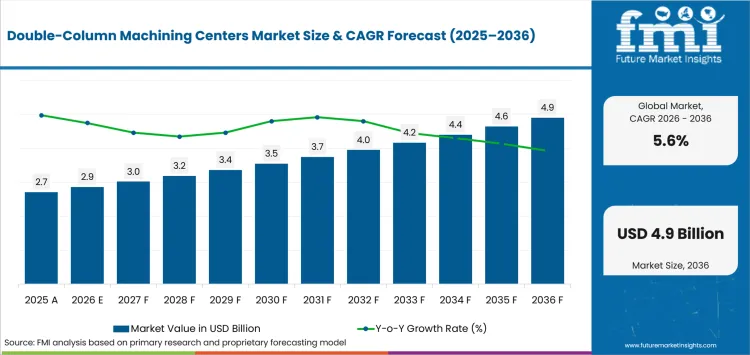
Key Takeaways
- Large molds, structural aerospace parts and heavy components support demand because double-column machines reduce re-clamping and protect geometry over long travels.
- By machine type, fixed bridge is estimated to hold 27.0% in 2026 owing to broad large-part fit without forcing every project into the largest installation class.
- In 2026, below 30 kW is expected to lead spindle power with 21.0% share because many finishing programs prioritize stable cutting over maximum output.
- Small molds/dies are projected to hold 18.0% share in 2026 attributable to toolrooms that need bridge stiffness without the heaviest foundation class.
- Large footprints, rigging requirements and long commissioning windows can slow approval unless expected spindle hours cover the installation burden and capital tied up in the machine.
- Some of the key players in this market include DN Solutions, Okuma, Mazak, Hartford, DMG MORI, Hurco, Fives, and Haas Automation.
Analyst Perspective
"A double-column machine earns its return if a defined part family keeps the table and spindle productive after commissioning. The strongest capital cases prove fewer reclamps, stable long-travel geometry and local service response instead of paying for extra machine envelope without a matching workload."
- Nikhil Kaitwade, Principal Consultant, Future Market Insights
How is the double-column machining centers market segmented?
The double-column machining centers market is segmented by machine type, spindle power, workpiece size, end use, sales channel and region.
Machine type covers fixed bridge, moving bridge, gantry-style double-column, five-axis double-column and heavy-duty mold machining centers. Spindle power spans below 30 kW, 30-60 kW, 60-100 kW and above 100 kW. Workpiece size covers small molds/dies, medium large parts, large structural parts and heavy-duty oversized parts. End use includes aerospace, automotive tooling, die and mold, heavy machinery and energy equipment. Sales channels comprise machine tool OEM direct, regional distributors, system integrators and turnkey project supply.
What makes fixed bridge central to the machine type category?
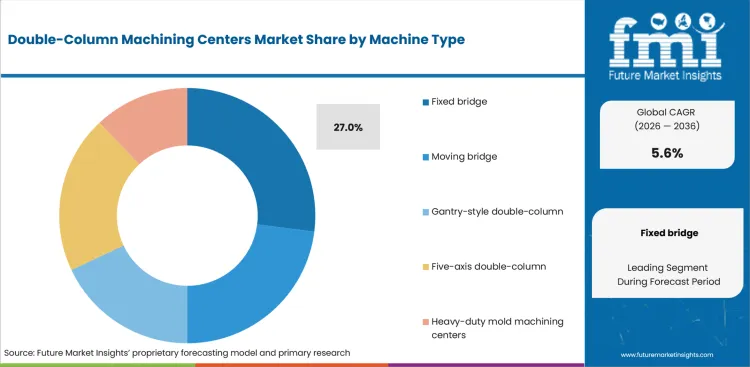
Fixed bridge machines keep the column structure stationary while the table carries the large component through controlled travel. The layout suits recurring molds and structural parts that need coordinate measuring machine access during acceptance and inspection.
- By machine type, fixed bridge is forecast to represent 27.0% in 2026 driven by a stationary bridge that preserves stiffness over broad large-part work envelopes.
- Large-workpiece job shops still receive current commercial attention for this format. In January 2025, Mazak announced that its Midwest event would demonstrate the FJV-35/60 double-column vertical machining center for large-workpiece job-shop production.
How do small molds/dies shape the workpiece size category?
Mold shops need a broad table, stable bridge and controlled metalworking fluids before a workpiece reaches oversized structural dimensions. Okuma documented the operating case in November 2025 through Cavalier Tool, which approved a third double-column machine once planning showed fewer transfers and shorter order cycles.
- The small molds/dies segment is likely to capture 18.0% share in 2026 attributable to toolrooms that need bridge rigidity without heavyweight foundations.
- One setup can preserve datum relationships through cavity work, drilling and finishing and free other machines for smaller jobs. That routing benefit is strongest for toolrooms with repeat molds that keep the bridge machine loaded.
What supports aerospace leadership in the end use category?
Repeated fixturing raises datum-loss risk on long aerostructures with complex multi-face features. Crane handling also consumes non-cutting time on long structural parts. Five-axis access and machine vision systems keep inspection tied to one controlled reference.
- Based on end use, aerospace is projected to account for 25.0% in 2026 due to structural parts and tooling that require long travel, high rigidity and multi-face access.
- In April 2026, DMG MORI machined a wing rib nearly two meters long from one aluminum block on a DMU 340 Gantry. That geometry shows why large-part aerospace programs sustain gantry demand.
Why does machine tool OEM direct lead the sales channel category?
Application review begins during specification for double-column orders. Table load, CNC controller interfaces and attachment heads must fit one defined part family. Mazak shifted the Rocky Mountain District to direct sales and service in February 2026, giving manufacturers local applications support and technical-center access.
- Machine tool OEM direct is set to lead the sales channel category with 48.0% share in 2026 due to tightly linked configuration, acceptance and service responsibility.
- Direct engineering clarifies interface ownership during industrial robotics commissioning and gives one manufacturer responsibility for factory acceptance, installation and initial process prove-out during ramp-up.
What are the drivers, restraints and opportunities in the Double-Column Machining Centers Market?
Large-part programs increase demand, facility and service requirements slow approval, and multi-face automation can release more productive spindle time.
- Driver: Large components favor machines that hold geometry over long travel by removing handling between separate cutting operations.
- Restraint: Installation space, utilities and service readiness can delay capital approval even where the machining requirement is technically clear.
- Opportunity: Automatic heads and multi-face processing can convert manual repositioning time into repeatable cutting capacity on recurring large-part programs.
Large-part programs justify capital spending once one rigid machine removes transfers that would otherwise consume crane time and re-establish datums. AMT documented April 2026 USA metalworking machinery orders 33.2% above April 2025, with higher average values partly tied to automation on more sophisticated equipment. Double-column projects convert that spending into orders once the planned routing releases enough spindle capacity to cover the larger capital base.
Service response becomes a capital criterion on machines that can occupy a bottleneck production slot for years. Okuma's July 2026 IMTS announcement described a new 35,000-square-foot Global Repair Center, four times the previous dedicated space. That investment shows the support depth manufacturers expect for critical large-part work, particularly if a distant repair route raises downtime exposure and predictive maintenance cannot replace physical repair capacity.
Multi-face processing earns a premium by removing handling from a verified customer routing. Hartford's June 2026 large-part announcement described the HSA-546AAC with automatic attachment changes for five-face work in one setup. Applications teams can monetize that configuration by documenting fewer reclamps, a repeatable cycle-time gain and stable cutting tools on the actual part during purchase approval under normal production conditions.
Which country CAGRs are profiled in the Double-Column Machining Centers Market?
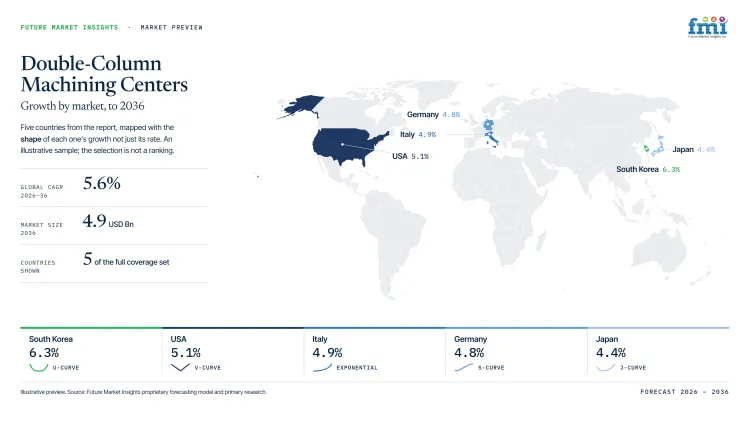
| Country | CAGR |
|---|---|
| South Korea | 6.3% |
| Mexico | 5.6% |
| USA | 5.1% |
| Italy | 4.9% |
| Germany | 4.8% |
| France | 4.7% |
| Japan | 4.4% |
How do country-level CAGRs compare in the Double-Column Machining Centers Market?
The forecasts span 1.9 percentage points. South Korea and Mexico form the upper group, with the USA bridging them to a tight European band. Italy, Germany and France differ by 0.2 points, so project timing outweighs headline CAGR there. Japan grows more slowly as replacement decisions face a mature machine-tool base.
- South Korea’s dense tooling ecosystem helps reduce technical-support travel and speeds up service response times.
- Mexico’s export-oriented manufacturing base favors the efficient routing of large, consolidated machining fixtures.
- In the USA, contract manufacturers increasingly prefer configurable tables and spindle-head options to support diverse workloads.
- Italy’s mold-making sector values machine rigidity for maintaining precision during extended finishing operations.
- Germany’s extensive installed machine base raises the threshold for new greenfield investments through retrofit compatibility requirements.
- France’s aerospace supply chain benefits from machining platforms that provide multi-face access for complex structural tooling.
- In Japan, thermal stability is often prioritized over maximum machining envelope to ensure consistent precision.
Similar CAGRs therefore mask different service and replacement thresholds for entrants. The full report provides country-level CAGR analysis across North America, Latin America, Western Europe, Eastern Europe, East Asia, South Asia and Pacific, Middle East and Africa.
Country-wise Analysis
- South Korean factories evaluate large machining centers beside automation controls and local applications support for mold, aerospace and machinery programs. In August 2025, the Korea Machine Tool Manufacturers' Association said more than 90% of SIMTOS 2026 exhibition space was already booked seven months early, confirming broad access to manufacturing-technology partners. Demand for double-column machining centers is forecast to rise at 6.3% CAGR through 2036, aided by dense industrial clusters that shorten applications travel and coordinated commissioning, though builders still need local technicians and stocked parts because one bridge machine can become a production bottleneck during qualification and regular operation.
- Mexico is likely to register 5.6% CAGR through 2036, aided by northern aerospace and industrial clusters that concentrate large-part machining demand near established export corridors and assembly plants. Data México counted 135 aerospace product and parts manufacturing establishments in May 2026, led by Sonora with 41 and Chihuahua with 30, giving applications engineers a practical route to qualified accounts and repeat visits. Import timing and uneven specialist service coverage can extend commissioning outside the largest industrial centers, so builders that place trained technicians and critical parts near customer plants are better positioned to protect uptime after installation and win follow-on work.
- American aerospace contractors and mixed-part job shops require a large machine to stay loaded after installation, making utilization proof a central part of capital approval for bridge platforms. AMT documented in August 2026 that first-half metalworking machinery orders were 36.0% above the prior year, the strongest first half in its series, which improved the funding environment for well-scoped projects involving sophisticated equipment and automation. The USA is estimated to post 5.1% CAGR through 2036, helped by that investment cycle, although scarce floor space and commissioning windows favor builders that define installation work early and restore production quickly during ramp-up and service.
- Italy-based die, mold and general engineering shops operate within dense machine-tool clusters that place applications support close to major industrial regions and shorten technical travel for complex installations. Double-column machining center sales in Italy are forecast to expand at 4.9% CAGR by 2036, tied to replacement and productivity projects as cautious capital committees demand a clear cycle-time case before approving large assets. UCIMU reported in July 2026 that its machine-tool order index fell 25.8% year over year in the second quarter and domestic orders fell 38.7%, so builders with credible financing and process evidence have a stronger route into defined projects than vendors selling capacity alone.
- The German double-column machining centers sector is projected to record 4.8% CAGR through 2036, given demand for high-accuracy large-part work in aerospace, machinery and tooling despite restrained capital spending and a capable installed base. VDW data published in June 2026 show first-quarter machine-tool orders rose 15% year over year even as production and employment stayed under pressure, allowing some delayed projects to return without removing budget scrutiny for large equipment. German manufacturers compare thermal stability, automation fit and service depth against existing assets, which favors builders that prove measurable cycle-time or accuracy gains instead of relying on nominal machine size during investment approval.
- French large-part machining demand is closely tied to aerospace structures, tooling and tier suppliers working through production ramp-ups, giving gantry and bridge builders a visible route into structural machining programs. GIFAS published May 2026 results showing French aerospace and defense revenue increased 11.9% in 2025 and exports rose 14.6%, reinforcing capacity requirements for structural parts and production tooling at qualified suppliers. Adoption of double-column machining centers is estimated to expand at 4.7% CAGR through 2036, propelled by that aerospace workload, though documented process control and reliable field service remain necessary before a large platform enters recurring production at an approved supplier.
- Japanese machine shops often replace capable equipment only after accuracy, cycle time and lifecycle service justify disruption against a mature installed base with disciplined maintenance and long asset lives. Demand in Japan is projected to advance at 4.4% CAGR through 2036, attributable to export-facing manufacturing and selective replacement rather than a broad domestic capacity surge for large machining equipment. JMTBA data published in February 2026 show foreign machine-tool orders for 2025 increased 11.5% while domestic orders slipped 0.2%, so builders need a specific productivity or accuracy gain and credible service support to displace equipment that still meets existing production requirements.
Who are the notable companies in the Double-Column Machining Centers Market?
DN Solutions, Okuma, Mazak, Hartford, DMG MORI, Hurco, Fives and Haas Automation are the notable companies serving this market.
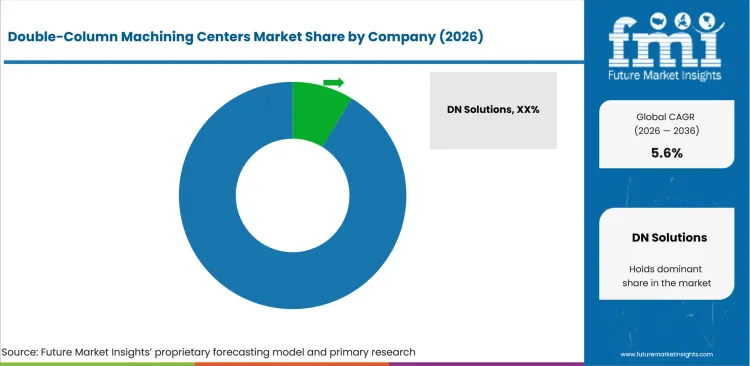
Dedicated double-column builders compete beside broader gantry and large-part machining groups. Entry barriers rise through applications engineering, tool holders, attachment-head integration and field service as the machine often becomes a bottleneck asset once commissioned.
- DN Solutions, Okuma, Mazak and Hartford compete with double-column or bridge platforms covering mold, structural and general large-part work.
- DMG MORI and Fives address high-value large components through gantry engineering, multi-axis processing and application-specific production systems.
- Hurco and Haas Automation broaden access for job shops that need large work envelopes with established regional sales and service routes.
Competitive Benchmarking: Double-Column Machining Centers Market
| Company | Large-Work Envelope Breadth | Multi-Face Integration | Service and Application Support | Geographic Reach |
|---|---|---|---|---|
| DN Solutions | High | High | High | Global |
| Okuma | High | High | High | Global |
| Mazak | High | Medium | High | Global |
| Hartford | High | High | Medium | Asia, Europe and Americas |
| DMG MORI | High | High | High | Global |
| Hurco | Medium | Medium | High | North America and international distributors |
| Fives | High | High | High | Global |
| Haas Automation | Medium | Medium | High | North America and global factory outlets |
Scoring basis: High envelope breadth requires at least three verified large-part configurations, Medium requires one or two and Low identifies one narrow format. High multi-face integration requires multiple indexed or simultaneous processing routes. Medium confirms one route and Low indicates limited integration. High service support requires documented applications, parts and field coverage in several regions. Medium covers fewer regions and Low identifies a limited support footprint.
Key Developments in the Double-Column Machining Centers Market
- In January 2026, DN Solutions completed its acquisition of HELLER following regulatory approvals, extending the combined machine-tool portfolio and manufacturer-backed service coverage in Europe and North America.
- In September 2025, Fives acquired Pietro Carnaghi, bringing a specialist in large-scale machining systems into its High Precision Machines division for aerospace, energy and other heavy-component programs.
- In August 2025, Hurco appointed Integra Machine Tool as its distribution and service partner for Illinois and Wisconsin, adding local sales, service and applications coverage for regional manufacturers.
Key Players in the Double-Column Machining Centers Market
Dedicated Double-Column and Bridge Platforms
- DN Solutions
- Okuma
- Mazak
- Hartford
Large-Part and Configurable Machining Systems
- DMG MORI
- Hurco
Industrial Project and Job-Shop Platforms
- Fives
- Haas Automation
Double-Column Machining Centers Market - Report Scope
| Coverage field | Report scope |
|---|---|
| Market breakdown | Machine type, spindle power, workpiece size, end use, sales channel and region. |
| Quantitative Units | USD billion. |
| Market Definition | New double-column machining centers sold within the stated segmentation universe, including factory-supplied heads, attachments and options bundled with the original machine sale. Used equipment, stand-alone tools, downstream finished parts and unrelated single-column machines are excluded. |
| Regions Covered | North America, Latin America, Western Europe, Eastern Europe, East Asia, South Asia and Pacific, Middle East and Africa. |
| Countries Covered | South Korea, Mexico, USA, Italy, Germany, France, Japan, and 20+ countries included in the full report. |
| Key Companies Profiled | DN Solutions, Okuma, Mazak, Hartford, DMG MORI, Hurco, Fives and Haas Automation. |
| Forecast Period | 2026 to 2036. |
| Approach | Primary and secondary research with market triangulation. |
Double-Column Machining Centers Market - Research Methodology
| Method | Approach |
|---|---|
| Primary Research | FMI analysts gathered input from manufacturers, service providers, technology developers, distributors, end users, procurement teams, and subject-matter experts. Interviews examined purchasing decisions, product or service evaluation, adoption barriers, approval requirements, pricing considerations, and expectations for technical or commercial support. Respondents were also asked what evidence is required before a trial, pilot, or initial order develops into regular purchasing. |
| Desk Research | Desk research covered government statistics, regulatory publications, trade data, industry associations, technical literature, standards, company filings, product information, and official corporate announcements. Sources were reviewed for relevance, publication date, geographic coverage, and consistency with the defined market scope. Claims relating to performance, applications, approvals, capacity, investment, and commercial activity were retained only when supported by credible public evidence. |
| Market Sizing and Forecasting | The market model combined the baseline value with historical performance, segment structure, pricing and volume indicators, adoption levels, company participation, and country-level demand conditions. Forecast assumptions considered economic activity, investment trends, regulatory developments, technology adoption, purchasing cycles, supply availability, and barriers to wider market use. Segment and regional estimates were reconciled before the final market total was calculated. |
| Data Validation | Estimates were checked against multiple independent indicators, including public data, company activity, trade patterns, industry developments, and findings from primary interviews. Validation also tested whether products, services, applications, and company revenues fell within the defined market boundaries. Adjacent categories, unsupported claims, overlapping revenues, and activities without direct market relevance were excluded to reduce double counting and maintain consistency across segments and countries. |
Double-Column Machining Centers Market by Segments
Double-Column Machining Centers Market segmented by Machine Type:
- Fixed bridge
- Moving bridge
- Gantry-style double-column
- Five-axis double-column
- Heavy-duty mold machining centers
Double-Column Machining Centers Market segmented by Spindle Power:
- Below 30 kW
- 30-60 kW
- 60-100 kW
- Above 100 kW
Double-Column Machining Centers Market segmented by Workpiece Size:
- Small molds/dies
- Medium large parts
- Large structural parts
- Heavy-duty oversized parts
Double-Column Machining Centers Market segmented by End Use:
- Aerospace
- Automotive tooling
- Die and mold
- Heavy machinery
- Energy equipment
Double-Column Machining Centers Market segmented by Sales Channel:
- Machine tool OEM direct
- Regional distributors
- System integrators
- Turnkey project supply
Double-Column Machining Centers Market by Region:
- North America
- United States
- Canada
- Latin America
- Brazil
- Mexico
- Chile
- Rest of Latin America
- Western Europe
- Germany
- United Kingdom
- Italy
- Spain
- France
- Nordics
- Benelux
- Rest of Western Europe
- Eastern Europe
- Russia
- Poland
- Hungary
- Balkan and Baltic States
- Rest of Eastern Europe
- East Asia
- China
- Japan
- South Korea
- South Asia and Pacific
- India
- ASEAN
- Australia and New Zealand
- Rest of South Asia and Pacific
- Middle East and Africa
- Kingdom of Saudi Arabia
- Other GCC Countries
- Türkiye
- South Africa
- Other African Union Countries
- Rest of Middle East and Africa
Research Sources and Bibliography
- AMT - The Association For Manufacturing Technology. (2026, February 9). Manufacturing Technology Orders Set Record in December 2025.
- VDW - German Machine Tool Builders' Association. (2025, August 12). Machine tool industry expecting no upturn until next year.
- Mazak Corporation. (2025, January 31). Midwest DISCOVER MORE WITH MAZAK Event Targets Job Shop Production.
- Okuma America Corporation. (2025, November 25). For Cavalier Tool: Fast Is the Best Way Forward.
- DMG MORI. (2026, April 19). High-tech solutions for aviation, mobility, and medical technology.
- Mazak Corporation. (2026, February 2). Mazak Shifts to Direct Sales and Service in Rocky Mountain District.
- AMT - The Association For Manufacturing Technology. (2026, June 8). Automation Fuels Strong Start to 2026 Manufacturing Technology Orders.
- Okuma America Corporation. (2026, July 24). Okuma America Corporation to Exhibit at IMTS 2026 with Comprehensive Lineup.
- Hartford. (2026, June 3). How 5-Face Gantry Machining Solves the Biggest Challenges in Large-Part Manufacturing.
- Korea Machine Tool Manufacturers' Association. (2025, August 25). SIMTOS 2026 Presents Global Roadshow @ EMO.
- Secretaria de Economia, Data Mexico. (2026, May). Aerospace Product and Parts Manufacturing.
- AMT - The Association For Manufacturing Technology. (2026, August 10). 2026 Manufacturing Technology Orders Set Half-Year Record.
- UCIMU-SISTEMI PER PRODURRE. (2026, July 14). Order index still falling in the second quarter of 2026 (-25.8%).
- VDW - German Machine Tool Builders' Association. (2026, June 23). Bottomed out - First quarter sees increase in orders for machine tool industry.
- GIFAS - French Aerospace Industries Association. (2026, May 11). 2025 Results: The French Aerospace Industry Remains Strongly Positioned for the Future.
- Japan Machine Tool Builders' Association. (2026, February 3). The Current Condition of the Japanese Machine Tool Industry: Monthly Machine Tool Orders (December 2025).
- DN Solutions. (2026, January 28). DN Solutions Completes Acquisition of German Machine Tool Manufacturer HELLER.
- Fives. (2025, September 17). Pietro Carnaghi joins Fives, Further Strengthening the Group's leadership in the Machine-Tool Sector.
- Hurco Companies. (2025, August 21). Hurco Names Integra Machine Tool as Distribution and Service Partner for Illinois and Wisconsin.
- Fives. (2026, April 2). Fives Giddings & Lewis Announces Major Equipment Investments and Facility Upgrades to Support Growth.
- DMG MORI. (2026, May 26). DMG MORI European Headquarters and Technology Center celebrates topping-out ceremony in Munich.
- DN Solutions. (2026, March 18). DN Solutions Unveils HELLER F 6000 5-Axis Horizontal Machining Center for First Time at SIMTOS 2026.
- Hartford. (2026, July 3). Building Trust Through Engineering: HSA-427EAY Proven Before Delivery.
- Fives. (2026, June 15). Fives will supply a fourth V-STAR machine to KNDS to support the ramp-up of its production in Roanne.
- DN Solutions. (2025, May 22). DN Solutions Celebrates Grand Opening of Chicago Technical Center.
- Okuma America Corporation. (2025, May 5). Okuma America Corporation Announces Agreement with New Channel Partner in Brazil.
- Mazak Corporation. (2026, January 16). New Mazak Phoenix Technical Center Opens for Business, Expands Regional Service and Support.
- Hartford. (2026, June 29). Hartford Completes SW-623 Factory Acceptance Test with Swedish Distributor.
- DMG MORI. (2026, March 23). DMG MORI opens new technology center in Gothenburg.
- Hurco Europe Ltd. (2026, April). MACH 2026 REVIEW.
- Fives. (2026, February 3). Fives Machining Systems Inc. and Prestige Equipment Partner to Expand Customer Options for Equipment Lifecycle Management.
- Haas Automation. (2025, July 28). Haas Automation's New Henderson Nevada Factory - July 2025 Update.
This bibliography is provided for reader reference and is not exhaustive. The full report contains the complete reference list and detailed citations.
This Report Answers
- What is the 2026 size and 2036 forecast for the double-column machining centers market?
- Which production conditions justify investment in double-column machining centers?
- Why does fixed bridge lead the machine type category?
- How do spindle power and workpiece size shape machine configuration?
- Why is aerospace important for large-format multi-face machining?
- How do growth rates differ among South Korea, Mexico, USA, Italy, Germany, France and Japan?
- Which companies provide double-column, gantry or large-part machining systems?
- Which installation and service frictions delay large machining-center approval?
Frequently Asked Questions
How big is the double-column machining centers market in 2026?
The double-column machining centers market is valued at USD 2.9 billion in 2026 and projected to reach USD 4.9 billion by 2036. Large-part programs favor fewer setups and stable geometry over long travels.
What is the CAGR of the double-column machining centers market from 2026 to 2036?
The double-column machining centers market is projected to grow at 5.6% CAGR between 2026 and 2036. Large molds, aerospace structures and heavy components sustain investment in long-travel machining.
Which machine type leads the double-column machining centers market?
The fixed bridge segment is expected to hold 27.0% of the double-column machining centers market in 2026, driven by broad large-part fit. Its stationary bridge offers rigidity without forcing every project into the largest installation class.
Which spindle power segment leads the double-column machining centers market?
The below 30 kW segment is expected to hold 21.0% of the double-column machining centers market in 2026, attributable to finishing and general large-part work. Stable cutting often outweighs sustained extreme spindle output in this band.
Which workpiece size segment leads the double-column machining centers market?
The small molds/dies segment is expected to hold 18.0% of the double-column machining centers market in 2026, supported by toolrooms that need bridge stiffness. These shops avoid the heaviest foundation and handling requirements.
Which countries are projected to record the highest growth in the double-column machining centers market?
South Korea is projected to grow at 6.3% CAGR, followed by Mexico at 5.6% and the USA at 5.1% through 2036. Automation density, export manufacturing and capital spending separate their growth paths.
Which companies are active in the double-column machining centers market?
Key companies operating in the market include DN Solutions, Okuma, Mazak, Hartford, DMG MORI, Hurco, Fives, and Haas Automation. Competition centers on work envelope, multi-face processing, applications engineering and field service.
Preview the report firsthand - request a free sample
Get SampleGet the brochure for pricing and purchase details.
Get PDFTable of Content
- Key Takeaways
- Market Size and CAGR
- Top Growth Driver
- Fastest Growing Segment
- Leading Region
- Key Companies
- Emerging Opportunities
- Executive Summary
- Global Market Outlook
- Demand-side Trends
- Supply-side Trends
- Technology Roadmap Analysis
- Analysis and Recommendations
- Analyst Perspective (What is happening? Why now? What should investors know?)
- Key Questions Answered
- How large is the market?
- What is the CAGR?
- What are key trends?
- Which region dominates?
- Who are the leaders?
- Market Overview
- Market Coverage / Taxonomy
- Market Definition / Scope / Limitations
- Research Methodology
- Chapter Orientation
- Analytical Lens and Working Hypotheses
- Market Structure, Signals, and Trend Drivers
- Benchmarking and Cross-market Comparability
- Market Sizing, Forecasting, and Opportunity Mapping
- Research Design and Evidence Framework
- Desk Research Programme (Secondary Evidence)
- Expert Input and Fieldwork (Primary Evidence)
- Tooling, Models, and Reference Databases
- Data Engineering and Model Build
- Quality Assurance and Audit Trail
- Market Background
- Market Dynamics (Drivers, Restraints, Opportunity, Trends)
- Scenario Forecast (Optimistic, Likely, Conservative)
- Impact Analysis
- AI Impact
- Sustainability Impact
- Regulatory Impact
- Technology Impact
- Consumer / Buyer Analysis
- Purchase Drivers
- Adoption Barriers
- Buyer Journey
- Opportunity Map Analysis
- Product Life Cycle Analysis
- Supply Chain Analysis
- Investment Feasibility Matrix
- Value Chain Analysis
- PESTLE and Porter's Analysis
- Regulatory Landscape
- Regional Parent Market Outlook
- Production and Consumption Statistics
- Import and Export Statistics
- Global Market Analysis and Forecast, 2021 to 2036
- Historical Market Size Value (USD Billion) Analysis, 2021 to 2025
- Current and Future Market Size Value (USD Billion) Projections, 2026 to 2036
- Y-o-Y Growth Trend Analysis
- Absolute $ Opportunity Analysis
- Global Market Pricing Analysis, 2021 to 2036
- Global Market Analysis and Forecast, By Machine Type, 2021 to 2036
- Introduction / Key Findings
- Historical Market Size Value (USD Billion) Analysis By Machine Type, 2021 to 2025
- Current and Future Market Size Value (USD Billion) Analysis and Forecast By Machine Type, 2026 to 2036
- Fixed bridge
- Moving bridge
- Gantry-style double-column
- Five-axis double-column
- Heavy-duty mold machining centers
- Fixed bridge
- Y-o-Y Growth Trend Analysis By Machine Type, 2021 to 2025
- Absolute $ Opportunity Analysis By Machine Type, 2026 to 2036
- Global Market Analysis and Forecast, By Spindle Power, 2021 to 2036
- Introduction / Key Findings
- Historical Market Size Value (USD Billion) Analysis By Spindle Power, 2021 to 2025
- Current and Future Market Size Value (USD Billion) Analysis and Forecast By Spindle Power, 2026 to 2036
- Below 30 kW
- 30-60 kW
- 60-100 kW
- Above 100 kW
- Below 30 kW
- Y-o-Y Growth Trend Analysis By Spindle Power, 2021 to 2025
- Absolute $ Opportunity Analysis By Spindle Power, 2026 to 2036
- Global Market Analysis and Forecast, By Workpiece Size, 2021 to 2036
- Introduction / Key Findings
- Historical Market Size Value (USD Billion) Analysis By Workpiece Size, 2021 to 2025
- Current and Future Market Size Value (USD Billion) Analysis and Forecast By Workpiece Size, 2026 to 2036
- Small molds/dies
- Medium large parts
- Large structural parts
- Heavy-duty oversized parts
- Small molds/dies
- Y-o-Y Growth Trend Analysis By Workpiece Size, 2021 to 2025
- Absolute $ Opportunity Analysis By Workpiece Size, 2026 to 2036
- Global Market Analysis and Forecast, By End Use, 2021 to 2036
- Introduction / Key Findings
- Historical Market Size Value (USD Billion) Analysis By End Use, 2021 to 2025
- Current and Future Market Size Value (USD Billion) Analysis and Forecast By End Use, 2026 to 2036
- Aerospace
- Automotive tooling
- Die & mold
- Heavy machinery
- Energy equipment
- Aerospace
- Y-o-Y Growth Trend Analysis By End Use, 2021 to 2025
- Absolute $ Opportunity Analysis By End Use, 2026 to 2036
- Global Market Analysis and Forecast, By Sales Channel, 2021 to 2036
- Introduction / Key Findings
- Historical Market Size Value (USD Billion) Analysis By Sales Channel, 2021 to 2025
- Current and Future Market Size Value (USD Billion) Analysis and Forecast By Sales Channel, 2026 to 2036
- Machine tool OEM direct
- Regional distributors
- System integrators
- Turnkey project supply
- Machine tool OEM direct
- Y-o-Y Growth Trend Analysis By Sales Channel, 2021 to 2025
- Absolute $ Opportunity Analysis By Sales Channel, 2026 to 2036
- Global Market Analysis and Forecast, By Region, 2021 to 2036
- Introduction
- Historical Market Size Value (USD Billion) Analysis By Region, 2021 to 2025
- Current Market Size Value (USD Billion) Analysis and Forecast By Region, 2026 to 2036
- North America
- Latin America
- Western Europe
- Eastern Europe
- East Asia
- South Asia and Pacific
- Middle East & Africa
- Market Attractiveness Analysis By Region
- North America Market Analysis and Forecast, By Country, 2021 to 2036
- Historical Market Size Value (USD Billion) Trend Analysis By Market Taxonomy, 2021 to 2025
- Market Size Value (USD Billion) Forecast By Market Taxonomy, 2026 to 2036
- By Country
- USA
- Canada
- By Machine Type
- By Spindle Power
- By Workpiece Size
- By End Use
- By Sales Channel
- By Country
- Market Attractiveness Analysis
- By Country
- By Machine Type
- By Spindle Power
- By Workpiece Size
- By End Use
- By Sales Channel
- Key Takeaways
- Latin America Market Analysis and Forecast, By Country
- Historical Market Size Value (USD Billion) Trend Analysis By Market Taxonomy, 2021 to 2025
- Market Size Value (USD Billion) Forecast By Market Taxonomy, 2026 to 2036
- By Country
- Brazil
- Mexico
- Chile
- Rest of Latin America
- By Machine Type
- By Spindle Power
- By Workpiece Size
- By End Use
- By Sales Channel
- By Country
- Market Attractiveness Analysis
- By Country
- By Machine Type
- By Spindle Power
- By Workpiece Size
- By End Use
- By Sales Channel
- Key Takeaways
- Western Europe Market Analysis and Forecast, By Country
- Historical Market Size Value (USD Billion) Trend Analysis By Market Taxonomy, 2021 to 2025
- Market Size Value (USD Billion) Forecast By Market Taxonomy, 2026 to 2036
- By Country
- Germany
- UK
- Italy
- Spain
- France
- Nordic
- BENELUX
- Rest of Western Europe
- By Machine Type
- By Spindle Power
- By Workpiece Size
- By End Use
- By Sales Channel
- By Country
- Market Attractiveness Analysis
- By Country
- By Machine Type
- By Spindle Power
- By Workpiece Size
- By End Use
- By Sales Channel
- Key Takeaways
- Eastern Europe Market Analysis and Forecast, By Country
- Historical Market Size Value (USD Billion) Trend Analysis By Market Taxonomy, 2021 to 2025
- Market Size Value (USD Billion) Forecast By Market Taxonomy, 2026 to 2036
- By Country
- Russia
- Poland
- Hungary
- Balkan & Baltic
- Rest of Eastern Europe
- By Machine Type
- By Spindle Power
- By Workpiece Size
- By End Use
- By Sales Channel
- By Country
- Market Attractiveness Analysis
- By Country
- By Machine Type
- By Spindle Power
- By Workpiece Size
- By End Use
- By Sales Channel
- Key Takeaways
- East Asia Market Analysis and Forecast, By Country
- Historical Market Size Value (USD Billion) Trend Analysis By Market Taxonomy, 2021 to 2025
- Market Size Value (USD Billion) Forecast By Market Taxonomy, 2026 to 2036
- By Country
- China
- Japan
- South Korea
- By Machine Type
- By Spindle Power
- By Workpiece Size
- By End Use
- By Sales Channel
- By Country
- Market Attractiveness Analysis
- By Country
- By Machine Type
- By Spindle Power
- By Workpiece Size
- By End Use
- By Sales Channel
- Key Takeaways
- South Asia and Pacific Market Analysis and Forecast, By Country
- Historical Market Size Value (USD Billion) Trend Analysis By Market Taxonomy, 2021 to 2025
- Market Size Value (USD Billion) Forecast By Market Taxonomy, 2026 to 2036
- By Country
- India
- ASEAN
- Australia & New Zealand
- Rest of South Asia and Pacific
- By Machine Type
- By Spindle Power
- By Workpiece Size
- By End Use
- By Sales Channel
- By Country
- Market Attractiveness Analysis
- By Country
- By Machine Type
- By Spindle Power
- By Workpiece Size
- By End Use
- By Sales Channel
- Key Takeaways
- Middle East & Africa Market Analysis and Forecast, By Country
- Historical Market Size Value (USD Billion) Trend Analysis By Market Taxonomy, 2021 to 2025
- Market Size Value (USD Billion) Forecast By Market Taxonomy, 2026 to 2036
- By Country
- Kingdom of Saudi Arabia
- Other GCC Countries
- Türkiye
- South Africa
- Other African Union
- Rest of Middle East & Africa
- By Machine Type
- By Spindle Power
- By Workpiece Size
- By End Use
- By Sales Channel
- By Country
- Market Attractiveness Analysis
- By Country
- By Machine Type
- By Spindle Power
- By Workpiece Size
- By End Use
- By Sales Channel
- Key Takeaways
- Key Countries Market Analysis
- USA
- Pricing Analysis
- Market Share Analysis, 2025
- By Machine Type
- By Spindle Power
- By Workpiece Size
- By End Use
- By Sales Channel
- Canada
- Pricing Analysis
- Market Share Analysis, 2025
- By Machine Type
- By Spindle Power
- By Workpiece Size
- By End Use
- By Sales Channel
- Mexico
- Pricing Analysis
- Market Share Analysis, 2025
- By Machine Type
- By Spindle Power
- By Workpiece Size
- By End Use
- By Sales Channel
- Brazil
- Pricing Analysis
- Market Share Analysis, 2025
- By Machine Type
- By Spindle Power
- By Workpiece Size
- By End Use
- By Sales Channel
- Chile
- Pricing Analysis
- Market Share Analysis, 2025
- By Machine Type
- By Spindle Power
- By Workpiece Size
- By End Use
- By Sales Channel
- Germany
- Pricing Analysis
- Market Share Analysis, 2025
- By Machine Type
- By Spindle Power
- By Workpiece Size
- By End Use
- By Sales Channel
- UK
- Pricing Analysis
- Market Share Analysis, 2025
- By Machine Type
- By Spindle Power
- By Workpiece Size
- By End Use
- By Sales Channel
- Italy
- Pricing Analysis
- Market Share Analysis, 2025
- By Machine Type
- By Spindle Power
- By Workpiece Size
- By End Use
- By Sales Channel
- Spain
- Pricing Analysis
- Market Share Analysis, 2025
- By Machine Type
- By Spindle Power
- By Workpiece Size
- By End Use
- By Sales Channel
- France
- Pricing Analysis
- Market Share Analysis, 2025
- By Machine Type
- By Spindle Power
- By Workpiece Size
- By End Use
- By Sales Channel
- India
- Pricing Analysis
- Market Share Analysis, 2025
- By Machine Type
- By Spindle Power
- By Workpiece Size
- By End Use
- By Sales Channel
- ASEAN
- Pricing Analysis
- Market Share Analysis, 2025
- By Machine Type
- By Spindle Power
- By Workpiece Size
- By End Use
- By Sales Channel
- Australia & New Zealand
- Pricing Analysis
- Market Share Analysis, 2025
- By Machine Type
- By Spindle Power
- By Workpiece Size
- By End Use
- By Sales Channel
- China
- Pricing Analysis
- Market Share Analysis, 2025
- By Machine Type
- By Spindle Power
- By Workpiece Size
- By End Use
- By Sales Channel
- Japan
- Pricing Analysis
- Market Share Analysis, 2025
- By Machine Type
- By Spindle Power
- By Workpiece Size
- By End Use
- By Sales Channel
- South Korea
- Pricing Analysis
- Market Share Analysis, 2025
- By Machine Type
- By Spindle Power
- By Workpiece Size
- By End Use
- By Sales Channel
- Russia
- Pricing Analysis
- Market Share Analysis, 2025
- By Machine Type
- By Spindle Power
- By Workpiece Size
- By End Use
- By Sales Channel
- Poland
- Pricing Analysis
- Market Share Analysis, 2025
- By Machine Type
- By Spindle Power
- By Workpiece Size
- By End Use
- By Sales Channel
- Hungary
- Pricing Analysis
- Market Share Analysis, 2025
- By Machine Type
- By Spindle Power
- By Workpiece Size
- By End Use
- By Sales Channel
- Kingdom of Saudi Arabia
- Pricing Analysis
- Market Share Analysis, 2025
- By Machine Type
- By Spindle Power
- By Workpiece Size
- By End Use
- By Sales Channel
- Türkiye
- Pricing Analysis
- Market Share Analysis, 2025
- By Machine Type
- By Spindle Power
- By Workpiece Size
- By End Use
- By Sales Channel
- South Africa
- Pricing Analysis
- Market Share Analysis, 2025
- By Machine Type
- By Spindle Power
- By Workpiece Size
- By End Use
- By Sales Channel
- USA
- Market Structure Analysis
- Competition Dashboard
- Competition Benchmarking
- Market Share Analysis of Top Players
- By Regional
- By Machine Type
- By Spindle Power
- By Workpiece Size
- By End Use
- By Sales Channel
- Emerging Startups
- Innovation Benchmarking
- Competition Analysis
- Competition Deep Dive
- DN Solutions
- Overview
- Product Portfolio
- Profitability by Market Segments
- Sales Footprint
- Strategy Overview
- Marketing Strategy
- Product Strategy
- Channel Strategy
- Okuma
- Mazak
- Makino
- DMG MORI
- Hurco
- Fives
- Haas Automation
- Hartford
- Awea Mechantronic
- DN Solutions
- Case Studies
- Success Stories
- Recent Developments
- Competition Deep Dive
- Assumptions & Acronyms Used


