

- Market Size (2026)
- USD 563.0 Mn
- Forecast (2036)
- USD 5243.0 Mn
- CAGR (2026 to 2036)
- 25.0%
How big is Elderly-Care & Companion Robots Market in 2026?
USD 563.0 million in 2026 and USD 5,243.0 million by 2036 at a 25.0% CAGR.
Sales in the elderly-care and companion robots market are projected to rise from USD 563.0 million in 2026 to USD 5,243.0 million by 2036, at 25.0% CAGR which reflects public spending on social support and dementia care rather than a consumer electronics replacement cycle. For instance, the New York State Office for the Aging reported in February 2026 that 834 older adults had joined its ElliQ program by May 2025. The agency had received more than 3,500 applications by that date, which shows demand beyond available capacity and gives healthcare technology research a concrete public-program benchmark.
National adoption paths differ through the budgets and approval routes used by each care system. Japan links facility purchases to national caregiving technology policy through established subsidy reviews for care organizations. The United States relies more on state programs and local aging agencies that screen participants before devices enter private homes. Intuition Robotics announced a USD 25 million funding round in August 2024 to meet ElliQ demand from government aging agencies and healthcare organizations. The investment shows that public distribution can influence private capital and product support across this sector. Care organizations must compare onboarding time with service coverage during platform selection for long-term use. Medical instrument research offers a useful comparison through its focus on service coverage and onboarding during long-term use.
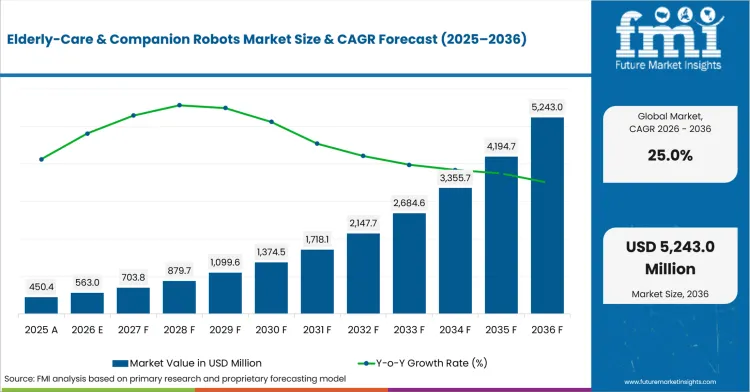
Key Takeaways of Elderly-Care & Companion Robots Market
- Demand for elderly-care and companion robots is driven by public programs that provide a direct commercial path from pilot use to recurring device and service revenue across organized care systems.
- By component, hardware is expected to lead with 58.0% share in 2026, owing to sensors and physical assemblies that must withstand repeated cleaning and daily interaction.
- Dementia therapy is the dominant application segment, projected to hold 34.0% share in 2026, driven by structured engagement that fits documented hospital or long-term care routines.
- Tabletop social robots are estimated to lead the product type category with 30.0% share in 2026, reflecting lower navigation risk and simpler installation for home programs.
- Municipal and public programs are anticipated to represent 34.0% of end-user demand, with purchasing rules favoring defined support duties and measurable use.
- South Korea, the United States, Japan, and the European Union are expected to grow at 27.0%, 25.0%, 24.0%, and 23.0% CAGR respectively through 2036, shaped by centralized welfare delivery versus fragmented national purchasing rules.
- Competition centers on Intuition Robotics, Hyodol, Intelligent System, Tombot, Navel Robotics, F&P Robotics, Ageless Innovation, and Hello Robot, with vendors differentiating through social interaction, animal-form memory care, and facility resident engagement.
Analyst Perspective
"The healthcare companion robots market is progressing as hospitals, senior care facilities, and home care providers seek technologies that deliver meaningful patient engagement while fitting seamlessly into established care workflows. Adoption is influenced by consistent real-world performance, ease of use for caregivers and patients, and the ability to demonstrate measurable care outcomes without increasing staff workload. Organizations that provide dependable robotic platforms, strong privacy safeguards, and comprehensive user support are expected to build lasting confidence across healthcare settings."
- Anurag Sharma, Principal Analyst at Future Market Insights
Source: FMI’s proprietary forecasting model and primary research
How is the Elderly-Care & Companion Robots Market segmented?
The industry is segmented by type, application, component, end user, procurement model, and region.
The segmentation compares robot design with the care setting and purchasing route that determine commercial use. Type analysis separates tabletop social robots from animal-form devices and doll-type companions used for emotional engagement. Application analysis covers dementia therapy and loneliness support alongside reminders that help older adults maintain daily routines. Component analysis divides hardware from software and services to show how recurring income develops during continued use. End-user categories distinguish public programs from nursing homes and private households that carry different support duties. Procurement models compare government contracts with direct purchases and subscriptions across funding cycles and service arrangements. Regional analysis shows how policy and care infrastructure change demand across national systems and budgets. The structure places robot capability beside connected care technology and the service setting that determines routine use.
How does the tabletop social robot format shape demand within the type category?
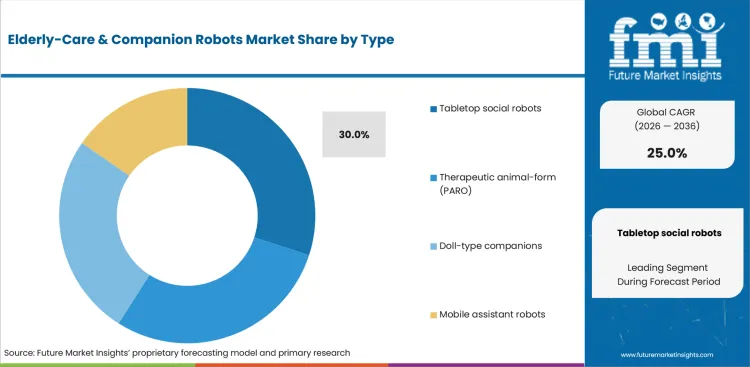
Tabletop social robots suit home programs that need voice interaction without the navigation risk created by mobile devices. Their fixed position gives support teams a repeatable installation process and a visible place for daily contact. The New York State Office for the Aging reported in February 2026 that ElliQ users averaged 41 interactions each day. The update found that 94% of surveyed users felt less lonely, linking sustained interaction with program value and renewal decisions.
- By type, tabletop social robots are forecast to represent 30.0% of demand in 2026 due to simple placement and repeatable voice interaction. The format avoids navigation problems in private homes and gives local program staff a defined support setup. Its share reflects lower operating complexity and easier training rather than a wider set of physical functions.
- Area agencies on aging are expected to favor tabletop systems for older adults who need reminders and regular conversation throughout the day. The device remains in one visible location and supports a consistent route for technical help. This operating pattern lets public programs train many households without creating separate navigation procedures for every home.
What supports demand for dementia therapy within the application category?
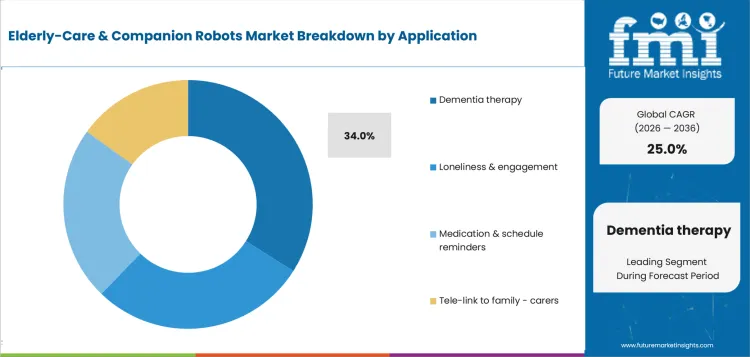
Dementia therapy requires products that provide calm and repeatable engagement without claiming to replace clinical care. Evidence from care settings carries more weight during purchasing than entertainment features without documented outcomes. Sarasota Memorial Health Care System reported in February 2026 that a year-long randomized trial compared robotic pets with standard care for hospitalized older adults. The study linked robotic pet use with fewer clinical disruptions and shorter stays among patients with mild to moderate dementia. These findings give hospital teams a clearer basis for controlled adoption within existing care routines.
- In 2026, dementia therapy is expected to account for 34.0% of application demand due to the need for non-drug engagement in hospitals and long-term care. Robotic pets and social robots can support structured sessions that staff repeat within documented care plans. Their role becomes clearer through a defined outcome and a response plan for unusual behavior.
- Memory care providers are anticipated to purchase systems that can reduce distress and support social interaction during routine care. Product selection depends on safe materials and simple controls that staff can use without interrupting resident support. Clinical acceptance improves through products that fit existing observation practices and avoid another heavy documentation task.
How is hardware positioned within the component category?
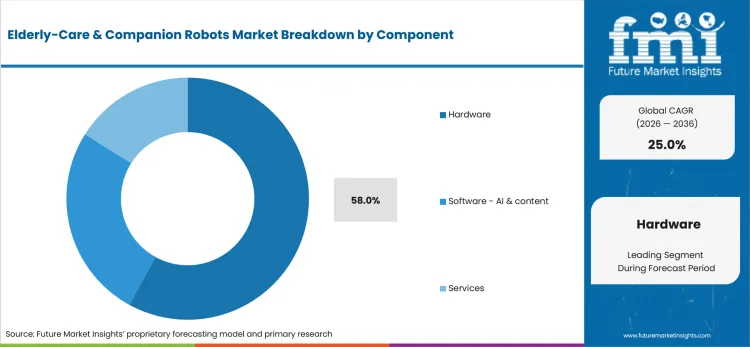
Physical interaction raises hardware value through microphones and sensors inside a durable product form built for care settings. Care environments add cleaning and safety needs that software cannot address without suitable physical design. Navel Robotics stated in its January 2026 press kit that Navel Care weighs 8.5 kilograms and measures 75 centimeters. Those specifications illustrate the engineering cost behind embodied social interaction and repeated use within care facilities. The resulting cost structure resembles industrial automation systems that require planned maintenance and dependable component support.
- By component, hardware is estimated to hold 58.0% share in 2026 owing to sensors and physical assemblies. Each unit must deliver reliable sound and touch responses through repeated sessions in demanding care environments. This capital requirement makes manufacturing quality and repair access important during contract review and later service renewal. Software gains value through updates and content management during regular use across an established care program.
- Care facilities are expected to evaluate cleaning and safety procedures first, then review conversation features under normal operating conditions. A device that is difficult to position or maintain can weaken support during daily resident activities. Service plans must protect uptime and limit disruption without adding complex maintenance duties for nurses or activity staff.
What are the drivers, restraints, and opportunities in the Elderly-Care & Companion Robots Market?
Public care funding supports demand. Evidence and privacy requirements slow approval. Managed services create recurring revenue opportunities.
- Driver: Public agencies are expected to fund companion robots that address loneliness and routine engagement within established home-care programs.
- Restraint: Care organizations are anticipated to delay purchases if clinical evidence or privacy controls remain unclear during formal review.
- Opportunity: Managed service contracts are projected to widen adoption by combining hardware with training and outcome reporting under one agreement.
Public funding converts a discretionary product into an organized care service with eligibility rules and local support. Ageless Innovation reported in July 2025 that a Veterans Affairs hospital had established a yearly budget for robotic pets used with dementia patients. Recreation therapists used the devices within planned activities rather than treating them as one-time gifts. This development shows how a recurring budget can place companion products inside normal care routines. The same commercial pattern appears across healthcare service programs that combine device access with recurring support.
Measuring emotional engagement through a short product demonstration is difficult, which creates a real evidence barrier. The World Health Organization reported in October 2025 that social isolation and loneliness affect about one quarter of older people. That need does not prove that every robot creates a measurable benefit during routine care. A review must examine study design and data handling during approval to protect vulnerable users and public budgets. Medical device evidence offers a useful comparison for outcome reporting and service expectations during formal review.
Managed services create an opening for companies that combine devices with training and maintenance under one accountable contract. Public programs need consistent onboarding across households or facilities and a defined route for technical escalation. A contract that includes software updates and usage reporting can reduce coordination work for the care organization. The model supports recurring income and gives the technology company direct evidence about product use and support demand. Process automation practices provide a practical comparison for contracts that assign service responsibility and operating control.
Which country CAGRs are profiled in the Elderly-Care & Companion Robots Market?
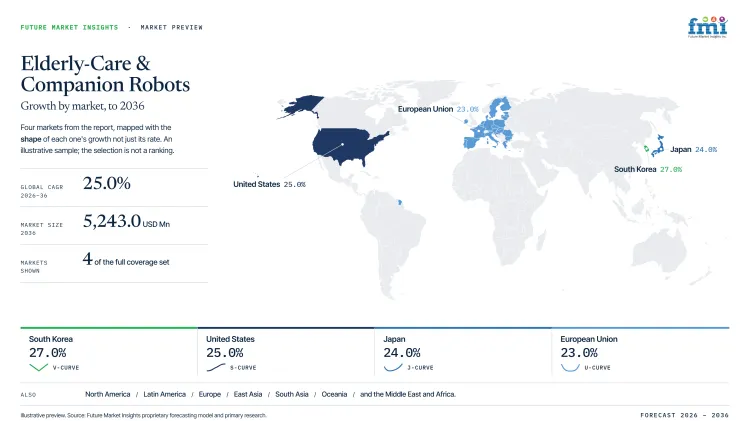
| Country | CAGR |
|---|---|
| Japan | 24.0% |
| South Korea | 27.0% |
| United States | 25.0% |
| European Union | 23.0% |
Source: FMI’s proprietary forecasting model and primary research.
How do country-level CAGRs compare in the Elderly-Care & Companion Robots Market?
The country comparison spans 4.0 percentage points and forms three distinct growth tiers across the elderly-care & companion robots market. South Korea and the United States occupy the upper tier with a 2.0-point difference between them. Japan follows in the middle, sitting 1.0 percentage point below the United States, while the European Union completes the comparison 1.0 percentage point behind Japan. The variation reflects differences in demographic pressures, healthcare delivery models and the integration of robotics into eldercare services.
-
South Korea leads the comparison with a CAGR of 27.0%. Growing attention to aging-in-place strategies and digital healthcare solutions is encouraging care providers and households to evaluate companion robots that assist with daily routines, social interaction and basic monitoring for older adults.
-
The United States records a CAGR of 25.0%, placing it 2.0 percentage points behind South Korea. Interest continues to expand across home care and assisted living settings where companion robots are being introduced to complement caregivers, encourage engagement and support independent living for aging populations.
-
Japan reaches 24.0%, only 1.0 percentage point below the United States. The country's aging demographic profile and longstanding acceptance of service robotics continue to create opportunities for companion robots that provide communication, reminders and assistance with everyday activities in residential and care environments.
-
The European Union posts a CAGR of 23.0%, remaining 1.0 percentage point behind Japan. Demand is associated with increasing focus on healthy aging, community-based care and digital health technologies that extend support for older adults. Adoption differs across member states because healthcare systems, reimbursement approaches and long-term care priorities are not uniform throughout the region.
Comparable CAGRs can still produce different market entry conditions. Differences in eldercare policies, healthcare infrastructure, consumer acceptance and public funding for assistive technologies influence commercialization strategies and long-term market opportunities. The full report provides country-level CAGR analysis across North America, Latin America, Europe, East Asia, South Asia, Oceania and the Middle East and Africa.
Country-wise Analysis
Country growth reflects the route from demographic need to an approved care budget and reliable support model. East Asian countries combine aging pressure with coordinated technology policy and public welfare delivery across local communities. The United States relies on state and local programs that create several purchasing paths for home and hospital use. European demand is spread across national systems and individual care organizations with different privacy requirements. These country differences matter for life science technology providers that must adapt evidence and support to each care system.
- Japan has a long policy history for caregiving technology and a care system familiar with facility evaluation. Demand in Japan is forecast to rise at 24.0% CAGR through 2036 under continued national support for caregiving technology. The Statistics Bureau reported in April 2025 that 36.243 million residents were aged 65 or older in October 2024. They represented 29.3% of the national population and created sustained pressure on institutional care capacity. METI’s policy framework identifies caregiving tasks that technology can support, including work that creates physical strain. Care operators can compare safety evidence with staff workload and service coverage through this policy structure. Companies therefore need documented facility value and dependable support coverage to compete for recurring care budgets.
- South Korea combines centralized welfare delivery with domestic experience in connected care products for older adults. The country is projected to record 27.0% CAGR from 2026 to 2036 as public programs seek home support that can serve many households. The Ministry of Data and Statistics reported in August 2025 that 16.447 million people were aged 55 to 79 in May 2025. The survey counted 8.029 million people aged 65 to 79 within that group and confirmed the scale of the older care population. Hyodol gives local agencies a companion robot designed around reminders and daily interaction for older adults. Program managers are likely to examine service response and caregiver access during decisions about wider program orders. Domestic companies can gain repeat business through functions that remain useful across long care periods.
- The United States develops demand through state aging agencies and health systems rather than one national purchasing program. Elderly-care and companion robot demand is anticipated to advance at 25.0% CAGR through 2036 under this distributed structure. The USA Census Bureau reported in June 2025 that the population aged 65 or older reached 61.2 million in 2024. That total represented a 3.1% annual increase and widened the population served by aging programs. Local agencies can target people living alone, whereas health systems can examine hospital use through controlled trials. Contracts need flexible onboarding and support terms to address different duties across states and provider systems. Service coverage is likely to influence contract renewal and program expansion decisions across state and health system programs.
- European demand is shaped by national health systems and separate long-term care purchasing rules across the region. The European Union sector is estimated to expand at 23.0% CAGR between 2026 and 2036 through local adoption of social robots. Eurostat reported in February 2026 that people aged 65 or older represented 22.0% of the EU population on January 1, 2025. That share creates a broad care need across systems with different approval and reimbursement structures. Navel Robotics and F&P Robotics offer products designed for institutional care workflows in European facilities. Adoption may slow if evidence and privacy documentation cannot transfer across national borders during formal approval. Companies with adaptable data policies are better placed to support expansion across multiple national care systems.
Who are the notable companies in the Elderly-Care & Companion Robots Market?
Intuition Robotics, Intelligent System Co., Ltd., Hyodol Co., Ltd., navel robotics GmbH, Tombot, Inc., F&P Robotics AG, Ageless Innovation, and Hello Robot, Inc. are notable companies in this market.
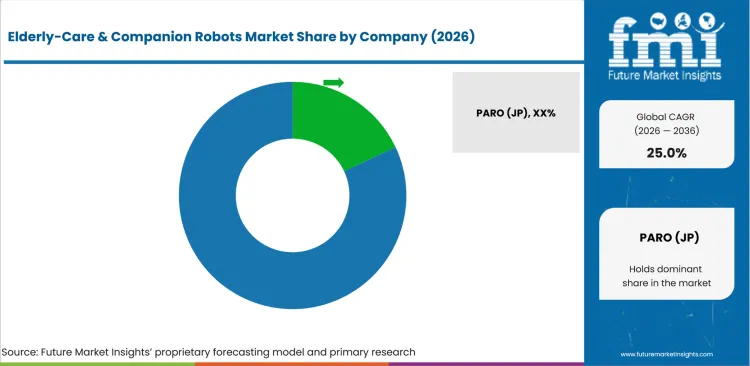
Competition includes social companions and mobile assistants that serve different care needs and require different evidence. Intuition Robotics and Hyodol connect daily interaction with reminders and program support for older adults. Intelligent System Co., Ltd. And Tombot use animal-form products for emotional engagement within dementia care. Navel Robotics and F&P Robotics address facility routines through resident interaction or mobile assistance across daily care schedules. Ageless Innovation provides robotic pets for emotional comfort, and Hello Robot develops mobile assistance for older adults and people with mobility impairments. Hardware durability makes electronics component research relevant during product review, repair planning and long-term service planning. Emotional support functions place robotic pets within consumer health products that require clear use limits and service guidance.
- Intuition Robotics and Hyodol focus on daily interaction and caregiver-facing functions designed specifically for older adults. ElliQ supports wellness routines and scheduled engagement, whereas Hyodol combines reminders with safety care and dementia prevention content. Continued user participation and reliable service support determine the commercial value of each platform across long program periods.
- Intelligent System Co., Ltd. And Tombot focus on therapeutic animal-form companions for people affected by dementia or other health conditions. PARO has documented use in dementia care, and Tombot is preparing Jennie robotic puppies for customer delivery. Care organizations are expected to compare product durability with evidence for calm and social response during routine use.
- Navel Robotics and F&P Robotics target facility use through conversation and mobile assistance within daily care routines. Navel supports resident activation; F&P Robotics positions Lio for service tasks in healthcare and elderly care. Each company must show that training and maintenance fit the facility schedule without increasing the workload carried by care staff.
- Ageless Innovation and Hello Robot address emotional comfort and physical assistance through different robot designs. Joy for All Companion Pets provide responsive interaction during planned activities in hospitals or residential care. Stretch supports research for people with mobility limits, including older adults in the company’s assistive program. Selection depends on the care task and available service support throughout each period of regular use.
Competitive Benchmarking: Elderly-Care & Companion Robots Market
| Company | Social Interaction | Care Workflow Support | Evidence Depth | Geographic Reach |
|---|---|---|---|---|
| Intuition Robotics | High | Medium | High | Medium |
| Intelligent System Co., Ltd. | High | Low | High | High |
| Hyodol Co., Ltd. | High | High | Medium | Medium |
| navel robotics GmbH | High | Medium | Medium | Medium |
| Tombot, Inc. | High | Low | Medium | Low |
| F&P Robotics AG | Medium | High | Medium | Medium |
| Ageless Innovation | High | Low | High | High |
| Hello Robot, Inc. | Low | High | Medium | Medium |
Scoring assigns High to verified direct capability, Medium to partial capability and Low to limited public evidence within the stated dimension.
Source: Future Market Insights competitive analysis, 2026. Ratings reflect official company materials and primary research.
Key Developments in the Elderly-Care & Companion Robots Market
- In May 2025, Intuition Robotics reported that 87% of ElliQ Wellness Coach users remained engaged at 30 days and 76% remained engaged at three months. The company recorded a 465% increase in user physical activity sessions following the feature’s introduction during the same period. These results give public aging programs a measurable basis for judging daily coaching and renewal value beyond initial companionship across funded services.
- In March 2025, Ageless Innovation announced a National Health Service program in the United Kingdom and state health agency awards in multiple USA states. The company linked these wins to wider healthcare distribution for its Joy for All Companion Pets. The expansion shows how robotic pets can enter recurring care channels through public agencies instead of depending on isolated consumer purchases.
- In November 2025, F&P Robotics AG reported that Lio traveled more than 1000 kilometers during 217 days at University Hospital Basel and maintained more than 99% reliability. The operating record gives care organizations measurable evidence about uptime and daily movement across a complex facility. That evidence supports clearer decisions about the balance between labor assistance and maintenance demands during fleet expansion.
Key Players in the Elderly-Care & Companion Robots Market
Social Care and Home Companion Platforms
- Intuition Robotics
- Hyodol Co., Ltd.
- navel robotics GmbH
Therapeutic Animal-Form Companion Providers
- Intelligent System Co., Ltd.
- Tombot, Inc.
- Ageless Innovation
Mobile Care Assistance Providers
- F&P Robotics AG
- Hello Robot, Inc.
Elderly-Care & Companion Robots Market - Report Scope
| Coverage field | Report scope |
|---|---|
| Market breakdown | Type, application, component, end user, procurement model, and region. |
| Quantitative units | Revenue in USD Million and CAGR in percentage terms. |
| Market definition | Embodied robots designed to provide social companionship or practical care support for older adults in homes and institutional settings. Surgical robots and general industrial robots are excluded. |
| Regions covered | North America, Latin America, Europe, East Asia, South Asia, Oceania, and the Middle East and Africa. |
| Countries covered | United States, Canada, Japan, China, South Korea, India, Australia, major European countries, and additional countries within the regional assessment. |
| Key companies profiled | Intuition Robotics, Intelligent System Co., Ltd., Hyodol Co., Ltd., navel robotics GmbH, Tombot, Inc., F&P Robotics AG, Ageless Innovation, and Hello Robot, Inc. |
| Forecast period | 2026 to 2036. |
| Approach | Hybrid bottom-up and top-down sizing supported by primary interviews, official demographic data, care program evidence, and company disclosures. |
Source: Future Market Insights analysis driven by proprietary forecasting models and primary research.
Elderly-Care & Companion Robots Market - Research Methodology
| Method | Approach |
|---|---|
| Primary Research | FMI analysts gathered input from manufacturers, service providers, technology developers, distributors, end users, sourcing teams, and subject-matter experts. Interviews examined purchasing decisions, product or service evaluation, adoption barriers, approval requirements, pricing considerations, and expectations for technical or commercial support. Respondents were also asked what evidence is required before a trial, pilot, or initial order develops into regular purchasing. |
| Desk Research | Desk research covered government statistics, regulatory publications, trade data, industry associations, technical literature, standards, company filings, product information, and official corporate announcements. Sources were reviewed for relevance, publication date, geographic coverage, and consistency with the defined market scope. Claims relating to performance, applications, approvals, capacity, investment, and commercial activity were retained only when supported by credible public evidence. |
| Market Sizing and Forecasting | The market model combined the baseline value with historical performance, segment structure, pricing and volume indicators, adoption levels, company participation, and country-level demand conditions. Forecast assumptions considered economic activity, investment trends, regulatory developments, technology adoption, purchasing cycles, supply availability, and barriers to wider market use. Segment and regional estimates were reconciled before the final market total was calculated. |
| Data Validation | Estimates were checked against multiple independent indicators, including public data, company activity, trade patterns, industry developments, and findings from primary interviews. Validation also tested whether products, services, applications, and company revenues fell within the defined market boundaries. Adjacent categories, unsupported claims, overlapping revenues, and activities without direct market relevance were excluded to reduce double counting and maintain consistency across segments and countries. |
Source: Future Market Insights analysis based on proprietary forecasting models and primary research.
Elderly-Care & Companion Robots Market by Segments
Elderly-Care & Companion Robots Market segmented by Type:
- Tabletop Social Robots
- Therapeutic Animal-Form Robots
- Doll-Type Companion Robots
- Mobile Assistant Robots
Elderly-Care & Companion Robots Market segmented by Application:
- Dementia Therapy
- Loneliness and Engagement Support
- Medication and Schedule Reminders
- Family and Caregiver Communication
Elderly-Care & Companion Robots Market segmented by Component:
- Hardware
- Software and AI Content
- Services
Elderly-Care & Companion Robots Market segmented by End User:
- Municipal and Public Programs
- Nursing Homes and Assisted Living
- Home Users
- Hospitals and Health Systems
Elderly-Care & Companion Robots Market segmented by Procurement Model:
- Government and Municipal Procurement
- Direct Purchase
- Subscription and Managed Service
- Pilot Programs
Elderly-Care & Companion Robots Market by Region:
- North America
- United States
- Canada
- Latin America
- Brazil
- Mexico
- Argentina
- Europe
- Germany
- United Kingdom
- France
- Italy
- Spain
- East Asia
- China
- Japan
- South Korea
- South Asia
- India
- Thailand
- Indonesia
- Oceania
- Australia
- New Zealand
- Middle East and Africa
- GCC Countries
- South Africa
- Türkiye
Research Sources and Bibliography
- Ageless Innovation. (2025, March 27). Ageless Innovation expands healthcare reach with domestic and international wins to start 2025 and welcomes a healthcare industry leader to its board. https://agelessinnovation.com/ageless-innovation-expands-healthcare-reach-with-domestic-and-international-wins-to-start-2025-and-welcomes-a-powerhouse-healthcare-industry-leader-to-its-board/
- Ageless Innovation. (2025, July 7). Chandler-area group donates robotic pets for VA dementia patients. https://agelessinnovation.com/chandler-area-group-donates-robotic-pets-for-va-dementia-patients/
- Eurostat. (2026, February 2). Population structure and ageing. https://ec.europa.eu/eurostat/statistics-explained/index.php?title=Population_structure_and_ageing
- F&P Robotics AG. (2025, November 13). Lio goes the extra mile. https://www.fp-robotics.com/blog/2025/11/13/lio-goes-the-extra-mile-literally-and-figuratively/
- Hello Robot, Inc. (2026, May 12). Introducing Stretch 4. https://forum.hello-robot.com/t/introducing-stretch-4/1505
- Hello Robot, Inc. (n.d.). Stretch Assist. https://hello-robot.com/assist/
- Hyodol Co., Ltd. (n.d.). Hyodol AI care platform. https://en.hyodol.com/
- Intelligent System Co., Ltd. (n.d.). PARO therapeutic robot. https://www.parorobots.com/
- Intuition Robotics. (2024, August 29). Intuition Robotics raises USD 25 million. https://www.intuitionrobotics.com/post/intuition-robotics-raises-25m
- Intuition Robotics. (2025, May 25). Where fitness coaches and wellness apps fall short, ElliQ delivers. https://www.intuitionrobotics.com/post/elliq-wellness-coach
- Ministry of Data and Statistics, Republic of Korea. (2025, August 6). Supplementary results of the Economically Active Population Survey for the old population in May 2025. https://mods.go.kr/boardDownload.es?bid=11735&list_no=438137&seq=1
- Ministry of Economy, Trade and Industry. (2024, June 28). Priority fields in the use of technologies for long-term care revised. https://www.meti.go.jp/english/press/2024/0628_004.html
- National Bureau of Statistics of China. (2025, January 17). National economy witnessed steady progress amidst stability with major development targets achieved successfully in 2024. https://www.stats.gov.cn/english/PressRelease/202501/t20250117_1958330.html
- navel robotics GmbH. (2026, January). Press kit. https://navelrobotics.com/wp-content/uploads/2026/02/2601_PressKit_navelrobotics-en-US.pdf
- New York State Office for the Aging. (2026, February). ElliQ project update 2026. https://aging.ny.gov/system/files/documents/2026/02/nysofa-elliq-project-update-2026.pdf
- Sarasota Memorial Health Care System. (2026, February 17). Innovative trial using robotic pets enhances dementia care and patient outcomes at SMH. https://www.smh.com/news/innovative-trial-using-robotic-pets-enhances-dementia-care-patient-outcomes-at-smh
- Statistics Bureau of Japan. (2025, April). Current population estimates as of October 1, 2024. https://www.stat.go.jp/english/data/jinsui/2024np/index.html
- Tombot, Inc. (n.d.). Robotic emotional support animals. https://tombot.com/
- USA Census Bureau. (2025, June 26). Older adults outnumber children in 11 states and nearly half of USA counties. https://www.census.gov/newsroom/press-releases/2025/older-adults-outnumber-children.html
- World Health Organization. (2025, October 8). Mental health of older adults. https://www.who.int/news-room/fact-sheets/detail/mental-health-of-older-adults
This bibliography is provided for reader reference and uses primary government, standards-body, official trade body, and company sources.
This Report Answers
- What market value is estimated for 2026 and 2036?
- What CAGR is projected from 2026 to 2036?
- Which product types and applications shape current demand?
- How do hardware and recurring services affect supplier economics?
- Which country CAGRs are profiled across Asia, North America, and Europe?
- Which companies compete through care platforms or animal-form companions?
- What evidence should care providers review before approving a robot?
- How do public procurement and subscription models change adoption?
- Which privacy and support factors affect long-term program value?
Frequently Asked Questions
What is driving growth in the Elderly-Care & Companion Robots Market?
Public care programs fund social engagement and dementia support through structured services for homes and care facilities. Aging populations give agencies a clear reason to test repeatable routines that complement human care and family contact.
Who are the key players in the Elderly-Care & Companion Robots Market?
Intuition Robotics and Hyodol provide social companion platforms designed for daily use by older adults. Intelligent System and Navel Robotics add therapeutic and facility-focused products for dementia care and resident engagement.
What is a notable restraint in the Elderly-Care & Companion Robots Market?
Care organizations may delay purchases if privacy controls and outcome evidence remain unclear during formal review. Weak service coverage can reduce staff confidence and limit contract renewal beyond the first demonstration period.
Why should executives track the Elderly-Care & Companion Robots Market?
The sector connects aging policy with recurring technology service revenue across home and institutional care programs. Public purchasing can create larger contracts through consistent evidence and support requirements across all participating agencies.
What business problem does the Elderly-Care & Companion Robots Market address?
The market addresses limited social contact and routine support needs among older adults in care settings. Robots can provide scheduled engagement without replacing professional care or the relationships maintained by families.
What should care organizations evaluate before selecting a company?
Care organizations should compare evidence with privacy controls and repair coverage across the full contract period. Training requirements must fit daily routines without adding unmanageable duties for nurses or activity staff.
What limits return on investment for purchasers?
Low use rates weaken commercial value even if the hardware performs reliably during repeated care sessions. Returns fall further if training and software support were excluded from the original purchasing budget.
What supports long-term commercial confidence?
Documented engagement and reliable service response support renewal decisions across public and private care programs. Clear product limits help organizations avoid unrealistic expectations for care staff and all participating families.
Preview the report firsthand - request a free sample
Get SampleGet the brochure for pricing and purchase details.
Get PDFTable of Content
- Key Takeaways
- Market Size and CAGR
- Top Growth Driver
- Fastest Growing Segment
- Leading Region
- Key Companies
- Emerging Opportunities
- Executive Summary
- Global Market Outlook
- Demand-side Trends
- Supply-side Trends
- Technology Roadmap Analysis
- Analysis and Recommendations
- Analyst Perspective (What is happening? Why now? What should investors know?)
- Key Questions Answered
- How large is the market?
- What is the CAGR?
- What are key trends?
- Which region dominates?
- Who are the leaders?
- Market Overview
- Market Coverage / Taxonomy
- Market Definition / Scope / Limitations
- Research Methodology
- Chapter Orientation
- Analytical Lens and Working Hypotheses
- Market Structure, Signals, and Trend Drivers
- Benchmarking and Cross-market Comparability
- Market Sizing, Forecasting, and Opportunity Mapping
- Research Design and Evidence Framework
- Desk Research Programme (Secondary Evidence)
- Expert Input and Fieldwork (Primary Evidence)
- Tooling, Models, and Reference Databases
- Data Engineering and Model Build
- Quality Assurance and Audit Trail
- Market Background
- Market Dynamics (Drivers, Restraints, Opportunity, Trends)
- Scenario Forecast (Optimistic, Likely, Conservative)
- Impact Analysis
- AI Impact
- Sustainability Impact
- Regulatory Impact
- Technology Impact
- Consumer / Buyer Analysis
- Purchase Drivers
- Adoption Barriers
- Buyer Journey
- Opportunity Map Analysis
- Product Life Cycle Analysis
- Supply Chain Analysis
- Investment Feasibility Matrix
- Value Chain Analysis
- PESTLE and Porter's Analysis
- Regulatory Landscape
- Regional Parent Market Outlook
- Production and Consumption Statistics
- Import and Export Statistics
- Global Market Analysis and Forecast, 2021 to 2036
- Historical Market Size Value (USD Mn) Analysis, 2021 to 2025
- Current and Future Market Size Value (USD Mn) Projections, 2026 to 2036
- Y-o-Y Growth Trend Analysis
- Absolute $ Opportunity Analysis
- Global Market Pricing Analysis, 2021 to 2036
- Global Market Analysis and Forecast, By Type, 2021 to 2036
- Introduction / Key Findings
- Historical Market Size Value (USD Mn) Analysis By Type, 2021 to 2025
- Current and Future Market Size Value (USD Mn) Analysis and Forecast By Type, 2026 to 2036
- Tabletop social robots
- Therapeutic animal-form (PARO)
- Doll-type companions
- Mobile assistant robots
- Tabletop social robots
- Y-o-Y Growth Trend Analysis By Type, 2021 to 2025
- Absolute $ Opportunity Analysis By Type, 2026 to 2036
- Global Market Analysis and Forecast, By Application, 2021 to 2036
- Introduction / Key Findings
- Historical Market Size Value (USD Mn) Analysis By Application, 2021 to 2025
- Current and Future Market Size Value (USD Mn) Analysis and Forecast By Application, 2026 to 2036
- Dementia therapy
- Loneliness & engagement
- Medication & schedule reminders
- Tele-link to family - carers
- Dementia therapy
- Y-o-Y Growth Trend Analysis By Application, 2021 to 2025
- Absolute $ Opportunity Analysis By Application, 2026 to 2036
- Global Market Analysis and Forecast, By Component, 2021 to 2036
- Introduction / Key Findings
- Historical Market Size Value (USD Mn) Analysis By Component, 2021 to 2025
- Current and Future Market Size Value (USD Mn) Analysis and Forecast By Component, 2026 to 2036
- Hardware
- Software - AI & content
- Services
- Hardware
- Y-o-Y Growth Trend Analysis By Component, 2021 to 2025
- Absolute $ Opportunity Analysis By Component, 2026 to 2036
- Global Market Analysis and Forecast, By End User, 2021 to 2036
- Introduction / Key Findings
- Historical Market Size Value (USD Mn) Analysis By End User, 2021 to 2025
- Current and Future Market Size Value (USD Mn) Analysis and Forecast By End User, 2026 to 2036
- Municipal & public programs
- Nursing homes
- Home users
- Hospitals
- Municipal & public programs
- Y-o-Y Growth Trend Analysis By End User, 2021 to 2025
- Absolute $ Opportunity Analysis By End User, 2026 to 2036
- Global Market Analysis and Forecast, By Procurement, 2021 to 2036
- Introduction / Key Findings
- Historical Market Size Value (USD Mn) Analysis By Procurement, 2021 to 2025
- Current and Future Market Size Value (USD Mn) Analysis and Forecast By Procurement, 2026 to 2036
- Government - municipal
- Direct consumer
- Subscription
- Pilot programs
- Government - municipal
- Y-o-Y Growth Trend Analysis By Procurement, 2021 to 2025
- Absolute $ Opportunity Analysis By Procurement, 2026 to 2036
- Global Market Analysis and Forecast, By Region, 2021 to 2036
- Introduction
- Historical Market Size Value (USD Mn) Analysis By Region, 2021 to 2025
- Current Market Size Value (USD Mn) Analysis and Forecast By Region, 2026 to 2036
- North America
- Latin America
- Western Europe
- Eastern Europe
- East Asia
- South Asia and Pacific
- Middle East & Africa
- Market Attractiveness Analysis By Region
- North America Market Analysis and Forecast, By Country, 2021 to 2036
- Historical Market Size Value (USD Mn) Trend Analysis By Market Taxonomy, 2021 to 2025
- Market Size Value (USD Mn) Forecast By Market Taxonomy, 2026 to 2036
- By Country
- USA
- Canada
- By Type
- By Application
- By Component
- By End User
- By Procurement
- By Country
- Market Attractiveness Analysis
- By Country
- By Type
- By Application
- By Component
- By End User
- By Procurement
- Key Takeaways
- Latin America Market Analysis and Forecast, By Country
- Historical Market Size Value (USD Mn) Trend Analysis By Market Taxonomy, 2021 to 2025
- Market Size Value (USD Mn) Forecast By Market Taxonomy, 2026 to 2036
- By Country
- Brazil
- Mexico
- Chile
- Rest of Latin America
- By Type
- By Application
- By Component
- By End User
- By Procurement
- By Country
- Market Attractiveness Analysis
- By Country
- By Type
- By Application
- By Component
- By End User
- By Procurement
- Key Takeaways
- Western Europe Market Analysis and Forecast, By Country
- Historical Market Size Value (USD Mn) Trend Analysis By Market Taxonomy, 2021 to 2025
- Market Size Value (USD Mn) Forecast By Market Taxonomy, 2026 to 2036
- By Country
- Germany
- UK
- Italy
- Spain
- France
- Nordic
- BENELUX
- Rest of Western Europe
- By Type
- By Application
- By Component
- By End User
- By Procurement
- By Country
- Market Attractiveness Analysis
- By Country
- By Type
- By Application
- By Component
- By End User
- By Procurement
- Key Takeaways
- Eastern Europe Market Analysis and Forecast, By Country
- Historical Market Size Value (USD Mn) Trend Analysis By Market Taxonomy, 2021 to 2025
- Market Size Value (USD Mn) Forecast By Market Taxonomy, 2026 to 2036
- By Country
- Russia
- Poland
- Hungary
- Balkan & Baltic
- Rest of Eastern Europe
- By Type
- By Application
- By Component
- By End User
- By Procurement
- By Country
- Market Attractiveness Analysis
- By Country
- By Type
- By Application
- By Component
- By End User
- By Procurement
- Key Takeaways
- East Asia Market Analysis and Forecast, By Country
- Historical Market Size Value (USD Mn) Trend Analysis By Market Taxonomy, 2021 to 2025
- Market Size Value (USD Mn) Forecast By Market Taxonomy, 2026 to 2036
- By Country
- China
- Japan
- South Korea
- By Type
- By Application
- By Component
- By End User
- By Procurement
- By Country
- Market Attractiveness Analysis
- By Country
- By Type
- By Application
- By Component
- By End User
- By Procurement
- Key Takeaways
- South Asia and Pacific Market Analysis and Forecast, By Country
- Historical Market Size Value (USD Mn) Trend Analysis By Market Taxonomy, 2021 to 2025
- Market Size Value (USD Mn) Forecast By Market Taxonomy, 2026 to 2036
- By Country
- India
- ASEAN
- Australia & New Zealand
- Rest of South Asia and Pacific
- By Type
- By Application
- By Component
- By End User
- By Procurement
- By Country
- Market Attractiveness Analysis
- By Country
- By Type
- By Application
- By Component
- By End User
- By Procurement
- Key Takeaways
- Middle East & Africa Market Analysis and Forecast, By Country
- Historical Market Size Value (USD Mn) Trend Analysis By Market Taxonomy, 2021 to 2025
- Market Size Value (USD Mn) Forecast By Market Taxonomy, 2026 to 2036
- By Country
- Kingdom of Saudi Arabia
- Other GCC Countries
- Türkiye
- South Africa
- Other African Union
- Rest of Middle East & Africa
- By Type
- By Application
- By Component
- By End User
- By Procurement
- By Country
- Market Attractiveness Analysis
- By Country
- By Type
- By Application
- By Component
- By End User
- By Procurement
- Key Takeaways
- Key Countries Market Analysis
- USA
- Pricing Analysis
- Market Share Analysis, 2025
- By Type
- By Application
- By Component
- By End User
- By Procurement
- Canada
- Pricing Analysis
- Market Share Analysis, 2025
- By Type
- By Application
- By Component
- By End User
- By Procurement
- Mexico
- Pricing Analysis
- Market Share Analysis, 2025
- By Type
- By Application
- By Component
- By End User
- By Procurement
- Brazil
- Pricing Analysis
- Market Share Analysis, 2025
- By Type
- By Application
- By Component
- By End User
- By Procurement
- Chile
- Pricing Analysis
- Market Share Analysis, 2025
- By Type
- By Application
- By Component
- By End User
- By Procurement
- Germany
- Pricing Analysis
- Market Share Analysis, 2025
- By Type
- By Application
- By Component
- By End User
- By Procurement
- UK
- Pricing Analysis
- Market Share Analysis, 2025
- By Type
- By Application
- By Component
- By End User
- By Procurement
- Italy
- Pricing Analysis
- Market Share Analysis, 2025
- By Type
- By Application
- By Component
- By End User
- By Procurement
- Spain
- Pricing Analysis
- Market Share Analysis, 2025
- By Type
- By Application
- By Component
- By End User
- By Procurement
- France
- Pricing Analysis
- Market Share Analysis, 2025
- By Type
- By Application
- By Component
- By End User
- By Procurement
- India
- Pricing Analysis
- Market Share Analysis, 2025
- By Type
- By Application
- By Component
- By End User
- By Procurement
- ASEAN
- Pricing Analysis
- Market Share Analysis, 2025
- By Type
- By Application
- By Component
- By End User
- By Procurement
- Australia & New Zealand
- Pricing Analysis
- Market Share Analysis, 2025
- By Type
- By Application
- By Component
- By End User
- By Procurement
- China
- Pricing Analysis
- Market Share Analysis, 2025
- By Type
- By Application
- By Component
- By End User
- By Procurement
- Japan
- Pricing Analysis
- Market Share Analysis, 2025
- By Type
- By Application
- By Component
- By End User
- By Procurement
- South Korea
- Pricing Analysis
- Market Share Analysis, 2025
- By Type
- By Application
- By Component
- By End User
- By Procurement
- Russia
- Pricing Analysis
- Market Share Analysis, 2025
- By Type
- By Application
- By Component
- By End User
- By Procurement
- Poland
- Pricing Analysis
- Market Share Analysis, 2025
- By Type
- By Application
- By Component
- By End User
- By Procurement
- Hungary
- Pricing Analysis
- Market Share Analysis, 2025
- By Type
- By Application
- By Component
- By End User
- By Procurement
- Kingdom of Saudi Arabia
- Pricing Analysis
- Market Share Analysis, 2025
- By Type
- By Application
- By Component
- By End User
- By Procurement
- Türkiye
- Pricing Analysis
- Market Share Analysis, 2025
- By Type
- By Application
- By Component
- By End User
- By Procurement
- South Africa
- Pricing Analysis
- Market Share Analysis, 2025
- By Type
- By Application
- By Component
- By End User
- By Procurement
- USA
- Market Structure Analysis
- Competition Dashboard
- Competition Benchmarking
- Market Share Analysis of Top Players
- By Regional
- By Type
- By Application
- By Component
- By End User
- By Procurement
- Emerging Startups
- Innovation Benchmarking
- Competition Analysis
- Competition Deep Dive
- PARO (JP)
- Overview
- Product Portfolio
- Profitability by Market Segments
- Sales Footprint
- Strategy Overview
- Marketing Strategy
- Product Strategy
- Channel Strategy
- Hyodol (KR)
- ElliQ - Intuition Robotics (IL-US)
- Aeolus (JP)
- PARO (JP)
- Case Studies
- Success Stories
- Recent Developments
- Competition Deep Dive
- Assumptions & Acronyms Used


