

- Industry Size (2026)
- USD 2.1 Bn
- Forecast (2036)
- USD 9.7 Bn
- CAGR (2026 to 2036)
- 16.50%
Care Pathway Variance Analytics Market Size, Market Forecast and Outlook By FMI
The care pathway variance analytics market reached USD 1.8 billion in 2025, driven primarily by mounting margin pressures associated with value‑based care penalties and payer denials. In response, hospital CFOs are prioritizing the adoption of pathway‑tracking solutions to mitigate near‑term revenue cycle risks and enforce cost discipline. The market is projected to expand at a 16.50% CAGR through 2036, reaching USD 9.7 billion, supported by the shift toward real‑time algorithmic decision support and the gradual replacement of retrospective clinical auditing.
Health systems that delay implementation risk losing leverage in negotiating favourable risk‑sharing agreements as standardized variance‑tracking capabilities become a contractual expectation.This commercial consequence compels institutions to abandon static order sets in favour of dynamic analytics that flag protocol deviations at the point of care. Real-time intervention capabilities differentiate advanced analytics platforms from legacy reporting tools.
Summary of Care Pathway Variance Analytics Market
- Care Pathway Variance Analytics Market Definition
- The sector provides specialized algorithmic platforms that compare executed clinical decisions against established treatment protocols. It relies entirely on the structural dependency between hospital reimbursement rates and documented adherence to evidence-based medicine.
- Demand Drivers in the Market
- Margin compression under fixed-fee reimbursement structures forces hospital administrators to eliminate unwarranted clinical variation.
- Stricter payer authorization requirements compel clinical directors to generate real-time evidence justifying off-pathway diagnostic orders.
- Hospital consolidation pressures drive network executives to deploy unified clinical standards across newly acquired community facilities.
- Key Segments Analysed in the FMI Report
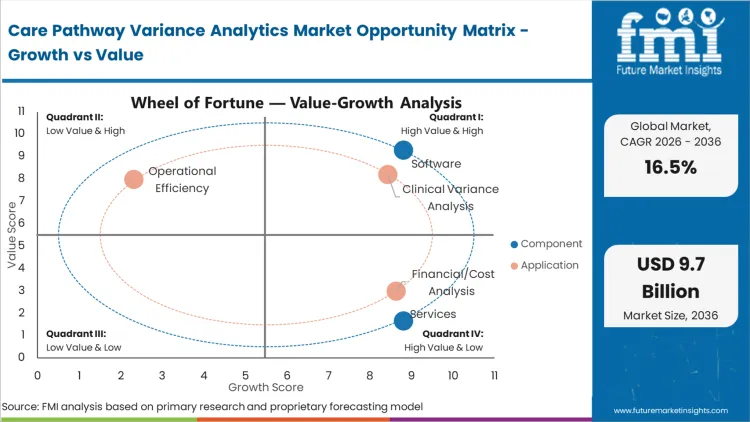
- Software: 62.0% share in 2026, commanding bulk investment as facilities prioritize algorithmic engines over human consulting hours.
- Clinical Variance Analysis: 45.0% share in 2026, driven by the immediate necessity to align physician behaviour with standardized care guidelines.
- China: 19.5% compound growth, anchored by rapid public hospital digitization mandates targeting care standardization.
- Analyst Opinion at FMI
- Sabyasachi Ghosh, Principal Consultant for Healthcare & Pharmaceuticals, says, "In my analysis, I have observed that hospitals frequently mistake basic cost accounting for true pathway optimization. The non-obvious tension lies in the fact that not all variance is negative; algorithms that strictly punish deviation often suppress clinical innovation. The critical mechanism is the readmission penalty window. Chief medical officers who fail to deploy analytics capable of distinguishing between harmful non-compliance and necessary personalized adjustments face severe commercial consequences, including permanent exclusion from preferred payer networks."
- Strategic Implications / Executive Takeaways
- Healthcare network executives must mandate the integration of variance alerts directly into physician order entry interfaces.
- Payer contract negotiators should leverage documented pathway adherence metrics to secure higher reimbursement tiers.
- Analytics software vendors must build seamless interoperability with legacy electronic health records to bypass hospital IT bottlenecks.
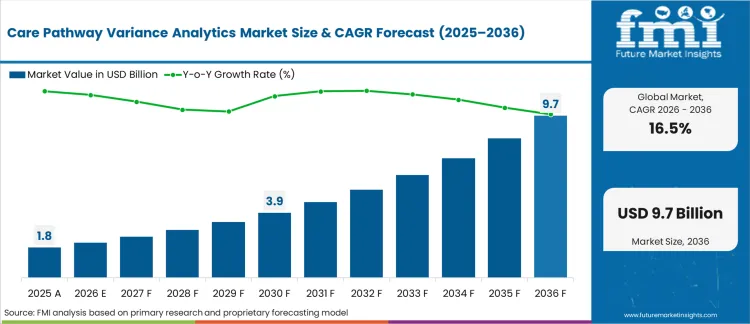
Care Pathway Variance Analytics Market Key Takeaways
| Metric | Details |
|---|---|
| Industry Size (2026) | USD 2.1 billion |
| Industry Value (2036) | USD 9.7 billion |
| CAGR (2026-2036) | 16.50% |
The integration of predictive algorithms into the physician's electronic workflow at the moment of order entry represents the critical inflection point. Clinical directors must intercept unjustified protocol deviations within the short diagnostic window before expensive procedures commence. Maturation of this capability transforms variance analytics from a backend administrative function into a frontline clinical navigation system.
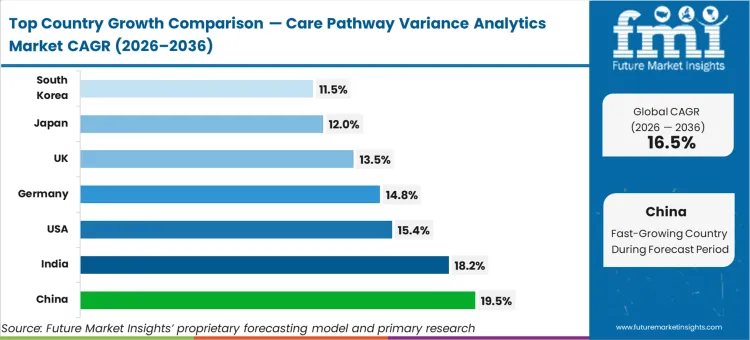
China advances at a 19.5% compound rate to 2036 driven by aggressive public hospital modernization mandates. India tracks at 18.2% as private tertiary networks expand evidence-based medicine frameworks. The United States grows at a 15.4% pace anchored by federal accountable care regulations. Germany expands at 14.8% while the UK follows at 13.5%. Japan records a 12.0% expansion, and South Korea posts an 11.5% trajectory. This geographic dispersion remains structural as diverse national reimbursement policies uniformly penalize unstandardized clinical delivery.
Care Pathway Variance Analytics Market Definition
Care pathway variance analytics encompasses specialized software platforms and methodologies designed to measure actual clinical delivery against standardized evidence-based protocols. The ecosystem isolates unwarranted diagnostic, therapeutic, and length-of-stay deviations to quantify their impact on patient outcomes and episode costs, distinguishing this discipline from generalized hospital business intelligence.
Care Pathway Variance Analytics Market Inclusions
The market scope includes clinical decision support engines, retrospective episode groupers, and cost-accounting algorithms mapped to specific disease pathways. Integration modules connecting electronic health records to predictive healthcare business intelligence dashboards fall within these boundaries. Advanced neural networks trained to identify positive clinical deviations for protocol updates are fully incorporated.
Care Pathway Variance Analytics Market Exclusions
General ledger accounting software lacking clinical context and standalone electronic health record systems without dedicated variance tracking modules are excluded. Broad population health management tools that do not analyse specific intra-episode protocol adherence fall outside the defined parameters. Independent physician credentialing systems are explicitly omitted from the valuation.
Care Pathway Variance Analytics Market Research Methodology
- Primary Research: Analysts engaged with chief medical officers, hospital chief financial officers, and clinical informatics directors to map the specific decision gates triggering analytics upgrades.
- Desk Research: The data collection phase aggregated compliance roadmaps from value-based care frameworks and major accountable care organization vendor guidelines.
- Market-Sizing and Forecasting: The baseline value derives from a bottom-up aggregation of analytics software deployments, applying region-specific modernization curves to project adoption velocity.
- Data Validation and Update Cycle: Projections are rigorously tested against publicly reported capital expenditure guidance from the leading health system conglomerates.
Segmental Analysis
Care Pathway Variance Analytics Market Analysis by Component
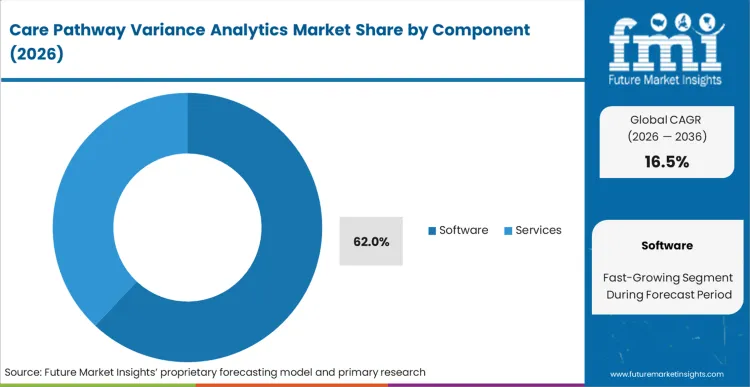
Dominating the investment domain, software commands a 62.0% share in 2026 as health systems prioritize scalable algorithmic engines over manual consulting reviews. Chief medical informatics officers demand automated platforms capable of ingesting vast unstructured clinical narratives to detect subtle protocol deviations. According to FMI's estimates, facilities transitioning to native virtual sleep clinics and broader variance tracking software realize measurable reductions in unnecessary diagnostic testing. The reliance on algorithmic processing eliminates the latency inherent in retrospective chart audits. Hospital administrators lacking automated detection capabilities face insurmountable manual labor costs when defending treatment choices against payer audits.
- Algorithmic processing: Advanced machine learning models identify hidden correlations between subtle protocol deviations and eventual hospital readmissions.
- Interoperability frameworks: Seamless integration with existing electronic health records prevents physician burnout by eliminating duplicate data entry requirements.
- Cloud native architecture: Centralized data lakes enable multi-facility health networks to benchmark physician performance across geographically dispersed campuses.
Care Pathway Variance Analytics Market Analysis by Application
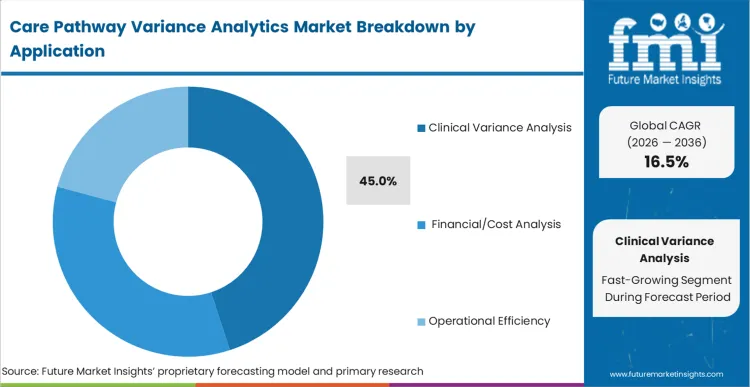
Retrospective financial reporting tools are failing, and an organized replacement toward clinical variance analysis is underway. This application holds a 45.0% share in 2026 as medical directors demand actionable insights into physician prescribing behaviour. Integrating these tools into value-based healthcare services frameworks ensures adherence to evidence-based medicine. By identifying the exact clinical moments where costs diverge from outcomes, these applications empower targeted intervention. FMI's research confirms that hospitals utilizing these applications rapidly eliminate low-value clinical practices. Network executives failing to implement standardized variance tracking forfeit their ability to negotiate shared-savings contracts with major insurers.
- Real-time interception: Algorithms flag non-compliant medication orders before pharmacy dispensing, instantly preventing costly therapeutic deviations.
- Outcome benchmarking: Platforms continuously compare individual physician complication rates against national specialty-specific standards to identify training gaps.
- Resource utilization: Analytics engines isolate specific surgical supply variations that drive up episode costs without improving patient recovery metrics.
Care Pathway Variance Analytics Market Analysis by Delivery Mode
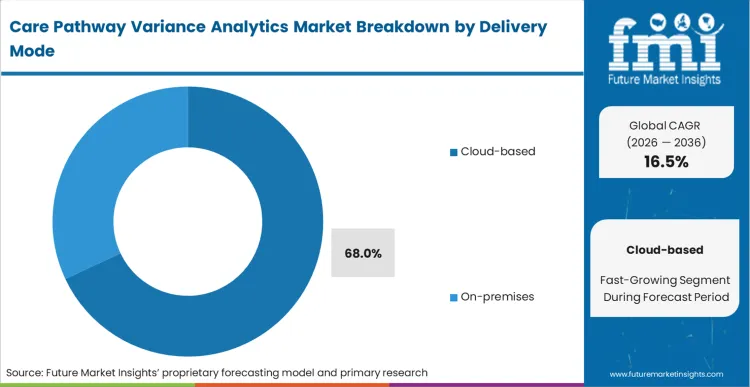
The absolute necessity of integrating disparate data streams forces hospitals to adopt cloud-based delivery, capturing 68.0% of the market in 2026. Health system chief information officers abandon isolated on-premises servers to facilitate seamless data exchange between acute and post-acute care settings. Based on FMI's assessment, cloud architecture provides the elastic computing power required to run complex predictive algorithms across millions of patient records simultaneously. This deployment model dramatically accelerates the implementation timeline for newly acquired community hospitals. IT directors resisting cloud migration face severe data silo constraints that critically compromise enterprise-wide quality reporting.
- Elastic scalability: Serverless architectures automatically provision computational resources during peak clinical charting hours to ensure zero interface latency.
- Remote accessibility: Secure web portals allow clinical department heads to review variance dashboards from any networked device across the hospital campus.
- Automated updates: Continuous software delivery mechanisms push the latest evidence-based protocol algorithms to all network nodes without requiring manual IT intervention.
Care Pathway Variance Analytics Market Analysis by End User
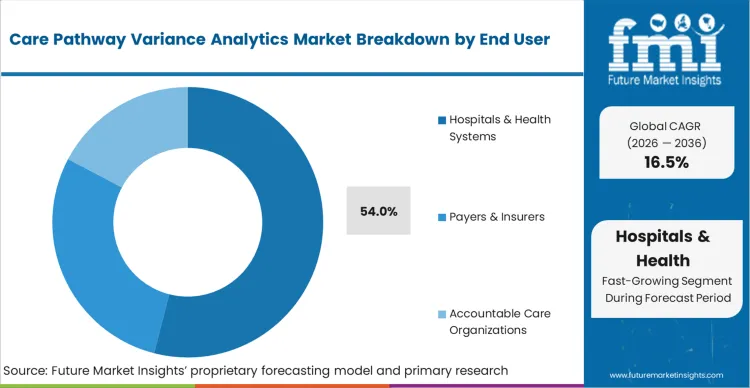
A prior failure to control episode costs created the massive demand from hospitals and health systems, anchoring a 54.0% share in 2026. Hospital chief financial officers deploy these tools to stem the bleeding from value-based care reimbursement penalties. By tracking every clinical decision against standardized pathways, facilities can proactively manage their financial risk. FMI analysts opine that this comprehensive oversight allows institutions to identify their most efficient practitioners and scale those specific techniques enterprise-wide. Clinical department heads lacking granular variance data remain unable to correct detrimental prescribing habits, triggering cascading financial losses.
- Margin protection: Granular cost accounting algorithms isolate the specific procedural deviations responsible for evaporating service line profitability.
- Physician alignment: Transparent performance dashboards foster healthy competition among clinical staff to adhere closely to optimal treatment protocols.
- Contract negotiation: Verified evidence of high pathway adherence empowers hospital administrators to secure premium reimbursement rates from commercial health plans.
Care Pathway Variance Analytics Market Drivers, Restraints, and Opportunities
Fixed-fee reimbursement structures drive the market as hospital administrators face severe financial penalties for unstandardized care. Chief medical officers facing these penalties must deploy variance analytics to achieve predictable episode costs. This transition allows facilities to secure shared-savings bonuses while isolating inefficient clinical practices. Institutions that fail to adopt these algorithms lose the leverage needed to survive in value-based contracting environments.
Fragmented electronic health record deployments present a severe operational friction. Data integration specialists struggle to extract clean, normalized clinical data from disparate legacy systems. Facilities attempt to bridge these gaps with custom application programming interfaces, but this workaround has severe scaling limits across large hospital networks.
Opportunities in the Care Pathway Variance Analytics Market
- Predictive Readmission Scoring: Machine learning algorithms flag at-risk patients prior to discharge. Discharge planners capture this capability to allocate limited home healthcare software and human resources efficiently.
- Dynamic Protocol Generation: Artificial intelligence identifies positive clinical deviations that improve outcomes. Medical society researchers leverage this data to continuously update national hospital treatment guidelines.
- Payer-Provider Data Syndication: Secure data enclaves allow bidirectional sharing of variance metrics. Contract negotiators use this transparency to instantly adjudicate value-based payment bonuses.
Regional Analysis
Based on the regional analysis, the Care Pathway Variance Analytics market is segmented into North America, Latin America, Europe, East Asia, South Asia, Oceania and Middle East & Africa across 40 plus countries.
.webp "Top Country Growth Comparison Care Pathway Variance Analytics Market Cagr (2026 2036)")
| Country | CAGR (2026 to 2036) |
|---|---|
| China | 19.5% |
| India | 18.2% |
| USA | 15.4% |
| Germany | 14.8% |
| UK | 13.5% |
| Japan | 12.0% |
| South Korea | 11.5% |
Source: Future Market Insights (FMI) analysis, based on proprietary forecasting model and primary research
Asia Pacific Care Pathway Variance Analytics Market Analysis
Aggressive public healthcare modernization mandates make this region structurally distinct. FMI's analysis indicates that ministries of health are bypassing legacy quality reporting mechanisms and directly funding intelligent hospital infrastructure. This clean-slate digital transformation sets up a massive deployment footprint for advanced analytical engines.
- China: The requirement to process unprecedented patient volumes forces hospital administrators to implement strict algorithmic triaging. Native analytics integration ensures that clinical pathways remain standardized despite severe physician-to-patient ratio imbalances. Hospital IT directors must install these platforms to prevent catastrophic bottlenecks during peak admission surges. Aggressive public hospital modernization mandates anchor China's 19.5% compound expansion to 2036.
- India: Private tertiary networks drive a 18.2% CAGR for the market in India. Corporate hospital chains face intense competition for international medical tourists, requiring verifiable proof of standardized clinical excellence. Transparent pathway adherence dashboards serve as the primary marketing tool for these premium healthcare providers. Clinical quality officers lacking robust variance documentation lose highly lucrative medical tourism contracts.
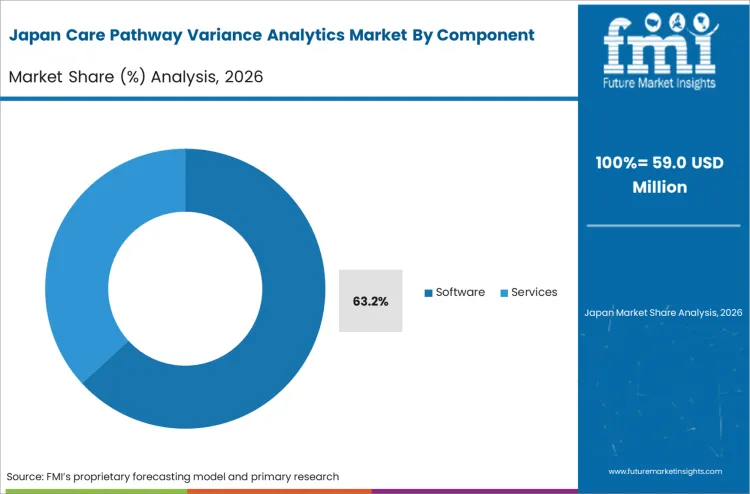
- Japan: Japan’s demographic reality of an ageing population requires hyper-efficient chronic disease management protocols. The geriatric care burden anchors the nation's 12.0% compound trajectory to 2036. Algorithms continuously track complex comorbidity treatments to minimize unnecessary hospital readmissions among elderly patients. Geriatric care coordinators deploying these tools prevent dangerous polypharmacy interactions and secure higher functional recovery rates.
- South Korea: South Korea's market expands at a 11.5% CAGR as tertiary facility throughput pressures mount. High-volume surgical centers rely on precision timing and standardized protocols to maximize operating room utilization. Variance analytics instantly identify surgical teams deviating from optimal turnaround times. Surgical department heads failing to implement these tracking mechanisms suffer severe revenue losses due to daily schedule overruns.
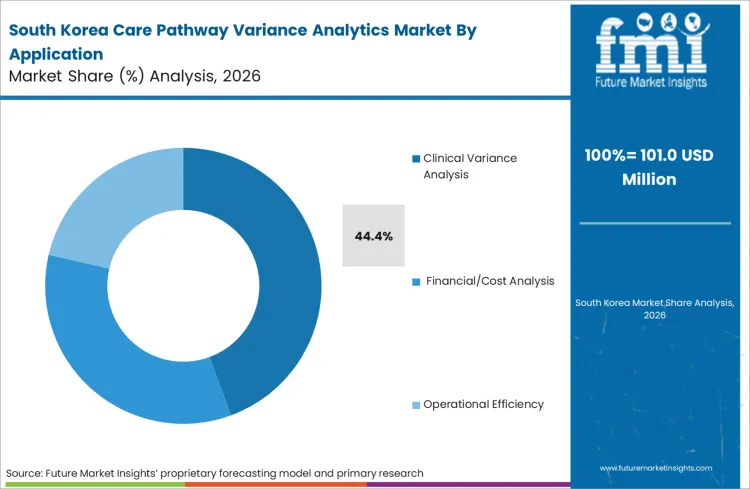
FMI's report includes detailed assessments of Australia, Indonesia, and Taiwan. The structural pattern across these additional countries reveals a rapid transition toward digital-first quality accreditation programs, heavily subsidizing analytics adoption.
North America Care Pathway Variance Analytics Market Analysis
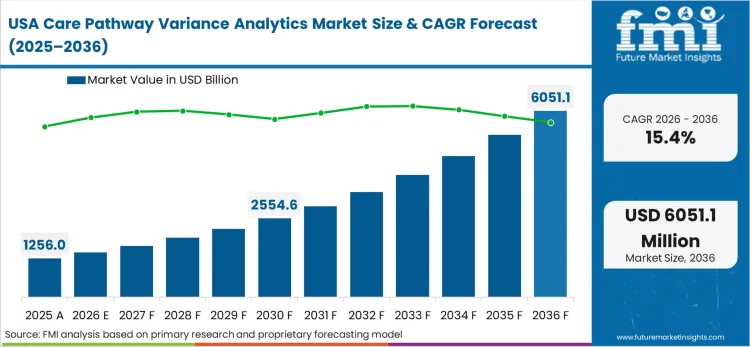
The dominance of commercial accountable care organizations creates a unique structural condition in this region. Private health insurers aggressively transfer financial risk onto provider networks, compelling massive investments in cost-containment technologies. This environment establishes the perfect catalyst for ubiquitous variance tracking implementation.
- USA: The United States' market demand is rising at a CAGR of 15.4% as federal accountable care regulations tighten. The Centers for Medicare & Medicaid Services systematically reduce reimbursements for facilities demonstrating high clinical variance. Predictive engines allow administrators to intercept protocol deviations before they trigger federal financial penalties. Chief financial officers failing to integrate these compliance safeguards risk catastrophic revenue forfeiture under mandatory bundled payment initiatives.
FMI's report includes comprehensive analysis of Canada and Mexico. The structural pattern across these additional countries highlights a growing emphasis on optimizing resource allocation within constrained public health budgets.
Europe Care Pathway Variance Analytics Market Analysis
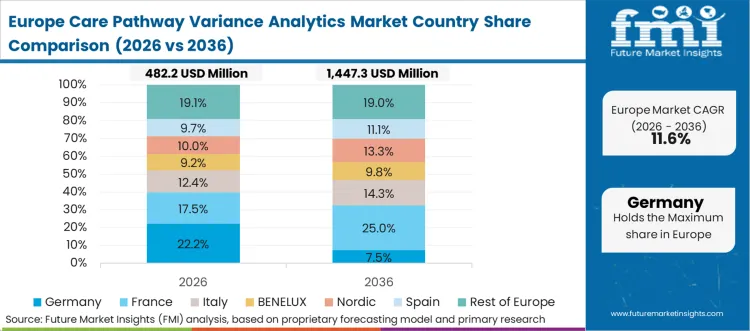
Strict statutory health insurance quality benchmarks define the European structural landscape. Regional health authorities demand exhaustive documentation proving that expensive therapeutic interventions adhere strictly to clinical guidelines. This compliance burden necessitates automated pathway tracking to avoid crippling administrative overhead.
- Germany: The national mandate for evidence-based medicine forces clinical directors to continuously audit physician prescribing patterns. Automated variance reports instantly justify complex treatment decisions to strict insurance review boards. Medical auditing leads lacking these algorithmic defenses face immediate claims rejections and severe institutional funding cuts. Thus, Germany advances at a 14.8% compound rate as stringent statutory insurance quality benchmarks intensify.
- UK: National Health Service efficiency directives drive a 13.5% annual expansion rate as waiting list pressures escalate. Trust executives require granular visibility into operational bottlenecks to maximise clinical throughput. Pathway analytics identify the exact procedural delays causing surgical backlog accumulation. Trust that capacity managers failing to utilise these optimisation tools face severe governmental intervention and forced administrative restructuring.
FMI's report includes extensive coverage of France, Italy, and the Nordics. The structural pattern across these additional countries emphasizes the deployment of analytics to support decentralized, community-based care models.
Competitive Aligners for Market Players
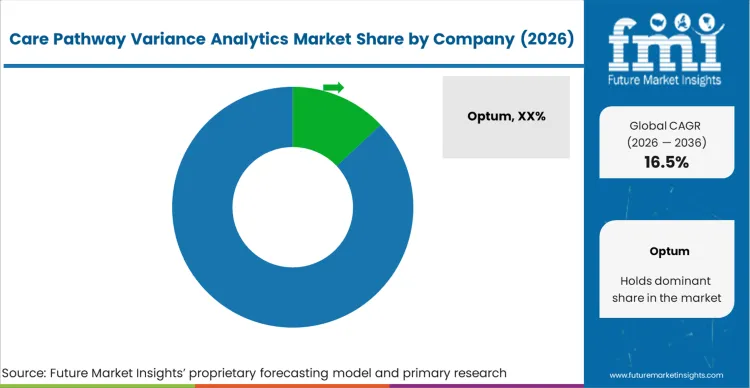
The care pathway variance analytics market remains concentrated among established healthcare IT conglomerates and specialized clinical intelligence firms. High barriers to entry, specifically the requirement for deep electronic health record integration and vast troves of training data, insulate incumbents. Companies like Optum, Health Catalyst, and Merative leverage their massive installed bases to block agile challengers. Buyers rely on vendor track records of successful electronic health record integration to distinguish qualified platforms from unproven software.
These dominant players maintain distinct structural advantages through proprietary digital health for obesity and pathway algorithms trained on billions of historical patient encounters. This immense data gravity allows established vendors to offer superior predictive accuracy that new entrants cannot replicate without decades of data collection. To compete, challengers must build highly specialized niche algorithms or offer radically superior user interfaces. For niche developers, this implies partnering with specific medical societies to validate their targeted variance engines.
Large health systems actively prevent vendor lock-in by mandating strict adherence to open data standards like Fast Healthcare Interoperability Resources. This structural requirement limits the pricing power of dominant analytics providers, forcing them to compete on continuous algorithmic improvement rather than data hostage tactics. A core structural tension exists between health systems demanding total data portability and vendors attempting to construct walled data gardens. As per FMI's projection, the competitive structure will inevitably shift toward modular, easily swappable analytical applications over the forecast period.
Key Players in Care Pathway Variance Analytics Market
- Optum
- McKesson
- Merative
- Health Catalyst
- SAS Institute
- Oracle Health
- Innovaccer
Scope of the Report
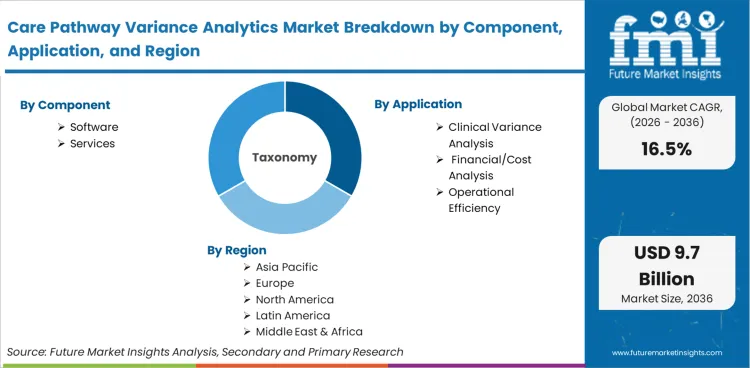
| Metric | Value |
|---|---|
| Quantitative Units | USD 2.1 billion to USD 9.7 billion, at a CAGR of 16.50% |
| Market Definition | Care pathway variance analytics encompasses specialized software platforms and methodologies designed to measure actual clinical delivery against standardized evidence-based protocols. |
| Component Segmentation | Software, Services |
| Application Segmentation | Clinical Variance Analysis, Financial/Cost Analysis, Operational Efficiency |
| Delivery Mode Segmentation | Cloud-based, On-premises |
| End User Segmentation | Hospitals & Health Systems, Payers & Insurers, Accountable Care Organizations |
| Regions Covered | North America, Latin America, Europe, East Asia, South Asia, Oceania, Middle East & Africa |
| Countries Covered | China, India, USA, Germany, UK, Japan, South Korea, and 40 plus countries |
| Key Companies Profiled | Optum, McKesson, Merative, Health Catalyst, SAS Institute, Oracle Health, Innovaccer |
| Forecast Period | 2026 to 2036 |
| Approach | Primary interviews mapped specific decision gates triggering analytics upgrades. The baseline derives from a bottom-up aggregation of software deployments, validated against reported health system capital expenditure. |
Source: Future Market Insights (FMI) analysis, based on proprietary forecasting model and primary research
Care Pathway Variance Analytics Market Analysis by Segments
Component:
- Software
- Services
Application:
- Clinical Variance Analysis
- Financial/Cost Analysis
- Operational Efficiency
Delivery Mode:
- Cloud-based
- On-premises
End User:
- Hospitals & Health Systems
- Payers & Insurers
- Accountable Care Organizations
Region:
- North America
- USA
- Canada
- Mexico
- Latin America
- Brazil
- Argentina
- Rest of Latin America
- Europe
- Germany
- UK
- France
- Rest of Europe
- East Asia
- China
- Japan
- South Korea
- South Asia
- India
- Rest of South Asia
- Oceania
- Australia
- New Zealand
- Middle East & Africa
- GCC Countries
- South Africa
- Rest of Middle East & Africa
Bibliography
- USA Food and Drug Administration. (2025). Artificial intelligence-enabled device software functions: Lifecycle management and marketing submission recommendations: Draft guidance for industry and Food and Drug Administration staff.
- Assistant Secretary for Technology Policy/Office of the National Coordinator for Health Information Technology. (2024). HTI-1 final rule overview with question & answer.
- International Medical Device Regulators Forum. (2025). Good machine learning practice for medical device development: Guiding principles.
- Medicines and Healthcare products Regulatory Agency. (2024, April 30). MHRA’s AI regulatory strategy ensures patient safety and industry innovation into 2030.
- USA Government Accountability Office. (2024). Science & tech spotlight: Generative AI in health care (GAO-24-107634).
- National Academy of Medicine. (2025). An artificial intelligence code of conduct for health and medicine: Essential guidance for aligned action.
- Agency for Healthcare Research and Quality. (2024, July 29). Artificial intelligence: System-level considerations. PSNet.
- Kim, J. Y., Hasan, A., Kueper, J., Tang, T., Hayes, C., Fine, B., Balu, S., & Sendak, M. (2025). Establishing organizational AI governance in healthcare: A case study in Canada. npj Digital Medicine.
This bibliography is provided for reader reference. The full FMI report contains the complete reference list with primary source documentation.
This Report Addresses
- Market intelligence to support financial, clinical, and operational decision‑making across the organized care pathway variance analytics ecosystem, with emphasis on protocol‑aligned care delivery and risk‑adjusted performance outcomes
- Market size estimation and 10‑year revenue forecasts from 2026 to 2036, supported by validated pathway adoption baselines, modernization curves, and structured interviews with clinical and financial leadership teams
- Growth opportunity mapping across software and service configurations, including algorithmic decision‑support engines, interoperability frameworks, and workflow‑embedded variance detection capabilities
- Segment and regional revenue forecasts across clinical variance analysis, financial/cost analytics, and operational efficiency tools, shaped by reimbursement models, quality mandates, and digitization intensity across key markets
- Competition strategy assessment covering analytics platform differentiation, evidence‑based protocol alignment, data‑interoperability compliance, and enterprise deployment scalability for healthcare intelligence vendors
- Innovation and capability tracking tied to predictive readmission scoring, real‑time intervention algorithms, and emerging clinical navigation mechanisms embedded within physician workflows
- Market access analysis across hospital systems, payer networks, and accountable care organizations, including procurement drivers linked to cost containment, pathway adherence, and quality‑linked reimbursement incentives
Frequently Asked Questions
How large is the Care Pathway Variance Analytics Market in 2026?
The market is expected to reach USD 2.1 billion in 2026. Hospital chief financial officers face imminent revenue cycle deficits and must deploy pathway tracking solutions.
What will the Care Pathway Variance Analytics Market be valued at by 2036?
The valuation will reach USD 9.7 billion by 2036. Real-time algorithmic decision support consistently replaces retrospective clinical auditing.
What CAGR is projected for Care Pathway Variance Analytics Market from 2026 to 2036?
A compound expansion at 16.50% sustains the market over the decade. The permanent structural shift from volume-based compensation to risk-bearing contracts anchors this trajectory.
Which segment leads by Component in 2026?
Software captures a 62.0% share in 2026. Health systems prioritize scalable algorithmic engines over manual consulting reviews to process vast clinical narratives.
Which segment dominates by Application?
Clinical Variance Analysis holds a 45.0% share in 2026. Medical directors demand actionable insights into physician prescribing behavior to align practices with evidence-based medicine.
Which segment commands the Delivery Mode landscape?
Cloud-based delivery accounts for 68.0% of the market in 2026. Chief information officers abandon isolated servers to facilitate seamless data exchange between acute and post-acute settings.
What End User segment captures the most market share?
Hospitals & Health Systems anchor a 54.0% share in 2026. Facilities proactively manage their financial risk by tracking every clinical decision against standardized pathways.
Which region presents the highest growth rate?
China expands at a 19.5% CAGR as greenfield smart hospitals mandate natively integrated clinical algorithms.
What forces drive demand in India?
Private tertiary networks drive an 18.2% CAGR for the market in India. Corporate hospital chains face intense competition for international medical tourists, requiring verifiable proof of clinical excellence.
What sustains growth in the USA?
The United States tracks at a 15.4% CAGR as value-based reimbursement penalties force rapid compliance. Predictive engines allow administrators to intercept protocol deviations before they trigger federal financial penalties.
What anchors demand in Germany?
Germany advances at a 14.8% CAGR due to stringent statutory insurance quality benchmarks. The national mandate for evidence-based medicine forces clinical directors to continuously audit physician prescribing patterns.
What accelerates adoption in the UK?
The UK expands at a 13.5% CAGR shaped by National Health Service efficiency directives. Trust executives require granular visibility into operational bottlenecks to maximize clinical throughput.
What operational friction acts as a restraint?
Fragmented electronic health record deployments prevent clean data extraction. Facilities struggle to normalize data from disparate legacy systems without breaking customized application programming interfaces.
What primary capability triggers algorithm upgrades?
The integration of predictive algorithms into the physician's electronic workflow at the moment of order entry represents the critical inflection point. This transforms variance analytics from a backend function into a frontline navigation system.
How do large buyers influence vendor pricing?
Large health systems mandate strict adherence to open data standards like Fast Healthcare Interoperability Resources. This limits pricing power by forcing vendors to compete on continuous algorithmic improvement rather than proprietary data lock-in.
What structural transformation shapes the outlook?
The shift from retrospective financial reporting tools to real-time clinical variance analysis forces hospitals to abandon static order sets. This requires dynamic analytics that flag protocol deviations at the point of care.
What distinguishes South Korea's adoption pattern?
South Korea expands at an 11.5% CAGR as tertiary facility throughput pressures mount. High-volume surgical centers rely on precision timing and standardized protocols to maximize operating room utilization.
How is Japan responding to demographic challenges?
Japan tracks at a 12.0% CAGR optimizing geriatric care pathways. Algorithms continuously track complex comorbidity treatments to minimize unnecessary hospital readmissions among elderly patients.
What defines the market definition?
Care pathway variance analytics encompasses specialized software platforms designed to measure actual clinical delivery against standardized evidence-based protocols. This isolates unwarranted diagnostic and therapeutic deviations to quantify their impact on episode costs.
What specific capability drives the Software segment?
Advanced machine learning models identify hidden correlations between subtle protocol deviations and eventual hospital readmissions. This eliminates the latency inherent in retrospective chart audits.
How is the scope bounded regarding exclusions?
General ledger accounting software lacking clinical context and standalone electronic health record systems without dedicated variance tracking modules are explicitly excluded.
What methodological approach validates the forecast?
The baseline derives from a bottom-up aggregation of analytics software deployments, applying region-specific modernization curves. Projections undergo cross-validation against quarterly software subscription revenues.
What specific takeaway should hospital executives action?
Healthcare network executives must mandate the integration of variance alerts directly into physician order entry interfaces. This intercepts unjustified protocol deviations within the diagnostic window before expensive procedures commence.
What regulatory standard shapes product development?
Interoperability regulations demand total data portability. Vendors must construct modular, easily swappable analytical applications rather than maintaining closed proprietary networks.
Preview the report firsthand - request a free sample
Get SampleGet the brochure for pricing and purchase details.
Get PDFTable of Content
- Key Takeaways
- Market Size and CAGR
- Top Growth Driver
- Fastest Growing Segment
- Leading Region
- Key Companies
- Emerging Opportunities
- Executive Summary
- Global Market Outlook
- Demand-side Trends
- Supply-side Trends
- Technology Roadmap Analysis
- Analysis and Recommendations
- Analyst Perspective (What is happening? Why now? What should investors know?)
- Key Questions Answered
- How large is the market?
- What is the CAGR?
- What are key trends?
- Which region dominates?
- Who are the leaders?
- Market Overview
- Market Coverage / Taxonomy
- Market Definition / Scope / Limitations
- Research Methodology
- Chapter Orientation
- Analytical Lens and Working Hypotheses
- Market Structure, Signals, and Trend Drivers
- Benchmarking and Cross-market Comparability
- Market Sizing, Forecasting, and Opportunity Mapping
- Research Design and Evidence Framework
- Desk Research Programme (Secondary Evidence)
- Expert Input and Fieldwork (Primary Evidence)
- Tooling, Models, and Reference Databases
- Data Engineering and Model Build
- Quality Assurance and Audit Trail
- Market Background
- Market Dynamics (Drivers, Restraints, Opportunity, Trends)
- Scenario Forecast (Optimistic, Likely, Conservative)
- Impact Analysis
- AI Impact
- Sustainability Impact
- Regulatory Impact
- Technology Impact
- Consumer / Buyer Analysis
- Purchase Drivers
- Adoption Barriers
- Buyer Journey
- Opportunity Map Analysis
- Product Life Cycle Analysis
- Supply Chain Analysis
- Investment Feasibility Matrix
- Value Chain Analysis
- PESTLE and Porter's Analysis
- Regulatory Landscape
- Regional Parent Market Outlook
- Production and Consumption Statistics
- Import and Export Statistics
- Global Market Analysis and Forecast, 2021 to 2036
- Historical Market Size Value (USD Billion) & Volume (Unit) Analysis, 2021 to 2025
- Current and Future Market Size Value (USD Billion) & Volume (Unit) Projections, 2026 to 2036
- Y-o-Y Growth Trend Analysis
- Absolute $ Opportunity Analysis
- Global Market Pricing Analysis, 2021 to 2036
- Global Market Analysis and Forecast, By Component, 2021 to 2036
- Introduction / Key Findings
- Historical Market Size Value (USD Billion) & Volume (Unit) Analysis By Component, 2021 to 2025
- Current and Future Market Size Value (USD Billion) & Volume (Unit) Analysis and Forecast By Component, 2026 to 2036
- Software
- Services
- Software
- Y-o-Y Growth Trend Analysis By Component, 2021 to 2025
- Absolute $ Opportunity Analysis By Component, 2026 to 2036
- Global Market Analysis and Forecast, By Application, 2021 to 2036
- Introduction / Key Findings
- Historical Market Size Value (USD Billion) & Volume (Unit) Analysis By Application, 2021 to 2025
- Current and Future Market Size Value (USD Billion) & Volume (Unit) Analysis and Forecast By Application, 2026 to 2036
- Clinical Variance Analysis
- Financial/Cost Analysis
- Operational Efficiency
- Clinical Variance Analysis
- Y-o-Y Growth Trend Analysis By Application, 2021 to 2025
- Absolute $ Opportunity Analysis By Application, 2026 to 2036
- Global Market Analysis and Forecast, By Delivery Mode, 2021 to 2036
- Introduction / Key Findings
- Historical Market Size Value (USD Billion) & Volume (Unit) Analysis By Delivery Mode, 2021 to 2025
- Current and Future Market Size Value (USD Billion) & Volume (Unit) Analysis and Forecast By Delivery Mode, 2026 to 2036
- Cloud-based
- On-premises
- Cloud-based
- Y-o-Y Growth Trend Analysis By Delivery Mode, 2021 to 2025
- Absolute $ Opportunity Analysis By Delivery Mode, 2026 to 2036
- Global Market Analysis and Forecast, By End User, 2021 to 2036
- Introduction / Key Findings
- Historical Market Size Value (USD Billion) & Volume (Unit) Analysis By End User, 2021 to 2025
- Current and Future Market Size Value (USD Billion) & Volume (Unit) Analysis and Forecast By End User, 2026 to 2036
- Hospitals & Health Systems
- Payers & Insurers
- Accountable Care Organizations
- Hospitals & Health Systems
- Y-o-Y Growth Trend Analysis By End User, 2021 to 2025
- Absolute $ Opportunity Analysis By End User, 2026 to 2036
- Global Market Analysis and Forecast, By Region, 2021 to 2036
- Introduction
- Historical Market Size Value (USD Billion) & Volume (Unit) Analysis By Region, 2021 to 2025
- Current Market Size Value (USD Billion) & Volume (Unit) Analysis and Forecast By Region, 2026 to 2036
- North America
- Latin America
- Western Europe
- Eastern Europe
- East Asia
- South Asia and Pacific
- Middle East & Africa
- Market Attractiveness Analysis By Region
- North America Market Analysis and Forecast, By Country, 2021 to 2036
- Historical Market Size Value (USD Billion) & Volume (Unit) Trend Analysis By Market Taxonomy, 2021 to 2025
- Market Size Value (USD Billion) & Volume (Unit) Forecast By Market Taxonomy, 2026 to 2036
- By Country
- USA
- Canada
- Mexico
- By Component
- By Application
- By Delivery Mode
- By End User
- By Country
- Market Attractiveness Analysis
- By Country
- By Component
- By Application
- By Delivery Mode
- By End User
- Key Takeaways
- Latin America Market Analysis and Forecast, By Country
- Historical Market Size Value (USD Billion) & Volume (Unit) Trend Analysis By Market Taxonomy, 2021 to 2025
- Market Size Value (USD Billion) & Volume (Unit) Forecast By Market Taxonomy, 2026 to 2036
- By Country
- Brazil
- Chile
- Rest of Latin America
- By Component
- By Application
- By Delivery Mode
- By End User
- By Country
- Market Attractiveness Analysis
- By Country
- By Component
- By Application
- By Delivery Mode
- By End User
- Key Takeaways
- Western Europe Market Analysis and Forecast, By Country
- Historical Market Size Value (USD Billion) & Volume (Unit) Trend Analysis By Market Taxonomy, 2021 to 2025
- Market Size Value (USD Billion) & Volume (Unit) Forecast By Market Taxonomy, 2026 to 2036
- By Country
- Germany
- UK
- Italy
- Spain
- France
- Nordic
- BENELUX
- Rest of Western Europe
- By Component
- By Application
- By Delivery Mode
- By End User
- By Country
- Market Attractiveness Analysis
- By Country
- By Component
- By Application
- By Delivery Mode
- By End User
- Key Takeaways
- Eastern Europe Market Analysis and Forecast, By Country
- Historical Market Size Value (USD Billion) & Volume (Unit) Trend Analysis By Market Taxonomy, 2021 to 2025
- Market Size Value (USD Billion) & Volume (Unit) Forecast By Market Taxonomy, 2026 to 2036
- By Country
- Russia
- Poland
- Hungary
- Balkan & Baltic
- Rest of Eastern Europe
- By Component
- By Application
- By Delivery Mode
- By End User
- By Country
- Market Attractiveness Analysis
- By Country
- By Component
- By Application
- By Delivery Mode
- By End User
- Key Takeaways
- East Asia Market Analysis and Forecast, By Country
- Historical Market Size Value (USD Billion) & Volume (Unit) Trend Analysis By Market Taxonomy, 2021 to 2025
- Market Size Value (USD Billion) & Volume (Unit) Forecast By Market Taxonomy, 2026 to 2036
- By Country
- China
- Japan
- South Korea
- By Component
- By Application
- By Delivery Mode
- By End User
- By Country
- Market Attractiveness Analysis
- By Country
- By Component
- By Application
- By Delivery Mode
- By End User
- Key Takeaways
- South Asia and Pacific Market Analysis and Forecast, By Country
- Historical Market Size Value (USD Billion) & Volume (Unit) Trend Analysis By Market Taxonomy, 2021 to 2025
- Market Size Value (USD Billion) & Volume (Unit) Forecast By Market Taxonomy, 2026 to 2036
- By Country
- India
- ASEAN
- Australia & New Zealand
- Rest of South Asia and Pacific
- By Component
- By Application
- By Delivery Mode
- By End User
- By Country
- Market Attractiveness Analysis
- By Country
- By Component
- By Application
- By Delivery Mode
- By End User
- Key Takeaways
- Middle East & Africa Market Analysis and Forecast, By Country
- Historical Market Size Value (USD Billion) & Volume (Unit) Trend Analysis By Market Taxonomy, 2021 to 2025
- Market Size Value (USD Billion) & Volume (Unit) Forecast By Market Taxonomy, 2026 to 2036
- By Country
- Kingdom of Saudi Arabia
- Other GCC Countries
- Türkiye
- South Africa
- Other African Union
- Rest of Middle East & Africa
- By Component
- By Application
- By Delivery Mode
- By End User
- By Country
- Market Attractiveness Analysis
- By Country
- By Component
- By Application
- By Delivery Mode
- By End User
- Key Takeaways
- Key Countries Market Analysis
- USA
- Pricing Analysis
- Market Share Analysis, 2025
- By Component
- By Application
- By Delivery Mode
- By End User
- Canada
- Pricing Analysis
- Market Share Analysis, 2025
- By Component
- By Application
- By Delivery Mode
- By End User
- Mexico
- Pricing Analysis
- Market Share Analysis, 2025
- By Component
- By Application
- By Delivery Mode
- By End User
- Brazil
- Pricing Analysis
- Market Share Analysis, 2025
- By Component
- By Application
- By Delivery Mode
- By End User
- Chile
- Pricing Analysis
- Market Share Analysis, 2025
- By Component
- By Application
- By Delivery Mode
- By End User
- Germany
- Pricing Analysis
- Market Share Analysis, 2025
- By Component
- By Application
- By Delivery Mode
- By End User
- UK
- Pricing Analysis
- Market Share Analysis, 2025
- By Component
- By Application
- By Delivery Mode
- By End User
- Italy
- Pricing Analysis
- Market Share Analysis, 2025
- By Component
- By Application
- By Delivery Mode
- By End User
- Spain
- Pricing Analysis
- Market Share Analysis, 2025
- By Component
- By Application
- By Delivery Mode
- By End User
- France
- Pricing Analysis
- Market Share Analysis, 2025
- By Component
- By Application
- By Delivery Mode
- By End User
- India
- Pricing Analysis
- Market Share Analysis, 2025
- By Component
- By Application
- By Delivery Mode
- By End User
- ASEAN
- Pricing Analysis
- Market Share Analysis, 2025
- By Component
- By Application
- By Delivery Mode
- By End User
- Australia & New Zealand
- Pricing Analysis
- Market Share Analysis, 2025
- By Component
- By Application
- By Delivery Mode
- By End User
- China
- Pricing Analysis
- Market Share Analysis, 2025
- By Component
- By Application
- By Delivery Mode
- By End User
- Japan
- Pricing Analysis
- Market Share Analysis, 2025
- By Component
- By Application
- By Delivery Mode
- By End User
- South Korea
- Pricing Analysis
- Market Share Analysis, 2025
- By Component
- By Application
- By Delivery Mode
- By End User
- Russia
- Pricing Analysis
- Market Share Analysis, 2025
- By Component
- By Application
- By Delivery Mode
- By End User
- Poland
- Pricing Analysis
- Market Share Analysis, 2025
- By Component
- By Application
- By Delivery Mode
- By End User
- Hungary
- Pricing Analysis
- Market Share Analysis, 2025
- By Component
- By Application
- By Delivery Mode
- By End User
- Kingdom of Saudi Arabia
- Pricing Analysis
- Market Share Analysis, 2025
- By Component
- By Application
- By Delivery Mode
- By End User
- Türkiye
- Pricing Analysis
- Market Share Analysis, 2025
- By Component
- By Application
- By Delivery Mode
- By End User
- South Africa
- Pricing Analysis
- Market Share Analysis, 2025
- By Component
- By Application
- By Delivery Mode
- By End User
- USA
- Market Structure Analysis
- Competition Dashboard
- Competition Benchmarking
- Market Share Analysis of Top Players
- By Regional
- By Component
- By Application
- By Delivery Mode
- By End User
- Emerging Startups
- Innovation Benchmarking
- Competition Analysis
- Competition Deep Dive
- Optum
- Overview
- Product Portfolio
- Profitability by Market Segments (Product/Region/Sales Channel)
- Sales Footprint
- Strategy Overview
- Marketing Strategy
- Product Strategy
- Channel Strategy
- McKesson
- Merative
- Health Catalyst
- SAS Institute
- Oracle Health
- Innovaccer
- Optum
- Case Studies
- Success Stories
- Recent Developments
- Competition Deep Dive
- Assumptions & Acronyms Used


