

- Market Size (2026)
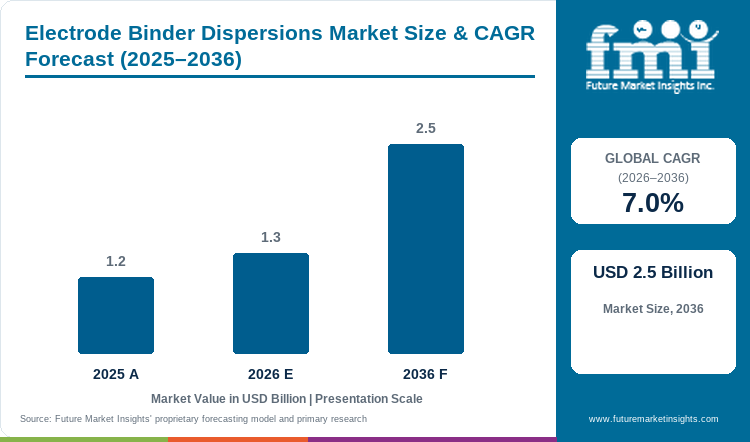
- USD 1.3 Bn
- Forecast (2036)
- USD 2.5 Bn
- CAGR (2026 to 2036)
- 7.0%
How big is Electrode Binder Dispersions Market in 2026?
USD 1.3 Billion in 2026 and USD 2.5 Billion by 2036 at a 7.0% CAGR.
The Electrode Binder Dispersions market stood at USD 1.2 Billion in 2025, is estimated at USD 1.3 Billion in 2026, and is forecast to reach USD 2.5 Billion by 2036 at a 7.0% CAGR from 2026 to 2036.
Battery-cell output is the direct volume bridge between electrode-binder demand and the broader electrification cycle. The International Energy Agency reported in May 2026 that EV battery deployment reached 1.2 TWh in 2025. That was almost 30% above 2024.
Each new coating line must qualify a binder against slurry rheology and foil adhesion. It must also pass drying and cycling tests before production scale-up. This makes binder demand sensitive to cell capacity and to chemistry transitions such as LFP or silicon-rich anodes.
PVDF remains embedded in many cathode coating workflows. Water-based SBR, acrylic, and PAA-type systems gain attention where manufacturers seek lower solvent burden or better mechanical control.
Cell makers therefore convert added capacity into binder purchases only after formulation and line-level qualification are secured.
Country conditions change how quickly that qualification becomes revenue. South Korea combines a dense cell-manufacturing base with rapid materials co-development. Finland and Canada are building supply-chain depth around battery materials and new industrial clusters.
Germany and France operate inside the EU chemical compliance framework. NMP controls there increase the value of solvent-management capability and credible aqueous alternatives. Japan pairs long supplier qualification cycles with explicit policy support for domestic battery manufacturing.
The USA is adding local PVDF capacity alongside new cell plants and storage demand. Across these markets, interest becomes purchase when a binder passes customer validation on the intended active material and coating line. Reliable regional supply must follow that technical approval.
Key Takeaways
- The market is estimated at USD 1.3 Billion in 2026 and is forecast to reach USD 2.5 Billion by 2036 at a 7.0% CAGR.
- PVDF dispersions lead in 2026. Cathode binders lead in 2026.
- Water-based systems lead in 2026. EV batteries lead in 2026. Cell makers direct lead in 2026.
- Driver: Scaling EV and stationary battery production increases qualified binder consumption across additional coating lines.
- Restraint: Qualification cycles and solvent-handling requirements slow binder switching after a line enters production.
- Opportunity: Water-based and silicon-compatible systems can win new programs where cell makers seek lower solvent burden and better mechanical control. South Korea has the highest profiled country CAGR at 7.6%, compared with Japan at 5.4%.
Analyst Perspective
Revenue capture depends on passing the buyer’s qualification gate and staying qualified through scale-up. The commercial advantage shifts toward suppliers that can tune binder behavior to the active material and coating process.
- Nikhil Kaitwade, Principal Consultant, Future Market Insights
How is the Electrode Binder Dispersions Market segmented?
The market is segmented by Binder Chemistry, Electrode Type, Solvent System, End Use, and Sales Channel.
Binder Chemistry separates fluoropolymer, rubber-latex, cellulose-based, acrylic, and acid- or biopolymer-based systems according to how they create adhesion and mechanical stability.
Electrode Type distinguishes binder requirements across conventional cathodes and anodes as well as silicon, LFP, and high-nickel programs. Solvent System separates water-based processing from NMP-based, low-VOC, and hybrid routes.
End Use tracks the duty cycle and qualification depth associated with EV batteries, stationary storage, consumer electronics, power tools, and pilot lines. Sales Channel reflects whether material is purchased directly by cell makers or through electrode producers, distributors, and laboratory suppliers.
What makes PVDF dispersions central to the Binder Chemistry category?
PVDF remains a reference chemistry for cathode coating because it combines chemical resistance with electrochemical stability across established lithium-ion production conditions. The installed process base matters as much as polymer performance.
Cathode lines designed around PVDF and NMP already have tuned mixing and coating steps. Their drying and solvent-management systems are also built around that process. A switch therefore requires requalification of slurry rheology and electrode adhesion.
It can also require changes to drying conditions or recovery equipment. Arkema continues to invest in battery-grade PVDF capacity. Solvay announced in February 2022 a EUR 300 million Tavaux expansion plan that targeted 35 kilotons of PVDF capacity.
These investments support supply continuity for customers that retain this process architecture while developing lower-solvent alternatives in parallel.
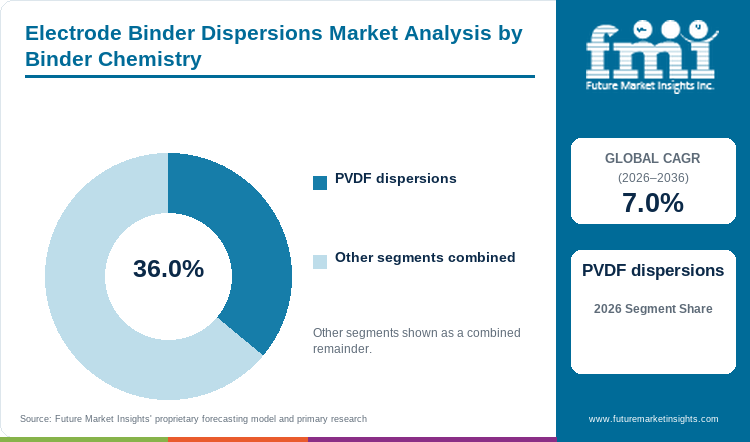
- PVDF dispersions hold a 36.0% share in 2026, supported by established cathode processing and a broad qualification history in lithium-ion manufacturing.
- Arkema announced in March 2026 that it would expand Kynar PVDF capacity at Changshu by 20%, with startup planned for 2028 and battery demand among the targeted uses.
Why do Cathode binders lead the Electrode Type category?
Cathode binders carry a demanding combination of adhesion, oxidative stability, and coating-uniformity requirements. Their role becomes more visible as manufacturers push active-material loading and seek thinner inactive fractions. High-nickel cathodes can place added stress on interfacial stability.
LFP programs emphasize throughput and cost control while still requiring durable particle-to-foil contact. These conditions keep cathode binder selection close to cell design and process engineering.
Suppliers that can offer multiple viscosity grades or chemistry options have an advantage during qualification because the buyer can tune solids content and coating behavior without changing the wider electrode recipe more than necessary. Suppliers of battery binder resins face the same adhesion and slurry-qualification tests.
- Cathode binders hold a 31.0% share in 2026, reflecting the importance of coating integrity and electrochemical stability on the positive electrode.
- Kureha announced in August 2023 an 8,000-ton-per-year PVDF expansion at its Iwaki Factory in Japan and identified lithium-ion battery binder use as a core demand case.
How does Water-based processing shape the Solvent System category?
Water-based processing removes NMP from the binder-solvent step and can simplify solvent handling when the electrode chemistry tolerates aqueous conditions. The economic case is strongest where the binder also delivers stable slurry viscosity and adhesion at production speed.
Anode lines already use SBR and CMC combinations widely, so waterborne systems have a practical installed base. Cathode conversion is more difficult because water can introduce corrosion or surface-reaction risks for some materials.
The winning formulation must therefore reduce solvent burden without shifting cost into longer drying, pH control, or yield loss. This makes application testing a central part of supplier competition.
- Water-based systems lead in 2026, supported by established anode practice and continued interest in reducing NMP handling.
- BASF announced in May 2023 that two dispersion plants in China would produce water-based Licity and Basonal Power anode binders with more than 100,000 metric tons per year of enabled capacity.
What supports EV batteries as the leading End Use?
EV batteries create the deepest qualification and recurring-volume opportunity because automotive cells combine high production scale with strict consistency requirements. The International Energy Agency reported that EV battery deployment reached 1.2 TWh in 2025.
That scale converts binder performance into a manufacturing economics issue. Small changes in slurry stability or coating defects can multiply across large electrode volumes.
Automotive programs also run long validation cycles, which makes a qualified binder difficult to replace without a clear technical or cost benefit.
Suppliers that can support both high-volume manufacturing and chemistry transitions are positioned to remain embedded as cell makers move among LFP, high-nickel, and silicon-containing designs.
- EV batteries lead in 2026, reflecting the scale of automotive cell deployment and the value of stable qualification across long production programs.
- Arkema reported in June 2026 that its 15% PVDF capacity expansion in Calvert City, Kentucky had started up and would support lithium-ion batteries for EV and energy storage applications.
What drives Cell makers direct within the Sales Channel category?
Direct purchasing gives cell makers tighter control over specifications and change management for a performance-critical formulation input. Binder approval usually involves materials R&D and process engineering. Quality teams and procurement also participate before a supplier is released for production.
That workflow favors direct technical contact when the program is large enough to justify dedicated support. Electrode producers remain important where cathode or anode material supply is bundled with process knowledge. Distributors and laboratory suppliers serve smaller programs or qualification work.
For high-volume cells, direct relationships shorten the path between a coating problem and a formulation adjustment. They also make supply planning easier once the grade is frozen.
- Cell makers direct lead in 2026, supported by the need for specification control and coordinated qualification on production coating lines.
- Zeon announced in March 2025 an agreement to establish a joint sales venture for lithium-ion battery anode binders in China, illustrating the value of dedicated market access close to large cell-manufacturing customers.
What are the drivers, restraints, and opportunities in the Electrode Binder Dispersions Market?
Battery-cell scale-up supports qualified binder demand, while switching and solvent controls slow reformulation, and water-based plus silicon-compatible systems create the clearest opening for new revenue.
- Driver: Scaling EV and stationary battery production increases qualified binder consumption across additional coating lines.
- Restraint: Qualification cycles and solvent-handling requirements slow binder switching after a line enters production.
- Opportunity: Water-based and silicon-compatible systems can win new programs where cell makers seek lower solvent burden and better mechanical control.
The driver starts with battery output rather than with binder demand in isolation. The International Energy Agency reported in May 2026 that EV battery deployment reached 1.2 TWh in 2025 and rose almost 30% year over year.
Every additional coating program requires a binder that passes the cell maker’s material and process tests. New LFP, high-nickel and silicon-containing designs also create requalification points where suppliers can compete for specification.
Once a grade is approved, recurring production volume can persist for the life of the cell program. This makes cell-capacity additions and chemistry launches the most direct mechanisms behind revenue expansion.
The main restraint appears during qualification and process change. PVDF cathode systems often rely on NMP. The European Chemicals Agency stated in July 2019 that battery manufacturing is among the industrial uses covered by the NMP restriction and that users had to comply with exposure controls from May 2020.
A cell maker considering a water-based replacement must still prove that adhesion and coating quality survive the change. Cathode water processing can add pH or corrosion concerns. As a result, a lower-solvent binder can face a long validation cycle even when its operating case is attractive.
The friction delays switching rather than eliminating demand.
The clearest opportunity is to solve a process problem that incumbent binders handle imperfectly. Silicon-rich anodes need binders that tolerate particle expansion while maintaining electrical contact. Cathode teams want alternatives that reduce NMP dependence without sacrificing coating yield or cycle stability.
Waterborne systems can address these needs when they are tuned to a specific active material. Relevant options include SBR, acrylic, CMC-blend and PAA-type systems. BASF’s May 2023 investment in water-based anode binder production shows that suppliers are building commercial capacity around this transition.
Companies with application laboratories and regional technical support are best placed to convert those chemistry advantages into qualified production revenue.
Which country CAGRs are profiled in the Electrode Binder Dispersions Market?
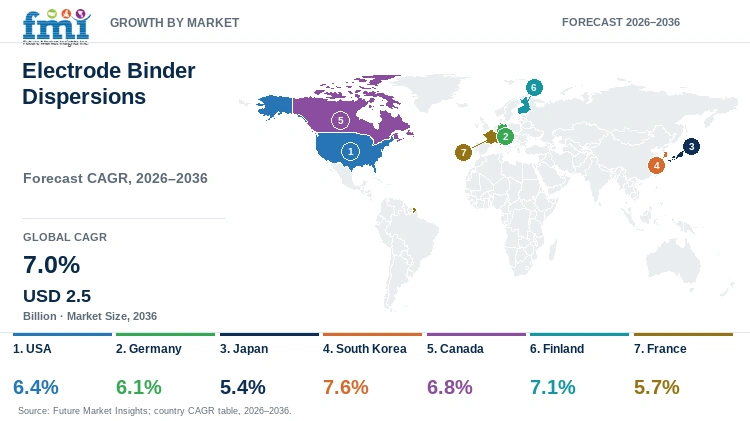
| Country | CAGR |
|---|---|
| USA | 6.4% |
| Germany | 6.1% |
| Japan | 5.4% |
| South Korea | 7.6% |
| Canada | 6.8% |
| Finland | 7.1% |
| France | 5.7% |
How do country-level CAGRs compare in the Electrode Binder Dispersions Market?
The seven profiled countries span 2.2 percentage points from South Korea at 7.6% CAGR to Japan at 5.4% CAGR from 2026 to 2036. South Korea and Finland form the upper growth group. Canada, USA and Germany occupy the middle range. France and Japan form the lower group.
These differences reflect the timing of battery capacity build-out, local materials ecosystems and qualification intensity rather than a simple ranking of addressable revenue. A country can grow more slowly from a larger installed base. A faster CAGR can also reflect an earlier stage of local supply-chain formation.
- South Korea leads Finland by 0.5 percentage points. The gap favors earlier channel and application-support investment in South Korea where customer programs can move quickly through materials co-development.
- Finland leads Canada by 0.3 percentage points. Finland’s materials-oriented build-out favors supplier partnerships upstream of cell assembly, while Canada requires coverage of emerging industrial clusters across a large geography.
- Canada leads the USA by 0.4 percentage points. The USA offers deeper incumbent demand, while Canada’s growth profile places more weight on winning specifications as new capacity is localized.
- Germany leads France by 0.4 percentage points, while France leads Japan by 0.3 percentage points. In all three markets, suppliers need to balance technical qualification with local compliance and long program cycles.
CAGR alone does not determine commercial priority. Suppliers also need to consider the number of operating coating lines and the concentration of cell makers. Plant commissioning pace and qualification-support cost also change the revenue opportunity.
The wider report therefore uses country growth rates as one input alongside solvent regulation and end-use demand. Customer concentration and local manufacturing conditions also shape commercial priority.
Country-wise Analysis
- USA: Battery-material buyers increasingly value local supply and scale-up support as cell capacity is localized. Demand for electrode binder dispersions in the USA is forecast to expand at 6.4% CAGR from 2026 to 2036. Arkema reported in June 2026 that its 15% PVDF capacity expansion in Calvert City, Kentucky had started up and would support EV and energy-storage battery demand. The local friction is not basic material availability but qualification against each cell maker’s coating process and specification. Suppliers need regional inventory, application support and a clear route from laboratory samples to production-volume supply.
- Germany: Buyers operate within a mature automotive engineering environment and increasingly serve both mobility and stationary storage applications. Demand for electrode binder dispersions in Germany is forecast to expand at 6.1% CAGR from 2026 to 2036. The Federal Ministry for Economic Affairs and Energy reported in June 2025 that German battery storage capacity reached 18.2 GWh at the start of 2025 after strong growth in 2024. EU NMP controls add compliance and process-management requirements for solvent-based cathode lines. Suppliers need local technical service and credible water-based options without forcing unacceptable coating or yield trade-offs.
- Japan: Cell makers tend to emphasize long qualification cycles and high process consistency before switching critical materials. Demand for electrode binder dispersions in Japan is forecast to expand at 5.4% CAGR from 2026 to 2036. METI revised its Battery and Power Industry Strategy in June 2026 and set a target for a domestic manufacturing base of 150 GWh per year from 2030 to the mid-2030s. The policy also acknowledged structural oversupply and supply-chain risks. Suppliers need dependable quality, close technical collaboration, and formulations that fit next-generation battery programs without destabilizing established production.
- South Korea: Large battery producers and materials companies favor rapid co-development when a formulation can improve throughput or support a new electrode chemistry. Demand for electrode binder dispersions in South Korea is forecast to expand at 7.6% CAGR from 2026 to 2036. MOTIE announced in September 2024 that KRW 684 billion would support 140 joint R&D projects through 2028 across advanced fields that include batteries. Cost pressure and global cell oversupply still raise the threshold for adopting premium materials. Suppliers need fast sample iteration, local technical response, and strong compatibility with LFP or silicon-anode roadmaps.
- Canada: Battery-material procurement is developing around emerging production clusters and infrastructure investment. Demand for electrode binder dispersions in Canada is forecast to expand at 6.8% CAGR from 2026 to 2036. Transport Canada announced in November 2024 a federal investment of CAD 163.8 million for Bécancour port and industrial-park upgrades within a project worth up to CAD 327.6 million. The friction is converting cluster investment into stable operating demand across new lines. Suppliers need regional logistics, qualification support, and relationships with cell or electrode-material producers before commercial ramp-up.
- Finland: The local battery value chain is strongest in materials, clean-transition investment and upstream industrial capability. Demand for electrode binder dispersions in Finland is forecast to expand at 7.1% CAGR from 2026 to 2036. Business Finland announced in July 2025 that Easpring Finland New Materials received EUR 115.4 million in investment aid and Fortum Battery Recycling received EUR 84.6 million. A smaller local cell-manufacturing base can limit immediate binder volumes. Suppliers should target material producers, pilot programs and European customer networks that value low-carbon processing and water-based formulation development.
- France: Purchasing conditions are shaped by new gigafactory projects and a policy push to deepen the domestic battery chain. Demand for electrode binder dispersions in France is forecast to expand at 5.7% CAGR from 2026 to 2036. The Direction générale des Entreprises launched France Batterie in March 2026 with a roadmap targeting 100 to 120 GWh of production capacity by 2030. Multi-year plant ramp-up and EU solvent compliance slow the conversion from announced capacity to binder volume. Suppliers need local qualification support and reliable delivery into the northern battery manufacturing corridor.
Who are the notable companies in the Electrode Binder Dispersions Market?
Arkema and Solvay are profiled. Kureha and Zeon Corporation are also covered. JSR Corporation and BASF are also covered. Dow and Synthomer are also covered. Nippon A&L and Targray complete the notable-company set.
Competition is shaped by three different ways of reaching the cell maker. Arkema, Solvay and Kureha compete from established fluoropolymer positions where PVDF supply and cathode qualification are central.
Zeon Corporation, BASF, Synthomer and Nippon A&L are more exposed to waterborne latex or dispersion routes that fit anode processing and selected next-generation formulations.
JSR Corporation, Dow and Targray broaden the competitive field through polymer know-how, adjacent formulation capability or material-distribution access. The dividing line is not company size. Buyers compare whether a supplier can meet the target electrode chemistry and reproduce slurry behavior at scale.
They also test line-trial support and the reliability of the regional supply route after launch.
- PVDF cathode platforms: Arkema, Solvay, and Kureha compete where fluoropolymer performance and grade depth matter most. Regional production continuity is another differentiator.
- Waterborne formulation platforms: Zeon Corporation, BASF, Synthomer and Nippon A&L address programs that prioritize aqueous processing. Anode compatibility and tailored latex behavior are additional differentiators.
- Polymer and market-access platforms: JSR Corporation, Dow, and Targray expand buyer choice through broader polymer expertise. Qualification options and access to multiple battery-material categories add to that role.
Competitive Benchmarking: Electrode Binder Dispersions Market
| Company | Cathode Binder Coverage | Waterborne & Silicon Readiness | Application Qualification Support | Geographic Reach |
|---|---|---|---|---|
| Arkema | High | High | High | North America, Europe, and East Asia |
| Solvay | High | Low | Medium | Europe, East Asia, and North America |
| Kureha | High | Low | High | Japan, East Asia, and global customer programs |
| Zeon Corporation | Medium | High | High | East Asia, Europe, and North America |
| JSR Corporation | Unscored | Unscored | Unscored | Japan and international legacy customer base |
| BASF | Medium | High | High | Europe, East Asia, and North America |
| Dow | Unscored | Low | Low | North America, Europe, and Asia-Pacific |
| Synthomer | Unscored | High | Medium | Europe, Asia-Pacific, and North America |
| Nippon A&L | Unscored | High | Medium | Japan and East Asia |
| Targray | High | High | Medium | North America, Europe, and Asia-Pacific |
Scoring basis: Cathode Binder Coverage measures documented binder availability or supply for cathode processing. Waterborne & Silicon Readiness measures evidence of aqueous formulations and compatibility with silicon-containing or next-generation anodes.
Application Qualification Support measures documented testing, local technical service or scale-up assistance tied to battery formulations. High indicates broad documented capability and Medium indicates credible but narrower coverage.
Low would indicate a documented limitation, while unavailable public information is left Unscored.
Key Developments in the Electrode Binder Dispersions Market
- In March 2026, Arkema announced a 20% expansion of Kynar PVDF production capacity at Changshu in China with startup planned for 2028. The company tied the project to demand from lithium-ion batteries and other high-performance applications. The action expands future regional fluoropolymer availability and signals continued investment in PVDF even as water-based binder development advances.
- In March 2025, Zeon announced an agreement to establish a joint sales venture for lithium-ion battery anode binders in China. The venture was designed to hold exclusive domestic sales rights for products made by its local partner. The move strengthens route-to-market proximity in the world’s largest battery-manufacturing ecosystem and puts more emphasis on dedicated customer access for anode-binder programs.
- In March 2024, Kureha discontinued a planned PVDF facility expansion in China. The decision followed an earlier strategy to expand binder capacity across Japan and China. It shows that supplier capacity plans can be recalibrated when regional utilization or investment economics changes. Demand timing can alter capacity decisions even when the long-term binder case remains attractive.
Key Players in the Electrode Binder Dispersions Market
PVDF Cathode Binder Platforms
- Arkema
- Solvay
- Kureha
Waterborne and Functional Latex Platforms
- Zeon Corporation
- BASF
- Synthomer
- Nippon A&L
Polymer and Market-Access Platforms
- JSR Corporation
- Dow
- Targray
Electrode Binder Dispersions Market - Report Scope
| Coverage field | Report scope |
|---|---|
| Market breakdown | Binder Chemistry; Electrode Type; Solvent System; End Use; Sales Channel |
| Quantitative Units | USD Billion |
| Market Definition | Revenue from electrode-specific binder dispersions and binder systems sold for slurry-based cathode or anode manufacture. The scope excludes separately sold solvents, active materials, conductive additives, current collectors, separator coatings, dry-process binders outside dispersion use, and downstream finished electrodes, cells, or battery packs. |
| Regions Covered | North America; Latin America; Western Europe; Eastern Europe; East Asia; South Asia and Pacific; Middle East and Africa |
| Countries Covered | USA, Germany, Japan, South Korea, Canada, Finland, France, plus additional countries in the full report |
| Key Companies Profiled | Arkema, Solvay, Kureha, Zeon Corporation, JSR Corporation, BASF, Dow, Synthomer, Nippon A&L, Targray |
| Forecast Period | 2026 to 2036 |
| Approach | Market sizing combines bottom-up supplier and application analysis with top-down checks against battery manufacturing activity, then reconciles overlaps to the defined revenue boundary. |
Electrode Binder Dispersions Market - Research Methodology
| Method | Approach |
|---|---|
| Primary Research | FMI consults binder suppliers and battery-material producers. Cell makers and electrode producers explain qualification and replacement behavior. The research tests purchase criteria and adoption barriers. |
| Desk Research | FMI reviews company filings and government releases. Technical literature and product documentation establish the electrode-binder boundary. Sources are retained when they support the defined market boundary. |
| Market Sizing and Forecasting | FMI reconciles supplier exposure with electrode production and battery demand. Forecasts reflect chemistry transitions and solvent-system adoption. Country conditions and channel structure are checked against the revenue boundary. |
| Data Validation | Findings are checked against independent evidence. The estimate excludes downstream battery revenue and adjacent products. Duplicate channel value and binders outside dispersion use are removed. |
Electrode Binder Dispersions Market by Segments
Electrode Binder Dispersions Market segmented by Binder Chemistry:
- PVDF dispersions
- SBR dispersions
- CMC blends
- Aqueous acrylic binders
- PAA/alginate systems
Electrode Binder Dispersions Market segmented by Electrode Type:
- Cathode binders
- Anode binders
- Silicon anode binders
- LFP electrode binders
- High-nickel electrode binders
Electrode Binder Dispersions Market segmented by Solvent System:
- Water-based
- NMP-based
- Low-VOC solvent
- Hybrid dispersion
Electrode Binder Dispersions Market segmented by End Use:
- EV batteries
- Energy storage cells
- Consumer electronics
- Power tools
- Pilot/R&D lines
Electrode Binder Dispersions Market segmented by Sales Channel:
- Cell makers direct
- Cathode/anode producers
- Battery material distributors
- R&D/lab suppliers
Electrode Binder Dispersions Market by Region:
- North America
- United States
- Canada
- Latin America
- Brazil
- Mexico
- Argentina
- Chile
- Western Europe
- Germany
- France
- United Kingdom
- Italy
- Spain
- Benelux
- Nordics
- Eastern Europe
- Poland
- Czech Republic
- Romania
- Hungary
- East Asia
- China
- Japan
- South Korea
- South Asia and Pacific
- India
- ASEAN
- Australia and New Zealand
- Middle East and Africa
- GCC Countries
- South Africa
- Türkiye
- Israel
Research Sources and Bibliography
- International Energy Agency (2026, May 20). Global EV Outlook 2026.
- European Chemicals Agency (2019, July 17). Advice on how to comply with NMP restriction.
- Arkema (2026, June 23). Arkema successfully started up its 15% PVDF capacity expansion in North America.
- Arkema (2026, March 16). Arkema expands its Kynar PVDF production capacity in China to support strong market growth.
- BASF (2023, May 11). BASF to invest in anode binder production assets for the lithium-ion battery industry.
- Zeon Corporation (2025, March 3). Zeon agrees to establish a joint venture specializing in sales of anode binders for lithium-ion batteries in China’s domestic market.
- Kureha Corporation (2023, August 22). Kureha to Boost PVDF Production.
- Kureha Corporation (2024, March 27). Kureha Discontinues PVDF Facility Expansion in China, Withdraws from Heat Shrink Multilayer Film Business.
- Solvay (2022, February 1). Solvay announces PVDF capacity investment in Europe to meet growing EV battery demand.
- Federal Ministry for Economic Affairs and Energy, Germany (2025, June 19). New energy storage for Germany.
- Ministry of Economy, Trade and Industry, Japan (2026, June 2). Battery Industry Strategy Revised as the Battery and Power Industry Strategy.
- Ministry of Trade, Industry and Energy, South Korea (2024, September 9). MOTIE to back joint R&D projects between homegrown companies and world-leading institutions.
- Transport Canada (2024, November 18). Nearly $330 Million for Bécancour Port and Industrial Park: A strategic investment for the Mauricie Battery Industry.
- Business Finland (2025, July 10). Investment aid granted for five major clean transition industrial projects.
- Direction générale des Entreprises, France (2026, March 24). Avec France Batterie, la France structure une filière compétitive et souveraine.
This bibliography is provided for reader reference and is not exhaustive. The full report contains the complete reference list and detailed citations.
This Report Answers
- What is the Electrode Binder Dispersions Market size in 2026 and what is it forecast to reach by 2036?
- Which battery-manufacturing pressures and chemistry changes support demand for electrode binder dispersions?
- Why do PVDF dispersions hold the leading position within Binder Chemistry?
- How do Cathode binders influence downstream electrode qualification and cell-production demand?
- Why do Water-based systems hold the leading position within Solvent System?
- How do the profiled country growth rates compare for the Electrode Binder Dispersions market?
- Which companies participate through PVDF, waterborne binder, polymer or market-access positions?
- How do qualification cycles and solvent-management requirements limit binder switching?
Frequently Asked Questions
What is driving growth in the Electrode Binder Dispersions Market?
Growth is driven by higher lithium-ion cell output and by new electrode chemistries that create fresh qualification cycles for binders. The strongest revenue conversion occurs when a supplier moves from laboratory validation to repeat production on a commercial coating line.
Who are the key players in the Electrode Binder Dispersions Market?
Arkema, Solvay and Kureha are among the profiled companies. The wider group listed under Key Players spans fluoropolymer and waterborne formulation routes. Application support and market access also shape competition.
What notable restraint affects the Electrode Binder Dispersions Market?
The main restraint is the time and process risk involved in changing a qualified binder on an operating electrode line. Solvent controls can strengthen the case for reformulation, but buyers still require proof that coating quality and cell performance remain stable.
Why should executives track the Electrode Binder Dispersions Market?
Binder choice affects coating reliability and can influence solvent-management cost even though the material is a small portion of cell value. Executives should track where chemistry shifts or new plants create qualification windows that can change supplier positions.
What business problem does the Electrode Binder Dispersions Market address?
Electrode binders keep active particles and conductive components attached to the current collector through manufacturing and cycling. The market addresses the need to achieve that mechanical function without undermining slurry processability, electrochemical stability, or production yield.
What should battery materials and procurement teams evaluate in the Electrode Binder Dispersions Market?
Teams should test adhesion and slurry stability at production scale. Coating behavior, electrochemical compatibility, impurity control and consistency also require validation. They should also evaluate regional supply and technical response time. Solvent implications and requalification cost matter if a grade changes.
What limits return on investment in the Electrode Binder Dispersions Market?
Return can be reduced when a lower-cost binder causes longer drying or poorer coating yield. Added solvent-control costs and repeated line trials can erase purchase-price savings. The relevant comparison is therefore total process cost and qualification risk rather than purchase price per kilogram alone.
What supports long-term commercial confidence in the Electrode Binder Dispersions Market?
Long-term confidence is supported by expanding battery deployment and by the need to requalify binder systems as cell chemistries evolve. Durable suppliers will be those that combine chemistry performance with scale-up support and reliable supply across major battery-manufacturing regions.
Preview the report firsthand - request a free sample
Get SampleGet the brochure for pricing and purchase details.
Get PDFTable of Content
- Key Takeaways
- Market Size and CAGR
- Top Growth Driver
- Fastest Growing Segment
- Leading Region
- Key Companies
- Emerging Opportunities
- Executive Summary
- Global Market Outlook
- Demand-side Trends
- Supply-side Trends
- Technology Roadmap Analysis
- Analysis and Recommendations
- Analyst Perspective (What is happening? Why now? What should investors know?)
- Key Questions Answered
- How large is the market?
- What is the CAGR?
- What are key trends?
- Which region dominates?
- Who are the leaders?
- Market Overview
- Market Coverage / Taxonomy
- Market Definition / Scope / Limitations
- Research Methodology
- Chapter Orientation
- Analytical Lens and Working Hypotheses
- Market Structure, Signals, and Trend Drivers
- Benchmarking and Cross-market Comparability
- Market Sizing, Forecasting, and Opportunity Mapping
- Research Design and Evidence Framework
- Desk Research Programme (Secondary Evidence)
- Expert Input and Fieldwork (Primary Evidence)
- Tooling, Models, and Reference Databases
- Data Engineering and Model Build
- Quality Assurance and Audit Trail
- Market Background
- Market Dynamics (Drivers, Restraints, Opportunity, Trends)
- Scenario Forecast (Optimistic, Likely, Conservative)
- Impact Analysis
- AI Impact
- Sustainability Impact
- Regulatory Impact
- Technology Impact
- Consumer / Buyer Analysis
- Purchase Drivers
- Adoption Barriers
- Buyer Journey
- Opportunity Map Analysis
- Product Life Cycle Analysis
- Supply Chain Analysis
- Investment Feasibility Matrix
- Value Chain Analysis
- PESTLE and Porter's Analysis
- Regulatory Landscape
- Regional Parent Market Outlook
- Production and Consumption Statistics
- Import and Export Statistics
- Global Market Analysis and Forecast, 2021 to 2036
- Historical Market Size Value (USD Billion) Analysis, 2021 to 2025
- Current and Future Market Size Value (USD Billion) Projections, 2026 to 2036
- Y-o-Y Growth Trend Analysis
- Absolute $ Opportunity Analysis
- Global Market Pricing Analysis, 2021 to 2036
- Global Market Analysis and Forecast, By Binder Chemistry, 2021 to 2036
- Introduction / Key Findings
- Historical Market Size Value (USD Billion) Analysis By Binder Chemistry, 2021 to 2025
- Current and Future Market Size Value (USD Billion) Analysis and Forecast By Binder Chemistry, 2026 to 2036
- PVDF dispersions
- SBR dispersions
- CMC blends
- Aqueous acrylic binders
- PAA/alginate systems
- Y-o-Y Growth Trend Analysis By Binder Chemistry, 2021 to 2025
- Absolute $ Opportunity Analysis By Binder Chemistry, 2026 to 2036
- Global Market Analysis and Forecast, By Electrode Type, 2021 to 2036
- Introduction / Key Findings
- Historical Market Size Value (USD Billion) Analysis By Electrode Type, 2021 to 2025
- Current and Future Market Size Value (USD Billion) Analysis and Forecast By Electrode Type, 2026 to 2036
- Cathode binders
- Anode binders
- Silicon anode binders
- LFP electrode binders
- High-nickel electrode binders
- Y-o-Y Growth Trend Analysis By Electrode Type, 2021 to 2025
- Absolute $ Opportunity Analysis By Electrode Type, 2026 to 2036
- Global Market Analysis and Forecast, By Solvent System, 2021 to 2036
- Introduction / Key Findings
- Historical Market Size Value (USD Billion) Analysis By Solvent System, 2021 to 2025
- Current and Future Market Size Value (USD Billion) Analysis and Forecast By Solvent System, 2026 to 2036
- Water-based
- NMP-based
- Low-VOC solvent
- Hybrid dispersion
- Y-o-Y Growth Trend Analysis By Solvent System, 2021 to 2025
- Absolute $ Opportunity Analysis By Solvent System, 2026 to 2036
- Global Market Analysis and Forecast, By End Use, 2021 to 2036
- Introduction / Key Findings
- Historical Market Size Value (USD Billion) Analysis By End Use, 2021 to 2025
- Current and Future Market Size Value (USD Billion) Analysis and Forecast By End Use, 2026 to 2036
- EV batteries
- Energy storage cells
- Consumer electronics
- Power tools
- Pilot/R&D lines
- Y-o-Y Growth Trend Analysis By End Use, 2021 to 2025
- Absolute $ Opportunity Analysis By End Use, 2026 to 2036
- Global Market Analysis and Forecast, By Sales Channel, 2021 to 2036
- Introduction / Key Findings
- Historical Market Size Value (USD Billion) Analysis By Sales Channel, 2021 to 2025
- Current and Future Market Size Value (USD Billion) Analysis and Forecast By Sales Channel, 2026 to 2036
- Cell makers direct
- Cathode/anode producers
- Battery material distributors
- R&D/lab suppliers
- Y-o-Y Growth Trend Analysis By Sales Channel, 2021 to 2025
- Absolute $ Opportunity Analysis By Sales Channel, 2026 to 2036
- Global Market Analysis and Forecast, By Region, 2021 to 2036
- Introduction
- Historical Market Size Value (USD Billion) Analysis By Region, 2021 to 2025
- Current Market Size Value (USD Billion) Analysis and Forecast By Region, 2026 to 2036
- North America
- Latin America
- Western Europe
- Eastern Europe
- East Asia
- South Asia and Pacific
- Middle East and Africa
- Market Attractiveness Analysis By Region
- North America Market Analysis and Forecast, By Country, 2021 to 2036
- Historical Market Size Value (USD Billion) Trend Analysis By Market Taxonomy, 2021 to 2025
- Market Size Value (USD Billion) Forecast By Market Taxonomy, 2026 to 2036
- By Country
- United States
- Canada
- By Binder Chemistry
- By Electrode Type
- By Solvent System
- By End Use
- By Sales Channel
- By Country
- Market Attractiveness Analysis
- By Country
- By Binder Chemistry
- By Electrode Type
- By Solvent System
- By End Use
- By Sales Channel
- Key Takeaways
- Latin America Market Analysis and Forecast, By Country
- Historical Market Size Value (USD Billion) Trend Analysis By Market Taxonomy, 2021 to 2025
- Market Size Value (USD Billion) Forecast By Market Taxonomy, 2026 to 2036
- By Country
- Brazil
- Mexico
- Argentina
- Chile
- By Binder Chemistry
- By Electrode Type
- By Solvent System
- By End Use
- By Sales Channel
- By Country
- Market Attractiveness Analysis
- By Country
- By Binder Chemistry
- By Electrode Type
- By Solvent System
- By End Use
- By Sales Channel
- Key Takeaways
- Western Europe Market Analysis and Forecast, By Country
- Historical Market Size Value (USD Billion) Trend Analysis By Market Taxonomy, 2021 to 2025
- Market Size Value (USD Billion) Forecast By Market Taxonomy, 2026 to 2036
- By Country
- Germany
- France
- United Kingdom
- Italy
- Spain
- Benelux
- Nordics
- By Binder Chemistry
- By Electrode Type
- By Solvent System
- By End Use
- By Sales Channel
- By Country
- Market Attractiveness Analysis
- By Country
- By Binder Chemistry
- By Electrode Type
- By Solvent System
- By End Use
- By Sales Channel
- Key Takeaways
- Eastern Europe Market Analysis and Forecast, By Country
- Historical Market Size Value (USD Billion) Trend Analysis By Market Taxonomy, 2021 to 2025
- Market Size Value (USD Billion) Forecast By Market Taxonomy, 2026 to 2036
- By Country
- Poland
- Czech Republic
- Romania
- Hungary
- By Binder Chemistry
- By Electrode Type
- By Solvent System
- By End Use
- By Sales Channel
- By Country
- Market Attractiveness Analysis
- By Country
- By Binder Chemistry
- By Electrode Type
- By Solvent System
- By End Use
- By Sales Channel
- Key Takeaways
- East Asia Market Analysis and Forecast, By Country
- Historical Market Size Value (USD Billion) Trend Analysis By Market Taxonomy, 2021 to 2025
- Market Size Value (USD Billion) Forecast By Market Taxonomy, 2026 to 2036
- By Country
- China
- Japan
- South Korea
- By Binder Chemistry
- By Electrode Type
- By Solvent System
- By End Use
- By Sales Channel
- By Country
- Market Attractiveness Analysis
- By Country
- By Binder Chemistry
- By Electrode Type
- By Solvent System
- By End Use
- By Sales Channel
- Key Takeaways
- South Asia and Pacific Market Analysis and Forecast, By Country
- Historical Market Size Value (USD Billion) Trend Analysis By Market Taxonomy, 2021 to 2025
- Market Size Value (USD Billion) Forecast By Market Taxonomy, 2026 to 2036
- By Country
- India
- ASEAN
- Australia and New Zealand
- By Binder Chemistry
- By Electrode Type
- By Solvent System
- By End Use
- By Sales Channel
- By Country
- Market Attractiveness Analysis
- By Country
- By Binder Chemistry
- By Electrode Type
- By Solvent System
- By End Use
- By Sales Channel
- Key Takeaways
- Middle East and Africa Market Analysis and Forecast, By Country
- Historical Market Size Value (USD Billion) Trend Analysis By Market Taxonomy, 2021 to 2025
- Market Size Value (USD Billion) Forecast By Market Taxonomy, 2026 to 2036
- By Country
- GCC Countries
- South Africa
- Türkiye
- Israel
- By Binder Chemistry
- By Electrode Type
- By Solvent System
- By End Use
- By Sales Channel
- By Country
- Market Attractiveness Analysis
- By Country
- By Binder Chemistry
- By Electrode Type
- By Solvent System
- By End Use
- By Sales Channel
- Key Takeaways
- Key Countries Market Analysis
- United States
- Pricing Analysis
- Market Share Analysis, 2025
- By Binder Chemistry
- By Electrode Type
- By Solvent System
- By End Use
- By Sales Channel
- Canada
- Pricing Analysis
- Market Share Analysis, 2025
- By Binder Chemistry
- By Electrode Type
- By Solvent System
- By End Use
- By Sales Channel
- Mexico
- Pricing Analysis
- Market Share Analysis, 2025
- By Binder Chemistry
- By Electrode Type
- By Solvent System
- By End Use
- By Sales Channel
- Brazil
- Pricing Analysis
- Market Share Analysis, 2025
- By Binder Chemistry
- By Electrode Type
- By Solvent System
- By End Use
- By Sales Channel
- Chile
- Pricing Analysis
- Market Share Analysis, 2025
- By Binder Chemistry
- By Electrode Type
- By Solvent System
- By End Use
- By Sales Channel
- Germany
- Pricing Analysis
- Market Share Analysis, 2025
- By Binder Chemistry
- By Electrode Type
- By Solvent System
- By End Use
- By Sales Channel
- United Kingdom
- Pricing Analysis
- Market Share Analysis, 2025
- By Binder Chemistry
- By Electrode Type
- By Solvent System
- By End Use
- By Sales Channel
- Italy
- Pricing Analysis
- Market Share Analysis, 2025
- By Binder Chemistry
- By Electrode Type
- By Solvent System
- By End Use
- By Sales Channel
- Spain
- Pricing Analysis
- Market Share Analysis, 2025
- By Binder Chemistry
- By Electrode Type
- By Solvent System
- By End Use
- By Sales Channel
- France
- Pricing Analysis
- Market Share Analysis, 2025
- By Binder Chemistry
- By Electrode Type
- By Solvent System
- By End Use
- By Sales Channel
- India
- Pricing Analysis
- Market Share Analysis, 2025
- By Binder Chemistry
- By Electrode Type
- By Solvent System
- By End Use
- By Sales Channel
- ASEAN
- Pricing Analysis
- Market Share Analysis, 2025
- By Binder Chemistry
- By Electrode Type
- By Solvent System
- By End Use
- By Sales Channel
- Australia and New Zealand
- Pricing Analysis
- Market Share Analysis, 2025
- By Binder Chemistry
- By Electrode Type
- By Solvent System
- By End Use
- By Sales Channel
- China
- Pricing Analysis
- Market Share Analysis, 2025
- By Binder Chemistry
- By Electrode Type
- By Solvent System
- By End Use
- By Sales Channel
- Japan
- Pricing Analysis
- Market Share Analysis, 2025
- By Binder Chemistry
- By Electrode Type
- By Solvent System
- By End Use
- By Sales Channel
- South Korea
- Pricing Analysis
- Market Share Analysis, 2025
- By Binder Chemistry
- By Electrode Type
- By Solvent System
- By End Use
- By Sales Channel
- Poland
- Pricing Analysis
- Market Share Analysis, 2025
- By Binder Chemistry
- By Electrode Type
- By Solvent System
- By End Use
- By Sales Channel
- Hungary
- Pricing Analysis
- Market Share Analysis, 2025
- By Binder Chemistry
- By Electrode Type
- By Solvent System
- By End Use
- By Sales Channel
- Türkiye
- Pricing Analysis
- Market Share Analysis, 2025
- By Binder Chemistry
- By Electrode Type
- By Solvent System
- By End Use
- By Sales Channel
- South Africa
- Pricing Analysis
- Market Share Analysis, 2025
- By Binder Chemistry
- By Electrode Type
- By Solvent System
- By End Use
- By Sales Channel
- Finland
- Pricing Analysis
- Market Share Analysis, 2025
- By Binder Chemistry
- By Electrode Type
- By Solvent System
- By End Use
- By Sales Channel
- United States
- Market Structure Analysis
- Competition Dashboard
- Competition Benchmarking
- Market Share Analysis of Top Players
- By Regional
- By Binder Chemistry
- By Electrode Type
- By Solvent System
- By End Use
- By Sales Channel
- Emerging Startups
- Innovation Benchmarking
- Competition Analysis
- Competition Deep Dive
- Arkema
- Overview
- Product Portfolio
- Profitability by Market Segments
- Sales Footprint
- Strategy Overview
- Marketing Strategy
- Product Strategy
- Channel Strategy
- Solvay
- Kureha
- Zeon Corporation
- JSR Corporation
- BASF
- Dow
- Synthomer
- Nippon A&L
- Targray
- Arkema
- Case Studies
- Success Stories
- Recent Developments
- Competition Deep Dive
- Assumptions & Acronyms Used


