

- Market Size (2026)
- USD 642.0 Mn
- Forecast (2036)
- USD 1262.9 Mn
- CAGR (2026 to 2036)
- 7.0%
Lithium Battery Binder Chemicals Market Size, Market Forecast and Outlook By FMI
USD 642.0 million in 2026 and USD 1,262.9 million by 2036 at a 7.0% CAGR.
The lithium battery binder chemicals industry value is forecast to grow from USD 600.0 million in 2025 to USD 1,262.9 million by 2036 at 7.0% CAGR as cell producers qualify electrode binders for higher energy density, stronger coating stability, and longer battery service life. Batteries are forecast to represent 71.0% share in 2026 because lithium-ion cell manufacturing creates the highest-value use case for battery-grade binders. Wet slurry processing is expected to secure 63.0% share in 2026, led by established anode and cathode coating lines.
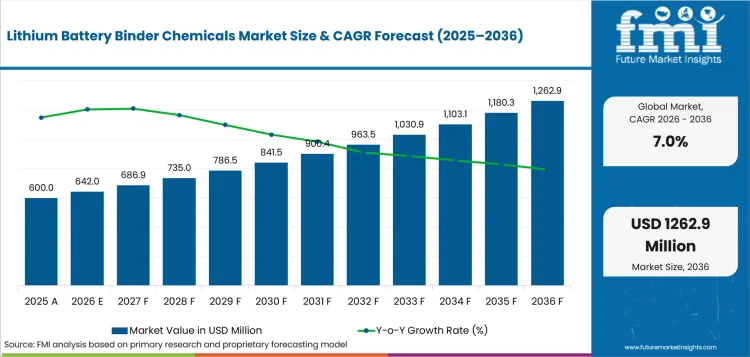
Lithium Battery Binder Chemicals Market Overview: Size and Forecast
- 2026 Market Size: USD 642.0 million
- 2036 Market Size: USD 1,262.9 million
- Forecast CAGR: 7.0% from 2026 to 2036
- Leading Application: Batteries
- Batteries Share in 2026: 71.0%
- Leading Processing Route: Wet Slurry Processing
- Wet Slurry Processing Share in 2026: 63.0%
- Fastest-growing Country: India
- India CAGR: 8.1% by 2036
Summary of the Lithium Battery Binder Chemicals Market
- Demand and Growth Drivers
- Cell producers are increasing binder qualification because silicon-rich anodes need stronger swelling control during repeated charging cycles.
- Cathode teams are reviewing PVDF grades more closely as high-nickel systems need stable adhesion under higher voltage stress.
- Battery makers are widening supplier checks as dry electrode processing changes binder requirements from slurry behavior to film formation
- Product and Segment View
- Batteries are forecast to represent 71.0% share in 2026, led by lithium-ion cell manufacturing and strict battery-grade purity requirements.
- Wet slurry processing is projected to hold 63.0% share in 2026, influenced by established electrode coating infrastructure across major cell plants.
- Automotive end use is expected to secure 56.0% share in 2026, supported by EV traction batteries with longer validation and warranty needs.
- Geography and Competitive Outlook
- India is projected to record 8.1% CAGR by 2036, backed by domestic cell localization and advanced chemistry cell manufacturing plans.
- China is expected to expand at 7.6% CAGR by 2036 through large-scale EV sales and lithium-ion battery output.
- Arkema, Syensqo, BASF, and Zeon compete through qualified electrode binder grades and cell-maker application support.
- Kureha, Daikin, LG Chem, and Resonac focus on PVDF, PTFE, latex, and polyamide-imide binder systems for battery applications.
- Analyst Opinion
- Nikhil Kaitwade, Principal Consultant at Future Market Insights, observes, “Lithium battery binder chemicals are now qualification-critical inputs inside cell manufacturing. Battery producers do not switch binders quickly once a cell chemistry is approved. They first review adhesion, swelling control, slurry behavior, and coating repeatability under real production conditions. Waterborne anode binders will gain attention as graphite and silicon blends need elastic support. PVDF will stay important in cathodes and separator coatings where voltage stability matters. Suppliers with pilot coating support and regional production access should gain stronger customer confidence.”
Battery material qualification is the main pressure point for lithium battery binder chemicals as cell makers move from broad polymer sourcing to tested electrode systems. Global electric car sales are expected to reach 23 million units in 2026, representing 28.0% of total car sales. The U.S. battery supply chain review identified a pipeline of more than 1,100 GWh per year of battery manufacturing capacity. Syensqo stated in May 2025 that new multi-year Solef PVDF battery material contracts exceeded EUR 150.0 million in cumulative net sales. Suppliers with qualified PVDF, SBR, CMC, PAA, and PTFE binder systems can secure stronger positions as cell makers demand coating evidence before scale purchases.
Which factors support expansion in the lithium battery binder chemicals market?
Battery-grade binder revenue and cell-qualified material supply support market value across regulated lithium-ion manufacturing channels.
- Market value is supported by battery-grade binder sales before separator coatings and dry-processing materials add incremental revenue.
- Supplier pricing reflects polymer purity and qualification risk before routine chemical distribution affects buyer decisions.
- Revenue improves as cell makers shift from general polymers toward approved anode and cathode binder systems.
- Buyer trust rises as suppliers provide coating-line data, swelling evidence, and regional technical support during validation.
Why is the lithium battery binder chemicals market growing?
Battery manufacturers are moving toward binder systems with stronger adhesion, lower swelling risk, and better process stability.
Growth outlook has become more structured as lithium-ion battery makers move from capacity expansion into chemistry-specific qualification programs. Global EV battery deployment is expected to rise from around 1.2 TWh in 2025 to almost 3.0 TWh by 2030. That scale gives binder suppliers a larger validation pipeline across cathodes, graphite anodes, and silicon-containing anodes. U.S. developers planned to add 24.0 GW of utility-scale battery storage in 2026, after a record 15.0 GW added in 2025. Stationary storage therefore widens binder demand beyond passenger EVs. BASF expanded Licity anode binder production in the United States in March 2025, indicating that local battery material supply is becoming more important for manufacturers and OEMs.
How is the lithium battery binder chemicals market segmented?
The lithium battery binder chemicals industry is segmented by chemistry type, function, application, end-use industry, and processing route.
- Waterborne chemistry is projected to secure 34.0% share in 2026, led by aqueous anode binder adoption in graphite and silicon-blend electrodes.
- Binder function is anticipated to hold 52.0% share in 2026 since electrode cohesion and current collector adhesion directly affect cell reliability.
- Batteries are expected to capture 71.0% share in 2026 due to the high-value qualification needs of lithium-ion cell manufacturing.
- Automotive end use is forecast to represent 56.0% share in 2026, guided by EV traction cell validation and long-duty-cycle requirements.
- Wet slurry processing is estimated to account for 63.0% share in 2026, supported by established electrode coating routes and validated plant infrastructure.
Why does waterborne chemistry lead the lithium battery binder chemicals market?
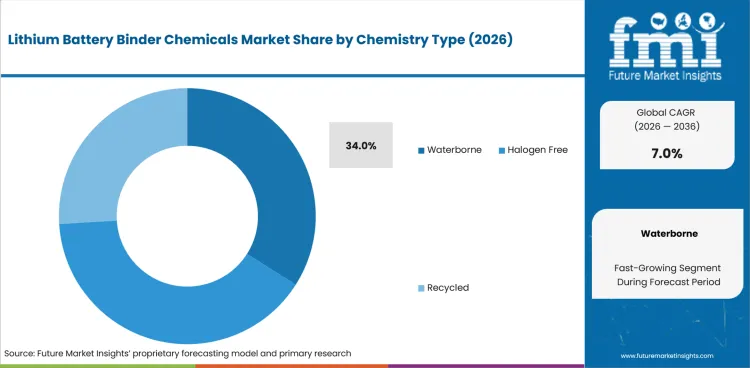
- Waterborne chemistry is projected to account for 34.0% share in 2026, influenced by anode makers using SBR, CMC, and PAA systems to manage slurry viscosity and reduce solvent handling.
- Solvent-borne PVDF remains important for cathode and separator coating systems because battery teams value voltage stability, electrolyte resistance, and aluminum foil adhesion.
Which function leads the lithium battery binder chemicals market?
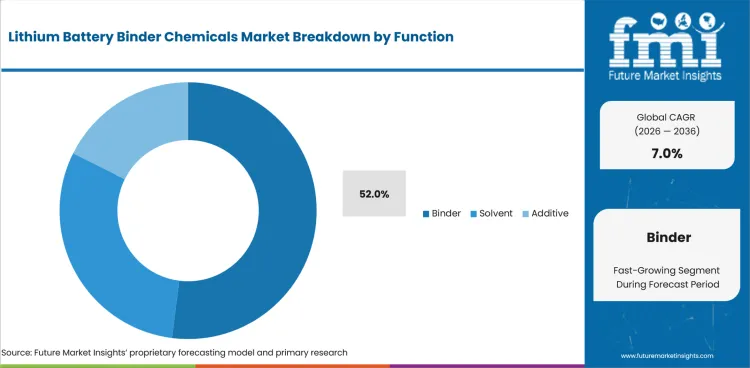
- Binder function is anticipated to hold 52.0% share in 2026 through its direct role in holding active materials and conductive additives together during coating and cycling.
- Coating functions gain importance as separator and cathode-adjacent systems need polymer layers that improve heat tolerance and electrolyte contact.
Which application leads the lithium battery binder chemicals market?
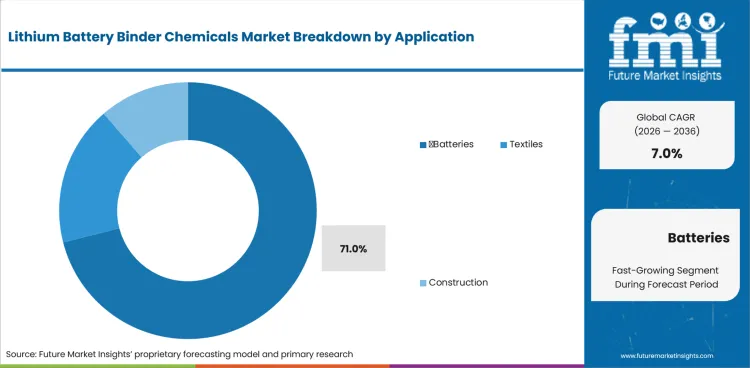
- Batteries are expected to represent 71.0% share in 2026, reflected by cleanroom-grade handling, electrochemical stability, and repeatable polymer performance inside lithium-ion cells.
- Separator coatings create adjacent demand as cell makers use related polymer systems to improve thermal behavior and internal safety design.
Which end-use industry leads the lithium battery binder chemicals market?
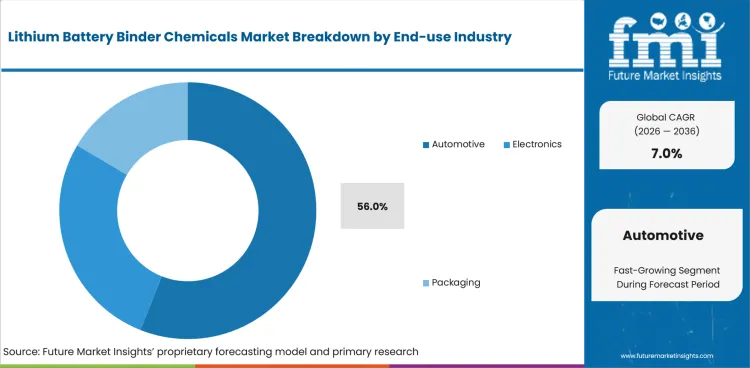
- Automotive end use is projected to account for 56.0% share in 2026, led by EV traction batteries that require binders tested for vibration, fast charging, and thermal cycling.
- Energy storage buyers create added demand because grid batteries need long warranty performance and stable electrode coatings across extended service periods.
Which processing route leads the lithium battery binder chemicals market?
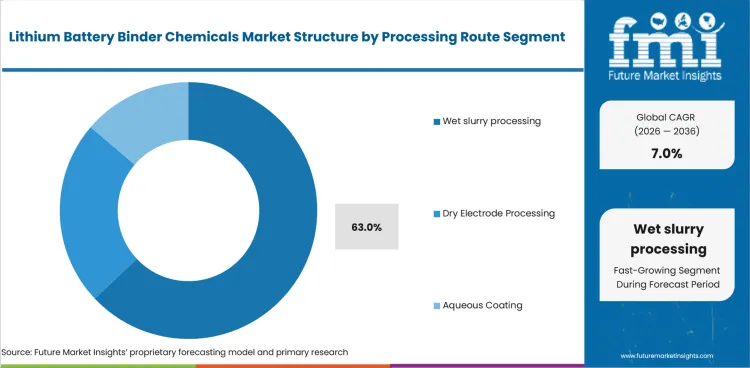
- Wet slurry processing is forecast to secure 63.0% share in 2026, shaped by established anode and cathode coating lines where binder dispersion is already validated.
- Dry electrode processing is gaining supplier attention as binders must support fibrillation, powder binding, and film strength without conventional solvent drying.
What are the driver, restraints, and opportunities in the lithium battery binder chemicals market?
Electrode performance demand supports growth while fluoropolymer scrutiny and supply concentration restrict faster supplier switching.
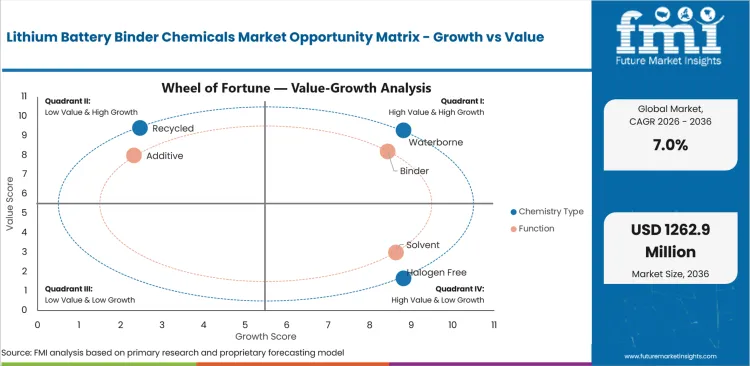
- Driver: Silicon-rich anodes increase demand for elastic binder systems that reduce swelling and coating damage.
- Restraint: Fluoropolymer scrutiny and concentrated upstream processing increase documentation pressure for battery material suppliers.
- Opportunity: Stationary storage expansion creates new qualification routes for binders used in long-life lithium-ion cells.
Silicon-Rich Anode Binder Control
Silicon-containing anodes create a clear demand route for binder suppliers because high-capacity particles expand and contract during cycling. Global electric car sales exceeded 20 million units in 2025, increasing the need for durable battery materials that can protect electrode coatings under real driving use. Binder producers that can prove elastic recovery, peel strength, and stable resistance should gain stronger positions in next-generation anode programs.
Fluoropolymer Compliance Pressure
Binder suppliers face closer review as buyers evaluate PVDF, PTFE, and other fluorinated materials under stricter chemical documentation expectations. The IEA reported that China produced about 75.0% of purified phosphoric acid for LFP batteries and 95.0% of high-purity manganese sulfate. This concentration increases buyer attention on traceability, compliance evidence, and alternative qualification pathways for cathode and separator coating suppliers.
Stationary Storage Qualification Path
Grid storage gives binder suppliers another demand route because stationary lithium-ion cells need long-cycle reliability and stable electrode performance. The U.S. Energy Information Administration reported that cumulative utility-scale battery storage capacity exceeded 26.0 GW in 2024. Suppliers that support energy storage cell makers with coating stability, local service, and long-life evidence can capture demand beyond passenger EV programs.
Lithium Battery Binder Chemicals Market Demand Outlook
Demand outlook is moving toward battery-grade binder systems that can prove electrode performance before commercial supply. Cell manufacturers are reviewing peel strength, slurry stability, swelling control, and thermal resistance rather than selecting binders only by polymer family. This makes application testing and technical service central to supplier selection.
Battery producers are also comparing manufacturing routes more closely. Waterborne anode binders support lower solvent exposure and better anode slurry control. PVDF remains important in cathodes and separator coatings where voltage stability and electrolyte resistance are needed. Dry electrode processing changes binder evaluation because powder binding and film formation become central performance requirements.
Consumer Segmentation and Purchase Behavior Analysis
Battery cell makers, electrode producers, separator coating suppliers, EV OEMs, and stationary storage integrators form the main buyer base for lithium battery binder chemicals. Cell manufacturers rarely approve binder substitutions after chemistry validation because a small polymer change can affect coating strength, impedance, and cycle performance.
Purchase behavior is therefore shaped by qualification risk and technical support. Buyers prefer suppliers that can provide sample consistency, pilot coating support, and regional availability. Binder producers with validated grades for graphite, silicon-blend anodes, high-nickel cathodes, and separator coatings can gain stronger repeat business.
Voice of Customer and Decision-driver Analysis
Buyer decisions for lithium battery binder chemicals are shaped by electrode performance, production stability, and supply security. Cell makers review whether a binder improves adhesion, limits swelling, supports stable slurry viscosity, and reduces coating defects during scale production.
Technical service is a key decision driver because binder problems often appear during coating, calendaring, electrolyte wetting, or cycling tests. Suppliers that can troubleshoot at pilot-line and plant level gain an advantage. Regional supply access also matters as battery manufacturers reduce logistics risk and shorten qualification cycles.
Which countries are growing fastest in the lithium battery binder chemicals market?
India 8.1% CAGR, China 7.6% CAGR, South Korea 7.2% CAGR, United States 6.9% CAGR, Germany 6.8% CAGR, France 6.5% CAGR, United Kingdom 6.2% CAGR, and Japan 5.9% CAGR through 2036.
.webp "Top Country Growth Comparison Lithium Battery Binder Chemicals Market Cagr (2026 2036)")
| Country | CAGR |
|---|---|
| United States | 6.9% |
| United Kingdom | 6.2% |
| Germany | 6.8% |
| France | 6.5% |
| Japan | 5.9% |
| China | 7.6% |
| South Korea | 7.2% |
| India | 8.1% |
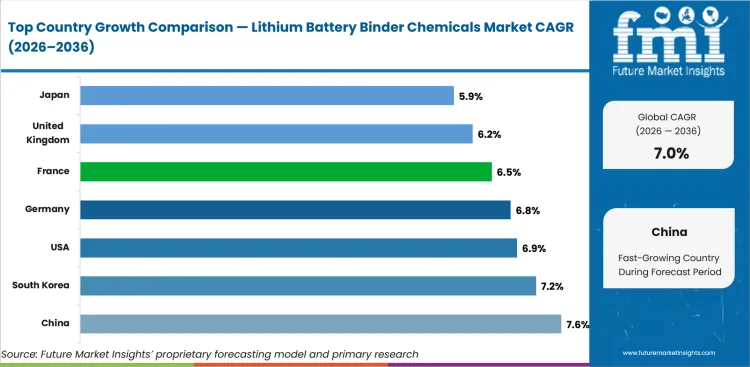
Source: Future Market Insights, 2026.
How do country-level CAGRs compare in the lithium battery binder chemicals market?
India leads country growth while Japan records the most measured expansion outlook among profiled markets.
- India is forecast to record 8.1% CAGR by 2036 as cell localization supports faster binder qualification.
- China is expected to expand at 7.6% CAGR from 2026 to 2036 due to large-scale EV and battery production.
- South Korea is projected to grow at 7.2% CAGR through 2036 as global EV battery platforms support binder demand.
- The United States is estimated to rise at 6.9% CAGR by 2036 with EV and grid storage demand supporting local supply.
- Germany is expected to advance at 6.8% CAGR over the forecast period as automotive validation shapes material approvals.
- France is forecast to grow at 6.5% CAGR through 2036 through PVDF activity and European battery projects.
- The United Kingdom is projected to post 6.2% CAGR by 2036 as gigafactory plans create early qualification routes.
- Japan is expected to increase at 5.9% CAGR through 2036 as specialist binder expertise supports high-reliability cell programs.
How fast is the lithium battery binder chemicals market growing in the United States?
A 6.9% CAGR through 2036 reflects EV cell demand, grid storage deployment, and local battery material qualification.
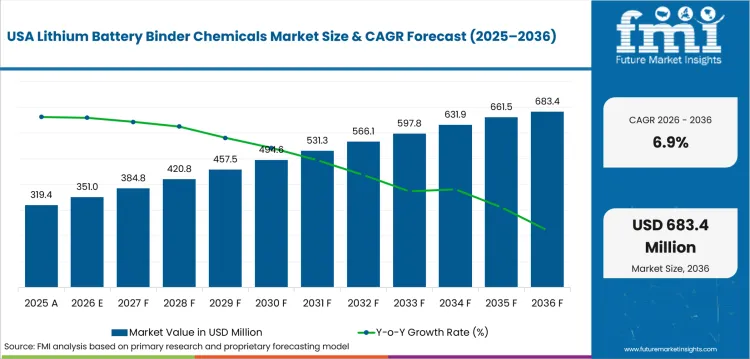
Country Market Snapshot Table
| Parameter | Value |
|---|---|
| Market Size in 2025 (Value) | USD 126.3 million |
| Market Size in 2026 (Value) | USD 135.0 million |
| Market Forecast in 2036 (Value) | USD 262.8 million |
| CAGR (2026 to 2036) | 6.9% |
| Years Considered | 2021 to 2036 |
| Base Year | 2025 |
| Forecast Period | 2026 to 2036 |
| Units Considered | Value (USD million) |
| Leading Sub-Region | Midwest and Southeast battery manufacturing corridors |
United States Lithium Battery Binder Chemicals Market Outlook
United States lithium battery binder chemical demand is shaped by EV cell production and utility-scale storage procurement. Battery makers need local technical support as electrode recipes move through pilot coating, validation, and commercial supply.
Domestic sourcing is becoming more important as cell manufacturers manage trade exposure and warranty requirements. Binder suppliers with application teams near cell plants should gain stronger customer access.
Key Growth Drivers
- EV cell demand supports binder qualification as Argonne reported about 1.5 million plug-in electric vehicles sold in the United States in 2025.
- Storage demand widens lithium-ion cell use because the EIA reported a record 15.0 GW of utility-scale battery storage added in 2025.
- Local coating support improves supplier acceptance as cell makers need faster troubleshooting during pilot production.
- Automotive and stationary buyers create different validation routes for binders used in high-cycle battery systems.
Key Restraints
- Large announced capacity raises supplier screening pressure because DOE reported nearly 1,400 GWh of cumulative announced North American battery capacity by mid-2024.
- Sourcing rules can slow material approvals when battery inputs need additional origin and compliance documentation.
- Qualification timelines remain lengthy because battery makers avoid changing binders after cell chemistry approval.
What makes United States unique
United States is unique due to the combined pull from EV cell manufacturing and utility-scale storage projects.
Key Companies
- BASF Corporation
- Arkema Inc.
- Syensqo USA Inc.
- Kureha America LLC
- Zeon Chemicals L.P.
- DuPont de Nemours Inc.
- The Chemours Company
Sales & Marketing Channels
- Direct technical sales to cell manufacturers
- OEM-approved material programs
- Chemical distributor agreements
- Pilot coating validation support
- Battery storage integrator referrals
- Regional battery manufacturing partnerships
Country Segment Breakdown Table
| Segment | Sub-Segments |
|---|---|
| By Chemistry Type | Bio-based · Recycled · Low VOC · Halogen Free · Waterborne |
| By Function | Solvent · Additive · Binder · Coating · Process Aid |
| By Application | Textiles · Batteries · Construction · Personal Care · Water Treatment |
| By End-use Industry | Automotive · Electronics · Packaging · Agriculture · Industrial Manufacturing |
| By Processing Route | Wet Slurry Processing · Dry Electrode Processing · Aqueous Coating · Solvent Recovery · Pilot Line Qualification |
| Key Sub-Regions Covered, Battery Manufacturing Corridors | Midwest · Southeast · California · Texas · Northeast · Pacific Northwest |
Market Taxonomy and Sub-Regions Covered
Frequently Asked Questions
How fast is United States lithium battery binder chemicals market growing?
Sales in the United States are ready to scale at 6.9% CAGR from 2026 to 2036, guided by EV and storage cell demand.
Who leads United States lithium battery binder chemicals market?
BASF, Arkema, Syensqo, Kureha America, Zeon Chemicals, DuPont, and Chemours compete through battery material supply and technical service.
What is driving adoption in United States lithium battery binder chemicals market?
EV cell production and utility battery storage are moving buyers toward qualified binder systems with local support.
What is the lithium battery binder chemicals market outlook in the United Kingdom?
A 6.2% CAGR through 2036 is supported by gigafactory planning, automotive electrification, and battery research capability.
Country Market Snapshot Table
| Parameter | Value |
|---|---|
| Market Size in 2025 (Value) | USD 27.1 million |
| Market Size in 2026 (Value) | USD 28.8 million |
| Market Forecast in 2036 (Value) | USD 52.6 million |
| CAGR (2026 to 2036) | 6.2% |
| Years Considered | 2021 to 2036 |
| Base Year | 2025 |
| Forecast Period | 2026 to 2036 |
| Units Considered | Value (USD million) |
| Leading Sub-Region | West Midlands and Northeast battery corridors |
United Kingdom Lithium Battery Binder Chemicals Market Outlook
United Kingdom demand is shaped by battery plant progress and automotive supply chain readiness. Binder suppliers are expected to work through cell project teams, research centers, and European distribution routes.
The market is not yet as large as East Asian cell hubs, but early qualification work can help suppliers enter before volume production expands. Technical support around anode and cathode binder trials will remain important.
Key Growth Drivers
- Battery demand creates binder qualification work because the Faraday Institution projected UK EV battery manufacturing demand near 110 GWh per year by 2030.
- Automotive policy supports cell material planning as the ZEV mandate requires 80.0% of new cars sold in Great Britain to be zero emission by 2030.
- Research clusters strengthen binder testing by connecting polymer suppliers with pilot coating and battery validation programs.
- European chemical distribution gives UK cell projects access to specialist PVDF, SBR, and waterborne binder grades.
Key Restraints
- Local capacity may fall short because UK battery plants announced or under construction are expected to reach only 57.6 GWh by 2030.
- Domestic binder production evidence remains limited, keeping buyers reliant on imported specialist chemicals.
- Project timing risk can delay supplier qualification when gigafactory financing and construction schedules shift.
What makes United Kingdom unique
United Kingdom is unique due to strong battery research capability and a demand gap that encourages early supplier positioning.
Key Companies
- Syensqo UK Limited
- Arkema UK Limited
- BASF plc
- Zeon Europe GmbH
- Kureha Europe B.V.
- Croda International Plc
- Johnson Matthey Plc
Sales & Marketing Channels
- Technical chemical distributors
- Battery research center collaborations
- Gigafactory supplier qualification
- Automotive supplier engineering networks
- Contract coating and testing labs
- European polymer supply agreements
Country Segment Breakdown Table
| Segment | Sub-Segments |
|---|---|
| By Chemistry Type | Bio-based · Recycled · Low VOC · Halogen Free · Waterborne |
| By Function | Solvent · Additive · Binder · Coating · Process Aid |
| By Application | Textiles · Batteries · Construction · Personal Care · Water Treatment |
| By End-use Industry | Automotive · Electronics · Packaging · Agriculture · Industrial Manufacturing |
| By Processing Route | Wet Slurry Processing · Dry Electrode Processing · Aqueous Coating · Solvent Recovery · Pilot Line Qualification |
| Key Sub-Regions Covered, Battery Project Areas | West Midlands · Northeast England · Oxfordshire · Coventry · Wales · Scotland |
Market Taxonomy and Sub-Regions Covered
Frequently Asked Questions
How fast is United Kingdom lithium battery binder chemicals market growing?
Demand in the United Kingdom is projected to rise at 6.2% CAGR from 2026 to 2036 through cell project qualification.
Who leads United Kingdom lithium battery binder chemicals market?
Syensqo, Arkema, BASF, Zeon Europe, Croda, and Johnson Matthey compete through technical supply and battery materials expertise.
What is driving adoption in United Kingdom lithium battery binder chemicals market?
Gigafactory planning and battery research programs are moving binder suppliers toward early qualification routes.
What is driving lithium battery binder chemicals growth in Germany?
A 6.8% CAGR through 2036 is supported by automotive validation discipline and battery materials production depth.
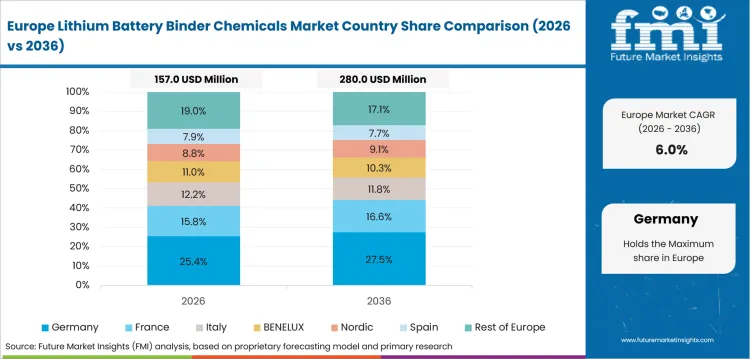
Country Market Snapshot Table
| Parameter | Value |
|---|---|
| Market Size in 2025 (Value) | USD 48.0 million |
| Market Size in 2026 (Value) | USD 51.3 million |
| Market Forecast in 2036 (Value) | USD 99.1 million |
| CAGR (2026 to 2036) | 6.8% |
| Years Considered | 2021 to 2036 |
| Base Year | 2025 |
| Forecast Period | 2026 to 2036 |
| Units Considered | Value (USD million) |
| Leading Sub-Region | Bavaria, Baden-Württemberg, and North Rhine-Westphalia auto clusters |
Germany Lithium Battery Binder Chemicals Market Outlook
Germany lithium battery binder chemical demand is shaped by auto OEM validation and strict supplier documentation. Buyers review durability, process control, and compliance data before accepting electrode material changes.
Chemical supplier depth gives Germany a strong role in European battery qualification. Binder grades approved for German-linked cell programs can influence purchasing decisions across wider European platforms.
Key Growth Drivers
- EV registrations support cell material demand as Germany recorded 45,535 new BEV registrations in April 2025.
- European battery demand supports German-linked qualification because the EU registered 1,880,370 new battery-electric cars in 2025.
- OEM validation creates demand for binders supported by coating data and long-cycle performance evidence.
- Local chemical expertise improves buyer confidence in SBR, PVDF, and separator coating support.
Key Restraints
- Policy volatility can slow cell planning because Germany recorded a 27.0% decline in BEV registrations in 2024 after purchase bonus cancellation.
- High operating costs can pressure local production economics for specialty binder materials.
- Longer automotive approval cycles can slow new supplier entry even when performance results are strong.
What makes Germany unique
Germany is unique due to automotive validation discipline and chemical production depth supporting approved binder grades.
Key Companies
- BASF SE
- Arkema GmbH
- Syensqo Germany GmbH
- Zeon Europe GmbH
- Kureha Europe B.V.
- Wacker Chemie AG
- Evonik Industries AG
Sales & Marketing Channels
- Direct enterprise sales to cell makers
- Automotive OEM material approval routes
- Tier supplier engineering programs
- European chemical distributor channels
- Pilot coating trials
- Technical workshops
Country Segment Breakdown Table
| Segment | Sub-Segments |
|---|---|
| By Chemistry Type | Bio-based · Recycled · Low VOC · Halogen Free · Waterborne |
| By Function | Solvent · Additive · Binder · Coating · Process Aid |
| By Application | Textiles · Batteries · Construction · Personal Care · Water Treatment |
| By End-use Industry | Automotive · Electronics · Packaging · Agriculture · Industrial Manufacturing |
| By Processing Route | Wet Slurry Processing · Dry Electrode Processing · Aqueous Coating · Solvent Recovery · Pilot Line Qualification |
| Key Sub-Regions Covered, Automotive and Chemical Clusters | Bavaria · Baden-Württemberg · North Rhine-Westphalia · Saxony · Lower Saxony · Hesse |
Market Taxonomy and Sub-Regions Covered
Frequently Asked Questions
How fast is Germany lithium battery binder chemicals market growing?
Germany demand is expected to increase at 6.8% CAGR from 2026 to 2036, supported by automotive cell validation.
Who leads Germany lithium battery binder chemicals market?
BASF, Arkema, Syensqo, Zeon Europe, Wacker, and Evonik compete through chemical production and technical battery support.
What is driving adoption in Germany lithium battery binder chemicals market?
EV platform validation and European battery compliance are moving buyers toward tested binder systems.
How is the lithium battery binder chemicals market performing in France?
A 6.5% CAGR through 2036 reflects EV demand, PVDF supply activity, and European battery materials development.
Country Market Snapshot Table
| Parameter | Value |
|---|---|
| Market Size in 2025 (Value) | USD 34.7 million |
| Market Size in 2026 (Value) | USD 37.0 million |
| Market Forecast in 2036 (Value) | USD 69.5 million |
| CAGR (2026 to 2036) | 6.5% |
| Years Considered | 2021 to 2036 |
| Base Year | 2025 |
| Forecast Period | 2026 to 2036 |
| Units Considered | Value (USD million) |
| Leading Sub-Region | Hauts-de-France and Auvergne-Rhône-Alpes battery corridors |
France Lithium Battery Binder Chemicals Market Outlook
France demand is shaped by EV adoption and specialty polymer involvement in European battery supply chains. Local PVDF activity and battery project development create a visible route for cathode binder qualification.
The market benefits from direct connections between chemical suppliers, cell projects, and automotive buyers. Binder suppliers with European production support can gain better access to France-linked battery programs.
Key Growth Drivers
- Private EV demand supports battery material pull as private buyers represented 55.8% of new French BEV registrations in 2025.
- PVDF supply commitments support cathode binder demand because Syensqo signed contracts exceeding EUR 150.0 million in cumulative net sales.
- European battery project activity improves qualification routes for local coating and separator material suppliers.
- Chemical producer proximity helps buyers connect polymer design with electrode performance trials.
Key Restraints
- Auto demand volatility can slow material planning because French passenger car registrations contracted by 5.0% in 2025.
- Fluoropolymer scrutiny can increase documentation pressure for PVDF binder suppliers.
- Gigafactory ramp-up timing can delay volume orders even when qualification work begins early.
What makes France unique
France is unique due to visible PVDF binder supply activity and dry-processing materials development inside Europe.
Key Companies
- Arkema SA
- Syensqo SA
- Solvay France
- BASF France SAS
- Hutchinson SA
- TotalEnergies SE
- Saint-Gobain Performance Plastics
Sales & Marketing Channels
- Direct sales to European cell producers
- Battery pilot line collaboration
- OEM and gigafactory qualification programs
- Technical service through polymer teams
- Regional chemical distributor support
- Separator coating supplier partnerships
Country Segment Breakdown Table
| Segment | Sub-Segments |
|---|---|
| By Chemistry Type | Bio-based · Recycled · Low VOC · Halogen Free · Waterborne |
| By Function | Solvent · Additive · Binder · Coating · Process Aid |
| By Application | Textiles · Batteries · Construction · Personal Care · Water Treatment |
| By End-use Industry | Automotive · Electronics · Packaging · Agriculture · Industrial Manufacturing |
| By Processing Route | Wet Slurry Processing · Dry Electrode Processing · Aqueous Coating · Solvent Recovery · Pilot Line Qualification |
| Key Sub-Regions Covered, Battery and Polymer Corridors | Hauts-de-France · Auvergne-Rhône-Alpes · Île-de-France · Grand Est · Normandy · Nouvelle-Aquitaine |
Market Taxonomy and Sub-Regions Covered
Frequently Asked Questions
How fast is France lithium battery binder chemicals market growing?
France demand is forecast to expand at 6.5% CAGR from 2026 to 2036 through EV and polymer-linked battery activity.
Who leads France lithium battery binder chemicals market?
Arkema, Syensqo, BASF France, Solvay France, and Saint-Gobain compete through specialty materials and battery support.
What is driving adoption in France lithium battery binder chemicals market?
PVDF supply activity and European battery project development are moving buyers toward qualified binder systems.
What is the lithium battery binder chemicals market forecast for Japan?
A 5.9% CAGR through 2036 reflects battery materials expertise and high-reliability cell qualification standards.
Country Market Snapshot Table
| Parameter | Value |
|---|---|
| Market Size in 2025 (Value) | USD 67.0 million |
| Market Size in 2026 (Value) | USD 71.0 million |
| Market Forecast in 2036 (Value) | USD 126.0 million |
| CAGR (2026 to 2036) | 5.9% |
| Years Considered | 2021 to 2036 |
| Base Year | 2025 |
| Forecast Period | 2026 to 2036 |
| Units Considered | Value (USD million) |
| Leading Sub-Region | Kanto-Chubu battery materials corridor |
Japan Lithium Battery Binder Chemicals Market Outlook
Japan demand is shaped by materials know-how, long qualification cycles, and battery reliability standards. The country’s binder role is stronger in specialized technology than in low-cost volume supply.
Domestic suppliers hold important positions in PVDF, waterborne, PTFE, and polyamide-imide binder systems. Cell makers are expected to favor proven materials with stable quality and co-development support.
Key Growth Drivers
- Battery policy supports local materials demand as METI targets 150 GWh per year of domestic battery manufacturing capacity.
- Vehicle electrification supports future cell material demand because Japan targets 100.0% electrified new passenger vehicle sales by 2035.
- Japanese suppliers have strong experience in PVDF, water-based anode, and dry process binder systems.
- Long-term cell reliability standards support demand for high-purity binders with stable coating performance.
Key Restraints
- Domestic BEV uptake remains limited because battery electric vehicles accounted for only 1.3% of Japan’s automotive market in the first half of 2025.
- Long validation cycles can slow new supplier approvals even when chemistry performance is suitable.
- Imported EV competition may make domestic cell material planning more conservative during early program phases.
What makes Japan unique
Japan is unique due to binder materials expertise and high-reliability cell qualification standards.
Key Companies
- Kureha Corporation
- Zeon Corporation
- Daikin Industries Ltd.
- Resonac Holdings Corporation
- Mitsubishi Chemical Group Corporation
- Toray Industries Inc.
- Sumitomo Chemical Co. Ltd.
Sales & Marketing Channels
- Direct sales to cell makers
- Co-development with battery R&D teams
- Trading company routes
- Specialty chemical supply channels
- Joint testing with automotive battery suppliers
- Pilot coating and safety validation programs
Country Segment Breakdown Table
| Segment | Sub-Segments |
|---|---|
| By Chemistry Type | Bio-based · Recycled · Low VOC · Halogen Free · Waterborne |
| By Function | Solvent · Additive · Binder · Coating · Process Aid |
| By Application | Textiles · Batteries · Construction · Personal Care · Water Treatment |
| By End-use Industry | Automotive · Electronics · Packaging · Agriculture · Industrial Manufacturing |
| By Processing Route | Wet Slurry Processing · Dry Electrode Processing · Aqueous Coating · Solvent Recovery · Pilot Line Qualification |
| Key Sub-Regions Covered, Battery Materials Areas | Tokyo · Kanagawa · Aichi · Osaka · Shizuoka · Fukuoka |
Market Taxonomy and Sub-Regions Covered
Frequently Asked Questions
How fast is Japan lithium battery binder chemicals market growing?
Japan demand is projected at 5.9% CAGR from 2026 to 2036, supported by battery materials expertise.
Who leads Japan lithium battery binder chemicals market?
Kureha, Zeon, Daikin, Resonac, Mitsubishi Chemical, Toray, and Sumitomo Chemical compete through binder technology.
What is driving adoption in Japan lithium battery binder chemicals market?
Specialized binder know-how and high-reliability cell programs are moving buyers toward advanced electrode materials.
What is driving lithium battery binder chemicals growth in China?
A 7.6% CAGR through 2036 is supported by large-scale EV sales, cell output, and local materials supply depth.
Country Market Snapshot Table
| Parameter | Value |
|---|---|
| Market Size in 2025 (Value) | USD 195.0 million |
| Market Size in 2026 (Value) | USD 209.8 million |
| Market Forecast in 2036 (Value) | USD 437.3 million |
| CAGR (2026 to 2036) | 7.6% |
| Years Considered | 2021 to 2036 |
| Base Year | 2025 |
| Forecast Period | 2026 to 2036 |
| Units Considered | Value (USD million) |
| Leading Sub-Region | Yangtze River Delta and Pearl River Delta cell clusters |
China Lithium Battery Binder Chemicals Market Outlook
China demand is shaped by the world’s largest EV and lithium-ion battery manufacturing base. High cell output gives binder suppliers a broad qualification pool across anode, cathode, and separator coating systems.
The market is volume-oriented and technically demanding. Local responsiveness, price discipline, and application support are central to supplier selection.
Key Growth Drivers
- EV scale supports binder demand as China sold more than 13.0 million electric cars in 2025.
- Cell output keeps binder volumes high as China’s lithium-ion battery production exceeded 473 GWh during January to April 2025.
- Local cell makers need fast sample supply and coating support during high-volume recipe changes.
- Domestic material ecosystems allow suppliers to coordinate polymer supply with cathode, anode, and separator producers.
Key Restraints
- Export pressure can intensify competition because more than 35.0% of China’s car exports were EVs in 2025.
- Overcapacity can shorten buyer negotiation cycles and push suppliers to defend margins.
- Rapid recipe changes can raise technical service costs for binder producers supporting multiple cell platforms.
What makes China unique
China is unique due to unmatched EV scale, lithium-ion cell output, and fast-moving local supplier qualification.
Key Companies
- Zhejiang Fluorine Chemical New Materials Co. Ltd.
- Shanghai Huayi Group Corporation Ltd.
- Zeon Shanghai Co. Ltd.
- Shenzhen Senior Technology Material Co. Ltd.
- Ningbo Shanshan Co. Ltd.
- Guangzhou Tinci Materials Technology Co. Ltd.
- Guangdong Chenyu New Materials Co. Ltd.
Sales & Marketing Channels
- Direct sales to cell manufacturers
- Local distributor agreements
- High-volume sample programs
- Cathode and anode material partnerships
- Battery material industrial parks
- Technical service near cell plants
Country Segment Breakdown Table
| Segment | Sub-Segments |
|---|---|
| By Chemistry Type | Bio-based · Recycled · Low VOC · Halogen Free · Waterborne |
| By Function | Solvent · Additive · Binder · Coating · Process Aid |
| By Application | Textiles · Batteries · Construction · Personal Care · Water Treatment |
| By End-use Industry | Automotive · Electronics · Packaging · Agriculture · Industrial Manufacturing |
| By Processing Route | Wet Slurry Processing · Dry Electrode Processing · Aqueous Coating · Solvent Recovery · Pilot Line Qualification |
| Key Sub-Regions Covered, Cell Manufacturing Clusters | Jiangsu · Guangdong · Shanghai · Zhejiang · Fujian · Sichuan |
Market Taxonomy and Sub-Regions Covered
Frequently Asked Questions
How fast is China lithium battery binder chemicals market growing?
China demand is expected to grow at 7.6% CAGR from 2026 to 2036, supported by cell output scale.
Who leads China lithium battery binder chemicals market?
Zeon Shanghai, Chenyu New Materials, Tinci Materials, Shanshan, and local fluoropolymer producers compete through scale and support.
What is driving adoption in China lithium battery binder chemicals market?
Large EV sales and high lithium-ion battery output are moving buyers toward qualified binder systems.
How fast is the lithium battery binder chemicals market growing in South Korea?
A 7.2% CAGR through 2036 reflects global battery export strength and advanced cell manufacturing expertise.
Country Market Snapshot Table
| Parameter | Value |
|---|---|
| Market Size in 2025 (Value) | USD 43.3 million |
| Market Size in 2026 (Value) | USD 46.4 million |
| Market Forecast in 2036 (Value) | USD 92.9 million |
| CAGR (2026 to 2036) | 7.2% |
| Years Considered | 2021 to 2036 |
| Base Year | 2025 |
| Forecast Period | 2026 to 2036 |
| Units Considered | Value (USD million) |
| Leading Sub-Region | Ulsan, Cheongju, and Pohang battery clusters |
South Korea Lithium Battery Binder Chemicals Market Outlook
South Korea demand is shaped by global EV battery supply programs and advanced cell manufacturing. Binder suppliers must support high-nickel cathodes, fast charging, and durable electrode designs.
The country’s battery producers require close technical collaboration from chemical suppliers. Performance data and supply reliability remain more important than catalog breadth.
Key Growth Drivers
- Battery ecosystem depth supports binder demand as Korea accounted for 19.8% of the world’s EV battery capacity in 2024.
- USA customer exposure supports Korean battery suppliers because Korean battery makers held 49.0% share in the USA market in the first half of 2025.
- High-nickel cathode and fast-charge cell programs support demand for premium binder systems.
- Global EV customer programs strengthen supplier need for repeatable coating and validation support.
Key Restraints
- Export exposure creates demand risk because Korean battery exports were expected to decline by 16.5% in 2024 during the global EV chasm.
- Critical mineral sourcing can increase procurement risk for cell and binder supply chains.
- Export-linked production exposes binder demand to overseas EV platform timing and inventory cycles.
What makes South Korea unique
South Korea is unique due to advanced cell manufacturing capability and strong export exposure to global EV platforms.
Key Companies
- LG Chem Ltd.
- SK Innovation Co. Ltd.
- Samsung SDI Co. Ltd.
- Lotte Chemical Corporation
- Hansol Chemical Co. Ltd.
- ENF Technology Co. Ltd.
- Dongjin Semichem Co. Ltd.
Sales & Marketing Channels
- Direct supply to cell makers
- Battery material group procurement
- OEM-linked technical approval
- Cathode and anode supplier partnerships
- Local specialty chemical channels
- Joint validation programs
Country Segment Breakdown Table
| Segment | Sub-Segments |
|---|---|
| By Chemistry Type | Bio-based · Recycled · Low VOC · Halogen Free · Waterborne |
| By Function | Solvent · Additive · Binder · Coating · Process Aid |
| By Application | Textiles · Batteries · Construction · Personal Care · Water Treatment |
| By End-use Industry | Automotive · Electronics · Packaging · Agriculture · Industrial Manufacturing |
| By Processing Route | Wet Slurry Processing · Dry Electrode Processing · Aqueous Coating · Solvent Recovery · Pilot Line Qualification |
| Key Sub-Regions Covered, Battery Manufacturing Areas | Ulsan · Cheongju · Pohang · Daejeon · Seoul Capital Area · Gumi |
Market Taxonomy and Sub-Regions Covered
Frequently Asked Questions
How fast is South Korea lithium battery binder chemicals market growing?
South Korea demand is projected to increase at 7.2% CAGR from 2026 to 2036, guided by export-focused battery manufacturing.
Who leads South Korea lithium battery binder chemicals market?
LG Chem, Samsung SDI, SK Innovation, Lotte Chemical, Hansol Chemical, and Dongjin Semichem compete through battery materials programs.
What is driving adoption in South Korea lithium battery binder chemicals market?
Advanced cell manufacturing and global EV platform supply are moving buyers toward high-performance binder systems.
What is the lithium battery binder chemicals market outlook in India?
An 8.1% CAGR through 2036 is supported by cell localization policy, domestic manufacturing plans, and EV demand creation.
Country Market Snapshot Table
| Parameter | Value |
|---|---|
| Market Size in 2025 (Value) | USD 14.2 million |
| Market Size in 2026 (Value) | USD 15.3 million |
| Market Forecast in 2036 (Value) | USD 33.4 million |
| CAGR (2026 to 2036) | 8.1% |
| Years Considered | 2021 to 2036 |
| Base Year | 2025 |
| Forecast Period | 2026 to 2036 |
| Units Considered | Value (USD million) |
| Leading Sub-Region | Gujarat, Tamil Nadu, and Karnataka cell localization hubs |
India Lithium Battery Binder Chemicals Market Outlook
India demand is moving from import-led battery supply toward domestic cell manufacturing. Binder suppliers are expected to gain opportunities as local cell makers begin qualification work for anode and cathode materials.
The market is smaller than East Asian hubs, but the localization curve is faster. Suppliers with technical service and reliable imports can enter before local binder production matures.
Key Growth Drivers
- EV demand support is backed by the PM E-DRIVE scheme with an outlay of INR 10,900 crore.
- Cell localization is supported by the PLI ACC scheme targeting 50 GWh of ACC capacity and 5 GWh of niche ACC technology.
- Domestic battery manufacturing plans increase the need for binder sample testing and coating validation.
- Local EV and stationary storage buyers create future demand for waterborne and PVDF binder systems.
Key Restraints
- Supply chain depth remains developing as at least 10 manufacturers announced about 178 GWh of cumulative battery capacity plans.
- Local binder production evidence is limited compared with China, Japan, and South Korea.
- Import dependence can extend qualification timelines when battery material sourcing changes during scale-up.
What makes India unique
India is unique due to the fastest localization curve and a policy-backed move toward domestic cell manufacturing.
Key Companies
- Reliance New Energy Limited
- Amara Raja Energy & Mobility Limited
- Exide Energy Solutions Limited
- Tata Chemicals Limited
- Himadri Speciality Chemical Limited
- Neogen Chemicals Limited
- Epsilon Advanced Materials Pvt. Ltd.
Sales & Marketing Channels
- Direct supply to cell manufacturers
- Chemical distributor imports
- Battery material localization programs
- EV OEM procurement routes
- Pilot coating support
- Industrial cluster partnerships
Country Segment Breakdown Table
| Segment | Sub-Segments |
|---|---|
| By Chemistry Type | Bio-based · Recycled · Low VOC · Halogen Free · Waterborne |
| By Function | Solvent · Additive · Binder · Coating · Process Aid |
| By Application | Textiles · Batteries · Construction · Personal Care · Water Treatment |
| By End-use Industry | Automotive · Electronics · Packaging · Agriculture · Industrial Manufacturing |
| By Processing Route | Wet Slurry Processing · Dry Electrode Processing · Aqueous Coating · Solvent Recovery · Pilot Line Qualification |
| Key Sub-Regions Covered, Battery Localization Hubs | Gujarat · Tamil Nadu · Karnataka · Maharashtra · Telangana · Andhra Pradesh |
Market Taxonomy and Sub-Regions Covered
Frequently Asked Questions
How fast is India lithium battery binder chemicals market growing?
India demand is set to grow at 8.1% CAGR from 2026 to 2036, driven by battery localization.
Who leads India lithium battery binder chemicals market?
Reliance New Energy, Amara Raja, Exide Energy, Tata Chemicals, Himadri, Neogen, and Epsilon compete through battery materials activity.
What is driving adoption in India lithium battery binder chemicals market?
Cell localization policy and EV manufacturing plans are moving suppliers toward binder qualification programs.
Who are the leading companies in the lithium battery binder chemicals market?
Arkema, Syensqo, BASF, Zeon, Kureha, Daikin, LG Chem, and Resonac.
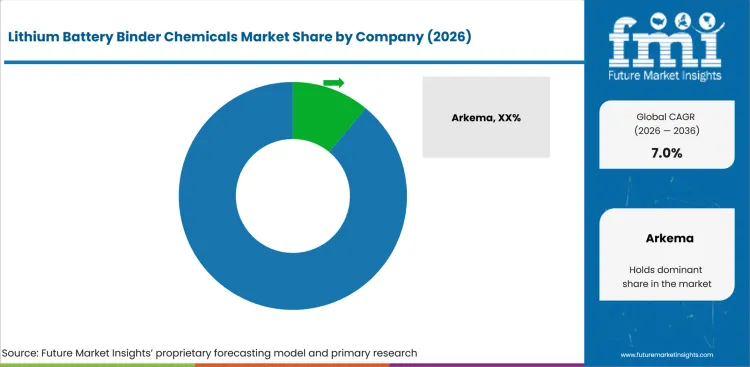
- Established specialty chemical companies hold an advantage through battery-grade polymer portfolios and technical application teams.
- Fluoropolymer specialists gain demand through PVDF binders used in cathodes and separator coating systems.
- Waterborne binder suppliers gain stronger access where anode makers need swelling control and lower solvent exposure.
- Regional technical service supports supplier selection because cell makers need pilot coating and validation support before approval.
Specialty polymer suppliers compete by linking chemistry development with electrode performance evidence. Arkema and Syensqo have strong positions in PVDF systems for cathode binders and separator coatings. BASF and Zeon compete through waterborne anode binder portfolios that support graphite and silicon-blend electrodes. Kureha and Daikin remain important in PVDF and PTFE systems for battery applications.
Application support has become a competitive separator as cell makers review binder behavior during coating, calendaring, electrolyte wetting, and cycling. Suppliers with pilot coating evidence can reduce buyer risk during cell qualification. Companies with regional production access also gain strength when buyers want faster sample delivery and supply stability.
Smaller and regional players can win through local responsiveness and chemistry-specific support. China and South Korea offer high-volume qualification routes, while Europe places more weight on compliance and automotive validation. India creates an early-stage localization opportunity for suppliers that can support sample trials before large-scale domestic cell output matures.
How do top lithium battery binder chemicals companies compare?
Arkema and Syensqo score strongest on PVDF binder depth while BASF and Zeon lead waterborne anode binder relevance.
| Company | Relevance to Market Title | PVDF Binder Depth | Waterborne Binder Portfolio | Application Support | Channel Reach | Geographic Footprint |
|---|---|---|---|---|---|---|
| Arkema | Very High | Very Strong | Moderate | Very Strong | Strong | Global |
| Syensqo | Very High | Very Strong | Moderate | Very Strong | Strong | Global |
| BASF | Very High | Moderate | Very Strong | Very Strong | Very Strong | Global |
| Zeon Corporation | Very High | Moderate | Very Strong | Strong | Strong | East Asia and Global |
| Kureha Corporation | High | Very Strong | Low to Moderate | Strong | Moderate | Japan and Global |
| Daikin Industries | High | Strong | Moderate | Strong | Strong | Global |
| LG Chem | High | Moderate | Strong | Strong | Strong | South Korea and Global |
| Resonac Corporation | High | Moderate | Moderate | Strong | Moderate | Japan and Asia |
| Mitsubishi Chemical Group | Moderate to High | Moderate | Moderate | Strong | Strong | Japan and Global |
| Sumitomo Chemical | Moderate | Moderate | Moderate | Moderate | Strong | Japan and Global |
Source: Future Market Insights competitive analysis, 2026.
Who are the major suppliers in the lithium battery binder chemicals market?
Arkema, Syensqo, BASF, and Zeon are listed with Kureha, Daikin, LG Chem, and Resonac among other suppliers.
Major global companies leading the lithium battery binder chemicals market include:
- Arkema
- Syensqo
- BASF
- Zeon Corporation
- Kureha Corporation
- Daikin Industries
- LG Chem
- Resonac Corporation
- Mitsubishi Chemical Group
- Sumitomo Chemical
Key Developments in Lithium Battery Binder Chemicals Market
- In March 2025, BASF expanded its United States manufacturing capabilities to include Licity anode binders, supporting local supply for lithium-ion battery manufacturers.
- In May 2025, Syensqo signed new multi-year Solef PVDF contracts for battery materials, with cumulative net sales exceeding EUR 150.0 million.
- In March 2025, Zeon agreed to establish a Shanghai joint venture specializing in anode binder sales for China’s domestic lithium-ion battery market.
Key Players in the Lithium Battery Binder Chemicals Market
Fluoropolymer Binder Specialists
- Arkema
- Syensqo
- Kureha Corporation
- Daikin Industries
- Mitsubishi Chemical Group
Waterborne Anode Binder Suppliers
- BASF
- Zeon Corporation
- LG Chem
- Resonac Corporation
- Sumitomo Chemical
Regional Cell Qualification and Application Support Companies
- Arkema
- BASF
- Syensqo
- Zeon Corporation
- Kureha Corporation
- Daikin Industries
- Resonac Corporation
Lithium Battery Binder Chemicals Market - Report Scope
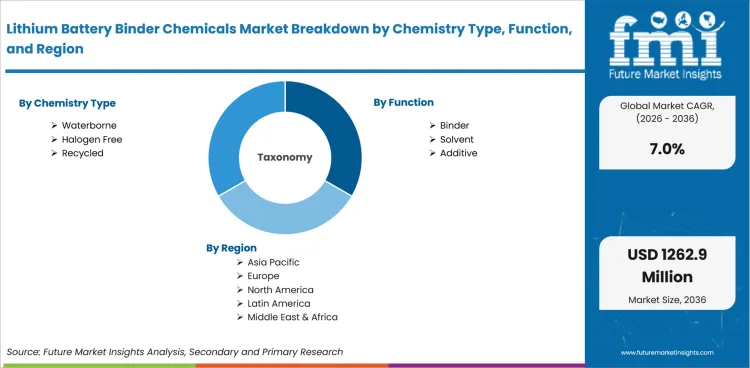
| Item | Value |
|---|---|
| Market size by 2036 | USD 1,262.9 million |
| Growth rate | 7.0% CAGR from 2026 to 2036 |
| Forecast period | 2026 to 2036 |
| Base year value (2025) | USD 600.0 million |
| By chemistry type | Bio-based, recycled, low VOC, halogen free, waterborne |
| By function | Solvent, additive, binder, coating, process aid |
| By application | Textiles, batteries, construction, personal care, water treatment |
| By end-use industry | Automotive, electronics, packaging, agriculture, industrial manufacturing |
| By processing route | Wet slurry processing, dry electrode processing, aqueous coating, solvent recovery, pilot line qualification |
| Regions covered | North America, Latin America, Europe, East Asia, South Asia and Pacific, Middle East and Africa |
| Countries covered | United States, United Kingdom, Germany, France, Japan, China, South Korea, India |
| Key companies profiled | Arkema, Syensqo, BASF, Zeon Corporation, Kureha Corporation, Daikin Industries, LG Chem, Resonac Corporation |
| Approach | Bottom-up material-boundary approach using eligible binder revenue, chemistry mix, cell demand, qualification behavior, and country-level adoption |
Source: Future Market Insights, 2026.
Lithium Battery Binder Chemicals Market - Scope & Definition
| Attribute | Detail |
|---|---|
| Market Definition | Polymer and chemical systems used to hold active materials and conductive additives together inside lithium battery electrodes, including anode, cathode, and separator-adjacent coating uses. |
| Functions Covered | Electrode bonding, particle cohesion, current collector adhesion, slurry stabilization, separator coating support, process assistance, and swelling control. |
| Applications Covered | Lithium-ion battery electrodes, separator coatings, anode formulations, cathode formulations, pilot coating lines, and adjacent high-performance coating systems. |
| End-Use Industries | Automotive, electronics, packaging, agriculture, industrial manufacturing, energy storage, and battery materials manufacturing. |
| Grades Covered | Bio-based, recycled, low VOC, halogen free, waterborne, PVDF, SBR, CMC, PAA, PTFE, and specialty latex systems. |
| Inclusions | Battery-qualified binder chemicals sold to cell makers, electrode producers, separator coating suppliers, and battery material manufacturers across commercial and pilot-scale routes. |
| Exclusions | Finished cells, battery modules, battery packs, cathode active materials, anode active materials, electrolytes, conductive carbon, and separator films sold separately. |
Lithium Battery Binder Chemicals Market - Research Methodology
| Method | Description |
|---|---|
| Primary Research | FMI analyst interviews with battery material suppliers, cell manufacturing teams, chemical distributors, coating specialists, and battery validation professionals across key markets. |
| Desk Research | Review of government battery policy, EV sales data, storage deployment, official company releases, technical binder information, and battery material supply evidence. |
| Market Sizing & Forecasting | Bottom-up material-boundary approach using cell demand, binder use rates, chemistry mix, regional production, qualification behavior, and battery-grade pricing. |
| Data Validation | Cross-verification using EV deployment, cell plant signals, company disclosures, battery localization policy, storage capacity additions, and country-level manufacturing indicators. |
Lithium Battery Binder Chemicals Market Breakdown by Chemistry Type, Function, Application, End-use Industry, Processing Route, and Region
Lithium Battery Binder Chemicals Market Segmented by Chemistry Type
- Bio-based
- Recycled
- Low VOC
- Halogen Free
- Waterborne
Lithium Battery Binder Chemicals Market Segmented by Function
- Solvent
- Additive
- Binder
- Coating
- Process Aid
Lithium Battery Binder Chemicals Market Segmented by Application
- Textiles
- Batteries
- Construction
- Personal Care
- Water Treatment
Lithium Battery Binder Chemicals Market Segmented by End-use Industry
- Automotive
- Electronics
- Packaging
- Agriculture
- Industrial Manufacturing
Lithium Battery Binder Chemicals Market Segmented by Processing Route
- Wet Slurry Processing
- Dry Electrode Processing
- Aqueous Coating
- Solvent Recovery
- Pilot Line Qualification
Lithium Battery Binder Chemicals Market by Region
- North America
- Latin America
- Europe
- East Asia
- South Asia and Pacific
- Middle East and Africa
Research Sources and Bibliography
- ACEA. (2026, January 27). New car registrations: Battery-electric market share in 2025.
- Argonne National Laboratory. (2026, April). Light duty electric drive vehicles monthly sales updates.
- Arkema. (2025, May 21). Arkema at the Battery Show 2025.
- Arkema. (2026, June 1). Arkema showcases innovative materials at The Battery Show Europe.
- BASF. (2025, March 31). BASF establishes global production for Licity anode binders with manufacturing scale-up in the United States.
- European Alternative Fuels Observatory. (2025, May). Germany BEV registrations surge by 54% in April 2025.
- European Alternative Fuels Observatory. (2026, January 21). France’s EV market in 2025: Renewed momentum and a growing fleet.
- European Environment Agency. (2025, November 6). New registrations of electric vehicles in Europe.
- Faraday Institution. (2024, September 17). UK electric vehicle and battery production potential to 2040.
- International Energy Agency. (2025, May). Global critical minerals outlook 2025.
- International Energy Agency. (2026, May). Global EV outlook 2026.
- Invest Korea. (2025, November 11). Korea’s battery industry, strengthening competitiveness amid global battery competition.
- Invest Korea. (2026). Battery industry.
- Japan Ministry of Economy, Trade and Industry. (2026, June 2). Battery Industry Strategy revised as the Battery and Power Industry Strategy.
- Korea Ministry of Trade, Industry and Energy. (2025). Battery industry policy and competitiveness materials.
- Ministry of Heavy Industries, Government of India. (2025, August 8). PM E-DRIVE scheme implementation update.
- Ministry of Heavy Industries, Government of India. (2026, March 24). PLI scheme for advanced chemistry cell battery storage.
- Press Information Bureau, Government of India. (2026, February 10). PLI-ACC scheme and battery manufacturing capacity announcements.
- Syensqo. (2025, May 15). Syensqo signs new multi-year Solef PVDF contracts for battery materials.
- USA Department of Energy. (2024, December). 2021 - 2024 four-year review of supply chains for the advanced batteries sector.
- USA Department of Energy. (2024, July 22). The pace of North American battery cell production announcements.
- USA Energy Information Administration. (2025, March 12). USA battery capacity increased 66% in 2024.
- USA Energy Information Administration. (2026, February 20). New USA electric generating capacity expected to reach a record high in 2026.
- Zeon Corporation. (2025, March 3). Zeon agrees to establish a joint venture specializing in sales of anode binders for lithium-ion batteries in China’s domestic market.
This bibliography is provided for reader reference and is not exhaustive. The full report contains the complete reference list and detailed citations.
This Report Answers
- Market size estimates for 2026 and forecasts through 2036 for the lithium battery binder chemicals market.
- Insights across regional and country-level markets tied to lithium-ion battery production.
- Analysis of demand drivers, electrode qualification trends, cell chemistry changes, and purchasing behavior.
- Evaluation of chemistry types, binder functions, application routes, end-use industries, and processing pathways.
- Assessment of waterborne binders, PVDF binders, dry electrode processing, and silicon-anode swelling control.
- Identification of growth opportunities across automotive batteries, stationary storage, separator coatings, and regional localization.
- Evaluation of supply chain dynamics, technical service needs, and battery material qualification barriers.
- Country-level growth analysis covering the United States, United Kingdom, Germany, France, Japan, China, South Korea, and India.
- Assessment of the competitive landscape, including leading binder chemical suppliers and battery material companies.
- Analysis of buyer preferences, supplier validation requirements, and regional battery manufacturing demand.
- Regional outlooks across North America, Europe, East Asia, South Asia and Pacific, Latin America, and the Middle East and Africa.
- Delivery of market data, forecasts, and supporting analysis in PDF and Excel formats.
Frequently Asked Questions
What is the lithium battery binder chemicals market size in 2026?
The lithium battery binder chemicals market size is anticipated to cross USD 642.0 million in 2026.
What is the lithium battery binder chemicals market forecast for 2036?
The lithium battery binder chemicals industry revenue is predicted to reach USD 1,262.9 million by 2036 as battery-grade binder qualification expands.
What is the lithium battery binder chemicals market CAGR?
The lithium battery binder chemicals sector is projected to expand at 7.0% CAGR from 2026 to 2036.
What segment leads the lithium battery binder chemicals market?
Batteries are likely to capture 71.0% share in 2026 due to lithium-ion cell manufacturing and strict electrode performance needs.
What country grows fastest in the lithium battery binder chemicals market?
India is set to record 8.1% CAGR by 2036, driven by cell localization and advanced chemistry battery capacity plans.
Preview the report firsthand - request a free sample
Get SampleGet the brochure for pricing and purchase details.
Get PDFTable of Content
- Executive Summary
- Global Market Outlook
- Demand to side Trends
- Supply to side Trends
- Technology Roadmap Analysis
- Analysis and Recommendations
- Market Overview
- Market Coverage / Taxonomy
- Market Definition / Scope / Limitations
- Research Methodology
- Chapter Orientation
- Analytical Lens and Working Hypotheses
- Market Structure, Signals, and Trend Drivers
- Benchmarking and Cross-market Comparability
- Market Sizing, Forecasting, and Opportunity Mapping
- Research Design and Evidence Framework
- Desk Research Programme (Secondary Evidence)
- Company Annual and Sustainability Reports
- Peer-reviewed Journals and Academic Literature
- Corporate Websites, Product Literature, and Technical Notes
- Earnings Decks and Investor Briefings
- Statutory Filings and Regulatory Disclosures
- Technical White Papers and Standards Notes
- Trade Journals, Industry Magazines, and Analyst Briefs
- Conference Proceedings, Webinars, and Seminar Materials
- Government Statistics Portals and Public Data Releases
- Press Releases and Reputable Media Coverage
- Specialist Newsletters and Curated Briefings
- Sector Databases and Reference Repositories
- FMI Internal Proprietary Databases and Historical Market Datasets
- Subscription Datasets and Paid Sources
- Social Channels, Communities, and Digital Listening Inputs
- Additional Desk Sources
- Expert Input and Fieldwork (Primary Evidence)
- Primary Modes
- Qualitative Interviews and Expert Elicitation
- Quantitative Surveys and Structured Data Capture
- Blended Approach
- Why Primary Evidence is Used
- Field Techniques
- Interviews
- Surveys
- Focus Groups
- Observational and In-context Research
- Social and Community Interactions
- Stakeholder Universe Engaged
- C-suite Leaders
- Board Members
- Presidents and Vice Presidents
- R&D and Innovation Heads
- Technical Specialists
- Domain Subject-matter Experts
- Scientists
- Physicians and Other Healthcare Professionals
- Governance, Ethics, and Data Stewardship
- Research Ethics
- Data Integrity and Handling
- Primary Modes
- Tooling, Models, and Reference Databases
- Desk Research Programme (Secondary Evidence)
- Data Engineering and Model Build
- Data Acquisition and Ingestion
- Cleaning, Normalisation, and Verification
- Synthesis, Triangulation, and Analysis
- Quality Assurance and Audit Trail
- Market Background
- Market Dynamics
- Drivers
- Restraints
- Opportunity
- Trends
- Scenario Forecast
- Demand in Optimistic Scenario
- Demand in Likely Scenario
- Demand in Conservative Scenario
- Opportunity Map Analysis
- Product Life Cycle Analysis
- Supply Chain Analysis
- Investment Feasibility Matrix
- Value Chain Analysis
- PESTLE and Porter’s Analysis
- Regulatory Landscape
- Regional Parent Market Outlook
- Production and Consumption Statistics
- Import and Export Statistics
- Market Dynamics
- Global Market Analysis 2021 to 2025 and Forecast, 2026 to 2036
- Historical Market Size Value (USD Million) Analysis, 2021 to 2025
- Current and Future Market Size Value (USD Million) Projections, 2026 to 2036
- Y to o to Y Growth Trend Analysis
- Absolute $ Opportunity Analysis
- Global Market Pricing Analysis 2021 to 2025 and Forecast 2026 to 2036
- Global Market Analysis 2021 to 2025 and Forecast 2026 to 2036, By Chemistry Type
- Introduction / Key Findings
- Historical Market Size Value (USD Million) Analysis By Chemistry Type , 2021 to 2025
- Current and Future Market Size Value (USD Million) Analysis and Forecast By Chemistry Type , 2026 to 2036
- Waterborne
- Halogen Free
- Recycled
- Waterborne
- Y to o to Y Growth Trend Analysis By Chemistry Type , 2021 to 2025
- Absolute $ Opportunity Analysis By Chemistry Type , 2026 to 2036
- Global Market Analysis 2021 to 2025 and Forecast 2026 to 2036, By Function
- Introduction / Key Findings
- Historical Market Size Value (USD Million) Analysis By Function, 2021 to 2025
- Current and Future Market Size Value (USD Million) Analysis and Forecast By Function, 2026 to 2036
- Binder
- Solvent
- Additive
- Binder
- Y to o to Y Growth Trend Analysis By Function, 2021 to 2025
- Absolute $ Opportunity Analysis By Function, 2026 to 2036
- Global Market Analysis 2021 to 2025 and Forecast 2026 to 2036, By Application
- Introduction / Key Findings
- Historical Market Size Value (USD Million) Analysis By Application, 2021 to 2025
- Current and Future Market Size Value (USD Million) Analysis and Forecast By Application, 2026 to 2036
- Batteries
- Textiles
- Construction
- Batteries
- Y to o to Y Growth Trend Analysis By Application, 2021 to 2025
- Absolute $ Opportunity Analysis By Application, 2026 to 2036
- Global Market Analysis 2021 to 2025 and Forecast 2026 to 2036, By End-use Industry
- Introduction / Key Findings
- Historical Market Size Value (USD Million) Analysis By End-use Industry, 2021 to 2025
- Current and Future Market Size Value (USD Million) Analysis and Forecast By End-use Industry, 2026 to 2036
- Automotive
- Electronics
- Packaging
- Automotive
- Y to o to Y Growth Trend Analysis By End-use Industry, 2021 to 2025
- Absolute $ Opportunity Analysis By End-use Industry, 2026 to 2036
- Global Market Analysis 2021 to 2025 and Forecast 2026 to 2036, By Processing Route
- Introduction / Key Findings
- Historical Market Size Value (USD Million) Analysis By Processing Route, 2021 to 2025
- Current and Future Market Size Value (USD Million) Analysis and Forecast By Processing Route, 2026 to 2036
- Wet slurry processing
- Dry Electrode Processing
- Aqueous Coating
- Wet slurry processing
- Y to o to Y Growth Trend Analysis By Processing Route, 2021 to 2025
- Absolute $ Opportunity Analysis By Processing Route, 2026 to 2036
- Global Market Analysis 2021 to 2025 and Forecast 2026 to 2036, By Region
- Introduction
- Historical Market Size Value (USD Million) Analysis By Region, 2021 to 2025
- Current Market Size Value (USD Million) Analysis and Forecast By Region, 2026 to 2036
- North America
- Latin America
- Western Europe
- Eastern Europe
- East Asia
- South Asia and Pacific
- Middle East & Africa
- Market Attractiveness Analysis By Region
- North America Market Analysis 2021 to 2025 and Forecast 2026 to 2036, By Country
- Historical Market Size Value (USD Million) Trend Analysis By Market Taxonomy, 2021 to 2025
- Market Size Value (USD Million) Forecast By Market Taxonomy, 2026 to 2036
- By Country
- USA
- Canada
- Mexico
- By Chemistry Type
- By Function
- By Application
- By End-use Industry
- By Processing Route
- By Country
- Market Attractiveness Analysis
- By Country
- By Chemistry Type
- By Function
- By Application
- By End-use Industry
- By Processing Route
- Key Takeaways
- Latin America Market Analysis 2021 to 2025 and Forecast 2026 to 2036, By Country
- Historical Market Size Value (USD Million) Trend Analysis By Market Taxonomy, 2021 to 2025
- Market Size Value (USD Million) Forecast By Market Taxonomy, 2026 to 2036
- By Country
- Brazil
- Chile
- Rest of Latin America
- By Chemistry Type
- By Function
- By Application
- By End-use Industry
- By Processing Route
- By Country
- Market Attractiveness Analysis
- By Country
- By Chemistry Type
- By Function
- By Application
- By End-use Industry
- By Processing Route
- Key Takeaways
- Western Europe Market Analysis 2021 to 2025 and Forecast 2026 to 2036, By Country
- Historical Market Size Value (USD Million) Trend Analysis By Market Taxonomy, 2021 to 2025
- Market Size Value (USD Million) Forecast By Market Taxonomy, 2026 to 2036
- By Country
- Germany
- UK
- Italy
- Spain
- France
- Nordic
- BENELUX
- Rest of Western Europe
- By Chemistry Type
- By Function
- By Application
- By End-use Industry
- By Processing Route
- By Country
- Market Attractiveness Analysis
- By Country
- By Chemistry Type
- By Function
- By Application
- By End-use Industry
- By Processing Route
- Key Takeaways
- Eastern Europe Market Analysis 2021 to 2025 and Forecast 2026 to 2036, By Country
- Historical Market Size Value (USD Million) Trend Analysis By Market Taxonomy, 2021 to 2025
- Market Size Value (USD Million) Forecast By Market Taxonomy, 2026 to 2036
- By Country
- Russia
- Poland
- Hungary
- Balkan & Baltic
- Rest of Eastern Europe
- By Chemistry Type
- By Function
- By Application
- By End-use Industry
- By Processing Route
- By Country
- Market Attractiveness Analysis
- By Country
- By Chemistry Type
- By Function
- By Application
- By End-use Industry
- By Processing Route
- Key Takeaways
- East Asia Market Analysis 2021 to 2025 and Forecast 2026 to 2036, By Country
- Historical Market Size Value (USD Million) Trend Analysis By Market Taxonomy, 2021 to 2025
- Market Size Value (USD Million) Forecast By Market Taxonomy, 2026 to 2036
- By Country
- China
- Japan
- South Korea
- By Chemistry Type
- By Function
- By Application
- By End-use Industry
- By Processing Route
- By Country
- Market Attractiveness Analysis
- By Country
- By Chemistry Type
- By Function
- By Application
- By End-use Industry
- By Processing Route
- Key Takeaways
- South Asia and Pacific Market Analysis 2021 to 2025 and Forecast 2026 to 2036, By Country
- Historical Market Size Value (USD Million) Trend Analysis By Market Taxonomy, 2021 to 2025
- Market Size Value (USD Million) Forecast By Market Taxonomy, 2026 to 2036
- By Country
- India
- ASEAN
- Australia & New Zealand
- Rest of South Asia and Pacific
- By Chemistry Type
- By Function
- By Application
- By End-use Industry
- By Processing Route
- By Country
- Market Attractiveness Analysis
- By Country
- By Chemistry Type
- By Function
- By Application
- By End-use Industry
- By Processing Route
- Key Takeaways
- Middle East & Africa Market Analysis 2021 to 2025 and Forecast 2026 to 2036, By Country
- Historical Market Size Value (USD Million) Trend Analysis By Market Taxonomy, 2021 to 2025
- Market Size Value (USD Million) Forecast By Market Taxonomy, 2026 to 2036
- By Country
- Kingdom of Saudi Arabia
- Other GCC Countries
- Turkiye
- South Africa
- Other African Union
- Rest of Middle East & Africa
- By Chemistry Type
- By Function
- By Application
- By End-use Industry
- By Processing Route
- By Country
- Market Attractiveness Analysis
- By Country
- By Chemistry Type
- By Function
- By Application
- By End-use Industry
- By Processing Route
- Key Takeaways
- Key Countries Market Analysis
- USA
- Pricing Analysis
- Market Share Analysis, 2025
- By Chemistry Type
- By Function
- By Application
- By End-use Industry
- By Processing Route
- Canada
- Pricing Analysis
- Market Share Analysis, 2025
- By Chemistry Type
- By Function
- By Application
- By End-use Industry
- By Processing Route
- Mexico
- Pricing Analysis
- Market Share Analysis, 2025
- By Chemistry Type
- By Function
- By Application
- By End-use Industry
- By Processing Route
- Brazil
- Pricing Analysis
- Market Share Analysis, 2025
- By Chemistry Type
- By Function
- By Application
- By End-use Industry
- By Processing Route
- Chile
- Pricing Analysis
- Market Share Analysis, 2025
- By Chemistry Type
- By Function
- By Application
- By End-use Industry
- By Processing Route
- Germany
- Pricing Analysis
- Market Share Analysis, 2025
- By Chemistry Type
- By Function
- By Application
- By End-use Industry
- By Processing Route
- UK
- Pricing Analysis
- Market Share Analysis, 2025
- By Chemistry Type
- By Function
- By Application
- By End-use Industry
- By Processing Route
- Italy
- Pricing Analysis
- Market Share Analysis, 2025
- By Chemistry Type
- By Function
- By Application
- By End-use Industry
- By Processing Route
- Spain
- Pricing Analysis
- Market Share Analysis, 2025
- By Chemistry Type
- By Function
- By Application
- By End-use Industry
- By Processing Route
- France
- Pricing Analysis
- Market Share Analysis, 2025
- By Chemistry Type
- By Function
- By Application
- By End-use Industry
- By Processing Route
- India
- Pricing Analysis
- Market Share Analysis, 2025
- By Chemistry Type
- By Function
- By Application
- By End-use Industry
- By Processing Route
- ASEAN
- Pricing Analysis
- Market Share Analysis, 2025
- By Chemistry Type
- By Function
- By Application
- By End-use Industry
- By Processing Route
- Australia & New Zealand
- Pricing Analysis
- Market Share Analysis, 2025
- By Chemistry Type
- By Function
- By Application
- By End-use Industry
- By Processing Route
- China
- Pricing Analysis
- Market Share Analysis, 2025
- By Chemistry Type
- By Function
- By Application
- By End-use Industry
- By Processing Route
- Japan
- Pricing Analysis
- Market Share Analysis, 2025
- By Chemistry Type
- By Function
- By Application
- By End-use Industry
- By Processing Route
- South Korea
- Pricing Analysis
- Market Share Analysis, 2025
- By Chemistry Type
- By Function
- By Application
- By End-use Industry
- By Processing Route
- Russia
- Pricing Analysis
- Market Share Analysis, 2025
- By Chemistry Type
- By Function
- By Application
- By End-use Industry
- By Processing Route
- Poland
- Pricing Analysis
- Market Share Analysis, 2025
- By Chemistry Type
- By Function
- By Application
- By End-use Industry
- By Processing Route
- Hungary
- Pricing Analysis
- Market Share Analysis, 2025
- By Chemistry Type
- By Function
- By Application
- By End-use Industry
- By Processing Route
- Kingdom of Saudi Arabia
- Pricing Analysis
- Market Share Analysis, 2025
- By Chemistry Type
- By Function
- By Application
- By End-use Industry
- By Processing Route
- Turkiye
- Pricing Analysis
- Market Share Analysis, 2025
- By Chemistry Type
- By Function
- By Application
- By End-use Industry
- By Processing Route
- South Africa
- Pricing Analysis
- Market Share Analysis, 2025
- By Chemistry Type
- By Function
- By Application
- By End-use Industry
- By Processing Route
- USA
- Market Structure Analysis
- Competition Dashboard
- Competition Benchmarking
- Market Share Analysis of Top Players
- By Regional
- By Chemistry Type
- By Function
- By Application
- By End-use Industry
- By Processing Route
- Competition Analysis
- Competition Deep Dive
- Arkema
- Overview
- Product Portfolio
- Profitability by Market Segments (Product/Age /Sales Channel/Region)
- Sales Footprint
- Strategy Overview
- Marketing Strategy
- Product Strategy
- Channel Strategy
- Syensqo
- Kureha Corporation
- Daikin Industries
- Mitsubishi Chemical Group
- Arkema
- Competition Deep Dive
- Assumptions & Acronyms Used


