

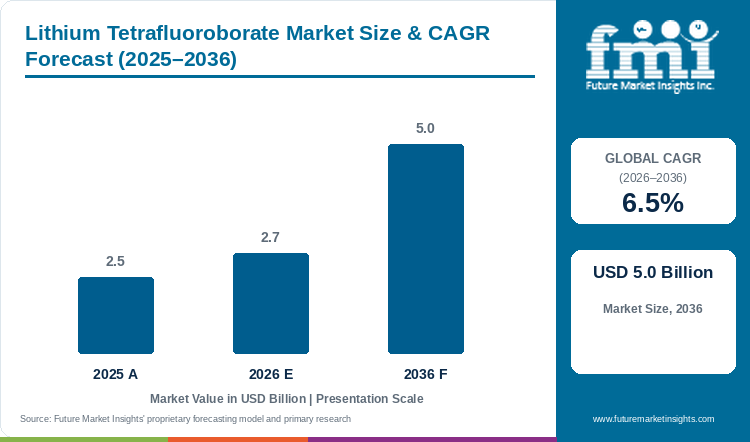
- Market Size (2026)
- USD 2.7 Bn
- Forecast (2036)
- USD 5.0 Bn
- CAGR (2026 to 2036)
- 6.5%
How big is Lithium Tetrafluoroborate Market in 2026?
Valued at USD 2.5 billion in 2025, the lithium tetrafluoroborate market is estimated at USD 2.7 billion in 2026 and is forecast to reach USD 5.0 billion by 2036. Sales of lithium tetrafluoroborate are set to grow at a 6.5% CAGR over the 2026 to 2036 forecast period.
Key drivers of the lithium tetrafluoroborate market include rising EV battery output, battery-led lithium consumption and new electrolyte approvals. EV battery deployment reached 1.2 TWh in 2025, nearly 30% above 2024, according to the International Energy Agency [1]. Batteries also accounted for 88% of the estimated 263,000 tons of lithium consumed worldwide in 2025, the U.S. Geological Survey reported [2]. As per FMI, battery grade LiBF4 holds the leading 42% share in 2026, as formulators reorder approved production lots for running cell lines. Apart from that, fluorochemicals producers are adding battery-grade salt lines to qualify with new cell plants. Each additive recipe approved for vehicle and storage cells is expected to add to lithium tetrafluoroborate sales through 2036.
Key Market Trends & Insights
- By grade, battery grade LiBF4 leads with 42% of 2026 revenue, owing to repeat orders in lots with fixed moisture and impurity limits.
- By application, lithium-ion electrolyte additives account for 47% of sales in 2026. A September 2025 Nano-Micro Letters review found LiBF4 is used mainly as an additive for high-temperature stability and low-temperature performance [3].
- By battery type, EV lithium-ion cells hold 38% in 2026, as vehicle packs need the largest number of electrolyte approvals. EVs made up more than 70% of global battery deployment in 2025 [1].
- By purity, the 99.5-99.9% band takes 37% in 2026 and is expected to remain the volume choice through 2036, even as some cell makers shift to ultra-dry lots.
- By sales channel, electrolyte manufacturers take 43% of sales in 2026, since cell makers leave salt sourcing to the formulator of each approved recipe.
Regional Highlights
- Fastest-growing profiled country: South Korea (7.2% CAGR, 2026 to 2036).
- By country: USA (6.2%) and Germany (5.9%) follow, and France records the slowest profiled rate at 5.3% through 2036.
- Demand for lithium tetrafluoroborate in South Korea is rising fastest, after the government set aside about KRW 280 billion through 2029 for next-generation battery technology in November 2025 [4]. France grows slowest, as most electrolyte approvals at new French cell plants are still ahead.
Market Size & Forecast
Table 1: Market Size and Forecast for the Lithium Tetrafluoroborate Market (USD billion and percentage), 2025 to 2036
| Metric | Value |
|---|---|
| 2025 Market Size | USD 2.5 billion |
| Estimated Market Size in 2026 | USD 2.7 billion |
| Projected Market Size by 2036 | USD 5.0 billion |
| CAGR, 2026 to 2036 | 6.5% |
| Added Revenue, 2026 to 2036 | USD 2.3 billion |
| Market Expansion Multiple | 1.9x |
Revenue from lithium tetrafluoroborate today comes from a small number of electrolyte recipes that use LiBF4 as a co-salt in vehicle and storage cells. Cell factory construction is running ahead of plant use, yet every new line still needs an approved electrolyte before shipping cells. The IEA counted more than 4 TWh of lithium-ion nameplate capacity at the end of 2025, about 30% more than a year earlier [1]. Producers of battery materials are also moving closer to new cell plants. Orbia planned the Louisiana site to make 10,000 metric tons a year of battery-grade electrolyte salts with a USD 100 million U.S. Department of Energy grant [5]. However, Japan's METI described the global battery market as one of structural oversupply in June 2026, and some cell programs are delaying new salt orders [6]. FMI expects suppliers already holding approvals at running cell plants to take most new LiBF4 volume through 2036.
Cell Capacity, Salt Sales per kWh and Electrolyte Qualification
FMI expects most of the USD 2.3 billion added between 2026 and 2036 to come from electrolyte recipes newly cleared for vehicle packs and grid storage. Salt suppliers gain this business by passing cell maker tests, and cell makers rarely swap the salt once a recipe is approved. Vehicle cells set the base, with 1.2 TWh of EV batteries deployed worldwide in 2025 [1]. Cell capacity is concentrated in China, which held more than 80% of global lithium-ion nameplate capacity at the end of 2025 [1]. Storage is adding a second stream of orders, as stationary storage made up one-third of U.S. battery deployment in 2025 [1]. A September 2025 Nano-Micro Letters review found buyers value LiBF4 as a helper salt for high-temperature stability, low-temperature performance and low moisture sensitivity [3]. The same review reported that low conductivity and poor graphite compatibility keep LiBF4 out of the main-salt role [3]. Due to this, LiBF4 orders grow with each additive package that a cell maker approves.
Key trends in the lithium tetrafluoroborate market point to salt supply moving closer to new cell plants in North America and Europe. Orbia's St. Gabriel, Louisiana salt project, backed by a U.S. Department of Energy grant, was set to start operation by 2026 [5]. AMG opened a Bitterfeld-Wolfen refinery in September 2024 with 20,000 tons a year of battery-grade lithium hydroxide [7]. In December 2025, Germany's economy ministry named the planned AMG lithium salts plant at the same park among seven projects sharing about EUR 170 million [8]. Progress has been uneven, however, as Northvolt filed for bankruptcy in Sweden in March 2025 after failing to secure financing [9]. In the USA, the new clean vehicle credit ended for vehicles acquired after September 30, 2025 [10]. In France, Verkor opened the 16 GWh Bourbourg gigafactory in December 2025 and aims for 50 GWh by 2030 [11]. FMI expects purchases at each plant to track the share of cell lines approved with a LiBF4 additive. Suppliers that qualify early at a new plant are expected to keep LiBF4 orders for the life of each cell program.
Table 2: Cell Capacity and Electrolyte Qualification Indicators for the Lithium Tetrafluoroborate Market (TWh, GWh, tons, metric tons, KRW, USD and performance notes), mixed reporting years from 2023 to 2026
| Indicator | Data Point | Market Relevance | Source |
|---|---|---|---|
| EV battery deployment, 2025 | 1.2 TWh, nearly 30% above 2024 | Each new vehicle cell line adds an approved electrolyte and repeat salt lots. | [1] |
| EV share of all battery deployment, 2025 | More than 70%, down from almost 80% in 2024 | Vehicles still bring most salt orders, and storage cells gain share. | [1] |
| Global lithium-ion nameplate capacity, end-2025 | More than 4 TWh, about 30% above end-2024, China over 80% | Spare cell capacity slows new electrolyte approvals at idle plants. | [1] |
| World lithium consumption, 2025 | About 263,000 tons, up 20%, batteries 88% of end uses | Battery makers now set most demand for lithium salts. | [2] |
| LiBF4 performance profile | Stable at high and low temperature, low conductivity as a standalone salt | Sales of LiBF4 stay tied to additive doses more than main-salt volume. | [3] |
| Orbia St. Gabriel salt plant | 10,000 metric tons a year planned, USD 100 million DOE grant | U.S. formulators gain a domestic salt source to qualify. | [5] |
| U.S. new clean vehicle credit | Not allowed for vehicles acquired after September 30, 2025 | Some U.S. EV cell programs and the related electrolyte approvals are slowing. | [10] |
| Korea next-generation battery R&D | About KRW 280 billion through 2029, 25% share goal in 2030 | Korean cell makers are adding new additive packages. | [4] |
| Japan domestic battery base | 150 GWh a year, 2030 to mid-2030s | Japanese electrolyte approvals will grow with the output target. | [6] |
| Verkor Bourbourg gigafactory | Opened at 16 GWh a year, 50 GWh goal by 2030 | French electrolyte buying is now under way. | [11] |
Table 3: Battery Output and LiBF4 Sales Benchmarks for the Lithium Tetrafluoroborate Market (TWh, GWh and USD), 2025 to 2030, mixed years
| Benchmark | Reported Value | Sales Comparison | Source |
|---|---|---|---|
| EV battery deployment, 2025 | 1.2 TWh | About USD 2.08 of LiBF4 sales per kWh (2025 market value of USD 2.5 billion) | IEA [1], Future Market Insights |
| Total battery deployment, 2025 | EVs more than 70% of total | Over USD 1.4 of LiBF4 sales per kWh across all battery types | IEA [1], Future Market Insights |
| Global nameplate capacity, end-2025 | More than 4 TWh | More than 80% of capacity in China | IEA [1] |
| Verkor Bourbourg, opening capacity | 16 GWh a year | About USD 23 million a year of LiBF4 sales at full output | Verkor [11], Future Market Insights |
| Verkor Bourbourg, 2030 goal | 50 GWh a year | About USD 73 million a year | Verkor [11], Future Market Insights |
| Japan domestic manufacturing base | 150 GWh a year | About USD 219 million a year | METI [6], Future Market Insights |
| Market increment, 2026 to 2036 | USD 2.7 billion (2026), USD 5.0 billion (2036) | USD 2.3 billion added | Future Market Insights |
Analyst Perspective
“Cell makers will buy more LiBF4 as electrolytes are asked to work in both freezing weather and summer heat. Salt producers that place approved capacity close to new cell plants in Korea, North America and Europe will hold the strongest position with cell makers through 2036.”
- Nikhil Kaitwade, Principal Consultant, Future Market Insights.
How is the lithium tetrafluoroborate market segmented?
Five commercial categories plus region structure the lithium tetrafluoroborate market, namely grade, application, battery type, purity and sales channel. Leading 2026 shares are battery grade LiBF4 at 42%, lithium-ion electrolyte additives at 47%, EV lithium-ion cells at 38%, the 99.5-99.9% band at 37% and electrolyte manufacturers at 43%.
By grade: battery grade LiBF4, electrolyte additive grade, high-purity electronic grade, industrial grade, and custom formulated salt.
By application: lithium-ion electrolyte additives, primary lithium batteries, supercapacitors, electrochemical research, and specialty fluorination chemistry.
By battery type: EV lithium-ion cells, consumer electronics cells, energy storage cells, and power tools and industrial cells.
By purity: 99.5-99.9%, 99.0-99.5%, above 99.9%, and moisture-controlled ultra-dry.
By sales channel: electrolyte manufacturers, battery cell makers direct, chemical distributors, and R&D/lab suppliers.
By region: North America, Latin America, Western Europe, Eastern Europe, East Asia, South Asia and Pacific, and Middle East and Africa.
Why do cell programs favour battery grade LiBF4 within the grade category?
Battery grade LiBF4 leads with 42% of grade revenue in 2026, owing to fixed-lot reorders from approved cell programs.
Table 4: Grade Share for the Lithium Tetrafluoroborate Market (percentage share), 2026
| Grade | Share (2026) |
|---|---|
| Battery grade LiBF4 | 42% |
| Other Segments Combined | 58% |
| Total | 100% |
Table 5: Grade Leadership and Market Growth for the Lithium Tetrafluoroborate Market (segment and CAGR percentage), 2026 to 2036
| Metric | Value |
|---|---|
| Global CAGR (2026 to 2036) | 6.5% |
| Leading Segment | Battery grade LiBF4 |
Battery grade LiBF4 accounts for 42% of grade revenue in 2026, the largest share in the grade category. Formulators buy this grade once a cell maker approves an electrolyte recipe, and the same grade is then reordered for the life of that cell program. Each lot also has to meet fixed moisture and impurity limits. Electrolyte additive grade follows with smaller lots for trial blends, and electronic, industrial and custom grades serve buyers outside cell production. In May 2025, WIPO published a Stella Chemifa patent application for a battery electrolyte salt blend that lists lithium tetrafluoroborate among borate salt options [12]. FMI notes that demand for battery grade LiBF4 will hold the lead through 2036 as additive packages gain approval at more cell lines in Korea, Japan and North America.
- Repeat orders from approved cell programs hold battery grade LiBF4 at 42% of grade revenue in 2026.
- Every battery grade lot is checked for moisture and impurities before entering a production electrolyte, and formulators expect matching results from each delivery.
What makes lithium-ion electrolyte additives the core application?
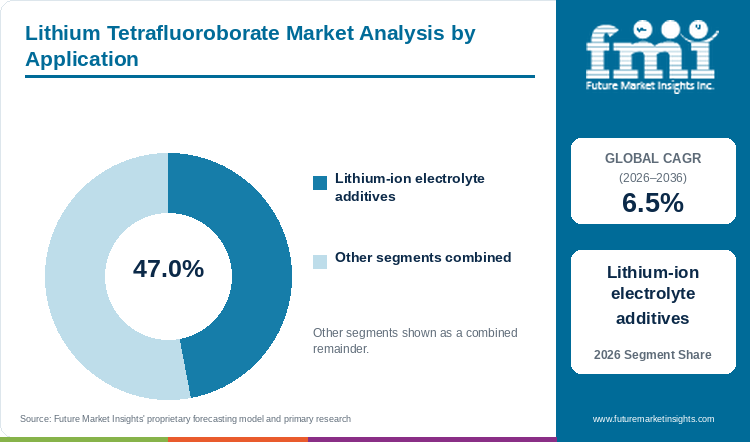
Lithium-ion electrolyte additives take 47% of application revenue in 2026, with LiBF4 dosed next to the main salt.
Lithium-ion electrolyte additives hold 47% of application revenue in 2026, the largest single use of LiBF4. Electrolyte formulators add small amounts of the salt to lithium-ion battery electrolytes so that cells start in freezing weather and stay stable in summer heat. A September 2025 review in Nano-Micro Letters reported that LiBF4 is usually paired with more conductive lithium salts, as poor graphite compatibility and low conductivity limit standalone use [3]. Primary lithium batteries and supercapacitors use far less salt, and research and fluorination buyers order lab-scale lots. Sales of electrolyte additives for lithium-ion batteries are set to grow as more cold-climate vehicle and storage programs clear testing.
- Lithium-ion electrolyte additives take a 47% share in 2026, as cell recipes use LiBF4 for cold starts and heat stability [3].
- Each additive package passes conductivity and gas tests before a cell maker signs off, which delays the first order.
Why are EV lithium-ion cells central to battery type demand?
EV lithium-ion cells command 38% of battery type revenue in 2026, owing to the volume of vehicle electrolyte approvals.
EV lithium-ion cells account for 38% of battery type revenue in 2026, as each new pack design in the electric vehicle battery supply chain needs a separately tested recipe. EVs made up more than 70% of global battery deployment in 2025, and electric trucks reached about 8% of EV battery deployment, the IEA reported [1]. Energy storage cells are growing from a smaller base, and consumer electronics and power tool cells use little salt per program. In June 2026, Japan's METI set a domestic battery base of 150 GWh a year from 2030 to the mid-2030s [6]. Electric trucks and storage are expected to add volume, though passenger EV cells will remain the largest buyer group through 2036.
- EV lithium-ion cells represent 38% share in 2026 and will remain the largest buyer group through 2036, with electric trucks and storage adding volume.
- Salt suppliers usually need a separate approval for each vehicle platform, which lengthens sales cycles.
Why is the 99.5-99.9% band the preferred purity range?
The 99.5-99.9% band carries 37% of purity revenue in 2026, balancing cell limits against lot price.
The 99.5-99.9% band holds 37% of purity revenue in 2026, as buyers weighing lithium tetrafluoroborate price against cell specifications usually settle on this range. Material above 99.9% and ultra-dry lots cost more to purify, and 99.0-99.5% material misses many cell limits. In December 2025, Germany's economy ministry named the planned AMG battery-grade lithium salts plant in Bitterfeld-Wolfen among seven projects sharing about EUR 170 million [8]. Ultra-dry lots will gain orders as cell makers tighten moisture limits, although the middle band will stay the volume choice.
- The 99.5-99.9% band takes 37% share in 2026, as the range meets most cell limits at a workable lot price.
- Buyers shifting to ultra-dry lots check dry packing and dry-room handling with each supplier before approval.
Why do electrolyte manufacturers anchor the sales channel category?
Electrolyte manufacturers buy 43% of LiBF4 by sales channel in 2026, due to control over recipe approval.
Electrolyte manufacturers account for 43% of channel revenue in 2026, as cell makers approve a finished electrolyte and leave salt sourcing to the formulator owning the recipe. Formulators are also building plants next to cell plants abroad. In December 2022, Soulbrain MI announced a USD 75 million plant in Kokomo, Indiana to serve the Stellantis and Samsung SDI battery site [13]. Direct buying by cell makers stays smaller, and distributors and lab suppliers cover small buyers. As per FMI, regional blending plants will keep electrolyte manufacturers as the main route to market through 2036.
- Electrolyte manufacturers command 43% share in 2026, since formulators choose the salt mix before a cell maker signs off.
- Plant sales can move formulator accounts to new owners. In December 2025, Green Energy Origin agreed to buy the Mitsubishi Chemical electrolyte plants in Memphis and Billingham, so salt suppliers may need to requalify with the new owner [14].
What are the drivers, restraints, and opportunities in the lithium tetrafluoroborate market?
Rising battery output adds electrolyte programs that test LiBF4, weak standalone conductivity limits wider use, and new cell plants in North America and Europe open room for local salt suppliers.
- Driver: Rising EV and storage battery output is driving demand for lithium tetrafluoroborate, adding new electrolyte recipes to qualify.
- Restraint: Low standalone conductivity and poor graphite compatibility are top challenges for lithium tetrafluoroborate suppliers, and long approval cycles add delay before the first order.
- Opportunity: Adoption of lithium tetrafluoroborate is expected to widen at new cell plants in North America and Europe through 2036, as buyers seek local high-purity and ultra-dry salt.
Battery Output Lifts Electrolyte Approvals
Sales of lithium tetrafluoroborate rise each time a new cell line clears an electrolyte recipe. Storage adds a second stream of orders, as stationary storage made up one-third of U.S. battery deployment in 2025, according to the IEA [1]. In December 2025, PowerCo began cell production in Salzgitter, with 20 GWh a year planned for the first stage [15]. Each new line needs repeat salt lots once testing is complete. Rising cell output in Europe, Asia and North America is expected to keep new LiBF4 approvals coming through 2036.
Conductivity Limits Keep LiBF4 in a Supporting Role
Low standalone ionic conductivity and poor graphite compatibility keep LiBF4 out of the main-salt role, the Nano-Micro Letters review reported in September 2025 [3]. Formulators therefore pair LiBF4 with LiPF6 or with SEI additives and run long conductivity and gas tests before approval. Slower EV programs add delay, as Northvolt filed for bankruptcy in Sweden in March 2025 [9]. In the USA, the new clean vehicle credit ended for vehicles acquired after September 30, 2025 [10]. FMI observes that long testing and slower vehicle programs may hold back new LiBF4 orders in Europe and the USA.
Local Cell Plants Open Room for Regional Salt Supply
New cell plants in North America and Europe prefer to qualify salt from nearby producers. Verkor opened the 16 GWh Bourbourg gigafactory in December 2025 and aims for 50 GWh by 2030 [11]. AMG opened a refinery in Bitterfeld-Wolfen in September 2024 with 20,000 tons a year of battery-grade lithium hydroxide capacity [7]. Producers sampling high-purity and ultra-dry LiBF4 early at these sites can secure multi-year supply terms. Local salt capacity is expected to open new revenue streams for suppliers in Europe and North America through 2036.
Which country CAGRs are profiled in the lithium tetrafluoroborate market?
South Korea grows fastest among the profiled markets, with a 7.2% CAGR in lithium tetrafluoroborate sales over 2026 to 2036, and France grows slowest at 5.3%. FMI finds that sales of LiBF4 rise only when a new cell line or storage project clears an electrolyte recipe. Due to this, the start-up dates of local battery plants set the pace in each country.
Table 6: Country CAGRs and Primary Growth Levers for the Lithium Tetrafluoroborate Market (CAGR percentage), 2026 to 2036
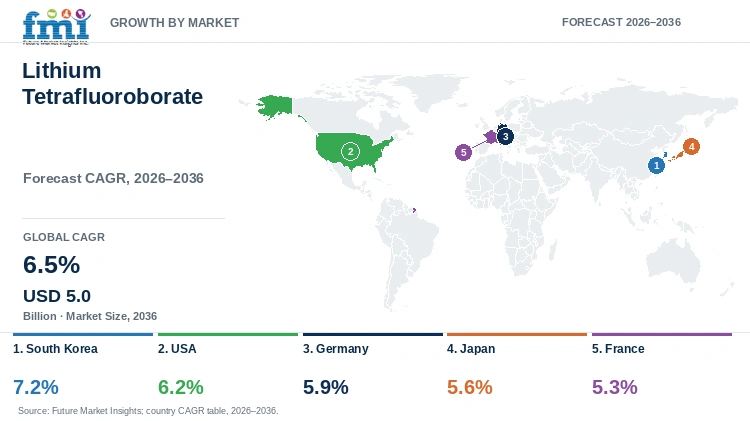
| Country | CAGR (2026-2036) | Primary Growth Lever |
|---|---|---|
| South Korea | 7.2% | Grid storage tenders that score fire safety |
| USA | 6.2% | Local salt supply as tariffs on Chinese batteries rise |
| Germany | 5.9% | First approvals at Salzgitter cell lines |
| Japan | 5.6% | Domestic 150 GWh battery output target |
| France | 5.3% | Electrolyte lots for Douai and Bourbourg plants |
Source: Future Market Insights
South Korea Lithium Tetrafluoroborate Market Outlook (2026-2036)
Demand for lithium tetrafluoroborate in South Korea is forecast to lead the table with a 7.2% CAGR through 2036. Korea Power Exchange held a 540MW/3,240MWh grid storage tender, with winners due to be announced in February 2026 [16]. Fire and facility safety ranked among the highest-weighted non-price factors in the bidding [16]. Storage bidders need cells that stay stable in heat, which favours electrolytes with a LiBF4 co-salt [3]. Contracts are signed only after successful bidders obtain generation permits, so salt orders from the tender will build slowly [16]. The ministry has also set aside about KRW 280 billion through 2029 for next-generation battery technology, giving Korean formulators more new recipes to fill [4].
Key takeaway: Safety-scored storage tenders give Korean LiBF4 suppliers the clearest source of new orders.
USA Lithium Tetrafluoroborate Market Outlook (2026-2036)
Sales of LiBF4 in the USA carry a 6.2% CAGR through 2036, the second-highest rate in the table. Tariffs on Chinese lithium-ion batteries for non-EV uses rise from 7.5% to 25% in 2026, giving battery makers a new reason to source cells and salts locally [17]. The federal new clean vehicle credit no longer applies to vehicles acquired after September 30, 2025, and some EV cell programs are slowing as a result [10]. Orbia's Louisiana salt plant, built with Kanto Denka Kogyo technology and a USD 100 million DOE grant, gives formulators a domestic source to test [5].
Key takeaway: Storage and tool battery lines moving away from Chinese imports will carry U.S. salt orders.
Germany Lithium Tetrafluoroborate Market Outlook (2026-2036)
PowerCo began cell production in Salzgitter in December 2025, with 20 GWh a year planned at first and 40 GWh later [15]. Series production for the Volkswagen Group's Electric Urban Car family starts only in 2026, so German salt volumes will build step by step [15]. Buyers also want nearby sources, and the federal ministry picked the planned AMG battery-grade lithium salts plant in Bitterfeld-Wolfen for STARK funding in December 2025 [8]. Germany holds the middle of the table, with lithium tetrafluoroborate sales set for a 5.9% CAGR through 2036.
Key takeaway: Salt makers qualifying early at Salzgitter are set to lead German sales.
Japan Lithium Tetrafluoroborate Market Outlook (2026-2036)
Japan ranks fourth with a 5.6% CAGR for lithium tetrafluoroborate demand through 2036, ahead of only France. Nissan dropped the planned 5 GWh LFP battery plant in Kitakyushu in May 2025, despite reported state support worth as much as EUR 340 million [18]. Japan's revised battery strategy of June 2026 still aims for 150 GWh a year of domestic output from 2030 [6]. Japanese formulators run long validation cycles, which slows the entry of new salt suppliers. Local producers such as Stella Chemifa, whose 2025 electrolyte patent publication lists LiBF4 among borate salts, stand the strongest chance of taking new lots [12].
Key takeaway: Japanese orders will go to salt producers already holding local electrolyte approvals.
France Lithium Tetrafluoroborate Market Outlook (2026-2036)
France records the slowest rate in the ranking, a 5.3% CAGR through 2036, as most electrolyte recipes at new plants are still in approval. Northern France now has two new battery plants to supply with electrolyte. AESC's 10 GWh Douai site for Renault started production in June 2025 [19], and Verkor opened the 16 GWh Bourbourg gigafactory in December 2025 [11]. Verkor's goal of 50 GWh by 2030 will add more salt orders toward the end of the decade [11].
Key takeaway: French LiBF4 sales will speed up once Douai and Bourbourg complete electrolyte approvals.
Who are the notable companies in the lithium tetrafluoroborate market?
The profiled supplier base covers Morita Chemical Industries, Stella Chemifa, Kanto Denka Kogyo, Foosung, Soulbrain, Central Glass, Mitsubishi Chemical Group, Solvay, Arkema, and Targray.
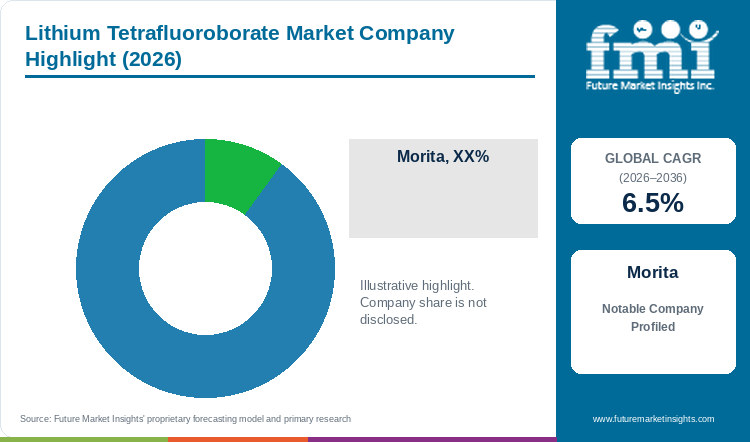
Supply of lithium tetrafluoroborate comes from a small group of fluorochemical salt producers and the electrolyte formulators that approve the lots. Morita Chemical Industries, Stella Chemifa, Kanto Denka Kogyo and Foosung produce fluorinated salts, and Soulbrain, Central Glass and Mitsubishi Chemical Group blend finished electrolytes. Solvay, Arkema and Targray take part through specialty electrolyte materials and distribution. Korean salt makers are also seeking U.S. buyers, as Foosung was reported in October 2025 to have signed a LiPF6 supply contract with a U.S. company [20].
- Fluorochemical salt producers: Morita Chemical Industries, Stella Chemifa, Kanto Denka Kogyo, and Foosung, competing on lot purity and moisture control.
- Electrolyte formulators: Soulbrain, Central Glass, and Mitsubishi Chemical Group, which blend finished electrolytes for cell makers.
- Specialty materials and distribution: Solvay and Arkema supply electrolyte materials, and Targray distributes battery materials.
Competitive Benchmarking: Lithium Tetrafluoroborate Market
Table 7: Competitive Benchmarking for the Lithium Tetrafluoroborate Market (qualitative capability ratings), 2026
| Company | Battery Salt Capability | Formulation | Purity | Reach |
|---|---|---|---|---|
| Morita | Low | Low | High | Low |
| Stella Chemifa | High | High | High | Medium |
| Kanto Denka Kogyo | High | Medium | High | Medium |
| Foosung | High | Low | High | Low |
| Soulbrain | Low | High | Medium | High |
| Central Glass | Low | High | High | High |
| Mitsubishi Chemical | Low | High | Medium | Medium |
| Solvay | Low | Medium | High | High |
| Arkema | Low | High | High | High |
| Targray | Low | Medium | Medium | High |
High marks wide capability in the named column, Medium marks a narrower or program-level range, and Low marks limited public documentation.
Key Developments in the Lithium Tetrafluoroborate Market
- Mitsubishi Chemical agreed in December 2025 to transfer the Memphis and Billingham electrolyte plants to Green Energy Origin [14]. Completion was scheduled for March 31, 2026, subject to approvals [21].
- In October 2025, Foosung was reported to have signed a LiPF6 supply contract with a U.S. company. Eugene Investment & Securities put the volume at about 20% to 30% of Foosung's domestic capacity [20].
- In May 2025, WIPO published a Stella Chemifa electrolyte patent application that lists lithium tetrafluoroborate among borate salts [12].
- In November 2023, Orbia said the Louisiana site would make battery-grade electrolyte salts with LiPF6 technology licensed from Kanto Denka Kogyo, giving U.S. formulators a planned domestic source [5].
Key Players in the Lithium Tetrafluoroborate Market
Fluorochemical Salt Producers
- Morita Chemical Industries Co., Ltd.
- Stella Chemifa Corporation
- Kanto Denka Kogyo Co., Ltd.
- Foosung Co., Ltd.
Electrolyte Formulators
- Soulbrain Co., Ltd.
- Central Glass Co., Ltd.
- Mitsubishi Chemical Group Corporation
Specialty Materials and Distribution
- Solvay S.A.
- Arkema S.A.
- Targray Technology International Inc.
Lithium Tetrafluoroborate Market - Report Scope
Table 8: Report Scope for the Lithium Tetrafluoroborate Market (coverage fields and definitions), 2026 to 2036
| Coverage field | Report scope |
|---|---|
| Market breakdown | Grade; application; battery type; purity; sales channel; region |
| Quantitative units | USD billion |
| Market definition | First-sale revenue from lithium tetrafluoroborate sold as battery, additive, electronic, industrial or custom grade salt. Finished electrolytes, battery cells, other lithium salts and contract services are excluded. |
| Regions covered | North America; Latin America; Western Europe; Eastern Europe; East Asia; South Asia and Pacific; Middle East and Africa |
| Countries covered | South Korea; USA; Germany; Japan; France |
| Key companies profiled | Morita Chemical Industries, Stella Chemifa, Kanto Denka Kogyo, Foosung, Soulbrain, Central Glass, Mitsubishi Chemical Group, Solvay, Arkema, Targray |
| Forecast period | 2026 to 2036 |
| Approach | Salt revenue is built up from grade, application and channel volumes and then matched against top-down battery output, electrolyte approvals and salt plant capacity for each profiled country. |
Lithium Tetrafluoroborate Market - Research Methodology
Table 9: Research Methodology for the Lithium Tetrafluoroborate Market (research methods and approach), 2026 edition
| Method | Approach |
|---|---|
| Primary Research | Primary research includes interviews with fluorochemical salt producers, electrolyte formulators, cell makers, distributors and battery materials buyers. Interviews cover purity limits, approval times, lot prices and supplier switching. |
| Desk Research | Desk research covers government battery programs, ministry releases, company announcements, patent publications, peer-reviewed electrolyte studies and battery output statistics. |
| Market Sizing and Forecasting | The market size is built from the 2025 base value, grade and application shares, salt prices per lot, battery output, electrolyte approvals and country demand conditions. |
| Data Validation | Each estimate is reviewed against company disclosures, battery deployment data and interview findings. LiPF6, LiFSI and finished electrolyte revenue stay outside the count so that no salt sale is counted twice. |
Lithium Tetrafluoroborate Market by Segments
Lithium Tetrafluoroborate Market segmented by Grade:
- Battery grade LiBF4
- Electrolyte additive grade
- High-purity electronic grade
- Industrial grade
- Custom formulated salt
Lithium Tetrafluoroborate Market segmented by Application:
- Lithium-ion electrolyte additives
- Primary lithium batteries
- Supercapacitors
- Electrochemical research
- Specialty fluorination chemistry
Lithium Tetrafluoroborate Market segmented by Battery Type:
- EV lithium-ion cells
- Consumer electronics cells
- Energy storage cells
- Power tools and industrial cells
Lithium Tetrafluoroborate Market segmented by Purity:
- 99.5-99.9%
- 99.0-99.5%
- Above 99.9%
- Moisture-controlled ultra-dry
Lithium Tetrafluoroborate Market segmented by Sales Channel:
- Electrolyte manufacturers
- Battery cell makers direct
- Chemical distributors
- R&D/lab suppliers
Lithium Tetrafluoroborate Market by Region
- North America
- United States
- Canada
- Latin America
- Brazil
- Mexico
- Argentina
- Chile
- Western Europe
- Germany
- France
- United Kingdom
- Italy
- Spain
- Benelux
- Nordics
- Eastern Europe
- Poland
- Czech Republic
- Romania
- Hungary
- East Asia
- Japan
- South Korea
- South Asia and Pacific
- ASEAN
- Australia and New Zealand
- Middle East and Africa
- GCC Countries
- South Africa
- Türkiye
- Israel
Research Sources and Bibliography
- [1] International Energy Agency. (2026). Global EV Outlook 2026, Electric vehicle batteries.https://www.iea.org/reports/global-ev-outlook-2026/electric-vehicle-batteries
- [2] U.S. Geological Survey. (2026, February). Mineral Commodity Summaries 2026, Lithium.https://pubs.usgs.gov/periodicals/mcs2026/mcs2026-lithium.pdf
- [3] Zhao, Y. et al., Nano-Micro Letters. (2025, September 12). Low-Temperature Electrolytes for Lithium-Ion Batteries: Current Challenges, Development, and Perspectives.https://pmc.ncbi.nlm.nih.gov/articles/PMC12432001
- [4] Herald Economy (reporting on the Ministry of Trade, Industry and Energy, Republic of Korea). (2025, November 28). (Ministry moves to secure next-generation battery technology, targets 25% global share in 2030).https://www.heraldk.com/article/2025112800155448489
- [5] Orbia. (2023, November 21). U.S. Department of Energy Secretary Jennifer Granholm visits, commends Orbia Fluorinated Solutions battery materials site as a model for the nation.https://orbia.com/this-is-orbia/news-and-stories/US-DOE-commends-Orbia-FS-battery-materials-site
- [6] Ministry of Economy, Trade and Industry, Japan. (2026, June 2). "Battery Industry Strategy" Revised as the "Battery and Power Industry Strategy".https://www.meti.go.jp/english/press/2026/0602_003.html
- [7] AMG Critical Materials N.V. (2024, September 18). AMG Hosts Successful Opening of Europe's First Lithium Hydroxide Refinery.https://live.euronext.com/sites/default/files/company_press_releases/attachments/2024/09/18/cpr01_hugin_AMG%20Lithium%20Hydroxide%20Refinery%20Opening.pdf
- [8] Federal Ministry for Economic Affairs and Energy, Germany. (2025, December 19). 170 Millionen Euro für Transformationsprojekte in Kohleregionen im Bundesförderprogramm STARK.https://www.bundeswirtschaftsministerium.de/Redaktion/DE/Pressemitteilungen/2025/12/20251219-170-millionen-euro-fuer-transformationsprojekte-kohleregionen-bundesfoerderprogramm-stark.html
- [9] Northvolt. (2025, March 12). Northvolt files for bankruptcy in Sweden.https://northvolt.com/articles/northvolt-files-for-bankruptcy-in-sweden/
- [10] Internal Revenue Service. (2025, August 21). FS-2025-05, FAQs for modification of sections 25C, 25D, 25E, 30C, 30D, 45L, 45W and 179D under Public Law 119-21 (One Big Beautiful Bill Act).https://www.irs.gov/newsroom/faqs-for-modification-of-sections-25c-25d-25e-30c-30d-45l-45w-and-179d-under-public-law-119-21-139-stat-72-july-4-2025-commonly-known-as-the-one-big-beautiful-bill-act-obbb
- [11] Verkor. (2025, December 11). Verkor reaches a decisive milestone and opens its first gigafactory.https://verkor.com/wp-content/uploads/2025/12/Press-release-_-Verkor-inauguration-gigafactory-2.pdf
- [12] Stella Chemifa Corporation (WIPO publication, via Google Patents). (2025, May 8). WO2025095088A1, Non-aqueous electrolyte solution for secondary battery, and secondary battery provided with said solution.https://patents.google.com/patent/WO2025095088A1/en
- [13] Indiana Economic Development Corporation. (2022, December 13). Electric Vehicle Battery Supplier Powers Indiana's Thriving Economy of the Future.https://www.iedc.in.gov/events/news/details/2022/12/13/electric-vehicle-battery-supplier-powers-indiana%27s-thriving-economy-of-the-future
- [14] Green Energy Origin (GEO), via Fortune press releases. (2025, December 12). GEO expands EV supply chain with acquisition of Mitsubishi Chemical electrolyte plants.https://www.fortune.com/press-releases/green-energy-origin-geo-ev-supply-chain-mitsubishi-chemical-electrolyte-plant-acquisition-2025-12-12
- [15] battery-news.de. (2025, December 18). Volkswagen Launches Cell Production in Salzgitter.https://battery-news.de/en/2025/12/18/volkswagen-launches-cell-production-in-salzgitter/
- [16] Energy-Storage.news. (2025, December 15). Korea Power Exchange to announce winners of 540MW/3,240MWh energy storage auction in February.https://www.energy-storage.news/?p=92059
- [17] Mayer Brown. (2024, May 17). USTR Finalizes 4-Year Review of Section 301 Tariffs on Imports from China, Increasing Tariffs on Clean Energy Supply Chains.https://www.mayerbrown.com/en/insights/publications/2024/05/ustr-finalizes-4year-review-of-section-301-tariffs-on-imports-from-china-increasing-tariffs-on-clean-energy-supply-chains
- [18] electrive. (2025, May 9). Nissan scraps plans for Japanese LFP battery plant in struggle for survival.https://www.electrive.com/2025/05/09/nissan-scraps-plans-for-japanese-lfp-battery-plant-in-struggle-for-survival/
- [19] Evertiq. (2025, June 12). AESC starts battery production at Douai gigafactory.https://evertiq.com/news/2025-06-12-aesc-starts-battery-production-at-douai-gigafactory
- [20] Asia Economy. (2025, October 27). [Market Focus] Foosung Surges on News of Supply Contract with U.S. Company.https://view.asiae.co.kr/en/article/2025102710061740335
- [21] ChemIn Digest. (2025, December 15). Mitsubishi to Transfer U.S. and U.K. Electrolyte Manufacturing Assets to GEO.https://chemindigest.com/mitsubishi-to-transfer-u-s-and-u-k-electrolyte-assets/
- [22] Arkema and Nippon Shokubai, via Business Wire. (2022, May 30). Nippon Shokubai and Arkema, a strategic partnership to mass-produce LiFSI electrolyte salts for a European battery supply chain.https://www.businesswire.com/news/home/20220530005324/en/Nippon-Shokubai-and-Arkema-a-Strategic-Partnership-to-Mass-produce-LiFSI-Electrolyte-Salts-for-a-European-Battery-Supply-Chain
This bibliography is provided for reader reference. The full report contains the complete reference list and detailed citations.
This Report Answers
- What value does the lithium tetrafluoroborate market hold in 2026?
- By 2036, what value will LiBF4 sales reach?
- Which grade holds the largest share of lithium tetrafluoroborate demand?
- Why do lithium-ion electrolyte additives lead application sales?
- Which profiled country records the fastest LiBF4 growth?
- Which salt producers and electrolyte formulators lead the market?
Frequently Asked Questions
How large is the lithium tetrafluoroborate market expected in 2026?
The lithium tetrafluoroborate market stands at USD 2.7 billion in 2026, according to FMI. Revenue will reach USD 5.0 billion by 2036 as more vehicle and storage cells adopt additive-based electrolytes.
What CAGR is projected for the lithium tetrafluoroborate market through 2036?
Sales will expand at a 6.5% CAGR between 2026 and 2036, as per FMI. New cell plants in North America and Europe and steady programs in East Asia will add most of the gain.
Which grade holds a notable market share in 2026?
Battery grade LiBF4 will hold 42% of grade revenue in 2026. Approved cell programs will keep reordering this grade in lots with fixed moisture and impurity limits.
Which application holds a notable share in 2026?
Lithium-ion electrolyte additives will account for 47% of application revenue in 2026. Formulators will keep adding small LiBF4 doses next to LiPF6 for cold starts and heat stability.
Which country has a notable expansion outlook through 2036?
South Korea will post a 7.2% CAGR from 2026 to 2036, the highest among profiled countries. Public battery funding and safety-scored grid storage tenders will support new salt orders there.
Who are the key companies in the lithium tetrafluoroborate market?
Morita Chemical Industries, Stella Chemifa, Kanto Denka Kogyo, Foosung, Soulbrain, Central Glass, Mitsubishi Chemical Group, Solvay, Arkema, and Targray are the main suppliers. Competition among these firms will turn on salt purity, moisture control and approvals held at cell plants.
Preview the report firsthand - request a free sample
Get SampleGet the brochure for pricing and purchase details.
Get PDFTable of Content
- Key Takeaways
- Market Size and CAGR
- Top Growth Driver
- Fastest Growing Segment
- Leading Region
- Key Companies
- Emerging Opportunities
- Executive Summary
- Global Market Outlook
- Demand-side Trends
- Supply-side Trends
- Technology Roadmap Analysis
- Analysis and Recommendations
- Analyst Perspective (What is happening? Why now? What should investors know?)
- Key Questions Answered
- How large is the market?
- What is the CAGR?
- What are key trends?
- Which region dominates?
- Who are the leaders?
- Market Overview
- Market Coverage / Taxonomy
- Market Definition / Scope / Limitations
- Research Methodology
- Chapter Orientation
- Analytical Lens and Working Hypotheses
- Market Structure, Signals, and Trend Drivers
- Benchmarking and Cross-market Comparability
- Market Sizing, Forecasting, and Opportunity Mapping
- Research Design and Evidence Framework
- Desk Research Programme (Secondary Evidence)
- Expert Input and Fieldwork (Primary Evidence)
- Tooling, Models, and Reference Databases
- Data Engineering and Model Build
- Quality Assurance and Audit Trail
- Market Background
- Market Dynamics (Drivers, Restraints, Opportunity, Trends)
- Scenario Forecast (Optimistic, Likely, Conservative)
- Impact Analysis
- AI Impact
- Sustainability Impact
- Regulatory Impact
- Technology Impact
- Consumer / Buyer Analysis
- Purchase Drivers
- Adoption Barriers
- Buyer Journey
- Opportunity Map Analysis
- Product Life Cycle Analysis
- Supply Chain Analysis
- Investment Feasibility Matrix
- Value Chain Analysis
- PESTLE and Porter's Analysis
- Regulatory Landscape
- Regional Parent Market Outlook
- Production and Consumption Statistics
- Import and Export Statistics
- Global Market Analysis and Forecast, 2021 to 2036
- Historical Market Size Value (USD Billion) Analysis, 2021 to 2025
- Current and Future Market Size Value (USD Billion) Projections, 2026 to 2036
- Y-o-Y Growth Trend Analysis
- Absolute $ Opportunity Analysis
- Global Market Pricing Analysis, 2021 to 2036
- Global Market Analysis and Forecast, By Grade, 2021 to 2036
- Introduction / Key Findings
- Historical Market Size Value (USD Billion) Analysis By Grade, 2021 to 2025
- Current and Future Market Size Value (USD Billion) Analysis and Forecast By Grade, 2026 to 2036
- Battery grade LiBF4
- Electrolyte additive grade
- High-purity electronic grade
- Industrial grade
- Custom formulated salt
- Y-o-Y Growth Trend Analysis By Grade, 2021 to 2025
- Absolute $ Opportunity Analysis By Grade, 2026 to 2036
- Global Market Analysis and Forecast, By Application, 2021 to 2036
- Introduction / Key Findings
- Historical Market Size Value (USD Billion) Analysis By Application, 2021 to 2025
- Current and Future Market Size Value (USD Billion) Analysis and Forecast By Application, 2026 to 2036
- Lithium-ion electrolyte additives
- Primary lithium batteries
- Supercapacitors
- Electrochemical research
- Specialty fluorination chemistry
- Y-o-Y Growth Trend Analysis By Application, 2021 to 2025
- Absolute $ Opportunity Analysis By Application, 2026 to 2036
- Global Market Analysis and Forecast, By Battery Type, 2021 to 2036
- Introduction / Key Findings
- Historical Market Size Value (USD Billion) Analysis By Battery Type, 2021 to 2025
- Current and Future Market Size Value (USD Billion) Analysis and Forecast By Battery Type, 2026 to 2036
- EV lithium-ion cells
- Consumer electronics cells
- Energy storage cells
- Power tools and industrial cells
- Y-o-Y Growth Trend Analysis By Battery Type, 2021 to 2025
- Absolute $ Opportunity Analysis By Battery Type, 2026 to 2036
- Global Market Analysis and Forecast, By Purity, 2021 to 2036
- Introduction / Key Findings
- Historical Market Size Value (USD Billion) Analysis By Purity, 2021 to 2025
- Current and Future Market Size Value (USD Billion) Analysis and Forecast By Purity, 2026 to 2036
- 99.5-99.9%
- 99.0-99.5%
- Above 99.9%
- Moisture-controlled ultra-dry
- Y-o-Y Growth Trend Analysis By Purity, 2021 to 2025
- Absolute $ Opportunity Analysis By Purity, 2026 to 2036
- Global Market Analysis and Forecast, By Sales Channel, 2021 to 2036
- Introduction / Key Findings
- Historical Market Size Value (USD Billion) Analysis By Sales Channel, 2021 to 2025
- Current and Future Market Size Value (USD Billion) Analysis and Forecast By Sales Channel, 2026 to 2036
- Electrolyte manufacturers
- Battery cell makers direct
- Chemical distributors
- R&D/lab suppliers
- Y-o-Y Growth Trend Analysis By Sales Channel, 2021 to 2025
- Absolute $ Opportunity Analysis By Sales Channel, 2026 to 2036
- Global Market Analysis and Forecast, By Region, 2021 to 2036
- Introduction
- Historical Market Size Value (USD Billion) Analysis By Region, 2021 to 2025
- Current Market Size Value (USD Billion) Analysis and Forecast By Region, 2026 to 2036
- North America
- Latin America
- Western Europe
- Eastern Europe
- East Asia
- South Asia and Pacific
- Middle East and Africa
- Market Attractiveness Analysis By Region
- North America Market Analysis and Forecast, By Country, 2021 to 2036
- Historical Market Size Value (USD Billion) Trend Analysis By Market Taxonomy, 2021 to 2025
- Market Size Value (USD Billion) Forecast By Market Taxonomy, 2026 to 2036
- By Country
- United States
- Canada
- By Grade
- By Application
- By Battery Type
- By Purity
- By Sales Channel
- By Country
- Market Attractiveness Analysis
- By Country
- By Grade
- By Application
- By Battery Type
- By Purity
- By Sales Channel
- Key Takeaways
- Latin America Market Analysis and Forecast, By Country
- Historical Market Size Value (USD Billion) Trend Analysis By Market Taxonomy, 2021 to 2025
- Market Size Value (USD Billion) Forecast By Market Taxonomy, 2026 to 2036
- By Country
- Brazil
- Mexico
- Argentina
- Chile
- By Grade
- By Application
- By Battery Type
- By Purity
- By Sales Channel
- By Country
- Market Attractiveness Analysis
- By Country
- By Grade
- By Application
- By Battery Type
- By Purity
- By Sales Channel
- Key Takeaways
- Western Europe Market Analysis and Forecast, By Country
- Historical Market Size Value (USD Billion) Trend Analysis By Market Taxonomy, 2021 to 2025
- Market Size Value (USD Billion) Forecast By Market Taxonomy, 2026 to 2036
- By Country
- Germany
- France
- United Kingdom
- Italy
- Spain
- Benelux
- Nordics
- By Grade
- By Application
- By Battery Type
- By Purity
- By Sales Channel
- By Country
- Market Attractiveness Analysis
- By Country
- By Grade
- By Application
- By Battery Type
- By Purity
- By Sales Channel
- Key Takeaways
- Eastern Europe Market Analysis and Forecast, By Country
- Historical Market Size Value (USD Billion) Trend Analysis By Market Taxonomy, 2021 to 2025
- Market Size Value (USD Billion) Forecast By Market Taxonomy, 2026 to 2036
- By Country
- Poland
- Czech Republic
- Romania
- Hungary
- By Grade
- By Application
- By Battery Type
- By Purity
- By Sales Channel
- By Country
- Market Attractiveness Analysis
- By Country
- By Grade
- By Application
- By Battery Type
- By Purity
- By Sales Channel
- Key Takeaways
- East Asia Market Analysis and Forecast, By Country
- Historical Market Size Value (USD Billion) Trend Analysis By Market Taxonomy, 2021 to 2025
- Market Size Value (USD Billion) Forecast By Market Taxonomy, 2026 to 2036
- By Country
- Japan
- South Korea
- By Grade
- By Application
- By Battery Type
- By Purity
- By Sales Channel
- By Country
- Market Attractiveness Analysis
- By Country
- By Grade
- By Application
- By Battery Type
- By Purity
- By Sales Channel
- Key Takeaways
- South Asia and Pacific Market Analysis and Forecast, By Country
- Historical Market Size Value (USD Billion) Trend Analysis By Market Taxonomy, 2021 to 2025
- Market Size Value (USD Billion) Forecast By Market Taxonomy, 2026 to 2036
- By Country
- ASEAN
- Australia and New Zealand
- By Grade
- By Application
- By Battery Type
- By Purity
- By Sales Channel
- By Country
- Market Attractiveness Analysis
- By Country
- By Grade
- By Application
- By Battery Type
- By Purity
- By Sales Channel
- Key Takeaways
- Middle East and Africa Market Analysis and Forecast, By Country
- Historical Market Size Value (USD Billion) Trend Analysis By Market Taxonomy, 2021 to 2025
- Market Size Value (USD Billion) Forecast By Market Taxonomy, 2026 to 2036
- By Country
- GCC Countries
- South Africa
- Türkiye
- Israel
- By Grade
- By Application
- By Battery Type
- By Purity
- By Sales Channel
- By Country
- Market Attractiveness Analysis
- By Country
- By Grade
- By Application
- By Battery Type
- By Purity
- By Sales Channel
- Key Takeaways
- Key Countries Market Analysis
- United States
- Pricing Analysis
- Market Share Analysis, 2025
- By Grade
- By Application
- By Battery Type
- By Purity
- By Sales Channel
- Canada
- Pricing Analysis
- Market Share Analysis, 2025
- By Grade
- By Application
- By Battery Type
- By Purity
- By Sales Channel
- Mexico
- Pricing Analysis
- Market Share Analysis, 2025
- By Grade
- By Application
- By Battery Type
- By Purity
- By Sales Channel
- Brazil
- Pricing Analysis
- Market Share Analysis, 2025
- By Grade
- By Application
- By Battery Type
- By Purity
- By Sales Channel
- Chile
- Pricing Analysis
- Market Share Analysis, 2025
- By Grade
- By Application
- By Battery Type
- By Purity
- By Sales Channel
- Germany
- Pricing Analysis
- Market Share Analysis, 2025
- By Grade
- By Application
- By Battery Type
- By Purity
- By Sales Channel
- United Kingdom
- Pricing Analysis
- Market Share Analysis, 2025
- By Grade
- By Application
- By Battery Type
- By Purity
- By Sales Channel
- Italy
- Pricing Analysis
- Market Share Analysis, 2025
- By Grade
- By Application
- By Battery Type
- By Purity
- By Sales Channel
- Spain
- Pricing Analysis
- Market Share Analysis, 2025
- By Grade
- By Application
- By Battery Type
- By Purity
- By Sales Channel
- France
- Pricing Analysis
- Market Share Analysis, 2025
- By Grade
- By Application
- By Battery Type
- By Purity
- By Sales Channel
- ASEAN
- Pricing Analysis
- Market Share Analysis, 2025
- By Grade
- By Application
- By Battery Type
- By Purity
- By Sales Channel
- Australia and New Zealand
- Pricing Analysis
- Market Share Analysis, 2025
- By Grade
- By Application
- By Battery Type
- By Purity
- By Sales Channel
- Japan
- Pricing Analysis
- Market Share Analysis, 2025
- By Grade
- By Application
- By Battery Type
- By Purity
- By Sales Channel
- South Korea
- Pricing Analysis
- Market Share Analysis, 2025
- By Grade
- By Application
- By Battery Type
- By Purity
- By Sales Channel
- Poland
- Pricing Analysis
- Market Share Analysis, 2025
- By Grade
- By Application
- By Battery Type
- By Purity
- By Sales Channel
- Hungary
- Pricing Analysis
- Market Share Analysis, 2025
- By Grade
- By Application
- By Battery Type
- By Purity
- By Sales Channel
- Türkiye
- Pricing Analysis
- Market Share Analysis, 2025
- By Grade
- By Application
- By Battery Type
- By Purity
- By Sales Channel
- South Africa
- Pricing Analysis
- Market Share Analysis, 2025
- By Grade
- By Application
- By Battery Type
- By Purity
- By Sales Channel
- United States
- Market Structure Analysis
- Competition Dashboard
- Competition Benchmarking
- Market Share Analysis of Top Players
- By Regional
- By Grade
- By Application
- By Battery Type
- By Purity
- By Sales Channel
- Emerging Startups
- Innovation Benchmarking
- Competition Analysis
- Competition Deep Dive
- Morita
- Overview
- Product Portfolio
- Profitability by Market Segments
- Sales Footprint
- Strategy Overview
- Marketing Strategy
- Product Strategy
- Channel Strategy
- Stella Chemifa
- Kanto Denka Kogyo
- Foosung
- Soulbrain
- Central Glass
- Mitsubishi Chemical
- Solvay
- Arkema
- Targray
- Morita Chemical Industries Co., Ltd.
- Stella Chemifa Corporation
- Kanto Denka Kogyo Co., Ltd.
- Foosung Co., Ltd.
- Soulbrain Co., Ltd.
- Central Glass Co., Ltd.
- Mitsubishi Chemical Group Corporation
- Solvay S.A.
- Arkema S.A.
- Targray Technology International Inc.
- Morita
- Case Studies
- Success Stories
- Recent Developments
- Competition Deep Dive
- Assumptions & Acronyms Used


