

- Market Size (2026)
- USD 460.0 Mn
- Forecast (2036)
- USD 1150.4 Mn
- CAGR (2026 to 2036)
- 9.6%
How big is the Electronic Batch Record Integration for Automation Market in 2026?
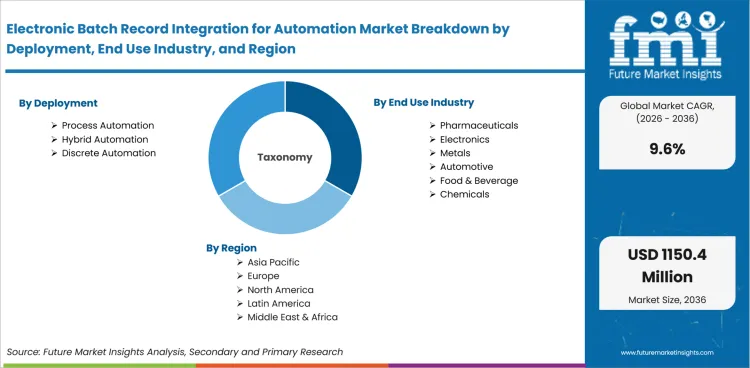
The market is estimated at USD 460.0 million in 2026 and is projected to reach USD 1,150.4 million by 2036 at 9.6% CAGR.
The Electronic Batch Record Integration for Automation Market is forecast to grow from USD 419.7 million in 2025 to USD 1,150.4 million by 2036 as regulated manufacturers connect batch evidence to automation data. Process Automation is expected to hold 52.0% share in 2026 because batch plants need recipe, equipment, and operator events in one validated record. Pharmaceuticals are projected to represent 46.0% share in 2026 owing to GMP release pressure and FDA-facing audit requirements.
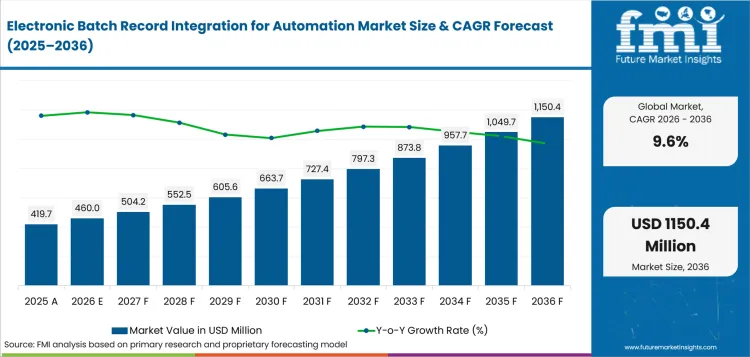
Electronic Batch Record Integration for Automation Market Overview: Size and Forecast
- 2025 Market Size: USD 419.7 million
- 2026 Market Size: USD 460.0 million
- 2036 Market Size: USD 1,150.4 million
- Forecast CAGR: 9.6% from 2026 to 2036
- Leading Deployment: Process Automation
- Process Automation Share in 2026: 52.0%
- Leading End-use Industry: Pharmaceuticals
- Pharmaceuticals Share in 2026: 46.0%
- Leading Country by CAGR: India
- India CAGR: 11.2% by 2036
Summary of the Electronic Batch Record Integration for Automation Market
- Demand and Growth Drivers
- Increasing adoption of electronic batch record (EBR) platforms across pharmaceutical and biopharmaceutical manufacturing facilities is driving demand for seamless integration with automation, MES, and process control systems.
- Growing production volumes of biologics, vaccines, and personalized medicines are accelerating investments in automated batch documentation solutions that improve operational efficiency and data integrity.
- Regulatory compliance requirements and the shift toward paperless manufacturing are encouraging manufacturers to deploy integrated EBR systems, supporting steady market growth and technology adoption.
- Rising digital transformation spending in the life sciences industry, coupled with expanding sales of smart manufacturing solutions, is boosting the deployment of EBR-automation integration platforms worldwide.
- Product and Segment View
- Process Automation leads Deployment with 52.0% share because recipe-led plants need equipment-context records.
- Pharmaceuticals lead End-use Industry with 46.0% share as GMP release depends on validated audit trails.
- Engineering Software leads Offering with 42.0% share as templates and e-signature workflows carry the highest software value.
- North America leads Region with 34.0% share owing to established compliance spending.
- Geography and Competitive Outlook
- The United States is expected to expand at 9.2% CAGR with FDA record rules shaping buyer requirements.
- Germany is projected to grow at 8.8% CAGR as CDMO and specialty production sites digitize batch execution.
- China and India are forecast above the global pace at 10.3% CAGR and 11.2% CAGR respectively.
- Siemens, Rockwell Automation, Emerson, Yokogawa, AVEVA, Honeywell, Körber, and Tulip compete through batch workflow and automation integration.
- Analyst Opinion
- Nandini Roy Choudhury, Principal Consultant at Future Market Insights for the industrial domain, says, “This market is best understood as release-control infrastructure. Buyers are not only replacing paper records. They are trying to prove what happened on the line without slowing operators or creating validation debt. Platforms that connect recipes, materials, alarms, e-signatures, and review notes into one trusted record should gain preference in regulated plants.”
Record integrity is the central purchase driver. FDA Part 11 gives electronic records and electronic signatures a compliance basis when systems meet audit-trail, access, and retention rules. FDA reported in December 2025 that its FY2024 quality program covered 972 drug quality inspections and that more than 62% occurred at foreign sites. This inspection mix pushes export-facing plants to strengthen batch evidence before release decisions. Interoperability now affects supplier selection. OPC Foundation described OPC UA as an interoperability framework for secure industrial data exchange and launched its Cloud Initiative in April 2024. Buyers comparing manufacturing execution systems increasingly ask whether integration can reduce validation work without weakening production control.
Electronic Batch Record Integration for Automation Market Value Analysis
- The market rises from USD 460.0 million in 2026 to USD 1,150.4 million by 2036 as batch review becomes tied to production release.
- A 9.6% CAGR reflects the shift from stand-alone documents to validated execution data in regulated manufacturing.
- Process Automation is expected to represent 52.0% share in 2026 with batch plants linking records to DCS and PLC events.
- Pharmaceuticals are projected to account for 46.0% share in 2026 as batch release and GMP traceability shape purchase decisions.
- Engineering Software is estimated at 42.0% share in 2026 as templates and e-signature workflows carry the highest software value.
Why is the Electronic Batch Record Integration for Automation Market Growing?
- Batch release teams need records tied to line events because manual review creates delay and data-integrity risk.
- Pharma and specialty chemical plants use MES links to turn recipe execution into audit-ready evidence.
- Remote operations require stronger electronic signatures and operator identity control within validated workflows.
- Legacy plant data must be mapped into records because older PLC and historian tags often lack business context.
- Review-by-exception gains support as quality teams focus on deviations instead of reading every paper entry.
Batch release is becoming a production constraint in regulated plants. FDA reported in December 2025 that FY2024 inspections covered 972 drug quality sites and that more than 62% occurred outside the United States. This makes electronic evidence more useful for suppliers serving USA and global buyers.
Automation integration is gaining weight as buyers try to reduce gaps between shop-floor data and quality records. OPC Foundation’s April 2024 Cloud Initiative focused on extending OPC UA interoperability across IT and cloud platforms. Suppliers with tested industrial automation spending links can shorten mapping work and improve project economics.
How is the electronic batch record integration for automation market segmented?
The electronic batch record integration for automation market is segmented by offering, deployment, application, end-use industry, and region.
- Process Automation is expected to lead Deployment with 52.0% share in 2026 because batch plants need recipe-linked evidence.
- Pharmaceuticals are projected to lead End-use Industry with 46.0% share in 2026 given batch release and GMP traceability needs.
- Engineering Software is estimated to lead Offering with 42.0% share in 2026 as templates and e-signature rules form the record backbone.
- Line Integration is anticipated to lead Application with 35.0% share in 2026 with records tied to machine and operator steps.
- North America is projected to hold 34.0% share in 2026 as compliance budgets support validated software projects.
Segmentation reflects where automation data becomes usable as a batch record. Buyers prefer systems that connect factory automation controls with validated release workflows without weakening production control. The same buying logic also overlaps with manufacturing execution systems, where record context, recipe status, operator actions, and equipment events need to move together.
Why does process automation lead the deployment segment?
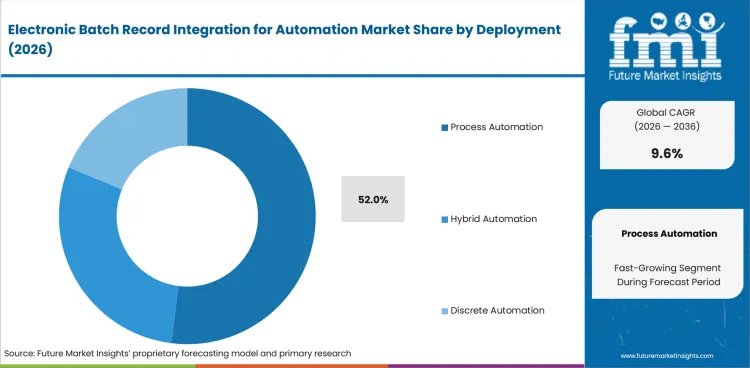
- Process Automation is expected to represent 52.0% share in 2026 as batch plants rely on recipes, tanks, reactors, and cleaning steps.
- Hybrid Automation gains attention in packaging and final assembly lines where batch genealogy must connect process steps with discrete handling.
Why do pharmaceuticals lead the end-use industry segment?
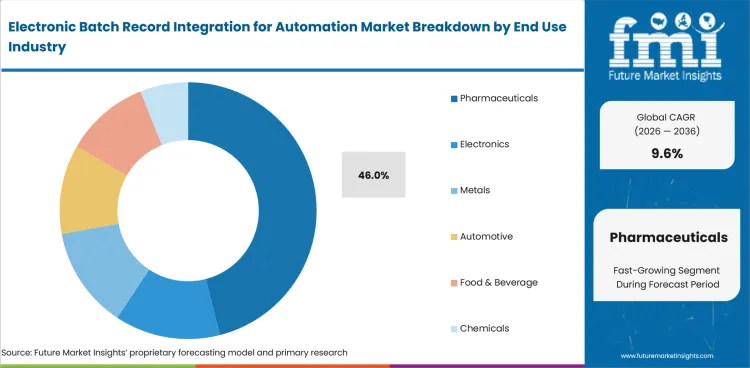
- Pharmaceuticals are projected to represent 46.0% share in 2026 as GMP release needs trusted batch evidence and clear deviation records. Food & Beverage sites use the same tools for allergen control and recipe checks, but validation pressure is usually lower than pharma.
- Pharmaceutical buyers lead because every batch must support release, inspection readiness, and product genealogy. This creates adjacent demand from pharmaceutical continuous manufacturing equipment, where tighter process control also increases the need for clean electronic evidence.
Why does engineering software lead the offering segment?
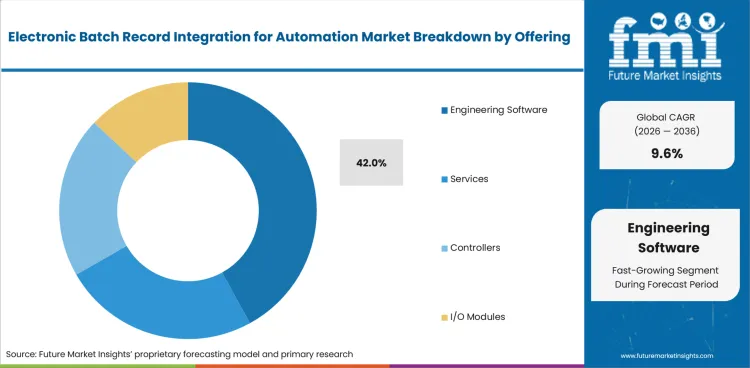
- Engineering Software is projected to account for 42.0% share in 2026 as recipe templates, audit trails, and e-signatures carry the highest record value.
- Services are expected to stay critical as validation teams must test each equipment interface before electronic records can support batch release.
Why does line integration lead the application segment?
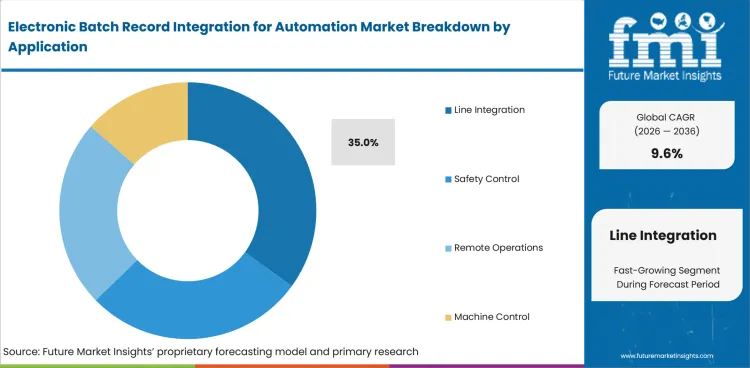
- Line Integration is anticipated to hold 35.0% share in 2026 as plants link weigh rooms, processing skids, and packaging stations.
- Remote Operations needs stronger identity control as operators approve steps from distributed stations and supervisors review exceptions away from the line.
What are the drivers, restraints, and opportunities in the electronic batch record integration for automation market?
Validated data capture, MES-DCS integration, and review-by-exception workflows support adoption, while legacy data-context gaps and validation cost slow rollout.
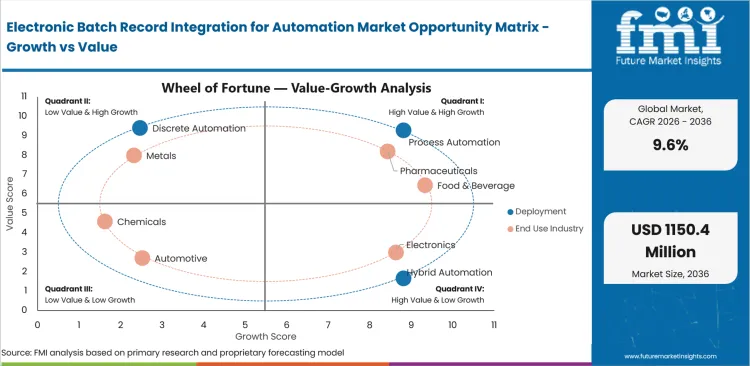
- Driver: Validated e-signature workflows drive software demand as plants need each operator action linked to identity and time.
- Driver: MES-DCS integration raises project value because batch records must capture recipe status and equipment events.
- Restraint: Data-context gaps restrain adoption when old tags do not match business terms used by quality teams.
- Opportunity: Cloud and edge architectures open opportunity where companies need multi-site standards without replacing all local control systems.
- Restraint: Services intensity stays high as validation, training, and change control shape project cost.
Validated Data Capture
Validated data capture is the core demand driver for electronic batch record integration. FDA Part 11 applies to electronic records used under FDA record requirements and treats compliant e-signatures as equivalent to handwritten signatures. A record must show the operator, time, action, equipment state, and exception path in one traceable chain.
MES-DCS Integration
The strongest project value appears when MES and control systems share the right context. Rockwell noted in 2024 that FactoryTalk PharmaSuite MES was adopted for central weighing at Rottendorf Pharma. Similar digital-thread projects are expected to reduce mismatches between the manufacturing step and the quality record.
Electronic Batch Record Integration for Automation Market Demand Outlook
Demand outlook is moving toward validated production records that reduce release queues and support faster exception review. FDA’s FY2024 quality report recorded 421 recall events and 105 warning letters across drug quality work. These enforcement signals show why regulated producers need records that connect exceptions to equipment state and corrective action history.
Automation suppliers are changing product design around usability. Emerson introduced DeltaV Workflow Management in April 2024 and Yokogawa released OpreX Batch MES in October 2024. These moves indicate that suppliers are treating batch workflow as part of process automation instrumentation rather than a separate document layer.
Voice of Customer and Decision-driver Analysis
The practical decision drivers are interface reliability, validation effort, role-based access, and record review speed. Buyers want systems that capture operator actions and equipment events without slowing line work. A low license price can become expensive when every interface requires custom testing.
Supplier selection increasingly favors platforms with configurable templates and reusable connectors. Siemens Opcenter updates in 2024 and 2026 emphasized manufacturing execution workflows for regulated production. These directions align with smart factory software buying where traceability and operator guidance must be designed together.
Which countries are growing fastest in the Electronic Batch Record Integration for Automation Market?
India 11.2% CAGR, China 10.3% CAGR, South Korea 9.8% CAGR, United States 9.2% CAGR, Germany 8.8% CAGR, France 8.6% CAGR, United Kingdom 8.5% CAGR, and Japan 8.1% CAGR through 2036.
.webp "Top Country Growth Comparison Electronic Batch Record Integration For Automation Market Cagr (2026 2036)")
| Country | CAGR |
|---|---|
| India | 11.2% |
| China | 10.3% |
| South Korea | 9.8% |
| United States | 9.2% |
| Germany | 8.8% |
| France | 8.6% |
| United Kingdom | 8.5% |
| Japan | 8.1% |
Source: Future Market Insights, 2026.
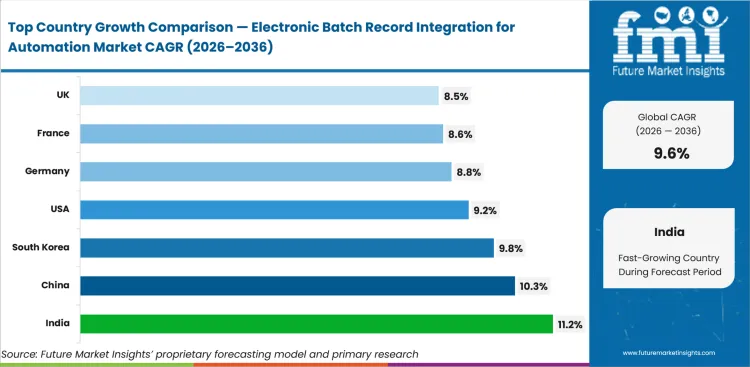
How do country-level CAGRs compare in the Electronic Batch Record Integration for Automation Market?
India leads country growth while Japan records the most cautious expansion outlook among profiled markets.
- India is forecast to record 11.2% CAGR by 2036 as export-facing pharmaceutical plants digitize release evidence.
- China is projected to expand at 10.3% CAGR through 2036 as revised device GMP rules increase data-control attention.
- South Korea is expected to grow at 9.8% CAGR by 2036 as biologics and biosimilar production scale with quality-system investment.
- The United States is forecast to post 9.2% CAGR through 2036 as FDA-facing plants prioritize release control.
- Germany is projected to grow at 8.8% CAGR by 2036 as CDMOs and specialty producers digitize batch execution.
- France is expected to rise at 8.6% CAGR through 2036 with biomanufacturing investment supporting validated records.
- The United Kingdom is projected to advance at 8.5% CAGR by 2036 as life sciences manufacturing grants support modernization.
- Japan is forecast to grow at 8.1% CAGR through 2036 as conservative validation cycles slow but do not stop adoption.
How fast is the Electronic Batch Record Integration for Automation Market growing in United States?
A 9.2% CAGR through 2036 reflects FDA-facing release control and mature automation spending across regulated plants.
Country Market Snapshot Table
| Parameter | Value |
|---|---|
| Market Size in 2025 (Value) | USD 135.5 million |
| Market Size in 2026 (Value) | USD 148.0 million |
| Market Forecast in 2036 (Value) | USD 356.9 million |
| CAGR (2026 to 2036) | 9.2% |
| Years Considered | 2021 to 2036 |
| Base Year | 2025 |
| Forecast Period | 2026 to 2036 |
| Units Considered | Value (USD million) |
| Leading Sub-Region | Massachusetts, New Jersey, North Carolina, and California pharma corridors |
United States Electronic Batch Record Integration for Automation Market Outlook
United States demand is shaped by FDA-facing record integrity requirements and a large installed base of validated manufacturing systems. Plants are expected to connect batch review more tightly with equipment events, e-signatures, and deviation notes.
Automation suppliers are likely to gain when their platforms reduce review time without creating new validation burden. Cloud and remote workflows can expand where cyber controls are defined during procurement.
Key Growth Drivers
- FDA’s December 2025 quality report listed 1,892 USA drug manufacturing sites in its FY2024 Site Catalog, creating a large base for audit-trail and release-control upgrades.
- CISA’s January 2025 Secure by Demand guide identified 12 OT procurement security elements, supporting stronger identity and access controls in automation-linked records.
- Biologics and specialty pharmaceutical lines need smaller-batch records with faster review cycles because evidence must follow recipe, operator, and equipment events.
- Multi-site manufacturers are standardizing USA batch templates to reduce release variation across plants and contract manufacturing networks.
Key Restraints
- FBI reported in April 2025 that ransomware complaints affecting critical infrastructure rose 9.0% in 2024, keeping OT cybersecurity reviews central to cloud and remote eBR approval.
- Legacy control tags often lack the business context needed for clean electronic records across mixed PLC and historian environments.
- Validation teams may delay multi-site rollouts when recipe changes require retesting across equipment interfaces.
What makes United States unique
The United States is unique because FDA-facing inspection pressure and deep automation supplier coverage make release-control performance a direct buying requirement.
Key Companies
- Rockwell Automation
- Emerson Electric
- Honeywell International
- Tulip Interfaces
- MasterControl
- Emerson AspenTech
- POMS Corporation
Sales & Marketing Channels
- Direct enterprise sales
- MES integrators
- Validation consultants
- Automation distributors
- Cloud marketplace programs
- Pharmaceutical CDMO partnerships
Country Segment Breakdown Table
| Segment | Sub-Segments |
|---|---|
| By Offering | Controllers, I/O Modules, Engineering Software, Services |
| By Deployment | Discrete Automation, Process Automation, Hybrid Automation |
| By Application | Machine Control, Line Integration, Safety Control, Remote Operations |
| By End-use Industry | Automotive, Food & Beverage, Chemicals, Pharmaceuticals, Electronics, Metals |
| By Region | North America, Latin America, Europe, East Asia, South Asia & Pacific, Middle East & Africa |
| Key Sub-Regions Covered, Northeast and Southeast pharma corridors | Boston, Raleigh-Durham, New Jersey, Philadelphia, San Diego, San Francisco Bay Area |
Frequently Asked Questions
How fast is the United States electronic batch record integration for automation market growing?
Sales in United States are projected to expand at 9.2% CAGR from 2026 to 2036, supported by FDA-facing release control and existing automation depth.
What makes United States an important market for electronic batch record integration?
The United States is unique because FDA-facing inspection pressure and deep automation supplier coverage make release-control performance a direct buying requirement.
Which suppliers are active in United States?
Rockwell Automation, Emerson Electric, Honeywell International, Tulip Interfaces are among the suppliers and service providers active in the country market.
How fast is the Electronic Batch Record Integration for Automation Market growing in United Kingdom?
A 8.5% CAGR through 2036 reflects grant-backed life sciences manufacturing and concentrated validation expertise.
Country Market Snapshot Table
| Parameter | Value |
|---|---|
| Market Size in 2025 (Value) | USD 30.4 million |
| Market Size in 2026 (Value) | USD 33.0 million |
| Market Forecast in 2036 (Value) | USD 74.6 million |
| CAGR (2026 to 2036) | 8.5% |
| Years Considered | 2021 to 2036 |
| Base Year | 2025 |
| Forecast Period | 2026 to 2036 |
| Units Considered | Value (USD million) |
| Leading Sub-Region | Cambridge, Oxford, Stevenage, and North West life sciences clusters |
United Kingdom Electronic Batch Record Integration for Automation Market Outlook
United Kingdom demand is linked to life sciences manufacturing modernization and higher scrutiny of validated digital workflows. Sites need electronic batch records that can support release documentation across medicines and medtech production.
Grant-backed manufacturing investment is expected to create selective demand for MES and eBR integration. Suppliers with cyber-aware deployment models should gain preference in plants handling regulated production data.
Key Growth Drivers
- GOV.UK stated in October 2024 that LSIMF committed up to GBP 520.0 million for life sciences manufacturing, supporting modernization of validated production sites.
- GOV.UK reported in July 2025 that the Life Sciences Sector Plan would support investments above GBP 250.0 million, improving the case for standardized batch evidence across large projects.
- Advanced therapy and biologics producers need cleaner genealogy records because short-run production makes paper review slower and harder to reconcile.
- Validation consultants and systems integrators support adoption by helping plants map recipes, alarms, and quality review notes into controlled workflows.
Key Restraints
- GOV.UK reported in April 2026 that 69.0% of large businesses experienced a cyber breach or attack in the prior year, increasing scrutiny around remote access and cloud-connected records.
- Budget release can be phased because grant-backed projects still require internal validation and site readiness work before software deployment.
- Smaller manufacturers may prefer staged digitization when existing paper batch records still satisfy current customer audits.
What makes United Kingdom unique
The United Kingdom is unique because manufacturing grants and concentrated life sciences clusters create targeted demand for validated digital release systems.
Key Companies
- Körber Pharma Software UK
- Siemens UK
- Rockwell Automation UK
- AVEVA Group
- Emerson UK
- Razorleaf UK
- ATS Global UK
Sales & Marketing Channels
- Direct software sales
- Life sciences integrators
- Validation service firms
- Automation partners
- Government-funded project tenders
- CDMO partnerships
Country Segment Breakdown Table
| Segment | Sub-Segments |
|---|---|
| By Offering | Controllers, I/O Modules, Engineering Software, Services |
| By Deployment | Discrete Automation, Process Automation, Hybrid Automation |
| By Application | Machine Control, Line Integration, Safety Control, Remote Operations |
| By End-use Industry | Automotive, Food & Beverage, Chemicals, Pharmaceuticals, Electronics, Metals |
| By Region | North America, Latin America, Europe, East Asia, South Asia & Pacific, Middle East & Africa |
| Key Sub-Regions Covered, Golden Triangle and North West clusters | Cambridge, Oxford, Stevenage, London, Manchester, Liverpool |
Frequently Asked Questions
How fast is the United Kingdom electronic batch record integration for automation market growing?
Sales in United Kingdom are projected to expand at 8.5% CAGR from 2026 to 2036, supported by life sciences manufacturing support and cyber-aware modernization.
What makes United Kingdom an important market for electronic batch record integration?
The United Kingdom is unique because manufacturing grants and concentrated life sciences clusters create targeted demand for validated digital release systems.
Which suppliers are active in United Kingdom?
Körber Pharma Software UK, Siemens UK, Rockwell Automation UK, AVEVA Group are among the suppliers and service providers active in the country market.
How fast is the Electronic Batch Record Integration for Automation Market growing in Germany?
A 8.8% CAGR through 2036 reflects CDMO depth and process automation discipline in regulated production.
Country Market Snapshot Table
| Parameter | Value |
|---|---|
| Market Size in 2025 (Value) | USD 35.8 million |
| Market Size in 2026 (Value) | USD 39.0 million |
| Market Forecast in 2036 (Value) | USD 90.6 million |
| CAGR (2026 to 2036) | 8.8% |
| Years Considered | 2021 to 2036 |
| Base Year | 2025 |
| Forecast Period | 2026 to 2036 |
| Units Considered | Value (USD million) |
| Leading Sub-Region | North Rhine-Westphalia, Bavaria, Baden-Wuerttemberg, and Hesse production clusters |
Germany Electronic Batch Record Integration for Automation Market Outlook
Germany demand is supported by pharmaceutical and specialty chemical production that already uses structured automation. Batch record integration is expected to focus on validated interfaces between MES, DCS, and historian systems.
CDMOs and precision manufacturing sites should favor suppliers that can document change control without disrupting validated operation. Local engineering depth supports complex integration but can raise expectations for technical proof.
Key Growth Drivers
- FDA’s December 2025 quality report listed 194 Germany drug manufacturing sites in its FY2024 Site Catalog, supporting demand for USA-export-ready batch evidence.
- Germany Trade & Invest reported in June 2025 that 69.0% of German companies were increasing ICT investment, supporting plant-level software modernization.
- Specialty chemical and pharma plants need MES-DCS links because process deviations must be connected to recipe status and material genealogy.
- German engineering teams often prefer validated integrations that preserve equipment uptime and avoid broad control-system replacement.
Key Restraints
- Destatis reported in June 2025 that German pharmaceutical industry orders decreased 14.1% in April 2025, which can delay discretionary software and validation projects.
- Highly customized plant automation can make standard eBR templates harder to deploy across older production assets.
- Change-control expectations can stretch implementation timelines when every interface must be documented for regulated release use.
What makes Germany unique
Germany is unique because CDMO depth and process engineering discipline create demand for precise MES-DCS record integration.
Key Companies
- Siemens AG
- Körber AG
- Werum IT Solutions
- Bayer Technology Services
- SAP SE
- ATS Global Germany
- Rockwell Automation Germany
Sales & Marketing Channels
- Direct enterprise sales
- Process automation integrators
- CDMO engineering teams
- Validation consultants
- SAP ecosystem partners
- MES service partners
Country Segment Breakdown Table
| Segment | Sub-Segments |
|---|---|
| By Offering | Controllers, I/O Modules, Engineering Software, Services |
| By Deployment | Discrete Automation, Process Automation, Hybrid Automation |
| By Application | Machine Control, Line Integration, Safety Control, Remote Operations |
| By End-use Industry | Automotive, Food & Beverage, Chemicals, Pharmaceuticals, Electronics, Metals |
| By Region | North America, Latin America, Europe, East Asia, South Asia & Pacific, Middle East & Africa |
| Key Sub-Regions Covered, Industrial and CDMO production clusters | Frankfurt Rhine-Main, Munich, Leverkusen, Mannheim, Hamburg, Stuttgart |
Frequently Asked Questions
How fast is the Germany electronic batch record integration for automation market growing?
Sales in Germany are projected to expand at 8.8% CAGR from 2026 to 2036, supported by CDMO integration demand and validated process engineering.
What makes Germany an important market for electronic batch record integration?
Germany is unique because CDMO depth and process engineering discipline create demand for precise MES-DCS record integration.
Which suppliers are active in Germany?
Siemens AG, Körber AG, Werum IT Solutions, Bayer Technology Services are among the suppliers and service providers active in the country market.
How fast is the Electronic Batch Record Integration for Automation Market growing in France?
A 8.6% CAGR through 2036 reflects biomanufacturing investment and traceability needs across healthcare production.
Country Market Snapshot Table
| Parameter | Value |
|---|---|
| Market Size in 2025 (Value) | USD 31.3 million |
| Market Size in 2026 (Value) | USD 34.0 million |
| Market Forecast in 2036 (Value) | USD 77.6 million |
| CAGR (2026 to 2036) | 8.6% |
| Years Considered | 2021 to 2036 |
| Base Year | 2025 |
| Forecast Period | 2026 to 2036 |
| Units Considered | Value (USD million) |
| Leading Sub-Region | Paris-Saclay, Lyon, Normandy, and Grand Est manufacturing clusters |
France Electronic Batch Record Integration for Automation Market Outlook
France demand is influenced by biomanufacturing investment and national efforts to reinforce healthcare production capacity. Electronic batch record integration is expected to support plants that need traceability across biologics, vaccines, and specialty medicines.
Suppliers with French-language validation support and proven life sciences workflows should gain preference. Integration value is strongest where batch data must connect manufacturing, quality, and release documentation.
Key Growth Drivers
- Sanofi stated in May 2024 that it would invest more than EUR 1.0 billion in French biomanufacturing, supporting demand for validated batch data capture.
- FDA’s December 2025 quality report listed 135 France drug manufacturing sites in its FY2024 Site Catalog, indicating a meaningful base of USA-facing GMP producers.
- Biologics and vaccine operations need integrated batch evidence because product genealogy must link materials, process steps, and exceptions.
- French manufacturing groups are expected to prefer eBR platforms that can document release decisions without forcing operators into parallel paper routines.
Key Restraints
- INSEE reported in February 2026 that French manufacturing output fell 0.8% in December 2025, making project timing a practical constraint for software rollouts.
- Site-specific validation practices can slow standard template reuse across multi-plant pharmaceutical networks.
- Integration work can be harder where legacy historians and recipe systems were not designed for audit-ready batch records.
What makes France unique
France is unique because biomanufacturing investment and public industrial policy create demand for traceable batch evidence in health production.
Key Companies
- Dassault Systemes
- Schneider Electric France
- Sanofi Digital Manufacturing
- Atos Eviden
- Sopra Steria
- Capgemini Engineering
- Technord France
Sales & Marketing Channels
- Direct enterprise software sales
- French systems integrators
- Biomanufacturing project tenders
- Validation consultancies
- Automation engineering firms
- CDMO partnerships
Country Segment Breakdown Table
| Segment | Sub-Segments |
|---|---|
| By Offering | Controllers, I/O Modules, Engineering Software, Services |
| By Deployment | Discrete Automation, Process Automation, Hybrid Automation |
| By Application | Machine Control, Line Integration, Safety Control, Remote Operations |
| By End-use Industry | Automotive, Food & Beverage, Chemicals, Pharmaceuticals, Electronics, Metals |
| By Region | North America, Latin America, Europe, East Asia, South Asia & Pacific, Middle East & Africa |
| Key Sub-Regions Covered, Biomanufacturing and health-technology corridors | Paris-Saclay, Lyon, Normandy, Strasbourg, Toulouse, Lille |
Frequently Asked Questions
How fast is the France electronic batch record integration for automation market growing?
Sales in France are projected to expand at 8.6% CAGR from 2026 to 2036, supported by biomanufacturing investment and batch genealogy requirements.
What makes France an important market for electronic batch record integration?
France is unique because biomanufacturing investment and public industrial policy create demand for traceable batch evidence in health production.
Which suppliers are active in France?
Dassault Systemes, Schneider Electric France, Sanofi Digital Manufacturing, Atos Eviden are among the suppliers and service providers active in the country market.
How fast is the Electronic Batch Record Integration for Automation Market growing in Japan?
A 8.1% CAGR through 2036 reflects automation depth and conservative validation cycles in high-value manufacturing.
Country Market Snapshot Table
| Parameter | Value |
|---|---|
| Market Size in 2025 (Value) | USD 25.9 million |
| Market Size in 2026 (Value) | USD 28.0 million |
| Market Forecast in 2036 (Value) | USD 61.0 million |
| CAGR (2026 to 2036) | 8.1% |
| Years Considered | 2021 to 2036 |
| Base Year | 2025 |
| Forecast Period | 2026 to 2036 |
| Units Considered | Value (USD million) |
| Leading Sub-Region | Kanto, Kansai, Chubu, and Kyushu manufacturing corridors |
Japan Electronic Batch Record Integration for Automation Market Outlook
Japan demand is shaped by conservative validation cycles and a strong installed base of process automation. Adoption is expected to favor platforms that can prove reliability before large-scale deployment.
Domestic suppliers and global automation vendors should compete on integration quality and lifecycle support. Electronic batch records are likely to expand first in pharmaceutical, fine chemical, and high-value production lines.
Key Growth Drivers
- The USA International Trade Administration reported in November 2025 that Japan’s prescription drug market surpassed JPY 11.0 trillion, supporting investment in compliant production systems.
- FDA’s December 2025 quality report listed 123 Japan drug manufacturing sites in its FY2024 Site Catalog, creating a clear base for audit-ready batch documentation.
- Fine chemical and pharmaceutical producers need reliable batch genealogy because product quality depends on recipe discipline and clean deviation handling.
- Local automation suppliers can support adoption by linking eBR workflows with DCS, historian, and plant information systems already used in Japan.
Key Restraints
- The USA International Trade Administration estimated Japan’s prescription drug market would exceed JPY 12.0 trillion in 2029, indicating modest expansion that can make software investments selective.
- Conservative validation practices can extend implementation timelines when plants require long proof cycles before release records go live.
- Older production assets may need custom mapping before electronic batch records can capture equipment context cleanly.
What makes Japan unique
Japan is unique because process automation depth and cautious validation practice make reliability proof more important than speed of rollout.
Key Companies
- Yokogawa Electric Corporation
- Hitachi Industrial Equipment Systems
- Mitsubishi Electric
- NEC Corporation
- Fuji Electric
- Azbil Corporation
- Toshiba Digital Solutions
Sales & Marketing Channels
- Direct automation sales
- Japanese systems integrators
- DCS upgrade projects
- Validation support firms
- Pharma engineering partners
- Distributor-led automation support
Country Segment Breakdown Table
| Segment | Sub-Segments |
|---|---|
| By Offering | Controllers, I/O Modules, Engineering Software, Services |
| By Deployment | Discrete Automation, Process Automation, Hybrid Automation |
| By Application | Machine Control, Line Integration, Safety Control, Remote Operations |
| By End-use Industry | Automotive, Food & Beverage, Chemicals, Pharmaceuticals, Electronics, Metals |
| By Region | North America, Latin America, Europe, East Asia, South Asia & Pacific, Middle East & Africa |
| Key Sub-Regions Covered, Kanto and Kansai regulated manufacturing corridors | Tokyo, Osaka, Kobe, Nagoya, Yokohama, Fukuoka |
Frequently Asked Questions
How fast is the Japan electronic batch record integration for automation market growing?
Sales in Japan are projected to expand at 8.1% CAGR from 2026 to 2036, supported by careful validation practices and strong control-system foundations.
What makes Japan an important market for electronic batch record integration?
Japan is unique because process automation depth and cautious validation practice make reliability proof more important than speed of rollout.
Which suppliers are active in Japan?
Yokogawa Electric Corporation, Hitachi Industrial Equipment Systems, Mitsubishi Electric, NEC Corporation are among the suppliers and service providers active in the country market.
How fast is the Electronic Batch Record Integration for Automation Market growing in China?
A 10.3% CAGR through 2036 reflects large regulated manufacturing scale and device GMP tightening.
Country Market Snapshot Table
| Parameter | Value |
|---|---|
| Market Size in 2025 (Value) | USD 58.0 million |
| Market Size in 2026 (Value) | USD 64.0 million |
| Market Forecast in 2036 (Value) | USD 170.6 million |
| CAGR (2026 to 2036) | 10.3% |
| Years Considered | 2021 to 2036 |
| Base Year | 2025 |
| Forecast Period | 2026 to 2036 |
| Units Considered | Value (USD million) |
| Leading Sub-Region | Yangtze River Delta, Greater Bay Area, Beijing-Tianjin, and Chengdu-Chongqing clusters |
China Electronic Batch Record Integration for Automation Market Outlook
China demand is linked to pharmaceutical scale, medical device GMP tightening, and continued automation investment. Electronic batch record integration is expected to expand where plants need stronger release evidence for domestic and export channels.
The fastest projects should appear in sites that already operate MES, DCS, or historian systems. Buyers will still scrutinize cybersecurity, localization, and validation documentation before wider deployment.
Key Growth Drivers
- FDA’s December 2025 quality report listed 477 China drug manufacturing sites in its FY2024 Site Catalog, creating a large base for audit-ready batch record projects.
- NMPA stated in November 2025 that revised medical device GMP rules would take effect on November 1, 2026, increasing attention to production data control.
- Large pharmaceutical and device manufacturers need integrated records because export customers expect clear genealogy and exception documentation.
- Automation depth in coastal manufacturing clusters supports eBR adoption where plants already use MES, DCS, and historian systems.
Key Restraints
- FDA’s December 2025 quality report recorded 13 China drug-quality warning letters in FY2024, keeping data integrity and remediation pressure high for export-facing suppliers.
- Localization and cybersecurity reviews can extend implementation work for cloud-connected batch record platforms.
- Legacy site variation can make common templates harder to apply across multi-plant manufacturing groups.
What makes China unique
China is unique because large regulated manufacturing scale and revised device GMP rules create a broad base for automation-linked records.
Key Companies
- SUPCON Technology
- HollySys Automation
- Shanghai STEP Electric
- Shenzhen Inovance Technology
- Yonyou Network
- Kingdee Software
- Wuxi AppTec Digital Manufacturing
Sales & Marketing Channels
- Local automation integrators
- Direct MES sales
- Device GMP consulting channels
- Pharma engineering contractors
- Industrial software partners
- Cloud deployment partners
Country Segment Breakdown Table
| Segment | Sub-Segments |
|---|---|
| By Offering | Controllers, I/O Modules, Engineering Software, Services |
| By Deployment | Discrete Automation, Process Automation, Hybrid Automation |
| By Application | Machine Control, Line Integration, Safety Control, Remote Operations |
| By End-use Industry | Automotive, Food & Beverage, Chemicals, Pharmaceuticals, Electronics, Metals |
| By Region | North America, Latin America, Europe, East Asia, South Asia & Pacific, Middle East & Africa |
| Key Sub-Regions Covered, Coastal pharma and device production clusters | Shanghai, Suzhou, Hangzhou, Shenzhen, Guangzhou, Beijing |
Frequently Asked Questions
How fast is the China electronic batch record integration for automation market growing?
Sales in China are projected to expand at 10.3% CAGR from 2026 to 2036, supported by regulated manufacturing scale and revised GMP requirements.
What makes China an important market for electronic batch record integration?
China is unique because large regulated manufacturing scale and revised device GMP rules create a broad base for automation-linked records.
Which suppliers are active in China?
SUPCON Technology, HollySys Automation, Shanghai STEP Electric, Shenzhen Inovance Technology are among the suppliers and service providers active in the country market.
How fast is the Electronic Batch Record Integration for Automation Market growing in South Korea?
A 9.8% CAGR through 2036 reflects biologics scale and export-focused quality-system investment.
Country Market Snapshot Table
| Parameter | Value |
|---|---|
| Market Size in 2025 (Value) | USD 18.2 million |
| Market Size in 2026 (Value) | USD 20.0 million |
| Market Forecast in 2036 (Value) | USD 50.9 million |
| CAGR (2026 to 2036) | 9.8% |
| Years Considered | 2021 to 2036 |
| Base Year | 2025 |
| Forecast Period | 2026 to 2036 |
| Units Considered | Value (USD million) |
| Leading Sub-Region | Seoul-Incheon, Songdo, Daejeon, and Gyeonggi biologics clusters |
South Korea Electronic Batch Record Integration for Automation Market Outlook
South Korea demand is supported by biologics capacity, biosimilar production, and digitally managed quality systems. Electronic batch record integration is expected to support plants that need faster release documentation for export markets.
Suppliers with experience in biologics workflows and validated plant integration should gain preference. Adoption is likely to concentrate around high-value sites that already use structured automation and quality platforms.
Key Growth Drivers
- InvestKOREA reported in 2025 that Korea’s pharmaceutical production reached KRW 32.86 trillion in 2024, supporting demand for compliant manufacturing records.
- MFDS stated in May 2026 that it targeted a 240-day review period for new drug approvals, reinforcing pressure for faster and better documented development-to-manufacturing workflows.
- Biologics and biosimilar producers need detailed batch genealogy because release evidence must support quality review and export customer audits.
- Large manufacturing campuses can adopt standardized eBR templates across multiple suites when validation logic is defined early.
Key Restraints
- FDA’s December 2025 quality report recorded 9 South Korea drug-quality warning letters in FY2024, keeping remediation and inspection readiness central to system selection.
- High biologics complexity can raise validation cost when records must follow cell-culture, purification, and fill-finish workflows.
- Supplier selection may slow when buyers require local support for integrations across MES, QMS, ERP, and plant historians.
What makes South Korea unique
South Korea is unique because biologics scale and export-focused quality systems raise the value of connected batch evidence.
Key Companies
- Samsung SDS
- LG CNS
- LS Electric
- Hyundai AutoEver
- Doosan Robotics Digital Solutions
- Kakao Enterprise
- Samsung Biologics Digital Manufacturing
Sales & Marketing Channels
- Direct enterprise software sales
- Local SI partners
- Biologics campus projects
- Automation service firms
- Validation consultants
- Export-quality program tenders
Country Segment Breakdown Table
| Segment | Sub-Segments |
|---|---|
| By Offering | Controllers, I/O Modules, Engineering Software, Services |
| By Deployment | Discrete Automation, Process Automation, Hybrid Automation |
| By Application | Machine Control, Line Integration, Safety Control, Remote Operations |
| By End-use Industry | Automotive, Food & Beverage, Chemicals, Pharmaceuticals, Electronics, Metals |
| By Region | North America, Latin America, Europe, East Asia, South Asia & Pacific, Middle East & Africa |
| Key Sub-Regions Covered, Biologics and export manufacturing corridors | Songdo, Seoul, Incheon, Daejeon, Suwon, Cheongju |
Frequently Asked Questions
How fast is the South Korea electronic batch record integration for automation market growing?
Sales in South Korea are projected to expand at 9.8% CAGR from 2026 to 2036, supported by biologics production and export-quality documentation needs.
What makes South Korea an important market for electronic batch record integration?
South Korea is unique because biologics scale and export-focused quality systems raise the value of connected batch evidence.
Which suppliers are active in South Korea?
Samsung SDS, LG CNS, LS Electric, Hyundai AutoEver are among the suppliers and service providers active in the country market.
How fast is the Electronic Batch Record Integration for Automation Market growing in India?
A 11.2% CAGR through 2036 reflects export-facing pharmaceutical production and a large FDA-compliant plant base.
Country Market Snapshot Table
| Parameter | Value |
|---|---|
| Market Size in 2025 (Value) | USD 22.5 million |
| Market Size in 2026 (Value) | USD 25.0 million |
| Market Forecast in 2036 (Value) | USD 72.3 million |
| CAGR (2026 to 2036) | 11.2% |
| Years Considered | 2021 to 2036 |
| Base Year | 2025 |
| Forecast Period | 2026 to 2036 |
| Units Considered | Value (USD million) |
| Leading Sub-Region | Hyderabad, Ahmedabad, Mumbai-Pune, Bengaluru, and Visakhapatnam pharma corridors |
India Electronic Batch Record Integration for Automation Market Outlook
India demand is led by export-facing pharmaceutical plants that need traceable records for USA, European, and regulated-market customers. Electronic batch record integration is expected to help plants reduce manual review load and improve inspection readiness.
Growth should be fastest where manufacturers combine GMP upgrades with automation modernization. Local systems integrators and validation specialists are likely to influence vendor shortlisting.
Key Growth Drivers
- PIB reported in March 2026 that India’s pharmaceutical exports reached USD 30.5 billion in FY2024-25, supporting investment in export-ready batch evidence.
- FDA’s December 2025 quality report listed 597 India drug manufacturing sites in its FY2024 Site Catalog, creating a large base for eBR upgrades.
- High-volume generic drug production needs faster exception review because manual batch checks can delay release across large SKU portfolios.
- Domestic integrator depth supports adoption by helping plants connect MES workflows with existing PLC, historian, QMS, and ERP systems.
Key Restraints
- FDA’s December 2025 quality report showed India sites had 87.0% NAI or VAI inspection outcomes in FY2024, keeping remediation and validation discipline central to adoption.
- Price-sensitive manufacturers may delay enterprise-scale eBR deployment when services and validation costs exceed the software license.
- Plant variation across older facilities can raise integration effort when paper records and automation tags use different naming conventions.
What makes India unique
India is unique because export exposure and a large FDA-compliant plant base make digital batch evidence a competitiveness requirement.
Key Companies
- Tata Consultancy Services
- Infosys
- Wipro
- Larsen & Toubro Technology Services
- Tata Technologies
- HCLTech
- Tata Elxsi
Sales & Marketing Channels
- Direct enterprise sales
- Indian systems integrators
- Validation service providers
- Pharma engineering consultants
- CDMO quality programs
- Automation distributor networks
Country Segment Breakdown Table
| Segment | Sub-Segments |
|---|---|
| By Offering | Controllers, I/O Modules, Engineering Software, Services |
| By Deployment | Discrete Automation, Process Automation, Hybrid Automation |
| By Application | Machine Control, Line Integration, Safety Control, Remote Operations |
| By End-use Industry | Automotive, Food & Beverage, Chemicals, Pharmaceuticals, Electronics, Metals |
| By Region | North America, Latin America, Europe, East Asia, South Asia & Pacific, Middle East & Africa |
| Key Sub-Regions Covered, Western and southern pharma manufacturing corridors | Hyderabad, Ahmedabad, Mumbai, Pune, Bengaluru, Visakhapatnam |
Frequently Asked Questions
How fast is the India electronic batch record integration for automation market growing?
Sales in India are projected to expand at 11.2% CAGR from 2026 to 2036, supported by regulated-market exports and site-level GMP modernization.
What makes India an important market for electronic batch record integration?
India is unique because export exposure and a large FDA-compliant plant base make digital batch evidence a competitiveness requirement.
Which suppliers are active in India?
Tata Consultancy Services, Infosys, Wipro, Larsen & Toubro Technology Services are among the suppliers and service providers active in the country market.
Competitive Landscape and Strategic Positioning
Who are the leading companies in the electronic batch record integration for automation market?
Siemens AG, Rockwell Automation Inc., Emerson Electric Co., Yokogawa Electric Corporation, Honeywell International Inc., AVEVA Group Limited, Körber AG, Tulip Interfaces Inc., MasterControl Solutions Inc., POMS Corporation, ABB Ltd., and Schneider Electric SE are key companies in the electronic batch record integration for automation market.
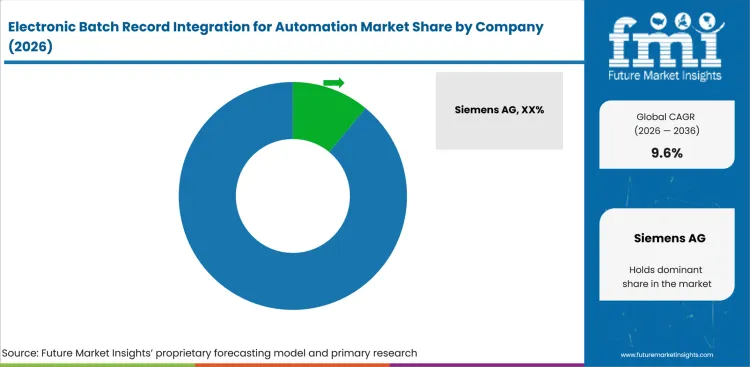
- Automation-platform suppliers compete through DCS, PLC, historian, MES, and plant-level integration depth.
- MES and pharma workflow specialists compete through validated batch workflows, e-signatures, review-by-exception tools, and GMP-ready templates.
- Industrial software and cloud platforms compete through multi-site standards, analytics, cyber-aware deployment, and remote operations support.
- Systems integrators and validation firms influence vendor selection by handling interface mapping, recipe migration, testing, and change-control documentation.
Competition is shaped by MES depth, process automation integration, validation support, and deployment flexibility. Siemens, Rockwell Automation, and Emerson compete through established automation portfolios and plant-level integration experience. Suppliers that reduce validation debt are expected to gain preference as plants connect private 5G industrial automation and other remote operations tools to regulated records.
The best-positioned suppliers are those that can prove record integrity across PLC, DCS, historian, MES, and QMS layers. Buyers are likely to favor vendors with reusable templates, tested connectors, role-based access controls, and validation documentation that supports change control without slowing batch release.
How do top electronic batch record integration for automation companies compare?
Siemens, Rockwell Automation, Emerson, and Yokogawa lead through automation integration depth, while Körber, Tulip, MasterControl, and POMS compete through batch workflow, e-signature, and review-by-exception capability.
| Company | Market Relevance | Automation and MES Integration | Validation and Compliance Fit | Channel Reach | Positioning |
|---|---|---|---|---|---|
| Siemens AG | Very High | Very Strong | High | Global | Automation and MES integration leader |
| Rockwell Automation Inc. | Very High | Very Strong | High | Global | MES-linked automation supplier |
| Emerson Electric Co. | High | Very Strong | High | Global | Process automation and batch workflow supplier |
| Yokogawa Electric Corporation | High | Very Strong | High | Global | Process MES and control-system specialist |
| Honeywell International Inc. | High | Strong | High | Global | Batch historian and automation supplier |
| AVEVA Group Limited | High | Strong | Medium to High | Global | Industrial software and data platform supplier |
| Körber AG | Very High | Strong | Very High | Global pharma footprint | Pharma MES and eBR workflow specialist |
| Tulip Interfaces Inc. | High | Medium to Strong | Medium | Global connected worker reach | No-code frontline workflow platform |
| MasterControl Solutions Inc. | High | Medium | Very High | North America led | Quality and batch record specialist |
| POMS Corporation | Moderate to High | Strong | High | North America led | Pharma MES specialist |
| ABB Ltd. | Moderate to High | Strong | Medium | Global | Automation platform supplier |
| Schneider Electric SE | Moderate to High | Strong | Medium | Global | Industrial software and automation supplier |
Source: Future Market Insights competitive analysis, 2026.
Key Developments in Electronic Batch Record Integration for Automation Market
- In January 2024, Rockwell Automation reported that Rottendorf Pharma adopted FactoryTalk PharmaSuite MES as part of an end-to-end electronic batch recording program. The project supports validated weighing and batch documentation for regulated medicine production.
- In April 2024, Emerson introduced DeltaV Workflow Management to streamline pharmaceutical development and production workflows. The launch reinforced the link between process automation and controlled execution records.
- In October 2024, Yokogawa released OpreX Batch MES to support flexible modification of batch manufacturing procedures in specialty and regulated production. The release strengthens Yokogawa’s position in process-oriented batch execution.
- In May 2025, Körber introduced new PAS-X software products for pharma manufacturing and highlighted AI-assisted applications for production workflows. The update supports batch execution, workflow support, and pharma manufacturing digitalization.
Who are the key players in the electronic batch record integration for automation market?
Key companies participating in the electronic batch record integration for automation market include:
Automation-platform Suppliers
- Siemens AG
- Rockwell Automation Inc.
- Emerson Electric Co.
- Yokogawa Electric Corporation
- Honeywell International Inc.
- ABB Ltd.
- Schneider Electric SE
MES and Pharma Workflow Specialists
- Körber AG
- Tulip Interfaces Inc.
- MasterControl Solutions Inc.
- POMS Corporation
Industrial Software and Cloud Platforms
- AVEVA Group Limited
- Emerson AspenTech
- SAP SE
- Dassault Systèmes SE
Systems Integrators and Validation Partners
- ATS Global
- Capgemini Engineering
- Larsen & Toubro Technology Services
- HCLTech
Electronic Batch Record Integration for Automation Market - Report Scope
| Parameter | Details |
|---|---|
| Forecast period | 2026 to 2036 |
| Historical period | 2021 to 2025 |
| Quantitative unit | Revenue in USD million |
| By offering | Controllers, I/O modules, engineering software, services |
| By deployment | Discrete automation, process automation, hybrid automation |
| By application | Machine control, line integration, safety control, remote operations |
| By end-use industry | Automotive, food and beverage, chemicals, pharmaceuticals, electronics, metals |
| Regions covered | North America, Latin America, Europe, East Asia, South Asia and Pacific, Middle East and Africa |
| Countries covered | United States, United Kingdom, Germany, France, Japan, China, South Korea, India |
| Key companies profiled | Siemens, Rockwell Automation, Emerson, Yokogawa, Honeywell, AVEVA, Körber, Tulip, MasterControl, POMS |
| Approach | Bottom-up product-boundary approach using eligible software revenue, integration services, validation workload, interface volume, and country-level adoption |
Source: Future Market Insights, 2026.
Electronic Batch Record Integration for Automation Market - Scope & Definition
| Attribute | Detail |
|---|---|
| Market Definition | Software, services, and automation-system links that capture batch execution evidence from production equipment and connect it with validated electronic records. |
| Functions Covered | Batch evidence capture, e-signature control, audit trail management, recipe-event linkage, review-by-exception, deviation support, and release documentation. |
| Applications Covered | Machine control, line integration, safety control, remote operations, weigh-and-dispense steps, packaging events, and production release workflows. |
| End-Use Industries | Pharmaceuticals, food and beverage, chemicals, automotive, electronics, metals, and other regulated or batch-oriented manufacturing sectors. |
| Grades Covered | Discrete automation, process automation, and hybrid automation deployments using controllers, I/O modules, engineering software, and services. |
| Inclusions | MES-linked batch records, PLC and DCS interfaces, historian connections, validated workflow templates, audit trails, and GMP-oriented integration services. |
| Exclusions | Generic ERP orders, standalone document control, paper batch logs, laboratory notebooks, non-validated spreadsheets, and automation hardware without batch-record integration. |
Electronic Batch Record Integration for Automation Market - Research Methodology
| Method | Description |
|---|---|
| Primary Research | FMI analyst interviews with automation managers, quality heads, MES integrators, validation consultants, systems integrators, and regulated manufacturing leaders. |
| Desk Research | Review of FDA quality reports, official cybersecurity guidance, industrial interoperability standards, company product documentation, and public manufacturing policy sources. |
| Market Sizing & Forecasting | Bottom-up software and services estimates using license value, services intensity, interface volume, validation workload, and country-level regulated manufacturing activity. |
| Data Validation | Cross-checking against supplier portfolios, country-level GMP activity, known batch automation workflows, and the addressable manufacturing execution systems base. |
Electronic Batch Record Integration for Automation Market Breakdown by Offering, Deployment, Application, End-use Industry, and Region
Electronic Batch Record Integration for Automation Market Segmented by Offering
- Controllers
- I/O Modules
- Engineering Software
- Services
Electronic Batch Record Integration for Automation Market Segmented by Deployment
- Discrete Automation
- Process Automation
- Hybrid Automation
Electronic Batch Record Integration for Automation Market Segmented by Application
- Machine Control
- Line Integration
- Safety Control
- Remote Operations
Electronic Batch Record Integration for Automation Market Segmented by End-use Industry
- Automotive
- Food & Beverage
- Chemicals
- Pharmaceuticals
- Electronics
- Metals
Electronic Batch Record Integration for Automation Market by Region
- North America
- Latin America
- Europe
- East Asia
- South Asia and Pacific
- Middle East and Africa
Research Sources and Bibliography
- Electronic Code of Federal Regulations. (2026, June). 21 CFR Part 11 - Electronic Records; Electronic Signatures.
- USA Food and Drug Administration. (2025, December 12). Report on the state of pharmaceutical quality.
- Cybersecurity and Infrastructure Security Agency. (2025, January 13). Secure by Demand: Priority Considerations for Operational Technology Owners and Operators When Selecting Digital Products.
- Cybersecurity and Infrastructure Security Agency. (2024, October 1). Principles of Operational Technology Cyber Security.
- Federal Bureau of Investigation. (2025, April 23). FBI Releases Annual Internet Crime Report.
- OPC Foundation. (2024, April 22). OPC Foundation Launches OPC UA Cloud Initiative.
- OPC Foundation. (2024, December). OPC UA Reverse Connect for Secure IT/OT Integration.
- GOV.UK. (2024, October 31). Life Sciences Innovative Manufacturing Fund (LSIMF).
- GOV.UK. (2026, April 30). Cyber Security Breaches Survey 2025/2026.
- GOV.UK. (2025, July 16). Life Sciences Sector Plan.
- Office for National Statistics. (2025, September 12). Index of Production, UK: July 2025.
- Destatis. (2025, June 5). New orders in manufacturing in April 2025: +0.6% on the previous month.
- Sanofi. (2024, May 13). Sanofi Adds over EUR 1 Billion for Biomanufacturing in France.
- Institut national de la statistique et des études économiques. (2026, February 5). In December 2025, manufacturing output fell back sharply.
- USA International Trade Administration. (2025, November 20). Japan - Pharmaceuticals.
- National Medical Products Administration. (2025, November 7). Revision and Release of the Good Manufacturing Practice for Medical Devices.
- Ministry of Food and Drug Safety. (2026, May 28). MFDS Opens a New Era of Innovation in New Drug Development.
- InvestKOREA. (2025). Pharma and Bio Industry Overview.
- Press Information Bureau. (2026, March 21). India’s Pharmaceuticals in Global Healthcare.
- Siemens Digital Industries Software. (2024, July 3). What’s New in Opcenter Execution Pharma Version 2405.
- Siemens Digital Industries Software. (2026, June 3). What’s New in Opcenter Execution Pharma Version 2605.
- Rockwell Automation. (2024, January 16). Rottendorf Pharma Targets Quality, Efficiency, and Accuracy in Medicine Production.
- Rockwell Automation. (2024, July 15). The Power of Biometrics in Life Sciences.
- Emerson Electric Co. (2024, April 16). Emerson’s Next-generation Software Streamlines Pharmaceutical Development.
- Yokogawa Electric Corporation. (2024, October 28). Yokogawa Releases OpreX Batch MES.
- AVEVA Group Limited. (2024, April 22). AVEVA Launches CONNECT Industrial Intelligence Platform.
- Honeywell International Inc. (2024, June). Batch Historian.
- Körber AG. (2025, May 20). New Software Products at Körber’s Software Pharma Open.
- Tulip Interfaces Inc. (2024, September 26). Electronic Batch Record.
This Report Answers
- What is the expected market size for electronic batch record integration for automation in 2026?
- Which deployment type leads the market and why does it hold the highest share?
- Which end-use industry creates the largest demand for integrated batch records?
- Which countries are expected to grow fastest through 2036?
- Which supplier capabilities matter most for validated batch record integration?
- How do MES, DCS, PLC, historian, and QMS integration needs shape supplier selection?
- Which companies are active across automation, MES, pharma workflow, and validation support?
- How do validation workload and cybersecurity reviews affect deployment timing?
Frequently Asked Questions
How large is the Electronic Batch Record Integration for Automation Market expected to be in 2026?
Growth is supported by regulated manufacturers shifting from paper-based batch documentation to validated digital records that connect production events, operator actions, audit trails, and release evidence.
What is the long-term outlook for the Electronic Batch Record Integration for Automation Market?
Demand is expected to strengthen as batch review becomes embedded in automated production workflows and manufacturers prioritize faster release, stronger data integrity, and easier inspection readiness.
How fast is the Electronic Batch Record Integration for Automation Market expected to grow?
Compliance pressure, review-by-exception adoption, MES and automation integration, and the need to reduce manual batch-release delays are key factors supporting this growth.
Which deployment segment is expected to lead the market?
The segment benefits from strong use in batch plants where recipes, tanks, reactors, cleaning steps, equipment events, and operator actions must be captured in one validated electronic record.
Which country is expected to grow fastest?
Growth is driven by export-facing pharmaceutical production, GMP modernization, and rising need for digital batch evidence that supports regulated-market audits and faster product release.
Preview the report firsthand - request a free sample
Get SampleGet the brochure for pricing and purchase details.
Get PDFTable of Content
- Key Takeaways
- Market Size and CAGR
- Top Growth Driver
- Fastest Growing Segment
- Leading Region
- Key Companies
- Emerging Opportunities
- Executive Summary
- Global Market Outlook
- Demand-side Trends
- Supply-side Trends
- Technology Roadmap Analysis
- Analysis and Recommendations
- Analyst Perspective (What is happening? Why now? What should investors know?)
- Key Questions Answered
- How large is the market?
- What is the CAGR?
- What are key trends?
- Which region dominates?
- Who are the leaders?
- Market Overview
- Market Coverage / Taxonomy
- Market Definition / Scope / Limitations
- Research Methodology
- Chapter Orientation
- Analytical Lens and Working Hypotheses
- Market Structure, Signals, and Trend Drivers
- Benchmarking and Cross-market Comparability
- Market Sizing, Forecasting, and Opportunity Mapping
- Research Design and Evidence Framework
- Desk Research Programme (Secondary Evidence)
- Expert Input and Fieldwork (Primary Evidence)
- Tooling, Models, and Reference Databases
- Data Engineering and Model Build
- Quality Assurance and Audit Trail
- Market Background
- Market Dynamics (Drivers, Restraints, Opportunity, Trends)
- Scenario Forecast (Optimistic, Likely, Conservative)
- Impact Analysis
- AI Impact
- Sustainability Impact
- Regulatory Impact
- Technology Impact
- Consumer / Buyer Analysis
- Purchase Drivers
- Adoption Barriers
- Buyer Journey
- Opportunity Map Analysis
- Product Life Cycle Analysis
- Supply Chain Analysis
- Investment Feasibility Matrix
- Value Chain Analysis
- PESTLE and Porter's Analysis
- Regulatory Landscape
- Regional Parent Market Outlook
- Production and Consumption Statistics
- Import and Export Statistics
- Global Market Analysis and Forecast, 2021 to 2036
- Historical Market Size Value (USD Million) Analysis, 2021 to 2025
- Current and Future Market Size Value (USD Million) Projections, 2026 to 2036
- Y-o-Y Growth Trend Analysis
- Absolute $ Opportunity Analysis
- Global Market Pricing Analysis, 2021 to 2036
- Global Market Analysis and Forecast, By Deployment, 2021 to 2036
- Introduction / Key Findings
- Historical Market Size Value (USD Million) Analysis By Deployment, 2021 to 2025
- Current and Future Market Size Value (USD Million) Analysis and Forecast By Deployment, 2026 to 2036
- Process Automation
- Hybrid Automation
- Discrete Automation
- Process Automation
- Y-o-Y Growth Trend Analysis By Deployment, 2021 to 2025
- Absolute $ Opportunity Analysis By Deployment, 2026 to 2036
- Global Market Analysis and Forecast, By End Use Industry, 2021 to 2036
- Introduction / Key Findings
- Historical Market Size Value (USD Million) Analysis By End Use Industry, 2021 to 2025
- Current and Future Market Size Value (USD Million) Analysis and Forecast By End Use Industry, 2026 to 2036
- Pharmaceuticals
- Electronics
- Metals
- Automotive
- Food & Beverage
- Chemicals
- Pharmaceuticals
- Y-o-Y Growth Trend Analysis By End Use Industry, 2021 to 2025
- Absolute $ Opportunity Analysis By End Use Industry, 2026 to 2036
- Global Market Analysis and Forecast, By Offering, 2021 to 2036
- Introduction / Key Findings
- Historical Market Size Value (USD Million) Analysis By Offering, 2021 to 2025
- Current and Future Market Size Value (USD Million) Analysis and Forecast By Offering, 2026 to 2036
- Engineering Software
- Services
- Controllers
- I/O Modules
- Engineering Software
- Y-o-Y Growth Trend Analysis By Offering, 2021 to 2025
- Absolute $ Opportunity Analysis By Offering, 2026 to 2036
- Global Market Analysis and Forecast, By Application, 2021 to 2036
- Introduction / Key Findings
- Historical Market Size Value (USD Million) Analysis By Application, 2021 to 2025
- Current and Future Market Size Value (USD Million) Analysis and Forecast By Application, 2026 to 2036
- Line Integration
- Safety Control
- Remote Operations
- Machine Control
- Line Integration
- Y-o-Y Growth Trend Analysis By Application, 2021 to 2025
- Absolute $ Opportunity Analysis By Application, 2026 to 2036
- Global Market Analysis and Forecast, By Region, 2021 to 2036
- Introduction
- Historical Market Size Value (USD Million) Analysis By Region, 2021 to 2025
- Current Market Size Value (USD Million) Analysis and Forecast By Region, 2026 to 2036
- North America
- Latin America
- Western Europe
- Eastern Europe
- East Asia
- South Asia and Pacific
- Middle East & Africa
- Market Attractiveness Analysis By Region
- North America Market Analysis and Forecast, By Country, 2021 to 2036
- Historical Market Size Value (USD Million) Trend Analysis By Market Taxonomy, 2021 to 2025
- Market Size Value (USD Million) Forecast By Market Taxonomy, 2026 to 2036
- By Country
- USA
- Canada
- Mexico
- By Deployment
- By End Use Industry
- By Offering
- By Application
- By Country
- Market Attractiveness Analysis
- By Country
- By Deployment
- By End Use Industry
- By Offering
- By Application
- Key Takeaways
- Latin America Market Analysis and Forecast, By Country
- Historical Market Size Value (USD Million) Trend Analysis By Market Taxonomy, 2021 to 2025
- Market Size Value (USD Million) Forecast By Market Taxonomy, 2026 to 2036
- By Country
- Brazil
- Chile
- Rest of Latin America
- By Deployment
- By End Use Industry
- By Offering
- By Application
- By Country
- Market Attractiveness Analysis
- By Country
- By Deployment
- By End Use Industry
- By Offering
- By Application
- Key Takeaways
- Western Europe Market Analysis and Forecast, By Country
- Historical Market Size Value (USD Million) Trend Analysis By Market Taxonomy, 2021 to 2025
- Market Size Value (USD Million) Forecast By Market Taxonomy, 2026 to 2036
- By Country
- Germany
- UK
- Italy
- Spain
- France
- Nordic
- BENELUX
- Rest of Western Europe
- By Deployment
- By End Use Industry
- By Offering
- By Application
- By Country
- Market Attractiveness Analysis
- By Country
- By Deployment
- By End Use Industry
- By Offering
- By Application
- Key Takeaways
- Eastern Europe Market Analysis and Forecast, By Country
- Historical Market Size Value (USD Million) Trend Analysis By Market Taxonomy, 2021 to 2025
- Market Size Value (USD Million) Forecast By Market Taxonomy, 2026 to 2036
- By Country
- Russia
- Poland
- Hungary
- Balkan & Baltic
- Rest of Eastern Europe
- By Deployment
- By End Use Industry
- By Offering
- By Application
- By Country
- Market Attractiveness Analysis
- By Country
- By Deployment
- By End Use Industry
- By Offering
- By Application
- Key Takeaways
- East Asia Market Analysis and Forecast, By Country
- Historical Market Size Value (USD Million) Trend Analysis By Market Taxonomy, 2021 to 2025
- Market Size Value (USD Million) Forecast By Market Taxonomy, 2026 to 2036
- By Country
- China
- Japan
- South Korea
- By Deployment
- By End Use Industry
- By Offering
- By Application
- By Country
- Market Attractiveness Analysis
- By Country
- By Deployment
- By End Use Industry
- By Offering
- By Application
- Key Takeaways
- South Asia and Pacific Market Analysis and Forecast, By Country
- Historical Market Size Value (USD Million) Trend Analysis By Market Taxonomy, 2021 to 2025
- Market Size Value (USD Million) Forecast By Market Taxonomy, 2026 to 2036
- By Country
- India
- ASEAN
- Australia & New Zealand
- Rest of South Asia and Pacific
- By Deployment
- By End Use Industry
- By Offering
- By Application
- By Country
- Market Attractiveness Analysis
- By Country
- By Deployment
- By End Use Industry
- By Offering
- By Application
- Key Takeaways
- Middle East & Africa Market Analysis and Forecast, By Country
- Historical Market Size Value (USD Million) Trend Analysis By Market Taxonomy, 2021 to 2025
- Market Size Value (USD Million) Forecast By Market Taxonomy, 2026 to 2036
- By Country
- Kingdom of Saudi Arabia
- Other GCC Countries
- Türkiye
- South Africa
- Other African Union
- Rest of Middle East & Africa
- By Deployment
- By End Use Industry
- By Offering
- By Application
- By Country
- Market Attractiveness Analysis
- By Country
- By Deployment
- By End Use Industry
- By Offering
- By Application
- Key Takeaways
- Key Countries Market Analysis
- USA
- Pricing Analysis
- Market Share Analysis, 2025
- By Deployment
- By End Use Industry
- By Offering
- By Application
- Canada
- Pricing Analysis
- Market Share Analysis, 2025
- By Deployment
- By End Use Industry
- By Offering
- By Application
- Mexico
- Pricing Analysis
- Market Share Analysis, 2025
- By Deployment
- By End Use Industry
- By Offering
- By Application
- Brazil
- Pricing Analysis
- Market Share Analysis, 2025
- By Deployment
- By End Use Industry
- By Offering
- By Application
- Chile
- Pricing Analysis
- Market Share Analysis, 2025
- By Deployment
- By End Use Industry
- By Offering
- By Application
- Germany
- Pricing Analysis
- Market Share Analysis, 2025
- By Deployment
- By End Use Industry
- By Offering
- By Application
- UK
- Pricing Analysis
- Market Share Analysis, 2025
- By Deployment
- By End Use Industry
- By Offering
- By Application
- Italy
- Pricing Analysis
- Market Share Analysis, 2025
- By Deployment
- By End Use Industry
- By Offering
- By Application
- Spain
- Pricing Analysis
- Market Share Analysis, 2025
- By Deployment
- By End Use Industry
- By Offering
- By Application
- France
- Pricing Analysis
- Market Share Analysis, 2025
- By Deployment
- By End Use Industry
- By Offering
- By Application
- India
- Pricing Analysis
- Market Share Analysis, 2025
- By Deployment
- By End Use Industry
- By Offering
- By Application
- ASEAN
- Pricing Analysis
- Market Share Analysis, 2025
- By Deployment
- By End Use Industry
- By Offering
- By Application
- Australia & New Zealand
- Pricing Analysis
- Market Share Analysis, 2025
- By Deployment
- By End Use Industry
- By Offering
- By Application
- China
- Pricing Analysis
- Market Share Analysis, 2025
- By Deployment
- By End Use Industry
- By Offering
- By Application
- Japan
- Pricing Analysis
- Market Share Analysis, 2025
- By Deployment
- By End Use Industry
- By Offering
- By Application
- South Korea
- Pricing Analysis
- Market Share Analysis, 2025
- By Deployment
- By End Use Industry
- By Offering
- By Application
- Russia
- Pricing Analysis
- Market Share Analysis, 2025
- By Deployment
- By End Use Industry
- By Offering
- By Application
- Poland
- Pricing Analysis
- Market Share Analysis, 2025
- By Deployment
- By End Use Industry
- By Offering
- By Application
- Hungary
- Pricing Analysis
- Market Share Analysis, 2025
- By Deployment
- By End Use Industry
- By Offering
- By Application
- Kingdom of Saudi Arabia
- Pricing Analysis
- Market Share Analysis, 2025
- By Deployment
- By End Use Industry
- By Offering
- By Application
- Türkiye
- Pricing Analysis
- Market Share Analysis, 2025
- By Deployment
- By End Use Industry
- By Offering
- By Application
- South Africa
- Pricing Analysis
- Market Share Analysis, 2025
- By Deployment
- By End Use Industry
- By Offering
- By Application
- USA
- Market Structure Analysis
- Competition Dashboard
- Competition Benchmarking
- Market Share Analysis of Top Players
- By Regional
- By Deployment
- By End Use Industry
- By Offering
- By Application
- Emerging Startups
- Innovation Benchmarking
- Competition Analysis
- Competition Deep Dive
- Siemens AG
- Overview
- Product Portfolio
- Profitability by Market Segments (Product/Region/Sales Channel)
- Sales Footprint
- Strategy Overview
- Marketing Strategy
- Product Strategy
- Channel Strategy
- Rockwell Automation Inc.
- Emerson Electric Co.
- Yokogawa Electric Corporation
- Honeywell International Inc.
- AVEVA Group Limited
- Körber AG
- Tulip Interfaces Inc.
- MasterControl Solutions Inc.
- POMS Corporation
- ABB Ltd.
- Schneider Electric SE
- Siemens AG
- Case Studies
- Success Stories
- Recent Developments
- Competition Deep Dive
- Assumptions & Acronyms Used


