

- Market Size (2026)
- USD 2.8 Bn
- Forecast (2036)
- USD 5.1 Bn
- CAGR (2026 to 2036)
- 6.2%
How big is Exocrine Pancreatic Insufficiency (EPI) Market size?
USD 2.8 billion in 2026 and USD 5.1 billion by 2036 at a 6.2% CAGR.
Demand for exocrine pancreatic insufficiency EPI is projected to expand at 6.2% CAGR between 2026 and 2036, increasing valuation from USD 2.8 billion in 2026 to USD 5.1 billion by 2036. Medical researchers led by Babajide evaluated health records for more than 79 million United States residents during October 2024. Their comprehensive study identified 24,080 individuals living with Exocrine Pancreatic Insufficiency (EPI), establishing a 0.8% prevalence rate across the analyzed population. Doctors prescribed pancreatic enzyme replacement therapy to only 58.0% of these identified patients. This significant treatment gap highlights a clear opportunity for healthcare professionals to review prescribing habits and expand nutritional follow-up care for affected individuals.
Healthcare systems around the world shape how medical teams diagnose and manage this digestive condition. Clinical teams in France and Italy prioritize sending patients to specialists and guiding them through dedicated hospital nutrition programs. Healthcare providers in the United States and Canada concentrate on securing insurance coverage and supporting patients as they administer treatments at home. During April 2026, the European Medicines Agency announced widespread Creon shortages affecting 10,000-unit, 25,000-unit, and 35,000-unit capsules since regulators project for manufacturers to resolve such supply disruptions during the first-half 2027, medical providers are actively evaluating alternative enzyme medications for patients who rely on daily therapy.
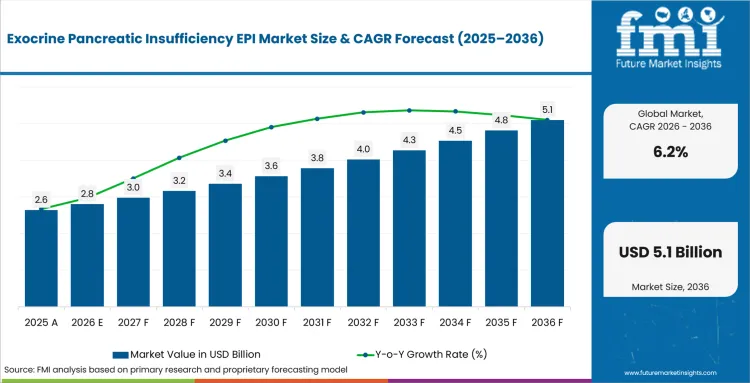
Key Takeaways for the Exocrine Pancreatic Insufficiency EPI Market
- Demand for exocrine pancreatic insufficiency treatment is driven by improved diagnosis, with healthcare providers emphasizing enzyme replacement and nutritional management across chronic pancreatic conditions.
- Oral administration is expected to garner 91.0% share of route in 2026, driven by established capsule use and convenient self-administration across long-term treatment.
- Pancreatic enzyme replacement therapy is anticipated to lead treatment with 74.0% share in 2026, backed by established clinical use for improving digestion and nutrient absorption.
- Delayed diagnosis and inconsistent enzyme dosing represent primary barriers limiting symptom control and dependable treatment outcomes across affected patients.
- Competition focusses on AbbVie Inc., Nestlé Health Science, VIVUS LLC, Digestive Care, Inc., Alcresta Therapeutics, Inc., Anagram Therapeutics, Inc., and Nordmark Pharma GmbH, with companies differentiating based on enzyme formulations and therapeutic development.
Analyst Perspective
“Exocrine pancreatic insufficiency forecasts gain credibility depending on documented symptom relief and nutrition recovery. Commercial planning needs a clear response to underdiagnosis and incorrect meal dosing. Suppliers connecting therapy access with dietitian support may secure recurring prescriptions.”
- Anurag Sharma, Principal Analyst for Healthcare at Future Market Insights.
How is Exocrine Pancreatic Insufficiency (EPI) Market segmented?
The exocrine pancreatic insufficiency EPI industry is segmented by treatment, indication, route of administration, end user, distribution channel, and region.
The exocrine pancreatic insufficiency EPI sector is segmented by treatment, indication, route of administration, end user, distribution channel, and region. Treatment coverage includes pancreatic enzyme replacement therapy and nutritional supplements. Digestive support products and supportive care extend treatment coverage. Indication coverage includes chronic pancreatitis and cystic fibrosis. Pancreatic cancer and other indications complete clinical coverage. Route of administration includes oral, enteral administration, and combination therapy. End user coverage includes hospitals and specialty clinics. Home care and retail & specialty pharmacies complete coverage. distribution channel includes hospital pharmacies and retail pharmacies. Online pharmacies complete channel coverage. Regional coverage includes North America and Europe. East Asia and South Asia and Pacific extend geographic coverage. Latin America and Middle East and Africa complete regional coverage.
What makes pancreatic enzyme replacement therapy central to treatment selection?
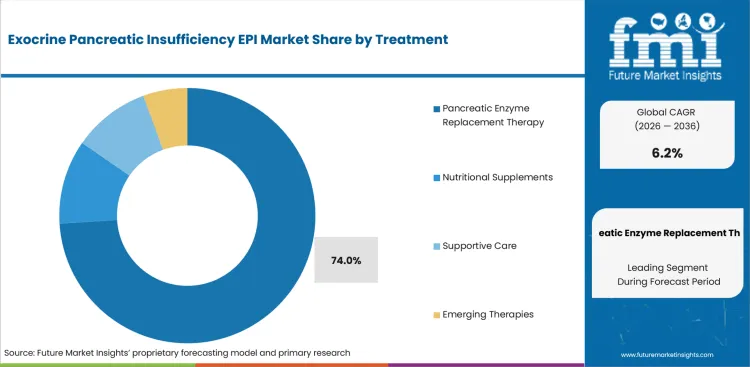
Pancreatic enzyme replacement therapy replaces deficient digestive enzyme activity during meals. Enteric-coated pancrelipase supplies protease and amylase across established EPI indications. Kadaj-Lipka et al. assessed 25 observational studies covering 3,818 patients in July 2025. Average doses stayed below 40,000 to 50,000 lipase units per meal in 40.0% of studies, highlighting the need for titration guidance and nutrition monitoring.
- Pancreatic enzyme replacement therapy is predicted to represent 74.0% share of treatment in 2026, driven by direct replacement of deficient digestive enzymes. Clinicians review symptom relief and nutritional stability during dose adjustment.
- Nutritional supplements and digestive support products complement enzyme therapy across documented deficiencies. Emerging therapies require clinical comparison with established pancrelipase products.
What supports chronic pancreatitis within indication demand?
European clinical guidance published in February 2025 placed EPI prevalence across chronic pancreatitis between 20.0% and 90.0%. This range reflects disease duration and clinical severity, promoting diagnostic confirmation across symptomatic patients. Chronic pancreatitis causes progressive pancreatic damage and recurring maldigestion. Long-term care often combines enzyme therapy with nutrition review.
- In 2026, chronic pancreatitis is anticipated to account for 42.0% share of Indication as it is guided by prolonged enzyme loss and recurring prescriptions. Specialist follow-up supports dose review and nutritional monitoring.
- Cystic fibrosis therapeutics and pancreatic cancer care create separate referral pathways. Other indications require careful diagnostic separation from overlapping digestive disorders.
Why does oral lead route of administration?
Oral capsules align enzyme delivery with meals across outpatient and home care. Available strengths support dosing according to symptoms and meal composition. Ashkar et al. surveyed 250 United States healthcare professionals in March 2026. Symptom improvement influenced treatment selection for 83.6% of respondents, influencing continued oral use.
- Based on route of administration, oral is expected to secure 91.0% share in 2026 since being led by familiar meal-linked administration. Clear instructions support routine self-administration.
- Enteral administration supports tube-fed patients and limited oral intake. Combination therapy links enzymes with vitamins or nutritional support.
How do hospitals shape end user demand?
Hospitals identify EPI during pancreatic surgery and oncology care. Inpatient teams initiate enzymes and transfer dosing instructions into discharge plans. Ni et al. reported a quality-improvement intervention covering 41 pancreatic-cancer patients in March 2026. PERT reached 90.0% of participants, with complete symptom resolution reported for 74.1% of treated patients. Structured pathways improve dose initiation across high-risk patients.
- By end user, hospitals are projected to hold 39.0% share in 2026 owing to diagnostic access and multidisciplinary nutrition review. Discharge planning supports continued treatment after inpatient initiation.
- Specialty clinics and home care extend treatment beyond discharge. Retail & specialty pharmacies support refills and administration guidance.
What keeps hospital pharmacies ahead within distribution channel?
Digestive Care revised PERTZYE prescribing information in May 2026. Guidance permits 4,000-unit capsule administration through gastrostomy tubes measuring 14 French or larger, sustaining treatment continuity during care transitions. Hospital Pharmacies connect diagnosis with discharge supply and specialist follow-up. Formulary access supports pancreatic surgery and enteral feeding pathways.
- Hospital pharmacies are likely to command 45.0% share in 2026, backed by specialist prescriptions and discharge planning. Institutional access helps patients begin therapy before leaving hospital care.
- Retail Pharmacies support routine oral refills across stable patients. Online Pharmacies extend access across dispersed patient groups.
What are drivers, restraints, and opportunities in Exocrine Pancreatic Insufficiency (EPI) Market?
Clinical recognition supports prescription conversion across pancreatic disease. Diagnostic delay restricts effective treatment.
- Driver: Specialist teams identify maldigestion across chronic pancreatitis and pancreatic surgery. Cystic fibrosis and pancreatic cancer create additional treatment pathways.
- Restraint: Nonspecific symptoms and incomplete testing delay diagnosis. Inadequate meal dosing may weaken treatment response.
- Opportunity: Standardized screening and dietitian-led titration improve treatment persistence. Feeding-compatible systems address enteral nutrition needs.
Pancreatic cancer creates a substantial untreated EPI population. In March 2024, Garcia et al. reported that up to 80.0% of pancreatic-cancer patients eventually develop EPI symptoms. PERT prescriptions reached only 21.0%, supporting routine nutrition review within oncology care.
Diagnostic delay restricts treatment across common gastrointestinal complaints. In May 2026, Kürtül et al. evaluated 310 patients with abdominal pain and malodorous flatus. EPI was identified in 45.8% of participants, and 65.0% of affected patients had lacked a prior diagnosis. Fecal pancreatic elastase testing may improve referral decisions.
Pancreatic surveillance creates an additional diagnostic pathway. In April 2026, National Library of Medicine listed a 600-participant IPEX study. The study measures pancreatic elastase and symptom scores during intraductal papillary mucinous neoplasm follow-up. Positive findings may support earlier EPI assessment.
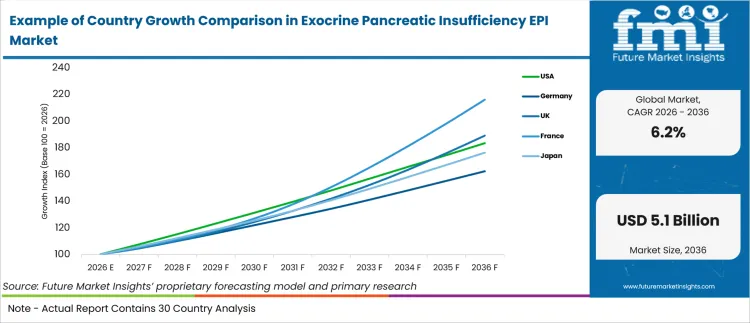
How are country CAGRs aligned in Exocrine Pancreatic Insufficiency EPI market?
| Country or Market | CAGR |
|---|---|
| France | 8.0% |
| Italy | 6.9% |
| UK | 6.6% |
| USA | 6.3% |
| Japan | 5.8% |
| Germany | 5.0% |
| Canada | 4.4% |
Source: Future Market Insights country analysis, 2026.
How do country-level CAGRs compare in Exocrine Pancreatic Insufficiency (EPI) Market?
The country comparison shows a gradual step-down across the markets covered. France occupies the upper end of the range, followed by Italy. The United Kingdom and the United States form a closely grouped middle tier. Japan and Germany follow with moderately lower rates. Canada records the lowest CAGR among the countries shown. The 3.6 percentage-point spread indicates broadly positive expansion, although national positions reflect different treatment and diagnostic conditions. Country rates describe the profiled markets and do not represent a universal ranking.
- France and Italy lead the comparison and establish Europe as the principal expansion cluster among the markets shown.
- The United Kingdom and the United States follow closely, indicating a limited difference between their forecast positions.
- Japan and Germany form the next rate band under established pancreatic care and prescription systems.
- Canada records the slowest expansion among the listed countries, although its forecast supports continued market development.
- The pattern forms a gradual downward slope rather than a sharp separation between faster and slower markets.
Markets carrying broadly similar CAGRs are expected to present different entry conditions due to diagnosis practices and treatment access. The full report provides country-level analysis across North America, Europe, East Asia, South Asia and Pacific, Latin America, and the Middle East and Africa.
Country-wise Analysis
- Exocrine pancreatic insufficiency sales in France are projected to rise at 8.0% CAGR between 2026 and 2036, guided by specialist pancreatic and cystic-fibrosis care. Daly et al. reported 3,313 French registry participants aged at least 12 years in May 2026, reinforcing long-term pancreatic-function monitoring. Registry depth supports nutrition review across established specialist centers.
- Zolin et al. recorded 6,206 people with cystic fibrosis in Italy in May 2026, supporting registry-led digestive-care planning. Regional hospitals manage diagnosis and continued enzyme use across specialist pathways. Sector in Italy is estimated to grow at 6.9% CAGR during the study period, aided by structured clinical coverage and hospital access.
- Demand in the UK is anticipated to scale at 6.6% CAGR from 2026 to 2036, underpinned by centralized guidance and home administration. Cystic Fibrosis Trust reported pancreatic enzyme supplementation among 79.9% of registry participants in October 2025, supporting routine enzyme use. Pharmacy refill pathways reinforce continued treatment across established care programs.
- Established specialist networks support diagnosis and treatment review across the USA. The market is projected to record 6.3% CAGR from 2026 to 2036, reflecting payer diversity and continued pharmacy access. Cystic Fibrosis Foundation reported Medicaid coverage for 36.0% of registry participants in 2025, showing the role of reimbursement in prescription continuity.
- Industry in Japan is predicted to post 5.8% CAGR between 2026 and 2036, led by hospital-based pancreatic-oncology nutrition management. National Cancer Center Japan projected 48,000 pancreatic-cancer cases for 2025 in December 2025, reinforcing continued EPI assessment across oncology services. Specialist pathways connect diagnosis with enzyme and nutrition review.
- Naehrlich and Burkhart reported more than 9,600 people within the German Cystic Fibrosis Registry in January 2025, reinforcing medication and nutrition monitoring. Formal specialist networks support chronic-care documentation across established treatment pathways. Adoption in Germany is forecast to record 5.0% CAGR by 2036, backed by structured registry coverage.
- Sector in Canada is estimated to increase at 4.4% CAGR from 2026 to 2036, guided by provincial reimbursement and dispersed care access. Cystic Fibrosis Canada recorded 4,571 registry participants in January 2026, reinforcing continued therapy planning. Home delivery and refill coordination support treatment across provincial programs.
Who are notable companies in Exocrine Pancreatic Insufficiency EPI market?
AbbVie Inc., Nestlé Health Science, VIVUS LLC, Digestive Care, Inc., Alcresta Therapeutics, Inc., Anagram Therapeutics, Inc., and Nordmark Pharma GmbH are the notable companies shaping this market.
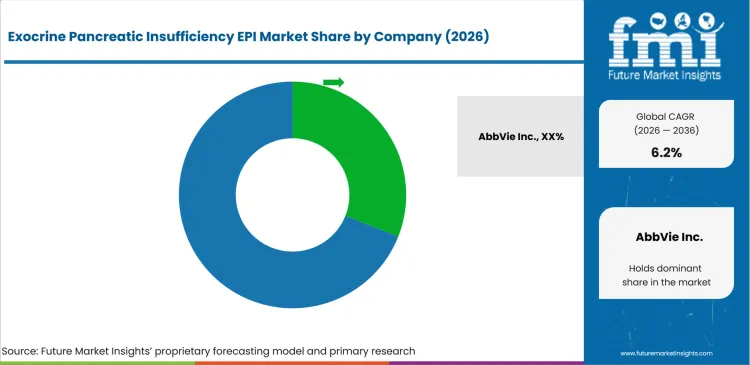
Competition in the sector centers on oral enzyme therapy and enteral nutrition support across EPI care. Established providers use product familiarity and pharmacy access during treatment selection. Specialist companies focus on feeding-compatible delivery or emerging enzymes. Prescribers review formulation range and administration guidance. Service coverage influences continued therapy across outpatient and hospital pathways.
- AbbVie Inc. and Nestlé Health Science compete based on established oral enzyme portfolios. Prescribers assess formulation choice and therapy support during treatment review.
- VIVUS LLC and Digestive Care, Inc. compete depending on oral pancrelipase products. Pharmacy access and administration guidance influence continued use.
- Alcresta Therapeutics, Inc. competes through enteral enzyme delivery. Hospital nutrition teams assess feeding compatibility and care support.
- Anagram Therapeutics, Inc. and Nordmark Pharma GmbH compete led by specialist enzyme capabilities. Buyers assess clinical evidence and manufacturing consistency.
Competitive Benchmarking: Exocrine Pancreatic Insufficiency EPI Market
| Company | Oral Therapy Depth | Enteral Support | Emerging Enzyme Capability | Service Reach |
|---|---|---|---|---|
| AbbVie Inc. | High | Low | Medium | Global |
| Nestlé Health Science | High | Medium | High | Global |
| VIVUS LLC | High | Low | Low | Selected markets |
| Digestive Care, Inc. | High | Medium | Low | United States |
| Alcresta Therapeutics, Inc. | Low | High | Medium | United States |
| Anagram Therapeutics, Inc. | Low | Low | High | Clinical programs |
| Nordmark Pharma GmbH | High | Low | Medium | Europe and selected markets |
Source: Future Market Insights competitive analysis, 2026.
Key Developments in Exocrine Pancreatic Insufficiency EPI Market
- In November 2025, Alcresta Therapeutics expanded United States clearance for RELiZORB across neonatal and infant enteral feeding. Company information connected feeding compatibility with broader enzyme delivery during tube-based nutrition.
- In April 2026, National Library of Medicine recorded a Phase 2a study sponsored by Nestlé Health Science. Study information connected NHS7108 comparison with ZENPEP across adults with EPI.
- In May 2026, Anagram Therapeutics initiated ANG003 study enrollment for people with cystic-fibrosis-related EPI. Company information connected broad-spectrum oral enzyme evaluation with continued clinical development.
Exocrine Pancreatic Insufficiency EPI Market Report Scope
| Coverage field | Report scope |
|---|---|
| Market breakdown | Exocrine Pancreatic Insufficiency EPI market breakdown includes Treatment, Indication, Route of Administration, End User, Distribution Channel, and Region. |
| Quantitative Units | Revenue in USD Million, CAGR in %. |
| Market Definition | Diagnosis and treatment of exocrine pancreatic insufficiency led by oral pancreatic enzyme replacement therapy. Enteral enzyme support and nutritional management complete defined coverage. Generic digestive supplements without an EPI pathway are excluded. |
| Regions Covered | North America, Europe, East Asia, South Asia and Pacific, Latin America, and Middle East and Africa. |
| Countries Covered | France, Italy, UK, USA, Japan, Germany, Canada, and additional countries covered in full regional analysis. |
| Key Companies Profiled | AbbVie Inc., Nestlé Health Science, VIVUS LLC, Digestive Care, Inc., Alcresta Therapeutics, Inc., Anagram Therapeutics, Inc., and Nordmark Pharma GmbH. |
| Forecast Period | 2026 to 2036 |
| Approach | Hybrid bottom-up and top-down methodology uses segment shares and country CAGRs. Company participation and treatment pathways support final reconciliation. |
Source: Future Market Insights analysis, 2026.
Exocrine Pancreatic Insufficiency EPI Market - Research Methodology
| Method | Approach |
|---|---|
| Primary Research | FMI analysts gathered input from manufacturers, service providers, technology developers, distributors, end users, procurement teams, and subject-matter experts. Interviews examined purchasing decisions, product or service evaluation, adoption barriers, approval requirements, pricing considerations, and expectations for technical or commercial support. Respondents were also asked what evidence is required before a trial, pilot, or initial order develops into regular purchasing. |
| Desk Research | Desk research covered government statistics, regulatory publications, trade data, industry associations, technical literature, standards, company filings, product information, and official corporate announcements. Sources were reviewed for relevance, publication date, geographic coverage, and consistency with the defined market scope. Claims relating to performance, applications, approvals, capacity, investment, and commercial activity were retained only when supported by credible public evidence. |
| Market Sizing and Forecasting | The market model combined the baseline value with historical performance, segment structure, pricing and volume indicators, adoption levels, company participation, and country-level demand conditions. Forecast assumptions considered economic activity, investment trends, regulatory developments, technology adoption, purchasing cycles, supply availability, and barriers to wider market use. Segment and regional estimates were reconciled before the final market total was calculated. |
| Data Validation | Estimates were checked against multiple independent indicators, including public data, company activity, trade patterns, industry developments, and findings from primary interviews. Validation also tested whether products, services, applications, and company revenues fell within the defined market boundaries. Adjacent categories, unsupported claims, overlapping revenues, and activities without direct market relevance were excluded to reduce double counting and maintain consistency across segments and countries. |
Source: Future Market Insights analysis, 2026.
Exocrine Pancreatic Insufficiency EPI Market by Segments
Exocrine Pancreatic Insufficiency EPI Market segmented by Treatment:
- Pancreatic Enzyme Replacement Therapy
- Nutritional Supplements
- Supportive Care
- Emerging Therapies
Exocrine Pancreatic Insufficiency EPI Market segmented by Indication:
- Chronic Pancreatitis
- Cystic Fibrosis
- Pancreatic Cancer
- Other Indications
Exocrine Pancreatic Insufficiency EPI Market segmented by Route of Administration:
- Oral
- Enteral Administration
- Combination Therapy
Exocrine Pancreatic Insufficiency EPI Market segmented by End User:
- Hospitals
- Specialty Clinics
- Home Care
- Retail & Specialty Pharmacies
Exocrine Pancreatic Insufficiency EPI Market segmented by Distribution Channel:
- Hospital Pharmacies
- Retail Pharmacies
- Online Pharmacies
Exocrine Pancreatic Insufficiency EPI Market segmented by Region:
- North America
- United States
- Canada
- Latin America
- Brazil
- Mexico
- Argentina
- Chile
- Western Europe
- Germany
- France
- United Kingdom
- Italy
- Spain
- Benelux
- Nordics
- Eastern Europe
- Poland
- Czech Republic
- Romania
- Hungary
- East Asia
- China
- Japan
- South Korea
- South Asia and Pacific
- India
- ASEAN
- Australia and New Zealand
- Middle East and Africa
- GCC Countries
- South Africa
- Türkiye
- Israel
Research Sources and Bibliography
- Babajide, O., Desai, A., Eruchalu, C., Sedarous, M., Adekunle, A. D., Youssef, M., Mahmud, M., & Okafor, P. N. (2024). The population-level prevalence of exocrine pancreas insufficiency and the subsequent risk of pancreatic cancer. Pancreas, 53(9), e723-e728.
- European Medicines Agency. (2026, April 14). Creon - supply shortage.
- Kadaj-Lipka, R., Monica, M., Stożek-Tutro, A., Ryś, P., & Rydzewska, G. (2025). Pancreatic enzyme replacement therapy in pancreatic exocrine insufficiency-real-world’s dosing and effectiveness: A systematic review. Digestive Diseases and Sciences, 70(7), 2270-2284.
- Dominguez-Muñoz, J. E., Vujasinovic, M., de la Iglesia, D., Cahen, D., Capurso, G., Gubergrits, N., Hegyi, P., Hungin, P., Ockenga, J., Paiella, S., Perkhofer, L., Rebours, V., Rosendahl, J., Salvia, R., Scheers, I., Szentesi, A., Bonovas, S., Piovani, D., & Löhr, J. M. (2025). European guidelines for the diagnosis and treatment of pancreatic exocrine insufficiency: UEG, EPC, EDS, ESPEN, ESPGHAN, ESDO, and ESPCG evidence-based recommendations. United European Gastroenterology Journal, 13(1), 125-172.
- Ashkar, M., Geremia, J., Baldwin, Z., Edwards, M. L., Zhang, Y., Garcia-Horton, V., Yang, M., Shen, E., Dylla, D. E., Sanchez Gonzalez, Y., & Barkin, J. A. (2026). Prescribing patterns and perceptions of pancreatic enzyme replacement therapy among healthcare providers: A prospective United States healthcare providers survey. Advances in Therapy, 43(3), 1109-1128.
- Ni, P., Baglini, C., Meurer, J., Drapek, L., Dhandibhotla, S., Liu, Y., Bazerbachi, F., Weekes, C., Ting, D. T., Kambadakone, A., Fernandez-Del Castillo, C., & Hernandez-Barco, Y. G. (2026). Disparities in the diagnosis and management of exocrine pancreatic insufficiency in resectable vs metastatic pancreatic cancer. The Oncologist, 31(4), oyag084.
- Digestive Care, Inc. (2026, May). Pertzye.
- Garcia, M. A. G., Imam, S., Braun, U. K., & Jackson, L. K. (2024, March 6). Rational prescribing of pancreatic enzymes for patients with pancreatic cancer. Palliative Medicine Reports, 5(1), 47-52.
- Kürtül, G. S., Sezgin, O., & Sucu, D. H. (2026). High frequency of pancreatic exocrine insufficiency among patients with abdominal pain, bloating, and malodorous flatus: Hidden pancreatic insufficiency. Turkish Journal of Gastroenterology, 37(7), 802-810.
- National Library of Medicine. (2026, April 16). IPEX study: Pancreatic exocrine insufficiency as a functional marker of disease progression in patients with IPMN.
- Daly, C., Burgel, P.-R., Sermet-Gaudelus, I., Baxter, C. A., Payen-Champenois, C., Giraudier, O., Wohling, H., Pafundi, P. C., Bessou, A., & Vega-Hernandez, G. (2026). SOLAR: A non-interventional study of outcomes over the long term of people with cystic fibrosis aged 6 years and older treated with ELX-TEZ-IVA using data from the French CF registry. ERJ Open Research.
- Zolin, A., Adamoli, A., Zomer, D., Fox, A., Krasnyk, M., Lorca Mayor, S., Prasad, V., Gambazza, S., Orenti, A., Gkolia, P., Cook, E., Burgel, P.-R., Duckers, J., Jung, A., Laidlaw, K., Petrova, G., Dubois, C., Kirwan, L., Krivec, U., Naehrlich, L., & Bakkeheim, E. (2026, May 18). ECFSPR 2024 Annual Data Report. Zenodo.
- Cystic Fibrosis Trust. (2025, October). UK Cystic Fibrosis Registry 2024 annual data report: At a glance.
- Cystic Fibrosis Foundation. (2025). 2024 Cystic Fibrosis Foundation patient registry highlights.
- National Cancer Center Japan. (2025, December 24). Projected cancer statistics.
- Naehrlich, L., & Burkhart, M. (2025). Success of the German Cystic Fibrosis Registry. Pharmacoepidemiology and Drug Safety, 34(1), e70076.
- Cystic Fibrosis Canada. (2026, January 22). Daily challenges persist for Canada’s cystic fibrosis community, even as it reaches a new milestone.
- AbbVie Inc. (2026, April 29). AbbVie reports first-quarter 2026 financial results.
- VIVUS LLC. (2026, January 12). VIVUS shares progress on pipeline and key program milestones during the 44th annual J.P. Morgan healthcare conference.
- Nordmark Pharma GmbH. (2024, March 1). Renaming the product.
- Alcresta Therapeutics, Inc. (2025, November 3). Alcresta Therapeutics announces FDA clearance for expanded use of RELiZORB (immobilized lipase) cartridge for neonates and infants.
- National Library of Medicine. (2026, April 30). A study to evaluate safety and explore efficacy of new lipase NHS7108 in adult participants with exocrine pancreatic insufficiency.
- Anagram Therapeutics, Inc. (2026, May 27). Anagram Therapeutics announces enrollment initiation in clinical study of ANG003 for people with exocrine pancreatic insufficiency due to cystic fibrosis.
This bibliography is provided for reader reference and is not exhaustive. The full report contains the complete reference list and detailed citations.
This Report Answers
- How do treatment and route of administration segments influence diagnosed EPI demand?
- What evidence guides clinicians during pancreatic enzyme dose selection?
- Why do country CAGRs differ across profiled markets?
- What companies compete through oral therapy and enteral enzyme delivery?
- How are forecasts validated through bottom-up and top-down analysis?
- What evidence supports hospital initiation and pharmacy fulfillment?
- Why do meal timing and nutritional response influence therapy selection?
- How does underdiagnosis limit prescription conversion?
- What company capabilities improve treatment persistence?
- How do shortages and reimbursement affect regional access?
Frequently Asked Questions
How big is the Exocrine Pancreatic Insufficiency (EPI) Market in 2026?
The exocrine pancreatic insufficiency market is valued at USD 2.8 billion in 2026 and is forecast to reach USD 5.1 billion by 2036. Growth is supported by a substantial underdiagnosed and undertreated patient population, with research across more than 79 million United States residents identifying a 0.8% EPI prevalence rate while pancreatic enzyme replacement therapy reached only 58.0% of confirmed cases, leaving a clear prescription and nutritional follow-up gap for healthcare providers to address.
What is the CAGR of the Exocrine Pancreatic Insufficiency (EPI) Market from 2026 to 2036?
The exocrine pancreatic insufficiency market grows at a CAGR of 6.2% between 2026 and 2036, supported by expanding specialist diagnosis across chronic pancreatitis, cystic fibrosis, and pancreatic oncology pathways, as providers adopt standardized enzyme replacement and dietitian-led titration programs once treatment demonstrates reliable symptom relief and nutritional recovery across long-term outpatient and home-care settings.
Which treatment type leads the Exocrine Pancreatic Insufficiency (EPI) Market?
Pancreatic enzyme replacement therapy accounts for 74.0% of the exocrine pancreatic insufficiency market by treatment in 2026, driven by direct replacement of deficient digestive enzymes across oral administration during meals, where symptom improvement influenced treatment selection for 83.6% of surveyed United States healthcare professionals and clinicians continue reviewing nutritional stability during ongoing dose adjustment.
How much will the Exocrine Pancreatic Insufficiency (EPI) Market add between 2026 and 2036?
The exocrine pancreatic insufficiency market is set to add USD 2.3 billion between 2026 and 2036, growing from USD 2.8 billion to USD 5.1 billion as oral pancrelipase portfolios, feeding-compatible enteral enzyme systems, and emerging broad-spectrum enzyme therapies enter funded specialist and oncology care pathways across both established reimbursement markets and expanding diagnostic programs worldwide.
Who are the leading companies in the Exocrine Pancreatic Insufficiency (EPI) Market?
Seven companies lead the exocrine pancreatic insufficiency market, including AbbVie Inc., Nestlé Health Science, VIVUS LLC, Digestive Care Inc., Alcresta Therapeutics Inc., Anagram Therapeutics Inc., and Nordmark Pharma GmbH, competing through established oral enzyme portfolios, enteral feeding-compatible delivery systems, emerging broad-spectrum enzyme development, and pharmacy and hospital access across United States, European, and selected international treatment programs.
Preview the report firsthand - request a free sample
Get SampleGet the brochure for pricing and purchase details.
Get PDFTable of Content
- Key Takeaways
- Market Size and CAGR
- Top Growth Driver
- Fastest Growing Segment
- Leading Region
- Key Companies
- Emerging Opportunities
- Executive Summary
- Global Market Outlook
- Demand-side Trends
- Supply-side Trends
- Technology Roadmap Analysis
- Analysis and Recommendations
- Analyst Perspective (What is happening? Why now? What should investors know?)
- Key Questions Answered
- How large is the market?
- What is the CAGR?
- What are key trends?
- Which region dominates?
- Who are the leaders?
- Market Overview
- Market Coverage / Taxonomy
- Market Definition / Scope / Limitations
- Research Methodology
- Chapter Orientation
- Analytical Lens and Working Hypotheses
- Market Structure, Signals, and Trend Drivers
- Benchmarking and Cross-market Comparability
- Market Sizing, Forecasting, and Opportunity Mapping
- Research Design and Evidence Framework
- Desk Research Programme (Secondary Evidence)
- Expert Input and Fieldwork (Primary Evidence)
- Tooling, Models, and Reference Databases
- Data Engineering and Model Build
- Quality Assurance and Audit Trail
- Market Background
- Market Dynamics (Drivers, Restraints, Opportunity, Trends)
- Scenario Forecast (Optimistic, Likely, Conservative)
- Impact Analysis
- AI Impact
- Sustainability Impact
- Regulatory Impact
- Technology Impact
- Consumer / Buyer Analysis
- Purchase Drivers
- Adoption Barriers
- Buyer Journey
- Opportunity Map Analysis
- Product Life Cycle Analysis
- Supply Chain Analysis
- Investment Feasibility Matrix
- Value Chain Analysis
- PESTLE and Porter's Analysis
- Regulatory Landscape
- Regional Parent Market Outlook
- Production and Consumption Statistics
- Import and Export Statistics
- Global Market Analysis and Forecast, 2021 to 2036
- Historical Market Size Value (USD Billion) Analysis, 2021 to 2025
- Current and Future Market Size Value (USD Billion) Projections, 2026 to 2036
- Y-o-Y Growth Trend Analysis
- Absolute $ Opportunity Analysis
- Global Market Pricing Analysis, 2021 to 2036
- Global Market Analysis and Forecast, By Treatment, 2021 to 2036
- Introduction / Key Findings
- Historical Market Size Value (USD Billion) Analysis By Treatment, 2021 to 2025
- Current and Future Market Size Value (USD Billion) Analysis and Forecast By Treatment, 2026 to 2036
- Pancreatic Enzyme Replacement Therapy
- Porcine-derived Enzyme Products
- Enteric-coated Capsules
- High-potency Formulations
- Nutritional Supplements
- Fat-soluble Vitamins
- Mineral Supplements
- Digestive Support Products
- Supportive Care
- Dietary Management
- Nutritional Counseling
- Symptom Management
- Emerging Therapies
- Recombinant Enzymes
- Microbial Enzyme Therapy
- Novel Drug Candidates
- Pancreatic Enzyme Replacement Therapy
- Y-o-Y Growth Trend Analysis By Treatment, 2021 to 2025
- Absolute $ Opportunity Analysis By Treatment, 2026 to 2036
- Global Market Analysis and Forecast, By Indication, 2021 to 2036
- Introduction / Key Findings
- Historical Market Size Value (USD Billion) Analysis By Indication, 2021 to 2025
- Current and Future Market Size Value (USD Billion) Analysis and Forecast By Indication, 2026 to 2036
- Chronic Pancreatitis
- Alcohol-induced Pancreatitis
- Idiopathic Pancreatitis
- Hereditary Pancreatitis
- Cystic Fibrosis
- Pediatric Patients
- Adult Patients
- Advanced Disease
- Pancreatic Cancer
- Post-pancreatectomy
- Chemotherapy-associated EPI
- Tumor-related EPI
- Other Indications
- Diabetes-associated EPI
- Celiac Disease
- Gastrointestinal Disorders
- Chronic Pancreatitis
- Y-o-Y Growth Trend Analysis By Indication, 2021 to 2025
- Absolute $ Opportunity Analysis By Indication, 2026 to 2036
- Global Market Analysis and Forecast, By Route of Administration, 2021 to 2036
- Introduction / Key Findings
- Historical Market Size Value (USD Billion) Analysis By Route of Administration, 2021 to 2025
- Current and Future Market Size Value (USD Billion) Analysis and Forecast By Route of Administration, 2026 to 2036
- Oral
- Capsules
- Tablets
- Granules
- Enteral Administration
- Feeding Tube Delivery
- Hospital Nutrition Support
- Critical Care Patients
- Combination Therapy
- Oral Plus Nutritional Support
- Enzyme Plus Vitamin Therapy
- Personalized Treatment
- Oral
- Y-o-Y Growth Trend Analysis By Route of Administration, 2021 to 2025
- Absolute $ Opportunity Analysis By Route of Administration, 2026 to 2036
- Global Market Analysis and Forecast, By End User, 2021 to 2036
- Introduction / Key Findings
- Historical Market Size Value (USD Billion) Analysis By End User, 2021 to 2025
- Current and Future Market Size Value (USD Billion) Analysis and Forecast By End User, 2026 to 2036
- Hospitals
- Tertiary Care Hospitals
- Community Hospitals
- Teaching Hospitals
- Specialty Clinics
- Gastroenterology Clinics
- Pancreatic Care Centers
- Cystic Fibrosis Clinics
- Home Care
- Self-administration
- Home Healthcare
- Long-term Care
- Retail & Specialty Pharmacies
- Retail Pharmacies
- Hospital Pharmacies
- Online Pharmacies
- Hospitals
- Y-o-Y Growth Trend Analysis By End User, 2021 to 2025
- Absolute $ Opportunity Analysis By End User, 2026 to 2036
- Global Market Analysis and Forecast, By Distribution Channel, 2021 to 2036
- Introduction / Key Findings
- Historical Market Size Value (USD Billion) Analysis By Distribution Channel, 2021 to 2025
- Current and Future Market Size Value (USD Billion) Analysis and Forecast By Distribution Channel, 2026 to 2036
- Hospital Pharmacies
- Inpatient Pharmacies
- Outpatient Pharmacies
- Specialty Hospital Pharmacies
- Retail Pharmacies
- Chain Pharmacies
- Independent Pharmacies
- Clinic Pharmacies
- Online Pharmacies
- E-commerce Pharmacies
- Mail-order Pharmacies
- Digital Healthcare Platforms
- Hospital Pharmacies
- Y-o-Y Growth Trend Analysis By Distribution Channel, 2021 to 2025
- Absolute $ Opportunity Analysis By Distribution Channel, 2026 to 2036
- Global Market Analysis and Forecast, By Region, 2021 to 2036
- Introduction
- Historical Market Size Value (USD Billion) Analysis By Region, 2021 to 2025
- Current Market Size Value (USD Billion) Analysis and Forecast By Region, 2026 to 2036
- North America
- Latin America
- Western Europe
- Eastern Europe
- East Asia
- South Asia and Pacific
- Middle East & Africa
- Market Attractiveness Analysis By Region
- North America Market Analysis and Forecast, By Country, 2021 to 2036
- Historical Market Size Value (USD Billion) Trend Analysis By Market Taxonomy, 2021 to 2025
- Market Size Value (USD Billion) Forecast By Market Taxonomy, 2026 to 2036
- By Country
- USA
- Canada
- By Treatment
- By Indication
- By Route of Administration
- By End User
- By Distribution Channel
- By Country
- Market Attractiveness Analysis
- By Country
- By Treatment
- By Indication
- By Route of Administration
- By End User
- By Distribution Channel
- Key Takeaways
- Latin America Market Analysis and Forecast, By Country
- Historical Market Size Value (USD Billion) Trend Analysis By Market Taxonomy, 2021 to 2025
- Market Size Value (USD Billion) Forecast By Market Taxonomy, 2026 to 2036
- By Country
- Brazil
- Mexico
- Chile
- Rest of Latin America
- By Treatment
- By Indication
- By Route of Administration
- By End User
- By Distribution Channel
- By Country
- Market Attractiveness Analysis
- By Country
- By Treatment
- By Indication
- By Route of Administration
- By End User
- By Distribution Channel
- Key Takeaways
- Western Europe Market Analysis and Forecast, By Country
- Historical Market Size Value (USD Billion) Trend Analysis By Market Taxonomy, 2021 to 2025
- Market Size Value (USD Billion) Forecast By Market Taxonomy, 2026 to 2036
- By Country
- Germany
- UK
- Italy
- Spain
- France
- Nordic
- BENELUX
- Rest of Western Europe
- By Treatment
- By Indication
- By Route of Administration
- By End User
- By Distribution Channel
- By Country
- Market Attractiveness Analysis
- By Country
- By Treatment
- By Indication
- By Route of Administration
- By End User
- By Distribution Channel
- Key Takeaways
- Eastern Europe Market Analysis and Forecast, By Country
- Historical Market Size Value (USD Billion) Trend Analysis By Market Taxonomy, 2021 to 2025
- Market Size Value (USD Billion) Forecast By Market Taxonomy, 2026 to 2036
- By Country
- Russia
- Poland
- Hungary
- Balkan & Baltic
- Rest of Eastern Europe
- By Treatment
- By Indication
- By Route of Administration
- By End User
- By Distribution Channel
- By Country
- Market Attractiveness Analysis
- By Country
- By Treatment
- By Indication
- By Route of Administration
- By End User
- By Distribution Channel
- Key Takeaways
- East Asia Market Analysis and Forecast, By Country
- Historical Market Size Value (USD Billion) Trend Analysis By Market Taxonomy, 2021 to 2025
- Market Size Value (USD Billion) Forecast By Market Taxonomy, 2026 to 2036
- By Country
- China
- Japan
- South Korea
- By Treatment
- By Indication
- By Route of Administration
- By End User
- By Distribution Channel
- By Country
- Market Attractiveness Analysis
- By Country
- By Treatment
- By Indication
- By Route of Administration
- By End User
- By Distribution Channel
- Key Takeaways
- South Asia and Pacific Market Analysis and Forecast, By Country
- Historical Market Size Value (USD Billion) Trend Analysis By Market Taxonomy, 2021 to 2025
- Market Size Value (USD Billion) Forecast By Market Taxonomy, 2026 to 2036
- By Country
- India
- ASEAN
- Australia & New Zealand
- Rest of South Asia and Pacific
- By Treatment
- By Indication
- By Route of Administration
- By End User
- By Distribution Channel
- By Country
- Market Attractiveness Analysis
- By Country
- By Treatment
- By Indication
- By Route of Administration
- By End User
- By Distribution Channel
- Key Takeaways
- Middle East & Africa Market Analysis and Forecast, By Country
- Historical Market Size Value (USD Billion) Trend Analysis By Market Taxonomy, 2021 to 2025
- Market Size Value (USD Billion) Forecast By Market Taxonomy, 2026 to 2036
- By Country
- Kingdom of Saudi Arabia
- Other GCC Countries
- Türkiye
- South Africa
- Other African Union
- Rest of Middle East & Africa
- By Treatment
- By Indication
- By Route of Administration
- By End User
- By Distribution Channel
- By Country
- Market Attractiveness Analysis
- By Country
- By Treatment
- By Indication
- By Route of Administration
- By End User
- By Distribution Channel
- Key Takeaways
- Key Countries Market Analysis
- USA
- Pricing Analysis
- Market Share Analysis, 2025
- By Treatment
- By Indication
- By Route of Administration
- By End User
- By Distribution Channel
- Canada
- Pricing Analysis
- Market Share Analysis, 2025
- By Treatment
- By Indication
- By Route of Administration
- By End User
- By Distribution Channel
- Mexico
- Pricing Analysis
- Market Share Analysis, 2025
- By Treatment
- By Indication
- By Route of Administration
- By End User
- By Distribution Channel
- Brazil
- Pricing Analysis
- Market Share Analysis, 2025
- By Treatment
- By Indication
- By Route of Administration
- By End User
- By Distribution Channel
- Chile
- Pricing Analysis
- Market Share Analysis, 2025
- By Treatment
- By Indication
- By Route of Administration
- By End User
- By Distribution Channel
- Germany
- Pricing Analysis
- Market Share Analysis, 2025
- By Treatment
- By Indication
- By Route of Administration
- By End User
- By Distribution Channel
- UK
- Pricing Analysis
- Market Share Analysis, 2025
- By Treatment
- By Indication
- By Route of Administration
- By End User
- By Distribution Channel
- Italy
- Pricing Analysis
- Market Share Analysis, 2025
- By Treatment
- By Indication
- By Route of Administration
- By End User
- By Distribution Channel
- Spain
- Pricing Analysis
- Market Share Analysis, 2025
- By Treatment
- By Indication
- By Route of Administration
- By End User
- By Distribution Channel
- France
- Pricing Analysis
- Market Share Analysis, 2025
- By Treatment
- By Indication
- By Route of Administration
- By End User
- By Distribution Channel
- India
- Pricing Analysis
- Market Share Analysis, 2025
- By Treatment
- By Indication
- By Route of Administration
- By End User
- By Distribution Channel
- ASEAN
- Pricing Analysis
- Market Share Analysis, 2025
- By Treatment
- By Indication
- By Route of Administration
- By End User
- By Distribution Channel
- Australia & New Zealand
- Pricing Analysis
- Market Share Analysis, 2025
- By Treatment
- By Indication
- By Route of Administration
- By End User
- By Distribution Channel
- China
- Pricing Analysis
- Market Share Analysis, 2025
- By Treatment
- By Indication
- By Route of Administration
- By End User
- By Distribution Channel
- Japan
- Pricing Analysis
- Market Share Analysis, 2025
- By Treatment
- By Indication
- By Route of Administration
- By End User
- By Distribution Channel
- South Korea
- Pricing Analysis
- Market Share Analysis, 2025
- By Treatment
- By Indication
- By Route of Administration
- By End User
- By Distribution Channel
- Russia
- Pricing Analysis
- Market Share Analysis, 2025
- By Treatment
- By Indication
- By Route of Administration
- By End User
- By Distribution Channel
- Poland
- Pricing Analysis
- Market Share Analysis, 2025
- By Treatment
- By Indication
- By Route of Administration
- By End User
- By Distribution Channel
- Hungary
- Pricing Analysis
- Market Share Analysis, 2025
- By Treatment
- By Indication
- By Route of Administration
- By End User
- By Distribution Channel
- Kingdom of Saudi Arabia
- Pricing Analysis
- Market Share Analysis, 2025
- By Treatment
- By Indication
- By Route of Administration
- By End User
- By Distribution Channel
- Türkiye
- Pricing Analysis
- Market Share Analysis, 2025
- By Treatment
- By Indication
- By Route of Administration
- By End User
- By Distribution Channel
- South Africa
- Pricing Analysis
- Market Share Analysis, 2025
- By Treatment
- By Indication
- By Route of Administration
- By End User
- By Distribution Channel
- USA
- Market Structure Analysis
- Competition Dashboard
- Competition Benchmarking
- Market Share Analysis of Top Players
- By Regional
- By Treatment
- By Indication
- By Route of Administration
- By End User
- By Distribution Channel
- Emerging Startups
- Innovation Benchmarking
- Competition Analysis
- Competition Deep Dive
- AbbVie Inc.
- Overview
- Product Portfolio
- Profitability by Market Segments
- Sales Footprint
- Strategy Overview
- Marketing Strategy
- Product Strategy
- Channel Strategy
- Nestlé Health Science
- Vivus LLC
- Codexis Inc.
- Azurity Pharmaceuticals
- Digestive Care Inc.
- AnX Robotica
- Nordmark Arzneimittel GmbH
- BioMarin Pharmaceutical Inc.
- Organon & Co.
- AbbVie Inc.
- Case Studies
- Success Stories
- Recent Developments
- Competition Deep Dive
- Assumptions & Acronyms Used


