

- Market Size (2026)
- USD 818 Mn
- Forecast (2036)
- USD 4200 Mn
- CAGR (2026 to 2036)
- 17.6%
How big is the Exosome Development and Manufacturing Market in 2026?
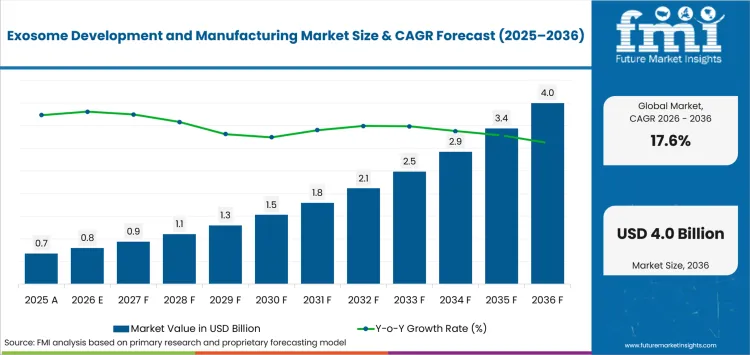
USD 818 million in 2026 and USD 4200 million by 2036 at a 17.6% CAGR.
Demand in exosome development and manufacturing market is projected to rise at 17.6% CAGR, increasing valuation from USD 818 million in 2026 and USD 4200 million by 2036. Expansion reflects increasing research activity in extracellular vesicle-based therapies, although commercialization remains highly dependent on regulatory compliance and manufacturing standardization. The FDA reiterated in 2025 that exosome products intended for therapeutic use require appropriate regulatory authorization and that no exosome products have received FDA approval for therapeutic indications, reinforcing the importance of formal development pathways.
The United Kingdom is improving its attractiveness as a development hub through measures that accelerate clinical research timelines. Trial setup times were reduced from 169 days to 122 days in 2026, enabling faster progression of advanced therapy programs into clinical evaluation. Cell and exosome therapy developers must nevertheless maintain robust manufacturing and product-release controls to support regulatory acceptance and commercial scalability.
Key Takeaways of Exosome Development And Manufacturing Market
- Clinical translation requires repeatable exosome batches and documented transfer into GMP manufacturing.
- Exosome manufacturing services are projected to represent 41.0% of product demand in 2026 owing to concentrated expertise.
- Upstream processing is estimated to account for 33.0% of workflow demand in 2026 as culture settings establish consistency.
- Therapeutics are forecast to capture 38.0% of application demand in 2026 supported by regulated development programs.
- Variable vesicle populations and incomplete potency standards extend release testing across manufacturing sites.
- Key players in the industry comprises Lonza Group AG, Evox Therapeutics Ltd., RoosterBio, Inc., FUJIFILM Biotechnologies, Sartorius AG, Thermo Fisher Scientific Inc., Aegle Therapeutics Corp. and Creative Biolabs.
Analyst Perspective
"Exosome scale-up loses value if particle output weakens biological activity. Sponsors should compare source-cell control with impurity removal and assay transfer during capacity selection."
- Anurag Sharma, Principal Consultant, Future Market Insights
How is the Exosome Development and Manufacturing Market segmented?
The exosome development and manufacturing market is segmented by product, workflow, application, end user, manufacturing scale and region.
Products include services, isolation materials, characterization solutions and delivery platforms. Workflows move from cell culture and expansion to purification, quality control and fill finish, so each stage affects batch consistency and release readiness. Applications include therapeutics, drug delivery, diagnostics and research. End users include biopharmaceutical companies, contract manufacturers and research institutes that differ in ownership of process development, regulatory records and clinical supply.
What makes therapeutics central to the application category?
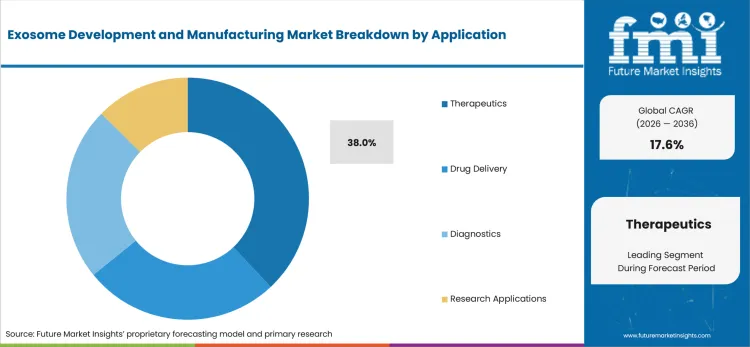
Therapeutic programs place tighter expectations on dose definition, biological activity and product comparability. Native and engineered exosome therapeutics therefore need clear cargo-loading rules, recovery controls and release strategies before clinical transfer.
- Based on application, therapeutics are projected to account for 38.0% in 2026 due to regenerative and targeted-delivery programs.
- Clinical teams must preserve vesicle attributes during dosing and transfer. Developers link cargo loading with recovery data and potency testing to support release decisions.
What supports exosome manufacturing services within the product category?
Manufacturing services combine process design, analytical development and GMP execution in one operating route. Sponsors use these services when internal facilities cannot efficiently cover source-cell handling, vesicle recovery, method transfer and regulated production records.
- By product, manufacturing services are estimated to hold 41.0% in 2026 owing to concentrated expertise and regulated production requirements.
- Clinical transfer depends on matching process choices with release controls. In March 2025, Lonza and Exogenus began work on a GMP-compliant process for Exo-101 production.
How does upstream processing shape demand within the workflow category?
Upstream processing sets the source-cell condition, culture environment and expansion parameters before vesicle recovery begins. A July 2026 RoosterBio and Qkine agreement brought cells, media and growth factors into a single-source platform for USA customers.
- The workflow category is forecast to be led by upstream processing at 33.0% in 2026 because expansion settings determine the consistency of later recovery steps.
- Automated cell culture systems and defined media reduce operator variation. Transfer records then connect expansion conditions with recovery results and release decisions.
How do biopharmaceutical companies influence the end-user category?
Biopharmaceutical companies shape the end-user category because they retain program strategy, CMC planning and regulatory accountability even when manufacturing work is outsourced. Sponsor teams still control product expectations and release responsibilities during transfer.
- Biopharmaceutical companies are likely to capture 44.0% in 2026 attributable to sponsor-led CMC planning and clinical supply oversight.
- External manufacturers add capacity and technical execution without taking over sponsor accountability. Contracts must define identity controls and record access.
What are the drivers, restraints and opportunities in the Exosome Development and Manufacturing Market?
Clinical programs require repeatable GMP supply, vesicle heterogeneity complicates release decisions and integrated production platforms reduce transfer risk.
- Driver: Therapeutic programs require documented process development and repeatable clinical supply across regulated manufacturing stages.
- Restraint: Variable vesicle populations and incomplete potency methods extend release testing across process changes.
- Opportunity: Closed culture and scalable purification with orthogonal analytics support transferable production platforms.
Clinical advancement converts laboratory feasibility into recurring demand for controlled batches. Sponsors must document starting materials and analytical controls throughout regulated campaigns.
Particle counts cannot establish identity and potency across heterogeneous products. Bioreactor analytics connect process conditions with defensible release decisions.
Integrated platforms combine closed culture with purification and fill finish manufacturing. Sponsors preserve process knowledge and reduce repeated facility-fit work.
Which country CAGRs are profiled in the Exosome Development and Manufacturing Market?
| Country | CAGR |
|---|---|
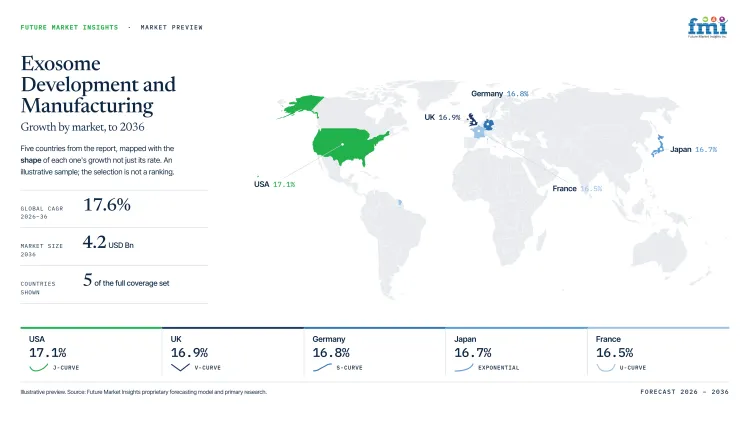
| United States | 17.1% |
| United Kingdom | 16.9% |
| Germany | 16.8% |
| Japan | 16.7% |
| France | 16.5% |
How do country-level CAGRs compare in the Exosome Development and Manufacturing Market?
The CAGRs span 0.6 percentage point and describe forecast pace instead of current size. National review practices shape entry conditions.
- United States programs combine biotechnology capacity with strict FDA oversight for regulated exosome products.
- United Kingdom programs benefit from coordinated review and licensed advanced-therapy manufacturing networks.
- Germany combines biomedicine expertise with demanding evidence requirements for advanced-therapy manufacturing.
- Japan applies dedicated extracellular-vesicle guidance across domestic manufacturing partnerships.
- France connects hospital research capacity with accelerated review for qualified advanced-therapy trials.
Comparable CAGRs can produce different entry conditions across national regulatory systems and treatment networks. The full report covers North America, Latin America, Europe, East Asia, South Asia and Pacific, and the Middle East and Africa.
Country-wise Analysis
- United States programs use biotechnology clusters and biologics contract manufacturing networks for clinical supply. Adoption is estimated to expand at 17.1% CAGR through 2036 despite costly comparability studies and strict premarket requirements. FDA stated in May 2026 that Blue Horizon products lacked an approved license or active IND, raising compliance costs for clinics and regulated sponsors.
- United Kingdom developers use academic networks and licensed facilities for specialist clinical supply. The outlook is anticipated to advance at 16.9% CAGR over the assessment period despite demanding licensing and scheduling. MHRA reported in July 2025 that it assessed more than 5,000 clinical-trial applications during 2024-25, supporting review capacity without removing manufacturing obligations.
- Germany combines university hospitals with bioprocess suppliers and advanced-therapy expertise. The sector is projected to record 16.8% CAGR during the assessment period despite demanding comparability work. Paul-Ehrlich-Institut reported 310 vaccine and biomedicine trial applications during 2024, confirming regulated activity while sponsors coordinate German sites with European procedures.
- Japan uses metropolitan research hospitals and domestic manufacturing partners for translated quality records and clinical supply. Sales are forecast to expand at 16.7% CAGR by 2036 despite detailed characterization requirements. PMDA issued extracellular-vesicle quality considerations in June 2026, giving regenerative medicine sponsors a framework for initial trial notifications.
- France connects public hospital research with national advanced-therapy trial infrastructure across biomedical clusters. France is projected to grow at 16.5% CAGR by 2036 despite complex dossiers and limited specialist routes outside major centers. The Health Ministry introduced a March 2026 fast-track with a maximum 49-day assessment calendar for eligible trials, reducing review delays without removing manufacturing documentation requirements.
Who are the notable companies in the Exosome Development and Manufacturing Market?
Lonza Group AG, Evox Therapeutics Ltd., RoosterBio, Inc., FUJIFILM Biotechnologies, Sartorius AG, Thermo Fisher Scientific Inc., Aegle Therapeutics Corp. and Creative Biolabs are the notable companies serving this market.
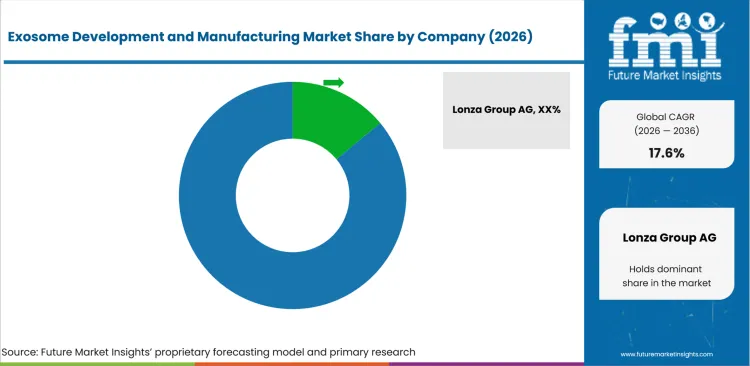
Competition spans integrated CDMOs, process specialists, analytical suppliers and therapeutic developers. Manufacturing competition centers on upstream control and scalable purification, while liquid biopsy supports characterization demand.
- Lonza and FUJIFILM Biotechnologies provide integrated development and GMP manufacturing routes.
- RoosterBio, Sartorius and Thermo Fisher Scientific support production, purification and analytical workflows.
- Evox Therapeutics and Aegle Therapeutics advance engineered platforms, while Creative Biolabs represents specialist service participation.
Competitive Benchmarking: Exosome Development and Manufacturing Market
| Company | Development and GMP Manufacturing | Exosome Platform or Process Fit | Analytics and Scale-up Support | Geographic Reach |
|---|---|---|---|---|
| Lonza Group AG | High | High | High | Global |
| Evox Therapeutics Ltd. | Low | High | Medium | United Kingdom |
| RoosterBio, Inc. | Medium | High | High | North America and partner network |
| FUJIFILM Biotechnologies | High | Medium | High | Global |
| Sartorius AG | Medium | High | High | Global |
| Thermo Fisher Scientific Inc. | High | Medium | High | Global |
| Aegle Therapeutics Corp. | Low | High | Medium | United States |
| Creative Biolabs | Medium | High | High | Global service coverage |
Key Developments in the Exosome Development and Manufacturing Market
- In May 2026, Made Scientific and RoosterBio partnered for scalable MSC and extracellular-vesicle manufacturing. The agreement connects standardized inputs with commercial GMP production for regulated campaigns.
- In February 2026, Evox Therapeutics partnered with Rett Syndrome Research Trust to evaluate ExoEdit gene-editing delivery. The program requires consistent cargo loading and release methods.
- In April 2025, RoosterBio and Thermo Fisher Scientific combined exosome process expertise with GMP trial-material manufacturing. The collaboration reduces technical handoffs during scale-up and trial preparation.
Key Players in the Exosome Development and Manufacturing Market
Integrated Development and GMP Manufacturing Platforms
- Lonza Group AG
- RoosterBio, Inc.
- FUJIFILM Biotechnologies
- Thermo Fisher Scientific Inc.
Therapeutic and Engineered Exosome Developers
- Evox Therapeutics Ltd.
- Aegle Therapeutics Corp.
Process and Analytical Solution Providers
- Sartorius AG
- Creative Biolabs
Exosome Development and Manufacturing Market - Report Scope
| Coverage field | Report scope |
|---|---|
| Market breakdown | By product, workflow, application, end user, manufacturing scale and region. |
| Quantitative Units | Revenue in USD million and CAGR in %. |
| Market Definition | Exosome development and manufacturing services, isolation materials, characterization solutions, drug-delivery platforms and production workflows for research and therapeutic applications. |
| Regions Covered | North America, Latin America, Western Europe, Eastern Europe, East Asia, South Asia and Pacific, and Middle East and Africa. |
| Countries Covered | United States, United Kingdom, Germany, Japan, France, and 20+ countries included in the full report. |
| Key Companies Profiled | Lonza Group AG, Evox Therapeutics Ltd., RoosterBio, Inc., FUJIFILM Biotechnologies, Sartorius AG, Thermo Fisher Scientific Inc., Aegle Therapeutics Corp. and Creative Biolabs. |
| Forecast Period | 2026 to 2036. |
| Approach | Primary and secondary research with market triangulation. |
Exosome Development and Manufacturing Market - Research Methodology
| Method | Approach |
|---|---|
| Primary Research | FMI analysts gathered input from manufacturers, service providers, technology developers, distributors, end users, procurement teams, and subject-matter experts. Interviews examined purchasing decisions, product or service evaluation, adoption barriers, approval requirements, pricing considerations, and expectations for technical or commercial support. Respondents were also asked what evidence is required before a trial, pilot, or initial order develops into regular purchasing. |
| Desk Research | Desk research covered government statistics, regulatory publications, trade data, industry associations, technical literature, standards, company filings, product information, and official corporate announcements. Sources were reviewed for relevance, publication date, geographic coverage, and consistency with the defined market scope. Claims relating to performance, applications, approvals, capacity, investment, and commercial activity were retained only when supported by credible public evidence. |
| Market Sizing and Forecasting | The market model combined the baseline value with historical performance, segment structure, pricing and volume indicators, adoption levels, company participation, and country-level demand conditions. Forecast assumptions considered economic activity, investment trends, regulatory developments, technology adoption, purchasing cycles, supply availability, and barriers to wider market use. Segment and regional estimates were reconciled before the final market total was calculated. |
| Data Validation | Estimates were checked against multiple independent indicators, including public data, company activity, trade patterns, industry developments, and findings from primary interviews. Validation also tested whether products, services, applications, and company revenues fell within the defined market boundaries. Adjacent categories, unsupported claims, overlapping revenues, and activities without direct market relevance were excluded to reduce double counting and maintain consistency across segments and countries. |
Exosome Development and Manufacturing Market by Segments
Exosome Development and Manufacturing Market segmented by Product:
- Exosome Manufacturing Services
- Process Development
- GMP Manufacturing
- Scale-up Manufacturing
- Exosome Isolation Kits & Reagents
- Precipitation Kits
- Size Exclusion Chromatography Kits
- Immunoaffinity Isolation Kits
- Exosome Characterization Solutions
- Particle Analysis Systems
- Flow Cytometry Solutions
- Molecular Characterization Assays
- Exosome Drug Delivery Platforms
- Therapeutic Exosomes
- Loaded Exosome Carriers
- Engineered Exosome Platforms
Exosome Development and Manufacturing Market segmented by Workflow:
- Upstream Processing
- Cell Culture
- Cell Expansion
- Bioreactor Production
- Downstream Processing
- Isolation & Purification
- Concentration
- Sterile Filtration
- Characterization & Quality Control
- Size Characterization
- Potency Testing
- Release Testing
- Fill & Finish
- Aseptic Filling
- Cryopreservation
- Packaging
Exosome Development and Manufacturing Market segmented by Application:
- Therapeutics
- Oncology
- Neurology
- Regenerative Medicine
- Drug Delivery
- RNA Delivery
- Gene Therapy Delivery
- Targeted Drug Delivery
- Diagnostics
- Liquid Biopsy
- Biomarker Discovery
- Disease Monitoring
- Research Applications
- Preclinical Research
- Translational Research
- Academic Research
Exosome Development and Manufacturing Market segmented by End User:
- Biopharmaceutical Companies
- Biotechnology Companies
- Pharmaceutical Companies
- Cell & Gene Therapy Developers
- Contract Development & Manufacturing Organizations
- Process Development Services
- GMP Manufacturing Services
- Analytical Services
- Academic & Research Institutes
- Universities
- Research Institutes
- Clinical Research Centers
Exosome Development and Manufacturing Market segmented by Manufacturing Scale:
- Clinical-scale Manufacturing
- Phase I Production
- Phase II Production
- Phase III Production
- Commercial-scale Manufacturing
- Large-scale GMP Production
- Automated Manufacturing
- Continuous Manufacturing
- Research-scale Manufacturing
- Laboratory Production
- Pilot-scale Production
- Process Optimization
Exosome Development and Manufacturing Market by Region:
- North America
- United States
- Canada
- Mexico
- Latin America
- Brazil
- Chile
- Rest of Latin America
- Western Europe
- Germany
- United Kingdom
- Italy
- Spain
- France
- Nordics
- Benelux
- Rest of Western Europe
- Eastern Europe
- Russia
- Poland
- Hungary
- Balkan and Baltic States
- Rest of Eastern Europe
- East Asia
- China
- Japan
- South Korea
- South Asia and Pacific
- India
- ASEAN
- Australia and New Zealand
- Rest of South Asia and Pacific
- Middle East and Africa
- Kingdom of Saudi Arabia
- Other GCC Countries
- Türkiye
- South Africa
- Other African Union Countries
- Rest of Middle East and Africa
Research Sources and Bibliography
- USA Food and Drug Administration. (2025, May 5). Supreme Rejuvenation, LLC - 700749 - 05/05/2025.
- Medicines and Healthcare products Regulatory Agency & Health Research Authority. (2026, April 27). Launch of clinical trial reforms.
- Lonza. (2025, March 11). Exogenus Therapeutics Chooses Lonza to Develop a GMP-Compliant Process to Manufacture Exo-101.
- RoosterBio. (2026, July 7). RoosterBio & Qkine Partner to Deliver a Single-Source Platform to USA Customers.
- USA Food and Drug Administration. (2026, May 26). Blue Horizon International, LLC - 728085 - 05/26/2026.
- Medicines and Healthcare products Regulatory Agency. (2025, July 21). MHRA’s 2024-25 Annual Report and Accounts and Impact Report show progress.
- Paul-Ehrlich-Institut. (2024, April 29). Regulation of Biomedicines: Paul-Ehrlich-Institut in Discussion with BPI.
- Pharmaceuticals and Medical Devices Agency. (2026, June 16). Early Consideration for Human Cell-Derived Extracellular Vesicle Products.
- Ministère de la Santé. (2026, March 5). Dispositif d’évaluation accélérée des essais cliniques en France.
- RoosterBio. (2026, May 5). Made Scientific and RoosterBio Announce Strategic Technology & Supply Partnership.
- Evox Therapeutics. (2026, February 26). Evox Therapeutics Partners with Rett Syndrome Research Trust.
- RoosterBio. (2025, April 29). RoosterBio Announces Collaboration with Thermo Fisher Scientific.
- Lonza. (2025, September 23). RION Engages Lonza to Scale Manufacturing Exosome Based Therapeutics.
- RoosterBio. (2026, March 12). Nikon CeLL Innovation to Provide End-to-End MSC and Extracellular-Vesicle Manufacturing in Japan.
- RoosterBio. (2026, April 8). RoosterBio & MineBio Life Sciences Partner to Expand MSC and Exosome Bioprocessing Access in China.
This bibliography is provided for reader reference and is not exhaustive. The full report contains the complete reference list and detailed citations.
This Report Answers
- How large is the market in 2026 and 2036?
- Which operating controls support regulated exosome manufacturing?
- Which product segment accounts for 41.0% in 2026?
- How does upstream processing affect recovery and release?
- Which applications support therapeutic manufacturing demand?
- How do growth rates differ across five countries?
- Which companies provide manufacturing and analytical capabilities?
- Which constraints limit regulated clinical supply?
Frequently Asked Questions
How big is the Exosome Development and Manufacturing Market in 2026?
In 2026, the exosome development and manufacturing market is valued at USD 818 million. Repeatable source-cell control and transferable release methods support expansion toward USD 4200 million by 2036 across regulated clinical programs.
What is the CAGR of the Exosome Development and Manufacturing Market from 2026 to 2036?
The exosome development and manufacturing market is projected to expand at 17.6% CAGR from 2026 to 2036. Scalable purification and potency strategies must preserve comparability during transfer into larger regulated facilities.
Which product segment is projected to account for 41.0% of the Exosome Development and Manufacturing Market?
Exosome manufacturing services are projected to account for 41.0% of product demand in the Exosome Development and Manufacturing Market during 2026. Concentrated process knowledge remains costly for sponsors to reproduce internally.
Which workflow segment is projected to account for 33.0% of the Exosome Development and Manufacturing Market?
Upstream processing is projected to account for 33.0% of workflow demand in the exosome development and manufacturing market during 2026. Cell source and culture conditions establish consistency for recurring production.
Which companies are active in the Exosome Development and Manufacturing Market?
Eight companies are profiled in the exosome development and manufacturing market: Lonza, Evox Therapeutics, RoosterBio, FUJIFILM Biotechnologies, Sartorius, Thermo Fisher Scientific, Aegle Therapeutics and Creative Biolabs. Their roles cover manufacturing, process support and therapeutic development.
Preview the report firsthand - request a free sample
Get SampleGet the brochure for pricing and purchase details.
Get PDFTable of Content
- Key Takeaways
- Market Size and CAGR
- Top Growth Driver
- Fastest Growing Segment
- Leading Region
- Key Companies
- Emerging Opportunities
- Executive Summary
- Global Market Outlook
- Demand-side Trends
- Supply-side Trends
- Technology Roadmap Analysis
- Analysis and Recommendations
- Analyst Perspective (What is happening? Why now? What should investors know?)
- Key Questions Answered
- How large is the market?
- What is the CAGR?
- What are key trends?
- Which region dominates?
- Who are the leaders?
- Market Overview
- Market Coverage / Taxonomy
- Market Definition / Scope / Limitations
- Research Methodology
- Chapter Orientation
- Analytical Lens and Working Hypotheses
- Market Structure, Signals, and Trend Drivers
- Benchmarking and Cross-market Comparability
- Market Sizing, Forecasting, and Opportunity Mapping
- Research Design and Evidence Framework
- Desk Research Programme (Secondary Evidence)
- Expert Input and Fieldwork (Primary Evidence)
- Tooling, Models, and Reference Databases
- Data Engineering and Model Build
- Quality Assurance and Audit Trail
- Market Background
- Market Dynamics (Drivers, Restraints, Opportunity, Trends)
- Scenario Forecast (Optimistic, Likely, Conservative)
- Impact Analysis
- AI Impact
- Sustainability Impact
- Regulatory Impact
- Technology Impact
- Consumer / Buyer Analysis
- Purchase Drivers
- Adoption Barriers
- Buyer Journey
- Opportunity Map Analysis
- Product Life Cycle Analysis
- Supply Chain Analysis
- Investment Feasibility Matrix
- Value Chain Analysis
- PESTLE and Porter's Analysis
- Regulatory Landscape
- Regional Parent Market Outlook
- Production and Consumption Statistics
- Import and Export Statistics
- Global Market Analysis and Forecast, 2021 to 2036
- Historical Market Size Value (USD Million) Analysis, 2021 to 2025
- Current and Future Market Size Value (USD Million) Projections, 2026 to 2036
- Y-o-Y Growth Trend Analysis
- Absolute $ Opportunity Analysis
- Global Market Pricing Analysis, 2021 to 2036
- Global Market Analysis and Forecast, By Product, 2021 to 2036
- Introduction / Key Findings
- Historical Market Size Value (USD Million) Analysis By Product, 2021 to 2025
- Current and Future Market Size Value (USD Million) Analysis and Forecast By Product, 2026 to 2036
- Exosome Manufacturing Services
- Process Development
- GMP Manufacturing
- Scale-up Manufacturing
- Exosome Isolation Kits & Reagents
- Precipitation Kits
- Size Exclusion Chromatography Kits
- Immunoaffinity Isolation Kits
- Exosome Characterization Solutions
- Particle Analysis Systems
- Flow Cytometry Solutions
- Molecular Characterization Assays
- Exosome Drug Delivery Platforms
- Therapeutic Exosomes
- Loaded Exosome Carriers
- Engineered Exosome Platforms
- Exosome Manufacturing Services
- Y-o-Y Growth Trend Analysis By Product, 2021 to 2025
- Absolute $ Opportunity Analysis By Product, 2026 to 2036
- Global Market Analysis and Forecast, By Workflow, 2021 to 2036
- Introduction / Key Findings
- Historical Market Size Value (USD Million) Analysis By Workflow, 2021 to 2025
- Current and Future Market Size Value (USD Million) Analysis and Forecast By Workflow, 2026 to 2036
- Upstream Processing
- Cell Culture
- Cell Expansion
- Bioreactor Production
- Downstream Processing
- Isolation & Purification
- Concentration
- Sterile Filtration
- Characterization & Quality Control
- Size Characterization
- Potency Testing
- Release Testing
- Fill & Finish
- Aseptic Filling
- Cryopreservation
- Packaging
- Upstream Processing
- Y-o-Y Growth Trend Analysis By Workflow, 2021 to 2025
- Absolute $ Opportunity Analysis By Workflow, 2026 to 2036
- Global Market Analysis and Forecast, By Application, 2021 to 2036
- Introduction / Key Findings
- Historical Market Size Value (USD Million) Analysis By Application, 2021 to 2025
- Current and Future Market Size Value (USD Million) Analysis and Forecast By Application, 2026 to 2036
- Therapeutics
- Oncology
- Neurology
- Regenerative Medicine
- Drug Delivery
- RNA Delivery
- Gene Therapy Delivery
- Targeted Drug Delivery
- Diagnostics
- Liquid Biopsy
- Biomarker Discovery
- Disease Monitoring
- Research Applications
- Preclinical Research
- Translational Research
- Academic Research
- Therapeutics
- Y-o-Y Growth Trend Analysis By Application, 2021 to 2025
- Absolute $ Opportunity Analysis By Application, 2026 to 2036
- Global Market Analysis and Forecast, By End User, 2021 to 2036
- Introduction / Key Findings
- Historical Market Size Value (USD Million) Analysis By End User, 2021 to 2025
- Current and Future Market Size Value (USD Million) Analysis and Forecast By End User, 2026 to 2036
- Biopharmaceutical Companies
- Biotechnology Companies
- Pharmaceutical Companies
- Cell & Gene Therapy Developers
- Contract Development & Manufacturing Organizations
- Process Development Services
- GMP Manufacturing Services
- Analytical Services
- Academic & Research Institutes
- Universities
- Research Institutes
- Clinical Research Centers
- Biopharmaceutical Companies
- Y-o-Y Growth Trend Analysis By End User, 2021 to 2025
- Absolute $ Opportunity Analysis By End User, 2026 to 2036
- Global Market Analysis and Forecast, By Manufacturing Scale, 2021 to 2036
- Introduction / Key Findings
- Historical Market Size Value (USD Million) Analysis By Manufacturing Scale, 2021 to 2025
- Current and Future Market Size Value (USD Million) Analysis and Forecast By Manufacturing Scale, 2026 to 2036
- Clinical-scale Manufacturing
- Phase I Production
- Phase II Production
- Phase III Production
- Commercial-scale Manufacturing
- Large-scale GMP Production
- Automated Manufacturing
- Continuous Manufacturing
- Research-scale Manufacturing
- Laboratory Production
- Pilot-scale Production
- Process Optimization
- Clinical-scale Manufacturing
- Y-o-Y Growth Trend Analysis By Manufacturing Scale, 2021 to 2025
- Absolute $ Opportunity Analysis By Manufacturing Scale, 2026 to 2036
- Global Market Analysis and Forecast, By Region, 2021 to 2036
- Introduction
- Historical Market Size Value (USD Million) Analysis By Region, 2021 to 2025
- Current Market Size Value (USD Million) Analysis and Forecast By Region, 2026 to 2036
- North America
- Latin America
- Western Europe
- Eastern Europe
- East Asia
- South Asia and Pacific
- Middle East & Africa
- Market Attractiveness Analysis By Region
- North America Market Analysis and Forecast, By Country, 2021 to 2036
- Historical Market Size Value (USD Million) Trend Analysis By Market Taxonomy, 2021 to 2025
- Market Size Value (USD Million) Forecast By Market Taxonomy, 2026 to 2036
- By Country
- USA
- Canada
- By Product
- By Workflow
- By Application
- By End User
- By Manufacturing Scale
- By Country
- Market Attractiveness Analysis
- By Country
- By Product
- By Workflow
- By Application
- By End User
- By Manufacturing Scale
- Key Takeaways
- Latin America Market Analysis and Forecast, By Country
- Historical Market Size Value (USD Million) Trend Analysis By Market Taxonomy, 2021 to 2025
- Market Size Value (USD Million) Forecast By Market Taxonomy, 2026 to 2036
- By Country
- Brazil
- Mexico
- Chile
- Rest of Latin America
- By Product
- By Workflow
- By Application
- By End User
- By Manufacturing Scale
- By Country
- Market Attractiveness Analysis
- By Country
- By Product
- By Workflow
- By Application
- By End User
- By Manufacturing Scale
- Key Takeaways
- Western Europe Market Analysis and Forecast, By Country
- Historical Market Size Value (USD Million) Trend Analysis By Market Taxonomy, 2021 to 2025
- Market Size Value (USD Million) Forecast By Market Taxonomy, 2026 to 2036
- By Country
- Germany
- UK
- Italy
- Spain
- France
- Nordic
- BENELUX
- Rest of Western Europe
- By Product
- By Workflow
- By Application
- By End User
- By Manufacturing Scale
- By Country
- Market Attractiveness Analysis
- By Country
- By Product
- By Workflow
- By Application
- By End User
- By Manufacturing Scale
- Key Takeaways
- Eastern Europe Market Analysis and Forecast, By Country
- Historical Market Size Value (USD Million) Trend Analysis By Market Taxonomy, 2021 to 2025
- Market Size Value (USD Million) Forecast By Market Taxonomy, 2026 to 2036
- By Country
- Russia
- Poland
- Hungary
- Balkan & Baltic
- Rest of Eastern Europe
- By Product
- By Workflow
- By Application
- By End User
- By Manufacturing Scale
- By Country
- Market Attractiveness Analysis
- By Country
- By Product
- By Workflow
- By Application
- By End User
- By Manufacturing Scale
- Key Takeaways
- East Asia Market Analysis and Forecast, By Country
- Historical Market Size Value (USD Million) Trend Analysis By Market Taxonomy, 2021 to 2025
- Market Size Value (USD Million) Forecast By Market Taxonomy, 2026 to 2036
- By Country
- China
- Japan
- South Korea
- By Product
- By Workflow
- By Application
- By End User
- By Manufacturing Scale
- By Country
- Market Attractiveness Analysis
- By Country
- By Product
- By Workflow
- By Application
- By End User
- By Manufacturing Scale
- Key Takeaways
- South Asia and Pacific Market Analysis and Forecast, By Country
- Historical Market Size Value (USD Million) Trend Analysis By Market Taxonomy, 2021 to 2025
- Market Size Value (USD Million) Forecast By Market Taxonomy, 2026 to 2036
- By Country
- India
- ASEAN
- Australia & New Zealand
- Rest of South Asia and Pacific
- By Product
- By Workflow
- By Application
- By End User
- By Manufacturing Scale
- By Country
- Market Attractiveness Analysis
- By Country
- By Product
- By Workflow
- By Application
- By End User
- By Manufacturing Scale
- Key Takeaways
- Middle East & Africa Market Analysis and Forecast, By Country
- Historical Market Size Value (USD Million) Trend Analysis By Market Taxonomy, 2021 to 2025
- Market Size Value (USD Million) Forecast By Market Taxonomy, 2026 to 2036
- By Country
- Kingdom of Saudi Arabia
- Other GCC Countries
- Türkiye
- South Africa
- Other African Union
- Rest of Middle East & Africa
- By Product
- By Workflow
- By Application
- By End User
- By Manufacturing Scale
- By Country
- Market Attractiveness Analysis
- By Country
- By Product
- By Workflow
- By Application
- By End User
- By Manufacturing Scale
- Key Takeaways
- Key Countries Market Analysis
- USA
- Pricing Analysis
- Market Share Analysis, 2025
- By Product
- By Workflow
- By Application
- By End User
- By Manufacturing Scale
- Canada
- Pricing Analysis
- Market Share Analysis, 2025
- By Product
- By Workflow
- By Application
- By End User
- By Manufacturing Scale
- Mexico
- Pricing Analysis
- Market Share Analysis, 2025
- By Product
- By Workflow
- By Application
- By End User
- By Manufacturing Scale
- Brazil
- Pricing Analysis
- Market Share Analysis, 2025
- By Product
- By Workflow
- By Application
- By End User
- By Manufacturing Scale
- Chile
- Pricing Analysis
- Market Share Analysis, 2025
- By Product
- By Workflow
- By Application
- By End User
- By Manufacturing Scale
- Germany
- Pricing Analysis
- Market Share Analysis, 2025
- By Product
- By Workflow
- By Application
- By End User
- By Manufacturing Scale
- UK
- Pricing Analysis
- Market Share Analysis, 2025
- By Product
- By Workflow
- By Application
- By End User
- By Manufacturing Scale
- Italy
- Pricing Analysis
- Market Share Analysis, 2025
- By Product
- By Workflow
- By Application
- By End User
- By Manufacturing Scale
- Spain
- Pricing Analysis
- Market Share Analysis, 2025
- By Product
- By Workflow
- By Application
- By End User
- By Manufacturing Scale
- France
- Pricing Analysis
- Market Share Analysis, 2025
- By Product
- By Workflow
- By Application
- By End User
- By Manufacturing Scale
- India
- Pricing Analysis
- Market Share Analysis, 2025
- By Product
- By Workflow
- By Application
- By End User
- By Manufacturing Scale
- ASEAN
- Pricing Analysis
- Market Share Analysis, 2025
- By Product
- By Workflow
- By Application
- By End User
- By Manufacturing Scale
- Australia & New Zealand
- Pricing Analysis
- Market Share Analysis, 2025
- By Product
- By Workflow
- By Application
- By End User
- By Manufacturing Scale
- China
- Pricing Analysis
- Market Share Analysis, 2025
- By Product
- By Workflow
- By Application
- By End User
- By Manufacturing Scale
- Japan
- Pricing Analysis
- Market Share Analysis, 2025
- By Product
- By Workflow
- By Application
- By End User
- By Manufacturing Scale
- South Korea
- Pricing Analysis
- Market Share Analysis, 2025
- By Product
- By Workflow
- By Application
- By End User
- By Manufacturing Scale
- Russia
- Pricing Analysis
- Market Share Analysis, 2025
- By Product
- By Workflow
- By Application
- By End User
- By Manufacturing Scale
- Poland
- Pricing Analysis
- Market Share Analysis, 2025
- By Product
- By Workflow
- By Application
- By End User
- By Manufacturing Scale
- Hungary
- Pricing Analysis
- Market Share Analysis, 2025
- By Product
- By Workflow
- By Application
- By End User
- By Manufacturing Scale
- Kingdom of Saudi Arabia
- Pricing Analysis
- Market Share Analysis, 2025
- By Product
- By Workflow
- By Application
- By End User
- By Manufacturing Scale
- Türkiye
- Pricing Analysis
- Market Share Analysis, 2025
- By Product
- By Workflow
- By Application
- By End User
- By Manufacturing Scale
- South Africa
- Pricing Analysis
- Market Share Analysis, 2025
- By Product
- By Workflow
- By Application
- By End User
- By Manufacturing Scale
- USA
- Market Structure Analysis
- Competition Dashboard
- Competition Benchmarking
- Market Share Analysis of Top Players
- By Regional
- By Product
- By Workflow
- By Application
- By End User
- By Manufacturing Scale
- Emerging Startups
- Innovation Benchmarking
- Competition Analysis
- Competition Deep Dive
- Lonza Group AG
- Overview
- Product Portfolio
- Profitability by Market Segments
- Sales Footprint
- Strategy Overview
- Marketing Strategy
- Product Strategy
- Channel Strategy
- Codiak BioSciences
- Evox Therapeutics
- Exopharm Limited
- RoosterBio, Inc.
- FUJIFILM Diosynth Biotechnologies
- Sartorius AG
- Thermo Fisher Scientific Inc.
- Aegle Therapeutics
- Creative Biolabs
- Lonza Group AG
- Case Studies
- Success Stories
- Recent Developments
- Competition Deep Dive
- Assumptions & Acronyms Used


