

- Industry Size (2026)
- USD 1.7 Bn
- Forecast (2036)
- USD 3.6 Bn
- CAGR (2026 to 2036)
- 7.9%
F-15EX GaN-Enhanced Fighter Radars Market Forecast and Outlook 2026 to 2036
The F-15EX GaN-enhanced fighter radars market is expected to grow from USD 1.7 billion in 2026 to USD 3.6 billion by 2036, reflecting a compound annual growth rate (CAGR) of 7.9%. This growth is driven by the increasing adoption of Gallium Nitride (GaN) technology in military radars, offering higher efficiency, reliability, and performance for advanced fighter jets like the F-15EX. GaN-based radar systems provide superior capabilities, including improved detection range and resistance to electronic warfare, making them a critical component in modernizing fighter aircraft for next-generation combat scenarios.
The market is expected to experience steady growth over the forecast period, with values rising from USD 1.7 billion in 2026 to USD 1.9 billion in 2027, followed by USD 2.1 billion in 2028. In 2029, the market is projected to reach USD 2.3 billion, continuing to expand to USD 2.6 billion in 2030. By 2036, the market will reach USD 3.6 billion, driven by the global push to enhance the capabilities of fighter jets and integrate more advanced radar systems into military aircraft fleets.
Quick Stats for the F-15EX GaN-Enhanced Fighter Radars Market:
- F-15EX GaN-Enhanced Fighter Radars Market Value (2026): USD 1.7 billion
- F-15EX GaN-Enhanced Fighter Radars Market Forecast Value (2036): USD 3.6 billion
- F-15EX GaN-Enhanced Fighter Radars Market Global Forecast CAGR 2026 to 2036: 7.9%
- F-15EX GaN-Enhanced Fighter Radars Market Leading Segment: F-15EX Fighters (72%)
- Key Growth Regions in F-15EX GaN-Enhanced Fighter Radars Market: India
- Top Players in F-15EX GaN-Enhanced Fighter Radars Market: Raytheon Technologies (RTX), Lockheed Martin Corporation, Northrop Grumman, BAE Systems, Thales Group
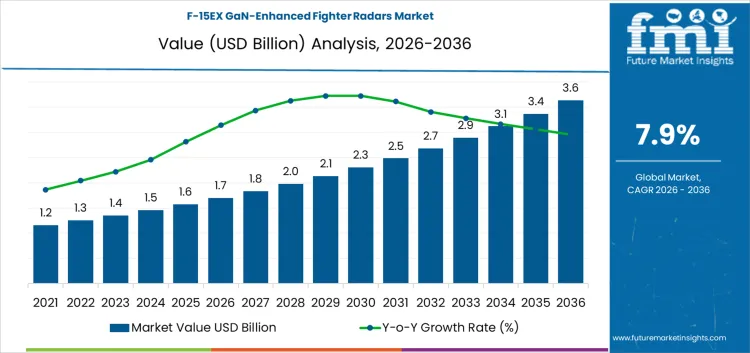
What is the Compound Absolute Growth Analysis for the F-15EX GaN-Enhanced Fighter Radars Market through 2036?
The compound absolute growth analysis of the F-15EX GaN-enhanced fighter radars market reveals consistent expansion driven by technological advancements and growing defense budgets. Starting at USD 1.7 billion in 2026, the market is projected to grow by USD 0.2 billion annually in the first few years, reaching USD 2.1 billion by 2028. As the demand for more advanced fighter jets and radar systems rises, the market is expected to experience continued absolute growth, increasing by USD 0.3 billion each year in the later years of the forecast.
By 2030, the market will reach USD 2.6 billion, followed by a stronger push in the subsequent years, with the market reaching USD 3.6 billion by 2036. This compound absolute growth underscores the growing importance of GaN-enhanced radar systems in the modernization of fighter aircraft, with defense spending focused on cutting-edge technologies to maintain tactical superiority. The market's consistent and predictable growth reflects both the expanding deployment of the F-15EX and the growing integration of GaN-based systems in global defense strategies.
F-15EX GaN-Enhanced Fighter Radars Market Key Takeaways
| Metric | Value |
|---|---|
| Industry Sales Value (2026) | USD 1.7 billion |
| Industry Forecast Value (2036) | USD 3.6 billion |
| Industry Forecast CAGR 2026 to 2036 | 7.9% |
Source: FMI analysis based on primary research and proprietary forecasting model
What Is Driving the F-15EX GaN-Enhanced Fighter Radars Market?
Historically, the fighter radar market evolved through successive generations of airborne sensor technology, with early fire control radars relying on mechanically scanned arrays that offered limited target resolution, slower scan rates, and narrower frequency agility. The transition to active electronically scanned array (AESA) radars in later decades marked a significant improvement, enabling faster beam steering, multi mode operation, and enhanced tracking fidelity. Early AESA radars used gallium arsenide (GaAs) semiconductor technology, which balanced performance with thermal management and production maturity.
As threats evolved and adversary air defenses and missile systems extended engagement ranges, the need for greater detection power, sensitivity, and electronic warfare integration grew. Gallium nitride (GaN) technology began to attract attention because it supports higher voltages and operates at elevated temperatures with increased power added efficiency compared with GaAs, enabling radars to transmit stronger signals, achieve greater range, and handle multi function tasks such as air to air detection, ground mapping, and electronic attack without prohibitive thermal penalties. Early implementation of GaN in airborne radars demonstrated performance gains, laying the foundation for its adoption in next generation fighter platforms and building confidence in its application for advanced systems such as those planned for the F 15EX.
Future demand for GaN enhanced fighter radars on the F 15EX and similar platforms is expected to be driven by the imperative to maintain sensor performance ahead of increasingly capable adversary aircraft, integrated air defenses, and longer range missiles. Advanced GaN AESA radars such as the proposed APG 82(V)X for the F 15EX promise increased detection range, improved situational awareness, and multi role capability without requiring higher onboard power supply or significant cooling upgrades, addressing key constraints on fighter radar design. These enhanced sensors support a “first look, first shoot” advantage that is critical in contested environments where non stealth aircraft must detect and engage threats at extended distances.
Expansion of radar functionality to include superior air to ground modes, electronic warfare, and low probability of intercept techniques further contributes to market growth as air forces seek to modernize fleets with adaptable, software driven sensors. Growth factors include rising defense budgets in key markets, export opportunities for upgraded radar suites alongside F 15EX sales to international customers, and broader integration of GaN technology across fighter radar families. Challenges remain in managing lifecycle costs, certifying advanced radar systems, and ensuring integration with mission systems. Long term market expansion will depend on demonstrated operational advantages, competitive cost performance metrics, and alignment of defense procurement priorities with emerging radar requirements in high threat scenarios.
What are the Key Segments in the F-15EX GaN-Enhanced Fighter Radars Market?
The F-15EX GaN-Enhanced Fighter Radars market is segmented into platforms and applications. Platform segments include F-15EX fighters, retrofit programs (for other airframes), test & evaluation platforms, trainer or simulation units, and others, with F-15EX fighters dominating the market at 72%. Applications in this market include air superiority missions, ground attack & strike, electronic warfare support, and training & simulation, with air superiority missions taking the largest share at 51%. The market is driven by the increasing demand for advanced radar systems, particularly those using Gallium Nitride (GaN) technology, to enhance the capabilities of fighter aircraft, especially in modern combat scenarios. GaN-enhanced radars provide greater detection range, improved resolution, and higher reliability, making them ideal for the F-15EX and other advanced military platforms. Key regions driving the growth of this market include North America, Europe, and Asia Pacific, where air forces are modernizing their fleets and upgrading their radar capabilities.
What is Driving Growth in the F-15EX Fighters Platform Segment?
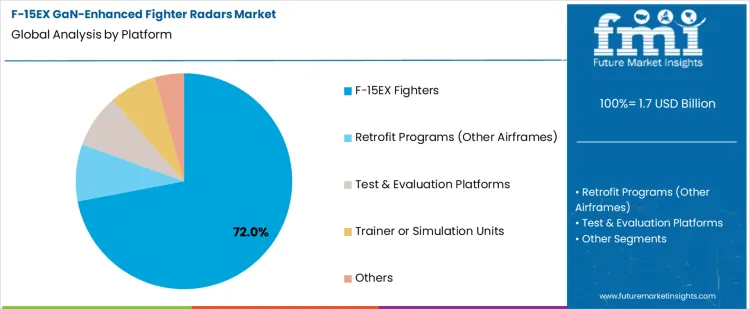
F-15EX fighters lead the platform segment in the F-15EX GaN-Enhanced Fighter Radars market, holding 72% of the market share. This growth is primarily driven by the USA Air Force's ongoing investment in the F-15EX fighter aircraft, which is designed to incorporate advanced technologies like GaN-based radar systems to enhance its combat capabilities. The F-15EX is equipped with cutting-edge radar systems, such as the APG-82 AESA radar, which utilize Gallium Nitride technology to provide superior performance in terms of range, resolution, and multi-target tracking. The increasing threat environment, including advanced air defense systems and emerging adversarial technologies, makes these capabilities essential for maintaining air superiority. The F-15EX is specifically designed for long-range, high-performance missions, making it an ideal platform for GaN-enhanced radar systems. As the USA Air Force and other international customers continue to invest in next-generation fighters, the F-15EX will remain a cornerstone of these efforts, further driving the demand for GaN-based fighter radars. The adoption of GaN radar technology in the F-15EX enhances its survivability and effectiveness in various combat scenarios, including air-to-air, air-to-ground, and electronic warfare missions, ensuring its continued relevance in modern air forces.
What is Driving the Demand for Air Superiority Missions in the Market?
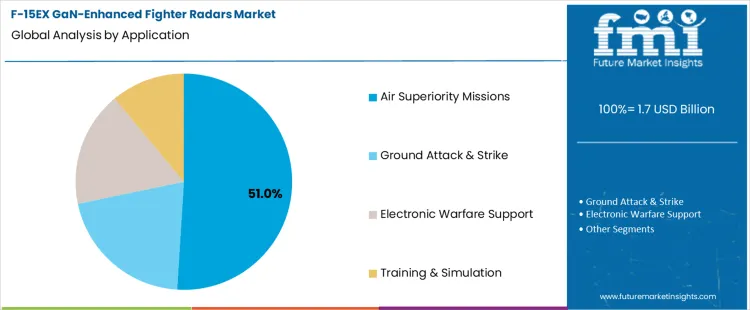
Air superiority missions represent the largest application segment in the F-15EX GaN-Enhanced Fighter Radars market, accounting for 51% of the share. This is driven by the growing importance of maintaining control over airspace in modern military conflicts. Air superiority missions require highly advanced radar systems that can detect, track, and engage multiple targets at long ranges and under challenging conditions. The integration of GaN-based radars into platforms like the F-15EX provides a significant advantage in these missions, offering enhanced target acquisition and identification capabilities, as well as greater resistance to electronic countermeasures. The need for air superiority is critical in both conventional warfare and asymmetric conflict, where control of the skies can determine the success of military operations. The enhanced performance offered by GaN radars, such as improved detection range, better resolution, and faster response times, is essential for successful air superiority missions. As geopolitical tensions rise and defense spending continues to increase in key regions like North America, Europe, and Asia Pacific, the demand for advanced radar systems to support air superiority missions is expected to grow, further driving the adoption of GaN-enhanced fighter radars.
What are the Key Dynamics in the F-15EX GaN-Enhanced Fighter Radars Market?
The F-15EX GaN-enhanced fighter radars market is being driven by the growing demand for advanced radar systems in modern combat aircraft, particularly in multi-role fighters like the F-15EX. Gallium Nitride (GaN) technology is a key enabler of next-generation radars, offering significant improvements over traditional radar materials in terms of power, efficiency, and thermal performance. GaN-based radar systems provide superior detection range, increased target tracking capabilities, and enhanced jamming resistance, making them crucial for modern air combat, especially in contested electromagnetic environments. The F-15EX, with its advanced GaN radar integration, represents a leap forward in terms of operational capability, and the market is growing as air forces around the world modernize their fleets to keep pace with evolving threats. The increasing focus on electronic warfare, multi-domain operations, and the need for greater situational awareness are key factors driving the adoption of GaN-enhanced radars in next-generation fighter jets.
What are the Key Drivers of Growth in the F-15EX GaN-Enhanced Fighter Radars Market?
The primary drivers of growth in the F-15EX GaN-enhanced fighter radars market include the increasing need for advanced radar systems in modern air combat, driven by the growing complexity of aerial warfare and evolving threats. The F-15EX, equipped with GaN-based radars, provides a significant upgrade over previous radar technologies, offering greater detection capabilities, longer range, and improved resistance to jamming. As air forces seek to maintain air superiority and enhance situational awareness in both peacetime and combat scenarios, the demand for more capable and resilient radar systems is increasing.
Furthermore, GaN technology offers advantages in power efficiency and thermal management, allowing for smaller, lighter, and more energy-efficient radars that can be integrated into existing aircraft platforms. The push for modernization and the ongoing development of 5th and 6th generation fighter jets are also driving the adoption of GaN-enhanced radars. Additionally, geopolitical tensions and the need for more capable defense systems in regions with high security risks are pushing the demand for advanced radar technologies like those found in the F-15EX.
What are the Key Restraints in the F-15EX GaN-Enhanced Fighter Radars Market?
The F-15EX GaN-enhanced fighter radars market faces several challenges. One key restraint is the high cost associated with GaN technology and the integration of advanced radar systems into existing fighter aircraft. GaN-based radars are expensive to develop and produce, and the cost of retrofitting existing aircraft or designing new platforms to accommodate these advanced systems may limit adoption, particularly for smaller air forces or nations with limited defense budgets.
Additionally, the complexity of developing GaN radar systems and the required support infrastructure may slow down the deployment of these technologies. There are also concerns regarding the potential for technological obsolescence, as rapidly advancing radar and stealth technologies could make current systems less relevant in the future. Furthermore, integrating GaN-based radars into a diverse fleet of aircraft with varying capabilities and requirements can be challenging, requiring significant investment in training, support, and upgrades to existing systems. Lastly, the strategic and political landscape may affect the export of GaN-enhanced radars, as certain countries may be subject to export controls or restrictions due to the sensitive nature of the technology.
What are the Key Trends in the F-15EX GaN-Enhanced Fighter Radars Market?
Several key trends are shaping the F-15EX GaN-enhanced fighter radars market. One major trend is the increasing focus on multi-domain operations, where radar systems need to operate effectively across various environments, including air, land, sea, and cyber domains. GaN-enhanced radar systems are well-suited for such operations, as they provide enhanced detection and tracking capabilities, even in highly contested and complex electromagnetic environments. Another significant trend is the growing emphasis on electronic warfare (EW) capabilities. As adversaries continue to develop more advanced jamming techniques, the demand for radars with superior resistance to electronic interference is increasing.
GaN technology offers improved performance in these areas, making it a valuable asset for future air combat scenarios. Additionally, there is a trend toward integrating GaN radar systems into a broader network of advanced sensors, including infrared search and track (IRST) systems, to provide more comprehensive situational awareness and targeting capabilities. The development of next-generation fighter jets, such as the F-15EX, which is designed to accommodate GaN-enhanced radar systems, is another key trend, as military forces aim to stay ahead of emerging threats. Finally, advancements in radar miniaturization and the increasing use of artificial intelligence (AI) to analyze radar data are shaping the future of GaN radar technology, enabling faster decision-making and improved operational efficiency.
What is the Country-Wise Analysis of the F-15EX GaN-Enhanced Fighter Radars Market?
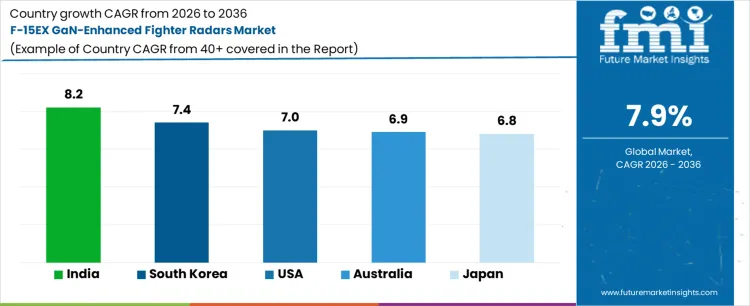
The F-15EX GaN-enhanced fighter radars market is experiencing growth as military forces continue to adopt advanced radar systems to enhance the performance of their fighter jets. Gallium Nitride (GaN) technology is revolutionizing radar capabilities by offering higher power, efficiency, and frequency, which is critical for modern aerial combat and air defense systems. The F-15EX, equipped with GaN-enhanced radar systems, is designed to improve target acquisition, tracking, and overall mission effectiveness. Countries like the USA, Japan, South Korea, India, and Australia are increasingly adopting these radar technologies to strengthen their air defense capabilities and maintain an edge in modern warfare.
| Country | CAGR (%) |
|---|---|
| USA | 7 |
| Japan | 6.8 |
| South Korea | 7.4 |
| India | 8.2 |
| Australia | 6.9 |
Source: FMI analysis based on primary research and proprietary forecasting model
What is Driving the Growth of the F-15EX GaN-Enhanced Fighter Radars Market in the USA?
The F-15EX GaN-enhanced fighter radars market in the USA is growing at a CAGR of 7%. The USA’s strong investment in defense technologies and its ongoing efforts to modernize its military fleet are key drivers of this growth. The F-15EX fighter jet, equipped with GaN-enhanced radars, provides improved detection range, target discrimination, and resistance to jamming, which are crucial for maintaining superiority in modern air combat. The USA's air force is adopting the F-15EX as part of its strategic shift towards more capable, versatile fighter jets. Additionally, the USA’s defense spending, research and development in radar technology, and emphasis on military innovation are further fueling the adoption of GaN-enhanced radar systems in fighter jets.
How is the F-15EX GaN-Enhanced Fighter Radars Market Performing in Japan?
Japan’s F-15EX GaN-enhanced fighter radars market is growing at a CAGR of 6.8%. Japan’s military modernization efforts are focused on upgrading its fighter jet capabilities, with a particular emphasis on enhancing radar performance for its air defense systems. The F-15EX, with its GaN-based radar systems, is becoming an integral part of Japan’s fleet as the country seeks to improve its defense capabilities amidst regional security challenges. The adoption of GaN-enhanced radar technology in Japan’s fighter jets is driven by the need for advanced target tracking, precision, and jamming resistance in complex air environments. As Japan continues to invest in next-generation defense technologies, the market for GaN-enhanced radars is expected to grow steadily.
What Factors are Shaping the F-15EX GaN-Enhanced Fighter Radars Market in South Korea?
South Korea’s F-15EX GaN-enhanced fighter radars market is growing at a CAGR of 7.4%. South Korea is modernizing its air force to address evolving security threats, and the F-15EX, equipped with GaN-enhanced radars, is a critical component of this modernization. The GaN radar technology allows for improved radar range, higher accuracy, and better performance in contested environments. South Korea’s focus on strengthening its air defense capabilities, particularly with advanced radar systems that can detect and track multiple targets simultaneously, is driving demand for these radars. As tensions in the region continue to shape defense strategies, South Korea’s military is expected to expand its use of GaN-based radar systems, further boosting the market for F-15EX fighter radars.
What is Contributing to the Growth of the F-15EX GaN-Enhanced Fighter Radars Market in India?
India’s F-15EX GaN-enhanced fighter radars market is growing at a CAGR of 8.2%, the highest among the countries analyzed. India is rapidly modernizing its air force and increasing its investments in advanced radar systems to enhance its defense capabilities. The F-15EX, with its GaN-enhanced radar technology, is a key part of this modernization, offering superior target detection and tracking capabilities in both conventional and electronic warfare environments. India’s growing defense budget, focus on strategic defense modernization, and regional security concerns are contributing to the increasing adoption of these advanced radar systems. As India continues to strengthen its air defense and surveillance capabilities, the demand for F-15EX GaN-enhanced fighter radars is expected to rise significantly.
What Factors are Shaping the F-15EX GaN-Enhanced Fighter Radars Market in Australia?
Australia’s F-15EX GaN-enhanced fighter radars market is growing at a CAGR of 6.9%. Australia is focusing on enhancing its air force capabilities, particularly in advanced radar technology, to address defense challenges in the Indo-Pacific region. The adoption of GaN-based radar systems in the F-15EX fighter jet provides Australia with a significant boost in detecting and tracking aerial targets in contested environments. With the increasing importance of maintaining air superiority in the region, Australia is investing in next-generation radar systems that provide high performance and reliability. The Australian government’s defense spending and its participation in multinational defense programs are contributing to the adoption of F-15EX GaN-enhanced fighter radars, driving the growth of this market.
What is the Competitive Landscape for the F-15EX GaN-Enhanced Fighter Radars Market?
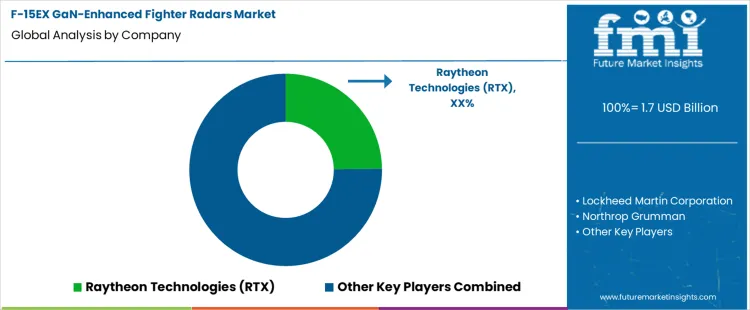
The F-15EX GaN-enhanced fighter radars market is rapidly advancing, driven by the need for high-performance radar systems that enhance the capabilities of next-generation fighter jets. Raytheon Technologies (RTX) is the market leader, providing cutting-edge Gallium Nitride (GaN)-based radar systems for the F-15EX fighter jet, offering superior range, resolution, and target tracking capabilities. Raytheon’s GaN technology significantly improves radar performance, allowing for more accurate detection and engagement of air and ground targets in complex environments. Lockheed Martin Corporation also plays a significant role, developing advanced radar technologies for fighter jets, including GaN-based systems designed for long-range detection and superior electronic warfare capabilities.
Northrop Grumman is a key player in the market, focusing on high-performance radar solutions for the F-15EX, leveraging its expertise in next-generation radar systems to provide enhanced situational awareness and survivability in combat. BAE Systems is investing in radar technologies that utilize GaN to enhance radar efficiency and targeting precision. Thales Group contributes to the market with its advanced radar solutions, focusing on GaN technology to improve the tracking and engagement of multiple targets, even in cluttered environments. These companies are at the forefront of developing next-generation radar systems for the F-15EX, driving innovation in the fighter radar market.
In this competitive landscape, companies focus on technological advancements, system integration, and performance enhancement to maintain their market leadership. Raytheon Technologies continues to refine its GaN-based radar systems, ensuring high reliability and advanced signal processing capabilities for the F-15EX fighter jet. Lockheed Martin focuses on expanding its radar portfolio with GaN technology to ensure seamless integration with existing military platforms. Northrop Grumman is enhancing the flexibility and functionality of its radar systems, integrating them with advanced electronic warfare systems to provide superior threat detection and mitigation.
BAE Systems is working on improving the radar’s ability to track and engage fast-moving targets while maintaining operational effectiveness in dense electromagnetic environments. Thales Group is advancing its radar solutions with a focus on multi-functionality and adaptability, ensuring their systems can operate effectively across diverse combat scenarios. These strategies, along with continuous technological improvements, position these companies to remain competitive in the growing F-15EX GaN-enhanced fighter radars market, which is integral to modern air combat.
Key Players of the F-15EX GaN-Enhanced Fighter Radars Market
- Raytheon Technologies (RTX)
- Lockheed Martin Corporation
- Northrop Grumman
- BAE Systems
- Thales Group
- Others
Scope of the Report
| Items | Values |
|---|---|
| Quantitative Units (2026) | USD Billion |
| Radar Type | GaN AESA Radars, Hybrid GaN/GaAs Radars, Upgraded Legacy Radars, Others |
| Platform | F-15EX Fighters, Retrofit Programs (Other Airframes), Test & Evaluation Platforms, Trainer or Simulation Units |
| Application | Air Superiority Missions, Ground Attack & Strike, Electronic Warfare Support, Training & Simulation, Others |
| Companies | Raytheon Technologies (RTX), Lockheed Martin Corporation, Northrop Grumman, BAE Systems, Thales Group, Others |
| Regions Covered | North America, Latin America, Western Europe, Eastern Europe, South Asia and Pacific, East Asia, Middle East & Africa |
| Countries Covered | United States, Canada, Mexico, Brazil, Argentina, Germany, France, United Kingdom, Italy, Spain, Netherlands, China, India, Japan, South Korea, ANZ, GCC Countries, South Africa |
| Additional Attributes | Dollar by sales by radar type, platform, application, and region. Includes market trends towards advanced radar technologies, cost-effectiveness, regulatory compliance, and the role of GaN-enhanced radars in improving fighter aircraft capabilities in modern combat. |
F-15EX GaN-Enhanced Fighter Radars Market Segmentation
Radar Type
- GaN AESA Radars
- Hybrid GaN/GaAs Radars
- Upgraded Legacy Radars
- Others
Platform
- F-15EX Fighters
- Retrofit Programs (Other Airframes)
- Test & Evaluation Platforms
- Trainer or Simulation Units
- Others
Application
- Air Superiority Missions
- Ground Attack & Strike
- Electronic Warfare Support
- Training & Simulation
- Others
Region
- Asia Pacific
- China
- Japan
- India
- Australia & New Zealand
- ASEAN
- Rest of Asia Pacific
- Europe
- Germany
- United Kingdom
- France
- Italy
- Spain
- Nordic
- BENELUX
- Rest of Europe
- North America
- United States
- Canada
- Mexico
- Latin America
- Brazil
- Argentina
- Rest of Latin America
- Middle East & Africa
- Kingdom of Saudi Arabia
- Other GCC Countries
- South Africa
- Rest of Middle East & Africa
Bibliography
- Raytheon (RTX). (n.d.). AN/APG-82(V)1 AESA radar (product page). RTX.
- Raytheon (RTX). (2025, September 23). APG-82(V)X radar for F-15EX announced (GaN-based next iteration) (reporting). The War Zone (TWZ).
- Northrop Grumman. (n.d.). AN/APG-81 Active Electronically Scanned Array (AESA) fire control radar (F-35) (product page). Northrop Grumman.
- Northrop Grumman. (n.d.). AN/APG-77 AESA radar (F-22) (product page). Northrop Grumman.
Frequently Asked Questions
How big is the f-15ex gan-enhanced fighter radars market in 2026?
The global f-15ex gan-enhanced fighter radars market is estimated to be valued at USD 1.7 billion in 2026.
What will be the size of f-15ex gan-enhanced fighter radars market in 2036?
The market size for the f-15ex gan-enhanced fighter radars market is projected to reach USD 3.6 billion by 2036.
How much will be the f-15ex gan-enhanced fighter radars market growth between 2026 and 2036?
The f-15ex gan-enhanced fighter radars market is expected to grow at a 7.9% CAGR between 2026 and 2036.
What are the key product types in the f-15ex gan-enhanced fighter radars market?
The key product types in f-15ex gan-enhanced fighter radars market are gan aesa radars, hybrid gan/gaas radars, upgraded legacy radars and others.
Which platform segment to contribute significant share in the f-15ex gan-enhanced fighter radars market in 2026?
In terms of platform, f-15ex fighters segment to command 72.0% share in the f-15ex gan-enhanced fighter radars market in 2026.
Preview the report firsthand - request a free sample
Get SampleGet the brochure for pricing and purchase details.
Get PDFTable of Content
- Executive Summary
- Global Market Outlook
- Demand-side Trends
- Supply-side Trends
- Technology Roadmap Analysis
- Analysis and Recommendations
- Market Overview
- Market Coverage / Taxonomy
- Market Definition / Scope / Limitations
- Market Background
- Market Dynamics
- Drivers
- Restraints
- Opportunity
- Trends
- Scenario Forecast
- Demand in Optimistic Scenario
- Demand in Likely Scenario
- Demand in Conservative Scenario
- Opportunity Map Analysis
- Product Life Cycle Analysis
- Supply Chain Analysis
- Investment Feasibility Matrix
- Value Chain Analysis
- PESTLE and Porter’s Analysis
- Regulatory Landscape
- Regional Parent Market Outlook
- Production and Consumption Statistics
- Import and Export Statistics
- Market Dynamics
- Global Market Analysis 2021 to 2025 and Forecast, 2026 to 2036
- Historical Market Size Value (USD Million) Analysis, 2021 to 2025
- Current and Future Market Size Value (USD Million) Projections, 2026 to 2036
- Y-o-Y Growth Trend Analysis
- Absolute $ Opportunity Analysis
- Global Market Pricing Analysis 2021 to 2025 and Forecast 2026 to 2036
- Global Market Analysis 2021 to 2025 and Forecast 2026 to 2036, By Radar Type
- Introduction / Key Findings
- Historical Market Size Value (USD Million) Analysis By Radar Type , 2021 to 2025
- Current and Future Market Size Value (USD Million) Analysis and Forecast By Radar Type , 2026 to 2036
- GaN AESA Radars
- Hybrid GaN/GaAs Radars
- Upgraded Legacy Radars
- Others
- GaN AESA Radars
- Y-o-Y Growth Trend Analysis By Radar Type , 2021 to 2025
- Absolute $ Opportunity Analysis By Radar Type , 2026 to 2036
- Global Market Analysis 2021 to 2025 and Forecast 2026 to 2036, By Platform
- Introduction / Key Findings
- Historical Market Size Value (USD Million) Analysis By Platform, 2021 to 2025
- Current and Future Market Size Value (USD Million) Analysis and Forecast By Platform, 2026 to 2036
- F-15EX Fighters
- Retrofit Programs (Other Airframes)
- Test & Evaluation Platforms
- Trainer or Simulation Value (USD Million)s
- Others
- F-15EX Fighters
- Y-o-Y Growth Trend Analysis By Platform, 2021 to 2025
- Absolute $ Opportunity Analysis By Platform, 2026 to 2036
- Global Market Analysis 2021 to 2025 and Forecast 2026 to 2036, By Application
- Introduction / Key Findings
- Historical Market Size Value (USD Million) Analysis By Application, 2021 to 2025
- Current and Future Market Size Value (USD Million) Analysis and Forecast By Application, 2026 to 2036
- Air Superiority Missions
- Ground Attack & Strike
- Electronic Warfare Support
- Training & Simulation
- Air Superiority Missions
- Y-o-Y Growth Trend Analysis By Application, 2021 to 2025
- Absolute $ Opportunity Analysis By Application, 2026 to 2036
- Global Market Analysis 2021 to 2025 and Forecast 2026 to 2036, By Region
- Introduction
- Historical Market Size Value (USD Million) Analysis By Region, 2021 to 2025
- Current Market Size Value (USD Million) Analysis and Forecast By Region, 2026 to 2036
- North America
- Latin America
- Western Europe
- Eastern Europe
- East Asia
- South Asia and Pacific
- Middle East & Africa
- Market Attractiveness Analysis By Region
- North America Market Analysis 2021 to 2025 and Forecast 2026 to 2036, By Country
- Historical Market Size Value (USD Million) Trend Analysis By Market Taxonomy, 2021 to 2025
- Market Size Value (USD Million) Forecast By Market Taxonomy, 2026 to 2036
- By Country
- USA
- Canada
- Mexico
- By Radar Type
- By Platform
- By Application
- By Country
- Market Attractiveness Analysis
- By Country
- By Radar Type
- By Platform
- By Application
- Key Takeaways
- Latin America Market Analysis 2021 to 2025 and Forecast 2026 to 2036, By Country
- Historical Market Size Value (USD Million) Trend Analysis By Market Taxonomy, 2021 to 2025
- Market Size Value (USD Million) Forecast By Market Taxonomy, 2026 to 2036
- By Country
- Brazil
- Chile
- Rest of Latin America
- By Radar Type
- By Platform
- By Application
- By Country
- Market Attractiveness Analysis
- By Country
- By Radar Type
- By Platform
- By Application
- Key Takeaways
- Western Europe Market Analysis 2021 to 2025 and Forecast 2026 to 2036, By Country
- Historical Market Size Value (USD Million) Trend Analysis By Market Taxonomy, 2021 to 2025
- Market Size Value (USD Million) Forecast By Market Taxonomy, 2026 to 2036
- By Country
- Germany
- UK
- Italy
- Spain
- France
- Nordic
- BENELUX
- Rest of Western Europe
- By Radar Type
- By Platform
- By Application
- By Country
- Market Attractiveness Analysis
- By Country
- By Radar Type
- By Platform
- By Application
- Key Takeaways
- Eastern Europe Market Analysis 2021 to 2025 and Forecast 2026 to 2036, By Country
- Historical Market Size Value (USD Million) Trend Analysis By Market Taxonomy, 2021 to 2025
- Market Size Value (USD Million) Forecast By Market Taxonomy, 2026 to 2036
- By Country
- Russia
- Poland
- Hungary
- Balkan & Baltic
- Rest of Eastern Europe
- By Radar Type
- By Platform
- By Application
- By Country
- Market Attractiveness Analysis
- By Country
- By Radar Type
- By Platform
- By Application
- Key Takeaways
- East Asia Market Analysis 2021 to 2025 and Forecast 2026 to 2036, By Country
- Historical Market Size Value (USD Million) Trend Analysis By Market Taxonomy, 2021 to 2025
- Market Size Value (USD Million) Forecast By Market Taxonomy, 2026 to 2036
- By Country
- China
- Japan
- South Korea
- By Radar Type
- By Platform
- By Application
- By Country
- Market Attractiveness Analysis
- By Country
- By Radar Type
- By Platform
- By Application
- Key Takeaways
- South Asia and Pacific Market Analysis 2021 to 2025 and Forecast 2026 to 2036, By Country
- Historical Market Size Value (USD Million) Trend Analysis By Market Taxonomy, 2021 to 2025
- Market Size Value (USD Million) Forecast By Market Taxonomy, 2026 to 2036
- By Country
- India
- ASEAN
- Australia & New Zealand
- Rest of South Asia and Pacific
- By Radar Type
- By Platform
- By Application
- By Country
- Market Attractiveness Analysis
- By Country
- By Radar Type
- By Platform
- By Application
- Key Takeaways
- Middle East & Africa Market Analysis 2021 to 2025 and Forecast 2026 to 2036, By Country
- Historical Market Size Value (USD Million) Trend Analysis By Market Taxonomy, 2021 to 2025
- Market Size Value (USD Million) Forecast By Market Taxonomy, 2026 to 2036
- By Country
- Kingdom of Saudi Arabia
- Other GCC Countries
- Turkiye
- South Africa
- Other African Union
- Rest of Middle East & Africa
- By Radar Type
- By Platform
- By Application
- By Country
- Market Attractiveness Analysis
- By Country
- By Radar Type
- By Platform
- By Application
- Key Takeaways
- Key Countries Market Analysis
- USA
- Pricing Analysis
- Market Share Analysis, 2025
- By Radar Type
- By Platform
- By Application
- Canada
- Pricing Analysis
- Market Share Analysis, 2025
- By Radar Type
- By Platform
- By Application
- Mexico
- Pricing Analysis
- Market Share Analysis, 2025
- By Radar Type
- By Platform
- By Application
- Brazil
- Pricing Analysis
- Market Share Analysis, 2025
- By Radar Type
- By Platform
- By Application
- Chile
- Pricing Analysis
- Market Share Analysis, 2025
- By Radar Type
- By Platform
- By Application
- Germany
- Pricing Analysis
- Market Share Analysis, 2025
- By Radar Type
- By Platform
- By Application
- UK
- Pricing Analysis
- Market Share Analysis, 2025
- By Radar Type
- By Platform
- By Application
- Italy
- Pricing Analysis
- Market Share Analysis, 2025
- By Radar Type
- By Platform
- By Application
- Spain
- Pricing Analysis
- Market Share Analysis, 2025
- By Radar Type
- By Platform
- By Application
- France
- Pricing Analysis
- Market Share Analysis, 2025
- By Radar Type
- By Platform
- By Application
- India
- Pricing Analysis
- Market Share Analysis, 2025
- By Radar Type
- By Platform
- By Application
- ASEAN
- Pricing Analysis
- Market Share Analysis, 2025
- By Radar Type
- By Platform
- By Application
- Australia & New Zealand
- Pricing Analysis
- Market Share Analysis, 2025
- By Radar Type
- By Platform
- By Application
- China
- Pricing Analysis
- Market Share Analysis, 2025
- By Radar Type
- By Platform
- By Application
- Japan
- Pricing Analysis
- Market Share Analysis, 2025
- By Radar Type
- By Platform
- By Application
- South Korea
- Pricing Analysis
- Market Share Analysis, 2025
- By Radar Type
- By Platform
- By Application
- Russia
- Pricing Analysis
- Market Share Analysis, 2025
- By Radar Type
- By Platform
- By Application
- Poland
- Pricing Analysis
- Market Share Analysis, 2025
- By Radar Type
- By Platform
- By Application
- Hungary
- Pricing Analysis
- Market Share Analysis, 2025
- By Radar Type
- By Platform
- By Application
- Kingdom of Saudi Arabia
- Pricing Analysis
- Market Share Analysis, 2025
- By Radar Type
- By Platform
- By Application
- Turkiye
- Pricing Analysis
- Market Share Analysis, 2025
- By Radar Type
- By Platform
- By Application
- South Africa
- Pricing Analysis
- Market Share Analysis, 2025
- By Radar Type
- By Platform
- By Application
- USA
- Market Structure Analysis
- Competition Dashboard
- Competition Benchmarking
- Market Share Analysis of Top Players
- By Regional
- By Radar Type
- By Platform
- By Application
- Competition Analysis
- Competition Deep Dive
- Raytheon Technologies (RTX)
- Overview
- Product Portfolio
- Profitability by Market Segments (Product/Age /Sales Channel/Region)
- Sales Footprint
- Strategy Overview
- Marketing Strategy
- Product Strategy
- Channel Strategy
- Lockheed Martin Corporation
- Northrop Grumman
- BAE Systems
- Thales Group
- Others
- Raytheon Technologies (RTX)
- Competition Deep Dive
- Assumptions & Acronyms Used
- Research Methodology


