

- Industry Size (2026)
- USD 2.4 Bn
- Forecast (2036)
- USD 5.0 Bn
- CAGR (2026 to 2036)
- 7.6%
Combat Aircraft Swarm Radars Market Forecast and Outlook 2026 to 2036
The combat aircraft swarm radars market is projected to reach USD 5.0 billion by 2036, growing at a CAGR of 7.6% from its 2026 value of USD 2.4 billion. While the market shows significant growth potential, execution risk remains a key challenge. The complexity of integrating advanced radar systems with existing aircraft platforms introduces friction in adoption, particularly for defense contractors and government agencies facing budget constraints and procurement delays. Economic sensitivity adds another layer of uncertainty, as defense spending is often subject to fluctuations based on geopolitical stability and national priorities. Though demand is likely to rise as military forces invest in advanced technologies, the pace of market expansion will depend on overcoming these barriers. Suppliers will need to balance innovation with risk mitigation strategies, ensuring both operational feasibility and cost efficiency as they navigate a competitive and highly regulated sector.
Quick Stats for the Combat Aircraft Swarm Radars Market
- Combat Aircraft Swarm Radars Market Value (2026): USD 2.4 billion
- Combat Aircraft Swarm Radars Market Forecast Value (2036): USD 5.0 billion
- Combat Aircraft Swarm Radars Market Global Forecast CAGR (2026-2035): 7.6%
- Combat Aircraft Swarm Radars Market Leading Segment: Swarm Detection & Counter-UAS (52%)
- Key Growth Regions in Combat Aircraft Swarm Radars Market: India
- Top Players in Combat Aircraft Swarm Radars Market: Lockheed Martin Corporation, Northrop Grumman, Raytheon Technologies (RTX), BAE Systems, Thales Group
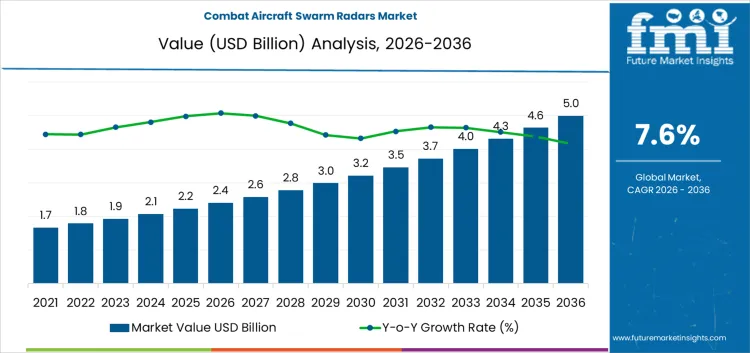
What is the Saturation Point Analysis for the Combat Aircraft Swarm Radars Market through 2036?
The combat aircraft swarm radars market is expected to follow a growth trajectory that gradually approaches a saturation point over the next decade. Initially, the market will experience steady growth, with annual increases from USD 2.4 billion in 2026 to USD 3 billion by 2029. As technological advancements in radar capabilities continue, this growth will be driven by increasing demand from defense sectors seeking to improve the effectiveness of their combat aircraft.
However, a saturation point will likely be reached around the mid-2030s as the market approaches wider adoption and more mature radar technologies. By 2031, the market will grow to USD 3.8 billion, with the expansion continuing to USD 4.8 billion in 2035. The saturation point will occur as most defense contractors have integrated swarm radar systems into their fleets, and further growth will rely on incremental upgrades or replacement cycles. By 2036, the market value will reach USD 5.0 billion, representing the peak of its growth curve. The saturation point reflects a stage where most major military powers have adopted the technology, and future market expansion will slow, relying more on upgrades, maintenance, and system enhancements rather than large-scale adoption.
Combat Aircraft Swarm Radars Market Key Takeaways
| Metric | Value |
|---|---|
| Industry Sales Value (2026) | USD 2.4 billion |
| Industry Forecast Value (2036) | USD 5.0 billion |
| Industry Forecast CAGR 2026 to 2036 | 7.6% |
What Is Driving the Combat Aircraft Swarm Radars Market?
Historically, the combat aircraft swarm radars market developed from incremental enhancements in airborne radar systems designed for situational awareness and target tracking in increasingly complex airspaces. Conventional airborne radars focused on detecting individual aircraft, ground targets, and larger threats, with limited capability to manage dense, fast-moving swarms of small unmanned systems. Early radar systems emphasized range, resolution, and clutter rejection, yet were not optimized for the unique challenges posed by swarming threats, such as low radar cross-section, high numbers of simultaneous targets, and maneuverability at varying altitudes and speeds.
As unmanned aerial systems proliferated and adversaries began experimenting with coordinated swarm tactics, traditional search and track methodologies showed limitations in response time and target discrimination. Research institutions and defense contractors invested in signal processing algorithms, multi-function phased array technologies, and distributed aperture systems that improved detection of small, agile objects in contested environments. Initial adoption of advanced swarm-capable radar was concentrated in experimental airborne platforms where system integrators could assess performance against simulated swarm scenarios. These efforts generated early data on detection probabilities, false alarm rates, and tracking fidelity, shaping requirements for next-generation combat aircraft radar suites capable of addressing evolving aerial threat profiles.
Future demand for combat aircraft swarm radars is expected to be shaped by the increasing operational significance of unmanned swarm tactics, investments in networked air defense systems, and the imperative for advanced electronic warfare capabilities. As militaries modernize air fleets, there is growing emphasis on radar systems that can autonomously detect, classify, and respond to large numbers of simultaneous contacts with minimal latency. Growth factors will include advances in digital beamforming, artificial intelligence-enabled signal processing, and sensor fusion that enable rapid identification of swarm elements against clutter and electronic countermeasure environments.
Integration with mission systems will allow combat aircraft to share swarm threat data with allied assets, enhancing coordinated defense and offense. Adaptive waveform agility and multi-static sensing techniques will also improve resilience against stealthy and cooperative unmanned systems. Barriers to market expansion include high development and integration costs, certification challenges for advanced radar systems, and the need for substantial onboard processing power without excessive size, weight, or power penalties. Long-term market growth will depend on how effectively radar manufacturers demonstrate reliable swarm detection in complex, contested electromagnetic environments and how defense acquisition strategies prioritize these capabilities within broader combat aircraft modernization programs.
What are the Key Segments in the Combat Aircraft Swarm Radars Market?
The Combat Aircraft Swarm Radars market is segmented into radar types and applications. The radar types include AESA (Active Electronically Scanned Array), PESA (Passive Electronically Scanned Array), hybrid AESA-PESA, phased array with AI-assisted swarm detection, and others, with AESA holding the largest market share at 44%. Applications in this market include swarm detection & counter-UAS (Unmanned Aerial Systems), air-to-air target tracking, terrain following & obstacle avoidance, and electronic warfare support, with swarm detection & counter-UAS leading the application segment at 52%. The market growth is driven by the increasing adoption of advanced radar technologies to support modern combat aircraft, improve situational awareness, and enhance defense capabilities, particularly against swarm attacks and emerging threats. Key regions driving the market include North America, Europe, and Asia Pacific, where defense modernization and technological advancements in radar systems are a priority.
What is Driving Growth in the AESA Radar Type Segment?

AESA radars lead the radar type segment in the Combat Aircraft Swarm Radars market, with 44% of the market share. This is driven by the superior performance and flexibility offered by AESA technology, which allows for faster scanning, higher resolution, and improved accuracy compared to traditional radar systems. AESA radars use electronically controlled beams, enabling rapid beam steering, multiple simultaneous targets tracking, and resistance to jamming.
These advantages make AESA radars highly effective in combat situations, particularly in detecting and countering threats such as swarm drones or small, fast-moving targets. In the context of combat aircraft, AESA radars are integral to advanced fighter jets, where they play a crucial role in providing real-time data for targeting, situational awareness, and defense. The adoption of AESA technology in combat aircraft is further supported by its ability to integrate with other advanced avionics systems, enhancing the aircraft's overall effectiveness. With defense modernization programs focusing on improving the capabilities of air forces globally, AESA radar systems are expected to continue dominating the market, especially in North America and Europe, where defense spending is high.
What is Driving the Demand for Swarm Detection & Counter-UAS Applications?

Swarm detection & counter-UAS is the largest application segment in the Combat Aircraft Swarm Radars market, accounting for 52% of the share. The growth in this segment is driven by the increasing threat of swarming tactics used by adversaries in modern warfare, where multiple unmanned aerial systems (UAS) are deployed to overwhelm conventional defense systems. Combat aircraft equipped with advanced radar systems capable of detecting and countering these swarms are essential for maintaining air superiority and operational security. Radar systems, particularly those with AESA and hybrid AESA-PESA technologies, are highly effective in tracking multiple targets in real-time, identifying potential threats, and coordinating countermeasures to neutralize UAS swarms.
The rising use of drones for military and surveillance purposes is prompting military forces to invest in advanced radar solutions that can detect, track, and engage multiple threats simultaneously. Additionally, the growing emphasis on electronic warfare and the protection of critical infrastructure is further driving the demand for swarm detection & counter-UAS capabilities. As defense forces worldwide enhance their capabilities to address emerging threats, the demand for radar systems specializing in swarm detection and UAS countermeasures is expected to grow, particularly in regions with ongoing military modernization, such as North America, Europe, and Asia Pacific.
What are the Key Dynamics in the Combat Aircraft Swarm Radars Market?
The combat aircraft swarm radars market is evolving as military forces seek advanced systems to enhance combat capabilities through coordinated operations of multiple aircraft. Swarm radar technology enables multiple combat aircraft to work together as a cohesive unit by utilizing radar systems that can detect and track targets in real-time, while avoiding interference and maintaining synchronization. This technology is increasingly being integrated into modern fighter jets, unmanned aerial vehicles (UAVs), and other military aircraft to enhance operational efficiency, survivability, and mission success. The demand for swarm radar systems is driven by the growing focus on network-centric warfare, where swarming tactics and coordination among multiple platforms are crucial for gaining a strategic advantage. Additionally, advancements in radar technologies such as phased-array radar, electronic warfare capabilities, and radar miniaturization are key factors contributing to market growth.
What are the Key Drivers of Growth in the Combat Aircraft Swarm Radars Market?
The key drivers of growth in the combat aircraft swarm radars market include the increasing need for enhanced situational awareness, real-time data sharing, and improved combat capabilities in modern warfare. Swarm radar technology allows combat aircraft to collaborate more effectively by sharing radar data and tracking targets over a larger area, making them more effective in complex combat environments. The rising focus on network-centric warfare, where various military assets must operate in a synchronized manner, is pushing the adoption of advanced swarm radar systems. Furthermore, the growing threat of anti-access/area-denial (A2/AD) systems and the need for enhanced stealth and survivability of aircraft are driving demand for technologies that improve aircraft collaboration and coordination. The evolution of radar technologies, such as the development of more compact, lightweight, and efficient phased-array radars, is making it easier to integrate swarm radar systems into combat aircraft, thus further driving market growth. Increasing defense budgets and modernization programs in both developed and emerging countries are also contributing to the adoption of swarm radar technologies.
What are the Key Restraints in the Combat Aircraft Swarm Radars Market?
Despite the significant growth potential, the combat aircraft swarm radars market faces several challenges. One of the primary restraints is the high cost of developing and deploying swarm radar systems, as these technologies require advanced research, complex integration processes, and cutting-edge components that are expensive to manufacture. Additionally, the integration of swarm radars into existing aircraft fleets requires significant upgrades to the aircraft's avionics, communication systems, and radar processing capabilities, which can add to the overall cost. Another challenge is the potential for technological limitations in terms of range, resolution, and interference avoidance, particularly when multiple aircraft are operating in close proximity in a swarm. Ensuring the reliability and robustness of these systems under a range of operational conditions, including high-speed maneuvers and electronic warfare environments, is a critical consideration. Lastly, regulatory and geopolitical factors, such as export restrictions or international agreements on radar technologies, may hinder the widespread adoption of swarm radar systems in certain regions or by non-allied nations.
What are the Key Trends in the Combat Aircraft Swarm Radars Market?
Several key trends are shaping the combat aircraft swarm radars market. One major trend is the increasing integration of artificial intelligence (AI) and machine learning (ML) algorithms in swarm radar systems, which enable better data analysis, target recognition, and real-time decision-making. AI and ML are being utilized to improve the system's ability to adapt to dynamic and complex environments, enhance target tracking accuracy, and enable autonomous operation of multiple aircraft in a swarm. Another trend is the development of multi-function radar systems that combine air-to-air, air-to-ground, and electronic warfare capabilities in a single radar platform. This integration allows for more efficient use of resources and enhances the overall effectiveness of combat operations. Additionally, the trend toward miniaturization and reduced weight of radar components is allowing for more compact and versatile systems, which can be integrated into a wider range of aircraft, including UAVs and smaller combat platforms. There is also a growing interest in the development of counter-swarm radar technologies to detect and neutralize enemy swarming tactics, further driving innovation in this market. As defense strategies increasingly rely on swarm tactics and networked operations, swarm radar technologies are expected to play a critical role in future combat scenarios.
What is the Country-Wise Analysis of the Combat Aircraft Swarm Radars Market?
The combat aircraft swarm radars market is growing as militaries worldwide invest in advanced radar systems for enhanced situational awareness and precision targeting. Swarm radars are designed to track and manage multiple targets simultaneously, improving the effectiveness of combat aircraft in complex and dynamic battlefield environments. With advancements in radar technologies, such as increased range, accuracy, and the ability to manage multiple targets, countries like the USA, China, the UK, Germany, and India are expanding their military capabilities. These nations are adopting swarm radar technologies to enhance their air defense systems and ensure superiority in modern warfare.
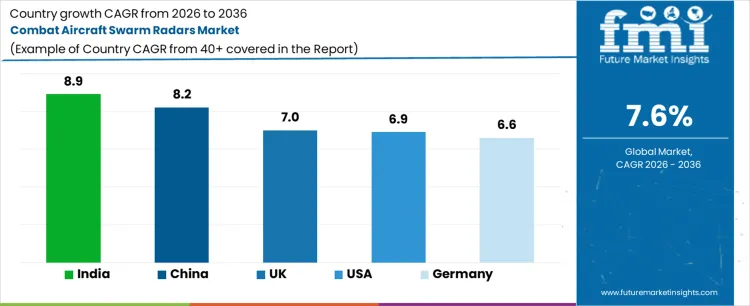
| Country | CAGR (%) |
|---|---|
| USA | 6.9 |
| China | 8.2 |
| UK | 7 |
| Germany | 6.6 |
| India | 8.9 |
What is Driving the Growth of the Combat Aircraft Swarm Radars Market in the USA?
The combat aircraft swarm radars market in the USA is growing at a CAGR of 6.9%. The USA’s significant investment in military modernization and the need for enhanced radar systems to track multiple aerial threats are key drivers of this market growth. With the increasing complexity of modern warfare and the rising number of unmanned aerial vehicles (UAVs) and swarming tactics, the USA is focusing on developing swarm radar systems for its combat aircraft to ensure superior targeting and defense capabilities. The US Department of Defense’s emphasis on next-generation radar technologies, including swarm radar systems, is propelling demand. Additionally, advancements in radar miniaturization and signal processing technology are further supporting the adoption of swarm radars in military aircraft.
How is the Combat Aircraft Swarm Radars Market Performing in China?
China’s combat aircraft swarm radars market is growing at a CAGR of 8.2%. China is heavily investing in modernizing its military and enhancing its air defense capabilities, and radar technology is a critical component of this modernization. With the increasing use of swarm tactics and UAVs in combat, China’s military is prioritizing the development of advanced swarm radars for its combat aircraft. These radar systems offer enhanced multi-target tracking and precision, which are essential in countering modern threats. The rapid advancement of China’s defense technology and its growing focus on becoming a global military power are key factors contributing to the growth of the combat aircraft swarm radars market in the country.
What Factors are Shaping the Combat Aircraft Swarm Radars Market in the UK?
The combat aircraft swarm radars market in the UK is growing at a CAGR of 7%. The UK’s defense strategy is focused on enhancing its combat aircraft capabilities, and the integration of swarm radars is essential for improving the tracking of multiple targets in complex combat environments. The UK’s military is increasingly investing in radar technologies that enable real-time situational awareness, particularly for dealing with swarming tactics and UAVs. As part of its military modernization efforts, the UK is looking to adopt advanced radar systems for its fighter jets, aligning with NATO defense standards. The development of cost-effective and high-performance swarm radar systems is expected to drive the market in the UK as the country seeks to maintain its strategic air superiority.
How is the Combat Aircraft Swarm Radars Market Evolving in Germany?
Germany’s combat aircraft swarm radars market is growing at a CAGR of 6.6%. The German military is investing in advanced radar technologies to enhance its air combat capabilities and maintain a competitive edge in modern warfare. With the increasing need to counter multi-target threats and swarming tactics, Germany’s defense forces are focusing on adopting swarm radar systems for its combat aircraft. These systems allow for the simultaneous tracking of multiple aerial targets, improving mission success rates and reducing the risk of being overwhelmed in high-intensity conflicts. Germany’s commitment to defense modernization, as well as its role within the European Union and NATO, is driving the demand for state-of-the-art radar systems for combat aircraft.
What is Contributing to the Growth of the Combat Aircraft Swarm Radars Market in India?
India’s combat aircraft swarm radars market is growing at the highest rate among the countries analyzed, with a CAGR of 8.9%. India’s defense sector is undergoing significant modernization, with a focus on strengthening air defense capabilities and improving its combat aircraft’s ability to track and neutralize multiple threats. The increasing use of UAVs and advanced aerial tactics in regional conflicts is driving India to develop and adopt swarm radar systems for its fighter jets. As part of its focus on indigenization and self-reliance in defense technologies, India is investing in research and development to produce cutting-edge radar systems. The growth in defense spending and the need to secure airspace from advanced threats are key factors contributing to the rise in demand for combat aircraft swarm radars in India.
What is the Competitive Landscape for the Combat Aircraft Swarm Radars Market?
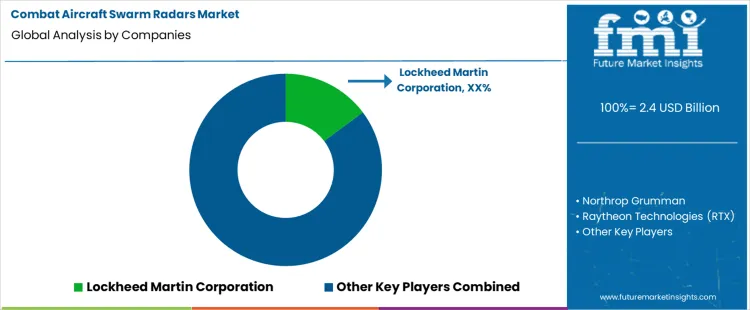
The combat aircraft swarm radars market is evolving rapidly, driven by the need for advanced radar systems capable of detecting and tracking multiple targets simultaneously in complex combat environments. Lockheed Martin Corporation is the market leader, offering cutting-edge radar technologies designed for swarm operations, providing high-resolution tracking capabilities and enhanced situational awareness for combat aircraft. Lockheed Martin’s innovative radar systems focus on improving precision targeting, electronic warfare, and survivability in crowded airspaces. Northrop Grumman is also a significant player, developing radar systems that provide long-range detection and track capabilities, essential for coordinating multiple aircraft in swarm missions.
Their focus on advanced signal processing and stealth features positions them strongly in the market. Raytheon Technologies (RTX) is another key competitor, leveraging its extensive experience in defense systems to offer radar solutions that support swarm tactics, enhancing interoperability and operational flexibility for military aircraft. BAE Systems provides radar systems focused on agility, modularity, and effective communication between aircraft in swarm formations. Thales Group is also actively involved, offering radar technologies that focus on multi-target tracking, secure communications, and integration with other defense systems. These companies play pivotal roles in advancing the capabilities of swarm radars for combat aircraft, ensuring their readiness for modern warfare strategies.
In the competitive landscape of the combat aircraft swarm radars market, companies are focusing on technological innovation, system integration, and strategic partnerships. Lockheed Martin continues to enhance its radar capabilities, focusing on low-observable designs and advanced data fusion to improve swarm coordination. Northrop Grumman prioritizes the development of radar systems that offer superior range and accuracy, making them ideal for complex swarm operations. Raytheon Technologies is advancing radar systems that enable autonomous targeting and real-time decision-making in swarm missions. BAE Systems focuses on developing flexible radar solutions that can be adapted for diverse mission profiles, while Thales Group is integrating its radar systems with other advanced military technologies to ensure seamless communication and coordination across multi-aircraft formations. These strategies are positioning these companies at the forefront of the rapidly growing combat aircraft swarm radars market, which is critical to modern air combat strategies.
Key Players of the Combat Aircraft Swarm Radars Market
- Lockheed Martin Corporation
- Northrop Grumman
- Raytheon Technologies (RTX)
- BAE Systems
- Thales Group
- Others
Scope of the Report
| Items | Values |
|---|---|
| Quantitative Units (2026) | USD Billion |
| Radar Type | AESA (Active Electronically Scanned Array), PESA (Passive Electronically Scanned Array), Hybrid AESA-PESA, Phased Array with AI-Assisted Swarm Detection, Others |
| Application | Swarm Detection & Counter-UAS, Air-to-Air Target Tracking, Terrain Following & Obstacle Avoidance, Electronic Warfare Support |
| Companies | Lockheed Martin Corporation, Northrop Grumman, Raytheon Technologies (RTX), BAE Systems, Thales Group, Others |
| Regions Covered | North America, Latin America, Western Europe, Eastern Europe, South Asia and Pacific, East Asia, Middle East & Africa |
| Countries Covered | United States, Canada, Mexico, Brazil, Argentina, Germany, France, United Kingdom, Italy, Spain, Netherlands, China, India, Japan, South Korea, ANZ, GCC Countries, South Africa |
| Additional Attributes | Dollar by sales by radar type, application, and region. Includes market trends towards swarm detection technologies, electronic warfare advancements, cost-effectiveness, regulatory compliance, and the role of advanced radar systems in enhancing combat aircraft capabilities. |
Combat Aircraft Swarm Radars Market Segmentation
Radar Type
- AESA (Active Electronically Scanned Array)
- PESA (Passive Electronically Scanned Array)
- Hybrid AESA-PESA
- Phased Array with AI-Assisted Swarm Detection
- Others
Application
- Swarm Detection & Counter-UAS
- Air-to-Air Target Tracking
- Terrain Following & Obstacle Avoidance
- Electronic Warfare Support
- Others
Region
- Asia Pacific
- China
- Japan
- India
- Australia & New Zealand
- ASEAN
- Rest of Asia Pacific
- Europe
- Germany
- United Kingdom
- France
- Italy
- Spain
- Nordic
- BENELUX
- Rest of Europe
- North America
- United States
- Canada
- Mexico
- Latin America
- Brazil
- Argentina
- Rest of Latin America
- Middle East & Africa
- Kingdom of Saudi Arabia
- Other GCC Countries
- South Africa
- Rest of Middle East & Africa
Bibliography
Lockheed Martin Corporation. (2023). Next Generation Interceptor radar and sensor networking for advanced air and missile defense. Lockheed Martin.
Northrop Grumman. (2023). Advanced Active Electronically Scanned Array (AESA) radars for multi-domain and multi-target operations. Northrop Grumman.
Raytheon Technologies. (2023). Airborne AESA radars for next-generation fighter and combat aircraft. Raytheon Missiles and Defense.
BAE Systems. (2023). Digital electronic warfare and radar technologies for combat air. BAE Systems.
Thales Group. (2023). AI-enabled airborne radars and electronic surveillance systems for combat aircraft. Thales Defence & Security.
Frequently Asked Questions
How big is the combat aircraft swarm radars market in 2026?
The global combat aircraft swarm radars market is estimated to be valued at USD 2.4 billion in 2026.
What will be the size of combat aircraft swarm radars market in 2036?
The market size for the combat aircraft swarm radars market is projected to reach USD 5.0 billion by 2036.
How much will be the combat aircraft swarm radars market growth between 2026 and 2036?
The combat aircraft swarm radars market is expected to grow at a 7.6% CAGR between 2026 and 2036.
What are the key product types in the combat aircraft swarm radars market?
The key product types in combat aircraft swarm radars market are aesa (active electronically scanned array), pesa (passive electronically scanned array), hybrid aesa-pesa, phased array with ai-assisted swarm detection and others.
Which application segment to contribute significant share in the combat aircraft swarm radars market in 2026?
In terms of application, swarm detection & counter-uas segment to command 52.0% share in the combat aircraft swarm radars market in 2026.
Preview the report firsthand - request a free sample
Get SampleGet the brochure for pricing and purchase details.
Get PDFTable of Content
- Executive Summary
- Global Market Outlook
- Demand-side Trends
- Supply-side Trends
- Technology Roadmap Analysis
- Analysis and Recommendations
- Market Overview
- Market Coverage / Taxonomy
- Market Definition / Scope / Limitations
- Market Background
- Market Dynamics
- Drivers
- Restraints
- Opportunity
- Trends
- Scenario Forecast
- Demand in Optimistic Scenario
- Demand in Likely Scenario
- Demand in Conservative Scenario
- Opportunity Map Analysis
- Product Life Cycle Analysis
- Supply Chain Analysis
- Investment Feasibility Matrix
- Value Chain Analysis
- PESTLE and Porter’s Analysis
- Regulatory Landscape
- Regional Parent Market Outlook
- Production and Consumption Statistics
- Import and Export Statistics
- Market Dynamics
- Global Market Analysis 2021 to 2025 and Forecast, 2026 to 2036
- Historical Market Size Value (USD Million) Analysis, 2021 to 2025
- Current and Future Market Size Value (USD Million) Projections, 2026 to 2036
- Y-o-Y Growth Trend Analysis
- Absolute $ Opportunity Analysis
- Global Market Pricing Analysis 2021 to 2025 and Forecast 2026 to 2036
- Global Market Analysis 2021 to 2025 and Forecast 2026 to 2036, By Radar Type
- Introduction / Key Findings
- Historical Market Size Value (USD Million) Analysis By Radar Type , 2021 to 2025
- Current and Future Market Size Value (USD Million) Analysis and Forecast By Radar Type , 2026 to 2036
- AESA (Active Electronically Scanned Array)
- PESA (Passive Electronically Scanned Array)
- Hybrid AESA-PESA
- Phased Array with AI-Assisted Swarm Detection
- Others
- AESA (Active Electronically Scanned Array)
- Y-o-Y Growth Trend Analysis By Radar Type , 2021 to 2025
- Absolute $ Opportunity Analysis By Radar Type , 2026 to 2036
- Global Market Analysis 2021 to 2025 and Forecast 2026 to 2036, By Application
- Introduction / Key Findings
- Historical Market Size Value (USD Million) Analysis By Application, 2021 to 2025
- Current and Future Market Size Value (USD Million) Analysis and Forecast By Application, 2026 to 2036
- Swarm Detection & Counter-UAS
- Air-to-Air Target Tracking
- Terrain Following & Obstacle Avoidance
- Electronic Warfare Support
- Swarm Detection & Counter-UAS
- Y-o-Y Growth Trend Analysis By Application, 2021 to 2025
- Absolute $ Opportunity Analysis By Application, 2026 to 2036
- Global Market Analysis 2021 to 2025 and Forecast 2026 to 2036, By Region
- Introduction
- Historical Market Size Value (USD Million) Analysis By Region, 2021 to 2025
- Current Market Size Value (USD Million) Analysis and Forecast By Region, 2026 to 2036
- North America
- Latin America
- Western Europe
- Eastern Europe
- East Asia
- South Asia and Pacific
- Middle East & Africa
- Market Attractiveness Analysis By Region
- North America Market Analysis 2021 to 2025 and Forecast 2026 to 2036, By Country
- Historical Market Size Value (USD Million) Trend Analysis By Market Taxonomy, 2021 to 2025
- Market Size Value (USD Million) Forecast By Market Taxonomy, 2026 to 2036
- By Country
- USA
- Canada
- Mexico
- By Radar Type
- By Application
- By Country
- Market Attractiveness Analysis
- By Country
- By Radar Type
- By Application
- Key Takeaways
- Latin America Market Analysis 2021 to 2025 and Forecast 2026 to 2036, By Country
- Historical Market Size Value (USD Million) Trend Analysis By Market Taxonomy, 2021 to 2025
- Market Size Value (USD Million) Forecast By Market Taxonomy, 2026 to 2036
- By Country
- Brazil
- Chile
- Rest of Latin America
- By Radar Type
- By Application
- By Country
- Market Attractiveness Analysis
- By Country
- By Radar Type
- By Application
- Key Takeaways
- Western Europe Market Analysis 2021 to 2025 and Forecast 2026 to 2036, By Country
- Historical Market Size Value (USD Million) Trend Analysis By Market Taxonomy, 2021 to 2025
- Market Size Value (USD Million) Forecast By Market Taxonomy, 2026 to 2036
- By Country
- Germany
- UK
- Italy
- Spain
- France
- Nordic
- BENELUX
- Rest of Western Europe
- By Radar Type
- By Application
- By Country
- Market Attractiveness Analysis
- By Country
- By Radar Type
- By Application
- Key Takeaways
- Eastern Europe Market Analysis 2021 to 2025 and Forecast 2026 to 2036, By Country
- Historical Market Size Value (USD Million) Trend Analysis By Market Taxonomy, 2021 to 2025
- Market Size Value (USD Million) Forecast By Market Taxonomy, 2026 to 2036
- By Country
- Russia
- Poland
- Hungary
- Balkan & Baltic
- Rest of Eastern Europe
- By Radar Type
- By Application
- By Country
- Market Attractiveness Analysis
- By Country
- By Radar Type
- By Application
- Key Takeaways
- East Asia Market Analysis 2021 to 2025 and Forecast 2026 to 2036, By Country
- Historical Market Size Value (USD Million) Trend Analysis By Market Taxonomy, 2021 to 2025
- Market Size Value (USD Million) Forecast By Market Taxonomy, 2026 to 2036
- By Country
- China
- Japan
- South Korea
- By Radar Type
- By Application
- By Country
- Market Attractiveness Analysis
- By Country
- By Radar Type
- By Application
- Key Takeaways
- South Asia and Pacific Market Analysis 2021 to 2025 and Forecast 2026 to 2036, By Country
- Historical Market Size Value (USD Million) Trend Analysis By Market Taxonomy, 2021 to 2025
- Market Size Value (USD Million) Forecast By Market Taxonomy, 2026 to 2036
- By Country
- India
- ASEAN
- Australia & New Zealand
- Rest of South Asia and Pacific
- By Radar Type
- By Application
- By Country
- Market Attractiveness Analysis
- By Country
- By Radar Type
- By Application
- Key Takeaways
- Middle East & Africa Market Analysis 2021 to 2025 and Forecast 2026 to 2036, By Country
- Historical Market Size Value (USD Million) Trend Analysis By Market Taxonomy, 2021 to 2025
- Market Size Value (USD Million) Forecast By Market Taxonomy, 2026 to 2036
- By Country
- Kingdom of Saudi Arabia
- Other GCC Countries
- Turkiye
- South Africa
- Other African Union
- Rest of Middle East & Africa
- By Radar Type
- By Application
- By Country
- Market Attractiveness Analysis
- By Country
- By Radar Type
- By Application
- Key Takeaways
- Key Countries Market Analysis
- USA
- Pricing Analysis
- Market Share Analysis, 2025
- By Radar Type
- By Application
- Canada
- Pricing Analysis
- Market Share Analysis, 2025
- By Radar Type
- By Application
- Mexico
- Pricing Analysis
- Market Share Analysis, 2025
- By Radar Type
- By Application
- Brazil
- Pricing Analysis
- Market Share Analysis, 2025
- By Radar Type
- By Application
- Chile
- Pricing Analysis
- Market Share Analysis, 2025
- By Radar Type
- By Application
- Germany
- Pricing Analysis
- Market Share Analysis, 2025
- By Radar Type
- By Application
- UK
- Pricing Analysis
- Market Share Analysis, 2025
- By Radar Type
- By Application
- Italy
- Pricing Analysis
- Market Share Analysis, 2025
- By Radar Type
- By Application
- Spain
- Pricing Analysis
- Market Share Analysis, 2025
- By Radar Type
- By Application
- France
- Pricing Analysis
- Market Share Analysis, 2025
- By Radar Type
- By Application
- India
- Pricing Analysis
- Market Share Analysis, 2025
- By Radar Type
- By Application
- ASEAN
- Pricing Analysis
- Market Share Analysis, 2025
- By Radar Type
- By Application
- Australia & New Zealand
- Pricing Analysis
- Market Share Analysis, 2025
- By Radar Type
- By Application
- China
- Pricing Analysis
- Market Share Analysis, 2025
- By Radar Type
- By Application
- Japan
- Pricing Analysis
- Market Share Analysis, 2025
- By Radar Type
- By Application
- South Korea
- Pricing Analysis
- Market Share Analysis, 2025
- By Radar Type
- By Application
- Russia
- Pricing Analysis
- Market Share Analysis, 2025
- By Radar Type
- By Application
- Poland
- Pricing Analysis
- Market Share Analysis, 2025
- By Radar Type
- By Application
- Hungary
- Pricing Analysis
- Market Share Analysis, 2025
- By Radar Type
- By Application
- Kingdom of Saudi Arabia
- Pricing Analysis
- Market Share Analysis, 2025
- By Radar Type
- By Application
- Turkiye
- Pricing Analysis
- Market Share Analysis, 2025
- By Radar Type
- By Application
- South Africa
- Pricing Analysis
- Market Share Analysis, 2025
- By Radar Type
- By Application
- USA
- Market Structure Analysis
- Competition Dashboard
- Competition Benchmarking
- Market Share Analysis of Top Players
- By Regional
- By Radar Type
- By Application
- Competition Analysis
- Competition Deep Dive
- Lockheed Martin Corporation
- Overview
- Product Portfolio
- Profitability by Market Segments (Product/Age /Sales Channel/Region)
- Sales Footprint
- Strategy Overview
- Marketing Strategy
- Product Strategy
- Channel Strategy
- Northrop Grumman
- Raytheon Technologies (RTX)
- BAE Systems
- Thales Group
- Others
- Lockheed Martin Corporation
- Competition Deep Dive
- Assumptions & Acronyms Used
- Research Methodology


