

- Market Size (2026)
- USD 5.80 Mn
- Forecast (2036)
- USD 11.7 Mn
- CAGR (2026 to 2036)
- 7.3%
How big is the Fampridine Market in 2026?
USD 5.80 million in 2026 and USD 11.7 million by 2036 at a 7.3% CAGR.
Demand for fampridine is defined by a narrow specialist pathway. The buyer case depends on specialist prescribing, safety monitoring, payer or hospital access, and therapy continuity, so the market has to be read through clinical access and supply quality before broader neurology assumptions.
The evidence base matters because the therapy is tied to a defined indication and safety context. FDA Orphan Drug Designations for dalfampridine and FDA AMPYRA label give the regulatory and label background that procurement teams use when they check whether supply, dosage context, and documentation are fit for controlled use.
The operating problem is continuity. If a supplier cannot support regulatory files, clinical-use evidence, and batch-level documentation, hospitals, payers, or channel partners may slow approval even when patient need is clear. This keeps the market concentrated around suppliers that can keep quality and availability stable.
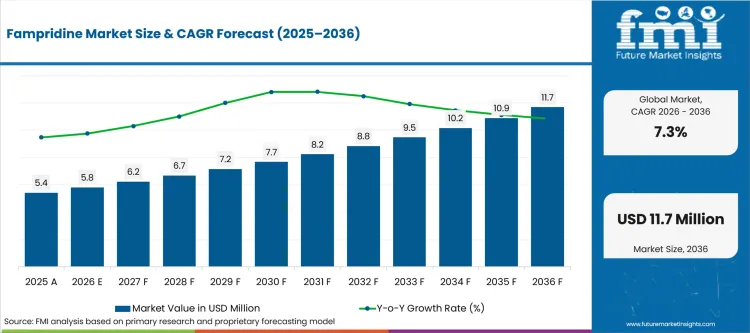
| Metric | Value |
|---|---|
| 2025 Market Size | USD 5.38 million |
| 2026 Market Size | USD 5.80 million |
| 2036 Market Size | USD 11.7 million |
| Forecast CAGR (2026-2036) | 7.3% |
| Application Focus | Multiple Sclerosis (Walking Improvement) |
| Multiple Sclerosis (Walking Improvement) Share (2026) | 85.1% |
| Form Focus | Powder |
| Powder Share (2026) | 72.9% |
| Sales Channel Focus | Direct |
| Direct Share (2026) | 71.3% |
Summary of the Fampridine Market
| Market Signal | Commercial Impact |
|---|---|
| Demand and Growth Drivers | Demand for fampridine is increasing as healthcare providers focus on evidence-based treatment options that improve walking ability in patients with multiple sclerosis while maintaining regulatory compliance and supply continuity.
|
| Product and Segment View | Multiple sclerosis treatment applications, powder formulations, and direct sales channels continue to represent the leading commercial opportunities across the fampridine market.
|
| Geography and Growth Outlook | North America and Asia continue to support market expansion through improving specialist access, expanding healthcare infrastructure, and regulated pharmaceutical supply chains.
|
| Competitive Landscape | Competition increasingly focuses on regulatory documentation, product quality, supply continuity, and healthcare channel access.
|
| Analyst Perspective | Fampridine is evolving as a specialized neurological therapy market where regulatory compliance, product quality, and uninterrupted supply are more important than volume expansion.
|
How is the Fampridine Market segmented?
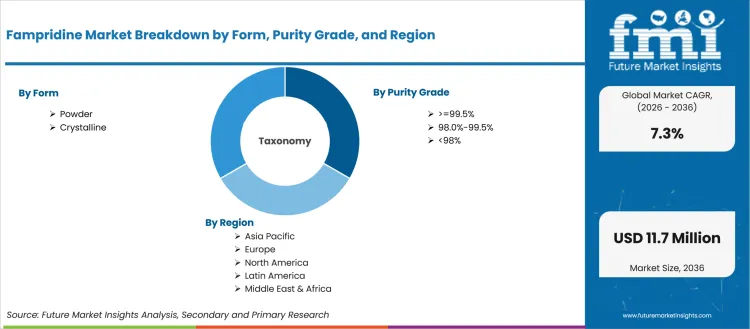
The Fampridine Market industry is segmented by Form, Purity Grade, Application, Sales Channel, and Region.
By form, the market covers Powder and Crystalline. By purity grade, the market covers >=99.5%, 98.0%-99.5%, and <98%. By application, the market covers Multiple Sclerosis (Walking Improvement) and Other Neurological Indications. By sales channel, the market covers Direct and Distributors. By region, the market covers North America, Latin America, East Asia, South Asia and Pacific, Europe, and Middle East and Africa.
Why does Multiple Sclerosis (Walking Improvement) carry weight within Application?
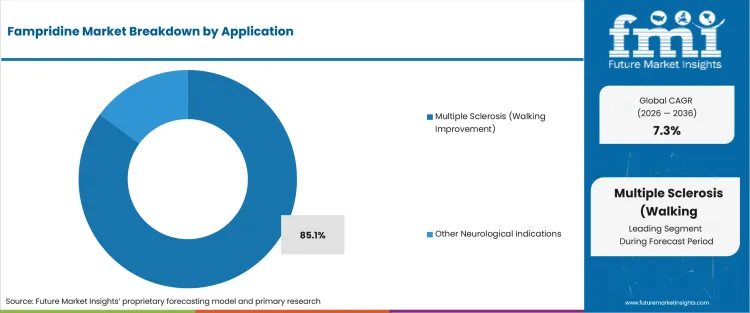
Multiple Sclerosis (Walking Improvement) demand within Application is shaped by care-pathway fit and the level of documentation needed before buyer approval. This application is tied to the labeled care pathway, specialist prescribing, safety review, and therapy access for walking improvement in multiple sclerosis.
Multiple Sclerosis (Walking Improvement) accounts for 85.1% share within Application in 2026. The segment is valued at USD 4.58 million in 2025, USD 4.94 million in 2026, and USD 9.94 million by 2036. FDA Orphan Drug Designations for dalfampridine provides approval and indication context for dalfampridine and multiple-sclerosis walking improvement.
For care providers, the practical issue is clinical fit. Adoption depends on whether evidence, staffing, monitoring, and follow-up requirements can be managed without adding avoidable risk.
What keeps Powder relevant in the Form category?
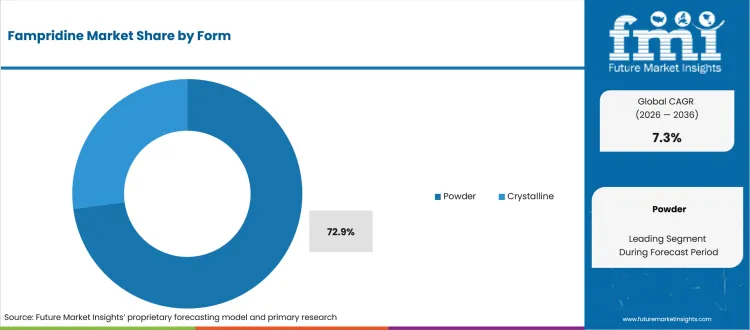
Powder demand within Form is shaped by care-pathway fit and the level of documentation needed before buyer approval. Powder form fits API handling and formulation work where buyers need clean specifications, stable documentation, and predictable supply.
Powder accounts for 72.9% share within Form in 2026. The segment is valued at USD 3.92 million in 2025, USD 4.23 million in 2026, and USD 8.52 million by 2036. FDA AMPYRA label gives dosage, indication, safety, and pharmacology context for controlled therapy use.
For executives, the practical issue is qualification. Buyers need documentation around specification control, batch quality, and supply continuity before they can rely on the supplier in a regulated pathway.
How do buyers evaluate Direct within Sales Channel?
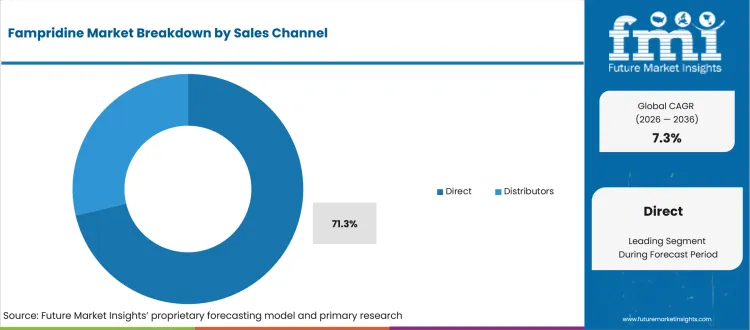
Direct demand within Sales Channel is shaped by care-pathway fit and the level of documentation needed before buyer approval. Direct sales matter because the buyer needs a tighter line of sight into quality files, order continuity, and supplier accountability.
Direct accounts for 71.3% share within Sales Channel in 2026. The segment is valued at USD 3.84 million in 2025, USD 4.14 million in 2026, and USD 8.33 million by 2036. ClinicalTrials.gov dalfampridine search provides trial-activity context for the active ingredient.
For procurement teams, the issue is accountability after approval. Direct supplier control can reduce handoff risk when documentation, availability, or therapy continuity needs quick attention.
Where does >=99.5% fit within Purity Grade demand?
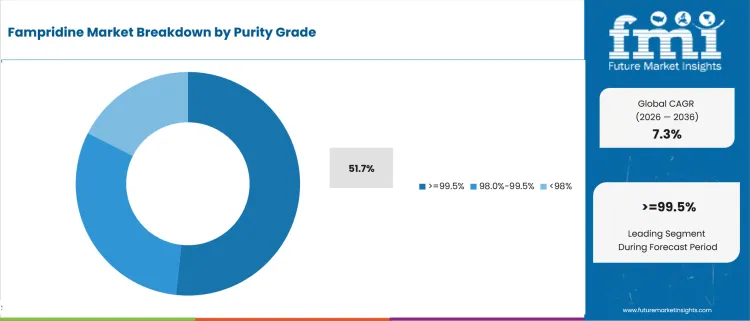
>=99.5% demand within Purity Grade is shaped by care-pathway fit and the level of documentation needed before buyer approval. The higher-purity grade is important where impurity control, regulatory documentation, and batch consistency decide qualification.
>=99.5% accounts for 51.7% share within Purity Grade in 2026. The segment is valued at USD 2.78 million in 2025, USD 3.00 million in 2026, and USD 6.04 million by 2036. Merz Therapeutics asset purchase agreement with Acorda provides the source context used for this demand view.
For executives, the practical issue is qualification. Buyers need documentation around specification control, batch quality, and supply continuity before they can rely on the supplier in a regulated pathway.
What explains the 98.0%-99.5% position within Purity Grade?
98.0%-99.5% demand within Purity Grade is shaped by care-pathway fit and the level of documentation needed before buyer approval. This grade remains relevant for buyers balancing specification fit with cost and availability, provided documentation supports use.
98.0%-99.5% accounts for 36% share within Purity Grade in 2026. The segment is valued at USD 1.94 million in 2025, USD 2.09 million in 2026, and USD 4.21 million by 2036. SEC filing on Acorda and Merz stalking horse asset purchase agreement provides the source context used for this demand view.
For executives, the practical issue is qualification. Buyers need documentation around specification control, batch quality, and supply continuity before they can rely on the supplier in a regulated pathway.
What are the drivers, restraints, and opportunities in the Fampridine Market?
Near-term purchases are being shaped by the operating requirement, implementation constraint, and expansion route outlined below.
- The main driver is that clinical evidence, regulatory access, and provider adoption support demand. Buyers need a practical reason to approve spend, so demand improves where evidence can be linked to regulatory files, clinical-use evidence, and batch-level documentation.
- The main restraint is that safety limits, reimbursement controls, access barriers, and a narrow eligible patient pool restrain adoption. Adoption slows when buyer teams cannot see the payback, safety boundary, service owner, or documentation path clearly enough for approval.
- The opportunity lies in better specialty-care access, current clinical evidence, and therapy-continuity support. Suppliers can use this route only when they bring practical evidence, local support, and a realistic implementation plan.
- Demand is more defensible where specialist teams can connect clinical need with clear evidence and workable access. FDA Orphan Drug Designations for dalfampridine anchors the operating context, so buyer decisions should be tied to care-pathway fit with less weight on general healthcare-spending claims.
- The profiled country rows reconcile to USD 5.80 million in 2026 and USD 11.7 million by 2036 at a 7.3% CAGR. This matters because country growth can look attractive while reimbursement, safety monitoring, or specialist access still limits near-term procurement.
- Implementation friction comes from the need to connect clinician confidence, payer or hospital controls, supplier qualification, and continuity of therapy support. Suppliers with clean documentation and a clear support owner are less likely to create approval delays.
Which country CAGRs are profiled in the Fampridine Market?
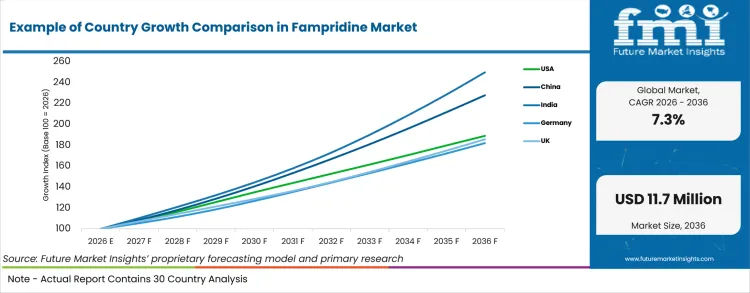
| Country | CAGR |
|---|---|
| United States | 6.57% |
| China | 8.58% |
| India | 9.58% |
| Germany | 6.17% |
| United Kingdom | 6.37% |
| Japan | 5.77% |
| South Korea | 6.97% |
| Rest of World | 7.97% |
How do country-level CAGRs compare in the Fampridine Market?
- Country growth in the Fampridine Market should be read through specialist access, documentation quality, reimbursement discipline, and therapy continuity. The same CAGR can reflect different operating constraints, so executives should compare how each country handles clinical evidence, supplier qualification, and care delivery.
- United States records USD 1.80 million in 2026, USD 3.40 million by 2036, and 6.57% CAGR. Demand is shaped by specialist access, payer review, liability control, and the need for clear clinical-use documentation. Procurement teams therefore ask for evidence, service coverage, and payer-aware access planning before widening supplier use.
- China records USD 0.58 million in 2026, USD 1.32 million by 2036, and 8.58% CAGR. Hospital access, qualification discipline, and supplier repeatability are important because clinical procurement must be supported across larger care networks. This puts repeatability, documentation, and local support at the center of supplier review.
- India records USD 0.35 million in 2026, USD 0.87 million by 2036, and 9.58% CAGR. Growth depends on affordability, specialist availability, and the ability to maintain evidence-backed care beyond major urban centers. Suppliers need affordable support models, evidence that works in specialist settings, and reliable channel continuity.
- Germany records USD 0.52 million in 2026, USD 0.95 million by 2036, and 6.17% CAGR. Buyers place more weight on documentation, clinical governance, and supplier traceability before widening use. Supplier review therefore centers on traceable files, consistent quality, and clear clinical governance support.
- United Kingdom records USD 0.41 million in 2026, USD 0.75 million by 2036, and 6.37% CAGR. Access is filtered through managed budgets, specialist referral pathways, and a need to show practical care value. Buyers need proof that supplier support can fit managed budgets and controlled specialty pathways.
- Japan records USD 0.46 million in 2026, USD 0.81 million by 2036, and 5.77% CAGR. Adoption depends on disciplined clinical pathways, reliability, and careful follow-up in compact specialist settings. Supplier confidence depends on reliability, follow-up support, and careful documentation.
- South Korea records USD 0.23 million in 2026, USD 0.46 million by 2036, and 6.97% CAGR. Specialist networks are compact and quality expectations are high, so evidence, access discipline, and service reliability carry weight. Buyers are likely to favor suppliers that can respond quickly and document quality without adding clinical workload.
- Rest of World records USD 1.45 million in 2026, USD 3.12 million by 2036, and 7.97% CAGR. Adoption depends on local reimbursement, distributor continuity, and the availability of specialist support. Local access, distributor reliability, and continuity support decide how far adoption can move beyond early demand.
Who are the notable companies in the Fampridine Market?
Merz Therapeutics, Viatris / Mylan, Teva / Actavis, Aurobindo Pharma, Accord Healthcare, Sun Pharma, Hikma Pharmaceuticals, Alkem Laboratories, Ascend Laboratories, and CivicaScript are the notable companies shaping this market.
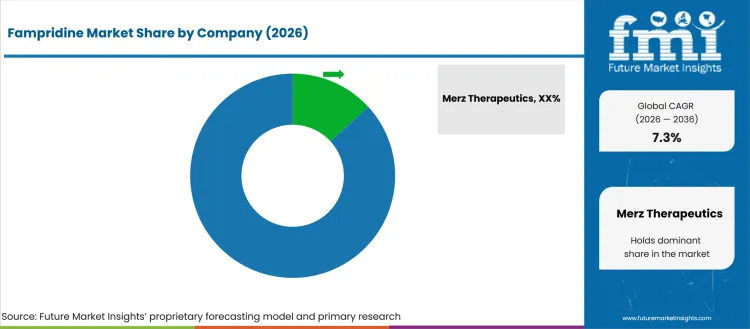
Competition is split between brand-asset control and generic extended-release tablet access. Merz carries the AMPYRA and FAMPYRA asset position after the Acorda transaction, while generic suppliers compete on approved supply, labeling, batch documentation, and channel reliability. Buyers should verify current approval, packager, and availability status before relying on a supplier for continuity.
Merz Therapeutics is relevant because it now holds the main branded fampridine asset position through AMPYRA and FAMPYRA. Healthcare buyers can treat Merz as the reference point for brand stewardship, label continuity, and specialty-neurology channel planning.
Viatris / Mylan, Teva / Actavis, Aurobindo Pharma, Accord Healthcare, Sun Pharma, Hikma Pharmaceuticals, Alkem Laboratories, and Ascend Laboratories matter on the generic side of the market. Their competitive role is practical: hospitals, pharmacies, and distributors need approved supply, clear labeling, and dependable order fulfillment rather than a broad company story.
CivicaScript is included because DailyMed lists dalfampridine packaging activity under its name. Its relevance should be read through access and supply-channel support, while buyer qualification still has to check the current NDC, sourcing file, and availability position.
Competitive Benchmarking: Fampridine Market
| Company | Branded or Generic Supply Fit | Regulatory Documentation Support | Channel Reach | Geographic Footprint |
|---|---|---|---|---|
| Merz Therapeutics | High | High | Strong | United States and international territories |
| Viatris / Mylan | High | High | Strong | Global |
| Teva / Actavis | High | High | Strong | Global |
| Aurobindo Pharma | High | Medium | Strong | United States and international |
| Accord Healthcare | High | High | Strong | United States and Europe |
| Sun Pharma | Medium | Medium | Strong | Global |
| Hikma Pharmaceuticals | Medium | Medium | Strong | United States and international |
| Alkem Laboratories | Medium | Medium | Medium | United States and India-linked supply |
| Ascend Laboratories | Medium | Medium | Medium | United States |
| CivicaScript | Medium | Medium | Medium | United States |
Source: Future Market Insights competitive analysis, 2026. Ratings reflect relative portfolio relevance, workflow or project fit, service capability, and geographic reach.
Key Developments in the Fampridine Market
- In January 2024, Acorda said it would regain global commercialization rights to FAMPYRA after Biogen decided to terminate the license and collaboration agreement. The development mattered because it changed the rights pathway for ex-US fampridine commercialization before the later asset sale.
- In April 2024, Acorda and Merz announced a stalking-horse asset purchase agreement while Acorda filed for voluntary Chapter 11 protection. The step was relevant to buyers because it placed brand ownership and therapy-continuity planning inside a formal sale process.
- In July 2024, Merz Therapeutics closed the purchase of INBRIJA and AMPYRA / FAMPYRA assets from Acorda. The transaction is the main current competitive reference point for branded fampridine because it moved the asset position to Merz.
Key Players in the Fampridine Market
Brand Asset Holder
- Merz Therapeutics
Generic Tablet Suppliers and Packagers
- Viatris / Mylan
- Teva / Actavis
- Aurobindo Pharma
- Accord Healthcare
- Sun Pharma
- Hikma Pharmaceuticals
- Alkem Laboratories
- Ascend Laboratories
- CivicaScript
Fampridine Market - Report Scope
| Coverage field | Report scope |
|---|---|
| Market breakdown | Fampridine Market Breakdown Form, Purity Grade, Application, Sales Channel, By Region |
| Market Definition | Commercial demand covered under Fampridine Market, including country demand, segment demand, and supplier-selection context |
| Regions Covered | East Asia, Europe, North America, Rest of World, South Asia |
| Countries Covered | United States, China, India, Germany, United Kingdom, Japan, South Korea, Rest of World |
| Key Companies Profiled | Merz Therapeutics, Viatris / Mylan, Teva / Actavis, Aurobindo Pharma, Accord Healthcare, Sun Pharma, Hikma Pharmaceuticals, Alkem Laboratories, Ascend Laboratories, and CivicaScript |
| Forecast Period | 2026 to 2036 |
| Approach | Global, country, and segment assessment using public source evidence and market context |
Fampridine Market - Research Methodology
| Method | Approach |
|---|---|
| Primary Research | The assessment covers buyer needs, supplier roles, country demand, and segment-level adoption patterns. |
| Desk Research | FDA Orphan Drug Designations - dalfampridine; FDA AMPYRA label; ClinicalTrials.gov dalfampridine search. Official company portfolio, product, label, and press-release pages were reviewed where company names were used. |
| Market Sizing and Forecasting | Global, country, and segment values were assessed across demand pools, country adoption, segment share, and forecast-period growth. |
| Data Validation | Country totals, segment shares, and forecast values are presented on one reconciled base. |
Fampridine Market by Segments
Fampridine Market segmented by Form:
- Powder
- Crystalline
Fampridine Market segmented by Purity Grade:
- >=99.5%
- 98.0%-99.5%
- <98%
Fampridine Market segmented by Application:
- Multiple Sclerosis (Walking Improvement)
- Other Neurological Indications
Fampridine Market segmented by Sales Channel:
- Direct
- Distributors
Fampridine Market segmented by Region:
- North America
- Latin America
- East Asia
- South Asia and Pacific
- Europe
- Middle East and Africa
Research Sources and Bibliography
- 1. FDA Orphan Drug Designations - dalfampridine. FDA approval/indication evidence for dalfampridine and multiple-sclerosis walking improvement.
- 2. FDA AMPYRA label. Official dosage, indication, safety, and pharmacology context.
- 3. ClinicalTrials.gov dalfampridine search. Trial activity and clinical-use signal for the active ingredient.
- 4. Merz Therapeutics asset purchase agreement with Acorda. https://merztherapeutics.com/us/merz-therapeutics-closes-185m-asset-purchase-agreement-with-acorda-therapeutics/
- 5. SEC filing on Acorda and Merz stalking horse asset purchase agreement. https://www.sec.gov/Archives/edgar/data/1008848/000095017024039674/acor-ex99_1.htm
- 6. DailyMed dalfampridine search results. https://dailymed.nlm.nih.gov/dailymed/search.cfm?labeltype=all&query=dalfampridine
- 7. DailyMed AMPYRA medication guide. https://dailymed.nlm.nih.gov/dailymed/medguide.cfm?setid=550eb76a-e4a6-4fa1-ad65-c0fd8b0ce783
- 8. Aurobindo dalfampridine approval announcement. https://www.aurobindousa.com/news/product-news/aurobindo-receives-fda-approval-for-dalfampridine-extended-release-tablets-10-mg/
- 9. Mylan authorized generic AMPYRA announcement. https://investor.mylan.com/news-releases/news-release-details/mylan-launches-authorized-generic-ampyrar-tablets
- 10. Hikma dalfampridine launch announcement. https://www.hikma.com/media/zslhkimy/ww00743-dalfampridine-tablets-press-release-final.pdf
This Report Answers
- What is the expected global value of the Fampridine Market in 2026 and 2036?
- What CAGR is forecast for the Fampridine Market during the 2026 to 2036 period?
- Which country value and CAGR rows are included for Fampridine Market?
- Which segment groups and subsegments carry the higher 2026 shares?
- How do country values reconcile with the global 2026 and 2036 totals?
- Which public sources support the market, country, and segment context?
- Which named companies shape competition in the Fampridine Market?
- What adoption risk, procurement risk, or supplier-selection issue should executives watch?
- How does FMI size and forecast Fampridine Market across countries and segments?
- Which supplier or development signals affect executive decisions?
Frequently Asked Questions
Why should executives track the Fampridine Market?
Executives should track this market because adoption depends on clinical evidence, access controls, supplier qualification, and continuity of care. A forecast is less useful if the buyer cannot translate it into safe procurement and service planning.
What business problem does the Fampridine Market address?
The market addresses the need to connect specialist therapy use with documentation, reimbursement discipline, and care-delivery capacity. Buyers need a way to compare supplier fit before wider approval creates risk for clinicians or patients.
What should procurement leaders evaluate before selecting suppliers?
Procurement leaders should compare evidence quality, specification fit, regulatory documentation, service ownership, channel reliability, and country exposure. The strongest supplier case is the one that reduces approval work after the purchase decision.
What can limit return on investment for buyers?
Return on investment can be limited when safety review, reimbursement access, specialist capacity, or supplier documentation is weak. Buyers can reduce this risk by phasing adoption and assigning clear ownership for evidence review, supply continuity, and support response.
How can suppliers build executive confidence?
Suppliers build confidence by providing clean files, realistic implementation guidance, responsive service, and proof that quality and availability can be maintained. Buyer trust improves when the supplier can explain what happens after approval, as well as before sale.
Preview the report firsthand - request a free sample
Get SampleGet the brochure for pricing and purchase details.
Get PDFTable of Content
- Key Takeaways
- Market Size and CAGR
- Top Growth Driver
- Fastest Growing Segment
- Leading Region
- Key Companies
- Emerging Opportunities
- Executive Summary
- Global Market Outlook
- Demand-side Trends
- Supply-side Trends
- Technology Roadmap Analysis
- Analysis and Recommendations
- Analyst Perspective (What is happening? Why now? What should investors know?)
- Key Questions Answered
- How large is the market?
- What is the CAGR?
- What are key trends?
- Which region dominates?
- Who are the leaders?
- Market Overview
- Market Coverage / Taxonomy
- Market Definition / Scope / Limitations
- Research Methodology
- Chapter Orientation
- Analytical Lens and Working Hypotheses
- Market Structure, Signals, and Trend Drivers
- Benchmarking and Cross-market Comparability
- Market Sizing, Forecasting, and Opportunity Mapping
- Research Design and Evidence Framework
- Desk Research Programme (Secondary Evidence)
- Expert Input and Fieldwork (Primary Evidence)
- Tooling, Models, and Reference Databases
- Data Engineering and Model Build
- Quality Assurance and Audit Trail
- Market Background
- Market Dynamics (Drivers, Restraints, Opportunity, Trends)
- Scenario Forecast (Optimistic, Likely, Conservative)
- Impact Analysis
- AI Impact
- Sustainability Impact
- Regulatory Impact
- Technology Impact
- Consumer / Buyer Analysis
- Purchase Drivers
- Adoption Barriers
- Buyer Journey
- Opportunity Map Analysis
- Product Life Cycle Analysis
- Supply Chain Analysis
- Investment Feasibility Matrix
- Value Chain Analysis
- PESTLE and Porter's Analysis
- Regulatory Landscape
- Regional Parent Market Outlook
- Production and Consumption Statistics
- Import and Export Statistics
- Global Market Analysis and Forecast, 2021 to 2036
- Historical Market Size Value (USD Million) Analysis, 2021 to 2025
- Current and Future Market Size Value (USD Million) Projections, 2026 to 2036
- Y-o-Y Growth Trend Analysis
- Absolute $ Opportunity Analysis
- Global Market Pricing Analysis, 2021 to 2036
- Global Market Analysis and Forecast, By Form, 2021 to 2036
- Introduction / Key Findings
- Historical Market Size Value (USD Million) Analysis By Form, 2021 to 2025
- Current and Future Market Size Value (USD Million) Analysis and Forecast By Form, 2026 to 2036
- Powder
- Crystalline
- Powder
- Y-o-Y Growth Trend Analysis By Form, 2021 to 2025
- Absolute $ Opportunity Analysis By Form, 2026 to 2036
- Global Market Analysis and Forecast, By Purity Grade, 2021 to 2036
- Introduction / Key Findings
- Historical Market Size Value (USD Million) Analysis By Purity Grade, 2021 to 2025
- Current and Future Market Size Value (USD Million) Analysis and Forecast By Purity Grade, 2026 to 2036
- >=99.5%
- 98.0%-99.5%
- <98%
- >=99.5%
- Y-o-Y Growth Trend Analysis By Purity Grade, 2021 to 2025
- Absolute $ Opportunity Analysis By Purity Grade, 2026 to 2036
- Global Market Analysis and Forecast, By Application, 2021 to 2036
- Introduction / Key Findings
- Historical Market Size Value (USD Million) Analysis By Application, 2021 to 2025
- Current and Future Market Size Value (USD Million) Analysis and Forecast By Application, 2026 to 2036
- Multiple Sclerosis (Walking Improvement)
- Other Neurological Indications
- Multiple Sclerosis (Walking Improvement)
- Y-o-Y Growth Trend Analysis By Application, 2021 to 2025
- Absolute $ Opportunity Analysis By Application, 2026 to 2036
- Global Market Analysis and Forecast, By Sales Channel, 2021 to 2036
- Introduction / Key Findings
- Historical Market Size Value (USD Million) Analysis By Sales Channel, 2021 to 2025
- Current and Future Market Size Value (USD Million) Analysis and Forecast By Sales Channel, 2026 to 2036
- Direct
- Distributors
- Direct
- Y-o-Y Growth Trend Analysis By Sales Channel, 2021 to 2025
- Absolute $ Opportunity Analysis By Sales Channel, 2026 to 2036
- Global Market Analysis and Forecast, By Region, 2021 to 2036
- Introduction
- Historical Market Size Value (USD Million) Analysis By Region, 2021 to 2025
- Current Market Size Value (USD Million) Analysis and Forecast By Region, 2026 to 2036
- North America
- Latin America
- Western Europe
- Eastern Europe
- East Asia
- South Asia and Pacific
- Middle East & Africa
- Market Attractiveness Analysis By Region
- North America Market Analysis and Forecast, By Country, 2021 to 2036
- Historical Market Size Value (USD Million) Trend Analysis By Market Taxonomy, 2021 to 2025
- Market Size Value (USD Million) Forecast By Market Taxonomy, 2026 to 2036
- By Country
- USA
- Canada
- By Form
- By Purity Grade
- By Application
- By Sales Channel
- By Country
- Market Attractiveness Analysis
- By Country
- By Form
- By Purity Grade
- By Application
- By Sales Channel
- Key Takeaways
- Latin America Market Analysis and Forecast, By Country
- Historical Market Size Value (USD Million) Trend Analysis By Market Taxonomy, 2021 to 2025
- Market Size Value (USD Million) Forecast By Market Taxonomy, 2026 to 2036
- By Country
- Brazil
- Mexico
- Chile
- Rest of Latin America
- By Form
- By Purity Grade
- By Application
- By Sales Channel
- By Country
- Market Attractiveness Analysis
- By Country
- By Form
- By Purity Grade
- By Application
- By Sales Channel
- Key Takeaways
- Western Europe Market Analysis and Forecast, By Country
- Historical Market Size Value (USD Million) Trend Analysis By Market Taxonomy, 2021 to 2025
- Market Size Value (USD Million) Forecast By Market Taxonomy, 2026 to 2036
- By Country
- Germany
- UK
- Italy
- Spain
- France
- Nordic
- BENELUX
- Rest of Western Europe
- By Form
- By Purity Grade
- By Application
- By Sales Channel
- By Country
- Market Attractiveness Analysis
- By Country
- By Form
- By Purity Grade
- By Application
- By Sales Channel
- Key Takeaways
- Eastern Europe Market Analysis and Forecast, By Country
- Historical Market Size Value (USD Million) Trend Analysis By Market Taxonomy, 2021 to 2025
- Market Size Value (USD Million) Forecast By Market Taxonomy, 2026 to 2036
- By Country
- Russia
- Poland
- Hungary
- Balkan & Baltic
- Rest of Eastern Europe
- By Form
- By Purity Grade
- By Application
- By Sales Channel
- By Country
- Market Attractiveness Analysis
- By Country
- By Form
- By Purity Grade
- By Application
- By Sales Channel
- Key Takeaways
- East Asia Market Analysis and Forecast, By Country
- Historical Market Size Value (USD Million) Trend Analysis By Market Taxonomy, 2021 to 2025
- Market Size Value (USD Million) Forecast By Market Taxonomy, 2026 to 2036
- By Country
- China
- Japan
- South Korea
- By Form
- By Purity Grade
- By Application
- By Sales Channel
- By Country
- Market Attractiveness Analysis
- By Country
- By Form
- By Purity Grade
- By Application
- By Sales Channel
- Key Takeaways
- South Asia and Pacific Market Analysis and Forecast, By Country
- Historical Market Size Value (USD Million) Trend Analysis By Market Taxonomy, 2021 to 2025
- Market Size Value (USD Million) Forecast By Market Taxonomy, 2026 to 2036
- By Country
- India
- ASEAN
- Australia & New Zealand
- Rest of South Asia and Pacific
- By Form
- By Purity Grade
- By Application
- By Sales Channel
- By Country
- Market Attractiveness Analysis
- By Country
- By Form
- By Purity Grade
- By Application
- By Sales Channel
- Key Takeaways
- Middle East & Africa Market Analysis and Forecast, By Country
- Historical Market Size Value (USD Million) Trend Analysis By Market Taxonomy, 2021 to 2025
- Market Size Value (USD Million) Forecast By Market Taxonomy, 2026 to 2036
- By Country
- Kingdom of Saudi Arabia
- Other GCC Countries
- Türkiye
- South Africa
- Other African Union
- Rest of Middle East & Africa
- By Form
- By Purity Grade
- By Application
- By Sales Channel
- By Country
- Market Attractiveness Analysis
- By Country
- By Form
- By Purity Grade
- By Application
- By Sales Channel
- Key Takeaways
- Key Countries Market Analysis
- USA
- Pricing Analysis
- Market Share Analysis, 2025
- By Form
- By Purity Grade
- By Application
- By Sales Channel
- Canada
- Pricing Analysis
- Market Share Analysis, 2025
- By Form
- By Purity Grade
- By Application
- By Sales Channel
- Mexico
- Pricing Analysis
- Market Share Analysis, 2025
- By Form
- By Purity Grade
- By Application
- By Sales Channel
- Brazil
- Pricing Analysis
- Market Share Analysis, 2025
- By Form
- By Purity Grade
- By Application
- By Sales Channel
- Chile
- Pricing Analysis
- Market Share Analysis, 2025
- By Form
- By Purity Grade
- By Application
- By Sales Channel
- Germany
- Pricing Analysis
- Market Share Analysis, 2025
- By Form
- By Purity Grade
- By Application
- By Sales Channel
- UK
- Pricing Analysis
- Market Share Analysis, 2025
- By Form
- By Purity Grade
- By Application
- By Sales Channel
- Italy
- Pricing Analysis
- Market Share Analysis, 2025
- By Form
- By Purity Grade
- By Application
- By Sales Channel
- Spain
- Pricing Analysis
- Market Share Analysis, 2025
- By Form
- By Purity Grade
- By Application
- By Sales Channel
- France
- Pricing Analysis
- Market Share Analysis, 2025
- By Form
- By Purity Grade
- By Application
- By Sales Channel
- India
- Pricing Analysis
- Market Share Analysis, 2025
- By Form
- By Purity Grade
- By Application
- By Sales Channel
- ASEAN
- Pricing Analysis
- Market Share Analysis, 2025
- By Form
- By Purity Grade
- By Application
- By Sales Channel
- Australia & New Zealand
- Pricing Analysis
- Market Share Analysis, 2025
- By Form
- By Purity Grade
- By Application
- By Sales Channel
- China
- Pricing Analysis
- Market Share Analysis, 2025
- By Form
- By Purity Grade
- By Application
- By Sales Channel
- Japan
- Pricing Analysis
- Market Share Analysis, 2025
- By Form
- By Purity Grade
- By Application
- By Sales Channel
- South Korea
- Pricing Analysis
- Market Share Analysis, 2025
- By Form
- By Purity Grade
- By Application
- By Sales Channel
- Russia
- Pricing Analysis
- Market Share Analysis, 2025
- By Form
- By Purity Grade
- By Application
- By Sales Channel
- Poland
- Pricing Analysis
- Market Share Analysis, 2025
- By Form
- By Purity Grade
- By Application
- By Sales Channel
- Hungary
- Pricing Analysis
- Market Share Analysis, 2025
- By Form
- By Purity Grade
- By Application
- By Sales Channel
- Kingdom of Saudi Arabia
- Pricing Analysis
- Market Share Analysis, 2025
- By Form
- By Purity Grade
- By Application
- By Sales Channel
- Türkiye
- Pricing Analysis
- Market Share Analysis, 2025
- By Form
- By Purity Grade
- By Application
- By Sales Channel
- South Africa
- Pricing Analysis
- Market Share Analysis, 2025
- By Form
- By Purity Grade
- By Application
- By Sales Channel
- USA
- Market Structure Analysis
- Competition Dashboard
- Competition Benchmarking
- Market Share Analysis of Top Players
- By Regional
- By Form
- By Purity Grade
- By Application
- By Sales Channel
- Emerging Startups
- Innovation Benchmarking
- Competition Analysis
- Competition Deep Dive
- Merz Therapeutics
- Overview
- Product Portfolio
- Profitability by Market Segments
- Sales Footprint
- Strategy Overview
- Marketing Strategy
- Product Strategy
- Channel Strategy
- Viatris / Mylan
- Teva / Actavis
- Aurobindo Pharma
- Accord Healthcare
- Sun Pharma
- Hikma Pharmaceuticals
- Alkem Laboratories
- Ascend Laboratories
- CivicaScript
- Merz Therapeutics
- Case Studies
- Success Stories
- Recent Developments
- Competition Deep Dive
- Assumptions & Acronyms Used


