

- Market Size (2026)
- USD 2.9 Bn
- Forecast (2036)
- USD 7.5 Bn
- CAGR (2026 to 2036)
- 10.0%
How big is HDAC Inhibitors Market in 2026?
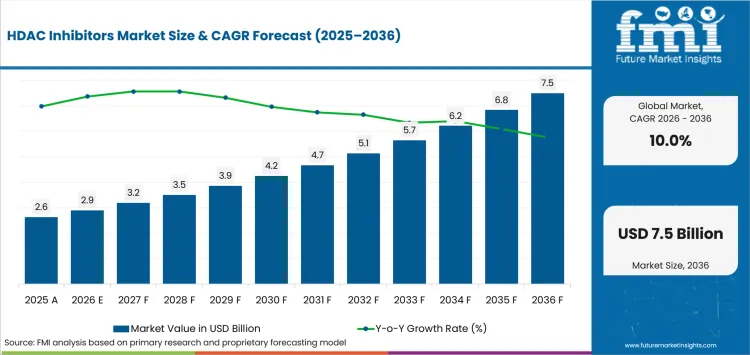
USD 2.9 billion in 2026 and USD 7.5 billion by 2036 at a 10.0% CAGR.
Demand for HDAC inhibitors is projected to expand at 10.0% CAGR between 2026 and 2036, lifting value from USD 2.9 billion in 2026 to USD 7.5 billion by 2036. Established lymphoma pathways anchor specialist use while chromatin-modifier biology supports rare-disease and selective commercial programs. The FDA approved oral givinostat in March 2024 and established a non-oncology route for development.
Access conditions diverge after approval because Japan has established tucidinostat use, while Germany requires formal benefit assessment and price negotiation for givinostat. The G-BA estimated 270 to 400 eligible ambulant patients in January 2026, which concentrates launch activity in specialist centers and raises the value of evidence.
Key Takeaways of HDAC Inhibitors Market
- Approved lymphoma pathways and rare-disease indications expand specialist prescribing across defined treatment populations in hospitals.
- Pan-HDAC inhibitors are projected to account for 44.0% of product demand in 2026 due to established labels and specialist familiarity.
- Hematologic malignancies are estimated to represent 41.0% of application demand in 2026 owing to recognized lymphoma treatment pathways.
- Oral products are forecast to capture 63.0% of administration revenue in 2026 as scheduled dosing reduces reliance on infusion capacity.
- Safety monitoring and comparative evidence requirements can narrow eligible populations or delay reimbursement across approved indications.
- Italfarmaco S.p.A., Merck & Co., Inc., Acrotech Biopharma Inc., Fresenius Kabi USA, LLC, Shenzhen Chipscreen Biosciences Co., Ltd., HUYA Bioscience International, LLC, IngenOx Therapeutics and Tenaya Therapeutics, Inc. operate across commercial and clinical-stage HDAC programs.
Analyst Perspective
"Commercial performance depends on whether each HDAC program owns a defined indication and a workable monitoring pathway. Developers that reduce toxicity without weakening clinical effect should gain stronger label durability and payer confidence than programs built mainly around broader target coverage."
- Anurag Sharma, Principal Consultant, Future Market Insights
How is the HDAC Inhibitors Market segmented?
The HDAC inhibitors market is segmented by product, application, route of administration, end user, distribution channel and region.
The product taxonomy covers pan-HDAC inhibitors, selective inhibitors, combination therapies and pipeline molecules across hematologic malignancies, solid tumors, neurological disorders and inflammatory or autoimmune disorders. Administration covers oral, injectable and investigational systems used by hospitals, specialty oncology clinics and research institutes. Distribution channels include hospital pharmacies, specialty pharmacies and retail or online outlets serving treatment pathways.
What supports Demand for Pan-HDAC inhibitors within the Product category?
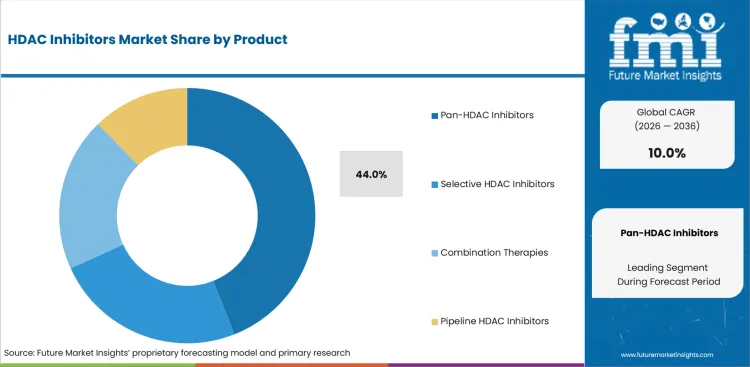
Pan-HDAC inhibitors remain relevant because approved agents established treatment ownership in relapsed hematologic oncology and broad enzyme coverage gives specialists a familiar mechanism across cutaneous lymphoma treatment. Cytopenia and infection risks require laboratory review during repeat dosing, which limits continuity for patients with recurrent toxicity.
- Based on product, pan-HDAC inhibitors are projected to account for 44.0% in 2026 due to established labels and specialist familiarity.
- Specialists use pan-HDAC agents where recognized labels define treatment sequencing, while safety checks limit use beyond established lymphoma pathways.
How do Hematology teams evaluate Hematologic malignancy applications?
Hematologic malignancies provide the deepest HDAC approval history because specialist teams manage relapsed disease and laboratory surveillance within hospital-led pathways using generic oncology medicines and supportive care.
- In 2026, hematologic malignancies are expected to lead the application category with 41.0% share because approved lymphoma indications retain recognized pathways.
- Hematology teams coordinate prior therapy review and adverse-event management, while commercial durability depends on indication-specific evidence rather than broad epigenetic activity alone.
What makes Oral products central to the Administration category?
Oral HDAC products shift administration from infusion units to scheduled outpatient dosing while manufacturers combine oral solid dosage production and containment controls for specialty active ingredients.
- By administration route, oral products are forecast to represent 63.0% in 2026 driven by established tablets and oral suspensions across approved programs.
- Oral delivery supports scheduled dispensing and reduces reliance on infusion capacity, although specialist monitoring remains necessary because laboratory findings can require dose changes.
How do Hospitals shape selection within the End-user category?
Hospitals retain treatment ownership because HDAC therapies require diagnosis and baseline laboratory assessment while specialist teams coordinate adverse events and targeted oncology biologics when combination regimens enter clinical practice.
- Hospitals are set to lead the end-user category with 45.0% share in 2026 due to specialist control over treatment initiation and monitoring.
- Hospital pharmacies link prescribing with laboratory results and infusion schedules across oral and injectable regimens, allowing coordinated dose changes after platelet or cardiac findings.
What are the drivers, restraints and opportunities in the HDAC inhibitors market?
New indications broaden commercial use while safety and payer evidence requirements restrict access. Selective oral molecules and defined combinations provide the clearest route into patient groups.
- Driver: Approvals beyond lymphoma indications validate additional commercial routes for HDAC inhibition across specialist care.
- Restraint: Monitoring and comparative-evidence obligations can restrict reimbursement and treatment continuity for eligible populations nationally.
- Opportunity: Selective oral molecules and evidence-led combinations can address defined patient groups with clearer benefit-risk profiles.
Regulatory Approvals Extend Defined Treatment Routes
Regulatory approvals are expanding the role of HDAC inhibitors in precision oncology by moving these therapies into earlier treatment settings and biomarker-defined patient populations. Shenzhen Chipscreen Biosciences gained Chinese approval in April 2024 for chidamide plus R-CHOP in a defined first-line DLBCL population. The approval places HDAC therapy with next-generation immunotherapies within a pathway defined by MYC and BCL2 expression.
Comparative Evidence Limits Funded Access
Regulatory authorization does not secure funded prescribing because payers assess comparative benefit separately, and France issued an unfavorable givinostat reimbursement opinion in February 2026. Developers need evidence on added benefit and treatment burden before products convert into routine orders.
Selective Programs Require Defined Expansion Plans
Selective inhibitors have a clearer route when sponsors define the treated population and combination partner early. Programs aligned with personalized medicine can focus enrollment and launch preparation on settings with measurable response criteria.
Which country CAGRs are profiled in the HDAC inhibitors market?
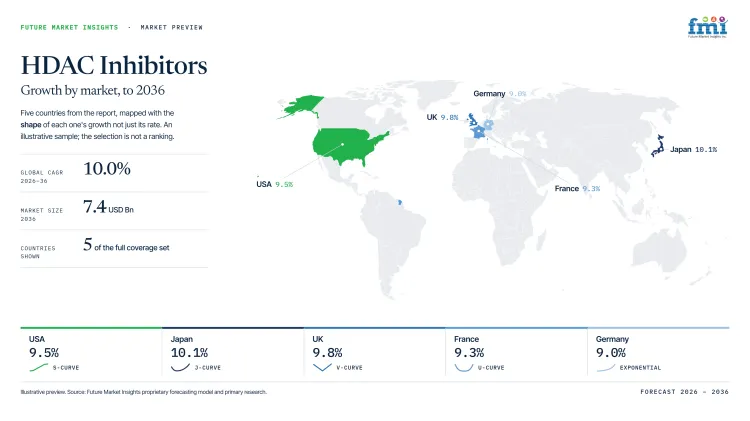
| Country | CAGR |
|---|---|
| Japan | 10.1% |
| United Kingdom | 9.8% |
| United States | 9.5% |
| France | 9.3% |
| Germany | 9.0% |
How do country-level CAGRs compare in the HDAC inhibitors market?
The forecasts span 1.1 percentage points between Japan and Germany, reflecting different approval and payment routes rather than current market size.
- Japan combines marketed tucidinostat with mandatory surveillance that supports specialist hematology use and monitors recurring safety risks.
- United Kingdom access pairs conditional authorization with annual renewal and commissioning requirements that can delay funded prescribing.
- United States pathways combine rare-disease approval with established lymphoma channels and monitoring capacity across specialist referral networks.
- France separates European authorization from national reimbursement and early-access decisions that determine whether prescribing converts into funded orders.
- Germany applies formal benefit assessment followed by statutory price negotiation that can delay routine access across sickness funds.
Comparable CAGRs can produce different entry conditions across authorization and payment, while the full report covers every FMI region.
Country-wise Analysis
- Japan is projected to expand at a 10.1% CAGR through 2036, reflecting established clinical familiarity with HDAC inhibitors in hematology practice. Marketed use of tucidinostat for peripheral T-cell lymphoma under hospital dispensing and post-marketing surveillance has provided physicians with practical treatment experience. A June 2025 registry survey targeted 170 patients, although bone marrow suppression and infection monitoring requirements can limit repeat use outside specialist centers.
- HDAC inhibitor demand in the United Kingdom is forecast to increase at a 9.8% CAGR, supported by a defined regulatory pathway for rare disease therapies. Neuromuscular centers can prescribe conditionally authorized oral givinostat for ambulant Duchenne muscular dystrophy through established commissioning arrangements. The MHRA reported around 2,500 people living with DMD in December 2024, while annual review and funding requirements can lengthen the timeline to routine access.
- The United States is expected to record a 9.5% CAGR during the forecast period, aided by specialist referral networks and established specialty-pharmacy infrastructure. Oral and injectable HDAC therapies are available across centers treating relapsed lymphoma and Duchenne muscular dystrophy. The FDA clinical program enrolled 179 givinostat participants, although platelet and triglyceride monitoring requirements can restrict prescribing outside experienced treatment settings.
- France is anticipated to expand at a 9.3% CAGR through 2036, with commercial uptake closely tied to reimbursement outcomes. European authorization alone does not guarantee routine prescribing, as national authorities must first establish therapeutic value relative to available alternatives. HAS issued an unfavorable reimbursement opinion for givinostat in February 2026, requiring additional evidence on clinical benefit and tolerability before broader funded adoption can occur.
- Germany is forecast to grow at a 9.0% CAGR, benefiting from a structured pathway for orphan-drug assessment and reimbursement review. Access generally progresses through benefit evaluation and price negotiations before wider uptake across sickness funds. The G-BA procedure ran from July 2025 to January 2026, while the relatively small eligible patient population is likely to keep initial prescribing concentrated in specialist centers.
Who are the notable companies in the HDAC inhibitors market?
Italfarmaco S.p.A., Merck & Co., Inc., Acrotech Biopharma Inc., Fresenius Kabi USA, LLC, Shenzhen Chipscreen Biosciences Co., Ltd., HUYA Bioscience International, LLC, IngenOx Therapeutics and Tenaya Therapeutics, Inc. are the notable companies serving this market.
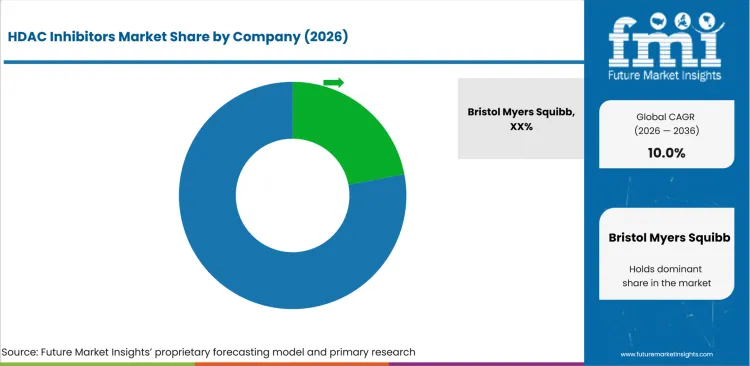
The competitive landscape combines sponsor-owned oral therapies, branded generic portfolios and selective clinical programs competing on indication evidence and access. Commercial expansion also depends on high-potency oral manufacturing with containment and repeatable quality controls at production sites.
- Italfarmaco S.p.A., Merck & Co., Inc., Acrotech Biopharma Inc. and Fresenius Kabi USA, LLC hold approved oral or injectable HDAC positions.
- Shenzhen Chipscreen Biosciences Co., Ltd. and HUYA Bioscience International, LLC combine regional commercialization with subtype-selective oral development.
- IngenOx Therapeutics and Tenaya Therapeutics, Inc. pursue selective programs that require indication-specific clinical evidence before commercial entry.
Competitive Benchmarking: HDAC Inhibitors Market
| Company | Commercial Position | Indication Breadth | Development Maturity | Geographic Reach |
|---|---|---|---|---|
| Italfarmaco S.p.A. | High | Medium | High | North America and Europe |
| Merck & Co., Inc. | High | Low | Medium | North America |
| Acrotech Biopharma Inc. | High | Low | Medium | North America |
| Fresenius Kabi USA, LLC | High | Low | Medium | North America |
| Shenzhen Chipscreen Biosciences Co., Ltd. | High | High | High | China, Japan and licensing markets |
| HUYA Bioscience International, LLC | Medium | Medium | High | Japan and multiregional trials |
| IngenOx Therapeutics | Low | Medium | Medium | United Kingdom and Asian trials |
| Tenaya Therapeutics, Inc. | Low | Medium | Medium | North America |
Scoring basis: Commercial Position is High for active approval, Medium for regional commercialization and Low for verified clinical development. Indication Breadth is High for three settings, Medium for two and Low for one setting. Development Maturity separates lifecycle expansion from clinical work, while Geographic Reach records commercialization or trial coverage.
Key Developments in the HDAC Inhibitors Market
- In March 2026, Tenaya Therapeutics, Inc. presented TN-301 findings from Duchenne muscular dystrophy models and outlined patient studies required to establish clinical performance.
- In February 2025, IngenOx Therapeutics reported interim Phase 2 zabadinostat combination findings in checkpoint-resistant hepatocellular carcinoma and recorded no progression-free survival improvement.
- In November 2024, Acrotech Biopharma Inc. received FDA approval for a BELEODAQ supplement covering dosing changes for organ impairment and UGT1A1 inhibitors.
Key Players in the HDAC Inhibitors Market
Approved Oral and Injectable Portfolio Owners
- Italfarmaco S.p.A.
- Merck & Co., Inc.
- Acrotech Biopharma Inc.
- Fresenius Kabi USA, LLC
Regional Selective HDAC Developers
- Shenzhen Chipscreen Biosciences Co., Ltd.
- HUYA Bioscience International, LLC
Clinical-Stage Selective Developers
- IngenOx Therapeutics
- Tenaya Therapeutics, Inc.
HDAC Inhibitors Market - Report Scope
| Coverage field | Report scope |
|---|---|
| Market breakdown | By product, application, route of administration, end user, distribution channel and region. |
| Quantitative Units | USD Billion. |
| Market Definition | Commercial and investigational histone deacetylase inhibitors across approved therapeutic and clinical-development applications. |
| Regions Covered | North America, Latin America, Europe, East Asia, South Asia and Pacific, and Middle East and Africa. |
| Countries Covered | Japan, United Kingdom, United States, France, Germany, and 20+ countries included in the full report. |
| Key Companies Profiled | Italfarmaco S.p.A., Merck & Co., Inc., Acrotech Biopharma Inc., Fresenius Kabi USA, LLC, Shenzhen Chipscreen Biosciences Co., Ltd., HUYA Bioscience International, LLC, IngenOx Therapeutics, Tenaya Therapeutics, Inc. |
| Forecast Period | 2026 to 2036. |
| Approach | Primary and secondary research with market triangulation. |
HDAC Inhibitors Market - Research Methodology
| Method | Approach |
|---|---|
| Primary Research | FMI analysts gathered input from manufacturers, service providers, technology developers, distributors, end users, procurement teams, and subject-matter experts. Interviews examined purchasing decisions, product or service evaluation, adoption barriers, approval requirements, pricing considerations, and expectations for technical or commercial support. Respondents were also asked what evidence is required before a trial, pilot, or initial order develops into regular purchasing. |
| Desk Research | Desk research covered government statistics, regulatory publications, trade data, industry associations, technical literature, standards, company filings, product information, and official corporate announcements. Sources were reviewed for relevance, publication date, geographic coverage, and consistency with the defined market scope. Claims relating to performance, applications, approvals, capacity, investment, and commercial activity were retained only when supported by credible public evidence. |
| Market Sizing and Forecasting | The market model combined the baseline value with historical performance, segment structure, pricing and volume indicators, adoption levels, company participation, and country-level demand conditions. Forecast assumptions considered economic activity, investment trends, regulatory developments, technology adoption, purchasing cycles, supply availability, and barriers to wider market use. Segment and regional estimates were reconciled before the final market total was calculated. |
| Data Validation | Estimates were checked against multiple independent indicators, including public data, company activity, trade patterns, industry developments, and findings from primary interviews. Validation also tested whether products, services, applications, and company revenues fell within the defined market boundaries. Adjacent categories, unsupported claims, overlapping revenues, and activities without direct market relevance were excluded to reduce double counting and maintain consistency across segments and countries. |
HDAC Inhibitors Market by Segments
HDAC Inhibitors Market segmented by Product:
- Pan-HDAC Inhibitors
- Vorinostat
- Panobinostat
- Belinostat
- Selective HDAC Inhibitors
- Class I HDAC Inhibitors
- HDAC6 Inhibitors
- Class II HDAC Inhibitors
- Combination Therapies
- HDAC-Immunotherapy Combinations
- HDAC-Chemotherapy Combinations
- HDAC-Targeted Therapy Combinations
- Pipeline HDAC Inhibitors
- Next-Generation HDAC Inhibitors
- Oral Small Molecules
- Dual Epigenetic Inhibitors
HDAC Inhibitors Market segmented by Application:
- Hematologic Malignancies
- Cutaneous T-Cell Lymphoma
- Peripheral T-Cell Lymphoma
- Multiple Myeloma
- Solid Tumors
- Breast Cancer
- Lung Cancer
- Colorectal Cancer
- Neurological Disorders
- Alzheimer's Disease
- Huntington's Disease
- Parkinson's Disease
- Inflammatory & Autoimmune Disorders
- Rheumatoid Arthritis
- Systemic Lupus Erythematosus
- Inflammatory Bowel Disease
HDAC Inhibitors Market segmented by Route of Administration:
- Oral
- Tablets
- Capsules
- Oral Suspensions
- Injectable
- Intravenous Infusion
- Hospital-Administered Therapy
- Combination Infusion Therapy
- Investigational Delivery Systems
- Nanoparticle Formulations
- Targeted Drug Delivery
- Sustained-Release Systems
HDAC Inhibitors Market segmented by End User:
- Hospitals
- Comprehensive Cancer Centers
- Tertiary Care Hospitals
- Academic Medical Centers
- Specialty Oncology Clinics
- Hematology Clinics
- Oncology Clinics
- Outpatient Cancer Centers
- Research Institutes
- Cancer Research Institutes
- Clinical Trial Centers
- Academic Research Laboratories
HDAC Inhibitors Market segmented by Distribution Channel:
- Hospital Pharmacies
- Inpatient Pharmacies
- Outpatient Hospital Pharmacies
- Oncology Pharmacy Units
- Specialty Pharmacies
- Oncology Specialty Pharmacies
- Rare Disease Pharmacies
- Limited Distribution Networks
- Retail & Online Pharmacies
- Chain Pharmacies
- E-Pharmacy Platforms
- Home Delivery Services
HDAC Inhibitors Market by Region:
- North America
- United States
- Canada
- Mexico
- Latin America
- Brazil
- Chile
- Rest of Latin America
- Western Europe
- Germany
- United Kingdom
- Italy
- Spain
- France
- Nordics
- Benelux
- Rest of Western Europe
- Eastern Europe
- Russia
- Poland
- Hungary
- Balkan and Baltic States
- Rest of Eastern Europe
- East Asia
- China
- Japan
- South Korea
- South Asia and Pacific
- India
- ASEAN
- Australia and New Zealand
- Rest of South Asia and Pacific
- Middle East and Africa
- Kingdom of Saudi Arabia
- Other GCC Countries
- Türkiye
- South Africa
- Other African Union Countries
- Rest of Middle East and Africa
Research Sources and Bibliography
- USA Food and Drug Administration. (2024, March 21). FDA Approves Nonsteroidal Treatment for Duchenne Muscular Dystrophy
- Gemeinsamer Bundesausschuss. (2026, January 22). Nutzenbewertungsverfahren zum Wirkstoff Givinostat (Duchenne-Muskeldystrophie, ≥ 6 Jahre, Kombination mit einem Corticosteroid)
- Shenzhen Chipscreen Biosciences Co., Ltd. (2024, April 30). National Medical Products Administration (NMPA) Approves Chipscreen Bioscience’s Chidamide (Epidaza) combined with R-CHOP for the treatment of diffuse large B-cell lymphoma
- Japan Registry of Clinical Trials. (2025, June 10). General drug use-results survey of Hiyasta tablets for relapsed or refractory peripheral T-cell lymphoma
- Medicines and Healthcare products Regulatory Agency. (2024, December 20). Givinostat conditionally approved to treat patients with Duchenne muscular dystrophy (DMD)
- Haute Autorité de Santé. (2026, February 12). DUVYZAT (givinostat)
- Tenaya Therapeutics, Inc. (2026, March 9). Tenaya Therapeutics Presents Preclinical Data at MDA 2026 Highlighting TN-301's Potential to Correct Skeletal and Cardiac Muscle Decline in Duchenne Muscular Dystrophy
- IngenOx Therapeutics. (2025, February 26). Interim Phase 2 Results Suggest Zabadinostat Combination Improves Overall Survival in Advanced Liver Cancer
- USA Food and Drug Administration. (2024, November 19). NDA 206256/S-006 Supplement Approval
This bibliography is provided for reader reference and is not exhaustive. The full report contains the complete reference list and detailed citations
This Report Answers
- How do approved indications shape demand?
- Why do pan-HDAC inhibitors retain product share?
- How do hematologic malignancies shape HDAC use?
- Which monitoring requirements restrict continuity?
- How do access routes differ across profiled countries?
- Which companies hold approved positions?
- How does benchmarking distinguish commercial and clinical programs?
- Which developments expand use?
Frequently Asked Questions
How big is the HDAC Inhibitors Market in 2026?
The global HDAC Inhibitors Market is estimated at USD 2.9 billion in 2026 across approved treatment indications. The HDAC Inhibitors Market is projected to reach USD 7.5 billion by 2036 as those indications expand demand within specialist channels.
What is the CAGR of the HDAC Inhibitors Market from 2026 to 2036?
The HDAC Inhibitors Market is projected to expand at 10.0% CAGR from 2026 to 2036. The HDAC Inhibitors Market forecast reflects indication expansion while monitoring and reimbursement requirements restrict conversion across eligible populations.
Which product segment is projected to account for 44.0% of the HDAC Inhibitors Market?
Pan-HDAC inhibitors are projected to account for 44.0% of the HDAC Inhibitors Market in 2026. Approved agents preserve this HDAC Inhibitors Market position across lymphoma pathways that guide treatment selection and repeat prescribing.
Which application segment is projected to account for 41.0% of the HDAC Inhibitors Market?
Hematologic malignancies are projected to account for 41.0% of the HDAC Inhibitors Market in 2026. The HDAC Inhibitors Market remains concentrated in lymphoma care because specialist teams manage dosing and surveillance.
Which companies are active in the HDAC Inhibitors Market?
Key players in the HDAC inhibitors market includes Italfarmaco, Merck, Acrotech Biopharma, Fresenius Kabi, Shenzhen Chipscreen Biosciences, HUYA Bioscience International, IngenOx and Tenaya Therapeutics.
Preview the report firsthand - request a free sample
Get SampleGet the brochure for pricing and purchase details.
Get PDFTable of Content
- Key Takeaways
- Market Size and CAGR
- Top Growth Driver
- Fastest Growing Segment
- Leading Region
- Key Companies
- Emerging Opportunities
- Executive Summary
- Global Market Outlook
- Demand-side Trends
- Supply-side Trends
- Technology Roadmap Analysis
- Analysis and Recommendations
- Analyst Perspective (What is happening? Why now? What should investors know?)
- Key Questions Answered
- How large is the market?
- What is the CAGR?
- What are key trends?
- Which region dominates?
- Who are the leaders?
- Market Overview
- Market Coverage / Taxonomy
- Market Definition / Scope / Limitations
- Research Methodology
- Chapter Orientation
- Analytical Lens and Working Hypotheses
- Market Structure, Signals, and Trend Drivers
- Benchmarking and Cross-market Comparability
- Market Sizing, Forecasting, and Opportunity Mapping
- Research Design and Evidence Framework
- Desk Research Programme (Secondary Evidence)
- Expert Input and Fieldwork (Primary Evidence)
- Tooling, Models, and Reference Databases
- Data Engineering and Model Build
- Quality Assurance and Audit Trail
- Market Background
- Market Dynamics (Drivers, Restraints, Opportunity, Trends)
- Scenario Forecast (Optimistic, Likely, Conservative)
- Impact Analysis
- AI Impact
- Sustainability Impact
- Regulatory Impact
- Technology Impact
- Consumer / Buyer Analysis
- Purchase Drivers
- Adoption Barriers
- Buyer Journey
- Opportunity Map Analysis
- Product Life Cycle Analysis
- Supply Chain Analysis
- Investment Feasibility Matrix
- Value Chain Analysis
- PESTLE and Porter's Analysis
- Regulatory Landscape
- Regional Parent Market Outlook
- Production and Consumption Statistics
- Import and Export Statistics
- Global Market Analysis and Forecast, 2021 to 2036
- Historical Market Size Value (USD Billion) Analysis, 2021 to 2025
- Current and Future Market Size Value (USD Billion) Projections, 2026 to 2036
- Y-o-Y Growth Trend Analysis
- Absolute $ Opportunity Analysis
- Global Market Pricing Analysis, 2021 to 2036
- Global Market Analysis and Forecast, By Product, 2021 to 2036
- Introduction / Key Findings
- Historical Market Size Value (USD Billion) Analysis By Product, 2021 to 2025
- Current and Future Market Size Value (USD Billion) Analysis and Forecast By Product, 2026 to 2036
- Pan-HDAC Inhibitors
- Vorinostat
- Panobinostat
- Belinostat
- Selective HDAC Inhibitors
- Class I HDAC Inhibitors
- HDAC6 Inhibitors
- Class II HDAC Inhibitors
- Combination Therapies
- HDAC - Immunotherapy
- HDAC - Chemotherapy
- HDAC - Targeted Therapy
- Pipeline HDAC Inhibitors
- Next-generation HDAC Inhibitors
- Oral Small Molecules
- Dual Epigenetic Inhibitors
- Pan-HDAC Inhibitors
- Y-o-Y Growth Trend Analysis By Product, 2021 to 2025
- Absolute $ Opportunity Analysis By Product, 2026 to 2036
- Global Market Analysis and Forecast, By Application, 2021 to 2036
- Introduction / Key Findings
- Historical Market Size Value (USD Billion) Analysis By Application, 2021 to 2025
- Current and Future Market Size Value (USD Billion) Analysis and Forecast By Application, 2026 to 2036
- Hematologic Malignancies
- Cutaneous T-cell Lymphoma
- Peripheral T-cell Lymphoma
- Multiple Myeloma
- Solid Tumors
- Breast Cancer
- Lung Cancer
- Colorectal Cancer
- Neurological Disorders
- Alzheimer's Disease
- Huntington's Disease
- Parkinson's Disease
- Inflammatory & Autoimmune Disorders
- Rheumatoid Arthritis
- Systemic Lupus Erythematosus
- Inflammatory Bowel Disease
- Hematologic Malignancies
- Y-o-Y Growth Trend Analysis By Application, 2021 to 2025
- Absolute $ Opportunity Analysis By Application, 2026 to 2036
- Global Market Analysis and Forecast, By Route of Administration, 2021 to 2036
- Introduction / Key Findings
- Historical Market Size Value (USD Billion) Analysis By Route of Administration, 2021 to 2025
- Current and Future Market Size Value (USD Billion) Analysis and Forecast By Route of Administration, 2026 to 2036
- Oral
- Tablets
- Capsules
- Extended-release Formulations
- Injectable
- Intravenous Infusion
- Hospital-administered Therapy
- Combination Infusion Therapy
- Investigational Delivery Systems
- Nanoparticle Formulations
- Targeted Drug Delivery
- Sustained-release Systems
- Oral
- Y-o-Y Growth Trend Analysis By Route of Administration, 2021 to 2025
- Absolute $ Opportunity Analysis By Route of Administration, 2026 to 2036
- Global Market Analysis and Forecast, By End User, 2021 to 2036
- Introduction / Key Findings
- Historical Market Size Value (USD Billion) Analysis By End User, 2021 to 2025
- Current and Future Market Size Value (USD Billion) Analysis and Forecast By End User, 2026 to 2036
- Hospitals
- Comprehensive Cancer Centers
- Tertiary Care Hospitals
- Academic Medical Centers
- Specialty Oncology Clinics
- Hematology Clinics
- Oncology Clinics
- Outpatient Cancer Centers
- Research Institutes
- Cancer Research Institutes
- Clinical Trial Centers
- Academic Research Laboratories
- Hospitals
- Y-o-Y Growth Trend Analysis By End User, 2021 to 2025
- Absolute $ Opportunity Analysis By End User, 2026 to 2036
- Global Market Analysis and Forecast, By Distribution Channel, 2021 to 2036
- Introduction / Key Findings
- Historical Market Size Value (USD Billion) Analysis By Distribution Channel, 2021 to 2025
- Current and Future Market Size Value (USD Billion) Analysis and Forecast By Distribution Channel, 2026 to 2036
- Hospital Pharmacies
- Inpatient Pharmacies
- Outpatient Hospital Pharmacies
- Oncology Pharmacy Units
- Specialty Pharmacies
- Biologic Drug Distribution
- Oncology Specialty Pharmacies
- Rare Disease Pharmacies
- Retail & Online Pharmacies
- Chain Pharmacies
- E-pharmacy Platforms
- Home Delivery Services
- Hospital Pharmacies
- Y-o-Y Growth Trend Analysis By Distribution Channel, 2021 to 2025
- Absolute $ Opportunity Analysis By Distribution Channel, 2026 to 2036
- Global Market Analysis and Forecast, By Region, 2021 to 2036
- Introduction
- Historical Market Size Value (USD Billion) Analysis By Region, 2021 to 2025
- Current Market Size Value (USD Billion) Analysis and Forecast By Region, 2026 to 2036
- North America
- Latin America
- Western Europe
- Eastern Europe
- East Asia
- South Asia and Pacific
- Middle East & Africa
- Market Attractiveness Analysis By Region
- North America Market Analysis and Forecast, By Country, 2021 to 2036
- Historical Market Size Value (USD Billion) Trend Analysis By Market Taxonomy, 2021 to 2025
- Market Size Value (USD Billion) Forecast By Market Taxonomy, 2026 to 2036
- By Country
- USA
- Canada
- By Product
- By Application
- By Route of Administration
- By End User
- By Distribution Channel
- By Country
- Market Attractiveness Analysis
- By Country
- By Product
- By Application
- By Route of Administration
- By End User
- By Distribution Channel
- Key Takeaways
- Latin America Market Analysis and Forecast, By Country
- Historical Market Size Value (USD Billion) Trend Analysis By Market Taxonomy, 2021 to 2025
- Market Size Value (USD Billion) Forecast By Market Taxonomy, 2026 to 2036
- By Country
- Brazil
- Mexico
- Chile
- Rest of Latin America
- By Product
- By Application
- By Route of Administration
- By End User
- By Distribution Channel
- By Country
- Market Attractiveness Analysis
- By Country
- By Product
- By Application
- By Route of Administration
- By End User
- By Distribution Channel
- Key Takeaways
- Western Europe Market Analysis and Forecast, By Country
- Historical Market Size Value (USD Billion) Trend Analysis By Market Taxonomy, 2021 to 2025
- Market Size Value (USD Billion) Forecast By Market Taxonomy, 2026 to 2036
- By Country
- Germany
- UK
- Italy
- Spain
- France
- Nordic
- BENELUX
- Rest of Western Europe
- By Product
- By Application
- By Route of Administration
- By End User
- By Distribution Channel
- By Country
- Market Attractiveness Analysis
- By Country
- By Product
- By Application
- By Route of Administration
- By End User
- By Distribution Channel
- Key Takeaways
- Eastern Europe Market Analysis and Forecast, By Country
- Historical Market Size Value (USD Billion) Trend Analysis By Market Taxonomy, 2021 to 2025
- Market Size Value (USD Billion) Forecast By Market Taxonomy, 2026 to 2036
- By Country
- Russia
- Poland
- Hungary
- Balkan & Baltic
- Rest of Eastern Europe
- By Product
- By Application
- By Route of Administration
- By End User
- By Distribution Channel
- By Country
- Market Attractiveness Analysis
- By Country
- By Product
- By Application
- By Route of Administration
- By End User
- By Distribution Channel
- Key Takeaways
- East Asia Market Analysis and Forecast, By Country
- Historical Market Size Value (USD Billion) Trend Analysis By Market Taxonomy, 2021 to 2025
- Market Size Value (USD Billion) Forecast By Market Taxonomy, 2026 to 2036
- By Country
- China
- Japan
- South Korea
- By Product
- By Application
- By Route of Administration
- By End User
- By Distribution Channel
- By Country
- Market Attractiveness Analysis
- By Country
- By Product
- By Application
- By Route of Administration
- By End User
- By Distribution Channel
- Key Takeaways
- South Asia and Pacific Market Analysis and Forecast, By Country
- Historical Market Size Value (USD Billion) Trend Analysis By Market Taxonomy, 2021 to 2025
- Market Size Value (USD Billion) Forecast By Market Taxonomy, 2026 to 2036
- By Country
- India
- ASEAN
- Australia & New Zealand
- Rest of South Asia and Pacific
- By Product
- By Application
- By Route of Administration
- By End User
- By Distribution Channel
- By Country
- Market Attractiveness Analysis
- By Country
- By Product
- By Application
- By Route of Administration
- By End User
- By Distribution Channel
- Key Takeaways
- Middle East & Africa Market Analysis and Forecast, By Country
- Historical Market Size Value (USD Billion) Trend Analysis By Market Taxonomy, 2021 to 2025
- Market Size Value (USD Billion) Forecast By Market Taxonomy, 2026 to 2036
- By Country
- Kingdom of Saudi Arabia
- Other GCC Countries
- Türkiye
- South Africa
- Other African Union
- Rest of Middle East & Africa
- By Product
- By Application
- By Route of Administration
- By End User
- By Distribution Channel
- By Country
- Market Attractiveness Analysis
- By Country
- By Product
- By Application
- By Route of Administration
- By End User
- By Distribution Channel
- Key Takeaways
- Key Countries Market Analysis
- USA
- Pricing Analysis
- Market Share Analysis, 2025
- By Product
- By Application
- By Route of Administration
- By End User
- By Distribution Channel
- Canada
- Pricing Analysis
- Market Share Analysis, 2025
- By Product
- By Application
- By Route of Administration
- By End User
- By Distribution Channel
- Mexico
- Pricing Analysis
- Market Share Analysis, 2025
- By Product
- By Application
- By Route of Administration
- By End User
- By Distribution Channel
- Brazil
- Pricing Analysis
- Market Share Analysis, 2025
- By Product
- By Application
- By Route of Administration
- By End User
- By Distribution Channel
- Chile
- Pricing Analysis
- Market Share Analysis, 2025
- By Product
- By Application
- By Route of Administration
- By End User
- By Distribution Channel
- Germany
- Pricing Analysis
- Market Share Analysis, 2025
- By Product
- By Application
- By Route of Administration
- By End User
- By Distribution Channel
- UK
- Pricing Analysis
- Market Share Analysis, 2025
- By Product
- By Application
- By Route of Administration
- By End User
- By Distribution Channel
- Italy
- Pricing Analysis
- Market Share Analysis, 2025
- By Product
- By Application
- By Route of Administration
- By End User
- By Distribution Channel
- Spain
- Pricing Analysis
- Market Share Analysis, 2025
- By Product
- By Application
- By Route of Administration
- By End User
- By Distribution Channel
- France
- Pricing Analysis
- Market Share Analysis, 2025
- By Product
- By Application
- By Route of Administration
- By End User
- By Distribution Channel
- India
- Pricing Analysis
- Market Share Analysis, 2025
- By Product
- By Application
- By Route of Administration
- By End User
- By Distribution Channel
- ASEAN
- Pricing Analysis
- Market Share Analysis, 2025
- By Product
- By Application
- By Route of Administration
- By End User
- By Distribution Channel
- Australia & New Zealand
- Pricing Analysis
- Market Share Analysis, 2025
- By Product
- By Application
- By Route of Administration
- By End User
- By Distribution Channel
- China
- Pricing Analysis
- Market Share Analysis, 2025
- By Product
- By Application
- By Route of Administration
- By End User
- By Distribution Channel
- Japan
- Pricing Analysis
- Market Share Analysis, 2025
- By Product
- By Application
- By Route of Administration
- By End User
- By Distribution Channel
- South Korea
- Pricing Analysis
- Market Share Analysis, 2025
- By Product
- By Application
- By Route of Administration
- By End User
- By Distribution Channel
- Russia
- Pricing Analysis
- Market Share Analysis, 2025
- By Product
- By Application
- By Route of Administration
- By End User
- By Distribution Channel
- Poland
- Pricing Analysis
- Market Share Analysis, 2025
- By Product
- By Application
- By Route of Administration
- By End User
- By Distribution Channel
- Hungary
- Pricing Analysis
- Market Share Analysis, 2025
- By Product
- By Application
- By Route of Administration
- By End User
- By Distribution Channel
- Kingdom of Saudi Arabia
- Pricing Analysis
- Market Share Analysis, 2025
- By Product
- By Application
- By Route of Administration
- By End User
- By Distribution Channel
- Türkiye
- Pricing Analysis
- Market Share Analysis, 2025
- By Product
- By Application
- By Route of Administration
- By End User
- By Distribution Channel
- South Africa
- Pricing Analysis
- Market Share Analysis, 2025
- By Product
- By Application
- By Route of Administration
- By End User
- By Distribution Channel
- USA
- Market Structure Analysis
- Competition Dashboard
- Competition Benchmarking
- Market Share Analysis of Top Players
- By Regional
- By Product
- By Application
- By Route of Administration
- By End User
- By Distribution Channel
- Emerging Startups
- Innovation Benchmarking
- Competition Analysis
- Competition Deep Dive
- Bristol Myers Squibb
- Overview
- Product Portfolio
- Profitability by Market Segments
- Sales Footprint
- Strategy Overview
- Marketing Strategy
- Product Strategy
- Channel Strategy
- Merck & Co., Inc.
- Novartis AG
- Celleron Therapeutics
- Syndax Pharmaceuticals, Inc.
- Italfarmaco S.p.A.
- M4K Pharma
- Celgene Corporation
- HUYA Bioscience International
- Chipscreen Biosciences Ltd.
- Bristol Myers Squibb
- Case Studies
- Success Stories
- Recent Developments
- Competition Deep Dive
- Assumptions & Acronyms Used


