

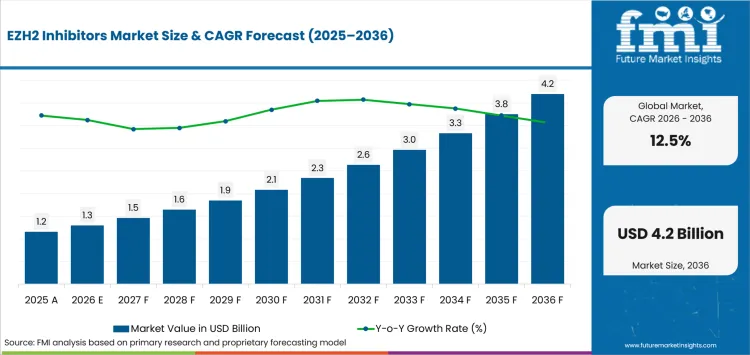
- Market Size (2026)
- USD 1.3 Bn
- Forecast (2036)
- USD 4.2 Bn
- CAGR (2026 to 2036)
- 12.5%
How big is the EZH2 Inhibitors Market in 2026?
USD 1.3 billion in 2026 and USD 4.2 billion by 2036 at a 12.5% CAGR.
Sales in the EZH2 inhibitors market are projected to increase from USD 1.3 billion in 2026 to USD 4.2 billion by 2036 at 12.5% CAGR. Daiichi Growth is being driven by continued development of epigenetic therapies for hematologic malignancies and other oncology indications where EZH pathway inhibition has demonstrated therapeutic potential. Daiichi Sankyo received Japanese approval for valemetostat in relapsed or refractory peripheral T-cell lymphoma in June 2024, making it the first dual EZH1/EZH2 inhibitor approved for this indication in Japan. The approval with ongoing oncology clinical trials evaluating EZH-targeted therapies, reinforces the expanding clinical evidence base for epigenetic cancer treatments and supports adoption despite currently limited routine use across global oncology practice.
United States access now differs from Japan and China following withdrawal of both Tazverik accelerated approvals. In May 2026, FDA reported hematologic second primary malignancies in 18 of 318 SYMPHONY-1 participants. The 5.7% incidence makes prospective surveillance and companion diagnostics central to any United States commercial re-entry.
Key Takeaways of EZH2 Inhibitors Market
- Replacement assets must prove durable efficacy and acceptable long-term safety across biomarker-defined hematologic and solid-tumor populations.
- Tazemetostat is forecast to represent 68.0% by product in 2026 due to its accumulated regulatory and treatment history.
- Follicular lymphoma is estimated to account for 36.0% of indication demand in 2026 due to mutation-defined patient selection.
- Secondary malignancy findings and withdrawn approvals restrict commercial access until replacement programs establish prospective safety evidence.
- Ipsen, Pfizer, Novartis, Daiichi Sankyo, Haihe Biopharma, Jiangsu Hengrui Pharmaceuticals, Treeline Biosciences and Axter Therapeutics maintain commercial or clinical positions within the defined market.
Analyst Perspective
“Market recovery depends on replacement programs that separate efficacy from the secondary malignancy risk associated with tazemetostat. Developers that pair biomarker-defined enrollment with long safety follow-up are better positioned to regain oncology committee confidence across lymphoma and prostate cancer programs.”
- Anurag Sharma, Principal Consultant, Future Market Insights
How is the EZH2 Inhibitors Market segmented?
The EZH2 inhibitors market is segmented by product, indication, mechanism of action, end user, distribution channel and region.
Product categories cover tazemetostat, next-generation inhibitors, combination therapies and research-stage candidates. Indications include follicular lymphoma, epithelioid sarcoma, diffuse large B-cell lymphoma and solid tumors. Mechanism groups comprise selective EZH2 inhibition, dual EZH1-EZH2 inhibition and combination epigenetic therapy. End users include hospitals, cancer specialty clinics and research institutes. Distribution channels include hospital pharmacies, retail specialty pharmacies and online pharmacies.
What supports tazemetostat within the product category?
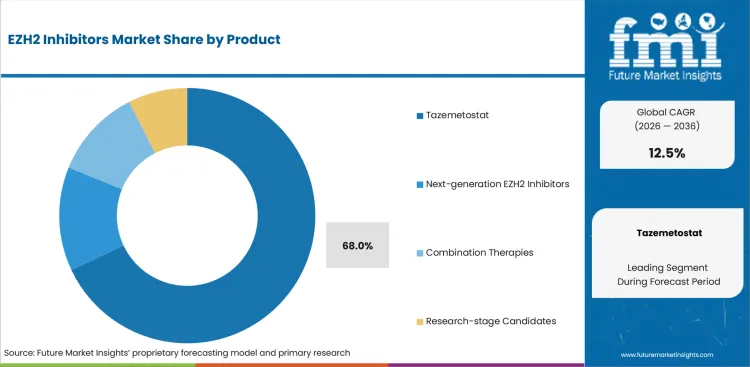
Tazemetostat established the first commercial benchmark for targeted oncology programs in follicular lymphoma and epithelioid sarcoma. FDA listed both accelerated approvals as withdrawn in June 2026, so previous treatment and pharmacy workflows remain comparison points without providing current United States access.
- In 2026, tazemetostat is expected to lead product demand with 68.0% share due to its accumulated clinical and regulatory history.
- Replacement products must preserve oral dosing and biomarker selection without repeating the same long-term safety uncertainty across larger exposed populations. Hospital committees need prospective follow-up that separates class activity from product-specific malignancy risk during longer treatment periods.
What makes follicular lymphoma central to the indication category?
Follicular lymphoma provides a mutation-defined setting with established tissue testing and specialist hematology review. Molecular cancer biomarkers separate mutation-positive cohorts from broader relapsed populations during trial eligibility and hospital pharmacy review.
- The follicular lymphoma segment is likely to capture 36.0% share in 2026 attributable to mutation-defined testing and established relapsed-disease pathways.
- Valemetostat development tests broader B-cell use beyond mutation status, and ClinicalTrials.gov updated a 141-participant phase 2 study across six lymphoma cohorts in February 2026. The design tests whether dual inhibition can support defined B-cell populations without treating one biomarker as a universal response predictor.
Why does selective EZH2 inhibition remain central to the mechanism category?
Selective EZH2 inhibition has the longest direct target-validation record within chromatin modifier research across oral clinical programs. A Novartis-sponsored phase 1/2 study updated in July 2026 evaluates tulmimetostat across lymphomas and solid tumors as monotherapy and with enzalutamide.
- By mechanism of action, selective EZH2 inhibition is forecast to represent 62.0% share in 2026 driven by its established target-validation record.
- Broader pathway coverage must improve tumor control without widening hematologic toxicity across longer treatment periods and clinically distinct tumor populations across multiple settings. Developers need combination-specific safety evidence instead of assuming dual inhibition resolves adaptive resistance.
What role do hospitals play within the end-user category?
Hospitals combine molecular testing with specialist prescribing and prolonged adverse-event surveillance inside one oncology pathway. Their committees coordinate trial eligibility, pharmacy controls and treatment scheduling as cancer diagnostics services guide patient selection across complex investigational oncology protocols.
- Hospitals are projected to hold 47.0% share in 2026 owing to integrated testing and prolonged safety monitoring across specialist oncology workflows.
- Global site networks concentrate recruitment and protocol oversight within hospital systems, and ClinicalTrials.gov updated the 900-participant MEVPRO-2 phase 3 study in June 2026. The network links late-stage development with centers trained for prostate cancer treatment and safety follow-up.
What are the drivers, restraints and opportunities in the EZH2 Inhibitors Market?
Phase 3 prostate programs increase late-stage testing as malignancy risk raises safety requirements and biomarker-matched combinations extend development across defined tumors.
- Driver: Phase 3 programs compare EZH2 combinations against established prostate cancer treatment across multinational hospital networks.
- Restraint: Secondary hematologic malignancy findings require longer surveillance and reduce confidence in routine class prescribing.
- Opportunity: Dual inhibition and biomarker-matched combinations require indication-specific trials that fit established oncology treatment sequences.
Late-stage development depends on trials that compare measurable disease control against established prostate cancer therapies. ClinicalTrials.gov updated Pfizer's 600-participant MEVPRO-1 phase 3 record in May 2026 across a multinational network. The randomized design gives hospital committees a direct efficacy comparison for future trial placement and formulary review.
Hospital committees must compare delayed malignancy risk across anti-neoplastic agents used during longer treatment courses. Routine commercial use requires larger exposed populations and extended follow-up that can resolve delayed malignancy uncertainty. Prospective datasets must distinguish secondary blood cancers from background risk during future regulatory and hospital review.
Combination programs test dual inhibition beside hormonal therapy across defined castration-resistant treatment sequences in specialist centers. Novartis began the 203-participant TulmiSTAR-02 study in January 2026 with darolutamide and abiraterone combinations globally. Results must show whether broader epigenetic coverage earns a practical role beside established prostate cancer treatment.
Which country CAGRs are profiled in the EZH2 Inhibitors Market?
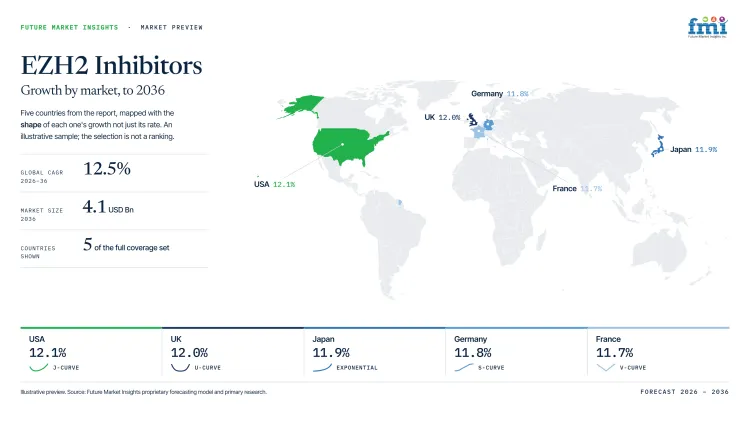
| Country | CAGR |
|---|---|
| United States | 12.1% |
| United Kingdom | 12.0% |
| Japan | 11.9% |
| Germany | 11.8% |
| France | 11.7% |
How do country-level CAGRs compare in the EZH2 Inhibitors Market?
The country forecasts span 0.4 percentage point and describe forecast pace instead of current market size. Shared dependence on replacement assets compresses the spread although trial activation and hospital access routes remain distinct.
- United States prospects reflect broad phase 3 participation alongside caution following withdrawal of both accelerated approvals.
- United Kingdom growth depends on predictable trial review and experienced NHS oncology sites despite contracting delays during activation.
- Japan combines an approved dual inhibitor with active post-marketing surveillance and detailed local evidence requirements.
- Germany offers experienced academic sites and specialized ethics review for trials involving companion diagnostics.
- France pairs specialist cancer centers with accelerated trial review although pricing and hospital access decisions remain separate.
Comparable CAGRs can produce different market entry conditions. The full report provides country-level CAGR analysis across North America, Latin America, Europe, East Asia, South Asia and Pacific, and the Middle East and Africa.
Country-wise Analysis
- United States oncology networks connect molecular pathology laboratories with academic and community trial centers that coordinate biomarker screening, controlled dosing and prolonged safety surveillance across metropolitan and regional referral systems. EZH2 inhibitor demand in the United States is forecast to rise at 12.1% CAGR over the forecast period as broad phase 3 participation supports trial access despite absent routine approval and uncertain payer coverage across multiple oncology treatment settings. A Veterans Affairs record updated in January 2026 listed five tulmimetostat combination sites across its federal network and confirmed federal research capacity for nationally distributed patients despite absent routine commercial access.
- United Kingdom programs use NHS cancer centers with molecular pathology services and specialist pharmacies that coordinate multicenter screening, controlled dispensing and consistent follow-up across the four national health systems serving demanding investigational oncology protocols. The United Kingdom's EZH2 inhibitors outlook is anticipated to advance at 12.0% CAGR over the assessment period as predictable review supports study access for commercial sponsors despite local contracting and hospital governance delays. MHRA reported that 94% of initial clinical trial applications met statutory timelines in June 2026 and gave sponsors a reliable regulatory benchmark during activation across regional oncology centers outside major academic hubs nationwide.
- Japan combines PMDA oversight with national cancer centers and oral oncology pharmacy channels that coordinate biomarker testing, translated safety records and scheduled monitoring across specialist referral regions and nationally distributed treatment programs. EZH2 inhibitor demand in Japan is predicted to advance at 11.9% CAGR through 2036 as valemetostat approval supports clinical familiarity across specialist centers serving lymphoma patients despite demanding local evidence and pharmacovigilance requirements across regional clinical pathways. PMDA published revised valemetostat precautions and an investigation summary in June 2026 and required hospitals to integrate updated warnings into consistent post-marketing surveillance across routine lymphoma treatment and specialist follow-up nationwide.
- Germany combines university oncology hospitals with molecular pathology services and centralized European authorization routes that support biomarker-led studies, specialist pharmacies and coordinated safety review across experienced regional research networks serving first-in-human and companion-diagnostic protocols. By 2036, Germany is projected to grow at 11.8% CAGR as specialized ethics review supports complex trials across regional networks despite contracting and site coordination delays outside major academic hubs. The Federal Health Ministry appointed 93 members to a specialized national commission in March 2025 and created a national review route for urgent or complex medicine trials and later regulatory decisions across regional oncology networks nationwide.
- France combines comprehensive cancer centers with centralized medicine review and nationally managed reimbursement that support biomarker-selected studies, specialist pathology services and coordinated referral across regional oncology networks serving hematology and solid-tumor programs. EZH2 inhibitor sales in France are forecast to expand at 11.7% CAGR by 2036 as accelerated trial review supports activation across regional treatment networks despite separate pricing negotiations and hospital access decisions. The Health Ministry introduced a fast-track process in March 2026 with a 14-day authorization target for eligible dossiers and gave sponsors a defined national route for qualifying studies without review questions during early study planning activities.
Who are the notable companies in the EZH2 Inhibitors Market?
Ipsen S.A., Pfizer Inc., Novartis AG, Daiichi Sankyo Company, Limited, Haihe Biopharma Co., Ltd., Jiangsu Hengrui Pharmaceuticals Co., Ltd., Treeline Biosciences, Inc. and Axter Therapeutics (Beijing) Co., Ltd. are the notable companies serving this market.
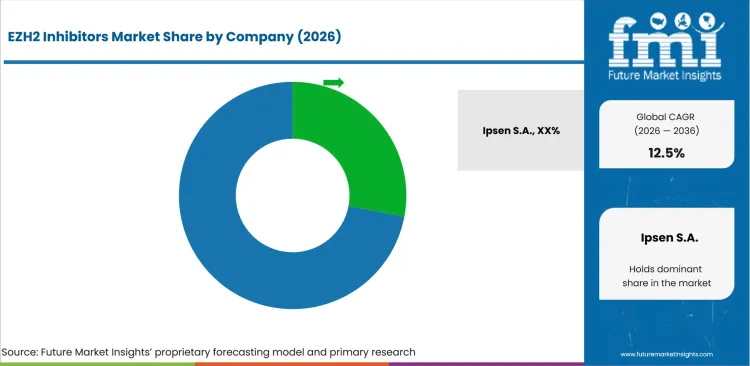
The field is concentrated around eight companies with withdrawn commercial history, regional approvals or active clinical assets in a narrow epigenetic oncology category. Entry requires molecular diagnostics infrastructure and long safety follow-up across biomarker-defined programs as competition centers on development maturity, indication breadth and specialist trial networks.
- Ipsen retains the withdrawn tazemetostat history, whereas Pfizer and Novartis carry multinational selective-inhibitor and dual-inhibitor development programs.
- Daiichi Sankyo and Jiangsu Hengrui Pharmaceuticals hold regional approvals that provide current commercial reference points outside former Tazverik territories.
- Haihe Biopharma, Treeline Biosciences and Axter Therapeutics advance clinical assets across lymphoma and broader malignant-tumor settings.
Competitive Benchmarking: EZH2 Inhibitors Market
| Company | Development Maturity | Indication Breadth | Combination Readiness | Geographic Reach |
|---|---|---|---|---|
| Ipsen S.A. | High | High | Low | Former global markets |
| Pfizer Inc. | High | Low | Medium | Global |
| Novartis AG | Medium | High | High | Global |
| Daiichi Sankyo Company, Limited | High | High | High | Japan and global trials |
| Haihe Biopharma Co., Ltd. | Medium | High | Low | China and United States |
| Jiangsu Hengrui Pharmaceuticals Co., Ltd. | High | Low | Low | China |
| Treeline Biosciences, Inc. | Low | Low | Low | United States and Canada |
| Axter Therapeutics (Beijing) Co., Ltd. | Low | High | Low | China |
Scoring basis: Development maturity is High for approval or phase 3 evidence, Medium for phase 2 or phase 1/2 and Low for phase 1. Indication breadth is High for documented hematologic and solid-tumor programs, Medium for two disease families and Low for one family. Combination readiness is High for multiple active combinations, Medium for one active combination and Low for documented monotherapy or a discontinued program. Geographic reach records confirmed study or former commercial regions, and every Low rating reflects affirmative evidence instead of missing information.
Key Developments in the EZH2 Inhibitors Market
- In June 2026, Treeline Biosciences entered a definitive all-stock merger agreement with Standard BioTools during clinical expansion. The pending transaction was expected to provide more than USD 900 million in pro forma cash at closing and support continued TLN-254 development.
- In March 2026, Ipsen S.A. announced withdrawal of Tazverik from all indications and Ipsen markets following secondary hematologic malignancy findings in SYMPHONY-1. The company also discontinued active tazemetostat trials and expanded access programs across former commercial territories worldwide.
- In September 2025, Jiangsu Hengrui Pharmaceuticals received Chinese approval for zeprumetostat tablets in adults with relapsed or refractory peripheral T-cell lymphoma following prior systemic therapy. The approval provides a current selective-inhibitor reference outside the five-country profile and supports regional commercial comparison.
Key Players in the EZH2 Inhibitors Market
Commercial and Approved Platforms
- Ipsen S.A.
- Daiichi Sankyo Company, Limited
- Jiangsu Hengrui Pharmaceuticals Co., Ltd.
Global Clinical Development
- Pfizer Inc.
- Novartis AG
- Treeline Biosciences, Inc.
Regional Clinical-stage Programs
- Haihe Biopharma Co., Ltd.
- Axter Therapeutics (Beijing) Co., Ltd.
EZH2 Inhibitors Market - Report Scope
| Coverage field | Report scope |
|---|---|
| Market breakdown | By product, indication, mechanism of action, end user, distribution channel and region. |
| Quantitative Units | Revenue in USD billion and CAGR in %. |
| Market Definition | Commercial and investigational small-molecule therapies that inhibit EZH2 or dual EZH1-EZH2 activity across oncology indications, including monotherapy and combination programs. |
| Regions Covered | North America, Latin America, Europe, East Asia, South Asia and Pacific, and Middle East and Africa. |
| Countries Covered | United States, United Kingdom, Japan, Germany, France, and 20+ countries included in the full report. |
| Key Companies Profiled | Ipsen S.A., Pfizer Inc., Novartis AG, Daiichi Sankyo Company, Limited, Haihe Biopharma Co., Ltd., Jiangsu Hengrui Pharmaceuticals Co., Ltd., Treeline Biosciences, Inc. and Axter Therapeutics (Beijing) Co., Ltd. |
| Forecast Period | 2026 to 2036. |
| Approach | Primary and secondary research with market triangulation. |
EZH2 Inhibitors Market - Research Methodology
| Method | Approach |
|---|---|
| Primary Research | FMI analysts gathered input from manufacturers, service providers, technology developers, distributors, end users, procurement teams, and subject-matter experts. Interviews examined purchasing decisions, product or service evaluation, adoption barriers, approval requirements, pricing considerations, and expectations for technical or commercial support. Respondents were also asked what evidence is required before a trial, pilot, or initial order develops into regular purchasing. |
| Desk Research | Desk research covered government statistics, regulatory publications, trade data, industry associations, technical literature, standards, company filings, product information, and official corporate announcements. Sources were reviewed for relevance, publication date, geographic coverage, and consistency with the defined market scope. Claims relating to performance, applications, approvals, capacity, investment, and commercial activity were retained only when supported by credible public evidence. |
| Market Sizing and Forecasting | The market model combined the baseline value with historical performance, segment structure, pricing and volume indicators, adoption levels, company participation, and country-level demand conditions. Forecast assumptions considered economic activity, investment trends, regulatory developments, technology adoption, purchasing cycles, supply availability, and barriers to wider market use. Segment and regional estimates were reconciled before the final market total was calculated. |
| Data Validation | Estimates were checked against multiple independent indicators, including public data, company activity, trade patterns, industry developments, and findings from primary interviews. Validation also tested whether products, services, applications, and company revenues fell within the defined market boundaries. Adjacent categories, unsupported claims, overlapping revenues, and activities without direct market relevance were excluded to reduce double counting and maintain consistency across segments and countries. |
EZH2 Inhibitors Market by Segments
EZH2 Inhibitors Market segmented by Product:
- Tazemetostat
- TAZVERIK
- Capsule Formulation
- Oral Therapy
- Next-generation EZH2 Inhibitors
- Dual EZH1-EZH2 Inhibitors
- Selective EZH2 Inhibitors
- Investigational Molecules
- Combination Therapies
- EZH2 - Chemotherapy
- EZH2 - Immunotherapy
- EZH2 - Targeted Therapy
- Research-stage Candidates
- Preclinical Compounds
- Phase I Candidates
- Phase II Candidates
EZH2 Inhibitors Market segmented by Indication:
- Follicular Lymphoma
- Relapsed Disease
- Refractory Disease
- EZH2 Mutation-positive
- Epithelioid Sarcoma
- Locally Advanced Disease
- Metastatic Disease
- Post-surgical Therapy
- Diffuse Large B-cell Lymphoma
- Germinal Center B-cell Type
- Relapsed Disease
- Combination Therapy
- Solid Tumors
- Prostate Cancer
- Breast Cancer
- Non-small Cell Lung Cancer
EZH2 Inhibitors Market segmented by Mechanism of Action:
- Selective EZH2 Inhibition
- Histone Methylation Inhibition
- Gene Expression Restoration
- Tumor Suppressor Reactivation
- Dual EZH1-EZH2 Inhibition
- Chromatin Remodeling
- Epigenetic Regulation
- Resistance Prevention
- Combination Epigenetic Therapy
- With Immune Checkpoint Inhibitors
- With Targeted Therapies
- With Cytotoxic Agents
EZH2 Inhibitors Market segmented by End User:
- Hospitals
- Oncology Hospitals
- Tertiary Care Hospitals
- Academic Medical Centers
- Cancer Specialty Clinics
- Medical Oncology Clinics
- Hematology Centers
- Comprehensive Cancer Centers
- Research Institutes
- Pharmaceutical Research
- Academic Research
- Clinical Trial Centers
EZH2 Inhibitors Market segmented by Distribution Channel:
- Hospital Pharmacies
- Inpatient Pharmacies
- Oncology Pharmacy Units
- Specialty Hospital Supply
- Retail Specialty Pharmacies
- Chain Specialty Pharmacies
- Independent Pharmacies
- Oncology Retail Pharmacies
- Online Pharmacies
- E-prescription Platforms
- Home Delivery Services
- Specialty Pharmacy Networks
EZH2 Inhibitors Market by Region:
- North America
- United States
- Canada
- Mexico
- Latin America
- Brazil
- Chile
- Rest of Latin America
- Western Europe
- Germany
- United Kingdom
- Italy
- Spain
- France
- Nordics
- Benelux
- Rest of Western Europe
- Eastern Europe
- Russia
- Poland
- Hungary
- Balkan and Baltic States
- Rest of Eastern Europe
- East Asia
- China
- Japan
- South Korea
- South Asia and Pacific
- India
- ASEAN
- Australia and New Zealand
- Rest of South Asia and Pacific
- Middle East and Africa
- Kingdom of Saudi Arabia
- Other GCC Countries
- Türkiye
- South Africa
- Other African Union Countries
- Rest of Middle East and Africa
Research Sources and Bibliography
- Daiichi Sankyo Company, Limited. (2024, June 24). EZHARMIA® Approved in Japan as First Dual EZH1 and EZH2 Inhibitor Therapy for Patients with Peripheral T-Cell Lymphoma.
- USA Food and Drug Administration. (2026, May 8). FDA Alerts Health Care Providers and Patients about Increased Risk of New Blood Cancers with Tazverik (tazemetostat) Use; Sponsor to Voluntarily Withdraw Product from Market.
- USA Food and Drug Administration. (2026, June 22). Withdrawn | Cancer Accelerated Approvals.
- ClinicalTrials.gov. (2026, February 19). Study of Valemetostat Tosylate as a Single Agent in Patients With Relapse/Refractory B-cell Lymphoma.
- ClinicalTrials.gov. (2026, July 17). A Study of Tulmimetostat DZR123 (CPI-0209) in Patients With Advanced Solid Tumors and Lymphomas.
- ClinicalTrials.gov. (2026, June 16). A Study to Learn How PF-06821497 (Mevrometostat) Works in Men With Metastatic Castration-resistant Prostate Cancer.
- ClinicalTrials.gov. (2026, May 5). A Study to Learn About the Investigational Medicine Called PF-06821497 (Mevrometostat) in Men With mCRPC Who Were Previously Treated With Abiraterone Acetate for Prostate Cancer (MEVPRO-1).
- ClinicalTrials.gov. (2026, June 9). TulmiSTAR-02: A Phase I/II Open-label Study of Tulmimetostat in Combination With Darolutamide vs. Darolutamide, and Tulmimetostat With Abiraterone in Patients With Metastatic Hormone-sensitive Prostate Cancer (mHSPC).
- ClinicalTrials.gov. (2026, January 27). EZH2 Inhibitor, Tulmimetostat, and PD-1 Blockade for Treatment of Advanced Non-small Cell Lung Cancer.
- Medicines and Healthcare products Regulatory Agency. (2026, July 30). MHRA Performance Data.
- Pharmaceuticals and Medical Devices Agency. (2026, June 16). Revisions of PRECAUTIONS (FY2026).
- Bundesministerium für Gesundheit. (2025, March 12). BMG beruft Mitglieder für Spezialisierte Ethik-Kommission.
- Ministère de la Santé, de la Famille, de l’Autonomie et des Personnes handicapées. (2026, March 5). Dispositif d’évaluation accélérée des essais cliniques en France (fast-track) : les promoteurs pourront soumettre leurs demandes dès le 16 mars 2026.
- Treeline Biosciences, Inc. (2026, June 8). Standard BioTools and Treeline Biosciences Announce Merger Agreement.
- Ipsen. (2026, March 9). Ipsen voluntarily withdraws Tazverik® (tazemetostat) in follicular lymphoma and epithelioid sarcoma.
- Jiangsu Hengrui Pharmaceuticals Co., Ltd. (2025, September 3)
- ClinicalTrials.gov. (2026, February 4). A Study of Valemetostat Tosylate in Combination With DXd ADCs in Subjects With Solid Tumors.
- ClinicalTrials.gov. (2026, January 30). Evaluate the Safety and Clinical Activity of HH2853.
- Treeline Biosciences, Inc. (2025, September 3). Treeline Announces First Clinical Trials and Secures $200M in Additional Funding.
- ClinicalTrials.gov. (2025, October 10). A Study of TLN-254 in Participants With Relapsed or Refractory T-cell Lymphoma.
- ClinicalTrials.gov. (2026, January 28). Study of AXT-1003 in Subjects With Advanced Malignant Tumors.
- ClinicalTrials.gov. (2026, June 23). This Study Will Explore Whether a Combination of the Investigational Drug Mevrometostat (PF-06821497) and Enzalutamide Will Work Better Than Taking Enzalutamide Alone in Participants With mCSPC Who Are ARPI naïve.
- ClinicalTrials.gov. (2026, May 15). A Study of Valemetostat (DS-3201b) in Combination With Darolutamide in Metastatic Castration Resistant Prostate Cancer (mCRPC).
This bibliography is provided for reader reference and is not exhaustive. The full report contains the complete reference list and detailed citations.
This Report Answers
- How large is the EZH2 inhibitors market in 2026 and 2036?
- Which safety evidence changed the commercial outlook for tazemetostat?
- Why does tazemetostat retain the largest modelled product share?
- How do the four selected segment categories shape treatment access and development requirements?
- Which mechanisms define the current driver, restraint and opportunity?
- How do profiled countries differ despite closely grouped forecast rates?
- Which companies hold commercial or clinical positions?
- How do recent company developments shape competitive investment and program maturity?
Frequently Asked Questions
How big is the EZH2 Inhibitors Market in 2026?
In 2026, the EZH2 inhibitors market is estimated to be valued at USD 1.3 billion across commercial legacy and active clinical development. The valuation is projected to reach USD 4.2 billion by 2036 as replacement programs establish biomarker-defined efficacy and prospective long-term safety.
What is the CAGR of the EZH2 Inhibitors Market from 2026 to 2036?
A 12.5% CAGR is projected for the EZH2 Inhibitors Market from 2026 to 2036 across the defined global scope. The EZH2 Inhibitors Market requires selective and dual-inhibitor programs to demonstrate durable efficacy without repeating the secondary malignancy risk associated with withdrawn tazemetostat approvals.
Which product is projected to account for 68.0% of the EZH2 Inhibitors Market?
A 68.0% product share is projected for tazemetostat within the EZH2 Inhibitors Market in 2026. The industry retains this concentration as tazemetostat established the class's clinical and regulatory history despite its subsequent commercial withdrawal and absent current United States access.
How much value will the EZH2 Inhibitors Market add between 2026 and 2036?
USD 2.9 billion is forecast to be added to the EZH2 Inhibitors Market between 2026 and 2036. The industry reaches this arithmetic difference provided that replacement assets establish durable efficacy and prospective safety without repeating the malignancy findings that removed tazemetostat from commercial use.
Which companies are active in the EZH2 Inhibitors Market?
Active companies in the EZH2 inhibitors market across approved and clinical-stage programs worldwide include Ipsen, Pfizer, Novartis, Daiichi Sankyo, Haihe Biopharma, Jiangsu Hengrui Pharmaceuticals, Treeline Biosciences and Axter Therapeutics.
Preview the report firsthand - request a free sample
Get SampleGet the brochure for pricing and purchase details.
Get PDFTable of Content
- Key Takeaways
- Market Size and CAGR
- Top Growth Driver
- Fastest Growing Segment
- Leading Region
- Key Companies
- Emerging Opportunities
- Executive Summary
- Global Market Outlook
- Demand-side Trends
- Supply-side Trends
- Technology Roadmap Analysis
- Analysis and Recommendations
- Analyst Perspective (What is happening? Why now? What should investors know?)
- Key Questions Answered
- How large is the market?
- What is the CAGR?
- What are key trends?
- Which region dominates?
- Who are the leaders?
- Market Overview
- Market Coverage / Taxonomy
- Market Definition / Scope / Limitations
- Research Methodology
- Chapter Orientation
- Analytical Lens and Working Hypotheses
- Market Structure, Signals, and Trend Drivers
- Benchmarking and Cross-market Comparability
- Market Sizing, Forecasting, and Opportunity Mapping
- Research Design and Evidence Framework
- Desk Research Programme (Secondary Evidence)
- Expert Input and Fieldwork (Primary Evidence)
- Tooling, Models, and Reference Databases
- Data Engineering and Model Build
- Quality Assurance and Audit Trail
- Market Background
- Market Dynamics (Drivers, Restraints, Opportunity, Trends)
- Scenario Forecast (Optimistic, Likely, Conservative)
- Impact Analysis
- AI Impact
- Sustainability Impact
- Regulatory Impact
- Technology Impact
- Consumer / Buyer Analysis
- Purchase Drivers
- Adoption Barriers
- Buyer Journey
- Opportunity Map Analysis
- Product Life Cycle Analysis
- Supply Chain Analysis
- Investment Feasibility Matrix
- Value Chain Analysis
- PESTLE and Porter's Analysis
- Regulatory Landscape
- Regional Parent Market Outlook
- Production and Consumption Statistics
- Import and Export Statistics
- Global Market Analysis and Forecast, 2021 to 2036
- Historical Market Size Value (USD Billion) Analysis, 2021 to 2025
- Current and Future Market Size Value (USD Billion) Projections, 2026 to 2036
- Y-o-Y Growth Trend Analysis
- Absolute $ Opportunity Analysis
- Global Market Pricing Analysis, 2021 to 2036
- Global Market Analysis and Forecast, By Product, 2021 to 2036
- Introduction / Key Findings
- Historical Market Size Value (USD Billion) Analysis By Product, 2021 to 2025
- Current and Future Market Size Value (USD Billion) Analysis and Forecast By Product, 2026 to 2036
- Tazemetostat
- TAZVERIK
- Capsule Formulation
- Oral Therapy
- Next-generation EZH2 Inhibitors
- Dual EZH1-EZH2 Inhibitors
- Selective EZH2 Inhibitors
- Investigational Molecules
- Combination Therapies
- EZH2 - Chemotherapy
- EZH2 - Immunotherapy
- EZH2 - Targeted Therapy
- Research-stage Candidates
- Preclinical Compounds
- Phase I Candidates
- Phase II Candidates
- Tazemetostat
- Y-o-Y Growth Trend Analysis By Product, 2021 to 2025
- Absolute $ Opportunity Analysis By Product, 2026 to 2036
- Global Market Analysis and Forecast, By Indication, 2021 to 2036
- Introduction / Key Findings
- Historical Market Size Value (USD Billion) Analysis By Indication, 2021 to 2025
- Current and Future Market Size Value (USD Billion) Analysis and Forecast By Indication, 2026 to 2036
- Follicular Lymphoma
- Relapsed Disease
- Refractory Disease
- EZH2 Mutation-positive
- Epithelioid Sarcoma
- Locally Advanced Disease
- Metastatic Disease
- Post-surgical Therapy
- Diffuse Large B-cell Lymphoma
- Germinal Center B-cell Type
- Relapsed Disease
- Combination Therapy
- Solid Tumors
- Prostate Cancer
- Breast Cancer
- Non-small Cell Lung Cancer
- Follicular Lymphoma
- Y-o-Y Growth Trend Analysis By Indication, 2021 to 2025
- Absolute $ Opportunity Analysis By Indication, 2026 to 2036
- Global Market Analysis and Forecast, By Mechanism of Action, 2021 to 2036
- Introduction / Key Findings
- Historical Market Size Value (USD Billion) Analysis By Mechanism of Action, 2021 to 2025
- Current and Future Market Size Value (USD Billion) Analysis and Forecast By Mechanism of Action, 2026 to 2036
- Selective EZH2 Inhibition
- Histone Methylation Inhibition
- Gene Expression Restoration
- Tumor Suppressor Reactivation
- Dual EZH1-EZH2 Inhibition
- Chromatin Remodeling
- Epigenetic Regulation
- Resistance Prevention
- Combination Epigenetic Therapy
- With Immune Checkpoint Inhibitors
- With Targeted Therapies
- With Cytotoxic Agents
- Selective EZH2 Inhibition
- Y-o-Y Growth Trend Analysis By Mechanism of Action, 2021 to 2025
- Absolute $ Opportunity Analysis By Mechanism of Action, 2026 to 2036
- Global Market Analysis and Forecast, By End User, 2021 to 2036
- Introduction / Key Findings
- Historical Market Size Value (USD Billion) Analysis By End User, 2021 to 2025
- Current and Future Market Size Value (USD Billion) Analysis and Forecast By End User, 2026 to 2036
- Hospitals
- Oncology Hospitals
- Tertiary Care Hospitals
- Academic Medical Centers
- Cancer Specialty Clinics
- Medical Oncology Clinics
- Hematology Centers
- Comprehensive Cancer Centers
- Research Institutes
- Pharmaceutical Research
- Academic Research
- Clinical Trial Centers
- Hospitals
- Y-o-Y Growth Trend Analysis By End User, 2021 to 2025
- Absolute $ Opportunity Analysis By End User, 2026 to 2036
- Global Market Analysis and Forecast, By Distribution Channel, 2021 to 2036
- Introduction / Key Findings
- Historical Market Size Value (USD Billion) Analysis By Distribution Channel, 2021 to 2025
- Current and Future Market Size Value (USD Billion) Analysis and Forecast By Distribution Channel, 2026 to 2036
- Hospital Pharmacies
- Inpatient Pharmacies
- Oncology Pharmacy Units
- Specialty Hospital Supply
- Retail Specialty Pharmacies
- Chain Specialty Pharmacies
- Independent Pharmacies
- Oncology Retail Pharmacies
- Online Pharmacies
- E-prescription Platforms
- Home Delivery Services
- Specialty Pharmacy Networks
- Hospital Pharmacies
- Y-o-Y Growth Trend Analysis By Distribution Channel, 2021 to 2025
- Absolute $ Opportunity Analysis By Distribution Channel, 2026 to 2036
- Global Market Analysis and Forecast, By Region, 2021 to 2036
- Introduction
- Historical Market Size Value (USD Billion) Analysis By Region, 2021 to 2025
- Current Market Size Value (USD Billion) Analysis and Forecast By Region, 2026 to 2036
- North America
- Latin America
- Western Europe
- Eastern Europe
- East Asia
- South Asia and Pacific
- Middle East & Africa
- Market Attractiveness Analysis By Region
- North America Market Analysis and Forecast, By Country, 2021 to 2036
- Historical Market Size Value (USD Billion) Trend Analysis By Market Taxonomy, 2021 to 2025
- Market Size Value (USD Billion) Forecast By Market Taxonomy, 2026 to 2036
- By Country
- USA
- Canada
- By Product
- By Indication
- By Mechanism of Action
- By End User
- By Distribution Channel
- By Country
- Market Attractiveness Analysis
- By Country
- By Product
- By Indication
- By Mechanism of Action
- By End User
- By Distribution Channel
- Key Takeaways
- Latin America Market Analysis and Forecast, By Country
- Historical Market Size Value (USD Billion) Trend Analysis By Market Taxonomy, 2021 to 2025
- Market Size Value (USD Billion) Forecast By Market Taxonomy, 2026 to 2036
- By Country
- Brazil
- Mexico
- Chile
- Rest of Latin America
- By Product
- By Indication
- By Mechanism of Action
- By End User
- By Distribution Channel
- By Country
- Market Attractiveness Analysis
- By Country
- By Product
- By Indication
- By Mechanism of Action
- By End User
- By Distribution Channel
- Key Takeaways
- Western Europe Market Analysis and Forecast, By Country
- Historical Market Size Value (USD Billion) Trend Analysis By Market Taxonomy, 2021 to 2025
- Market Size Value (USD Billion) Forecast By Market Taxonomy, 2026 to 2036
- By Country
- Germany
- UK
- Italy
- Spain
- France
- Nordic
- BENELUX
- Rest of Western Europe
- By Product
- By Indication
- By Mechanism of Action
- By End User
- By Distribution Channel
- By Country
- Market Attractiveness Analysis
- By Country
- By Product
- By Indication
- By Mechanism of Action
- By End User
- By Distribution Channel
- Key Takeaways
- Eastern Europe Market Analysis and Forecast, By Country
- Historical Market Size Value (USD Billion) Trend Analysis By Market Taxonomy, 2021 to 2025
- Market Size Value (USD Billion) Forecast By Market Taxonomy, 2026 to 2036
- By Country
- Russia
- Poland
- Hungary
- Balkan & Baltic
- Rest of Eastern Europe
- By Product
- By Indication
- By Mechanism of Action
- By End User
- By Distribution Channel
- By Country
- Market Attractiveness Analysis
- By Country
- By Product
- By Indication
- By Mechanism of Action
- By End User
- By Distribution Channel
- Key Takeaways
- East Asia Market Analysis and Forecast, By Country
- Historical Market Size Value (USD Billion) Trend Analysis By Market Taxonomy, 2021 to 2025
- Market Size Value (USD Billion) Forecast By Market Taxonomy, 2026 to 2036
- By Country
- China
- Japan
- South Korea
- By Product
- By Indication
- By Mechanism of Action
- By End User
- By Distribution Channel
- By Country
- Market Attractiveness Analysis
- By Country
- By Product
- By Indication
- By Mechanism of Action
- By End User
- By Distribution Channel
- Key Takeaways
- South Asia and Pacific Market Analysis and Forecast, By Country
- Historical Market Size Value (USD Billion) Trend Analysis By Market Taxonomy, 2021 to 2025
- Market Size Value (USD Billion) Forecast By Market Taxonomy, 2026 to 2036
- By Country
- India
- ASEAN
- Australia & New Zealand
- Rest of South Asia and Pacific
- By Product
- By Indication
- By Mechanism of Action
- By End User
- By Distribution Channel
- By Country
- Market Attractiveness Analysis
- By Country
- By Product
- By Indication
- By Mechanism of Action
- By End User
- By Distribution Channel
- Key Takeaways
- Middle East & Africa Market Analysis and Forecast, By Country
- Historical Market Size Value (USD Billion) Trend Analysis By Market Taxonomy, 2021 to 2025
- Market Size Value (USD Billion) Forecast By Market Taxonomy, 2026 to 2036
- By Country
- Kingdom of Saudi Arabia
- Other GCC Countries
- Türkiye
- South Africa
- Other African Union
- Rest of Middle East & Africa
- By Product
- By Indication
- By Mechanism of Action
- By End User
- By Distribution Channel
- By Country
- Market Attractiveness Analysis
- By Country
- By Product
- By Indication
- By Mechanism of Action
- By End User
- By Distribution Channel
- Key Takeaways
- Key Countries Market Analysis
- USA
- Pricing Analysis
- Market Share Analysis, 2025
- By Product
- By Indication
- By Mechanism of Action
- By End User
- By Distribution Channel
- Canada
- Pricing Analysis
- Market Share Analysis, 2025
- By Product
- By Indication
- By Mechanism of Action
- By End User
- By Distribution Channel
- Mexico
- Pricing Analysis
- Market Share Analysis, 2025
- By Product
- By Indication
- By Mechanism of Action
- By End User
- By Distribution Channel
- Brazil
- Pricing Analysis
- Market Share Analysis, 2025
- By Product
- By Indication
- By Mechanism of Action
- By End User
- By Distribution Channel
- Chile
- Pricing Analysis
- Market Share Analysis, 2025
- By Product
- By Indication
- By Mechanism of Action
- By End User
- By Distribution Channel
- Germany
- Pricing Analysis
- Market Share Analysis, 2025
- By Product
- By Indication
- By Mechanism of Action
- By End User
- By Distribution Channel
- UK
- Pricing Analysis
- Market Share Analysis, 2025
- By Product
- By Indication
- By Mechanism of Action
- By End User
- By Distribution Channel
- Italy
- Pricing Analysis
- Market Share Analysis, 2025
- By Product
- By Indication
- By Mechanism of Action
- By End User
- By Distribution Channel
- Spain
- Pricing Analysis
- Market Share Analysis, 2025
- By Product
- By Indication
- By Mechanism of Action
- By End User
- By Distribution Channel
- France
- Pricing Analysis
- Market Share Analysis, 2025
- By Product
- By Indication
- By Mechanism of Action
- By End User
- By Distribution Channel
- India
- Pricing Analysis
- Market Share Analysis, 2025
- By Product
- By Indication
- By Mechanism of Action
- By End User
- By Distribution Channel
- ASEAN
- Pricing Analysis
- Market Share Analysis, 2025
- By Product
- By Indication
- By Mechanism of Action
- By End User
- By Distribution Channel
- Australia & New Zealand
- Pricing Analysis
- Market Share Analysis, 2025
- By Product
- By Indication
- By Mechanism of Action
- By End User
- By Distribution Channel
- China
- Pricing Analysis
- Market Share Analysis, 2025
- By Product
- By Indication
- By Mechanism of Action
- By End User
- By Distribution Channel
- Japan
- Pricing Analysis
- Market Share Analysis, 2025
- By Product
- By Indication
- By Mechanism of Action
- By End User
- By Distribution Channel
- South Korea
- Pricing Analysis
- Market Share Analysis, 2025
- By Product
- By Indication
- By Mechanism of Action
- By End User
- By Distribution Channel
- Russia
- Pricing Analysis
- Market Share Analysis, 2025
- By Product
- By Indication
- By Mechanism of Action
- By End User
- By Distribution Channel
- Poland
- Pricing Analysis
- Market Share Analysis, 2025
- By Product
- By Indication
- By Mechanism of Action
- By End User
- By Distribution Channel
- Hungary
- Pricing Analysis
- Market Share Analysis, 2025
- By Product
- By Indication
- By Mechanism of Action
- By End User
- By Distribution Channel
- Kingdom of Saudi Arabia
- Pricing Analysis
- Market Share Analysis, 2025
- By Product
- By Indication
- By Mechanism of Action
- By End User
- By Distribution Channel
- Türkiye
- Pricing Analysis
- Market Share Analysis, 2025
- By Product
- By Indication
- By Mechanism of Action
- By End User
- By Distribution Channel
- South Africa
- Pricing Analysis
- Market Share Analysis, 2025
- By Product
- By Indication
- By Mechanism of Action
- By End User
- By Distribution Channel
- USA
- Market Structure Analysis
- Competition Dashboard
- Competition Benchmarking
- Market Share Analysis of Top Players
- By Regional
- By Product
- By Indication
- By Mechanism of Action
- By End User
- By Distribution Channel
- Emerging Startups
- Innovation Benchmarking
- Competition Analysis
- Competition Deep Dive
- Ipsen S.A.
- Overview
- Product Portfolio
- Profitability by Market Segments
- Sales Footprint
- Strategy Overview
- Marketing Strategy
- Product Strategy
- Channel Strategy
- Epizyme, Inc.
- Bristol Myers Squibb
- AstraZeneca PLC
- Novartis AG
- Pfizer Inc.
- Merck & Co., Inc.
- Roche Holding AG
- Celleron Therapeutics
- Constellation Pharmaceuticals
- Ipsen S.A.
- Case Studies
- Success Stories
- Recent Developments
- Competition Deep Dive
- Assumptions & Acronyms Used


