

- Market Size (2026)
- USD 10.38 Mn
- Forecast (2036)
- USD 22.23 Mn
- CAGR (2026 to 2036)
- 7.9%
Bilastine Market Size, Market Forecast and Outlook By FMI
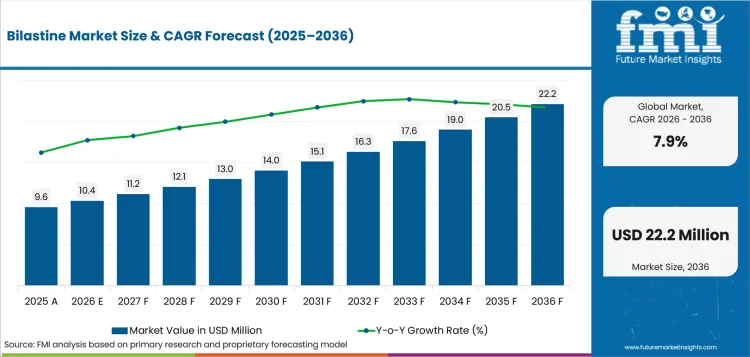
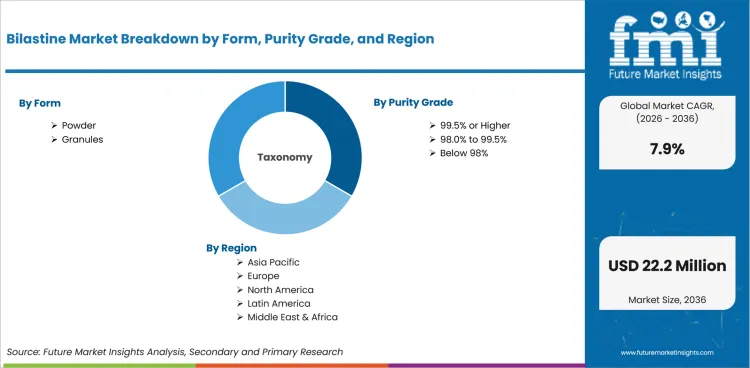
USD 10.38 million in 2026 and USD 22.23 million by 2036 at a 7.9% CAGR.
Bilastine industry value is predicted to rise from USD 9.62 million in 2025 to USD 22.23 million by 2036 at 7.9% CAGR due to approved allergy products and regulated API sourcing influencing repeat active-ingredient demand. Powder is expected to hold 82.4% share in 2026, supported by oral-solid manufacturing preference and direct blending suitability. Allergic Rhinitis is projected to secure 68.5% share in 2026, guided by recurring seasonal and perennial prescription use. Finished-dose
| Metric | Value |
|---|---|
| 2026 Market Size | USD 10.38 million |
| 2036 Market Size | USD 22.23 million |
| Forecast CAGR | 7.9% from 2026 to 2036 |
| Leading Form | Powder |
| Powder Share in 2026 | 82.4% |
| Leading Application | Allergic Rhinitis |
| Allergic Rhinitis Share in 2026 | 68.5% |
| Leading CAGR Country | India |
| India CAGR | 4.8% by 2036 |
Summary of the Bilastine Market
| Market Signal | Commercial Impact |
|---|---|
| Demand and Growth Drivers | Demand for bilastine API remains supported by approved allergy medicines and documentation-driven supply relationships.
|
| Product and Segment View | Powder form, allergic rhinitis applications, and finished-dose companies lead their respective segment categories.
|
| Geography and Growth Outlook | India and China are expected to remain important growth markets for bilastine API manufacturing and supply.
|
| Competitive Landscape | Competition is centered on regulatory documentation, formulation continuity, and regulated-market supply capabilities.
|
| Analyst Perspective | Bilastine represents a mature antihistamine API market where supply consistency and regulatory documentation outweigh discovery-driven opportunities.
- Anurag Sharma, Principal Consultant for Healthcare at FMI |
Commercial momentum remains stronger in countries combining Allergy Treatment demand and regulated API documentation. Adult allergy diagnosis created repeat antihistamine need in 2024, as United States health statistics showed 31.7% of adults had at least one diagnosed allergic condition. Generic competition is also more structured as FDA issued 925 product-specific guidances in fiscal year 2025 and had published 2,288 total guidances by 30 September 2025. Faes Farma reported 8% revenue improvement for Bilastine in 2025, showing how product holders can retain value through licensing and geographic coverage. Bilastine suppliers gain value from clean impurity files and responsive documentation rather than molecule scarcity.
Which factors support expansion in the Bilastine market?
Finished-dose continuity and regulated API documentation support value across established bilastine supply programs.
- Oral antihistamine manufacturers need consistent bilastine API for tablets and paediatric-linked formulations already aligned with approved product files.
- Higher-purity API supply reduces avoidable testing work for formulation teams managing impurity and stability evidence.
- Direct supplier relationships protect repeat supply in countries applying strict marketing-authorisation and variation expectations.
- Licence-linked product networks retain demand for audited suppliers able to support batch release and renewal documentation.
Why is the Bilastine market growing?
Approved allergy and urticaria use keeps bilastine commercially active while paediatric and combination formulations create selective API demand.
Bilastine API demand is rising as finished-dose companies continue ordering material for authorized tablets and related prescription formats. Adult allergy treatment need remains sizable, supported by 2024 United States health statistics showing 31.7% of adults had a diagnosed seasonal allergy or food allergy. Product holders still need repeat batches matching approved files and keeping impurity profiles stable. Suppliers able to connect clean release records with fast technical responses can protect selected accounts as regulated buyers prefer stable active-ingredient sources.
How is the Bilastine Market segmented?
Bilastine Market is segmented by form, purity grade, application, sales channel, and buyer type.
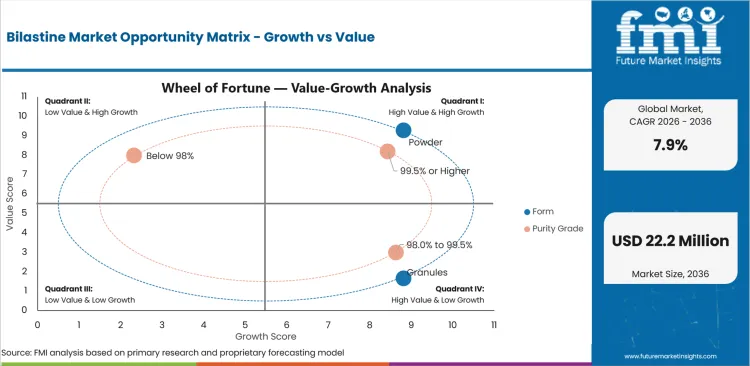
- Powder is projected to account for 82.4% share in 2026, influenced by direct blending suitability and lower handling cost for oral-solid manufacturers.
- 99.5% or Higher purity grade is expected to hold 61.8% share in 2026, shaped by impurity-control evidence needed for regulated finished-dose files.
- Allergic Rhinitis is anticipated to account for 68.5% share in 2026, led by recurring prescription demand across seasonal and perennial symptoms.
- Direct supply is projected to hold 57.2% share by Sales Channel in 2026, guided by audited supplier relationships and batch-level accountability.
- Finished-dose Companies are expected to represent 63.0% share by Buyer Type in 2026, supported by approved product continuity and repeat API sourcing.
Why does powder dominate the Bilastine market by form?
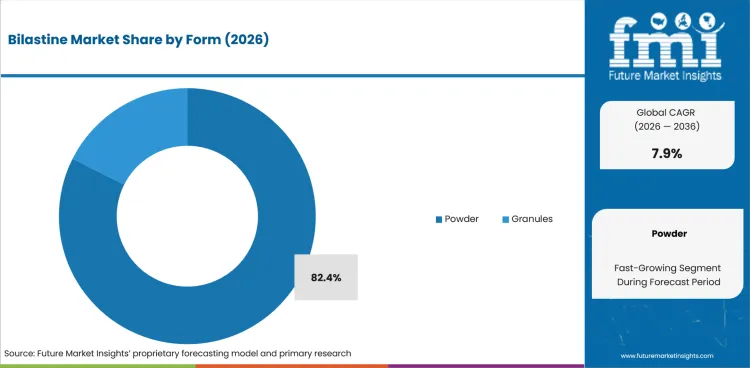
- Powder is projected to account for 82.4% share in 2026, driven by direct blending suitability for oral tablets and strong compatibility with mature formulation workflows.
- Granules gain selective demand among buyers seeking lower dusting and easier flow. Added processing cost limits adoption in price-sensitive API programs.
Which purity grade leads the Bilastine market?
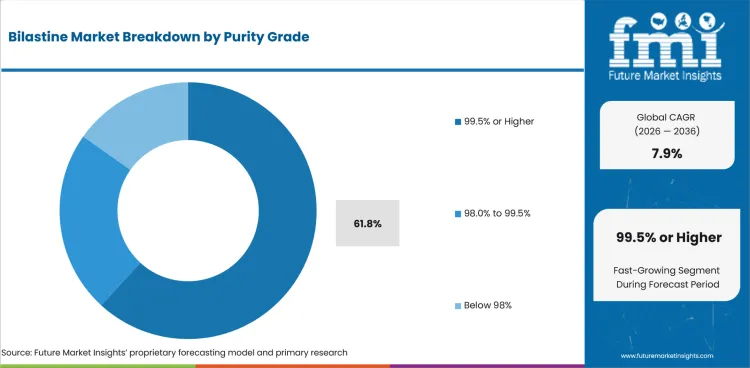
- 99.5% or Higher purity grade is expected to hold 61.8% share in 2026, shaped by regulated buyer preference for tighter impurity evidence and cleaner batch release.
- 98.0% to 99.5% purity grade remains active in development-stage sourcing and cost-sensitive supply, though commercial files often return to higher-purity API after validation.
Which application leads the Bilastine Market?
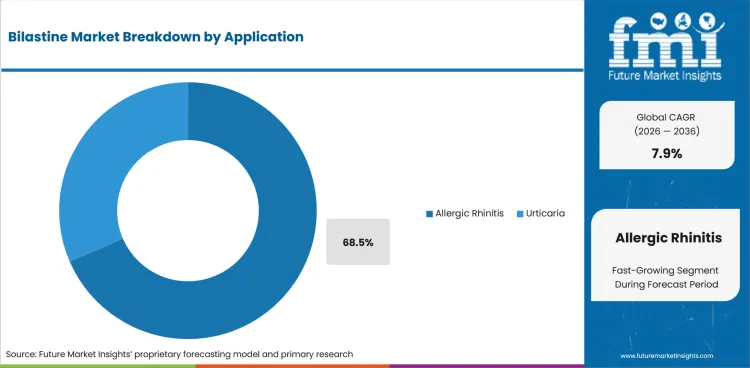
- Allergic Rhinitis is anticipated to account for 68.5% share in 2026, led by repeat oral antihistamine use across seasonal and perennial rhino-conjunctivitis.
- Urticaria supports baseline demand as chronic and recurrent skin symptoms sustain prescription continuity outside seasonal allergy peaks.
Which sales channel leads the Bilastine Market?
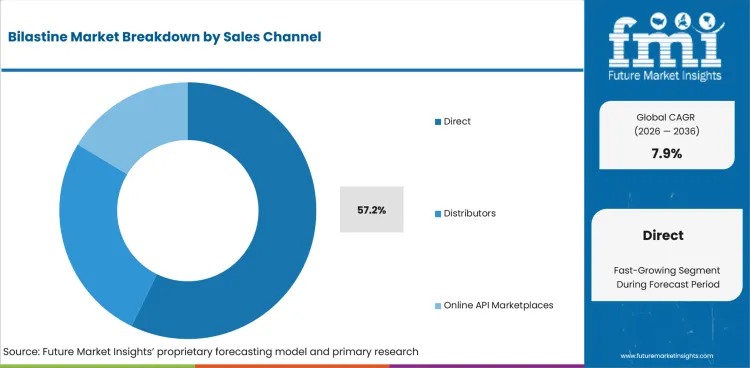
- Direct supply is expected to represent 57.2% share in 2026, guided by buyer preference for audited API relationships, release records, and supplier documentation.
- Distributors and online API marketplaces support smaller development accounts. Traceability needs limit reliance on spot-based sourcing for approved products.
Which buyer type leads the Bilastine Market?
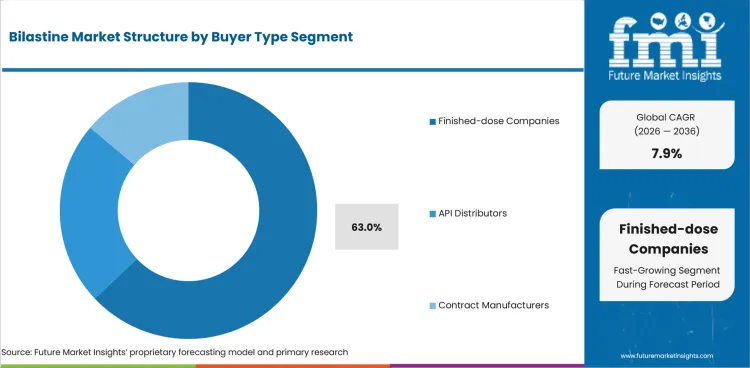
- Finished-dose Companies are expected to hold 63.0% share in 2026, supported by repeat API purchasing tied to approved tablets, oral solutions, and licence networks.
- Contract manufacturers and regulatory-file developers remain active in account-specific programs needing batch evidence and impurity documentation.
What are the drivers, restraints, and opportunities in the Bilastine Market?
Mature prescription use and documentation-led sourcing are shaping Bilastine API buying decisions.
- Driver: Approved allergy and urticaria products require repeat bilastine API supply from suppliers able to maintain clean files.
- Restraint: Generic antihistamine competition reduces supplier pricing power and limits premium recovery for late entrants.
- Opportunity: Paediatric and formulation-linked updates create selective demand for suppliers supporting low-dose uniformity and product-file continuity.
Approved Allergy Use Protects Baseline API Demand
Clinical demand remains useful for approved-product continuity. United States child allergy statistics released in 2026 showed 20.6% of children had seasonal allergy in 2024, which supports continued use of antihistamine treatment pathways across paediatric and adult care. Bilastine API sellers benefit from approved-product continuity and formulation-level repeat ordering. Suppliers that support stable oral-dose manufacturing and fast document response can protect accounts tied to prescription products.
Generic Guidance Expands Price Discipline
Generic-development clarity can intensify supplier comparison in mature molecule classes. FDA’s fiscal year 2025 generic-drug program reported 925 product-specific guidances issued and 2,288 total product-specific guidances published by 30 September 2025. More structured evidence expectations help applicants plan generic products efficiently. Bilastine API suppliers may face faster price comparison if more buyers evaluate alternative sources through clearer regulatory pathways.
Formulation Review Creates Selective Supplier Openings
Bilastine formulation work can create limited but valuable account-level demand. CDSCO’s 10 September 2025 Pulmonary SEC record reviewed Bilastine 10 mg with Montelukast 4 mg per 5 mL oral solution and recommended manufacturing and marketing permission with a Phase IV protocol submission within 3 months. Such formulation activity favors suppliers able to support low-dose assay control, impurity files, and stability evidence. API companies with stronger technical documentation can gain continuity in a price-sensitive value pool.
Which countries are growing in the Bilastine market?
India 4.8% CAGR, China 4.2% CAGR, Japan 3.8% CAGR, Germany 3.5% CAGR, France 3.2% CAGR, United Kingdom 3.0% CAGR, South Korea 2.7% CAGR, and United States 2.2% CAGR through 2036.
.webp "Top Country Growth Comparison Bilastine Market Cagr (2026 2036)")
| Country | CAGR |
|---|---|
| India | 4.8% |
| China | 4.2% |
| Japan | 3.8% |
| Germany | 3.5% |
| France | 3.2% |
| United Kingdom | 3.0% |
| South Korea | 2.7% |
| United States | 2.2% |
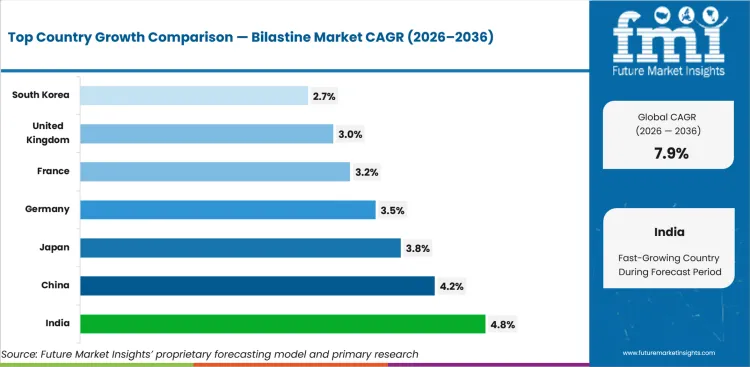
Source: Future Market Insights, 2026.
How do country-level CAGRs compare in the Bilastine Market?
India leads country expansion while the United States records the most cautious pace among profiled markets.
- India is forecast to record 4.8% CAGR by 2036, backed by API export depth and active local formulation review.
- China is expected to expand at 4.2% CAGR from 2026 to 2036, led by generic qualification and export certificate discipline.
- Japan is projected to grow at 3.8% CAGR through 2036, supported by branded-product history and conservative supplier change behavior.
- Germany is estimated to rise at 3.5% CAGR by 2036, reflected by authorised-product continuity under strict documentation expectations.
- France is expected to advance at 3.2% CAGR over the forecast period, guided by European medicine oversight and quality-control expectations.
- United Kingdom is forecast to post 3.0% CAGR by 2036, supported by product continuity and audited API supply needs.
- South Korea is projected to record 2.7% CAGR by 2036, driven by account-specific demand and regulated product approval review.
- United States is expected to record 2.2% CAGR by 2036, shaped by filing-stage API demand and substitute antihistamine availability.
How fast is the Bilastine market growing in India?
A 4.8% CAGR through 2036 reflects API export depth and formulation-linked evidence.
Country Market Snapshot Table
| Parameter | Value |
|---|---|
| Market Size in 2025 (Value) | USD 0.38 million |
| Market Size in 2026 (Value) | USD 0.40 million |
| Market Forecast in 2036 (Value) | USD 0.64 million |
| CAGR (2026 to 2036) | 4.8% |
| Years Considered | 2021 to 2036 |
| Base Year | 2025 |
| Forecast Period | 2026 to 2036 |
| Units Considered | Value (USD million) |
| Leading Sub-Region | Hyderabad and western India API corridors |
India Bilastine Market Outlook
India Bilastine API industry is supported by export-oriented active-ingredient manufacturing and domestic formulation review. Finished-dose companies need suppliers that maintain impurity control and repeat supply.
Indian suppliers are expected to defend accounts through written confirmations and direct buyer engagement. Price competition remains high, with documented API files being able to reduce supplier-switching risk for regulated clients.
Key Growth Drivers
- Export-oriented manufacturing improves API supplier credibility, supported by India’s pharmaceutical exports of USD 30.47 billion in FY 2024-25 and 9.4% annual expansion.
- Active-substance certificates strengthen regulated export accounts; CDSCO written-confirmation conditions require a 3-year validity period and inspection non-compliance reporting within 7 days.
- Domestic formulation buyers need stable bilastine lots for oral-solid and paediatric-linked formulation programs.
- Direct supplier communication helps buyers manage assay control and batch-release documentation.
Key Restraints
- Smaller formulation accounts may delay supplier qualification if product files or stability data need additional internal review.
- Domestic buyers can compare several antihistamine API sources before confirming annual supply.
- New formulation routes still face review risk, shown by CDSCO’s 12 May 2026 deferral of Bilastine Nasal Spray 0.36% w/v for Pulmonary SEC deliberation.
What makes India unique
India stands apart through export-linked API manufacturing strength and written-confirmation activity for active substances.
Key Companies
- Sai Life Sciences
- Symed Labs
- Lee Pharma
- MSN Laboratories
- Hetero
- MetroChem API
- Aurobindo Pharma - Milpharm
- Faes Farma
- Menarini International Operations Luxembourg
Sales & Marketing Channels
- Direct technical sales to finished-dose manufacturers
- Regulatory-documentation support for export accounts
- Contract manufacturing relationships
- API distributor networks
- Stability and impurity-file support
- Dossier developer partnerships
Country Segment Breakdown Table
| Segment | Sub-Segments |
|---|---|
| By Form | Powder · Granules |
| By Purity Grade | 99.5% or Higher · 98.0% to 99.5% · Below 98% |
| By Application | Allergic Rhinitis · Urticaria |
| By Sales Channel | Direct · Distributors · Online API Marketplaces |
| By Buyer Type | Finished-dose Companies · API Distributors · Contract Manufacturers · Regulatory-file Developers · Licence Partners |
| Key Sub-Regions Covered, API Corridors | Hyderabad · Ahmedabad · Mumbai-Pune · Bengaluru · Chennai · Delhi NCR |
Frequently Asked Questions
How fast is India Bilastine market growing?
Industry in India is projected to rise at 4.8% CAGR from 2026 to 2036, supported by export-led API supply and formulation-review activity.
Who leads India Bilastine market?
Sai Life Sciences leads regulated API-file support, while Symed Labs, Lee Pharma, MSN Laboratories, Hetero, MetroChem API, Aurobindo Pharma - Milpharm, Faes Farma, and Menarini support local and global supply.
What is driving adoption in India Bilastine market?
Written confirmations and pediatric formulation review are helping Indian suppliers protect Bilastine API accounts.
What is the Bilastine market outlook in China?
A 4.2% CAGR through 2036 reflects domestic generic qualification and export certificate discipline.
Country Market Snapshot Table
| Parameter | Value |
|---|---|
| Market Size in 2025 (Value) | USD 0.33 million |
| Market Size in 2026 (Value) | USD 0.34 million |
| Market Forecast in 2036 (Value) | USD 0.51 million |
| CAGR (2026 to 2036) | 4.2% |
| Years Considered | 2021 to 2036 |
| Base Year | 2025 |
| Forecast Period | 2026 to 2036 |
| Units Considered | Value (USD million) |
| Leading Sub-Region | Jiangsu, Zhejiang, and Guangdong pharmaceutical corridors |
China Bilastine Market Outlook
China Bilastine API business is influenced by contract-manufacturing oversight and buyer preference for local manufacturing control. More suppliers can qualify over time, which can support supply access but intensify price comparison.
Finished-dose buyers are expected to compare domestic API availability against imported-source reliability. Suppliers need quality agreements and rapid regulatory responses to defend repeat accounts.
Key Growth Drivers
- Drug-evaluation volume supports supplier qualification activity; China’s drug review system accepted 19,563 registration applications in 2024, including 2,142 chemical raw material applications.
- Faster clinical-review pathways support pharmaceutical development planning; eligible innovative-drug INDs can be reviewed within 30 working days and trials must be initiated within 12 weeks after approval commitment.
- Generic formulation activity can create qualification demand for bilastine API suppliers able to support equivalence evidence.
- Local supplier access helps buyers reduce lead-time exposure in mature antihistamine sourcing.
Key Restraints
- Domestic qualification can accelerate price comparison once multiple sources meet the buyer’s file requirements.
- Quality-agreement obligations raise documentation work for overseas and local participants seeking repeat business.
- Review workload can slow dossier response and supplier qualification; China’s review queue included 12,323 applications under review and 2,239 pending applicant responses at the end of 2024.
What makes China unique
China is distinguished by domestic generic development and export-certificate discipline.
Key Companies
- Jiangsu Huayang Pharmaceutical
- Zhejiang Hengkang Pharmaceutical
- Zhejiang Huahai Pharmaceutical
- Qilu Pharmaceutical
- CSPC Pharmaceutical Group
- Menarini China
- Faes Farma
- Hetero
- MSN Laboratories
Sales & Marketing Channels
- Direct finished-dose account selling
- Local regulatory partner channels
- API distributor networks
- Dossier-support relationships
- Contract manufacturing partnerships
- Technical documentation exchanges
Country Segment Breakdown Table
| Segment | Sub-Segments |
|---|---|
| By Form | Powder · Granules |
| By Purity Grade | 99.5% or Higher · 98.0% to 99.5% · Below 98% |
| By Application | Allergic Rhinitis · Urticaria |
| By Sales Channel | Direct · Distributors · Online API Marketplaces |
| By Buyer Type | Finished-dose Companies · API Distributors · Contract Manufacturers · Regulatory-file Developers · Licence Partners |
| Key Sub-Regions Covered, Pharmaceutical Corridors | Jiangsu · Zhejiang · Guangdong · Shanghai · Shandong · Hebei |
Frequently Asked Questions
How fast is China Bilastine market growing?
Industry in China is projected to rise at 4.2% CAGR from 2026 to 2036, guided by generic qualification and export-documentation control.
Who leads China Bilastine market?
Jiangsu Huayang Pharmaceutical leads local generic positioning, while Zhejiang Hengkang, Zhejiang Huahai, Qilu, CSPC, Menarini China, Faes Farma, Hetero, and MSN Laboratories support wider local and global supply.
What is driving adoption in China Bilastine market?
Drug-review volume and local generic development are supporting Bilastine API sourcing.
What is the Bilastine market forecast for Japan?
A 3.8% CAGR through 2036 reflects branded-product history and conservative supplier qualification.
Country Market Snapshot Table
| Parameter | Value |
|---|---|
| Market Size in 2025 (Value) | USD 0.92 million |
| Market Size in 2026 (Value) | USD 0.96 million |
| Market Forecast in 2036 (Value) | USD 1.39 million |
| CAGR (2026 to 2036) | 3.8% |
| Years Considered | 2021 to 2036 |
| Base Year | 2025 |
| Forecast Period | 2026 to 2036 |
| Units Considered | Value (USD million) |
| Leading Sub-Region | Kanto and Kansai pharmaceutical corridors |
Japan Bilastine Market Outlook
Japan Bilastine API industry is supported by branded-product history and high caution around supplier changes. Taiho Pharmaceutical and Meiji Seika Pharma remain central to local product routing through Bilanoa.
Japanese buyers are expected to favor stable release records, strong impurity documentation, and conservative supplier management. Qualified suppliers can retain accounts longer than price-led markets.
Key Growth Drivers
- Review predictability supports conservative product-file continuity; PMDA targets 9 months for priority review and 12 months for standard review, while achievement reached 80% or higher in FY 2023.
- Generic quality control remains a priority, supported by PMDA’s fiscal 2024 GMP report stating that approval-linked inspections apply to generic drugs containing an approved active ingredient.
- Branded-product history encourages cautious API switching and long-term supplier relationships.
- High documentation expectations favor suppliers with clean impurity files and stable deviation records.
Key Restraints
- Conservative qualification practices can extend supplier onboarding before commercial API orders begin.
- Mature antihistamine pricing limits upside for suppliers without established product-file access.
- Supplier qualification remains evidence-heavy for new API entrants, PMDA’s FY 2024 GMP reporting recorded 126 on-site inspections and 2,049 desktop inspections.
What makes Japan unique
Japan differs through branded conservative qualification behavior and disciplined product-review timelines.
Key Companies
- Taiho Pharmaceutical
- Meiji Seika Pharma
- Nichi-Iko Pharmaceutical
- Sawai Pharmaceutical
- Towa Pharmaceutical
- Faes Farma
- Menarini International Operations Luxembourg
- MSN Laboratories
- Hetero
Sales & Marketing Channels
- Direct product-holder relationships
- Licence-network supply channels
- Quality-assurance documentation reviews
- Distributor support for smaller accounts
- Regulatory-file support
- Stability-data exchanges
Country Segment Breakdown Table
| Segment | Sub-Segments |
|---|---|
| By Form | Powder · Granules |
| By Purity Grade | 99.5% or Higher · 98.0% to 99.5% · Below 98% |
| By Application | Allergic Rhinitis · Urticaria |
| By Sales Channel | Direct · Distributors · Online API Marketplaces |
| By Buyer Type | Finished-dose Companies · API Distributors · Contract Manufacturers · Regulatory-file Developers · Licence Partners |
| Key Sub-Regions Covered, Pharmaceutical Corridors | Kanto · Kansai · Chubu · Kyushu · Tohoku · Shikoku |
Frequently Asked Questions
How fast is Japan Bilastine market growing?
Industry in Japan is projected to rise at 3.8% CAGR from 2026 to 2036, supported by branded-product continuity and cautious supplier change.
Who leads Japan Bilastine market?
Taiho Pharmaceutical leads local commercial positioning through Bilanoa, while Meiji Seika Pharma, Nichi-Iko, Sawai, Towa, Faes Farma, Menarini, MSN Laboratories, and Hetero support broader supply.
What is driving adoption in Japan Bilastine market?
Approval-linked GMP inspection and branded product continuity are supporting repeat supplier relationships.
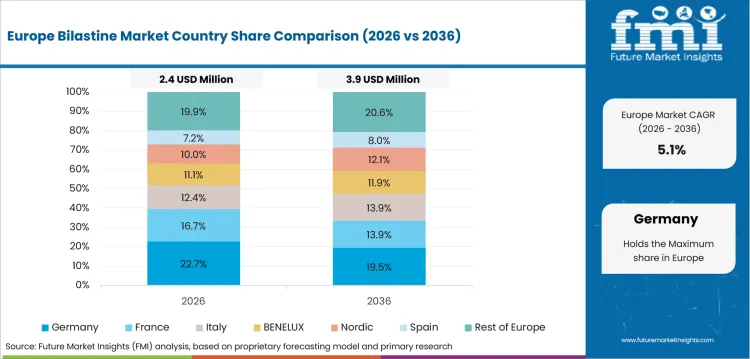
What is the Bilastine Market forecast for Germany?
A 3.5% CAGR through 2036 reflects authorised-product continuity under strict regulatory expectations.
Country Market Snapshot Table
| Parameter | Value |
|---|---|
| Market Size in 2025 (Value) | USD 0.71 million |
| Market Size in 2026 (Value) | USD 0.73 million |
| Market Forecast in 2036 (Value) | USD 1.03 million |
| CAGR (2026 to 2036) | 3.5% |
| Years Considered | 2021 to 2036 |
| Base Year | 2025 |
| Forecast Period | 2026 to 2036 |
| Units Considered | Value (USD million) |
| Leading Sub-Region | North Rhine-Westphalia and Bavaria pharmaceutical corridors |
Germany Bilastine Market Outlook
Germany Bilastine API business is guided by strict authorisation expectations and conservative pharmaceutical sourcing. Finished-dose companies require supplier evidence that protects approved files during price-led sourcing reviews.
API suppliers are expected to compete through stability support and European regulatory experience. Mature antihistamine substitution keeps buyer comparison active across repeat accounts.
Key Growth Drivers
- Authorisation transparency supports buyer due diligence, strengthened by PharmNet.Bund making medicinal product and authorisation data free from 13 February 2025.
- Official product texts strengthen dossier review because PharmNet requires SmPC and leaflet submissions under Sections 11 sub-section 1a and 11a sub-section 3 of the German Medicines Act.
- European product oversight supports demand for API suppliers able to answer variation and pharmacovigilance questions.
- Conservative finished-dose buyers favor suppliers with strong batch history and low documentation risk.
Key Restraints
- High documentation expectations can slow new supplier entry into approved German product files.
- Mature antihistamine competition keeps price discipline high across repeat API accounts.
- Product-text control can extend supplier-change paperwork; PharmNet.Bund requires current SmPC and patient leaflet submissions under 2 German Medicines Act sections, 11 and 11a.
What makes Germany unique
Germany stands out through transparent medicine-data systems and strong buyer caution around supplier changes.
Key Companies
- ratiopharm GmbH
- Heumann Pharma
- Aristo Pharma
- ALIUD PHARMA
- Zentiva Pharma Germany
- Menarini International Operations Luxembourg
- Faes Farma
- Aurobindo Pharma - Milpharm
- Hetero
Sales & Marketing Channels
- Direct regulated-market API sales
- Licence-network relationships
- Distributor support for smaller accounts
- Variation-support programs
- Quality-audit documentation exchanges
- Contract manufacturing links
Country Segment Breakdown Table
| Segment | Sub-Segments |
|---|---|
| By Form | Powder · Granules |
| By Purity Grade | 99.5% or Higher · 98.0% to 99.5% · Below 98% |
| By Application | Allergic Rhinitis · Urticaria |
| By Sales Channel | Direct · Distributors · Online API Marketplaces |
| By Buyer Type | Finished-dose Companies · API Distributors · Contract Manufacturers · Regulatory-file Developers · Licence Partners |
| Key Sub-Regions Covered, Pharmaceutical Corridors | North Rhine-Westphalia · Bavaria · Baden-Württemberg · Hesse · Saxony · Hamburg |
Frequently Asked Questions
How fast is Germany Bilastine market growing?
Industry in Germany is projected to rise at 3.5% CAGR from 2026 to 2036, influenced by authorisation discipline and product-file continuity.
Who leads Germany Bilastine market?
Menarini and Faes Farma lead originator-linked supply, while ratiopharm, Heumann, Aristo, ALIUD PHARMA, Zentiva Pharma Germany, Aurobindo, and Hetero support generic and API availability.
What is driving adoption in Germany Bilastine market?
Free medicine-data access and supplier documentation quality are supporting regulated Bilastine API decisions.
What is driving Bilastine Market growth in France?
A 3.2% CAGR through 2036 reflects European medicine oversight and quality-control expectations.
Country Market Snapshot Table
| Parameter | Value |
|---|---|
| Market Size in 2025 (Value) | USD 0.57 million |
| Market Size in 2026 (Value) | USD 0.59 million |
| Market Forecast in 2036 (Value) | USD 0.81 million |
| CAGR (2026 to 2036) | 3.2% |
| Years Considered | 2021 to 2036 |
| Base Year | 2025 |
| Forecast Period | 2026 to 2036 |
| Units Considered | Value (USD million) |
| Leading Sub-Region | Île-de-France and Auvergne-Rhône-Alpes pharmaceutical corridors |
France Bilastine Market Outlook
France Bilastine API business is tied to approved product continuity and generic pricing discipline. Finished-dose buyers need suppliers that can support dossiers and pharmacy-channel continuity without increasing compliance risk.
Suppliers are expected to defend accounts through European documentation strength and stable impurity records. Lower API prices keep buyer comparison active across mature antihistamine sourcing.
Key Growth Drivers
- European medicine-review capacity supports regulated product continuity; EMA recommended 114 new human medicines in 2024, including 46 medicines containing new active substances.
- EU quality assurance supports regulated supply confidence, reflected by EMA’s 2024 annual report recording 2,110 GMP certificates and 10 non-compliance statements issued by EEA authorities.
- Finished-dose buyers need API files that support approved product information and variation management.
- Licence-linked medicine networks support repeat sourcing from suppliers with proven European documentation.
Key Restraints
- Reimbursement and generic pricing pressure can narrow room for premium API supply.
- Supplier switching can create added variation work if impurity profiles differ from the approved file.
- EU inspection findings keep supplier evidence requirements strict; EEA authorities completed 210 GMP inspections requested through centralised procedures and issued 10 GMP non-compliance statements in 2024.
What makes France unique
France is marked by European pharmacovigilance links and national emphasis on medicine life-cycle quality.
Key Companies
- Biogaran
- Arrow Génériques
- EG Labo
- Viatris Santé
- Zentiva France
- Zydus France
- Menarini International Operations Luxembourg
- Faes Farma
- Aurobindo Pharma - Milpharm
Sales & Marketing Channels
- Direct sales to finished-dose holders
- Licence-network supply
- Distributor support for regional formulation buyers
- Quality-documentation exchanges
- Stability support programs
- Regulatory-file developer relationships
Country Segment Breakdown Table
| Segment | Sub-Segments |
|---|---|
| By Form | Powder · Granules |
| By Purity Grade | 99.5% or Higher · 98.0% to 99.5% · Below 98% |
| By Application | Allergic Rhinitis · Urticaria |
| By Sales Channel | Direct · Distributors · Online API Marketplaces |
| By Buyer Type | Finished-dose Companies · API Distributors · Contract Manufacturers · Regulatory-file Developers · Licence Partners |
| Key Sub-Regions Covered, Pharmaceutical Corridors | Île-de-France · Auvergne-Rhône-Alpes · Normandy · Grand Est · Hauts-de-France · Occitanie |
Frequently Asked Questions
How fast is France Bilastine market growing?
Industry in France is projected to rise at 3.2% CAGR from 2026 to 2036, shaped by European product oversight and stability-documentation needs.
Who leads France Bilastine market?
Biogaran leads local generic visibility, while Arrow Génériques, EG Labo, Viatris Santé, Zentiva France, Zydus France, Menarini, Faes Farma, and Aurobindo support local and global supply.
What is driving adoption in France Bilastine market?
GMP certificate discipline and inspection oversight are supporting disciplined Bilastine API sourcing.
How is the Bilastine Market performing in the United Kingdom?
A 3.0% CAGR through 2036 reflects product continuity and audited API supply needs.
Country Market Snapshot Table
| Parameter | Value |
|---|---|
| Market Size in 2025 (Value) | USD 0.54 million |
| Market Size in 2026 (Value) | USD 0.56 million |
| Market Forecast in 2036 (Value) | USD 0.75 million |
| CAGR (2026 to 2036) | 3.0% |
| Years Considered | 2021 to 2036 |
| Base Year | 2025 |
| Forecast Period | 2026 to 2036 |
| Units Considered | Value (USD million) |
| Leading Sub-Region | England finished-dose and distribution corridors |
United Kingdom Bilastine Market Outlook
United Kingdom Bilastine API industry is supported by a clear finished-dose record for Bilastine 20 mg Tablets. API sourcing depends on continuity and supplier documentation rather than new molecule demand.
Buyers are expected to compare price and quality evidence carefully. Suppliers with clean audit records and fast variation support can defend repeat business in a competitive value pool.
Key Growth Drivers
- Finished-dose evidence supports repeat API demand, as the electronic Medicines Compendium lists Bilastine 20 mg Tablets for adults and adolescents aged 12 years and above.
- Regulatory throughput supports active medicine oversight, as MHRA reported more than 2,000 medicine licences and 54 new medicines approved in 2024-25.
- Direct supplier relationships reduce change-control risk for authorised oral tablets.
- Quality documentation helps buyers manage release testing and renewal needs.
Key Restraints
- Generic price checks continue to pressure established antihistamine API supply.
- Suppliers without strong audit history can struggle to enter approved product files.
- Variation work can slow supplier changes in authorised products, MHRA guidance groups post-authorization changes into 4 routes, Type IA, Type IB, Type II, and extension applications.
What makes United Kingdom unique
United Kingdom stands apart through clear Bilastine 20 mg product records and structured variation controls.
Key Companies
- Aurobindo Pharma - Milpharm
- Brown & Burk UK
- Relonchem
- Zentiva Pharma UK
- Accord Healthcare
- Teva UK
- Faes Farma
- Menarini International Operations Luxembourg
- Hetero
Sales & Marketing Channels
- Direct finished-dose account selling
- Distributor-supported API supply
- Variation-support documentation
- Quality-audit engagement
- Contract manufacturing relationships
- Regulatory-file developer support
Country Segment Breakdown Table
| Segment | Sub-Segments |
|---|---|
| By Form | Powder · Granules |
| By Purity Grade | 99.5% or Higher · 98.0% to 99.5% · Below 98% |
| By Application | Allergic Rhinitis · Urticaria |
| By Sales Channel | Direct · Distributors · Online API Marketplaces |
| By Buyer Type | Finished-dose Companies · API Distributors · Contract Manufacturers · Regulatory-file Developers · Licence Partners |
| Key Sub-Regions Covered, Pharmaceutical Corridors | England · Scotland · Wales · Northern Ireland · London distribution corridor · Midlands |
Frequently Asked Questions
How fast is United Kingdom Bilastine market growing?
Industry in the United Kingdom is projected to rise at 3.0% CAGR from 2026 to 2036, guided by authorised product continuity and variation support.
Who leads United Kingdom Bilastine market?
Aurobindo Pharma - Milpharm leads local finished-dose visibility, while Brown & Burk UK, Relonchem, Zentiva Pharma UK, Accord Healthcare, Teva UK, Faes Farma, Menarini, and Hetero support wider supply.
What is driving adoption in United Kingdom Bilastine market?
Finished-dose evidence and structured variation routes are protecting repeat API sourcing.
What is the Bilastine Market outlook in South Korea?
A 2.7% CAGR through 2036 reflects account-specific demand and regulated product approval review.
Country Market Snapshot Table
| Parameter | Value |
|---|---|
| Market Size in 2025 (Value) | USD 0.31 million |
| Market Size in 2026 (Value) | USD 0.32 million |
| Market Forecast in 2036 (Value) | USD 0.42 million |
| CAGR (2026 to 2036) | 2.7% |
| Years Considered | 2021 to 2036 |
| Base Year | 2025 |
| Forecast Period | 2026 to 2036 |
| Units Considered | Value (USD million) |
| Leading Sub-Region | Seoul, Gyeonggi, and Incheon pharmaceutical corridors |
South Korea Bilastine Market Outlook
South Korea Bilastine API business remains account-specific due to thinner public product evidence than Japan or Europe. Finished-dose continuity and distributor reliability drive buyer decisions more than molecule expansion.
Suppliers are expected to need local regulatory routes and reliable batch evidence before meaningful volume develops. Price comparison remains active due to mature antihistamine alternatives.
Key Growth Drivers
- Drug-approval transparency supports supplier screening; MFDS maintains 59 English product-reference articles and includes the 2024 Drug Approval Report for overseas users.
- Ingredient-level review supports quality-led API sourcing. MFDS approval covers 2 pharmaceutical classifications, drug products and pharmaceutical ingredients, through technical review and inspection.
- Local formulation buyers value reliable distributors able to manage documentation and delivery consistency.
- Finished-dose accounts need API suppliers that can support registered-product continuity.
Key Restraints
- Limited public bilastine product depth keeps demand account-specific and harder to scale.
- New API suppliers may face slow onboarding if local finished-dose customers lack active file needs.
- Public approval evidence remains concentrated for overseas readers. MFDS English product reporting lists 5 annual drug approval reports covering 2020 through 2024.
What makes South Korea unique
South Korea is defined by account-specific demand and strong dependence on regulated approval evidence.
Key Companies
- Yuhan Corporation
- Hanmi Pharmaceutical
- Chong Kun Dang
- Dong-A ST
- Boryung
- Menarini Asia-Pacific
- Faes Farma
- Hetero
- MSN Laboratories
Sales & Marketing Channels
- Direct finished-dose relationships
- Local distributor partnerships
- Regulatory-file support
- Quality-assurance documentation exchange
- Contract manufacturing support
- Importer and wholesaler channels
Country Segment Breakdown Table
| Segment | Sub-Segments |
|---|---|
| By Form | Powder · Granules |
| By Purity Grade | 99.5% or Higher · 98.0% to 99.5% · Below 98% |
| By Application | Allergic Rhinitis · Urticaria |
| By Sales Channel | Direct · Distributors · Online API Marketplaces |
| By Buyer Type | Finished-dose Companies · API Distributors · Contract Manufacturers · Regulatory-file Developers · Licence Partners |
| Key Sub-Regions Covered, Pharmaceutical Corridors | Seoul · Gyeonggi · Incheon · Daejeon · Chungcheong · Busan |
Frequently Asked Questions
How fast is South Korea Bilastine market growing?
Industry in South Korea is projected to rise at 2.7% CAGR from 2026 to 2036, shaped by account-specific product demand.
Who leads South Korea Bilastine market?
Menarini Asia-Pacific and Faes Farma lead licence-linked access, while Yuhan, Hanmi, Chong Kun Dang, Dong-A ST, Boryung, Hetero, and MSN Laboratories support local and API-side supply.
What is driving adoption in South Korea Bilastine market?
Product-reference transparency and registered-product continuity are supporting selective API use.
How is the Bilastine Market performing in the United States?
A 2.2% CAGR through 2036 reflects filing-stage API demand and substitute antihistamine availability.
Country Market Snapshot Table
| Parameter | Value |
|---|---|
| Market Size in 2025 (Value) | USD 0.24 million |
| Market Size in 2026 (Value) | USD 0.25 million |
| Market Forecast in 2036 (Value) | USD 0.31 million |
| CAGR (2026 to 2036) | 2.2% |
| Years Considered | 2021 to 2036 |
| Base Year | 2025 |
| Forecast Period | 2026 to 2036 |
| Units Considered | Value (USD million) |
| Leading Sub-Region | Northeast and Midwest development-account corridors |
United States Bilastine Market Outlook
United States Bilastine API business is limited by a weaker approved finished-dose base compared with Europe and Japan. Allergy prevalence creates clinical interest, but repeat API demand needs approved product pathways and active formulation programs.
Suppliers are expected to treat the United States as a development-account and filing-support market. Substitute antihistamines already cover large portions of treatment demand, which limits recurring API pull.
Key Growth Drivers
- Clinical need remains large, supported by 2024 adult allergy data showing 25.2% seasonal allergy prevalence.
- Generic-development systems support filing-stage planning, as FDA issued 925 product-specific guidances in fiscal year 2025.
- Development-stage buyers may need bilastine API lots for filing work and equivalence planning.
- DMF-ready suppliers can support sponsors evaluating future finished-dose pathways.
Key Restraints
- Substitute antihistamines reduce urgency for new bilastine-based product programs.
- Repeat API demand remains limited without a broad approved finished-dose base.
- Generic-review outcomes can delay filing-stage API pull, justified by FDA’s generic-drug program recording 733 complete responses across reported fiscal 2025 monthly activity.
What makes United States unique
United States differs through high allergy prevalence but limited bilastine finished-dose approval depth.
Key Companies
- Hikma Pharmaceuticals USA
- Teva USA
- Viatris
- Amneal Pharmaceuticals
- Sandoz USA
- Aurobindo Pharma USA
- Faes Farma
- Hetero
- MSN Laboratories
Sales & Marketing Channels
- Development-account technical sales
- DMF support discussions
- Contract research and formulation channels
- API distributor networks
- Sponsor filing support
- Quality-documentation exchanges
Country Segment Breakdown Table
| Segment | Sub-Segments |
|---|---|
| By Form | Powder · Granules |
| By Purity Grade | 99.5% or Higher · 98.0% to 99.5% · Below 98% |
| By Application | Allergic Rhinitis · Urticaria |
| By Sales Channel | Direct · Distributors · Online API Marketplaces |
| By Buyer Type | Finished-dose Companies · API Distributors · Contract Manufacturers · Regulatory-file Developers · Licence Partners |
| Key Sub-Regions Covered, Development Corridors | Northeast · Midwest · New Jersey · Pennsylvania · California · North Carolina |
Frequently Asked Questions
How fast is United States Bilastine market growing?
Industry in the United States is projected to rise at 2.2% CAGR from 2026 to 2036, driven by filing-stage API demand.
Who leads United States Bilastine market?
Hikma Pharmaceuticals USA leads licence-linked commercialisation planning, while Teva USA, Viatris, Amneal, Sandoz USA, Aurobindo Pharma USA, Faes Farma, Hetero, and MSN Laboratories support broader generic and API capacity.
What is driving adoption in United States Bilastine market?
Allergy prevalence and complete-response management are shaping limited Bilastine API demand.
Who are the leading companies in the Bilastine Market?
Faes Farma, Menarini International Operations Luxembourg, Taiho Pharmaceutical, Meiji Seika Pharma, and Aurobindo Pharma - Milpharm.
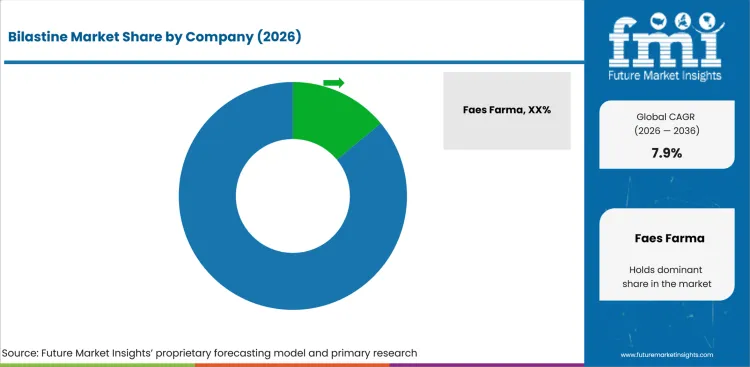
- Originator-linked suppliers hold an advantage due to clinical product history and licence-network access.
- API manufacturers gain stronger acceptance by connecting impurity control with repeatable release records.
- Regional suppliers win in selected markets by offering documentation support and responsive technical service.
- Service-ready suppliers improve renewal chances through stability evidence and fast regulatory responses.
Bilastine competition centers on documentation depth and account retention rather than new molecule differentiation. Faes Farma anchors product history through Bilaxten and international licensing. Menarini International Operations Luxembourg supports European product continuity. Taiho Pharmaceutical and Meiji Seika Pharma strengthen Japan relevance through Bilanoa.
Manufacturing depth and technical documentation have become stronger competitive separators as bilastine moves through established small molecule API sourcing. Aurobindo Pharma - Milpharm is visible in the United Kingdom finished-dose record for Bilastine 20 mg Tablets. MSN Laboratories, Hetero, MetroChem API, Sai Life Sciences, and Symed Labs compete through API files and regulated-market manufacturing capability. Buyers compare supplier performance through impurity evidence and variation support.
Smaller and regional suppliers can profit through targeted development lots and fast document support. India and China create opportunities for suppliers with formulation-support capability and local regulatory familiarity. Europe and Japan create stronger demand for approved-file continuity and conservative supplier management. Companies that prove stable impurity control under repeat orders should gain more durable annual supply positions.
How do top Bilastine companies compare?
Faes Farma and Menarini score on product history while Indian API suppliers lead through active-substance supply depth.
| Company | Relevance to Market Title | Bilastine File Depth | Impurity-Control Capability | Regulated-Market Supply Fit | Channel Reach | Geographic Footprint |
|---|---|---|---|---|---|---|
| Faes Farma | Very High | Very Strong | Strong | Very Strong | Strong | Europe and licensed markets |
| Menarini International Operations Luxembourg | Very High | Very Strong | Strong | Very Strong | Strong | Europe and international |
| Taiho Pharmaceutical | High | Strong | Strong | Very Strong | Moderate | Japan |
| Meiji Seika Pharma | High | Moderate | Strong | Strong | Moderate | Japan |
| Aurobindo Pharma - Milpharm | High | Moderate | Strong | Strong | Strong | United Kingdom, India, and global |
| MSN Laboratories | Moderate to High | Moderate | Strong | Strong | Strong | India and export markets |
| Hetero | Moderate to High | Moderate | Strong | Strong | Strong | India and export markets |
| MetroChem API | High | Strong | Strong | Moderate | Moderate | India and export markets |
| Sai Life Sciences | Moderate to High | Moderate | Strong | Moderate | Moderate | India and export markets |
| Symed Labs | Moderate to High | Moderate | Strong | Moderate | Moderate | India and export markets |
Source: Future Market Insights competitive analysis, 2026.
Who are the key players in the Bilastine Market?
Faes Farma, Menarini International Operations Luxembourg and Taiho Pharmaceutical are listed with Meiji Seika Pharma and Aurobindo Pharma - Milpharm among other suppliers.
Key global companies leading the Bilastine Market include:
- Faes Farma
- Menarini International Operations Luxembourg
- Taiho Pharmaceutical
- Meiji Seika Pharma
- Aurobindo Pharma - Milpharm
- MSN Laboratories
- Hetero
- MetroChem API
- Sai Life Sciences
- Symed Labs
Key Developments in Bilastine Market
- In February 2026, Faes Farma reported EUR 627 million revenue for 2025 and noted that Bilastine revenue increased by 8% during the year.
- In September 2025, CDSCO reviewed Bilastine 10 mg with Montelukast 4 mg per 5 mL oral solution for Ravenbhel Healthcare and recommended manufacturing and marketing permission with a Phase IV study condition.
- In March 2026, CDSCO amended a written confirmation for Symed Labs covering Bilastine IH, supporting export-oriented active-substance documentation.
Key Players in the Bilastine Market
Originator and Licence-Network Companies
- Faes Farma
- Menarini International Operations Luxembourg
- Taiho Pharmaceutical
- Meiji Seika Pharma
Large API and Generic Suppliers
- Aurobindo Pharma - Milpharm
- MSN Laboratories
- Hetero
- MetroChem API
Specialist and Regional API Suppliers
- Sai Life Sciences
- Symed Labs
- Lee Pharma
- Regional API distributors
Bilastine Market - Report Scope
| Parameter | Details |
|---|---|
| Forecast period | 2026 to 2036 |
| Historical period | 2021 to 2025 |
| Quantitative unit | Revenue in USD million |
| By form | Powder, granules |
| By purity grade | 99.5% or Higher, 98.0% to 99.5%, below 98% |
| By application | Allergic rhinitis, urticaria |
| By sales channel | Direct, distributors, online API marketplaces |
| By buyer type | Finished-dose companies, API distributors, contract manufacturers, regulatory-file developers, licence partners |
| Regions covered | North America, Latin America, Europe, East Asia, South Asia and Pacific, Middle East and Africa |
| Countries covered | India, China, Japan, Germany, France, United Kingdom, South Korea, United States |
| Key companies profiled | Faes Farma, Menarini International Operations Luxembourg, Taiho Pharmaceutical, Meiji Seika Pharma, Aurobindo Pharma - Milpharm, MSN Laboratories, Hetero, MetroChem API, Sai Life Sciences, Symed Labs |
| Approach | Hybrid bottom-up and top-down methodology using regulator records, product labels, API value expansion, supplier evidence, and country channel behavior |
Source: Future Market Insights competitive analysis, 2026.
Bilastine Market - Scope & Definition
| Attribute | Detail |
|---|---|
| Market Definition | Commercial active pharmaceutical ingredient supply used to manufacture bilastine-based finished dosage forms for allergic rhinitis and urticaria |
| Functions Covered | Histamine H1-antagonist API supply, oral-dose formulation support, impurity control, batch release, and dossier continuity |
| Applications Covered | Allergic rhinitis and urticaria |
| End-Use Industries | Pharmaceutical manufacturing, contract manufacturing, finished-dose formulation, licence networks, and regulated API distribution |
| Grades Covered | 99.5% or Higher, 98.0% to 99.5%, below 98%, commercial API grade, and development-grade supply |
| Inclusions | Bilastine API sold as powder or granules across form, purity grade, application, sales channel, buyer type, and country-level commercial use |
| Exclusions | Finished bilastine tablets, branded prescription revenue, OTC antihistamine sales, non-bilastine APIs, excipients, packaging, allergy diagnostics, immunotherapy products, and pharmacy retail margins |
Bilastine Market - Research Methodology
| Method | Description |
|---|---|
| Primary Research | FMI analyst interviews with API suppliers, formulation buyers, contract manufacturers, distributors, regulatory-file developers, and licence-linked product holders |
| Desk Research | Review of regulator records, product labels, public medicine references, company disclosures, written confirmations, and pharmaceutical approval documents |
| Market Sizing & Forecasting | Hybrid approach using base-year API value, finished-dose continuity, country-level authorisation signals, formulation demand, and supplier qualification intensity |
| Data Validation | Cross-verification using antihistamine API dynamics, Small Molecule API sourcing patterns, regulator evidence, company portfolio checks, and regional channel behavior |
Bilastine Market Breakdown by Form, Purity Grade, Application, Sales Channel, Buyer Type, and Region
Bilastine Market Segmented by Form
- Powder
- Granules
Bilastine Market Segmented by Purity Grade
- 99.5% or Higher
- 98.0% to 99.5%
- Below 98%
Bilastine Market Segmented by Application
- Allergic Rhinitis
- Urticaria
Bilastine Market Segmented by Sales Channel
- Direct
- Distributors
- Online API Marketplaces
Bilastine Market Segmented by Buyer Type
- Finished-dose Companies
- API Distributors
- Contract Manufacturers
- Regulatory-file Developers
- Licence Partners
Bilastine Market by Region
- North America
- Latin America
- Europe
- East Asia
- South Asia and Pacific
- Middle East and Africa
Research Sources and Bibliography
- BfArM. (2025, February 13). PharmNet.Bund drug information system public access update.
- Bottoms-McClain, L., & Boersma, P. (2026, January). Diagnosed allergic conditions in adults: United States, 2024. National Center for Health Statistics.
- Center for Drug Evaluation of NMPA. (2025). 2024 Drug Review Report.
- Central Drugs Standard Control Organisation. (2025, August 5). Written confirmation for active substances imported into the European Union: Sai Life Sciences Limited.
- Central Drugs Standard Control Organisation. (2025, September 10). Recommendations of the Subject Expert Committee: Pulmonary.
- Central Drugs Standard Control Organisation. (2026, May 12). Recommendations of the Subject Expert Committee: Dermatology and Allergy.
- Central Drugs Standard Control Organisation. (2026, March 10). Written confirmation amendment: Symed Labs Limited.
- Electronic Medicines Compendium. (2025). Bilastine 20 mg Tablets: Summary of Product Characteristics.
- European Medicines Agency. (2025, June 10). Annual Report 2024.
- Faes Farma. (2025, November 4). Faes Farma increases its revenue by more than 15% to EUR 454 million.
- Faes Farma. (2026, February 26). Faes Farma increases its revenue by 23% to EUR 627 million.
- Medicines and Healthcare products Regulatory Agency. (2025, July 21). MHRA annual report and accounts 2024 to 2025 impact summary.
- Medicines and Healthcare products Regulatory Agency. (2026, January 26). Medicines: Apply for a variation to marketing authorisation.
- Ministry of Commerce and Industry. (2026, February 21). Pharmaceutical exports register 9.4% growth.
- Ministry of Food and Drug Safety. (2025, July 1). 2024 Drug Approval Report.
- Ministry of Food and Drug Safety. (2025). Approval process for pharmaceuticals and pharmaceutical ingredients.
- National Medical Products Administration. (2025, October 14). Announcement on optimizing the review and approval process for clinical trials of innovative drugs.
- Pharmaceuticals and Medical Devices Agency. (2025, July 22). PMDA Updates 2025.
- Pharmaceuticals and Medical Devices Agency. (2025, September 5). FY 2024 GMP / GCTP Annual Report.
- USA Food and Drug Administration. (2025, March 26). Product-specific guidances for generic drug development.
- USA Food and Drug Administration. (2026, February). Generic Drug User Fee Amendments: Fiscal year 2025 performance report.
- USA Food and Drug Administration. (2026, May 13). Generic Drugs Program Monthly and Quarterly Activities Report.
This bibliography is provided for reader reference and is not exhaustive. The full report contains the complete reference list and detailed citations.
This Report Answers
- Market size estimates for 2026 and forecasts through 2036 for the Bilastine Market.
- Insights across regional and country-level bilastine API sourcing markets.
- Analysis of demand drivers and purchasing behavior.
- Evaluation of form, purity grade, application, sales channel, and buyer type.
- Assessment of regulatory records and API documentation impacts.
- Identification of opportunities across paediatric formulations and direct API supply.
- Evaluation of direct supplier relationships and technical sales channels.
- Country-level analysis covering India, China, Japan, Germany, France, United Kingdom, South Korea, and United States.
- Assessment of competition, including originator-linked firms and API suppliers.
- Analysis of dossier-level decision drivers and renewal criteria.
- Regional outlooks across North America, Europe, East Asia, South Asia and Pacific, Latin America, and Middle East and Africa.
- Delivery of market data, forecasts, and supporting analysis in report-ready format.
Frequently Asked Questions
What is the growth prospect for Bilastine API?
Demand for Bilastine API is expected to rise at a steady pace as approved product holders continue ordering clean and documented active ingredient.
Which companies are expected to shape the Bilastine market?
Faes Farma, Menarini International Operations Luxembourg, Taiho Pharmaceutical, Meiji Seika Pharma, Aurobindo Pharma - Milpharm, MSN Laboratories, Hetero, MetroChem API, Sai Life Sciences, and Symed Labs are expected to shape competition.
Why are pharmaceutical companies investing in Bilastine API continuity?
Pharmaceutical companies are investing in Bilastine API continuity to protect approved product files and allergy-product supply.
Why are direct sales channels important in the Bilastine market?
Direct sales channels support audit records and faster technical responses across approved finished-dose accounts.
Which formats are gaining attention in Bilastine API?
Powder remains the leading format as tablet manufacturers prefer direct blending and lower processing cost.
How do regulations influence Bilastine API demand?
Regulations influence demand through authorization records and active-substance documentation.
Why is high purity important for Bilastine API?
High purity is important since finished-dose companies need stable impurity evidence for approved product files.
What role do Finished-dose Companies play in Bilastine API adoption?
Finished-dose Companies support adoption by creating repeat API demand tied to approved tablets, oral solutions, and licence networks.
Preview the report firsthand - request a free sample
Get SampleGet the brochure for pricing and purchase details.
Get PDFTable of Content
- Key Takeaways
- Market Size and CAGR
- Top Growth Driver
- Fastest Growing Segment
- Leading Region
- Key Companies
- Emerging Opportunities
- Executive Summary
- Global Market Outlook
- Demand-side Trends
- Supply-side Trends
- Technology Roadmap Analysis
- Analysis and Recommendations
- Analyst Perspective (What is happening? Why now? What should investors know?)
- Key Questions Answered
- How large is the market?
- What is the CAGR?
- What are key trends?
- Which region dominates?
- Who are the leaders?
- Market Overview
- Market Coverage / Taxonomy
- Market Definition / Scope / Limitations
- Research Methodology
- Chapter Orientation
- Analytical Lens and Working Hypotheses
- Market Structure, Signals, and Trend Drivers
- Benchmarking and Cross-market Comparability
- Market Sizing, Forecasting, and Opportunity Mapping
- Research Design and Evidence Framework
- Desk Research Programme (Secondary Evidence)
- Expert Input and Fieldwork (Primary Evidence)
- Tooling, Models, and Reference Databases
- Data Engineering and Model Build
- Quality Assurance and Audit Trail
- Market Background
- Market Dynamics (Drivers, Restraints, Opportunity, Trends)
- Scenario Forecast (Optimistic, Likely, Conservative)
- Impact Analysis
- AI Impact
- Sustainability Impact
- Regulatory Impact
- Technology Impact
- Consumer / Buyer Analysis
- Purchase Drivers
- Adoption Barriers
- Buyer Journey
- Opportunity Map Analysis
- Product Life Cycle Analysis
- Supply Chain Analysis
- Investment Feasibility Matrix
- Value Chain Analysis
- PESTLE and Porter's Analysis
- Regulatory Landscape
- Regional Parent Market Outlook
- Production and Consumption Statistics
- Import and Export Statistics
- Global Market Analysis and Forecast, 2021 to 2036
- Historical Market Size Value (USD Million) Analysis, 2021 to 2025
- Current and Future Market Size Value (USD Million) Projections, 2026 to 2036
- Y-o-Y Growth Trend Analysis
- Absolute $ Opportunity Analysis
- Global Market Pricing Analysis, 2021 to 2036
- Global Market Analysis and Forecast, By Form, 2021 to 2036
- Introduction / Key Findings
- Historical Market Size Value (USD Million) Analysis By Form, 2021 to 2025
- Current and Future Market Size Value (USD Million) Analysis and Forecast By Form, 2026 to 2036
- Powder
- Granules
- Powder
- Y-o-Y Growth Trend Analysis By Form, 2021 to 2025
- Absolute $ Opportunity Analysis By Form, 2026 to 2036
- Global Market Analysis and Forecast, By Purity Grade, 2021 to 2036
- Introduction / Key Findings
- Historical Market Size Value (USD Million) Analysis By Purity Grade, 2021 to 2025
- Current and Future Market Size Value (USD Million) Analysis and Forecast By Purity Grade, 2026 to 2036
- 99.5% or Higher
- 98.0% to 99.5%
- Below 98%
- 99.5% or Higher
- Y-o-Y Growth Trend Analysis By Purity Grade, 2021 to 2025
- Absolute $ Opportunity Analysis By Purity Grade, 2026 to 2036
- Global Market Analysis and Forecast, By Application, 2021 to 2036
- Introduction / Key Findings
- Historical Market Size Value (USD Million) Analysis By Application, 2021 to 2025
- Current and Future Market Size Value (USD Million) Analysis and Forecast By Application, 2026 to 2036
- Allergic Rhinitis
- Urticaria
- Allergic Rhinitis
- Y-o-Y Growth Trend Analysis By Application, 2021 to 2025
- Absolute $ Opportunity Analysis By Application, 2026 to 2036
- Global Market Analysis and Forecast, By Sales Channel, 2021 to 2036
- Introduction / Key Findings
- Historical Market Size Value (USD Million) Analysis By Sales Channel, 2021 to 2025
- Current and Future Market Size Value (USD Million) Analysis and Forecast By Sales Channel, 2026 to 2036
- Direct
- Distributors
- Online API Marketplaces
- Direct
- Y-o-Y Growth Trend Analysis By Sales Channel, 2021 to 2025
- Absolute $ Opportunity Analysis By Sales Channel, 2026 to 2036
- Global Market Analysis and Forecast, By Buyer Type, 2021 to 2036
- Introduction / Key Findings
- Historical Market Size Value (USD Million) Analysis By Buyer Type, 2021 to 2025
- Current and Future Market Size Value (USD Million) Analysis and Forecast By Buyer Type, 2026 to 2036
- Finished-dose Companies
- API Distributors
- Contract Manufacturers
- Finished-dose Companies
- Y-o-Y Growth Trend Analysis By Buyer Type, 2021 to 2025
- Absolute $ Opportunity Analysis By Buyer Type, 2026 to 2036
- Global Market Analysis and Forecast, By Region, 2021 to 2036
- Introduction
- Historical Market Size Value (USD Million) Analysis By Region, 2021 to 2025
- Current Market Size Value (USD Million) Analysis and Forecast By Region, 2026 to 2036
- North America
- Latin America
- Western Europe
- Eastern Europe
- East Asia
- South Asia and Pacific
- Middle East & Africa
- Market Attractiveness Analysis By Region
- North America Market Analysis and Forecast, By Country, 2021 to 2036
- Historical Market Size Value (USD Million) Trend Analysis By Market Taxonomy, 2021 to 2025
- Market Size Value (USD Million) Forecast By Market Taxonomy, 2026 to 2036
- By Country
- USA
- Canada
- Mexico
- By Form
- By Purity Grade
- By Application
- By Sales Channel
- By Buyer Type
- By Country
- Market Attractiveness Analysis
- By Country
- By Form
- By Purity Grade
- By Application
- By Sales Channel
- By Buyer Type
- Key Takeaways
- Latin America Market Analysis and Forecast, By Country
- Historical Market Size Value (USD Million) Trend Analysis By Market Taxonomy, 2021 to 2025
- Market Size Value (USD Million) Forecast By Market Taxonomy, 2026 to 2036
- By Country
- Brazil
- Chile
- Rest of Latin America
- By Form
- By Purity Grade
- By Application
- By Sales Channel
- By Buyer Type
- By Country
- Market Attractiveness Analysis
- By Country
- By Form
- By Purity Grade
- By Application
- By Sales Channel
- By Buyer Type
- Key Takeaways
- Western Europe Market Analysis and Forecast, By Country
- Historical Market Size Value (USD Million) Trend Analysis By Market Taxonomy, 2021 to 2025
- Market Size Value (USD Million) Forecast By Market Taxonomy, 2026 to 2036
- By Country
- Germany
- UK
- Italy
- Spain
- France
- Nordic
- BENELUX
- Rest of Western Europe
- By Form
- By Purity Grade
- By Application
- By Sales Channel
- By Buyer Type
- By Country
- Market Attractiveness Analysis
- By Country
- By Form
- By Purity Grade
- By Application
- By Sales Channel
- By Buyer Type
- Key Takeaways
- Eastern Europe Market Analysis and Forecast, By Country
- Historical Market Size Value (USD Million) Trend Analysis By Market Taxonomy, 2021 to 2025
- Market Size Value (USD Million) Forecast By Market Taxonomy, 2026 to 2036
- By Country
- Russia
- Poland
- Hungary
- Balkan & Baltic
- Rest of Eastern Europe
- By Form
- By Purity Grade
- By Application
- By Sales Channel
- By Buyer Type
- By Country
- Market Attractiveness Analysis
- By Country
- By Form
- By Purity Grade
- By Application
- By Sales Channel
- By Buyer Type
- Key Takeaways
- East Asia Market Analysis and Forecast, By Country
- Historical Market Size Value (USD Million) Trend Analysis By Market Taxonomy, 2021 to 2025
- Market Size Value (USD Million) Forecast By Market Taxonomy, 2026 to 2036
- By Country
- China
- Japan
- South Korea
- By Form
- By Purity Grade
- By Application
- By Sales Channel
- By Buyer Type
- By Country
- Market Attractiveness Analysis
- By Country
- By Form
- By Purity Grade
- By Application
- By Sales Channel
- By Buyer Type
- Key Takeaways
- South Asia and Pacific Market Analysis and Forecast, By Country
- Historical Market Size Value (USD Million) Trend Analysis By Market Taxonomy, 2021 to 2025
- Market Size Value (USD Million) Forecast By Market Taxonomy, 2026 to 2036
- By Country
- India
- ASEAN
- Australia & New Zealand
- Rest of South Asia and Pacific
- By Form
- By Purity Grade
- By Application
- By Sales Channel
- By Buyer Type
- By Country
- Market Attractiveness Analysis
- By Country
- By Form
- By Purity Grade
- By Application
- By Sales Channel
- By Buyer Type
- Key Takeaways
- Middle East & Africa Market Analysis and Forecast, By Country
- Historical Market Size Value (USD Million) Trend Analysis By Market Taxonomy, 2021 to 2025
- Market Size Value (USD Million) Forecast By Market Taxonomy, 2026 to 2036
- By Country
- Kingdom of Saudi Arabia
- Other GCC Countries
- Türkiye
- South Africa
- Other African Union
- Rest of Middle East & Africa
- By Form
- By Purity Grade
- By Application
- By Sales Channel
- By Buyer Type
- By Country
- Market Attractiveness Analysis
- By Country
- By Form
- By Purity Grade
- By Application
- By Sales Channel
- By Buyer Type
- Key Takeaways
- Key Countries Market Analysis
- USA
- Pricing Analysis
- Market Share Analysis, 2025
- By Form
- By Purity Grade
- By Application
- By Sales Channel
- By Buyer Type
- Canada
- Pricing Analysis
- Market Share Analysis, 2025
- By Form
- By Purity Grade
- By Application
- By Sales Channel
- By Buyer Type
- Mexico
- Pricing Analysis
- Market Share Analysis, 2025
- By Form
- By Purity Grade
- By Application
- By Sales Channel
- By Buyer Type
- Brazil
- Pricing Analysis
- Market Share Analysis, 2025
- By Form
- By Purity Grade
- By Application
- By Sales Channel
- By Buyer Type
- Chile
- Pricing Analysis
- Market Share Analysis, 2025
- By Form
- By Purity Grade
- By Application
- By Sales Channel
- By Buyer Type
- Germany
- Pricing Analysis
- Market Share Analysis, 2025
- By Form
- By Purity Grade
- By Application
- By Sales Channel
- By Buyer Type
- UK
- Pricing Analysis
- Market Share Analysis, 2025
- By Form
- By Purity Grade
- By Application
- By Sales Channel
- By Buyer Type
- Italy
- Pricing Analysis
- Market Share Analysis, 2025
- By Form
- By Purity Grade
- By Application
- By Sales Channel
- By Buyer Type
- Spain
- Pricing Analysis
- Market Share Analysis, 2025
- By Form
- By Purity Grade
- By Application
- By Sales Channel
- By Buyer Type
- France
- Pricing Analysis
- Market Share Analysis, 2025
- By Form
- By Purity Grade
- By Application
- By Sales Channel
- By Buyer Type
- India
- Pricing Analysis
- Market Share Analysis, 2025
- By Form
- By Purity Grade
- By Application
- By Sales Channel
- By Buyer Type
- ASEAN
- Pricing Analysis
- Market Share Analysis, 2025
- By Form
- By Purity Grade
- By Application
- By Sales Channel
- By Buyer Type
- Australia & New Zealand
- Pricing Analysis
- Market Share Analysis, 2025
- By Form
- By Purity Grade
- By Application
- By Sales Channel
- By Buyer Type
- China
- Pricing Analysis
- Market Share Analysis, 2025
- By Form
- By Purity Grade
- By Application
- By Sales Channel
- By Buyer Type
- Japan
- Pricing Analysis
- Market Share Analysis, 2025
- By Form
- By Purity Grade
- By Application
- By Sales Channel
- By Buyer Type
- South Korea
- Pricing Analysis
- Market Share Analysis, 2025
- By Form
- By Purity Grade
- By Application
- By Sales Channel
- By Buyer Type
- Russia
- Pricing Analysis
- Market Share Analysis, 2025
- By Form
- By Purity Grade
- By Application
- By Sales Channel
- By Buyer Type
- Poland
- Pricing Analysis
- Market Share Analysis, 2025
- By Form
- By Purity Grade
- By Application
- By Sales Channel
- By Buyer Type
- Hungary
- Pricing Analysis
- Market Share Analysis, 2025
- By Form
- By Purity Grade
- By Application
- By Sales Channel
- By Buyer Type
- Kingdom of Saudi Arabia
- Pricing Analysis
- Market Share Analysis, 2025
- By Form
- By Purity Grade
- By Application
- By Sales Channel
- By Buyer Type
- Türkiye
- Pricing Analysis
- Market Share Analysis, 2025
- By Form
- By Purity Grade
- By Application
- By Sales Channel
- By Buyer Type
- South Africa
- Pricing Analysis
- Market Share Analysis, 2025
- By Form
- By Purity Grade
- By Application
- By Sales Channel
- By Buyer Type
- USA
- Market Structure Analysis
- Competition Dashboard
- Competition Benchmarking
- Market Share Analysis of Top Players
- By Regional
- By Form
- By Purity Grade
- By Application
- By Sales Channel
- By Buyer Type
- Emerging Startups
- Innovation Benchmarking
- Competition Analysis
- Competition Deep Dive
- Faes Farma
- Overview
- Product Portfolio
- Profitability by Market Segments (Product/Region/Sales Channel)
- Sales Footprint
- Strategy Overview
- Marketing Strategy
- Product Strategy
- Channel Strategy
- Menarini International Operations Luxembourg
- Taiho Pharmaceutical
- Meiji Seika Pharma
- Aurobindo Pharma - Milpharm
- MSN Laboratories
- Hetero
- Faes Farma
- Case Studies
- Success Stories
- Recent Developments
- Competition Deep Dive
- Assumptions & Acronyms Used


