

- Market Size (2026)
- USD 0.6 billion
- Forecast (2036)
- USD 10.4 billion
- CAGR (2026 to 2036)
- 33.1%
How big is the empagliflozin market in 2026?
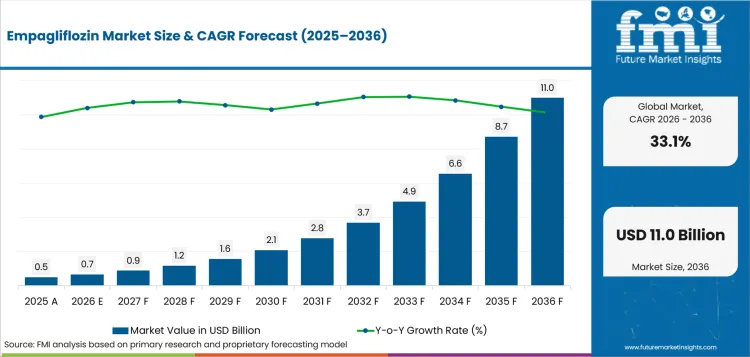
USD 0.6 billion in 2026 and USD 10.4 billion by 2036 at a 33.1% CAGR.
The empagliflozin API market is expected to rise from USD 0.5 billion in 2025 to USD 10.4 billion by 2036. Growth is expected to be driven by regulated formulation demand and wider cardiorenal use. Powder is expected to hold 68.4% share in 2026. The >=99.5% purity grade is estimated to hold 57.2% share in the same year.
| Metric | Value |
|---|---|
| 2026 Market Size | USD 0.6 billion |
| 2036 Market Size | USD 10.4 billion |
| Forecast CAGR (2026-2036) | 33.1% |
| Leading Form | Powder |
| Powder Share (2026) | 68.4% |
| Leading Purity Grade | >=99.5% |
| >=99.5% Grade Share (2026) | 57.2% |
| Fastest-growing Country | China |
| China CAGR by 2036 | 34.6% |
| Market Signal | Commercial Impact |
|---|---|
| Demand and Growth Drivers | Expanding cardiorenal therapy use is sustaining demand for empagliflozin APIs.
|
| Product and Segment View | Powder form, high-purity grades, and direct sales dominate their respective market segments.
|
| Geography and Growth Outlook | China and India are expected to remain the fastest-growing production and consumption markets.
|
| Competitive Landscape | Competition focuses on API quality, regulatory support, and formulation capabilities.
|
| Analyst Perspective | Empagliflozin API sourcing is increasingly driven by regulatory confidence rather than pricing alone.
- Anurag Sharma, Principal Consultant at Future Market Insights (Healthcare) |
Quality evidence is becoming the first buying filter in SGLT2 API sourcing because formulation teams verify demand relevance and export readiness before they scale orders. Boehringer Ingelheim reported in March 2026 that JARDIANCE grew 8.7% to EUR 8.8 billion in 2025. CDSCO’s April 2024 WC-0493 certificate lists MetroChem API Unit IV for 27 APIs with manufacturing and packing coverage including Empagliflozin IHS. The same certificate remains valid until January 21 2027. These records are important because small molecule API sourcing moves through documents before commercial orders scale.
Which factors support expansion in the empagliflozin market?
Finished API revenue and regulated filing support are expected to shape market value across diabetes and cardiorenal applications.
- Market value is supported by empagliflozin API revenue before finished-dose brands and pharmacy dispensing are counted.
- Supplier pricing reflects synthesis control and impurity evidence before channel margins affect contract terms.
- Revenue improves as diabetes tablet programs add heart failure and kidney disease planning.
- Buyer trust rises when suppliers provide DMF coverage and clear audit responses.
Why is the empagliflozin market growing?
Regulatory documentation drives API purchasing decisions
Adult diabetes treatment volume gives the market its base. IDF reported 589 million adults with diabetes worldwide in 2024. DailyMed labeling then extends the product role into heart failure and chronic kidney disease. The practical result is stronger demand for high-purity API with complete filing support. Buyers in specialty active pharmaceutical ingredients screen suppliers around documentation before price.
How is the empagliflozin market segmented?
The empagliflozin industry is segmented by form and purity grade. It also covers application, sales channel and region.
- Powder is projected to account for 68.4% share in 2026 because oral solid manufacturers value blend behavior.
- The >=99.5% grade is expected to secure 57.2% share in 2026 as regulated filings need impurity control.
- Type 2 diabetes is forecast to represent 61.5% application share in 2026 through broad oral SGLT2 use.
- Direct sales are anticipated to hold 58.6% share in 2026 because large formulators prefer supplier audits.
- East Asia is expected to hold 31.4% regional share in 2026 due to API capacity and formulation demand.
Why does powder lead the empagliflozin market?
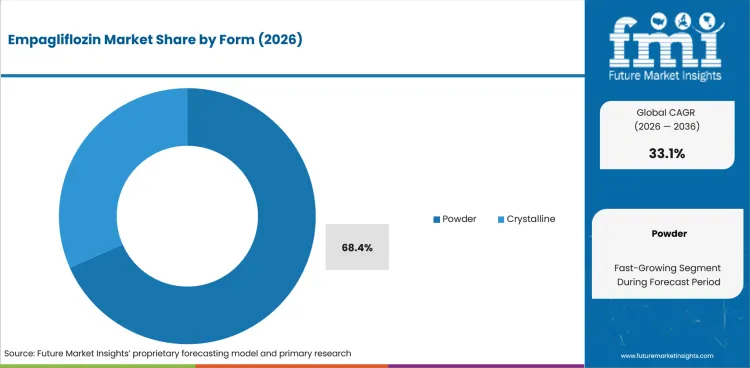
- Powder is projected to account for 68.4% share in 2026 because tablet makers need blend-ready API for oral solid manufacturing.
- Crystalline material remains relevant in stability-sensitive sourcing where buyers compare particle behavior before final processing.
Which purity grade leads the empagliflozin market?
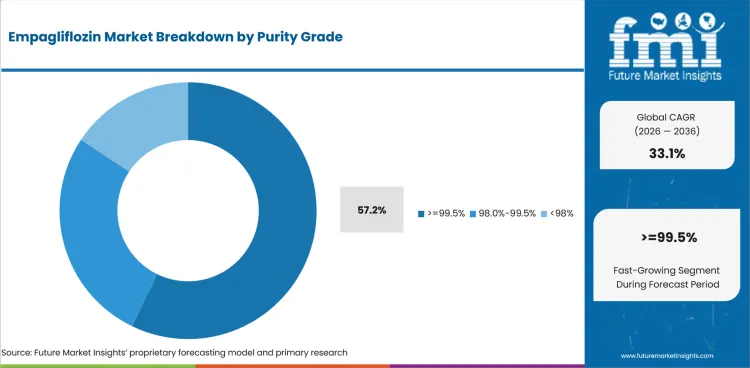
- The >=99.5% grade is expected to hold 57.2% share in 2026 because impurity control affects regulated dossiers.
- Lower-purity grades mainly support early development or less demanding channels before final filing batches are prepared.
Which application leads the empagliflozin market?
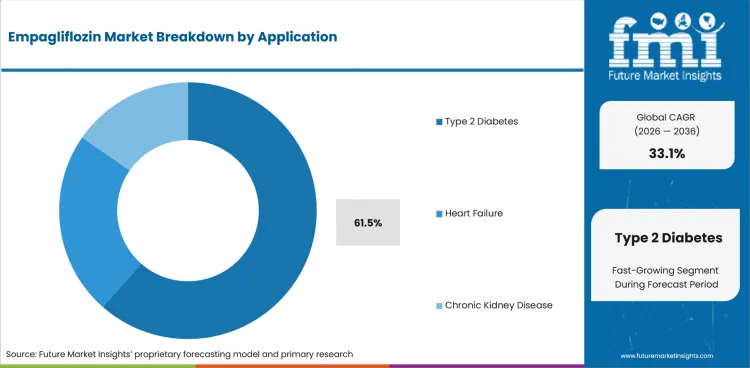
- Type 2 diabetes is projected to represent 61.5% share in 2026 because oral antidiabetic therapy provides the largest demand base.
- Heart failure and chronic kidney disease create added portfolio value for the same molecule.
Which sales channel leads the empagliflozin market?
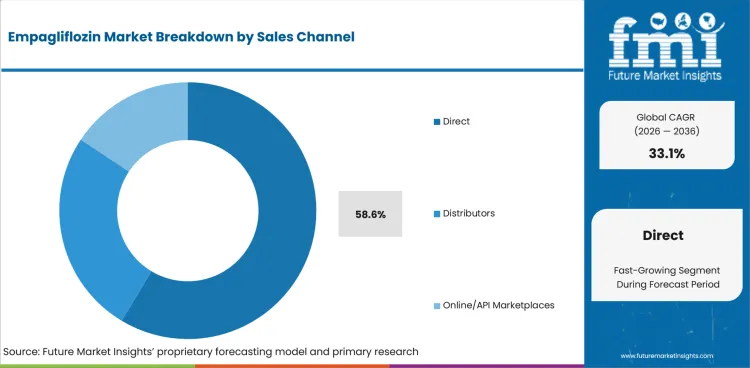
- Direct sales are expected to hold 58.6% share in 2026 because large buyers prefer audited supply contracts.
- Distributors remain useful for sample supply and smaller development batches.
What supports empagliflozin growth and what limits it?
Cardiorenal label expansion supports API demand but filing burden limits weaker suppliers.
- Driver: Diabetes and cardiorenal indications are expected to widen API sourcing across chronic disease portfolios.
- Restraint: Documentation gaps can delay supplier qualification when buyers prepare regulated filings.
- Opportunity: Filing-supported suppliers can win direct contracts as generic formulation windows tighten.
Empagliflozin Market Demand Outlook
Demand outlook is moving toward regulated API supply that can prove impurity control before commercial awards. DailyMed labeling covers adult heart failure and chronic kidney disease risk reduction. EMA product information also gives a 10 mg once-daily dose across type 2 diabetes and cardiorenal uses. Manufacturers serving oral solid dosage formulation should prioritize powder quality and audit-ready documents.
Buyer Segmentation and Purchase Behavior Analysis
The direct buyer is a regulated formulation manufacturer. Large buyers compare API suppliers through batch history and impurity profiles. Smaller buyers may use distributors or online API marketplaces for samples before direct qualification. Demand from obesity-diabetes drugs and GLP-1 diabetes treatment drugs does not remove SGLT2 demand. It raises the need for clear portfolio positioning.
Voice of Customer and Decision-driver Analysis
Formulation buyers are expected to choose suppliers that reduce regulatory friction. A lower API quote loses value when impurity data or audit response is weak. Buyers preparing controlled release or combination products also need partners that understand oral controlled release drug delivery. Documentation quality is therefore a commercial selection factor.
Which countries are growing fastest in the empagliflozin market?
China leads at 34.6% CAGR and India follows at 33.8% CAGR. South Korea records 30.9% and the United States reaches 29.8%. Germany posts 28.4% while France reaches 27.9%. The United Kingdom records 27.6% and Japan reaches 25.8% by 2036.
.webp "Top Country Growth Comparison Empagliflozin Market Cagr (2026 2036)")
| Country | CAGR |
|---|---|
| China | 34.6% |
| India | 33.8% |
| South Korea | 30.9% |
| United States | 29.8% |
| Germany | 28.4% |
| France | 27.9% |
| United Kingdom | 27.6% |
| Japan | 25.8% |
Source: Future Market Insights, 2026.
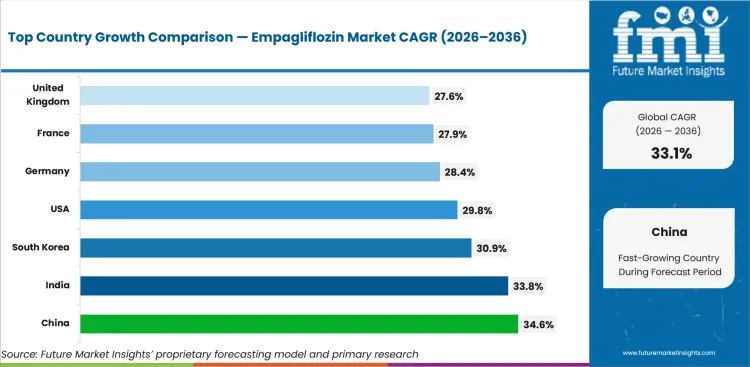
How do country-level CAGRs compare in the empagliflozin market?
China leads country growth while Japan records the most cautious expansion outlook among profiled markets.
- China is forecast to record 34.6% CAGR by 2036 as disease burden and API capacity support demand.
- India is expected to expand at 33.8% CAGR from 2026 to 2036 through domestic volume and export supply.
- South Korea is projected to grow at 30.9% CAGR through the forecast decade as filing-sensitive buyers qualify suppliers.
- The United States is estimated to rise at 29.8% CAGR by 2036 through FDA-driven product pathways.
- Germany is expected to advance at 28.4% CAGR across the forecast period as quality checks remain strict.
- France is forecast to grow at 27.9% CAGR over the assessment period as reimbursement review shapes access.
- The United Kingdom is projected to post 27.6% CAGR by 2036 as NHS pathways guide prescribing.
- Japan is expected to record 25.8% CAGR during the forecast period as validation cycles slow supplier switching.
How fast is the empagliflozin market growing in China?
A 34.6% CAGR by 2036 reflects country demand conditions and supplier qualification needs.
Country Market Snapshot Table
| Parameter | Value |
|---|---|
| Market Size in 2025 (Value) | USD 85.4 million |
| Market Size in 2026 (Value) | USD 115.0 million |
| Market Forecast in 2036 (Value) | USD 2244.6 million |
| CAGR (2026 to 2036) | 34.6% |
| Years Considered | 2021 to 2036 |
| Base Year | 2025 |
| Forecast Period | 2026 to 2036 |
| Units Considered | Value in USD million |
| Leading Sub-Region | Yangtze River Delta and Shandong API clusters |
China Empagliflozin Market Outlook
China is the largest diabetes demand center in the selected country set. IDF reported 148.0 million adults with diabetes in 2024. Domestic treatment volume and synthesis depth are expected to support a 34.6% CAGR by 2036. Suppliers that pair scale with impurity discipline should be better placed than firms selling only on price.
Commercial demand is expected to favor audited suppliers that can support filings and repeated quality reviews. This makes documentation strength as important as synthesis scale.
Key Growth Drivers
- China demand has a large treatment base since IDF reported 148.0 million adults with diabetes in 2024.
- China cardiorenal planning is supported by EMA product information that gives a 10 mg once-daily dose for chronic kidney disease.
- Chinese API buyers are expected to prioritize suppliers with repeatable impurity records and reliable batch release behavior.
- Export programs can favor suppliers able to answer dossier questions quickly for regulated-market buyers.
Key Restraints
- China demand conversion can lag as WHO reported over 50% of people with diabetes did not take medication in 2022.
- Tender pressure can reduce finished-dose prices and narrow API margin room for weaker suppliers.
- Export acceptance can slow when impurity data or audit records do not satisfy regulated buyers.
What makes China unique
China is unique because disease scale and API synthesis depth support both domestic supply and export screening.
Key Companies
- Zhejiang Huahai Pharmaceutical
- Hansoh Pharma
- CSPC Pharmaceutical Group
- Jiangsu Hengrui Pharmaceuticals
- Qilu Pharmaceutical
Sales & Marketing Channels
- Direct API contracts
- Tender-based formulation supply
- Distributors
- Regulated export channels
- Online API discovery
Country Segment Breakdown Table
| Segment | Sub-Segments |
|---|---|
| By Form | Powder · Crystalline |
| By Purity Grade | >=99.5% · 98.0%-99.5% · <98% |
| By Application | Type 2 Diabetes · Heart Failure · Chronic Kidney Disease |
| By Sales Channel | Direct · Distributors · Online/API Marketplaces |
| Key Sub-Regions Covered | Shanghai · Jiangsu · Zhejiang · Shandong · Guangdong · Beijing |
Frequently Asked Questions
How fast is China empagliflozin market growing?
Demand in China is expected to expand at 34.6% CAGR by 2036 based on local demand and qualification needs.
Who leads China empagliflozin market?
Zhejiang Huahai Pharmaceutical and Hansoh Pharma compete through formulation access. Other local suppliers use quality evidence to gain buyer trust.
What is driving adoption in China empagliflozin market?
Diabetes demand and cardiorenal label use are expected to move buyers toward qualified empagliflozin API suppliers.
What is driving empagliflozin growth in India?
A 33.8% CAGR by 2036 reflects country demand conditions and supplier qualification needs.
Country Market Snapshot Table
| Parameter | Value |
|---|---|
| Market Size in 2025 (Value) | USD 59.8 million |
| Market Size in 2026 (Value) | USD 80.0 million |
| Market Forecast in 2036 (Value) | USD 1471.1 million |
| CAGR (2026 to 2036) | 33.8% |
| Years Considered | 2021 to 2036 |
| Base Year | 2025 |
| Forecast Period | 2026 to 2036 |
| Units Considered | Value in USD million |
| Leading Sub-Region | Hyderabad and western India API corridors |
India Empagliflozin Market Outlook
India combines a large treatment pool with export-oriented API supply. IDF reported 89.8 million adults with diabetes in India in 2024. Domestic demand and regulated export qualification are projected to support a 33.8% CAGR by 2036. Official written confirmation evidence gives buyers a stronger basis for supplier screening.
Commercial demand is expected to favor audited suppliers that can support filings and repeated quality reviews. This makes documentation strength as important as synthesis scale.
Key Growth Drivers
- India demand is supported by diabetes scale since IDF reported 89.8 million adults with diabetes in 2024.
- India API qualification is reinforced by CDSCO written confirmation covering 1 MetroChem API Unit-IV site for Empagliflozin IHS.
- Export programs are expected to favor suppliers with DMF-ready documents and audit-ready production records.
- Formulation companies can combine domestic volume with regulated-market launch planning.
Key Restraints
- India demand conversion can lag as WHO reported over 50% of people with diabetes did not take medication in 2022.
- Domestic pricing pressure can squeeze API margins when finished-dose competition lowers tablet prices.
- Smaller producers may lose regulated buyers when filing documentation is incomplete or dated.
What makes India unique
India is unique because API manufacturing depth and generic formulation capacity operate in the same commercial system.
Key Companies
- Dr. Reddy’s Laboratories
- MetroChem API
- MSN Laboratories
- Lupin
- Zydus Lifesciences
- Aurobindo Pharma
Sales & Marketing Channels
- Direct API contracts
- Contract manufacturing supply
- Domestic formulation buyers
- Export distributors
- Online API marketplaces
Country Segment Breakdown Table
| Segment | Sub-Segments |
|---|---|
| By Form | Powder · Crystalline |
| By Purity Grade | >=99.5% · 98.0%-99.5% · <98% |
| By Application | Type 2 Diabetes · Heart Failure · Chronic Kidney Disease |
| By Sales Channel | Direct · Distributors · Online/API Marketplaces |
| Key Sub-Regions Covered | Hyderabad · Visakhapatnam · Mumbai · Ahmedabad · Pune · Delhi NCR |
Frequently Asked Questions
How fast is India empagliflozin market growing?
Demand in India is expected to expand at 33.8% CAGR by 2036 based on local demand and qualification needs.
Who leads India empagliflozin market?
Dr. Reddy’s Laboratories and MetroChem API compete through formulation access. Other local suppliers use quality evidence to gain buyer trust.
What is driving adoption in India empagliflozin market?
Diabetes demand and cardiorenal label use are expected to move buyers toward qualified empagliflozin API suppliers.
How is the empagliflozin market performing in South Korea?
A 30.9% CAGR by 2036 reflects country demand conditions and supplier qualification needs.
Country Market Snapshot Table
| Parameter | Value |
|---|---|
| Market Size in 2025 (Value) | USD 22.9 million |
| Market Size in 2026 (Value) | USD 30.0 million |
| Market Forecast in 2036 (Value) | USD 443.1 million |
| CAGR (2026 to 2036) | 30.9% |
| Years Considered | 2021 to 2036 |
| Base Year | 2025 |
| Forecast Period | 2026 to 2036 |
| Units Considered | Value in USD million |
| Leading Sub-Region | Seoul Capital Area and Incheon pharma corridors |
South Korea Empagliflozin Market Outlook
South Korea is a filing-sensitive formulation market with moderate volume. IDF reported 5.0 million adults with diabetes in South Korea in 2024. Korea DMF evidence and local quality review are expected to support a 30.9% CAGR by 2036. Supplier selection should favor documentation depth over opportunistic spot supply.
Commercial demand is expected to favor audited suppliers that can support filings and repeated quality reviews. This makes documentation strength as important as synthesis scale.
Key Growth Drivers
- South Korea demand is supported by IDF data showing 5.0 million adults with diabetes in 2024.
- South Korea supplier screening gains support from Dr. Reddy’s listing Korea DMF among 7 filing routes for empagliflozin API.
- Formulators are expected to value impurity discipline as cardiorenal use widens product planning.
- Direct sourcing can work well when suppliers support local review and stable batch history.
Key Restraints
- South Korea treatment conversion can lag since WHO reported over 50% of people with diabetes did not take medication in 2022.
- Market scale gives buyers less volume leverage than China or India during API negotiations.
- Supplier access can narrow when companies lack Korea-ready filing support.
What makes South Korea unique
South Korea is unique because supplier approval depends on quality review and Korea-ready filing evidence.
Key Companies
- Hanmi Pharm
- Dong-A ST
- Daewoong Pharmaceutical
- Chong Kun Dang
- Celltrion Pharm
Sales & Marketing Channels
- Direct API contracts
- Local formulation partners
- Hospital tender routes
- Regulated distributors
- Specialty pharma channels
Country Segment Breakdown Table
| Segment | Sub-Segments |
|---|---|
| By Form | Powder · Crystalline |
| By Purity Grade | >=99.5% · 98.0%-99.5% · <98% |
| By Application | Type 2 Diabetes · Heart Failure · Chronic Kidney Disease |
| By Sales Channel | Direct · Distributors · Online/API Marketplaces |
| Key Sub-Regions Covered | Seoul · Incheon · Gyeonggi · Daejeon · Busan · Daegu |
Frequently Asked Questions
How fast is South Korea empagliflozin market growing?
Demand in South Korea is expected to expand at 30.9% CAGR by 2036 based on local demand and qualification needs.
Who leads South Korea empagliflozin market?
Hanmi Pharm and Dong-A ST compete through formulation access. Other local suppliers use quality evidence to gain buyer trust.
What is driving adoption in South Korea empagliflozin market?
Diabetes demand and cardiorenal label use are expected to move buyers toward qualified empagliflozin API suppliers.
What is the empagliflozin market outlook in the United States?
A 29.8% CAGR by 2036 reflects country demand conditions and supplier qualification needs.
Country Market Snapshot Table
| Parameter | Value |
|---|---|
| Market Size in 2025 (Value) | USD 65.5 million |
| Market Size in 2026 (Value) | USD 85.0 million |
| Market Forecast in 2036 (Value) | USD 1153.9 million |
| CAGR (2026 to 2036) | 29.8% |
| Years Considered | 2021 to 2036 |
| Base Year | 2025 |
| Forecast Period | 2026 to 2036 |
| Units Considered | Value in USD million |
| Leading Sub-Region | Northeast and national generic supply networks |
United States Empagliflozin Market Outlook
The United States is shaped by strict filing expectations and chronic disease demand. CDC reported 40.1 million people with diagnosed or undiagnosed diabetes in 2023. FDA systems and label requirements are projected to support a 29.8% CAGR by 2036. API suppliers need USDMF depth and quick audit responses to compete.
Commercial demand is expected to favor audited suppliers that can support filings and repeated quality reviews. This makes documentation strength as important as synthesis scale.
Key Growth Drivers
- United States demand is supported by CDC data showing 40.1 million people with diabetes in 2023.
- United States cardiorenal use is supported by DailyMed labeling that lists 3 adult therapeutic pathways for Jardiance.
- FDA Orange Book checks are expected to guide buyers as generic planning moves through approval pathways.
- Formulators prefer suppliers with USDMF coverage and repeatable impurity evidence before commercial awards.
Key Restraints
- United States demand conversion is limited because CDC estimated 27.6% of adults with diabetes were undiagnosed.
- Supplier qualification can be slow because FDA-based filing evidence must be checked before commercial sourcing.
- Price pressure can rise quickly after generic competition expands across oral SGLT2 products.
What makes United States unique
The United States is unique because FDA databases and Orange Book checks shape product launch planning.
Key Companies
- Boehringer Ingelheim Pharmaceuticals
- Eli Lilly and Company
- Dr. Reddy’s Laboratories USA
- Lupin Pharmaceuticals Inc.
- Aurobindo Pharma USA
Sales & Marketing Channels
- Direct API supply
- ANDA-based formulation programs
- Contract manufacturing
- National wholesalers
- Specialty distributors
Country Segment Breakdown Table
| Segment | Sub-Segments |
|---|---|
| By Form | Powder · Crystalline |
| By Purity Grade | >=99.5% · 98.0%-99.5% · <98% |
| By Application | Type 2 Diabetes · Heart Failure · Chronic Kidney Disease |
| By Sales Channel | Direct · Distributors · Online/API Marketplaces |
| Key Sub-Regions Covered | New Jersey · North Carolina · Pennsylvania · California · Texas · Illinois |
Frequently Asked Questions
How fast is United States empagliflozin market growing?
Demand in United States is expected to expand at 29.8% CAGR by 2036 based on local demand and qualification needs.
Who leads United States empagliflozin market?
Boehringer Ingelheim Pharmaceuticals and Eli Lilly and Company compete through formulation access. Other local suppliers use quality evidence to gain buyer trust.
What is driving adoption in United States empagliflozin market?
Diabetes demand and cardiorenal label use are expected to move buyers toward qualified empagliflozin API suppliers.
How is the empagliflozin market performing in Germany?
A 28.4% CAGR by 2036 reflects country demand conditions and supplier qualification needs.
Country Market Snapshot Table
| Parameter | Value |
|---|---|
| Market Size in 2025 (Value) | USD 27.3 million |
| Market Size in 2026 (Value) | USD 35.0 million |
| Market Forecast in 2036 (Value) | USD 426.3 million |
| CAGR (2026 to 2036) | 28.4% |
| Years Considered | 2021 to 2036 |
| Base Year | 2025 |
| Forecast Period | 2026 to 2036 |
| Units Considered | Value in USD million |
| Leading Sub-Region | North Rhine-Westphalia and southern pharma corridors |
Germany Empagliflozin Market Outlook
Germany is a quality-led demand market with careful reimbursement review. IDF reported 6.5 million adults with diabetes in Germany in 2024. EMA and German G-BA review activity are expected to support a 28.4% CAGR by 2036. Suppliers need strong documentation before lower-cost API can win trust.
Commercial demand is expected to favor audited suppliers that can support filings and repeated quality reviews. This makes documentation strength as important as synthesis scale.
Key Growth Drivers
- Germany demand is supported by IDF data showing 6.5 million adults with diabetes in 2024.
- Germany CKD access is supported by G-BA evidence noting the chronic kidney disease indication entered force on 1 February 2024.
- German buyers are expected to reward API suppliers with stable quality systems and complete batch records.
- Pharmacy reimbursement systems can support broad use once finished-dose products meet access requirements.
Key Restraints
- Germany demand conversion can lag as WHO reported over 50% of people with diabetes did not take medication in 2022.
- Supplier qualification can slow switching because buyers require strong documentation before accepting lower-cost API.
- Reimbursement pressure can reduce finished-product margins and squeeze API pricing.
What makes Germany unique
Germany is unique because reimbursement review and strict supplier documentation both guide API qualification.
Key Companies
- Boehringer Ingelheim
- STADA Arzneimittel
- Ratiopharm
- Hexal
- Zentiva Germany
Sales & Marketing Channels
- Direct API contracts
- Generic formulation buyers
- Hospital purchasing groups
- Pharmacy wholesalers
- EU distribution partners
Country Segment Breakdown Table
| Segment | Sub-Segments |
|---|---|
| By Form | Powder · Crystalline |
| By Purity Grade | >=99.5% · 98.0%-99.5% · <98% |
| By Application | Type 2 Diabetes · Heart Failure · Chronic Kidney Disease |
| By Sales Channel | Direct · Distributors · Online/API Marketplaces |
| Key Sub-Regions Covered | North Rhine-Westphalia · Bavaria · Baden-Wurttemberg · Hesse · Hamburg · Berlin |
Frequently Asked Questions
How fast is Germany empagliflozin market growing?
Demand in Germany is expected to expand at 28.4% CAGR by 2036 based on local demand and qualification needs.
Who leads Germany empagliflozin market?
Boehringer Ingelheim and STADA Arzneimittel compete through formulation access. Other local suppliers use quality evidence to gain buyer trust.
What is driving adoption in Germany empagliflozin market?
Diabetes demand and cardiorenal label use are expected to move buyers toward qualified empagliflozin API suppliers.
What is the empagliflozin market forecast for France?
A 27.9% CAGR by 2036 reflects country demand conditions and supplier qualification needs.
Country Market Snapshot Table
| Parameter | Value |
|---|---|
| Market Size in 2025 (Value) | USD 21.9 million |
| Market Size in 2026 (Value) | USD 28.0 million |
| Market Forecast in 2036 (Value) | USD 328.0 million |
| CAGR (2026 to 2036) | 27.9% |
| Years Considered | 2021 to 2036 |
| Base Year | 2025 |
| Forecast Period | 2026 to 2036 |
| Units Considered | Value in USD million |
| Leading Sub-Region | Ile-de-France and Lyon pharma corridors |
France Empagliflozin Market Outlook
France is guided by reimbursement review and chronic disease access. IDF reported 4.1 million adults with diabetes in France in 2024. Public benefit review and regulated formulation demand are expected to support a 27.9% CAGR by 2036. Suppliers must align API quality evidence with finished-product access needs.
Commercial demand is expected to favor audited suppliers that can support filings and repeated quality reviews. This makes documentation strength as important as synthesis scale.
Key Growth Drivers
- France demand is supported by IDF data showing 4.1 million adults with diabetes in 2024.
- France cardiorenal relevance is supported by EMA product information that states 3 therapeutic areas for Jardiance.
- French buyers are expected to connect API sourcing with finished-product reimbursement and clinical review.
- Generic suppliers can benefit when reimbursement access supports wider prescribing across chronic disease groups.
Key Restraints
- France demand conversion can lag as WHO reported over 50% of people with diabetes did not take medication in 2022.
- Pricing negotiation can narrow margin room for finished products and API sourcing.
- Suppliers without strong documentation may lose access when public review raises evidence expectations.
What makes France unique
France is unique because reimbursement review can affect both launch timing and supplier selection.
Key Companies
- Sanofi
- Servier
- Biogaran
- Zentiva France
- Bouchara-Recordati
Sales & Marketing Channels
- Direct API contracts
- Reimbursement-based formulation programs
- Hospital pharmacy buyers
- National wholesalers
- Specialty distributors
Country Segment Breakdown Table
| Segment | Sub-Segments |
|---|---|
| By Form | Powder · Crystalline |
| By Purity Grade | >=99.5% · 98.0%-99.5% · <98% |
| By Application | Type 2 Diabetes · Heart Failure · Chronic Kidney Disease |
| By Sales Channel | Direct · Distributors · Online/API Marketplaces |
| Key Sub-Regions Covered | Ile-de-France · Lyon · Normandy · Hauts-de-France · Occitanie · Provence-Alpes-Cote d’Azur |
Frequently Asked Questions
How fast is France empagliflozin market growing?
Demand in France is expected to expand at 27.9% CAGR by 2036 based on local demand and qualification needs.
Who leads France empagliflozin market?
Sanofi and Servier compete through formulation access. Other local suppliers use quality evidence to gain buyer trust.
What is driving adoption in France empagliflozin market?
Diabetes demand and cardiorenal label use are expected to move buyers toward qualified empagliflozin API suppliers.
What is the empagliflozin market outlook in the United Kingdom?
A 27.6% CAGR by 2036 reflects country demand conditions and supplier qualification needs.
Country Market Snapshot Table
| Parameter | Value |
|---|---|
| Market Size in 2025 (Value) | USD 20.4 million |
| Market Size in 2026 (Value) | USD 26.0 million |
| Market Forecast in 2036 (Value) | USD 297.5 million |
| CAGR (2026 to 2036) | 27.6% |
| Years Considered | 2021 to 2036 |
| Base Year | 2025 |
| Forecast Period | 2026 to 2036 |
| Units Considered | Value in USD million |
| Leading Sub-Region | London and national NHS supply pathways |
United Kingdom Empagliflozin Market Outlook
The United Kingdom is shaped by NICE guidance and NHS supply pathways. IDF reported 4.5 million adults with diabetes in the United Kingdom in 2024. National guidance and chronic kidney disease use are expected to support a 27.6% CAGR by 2036. Buyers should favor suppliers that protect filing continuity.
Commercial demand is expected to favor audited suppliers that can support filings and repeated quality reviews. This makes documentation strength as important as synthesis scale.
Key Growth Drivers
- United Kingdom demand is supported by IDF data showing 4.5 million adults with diabetes in 2024.
- United Kingdom kidney disease access is supported by NICE TA942 which recommends empagliflozin for eligible adults with CKD.
- NHS supply routes are expected to favor stable formulation partners with secure API sourcing.
- National guidance can help buyers plan wider cardiorenal portfolios around one molecule.
Key Restraints
- United Kingdom demand conversion can lag as WHO reported over 50% of people with diabetes did not take medication in 2022.
- Imported API reliance can expose formulation supply to documentation and logistics delays.
- Uptake can remain budget-sensitive because NHS pathways review treatment cost before broad access.
What makes United Kingdom unique
The United Kingdom is unique because NICE guidance and NHS pathways shape demand timing.
Key Companies
- Boehringer Ingelheim UK
- Eli Lilly UK
- Accord Healthcare
- Teva UK
- Zentiva UK
Sales & Marketing Channels
- Direct API contracts
- NHS supply routes
- Generic formulation buyers
- Hospital pharmacy buyers
- National wholesalers
Country Segment Breakdown Table
| Segment | Sub-Segments |
|---|---|
| By Form | Powder · Crystalline |
| By Purity Grade | >=99.5% · 98.0%-99.5% · <98% |
| By Application | Type 2 Diabetes · Heart Failure · Chronic Kidney Disease |
| By Sales Channel | Direct · Distributors · Online/API Marketplaces |
| Key Sub-Regions Covered | London · Manchester · Birmingham · Leeds · Glasgow · Cambridge |
Frequently Asked Questions
How fast is United Kingdom empagliflozin market growing?
Demand in United Kingdom is expected to expand at 27.6% CAGR by 2036 based on local demand and qualification needs.
Who leads United Kingdom empagliflozin market?
Boehringer Ingelheim UK and Eli Lilly UK compete through formulation access. Other local suppliers use quality evidence to gain buyer trust.
What is driving adoption in United Kingdom empagliflozin market?
Diabetes demand and cardiorenal label use are expected to move buyers toward qualified empagliflozin API suppliers.
What is the empagliflozin market forecast for Japan?
A 25.8% CAGR by 2036 reflects country demand conditions and supplier qualification needs.
Country Market Snapshot Table
| Parameter | Value |
|---|---|
| Market Size in 2025 (Value) | USD 25.4 million |
| Market Size in 2026 (Value) | USD 32.0 million |
| Market Forecast in 2036 (Value) | USD 317.7 million |
| CAGR (2026 to 2036) | 25.8% |
| Years Considered | 2021 to 2036 |
| Base Year | 2025 |
| Forecast Period | 2026 to 2036 |
| Units Considered | Value in USD million |
| Leading Sub-Region | Tokyo and Kansai pharma corridors |
Japan Empagliflozin Market Outlook
Japan combines steady oral therapy demand with careful supplier validation. IDF reported 10.8 million adults with diabetes in Japan in 2024. Quality review and long validation cycles are projected to support a 25.8% CAGR by 2036. Suppliers must show stable documents before commercial switching becomes realistic.
Commercial demand is expected to favor audited suppliers that can support filings and repeated quality reviews. This makes documentation strength as important as synthesis scale.
Key Growth Drivers
- Japan demand is supported by IDF data showing 10.8 million adults with diabetes in 2024.
- Japan cardiorenal planning is supported by EMA product information that gives a 10 mg once-daily dose for chronic kidney disease.
- Japanese formulation partners are expected to value empagliflozin where cardiorenal use supports portfolio extension.
- Direct sourcing can work well when suppliers support long validation cycles and local documentation needs.
Key Restraints
- Japan demand conversion can lag as WHO reported over 50% of people with diabetes did not take medication in 2022.
- Supplier switching can be slow because validation cycles and quality reviews take time.
- Smaller API suppliers can face access limits when documentation depth does not match buyer expectations.
What makes Japan unique
Japan is unique because supplier validation can be slower than demand growth.
Key Companies
- Nippon Boehringer Ingelheim
- Eli Lilly Japan
- Sawai Group Holdings
- Towa Pharmaceutical
- Nichi-Iko Pharmaceutical
Sales & Marketing Channels
- Direct API contracts
- Generic formulation programs
- Wholesaler networks
- Hospital pharmacy routes
- Specialty distributors
Country Segment Breakdown Table
| Segment | Sub-Segments |
|---|---|
| By Form | Powder · Crystalline |
| By Purity Grade | >=99.5% · 98.0%-99.5% · <98% |
| By Application | Type 2 Diabetes · Heart Failure · Chronic Kidney Disease |
| By Sales Channel | Direct · Distributors · Online/API Marketplaces |
| Key Sub-Regions Covered | Tokyo · Osaka · Yokohama · Nagoya · Fukuoka · Sapporo |
Frequently Asked Questions
How fast is Japan empagliflozin market growing?
Demand in Japan is expected to expand at 25.8% CAGR by 2036 based on local demand and qualification needs.
Who leads Japan empagliflozin market?
Nippon Boehringer Ingelheim and Eli Lilly Japan compete through formulation access. Other local suppliers use quality evidence to gain buyer trust.
What is driving adoption in Japan empagliflozin market?
Diabetes demand and cardiorenal label use are expected to move buyers toward qualified empagliflozin API suppliers.
Who are the leading companies in the empagliflozin market?
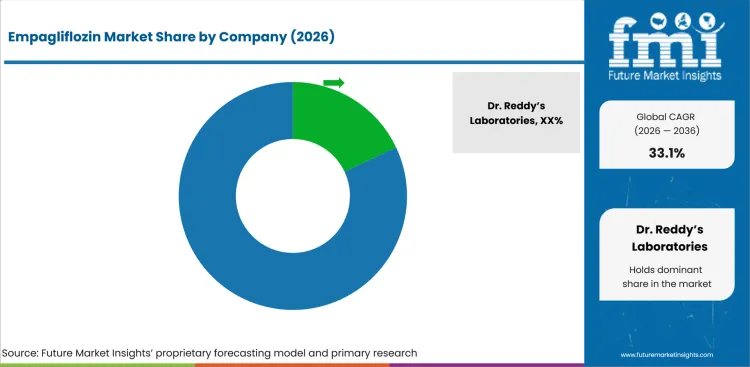
Dr. Reddy’s Laboratories and MetroChem API lead the API-side evidence. MSN Laboratories, Lupin and Boehringer Ingelheim support formulation and brand activity.
- DMF coverage and consistent impurity profiles create a competitive advantage for API manufacturers seeking regulated-market business.
- Rising use of Empagliflozin across diabetes and cardiorenal therapies improves demand visibility for formulation companies.
- Growing documentation and batch-planning requirements create support opportunities for contract manufacturing organizations (CMOs).
- Fast audit responses and strong product documentation help regulated-market suppliers differentiate themselves from competitors.
Industry in the competition is shaped by documentation strength. Dr. Reddy’s lists empagliflozin API with USDMF and Korea DMF coverage. MetroChem API has official CDSCO written confirmation evidence for Empagliflozin IHS. This supports buyer confidence in CMO and CDMO services where filings depend on supplier evidence.
Formulation-side competition is influenced by product access and brand transfers. Lupin’s December 2024 acquisition of GIBTULIO and related diabetes trademarks strengthens its India diabetes portfolio. MSN Laboratories also lists empagliflozin tablet products. These signals matter because API offtake follows finished-dose planning.
Suppliers with stronger filing support are better positioned than companies selling only on spot price. The opportunity is clearest for firms that combine synthesis control with high-potent oral solid dosage contract manufacturing support and stable quality systems.
How do top empagliflozin companies compare?
Dr. Reddy’s and MetroChem show stronger public API evidence while Lupin and MSN support formulation-side demand signals.
| Company | Relevance to Market Title | API Evidence | Formulation Evidence | Regulatory Filing Depth | Geographic Footprint |
|---|---|---|---|---|---|
| Dr. Reddy’s Laboratories | Very High | Very Strong | Moderate | Very Strong | Global |
| MetroChem API | Very High | Very Strong | Low | Strong | India and export markets |
| MSN Laboratories | High | Moderate | Strong | Moderate | India and selected exports |
| Lupin | High | Low | Strong | Strong | India and global generics |
| Boehringer Ingelheim | High | Low | Very Strong | Very Strong | Global |
| Eli Lilly and Company | Moderate | Low | Strong | Very Strong | United States and global |
| Zydus Lifesciences | Moderate | Moderate | Moderate | Moderate | India and export markets |
| Aurobindo Pharma | Moderate | Moderate | Moderate | Moderate | India and global generics |
| Sawai Group Holdings | Moderate | Low | Moderate | Moderate | Japan |
| STADA Arzneimittel | Moderate | Low | Moderate | Moderate | Europe |
Source: Future Market Insights competitive analysis, 2026.
Who are the key players in the empagliflozin market?
Dr. Reddy’s Laboratories, MetroChem API and MSN Laboratories are listed with Lupin and Boehringer Ingelheim among other suppliers.
Key global companies leading the empagliflozin market include:
- Dr. Reddy’s Laboratories
- MetroChem API
- MSN Laboratories
- Lupin
- Boehringer Ingelheim
- Eli Lilly and Company
- Zydus Lifesciences
- Aurobindo Pharma
- Sawai Group Holdings
- STADA Arzneimittel
Key Developments in Empagliflozin Market
- In April 2025 IDF released its Diabetes Atlas 11th edition with 589 million adults living with diabetes worldwide.
- In September 2025 CDSCO issued written confirmation for MetroChem API Unit-IV covering Empagliflozin IHS manufacturing and packing.
- In December 2024 Lupin announced the acquisition of GIBTULIO and related anti-diabetes trademarks from Boehringer Ingelheim.
Key Players in the Empagliflozin Market
API Manufacturers
- Dr. Reddy’s Laboratories
- MetroChem API
- Zydus Lifesciences
- Aurobindo Pharma
- Hetero Labs
Formulation and Brand Owners
- Boehringer Ingelheim
- Eli Lilly and Company
- Lupin
- MSN Laboratories
- Sawai Group Holdings
Regional Generic Suppliers
- STADA Arzneimittel
- Accord Healthcare
- Teva UK
- Zentiva
- Biogaran
Empagliflozin Market - Report Scope
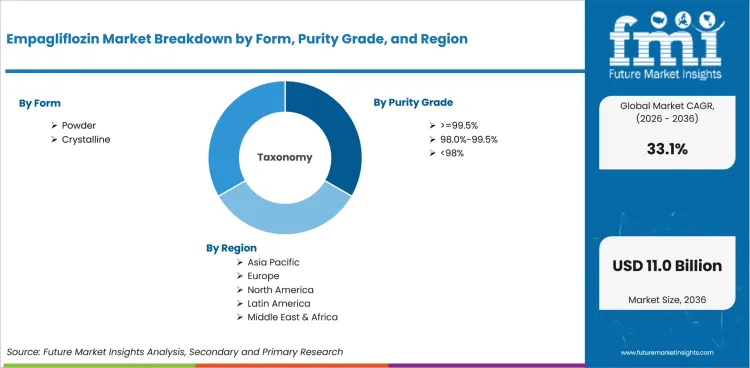
| Parameter | Details |
|---|---|
| Forecast period | 2026 to 2036 |
| Historical period | 2021 to 2025 |
| Quantitative unit | Revenue in USD billion |
| By form | Powder and crystalline |
| By purity grade | >=99.5%; 98.0%-99.5%; <98% |
| By application | Type 2 diabetes; heart failure; chronic kidney disease |
| By sales channel | Direct; distributors; online/API marketplaces |
| Regions covered | North America; Latin America; Europe; East Asia; South Asia and Pacific; Middle East and Africa |
| Countries covered | China; India; South Korea; United States; Germany; France; United Kingdom; Japan |
| Key companies profiled | Dr. Reddy’s; MetroChem API; MSN Laboratories; Lupin; Boehringer Ingelheim; Eli Lilly |
Empagliflozin Market - Scope & Definition
| Attribute | Detail |
|---|---|
| Market Definition | Commercially traded empagliflozin active pharmaceutical ingredient used in oral solid dosage medicines. |
| Functions Covered | Glucose-lowering API supply; cardiorenal product support; regulated formulation input; filing-backed active ingredient sourcing. |
| Applications Covered | Type 2 diabetes; heart failure; chronic kidney disease across approved empagliflozin product pathways. |
| End-Use Industries | Pharmaceutical manufacturing; generic formulation; contract development and manufacturing; regulated API distribution. |
| Grades Covered | >=99.5%; 98.0%-99.5%; <98% purity grades. |
| Inclusions | Powder and crystalline empagliflozin API sold through direct contracts and distributors. Online/API marketplaces are included for early sourcing. |
| Exclusions | Finished Jardiance revenue; combination brand revenue; non-empagliflozin SGLT2 APIs; GLP-1 drugs; insulin; excipients; packaging; pharmacy dispensing revenue. |
Empagliflozin Market - Research Methodology
| Method | Description |
|---|---|
| Primary Research | FMI analyst interviews with API buyers and formulation manufacturers. Regulatory consultants and distribution partners were also reviewed. |
| Desk Research | Review of FDA and EMA records. DailyMed and CDSCO records were also checked. Company portfolios and public medicine records were reviewed separately. |
| Market Sizing & Forecasting | Bottom-up API demand approach using application mix and channel share. Contract pricing and country-level formulation activity were then reconciled. |
| Data Validation | Cross-verification using approved-use evidence and disease burden indicators. Company portfolio evidence and regional API supply behavior were then checked. |
Empagliflozin Market Breakdown by Core Segments
Empagliflozin Market Segmented by Form:
- Powder
- Crystalline
Empagliflozin Market Segmented by Purity Grade:
- >=99.5%
- 98.0%-99.5%
- <98%
Empagliflozin Market Segmented by Application:
- Type 2 Diabetes
- Heart Failure
- Chronic Kidney Disease
Empagliflozin Market Segmented by Sales Channel:
- Direct
- Distributors
- Online/API Marketplaces
Empagliflozin Market by Region:
- North America
- Latin America
- Europe
- East Asia
- South Asia and Pacific
- Middle East and Africa
Research Sources and Bibliography
- Centers for Disease Control and Prevention. (2026, January 21). National diabetes statistics report.
- Central Drugs Standard Control Organisation. (2025, September 26). Written confirmation for MetroChem API Private Limited Unit-IV.
- DailyMed. (2026). Jardiance - empagliflozin tablet film coated.
- Dr. Reddy’s Laboratories. (2026). About Empagliflozin API.
- European Medicines Agency. (2026, February). Jardiance product information.
- European Medicines Agency. (2024). Jardiance EPAR summary for the public.
- Federal Joint Committee. (2024, February 1). Empagliflozin new therapeutic indication chronic kidney disease.
- International Diabetes Federation. (2025, April 7). Over 250 million people worldwide unaware they have diabetes according to new IDF research.
- International Diabetes Federation. (2025). Diabetes Atlas 11th edition.
- International Diabetes Federation. (2025). China diabetes country report 2000-2050.
- International Diabetes Federation. (2025). India diabetes country report 2000-2050.
- International Diabetes Federation. (2025). Republic of Korea diabetes country report 2000-2050.
- International Diabetes Federation. (2025). Germany diabetes country report 2000-2050.
- International Diabetes Federation. (2025). France diabetes country report 2000-2050.
- International Diabetes Federation. (2025). United Kingdom diabetes country report 2000-2050.
- International Diabetes Federation. (2025). Japan diabetes country report 2000-2050.
- Lupin Limited. (2024, December 13). Lupin acquires 3 trademarks from Boehringer Ingelheim to strengthen diabetes portfolio.
- MSN Laboratories. (2025). Rx list for Empaone 10 and 25 empagliflozin tablets.
- National Institute for Health and Care Excellence. (2023, December 20). Empagliflozin for treating chronic kidney disease.
- U.S. Food and Drug Administration. (2026, May 8). Approved drug products with therapeutic equivalence evaluations Orange Book.
- World Health Organization. (2024, November 14). Diabetes fact sheet.
This bibliography is provided for reader reference and is not exhaustive. The full report contains the complete reference list and detailed citations.
This Report Answers
- Market size estimates for 2026 and forecasts through 2036 for the empagliflozin market.
- Insights across regional and country-level markets with country CAGR comparison.
- Analysis of demand drivers and buyer qualification needs. API sourcing behavior is reviewed separately.
- Evaluation of leading forms and purity grades across regulated formulation demand.
- Assessment of diabetes and heart failure applications. Chronic kidney disease demand is reviewed separately.
- Identification of opportunities across direct sales and distributor channels.
- Evaluation of supplier documentation and impurity control. Audit readiness is reviewed as a separate buyer filter.
- Country-level analysis covering China and India. South Korea and the United States are included. Germany and France are also covered. The United Kingdom and Japan complete the country view.
- Assessment of the competitive landscape including API manufacturers and formulation companies.
- Delivery of market data and forecasts. Supporting analysis is prepared in Word and Excel-ready formats.
Frequently Asked Questions
What is the growth prospect for empagliflozin API?
Demand for empagliflozin API is expected to rise as diabetes use combines with heart failure and kidney disease indications.
Which companies are expected to shape the empagliflozin market?
Dr. Reddy’s and MetroChem API are expected to shape supply. MSN Laboratories, Lupin and Boehringer Ingelheim influence formulation activity.
Which form leads empagliflozin API demand?
Powder leads demand because tablet makers need material that supports blending and oral solid manufacturing.
Which purity grade is preferred by regulated buyers?
The >=99.5% grade is preferred because impurity control affects filing quality and supplier approval.
Which application area creates the largest demand?
Type 2 diabetes creates the largest demand while heart failure and chronic kidney disease widen product planning.
Which country grows fastest?
China grows fastest due to disease scale and API production depth.
What is included in this market?
The market includes commercially traded empagliflozin API across powder and crystalline forms.
What is excluded from this market?
The market excludes finished branded drug revenue and non-empagliflozin SGLT2 APIs.
Preview the report firsthand - request a free sample
Get SampleGet the brochure for pricing and purchase details.
Get PDFTable of Content
- Key Takeaways
- Market Size and CAGR
- Top Growth Driver
- Fastest Growing Segment
- Leading Region
- Key Companies
- Emerging Opportunities
- Executive Summary
- Global Market Outlook
- Demand-side Trends
- Supply-side Trends
- Technology Roadmap Analysis
- Analysis and Recommendations
- Analyst Perspective (What is happening? Why now? What should investors know?)
- Key Questions Answered
- How large is the market?
- What is the CAGR?
- What are key trends?
- Which region dominates?
- Who are the leaders?
- Market Overview
- Market Coverage / Taxonomy
- Market Definition / Scope / Limitations
- Research Methodology
- Chapter Orientation
- Analytical Lens and Working Hypotheses
- Market Structure, Signals, and Trend Drivers
- Benchmarking and Cross-market Comparability
- Market Sizing, Forecasting, and Opportunity Mapping
- Research Design and Evidence Framework
- Desk Research Programme (Secondary Evidence)
- Expert Input and Fieldwork (Primary Evidence)
- Tooling, Models, and Reference Databases
- Data Engineering and Model Build
- Quality Assurance and Audit Trail
- Market Background
- Market Dynamics (Drivers, Restraints, Opportunity, Trends)
- Scenario Forecast (Optimistic, Likely, Conservative)
- Impact Analysis
- AI Impact
- Sustainability Impact
- Regulatory Impact
- Technology Impact
- Consumer / Buyer Analysis
- Purchase Drivers
- Adoption Barriers
- Buyer Journey
- Opportunity Map Analysis
- Product Life Cycle Analysis
- Supply Chain Analysis
- Investment Feasibility Matrix
- Value Chain Analysis
- PESTLE and Porter's Analysis
- Regulatory Landscape
- Regional Parent Market Outlook
- Production and Consumption Statistics
- Import and Export Statistics
- Global Market Analysis and Forecast, 2021 to 2036
- Historical Market Size Value (USD Million) Analysis, 2021 to 2025
- Current and Future Market Size Value (USD Million) Projections, 2026 to 2036
- Y-o-Y Growth Trend Analysis
- Absolute $ Opportunity Analysis
- Global Market Pricing Analysis, 2021 to 2036
- Global Market Analysis and Forecast, By Form, 2021 to 2036
- Introduction / Key Findings
- Historical Market Size Value (USD Million) Analysis By Form, 2021 to 2025
- Current and Future Market Size Value (USD Million) Analysis and Forecast By Form, 2026 to 2036
- Powder
- Crystalline
- Powder
- Y-o-Y Growth Trend Analysis By Form, 2021 to 2025
- Absolute $ Opportunity Analysis By Form, 2026 to 2036
- Global Market Analysis and Forecast, By Purity Grade, 2021 to 2036
- Introduction / Key Findings
- Historical Market Size Value (USD Million) Analysis By Purity Grade, 2021 to 2025
- Current and Future Market Size Value (USD Million) Analysis and Forecast By Purity Grade, 2026 to 2036
- >=99.5%
- 98.0%-99.5%
- <98%
- >=99.5%
- Y-o-Y Growth Trend Analysis By Purity Grade, 2021 to 2025
- Absolute $ Opportunity Analysis By Purity Grade, 2026 to 2036
- Global Market Analysis and Forecast, By Application, 2021 to 2036
- Introduction / Key Findings
- Historical Market Size Value (USD Million) Analysis By Application, 2021 to 2025
- Current and Future Market Size Value (USD Million) Analysis and Forecast By Application, 2026 to 2036
- Type 2 Diabetes
- Heart Failure
- Chronic Kidney Disease
- Type 2 Diabetes
- Y-o-Y Growth Trend Analysis By Application, 2021 to 2025
- Absolute $ Opportunity Analysis By Application, 2026 to 2036
- Global Market Analysis and Forecast, By Sales Channel, 2021 to 2036
- Introduction / Key Findings
- Historical Market Size Value (USD Million) Analysis By Sales Channel, 2021 to 2025
- Current and Future Market Size Value (USD Million) Analysis and Forecast By Sales Channel, 2026 to 2036
- Direct
- Distributors
- Online/API Marketplaces
- Direct
- Y-o-Y Growth Trend Analysis By Sales Channel, 2021 to 2025
- Absolute $ Opportunity Analysis By Sales Channel, 2026 to 2036
- Global Market Analysis and Forecast, By Region, 2021 to 2036
- Introduction
- Historical Market Size Value (USD Million) Analysis By Region, 2021 to 2025
- Current Market Size Value (USD Million) Analysis and Forecast By Region, 2026 to 2036
- North America
- Latin America
- Western Europe
- Eastern Europe
- East Asia
- South Asia and Pacific
- Middle East & Africa
- Market Attractiveness Analysis By Region
- North America Market Analysis and Forecast, By Country, 2021 to 2036
- Historical Market Size Value (USD Million) Trend Analysis By Market Taxonomy, 2021 to 2025
- Market Size Value (USD Million) Forecast By Market Taxonomy, 2026 to 2036
- By Country
- USA
- Canada
- Mexico
- By Form
- By Purity Grade
- By Application
- By Sales Channel
- By Country
- Market Attractiveness Analysis
- By Country
- By Form
- By Purity Grade
- By Application
- By Sales Channel
- Key Takeaways
- Latin America Market Analysis and Forecast, By Country
- Historical Market Size Value (USD Million) Trend Analysis By Market Taxonomy, 2021 to 2025
- Market Size Value (USD Million) Forecast By Market Taxonomy, 2026 to 2036
- By Country
- Brazil
- Chile
- Rest of Latin America
- By Form
- By Purity Grade
- By Application
- By Sales Channel
- By Country
- Market Attractiveness Analysis
- By Country
- By Form
- By Purity Grade
- By Application
- By Sales Channel
- Key Takeaways
- Western Europe Market Analysis and Forecast, By Country
- Historical Market Size Value (USD Million) Trend Analysis By Market Taxonomy, 2021 to 2025
- Market Size Value (USD Million) Forecast By Market Taxonomy, 2026 to 2036
- By Country
- Germany
- UK
- Italy
- Spain
- France
- Nordic
- BENELUX
- Rest of Western Europe
- By Form
- By Purity Grade
- By Application
- By Sales Channel
- By Country
- Market Attractiveness Analysis
- By Country
- By Form
- By Purity Grade
- By Application
- By Sales Channel
- Key Takeaways
- Eastern Europe Market Analysis and Forecast, By Country
- Historical Market Size Value (USD Million) Trend Analysis By Market Taxonomy, 2021 to 2025
- Market Size Value (USD Million) Forecast By Market Taxonomy, 2026 to 2036
- By Country
- Russia
- Poland
- Hungary
- Balkan & Baltic
- Rest of Eastern Europe
- By Form
- By Purity Grade
- By Application
- By Sales Channel
- By Country
- Market Attractiveness Analysis
- By Country
- By Form
- By Purity Grade
- By Application
- By Sales Channel
- Key Takeaways
- East Asia Market Analysis and Forecast, By Country
- Historical Market Size Value (USD Million) Trend Analysis By Market Taxonomy, 2021 to 2025
- Market Size Value (USD Million) Forecast By Market Taxonomy, 2026 to 2036
- By Country
- China
- Japan
- South Korea
- By Form
- By Purity Grade
- By Application
- By Sales Channel
- By Country
- Market Attractiveness Analysis
- By Country
- By Form
- By Purity Grade
- By Application
- By Sales Channel
- Key Takeaways
- South Asia and Pacific Market Analysis and Forecast, By Country
- Historical Market Size Value (USD Million) Trend Analysis By Market Taxonomy, 2021 to 2025
- Market Size Value (USD Million) Forecast By Market Taxonomy, 2026 to 2036
- By Country
- India
- ASEAN
- Australia & New Zealand
- Rest of South Asia and Pacific
- By Form
- By Purity Grade
- By Application
- By Sales Channel
- By Country
- Market Attractiveness Analysis
- By Country
- By Form
- By Purity Grade
- By Application
- By Sales Channel
- Key Takeaways
- Middle East & Africa Market Analysis and Forecast, By Country
- Historical Market Size Value (USD Million) Trend Analysis By Market Taxonomy, 2021 to 2025
- Market Size Value (USD Million) Forecast By Market Taxonomy, 2026 to 2036
- By Country
- Kingdom of Saudi Arabia
- Other GCC Countries
- Türkiye
- South Africa
- Other African Union
- Rest of Middle East & Africa
- By Form
- By Purity Grade
- By Application
- By Sales Channel
- By Country
- Market Attractiveness Analysis
- By Country
- By Form
- By Purity Grade
- By Application
- By Sales Channel
- Key Takeaways
- Key Countries Market Analysis
- USA
- Pricing Analysis
- Market Share Analysis, 2025
- By Form
- By Purity Grade
- By Application
- By Sales Channel
- Canada
- Pricing Analysis
- Market Share Analysis, 2025
- By Form
- By Purity Grade
- By Application
- By Sales Channel
- Mexico
- Pricing Analysis
- Market Share Analysis, 2025
- By Form
- By Purity Grade
- By Application
- By Sales Channel
- Brazil
- Pricing Analysis
- Market Share Analysis, 2025
- By Form
- By Purity Grade
- By Application
- By Sales Channel
- Chile
- Pricing Analysis
- Market Share Analysis, 2025
- By Form
- By Purity Grade
- By Application
- By Sales Channel
- Germany
- Pricing Analysis
- Market Share Analysis, 2025
- By Form
- By Purity Grade
- By Application
- By Sales Channel
- UK
- Pricing Analysis
- Market Share Analysis, 2025
- By Form
- By Purity Grade
- By Application
- By Sales Channel
- Italy
- Pricing Analysis
- Market Share Analysis, 2025
- By Form
- By Purity Grade
- By Application
- By Sales Channel
- Spain
- Pricing Analysis
- Market Share Analysis, 2025
- By Form
- By Purity Grade
- By Application
- By Sales Channel
- France
- Pricing Analysis
- Market Share Analysis, 2025
- By Form
- By Purity Grade
- By Application
- By Sales Channel
- India
- Pricing Analysis
- Market Share Analysis, 2025
- By Form
- By Purity Grade
- By Application
- By Sales Channel
- ASEAN
- Pricing Analysis
- Market Share Analysis, 2025
- By Form
- By Purity Grade
- By Application
- By Sales Channel
- Australia & New Zealand
- Pricing Analysis
- Market Share Analysis, 2025
- By Form
- By Purity Grade
- By Application
- By Sales Channel
- China
- Pricing Analysis
- Market Share Analysis, 2025
- By Form
- By Purity Grade
- By Application
- By Sales Channel
- Japan
- Pricing Analysis
- Market Share Analysis, 2025
- By Form
- By Purity Grade
- By Application
- By Sales Channel
- South Korea
- Pricing Analysis
- Market Share Analysis, 2025
- By Form
- By Purity Grade
- By Application
- By Sales Channel
- Russia
- Pricing Analysis
- Market Share Analysis, 2025
- By Form
- By Purity Grade
- By Application
- By Sales Channel
- Poland
- Pricing Analysis
- Market Share Analysis, 2025
- By Form
- By Purity Grade
- By Application
- By Sales Channel
- Hungary
- Pricing Analysis
- Market Share Analysis, 2025
- By Form
- By Purity Grade
- By Application
- By Sales Channel
- Kingdom of Saudi Arabia
- Pricing Analysis
- Market Share Analysis, 2025
- By Form
- By Purity Grade
- By Application
- By Sales Channel
- Türkiye
- Pricing Analysis
- Market Share Analysis, 2025
- By Form
- By Purity Grade
- By Application
- By Sales Channel
- South Africa
- Pricing Analysis
- Market Share Analysis, 2025
- By Form
- By Purity Grade
- By Application
- By Sales Channel
- USA
- Market Structure Analysis
- Competition Dashboard
- Competition Benchmarking
- Market Share Analysis of Top Players
- By Regional
- By Form
- By Purity Grade
- By Application
- By Sales Channel
- Emerging Startups
- Innovation Benchmarking
- Competition Analysis
- Competition Deep Dive
- Dr. Reddy’s Laboratories
- Overview
- Product Portfolio
- Profitability by Market Segments (Product/Region/Sales Channel)
- Sales Footprint
- Strategy Overview
- Marketing Strategy
- Product Strategy
- Channel Strategy
- MetroChem API
- MSN Laboratories
- Lupin
- Boehringer Ingelheim
- Eli Lilly and Company
- Dr. Reddy’s Laboratories
- Case Studies
- Success Stories
- Recent Developments
- Competition Deep Dive
- Assumptions & Acronyms Used


