

- Industry Size (2026)
- USD 63.9 Bn
- Forecast (2036)
- USD 149.9 Bn
- CAGR (2026 to 2036)
- 8.9%
Inflammatory Bowel Disease Biologics Market Forecast and Outlook 2026 to 2036
The inflammatory bowel disease biologics market is likely to be valued at USD 63.9 billion in 2026 and is expected to reach USD 149.9 billion by 2036, at a CAGR of 8.9% over the forecast period. Expansion reflects a structural shift in gastroenterology practice, where biologics have moved from late-line rescue therapy to a core component of moderate-to-severe disease management. Crohn’s disease and ulcerative colitis treatment strategies increasingly prioritize mucosal healing, relapse prevention, and steroid avoidance, positioning biologics as long-duration maintenance therapies rather than episodic interventions. For manufacturers and suppliers, revenue visibility improves as treatment duration per patient extends, particularly in younger diagnosed cohorts requiring sustained therapy across multiple disease cycles.
Utilization patterns are being shaped by how care is organized rather than by episodic treatment demand. Hospital systems and specialist clinics increasingly operate within standardized escalation algorithms that define when biologics are initiated, optimized, or switched, creating predictable and sustained consumption volumes. Broader availability of biosimilars is altering procurement dynamics, lowering per-patient cost while enabling wider access across public and private health systems. From a supplier perspective, competitive positioning is increasingly linked to supply continuity, interchangeability acceptance, and alignment with payer-imposed access frameworks. Growth across the forecast period is therefore anchored in chronic therapy economics, where biologics are embedded as long-term disease control tools rather than discretionary or short-course interventions.
Quick Stats for Inflammatory Bowel Disease Biologics Market
- Inflammatory Bowel Disease Biologics Market Value (2026): USD 63.9 billion
- Inflammatory Bowel Disease Biologics Market Forecast Value (2036): USD 149.9 billion
- Inflammatory Bowel Disease Biologics Market Forecast CAGR 2026 to 2036: 8.9%
- Leading Product Type by Demand Share: Anti-TNF agents
- Fastest-Growing Countries: India, China, Brazil, USA, UK
- Top Players in Global Demand: AbbVie, Johnson & Johnson, Takeda, Pfizer, Bristol Myers Squibb
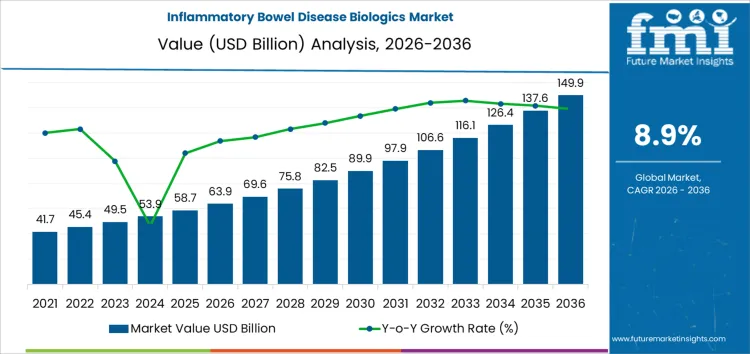
Inflammatory Bowel Disease Biologics Market Key Takeaways
| Metric | Value |
|---|---|
| Market Value (2026) | USD 63.9 billion |
| Market Forecast Value (2036) | USD 149.9 billion |
| Forecast CAGR 2026 to 2036 | 8.9% |
Why is the Demand for Inflammatory Bowel Disease Biologics Growing?
Clinical management of Crohn’s disease and ulcerative colitis increasingly relies on biologic therapies that intervene at defined immune targets responsible for chronic intestinal inflammation. Gastroenterologists adopt these agents to achieve sustained mucosal healing, durable disease control, and lower hospitalization rates in patients with moderate to severe disease activity. Treatment pathways now emphasize earlier biologic initiation when conventional therapies fail to maintain remission. Hospital pharmacies and specialty clinics invest in infusion capacity, monitoring protocols, and long-term treatment planning to support consistent administration and risk management. Improved diagnostic accuracy expands the eligible patient pool across tertiary care centers and ambulatory gastroenterology practices.
Treatment demand is further shaped by health system priorities focused on reducing surgical interventions and long-term complications associated with uncontrolled inflammation. Biologics offer mechanisms that align with treat-to-target strategies centered on endoscopic and biomarker-defined remission. Payers increasingly evaluate total cost of care metrics, where sustained disease control lowers emergency utilization and inpatient burden over time. Clinical adoption is reinforced by therapeutic drug monitoring and individualized dosing strategies that improve persistence on therapy. Ongoing development of biosimilars broadens access while preserving clinical outcomes, encouraging wider uptake across hospital networks and specialty providers managing chronic inflammatory bowel disease populations.
How Is the Inflammatory Bowel Disease Biologics Industry Segmented by Product Type, Application, and End User?
Demand for biologics in inflammatory bowel disease is shaped by chronic inflammation control, relapse prevention, and reduced dependence on systemic steroids. Clinical practice increasingly favors early use of biologics to maintain long-term remission and prevent structural bowel damage. Adoption reflects updated treatment guidelines, broader biologic availability, and improved disease phenotyping. Therapy selection considers mechanism specificity, safety monitoring burden, and administration setting. Segmentation highlights how biologic class choice, disease indication, and care delivery environment determine utilization intensity, procurement concentration, and continuity of treatment across inflammatory bowel disease care pathways.
Which Product Type Holds the Largest Share in Inflammatory Bowel Disease Biologics?
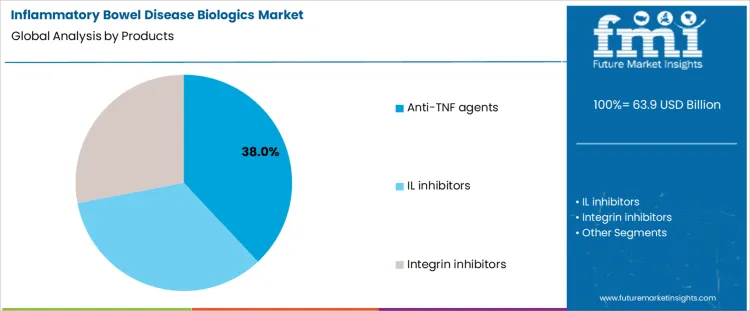
Anti-TNF agents hold 38.0%, representing the largest share among biologic product types used in inflammatory bowel disease. These agents retain a central role due to extensive real-world evidence supporting durable inflammatory control. Broad activity across intestinal and extraintestinal manifestations supports use in heterogeneous patient populations. Familiar dosing schedules and established switching strategies aid clinical decision-making. IL inhibitors follow with growing uptake driven by targeted cytokine suppression and differentiated safety considerations. Integrin inhibitors remain positioned for gut-selective treatment needs. Product segmentation reflects continued reliance on biologics offering proven efficacy, clinical familiarity, and flexibility across treatment lines.
Key Points
- Anti-TNF agents remain embedded in standard treatment algorithms.
- Long-term evidence supports use across diverse disease presentations.
- Other biologics address targeted or gut-selective therapeutic needs.
Why Does Crohn’s Disease Represent the Largest Application Segment?
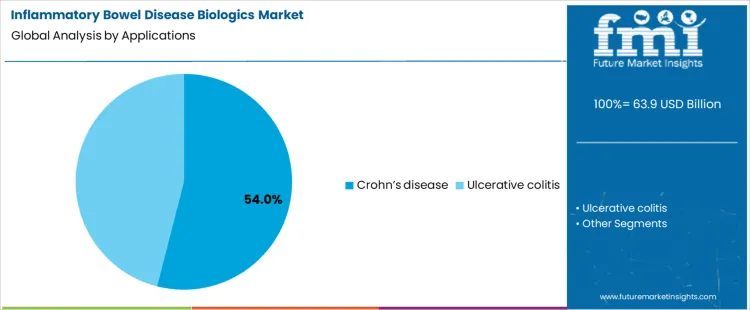
Crohn’s disease accounts for 54.0%, representing the largest share among clinical applications for biologic therapies. Transmural inflammation and variable disease behavior increase risk of strictures, fistulas, and surgical intervention. These characteristics drive earlier escalation to biologic therapy and prolonged maintenance treatment. Relapse prevention requires sustained inflammatory suppression rather than episodic control. Ulcerative colitis follows with biologic use concentrated in moderate to severe disease stages. Response assessment and disease extent influence escalation timing. Application segmentation reflects higher biologic intensity where disease complexity and complication risk necessitate continuous advanced therapy.
Key Points
- Crohn’s disease often requires early and sustained biologic use.
- Complication risk increases reliance on long-term therapy.
- Ulcerative colitis adoption aligns with defined severity thresholds.
Which End User Accounts for the Highest Share of Biologic Utilization?
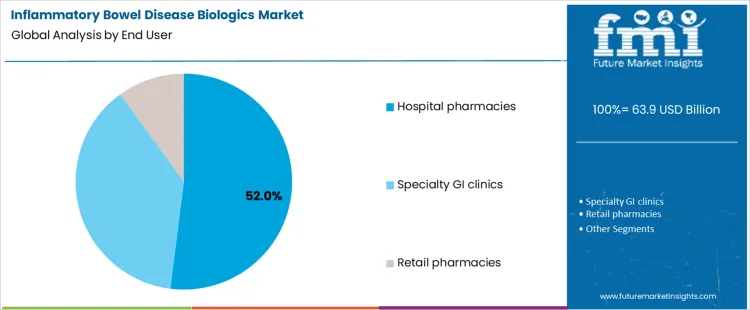
Hospital pharmacies account for 52.0%, representing the largest share among end-user settings for inflammatory bowel disease biologics. Treatment initiation frequently occurs within hospital-based care due to diagnostic confirmation and disease severity assessment. Infusion services, cold-chain handling, and adverse event monitoring favor centralized pharmacy oversight. Multidisciplinary coordination supports therapy initiation, switching, and safety management. Specialty gastroenterology clinics manage ongoing outpatient administration with structured follow-up. Retail pharmacies dispense limited self-injectable formulations under specialist supervision. End-user segmentation reflects concentration where infrastructure, governance, and clinical oversight support safe biologic therapy delivery.
Key Points
- Hospitals dominate biologic initiation and monitored administration.
- Centralized pharmacies support safety and protocol compliance.
- Other settings focus on outpatient continuity or limited dispensing.
What are the Key Dynamics in the Inflammatory Bowel Disease Biologics Market?
Demand for inflammatory bowel disease biologics arises from need to control chronic immune-mediated inflammation in Crohn’s disease and ulcerative colitis beyond conventional therapy limits. Adoption is concentrated in specialty gastroenterology practices, tertiary hospitals, and infusion centers. Global scope reflects guideline-driven escalation pathways and rising diagnosis rates. Product use focuses on monoclonal antibodies targeting specific inflammatory mediators to induce remission and reduce long-term disease complications.
How do disease course complexity and treatment outcome expectations shape adoption?
IBD presents with relapsing, progressive inflammation that leads to bowel damage, hospitalization, and surgery if inadequately controlled. Demand increases where steroid dependence or immunomodulator failure signals need for durable immune suppression. Biologics enable targeted pathway inhibition, improving mucosal healing rates and reducing flare frequency. Therapy choice depends on disease severity, location, prior treatment exposure, and extraintestinal manifestations. Earlier biologic initiation gains relevance in high-risk patients to limit structural damage. Availability of subcutaneous options supports outpatient management and continuity of care. Clinical decision-making increasingly incorporates therapeutic drug monitoring to maintain response. Adoption reflects prioritization of sustained remission and complication avoidance rather than episodic symptom control.
How do immunogenicity management, access controls, and treatment persistence influence market scalability?
Biologic therapies face loss of response due to immunogenicity, requiring dose escalation or switching. Demand sensitivity rises where monitoring infrastructure is insufficient to manage drug levels and antibodies. Infection screening and long-term safety surveillance increase care complexity. High acquisition cost drives payer-imposed step therapy and prior authorization barriers. Biosimilar adoption improves affordability yet introduces interchangeability considerations for clinicians. Cold chain requirements and infusion capacity limit reach in resource-constrained settings. Treatment discontinuation due to adverse events or adherence challenges affects real-world utilization. Scalability remains constrained by safety oversight demands, reimbursement controls, and long-duration disease management requirements.
How Is Demand for Inflammatory Bowel Disease Biologics Evolving Globally?
Demand for inflammatory bowel disease biologics is rising globally as treatment strategies shift toward early intervention and sustained disease control. Clinical focus increasingly prioritizes mucosal healing, relapse prevention, and reduction of steroid dependence. Expansion of specialist gastroenterology services and wider use of biosimilars improve access across health systems. Long-term maintenance therapy extends treatment duration per patient. Growth rates in India at 10.6%, China at 10.4%, Brazil at 10.1%, USA at 9.5%, and the UK at 8.4% indicate strong expansion driven by guideline evolution, diagnostic intensity, and reimbursement alignment rather than short-term therapy switching.
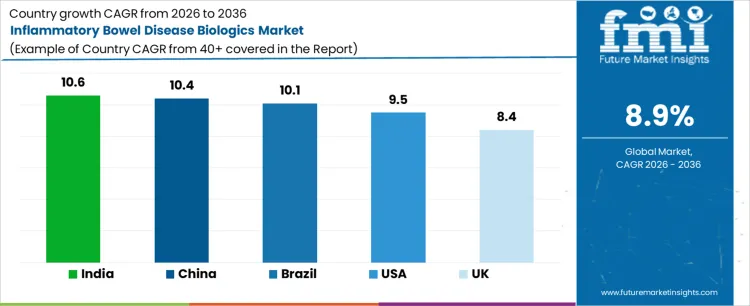
| Country | CAGR (%) |
|---|---|
| India | 10.6% |
| China | 10.4% |
| Brazil | 10.1% |
| USA | 9.5% |
| UK | 8.4% |
What Is Shaping Demand Momentum for IBD Biologics in India?
IBD biologic demand in India is expanding at a CAGR of 10.6%, reflecting structural changes in gastroenterology care delivery. Tertiary hospitals report higher diagnosis of moderate to severe disease requiring escalation beyond conventional therapies. Private insurance participation increases affordability for biologic initiation. Biosimilar availability reduces treatment discontinuation linked to cost. Urban concentration of specialists improves treatment continuity and monitoring. Younger patient demographics extend maintenance therapy timelines. Growth is anchored in access expansion and clinical escalation patterns rather than replacement of immunomodulators across all patient groups.
- Rising diagnosis of moderate to severe IBD
- Insurance-led improvement in biologic affordability
- Biosimilar-driven cost stabilization
- Younger patient cohorts extending treatment duration
Why Is China Experiencing Accelerated Growth in IBD Biologic Utilization?
Demand for inflammatory bowel disease biologics in China is growing at a CAGR of 10.4%, supported by hospital-led protocol standardization. Large tertiary hospitals increasingly adopt treat-to-target strategies emphasizing early biologic use. Reimbursement inclusion for selected agents improves initiation rates. Domestic biologic production strengthens supply reliability. Expansion of gastroenterology services into secondary cities broadens patient reach. Growth reflects system-wide alignment of diagnosis, reimbursement, and specialist capacity rather than isolated uptake in premium care settings.
- Treat-to-target adoption in tertiary hospitals
- Reimbursement support for selected biologics
- Domestic manufacturing improving supply continuity
- Expansion of specialist services beyond major cities
How Is Brazil Sustaining Expansion of IBD Biologic Demand?
IBD biologic demand in Brazil is expanding at a CAGR of 10.1%, shaped by public healthcare engagement and legal access mechanisms. National treatment protocols position biologics for refractory and severe disease. Judicial decisions frequently mandate coverage, increasing patient eligibility. Public hospitals integrate biosimilars to manage budget constraints. Growth of regional referral centers improves treatment access outside major cities. Expansion is driven by access enforcement and public system scale rather than rapid private-sector adoption.
- Judicial rulings enabling biologic access
- Public protocol support for severe disease
- Biosimilar use to manage system costs
- Regional oncology and gastroenterology center growth
What Factors Are Driving IBD Biologic Growth in United States?
Inflammatory bowel disease biologic demand in the United States is growing at a CAGR of 9.5%, reflecting early escalation strategies and long-term therapy persistence. Clinical practice increasingly favors biologics earlier in treatment pathways. Broad insurance coverage supports access across therapy classes. High specialist density enables treatment switching and optimization. Maintenance therapy over extended periods sustains prescription volumes. Growth is reinforced by protocol sophistication and patient retention rather than sharp increases in diagnosed prevalence.
- Early biologic escalation in treatment pathways
- Broad payer coverage across biologic classes
- Specialist-driven regimen optimization
- Long-term maintenance therapy persistence
Why Is the UK Showing Controlled but Sustained Growth in IBD Biologics?
Demand for inflammatory bowel disease biologics in United Kingdom is expanding at a CAGR of 8.4%, supported by structured NHS commissioning. National guidelines define clear thresholds for biologic initiation. Managed access agreements balance cost control with patient availability. Biosimilar adoption increases treatment capacity without proportional budget expansion. Centralized specialist services ensure monitoring and adherence. Growth remains controlled, reflecting governance-led expansion and standardized care delivery rather than unrestricted biologic uptake.
- NHS-defined thresholds for biologic initiation
- Managed access and cost control frameworks
- Biosimilar-driven capacity expansion
- Centralized specialist monitoring systems
What is the competitive landscape of demand for the inflammatory bowel disease biologics market globally?
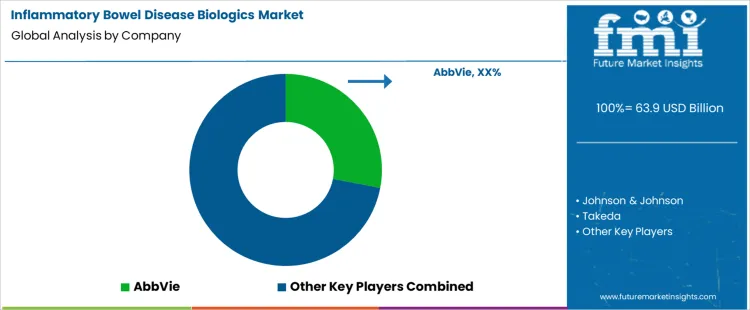
Demand for inflammatory bowel disease biologics is shaped by chronic disease burden, treatment escalation patterns, and long-term remission objectives. Gastroenterologists evaluate mucosal healing evidence, durability of response, safety monitoring intensity, dosing frequency, and route of administration. Hospital buyers assess regulatory labeling by indication, cold chain robustness, and consistency of supply across treatment centers. Procurement behavior reflects formulary negotiations, biosimilar exposure management, and total cost impact over extended therapy durations. Trend in the inflammatory bowel disease biologics market shows sustained preference for biologics in moderate to severe disease, supported by earlier biologic initiation and structured treatment algorithms.
AbbVie holds leading positioning through biologics with broad indication coverage and extensive clinical familiarity among gastroenterology specialists. Johnson & Johnson competes through differentiated mechanisms positioned for durable response in both Crohn’s disease and ulcerative colitis. Takeda supports demand with gut-selective biologics favored for localized activity and long-term safety perception. Pfizer maintains relevance through biologic and biosimilar participation aligned with hospital procurement economics and access strategies. Bristol Myers Squibb participates through targeted biologic assets addressing immune-mediated inflammation pathways. Competitive differentiation depends on remission durability, safety confidence, payer access strength, and alignment with evolving clinical treatment pathways.
Key Players in the Inflammatory Bowel Disease Biologics Market
- AbbVie
- Johnson & Johnson
- Takeda
- Pfizer
- BMS
- Others
Scope of the Report
| Items | Values |
|---|---|
| Quantitative Units | USD billion |
| Products | Anti-TNF agents; IL inhibitors; Integrin inhibitors |
| Applications | Crohn’s disease; Ulcerative colitis |
| End User | Hospital pharmacies; Specialty GI clinics; Retail pharmacies |
| Regions Covered | Asia Pacific, Europe, North America, Latin America, Middle East & Africa |
| Countries Covered | India, China, Brazil, USA, UK, and 40+ countries |
| Key Companies Profiled | AbbVie; Johnson & Johnson; Takeda; Pfizer; BMS; Others |
| Additional Attributes | Dollar sales by product class, application, end user, and sales channel; clinical efficacy in inducing and maintaining remission across anti-TNF, IL, and integrin inhibitor therapies; safety monitoring and immunogenicity management in long-term biologic use; treatment sequencing influenced by disease severity and prior biologic exposure; cold-chain distribution and infusion versus self-injection considerations; procurement patterns shaped by hospital initiation, specialty clinic management, and retail pharmacy refills. |
Inflammatory Bowel Disease Biologics Market by Segment
Products:
- Anti-TNF agents
- IL inhibitors
- Integrin inhibitors
Applications:
- Crohn’s disease
- Ulcerative colitis
End User:
- Hospital pharmacies
- Specialty GI clinics
- Retail pharmacies
Region:
- Asia Pacific
- China
- Japan
- South Korea
- India
- Australia & New Zealand
- ASEAN
- Rest of Asia Pacific
- Europe
- Germany
- United Kingdom
- France
- Italy
- Spain
- Nordic
- BENELUX
- Rest of Europe
- North America
- United States
- Canada
- Mexico
- Latin America
- Brazil
- Chile
- Rest of Latin America
- Middle East & Africa
- Kingdom of Saudi Arabia
- Other GCC Countries
- Turkey
- South Africa
- Other African Union
- Rest of Middle East & Africa
Bibliography
- American Gastroenterological Association. (2024). AGA clinical practice update on the use of biologics and biosimilars in inflammatory bowel disease. American Gastroenterological Association.
- European Crohn’s and Colitis Organisation. (2024). ECCO guidelines on therapeutics in Crohn’s disease and ulcerative colitis (2024 revision). ECCO.
- European Medicines Agency. (2025). Guideline on the evaluation of medicinal products for the treatment of inflammatory bowel disease (Revision 2). EMA.
- National Institutes of Health, National Institute of Diabetes and Digestive and Kidney Diseases. (2025). Inflammatory bowel disease: Epidemiology, treatment pathways, and long-term outcomes. U.S. National Institutes of Health.
Frequently Asked Questions
How big is the inflammatory bowel disease biologics market in 2026?
The global inflammatory bowel disease biologics market is estimated to be valued at USD 63.9 billion in 2026.
What will be the size of inflammatory bowel disease biologics market in 2036?
The market size for the inflammatory bowel disease biologics market is projected to reach USD 149.9 billion by 2036.
How much will be the inflammatory bowel disease biologics market growth between 2026 and 2036?
The inflammatory bowel disease biologics market is expected to grow at a 8.9% CAGR between 2026 and 2036.
What are the key product types in the inflammatory bowel disease biologics market?
The key product types in inflammatory bowel disease biologics market are anti-tnf agents, il inhibitors and integrin inhibitors.
Which applications segment to contribute significant share in the inflammatory bowel disease biologics market in 2026?
In terms of applications, crohn’s disease segment to command 54.0% share in the inflammatory bowel disease biologics market in 2026.
Preview the report firsthand - request a free sample
Get SampleGet the brochure for pricing and purchase details.
Get PDFTable of Content
- Executive Summary
- Global Market Outlook
- Demand-side Trends
- Supply-side Trends
- Technology Roadmap Analysis
- Analysis and Recommendations
- Market Overview
- Market Coverage / Taxonomy
- Market Definition / Scope / Limitations
- Market Background
- Market Dynamics
- Drivers
- Restraints
- Opportunity
- Trends
- Scenario Forecast
- Demand in Optimistic Scenario
- Demand in Likely Scenario
- Demand in Conservative Scenario
- Opportunity Map Analysis
- Product Life Cycle Analysis
- Supply Chain Analysis
- Investment Feasibility Matrix
- Value Chain Analysis
- PESTLE and Porter’s Analysis
- Regulatory Landscape
- Regional Parent Market Outlook
- Production and Consumption Statistics
- Import and Export Statistics
- Market Dynamics
- Global Market Analysis 2021 to 2025 and Forecast, 2026 to 2036
- Historical Market Size Value (USD Million) Analysis, 2021 to 2025
- Current and Future Market Size Value (USD Million) Projections, 2026 to 2036
- Y-o-Y Growth Trend Analysis
- Absolute $ Opportunity Analysis
- Global Market Pricing Analysis 2021 to 2025 and Forecast 2026 to 2036
- Global Market Analysis 2021 to 2025 and Forecast 2026 to 2036, By Products
- Introduction / Key Findings
- Historical Market Size Value (USD Million) Analysis By Products , 2021 to 2025
- Current and Future Market Size Value (USD Million) Analysis and Forecast By Products , 2026 to 2036
- Anti-TNF agents
- IL inhibitors
- Integrin inhibitors
- Anti-TNF agents
- Y-o-Y Growth Trend Analysis By Products , 2021 to 2025
- Absolute $ Opportunity Analysis By Products , 2026 to 2036
- Global Market Analysis 2021 to 2025 and Forecast 2026 to 2036, By Applications
- Introduction / Key Findings
- Historical Market Size Value (USD Million) Analysis By Applications, 2021 to 2025
- Current and Future Market Size Value (USD Million) Analysis and Forecast By Applications, 2026 to 2036
- Crohn’s disease
- Ulcerative colitis
- Crohn’s disease
- Y-o-Y Growth Trend Analysis By Applications, 2021 to 2025
- Absolute $ Opportunity Analysis By Applications, 2026 to 2036
- Global Market Analysis 2021 to 2025 and Forecast 2026 to 2036, By End User
- Introduction / Key Findings
- Historical Market Size Value (USD Million) Analysis By End User, 2021 to 2025
- Current and Future Market Size Value (USD Million) Analysis and Forecast By End User, 2026 to 2036
- Hospital pharmacies
- Specialty GI clinics
- Retail pharmacies
- Hospital pharmacies
- Y-o-Y Growth Trend Analysis By End User, 2021 to 2025
- Absolute $ Opportunity Analysis By End User, 2026 to 2036
- Global Market Analysis 2021 to 2025 and Forecast 2026 to 2036, By Region
- Introduction
- Historical Market Size Value (USD Million) Analysis By Region, 2021 to 2025
- Current Market Size Value (USD Million) Analysis and Forecast By Region, 2026 to 2036
- North America
- Latin America
- Western Europe
- Eastern Europe
- East Asia
- South Asia and Pacific
- Middle East & Africa
- Market Attractiveness Analysis By Region
- North America Market Analysis 2021 to 2025 and Forecast 2026 to 2036, By Country
- Historical Market Size Value (USD Million) Trend Analysis By Market Taxonomy, 2021 to 2025
- Market Size Value (USD Million) Forecast By Market Taxonomy, 2026 to 2036
- By Country
- USA
- Canada
- Mexico
- By Products
- By Applications
- By End User
- By Country
- Market Attractiveness Analysis
- By Country
- By Products
- By Applications
- By End User
- Key Takeaways
- Latin America Market Analysis 2021 to 2025 and Forecast 2026 to 2036, By Country
- Historical Market Size Value (USD Million) Trend Analysis By Market Taxonomy, 2021 to 2025
- Market Size Value (USD Million) Forecast By Market Taxonomy, 2026 to 2036
- By Country
- Brazil
- Chile
- Rest of Latin America
- By Products
- By Applications
- By End User
- By Country
- Market Attractiveness Analysis
- By Country
- By Products
- By Applications
- By End User
- Key Takeaways
- Western Europe Market Analysis 2021 to 2025 and Forecast 2026 to 2036, By Country
- Historical Market Size Value (USD Million) Trend Analysis By Market Taxonomy, 2021 to 2025
- Market Size Value (USD Million) Forecast By Market Taxonomy, 2026 to 2036
- By Country
- Germany
- UK
- Italy
- Spain
- France
- Nordic
- BENELUX
- Rest of Western Europe
- By Products
- By Applications
- By End User
- By Country
- Market Attractiveness Analysis
- By Country
- By Products
- By Applications
- By End User
- Key Takeaways
- Eastern Europe Market Analysis 2021 to 2025 and Forecast 2026 to 2036, By Country
- Historical Market Size Value (USD Million) Trend Analysis By Market Taxonomy, 2021 to 2025
- Market Size Value (USD Million) Forecast By Market Taxonomy, 2026 to 2036
- By Country
- Russia
- Poland
- Hungary
- Balkan & Baltic
- Rest of Eastern Europe
- By Products
- By Applications
- By End User
- By Country
- Market Attractiveness Analysis
- By Country
- By Products
- By Applications
- By End User
- Key Takeaways
- East Asia Market Analysis 2021 to 2025 and Forecast 2026 to 2036, By Country
- Historical Market Size Value (USD Million) Trend Analysis By Market Taxonomy, 2021 to 2025
- Market Size Value (USD Million) Forecast By Market Taxonomy, 2026 to 2036
- By Country
- China
- Japan
- South Korea
- By Products
- By Applications
- By End User
- By Country
- Market Attractiveness Analysis
- By Country
- By Products
- By Applications
- By End User
- Key Takeaways
- South Asia and Pacific Market Analysis 2021 to 2025 and Forecast 2026 to 2036, By Country
- Historical Market Size Value (USD Million) Trend Analysis By Market Taxonomy, 2021 to 2025
- Market Size Value (USD Million) Forecast By Market Taxonomy, 2026 to 2036
- By Country
- India
- ASEAN
- Australia & New Zealand
- Rest of South Asia and Pacific
- By Products
- By Applications
- By End User
- By Country
- Market Attractiveness Analysis
- By Country
- By Products
- By Applications
- By End User
- Key Takeaways
- Middle East & Africa Market Analysis 2021 to 2025 and Forecast 2026 to 2036, By Country
- Historical Market Size Value (USD Million) Trend Analysis By Market Taxonomy, 2021 to 2025
- Market Size Value (USD Million) Forecast By Market Taxonomy, 2026 to 2036
- By Country
- Kingdom of Saudi Arabia
- Other GCC Countries
- Turkiye
- South Africa
- Other African Union
- Rest of Middle East & Africa
- By Products
- By Applications
- By End User
- By Country
- Market Attractiveness Analysis
- By Country
- By Products
- By Applications
- By End User
- Key Takeaways
- Key Countries Market Analysis
- USA
- Pricing Analysis
- Market Share Analysis, 2025
- By Products
- By Applications
- By End User
- Canada
- Pricing Analysis
- Market Share Analysis, 2025
- By Products
- By Applications
- By End User
- Mexico
- Pricing Analysis
- Market Share Analysis, 2025
- By Products
- By Applications
- By End User
- Brazil
- Pricing Analysis
- Market Share Analysis, 2025
- By Products
- By Applications
- By End User
- Chile
- Pricing Analysis
- Market Share Analysis, 2025
- By Products
- By Applications
- By End User
- Germany
- Pricing Analysis
- Market Share Analysis, 2025
- By Products
- By Applications
- By End User
- UK
- Pricing Analysis
- Market Share Analysis, 2025
- By Products
- By Applications
- By End User
- Italy
- Pricing Analysis
- Market Share Analysis, 2025
- By Products
- By Applications
- By End User
- Spain
- Pricing Analysis
- Market Share Analysis, 2025
- By Products
- By Applications
- By End User
- France
- Pricing Analysis
- Market Share Analysis, 2025
- By Products
- By Applications
- By End User
- India
- Pricing Analysis
- Market Share Analysis, 2025
- By Products
- By Applications
- By End User
- ASEAN
- Pricing Analysis
- Market Share Analysis, 2025
- By Products
- By Applications
- By End User
- Australia & New Zealand
- Pricing Analysis
- Market Share Analysis, 2025
- By Products
- By Applications
- By End User
- China
- Pricing Analysis
- Market Share Analysis, 2025
- By Products
- By Applications
- By End User
- Japan
- Pricing Analysis
- Market Share Analysis, 2025
- By Products
- By Applications
- By End User
- South Korea
- Pricing Analysis
- Market Share Analysis, 2025
- By Products
- By Applications
- By End User
- Russia
- Pricing Analysis
- Market Share Analysis, 2025
- By Products
- By Applications
- By End User
- Poland
- Pricing Analysis
- Market Share Analysis, 2025
- By Products
- By Applications
- By End User
- Hungary
- Pricing Analysis
- Market Share Analysis, 2025
- By Products
- By Applications
- By End User
- Kingdom of Saudi Arabia
- Pricing Analysis
- Market Share Analysis, 2025
- By Products
- By Applications
- By End User
- Turkiye
- Pricing Analysis
- Market Share Analysis, 2025
- By Products
- By Applications
- By End User
- South Africa
- Pricing Analysis
- Market Share Analysis, 2025
- By Products
- By Applications
- By End User
- USA
- Market Structure Analysis
- Competition Dashboard
- Competition Benchmarking
- Market Share Analysis of Top Players
- By Regional
- By Products
- By Applications
- By End User
- Competition Analysis
- Competition Deep Dive
- AbbVie
- Overview
- Product Portfolio
- Profitability by Market Segments (Product/Age /Sales Channel/Region)
- Sales Footprint
- Strategy Overview
- Marketing Strategy
- Product Strategy
- Channel Strategy
- Johnson & Johnson
- Takeda
- Pfizer
- BMS
- Others
- AbbVie
- Competition Deep Dive
- Assumptions & Acronyms Used
- Research Methodology


