

- Industry Size (2026)
- USD 1663.5 Mn
- Forecast (2036)
- USD 5354.1 Mn
- CAGR (2026 to 2036)
- 12.4%
Chaperone-based Therapeutics Market Forecast and Outlook 2026 to 2036
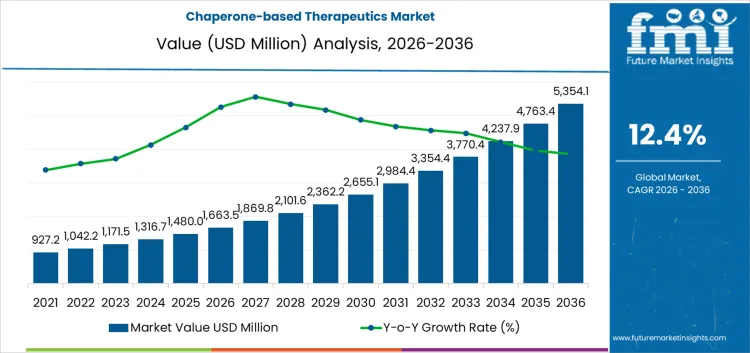
The chaperone-based therapeutics market is likely to be valued at USD 1,663.5 million in 2026, and reach USD 5,354.1 million by 2036, at a CAGR of 12.4%. Expansion reflects increasing clinical focus on correcting protein misfolding mechanisms that drive disease progression in genetically defined patient populations. Adoption remains concentrated in rare and chronic disorders where stabilization of endogenous proteins can preserve residual function and delay irreversible tissue damage. Revenue growth is supported by longer treatment duration, earlier diagnosis, and sustained therapy persistence rather than short treatment cycles or episodic use.
Clinical uptake is reinforced by advances in molecular diagnostics that enable precise identification of mutation-responsive patients suitable for chaperone-based intervention. Oral administration formats improve adherence and reduce care delivery burden compared with infusion-dependent alternatives, supporting outpatient-centered management models. Health systems and specialist centers prioritize these therapies where disease biology supports protein rescue rather than replacement, particularly in lysosomal storage and select neurodegenerative conditions. Pipeline maturation, orphan drug incentives, and expanding long-term outcome evidence continue to shape structured adoption across specialty clinics and tertiary hospitals.
Quick Stats for Chaperone-based Therapeutics Market
- Chaperone-based Therapeutics Market Value (2026): USD 1,663.5 million
- Chaperone-based Therapeutics Market Forecast Value (2036): USD 5,354.1 million
- Chaperone-based Therapeutics Market Forecast CAGR 2026 to 2036: 12.4%
- Leading Product Category by Demand Share: Pharmacological Chaperones
- Fastest-Growing Countries: India, China, Brazil, USA, UK
- Top Players in Global Demand: Amicus Therapeutics, Pfizer, Sanofi, Takeda, Vertex
Chaperone-based Therapeutics Market Key Takeaways
| Metric | Value |
|---|---|
| Market Value (2026) | USD 1,663.5 million |
| Market Forecast Value (2036) | USD 5,354.1 million |
| Forecast CAGR 2026 to 2036 | 12.4% |
Why is the Demand for Chaperone-based Therapeutics Growing?
Demand for chaperone-based therapeutics is increasing as researchers and clinicians focus on treatments that stabilize misfolded proteins underlying many rare and chronic diseases. Molecular chaperones assist in proper protein folding and trafficking, and therapeutic candidates that mimic or enhance these functions aim to correct pathophysiology at its source rather than only address symptoms. Genetic and biochemical screening improvements enable more precise identification of patients with protein misfolding mutations, prompting clinicians to consider chaperone-based options in personalized care plans. Hospitals and specialty clinics evaluate clinical efficacy, safety profiles, and compatibility with existing treatment protocols to integrate these therapies into care pathways. Regulatory frameworks for rare diseases support accelerated review of biologics and targeted modalities that demonstrate measurable impact on functional biomarkers, reinforcing investment in chaperone-based platforms across neuromuscular, metabolic, and neurodegenerative indications.
Clinical pipeline expansion and published outcome data on disease modification reinforce interest in chaperone-based therapeutics among prescribers and health systems. Payers increasingly assess long-term benefits versus chronic care costs, particularly where stabilization of protein misfolding could delay progression and reduce hospital utilization. Research collaborations between academic centers and biopharma firms expand evidence generation, which supports guideline incorporation once clinical thresholds are met. Therapeutic developers invest in formulation optimization and scalable manufacturing to meet anticipated demand in defined patient segments. These clinical and operational drivers are contributing to sustained uptake in the chaperone-based therapeutics market.
How Are the Segments Classified in the Chaperone-based Therapeutics Market?
Demand for chaperone-based therapeutics is shaped by precision treatment needs in rare genetic disorders, protein misfolding correction strategies, and long-term disease management objectives. These therapies stabilize misfolded proteins to restore functional activity at the cellular level. Adoption aligns with advances in molecular diagnostics, genotype-specific treatment selection, and chronic therapy planning. Treatment selection prioritizes oral availability, safety monitoring, and compatibility with lifelong use. Segment classification reflects differentiation by product approach, therapeutic application focus, and end-user care setting influencing prescribing patterns, monitoring intensity, and patient access pathways.
Which Product Category Holds the Largest Share in Chaperone-based Therapeutics?
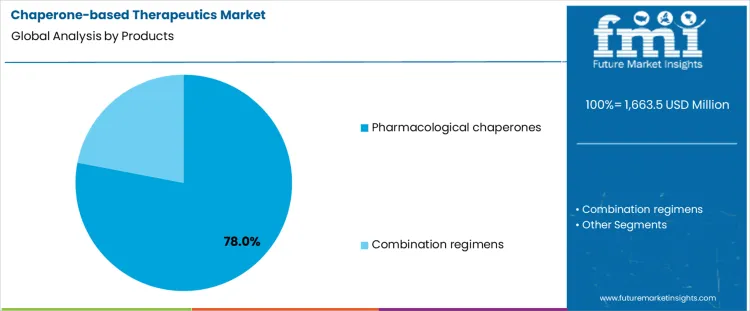
Pharmacological chaperones account for 78.0%, representing the largest share among product categories. These agents bind selectively to misfolded proteins, enhancing stability and intracellular trafficking. Oral administration supports outpatient management and sustained adherence. Target specificity enables use in genetically defined patient populations. Combination regimens integrate chaperones with complementary therapies to improve clinical response in selected cases. Product segmentation reflects reliance on single-agent chaperones where mechanism clarity, administration convenience, and established clinical evidence support widespread utilization.
Key Points
- Pharmacological chaperones stabilize misfolded proteins directly.
- Oral dosing supports long-term outpatient treatment.
- Combination regimens address selected clinical needs.
How Does Application Segmentation Influence Therapy Utilization?
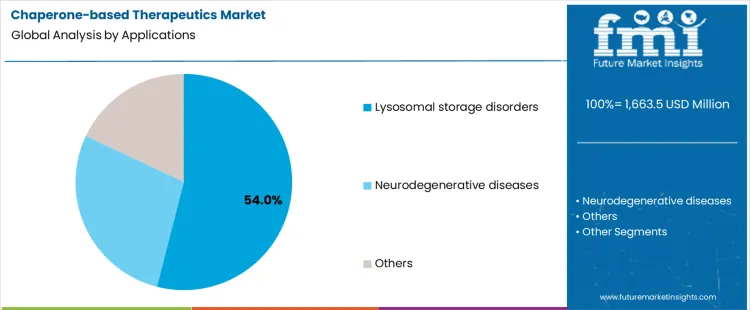
Lysosomal storage disorder applications account for 54.0%, representing the largest share among therapeutic uses. These conditions involve enzyme instability and misfolding, aligning directly with chaperone mechanisms. Defined genetic mutations support targeted patient selection. Long-term therapy aims to reduce substrate accumulation and organ damage progression. Neurodegenerative disease applications follow with emerging evidence and broader heterogeneity. Other indications apply chaperone strategies selectively. Application segmentation reflects concentration where mechanistic alignment, diagnostic clarity, and chronic management needs sustain higher therapeutic utilization.
Key Points
- Lysosomal disorders align directly with chaperone mechanisms.
- Genetic stratification supports targeted treatment use.
- Other applications show selective or emerging adoption.
Which End User Accounts for the Highest Share of Demand?
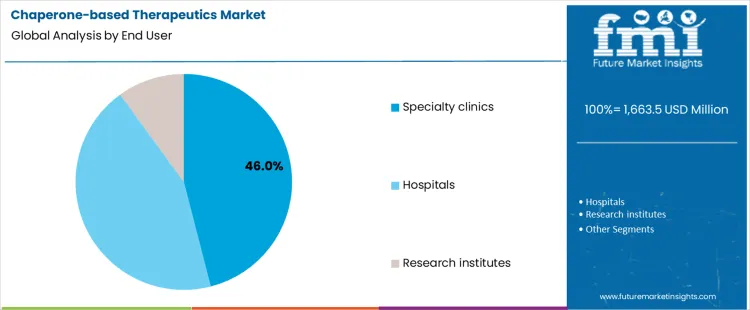
Specialty clinics account for 46.0%, representing the largest share among end users. These centers manage rare disease patients requiring genotype-specific therapy selection. Outpatient-focused care supports regular monitoring and adherence support. Multidisciplinary coordination enables long-term disease management. Hospitals follow closely with initiation and complex case oversight. Research institutes contribute through clinical development and early access programs. End-user segmentation reflects concentration where specialized expertise, continuity of care, and patient engagement support effective delivery of chaperone-based therapeutics.
Key Points
- Specialty clinics focus on genotype-driven rare disease care.
- Outpatient models support long-term monitoring.
- Other settings manage initiation or research activities.
What are the Key Dynamics in the Chaperone-based Therapeutics Market?
Demand for chaperone-based therapeutics reflects treatment needs for diseases driven by protein misfolding, instability, or premature degradation. Adoption concentrates in rare genetic disorders, metabolic diseases, and select neurodegenerative conditions managed through specialty clinics. Global scope aligns with precision medicine and mutation-specific intervention strategies. Usage centers on small molecules that stabilize target proteins, restore functional conformation, and improve intracellular trafficking without replacing the native protein.
How do mutation-specific disease mechanisms and oral therapy advantages shape adoption?
Chaperone-based therapeutics act by binding to misfolded proteins, enabling proper folding and cellular localization. Demand increases where diseases involve residual protein activity that can be rescued rather than replaced. Genotype-dependent efficacy drives use in well-characterized patient subsets identified through molecular diagnostics. Oral administration supports long-term adherence and outpatient management compared with infusion-based alternatives. Ability to cross cellular membranes provides advantage in disorders affecting intracellular organelles. Central nervous system penetration supports relevance in neurologically involved conditions. Treatment strategies emphasize early intervention to preserve organ function. Adoption reflects alignment between molecular pathology, patient stratification, and non-invasive chronic dosing suitability.
How do narrow applicability, safety monitoring, and development complexity influence market scalability?
Chaperone efficacy depends on specific mutations, limiting eligible patient populations. Demand sensitivity rises where genetic heterogeneity reduces predictable response rates. Off-target binding can affect unrelated proteins, requiring careful dose control and monitoring. Long-term exposure raises concerns around cumulative toxicity and metabolic interaction. Clinical development requires deep molecular characterization and companion diagnostics, increasing cost and timeline burden. Regulatory evaluation focuses on durability of functional improvement rather than biomarker change alone. Competition from gene and enzyme replacement approaches influences clinical positioning. Scalability remains constrained by mutation specificity, safety oversight requirements, and limited expansion potential beyond defined rare disease indications.
How Is Demand for Chaperone-based Therapeutics Evolving Globally?
Demand for chaperone-based therapeutics is expanding globally due to progress in rare disease diagnosis, precision medicine adoption, and improved understanding of protein misfolding disorders. These therapies address underlying cellular mechanisms rather than symptom management, supporting long-term disease modification. Oral availability and targeted applicability improve adherence across chronic indications. Reimbursement pathways and orphan drug incentives influence uptake across healthcare systems. Growth rates in India at 14.1%, China at 13.9%, Brazil at 13.6%, USA at 13.0%, and the UK at 11.9% indicate rapid expansion driven by diagnostic scale-up, specialist access, and protocol inclusion rather than short-term therapy switching.
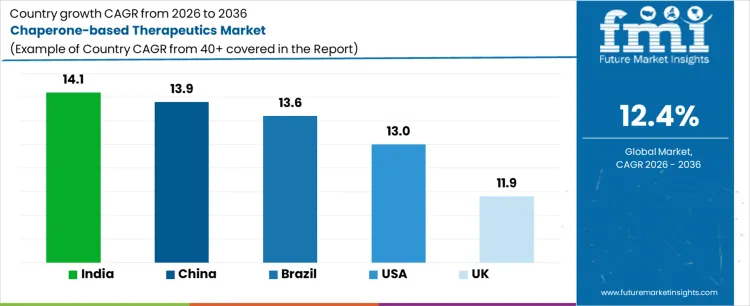
| Country | CAGR (%) |
|---|---|
| India | 14.1% |
| China | 13.9% |
| Brazil | 13.6% |
| USA | 13.0% |
| UK | 11.9% |
What Is Driving Rapid Expansion of Chaperone-based Therapeutic Demand in India?
Demand for chaperone-based therapeutics in India is growing at a CAGR of 14.1%, supported by expanding genetic diagnostics and specialist care access. Tertiary hospitals increase identification of protein misfolding disorders through improved testing. Public interest litigation and government schemes facilitate access for rare disease patients. Oral administration supports long-term outpatient management across regions. Younger diagnosed cohorts extend therapy duration. Growth reflects diagnostic progress, access mechanisms, and care continuity rather than broad label expansion.
- Expansion of genetic and metabolic diagnostics
- Legal and policy-driven access pathways
- Oral outpatient therapy suitability
- Younger diagnosis extending treatment duration
Why Is China Experiencing Strong Uptake of Chaperone-based Therapeutics?
Chaperone-based therapeutic demand in China is expanding at a CAGR of 13.9%, driven by rare disease policy inclusion and hospital network scale. National registries improve identification of eligible patients. Reimbursement pilots support initiation under defined conditions. Domestic manufacturing partnerships enhance supply reliability. Expansion of specialist centers beyond major cities increases access. Growth reflects system-level integration of rare disease care rather than isolated adoption in select institutions.
- National rare disease registry support
- Reimbursement pilots for targeted therapies
- Domestic manufacturing and licensing partnerships
- Specialist center expansion into secondary cities
How Is Brazil Supporting Growth in Chaperone-based Therapeutic Usage?
Demand for chaperone-based therapeutics in Brazil is growing at a CAGR of 13.6%, supported by judicial access mechanisms and public healthcare engagement. Court mandates frequently enable coverage for rare disease treatments. Public hospitals integrate these therapies within monitored protocols. Expanded screening and referral pathways improve diagnosis rates. Oral formulations simplify long-term administration. Growth reflects access enforcement and diagnostic expansion rather than rapid private-sector uptake.
- Judicial mandates enabling treatment access
- Public hospital protocol-based adoption
- Expanded screening and referral systems
- Oral administration supporting continuity
What Factors Are Driving Chaperone-based Therapeutic Demand in United States?
Chaperone-based therapeutic demand in the United States is expanding at a CAGR of 13.0%, supported by advanced diagnostics and strong rare disease frameworks. Broad genomic testing enables early identification of eligible patients. Insurance coverage for orphan therapies supports sustained treatment. Specialist density allows precise patient selection and monitoring. Patient advocacy organizations reinforce awareness and referral. Expansion reflects early diagnosis and therapy persistence rather than sudden growth in eligible populations.
- High penetration of genomic testing
- Insurance support for orphan therapies
- Specialist-led patient selection and monitoring
- Active patient advocacy networks
Why Is the UK Showing Sustained Growth in Chaperone-based Therapeutics?
Demand for chaperone-based therapeutics in United Kingdom is growing at a CAGR of 11.9%, driven by structured rare disease strategies and centralized commissioning. National diagnostic services improve early identification. Managed access agreements support controlled reimbursement. Specialist centers coordinate long-term patient follow-up. Oral therapy formats align with outpatient care models. Growth remains sustained, reflecting organized access expansion and diagnostic integration rather than unrestricted therapy adoption.
- National rare disease diagnostic programs
- Centralized commissioning and managed access
- Specialist center coordinated care pathways
- Outpatient-compatible oral therapy models
What is the competitive landscape of demand for the chaperone-based therapeutics market globally?
Demand for chaperone-based therapeutics is driven by unmet needs in rare genetic disorders involving protein misfolding and enzyme instability. Clinicians and payers evaluate target specificity, mutation responsiveness, oral bioavailability, safety tolerability, and durability of biochemical correction. Buyer assessment includes evidence of functional protein rescue, compatibility with combination regimens, and applicability across patient subpopulations. Procurement behavior centers on orphan designation status, regulatory approvals by indication, reimbursement coverage, and long-term supply assurance. Purchasing decisions emphasize adherence potential, real-world effectiveness signals, and integration within specialty care pathways. Trend in the chaperone-based therapeutics market reflects growing focus on precision mutation-driven treatments and combination strategies.
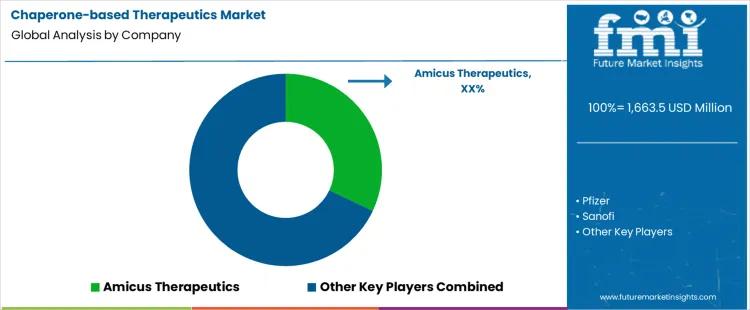
Amicus Therapeutics leads competitive positioning through mutation-specific pharmacological chaperones with established clinical adoption in lysosomal storage disorders. Pfizer supports demand via chaperone-related assets within broader rare disease and specialty portfolios. Sanofi maintains relevance through metabolic disease expertise and infrastructure supporting specialty therapeutics commercialization. Takeda participates by leveraging rare disease focus and global access capabilities aligned with specialty prescribers. Vertex contributes through protein-targeted therapeutic approaches intersecting with chaperone biology in selected indications. Competitive differentiation centers on mutation coverage breadth, clinical validation depth, regulatory positioning, and strength of specialist engagement models.
Key Players in the Chaperone-based Therapeutics Market
- Amicus Therapeutics
- Pfizer
- Sanofi
- Takeda
- Vertex
- Others
Scope of the Report
| Items | Values |
|---|---|
| Quantitative Units | USD million |
| Products | Pharmacological chaperones; Combination regimens |
| Applications | Lysosomal storage disorders; Neurodegenerative diseases; Others |
| End User | Specialty clinics; Hospitals; Research institutes |
| Regions Covered | Asia Pacific, Europe, North America, Latin America, Middle East & Africa |
| Countries Covered | India, China, Brazil, USA, UK, and 40+ countries |
| Key Companies Profiled | Amicus Therapeutics; Pfizer; Sanofi; Takeda; Vertex; Others |
| Additional Attributes | Dollar sales by product type, application, end user, and sales channel; mechanism-driven efficacy linked to protein stabilization and trafficking correction; oral dosing suitability and long-term adherence considerations; clinical development focus across rare metabolic and neurodegenerative indications; regulatory pathways and orphan designations shaping access; distribution patterns spanning specialty clinics, hospitals, and research-driven supply programs. |
Chaperone-based Therapeutics Market by Segment
Products:
- Pharmacological chaperones
- Combination regimens
Applications:
- Lysosomal storage disorders
- Neurodegenerative diseases
- Others
End User:
- Specialty clinics
- Hospitals
- Research institutes
Region:
- Asia Pacific
- China
- Japan
- South Korea
- India
- Australia & New Zealand
- ASEAN
- Rest of Asia Pacific
- Europe
- Germany
- United Kingdom
- France
- Italy
- Spain
- Nordic
- BENELUX
- Rest of Europe
- North America
- United States
- Canada
- Mexico
- Latin America
- Brazil
- Chile
- Rest of Latin America
- Middle East & Africa
- Kingdom of Saudi Arabia
- Other GCC Countries
- Turkey
- South Africa
- Other African Union
- Rest of Middle East & Africa
Bibliography
- European Medicines Agency. (2024). Guideline on the clinical development of medicinal products for the treatment of rare diseases involving protein misfolding (EMA/CHMP/204/2024). European Medicines Agency.
- United States Food and Drug Administration. (2024). Rare diseases and targeted therapies: Clinical considerations for pharmacological chaperones (FDA Guidance CDER-RD-2024-02). U.S. Department of Health and Human Services.
- World Health Organization. (2024). WHO policy framework on research, development, and access to orphan and advanced therapies for rare diseases. World Health Organization.
Frequently Asked Questions
How big is the chaperone-based therapeutics market in 2026?
The global chaperone-based therapeutics market is estimated to be valued at USD 1,663.5 million in 2026.
What will be the size of chaperone-based therapeutics market in 2036?
The market size for the chaperone-based therapeutics market is projected to reach USD 5,354.1 million by 2036.
How much will be the chaperone-based therapeutics market growth between 2026 and 2036?
The chaperone-based therapeutics market is expected to grow at a 12.4% CAGR between 2026 and 2036.
What are the key product types in the chaperone-based therapeutics market?
The key product types in chaperone-based therapeutics market are pharmacological chaperones and combination regimens.
Which applications segment to contribute significant share in the chaperone-based therapeutics market in 2026?
In terms of applications, lysosomal storage disorders segment to command 54.0% share in the chaperone-based therapeutics market in 2026.
Preview the report firsthand - request a free sample
Get SampleGet the brochure for pricing and purchase details.
Get PDFTable of Content
- Executive Summary
- Global Market Outlook
- Demand-side Trends
- Supply-side Trends
- Technology Roadmap Analysis
- Analysis and Recommendations
- Market Overview
- Market Coverage / Taxonomy
- Market Definition / Scope / Limitations
- Market Background
- Market Dynamics
- Drivers
- Restraints
- Opportunity
- Trends
- Scenario Forecast
- Demand in Optimistic Scenario
- Demand in Likely Scenario
- Demand in Conservative Scenario
- Opportunity Map Analysis
- Product Life Cycle Analysis
- Supply Chain Analysis
- Investment Feasibility Matrix
- Value Chain Analysis
- PESTLE and Porter’s Analysis
- Regulatory Landscape
- Regional Parent Market Outlook
- Production and Consumption Statistics
- Import and Export Statistics
- Market Dynamics
- Global Market Analysis 2021 to 2025 and Forecast, 2026 to 2036
- Historical Market Size Value (USD Million) Analysis, 2021 to 2025
- Current and Future Market Size Value (USD Million) Projections, 2026 to 2036
- Y-o-Y Growth Trend Analysis
- Absolute $ Opportunity Analysis
- Global Market Pricing Analysis 2021 to 2025 and Forecast 2026 to 2036
- Global Market Analysis 2021 to 2025 and Forecast 2026 to 2036, By Products
- Introduction / Key Findings
- Historical Market Size Value (USD Million) Analysis By Products , 2021 to 2025
- Current and Future Market Size Value (USD Million) Analysis and Forecast By Products , 2026 to 2036
- Pharmacological chaperones
- Combination regimens
- Pharmacological chaperones
- Y-o-Y Growth Trend Analysis By Products , 2021 to 2025
- Absolute $ Opportunity Analysis By Products , 2026 to 2036
- Global Market Analysis 2021 to 2025 and Forecast 2026 to 2036, By Applications
- Introduction / Key Findings
- Historical Market Size Value (USD Million) Analysis By Applications, 2021 to 2025
- Current and Future Market Size Value (USD Million) Analysis and Forecast By Applications, 2026 to 2036
- Lysosomal storage disorders
- Neurodegenerative diseases
- Others
- Lysosomal storage disorders
- Y-o-Y Growth Trend Analysis By Applications, 2021 to 2025
- Absolute $ Opportunity Analysis By Applications, 2026 to 2036
- Global Market Analysis 2021 to 2025 and Forecast 2026 to 2036, By End User
- Introduction / Key Findings
- Historical Market Size Value (USD Million) Analysis By End User, 2021 to 2025
- Current and Future Market Size Value (USD Million) Analysis and Forecast By End User, 2026 to 2036
- Specialty clinics
- Hospitals
- Research institutes
- Specialty clinics
- Y-o-Y Growth Trend Analysis By End User, 2021 to 2025
- Absolute $ Opportunity Analysis By End User, 2026 to 2036
- Global Market Analysis 2021 to 2025 and Forecast 2026 to 2036, By Region
- Introduction
- Historical Market Size Value (USD Million) Analysis By Region, 2021 to 2025
- Current Market Size Value (USD Million) Analysis and Forecast By Region, 2026 to 2036
- North America
- Latin America
- Western Europe
- Eastern Europe
- East Asia
- South Asia and Pacific
- Middle East & Africa
- Market Attractiveness Analysis By Region
- North America Market Analysis 2021 to 2025 and Forecast 2026 to 2036, By Country
- Historical Market Size Value (USD Million) Trend Analysis By Market Taxonomy, 2021 to 2025
- Market Size Value (USD Million) Forecast By Market Taxonomy, 2026 to 2036
- By Country
- USA
- Canada
- Mexico
- By Products
- By Applications
- By End User
- By Country
- Market Attractiveness Analysis
- By Country
- By Products
- By Applications
- By End User
- Key Takeaways
- Latin America Market Analysis 2021 to 2025 and Forecast 2026 to 2036, By Country
- Historical Market Size Value (USD Million) Trend Analysis By Market Taxonomy, 2021 to 2025
- Market Size Value (USD Million) Forecast By Market Taxonomy, 2026 to 2036
- By Country
- Brazil
- Chile
- Rest of Latin America
- By Products
- By Applications
- By End User
- By Country
- Market Attractiveness Analysis
- By Country
- By Products
- By Applications
- By End User
- Key Takeaways
- Western Europe Market Analysis 2021 to 2025 and Forecast 2026 to 2036, By Country
- Historical Market Size Value (USD Million) Trend Analysis By Market Taxonomy, 2021 to 2025
- Market Size Value (USD Million) Forecast By Market Taxonomy, 2026 to 2036
- By Country
- Germany
- UK
- Italy
- Spain
- France
- Nordic
- BENELUX
- Rest of Western Europe
- By Products
- By Applications
- By End User
- By Country
- Market Attractiveness Analysis
- By Country
- By Products
- By Applications
- By End User
- Key Takeaways
- Eastern Europe Market Analysis 2021 to 2025 and Forecast 2026 to 2036, By Country
- Historical Market Size Value (USD Million) Trend Analysis By Market Taxonomy, 2021 to 2025
- Market Size Value (USD Million) Forecast By Market Taxonomy, 2026 to 2036
- By Country
- Russia
- Poland
- Hungary
- Balkan & Baltic
- Rest of Eastern Europe
- By Products
- By Applications
- By End User
- By Country
- Market Attractiveness Analysis
- By Country
- By Products
- By Applications
- By End User
- Key Takeaways
- East Asia Market Analysis 2021 to 2025 and Forecast 2026 to 2036, By Country
- Historical Market Size Value (USD Million) Trend Analysis By Market Taxonomy, 2021 to 2025
- Market Size Value (USD Million) Forecast By Market Taxonomy, 2026 to 2036
- By Country
- China
- Japan
- South Korea
- By Products
- By Applications
- By End User
- By Country
- Market Attractiveness Analysis
- By Country
- By Products
- By Applications
- By End User
- Key Takeaways
- South Asia and Pacific Market Analysis 2021 to 2025 and Forecast 2026 to 2036, By Country
- Historical Market Size Value (USD Million) Trend Analysis By Market Taxonomy, 2021 to 2025
- Market Size Value (USD Million) Forecast By Market Taxonomy, 2026 to 2036
- By Country
- India
- ASEAN
- Australia & New Zealand
- Rest of South Asia and Pacific
- By Products
- By Applications
- By End User
- By Country
- Market Attractiveness Analysis
- By Country
- By Products
- By Applications
- By End User
- Key Takeaways
- Middle East & Africa Market Analysis 2021 to 2025 and Forecast 2026 to 2036, By Country
- Historical Market Size Value (USD Million) Trend Analysis By Market Taxonomy, 2021 to 2025
- Market Size Value (USD Million) Forecast By Market Taxonomy, 2026 to 2036
- By Country
- Kingdom of Saudi Arabia
- Other GCC Countries
- Turkiye
- South Africa
- Other African Union
- Rest of Middle East & Africa
- By Products
- By Applications
- By End User
- By Country
- Market Attractiveness Analysis
- By Country
- By Products
- By Applications
- By End User
- Key Takeaways
- Key Countries Market Analysis
- USA
- Pricing Analysis
- Market Share Analysis, 2025
- By Products
- By Applications
- By End User
- Canada
- Pricing Analysis
- Market Share Analysis, 2025
- By Products
- By Applications
- By End User
- Mexico
- Pricing Analysis
- Market Share Analysis, 2025
- By Products
- By Applications
- By End User
- Brazil
- Pricing Analysis
- Market Share Analysis, 2025
- By Products
- By Applications
- By End User
- Chile
- Pricing Analysis
- Market Share Analysis, 2025
- By Products
- By Applications
- By End User
- Germany
- Pricing Analysis
- Market Share Analysis, 2025
- By Products
- By Applications
- By End User
- UK
- Pricing Analysis
- Market Share Analysis, 2025
- By Products
- By Applications
- By End User
- Italy
- Pricing Analysis
- Market Share Analysis, 2025
- By Products
- By Applications
- By End User
- Spain
- Pricing Analysis
- Market Share Analysis, 2025
- By Products
- By Applications
- By End User
- France
- Pricing Analysis
- Market Share Analysis, 2025
- By Products
- By Applications
- By End User
- India
- Pricing Analysis
- Market Share Analysis, 2025
- By Products
- By Applications
- By End User
- ASEAN
- Pricing Analysis
- Market Share Analysis, 2025
- By Products
- By Applications
- By End User
- Australia & New Zealand
- Pricing Analysis
- Market Share Analysis, 2025
- By Products
- By Applications
- By End User
- China
- Pricing Analysis
- Market Share Analysis, 2025
- By Products
- By Applications
- By End User
- Japan
- Pricing Analysis
- Market Share Analysis, 2025
- By Products
- By Applications
- By End User
- South Korea
- Pricing Analysis
- Market Share Analysis, 2025
- By Products
- By Applications
- By End User
- Russia
- Pricing Analysis
- Market Share Analysis, 2025
- By Products
- By Applications
- By End User
- Poland
- Pricing Analysis
- Market Share Analysis, 2025
- By Products
- By Applications
- By End User
- Hungary
- Pricing Analysis
- Market Share Analysis, 2025
- By Products
- By Applications
- By End User
- Kingdom of Saudi Arabia
- Pricing Analysis
- Market Share Analysis, 2025
- By Products
- By Applications
- By End User
- Turkiye
- Pricing Analysis
- Market Share Analysis, 2025
- By Products
- By Applications
- By End User
- South Africa
- Pricing Analysis
- Market Share Analysis, 2025
- By Products
- By Applications
- By End User
- USA
- Market Structure Analysis
- Competition Dashboard
- Competition Benchmarking
- Market Share Analysis of Top Players
- By Regional
- By Products
- By Applications
- By End User
- Competition Analysis
- Competition Deep Dive
- Amicus Therapeutics
- Overview
- Product Portfolio
- Profitability by Market Segments (Product/Age /Sales Channel/Region)
- Sales Footprint
- Strategy Overview
- Marketing Strategy
- Product Strategy
- Channel Strategy
- Pfizer
- Sanofi
- Takeda
- Vertex
- Others
- Amicus Therapeutics
- Competition Deep Dive
- Assumptions & Acronyms Used
- Research Methodology


