

- Market Size (2026)
- USD 11.9 Mn
- Forecast (2036)
- USD 20.66 Mn
- CAGR (2026 to 2036)
- 5.7%
Fucosidosis Therapeutics Market Size, Market Forecast and Outlook By FMI
Summary of the Fucosidosis Therapeutics Market
- Demand and Growth Drivers
- Genetic diagnostic improvement is increasing confirmed case identification.
- Enzyme replacement therapy research is creating potential non-transplant treatment options.
- International collaboration is accelerating research across the ultra-rare patient population.
- Product and Segment View
- Bone marrow transplantation is expected to lead with 47.6% of therapy demand in 2026.
- Hospitals are expected to account for 62.3% of end-user demand.
- Intravenous administration is expected to represent 55.0% of route demand.
- Geography and Competitive Outlook
- The USA (5.9%) and the EU (5.8%) are expected to lead growth.
- South Korea (5.6%) maintains growth through genetic diagnostics and rare disease investment.
- Companies with enzyme therapy platforms and rare disease expertise are expected to drive treatment innovation.
- Analyst Opinion
- The fucosidosis therapeutics market is sustained by the chronic management requirements of this ultra-rare lysosomal storage disorder.
- Bone marrow transplantation remains the only established curative approach, with enzyme replacement research advancing as a potential alternative.
- The market is benefiting from improving genetic diagnostics that identify patients earlier in the disease course.
- Companies with CNS-penetrant enzyme delivery technology and rare disease development expertise are expected to capture emerging therapeutic value.
Key Takeaways, Market Size, and Forecast
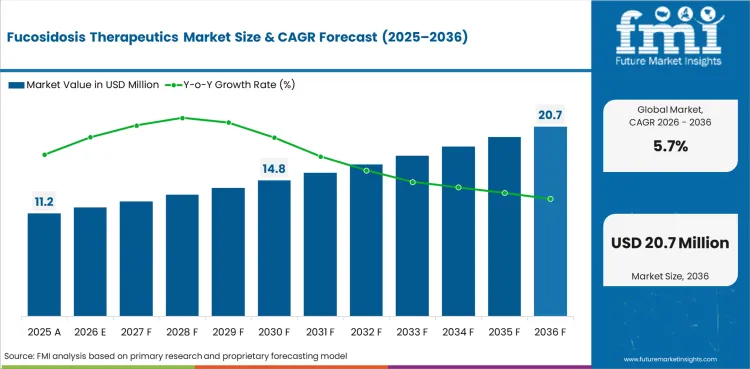
- The fucosidosis therapeutics market was valued at USD 11.23 million in 2025.
- The market is projected to reach USD 11.9 million in 2026 and USD 20.66 million by 2036, growing at a CAGR of 5.7%.
- By 2036, the Fucosidosis Therapeutics Market is expected to be worth USD 20.66 million.
- From 2026 to 2036, the market is projected to expand at a CAGR of 5.7%.
- The market is projected to create an incremental opportunity of USD 8.79 million between 2026 and 2036.
- In 2026, bone marrow transplantation is expected to account for 47.6% of the therapy segment, driven by its curative potential and increasing donor registry access.
- Hospitals are expected to lead the end-use segment with a 62.3% share.
- USA (5.9%) and EU (5.8%) are two of the fastest growing markets in the world.
Fucosidosis Therapeutics Market Definition
The fucosidosis therapeutics market covers pharmaceutical and cell-based interventions used in managing fucosidosis, a rare lysosomal storage disorder caused by alpha-L-fucosidase deficiency. Treatments include bone marrow transplantation, enzyme replacement therapy research, substrate reduction therapy, and symptomatic management.
Fucosidosis Therapeutics Market Inclusions
Market scope covers all commercially available fucosidosis therapeutics categorized by therapy (bone marrow transplantation, enzyme replacement, substrate reduction, symptomatic management, others), end user (hospitals, specialty centres, homecare), route of administration (intravenous, oral, subcutaneous), and treatment category (symptomatic treatment, disease-modifying therapy, supportive care). Revenue coverage spans 2026 to 2036.
Fucosidosis Therapeutics Market Exclusions
The scope does not include genetic counseling services billed separately, newborn screening test development costs, or general pediatric neurology consultations not specific to fucosidosis.
Fucosidosis Therapeutics Market Research Methodology
- Primary Research: FMI analysts conducted interviews with lysosomal storage disorder specialists, transplant physicians, and rare disease pharmaceutical developers across key markets.
- Desk Research: Combined data from rare disease registries, transplant activity databases, and pharmaceutical development pipeline records.
- Market Sizing and Forecasting: Bottom-up sizing across therapy type, end user, and treatment category segments with regional rare disease diagnosis rate curves.
- Data Validation: Cross-checked quarterly against rare disease registry data, transplant activity records, and pharmaceutical development milestone reports.
Why is the Fucosidosis Therapeutics Market Growing?
- Improving genetic diagnostic capabilities including whole exome sequencing are increasing confirmed fucosidosis case identification and enabling earlier treatment initiation with bone marrow transplantation.
- Advancement of enzyme replacement therapy and substrate reduction therapy research is creating potential treatment alternatives to bone marrow transplantation for patients without suitable donors.
- Growing international collaboration on lysosomal storage disorder research is accelerating therapeutic development and establishing treatment guidelines for this ultra-rare condition.
Demand for fucosidosis therapeutics reflects the ultra-rare nature of the condition and the high per-patient treatment costs associated with bone marrow transplantation and lifelong supportive care. Fucosidosis affects fewer than 1 in 200,000 births, making it one of the rarest lysosomal storage disorders. Early bone marrow transplantation remains the only established disease-modifying treatment.
Adoption of bone marrow transplantation leads at 47.6% of therapy demand, reflecting its established role as the primary curative approach when performed early in the disease course. Transplantation provides donor-derived enzyme-producing cells that can stabilize or partially reverse neurological deterioration.
Pricing reflects the orphan disease economics, with transplantation costs, lifelong supportive care, and emerging targeted therapies collectively creating high per-patient expenditure. Government rare disease programs and manufacturer compassionate use arrangements support treatment access.
Market Segmentation Analysis
- Bone Marrow Transplantation accounts for 47.6% of the therapy segment.
- Hospital represents 62.3% of the end-user segment.
- Intravenous leads the route of administration segment with 55.0% share.
The fucosidosis therapeutics market is segmented by therapy type, end user, route of administration, and treatment category. Demand patterns reflect the ultra-rare patient population, the centralized specialist treatment delivery model, and the evolving therapeutic landscape as enzyme replacement and substrate reduction approaches advance.
Insights into the Bone Marrow Transplantation Therapy Segment
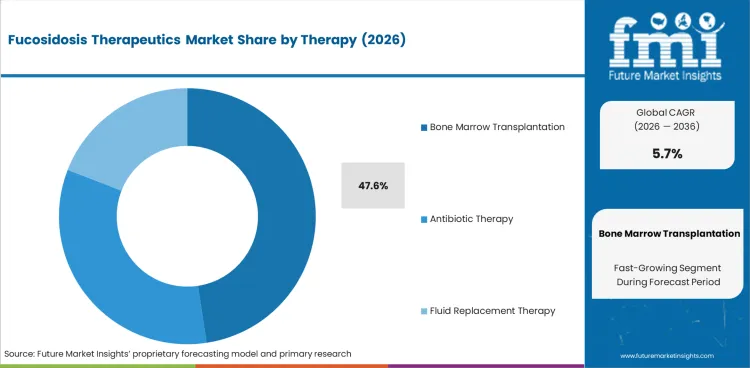
Bone marrow transplantation leads at 47.6% as the only established disease-modifying treatment for fucosidosis. Early transplantation provides donor-derived cells that produce functional alpha-L-fucosidase enzyme, offering the potential to stabilize neurological progression when performed before irreversible brain damage occurs.
Insights into the Hospital End-User Segment
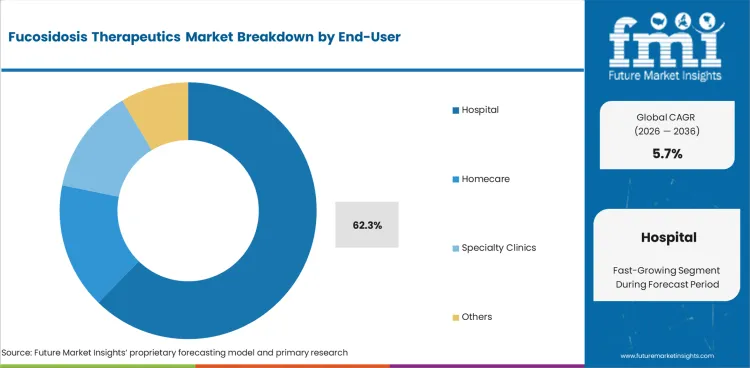
Hospitals represent 62.3% of end-user demand, driven by the requirement for specialized transplant and metabolic disease management facilities with pediatric neurology, genetics, and intensive care capabilities.
Fucosidosis Therapeutics Market Drivers, Restraints, and Opportunities
- Regulatory and structural demand drivers are creating sustained procurement patterns.
- Cost and access constraints create segmentation in adoption rates.
- Technology and product development are expanding the addressable market.
The fucosidosis therapeutics market is shaped by regulatory, technology, and procurement dynamics.
Genetic Diagnostic Advancement
Demand is shaped by improving molecular diagnostic capabilities that identify alpha-L-fucosidase gene mutations, enabling definitive fucosidosis diagnosis and timely referral for bone marrow transplantation assessment.
Enzyme Replacement Therapy Research
Growth reflects the advancing research pipeline for enzyme replacement therapy targeting fucosidosis, which could provide a non-transplant treatment option for patients without suitable donors.
International Research Collaboration
Adoption is supported by growing international collaboration on lysosomal storage disorder research that pools clinical experience across the very small global patient population.
Ultra-Rare Patient Population
The extremely small patient population creates very high per-patient costs and limits commercial incentives. Orphan drug designations and government rare disease funding are critical for sustaining therapeutic development.
Analysis of Fucosidosis Therapeutics Market By Key Countries
.webp "Top Country Growth Comparison Fucosidosis Therapeutics Market Cagr (2026 2036)")
| Country | CAGR |
|---|---|
| USA | 5.9% |
| EU | 5.8% |
| Japan | 5.7% |
| South Korea | 5.7% |
| UK | 5.6% |
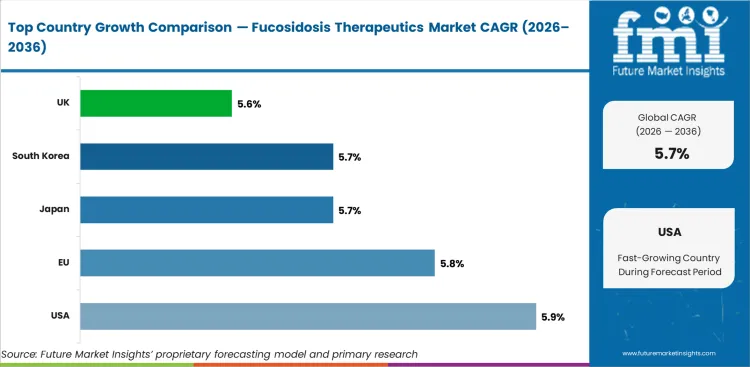
- USA leads with 5.9% CAGR.
- EU at 5.8% reflects expanding capabilities.
- Japan (5.7%) and South Korea (5.7%) maintain steady growth.
The global fucosidosis therapeutics market is expected to grow at 5.7% per year from 2026 to 2036.
Demand Outlook for Fucosidosis Therapeutics Market in the United States
The USA is expected to grow at 5.9% through 2036, driven by advanced transplant infrastructure, rare disease research investment, and comprehensive insurance coverage for orphan condition treatments.
- Transplant infrastructure supports bone marrow transplantation.
- Rare disease research drives therapeutic advancement.
- Insurance coverage supports treatment access.
Future Outlook for Fucosidosis Therapeutics Market in the European Union
The EU is expected to grow at 5.8% through 2036, supported by EU rare disease frameworks, cross-border treatment networks for lysosomal storage disorders, and clinical research collaboration.
- EU rare disease frameworks support treatment access.
- Cross-border networks coordinate specialist care.
- Clinical collaboration advances treatment understanding.
In-depth Analysis of Fucosidosis Therapeutics Market in Japan
Japan is expected to grow at 5.5% through 2036, driven by lysosomal storage disorder research expertise, government rare disease programs, and advanced transplant infrastructure.
- LSD research expertise drives therapeutic development.
- Government programs support treatment costs.
- Transplant infrastructure enables treatment delivery.
Opportunity Analysis of Fucosidosis Therapeutics Market in South Korea
South Korea is expected to grow at 5.6% through 2036, supported by genetic diagnostic capabilities, rare disease treatment investment, and participation in international metabolic disease research.
- Genetic diagnostics support case identification.
- Rare disease investment expands treatment capacity.
- International research participation advances treatment.
Sales Analysis of Fucosidosis Therapeutics Market in the United Kingdom
The UK is expected to grow at 5.3% through 2036, supported by NHS specialist commissioning for lysosomal storage disorders, genomic medicine integration, and rare disease clinical networks.
- NHS specialist commissioning supports treatment access.
- Genomic medicine improves diagnostic identification.
- Rare disease networks coordinate specialist care.
Competitive Landscape and Strategic Positioning
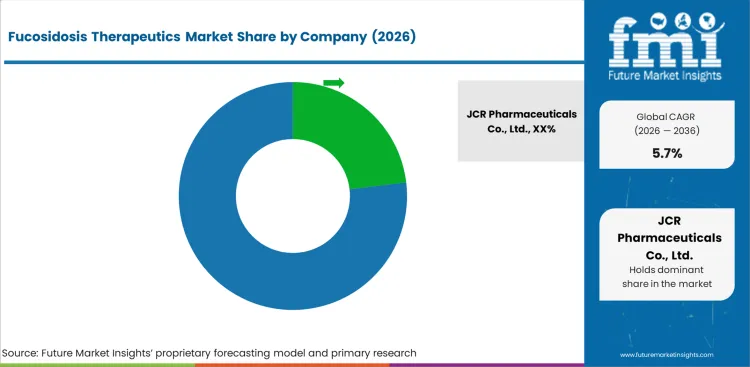
- JCR Pharmaceuticals Co., Ltd. leads with an estimated 23.1% market share.
- The competitive landscape includes global and specialized players.
- Entry barriers include regulatory, relationship, and scale factors.
JCR Pharmaceuticals Co., Ltd. leads through its enzyme replacement therapy development platform for lysosomal storage disorders including fucosidosis-relevant research programs.
Takeda Pharmaceutical Company Limited maintains a position through its rare disease portfolio and established lysosomal storage disorder treatment franchise.
Denali Therapeutics Inc. and Orphazyme A/S compete on CNS-penetrant enzyme delivery technology and substrate reduction therapy approaches relevant to neurological lysosomal storage disorders.
Entry barriers include the ultra-rare patient population, specialized lysosomal storage disorder clinical expertise, and the high cost of cell-based and enzyme therapy development.
Key Companies in the Fucosidosis Therapeutics Market
Key global companies leading the fucosidosis therapeutics market include:
- JCR Pharmaceuticals Co., Ltd. (Japan), Takeda Pharmaceutical (Japan), and Denali Therapeutics Inc. (USA) hold leading positions through enzyme therapy platforms and rare disease portfolios.
- Orphazyme A/S (Denmark) and Greenovation Biotech GmbH (Germany) compete on substrate reduction and plant-based enzyme production approaches.
- BioMarin Pharmaceutical (USA), Sanofi Genzyme (France), and Ultragenyx Pharmaceutical (USA) represent additional lysosomal storage disorder treatment positions.
Competitive Benchmarking: Fucosidosis Therapeutics Market
| Company | LSD Therapy Pipeline | Enzyme Technology | Rare Disease Programs | Geographic Reach |
|---|---|---|---|---|
| JCR Pharmaceuticals | High | High | Moderate | Asia, Global |
| Takeda Pharmaceutical | High | Medium | Strong | Global |
| Denali Therapeutics | Medium | High | Moderate | N. America |
| Orphazyme A/S | Medium | Medium | Moderate | Europe |
| Greenovation Biotech | Low | High | Low | Europe |
| BioMarin Pharmaceutical | Low | High | Strong | Global |
Source: Future Market Insights competitive analysis, 2026.
Key Developments in Fucosidosis Therapeutics Market
- In 2025, JCR Pharmaceuticals continued to advance its blood-brain barrier (BBB)-penetrating enzyme replacement therapy platform, supporting research into central nervous system-manifesting lysosomal storage disorders within the broader spectrum of ultra-rare metabolic diseases.
- In 2025, Takeda Pharmaceutical Company Limited continued to strengthen its rare disease research collaborations in lysosomal storage disorders, focusing on advancing therapeutic approaches for ultra-rare metabolic conditions with high unmet medical need.
Key Players in the Fucosidosis Therapeutics Market
Major Global Players
- JCR Pharmaceuticals Co., Ltd.
- Takeda Pharmaceutical Company Limited
- Denali Therapeutics Inc.
- Orphazyme A/S
- Greenovation Biotech GmbH
- ULTRAGENE PHARMA INC.
- Bio Marin Pharmaceutical Inc.
Emerging Players/Startups
- BioMarin Pharmaceutical
- Sanofi Genzyme
- Ultragenyx Pharmaceutical
- Prevail Therapeutics
- Passage Bio
Report Scope and Coverage
| Parameter | Details |
|---|---|
| Quantitative Units | USD 11.87 million to USD 20.66 million, at a CAGR of 5.7% |
| Market Definition | The fucosidosis therapeutics market covers pharmaceutical and cell-based interventions used in managing fucosidosis, a rare lysosomal storage disorder caused by alpha-L-fucosidase deficiency. Treatments include bone marrow transplantation, enzyme replacement therapy research, substrate reduction therapy, and symptomatic management. |
| Regions Covered | North America, Latin America, Europe, East Asia, South Asia and Pacific, Middle East and Africa |
| Countries Covered | USA, UK, France, Germany, Italy, South Korea, Japan, China, India, 30 plus countries |
| Key Companies Profiled | JCR Pharmaceuticals Co., Ltd., Takeda Pharmaceutical Company Limited, Denali Therapeutics Inc., Orphazyme A/S, Greenovation Biotech GmbH, ULTRAGENE PHARMA INC., Bio Marin Pharmaceutical Inc., Sangamo Therapeutics, Inc., REGENXBIO Inc., Avrobio, Inc., Abeona Therapeutics Inc., Lysogene S.A. |
| Forecast Period | 2026 to 2036 |
| Approach | Hybrid bottom-up and top-down methodology starting with verified transaction data, projecting adoption velocity across segments and regions. |
Market Segmentation Analysis
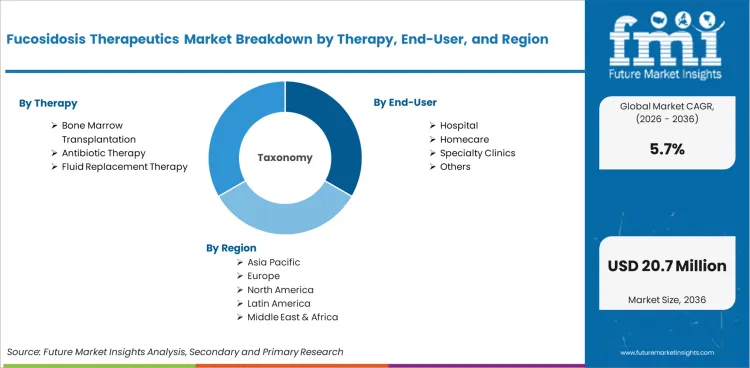
Fucosidosis Therapeutics Market Market Segmented by Therapy:
- Bone Marrow Transplantation
- Antibiotic Therapy
- Fluid Replacement Therapy
Fucosidosis Therapeutics Market Market Segmented by End-User:
- Hospital
- Homecare
- Specialty Clinics
- Others
Fucosidosis Therapeutics Market Market Segmented by Route Of Administration:
- Intravenous
- Intrathecal
- Oral
- Inhalation
Fucosidosis Therapeutics Market Market Segmented by Treatment Category:
- Symptomatic Treatment
- Enzyme Replacement Therapy
- Gene Therapy
- Supportive Care
Fucosidosis Therapeutics Market Market by Region:
- North America
- USA
- Canada
- Mexico
- Latin America
- Brazil
- Chile
- Rest of Latin America
- Western Europe
- Germany
- UK
- Italy
- Spain
- France
- Nordic
- BENELUX
- Rest of Western Europe
- Eastern Europe
- Russia
- Poland
- Hungary
- Balkan & Baltic
- Rest of Eastern Europe
- East Asia
- China
- Japan
- South Korea
- South Asia and Pacific
- India
- ASEAN
- Australia & New Zealand
- Rest of South Asia and Pacific
- Middle East & Africa
- Kingdom of Saudi Arabia
- Other GCC Countries
- Turkiye
- South Africa
- Other African Union
- Rest of Middle East & Africa
Research Sources and Bibliography
- 1. National Organization for Rare Disorders. (2025). NORD Rare Disease Database: Fucosidosis. NORD.
- 2. European Reference Network for Hereditary Metabolic Disorders. (2024). MetabERN Clinical Guidelines: Lysosomal Storage Disorders. MetabERN.
- 3. National Institutes of Health. (2025). NIH Genetic and Rare Diseases Information Center: Fucosidosis. NIH.
- 4. World Health Organization. (2024). WHO Classification of Lysosomal Storage Disorders. WHO.
- 5. International Society for Inherited Metabolic Disorders. (2024). JIMD Reports: Fucosidosis Treatment Outcomes. SSIEM.
This bibliography is provided for reader reference. The full Future Market Insights report contains the complete reference list with publication dates, URLs, and supporting data for all cited works.
This Report Answers
- Estimating the market size and revenue from 2026 to 2036.
- Segmentation by therapy, end user, route of administration, and treatment category.
- Regional and country-level insights across more than 30 markets.
- Enzyme therapy pipeline and transplant outcome analysis.
- Competitive landscape assessment.
- Investment opportunity identification.
- Patient identification and treatment access analysis.
- Data delivery in PDF and Excel formats.
Frequently Asked Questions
What is the global market demand for Fucosidosis Therapeutics in 2026?
In 2026, the global market is expected to be worth USD 11.87 million.
How big will the Fucosidosis Therapeutics Market be in 2036?
By 2036, the market is expected to be worth USD 20.66 million.
How much is demand expected to grow between 2026 and 2036?
Between 2026 and 2036, demand is expected to grow at a CAGR of 5.7%.
Which Therapy segment is expected to lead in 2026?
Bone Marrow Transplantation is expected to account for 47.6% of the segment in 2026.
What is causing demand to rise in USA?
USA is expected to grow at 5.9% through 2036.
What is causing demand to rise in EU?
EU is expected to grow at 5.8% through 2036.
What does this report mean by Fucosidosis Therapeutics Market definition?
The fucosidosis therapeutics market covers pharmaceutical and cell-based interventions used in managing fucosidosis, a rare lysosomal storage disorder caused by alpha-L-fucosidase deficiency. Treatmen.
How does FMI make the forecast?
Forecasting uses a hybrid bottom-up and top-down methodology starting with verified transaction data, projecting adoption velocity across segments and regions.
Preview the report firsthand - request a free sample
Get SampleGet the brochure for pricing and purchase details.
Get PDFTable of Content
- Executive Summary
- Global Market Outlook
- Demand-side Trends
- Supply-side Trends
- Technology Roadmap Analysis
- Analysis and Recommendations
- Market Overview
- Market Coverage / Taxonomy
- Market Definition / Scope / Limitations
- Research Methodology
- Chapter Orientation
- Analytical Lens and Working Hypotheses
- Market Structure, Signals, and Trend Drivers
- Benchmarking and Cross-market Comparability
- Market Sizing, Forecasting, and Opportunity Mapping
- Research Design and Evidence Framework
- Desk Research Programme (Secondary Evidence)
- Company Annual and Sustainability Reports
- Peer-reviewed Journals and Academic Literature
- Corporate Websites, Product Literature, and Technical Notes
- Earnings Decks and Investor Briefings
- Statutory Filings and Regulatory Disclosures
- Technical White Papers and Standards Notes
- Trade Journals, Industry Magazines, and Analyst Briefs
- Conference Proceedings, Webinars, and Seminar Materials
- Government Statistics Portals and Public Data Releases
- Press Releases and Reputable Media Coverage
- Specialist Newsletters and Curated Briefings
- Sector Databases and Reference Repositories
- FMI Internal Proprietary Databases and Historical Market Datasets
- Subscription Datasets and Paid Sources
- Social Channels, Communities, and Digital Listening Inputs
- Additional Desk Sources
- Expert Input and Fieldwork (Primary Evidence)
- Primary Modes
- Qualitative Interviews and Expert Elicitation
- Quantitative Surveys and Structured Data Capture
- Blended Approach
- Why Primary Evidence is Used
- Field Techniques
- Interviews
- Surveys
- Focus Groups
- Observational and In-context Research
- Social and Community Interactions
- Stakeholder Universe Engaged
- C-suite Leaders
- Board Members
- Presidents and Vice Presidents
- R&D and Innovation Heads
- Technical Specialists
- Domain Subject-matter Experts
- Scientists
- Physicians and Other Healthcare Professionals
- Governance, Ethics, and Data Stewardship
- Research Ethics
- Data Integrity and Handling
- Primary Modes
- Tooling, Models, and Reference Databases
- Desk Research Programme (Secondary Evidence)
- Data Engineering and Model Build
- Data Acquisition and Ingestion
- Cleaning, Normalisation, and Verification
- Synthesis, Triangulation, and Analysis
- Quality Assurance and Audit Trail
- Market Background
- Market Dynamics
- Drivers
- Restraints
- Opportunity
- Trends
- Scenario Forecast
- Demand in Optimistic Scenario
- Demand in Likely Scenario
- Demand in Conservative Scenario
- Opportunity Map Analysis
- Product Life Cycle Analysis
- Supply Chain Analysis
- Investment Feasibility Matrix
- Value Chain Analysis
- PESTLE and Porter’s Analysis
- Regulatory Landscape
- Regional Parent Market Outlook
- Production and Consumption Statistics
- Import and Export Statistics
- Market Dynamics
- Global Market Analysis 2021 to 2025 and Forecast, 2026 to 2036
- Historical Market Size Value (USD Million) Analysis, 2021 to 2025
- Current and Future Market Size Value (USD Million) Projections, 2026 to 2036
- Y-o-Y Growth Trend Analysis
- Absolute $ Opportunity Analysis
- Global Market Pricing Analysis 2021 to 2025 and Forecast 2026 to 2036
- Global Market Analysis 2021 to 2025 and Forecast 2026 to 2036, By Therapy
- Introduction / Key Findings
- Historical Market Size Value (USD Million) Analysis By Therapy , 2021 to 2025
- Current and Future Market Size Value (USD Million) Analysis and Forecast By Therapy , 2026 to 2036
- Bone Marrow Transplantation
- Antibiotic Therapy
- Fluid Replacement Therapy
- Bone Marrow Transplantation
- Y-o-Y Growth Trend Analysis By Therapy , 2021 to 2025
- Absolute $ Opportunity Analysis By Therapy , 2026 to 2036
- Global Market Analysis 2021 to 2025 and Forecast 2026 to 2036, By End-User
- Introduction / Key Findings
- Historical Market Size Value (USD Million) Analysis By End-User, 2021 to 2025
- Current and Future Market Size Value (USD Million) Analysis and Forecast By End-User, 2026 to 2036
- Hospital
- Homecare
- Specialty Clinics
- Others
- Hospital
- Y-o-Y Growth Trend Analysis By End-User, 2021 to 2025
- Absolute $ Opportunity Analysis By End-User, 2026 to 2036
- Global Market Analysis 2021 to 2025 and Forecast 2026 to 2036, By Route Of Administration
- Introduction / Key Findings
- Historical Market Size Value (USD Million) Analysis By Route Of Administration, 2021 to 2025
- Current and Future Market Size Value (USD Million) Analysis and Forecast By Route Of Administration, 2026 to 2036
- Intravenous
- Intrathecal
- Oral
- Inhalation
- Intravenous
- Y-o-Y Growth Trend Analysis By Route Of Administration, 2021 to 2025
- Absolute $ Opportunity Analysis By Route Of Administration, 2026 to 2036
- Global Market Analysis 2021 to 2025 and Forecast 2026 to 2036, By Treatment Category
- Introduction / Key Findings
- Historical Market Size Value (USD Million) Analysis By Treatment Category, 2021 to 2025
- Current and Future Market Size Value (USD Million) Analysis and Forecast By Treatment Category, 2026 to 2036
- Symptomatic Treatment
- Enzyme Replacement Therapy
- Gene Therapy
- Supportive Care
- Symptomatic Treatment
- Y-o-Y Growth Trend Analysis By Treatment Category, 2021 to 2025
- Absolute $ Opportunity Analysis By Treatment Category, 2026 to 2036
- Global Market Analysis 2021 to 2025 and Forecast 2026 to 2036, By Region
- Introduction
- Historical Market Size Value (USD Million) Analysis By Region, 2021 to 2025
- Current Market Size Value (USD Million) Analysis and Forecast By Region, 2026 to 2036
- North America
- Latin America
- Western Europe
- Eastern Europe
- East Asia
- South Asia and Pacific
- Middle East & Africa
- Market Attractiveness Analysis By Region
- North America Market Analysis 2021 to 2025 and Forecast 2026 to 2036, By Country
- Historical Market Size Value (USD Million) Trend Analysis By Market Taxonomy, 2021 to 2025
- Market Size Value (USD Million) Forecast By Market Taxonomy, 2026 to 2036
- By Country
- USA
- Canada
- Mexico
- By Therapy
- By End-User
- By Route Of Administration
- By Treatment Category
- By Country
- Market Attractiveness Analysis
- By Country
- By Therapy
- By End-User
- By Route Of Administration
- By Treatment Category
- Key Takeaways
- Latin America Market Analysis 2021 to 2025 and Forecast 2026 to 2036, By Country
- Historical Market Size Value (USD Million) Trend Analysis By Market Taxonomy, 2021 to 2025
- Market Size Value (USD Million) Forecast By Market Taxonomy, 2026 to 2036
- By Country
- Brazil
- Chile
- Rest of Latin America
- By Therapy
- By End-User
- By Route Of Administration
- By Treatment Category
- By Country
- Market Attractiveness Analysis
- By Country
- By Therapy
- By End-User
- By Route Of Administration
- By Treatment Category
- Key Takeaways
- Western Europe Market Analysis 2021 to 2025 and Forecast 2026 to 2036, By Country
- Historical Market Size Value (USD Million) Trend Analysis By Market Taxonomy, 2021 to 2025
- Market Size Value (USD Million) Forecast By Market Taxonomy, 2026 to 2036
- By Country
- Germany
- UK
- Italy
- Spain
- France
- Nordic
- BENELUX
- Rest of Western Europe
- By Therapy
- By End-User
- By Route Of Administration
- By Treatment Category
- By Country
- Market Attractiveness Analysis
- By Country
- By Therapy
- By End-User
- By Route Of Administration
- By Treatment Category
- Key Takeaways
- Eastern Europe Market Analysis 2021 to 2025 and Forecast 2026 to 2036, By Country
- Historical Market Size Value (USD Million) Trend Analysis By Market Taxonomy, 2021 to 2025
- Market Size Value (USD Million) Forecast By Market Taxonomy, 2026 to 2036
- By Country
- Russia
- Poland
- Hungary
- Balkan & Baltic
- Rest of Eastern Europe
- By Therapy
- By End-User
- By Route Of Administration
- By Treatment Category
- By Country
- Market Attractiveness Analysis
- By Country
- By Therapy
- By End-User
- By Route Of Administration
- By Treatment Category
- Key Takeaways
- East Asia Market Analysis 2021 to 2025 and Forecast 2026 to 2036, By Country
- Historical Market Size Value (USD Million) Trend Analysis By Market Taxonomy, 2021 to 2025
- Market Size Value (USD Million) Forecast By Market Taxonomy, 2026 to 2036
- By Country
- China
- Japan
- South Korea
- By Therapy
- By End-User
- By Route Of Administration
- By Treatment Category
- By Country
- Market Attractiveness Analysis
- By Country
- By Therapy
- By End-User
- By Route Of Administration
- By Treatment Category
- Key Takeaways
- South Asia and Pacific Market Analysis 2021 to 2025 and Forecast 2026 to 2036, By Country
- Historical Market Size Value (USD Million) Trend Analysis By Market Taxonomy, 2021 to 2025
- Market Size Value (USD Million) Forecast By Market Taxonomy, 2026 to 2036
- By Country
- India
- ASEAN
- Australia & New Zealand
- Rest of South Asia and Pacific
- By Therapy
- By End-User
- By Route Of Administration
- By Treatment Category
- By Country
- Market Attractiveness Analysis
- By Country
- By Therapy
- By End-User
- By Route Of Administration
- By Treatment Category
- Key Takeaways
- Middle East & Africa Market Analysis 2021 to 2025 and Forecast 2026 to 2036, By Country
- Historical Market Size Value (USD Million) Trend Analysis By Market Taxonomy, 2021 to 2025
- Market Size Value (USD Million) Forecast By Market Taxonomy, 2026 to 2036
- By Country
- Kingdom of Saudi Arabia
- Other GCC Countries
- Turkiye
- South Africa
- Other African Union
- Rest of Middle East & Africa
- By Therapy
- By End-User
- By Route Of Administration
- By Treatment Category
- By Country
- Market Attractiveness Analysis
- By Country
- By Therapy
- By End-User
- By Route Of Administration
- By Treatment Category
- Key Takeaways
- Key Countries Market Analysis
- USA
- Pricing Analysis
- Market Share Analysis, 2025
- By Therapy
- By End-User
- By Route Of Administration
- By Treatment Category
- Canada
- Pricing Analysis
- Market Share Analysis, 2025
- By Therapy
- By End-User
- By Route Of Administration
- By Treatment Category
- Mexico
- Pricing Analysis
- Market Share Analysis, 2025
- By Therapy
- By End-User
- By Route Of Administration
- By Treatment Category
- Brazil
- Pricing Analysis
- Market Share Analysis, 2025
- By Therapy
- By End-User
- By Route Of Administration
- By Treatment Category
- Chile
- Pricing Analysis
- Market Share Analysis, 2025
- By Therapy
- By End-User
- By Route Of Administration
- By Treatment Category
- Germany
- Pricing Analysis
- Market Share Analysis, 2025
- By Therapy
- By End-User
- By Route Of Administration
- By Treatment Category
- UK
- Pricing Analysis
- Market Share Analysis, 2025
- By Therapy
- By End-User
- By Route Of Administration
- By Treatment Category
- Italy
- Pricing Analysis
- Market Share Analysis, 2025
- By Therapy
- By End-User
- By Route Of Administration
- By Treatment Category
- Spain
- Pricing Analysis
- Market Share Analysis, 2025
- By Therapy
- By End-User
- By Route Of Administration
- By Treatment Category
- France
- Pricing Analysis
- Market Share Analysis, 2025
- By Therapy
- By End-User
- By Route Of Administration
- By Treatment Category
- India
- Pricing Analysis
- Market Share Analysis, 2025
- By Therapy
- By End-User
- By Route Of Administration
- By Treatment Category
- ASEAN
- Pricing Analysis
- Market Share Analysis, 2025
- By Therapy
- By End-User
- By Route Of Administration
- By Treatment Category
- Australia & New Zealand
- Pricing Analysis
- Market Share Analysis, 2025
- By Therapy
- By End-User
- By Route Of Administration
- By Treatment Category
- China
- Pricing Analysis
- Market Share Analysis, 2025
- By Therapy
- By End-User
- By Route Of Administration
- By Treatment Category
- Japan
- Pricing Analysis
- Market Share Analysis, 2025
- By Therapy
- By End-User
- By Route Of Administration
- By Treatment Category
- South Korea
- Pricing Analysis
- Market Share Analysis, 2025
- By Therapy
- By End-User
- By Route Of Administration
- By Treatment Category
- Russia
- Pricing Analysis
- Market Share Analysis, 2025
- By Therapy
- By End-User
- By Route Of Administration
- By Treatment Category
- Poland
- Pricing Analysis
- Market Share Analysis, 2025
- By Therapy
- By End-User
- By Route Of Administration
- By Treatment Category
- Hungary
- Pricing Analysis
- Market Share Analysis, 2025
- By Therapy
- By End-User
- By Route Of Administration
- By Treatment Category
- Kingdom of Saudi Arabia
- Pricing Analysis
- Market Share Analysis, 2025
- By Therapy
- By End-User
- By Route Of Administration
- By Treatment Category
- Turkiye
- Pricing Analysis
- Market Share Analysis, 2025
- By Therapy
- By End-User
- By Route Of Administration
- By Treatment Category
- South Africa
- Pricing Analysis
- Market Share Analysis, 2025
- By Therapy
- By End-User
- By Route Of Administration
- By Treatment Category
- USA
- Market Structure Analysis
- Competition Dashboard
- Competition Benchmarking
- Market Share Analysis of Top Players
- By Regional
- By Therapy
- By End-User
- By Route Of Administration
- By Treatment Category
- Competition Analysis
- Competition Deep Dive
- JCR Pharmaceuticals Co., Ltd.
- Overview
- Product Portfolio
- Profitability by Market Segments (Product/Age /Sales Channel/Region)
- Sales Footprint
- Strategy Overview
- Marketing Strategy
- Product Strategy
- Channel Strategy
- Takeda Pharmaceutical Company Limited
- Denali Therapeutics Inc.
- Orphazyme A/S
- Greenovation Biotech GmbH
- ULTRAGENE PHARMA INC.
- Bio Marin Pharmaceutical Inc.
- Sangamo Therapeutics, Inc.
- REGENXBIO Inc.
- Avrobio, Inc.
- Abeona Therapeutics Inc.
- Lysogene S.A.
- JCR Pharmaceuticals Co., Ltd.
- Competition Deep Dive
- Assumptions & Acronyms Used


