

- Market Size (2026)
- USD 1.7 Bn
- Forecast (2036)
- USD 6.7 Bn
- CAGR (2026 to 2036)
- 14.7%
How big is Oral GLP-1 Receptor Agonist Market in 2026?
Sales in the oral GLP-1 receptor agonist market are projected to grow at 14.7% CAGR through 2036. Market size rises from USD 1.5 billion in 2025 to USD 1.7 billion in 2026 and is expected to reach USD 6.7 billion by 2036.
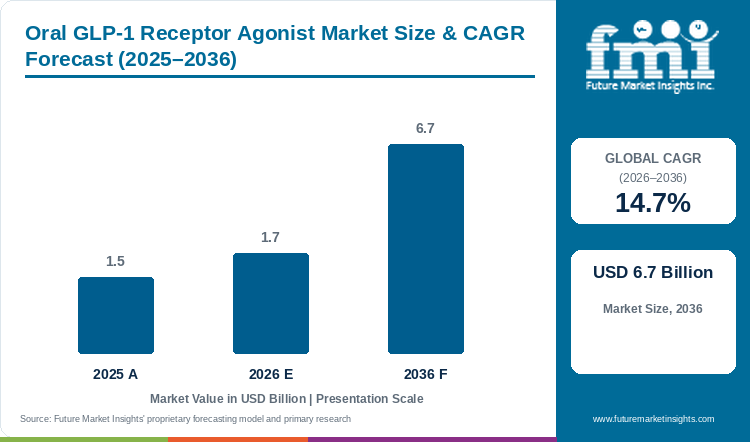
Oral GLP-1 receptor agonists are daily tablets developed for type 2 diabetes, obesity and other cardiometabolic treatment. The global oral GLP-1 receptor agonist market was valued at USD 1.5 billion in 2025 and is projected to grow from USD 1.7 billion in 2026 to USD 6.7 billion by 2036, at a CAGR of 14.7% from 2026 to 2036. Peptide Oral GLP-1 Agonists accounted for 61.2% of revenue in 2026, owing to approved semaglutide tablets and physician experience with gradual dose increase. The World Health Organization reported 1.1 billion people living with obesity in 2024, including 940 million adults, which provides a very large clinical population for long-term weight treatment.[1] In April 2026, the highest Foundayo dose produced 27.3 pounds or 12.4% average weight loss among participants who remained on treatment.[2] The MHRA also approved Wegovy tablets in four strengths from 1.5 mg to 25 mg in June 2026.[3] Availability of approved strengths along with measurable weight reduction is expected to support oral GLP-1 receptor agonist market growth.
Key Market Trends & Insights
- By Molecule Type: Peptide Oral GLP-1 Agonists represented 61.2% of revenue in 2026, owing to approved semaglutide tablets and established physician experience with oral dose escalation.
- By Indication: Obesity and Weight Management accounted for 52.4% of demand in 2026, as tablet approvals are moving the category beyond diabetes-only use.
- By Distribution Channel: Retail Pharmacies held 44.5% of revenue in 2026, supported by prescription dispensing, availability of several strengths and repeat refill requirement.
- By End User: Home Care Settings led with 48.6% in 2026, since once-daily tablets are self-administered while dose, tolerability and treatment response remains under physician supervision.
Regional Highlights
- Fastest-growing profiled country: France (18.5% CAGR, 2026 to 2036), supported by coordinated obesity pathways and expansion of specialist care.
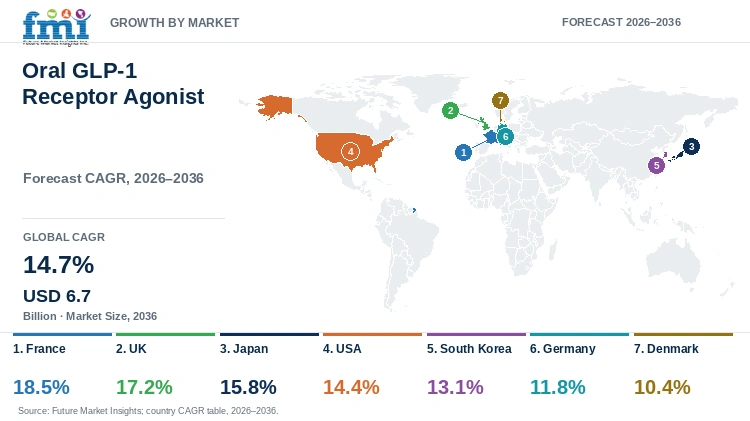
- By country: the UK (17.2%) and Japan (15.8%) follow, while Denmark records the lowest profiled CAGR at 10.4% from 2026 to 2036.
Market Size & Forecast
Table 1: Market Size and Forecast for the Oral GLP-1 Receptor Agonist Market (USD billion and percentage), 2025 to 2036
| Metric | Value |
|---|---|
| 2025 Market Size | USD 1.5 billion |
| Estimated Market Size in 2026 | USD 1.7 billion |
| Projected Market Size by 2036 | USD 6.7 billion |
| CAGR, 2026 to 2036 | 14.7% |
| Added Revenue, 2026 to 2036 | USD 5.0 billion |
| Market Expansion Multiple | 3.94x |
Treatment access is one of the primary factors deciding how much of the obesity population enters paid oral GLP-1 treatment. CMS started the Medicare GLP-1 Bridge on July 1, 2026 with USD 50 monthly cost for eligible beneficiaries and availability through December 31, 2027.[5] France increased specialist obesity centers to 42 in 2025, five more than in 2024, which is expanding referral and medicine evaluation.[6] Apart from that, 34.4% of adults in South Korea had obesity in 2024 and 65.0% tried to lose or maintain weight.[7] A large weight-control population does not directly create medicine sales because local approval, prescription and payment is still required. Administration is also different across products, as semaglutide requires fasting while orforglipron can be taken without food or water restriction.[4] Patient eligibility, reimbursement, dose instruction and pharmacy availability is therefore expected to decide repeat oral GLP-1 demand.
Treatment Access and Administration Readiness
Table 2: Treatment Access and Administration Readiness for the Oral GLP-1 Receptor Agonist Market (people, percentages, dose strengths, centers, and USD), mixed reporting years from 2024 to 2027
| Indicator | Data Point | Why It Matters | Source |
|---|---|---|---|
| Global obesity base | 1.1 billion people in 2024, including 940 million adults | Shows the clinical need, while diagnosis, eligibility and payment narrow the treated population. | [1] |
| Foundayo Phase 3 result | 27.3 pounds or 12.4% average weight loss at 72 weeks among participants remaining on treatment | Provides efficacy evidence for oral small-molecule prescribing and product competition. | [2] |
| UK oral semaglutide regimen | 4 strengths from 1.5 mg to 25 mg; fasting for at least 8 hours and waiting 30 minutes after dosing | Supports dose escalation but creates administration and counseling requirement. | [3] |
| UK orforglipron regimen | 6 strengths from 0.8 mg to 17.2 mg; no food or water restriction | Food-flexible dosing can reduce administration burden, subject to authorization and payment. | [4] |
| Medicare GLP-1 Bridge | USD 50 per month for eligible beneficiaries, July 2026 to December 2027 | Creates a defined paid-access route and pharmacy claims flow for qualifying patients. | [5] |
| France obesity care network | 42 specialist obesity centers in 2025, up by 5 from 2024 | Expands referral and multidisciplinary care capacity supporting medicine evaluation. | [6] |
| South Korea weight-control base | 34.4% adult obesity prevalence and 65.0% weight-control attempts in 2024 | Indicates high weight-management activity, although local approval and reimbursement remain necessary. | [7] |
Basis: Market values, segment shares and country CAGRs are report estimates. External indicators use the reporting years stated in each row. Added revenue equals USD 6.7 billion less USD 1.7 billion. Expansion multiple equals USD 6.7 billion divided by USD 1.7 billion.
Analyst Perspective
“Oral tablets will widen weight-treatment demand where patients need simpler dosing and pharmacies can support repeat access. Small-molecule products will gain opportunity when food-flexible dosing is combined with tolerability and paid coverage.”
- Anurag Sharma, Principal Consultant, Future Market Insights.
How is the oral GLP-1 receptor agonist market segmented?
Oral GLP-1 receptor agonist market is segmented by four primary commercial axes and region: molecule type, indication, distribution channel, end user, and region. In 2026, peptide oral GLP-1 agonists are projected at 61.2%, obesity and weight management at 52.4%, retail pharmacies at 44.5%, and home care settings at 48.6%.
On the basis of molecule type, oral GLP-1 receptor agonist market is segmented into Peptide Oral GLP-1 Agonists, Small-Molecule Oral GLP-1 Agonists and Oral Dual and Triple Agonists. As per FMI, indication is divided into Obesity and Weight Management, Type 2 Diabetes and Other Cardiometabolic Indications. Distribution channel includes Retail Pharmacies, Online and Mail-Order Pharmacies and Hospital Pharmacies. End user is segmented into Home Care Settings, Specialty Endocrinology and Obesity Clinics and Hospitals. Approved medicines create present revenue, whereas clinical-stage products represent future opportunity and do not establish current sales.
Why do Peptide Oral GLP-1 Agonists lead the Molecule Type category?
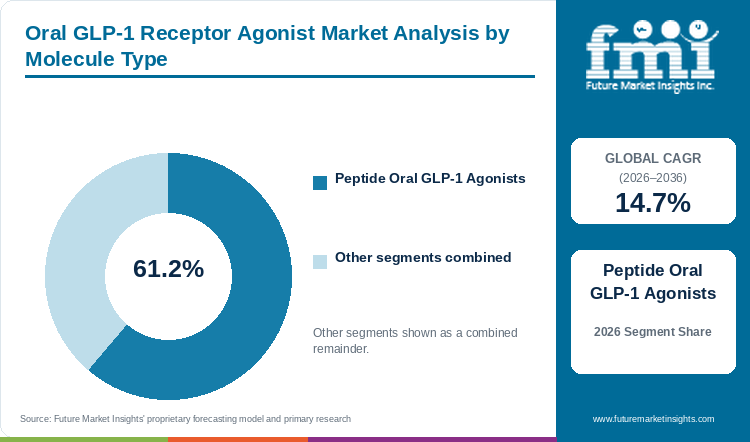
Based on molecule type, peptide oral GLP-1 agonists are projected to account for 61.2% in 2026, supported by established oral semaglutide formulations.
Table 3: Molecule Type Share for the Oral GLP-1 Receptor Agonist Market (percentage share), 2026
| Molecule Type | Share (2026) |
|---|---|
| Peptide Oral GLP-1 Agonists | 61.2% |
| Other Segments Combined | 38.8%* |
| Total | 100.0% |
*Calculated as the balance remaining after deducting the leading segment's reported share from 100.0%.
Table 4: Molecule Type Leadership and Market Growth for the Oral GLP-1 Receptor Agonist Market (segment and CAGR percentage), 2026 to 2036
| Metric | Value |
|---|---|
| Global CAGR (2026 to 2036) | 14.7% |
| Leading Segment | Peptide Oral GLP-1 Agonists |
Established oral semaglutide formulation is one of the primary factors supporting Peptide Oral GLP-1 Agonists. Wegovy tablets are available in 1.5 mg, 4 mg, 9 mg and 25 mg strengths with gradual dose increase.[8] Different strengths allow physicians to begin at a lower dose and increase treatment according to tolerability and response. Small-molecule products do not require peptide absorption enhancers, but each candidate still needs separate efficacy and safety evidence. Approved tablet strengths and physician familiarity with daily dose escalation is anticipated to support repeat demand for peptide oral GLP-1 agonists.
- Peptide Oral GLP-1 Agonists accounted for 61.2% share in 2026, owing to approved semaglutide tablets, approved strengths and physician familiarity with daily dose escalation.
- Increasing use of oral semaglutide for diabetes and weight management is anticipated to support repeat prescription and segment revenue growth.
What sustains Obesity and Weight Management within the Indication category?
By indication, obesity and weight management is estimated to hold 52.4% in 2026, owing to approved adult weight-management pathways.
Long-term weight treatment is moving oral GLP-1 medicines beyond diabetes-only use. The MHRA approved Wegovy tablets for adults with obesity or qualifying overweight in four once-daily strengths in June 2026.[3] The tablet is used with reduced-calorie diet and physical activity, due to which treatment remains connected with a wider weight management programme. However, age, weight criteria, contraindications and payment limits use among the complete patient population. Wider adult approval is expected to drive the Obesity and Weight Management segment during the forecast period.
- Obesity and Weight Management accounted for 52.4% share in 2026, owing to high requirement for chronic weight treatment and availability of approved daily oral medicines.
- Wider use will depend on patient eligibility, tolerability, physician prescription and reimbursement, which in turn affect continuation of treatment.
How do Retail Pharmacies anchor the Distribution Channel category?
In 2026, retail pharmacies are expected to lead distribution channel with 44.5% share, supported by national dispensing access.
Retail pharmacies are becoming a major distribution channel for oral GLP-1 receptor agonists owing to prescription dispensing and repeat refill requirement. Novo Nordisk made Wegovy tablets available through pharmacy and direct-access channels in the USA during January 2026.[9] Pharmacy supply helps patients obtain the prescribed strength at different stages of dose escalation. Apart from that, pharmacists provide product-specific food, water and refill instructions, which reduces confusion between oral formulations. Wider national availability of approved tablets is anticipated to support Retail Pharmacies segment revenue.
- Retail Pharmacies held 44.5% share in 2026, owing to wide pharmacy presence, prescription filling and availability of repeat refills.
- Correct claims processing, prescribed tablet strength and product-specific counseling are expected to remain important for continued pharmacy sales.
Why are Home Care Settings central to the End User category?
Home care settings are projected to hold 48.6% share in 2026, driven by daily self-administration outside staffed facilities.
Once-daily tablets are mainly taken at home and do not require facility-based dosing. CMS started the Medicare GLP-1 Bridge on July 1, 2026 with centralized authorization, claims processing and pharmacy payment for eligible beneficiaries.[5] The medicine can be self-administered, whereas physicians remain involved when dose, tolerability or treatment response changes. Telehealth supervision and pharmacy refill access are also supporting treatment outside hospitals. These factors are expected to increase the use of oral GLP-1 receptor agonists in Home Care Settings.
- Home Care Settings held 48.6% share in 2026, due to daily self-administration and increasing use of telehealth-supported treatment programmes.
- Home treatment still requires physician monitoring when dose, tolerability or treatment response changes, which supports continued connection with clinics and pharmacies.
What are the drivers, restraints and opportunities in the oral glp-1 receptor agonist market?
In the oral GLP-1 receptor agonist market, the key driver is outcome evidence, the key restraint is access, and the key opportunity is oral multiagonists.
- Driver: Outcome evidence strengthens the value case for repeat oral treatment.
- Restraint: Coverage eligibility and formulation-specific dosing restrict paid treatment.
- Opportunity: Oral multiagonists can add choice after confirmatory efficacy and safety testing.
Clinical Outcome Evidence Strengthens Value Case
Clinical outcome evidence is one of the primary factors supporting physician and payer interest in repeat oral GLP-1 receptor agonist treatment. The SOUL trial reported a hazard ratio of 0.86 for major cardiovascular events with oral semaglutide compared with placebo among high-risk adults with type 2 diabetes.[10] An FMI analyst notes that cardiovascular outcome evidence gives an additional treatment reason beyond the convenience of a daily tablet. However, the result belongs to oral semaglutide and cannot be applied to every oral GLP-1 medicine. Increasing availability of product-specific outcome evidence is expected to drive oral GLP-1 receptor agonist market growth.
Coverage Eligibility and Formulation Barriers Restrict Treatment
High treatment cost, coverage checks and formulation-specific dosing instructions are some of the factors limiting oral GLP-1 receptor agonist adoption. In December 2025, the MHRA warned that transition to a new Rybelsus formulation created medication-error risk because old and new tablet strengths were not equivalent.[11] Prior authorization can delay paid treatment, whereas confusion between tablet strengths can affect correct dose after prescription. High cost along with coverage and administration requirement may hamper the growth of oral GLP-1 receptor agonist market.
Oral Multiagonists Expand Formulation Choice
Oral multiagonists are creating growth opportunities by combining GLP-1 activity with another metabolic pathway in one tablet. In August 2025, Viking reported that oral VK2735 produced up to 12.2% mean weight loss after 13 weeks in its Phase 2 study.[12] The candidate combines GLP-1 and GIP activity, which can provide another oral treatment choice if later-stage studies confirm efficacy, tolerability and suitable dose. Development of oral multiagonists is expected to create new avenues in oral GLP-1 receptor agonist market.
Which country CAGRs are profiled in the oral glp-1 receptor agonist market?
Table 5: Country CAGR Comparison for the Oral GLP-1 Receptor Agonist Market (CAGR percentage), 2026 to 2036
| Country | CAGR |
|---|---|
| France | 18.5% |
| UK | 17.2% |
| Japan | 15.8% |
| USA | 14.4% |
| South Korea | 13.1% |
| Germany | 11.8% |
| Denmark | 10.4% |
How do country-level CAGRs compare in the oral glp-1 receptor agonist market?
As per the analysis from FMI, country growth differs through 2036 because approval, reimbursement and pharmacy access are not uniform. France and the UK have stronger expansion outlooks as structured obesity care and oral approvals are widening. Japan and the USA have existing oral semaglutide experience, whereas South Korea, Germany and Denmark are expected to follow measured adoption depending on local payment and prescribing requirement. Full report country CAGRs cover: North America; Latin America; Western Europe; Eastern Europe; East Asia; South Asia and Pacific; Middle East and Africa.
Country-wise Analysis
- France oral GLP-1 receptor agonist market is projected to grow at 18.5% CAGR between 2026 and 2036 owing to structured obesity treatment and specialist prescribing. In June 2026, the French health ministry stated that GLP-1 medicines for weight control are used after at least 6 months of nutritional, behavioral and physical-activity management for eligible adults.[13] The medicines are prescribed by physicians and supplied through pharmacies. Increasing inclusion of medicines after lifestyle treatment is expected to support oral GLP-1 receptor agonist demand in France.
- The UK oral GLP-1 receptor agonist market is anticipated to advance at 17.2% CAGR through 2036. In August 2026, the MHRA authorized Foundayo for weight management and type 2 diabetes, with six strengths from 0.8 mg to 17.2 mg and no food or water restriction.[4] Wegovy tablets requires fasting, whereas Foundayo can be taken at any time of day. Availability of two products with different administration requirement is widening prescription choice. However, NHS use remains under separate assessment, which will influence paid demand over the forecast period.
- Oral GLP-1 receptor agonist demand in Japan is forecast to rise at 15.8% CAGR over the forecast period. The International Diabetes Federation reported 10.8 million adults aged 20 to 79 living with diabetes in Japan during 2024.[14] Existing use of oral semaglutide provides physicians and pharmacies with experience in daily tablets, dose escalation and fasting administration. This treatment experience is expected to support oral product acceptance, whereas obesity use will depend on separate Japanese authorization and reimbursement.
- Sales of oral GLP-1 receptor agonists in the USA are forecast to expand at 14.4% CAGR through 2036. The FDA record for Wegovy tablets confirms the oral dosage form under NDA 218316 and product labeling during 2026.[15] FMI research indicates that approval of oral semaglutide along with Foundayo has increased tablet choices for eligible adults. Retail pharmacies, direct delivery and telehealth channels are also improving product availability. Increasing number of approved oral medicines is anticipated to drive the USA market growth, although coverage and prior authorization may restrict treatment for some patients.
- South Korea is estimated to post 13.1% CAGR over the forecast period owing to rising obesity prevalence and high weight-control activity. In November 2025, the Korea Disease Control and Prevention Agency reported that 34.4% of adults had obesity in 2024, increasing by 30.8% over ten years, while 65.0% attempted to lose or maintain weight.[7] FMI data suggests the high weight-control activity will depend on converting clinical evaluation into affordable local prescriptions. However, every oral GLP-1 medicine requires local authorization and reimbursement before wider commercial use, which is expected to result in measured market growth.
- Germany is projected to record 11.8% CAGR during the assessment period. The Federal Statistical Office reported national height, weight and body mass index measurements, with average adult body mass index remaining above the normal-weight range in the latest published population table.[16] Growing attention towards weight-related health is supporting demand for obesity and diabetes treatment. However, reimbursement is based on approved indication and benefit assessment for each medicine. Expansion of authorized oral products is expected to support Germany market growth.
- The outlook for oral GLP-1 receptor agonists in Denmark remains positive, with sales projected to increase at 10.4% CAGR through 2036. Denmark's June 2025 Wegovy review reported average weight reduction of 9.6% to 15.8% when treatment was used with reduced-calorie diet and physical activity.[17] The Danish Health Authority placed semaglutide after lifestyle treatment and individual clinical assessment. This approach supports selective medicine use instead of broad first-line adoption. Increasing availability of daily tablets is expected to support measured oral GLP-1 receptor agonist demand in Denmark.
Who are the notable companies in the oral glp-1 receptor agonist market?
Novo Nordisk, Eli Lilly and Company, Pfizer Inc., AstraZeneca plc, Roche Holding AG, Structure Therapeutics Inc., Viking Therapeutics, Inc., and Kailera Therapeutics, Inc. are notable companies profiled in this market.
According to FMI, oral GLP-1 receptor agonist market is moderately fragmented with approved-product companies and clinical-stage developers. Novo Nordisk and Eli Lilly and Company compete through authorized tablets, pharmacy availability and direct-access channels. AstraZeneca, Structure Therapeutics, Viking Therapeutics, Roche and Kailera are focusing on clinical efficacy, tolerability and movement towards registration. Pfizer discontinued danuglipron in April 2025, showing that safety evidence remains important for programme continuation. Product development and wider distribution is expected to remain primary competition factors.
- Commercial oral treatment franchises: Novo Nordisk and Eli Lilly and Company compete through authorized tablets, pharmacy availability and direct-access channels.
- Clinical-stage oral developers: AstraZeneca plc, Roche Holding AG, Structure Therapeutics Inc., Viking Therapeutics, Inc., and Kailera Therapeutics, Inc. advance distinct oral molecules or multiagonists.
- Licensing-linked and discontinued oral programs: Jiangsu Hengrui Pharmaceuticals Co., Ltd., Kailera Therapeutics, Inc., Jiangsu Hansoh Pharmaceutical Co., Ltd., and Pfizer Inc. represent licensed assets or evaluated molecules.
Competitive Benchmarking: Oral GLP-1 Receptor Agonist Market
Table 6: Competitive Benchmarking for the Oral GLP-1 Receptor Agonist Market (qualitative capability ratings), 2026
| Company | Oral Clinical Maturity | Meal-Timing Flexibility | Dual-Indication Evidence | Geographic Reach |
|---|---|---|---|---|
| Novo Nordisk | High | Low | High | High |
| Eli Lilly and Company | High | High | High | Low |
| Pfizer Inc. | Low | Low | Low | Low |
| AstraZeneca plc | Medium | High | High | High |
| Roche Holding AG | Medium | Medium | Medium | Medium |
| Structure Therapeutics Inc. | Medium | Low | Medium | Low |
| Jiangsu Hengrui Pharmaceuticals Co., Ltd. | High | Low | High | Low |
| Viking Therapeutics, Inc. | Medium | Low | Medium | Medium |
| Kailera Therapeutics, Inc. | High | Low | High | Medium |
| Jiangsu Hansoh Pharmaceutical Co., Ltd. | Low | Low | Low | Low |
Scoring basis: Oral Clinical Maturity is High for authorization or positive completed Phase 3 findings; Medium for human evidence below that threshold; and Low for a terminated program. Meal-Timing Flexibility is High for documented unrestricted administration in an authorized or later-stage clinical regimen; Medium for preliminary food-effect evidence; and Low for required fasting. Dual-Indication Evidence is High for reported human efficacy in both obesity and type 2 diabetes; Medium for one; and Low when the relevant program has been discontinued. Low denotes a documented limitation; unavailable public information is left Unscored.
Ratings concern the cited oral programs rather than each company’s entire portfolio. Sources are the FDA’s April 2026 decision and the MHRA’s August 2026 authorization, together with the company publications listed in the bibliography. Hengrui and Kailera ratings share underlying HRS-7535/KAI-7535 evidence and must not be read as independent clinical replication. Roche’s ratings use its July 2024 CT-996 disclosure; a later trial stage was not independently established in the cited primary material. The exact Jiangsu Hansoh entity is Unscored because the documented announcement is group-level. (FDA, April 1, 2026; MHRA, August 10, 2026; Hengrui Pharma, July 7, 2026; Kailera Therapeutics, May 26, 2026; Roche Holding AG, July 17, 2024; Hansoh Pharma, December 18, 2024)
Key Developments in the Oral GLP-1 Receptor Agonist Market
- In September 2026, Structure Therapeutics reported up to 16.2% mean weight reduction at 72 weeks for aleniglipron and continued Phase 3 enrollment.[18] The longer treatment result and Phase 3 progress is expected to increase competition among oral small-molecule GLP-1 medicines.
- In April 2026, Eli Lilly and Company received U.S. approval for Foundayo and started supply through retail pharmacies, telehealth and direct channels.[2] The launch increased commercial availability of once-daily oral GLP-1 treatment for eligible adults.
- In January 2026, Novo Nordisk made Wegovy tablets available in the USA through pharmacy and direct-access channels. The launch expanded oral semaglutide availability outside injectable weight-management treatment.[9]
Key Players in the Oral GLP-1 Receptor Agonist Market
Commercial oral treatment franchises
- Novo Nordisk
- Eli Lilly and Company
Clinical-stage oral platform developers
- AstraZeneca plc
- Roche Holding AG
- Structure Therapeutics Inc.
- Viking Therapeutics, Inc.
Licensing-linked and discontinued oral programs
- Jiangsu Hengrui Pharmaceuticals Co., Ltd.
- Kailera Therapeutics, Inc.
- Jiangsu Hansoh Pharmaceutical Co., Ltd.
- Pfizer Inc.
Oral GLP-1 Receptor Agonist Market - Report Scope
Table 7: Report Scope for the Oral GLP-1 Receptor Agonist Market (coverage fields and definitions), 2026 to 2036
| Coverage field | Report scope |
|---|---|
| Market breakdown | Molecule Type; Indication; Distribution Channel; End User |
| Quantitative Units | USD Billion |
| Market Definition | In the FMI report, revenue is measured once at the manufacturer sale of oral GLP-1 receptor agonist medicines and authorized oral multiagonist medicines within the stated categories; investigational categories represent future potential rather than current sales. Injectable substitutes, standalone ingredients, downstream finished-product revenue and retail resale margins, dispensing and care-service fees, and licensing payments are excluded; only the identifiable medicine component of a care bundle is included. |
| Regions Covered | North America; Latin America; Western Europe; Eastern Europe; East Asia; South Asia and Pacific; Middle East and Africa |
| Countries Covered | France; UK; Japan; USA; South Korea; Germany; Denmark |
| Key Companies Profiled | Novo Nordisk; Eli Lilly and Company; Pfizer Inc.; AstraZeneca plc; Roche Holding AG; Structure Therapeutics Inc.; Jiangsu Hengrui Pharmaceuticals Co., Ltd.; Viking Therapeutics, Inc.; Kailera Therapeutics, Inc.; Jiangsu Hansoh Pharmaceutical Co., Ltd. |
| Forecast Period | 2026 to 2036 |
| Approach | Primary and secondary research with market triangulation. |
Oral GLP-1 Receptor Agonist Market - Research Methodology
Table 8: Research Methodology for the Oral GLP-1 Receptor Agonist Market (research methods and approach), 2026 edition
| Method | Approach |
|---|---|
| Primary Research | Analysts conducted interviews with manufacturers, distributors, end users, procurement teams and industry experts. Interviews covers purchasing decision, product evaluation, pricing, treatment adoption, approval requirement and barriers to regular use. |
| Desk Research | Desk research includes government statistics, regulatory publications, clinical literature, company filings, product information and official company developments. Sources were checked for date, market relevance and consistency with the defined scope. |
| Market Sizing and Forecasting | Market sizing combines the base value with segment share, pricing, adoption, company participation and country demand. Forecast considers regulatory development, product approval, treatment access, supply and factors limiting wider use. |
| Data Validation | Market estimates were checked with public data, company activity and primary interviews. Products and revenues outside the market definition were excluded in order to reduce double counting. |
Oral GLP-1 Receptor Agonist Market by Segments
Oral GLP-1 Receptor Agonist Market segmented by Molecule Type:
- Peptide Oral GLP-1 Agonists
- Oral Semaglutide Tablets
- SNAC-Enabled Peptide Formulations
- Next-Generation Oral Peptide Candidates
- Small-Molecule Oral GLP-1 Agonists
- Orforglipron-Class Non-Peptide Agonists
- Late-Stage Small-Molecule Candidates
- Oral Dual and Triple Agonists
- Oral GLP-1 and GIP Co-Agonists
- Oral GLP-1 and Amylin Combinations
Oral GLP-1 Receptor Agonist Market segmented by Indication:
- Obesity and Weight Management
- Adult Chronic Weight Management
- Obesity with Cardiovascular Comorbidities
- Adolescent Obesity
- Type 2 Diabetes
- Glycemic Control Monotherapy
- Add-On to Metformin Therapy
- Other Cardiometabolic Indications
- Cardiovascular Risk Reduction
- MASH and Liver Fat Reduction
- Obstructive Sleep Apnea
Oral GLP-1 Receptor Agonist Market segmented by Distribution Channel:
- Retail Pharmacies
- Chain Pharmacies
- Independent Pharmacies
- Online and Mail-Order Pharmacies
- Direct-to-Consumer Manufacturer Platforms
- Telehealth-Linked Pharmacies
- Hospital Pharmacies
- Inpatient Metabolic Units
- Hospital Outpatient Pharmacies
Oral GLP-1 Receptor Agonist Market segmented by End User:
- Home Care Settings
- Self-Administered Daily Therapy
- Telehealth-Supervised Programs
- Specialty Endocrinology and Obesity Clinics
- Hospital-Affiliated Clinics
- Standalone Weight Management Centers
- Hospitals
- Public Hospitals
- Private Hospitals
Oral GLP-1 Receptor Agonist Market by Region
- North America
- United States
- Canada
- Latin America
- Brazil
- Mexico
- Argentina
- Chile
- Western Europe
- Germany
- France
- United Kingdom
- Italy
- Spain
- Benelux
- Nordics
- Eastern Europe
- Poland
- Czech Republic
- Romania
- Hungary
- East Asia
- China
- Japan
- South Korea
- South Asia and Pacific
- India
- ASEAN
- Australia and New Zealand
- Middle East and Africa
- GCC Countries
- South Africa
- Türkiye
- Israel
Research Sources and Bibliography
- [1] World Health Organization. (2026, October 7). Obesity and overweight. https://www.who.int/news-room/fact-sheets/detail/obesity-and-overweight
- [2] Eli Lilly and Company. (2026, April 9). Foundayo™ (orforglipron), Lilly's new oral GLP-1 pill for weight loss, now available in the U.S.
- [3] Medicines and Healthcare products Regulatory Agency. (2026, June 11). First GLP-1 tablet for weight loss approved in the UK. https://www.gov.uk/government/news/first-glp-1-tablet-for-weight-loss-approved-in-the-uk
- [4] Medicines and Healthcare products Regulatory Agency. (2026, August 10). UK first in Europe to authorise orforglipron for weight management and type 2 diabetes.
- [5] Centers for Medicare & Medicaid Services. (2026, July 1). CMS launches Medicare GLP-1 Bridge, expanding access to GLP-1 medications. https://www.cms.gov/newsroom/press-releases/cms-launches-medicare-glp-1-bridge-expanding-access-glp-1-medications
- [6] Ministère de la Santé. (2026, January 15). La feuille de route obésité 2026-2030.
- [7] Korea Disease Control and Prevention Agency. (2025, November 25). One in three Korean adults is obese, a 30.8% increase over the past decade.
- [8] U.S. Food and Drug Administration. (2026). WEGOVY (semaglutide) tablets prescribing information.
- [9] Novo Nordisk. (2026). Wegovy media kit: Wegovy pill U.S. availability.
- [10] McGuire, D. K., et al. (2025, March 29). Oral semaglutide and cardiovascular outcomes in high-risk type 2 diabetes. The New England Journal of Medicine.
- [11] Medicines and Healthcare products Regulatory Agency. (2025, December 17). Rybelsus (semaglutide tablets): Transition to new formulation and risk of medication error.
- [12] Viking Therapeutics, Inc. (2025, August 19). Viking Therapeutics announces positive top-line results from Phase 2 VENTURE-Oral dosing trial.
- [13] Ministère de la Santé. (2026, June 12). Médicaments à base d'analogue du GLP-1 indiqués dans le contrôle du poids.
- [14] International Diabetes Federation. (2025). Japan diabetes country report.
- [15] U.S. Food and Drug Administration. (2026). Drugs@FDA record for WEGOVY tablets, NDA 218316. https://www.accessdata.fda.gov/scripts/cder/daf/
- [16] Statistisches Bundesamt. (2026). Height, weight and body mass index of the population by sex and age groups.
- [17] Sundhedsstyrelsen. (2025, June 24). Wegovy (Semaglutid).
- [18] Structure Therapeutics Inc. (2026, September 8). Structure Therapeutics reports positive clinical data across oral small molecule amylin and GLP-1 programs.
- [19] Pfizer Inc. (2025, April 14). Pfizer provides update on oral GLP-1 receptor agonist danuglipron.
This bibliography is provided for reader reference. The full report contains the complete reference list and detailed citations.
This Report Answers
- How large is the Oral GLP-1 Receptor Agonist Market in 2026 and what is forecast for 2036?
- Which clinical and commercial pressures support demand for oral GLP-1 receptor agonists?
- Why does Peptide Oral GLP-1 Agonists lead the Molecule Type category?
- What supports Obesity and Weight Management within the Indication category?
- How do the profiled country growth rates differ from 2026 to 2036?
- Which profiled companies supply oral medicines or develop relevant clinical and licensed programs?
- What limits patient adoption and switching between oral GLP-1 formulations?
- What should payers and dispensing organizations evaluate before enabling repeat treatment?
Frequently Asked Questions
How big is the Oral GLP-1 Receptor Agonist Market in 2026?
Future Market Insights estimates the market at USD 1.7 billion in 2026, up from USD 1.5 billion in 2025.
What CAGR is projected for the oral GLP-1 receptor agonist market through 2036?
As per FMI, the market is projected to expand at 14.7% CAGR and reach USD 6.7 billion by 2036.
Which Molecule Type segment leads the oral GLP-1 receptor agonist market?
Peptide Oral GLP-1 Agonists are projected to hold 61.2% share in 2026 owing to established semaglutide tablets.
Which Indication segment leads the oral GLP-1 receptor agonist market?
Obesity and Weight Management is expected to account for 52.4% of demand in 2026 as oral weight treatment expands.
Which country has the highest profiled growth outlook?
France is projected to record the highest profiled growth at 18.5% CAGR through 2036, followed by the UK at 17.2%.
Which companies are profiled in the oral GLP-1 receptor agonist market?
Key companies include Novo Nordisk, Eli Lilly and Company, Pfizer, AstraZeneca, Roche, Structure Therapeutics, Viking Therapeutics and Kailera Therapeutics.
Preview the report firsthand - request a free sample
Get SampleGet the brochure for pricing and purchase details.
Get PDFTable of Content
- Key Takeaways
- Market Size and CAGR
- Top Growth Driver
- Fastest Growing Segment
- Leading Region
- Key Companies
- Emerging Opportunities
- Executive Summary
- Global Market Outlook
- Demand-side Trends
- Supply-side Trends
- Technology Roadmap Analysis
- Analysis and Recommendations
- Analyst Perspective (What is happening? Why now? What should investors know?)
- Key Questions Answered
- How large is the market?
- What is the CAGR?
- What are key trends?
- Which region dominates?
- Who are the leaders?
- Market Overview
- Market Coverage / Taxonomy
- Market Definition / Scope / Limitations
- Research Methodology
- Chapter Orientation
- Analytical Lens and Working Hypotheses
- Market Structure, Signals, and Trend Drivers
- Benchmarking and Cross-market Comparability
- Market Sizing, Forecasting, and Opportunity Mapping
- Research Design and Evidence Framework
- Desk Research Programme (Secondary Evidence)
- Expert Input and Fieldwork (Primary Evidence)
- Tooling, Models, and Reference Databases
- Data Engineering and Model Build
- Quality Assurance and Audit Trail
- Market Background
- Market Dynamics (Drivers, Restraints, Opportunity, Trends)
- Scenario Forecast (Optimistic, Likely, Conservative)
- Impact Analysis
- AI Impact
- Sustainability Impact
- Regulatory Impact
- Technology Impact
- Consumer / Buyer Analysis
- Purchase Drivers
- Adoption Barriers
- Buyer Journey
- Opportunity Map Analysis
- Product Life Cycle Analysis
- Supply Chain Analysis
- Investment Feasibility Matrix
- Value Chain Analysis
- PESTLE and Porter's Analysis
- Regulatory Landscape
- Regional Parent Market Outlook
- Production and Consumption Statistics
- Import and Export Statistics
- Global Market Analysis and Forecast, 2021 to 2036
- Historical Market Size Value (USD Billion) Analysis, 2021 to 2025
- Current and Future Market Size Value (USD Billion) Projections, 2026 to 2036
- Y-o-Y Growth Trend Analysis
- Absolute $ Opportunity Analysis
- Global Market Pricing Analysis, 2021 to 2036
- Global Market Analysis and Forecast, By Molecule Type, 2021 to 2036
- Introduction / Key Findings
- Historical Market Size Value (USD Billion) Analysis By Molecule Type, 2021 to 2025
- Current and Future Market Size Value (USD Billion) Analysis and Forecast By Molecule Type, 2026 to 2036
- Peptide Oral GLP-1 Agonists
- Oral Semaglutide Tablets
- SNAC-Enabled Peptide Formulations
- Next-Generation Oral Peptide Candidates
- Small-Molecule Oral GLP-1 Agonists
- Orforglipron-Class Non-Peptide Agonists
- Late-Stage Small-Molecule Candidates
- Oral Dual and Triple Agonists
- Oral GLP-1 and GIP Co-Agonists
- Oral GLP-1 and Amylin Combinations
- Peptide Oral GLP-1 Agonists
- Y-o-Y Growth Trend Analysis By Molecule Type, 2021 to 2025
- Absolute $ Opportunity Analysis By Molecule Type, 2026 to 2036
- Global Market Analysis and Forecast, By Indication, 2021 to 2036
- Introduction / Key Findings
- Historical Market Size Value (USD Billion) Analysis By Indication, 2021 to 2025
- Current and Future Market Size Value (USD Billion) Analysis and Forecast By Indication, 2026 to 2036
- Obesity and Weight Management
- Adult Chronic Weight Management
- Obesity with Cardiovascular Comorbidities
- Adolescent Obesity
- Type 2 Diabetes
- Glycemic Control Monotherapy
- Add-On to Metformin Therapy
- Other Cardiometabolic Indications
- Cardiovascular Risk Reduction
- MASH and Liver Fat Reduction
- Obstructive Sleep Apnea
- Obesity and Weight Management
- Y-o-Y Growth Trend Analysis By Indication, 2021 to 2025
- Absolute $ Opportunity Analysis By Indication, 2026 to 2036
- Global Market Analysis and Forecast, By Distribution Channel, 2021 to 2036
- Introduction / Key Findings
- Historical Market Size Value (USD Billion) Analysis By Distribution Channel, 2021 to 2025
- Current and Future Market Size Value (USD Billion) Analysis and Forecast By Distribution Channel, 2026 to 2036
- Retail Pharmacies
- Chain Pharmacies
- Independent Pharmacies
- Online and Mail-Order Pharmacies
- Direct-to-Consumer Manufacturer Platforms
- Telehealth-Linked Pharmacies
- Hospital Pharmacies
- Inpatient Metabolic Units
- Hospital Outpatient Pharmacies
- Retail Pharmacies
- Y-o-Y Growth Trend Analysis By Distribution Channel, 2021 to 2025
- Absolute $ Opportunity Analysis By Distribution Channel, 2026 to 2036
- Global Market Analysis and Forecast, By End User, 2021 to 2036
- Introduction / Key Findings
- Historical Market Size Value (USD Billion) Analysis By End User, 2021 to 2025
- Current and Future Market Size Value (USD Billion) Analysis and Forecast By End User, 2026 to 2036
- Home Care Settings
- Self-Administered Daily Therapy
- Telehealth-Supervised Programs
- Specialty Endocrinology and Obesity Clinics
- Hospital-Affiliated Clinics
- Standalone Weight Management Centers
- Hospitals
- Public Hospitals
- Private Hospitals
- Home Care Settings
- Y-o-Y Growth Trend Analysis By End User, 2021 to 2025
- Absolute $ Opportunity Analysis By End User, 2026 to 2036
- Global Market Analysis and Forecast, By Region, 2021 to 2036
- Introduction
- Historical Market Size Value (USD Billion) Analysis By Region, 2021 to 2025
- Current Market Size Value (USD Billion) Analysis and Forecast By Region, 2026 to 2036
- North America
- Latin America
- Western Europe
- Eastern Europe
- East Asia
- South Asia and Pacific
- Middle East and Africa
- Market Attractiveness Analysis By Region
- North America Market Analysis and Forecast, By Country, 2021 to 2036
- Historical Market Size Value (USD Billion) Trend Analysis By Market Taxonomy, 2021 to 2025
- Market Size Value (USD Billion) Forecast By Market Taxonomy, 2026 to 2036
- By Country
- United States
- Canada
- By Molecule Type
- By Indication
- By Distribution Channel
- By End User
- By Country
- Market Attractiveness Analysis
- By Country
- By Molecule Type
- By Indication
- By Distribution Channel
- By End User
- Key Takeaways
- Latin America Market Analysis and Forecast, By Country
- Historical Market Size Value (USD Billion) Trend Analysis By Market Taxonomy, 2021 to 2025
- Market Size Value (USD Billion) Forecast By Market Taxonomy, 2026 to 2036
- By Country
- Brazil
- Mexico
- Argentina
- Chile
- By Molecule Type
- By Indication
- By Distribution Channel
- By End User
- By Country
- Market Attractiveness Analysis
- By Country
- By Molecule Type
- By Indication
- By Distribution Channel
- By End User
- Key Takeaways
- Western Europe Market Analysis and Forecast, By Country
- Historical Market Size Value (USD Billion) Trend Analysis By Market Taxonomy, 2021 to 2025
- Market Size Value (USD Billion) Forecast By Market Taxonomy, 2026 to 2036
- By Country
- Germany
- France
- United Kingdom
- Italy
- Spain
- Benelux
- Nordics
- By Molecule Type
- By Indication
- By Distribution Channel
- By End User
- By Country
- Market Attractiveness Analysis
- By Country
- By Molecule Type
- By Indication
- By Distribution Channel
- By End User
- Key Takeaways
- Eastern Europe Market Analysis and Forecast, By Country
- Historical Market Size Value (USD Billion) Trend Analysis By Market Taxonomy, 2021 to 2025
- Market Size Value (USD Billion) Forecast By Market Taxonomy, 2026 to 2036
- By Country
- Poland
- Czech Republic
- Romania
- Hungary
- By Molecule Type
- By Indication
- By Distribution Channel
- By End User
- By Country
- Market Attractiveness Analysis
- By Country
- By Molecule Type
- By Indication
- By Distribution Channel
- By End User
- Key Takeaways
- East Asia Market Analysis and Forecast, By Country
- Historical Market Size Value (USD Billion) Trend Analysis By Market Taxonomy, 2021 to 2025
- Market Size Value (USD Billion) Forecast By Market Taxonomy, 2026 to 2036
- By Country
- China
- Japan
- South Korea
- By Molecule Type
- By Indication
- By Distribution Channel
- By End User
- By Country
- Market Attractiveness Analysis
- By Country
- By Molecule Type
- By Indication
- By Distribution Channel
- By End User
- Key Takeaways
- South Asia and Pacific Market Analysis and Forecast, By Country
- Historical Market Size Value (USD Billion) Trend Analysis By Market Taxonomy, 2021 to 2025
- Market Size Value (USD Billion) Forecast By Market Taxonomy, 2026 to 2036
- By Country
- India
- ASEAN
- Australia and New Zealand
- By Molecule Type
- By Indication
- By Distribution Channel
- By End User
- By Country
- Market Attractiveness Analysis
- By Country
- By Molecule Type
- By Indication
- By Distribution Channel
- By End User
- Key Takeaways
- Middle East and Africa Market Analysis and Forecast, By Country
- Historical Market Size Value (USD Billion) Trend Analysis By Market Taxonomy, 2021 to 2025
- Market Size Value (USD Billion) Forecast By Market Taxonomy, 2026 to 2036
- By Country
- GCC Countries
- South Africa
- Türkiye
- Israel
- By Molecule Type
- By Indication
- By Distribution Channel
- By End User
- By Country
- Market Attractiveness Analysis
- By Country
- By Molecule Type
- By Indication
- By Distribution Channel
- By End User
- Key Takeaways
- Key Countries Market Analysis
- United States
- Pricing Analysis
- Market Share Analysis, 2025
- By Molecule Type
- By Indication
- By Distribution Channel
- By End User
- Canada
- Pricing Analysis
- Market Share Analysis, 2025
- By Molecule Type
- By Indication
- By Distribution Channel
- By End User
- Mexico
- Pricing Analysis
- Market Share Analysis, 2025
- By Molecule Type
- By Indication
- By Distribution Channel
- By End User
- Brazil
- Pricing Analysis
- Market Share Analysis, 2025
- By Molecule Type
- By Indication
- By Distribution Channel
- By End User
- Chile
- Pricing Analysis
- Market Share Analysis, 2025
- By Molecule Type
- By Indication
- By Distribution Channel
- By End User
- Germany
- Pricing Analysis
- Market Share Analysis, 2025
- By Molecule Type
- By Indication
- By Distribution Channel
- By End User
- United Kingdom
- Pricing Analysis
- Market Share Analysis, 2025
- By Molecule Type
- By Indication
- By Distribution Channel
- By End User
- Italy
- Pricing Analysis
- Market Share Analysis, 2025
- By Molecule Type
- By Indication
- By Distribution Channel
- By End User
- Spain
- Pricing Analysis
- Market Share Analysis, 2025
- By Molecule Type
- By Indication
- By Distribution Channel
- By End User
- France
- Pricing Analysis
- Market Share Analysis, 2025
- By Molecule Type
- By Indication
- By Distribution Channel
- By End User
- India
- Pricing Analysis
- Market Share Analysis, 2025
- By Molecule Type
- By Indication
- By Distribution Channel
- By End User
- ASEAN
- Pricing Analysis
- Market Share Analysis, 2025
- By Molecule Type
- By Indication
- By Distribution Channel
- By End User
- Australia and New Zealand
- Pricing Analysis
- Market Share Analysis, 2025
- By Molecule Type
- By Indication
- By Distribution Channel
- By End User
- China
- Pricing Analysis
- Market Share Analysis, 2025
- By Molecule Type
- By Indication
- By Distribution Channel
- By End User
- Japan
- Pricing Analysis
- Market Share Analysis, 2025
- By Molecule Type
- By Indication
- By Distribution Channel
- By End User
- South Korea
- Pricing Analysis
- Market Share Analysis, 2025
- By Molecule Type
- By Indication
- By Distribution Channel
- By End User
- Poland
- Pricing Analysis
- Market Share Analysis, 2025
- By Molecule Type
- By Indication
- By Distribution Channel
- By End User
- Hungary
- Pricing Analysis
- Market Share Analysis, 2025
- By Molecule Type
- By Indication
- By Distribution Channel
- By End User
- Türkiye
- Pricing Analysis
- Market Share Analysis, 2025
- By Molecule Type
- By Indication
- By Distribution Channel
- By End User
- South Africa
- Pricing Analysis
- Market Share Analysis, 2025
- By Molecule Type
- By Indication
- By Distribution Channel
- By End User
- Denmark
- Pricing Analysis
- Market Share Analysis, 2025
- By Molecule Type
- By Indication
- By Distribution Channel
- By End User
- United States
- Market Structure Analysis
- Competition Dashboard
- Competition Benchmarking
- Market Share Analysis of Top Players
- By Regional
- By Molecule Type
- By Indication
- By Distribution Channel
- By End User
- Emerging Startups
- Innovation Benchmarking
- Competition Analysis
- Competition Deep Dive
- Novo Nordisk
- Overview
- Product Portfolio
- Profitability by Market Segments
- Sales Footprint
- Strategy Overview
- Marketing Strategy
- Product Strategy
- Channel Strategy
- Eli Lilly and Company
- Pfizer Inc.
- AstraZeneca plc
- Roche Holding AG
- Structure Therapeutics Inc.
- Jiangsu Hengrui Pharmaceuticals Co., Ltd.
- Viking Therapeutics, Inc.
- Kailera Therapeutics, Inc.
- Jiangsu Hansoh Pharmaceutical Co., Ltd.
- Novo Nordisk
- Case Studies
- Success Stories
- Recent Developments
- Competition Deep Dive
- Assumptions & Acronyms Used


