

- Market Size (2026)
- USD 541.6 Mn
- Forecast (2036)
- USD 938.2 Mn
- CAGR (2026 to 2036)
- 5.6%
Fast-Cure Two-Component Adhesive Car Repair Kits Market Size, Forecast and Outlook By FMI
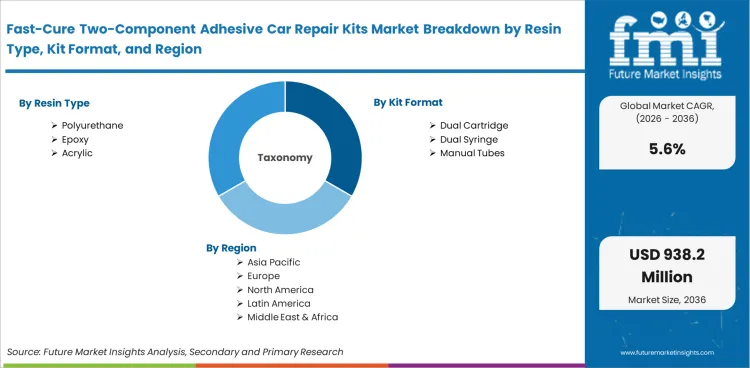
The fast-cure two-component adhesive car repair kits market value stood at USD 512.9 million in 2025. Industry revenue is estimated at USD 541.6 million in 2026 and projected to reach USD 938.2 million by 2036 at 5.6% CAGR. By kit format, dual cartridge kits are expected to represent 54.6% share in 2026. By sales channel, body shops are estimated to account for 47.5% share in 2026.
Body shops need adhesive kits matching repair speed with clean finishing results. Parker’s October 2024 Fusor 132/133 sheet lists 1 minute work time with 10 minutes each for clamp time, sand time and paint time at 70°F. Such fast handling supports plastic bumper and tab repair where same-day job movement is important. Parker’s May 2024 Fusor 110B/111B sheet gives a different repair path with 5 minutes work time, 20 minutes clamp time and 2 hours cure time at 70°F.
Metal bonding work needs more control than quick cosmetic repair. SikaPower-4720 adds another proof point through a 2:1 mixing ratio, 60 minutes open time and 24 hours curing time to 80% strength. 3M’s 08115 panel bonding adhesive also uses a 200 ml Duo Pack cartridge with a 2:1 ratio by volume. Repair kit suppliers can profit by separating quick plastic repair and panel bonding products instead of selling all adhesives under one speed claim.
Summary of Fast-Cure Two-Component Adhesive Car Repair Kits Market
- Demand and Growth Drivers
- Body shops are expected to keep adhesive kit use active as plastic bumper and trim repairs reduce part replacement needs.
- Customer-paid cosmetic repair keeps demand steady for quick cure products reducing car holding time inside workshops.
- Mixed-material vehicle structures are expected to support higher use of automotive adhesives and sealants in repair work.
- Product and Segment View
- Dual cartridge kits are expected to account for 54.6% share in 2026, driven by controlled mixing and lower rework risk.
- Body shops are expected to account for 47.5% share in 2026 due to trained use and recurring collision repair demand.
- A 5-15 minutes cure window is expected to capture 43.8% share in 2026, led by balanced speed and handling control.
- Geography and Competitive Outlook
- India is projected to record 8.6% CAGR by 2036, helped by rising car sales and expanding independent repair networks.
- China is expected to expand at 7.4% CAGR by 2036, shaped by vehicle parc scale and fast workshop throughput needs.
- 3M Company, Henkel AG & Co. KGaA and Sika AG compete based on dispenser systems and repair training depth.
- PPG Industries and Illinois Tool Works add competitive pressure through refinish channel reach and shop-facing adhesive repair systems.
- Analyst Opinion
- Nikhil Kaitwade, Principal Consultant for Automotive, opines, "Fast-cure repair adhesives are moving from emergency fixes into standard workshop workflow. Repairers now judge a kit by open time and first-time bond quality. Bumper plastics and tabs promote repeatable demand. Suppliers explaining cartridge choice in clear repair terms are expected to gain stronger repeat orders."
- Fast-Cure Two-Component Adhesive Car Repair Kits Market Value Analysis
- Market value in repair adhesive kits is tied to cure speed and workshop cycle time before a shop approves routine stocking.
- Supplier pricing reflects resin chemistry and mixer waste before technicians accept a kit for repeat repair jobs.
- Revenue rises above basic adhesive value as training support and dispensing control become part of the buying discussion.
- Distributor relationships influence higher-value orders as suppliers align adhesive kits with body shop repair procedures.
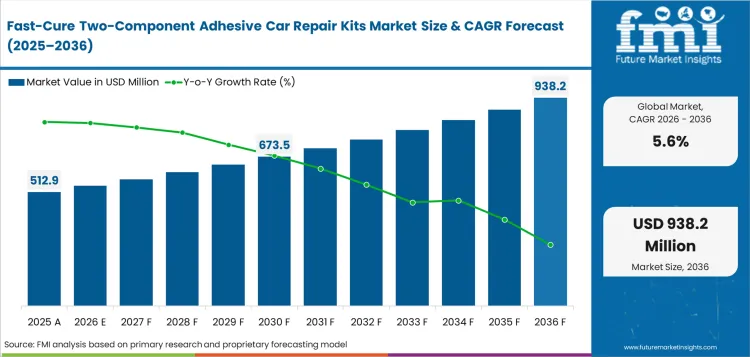
Key Takeaways, Market Size, and Forecast
- The fast-cure two-component adhesive car repair kits market was valued at USD 512.9 million in 2025.
- Industry value is projected to reach USD 938.2 million by 2036 as body shops use more cartridge-based plastic repair work.
- From 2026 to 2036, the sector is projected to expand at 5.6% CAGR.
- Industry revenue is projected to create incremental opportunity of USD 396.6 million from 2026 to 2036.
- Dual cartridge kits are expected to account for 54.6% share of kit format in 2026.
- Body shops are expected to secure 47.5% share of sales channel in 2026.
- India leads the country set with a projected 8.6% CAGR, followed by China at 7.4% CAGR by 2036.
Fast-Cure Two-Component Adhesive Car Repair Kits Market Definition
Fast-cure two-component adhesive car repair kits cover reactive bonding products sold for vehicle body and cosmetic repair. Scope includes dual cartridge and dual syringe formats with static mixers. Polyurethane, epoxy and acrylic systems are counted if both components are sold together as a repair kit. Plastic bumper repair, tab bonding and panel bonding applications are counted. Products sold for automotive body repair through professional and retail channels are included. General household glue and single-component sealants are excluded unless sold specifically as car repair kits.
Fast-Cure Two-Component Adhesive Car Repair Kits Market Inclusions
Scope includes cartridge kits used in body shops and independent workshops. Syringe kits sold through retail and online channels are counted if they are labeled for vehicle repair. Static mixer packs and repair patches are counted only as kit value. Two-component polyurethane systems used for bumper and clip repair are included. Epoxy panel bonding kits are counted through repair demand. Acrylic repair kits used for trim and composite bonding are counted through verified automotive use.
Fast-Cure Two-Component Adhesive Car Repair Kits Market Exclusions
Scope excludes one-component windshield urethanes sold without a second reactive part. Generic household epoxy and craft adhesives are excluded unless sold for vehicle repair. OEM assembly adhesives used on new vehicle lines are treated as adjacent categories. Paint fillers and sanding abrasives are excluded unless sold as part of a two-component bonding kit. Equipment revenue from dispensers is excluded unless bundled into the kit price.
Fast-Cure Two-Component Adhesive Car Repair Kits Market Research Methodology
- Primary Research: FMI analysts reviewed buying needs across collision repair distributors and body shop service managers.
- Desk Research: Vehicle parc data and public traffic crash releases supported repair pool checks and scope mapping.
- Market Sizing and Forecasting: Forecast values were based on repair job incidence and adhesive kit stocking assumptions. Dispenser indicators were checked against mixing assumptions.
- Data Validation: Checks compared 2026 value with 2036 value and tested CAGR consistency across seven country rates.
Why is the Fast-Cure Two-Component Adhesive Car Repair Kits Market Growing?
- Collision repair shops are moving toward fast plastic repair kits that reduce part replacement and shorten bay time.
- Professional repairers need 2K bonding products matching plastic tabs and rigid body repair points.
- Online automotive parts channels are gaining kit orders as older vehicles create more small cosmetic repairs.
Workshop buying is shifting toward adhesive kits saving time on small exterior repairs without forcing full part replacement. Federal Highway Administration Highway Statistics 2024 listed 297.5 million motor vehicles registered in the United States in January 2026. Such a large repair pool keeps bumper tabs and trim damage recurring across body shops. S&P Global Mobility reported in May 2025, the United States light vehicle fleet reached 289 million units and average vehicle age rose to 12.8 years.
Older cars create more customer-paid fixes since owners often repair visible damage before replacing exterior parts. CCC Intelligent Solutions reported in its Q3 2025 Crash Course that average total repair cost finished 2024 at over USD 4,730 and rose 1.4% year over year in the first half of 2025. Repair cost pressure makes automotive adhesives and sealants more practical as shops use fast-cure kits to preserve margin and speed vehicle release.
Market Segmentation Analysis
- Polyurethane is likely to account for 42.7% share in 2026, backed by flexible bonding on bumper plastics and repair tabs.
- Dual cartridge kits are expected to represent 54.6% share in 2026, influenced by controlled mix ratio and lower technician error.
- Plastic repair is projected to hold 38.9% share in 2026 since bumper covers and clips create repeat shop usage.
- A 5-15 minutes cure window is expected to represent 43.8% share in 2026 due to balanced open time and bay release speed.
- Body shops are projected to capture 47.5% share in 2026 as trained technicians handle repeat cartridge-based repair work.
Segmentation is divided into five parent groups built around how repairers specify adhesive kits. Resin type defines the bonding chemistry. Kit format shows how the two parts are mixed and applied. Repair application reflects the damaged part requiring bonds. Cure time explains workshop handling speed. Sales channel identifies the group approving the kit purchase.
Insights into Fast-Cure Two-Component Adhesive Car Repair Kits Market by Resin Type
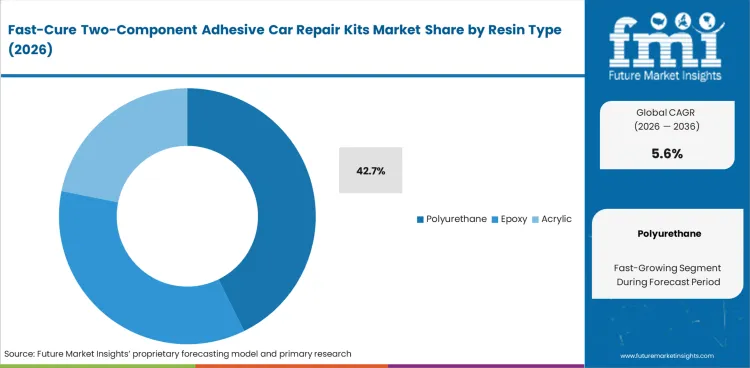
- Polyurethane is expected to account for 42.7% share in 2026, driven by flexible bonds tolerating bumper vibration and small impact movement after repair.
- Epoxy gains value in panel bonding and bracket work since repairers need higher stiffness and better gap filling on metal and composite parts.
Insights into Fast-Cure Two-Component Adhesive Car Repair Kits Market by Kit Format
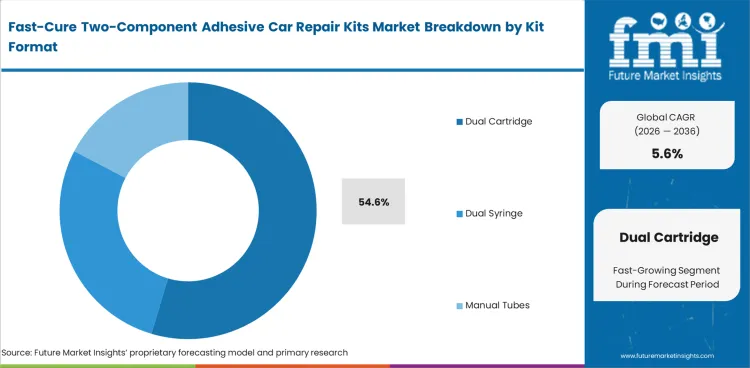
- Dual cartridge kits are expected to represent 54.6% share in 2026, influenced by static mixer use providing technicians a repeatable mix ratio during repair.
- Dual syringe kits attract retail users and small workshops since lower pack size suits occasional trim repair and small plastic damage work.
Insights into Fast-Cure Two-Component Adhesive Car Repair Kits Market by Repair Application
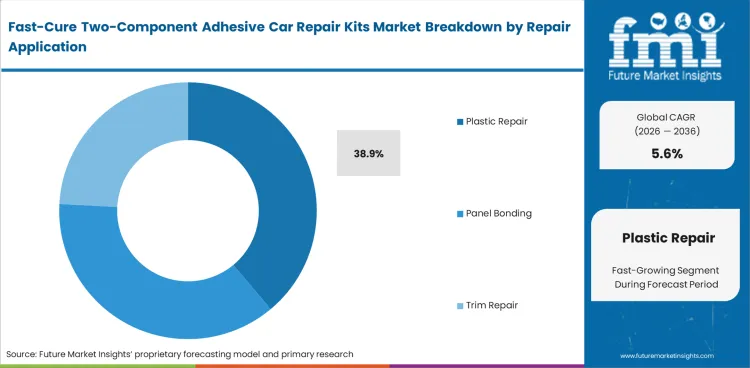
- Plastic repair is projected to hold 38.9% share in 2026 as bumper covers and headlamp tabs often need bonding instead of full part replacement.
- Panel bonding creates higher kit value since trained repairers use structural adhesives for selected metal and composite repair joints.
Insights into Fast-Cure Two-Component Adhesive Car Repair Kits Market by Cure Time
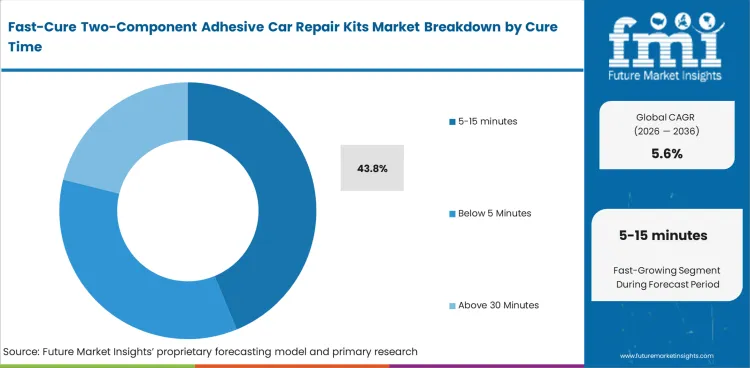
- A 5-15 minutes cure window is estimated to account for 43.8% share in 2026, supported by enough working time for shaping and clamping.
- Below 5 minutes kits fit emergency cosmetic repair, but faster reaction time can raise waste if technicians are not trained.
Insights into Fast-Cure Two-Component Adhesive Car Repair Kits Market by Sales Channel
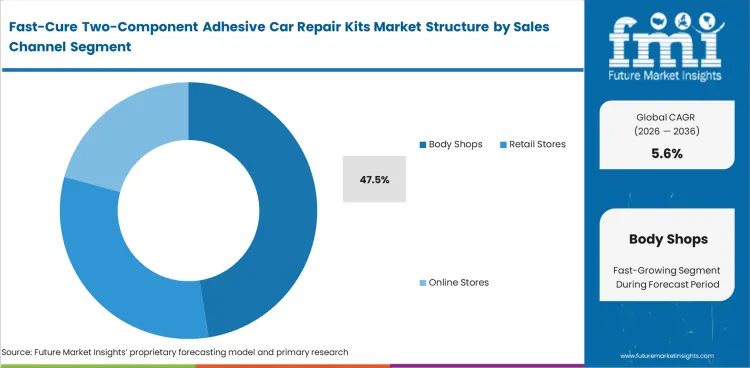
- Body shops are anticipated to capture 47.5% share in 2026 as repeat repair volume and supplier training favor professional stocking programs.
- Online stores support smaller kit orders as consumers search for automotive tapes and repair adhesives for visible damage work.
Fast-Cure Two-Component Adhesive Car Repair Kits Market Drivers, Restraints and Opportunities
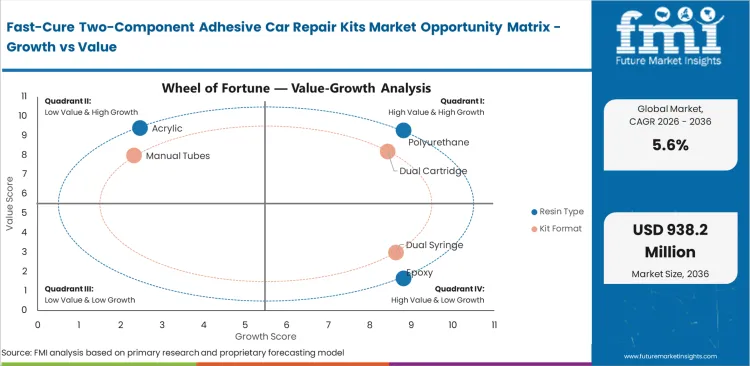
- Driver: Plastic bumper and tab repairs are moving toward fast-cure kits as workshops try to keep repairable parts in service.
- Restraint: Small shops stay cautious when kit choice depends on mix control and technician handling.
- Opportunity: Suppliers with clear cure windows and cartridge guidance can shift more minor repairs from replacement toward bonded repair.
Repair workshops are expected to favor automotive adhesives and sealants making plastic repair easier to control and finish instantly. Parker Hannifin’s April 2025 Fusor 100EZ/101EZ data sheet states, the two-component epoxy adhesive is used for structural and cosmetic repair of auto body panels and rigid body plastics. It lists 40 minutes of work time at 70°F and 10 minutes sand time at 180°F, reflecting why cure guidance is central to shop approval.
It also says the product must be applied by trained personnel, explaining why handling errors can limit use in smaller garages. Online ordering is creating another route for small kits. Auto Care Association stated, United States e-commerce sales of automotive aftermarket parts are forecast to reach USD 44.6 billion including marketplaces in 2025. This supports automotive e-tailing channels for cartridge kits and small repair packs.
Equipment Price Benchmarking Analysis
Price benchmarking for this market should track adhesive chemistry and kit hardware instead of automation systems. USA Bureau of Labor Statistics adhesive manufacturing index reached 381.368 in April 2026 after 375.341 in December 2025. This points to firm input pricing for cartridge systems and two-part repair materials. Suppliers are expected to protect margins through clearer product tiers for plastic repair kits and panel bonding kits.
Installed Base and Replacement Cycle Analysis
Replacement cycles are expected to support repair kit use as vehicles generate more faults after several years on the road. J.D. Power stated in February 2025, three-year-old vehicles averaged 202 problems per 100 vehicles in its 2025 USA Vehicle Dependability Study. It also reported a 6% increase from 2024 results. Higher problem frequency supports more workshop visits and makes fast-cure repair kits important for minor body damage and rigid plastic repairs.
Analysis of Fast-Cure Two-Component Adhesive Car Repair Kits Market by Key Countries
.webp "Top Country Growth Comparison Fast Cure Two Component Adhesive Car Repair Kits Market Cagr (2026 2036)")
| Country | CAGR |
|---|---|
| India | 8.6% |
| China | 7.4% |
| Brazil | 6.8% |
| United States | 5.3% |
| United Kingdom | 4.9% |
| Germany | 4.6% |
| Japan | 4.2% |
Source: Future Market Insights, 2026.
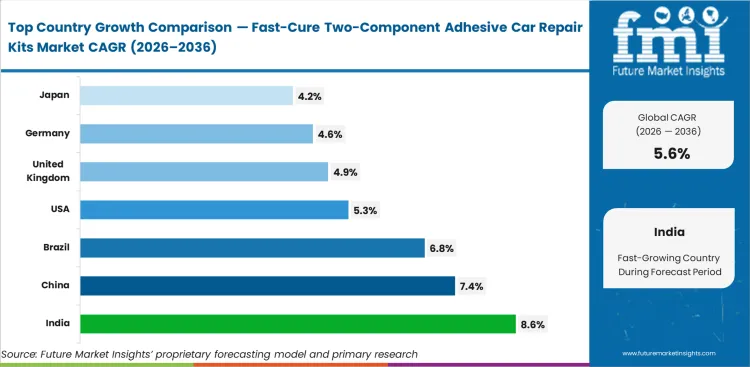
Fast-Cure Two-Component Adhesive Car Repair Kits Market CAGR Analysis by Country
- India is projected to record 8.6% CAGR by 2036, influenced by passenger vehicle additions and repair outlet expansion.
- China is expected to expand at 7.4% CAGR by 2036, led by vehicle parc scale and quick repair throughput needs.
- Brazil is forecast to grow at 6.8% CAGR by 2036 through fleet aging and price-sensitive exterior repair activity.
- United States is expected to advance at 5.3% CAGR by 2036 as collision repair complexity supports trained kit use.
The United Kingdom is projected to rise at 4.9% CAGR by 2036 as insurer repair checks guide adhesive kit use. Germany and Japan follow at 4.6% and 4.2% CAGR respectively through body shop quality standards and precision repair needs.
Country performance differs by car parc size and repair channel maturity. India and China track above the global pace as vehicle additions and workshop networks expand together. Brazil stays above established markets due to repair cost sensitivity and older vehicles. Established repair economies expand at steadier rates through trained body shops and tighter repair standards.
Demand Outlook for Fast-Cure Two-Component Adhesive Car Repair Kits in India
Demand in India is projected to record 8.6% CAGR by 2036, driven by passenger vehicle sales and independent garage growth. Society of Indian Automobile Manufacturers stated in August 2025, passenger vehicles recorded 4.3 million sales in financial year 2024-25. Such scale gives adhesive kit suppliers a wider route into bumper and trim repair. Price-sensitive consumers often prefer repair over replacement when exterior damage is manageable. Suppliers need smaller packs and distributor training to widen adoption beyond large collision chains.
- Independent garages can use dual syringe kits for minor trim repair without large dispenser investment.
- Body shops benefit from cartridge kits lowering failed mixing during repeat bumper repair work.
- Retail channels favor simple instructions since consumer repair users need visible results with limited tools.
Demand Analysis of Fast-Cure Two-Component Adhesive Car Repair Kits in China
Industry in China is expected to expand at 7.4% CAGR by 2036 through vehicle parc scale and fast service expectations. China State Council reported in January 2025, new energy vehicles in use exceeded 30 million by end-2024. Electric vehicle body panels and trims increase the need for repair products compatible with plastics and mixed materials. Large workshops want repeatable cure behavior to keep cars moving through service bays. Suppliers with adhesives for electric vehicle power batteries can adapt safety discipline and bonding know-how for repair kits.
- Large repair chains need cartridge systems keeping mix ratio stable across high daily job counts.
- Fast-cure products suit customer-paid cosmetic work needing same-day vehicle return.
- Training support becomes important as mixed materials raise the cost of incorrect adhesive choice.
Growth Outlook for Fast-Cure Two-Component Adhesive Car Repair Kits in Brazil
Sector in Brazil is forecast to grow at 6.8% CAGR by 2036, led by an older vehicle parc and practical repair economics. National vehicle distributor data cited by industry sources in 2025 showed passenger car and light commercial sales recovering during the year. Adhesive kits fit a market in which many owners repair visible damage instead of replacing full exterior parts. Workshops need repair products keeping costs predictable and handle humid service conditions. Suppliers of industrial adhesives can gain traction by offering pack sizes suited to independent garages.
- Plastic repair kits suit bumper damage caused by dense urban driving and low-speed contact.
- Smaller pack formats reduce cash tied up in adhesive stock for independent repair outlets.
- Distributor coverage is important in secondary cities as body shops need regular replenishment and training visits.
Growth Outlook for Fast-Cure Two-Component Adhesive Car Repair Kits in the United States
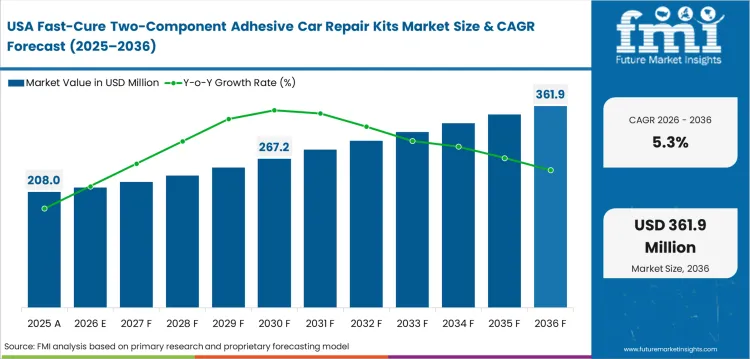
Industry in the United States is expected to rise at 5.3% CAGR by 2036 as repair severity and labor cost keep shops focused on time saving. United States National Highway Traffic Safety Administration estimated 6.1 million police-reported crashes in 2023 in its January 2025 overview. Repairers must choose between replacement parts and bonded repair on many lower-severity jobs. Automotive sector repair needs shape the kit stocking choice. Dual cartridge kits reduce guesswork during bumper and tab repair. Suppliers with repair procedure libraries and technician training are better placed in professional channels. Automotive performance parts sellers broaden the same channel for small repair kits.
- Body shops use fast curing epoxy adhesive for selected brackets and rigid repair points.
- Retail users buy small repair kits for minor cosmetic damage after avoiding insurance claims.
- Distributor programs gain value when product choice is tied to vehicle substrate and repair procedure.
Demand Outlook for Fast-Cure Two-Component Adhesive Car Repair Kits in the United Kingdom
Demand in the United Kingdom is projected to secure 4.9% CAGR by 2036 through licensed vehicle scale and insurer repair control. Department for Transport statistics published in January 2026 reported 124,000 zero-emission cars first registered during July to September 2025. Newer vehicle structures raise attention to approved repair methods and compatible bonding products. Fast-cure kits must fit documentation needs for body shops serving insurer-backed work. Suppliers with clear technical sheets can support adhesive choice in a cost-controlled repair environment.
- Insurer repair networks prefer kits showing predictable cure time and repeatable bond quality.
- Retail channels support cosmetic repairs as drivers manage small damage outside insurance claims.
- Electric vehicle repair adds need for clear product guidance on plastic and composite components.
Sales Analysis of Fast-Cure Two-Component Adhesive Car Repair Kits in Germany
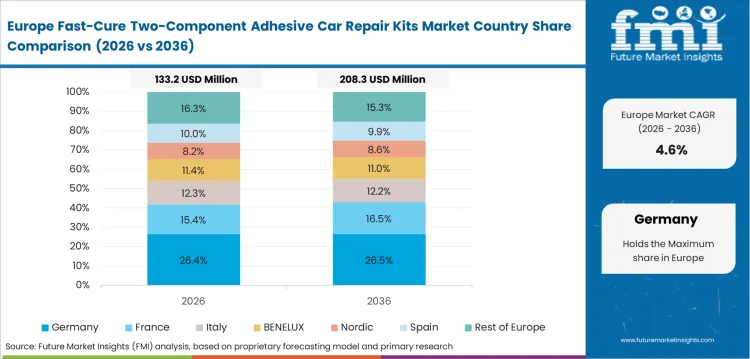
Sales in Germany are expected to record 4.6% CAGR by 2036, reflecting repair quality standards and a large passenger car parc. European Alternative Fuels Observatory reported in February 2026, Germany had 2,034,260 BEV passenger cars as of 1 January 2026. Electric car growth adds more plastic and lightweight parts into repair workflows. Body shops need adhesive kits with verified handling windows and clean repair finishes. Suppliers selling high temperature adhesive and controlled bonding systems can connect OEM discipline with aftermarket repair routines.
- Professional repairers value kit consistency since warranty-backed work leaves less room for rework.
- Car parc age supports ongoing cosmetic repair demand outside new vehicle warranty periods.
- Technical documentation improves acceptance by workshops following structured repair procedures.
Sales Outlook for Fast-Cure Two-Component Adhesive Car Repair Kits in Japan
Sales in Japan are expected to post 4.2% CAGR by 2036 since repair quality and vehicle age keep specification standards high. United States International Trade Administration reported in November 2025, Japan sold 4.4 million new passenger vehicles in 2024. A large and mature vehicle parc keeps body repair demand active even with moderate new sales. Japanese repairers favor controlled application and clean finishing over bulk adhesive consumption. Suppliers of adhesive films and precise bonding materials can position repair kits around quality consistency.
- Compact repair work favors low-waste kits integrating smaller service bays and careful finishing routines.
- Panel repair needs controlled cure behavior as visible finish quality affects customer acceptance.
- Specialist repair channels prefer brands with training materials and clear substrate guidance.
Competitive Landscape and Strategic Positioning
- Repair adhesive specialists hold an advantage based on cure time proof and technician training support.
- Integrated chemical groups compete by combining cartridge systems with broader adhesives and sealants portfolios.
- Automotive aftermarket distributors gain attention when they bundle mixers and surface preparation materials with kits.
- Suppliers with clear open time guidance and sanding readiness data gain repeat orders from body shop networks.
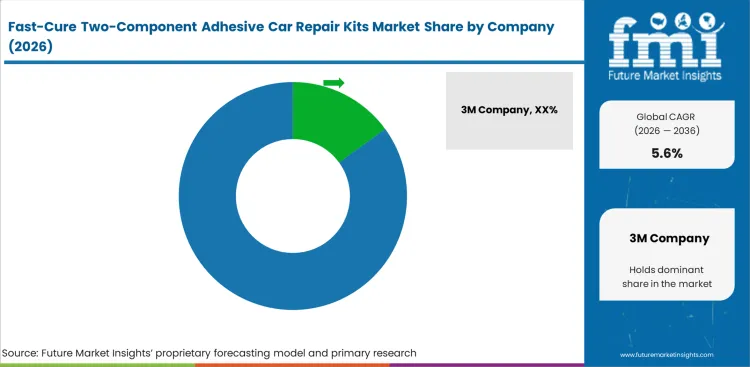
Competition in fast-cure two-component adhesive car repair kits is led by global adhesive groups and repair product specialists. Companies profit by proving bond consistency and reducing shop rework. 3M Company and Henkel AG & Co. KGaA bring repair procedure depth and recognized body shop brands. Sika AG adds broad bonding chemistry and aftermarket reach. PPG Industries, ITW Evercoat, Parker Hannifin and Transtar Autobody Technologies support specialist repair channels through plastic repair and structural bonding knowledge.
Supplier selection is shaped by training before quoted price. Repairers need proof the product bonds to the right material and cures within the stated time. Adjacent categories such as hot melt adhesives and silicone gasket-free sealant influence buyer expectations on speed and ease of use. Suppliers with strong test data and clear usage steps are better placed to acquire body shop accounts. Practical field support further strengthens repeat orders as repairers standardize on fewer kit systems.
Key Companies in the Fast-Cure Two-Component Adhesive Car Repair Kits Market
- Competitive structure is grouped by global adhesive groups, repair product specialists and aftermarket channel suppliers.
- Global Adhesive Groups: 3M Company, Henkel AG & Co. KGaA and Sika AG support repair kit demand through broad bonding portfolios.
- Repair Product Specialists: PPG Industries Inc., ITW Evercoat and Transtar Autobody Technologies support plastic and cosmetic repair workflows through shop-focused product lines.
Structural Bonding Suppliers: Parker Hannifin Corporation supports panel bonding and composite repair work through specialized adhesive systems.
Competitive Benchmarking: Fast-Cure Two-Component Adhesive Car Repair Kits Market
| Company | Cure Speed Proof | Plastic Repair Depth | Training Support | Geographic Footprint |
|---|---|---|---|---|
| 3M Company | Very Strong | Very Strong | Very Strong | Global |
| Henkel AG & Co. KGaA | Very Strong | Strong | Very Strong | Global |
| Sika AG | Strong | Very Strong | Strong | Global |
| PPG Industries Inc. | Moderate | Strong | Strong | Global |
| ITW Evercoat | Moderate | Strong | Moderate | North America |
| Parker Hannifin Corporation | Strong | Moderate | Strong | Global |
| Transtar Autobody Technologies | Strong | Strong | Moderate | North America |
Source: Future Market Insights competitive analysis 2026. Ratings reflect relative positioning by cure speed proof, plastic repair depth and training support.
Key Developments in Fast-Cure Two-Component Adhesive Car Repair Kits Market
- In February 2025, 3M published its collision repair standard operating procedures master file, listing 3M Super Fast Repair Adhesive in plastic tab repair workflows for bumper and plastic repair.
- In August 2025, Sika updated the SikaPower-492 G product data sheet for a semi crash-resistant hem flange body shop adhesive with 99% solid content and 28 MPa lap-shear strength.
- In October 2025, Axalta published the Audurra catalogue listing the Audurra 2K-PU Plastic Repair System as a fast-curing structural two-component polyurethane adhesive for small repair jobs.
Key Players in the Fast-Cure Two-Component Adhesive Car Repair Kits Market
- 3M Company
- Henkel AG & Co. KGaA
- Sika AG
- PPG Industries Inc.
- ITW Evercoat
- Parker Hannifin Corporation
- Transtar Autobody Technologies
Market Report Scope
| Parameter | Details |
|---|---|
| Quantitative units | USD 541.6 million to USD 938.2 million at 5.6% CAGR |
| Market definition | Fast-cure two-component adhesive kits used for car body and cosmetic repair |
| By resin type | Polyurethane, epoxy, acrylic, hybrid |
| By kit format | Dual cartridge, dual syringe, manual tubes, bulk packs |
| By repair application | Plastic repair, panel bonding, trim repair, tab repair, cosmetic filling |
| By cure time | Below 5 minutes, 5-15 minutes, 15-30 minutes, above 30 minutes |
| By sales channel | Body shops, retail stores, online stores, fleet workshops |
| Regions covered | North America, Latin America, Europe, East Asia, South Asia and Pacific, Middle East and Africa |
| Countries covered | India, China, Brazil, United States, United Kingdom, Germany, Japan |
| Key companies profiled | 3M Company, Henkel AG & Co. KGaA, Sika AG, Bostik SA, PPG Industries Inc., ITW Evercoat, Parker Hannifin Corporation |
| Forecast period | 2026 to 2036 |
| Approach | Hybrid top-down and bottom-up sizing with repair incidence and channel checks |
Source: Future Market Insights, 2026.
Fast-Cure Two-Component Adhesive Car Repair Kits Market Breakdown by Resin Type, Kit Format, Repair Application, Cure Time, Sales Channel, and Region
By Resin Type
- Polyurethane
- Epoxy
- Acrylic
- Hybrid
By Kit Format
- Dual Cartridge
- Dual Syringe
- Manual Tubes
- Bulk Packs
By Repair Application
- Plastic Repair
- Panel Bonding
- Trim Repair
- Tab Repair
- Cosmetic Filling
By Cure Time
- Below 5 Minutes
- 5-15 Minutes
- 15-30 Minutes
- Above 30 Minutes
By Sales Channel
- Body Shops
- Retail Stores
- Online Stores
- Fleet Workshops
By Region
- North America
- Latin America
- Europe
- East Asia
- South Asia and Pacific
- Middle East and Africa
Research Sources and Bibliography
- 3M. (2025, February). 3M standard operating procedures for collision repair.
- Sika Limited. (2025, August). SikaPower®-492 G: Product data sheet.
- Axalta Coating Systems. (2025, October). Audurra catalogue EN 2025-10.
- Parker Hannifin Corporation. (2024, October). Fusor® 132/133 plastic repair adhesive (super fast): Technical data sheet.
- Parker Hannifin Corporation. (2024, May). Fusor® 110B/111B metal bonding adhesive (fast): Technical data sheet.
- Sika India Pvt. Ltd. (2024, June). SikaPower®-4720: Product data sheet.
- 3M. (2024, January 2). 3M™ 08115 panel bonding adhesive: Technical data sheet.
- Parker Hannifin Corporation. (2024, December). Fusor® OEM product specific approvals and recommendations for cars.
- Federal Highway Administration. (2026, January). Highway statistics 2024: Table MV-1, state motor-vehicle registrations. USA Department of Transportation.
- S&P Global Mobility. (2025, May 21). Average age of vehicles in the US rises to 12.8 years in 2025.
- CCC Intelligent Solutions Inc. (2025, Q3). Crash Course Q3 2025: Auto industry economic uncertainty.
- Parker Hannifin Corporation. (2025, April). Fusor® 100EZ/101EZ plastic repair adhesive: Technical data sheet.
- Auto Care Association, & MEMA Aftermarket Suppliers. (2025, November 5). Auto Care Association, MEMA Aftermarket Suppliers release 2025 Joint E-commerce Trends and Outlook Forecast report.
- Federal Reserve Bank of St. Louis. (2026, May 13). Producer price index by industry: Adhesive manufacturing (PCU325520325520). FRED Economic Data.
- J.D. Power. (2025, February 13). 2025 USA vehicle dependability study.
- Society of Indian Automobile Manufacturers. (2025, August 28). SIAM annual report 2024-25.
- China State Council. (2025, January 17). New energy vehicles in use in China exceed 30 million.
- Department for Transport. (2026, January 15). Vehicle licensing statistics, United Kingdom: July to September 2025. GOV.UK.
- European Alternative Fuels Observatory. (2026, March 2). Germany’s BEV fleet surpasses 2 million units: Major milestone in electrification.
- National Center for Statistics and Analysis. (2025, April). Overview of motor vehicle traffic crashes in 2023 (Traffic Safety Facts Research Note. Report No. DOT HS 813 705). National Highway Traffic Safety Administration.
- International Trade Administration. (2025, November 20). Japan: Automotive. USA Department of Commerce.
- Sika Industry USA. (2025, May 22). Sika launches new Sikaflex® P2G Premium, primerless auto glass replacement (AGR) adhesive.
- Henkel AG & Co. KGaA. (2025, December 12). Henkel launches Loctite MS 9650 for durable, lightweight structural bonding for automotive display.
- Henkel AG & Co. KGaA. (2026, May 12). New Henkel automotive adhesive: One product, twice the power.
This Report Answers
- What is the current and forecast value of the fast-cure two-component adhesive car repair kits market?
- Which kit format is projected to hold a leading share in 2026?
- How do plastic repair needs shape demand for fast-cure two-component adhesive car repair kits?
- Which countries lead in the industry for fast-cure two-component adhesive car repair kits?
- How do cure speed and training support affect supplier positioning?
- Which companies compete in fast-cure two-component adhesive car repair kits?
Frequently Asked Questions
What is the fast-cure two-component adhesive car repair kits market value in 2026?
Industry value is estimated at USD 541.6 million in 2026 and projected to reach USD 938.2 million by 2036.
What CAGR is projected for the fast-cure two-component adhesive car repair kits market?
The sector is projected to expand at 5.6% CAGR from 2026 to 2036 as repair shops use more cartridge-based bonding kits.
Which kit format leads the fast-cure two-component adhesive car repair kits market?
Dual cartridge kits are projected to account for 54.6% share in 2026 due to controlled mixing and lower technician error.
Which application is important for fast-cure two-component adhesive car repair kits?
Plastic repair is expected to hold 38.9% share in 2026, led by bumper covers and repair tabs needing reliable bonding.
Which country leads the fast-cure two-component adhesive car repair kits market?
India is projected to record 8.6% CAGR by 2036, driven by passenger vehicle additions and expanding independent repair networks.
Who are key players in fast-cure two-component adhesive car repair kits?
3M Company and Henkel AG & Co. KGaA are active suppliers. Sika AG, Bostik SA and PPG Industries Inc. compete in this sector.
Preview the report firsthand - request a free sample
Get SampleGet the brochure for pricing and purchase details.
Get PDFTable of Content
- Executive Summary
- Global Market Outlook
- Demand-side Trends
- Supply-side Trends
- Technology Roadmap Analysis
- Analysis and Recommendations
- Market Overview
- Market Coverage / Taxonomy
- Market Definition / Scope / Limitations
- Research Methodology
- Chapter Orientation
- Analytical Lens and Working Hypotheses
- Market Structure, Signals, and Trend Drivers
- Benchmarking and Cross-market Comparability
- Market Sizing, Forecasting, and Opportunity Mapping
- Research Design and Evidence Framework
- Desk Research Programme (Secondary Evidence)
- Company Annual and Sustainability Reports
- Peer-reviewed Journals and Academic Literature
- Corporate Websites, Product Literature, and Technical Notes
- Earnings Decks and Investor Briefings
- Statutory Filings and Regulatory Disclosures
- Technical White Papers and Standards Notes
- Trade Journals, Industry Magazines, and Analyst Briefs
- Conference Proceedings, Webinars, and Seminar Materials
- Government Statistics Portals and Public Data Releases
- Press Releases and Reputable Media Coverage
- Specialist Newsletters and Curated Briefings
- Sector Databases and Reference Repositories
- FMI Internal Proprietary Databases and Historical Market Datasets
- Subscription Datasets and Paid Sources
- Social Channels, Communities, and Digital Listening Inputs
- Additional Desk Sources
- Expert Input and Fieldwork (Primary Evidence)
- Primary Modes
- Qualitative Interviews and Expert Elicitation
- Quantitative Surveys and Structured Data Capture
- Blended Approach
- Why Primary Evidence is Used
- Field Techniques
- Interviews
- Surveys
- Focus Groups
- Observational and In-context Research
- Social and Community Interactions
- Stakeholder Universe Engaged
- C-suite Leaders
- Board Members
- Presidents and Vice Presidents
- R&D and Innovation Heads
- Technical Specialists
- Domain Subject-matter Experts
- Scientists
- Physicians and Other Healthcare Professionals
- Governance, Ethics, and Data Stewardship
- Research Ethics
- Data Integrity and Handling
- Primary Modes
- Tooling, Models, and Reference Databases
- Desk Research Programme (Secondary Evidence)
- Data Engineering and Model Build
- Data Acquisition and Ingestion
- Cleaning, Normalisation, and Verification
- Synthesis, Triangulation, and Analysis
- Quality Assurance and Audit Trail
- Market Background
- Market Dynamics
- Drivers
- Restraints
- Opportunity
- Trends
- Scenario Forecast
- Demand in Optimistic Scenario
- Demand in Likely Scenario
- Demand in Conservative Scenario
- Opportunity Map Analysis
- Product Life Cycle Analysis
- Supply Chain Analysis
- Investment Feasibility Matrix
- Value Chain Analysis
- PESTLE and Porter’s Analysis
- Regulatory Landscape
- Regional Parent Market Outlook
- Production and Consumption Statistics
- Import and Export Statistics
- Market Dynamics
- Global Market Analysis 2021 to 2025 and Forecast, 2026 to 2036
- Historical Market Size Value (USD Million) Analysis, 2021 to 2025
- Current and Future Market Size Value (USD Million) Projections, 2026 to 2036
- Y-o-Y Growth Trend Analysis
- Absolute $ Opportunity Analysis
- Global Market Pricing Analysis 2021 to 2025 and Forecast 2026 to 2036
- Global Market Analysis 2021 to 2025 and Forecast 2026 to 2036, By Resin Type
- Introduction / Key Findings
- Historical Market Size Value (USD Million) Analysis By Resin Type , 2021 to 2025
- Current and Future Market Size Value (USD Million) Analysis and Forecast By Resin Type , 2026 to 2036
- Polyurethane
- Epoxy
- Acrylic
- Polyurethane
- Y-o-Y Growth Trend Analysis By Resin Type , 2021 to 2025
- Absolute $ Opportunity Analysis By Resin Type , 2026 to 2036
- Global Market Analysis 2021 to 2025 and Forecast 2026 to 2036, By Kit Format
- Introduction / Key Findings
- Historical Market Size Value (USD Million) Analysis By Kit Format, 2021 to 2025
- Current and Future Market Size Value (USD Million) Analysis and Forecast By Kit Format, 2026 to 2036
- Dual Cartridge
- Dual Syringe
- Manual Tubes
- Dual Cartridge
- Y-o-Y Growth Trend Analysis By Kit Format, 2021 to 2025
- Absolute $ Opportunity Analysis By Kit Format, 2026 to 2036
- Global Market Analysis 2021 to 2025 and Forecast 2026 to 2036, By Repair Application
- Introduction / Key Findings
- Historical Market Size Value (USD Million) Analysis By Repair Application, 2021 to 2025
- Current and Future Market Size Value (USD Million) Analysis and Forecast By Repair Application, 2026 to 2036
- Plastic Repair
- Panel Bonding
- Trim Repair
- Plastic Repair
- Y-o-Y Growth Trend Analysis By Repair Application, 2021 to 2025
- Absolute $ Opportunity Analysis By Repair Application, 2026 to 2036
- Global Market Analysis 2021 to 2025 and Forecast 2026 to 2036, By Cure Time
- Introduction / Key Findings
- Historical Market Size Value (USD Million) Analysis By Cure Time, 2021 to 2025
- Current and Future Market Size Value (USD Million) Analysis and Forecast By Cure Time, 2026 to 2036
- 5-15 minutes
- Below 5 Minutes
- Above 30 Minutes
- 5-15 minutes
- Y-o-Y Growth Trend Analysis By Cure Time, 2021 to 2025
- Absolute $ Opportunity Analysis By Cure Time, 2026 to 2036
- Global Market Analysis 2021 to 2025 and Forecast 2026 to 2036, By Sales Channel
- Introduction / Key Findings
- Historical Market Size Value (USD Million) Analysis By Sales Channel, 2021 to 2025
- Current and Future Market Size Value (USD Million) Analysis and Forecast By Sales Channel, 2026 to 2036
- Body Shops
- Retail Stores
- Online Stores
- Body Shops
- Y-o-Y Growth Trend Analysis By Sales Channel, 2021 to 2025
- Absolute $ Opportunity Analysis By Sales Channel, 2026 to 2036
- Global Market Analysis 2021 to 2025 and Forecast 2026 to 2036, By Region
- Introduction
- Historical Market Size Value (USD Million) Analysis By Region, 2021 to 2025
- Current Market Size Value (USD Million) Analysis and Forecast By Region, 2026 to 2036
- North America
- Latin America
- Western Europe
- Eastern Europe
- East Asia
- South Asia and Pacific
- Middle East & Africa
- Market Attractiveness Analysis By Region
- North America Market Analysis 2021 to 2025 and Forecast 2026 to 2036, By Country
- Historical Market Size Value (USD Million) Trend Analysis By Market Taxonomy, 2021 to 2025
- Market Size Value (USD Million) Forecast By Market Taxonomy, 2026 to 2036
- By Country
- USA
- Canada
- Mexico
- By Resin Type
- By Kit Format
- By Repair Application
- By Cure Time
- By Sales Channel
- By Country
- Market Attractiveness Analysis
- By Country
- By Resin Type
- By Kit Format
- By Repair Application
- By Cure Time
- By Sales Channel
- Key Takeaways
- Latin America Market Analysis 2021 to 2025 and Forecast 2026 to 2036, By Country
- Historical Market Size Value (USD Million) Trend Analysis By Market Taxonomy, 2021 to 2025
- Market Size Value (USD Million) Forecast By Market Taxonomy, 2026 to 2036
- By Country
- Brazil
- Chile
- Rest of Latin America
- By Resin Type
- By Kit Format
- By Repair Application
- By Cure Time
- By Sales Channel
- By Country
- Market Attractiveness Analysis
- By Country
- By Resin Type
- By Kit Format
- By Repair Application
- By Cure Time
- By Sales Channel
- Key Takeaways
- Western Europe Market Analysis 2021 to 2025 and Forecast 2026 to 2036, By Country
- Historical Market Size Value (USD Million) Trend Analysis By Market Taxonomy, 2021 to 2025
- Market Size Value (USD Million) Forecast By Market Taxonomy, 2026 to 2036
- By Country
- Germany
- UK
- Italy
- Spain
- France
- Nordic
- BENELUX
- Rest of Western Europe
- By Resin Type
- By Kit Format
- By Repair Application
- By Cure Time
- By Sales Channel
- By Country
- Market Attractiveness Analysis
- By Country
- By Resin Type
- By Kit Format
- By Repair Application
- By Cure Time
- By Sales Channel
- Key Takeaways
- Eastern Europe Market Analysis 2021 to 2025 and Forecast 2026 to 2036, By Country
- Historical Market Size Value (USD Million) Trend Analysis By Market Taxonomy, 2021 to 2025
- Market Size Value (USD Million) Forecast By Market Taxonomy, 2026 to 2036
- By Country
- Russia
- Poland
- Hungary
- Balkan & Baltic
- Rest of Eastern Europe
- By Resin Type
- By Kit Format
- By Repair Application
- By Cure Time
- By Sales Channel
- By Country
- Market Attractiveness Analysis
- By Country
- By Resin Type
- By Kit Format
- By Repair Application
- By Cure Time
- By Sales Channel
- Key Takeaways
- East Asia Market Analysis 2021 to 2025 and Forecast 2026 to 2036, By Country
- Historical Market Size Value (USD Million) Trend Analysis By Market Taxonomy, 2021 to 2025
- Market Size Value (USD Million) Forecast By Market Taxonomy, 2026 to 2036
- By Country
- China
- Japan
- South Korea
- By Resin Type
- By Kit Format
- By Repair Application
- By Cure Time
- By Sales Channel
- By Country
- Market Attractiveness Analysis
- By Country
- By Resin Type
- By Kit Format
- By Repair Application
- By Cure Time
- By Sales Channel
- Key Takeaways
- South Asia and Pacific Market Analysis 2021 to 2025 and Forecast 2026 to 2036, By Country
- Historical Market Size Value (USD Million) Trend Analysis By Market Taxonomy, 2021 to 2025
- Market Size Value (USD Million) Forecast By Market Taxonomy, 2026 to 2036
- By Country
- India
- ASEAN
- Australia & New Zealand
- Rest of South Asia and Pacific
- By Resin Type
- By Kit Format
- By Repair Application
- By Cure Time
- By Sales Channel
- By Country
- Market Attractiveness Analysis
- By Country
- By Resin Type
- By Kit Format
- By Repair Application
- By Cure Time
- By Sales Channel
- Key Takeaways
- Middle East & Africa Market Analysis 2021 to 2025 and Forecast 2026 to 2036, By Country
- Historical Market Size Value (USD Million) Trend Analysis By Market Taxonomy, 2021 to 2025
- Market Size Value (USD Million) Forecast By Market Taxonomy, 2026 to 2036
- By Country
- Kingdom of Saudi Arabia
- Other GCC Countries
- Turkiye
- South Africa
- Other African Union
- Rest of Middle East & Africa
- By Resin Type
- By Kit Format
- By Repair Application
- By Cure Time
- By Sales Channel
- By Country
- Market Attractiveness Analysis
- By Country
- By Resin Type
- By Kit Format
- By Repair Application
- By Cure Time
- By Sales Channel
- Key Takeaways
- Key Countries Market Analysis
- USA
- Pricing Analysis
- Market Share Analysis, 2025
- By Resin Type
- By Kit Format
- By Repair Application
- By Cure Time
- By Sales Channel
- Canada
- Pricing Analysis
- Market Share Analysis, 2025
- By Resin Type
- By Kit Format
- By Repair Application
- By Cure Time
- By Sales Channel
- Mexico
- Pricing Analysis
- Market Share Analysis, 2025
- By Resin Type
- By Kit Format
- By Repair Application
- By Cure Time
- By Sales Channel
- Brazil
- Pricing Analysis
- Market Share Analysis, 2025
- By Resin Type
- By Kit Format
- By Repair Application
- By Cure Time
- By Sales Channel
- Chile
- Pricing Analysis
- Market Share Analysis, 2025
- By Resin Type
- By Kit Format
- By Repair Application
- By Cure Time
- By Sales Channel
- Germany
- Pricing Analysis
- Market Share Analysis, 2025
- By Resin Type
- By Kit Format
- By Repair Application
- By Cure Time
- By Sales Channel
- UK
- Pricing Analysis
- Market Share Analysis, 2025
- By Resin Type
- By Kit Format
- By Repair Application
- By Cure Time
- By Sales Channel
- Italy
- Pricing Analysis
- Market Share Analysis, 2025
- By Resin Type
- By Kit Format
- By Repair Application
- By Cure Time
- By Sales Channel
- Spain
- Pricing Analysis
- Market Share Analysis, 2025
- By Resin Type
- By Kit Format
- By Repair Application
- By Cure Time
- By Sales Channel
- France
- Pricing Analysis
- Market Share Analysis, 2025
- By Resin Type
- By Kit Format
- By Repair Application
- By Cure Time
- By Sales Channel
- India
- Pricing Analysis
- Market Share Analysis, 2025
- By Resin Type
- By Kit Format
- By Repair Application
- By Cure Time
- By Sales Channel
- ASEAN
- Pricing Analysis
- Market Share Analysis, 2025
- By Resin Type
- By Kit Format
- By Repair Application
- By Cure Time
- By Sales Channel
- Australia & New Zealand
- Pricing Analysis
- Market Share Analysis, 2025
- By Resin Type
- By Kit Format
- By Repair Application
- By Cure Time
- By Sales Channel
- China
- Pricing Analysis
- Market Share Analysis, 2025
- By Resin Type
- By Kit Format
- By Repair Application
- By Cure Time
- By Sales Channel
- Japan
- Pricing Analysis
- Market Share Analysis, 2025
- By Resin Type
- By Kit Format
- By Repair Application
- By Cure Time
- By Sales Channel
- South Korea
- Pricing Analysis
- Market Share Analysis, 2025
- By Resin Type
- By Kit Format
- By Repair Application
- By Cure Time
- By Sales Channel
- Russia
- Pricing Analysis
- Market Share Analysis, 2025
- By Resin Type
- By Kit Format
- By Repair Application
- By Cure Time
- By Sales Channel
- Poland
- Pricing Analysis
- Market Share Analysis, 2025
- By Resin Type
- By Kit Format
- By Repair Application
- By Cure Time
- By Sales Channel
- Hungary
- Pricing Analysis
- Market Share Analysis, 2025
- By Resin Type
- By Kit Format
- By Repair Application
- By Cure Time
- By Sales Channel
- Kingdom of Saudi Arabia
- Pricing Analysis
- Market Share Analysis, 2025
- By Resin Type
- By Kit Format
- By Repair Application
- By Cure Time
- By Sales Channel
- Turkiye
- Pricing Analysis
- Market Share Analysis, 2025
- By Resin Type
- By Kit Format
- By Repair Application
- By Cure Time
- By Sales Channel
- South Africa
- Pricing Analysis
- Market Share Analysis, 2025
- By Resin Type
- By Kit Format
- By Repair Application
- By Cure Time
- By Sales Channel
- USA
- Market Structure Analysis
- Competition Dashboard
- Competition Benchmarking
- Market Share Analysis of Top Players
- By Regional
- By Resin Type
- By Kit Format
- By Repair Application
- By Cure Time
- By Sales Channel
- Competition Analysis
- Competition Deep Dive
- 3M Company
- Overview
- Product Portfolio
- Profitability by Market Segments (Product/Age /Sales Channel/Region)
- Sales Footprint
- Strategy Overview
- Marketing Strategy
- Product Strategy
- Channel Strategy
- Henkel AG & Co. KGaA
- Sika AG
- PPG Industries Inc.
- ITW Evercoat
- Parker Hannifin Corporation
- 3M Company
- Competition Deep Dive
- Assumptions & Acronyms Used


