

- Industry Size (2026)
- USD 1.8 Bn
- Forecast (2036)
- USD 2.6 Bn
- CAGR (2026 to 2036)
- 3.6%
Activated Carbon Canisters Market Forecast and Outlook 2026 to 2036
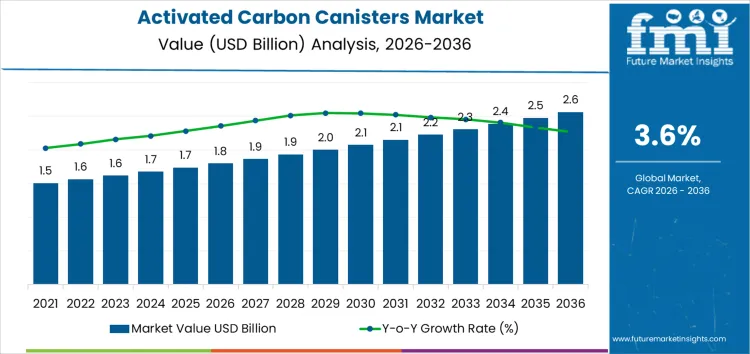
The activated carbon canisters market is valued at USD 1.8 billion in 2026 and is projected to reach USD 2.6 billion by 2036, reflecting a CAGR of 3.6%. Adoption is shaped by regulatory requirements targeting evaporative emissions and vehicle emission compliance. Production concentration depends on suppliers capable of delivering high-capacity, durable carbon media with validated adsorption performance. Compliance costs and certification complexity influence procurement and vendor positioning. Smaller operators face barriers in meeting emission standards and maintaining multi-regional approval.
Revenue concentration is determined by integration with OEM programs and adherence to environmental regulations. Adoption varies regionally according to fleet composition, regulatory enforcement, and fuel quality. Margin concentration favors suppliers providing certified, high-performance canisters with technical support. Fragmentation persists in aftermarket and regional providers, while established companies secure concentrated value through quality control, regulatory alignment, and fleet integration rather than output volume alone.
Quick Stats of the Activated Carbon Canisters Market
- Activated Carbon Canisters Market Value (2026): USD 1.8 billion
- Activated Carbon Canisters Forecast Value (2036): USD 2.6 billion
- Activated Carbon Canisters Forecast CAGR 2026 to 2036: 3.6%
- Leading Canister Type in Activated Carbon Canisters Market: Single-Bed Canisters (34 % share)
- Leading Vehicle Segment in Activated Carbon Canisters Market: Passenger Vehicles (62 % share)
- Key Growth Regions in Activated Carbon Canisters Market: China, Brazil, USA, UK, Japan
- Top Players in Activated Carbon Canisters Market: MANN+HUMMEL, Mahle, Marelli, Donaldson, Bosch, Continental, Aisan Industry, Hengst, UFI Filters, Sogefi
What is the Growth Forecast for Activated Carbon Canisters Market through 2036?
Between 2026 and 2031, the activated carbon canisters market is projected to grow from USD 1.8 billion to USD 2.2 billion, generating an absolute increase of USD 0.4 billion and reflecting a CAGR of 3.6%. Growth is driven by adoption of single-bed, multi-bed, and integrated canister + valve systems across passenger vehicles, LCVs, and two- and three-wheelers. Regulatory focus such as Euro 6/7, EPA Evap/ORVR, and China 6 supports compliance adoption. Value capture favors suppliers providing high-performance canisters, validated emissions control, and OEM line-fit solutions with technical support and global supply capabilities.
From 2031 to 2036, the market is expected to expand from USD 2.2 billion to USD 2.6 billion, adding USD 0.3 billion. Growth is supported by wider adoption across vehicle types, stricter global emissions regulations, and retrofits in legacy vehicles. Competitive advantage favors suppliers offering validated performance, regulatory compliance, and strong OEM and aftermarket presence. Leading companies include MANN+HUMMEL, Mahle, Marelli, Donaldson, Bosch, Continental, Aisan Industry, Hengst, UFI Filters, and Sogefi.
Activated Carbon Canisters Market Key Takeaways
| Metric | Value |
|---|---|
| Market Value (2026) | USD 1.8 billion |
| Forecast Value (2036) | USD 2.6 billion |
| Forecast CAGR 2026 to 2036 | 3.60% |
What Is Driving Demand for Activated Carbon Canisters?
Activated carbon canisters are increasingly used to capture fuel vapors and reduce hydrocarbon emissions from vehicles. Historically, evaporative emissions control relied on simple venting systems, which allowed fuel vapors to escape into the atmosphere. Modern canisters employ high-surface-area activated carbon to adsorb hydrocarbons during fuel tank evaporation, improving air quality and regulatory compliance. Automotive OEMs, emission system suppliers, and regulatory agencies prioritize adsorption efficiency, material durability, and compatibility with different fuel types. Early adoption focused on regions with strict emission standards, while current demand spans passenger cars, light commercial vehicles, and hybrid or alternative fuel vehicles, driven by tightening global evaporative emission regulations. Canister capacity, carbon quality, and system integration influence supplier selection.
Increasing environmental regulations, fuel system standards, and emission reduction mandates are shaping market growth. Compared with older systems, contemporary activated carbon canisters provide higher adsorption capacity, improved thermal stability, and durability across varying operating conditions. Cost structures depend on activated carbon sourcing, canister design, and assembly, concentrating margins among suppliers delivering high-performance, compliant components. Vehicle manufacturers adopt these canisters to reduce evaporative emissions, maintain regulatory compliance, and enhance environmental performance. By 2036, activated carbon canisters are expected to be standard across passenger, commercial, and alternative fuel vehicles, supporting emission control, fuel system safety, and sustainability objectives globally.
What Factors Are Shaping the Demand for Activated Carbon Canisters in Terms of Canister Type and Vehicle Segment?
The demand for activated carbon canisters is segmented by canister type and vehicle segment. Canister types include single-bed, multi-bed, integrated canister with valve, and other configurations. Vehicle segments cover passenger vehicles, light commercial vehicles (LCVs), two- and three-wheelers, and other categories. Adoption is influenced by fuel vapor capture efficiency, emissions compliance, and operational durability. Uptake is driven by regulatory requirements for evaporative emission reduction, fuel system efficiency, and long-term reliability. Canister type and vehicle segment selection depend on engine design, fuel system integration, and operational conditions, ensuring effective vapor recovery, safety, and regulatory compliance across diverse automotive platforms.
Why Are Single-Bed Canisters Leading the Canister Type Segment in Activated Carbon Canisters?
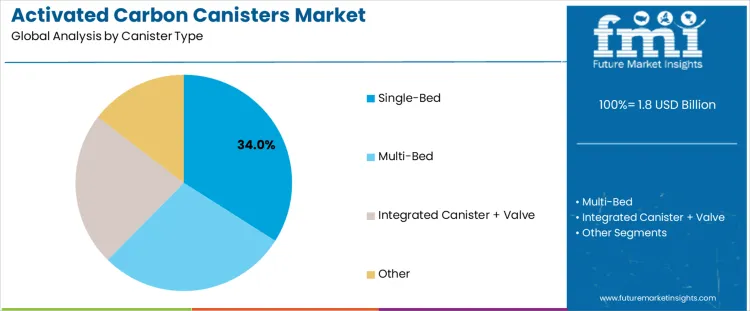
Single-bed canisters account for approximately 34% of total canister type demand, making them the leading category. These canisters provide effective hydrocarbon adsorption, compact design, and ease of integration into fuel systems. Adoption is driven by compatibility with gasoline and low-emission fuel systems, cost efficiency, and operational reliability. Manufacturers implement single-bed canisters in passenger vehicles to capture fuel vapors, reduce emissions, and comply with environmental regulations. Maintenance programs monitor adsorption efficiency, valve operation, and structural integrity to ensure consistent performance. The segment leads because single-bed canisters combine effective vapor control, operational durability, and cost-efficient integration in modern vehicles.
Operational factors further shape adoption. Canisters must maintain adsorption capacity under varying temperatures, fuel compositions, and pressure fluctuations. Integration with fuel tanks, venting systems, and emission controls ensures system efficiency. The segment leads because single-bed canisters provide predictable vapor capture performance, regulatory compliance, and operational reliability across high-volume passenger vehicle applications.
Why Are Passenger Vehicles Representing the Largest Vehicle Segment in Activated Carbon Canisters?
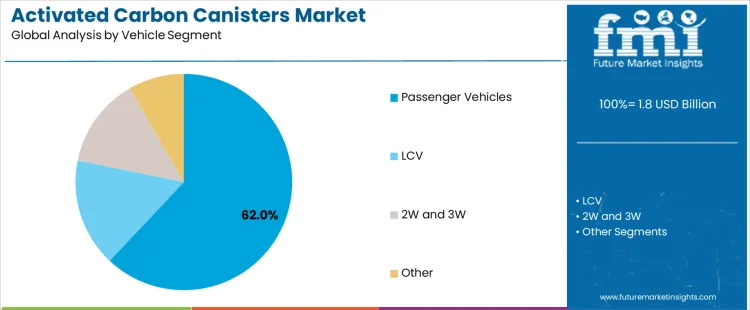
Passenger vehicles account for approximately 62% of total vehicle segment demand, making them the largest category. Adoption is driven by high fleet volume, stringent evaporative emission regulations, and demand for operational safety. Canisters in passenger vehicles are required to efficiently capture fuel vapors, prevent environmental release, and maintain system integrity under variable operational conditions. Manufacturers select single-bed and integrated canisters to ensure compliance and reliability while minimizing space and weight impact. Maintenance routines include monitoring adsorption performance, valve operation, and canister integrity to prevent fuel vapor leaks and maintain environmental compliance.
Functional and operational considerations influence adoption. Canisters must withstand temperature fluctuations, vibration, and repeated fuel refilling cycles while maintaining adsorption efficiency. Integration with fuel lines, tanks, and onboard diagnostics ensures consistent vapor capture. Passenger vehicles lead because they represent the largest fleet segment using activated carbon canisters, delivering measurable emission reduction, operational efficiency, and regulatory compliance.
How Are Activated Carbon Canisters Supporting Automotive Emission Control?
Activated carbon canisters are increasingly used in passenger vehicles, commercial trucks, and off-road equipment to capture fuel vapors and reduce hydrocarbon emissions. Adoption is strongest in regions with strict evaporative emission regulations, high vehicle production, and growing environmental awareness. Canisters are selected for adsorption capacity, chemical resistance, and durability under thermal and pressure fluctuations. Growth is driven by regulatory compliance, emission reduction targets, and operational reliability. Investment focuses on material quality, structural integrity, and integration with fuel and vapor recovery systems. OEMs prioritize canisters that ensure consistent emission control and maintain fuel system performance.
Why Are Regional Emission Regulations and Environmental Policies Driving Adoption?
Demand is shaped by local regulations limiting evaporative hydrocarbons and mandating onboard vapor recovery. Manufacturers adopt activated carbon canisters to comply with emission limits, reduce environmental impact, and meet certification requirements. Canisters with high adsorption efficiency, chemical stability, and resistance to fuel additives gain preference. Adoption is concentrated in regions with strict emission mandates and robust regulatory enforcement. Compliance with environmental standards and operational reliability drive procurement rather than cost. Suppliers providing validated, high-performance canisters gain competitive advantage among OEMs and automotive component manufacturers.
What Factors Limit Broader Deployment of Activated Carbon Canisters?
High production costs, material selection challenges, and precision engineering requirements restrict adoption. Adsorption efficiency can vary with temperature, fuel composition, and pressure changes. Integration with fuel tanks, venting systems, and evaporative controls requires technical expertise. Certification, testing, and regulatory approval processes may delay deployment. Smaller manufacturers or regions with lenient emission regulations adopt canisters more slowly. Early adoption is concentrated among well-resourced OEMs, commercial fleets, and regions with stringent environmental compliance requirements.
How Are Technological Advancements and Industry Collaboration Shaping Market Growth?
Recent developments include high-capacity activated carbon, multi-layer canisters, and enhanced resistance to fuel additives and thermal cycling. Collaboration between canister manufacturers, OEMs, and regulatory agencies ensures performance validation, emission compliance, and system integration. Pilot testing evaluates adsorption efficiency, durability, and reliability before large-scale adoption. Quality monitoring, traceability, and standardized production processes maintain consistency. Focus is on emission reduction, operational reliability, and regulatory alignment rather than cost or volume. Collaborative initiatives enable broader adoption of activated carbon canisters across regional and global automotive markets.
What is the Demand for Activated Carbon Canisters by Country?
| Country | CAGR (%) |
|---|---|
| USA | 3.4% |
| Japan | 2.4% |
| China | 4.9% |
| UK | 2.9% |
| Brazil | 4.6% |
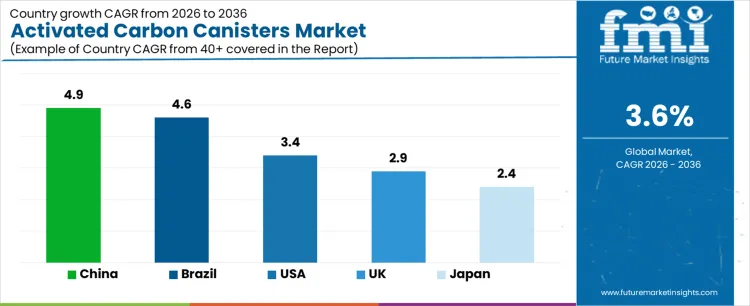
Demand for activated carbon canisters is rising as automotive manufacturers and refueling systems implement evaporative emission control technologies to comply with environmental regulations. China leads with a 4.9% CAGR, driven by growing vehicle production, stricter emission standards, and widespread adoption of carbon canister systems. Brazil follows at 4.6%, supported by regulatory requirements and fleet modernization. The USA grows at 3.4%, shaped by replacement demand and integration in passenger and commercial vehicles. The UK records 2.9% growth, reflecting adoption in new vehicles and regulatory compliance programs. Japan shows 2.4% CAGR, influenced by mature automotive markets and gradual adoption of evaporative emission control systems.
How Is the United States Experiencing Growth in the Activated Carbon Canisters Market?
United States is experiencing growth at a CAGR of 3.4%, supported by adoption of activated carbon canisters in passenger, commercial, and specialty vehicles to reduce evaporative fuel emissions and improve fuel system compliance. Automotive OEMs and suppliers are producing canisters optimized for adsorption capacity, chemical resistance, and durability under variable temperature conditions. Demand is concentrated in automotive manufacturing hubs, engine assembly plants, and aftermarket service centers. Investments focus on material performance, regulatory compliance, and manufacturing precision rather than large-scale fleet deployment. Growth reflects increasing regulatory mandates, adoption of low-emission technologies, and replacement demand in older vehicle fleets.
- Emission-reduction regulations drive adoption.
- Canisters optimize adsorption and fuel vapor control.
- Automotive hubs and assembly plants concentrate demand.
- Material performance and regulatory compliance guide investment.
How Is Japan Witnessing Moderate Adoption With Emission Standards?
Japan is witnessing growth at a CAGR of 2.4%, supported by adoption of activated carbon canisters in passenger and commercial vehicles to comply with evaporative emission standards. OEMs and suppliers are providing canisters optimized for adsorption efficiency, chemical resistance, and integration with fuel systems. Demand is concentrated in automotive manufacturing hubs, engine assembly plants, and urban vehicle production centers. Investments prioritize material reliability, operational precision, and regulatory compliance rather than fleet expansion. Growth reflects gradual adoption of low-emission technologies, stringent fuel vapor regulations, and modernization of fuel system components.
- Emission standards drive adoption.
- Canisters ensure efficient fuel vapor adsorption.
- Automotive hubs and production centers concentrate demand.
- Material reliability and operational precision guide investment.
How Is China Experiencing Rapid Growth With Evaporative Emission Control?
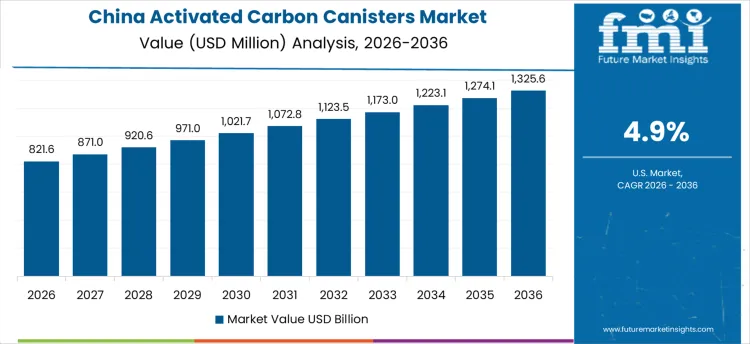
China is experiencing growth at a CAGR of 4.9%, fueled by adoption of activated carbon canisters in passenger and commercial vehicles to reduce evaporative fuel emissions and comply with environmental regulations. Manufacturers and suppliers are deploying canisters optimized for adsorption performance, chemical resistance, and long-term durability. Demand is concentrated in automotive manufacturing hubs, engine assembly plants, and industrial vehicle production centers. Investments focus on material performance, operational reliability, and regulatory compliance rather than fleet-scale deployment. Growth reflects government emission mandates, increasing vehicle production, and industrial adoption of advanced fuel system technologies.
- Evaporative emission control drives adoption.
- Canisters optimize fuel vapor adsorption and durability.
- Automotive hubs and assembly plants concentrate demand.
- Material performance and operational reliability guide investment.
How Is the United Kingdom Witnessing Steady Growth With Low-Emission Vehicles?
United Kingdom is witnessing growth at a CAGR of 2.9%, supported by adoption of activated carbon canisters in passenger and commercial vehicles to improve fuel system efficiency and reduce evaporative emissions. OEMs and suppliers are implementing canisters designed for high adsorption capacity, chemical resistance, and fuel system integration. Demand is concentrated in automotive manufacturing hubs, engine assembly plants, and urban vehicle production centers. Investments prioritize material performance, regulatory compliance, and operational precision rather than large-scale deployment. Growth reflects regulatory enforcement, fleet modernization, and gradual adoption of low-emission fuel system technologies.
- Low-emission vehicles drive adoption.
- Canisters provide fuel vapor adsorption and durability.
- Automotive hubs and assembly plants concentrate demand.
- Material performance and regulatory compliance guide investment.
How Is Brazil Experiencing Rapid Growth With Emission Compliance Initiatives?
Brazil is experiencing growth at a CAGR of 4.6%, fueled by adoption of activated carbon canisters in passenger, commercial, and industrial vehicles to control evaporative fuel emissions and improve compliance with environmental standards. Manufacturers and suppliers are producing canisters optimized for adsorption efficiency, chemical resistance, and integration with high ethanol-content fuel systems. Demand is concentrated in automotive manufacturing hubs, engine assembly plants, and fleet service centers. Investments focus on material performance, operational reliability, and regulatory compliance rather than fleet expansion. Growth reflects regulatory incentives, increasing adoption of low-emission technologies, and industrial modernization of fuel systems.
- Emission compliance initiatives drive adoption.
- Canisters ensure efficient fuel vapor control and durability.
- Automotive hubs and assembly plants concentrate demand.
- Material performance and operational reliability guide investment.
Who Competes in the Activated Carbon Canisters Market and What Defines Their Capabilities?
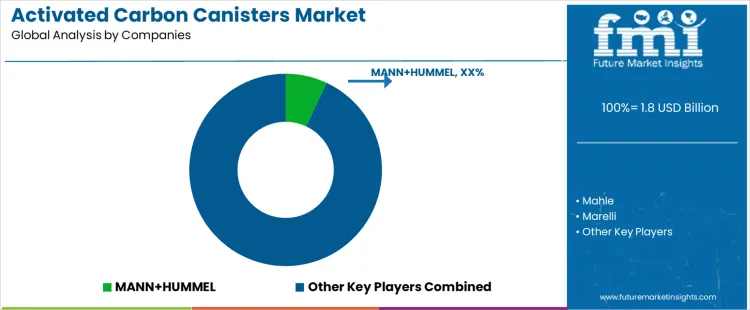
Competition in the activated carbon canisters market is defined by adsorption efficiency, durability under thermal and vibration stress, and integration with vehicle evaporative emission control systems. MANN+HUMMEL supplies activated carbon canisters engineered for high hydrocarbon capture efficiency and long service life across diverse vehicle platforms. Mahle focuses on canister systems optimized for packaging flexibility, emission reduction, and fuel compatibility. Marelli delivers canisters integrated with fuel vapor routing for compliance with global evaporative emission standards. Donaldson provides high-performance canisters with consistent adsorption under thermal and pressure fluctuations. Bosch supplies canisters designed for precise vapor flow control and OEM integration.
Continental develops canister solutions that combine vapor adsorption with vehicle fuel system integration. Aisan Industry provides compact, durable canisters compatible with hybrid and conventional fuel tanks. Hengst focuses on material selection and optimized flow dynamics for emission control. UFI Filters delivers specialized canisters designed for compact packaging and thermal stability. Sogefi offers canisters engineered for long-term adsorption efficiency and compatibility with fuel vapors. Other regional and specialty suppliers provide canisters tailored to alternative fuel systems and regulatory compliance. Competitive differentiation arises from adsorption capacity, material durability, system integration, fuel compatibility, and adherence to evaporative emission standards across different vehicle classes.
Key Players in the Activated Carbon Canisters Market
- MANN+HUMMEL
- Mahle
- Marelli
- Donaldson
- Bosch
- Continental
- Aisan Industry
- Hengst
- UFI Filters
- Sogefi
Scope of the Report
| Items | Values |
|---|---|
| Quantitative Units (2026) | USD billion |
| Canister Type | Single-Bed, Multi-Bed, Integrated Canister + Valve, Other |
| Vehicle Segment | Passenger Vehicles, LCV, 2W and 3W, Other |
| Regulation Focus | Euro 6/7 Evap, EPA Evap and ORVR, China 6, Other |
| Sales Channel | OEM Line-Fit, Aftermarket, Dealer and OES, Other |
| Region | Asia Pacific, Europe, North America, Latin America, Middle East & Africa |
| Key Countries Covered | China, Japan, South Korea, India, Australia & New Zealand, Germany, United Kingdom, France, Italy, Spain, Nordic, BENELUX, United States, Canada, Mexico, Brazil, Chile, Kingdom of Saudi Arabia, Other GCC Countries, Turkey, South Africa, Other African Union |
| Key Companies Profiled | MANN+HUMMEL, Mahle, Marelli, Donaldson, Bosch, Continental, Aisan Industry, Hengst, UFI Filters, Sogefi |
| Additional Attributes | Dollar sales by canister type, vehicle segment, regulation focus, and sales channel; regional CAGR, volume and value growth projections; adoption across passenger, LCV, and two-/three-wheel vehicles; adsorption efficiency, material durability, and thermal stability; compliance with Euro, EPA, and China emission standards; integration with fuel tanks, venting systems, and onboard evaporative emission control systems |
Activated Carbon Canisters Market Segmentation
Canister Type:
- Single-Bed
- Multi-Bed
- Integrated Canister + Valve
- Other
Vehicle Segment:
- Passenger Vehicles
- LCV
- 2Wand3W
- Other
Regulation Focus:
- Euro 6/7 Evap
- EPA Evap and ORVR
- China 6
- Other
Sales Channel:
- OEM Line-Fit
- Aftermarket
- Dealer and OES
- Other
Region
- Asia Pacific
- China
- Japan
- South Korea
- India
- Australia & New Zealand
- ASEAN
- Rest of Asia Pacific
- Europe
- Germany
- United Kingdom
- France
- Italy
- Spain
- Nordic
- BENELUX
- Rest of Europe
- North America
- United States
- Canada
- Mexico
- Latin America
- Brazil
- Chile
- Rest of Latin America
- Middle East & Africa
- Kingdom of Saudi Arabia
- Other GCC Countries
- Turkey
- South Africa
- Other African Union
- Rest of Middle East & Africa
Bibliography
- Onboard refueling vapor recovery. (2025). US Environmental Protection Agency (EPA) overview of ORVR as a vehicle fuel-vapor emission control system. (Wikipedia / EPA summary).
- Understanding and designing automotive evaporative emission control systems. (2025). ResearchGate technical overview of EVAP design and efficiency factors.
- Jo, D. S. (2025). Effect of pore characteristics of biomass-derived activated carbon for automotive canisters. Technologies (MDPI Journal).
- Review of the European test procedure for evaporative emissions control. (2025). European Commission JRC technical report on EVAP test methods and activated carbon quality.
- Characterization of activated carbon adsorption and deterioration in carbon canisters during vehicle refueling. (2025). Semantic Scholar research summary of adsorption performance in carbon canisters.
Frequently Asked Questions
How big is the activated carbon canisters market in 2026?
The global activated carbon canisters market is estimated to be valued at USD 1.8 billion in 2026.
What will be the size of activated carbon canisters market in 2036?
The market size for the activated carbon canisters market is projected to reach USD 2.6 billion by 2036.
How much will be the activated carbon canisters market growth between 2026 and 2036?
The activated carbon canisters market is expected to grow at a 3.6% CAGR between 2026 and 2036.
What are the key product types in the activated carbon canisters market?
The key product types in activated carbon canisters market are single-bed, multi-bed, integrated canister + valve and other.
Which vehicle segment segment to contribute significant share in the activated carbon canisters market in 2026?
In terms of vehicle segment, passenger vehicles segment to command 62.0% share in the activated carbon canisters market in 2026.
Preview the report firsthand - request a free sample
Get SampleGet the brochure for pricing and purchase details.
Get PDFTable of Content
- Executive Summary
- Global Market Outlook
- Demand-side Trends
- Supply-side Trends
- Technology Roadmap Analysis
- Analysis and Recommendations
- Market Overview
- Market Coverage / Taxonomy
- Market Definition / Scope / Limitations
- Market Background
- Market Dynamics
- Drivers
- Restraints
- Opportunity
- Trends
- Scenario Forecast
- Demand in Optimistic Scenario
- Demand in Likely Scenario
- Demand in Conservative Scenario
- Opportunity Map Analysis
- Product Life Cycle Analysis
- Supply Chain Analysis
- Investment Feasibility Matrix
- Value Chain Analysis
- PESTLE and Porter’s Analysis
- Regulatory Landscape
- Regional Parent Market Outlook
- Production and Consumption Statistics
- Import and Export Statistics
- Market Dynamics
- Global Market Analysis 2021 to 2025 and Forecast, 2026 to 2036
- Historical Market Size Value (USD Million) Analysis, 2021 to 2025
- Current and Future Market Size Value (USD Million) Projections, 2026 to 2036
- Y-o-Y Growth Trend Analysis
- Absolute $ Opportunity Analysis
- Global Market Pricing Analysis 2021 to 2025 and Forecast 2026 to 2036
- Global Market Analysis 2021 to 2025 and Forecast 2026 to 2036, By Canister Type
- Introduction / Key Findings
- Historical Market Size Value (USD Million) Analysis By Canister Type , 2021 to 2025
- Current and Future Market Size Value (USD Million) Analysis and Forecast By Canister Type , 2026 to 2036
- Single-Bed
- Multi-Bed
- Integrated Canister + Valve
- Other
- Single-Bed
- Y-o-Y Growth Trend Analysis By Canister Type , 2021 to 2025
- Absolute $ Opportunity Analysis By Canister Type , 2026 to 2036
- Global Market Analysis 2021 to 2025 and Forecast 2026 to 2036, By Vehicle Segment
- Introduction / Key Findings
- Historical Market Size Value (USD Million) Analysis By Vehicle Segment, 2021 to 2025
- Current and Future Market Size Value (USD Million) Analysis and Forecast By Vehicle Segment, 2026 to 2036
- Passenger Vehicles
- LCV
- 2W and 3W
- Other
- Passenger Vehicles
- Y-o-Y Growth Trend Analysis By Vehicle Segment, 2021 to 2025
- Absolute $ Opportunity Analysis By Vehicle Segment, 2026 to 2036
- Global Market Analysis 2021 to 2025 and Forecast 2026 to 2036, By Regulation Focus
- Introduction / Key Findings
- Historical Market Size Value (USD Million) Analysis By Regulation Focus, 2021 to 2025
- Current and Future Market Size Value (USD Million) Analysis and Forecast By Regulation Focus, 2026 to 2036
- Euro 6/7 Evap
- EPA Evap and ORVR
- China 6
- Other
- Euro 6/7 Evap
- Y-o-Y Growth Trend Analysis By Regulation Focus, 2021 to 2025
- Absolute $ Opportunity Analysis By Regulation Focus, 2026 to 2036
- Global Market Analysis 2021 to 2025 and Forecast 2026 to 2036, By Sales Channel
- Introduction / Key Findings
- Historical Market Size Value (USD Million) Analysis By Sales Channel, 2021 to 2025
- Current and Future Market Size Value (USD Million) Analysis and Forecast By Sales Channel, 2026 to 2036
- OEM Line-Fit
- Aftermarket
- Dealer and OES
- Other
- OEM Line-Fit
- Y-o-Y Growth Trend Analysis By Sales Channel, 2021 to 2025
- Absolute $ Opportunity Analysis By Sales Channel, 2026 to 2036
- Global Market Analysis 2021 to 2025 and Forecast 2026 to 2036, By Region
- Introduction
- Historical Market Size Value (USD Million) Analysis By Region, 2021 to 2025
- Current Market Size Value (USD Million) Analysis and Forecast By Region, 2026 to 2036
- North America
- Latin America
- Western Europe
- Eastern Europe
- East Asia
- South Asia and Pacific
- Middle East & Africa
- Market Attractiveness Analysis By Region
- North America Market Analysis 2021 to 2025 and Forecast 2026 to 2036, By Country
- Historical Market Size Value (USD Million) Trend Analysis By Market Taxonomy, 2021 to 2025
- Market Size Value (USD Million) Forecast By Market Taxonomy, 2026 to 2036
- By Country
- USA
- Canada
- Mexico
- By Canister Type
- By Vehicle Segment
- By Regulation Focus
- By Sales Channel
- By Country
- Market Attractiveness Analysis
- By Country
- By Canister Type
- By Vehicle Segment
- By Regulation Focus
- By Sales Channel
- Key Takeaways
- Latin America Market Analysis 2021 to 2025 and Forecast 2026 to 2036, By Country
- Historical Market Size Value (USD Million) Trend Analysis By Market Taxonomy, 2021 to 2025
- Market Size Value (USD Million) Forecast By Market Taxonomy, 2026 to 2036
- By Country
- Brazil
- Chile
- Rest of Latin America
- By Canister Type
- By Vehicle Segment
- By Regulation Focus
- By Sales Channel
- By Country
- Market Attractiveness Analysis
- By Country
- By Canister Type
- By Vehicle Segment
- By Regulation Focus
- By Sales Channel
- Key Takeaways
- Western Europe Market Analysis 2021 to 2025 and Forecast 2026 to 2036, By Country
- Historical Market Size Value (USD Million) Trend Analysis By Market Taxonomy, 2021 to 2025
- Market Size Value (USD Million) Forecast By Market Taxonomy, 2026 to 2036
- By Country
- Germany
- UK
- Italy
- Spain
- France
- Nordic
- BENELUX
- Rest of Western Europe
- By Canister Type
- By Vehicle Segment
- By Regulation Focus
- By Sales Channel
- By Country
- Market Attractiveness Analysis
- By Country
- By Canister Type
- By Vehicle Segment
- By Regulation Focus
- By Sales Channel
- Key Takeaways
- Eastern Europe Market Analysis 2021 to 2025 and Forecast 2026 to 2036, By Country
- Historical Market Size Value (USD Million) Trend Analysis By Market Taxonomy, 2021 to 2025
- Market Size Value (USD Million) Forecast By Market Taxonomy, 2026 to 2036
- By Country
- Russia
- Poland
- Hungary
- Balkan & Baltic
- Rest of Eastern Europe
- By Canister Type
- By Vehicle Segment
- By Regulation Focus
- By Sales Channel
- By Country
- Market Attractiveness Analysis
- By Country
- By Canister Type
- By Vehicle Segment
- By Regulation Focus
- By Sales Channel
- Key Takeaways
- East Asia Market Analysis 2021 to 2025 and Forecast 2026 to 2036, By Country
- Historical Market Size Value (USD Million) Trend Analysis By Market Taxonomy, 2021 to 2025
- Market Size Value (USD Million) Forecast By Market Taxonomy, 2026 to 2036
- By Country
- China
- Japan
- South Korea
- By Canister Type
- By Vehicle Segment
- By Regulation Focus
- By Sales Channel
- By Country
- Market Attractiveness Analysis
- By Country
- By Canister Type
- By Vehicle Segment
- By Regulation Focus
- By Sales Channel
- Key Takeaways
- South Asia and Pacific Market Analysis 2021 to 2025 and Forecast 2026 to 2036, By Country
- Historical Market Size Value (USD Million) Trend Analysis By Market Taxonomy, 2021 to 2025
- Market Size Value (USD Million) Forecast By Market Taxonomy, 2026 to 2036
- By Country
- India
- ASEAN
- Australia & New Zealand
- Rest of South Asia and Pacific
- By Canister Type
- By Vehicle Segment
- By Regulation Focus
- By Sales Channel
- By Country
- Market Attractiveness Analysis
- By Country
- By Canister Type
- By Vehicle Segment
- By Regulation Focus
- By Sales Channel
- Key Takeaways
- Middle East & Africa Market Analysis 2021 to 2025 and Forecast 2026 to 2036, By Country
- Historical Market Size Value (USD Million) Trend Analysis By Market Taxonomy, 2021 to 2025
- Market Size Value (USD Million) Forecast By Market Taxonomy, 2026 to 2036
- By Country
- Kingdom of Saudi Arabia
- Other GCC Countries
- Turkiye
- South Africa
- Other African Union
- Rest of Middle East & Africa
- By Canister Type
- By Vehicle Segment
- By Regulation Focus
- By Sales Channel
- By Country
- Market Attractiveness Analysis
- By Country
- By Canister Type
- By Vehicle Segment
- By Regulation Focus
- By Sales Channel
- Key Takeaways
- Key Countries Market Analysis
- USA
- Pricing Analysis
- Market Share Analysis, 2025
- By Canister Type
- By Vehicle Segment
- By Regulation Focus
- By Sales Channel
- Canada
- Pricing Analysis
- Market Share Analysis, 2025
- By Canister Type
- By Vehicle Segment
- By Regulation Focus
- By Sales Channel
- Mexico
- Pricing Analysis
- Market Share Analysis, 2025
- By Canister Type
- By Vehicle Segment
- By Regulation Focus
- By Sales Channel
- Brazil
- Pricing Analysis
- Market Share Analysis, 2025
- By Canister Type
- By Vehicle Segment
- By Regulation Focus
- By Sales Channel
- Chile
- Pricing Analysis
- Market Share Analysis, 2025
- By Canister Type
- By Vehicle Segment
- By Regulation Focus
- By Sales Channel
- Germany
- Pricing Analysis
- Market Share Analysis, 2025
- By Canister Type
- By Vehicle Segment
- By Regulation Focus
- By Sales Channel
- UK
- Pricing Analysis
- Market Share Analysis, 2025
- By Canister Type
- By Vehicle Segment
- By Regulation Focus
- By Sales Channel
- Italy
- Pricing Analysis
- Market Share Analysis, 2025
- By Canister Type
- By Vehicle Segment
- By Regulation Focus
- By Sales Channel
- Spain
- Pricing Analysis
- Market Share Analysis, 2025
- By Canister Type
- By Vehicle Segment
- By Regulation Focus
- By Sales Channel
- France
- Pricing Analysis
- Market Share Analysis, 2025
- By Canister Type
- By Vehicle Segment
- By Regulation Focus
- By Sales Channel
- India
- Pricing Analysis
- Market Share Analysis, 2025
- By Canister Type
- By Vehicle Segment
- By Regulation Focus
- By Sales Channel
- ASEAN
- Pricing Analysis
- Market Share Analysis, 2025
- By Canister Type
- By Vehicle Segment
- By Regulation Focus
- By Sales Channel
- Australia & New Zealand
- Pricing Analysis
- Market Share Analysis, 2025
- By Canister Type
- By Vehicle Segment
- By Regulation Focus
- By Sales Channel
- China
- Pricing Analysis
- Market Share Analysis, 2025
- By Canister Type
- By Vehicle Segment
- By Regulation Focus
- By Sales Channel
- Japan
- Pricing Analysis
- Market Share Analysis, 2025
- By Canister Type
- By Vehicle Segment
- By Regulation Focus
- By Sales Channel
- South Korea
- Pricing Analysis
- Market Share Analysis, 2025
- By Canister Type
- By Vehicle Segment
- By Regulation Focus
- By Sales Channel
- Russia
- Pricing Analysis
- Market Share Analysis, 2025
- By Canister Type
- By Vehicle Segment
- By Regulation Focus
- By Sales Channel
- Poland
- Pricing Analysis
- Market Share Analysis, 2025
- By Canister Type
- By Vehicle Segment
- By Regulation Focus
- By Sales Channel
- Hungary
- Pricing Analysis
- Market Share Analysis, 2025
- By Canister Type
- By Vehicle Segment
- By Regulation Focus
- By Sales Channel
- Kingdom of Saudi Arabia
- Pricing Analysis
- Market Share Analysis, 2025
- By Canister Type
- By Vehicle Segment
- By Regulation Focus
- By Sales Channel
- Turkiye
- Pricing Analysis
- Market Share Analysis, 2025
- By Canister Type
- By Vehicle Segment
- By Regulation Focus
- By Sales Channel
- South Africa
- Pricing Analysis
- Market Share Analysis, 2025
- By Canister Type
- By Vehicle Segment
- By Regulation Focus
- By Sales Channel
- USA
- Market Structure Analysis
- Competition Dashboard
- Competition Benchmarking
- Market Share Analysis of Top Players
- By Regional
- By Canister Type
- By Vehicle Segment
- By Regulation Focus
- By Sales Channel
- Competition Analysis
- Competition Deep Dive
- MANN+HUMMEL
- Overview
- Product Portfolio
- Profitability by Market Segments (Product/Age /Sales Channel/Region)
- Sales Footprint
- Strategy Overview
- Marketing Strategy
- Product Strategy
- Channel Strategy
- Mahle
- Marelli
- Donaldson
- Bosch
- Continental
- Aisan Industry
- Hengst
- UFI Filters
- Sogefi
- MANN+HUMMEL
- Competition Deep Dive
- Assumptions & Acronyms Used
- Research Methodology


