

- Industry Size (2026)
- USD 2.94 Bn
- Forecast (2036)
- USD 5.79 Bn
- CAGR (2026 to 2036)
- 7.0%
Activated Carbon Bags Market Size, Market Forecast and Outlook By FMI
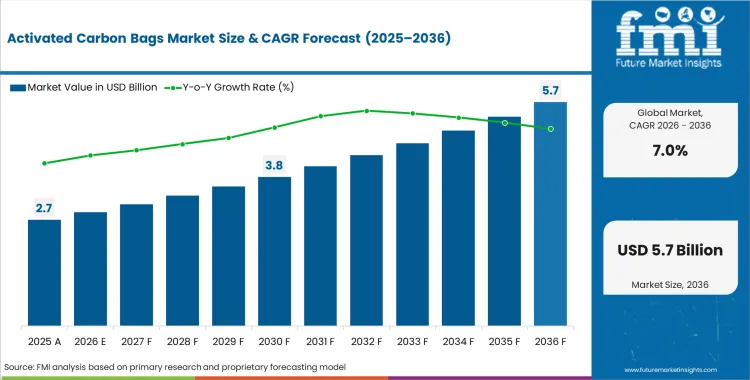
The Activated Carbon Bags market was valued at USD 2.75 billion in 2025, projected to reach USD 2.94 billion in 2026, and is forecast to expand to USD 5.79 billion by 2036 at a 7.0% CAGR. Activated carbon bags are pre-packaged consumer and commercial air and water purification products containing activated carbon in permeable bag formats designed for placement in enclosed spaces, HVAC air filtration systems, refrigerators, automotive interiors, and water filtration applications where controlled release of adsorption capacity over time removes odours, volatile organic compounds, moisture, and chemical contaminants without active mechanical filtration systems.
As per FMI, the activated carbon bags market is driven by rising consumer awareness of indoor air quality, the growing availability of natural and eco-friendly air purification products positioning activated carbon bags as sustainable alternatives to synthetic air fresheners and chemical deodorisers, and expanding e-commerce distribution enabling direct-to-consumer product access across global markets. The market spans consumer retail channels, industrial workplace air quality management, and specialty automotive and storage applications.
Summary of Activated Carbon Bags Market
- Market Snapshot
- The Activated Carbon Bags market is valued at USD 2.75 billion in 2025 and is projected to reach USD 5.79 billion by 2036.
- The industry is expected to grow at a 7.0% CAGR from 2026 to 2036, creating an incremental opportunity of USD 2.794 billion.
- The market is a growth-oriented, demand-driven category where carbon type differentiation and end-use adoption dynamics define competitive positioning.
- Demand and Growth Drivers
- 5 to 15 microns procurement growth and regulatory or clinical compliance requirements are sustaining demand expansion for activated carbon bags products across primary end-use markets.
- Powdered specifications and performance differentiation over alternative carbon type variants are creating stable demand channels in regulated and performance-specification-driven procurement segments.
- Expanding manufacturing and healthcare infrastructure in emerging markets alongside established compliance-driven replacement cycles in developed markets are broadening the addressable activated carbon bags market base.
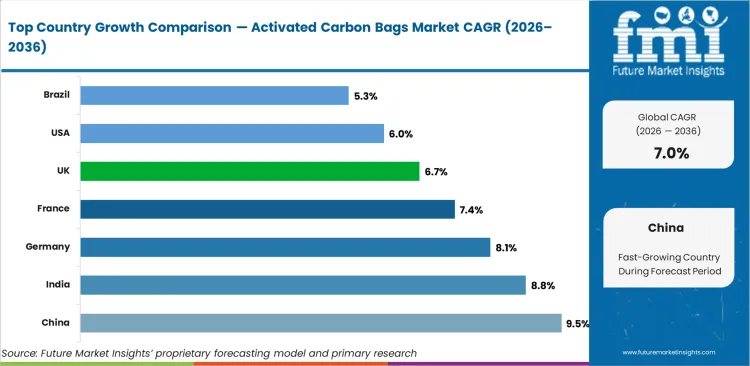
- China leads at 9.5% CAGR, India at 8.8%, Germany at 8.1%, France at 7.4%, UK at 6.7%, USA at 6.0%, Brazil at 5.3%.
- Product and Segment View
- The market covers activated carbon bags products across carbon type categories serving regulated, industrial, consumer, and clinical end-use procurement channels.
- Powdered leads Carbon Type with 49.6% share in 2026, driven by established performance advantages and specification compliance across primary application markets.
- 5 to 15 microns accounts for 25.0% by Pore Size in 2026, reflecting dominant volume procurement across primary institutional and commercial end users.
- 200 to 500 grams accounts for 51.2% by Bag Capacity in 2026, reflecting dominant volume demand in the leading functional application category.
- Scope includes certified activated carbon bags products for defined end-use applications; excludes upstream precursor materials, downstream derivative products, and non-applicable treatment categories.
- Geography and Competitive Outlook
- China and India are the fastest-growing markets driven by infrastructure expansion and adoption programme growth, while established markets sustain demand through compliance-driven and innovation-led replacement and upgrade cycles.
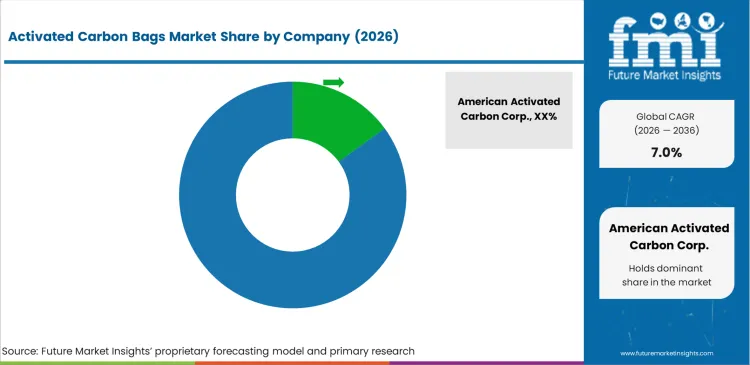
- Competition is served by global integrated manufacturers, specialty producers, and regional suppliers, with key players including American Activated Carbon Corp., Filtra Systems, TIGG LLC, Lenntech B.V., Jurassis Activated Carbon Inc., Huizhou Huadi Industrial Co. Ltd., Delta Enterprises Inc., CleanFlow Filter Solutions, Xiamen Minghui Import and Export Co. Ltd., Shenzhen Chunwang Environmental Protection Technology Co. Ltd..
Activated Carbon Bags Market Key Takeaways
| Metric | Details |
|---|---|
| Industry Size (2026) | USD 2.94 billion |
| Industry Value (2036) | USD 5.79 billion |
| CAGR (2026 to 2036) | 7.0% |
| Source | Future Market Insights, 2026 |
Source: FMI analysis based on primary research and proprietary forecasting model
The absolute dollar increment from 2026 to 2036 stands at USD 2.794 billion, reflecting strong consumer product market expansion driven by indoor air quality awareness and the premiumisation of home environment products. FMI analysts observe that powdered activated carbon in bag format dominates by carbon type due to its higher surface area per unit weight relative to granular and pelletised forms, providing faster odour adsorption response in consumer applications where immediate air freshening effect perception influences repeat purchase behaviour. The 200 to 500 gram bag capacity range accounts for the largest share by bag capacity, representing the standard consumer retail format sized for single-room, refrigerator, or automotive interior air quality management applications across the broadest addressable consumer purchasing occasion.
China leads at a 9.5% CAGR through 2036, driven by domestic consumer indoor air quality product market growth, large-scale manufacturing of activated carbon bag products for domestic consumption and global export, and strong e-commerce distribution enabling consumer market penetration. India follows at 8.8% as consumer awareness of indoor air pollution and demand for natural home environment products grows alongside urban middle-class expansion. Germany advances at 8.1% supported by consumer environmental consciousness, indoor air quality regulatory awareness, and automotive interior air quality applications. France progresses at 7.4% anchored by consumer home product and wellness market demand. The United Kingdom tracks at 6.7%, the United States at 6.0% from established consumer and industrial markets, and Brazil at 5.3% from consumer product market growth.
Activated Carbon Bags Market Definition
The Activated Carbon Bags market encompasses packaged consumer and commercial air and water purification products containing activated carbon in powdered, granular, or pelletised form enclosed within permeable fabric, mesh, or specialised bag structures, designed for passive adsorption of odour compounds, volatile organic compounds, moisture, and chemical contaminants from enclosed air spaces in residential, automotive, commercial refrigeration, workplace, and storage environments without powered mechanical filtration systems. Products are characterised by their activated carbon source, particle form, pore size distribution, bag capacity, and intended placement application.
Activated Carbon Bags Market Inclusions
Market scope includes consumer retail activated carbon bags for home room air purification, refrigerator deodorisation, automotive interior air quality, wardrobe and storage odour control, and shoe deodourising applications, as well as commercial and industrial activated carbon bag products for workplace air quality management, industrial enclosure odour control, and point-of-use water filtration applications. Both bamboo charcoal and coal-based activated carbon bag product variants across all commercial bag capacity formats are incorporated.
Activated Carbon Bags Market Exclusions
Bulk loose activated carbon granules and pellets for industrial water treatment and gas processing without retail bag packaging are covered under the separate Activated Carbon market categories. Powered HEPA and activated carbon combination air purifier appliances, activated carbon filter cartridges for tap water filtration systems requiring installation, and industrial activated carbon adsorber vessel systems fall outside activated carbon bag market scope.
Activated Carbon Bags Market Research Methodology
- Primary Research: FMI analysts engaged with procurement managers, clinical or regulatory specialists, product development leads, and manufacturer executives across key end-use industries and activated carbon bags supplier organisations to map adoption drivers, specification requirements, and compliance obligations shaping procurement and prescribing decisions.
- Desk Research: Data aggregation incorporated end-use industry output and utilisation statistics from national statistical agencies and international organisations, regulatory and clinical guideline documentation, and primary disclosures from company annual reports, investor presentations, and official product announcements.
- Market-Sizing and Forecasting: Baseline values were derived from a bottom-up aggregation of end-use activity volumes, activated carbon bags adoption intensity per unit of downstream output or clinical utilisation, and regional product and grade mix, with forward projections applying regulatory compliance and technology adoption curves from government and multilateral sources.
- Data Validation and Update Cycle: Projections are cross-validated against publicly reported revenue data from leading manufacturers and calibrated against downstream industry production output, healthcare utilisation statistics, and regulatory programme enrolment data from national authorities and international organisations.
Why is the Activated Carbon Bags Market Growing?
The Activated Carbon Bags market is experiencing sustained growth due to increasing demand for efficient air and water purification solutions across residential, commercial, and industrial applications. The market expansion is being influenced by rising environmental awareness, stricter regulations on air and water quality, and growing adoption of portable and easy-to-use filtration products.
Technological advancements in activated carbon production and bag manufacturing have enhanced the adsorption efficiency and lifespan of these products, allowing for more targeted and cost-effective purification solutions. The market is also being shaped by a preference for customized bag capacities and pore structures to meet the specific requirements of different environments.
As consumers and industries prioritize sustainability and safety, the demand for high-performance activated carbon bags is expected to continue growing Opportunities are emerging for products with improved adsorption rates, longer service life, and compatibility with automated filtration systems, which further strengthens the market outlook.
Segmental Analysis
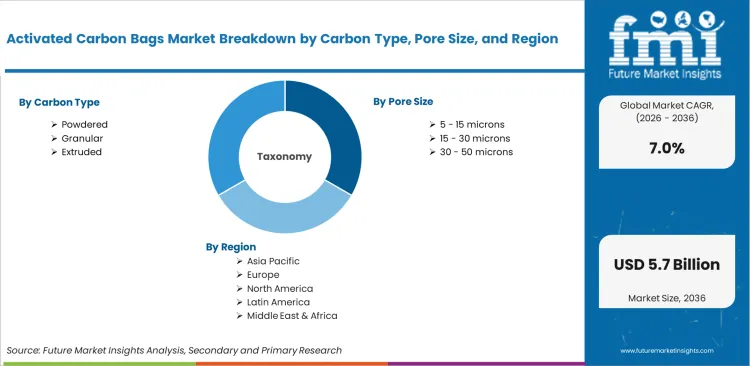
The activated carbon bags market is segmented by carbon type, pore size, bag capacity, application, end use, and geographic regions. By carbon type, activated carbon bags market is divided into Powdered, Granular, and Extruded. In terms of pore size, activated carbon bags market is classified into 5 - 15 microns, 15 - 30 microns, and 30 - 50 microns. Based on bag capacity, activated carbon bags market is segmented into 200 - 500 grams, Less than 200 grams, and 500 grams and above.
By application, activated carbon bags market is segmented into Water Treatment, Air Purification, Discoloring, and Metal Recovery. By end use, activated carbon bags market is segmented into Beverages, Electronics, Pharmaceuticals, Paints & Coatings, Petrochemicals, and Chemicals & Fertilizers. Regionally, the activated carbon bags industry is classified into North America, Latin America, Western Europe, Eastern Europe, Balkan & Baltic Countries, Russia & Belarus, Central Asia, East Asia, South Asia & Pacific, and the Middle East & Africa.
Insights into the Powdered Carbon Type Segment
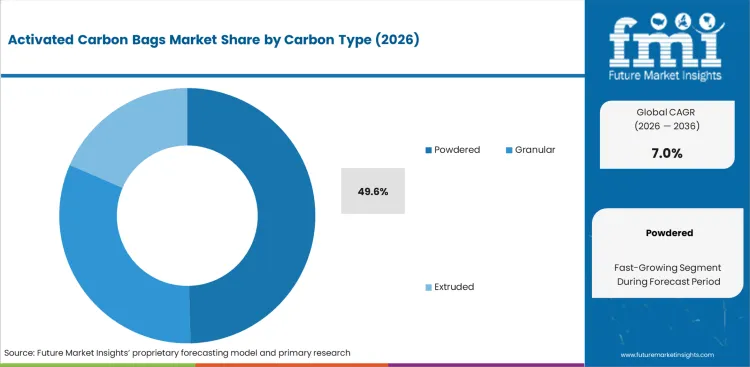
The powdered carbon type is expected to hold 49.60% of the Activated Carbon Bags market revenue share in 2026, making it the leading carbon type. This dominance is being attributed to its high surface area, which allows for enhanced adsorption of pollutants and contaminants. The fine granularity of powdered carbon ensures rapid interaction with impurities, leading to more efficient filtration in shorter durations.
Its widespread adoption has been encouraged by its versatility across air purification, water treatment, and industrial applications. The growth of this segment is further supported by the increasing demand for portable and small-scale filtration solutions where powdered carbon can be easily integrated.
Additionally, powdered carbon allows for consistent quality and predictable performance, which has made it a preferred choice among commercial users The segment is expected to sustain growth as consumers and industries continue to prioritize highly efficient, reliable, and adaptable purification solutions.
Insights into the 5 - 15 Microns Pore Size Segment
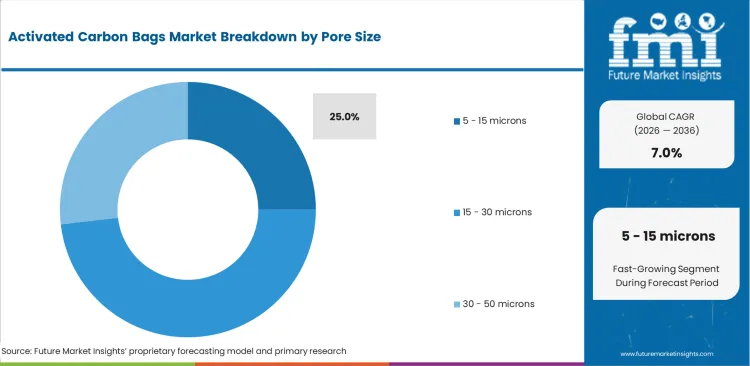
The 5 - 15 microns pore size segment is projected to account for 45.30% of the Activated Carbon Bags market revenue in 2026, establishing it as the leading pore size category. This popularity is being driven by its optimal balance between adsorption efficiency and flow rate, which enables effective removal of fine particles and volatile compounds from air and liquids.
Bags with this pore size are particularly favored in environments requiring precise filtration and contamination control. Adoption has been facilitated by the capability to target a wide range of pollutants without compromising system performance.
Additionally, this pore size range allows for compatibility with both industrial and consumer-grade filtration systems, supporting scalability across applications As environmental standards and consumer expectations rise, the demand for activated carbon bags with carefully engineered pore sizes is expected to continue driving market growth.
Insights into the 200 - 500 Grams Bag Capacity Segment
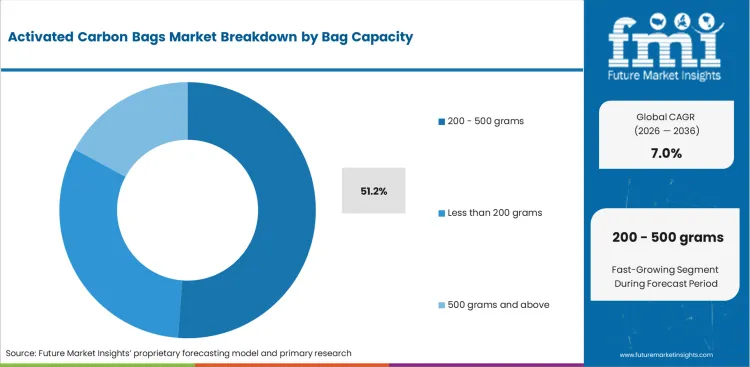
The 200 - 500 grams bag capacity segment is anticipated to hold 51.20% of the market revenue in 2026, making it the dominant capacity category. This leadership is being driven by the suitability of this range for a wide variety of applications, offering a balance between portability and effective filtration lifespan.
Bags in this capacity range are easily installed in residential, commercial, and light industrial setups, providing consistent purification without frequent replacement. Growth in this segment is further supported by the rising demand for user-friendly and maintenance-efficient solutions, particularly in environments where space and handling convenience are important.
Additionally, the moderate capacity allows for scalable deployment in larger filtration systems by combining multiple units, thereby enhancing flexibility As end users increasingly seek efficient and manageable purification products, the 200 - 500 grams bag capacity segment is expected to maintain its leading market position.
Market Overview
Activated Carbon Bags Market: Overview
Activated carbon is a carbonaceous material with a large internal surface area and a porous structure. It is manufactured by treating materials at a very high temperature. Activated carbon bags are gaining popularity due to their unique property of absorbing impurities. Activated carbon bags are made with activated carbon fibers with remarkable absorption properties. Activated carbon bags are used to dehumidify the air. Also, activated carbon bags are normally used for removing color, odor, and organic materials from wastewater.
These also assist in absorbing harmful mutagenic dyes such as electrophoresis solution or ethidium bromide. Activated carbon bags find useful applications in various industries including automotive, electronics, paints & coatings, semiconductors, metallurgical, petrochemicals, and pharmaceuticals. Overall, the activated carbon bags market is expected to witness positive growth during the forecast period.
Activated Carbon Bags Market: Dynamics
The rising impurities in water bodies lead to the low availability of consumable water for human beings. Activated carbon bags are highly used and recommended for the purification of wastewater. Each gram of activated carbon has a surface area of approximately 3,000 m2. Activated carbon bags are very useful in the removal of sediments, chlorine, odor, taste, and volatile organic compounds from wastewater.
This factor is expected to drive the global activated carbon bags market during the forecast period. Activated carbon bags act as a carbon filter and can be used for air filtering, water purification, industrial gas processing, and other processes. Impurities in size range of 0.5 to 50 microns can be removed using activated carbon bags. Activated carbon bags are available in different sizes in the market as per the size of the particle it can remove.
These factors are supposed to fuel the growth of the global activated carbon bags market during the forecast period. Activated carbon bags are used in gas purification and removal as well. These have various applications in industries like electronics, semiconductors, paints and coatings, pharmaceuticals, beverages, petrochemicals, and rubber. For instance, activated carbon bags are used in the processing of alcohol and used as discoloring liquids in pharmaceutical industries.
These factors are expected to drive the global activated carbon bags market during the forecast period. In spite of all these benefits, activated carbon bags are not effective in the removal of salts, and other dissolved inorganic substances. This drawback is expected to hamper the growth of the activated carbon bags market during the forecast period.
The global demand for activated carbon bags is concentrated mainly in North America and Japan, followed by some developed economies. In North America, the USA is the major market owing to the demand from various end-use industries.
The implementation of EPA’s mercury standards is expected to boost the growth of the activated carbon bags market in the region. In regards to capacity, China is supposed to be one of the major producers of activated carbon in the region and the rising demand from environmental protection, water purification, and other related sectors is expected to fuel the growth of activated carbon bags market in the region.
Activated Carbon Bags Market: Key Players
Few of the leading players operating in the global activated carbon bags market
- Filtra Systems
- American Activated Carbon Corp.
- TIGG LLC
- Lenntech B.V.
- Jurassis Activated Carbon, Inc.
- Huizhou Huadi Industrial Co., Ltd
- Delta Enterprises, Inc.
- CleanFlow Filter Solutions
- Xiamen Minghui Import and Export Co., Ltd
- Shenzhen Chunwang Environmental Protection Technology Co., Ltd.
The report is a compilation of first-hand information, qualitative and quantitative assessment by industry analysts, inputs from industry experts and industry participants across the value chain. The report provides in-depth analysis of parent market trends, macroeconomic indicators and governing factors along with market attractiveness as per segments. The report also maps the qualitative impact of various market factors on market segments and geographies.
Analysis of Activated Carbon Bags Market By Key Countries
.webp "Top Country Growth Comparison Activated Carbon Bags Market Cagr (2026 2036)")
| Country | CAGR |
|---|---|
| China | 9.5% |
| India | 8.8% |
| Germany | 8.1% |
| France | 7.4% |
| UK | 6.7% |
| USA | 6.0% |
| Brazil | 5.3% |
Source: FMI analysis based on primary research and proprietary forecasting model
Country-wise Analysis
The Activated Carbon Bags Market is expected to register a CAGR of 7.0% during the forecast period, exhibiting varied country level momentum. China leads with the highest CAGR of 9.5%, followed by India at 8.8%. Developed markets such as Germany, France, and the UK continue to expand steadily, while the USA is likely to grow at consistent rates. Brazil posts the lowest CAGR at 5.3%, yet still underscores a broadly positive trajectory for the global Activated Carbon Bags Market. In 2026, Germany held a dominant revenue in the Western Europe market and is expected to grow with a CAGR of 8.1%. The USA Activated Carbon Bags Market is estimated to be valued at USD 952.0 million in 2026 and is anticipated to reach a valuation of USD 1.7 billion by 2036. Sales are projected to rise at a CAGR of 6.0% over the forecast period between 2026 and 2036. While Japan and South Korea markets are estimated to be valued at USD 132.8 million and USD 68.2 million respectively in 2026.
Key Players in the Activated Carbon Bags Market
- Filtra Systems
- American Activated Carbon Corp.
- TIGG LLC
- Lenntech B.V.
- Jurassis Activated Carbon, Inc.
- Huizhou Huadi Industrial Co., Ltd
- Delta Enterprises, Inc.
- CleanFlow Filter Solutions
- Xiamen Minghui Import and Export Co., Ltd
- Shenzhen Chunwang Environmental Protection Technology Co., Ltd.
Scope of the Report
| Metric | Value |
|---|---|
| Quantitative Units | USD 2.94 billion to USD 5.79 billion, at a CAGR of 7.0% |
| Market Definition | The Activated Carbon Bags market encompasses packaged consumer and commercial air and water purification products containing activated carbon in powdered, granular, or pelletised form enclosed within permeable fabric, mesh, or specialised bag structures, desig... |
| Carbon Type Segmentation | Powdered, Granular, Pelletized) |
| Pore Size Segmentation | 5 to 15 microns, 15 to 30 microns, Above 30 microns) |
| Regions Covered | North America, Latin America, Europe, East Asia, South Asia, Oceania, Middle East & Africa |
| Countries Covered | China, India, Germany, France, UK, USA, Brazil, and 40 plus countries |
| Key Companies Profiled | American Activated Carbon Corp., Filtra Systems, TIGG LLC, Lenntech B.V., Jurassis Activated Carbon Inc., Huizhou Huadi Industrial Co. Ltd., Delta Enterprises Inc., CleanFlow Filter Solutions, Xiamen Minghui Import and Export Co. Ltd., Shenzhen Chunwang Environmental Protection Technology Co. Ltd. |
| Forecast Period | 2026 to 2036 |
| Approach | Bottom-up aggregation from end-use industry activity levels and activated carbon bags adoption intensity parameters, with regulatory compliance adoption and technology transition scenario modelling applied to segment and regional projections. |
Activated Carbon Bags Market by Segments
Carbon Type:
- Powdered
- Granular
- Extruded
Pore Size:
- 5 - 15 microns
- 15 - 30 microns
- 30 - 50 microns
Bag Capacity:
- 200 - 500 grams
- Less than 200 grams
- 500 grams and above
Application:
- Water Treatment
- Air Purification
- Discoloring
- Metal Recovery
End Use:
- Beverages
- Electronics
- Pharmaceuticals
- Paints & Coatings
- Petrochemicals
- Chemicals & Fertilizers
Region:
- North America
- USA
- Canada
- Mexico
- Latin America
- Brazil
- Chile
- Rest of Latin America
- Western Europe
- Germany
- UK
- Italy
- Spain
- France
- Nordic
- BENELUX
- Rest of Western Europe
- Eastern Europe
- Russia
- Poland
- Hungary
- Balkan & Baltic
- Rest of Eastern Europe
- East Asia
- China
- Japan
- South Korea
- South Asia and Pacific
- India
- ASEAN
- Australia & New Zealand
- Rest of South Asia and Pacific
- Middle East & Africa
- Kingdom of Saudi Arabia
- Other GCC Countries
- Turkiye
- South Africa
- Other African Union
- Rest of Middle East & Africa
Bibliography
- 1. United States Environmental Protection Agency. (2025). Indoor air quality: Volatile organic compounds guidance. USA EPA. https://www.epa.gov
- 2. European Environment Agency. (2025). Indoor air quality in European homes: Assessment report. EEA. https://www.eea.europa.eu
- 3. World Health Organisation. (2023). WHO global air quality guidelines: Indoor air quality. WHO. https://www.who.int
- 4. China National Environmental Monitoring Centre. (2025). Indoor air pollution monitoring report. CNEMC. https://www.cnemc.cn
- 5. Japan Industrial Association of Activated Carbon. (2025). Activated carbon market statistics. JIAAC. https://www.jiaac.or.jp
- 6. European Activated Carbon Association. (2025). Activated carbon market and applications report. EACA. https://www.eaca.eu
This bibliography is provided for reader reference. The full Future Market Insights report contains the complete reference list with primary research documentation.
Frequently Asked Questions
How large is the Activated Carbon Bags market in 2026?
The Activated Carbon Bags market is estimated at USD 2.943 billion in 2026.
What will the Activated Carbon Bags market reach by 2036?
The market is projected to reach USD 5.788 billion by 2036.
What is the CAGR from 2026 to 2036?
The market is expected to grow at a CAGR of 7.0% from 2026 to 2036.
Which Carbon Type leads the Activated Carbon Bags market in 2026?
Powdered activated carbon holds 49.6% share in 2026, driven by its higher surface area per unit weight delivering faster odour adsorption response in consumer retail applications where immediate air freshening effect perception influences purchase satisfaction and repeat buying behaviour.
Which Bag Capacity dominates demand in 2026?
The 200 to 500 gram range accounts for 51.2% share in 2026, representing the standard consumer retail format sized for single-room, refrigerator compartment, or automotive interior air quality management across the broadest addressable consumer purchasing occasions.
Which country leads growth in the Activated Carbon Bags market?
China leads with a 9.5% CAGR through 2036, driven by domestic consumer indoor air quality awareness growth, large-scale activated carbon bag manufacturing for domestic and export markets, and strong e-commerce distribution enabling mass consumer market penetration at accessible price points.
What is the primary driver of Activated Carbon Bags market growth?
Rising consumer awareness of indoor air quality and volatile organic compound exposure risks, growing preference for natural and chemical-free home environment products as sustainable alternatives to synthetic air fresheners, and expanding e-commerce distribution enabling global direct-to-consumer market access are the primary structural demand drivers.
Preview the report firsthand - request a free sample
Get SampleGet the brochure for pricing and purchase details.
Get PDFTable of Content
- Executive Summary
- Global Market Outlook
- Demand-side Trends
- Supply-side Trends
- Technology Roadmap Analysis
- Analysis and Recommendations
- Market Overview
- Market Coverage / Taxonomy
- Market Definition / Scope / Limitations
- Research Methodology
- Chapter Orientation
- Analytical Lens and Working Hypotheses
- Market Structure, Signals, and Trend Drivers
- Benchmarking and Cross-market Comparability
- Market Sizing, Forecasting, and Opportunity Mapping
- Research Design and Evidence Framework
- Desk Research Programme (Secondary Evidence)
- Company Annual and Sustainability Reports
- Peer-reviewed Journals and Academic Literature
- Corporate Websites, Product Literature, and Technical Notes
- Earnings Decks and Investor Briefings
- Statutory Filings and Regulatory Disclosures
- Technical White Papers and Standards Notes
- Trade Journals, Industry Magazines, and Analyst Briefs
- Conference Proceedings, Webinars, and Seminar Materials
- Government Statistics Portals and Public Data Releases
- Press Releases and Reputable Media Coverage
- Specialist Newsletters and Curated Briefings
- Sector Databases and Reference Repositories
- FMI Internal Proprietary Databases and Historical Market Datasets
- Subscription Datasets and Paid Sources
- Social Channels, Communities, and Digital Listening Inputs
- Additional Desk Sources
- Expert Input and Fieldwork (Primary Evidence)
- Primary Modes
- Qualitative Interviews and Expert Elicitation
- Quantitative Surveys and Structured Data Capture
- Blended Approach
- Why Primary Evidence is Used
- Field Techniques
- Interviews
- Surveys
- Focus Groups
- Observational and In-context Research
- Social and Community Interactions
- Stakeholder Universe Engaged
- C-suite Leaders
- Board Members
- Presidents and Vice Presidents
- R&D and Innovation Heads
- Technical Specialists
- Domain Subject-matter Experts
- Scientists
- Physicians and Other Healthcare Professionals
- Governance, Ethics, and Data Stewardship
- Research Ethics
- Data Integrity and Handling
- Primary Modes
- Tooling, Models, and Reference Databases
- Desk Research Programme (Secondary Evidence)
- Data Engineering and Model Build
- Data Acquisition and Ingestion
- Cleaning, Normalisation, and Verification
- Synthesis, Triangulation, and Analysis
- Quality Assurance and Audit Trail
- Market Background
- Market Dynamics
- Drivers
- Restraints
- Opportunity
- Trends
- Scenario Forecast
- Demand in Optimistic Scenario
- Demand in Likely Scenario
- Demand in Conservative Scenario
- Opportunity Map Analysis
- Product Life Cycle Analysis
- Supply Chain Analysis
- Investment Feasibility Matrix
- Value Chain Analysis
- PESTLE and Porter’s Analysis
- Regulatory Landscape
- Regional Parent Market Outlook
- Production and Consumption Statistics
- Import and Export Statistics
- Market Dynamics
- Global Market Analysis 2021 to 2025 and Forecast, 2026 to 2036
- Historical Market Size Value (USD Million) Analysis, 2021 to 2025
- Current and Future Market Size Value (USD Million) Projections, 2026 to 2036
- Y-o-Y Growth Trend Analysis
- Absolute $ Opportunity Analysis
- Global Market Pricing Analysis 2021 to 2025 and Forecast 2026 to 2036
- Global Market Analysis 2021 to 2025 and Forecast 2026 to 2036, By Carbon Type
- Introduction / Key Findings
- Historical Market Size Value (USD Million) Analysis By Carbon Type , 2021 to 2025
- Current and Future Market Size Value (USD Million) Analysis and Forecast By Carbon Type , 2026 to 2036
- Powdered
- Granular
- Extruded
- Powdered
- Y-o-Y Growth Trend Analysis By Carbon Type , 2021 to 2025
- Absolute $ Opportunity Analysis By Carbon Type , 2026 to 2036
- Global Market Analysis 2021 to 2025 and Forecast 2026 to 2036, By Pore Size
- Introduction / Key Findings
- Historical Market Size Value (USD Million) Analysis By Pore Size, 2021 to 2025
- Current and Future Market Size Value (USD Million) Analysis and Forecast By Pore Size, 2026 to 2036
- 5 - 15 microns
- 15 - 30 microns
- 30 - 50 microns
- 5 - 15 microns
- Y-o-Y Growth Trend Analysis By Pore Size, 2021 to 2025
- Absolute $ Opportunity Analysis By Pore Size, 2026 to 2036
- Global Market Analysis 2021 to 2025 and Forecast 2026 to 2036, By Bag Capacity
- Introduction / Key Findings
- Historical Market Size Value (USD Million) Analysis By Bag Capacity, 2021 to 2025
- Current and Future Market Size Value (USD Million) Analysis and Forecast By Bag Capacity, 2026 to 2036
- 200 - 500 grams
- Less than 200 grams
- 500 grams and above
- 200 - 500 grams
- Y-o-Y Growth Trend Analysis By Bag Capacity, 2021 to 2025
- Absolute $ Opportunity Analysis By Bag Capacity, 2026 to 2036
- Global Market Analysis 2021 to 2025 and Forecast 2026 to 2036, By Application
- Introduction / Key Findings
- Historical Market Size Value (USD Million) Analysis By Application, 2021 to 2025
- Current and Future Market Size Value (USD Million) Analysis and Forecast By Application, 2026 to 2036
- Water Treatment
- Air Purification
- Discoloring
- Metal Recovery
- Water Treatment
- Y-o-Y Growth Trend Analysis By Application, 2021 to 2025
- Absolute $ Opportunity Analysis By Application, 2026 to 2036
- Global Market Analysis 2021 to 2025 and Forecast 2026 to 2036, By End Use
- Introduction / Key Findings
- Historical Market Size Value (USD Million) Analysis By End Use, 2021 to 2025
- Current and Future Market Size Value (USD Million) Analysis and Forecast By End Use, 2026 to 2036
- Beverages
- Electronics
- Pharmaceuticals
- Paints & Coatings
- Petrochemicals
- Chemicals & Fertilizers
- Beverages
- Y-o-Y Growth Trend Analysis By End Use, 2021 to 2025
- Absolute $ Opportunity Analysis By End Use, 2026 to 2036
- Global Market Analysis 2021 to 2025 and Forecast 2026 to 2036, By Region
- Introduction
- Historical Market Size Value (USD Million) Analysis By Region, 2021 to 2025
- Current Market Size Value (USD Million) Analysis and Forecast By Region, 2026 to 2036
- North America
- Latin America
- Western Europe
- Eastern Europe
- East Asia
- South Asia and Pacific
- Middle East & Africa
- Market Attractiveness Analysis By Region
- North America Market Analysis 2021 to 2025 and Forecast 2026 to 2036, By Country
- Historical Market Size Value (USD Million) Trend Analysis By Market Taxonomy, 2021 to 2025
- Market Size Value (USD Million) Forecast By Market Taxonomy, 2026 to 2036
- By Country
- USA
- Canada
- Mexico
- By Carbon Type
- By Pore Size
- By Bag Capacity
- By Application
- By End Use
- By Country
- Market Attractiveness Analysis
- By Country
- By Carbon Type
- By Pore Size
- By Bag Capacity
- By Application
- By End Use
- Key Takeaways
- Latin America Market Analysis 2021 to 2025 and Forecast 2026 to 2036, By Country
- Historical Market Size Value (USD Million) Trend Analysis By Market Taxonomy, 2021 to 2025
- Market Size Value (USD Million) Forecast By Market Taxonomy, 2026 to 2036
- By Country
- Brazil
- Chile
- Rest of Latin America
- By Carbon Type
- By Pore Size
- By Bag Capacity
- By Application
- By End Use
- By Country
- Market Attractiveness Analysis
- By Country
- By Carbon Type
- By Pore Size
- By Bag Capacity
- By Application
- By End Use
- Key Takeaways
- Western Europe Market Analysis 2021 to 2025 and Forecast 2026 to 2036, By Country
- Historical Market Size Value (USD Million) Trend Analysis By Market Taxonomy, 2021 to 2025
- Market Size Value (USD Million) Forecast By Market Taxonomy, 2026 to 2036
- By Country
- Germany
- UK
- Italy
- Spain
- France
- Nordic
- BENELUX
- Rest of Western Europe
- By Carbon Type
- By Pore Size
- By Bag Capacity
- By Application
- By End Use
- By Country
- Market Attractiveness Analysis
- By Country
- By Carbon Type
- By Pore Size
- By Bag Capacity
- By Application
- By End Use
- Key Takeaways
- Eastern Europe Market Analysis 2021 to 2025 and Forecast 2026 to 2036, By Country
- Historical Market Size Value (USD Million) Trend Analysis By Market Taxonomy, 2021 to 2025
- Market Size Value (USD Million) Forecast By Market Taxonomy, 2026 to 2036
- By Country
- Russia
- Poland
- Hungary
- Balkan & Baltic
- Rest of Eastern Europe
- By Carbon Type
- By Pore Size
- By Bag Capacity
- By Application
- By End Use
- By Country
- Market Attractiveness Analysis
- By Country
- By Carbon Type
- By Pore Size
- By Bag Capacity
- By Application
- By End Use
- Key Takeaways
- East Asia Market Analysis 2021 to 2025 and Forecast 2026 to 2036, By Country
- Historical Market Size Value (USD Million) Trend Analysis By Market Taxonomy, 2021 to 2025
- Market Size Value (USD Million) Forecast By Market Taxonomy, 2026 to 2036
- By Country
- China
- Japan
- South Korea
- By Carbon Type
- By Pore Size
- By Bag Capacity
- By Application
- By End Use
- By Country
- Market Attractiveness Analysis
- By Country
- By Carbon Type
- By Pore Size
- By Bag Capacity
- By Application
- By End Use
- Key Takeaways
- South Asia and Pacific Market Analysis 2021 to 2025 and Forecast 2026 to 2036, By Country
- Historical Market Size Value (USD Million) Trend Analysis By Market Taxonomy, 2021 to 2025
- Market Size Value (USD Million) Forecast By Market Taxonomy, 2026 to 2036
- By Country
- India
- ASEAN
- Australia & New Zealand
- Rest of South Asia and Pacific
- By Carbon Type
- By Pore Size
- By Bag Capacity
- By Application
- By End Use
- By Country
- Market Attractiveness Analysis
- By Country
- By Carbon Type
- By Pore Size
- By Bag Capacity
- By Application
- By End Use
- Key Takeaways
- Middle East & Africa Market Analysis 2021 to 2025 and Forecast 2026 to 2036, By Country
- Historical Market Size Value (USD Million) Trend Analysis By Market Taxonomy, 2021 to 2025
- Market Size Value (USD Million) Forecast By Market Taxonomy, 2026 to 2036
- By Country
- Kingdom of Saudi Arabia
- Other GCC Countries
- Turkiye
- South Africa
- Other African Union
- Rest of Middle East & Africa
- By Carbon Type
- By Pore Size
- By Bag Capacity
- By Application
- By End Use
- By Country
- Market Attractiveness Analysis
- By Country
- By Carbon Type
- By Pore Size
- By Bag Capacity
- By Application
- By End Use
- Key Takeaways
- Key Countries Market Analysis
- USA
- Pricing Analysis
- Market Share Analysis, 2025
- By Carbon Type
- By Pore Size
- By Bag Capacity
- By Application
- By End Use
- Canada
- Pricing Analysis
- Market Share Analysis, 2025
- By Carbon Type
- By Pore Size
- By Bag Capacity
- By Application
- By End Use
- Mexico
- Pricing Analysis
- Market Share Analysis, 2025
- By Carbon Type
- By Pore Size
- By Bag Capacity
- By Application
- By End Use
- Brazil
- Pricing Analysis
- Market Share Analysis, 2025
- By Carbon Type
- By Pore Size
- By Bag Capacity
- By Application
- By End Use
- Chile
- Pricing Analysis
- Market Share Analysis, 2025
- By Carbon Type
- By Pore Size
- By Bag Capacity
- By Application
- By End Use
- Germany
- Pricing Analysis
- Market Share Analysis, 2025
- By Carbon Type
- By Pore Size
- By Bag Capacity
- By Application
- By End Use
- UK
- Pricing Analysis
- Market Share Analysis, 2025
- By Carbon Type
- By Pore Size
- By Bag Capacity
- By Application
- By End Use
- Italy
- Pricing Analysis
- Market Share Analysis, 2025
- By Carbon Type
- By Pore Size
- By Bag Capacity
- By Application
- By End Use
- Spain
- Pricing Analysis
- Market Share Analysis, 2025
- By Carbon Type
- By Pore Size
- By Bag Capacity
- By Application
- By End Use
- France
- Pricing Analysis
- Market Share Analysis, 2025
- By Carbon Type
- By Pore Size
- By Bag Capacity
- By Application
- By End Use
- India
- Pricing Analysis
- Market Share Analysis, 2025
- By Carbon Type
- By Pore Size
- By Bag Capacity
- By Application
- By End Use
- ASEAN
- Pricing Analysis
- Market Share Analysis, 2025
- By Carbon Type
- By Pore Size
- By Bag Capacity
- By Application
- By End Use
- Australia & New Zealand
- Pricing Analysis
- Market Share Analysis, 2025
- By Carbon Type
- By Pore Size
- By Bag Capacity
- By Application
- By End Use
- China
- Pricing Analysis
- Market Share Analysis, 2025
- By Carbon Type
- By Pore Size
- By Bag Capacity
- By Application
- By End Use
- Japan
- Pricing Analysis
- Market Share Analysis, 2025
- By Carbon Type
- By Pore Size
- By Bag Capacity
- By Application
- By End Use
- South Korea
- Pricing Analysis
- Market Share Analysis, 2025
- By Carbon Type
- By Pore Size
- By Bag Capacity
- By Application
- By End Use
- Russia
- Pricing Analysis
- Market Share Analysis, 2025
- By Carbon Type
- By Pore Size
- By Bag Capacity
- By Application
- By End Use
- Poland
- Pricing Analysis
- Market Share Analysis, 2025
- By Carbon Type
- By Pore Size
- By Bag Capacity
- By Application
- By End Use
- Hungary
- Pricing Analysis
- Market Share Analysis, 2025
- By Carbon Type
- By Pore Size
- By Bag Capacity
- By Application
- By End Use
- Kingdom of Saudi Arabia
- Pricing Analysis
- Market Share Analysis, 2025
- By Carbon Type
- By Pore Size
- By Bag Capacity
- By Application
- By End Use
- Turkiye
- Pricing Analysis
- Market Share Analysis, 2025
- By Carbon Type
- By Pore Size
- By Bag Capacity
- By Application
- By End Use
- South Africa
- Pricing Analysis
- Market Share Analysis, 2025
- By Carbon Type
- By Pore Size
- By Bag Capacity
- By Application
- By End Use
- USA
- Market Structure Analysis
- Competition Dashboard
- Competition Benchmarking
- Market Share Analysis of Top Players
- By Region
- By Carbon Type
- By Pore Size
- By Bag Capacity
- By Application
- By End Use
- Competition Analysis
- Competition Deep Dive
- American Activated Carbon Corp.
- Overview
- Product Portfolio
- Profitability by Market Segments (Product/Age /Sales Channel/Region)
- Sales Footprint
- Strategy Overview
- Marketing Strategy
- Product Strategy
- Channel Strategy
- Filtra Systems
- TIGG LLC
- Lenntech B.V.
- Jurassis Activated Carbon, Inc.
- Huizhou Huadi Industrial Co., Ltd
- Delta Enterprises, Inc.
- CleanFlow Filter Solutions
- Xiamen Minghui Import and Export Co., Ltd
- Shenzhen Chunwang Environmental Protection Technology Co., Ltd.
- American Activated Carbon Corp.
- Competition Deep Dive
- Assumptions & Acronyms Used


