

- Market Size (2026)
- USD 205.0 Mn
- Forecast (2036)
- USD 619.8 Mn
- CAGR (2026 to 2036)
- 11.7%
How big is the fava bean plant burger market in 2026?
USD 205.0 million in 2026 and USD 619.8 million by 2036 at an 11.7% CAGR.
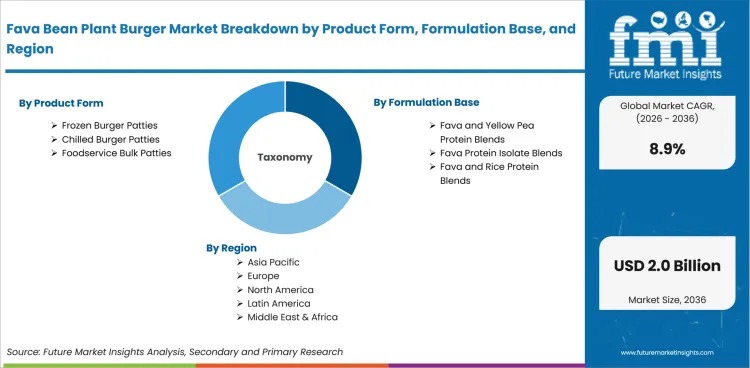
The fava bean plant burger market is forecast to grow from USD 183.5 million in 2025 to USD 619.8 million by 2036 at 11.7% CAGR. Growth is tied to soy-free reformulation and frozen patty economics. Isolate is forecast to represent 45.0% share in 2026 because burger makers need compact protein inputs. Frozen patties are expected to secure 52.0% share in 2026 as retailers manage slower plant-based meat turns.
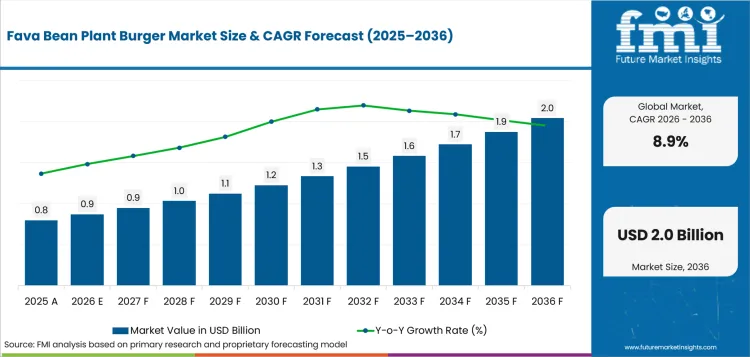
Fava Bean Plant Burger Market Overview: Size and Forecast
- 2026 Market Size: USD 205.0 million
- 2036 Market Size: USD 619.8 million
- Forecast CAGR: 11.7% from 2026 to 2036
- Leading Protein Format: Isolate
- Isolate Share in 2026: 45.0%
- Leading Burger Format: Frozen Patties
- Frozen Patties Share in 2026: 52.0%
- Fastest-growing Country: India
- India CAGR: 14.6% by 2036
Summary of Fava Bean Plant Burger Market
Isolate leads at 45.0% with frozen patties at 52.0% and India fastest at 14.6%.
- Demand and Growth Drivers
- Fava pea blends are gaining use as brands reduce soy dependence and improve protein claims in burger patties.
- Frozen patties are expected to gain share as retailers use longer shelf life to manage slower plant-based meat turns.
- Ingredient suppliers are improving isolate taste and color so fava can move into higher-volume burger recipes.
- Product and Segment View
- Isolate is projected to lead protein format demand with 45.0% share as brands build high-protein patties.
- Frozen patties are expected to represent 52.0% share in 2026 because frozen stock reduces retail shrink.
- Fava pea blends are anticipated to hold 54.0% formulation share as pea texture offsets fava flavor limits.
- Geography and Competitive Outlook
- India is projected to record 14.6% CAGR by 2036 as smart protein funding supports ingredient pilots.
- China is forecast to grow at 13.7% CAGR through 2036 with urban foodservice and e-commerce testing.
- Beyond Meat and Roquette are benchmark names because they connect burger format proof with fava ingredient supply.
- Bunge and BENEO compete through fava protein inputs. Burcon, Ingredion and AGT Food add application support.
- Analyst Opinion
- Nandini Roy Choudhury, Principal Consultant at Future Market Insights, observes, “Fava bean plant burgers are a formulation market first. Buyers compare cooking behavior and texture before accepting a fava claim. Price is the third test. Suppliers with isolate quality and application support should gain a better route into frozen burger programs.”
Formulation quality is the main pressure point for fava bean plant burgers. GFI reported that United States plant-based meat and seafood dollar sales fell 10% in 2025. That forces brands to compete on taste and price instead of plant-based claims alone. Roquette launched a 90% fava bean protein isolate in May 2024 for meat substitutes and related foods. This gives formulators a clearer route to higher-protein burger systems.
What supports value in the fava bean plant burger market?
Premium fava isolates and frozen patty programs support value across retail and foodservice channels.
- Market value is supported by fava isolate use in high-protein burger patties.
- Supplier pricing reflects protein content and sensory performance before retail channel mix affects volume.
- Revenue improves when brands convert plant-based trial into repeat frozen patty purchases.
- Retail trust rises when patties show clear cooking behavior and lower breakage during frozen handling.
Why is the fava bean plant burger market growing?
Burger brands are reformulating around soy-free blends with better texture and clearer protein claims.
The first growth driver is formula repair in plant-based burgers. Many early patties lost repeat buyers when taste and price did not align. Fava protein gives R&D teams another pulse option beside pea and soy. Ingredient makers win when their fava systems solve flavor and water-binding problems together.
The second growth driver is the burger format’s stronger fit inside plant-based meat. GFI estimated that plant-based patties held 6% to 7% of United States packaged meat patty dollar sales based on 2024 data. This means burgers remain one of the few analog formats where consumers already know how to buy and cook the product.
How is the fava bean plant burger market segmented?
The industry is segmented by protein format and burger format. Formulation, channel and claim complete the structure.
- Isolate is expected to secure 45.0% share in 2026 as brands build high-protein patties in small serving sizes.
- Frozen patties are projected to account for 52.0% share in 2026 with retailers favoring lower shrink.
- Fava pea blends are anticipated to hold 54.0% formulation share in 2026 as pea texture reduces flavor risk.
- Retail grocery is expected to capture 62.0% channel share in 2026 since households still buy plant burgers for home cooking.
- Clean label is projected to lead claim positioning with 40.0% share in 2026 as brands simplify ingredient lists.
Why does isolate lead the fava bean plant burger market?
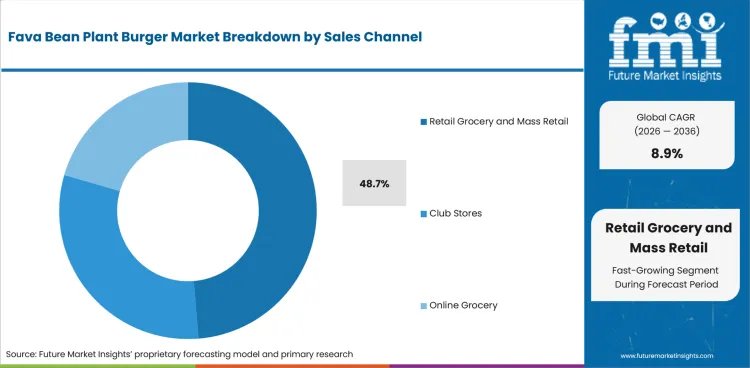
- Isolate is projected to account for 45.0% share in 2026 as burger makers need higher protein density.
- Roquette launched NUTRALYS Fava S900M in May 2024 with 90% protein content for meat substitute use.
Which burger format leads the fava bean plant burger market?
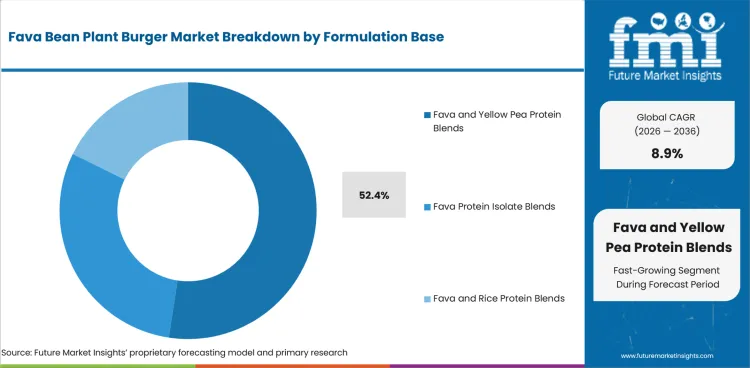
- Frozen patties are expected to represent 52.0% share in 2026 as retailers reduce waste risk.
- Frozen handling increases the need for water binding and texture stability after thawing.
Which formulation leads the fava bean plant burger market?
- Fava pea blends are anticipated to hold 54.0% share in 2026 as pea protein improves bite.
- Bunge’s June 2024 pea and faba concentrates offered 55% to 70% protein on a dry basis.
Which channel leads the fava bean plant burger market?
- Retail grocery is estimated to hold 62.0% share in 2026 as households compare patties against beef.
- Online sales give smaller fava brands a test channel before national freezer listings.
Which claim leads the fava bean plant burger market?
- Clean label is projected to account for 40.0% share in 2026 as brands replace long protein stacks.
- Beyond Meat’s 2024 Beyond IV platform used peas and brown rice. Red lentils and faba beans completed the blend.
What are the driver, restraints, and opportunities in the fava bean plant burger market?
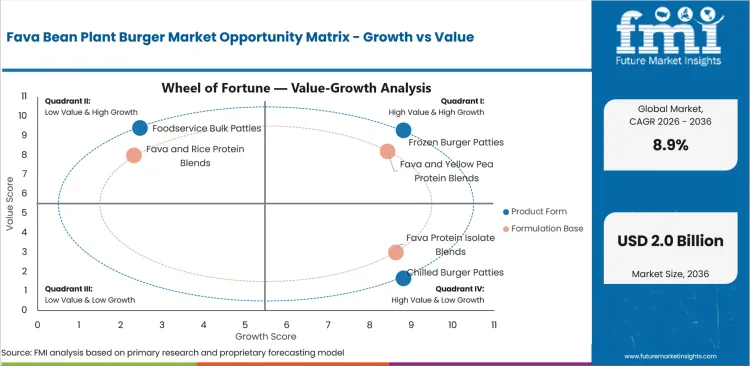
Fava isolate supply supports burger reformulation while taste and price gaps limit repeat buying.
- Driver: Fava isolate supply gives burger makers another route to soy-free claims and higher protein density.
- Restraint: Taste and price remain the main barrier when plant-based meat costs more than conventional patties.
- Opportunity: Foodservice trials create a route for fava burgers where operators need cleaner label protein options.
Protein density is the key technical driver in this market. A burger patty has limited room for water and fat. Roquette’s 90% fava isolate launch in May 2024 gave formulators a compact protein source for meat substitute use. The forecast therefore depends more on repeatable ingredient performance than on broad plant-based positioning.
The main restraint is the gap between a convincing burger and a price consumers accept. GFI noted that United States plant-based meat products were still priced up to twice conventional counterparts in 2025. Fava protein helps only if it improves taste or nutrition without raising cost too much.
What influences fava bean plant burger purchase decisions?
Taste and price shape repeat purchase across channels. Protein claims and freezer stability complete the buying test. Purchase decisions depend on whether the product behaves like a burger during cooking. A fava claim can win trial when shoppers want soy-free options. It only supports repeat purchase when texture and flavor remain close to familiar burger formats. Suppliers with application data can reduce buyer hesitation during formulation approval.
Which countries are growing fastest in the fava bean plant burger market?
India reaches 14.6% CAGR followed by China at 13.7% and South Korea at 12.9% through 2036.
.webp "Top Country Growth Comparison Fava Bean Plant Burger Market Cagr (2026 2036)")
| Country | CAGR |
| India | 14.6% |
| China | 13.7% |
| South Korea | 12.9% |
| France | 11.2% |
| United States | 10.6% |
| Germany | 10.1% |
| Japan | 9.8% |
| United Kingdom | 9.4% |
Source: Future Market Insights, 2026.
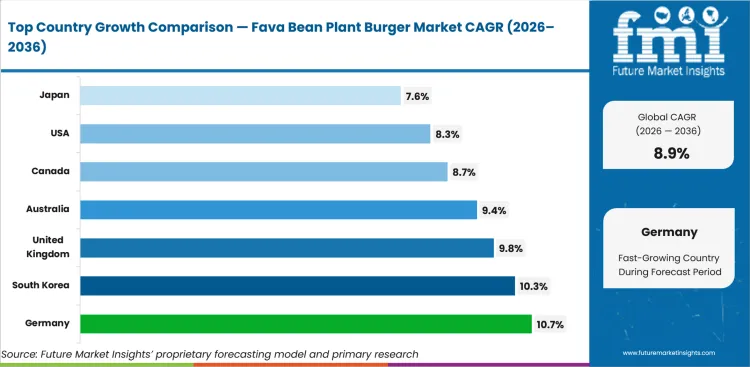
How do country-level CAGRs compare in the fava bean plant burger market?
India leads country growth while the United Kingdom records the most cautious expansion outlook among profiled markets.
- India is projected to record 14.6% CAGR by 2036 as smart protein funding supports early product testing.
- China is forecast to grow at 13.7% CAGR through 2036 with urban foodservice scale widening trial channels.
- South Korea is expected to post 12.9% CAGR by 2036 through convenience retail and online food buying.
- France is anticipated to advance at 11.2% CAGR through 2036 due to low penetration and ingredient supply.
- The United States is likely to grow at 10.6% CAGR by 2036 with reformulation and foodservice testing.
- Germany is estimated to expand at 10.1% CAGR through 2036 given meat alternative familiarity and local pulse processing.
- Japan is expected to rise at 9.8% CAGR by 2036 through prepared meal channels and plant protein use.
- The United Kingdom is forecast to grow at 9.4% CAGR through 2036 with private-label testing and foodservice discipline.
How fast is the fava bean plant burger market growing in India?
A 14.6% CAGR through 2036 reflects smart protein funding and urban foodservice trials.
Country Market Snapshot Table
| Parameter | Value |
| Market Size in 2025 (Value) | USD 6.1 million |
| Market Size in 2026 (Value) | USD 7.0 million |
| Market Forecast in 2036 (Value) | USD 27.3 million |
| CAGR (2026 to 2036) | 14.6% |
| Years Considered | 2021 to 2036 |
| Base Year | 2025 |
| Forecast Period | 2026 to 2036 |
| Units Considered | Value (USD million) |
| Leading Sub-Region | Mumbai and Bengaluru quick-service corridors |
India Fava Bean Plant Burger Market Outlook
- India fava bean plant burger demand is shaped by vegetarian familiarity and metro foodservice testing. Fava formats can gain attention when brands offer a burger texture instead of a generic bean patty.
- Quick-service restaurants and cloud kitchens provide the first practical route. Price remains the main test because local vegetarian snacks give consumers cheaper protein choices.
Key Growth Drivers
- Public biotechnology funding supports alternative protein pilots. PIB stated in February 2026 that Bio-RIDE carries an outlay of INR 9,197 crore through 2025 to 2026.
- Packaged food scale gives fava burgers a supplier base. USDA FAS reported India’s food processing sector at USD 355.0 billion in 2024.
- Metro quick-service restaurants are expected to test fava burgers where limited-time menus can control risk.
- Vegetarian protein familiarity is likely to reduce education work for fava pea burger formats.
Key Restraints
- Food value sensitivity can limit premium patty trials. MoSPI reported Consumer Food Price Index inflation at -2.71% in December 2025.
- Fava protein processing remains less developed than soy and pea supply chains in India.
- Burger analogs need price discipline because paneer snacks and pulse foods already compete for vegetarian buyers.
What makes India unique
India is unique due to vegetarian familiarity and public smart protein support that can lower early development barriers.
Key Companies
- GoodDot
- Blue Tribe Foods
- Imagine Meats
- BVeg Foods
- Evolved Foods
- Tata SmartFoodz
- Licious Plant-Based
Sales & Marketing Channels
- Quick-service restaurant chains
- Cloud kitchens
- Premium grocery stores
- Foodtech incubators
- Online grocery platforms
- Modern trade freezers
Market Taxonomy and Sub-Regions Covered
| Segment | Sub-Segments |
| By Protein Format | Isolate · Concentrate · Flour · Mixed Pulses |
| By Burger Format | Frozen Patties · Chilled Patties · Foodservice Burgers |
| By Formulation | Fava Pea Blends · Fava Rice Blends · Pure Fava · Fava Potato |
| By Channel | Retail Grocery · Foodservice Chains · Online Retail · Ingredient Sales |
| By Claim | Clean Label · High Protein · Low Saturate · Allergen Friendly |
| Key Sub-Regions Covered, Foodservice and Retail Areas | Maharashtra · Delhi NCR · Karnataka · Telangana · Tamil Nadu · Gujarat |
Frequently Asked Questions
How fast is India fava bean plant burger market growing?
India is projected to expand at 14.6% CAGR from 2026 to 2036.
Who leads India fava bean plant burger market?
GoodDot and Blue Tribe Foods compete through local retail channels. Imagine Meats and BVeg Foods add foodservice reach.
What is driving adoption in India fava bean plant burger market?
Soy-free formulation and frozen burger testing are moving brands toward fava-based patty systems.
How fast is the fava bean plant burger market growing in China?
A 13.7% CAGR through 2036 is supported by urban foodservice scale and online grocery testing.
Country Market Snapshot Table
| Parameter | Value |
| Market Size in 2025 (Value) | USD 19.3 million |
| Market Size in 2026 (Value) | USD 22.0 million |
| Market Forecast in 2036 (Value) | USD 79.4 million |
| CAGR (2026 to 2036) | 13.7% |
| Years Considered | 2021 to 2036 |
| Base Year | 2025 |
| Forecast Period | 2026 to 2036 |
| Units Considered | Value (USD million) |
| Leading Sub-Region | Beijing, Shanghai and tier-one foodservice hubs |
China Fava Bean Plant Burger Market Outlook
- China fava bean plant burger demand is expected to build through urban channels rather than mass household use. Consumers already know soy and wheat proteins, so fava must offer texture and claim value.
- Foodservice chains and e-commerce platforms can test limited fava burger batches. Local faba bean availability improves the long-run sourcing case but does not remove price competition.
Key Growth Drivers
- Urban retail depth supports premium burger testing. The National Bureau of Statistics reported urban consumer goods retail sales of CNY 43,297.2 billion in 2025.
- Catering outlets give plant burgers a large trial base. The National Bureau of Statistics reported catering industry revenue of CNY 5,798.2 billion in 2025.
- E-commerce platforms can test small fava burger batches before wider frozen retail distribution.
- Domestic faba bean supply is expected to improve long-run ingredient security for local manufacturers.
Key Restraints
- Traditional plant proteins create direct price pressure. The National Bureau of Statistics reported online food sales growth of 15.6% from January to April 2026.
- Fava burgers must compete with tofu and wheat protein foods that already fit local meals.
- Western-style burger demand remains concentrated in tier-one cities and premium retail channels.
What makes China unique
China is unique because urban foodservice scale meets traditional plant protein familiarity in the same market.
Key Companies
- Starfield Food Science
- Zhenmeat
- Hero Protein
- Qishan Foods
- Shuangta Food
- Hey Maet China
- Green Common China
Sales & Marketing Channels
- Quick-service restaurant trials
- New retail grocery platforms
- E-commerce marketplaces
- Ingredient supply partnerships
- City-level food innovation pilots
- Premium frozen retail
Market Taxonomy and Sub-Regions Covered
| Segment | Sub-Segments |
| By Protein Format | Isolate · Concentrate · Flour · Mixed Pulses |
| By Burger Format | Frozen Patties · Chilled Patties · Foodservice Burgers |
| By Formulation | Fava Pea Blends · Fava Rice Blends · Pure Fava · Fava Potato |
| By Channel | Retail Grocery · Foodservice Chains · Online Retail · Ingredient Sales |
| By Claim | Clean Label · High Protein · Low Saturate · Allergen Friendly |
| Key Sub-Regions Covered, Foodservice and Retail Areas | Beijing · Shanghai · Guangdong · Zhejiang · Jiangsu · Sichuan |
Frequently Asked Questions
How fast is China fava bean plant burger market growing?
China is projected to expand at 13.7% CAGR from 2026 to 2036.
Who leads China fava bean plant burger market?
Starfield Food Science and Zhenmeat compete through local retail channels. Hero Protein and Qishan Foods add ingredient reach.
What is driving adoption in China fava bean plant burger market?
Soy-free formulation and frozen burger testing are moving brands toward fava-based patty systems.
How fast is the fava bean plant burger market growing in South Korea?
A 12.9% CAGR through 2036 reflects fast online food retail and controlled foodtech trials.
Country Market Snapshot Table
| Parameter | Value |
| Market Size in 2025 (Value) | USD 8.0 million |
| Market Size in 2026 (Value) | USD 9.0 million |
| Market Forecast in 2036 (Value) | USD 30.3 million |
| CAGR (2026 to 2036) | 12.9% |
| Years Considered | 2021 to 2036 |
| Base Year | 2025 |
| Forecast Period | 2026 to 2036 |
| Units Considered | Value (USD million) |
| Leading Sub-Region | Seoul and national convenience retail networks |
South Korea Fava Bean Plant Burger Market Outlook
- South Korea’s fava burger market is shaped by fast-cycle retail testing and foodservice experimentation. Convenience channels can run limited offers before brands commit to national listings.
- Imported ingredient cost is a key constraint. Fava burgers need clear sensory proof because shoppers can compare them quickly with meat and rice-based meals.
Key Growth Drivers
- Online food ordering supports early testing. Statistics Korea reported food services online shopping transaction value rose 9.0% year on year in August 2025.
- Food and beverage online sales support retail exposure. Statistics Korea reported food and beverage online transaction value grew 5.8% year on year in August 2025.
- Convenience retail can run limited fava burger launches quickly through prepared food cases.
- Café and fast-casual menus are expected to provide controlled sampling routes for fava patties.
Key Restraints
- Imported protein cost can pressure value. Statistics Korea reported Korean native cattle and beef cattle at 3.422 million in the third quarter of 2025.
- Consumer trial does not guarantee repeat purchase once novelty fades in convenience retail.
- Rice-based meals and meat snacks compete strongly with burger analogs for routine eating occasions.
What makes South Korea unique
South Korea is unique because short product cycles allow fast testing but require quick proof of repeat demand.
Key Companies
- CJ CheilJedang
- Pulmuone
- Shinsegae Food
- Nongshim
- Lotte Wellfood
- Dongwon F&B
- Unlimeat
Sales & Marketing Channels
- Convenience store launches
- Café and bakery chains
- Foodtech incubator pilots
- Online grocery platforms
- Foodservice distributors
- Home-shopping channels
Market Taxonomy and Sub-Regions Covered
| Segment | Sub-Segments |
| By Protein Format | Isolate · Concentrate · Flour · Mixed Pulses |
| By Burger Format | Frozen Patties · Chilled Patties · Foodservice Burgers |
| By Formulation | Fava Pea Blends · Fava Rice Blends · Pure Fava · Fava Potato |
| By Channel | Retail Grocery · Foodservice Chains · Online Retail · Ingredient Sales |
| By Claim | Clean Label · High Protein · Low Saturate · Allergen Friendly |
| Key Sub-Regions Covered, Foodservice and Retail Areas | Seoul · Gyeonggi · Busan · Incheon · Daegu · Daejeon |
Frequently Asked Questions
How fast is South Korea fava bean plant burger market growing?
South Korea is projected to expand at 12.9% CAGR from 2026 to 2036.
Who leads South Korea fava bean plant burger market?
CJ CheilJedang and Pulmuone compete through local retail channels. Shinsegae Food and Nongshim add prepared-food reach.
What is driving adoption in South Korea fava bean plant burger market?
Soy-free formulation and frozen burger testing are moving brands toward fava-based patty systems.
What is driving fava bean plant burger growth in France?
An 11.2% CAGR through 2036 reflects low current penetration and strong ingredient relevance from French suppliers.
Country Market Snapshot Table
| Parameter | Value |
| Market Size in 2025 (Value) | USD 18.9 million |
| Market Size in 2026 (Value) | USD 21.0 million |
| Market Forecast in 2036 (Value) | USD 60.7 million |
| CAGR (2026 to 2036) | 11.2% |
| Years Considered | 2021 to 2036 |
| Base Year | 2025 |
| Forecast Period | 2026 to 2036 |
| Units Considered | Value (USD million) |
| Leading Sub-Region | Île-de-France and hypermarket freezer corridors |
France Fava Bean Plant Burger Market Outlook
- France is earlier than Germany in mainstream plant-based meat adoption. Fava burgers can gain when they show culinary value and avoid vague meat-like naming.
- Roquette gives France a strong ingredient link through fava isolate. Retailers are still expected to test frozen formats carefully because repeat purchase depends on taste and price.
Key Growth Drivers
- Meat price pressure supports substitution trials. INSEE reported meat prices rose 2.7% year on year in December 2025.
- Food innovation networks support local testing. France’s agriculture network reported 454 territorial food projects underway in 2024.
- Roquette’s fava isolate launch improves supply credibility for French-linked burger brands.
- Retailers can use frozen fava patties to test demand without high waste in chilled aisles.
Key Restraints
- Food inflation can keep value pressure on premium patties. INSEE reported food prices rose 1.7% year on year in December 2025.
- Meat-term rules create label risk for products using burger language in consumer-facing packs.
- French buyers may reject products that seem too processed or lack culinary credibility.
What makes France unique
France is unique due to regulation-sensitive product naming and a strong domestic ingredient supplier role.
Key Companies
- Roquette
- HappyVore
- Hari&Co
- Nutrition & Santé
- Bonduelle
- Fleury Michon Végétal
- Les Nouveaux Fermiers
Sales & Marketing Channels
- Hypermarket freezer aisles
- Specialty organic retail
- Ingredient distributors
- Foodservice burger chains
- Private-label retail development
- Online grocery platforms
Market Taxonomy and Sub-Regions Covered
| Segment | Sub-Segments |
| By Protein Format | Isolate · Concentrate · Flour · Mixed Pulses |
| By Burger Format | Frozen Patties · Chilled Patties · Foodservice Burgers |
| By Formulation | Fava Pea Blends · Fava Rice Blends · Pure Fava · Fava Potato |
| By Channel | Retail Grocery · Foodservice Chains · Online Retail · Ingredient Sales |
| By Claim | Clean Label · High Protein · Low Saturate · Allergen Friendly |
| Key Sub-Regions Covered, Foodservice and Retail Areas | Île-de-France · Auvergne-Rhône-Alpes · Hauts-de-France · Occitanie · Nouvelle-Aquitaine · Provence-Alpes-Côte d’Azur |
Frequently Asked Questions
How fast is France fava bean plant burger market growing?
France is projected to expand at 11.2% CAGR from 2026 to 2036.
Who leads France fava bean plant burger market?
Roquette and HappyVore compete through local retail channels. Hari&Co and Nutrition & Santé add ingredient and retail reach.
What is driving adoption in France fava bean plant burger market?
Soy-free formulation and frozen burger testing are moving brands toward fava-based patty systems.
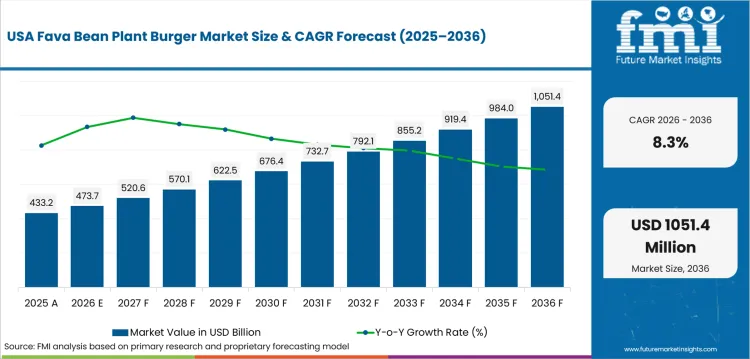
What is the fava bean plant burger market outlook in the United States?
A 10.6% CAGR through 2036 is supported by reformulation and foodservice testing.
Country Market Snapshot Table
| Parameter | Value |
| Market Size in 2025 (Value) | USD 48.8 million |
| Market Size in 2026 (Value) | USD 54.0 million |
| Market Forecast in 2036 (Value) | USD 147.9 million |
| CAGR (2026 to 2036) | 10.6% |
| Years Considered | 2021 to 2036 |
| Base Year | 2025 |
| Forecast Period | 2026 to 2036 |
| Units Considered | Value (USD million) |
| Leading Sub-Region | California and national grocery freezer networks |
United States Fava Bean Plant Burger Market Outlook
- United States demand is developed enough to expose weak plant burgers quickly. Fava plant burgers fit this reset when they improve texture and nutrition without creating a strong pulse aftertaste.
- Retail freezer doors and broadline foodservice distributors remain the main testing routes. Category buyers will require stronger proof on cooking loss and repeat purchase.
Key Growth Drivers
- Food spending scale supports retail and foodservice trials. USDA ERS reported total food spending reached USD 2.51 trillion in 2025.
- Online retail can support specialty launches. The Census Bureau reported Q1 2026 retail e-commerce sales of USD 326.7 billion.
- Beyond IV gives United States retailers a visible fava-backed burger platform.
- Natural grocery chains can support cleaner label products before mass retail scale.
Key Restraints
- Beef pricing keeps comparison pressure visible. BLS retail tables listed ground beef at USD 6.745 per lb in the latest release.
- Plant-based meat unit declines make category managers stricter during shelf resets.
- Price premiums against beef reduce repeat purchase outside premium households.
What makes United States unique
The United States is unique because it tests whether fava burgers can convert nutrition-led trial into repeat mainstream purchase.
Key Companies
- Beyond Meat
- Bunge
- Roquette America
- Ingredion
- Burcon NutraScience
- AGT Foods USA
- A&B Ingredients
Sales & Marketing Channels
- National grocery freezer doors
- Natural food chains
- Broadline foodservice distributors
- Online grocery platforms
- Restaurant chain limited-time offers
- Club store freezer cases
Market Taxonomy and Sub-Regions Covered
| Segment | Sub-Segments |
| By Protein Format | Isolate · Concentrate · Flour · Mixed Pulses |
| By Burger Format | Frozen Patties · Chilled Patties · Foodservice Burgers |
| By Formulation | Fava Pea Blends · Fava Rice Blends · Pure Fava · Fava Potato |
| By Channel | Retail Grocery · Foodservice Chains · Online Retail · Ingredient Sales |
| By Claim | Clean Label · High Protein · Low Saturate · Allergen Friendly |
| Key Sub-Regions Covered, Foodservice and Retail Areas | California · New York · Texas · Florida · Illinois · Pacific Northwest |
Frequently Asked Questions
How fast is United States fava bean plant burger market growing?
United States is projected to expand at 10.6% CAGR from 2026 to 2036.
Who leads United States fava bean plant burger market?
Beyond Meat and Bunge compete through retail and ingredient channels. Roquette America and Ingredion add formulation reach.
What is driving adoption in United States fava bean plant burger market?
Soy-free formulation and frozen burger testing are moving brands toward fava-based patty systems.
How is the fava bean plant burger market performing in Germany?
A 10.1% CAGR through 2036 reflects meat alternative familiarity and local faba processing capacity.
Country Market Snapshot Table
| Parameter | Value |
| Market Size in 2025 (Value) | USD 24.5 million |
| Market Size in 2026 (Value) | USD 27.0 million |
| Market Forecast in 2036 (Value) | USD 70.7 million |
| CAGR (2026 to 2036) | 10.1% |
| Years Considered | 2021 to 2036 |
| Base Year | 2025 |
| Forecast Period | 2026 to 2036 |
| Units Considered | Value (USD million) |
| Leading Sub-Region | North Rhine-Westphalia and national discounter chains |
Germany Fava Bean Plant Burger Market Outlook
- Germany has a large European retail base for plant-based meat. Fava burgers can grow when discounters and supermarkets see a clear price and texture case.
- Local pulse processing gives Germany a stronger supply role than many European markets. Premium isolate formulas still need value discipline inside discount-led channels.
Key Growth Drivers
- Meat price pressure supports alternative testing. Destatis reported meat and meat product prices rose 4.2% year on year in November 2025.
- Food price stability can help frozen trials. Destatis reported annual food prices increased 2.0% in 2025.
- Local faba processing improves supply confidence for European manufacturers.
- Meat alternative familiarity reduces education work for burger brands in supermarkets.
Key Restraints
- Value pressure remains visible in food. Destatis reported consumer prices rose 2.2% on annual average in 2025.
- Discount channels force tight price control on premium fava isolate formulations.
- Plant-based meat volume decline can pressure weaker branded listings during retail resets.
What makes Germany unique
Germany is unique because large retail meat alternative demand is paired with local pulse-processing capacity.
Key Companies
- BENEO
- Rügenwalder Mühle
- Greenforce
- Veganz
- Endori
- LikeMeat
- PHW Group
Sales & Marketing Channels
- Discounter stores
- Supermarket chilled shelves
- Frozen retail cases
- Ingredient distributor networks
- Foodservice wholesalers
- Organic retail chains
Market Taxonomy and Sub-Regions Covered
| Segment | Sub-Segments |
| By Protein Format | Isolate · Concentrate · Flour · Mixed Pulses |
| By Burger Format | Frozen Patties · Chilled Patties · Foodservice Burgers |
| By Formulation | Fava Pea Blends · Fava Rice Blends · Pure Fava · Fava Potato |
| By Channel | Retail Grocery · Foodservice Chains · Online Retail · Ingredient Sales |
| By Claim | Clean Label · High Protein · Low Saturate · Allergen Friendly |
| Key Sub-Regions Covered, Foodservice and Retail Areas | North Rhine-Westphalia · Bavaria · Baden-Württemberg · Berlin · Hamburg · Hesse |
Frequently Asked Questions
How fast is Germany fava bean plant burger market growing?
Germany is projected to expand at 10.1% CAGR from 2026 to 2036.
Who leads Germany fava bean plant burger market?
BENEO and Rügenwalder Mühle compete through ingredient and retail channels. Greenforce and Veganz add branded reach.
What is driving adoption in Germany fava bean plant burger market?
Soy-free formulation and frozen burger testing are moving brands toward fava-based patty systems.
What is the fava bean plant burger market forecast for Japan?
A 9.8% CAGR through 2036 reflects prepared meal trials and selective plant protein use.
Country Market Snapshot Table
| Parameter | Value |
| Market Size in 2025 (Value) | USD 11.8 million |
| Market Size in 2026 (Value) | USD 13.0 million |
| Market Forecast in 2036 (Value) | USD 33.1 million |
| CAGR (2026 to 2036) | 9.8% |
| Years Considered | 2021 to 2036 |
| Base Year | 2025 |
| Forecast Period | 2026 to 2036 |
| Units Considered | Value (USD million) |
| Leading Sub-Region | Tokyo and convenience meal corridors |
Japan Fava Bean Plant Burger Market Outlook
- Japan’s fava burger opportunity is found inside a broader plant protein ingredient system. Fava needs a clear blend role because soy remains the familiar plant protein base.
- Convenience stores and prepared meals are expected to test new burger formats before home-cooking demand scales. Portion size and texture consistency will matter more than broad protein claims.
Key Growth Drivers
- Plant protein ingredient use gives fava a relevant entry point. Agriculture and Agri-Food Canada reported Japan used 46.1 thousand tonnes of non-animal protein ingredients in 2024.
- Food security policy supports protein diversification. MAFF stated Japan’s calorie-based food self-sufficiency ratio was 38% in FY2023.
- Convenience food formats can test fava patties in small portions before broad retail rollout.
- Processed meat substitute use gives fava a relevant application route in prepared food systems.
Key Restraints
- Established food habits slow burger volume. MAFF estimated fish and shellfish consumption at 21.4 kg per person in FY2023.
- Soy protein familiarity limits quick switching to fava ingredients in Japanese formulations.
- Smaller burger eating occasions reduce volume potential compared with Western markets.
What makes Japan unique
Japan is unique because fava burgers must fit prepared food standards and portion control expectations.
Key Companies
-
DAIZ
- Otsuka Foods
- Kagome
- NH Foods
- Marukome
- Fuji Oil Holdings
- Nisshin OilliO
Sales & Marketing Channels
- Convenience store ready meals
- Supermarket prepared foods
- Restaurant limited-time offers
- Ingredient import distributors
- Health-focused online retail
- Department store food halls
Market Taxonomy and Sub-Regions Covered
| Segment | Sub-Segments |
| By Protein Format | Isolate · Concentrate · Flour · Mixed Pulses |
| By Burger Format | Frozen Patties · Chilled Patties · Foodservice Burgers |
| By Formulation | Fava Pea Blends · Fava Rice Blends · Pure Fava · Fava Potato |
| By Channel | Retail Grocery · Foodservice Chains · Online Retail · Ingredient Sales |
| By Claim | Clean Label · High Protein · Low Saturate · Allergen Friendly |
| Key Sub-Regions Covered, Foodservice and Retail Areas | Tokyo · Osaka · Yokohama · Nagoya · Fukuoka · Sapporo |
Frequently Asked Questions
How fast is Japan fava bean plant burger market growing?
Japan is projected to expand at 9.8% CAGR from 2026 to 2036.
Who leads Japan fava bean plant burger market?
DAIZ and Otsuka Foods compete through local retail channels. Kagome and NH Foods add prepared-food reach.
What is driving adoption in Japan fava bean plant burger market?
Soy-free formulation and frozen burger testing are moving brands toward fava-based patty systems.
How is the fava bean plant burger market performing in the United Kingdom?
A 9.4% CAGR through 2036 reflects private-label testing and foodservice format discipline.
Country Market Snapshot Table
| Parameter | Value |
| Market Size in 2025 (Value) | USD 16.5 million |
| Market Size in 2026 (Value) | USD 18.0 million |
| Market Forecast in 2036 (Value) | USD 44.2 million |
| CAGR (2026 to 2036) | 9.4% |
| Years Considered | 2021 to 2036 |
| Base Year | 2025 |
| Forecast Period | 2026 to 2036 |
| Units Considered | Value (USD million) |
| Leading Sub-Region | London and national supermarket private-label channels |
United Kingdom Fava Bean Plant Burger Market Outlook
- United Kingdom demand is shaped by a split between analog burgers and whole-food meat alternatives. Fava succeeds when it behaves like a burger and avoids a bean-patty texture signal.
- Supermarket private label and foodservice trials remain important. Brands need pricing that works against tofu and lower-cost vegetarian alternatives.
Key Growth Drivers
- Retail recovery supports freezer tests. ONS reported annual retail sales volumes rose 1.3% over the year to 2025.
- Government strategy keeps alternative proteins visible. GOV.UK identified alternative proteins as a sector-specific growth opportunity in July 2025.
- Supermarket private label can use fava blends for cleaner plant burger recipes.
- University and workplace catering can test plant-forward burger menus with controlled volume.
Key Restraints
- Household cutbacks can affect premium patties. ONS reported food store sales volumes fell 5.0% in May 2025.
- Bean burger declines show weak demand for non-analog positioning in mainstream retail.
- Price-sensitive households may trade down to tofu or private-label alternatives.
What makes United Kingdom unique
The United Kingdom is unique because fava burgers must meet strict format expectations in a mature plant-based retail market.
Key Companies
- THIS
- Quorn Foods
- Meatless Farm
- Linda McCartney Foods
- VFC Foods
- Plant & Bean
- Squeaky Bean
Sales & Marketing Channels
- Supermarket private label
- Foodservice distributors
- Pub and casual dining menus
- University catering
- Online grocery delivery
- Specialty vegan retail
Market Taxonomy and Sub-Regions Covered
| Segment | Sub-Segments |
| By Protein Format | Isolate · Concentrate · Flour · Mixed Pulses |
| By Burger Format | Frozen Patties · Chilled Patties · Foodservice Burgers |
| By Formulation | Fava Pea Blends · Fava Rice Blends · Pure Fava · Fava Potato |
| By Channel | Retail Grocery · Foodservice Chains · Online Retail · Ingredient Sales |
| By Claim | Clean Label · High Protein · Low Saturate · Allergen Friendly |
| Key Sub-Regions Covered, Foodservice and Retail Areas | London · Manchester · Birmingham · Leeds · Glasgow · Bristol |
Frequently Asked Questions
How fast is United Kingdom fava bean plant burger market growing?
United Kingdom is projected to expand at 9.4% CAGR from 2026 to 2036.
Who leads United Kingdom fava bean plant burger market?
THIS and Quorn Foods compete through retail and foodservice channels. Meatless Farm and Linda McCartney Foods add private-label reach.
What is driving adoption in United Kingdom fava bean plant burger market?
Soy-free formulation and frozen burger testing are moving brands toward fava-based patty systems.
Who are the leading companies in the fava bean plant burger market?
Beyond Meat and Roquette are the most relevant benchmark names. Bunge, BENEO and Burcon add ingredient depth.
- Burger brands hold an advantage when they can prove repeat purchase and cooking behavior.
- Ingredient suppliers gain relevance through protein density, flavor control and application service.
- Regional processors can win through local sourcing and private-label relationships.
- Retail-ready frozen formats support trial by lowering shrink for category managers.
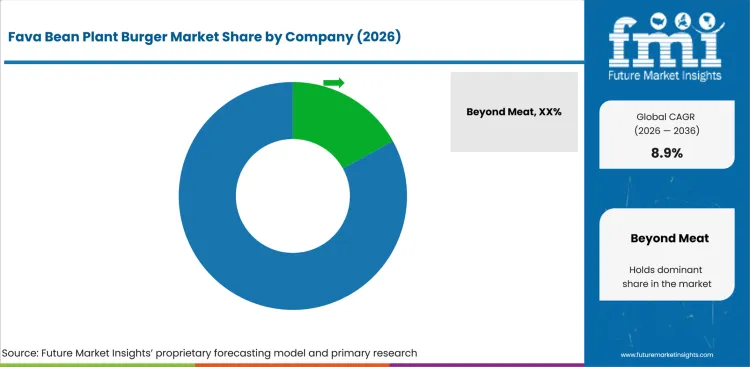
Company positioning in this market starts with the ingredient stack. Beyond Meat’s February 2024 Beyond IV launch used peas and brown rice. Red lentils and faba beans supported 21 grams of protein per serving. Roquette’s May 2024 NUTRALYS Fava S900M launch brought a 90% fava isolate to Europe and North America. Burcon followed in August 2025 with FavaPro as a 90%+ fava protein isolate.
Regional players can gain share through local sourcing and private-label relationships. BENEO’s April 2025 pulse-processing plant in Germany processes local pulses into food and feed ingredients. Bunge’s June 2024 collaboration with Golden Fields created pea and faba concentrates from a Latvia factory. These moves matter for European burger makers that want supply assurance and shorter sourcing routes.
How do top fava bean plant burger companies compare?
Beyond Meat scores highest on burger proof while Roquette leads fava isolate relevance.
| Company | Relevance to Market Title | Fava Protein Portfolio Depth | Burger Formulation Fit | Supply Traceability Strength | Geographic Footprint |
|---|---|---|---|---|---|
| Beyond Meat | Very High | Medium | Very Strong | Strong | Global |
| Roquette | Very High | Very Strong | Very Strong | Strong | Europe and North America |
| Bunge | High | Strong | Moderate | Strong | Global |
| BENEO | High | Strong | Moderate | Very Strong | Europe |
| Burcon NutraScience | High | Very Strong | Moderate | Moderate | North America |
| Ingredion | Moderate to High | Moderate | Moderate | Strong | Global |
| AGT Food and Ingredients | Moderate to High | Moderate | Moderate | Strong | North America and export markets |
| Cosucra | Moderate | Moderate | Low | Moderate | Europe |
| Meelunie | Moderate | Moderate | Low | Moderate | Europe and Asia |
| A&B Ingredients | Moderate | Low | Moderate | Moderate | North America |
Source: Future Market Insights competitive analysis, 2026.
Who are the key players in the fava bean plant burger market?
Beyond Meat and Roquette are listed with Bunge, BENEO and Burcon among other suppliers.
Key global companies leading the fava bean plant burger market include:
- Beyond Meat
- Roquette
- Bunge
- BENEO
- Burcon NutraScience
- Ingredion
- AGT Food and Ingredients
- Cosucra
- Meelunie
- A&B Ingredients
Key Developments in Fava Bean Plant Burger Market
- In February 2024, Beyond Meat launched its Beyond IV burger and beef platform with 21 grams of protein. The protein blend used peas and brown rice. Red lentils and faba beans completed the blend.
- In May 2024, Roquette launched NUTRALYS Fava S900M as a fava bean protein isolate with 90% protein content.
- In June 2024, Bunge added pea and faba protein concentrates from a Latvia facility operated by Golden Fields.
- In April 2025, BENEO opened a EUR 50 million pulse-processing plant in Germany for local faba bean and other pulse ingredients.
- In August 2025, Burcon achieved first commercial production and launched FavaPro 90%+ pure fava protein.
Key Players in the Fava Bean Plant Burger Market
Burger Brand Benchmarks
- Beyond Meat
Protein Ingredient Specialists
- Roquette
- Bunge
- BENEO
- Burcon NutraScience
- Ingredion
- Cosucra
- Meelunie
Pulse Supply and Processing Players
- AGT Food and Ingredients
- A&B Ingredients
Research Sources and Bibliography
| Attribute | Detail |
|---|---|
| Market Definition | Burger patties and foodservice burger builds that use fava bean protein, fava concentrate, fava flour or fava-based textured protein as a main or named protein input. |
| Functions Covered | Protein fortification, texture building, water binding, soy-free positioning and burger patty structure. |
| Applications Covered | Frozen patties, chilled patties and prepared foodservice burgers using fava as a named protein source. |
| End-Use Industries | Plant-based meat industry, foodservice burger chains, retail grocery, ingredient distribution and private-label food manufacturing. |
| Grades Covered | Fava protein isolate, fava protein concentrate, fava flour, mixed pulse blends and textured fava systems. |
| Inclusions | Commercially traded fava-based burger products across protein formats, burger formats, formulations, channels and claim positions. |
| Exclusions | Soy-only burgers, pea-only burgers, mushroom burgers without fava protein, bean dips, animal meat burgers, cultivated meat burgers and non-burger plant-based foods. |
Fava Bean Plant Burger Market - Research Methodology
| Method | Description |
|---|---|
| Primary Research | FMI analyst interviews with plant-based burger brands, foodservice menu teams, ingredient distributors and pulse protein suppliers across key markets. |
| Desk Research | Review of government food data, official company launches, nonprofit plant-based retail research and scientific sources related to fava protein and meat alternatives. |
| Market Sizing & Forecasting | Hybrid product-boundary approach using plant-based meat sales, burger format share, fava penetration, supplier launch evidence and country-level channel behavior. |
| Data Validation | Cross-verification using retail share patterns, foodservice data, ingredient availability, supplier disclosures and country demand signals. |
Fava Bean Plant Burger Market - Report Scope
| Item | Value |
|---|---|
| Market size by 2036 | USD 619.8 million |
| Growth rate | 11.7% CAGR from 2026 to 2036 |
| Forecast period | 2026 to 2036 |
| Base year value (2025) | USD 183.5 million |
| By protein format | Isolate, concentrate, flour, mixed pulses |
| By burger format | Frozen patties, chilled patties, foodservice burgers |
| By formulation | Fava pea blends, fava rice blends, pure fava, fava potato |
| By channel | Retail grocery, foodservice chains, online retail, ingredient sales |
| By claim | Clean label, high protein, low saturate, allergen friendly |
| Regions covered | North America, Latin America, Europe, East Asia, South Asia and Pacific, Middle East and Africa |
| Countries covered | India, China, South Korea, France, United States, Germany, Japan, United Kingdom |
| Key companies profiled | Beyond Meat, Roquette, Bunge, BENEO, Burcon, Ingredion, AGT Food and Ingredients |
| Approach | Hybrid product-boundary approach using plant-based meat sales, burger format share, fava penetration, supplier launches and country-level channel behavior |
Source: Future Market Insights, 2026.
Fava Bean Plant Burger Market Breakdown by Protein Format, Burger Format, Formulation, Channel, Claim, and Region
Fava Bean Plant Burger Market Segmented by Protein Format
- Isolate
- Concentrate
- Flour
- Mixed Pulses
Fava Bean Plant Burger Market Segmented by Burger Format
- Frozen Patties
- Chilled Patties
- Foodservice Burgers
Fava Bean Plant Burger Market Segmented by Formulation
- Fava Pea Blends
- Fava Rice Blends
- Pure Fava
- Fava Potato
Fava Bean Plant Burger Market Segmented by Channel
- Retail Grocery
- Foodservice Chains
- Online Retail
- Ingredient Sales
Fava Bean Plant Burger Market Segmented by Claim
- Clean Label
- High Protein
- Low Saturate
- Allergen Friendly
Fava Bean Plant Burger Market by Region
- North America
- Latin America
- Europe
- East Asia
- South Asia and Pacific
- Middle East and Africa
Research Sources and Bibliography
- The Good Food Institute. (2026). Analyzing plant-based meat and seafood sales.
- The Good Food Institute. (2026). USA foodservice market insights for plant-based foods.
- The Good Food Institute. (2026). State of the Industry: Plant-based meat, seafood, eggs, dairy, and ingredients.
- GFI Europe. (2026). European plant-based sales data.
- Agriculture and Agri-Food Canada. (2025, July 2). Sector trend analysis: Plant-based protein food and drink trends in Japan.
- Beyond Meat. (2024, February 21). Beyond Meat unveils its Beyond IV platform.
- Roquette. (2024, May 28). Roquette launches its first fava bean protein isolate.
- Bunge. (2024, June 17). Meeting demand with new pea and faba protein concentrates.
- BENEO. (2025, April 11). BENEO inaugurates new pulse-processing plant.
- Burcon NutraScience. (2025, August 5). Burcon achieves first commercial production of fava protein and launches FavaPro.
- USA Census Bureau. (2026, May 18). Quarterly retail e-commerce sales report.
- USDA Economic Research Service. (2026, June 1). Food Expenditure Series.
- USA Bureau of Labor Statistics. (2026). Average retail food and energy prices.
- Office for National Statistics. (2026, January 23). Retail sales, Great Britain: December 2025.
- GOV.UK. (2025, July 15). Annex A: Outcome summaries.
- Federal Statistical Office of Germany. (2026, January 16). Inflation rate at 2.2% in 2025.
- Federal Statistical Office of Germany. (2025, December 12). Inflation rate of 2.3% in November 2025.
- INSEE. (2026, January 15). In December 2025, consumer prices increased by 0.1% over one month.
- Ministry of Agriculture and Food Sovereignty. (2025). Agricultures and Rurality.
- Ministry of Agriculture, Forestry and Fisheries Japan. (2025). Basic Plan for Food, Agriculture and Rural Areas.
- Ministry of Agriculture, Forestry and Fisheries Japan. (2025). White Paper on Fisheries Summary FY2024.
- National Bureau of Statistics of China. (2026, January 20). Total retail sales of consumer goods in December 2025.
- National Bureau of Statistics of China. (2026, May 19). Total retail sales of consumer goods from January to April 2026.
- Statistics Korea. (2025, August). Online shopping in August 2025.
- Statistics Korea. (2025). Livestock statistics in the third quarter of 2025.
- Press Information Bureau India. (2026, February 2). Transforming India into a global biopharma hub.
- Ministry of Statistics and Programme Implementation India. (2026, January 12). Press release of CPI for December 2025.
This bibliography is provided for reader reference and is not exhaustive. The full report contains the complete reference list and detailed citations.
This Report Answers
- What is the 2026 value and 2036 forecast for fava bean plant burger market?
- What protein format is projected to hold the leading share during the forecast period?
- What burger format is expected to account for the leading 2026 share?
- How do isolate supply and frozen retail economics affect fava burger rollout?
- What companies compete in fava bean plant burgers and fava protein ingredients?
Frequently Asked Questions
What is the fava bean plant burger market size in 2026?
The fava bean plant burger market size is anticipated to cross USD 205.0 million in 2026.
What is the fava bean plant burger market forecast for 2036?
The fava bean plant burger industry revenue is predicted to reach USD 619.8 million by 2036 as fava pea blends scale.
What is the fava bean plant burger market CAGR?
The fava bean plant burger sector is projected to expand at 11.7% CAGR from 2026 to 2036.
What segment leads the fava bean plant burger market?
Isolate is likely to capture 45.0% share in 2026 due to compact protein density.
What country grows fastest in the fava bean plant burger market?
India is set to record 14.6% CAGR by 2036, driven by smart protein funding and urban foodservice trials.
Preview the report firsthand - request a free sample
Get SampleGet the brochure for pricing and purchase details.
Get PDFTable of Content
- Executive Summary
- Global Market Outlook
- Demand to side Trends
- Supply to side Trends
- Technology Roadmap Analysis
- Analysis and Recommendations
- Market Overview
- Market Coverage / Taxonomy
- Market Definition / Scope / Limitations
- Research Methodology
- Chapter Orientation
- Analytical Lens and Working Hypotheses
- Market Structure, Signals, and Trend Drivers
- Benchmarking and Cross-market Comparability
- Market Sizing, Forecasting, and Opportunity Mapping
- Research Design and Evidence Framework
- Desk Research Programme (Secondary Evidence)
- Company Annual and Sustainability Reports
- Peer-reviewed Journals and Academic Literature
- Corporate Websites, Product Literature, and Technical Notes
- Earnings Decks and Investor Briefings
- Statutory Filings and Regulatory Disclosures
- Technical White Papers and Standards Notes
- Trade Journals, Industry Magazines, and Analyst Briefs
- Conference Proceedings, Webinars, and Seminar Materials
- Government Statistics Portals and Public Data Releases
- Press Releases and Reputable Media Coverage
- Specialist Newsletters and Curated Briefings
- Sector Databases and Reference Repositories
- FMI Internal Proprietary Databases and Historical Market Datasets
- Subscription Datasets and Paid Sources
- Social Channels, Communities, and Digital Listening Inputs
- Additional Desk Sources
- Expert Input and Fieldwork (Primary Evidence)
- Primary Modes
- Qualitative Interviews and Expert Elicitation
- Quantitative Surveys and Structured Data Capture
- Blended Approach
- Why Primary Evidence is Used
- Field Techniques
- Interviews
- Surveys
- Focus Groups
- Observational and In-context Research
- Social and Community Interactions
- Stakeholder Universe Engaged
- C-suite Leaders
- Board Members
- Presidents and Vice Presidents
- R&D and Innovation Heads
- Technical Specialists
- Domain Subject-matter Experts
- Scientists
- Physicians and Other Healthcare Professionals
- Governance, Ethics, and Data Stewardship
- Research Ethics
- Data Integrity and Handling
- Primary Modes
- Tooling, Models, and Reference Databases
- Desk Research Programme (Secondary Evidence)
- Data Engineering and Model Build
- Data Acquisition and Ingestion
- Cleaning, Normalisation, and Verification
- Synthesis, Triangulation, and Analysis
- Quality Assurance and Audit Trail
- Market Background
- Market Dynamics
- Drivers
- Restraints
- Opportunity
- Trends
- Scenario Forecast
- Demand in Optimistic Scenario
- Demand in Likely Scenario
- Demand in Conservative Scenario
- Opportunity Map Analysis
- Product Life Cycle Analysis
- Supply Chain Analysis
- Investment Feasibility Matrix
- Value Chain Analysis
- PESTLE and Porter’s Analysis
- Regulatory Landscape
- Regional Parent Market Outlook
- Production and Consumption Statistics
- Import and Export Statistics
- Market Dynamics
- Global Market Analysis 2021 to 2025 and Forecast, 2026 to 2036
- Historical Market Size Value (USD Million) Analysis, 2021 to 2025
- Current and Future Market Size Value (USD Million) Projections, 2026 to 2036
- Y to o to Y Growth Trend Analysis
- Absolute $ Opportunity Analysis
- Global Market Pricing Analysis 2021 to 2025 and Forecast 2026 to 2036
- Global Market Analysis 2021 to 2025 and Forecast 2026 to 2036, By Form
- Introduction / Key Findings
- Historical Market Size Value (USD Million) Analysis By Form , 2021 to 2025
- Current and Future Market Size Value (USD Million) Analysis and Forecast By Form , 2026 to 2036
- Powder
- Liquid
- Powder
- Y to o to Y Growth Trend Analysis By Form , 2021 to 2025
- Absolute $ Opportunity Analysis By Form , 2026 to 2036
- Global Market Analysis 2021 to 2025 and Forecast 2026 to 2036, By Application
- Introduction / Key Findings
- Historical Market Size Value (USD Million) Analysis By Application, 2021 to 2025
- Current and Future Market Size Value (USD Million) Analysis and Forecast By Application, 2026 to 2036
- Packaged Bread
- Buns
- Flatbreads
- Packaged Bread
- Y to o to Y Growth Trend Analysis By Application, 2021 to 2025
- Absolute $ Opportunity Analysis By Application, 2026 to 2036
- Global Market Analysis 2021 to 2025 and Forecast 2026 to 2036, By Label Claim
- Introduction / Key Findings
- Historical Market Size Value (USD Million) Analysis By Label Claim, 2021 to 2025
- Current and Future Market Size Value (USD Million) Analysis and Forecast By Label Claim, 2026 to 2036
- Clean Label
- Natural
- Organic
- Clean Label
- Y to o to Y Growth Trend Analysis By Label Claim, 2021 to 2025
- Absolute $ Opportunity Analysis By Label Claim, 2026 to 2036
- Global Market Analysis 2021 to 2025 and Forecast 2026 to 2036, By Sales Channel
- Introduction / Key Findings
- Historical Market Size Value (USD Million) Analysis By Sales Channel, 2021 to 2025
- Current and Future Market Size Value (USD Million) Analysis and Forecast By Sales Channel, 2026 to 2036
- Direct Sales
- Distributors
- Premix Partners
- Direct Sales
- Y to o to Y Growth Trend Analysis By Sales Channel, 2021 to 2025
- Absolute $ Opportunity Analysis By Sales Channel, 2026 to 2036
- Global Market Analysis 2021 to 2025 and Forecast 2026 to 2036, By Function
- Introduction / Key Findings
- Historical Market Size Value (USD Million) Analysis By Function, 2021 to 2025
- Current and Future Market Size Value (USD Million) Analysis and Forecast By Function, 2026 to 2036
- Mold Control
- Freshness Support
- pH Support
- Mold Control
- Y to o to Y Growth Trend Analysis By Function, 2021 to 2025
- Absolute $ Opportunity Analysis By Function, 2026 to 2036
- Global Market Analysis 2021 to 2025 and Forecast 2026 to 2036, By Region
- Introduction
- Historical Market Size Value (USD Million) Analysis By Region, 2021 to 2025
- Current Market Size Value (USD Million) Analysis and Forecast By Region, 2026 to 2036
- North America
- Latin America
- Western Europe
- Eastern Europe
- East Asia
- South Asia and Pacific
- Middle East & Africa
- Market Attractiveness Analysis By Region
- North America Market Analysis 2021 to 2025 and Forecast 2026 to 2036, By Country
- Historical Market Size Value (USD Million) Trend Analysis By Market Taxonomy, 2021 to 2025
- Market Size Value (USD Million) Forecast By Market Taxonomy, 2026 to 2036
- By Country
- USA
- Canada
- Mexico
- By Form
- By Application
- By Label Claim
- By Sales Channel
- By Function
- By Country
- Market Attractiveness Analysis
- By Country
- By Form
- By Application
- By Label Claim
- By Sales Channel
- By Function
- Key Takeaways
- Latin America Market Analysis 2021 to 2025 and Forecast 2026 to 2036, By Country
- Historical Market Size Value (USD Million) Trend Analysis By Market Taxonomy, 2021 to 2025
- Market Size Value (USD Million) Forecast By Market Taxonomy, 2026 to 2036
- By Country
- Brazil
- Chile
- Rest of Latin America
- By Form
- By Application
- By Label Claim
- By Sales Channel
- By Function
- By Country
- Market Attractiveness Analysis
- By Country
- By Form
- By Application
- By Label Claim
- By Sales Channel
- By Function
- Key Takeaways
- Western Europe Market Analysis 2021 to 2025 and Forecast 2026 to 2036, By Country
- Historical Market Size Value (USD Million) Trend Analysis By Market Taxonomy, 2021 to 2025
- Market Size Value (USD Million) Forecast By Market Taxonomy, 2026 to 2036
- By Country
- Germany
- UK
- Italy
- Spain
- France
- Nordic
- BENELUX
- Rest of Western Europe
- By Form
- By Application
- By Label Claim
- By Sales Channel
- By Function
- By Country
- Market Attractiveness Analysis
- By Country
- By Form
- By Application
- By Label Claim
- By Sales Channel
- By Function
- Key Takeaways
- Eastern Europe Market Analysis 2021 to 2025 and Forecast 2026 to 2036, By Country
- Historical Market Size Value (USD Million) Trend Analysis By Market Taxonomy, 2021 to 2025
- Market Size Value (USD Million) Forecast By Market Taxonomy, 2026 to 2036
- By Country
- Russia
- Poland
- Hungary
- Balkan & Baltic
- Rest of Eastern Europe
- By Form
- By Application
- By Label Claim
- By Sales Channel
- By Function
- By Country
- Market Attractiveness Analysis
- By Country
- By Form
- By Application
- By Label Claim
- By Sales Channel
- By Function
- Key Takeaways
- East Asia Market Analysis 2021 to 2025 and Forecast 2026 to 2036, By Country
- Historical Market Size Value (USD Million) Trend Analysis By Market Taxonomy, 2021 to 2025
- Market Size Value (USD Million) Forecast By Market Taxonomy, 2026 to 2036
- By Country
- China
- Japan
- South Korea
- By Form
- By Application
- By Label Claim
- By Sales Channel
- By Function
- By Country
- Market Attractiveness Analysis
- By Country
- By Form
- By Application
- By Label Claim
- By Sales Channel
- By Function
- Key Takeaways
- South Asia and Pacific Market Analysis 2021 to 2025 and Forecast 2026 to 2036, By Country
- Historical Market Size Value (USD Million) Trend Analysis By Market Taxonomy, 2021 to 2025
- Market Size Value (USD Million) Forecast By Market Taxonomy, 2026 to 2036
- By Country
- India
- ASEAN
- Australia & New Zealand
- Rest of South Asia and Pacific
- By Form
- By Application
- By Label Claim
- By Sales Channel
- By Function
- By Country
- Market Attractiveness Analysis
- By Country
- By Form
- By Application
- By Label Claim
- By Sales Channel
- By Function
- Key Takeaways
- Middle East & Africa Market Analysis 2021 to 2025 and Forecast 2026 to 2036, By Country
- Historical Market Size Value (USD Million) Trend Analysis By Market Taxonomy, 2021 to 2025
- Market Size Value (USD Million) Forecast By Market Taxonomy, 2026 to 2036
- By Country
- Kingdom of Saudi Arabia
- Other GCC Countries
- Turkiye
- South Africa
- Other African Union
- Rest of Middle East & Africa
- By Form
- By Application
- By Label Claim
- By Sales Channel
- By Function
- By Country
- Market Attractiveness Analysis
- By Country
- By Form
- By Application
- By Label Claim
- By Sales Channel
- By Function
- Key Takeaways
- Key Countries Market Analysis
- USA
- Pricing Analysis
- Market Share Analysis, 2025
- By Form
- By Application
- By Label Claim
- By Sales Channel
- By Function
- Canada
- Pricing Analysis
- Market Share Analysis, 2025
- By Form
- By Application
- By Label Claim
- By Sales Channel
- By Function
- Mexico
- Pricing Analysis
- Market Share Analysis, 2025
- By Form
- By Application
- By Label Claim
- By Sales Channel
- By Function
- Brazil
- Pricing Analysis
- Market Share Analysis, 2025
- By Form
- By Application
- By Label Claim
- By Sales Channel
- By Function
- Chile
- Pricing Analysis
- Market Share Analysis, 2025
- By Form
- By Application
- By Label Claim
- By Sales Channel
- By Function
- Germany
- Pricing Analysis
- Market Share Analysis, 2025
- By Form
- By Application
- By Label Claim
- By Sales Channel
- By Function
- UK
- Pricing Analysis
- Market Share Analysis, 2025
- By Form
- By Application
- By Label Claim
- By Sales Channel
- By Function
- Italy
- Pricing Analysis
- Market Share Analysis, 2025
- By Form
- By Application
- By Label Claim
- By Sales Channel
- By Function
- Spain
- Pricing Analysis
- Market Share Analysis, 2025
- By Form
- By Application
- By Label Claim
- By Sales Channel
- By Function
- France
- Pricing Analysis
- Market Share Analysis, 2025
- By Form
- By Application
- By Label Claim
- By Sales Channel
- By Function
- India
- Pricing Analysis
- Market Share Analysis, 2025
- By Form
- By Application
- By Label Claim
- By Sales Channel
- By Function
- ASEAN
- Pricing Analysis
- Market Share Analysis, 2025
- By Form
- By Application
- By Label Claim
- By Sales Channel
- By Function
- Australia & New Zealand
- Pricing Analysis
- Market Share Analysis, 2025
- By Form
- By Application
- By Label Claim
- By Sales Channel
- By Function
- China
- Pricing Analysis
- Market Share Analysis, 2025
- By Form
- By Application
- By Label Claim
- By Sales Channel
- By Function
- Japan
- Pricing Analysis
- Market Share Analysis, 2025
- By Form
- By Application
- By Label Claim
- By Sales Channel
- By Function
- South Korea
- Pricing Analysis
- Market Share Analysis, 2025
- By Form
- By Application
- By Label Claim
- By Sales Channel
- By Function
- Russia
- Pricing Analysis
- Market Share Analysis, 2025
- By Form
- By Application
- By Label Claim
- By Sales Channel
- By Function
- Poland
- Pricing Analysis
- Market Share Analysis, 2025
- By Form
- By Application
- By Label Claim
- By Sales Channel
- By Function
- Hungary
- Pricing Analysis
- Market Share Analysis, 2025
- By Form
- By Application
- By Label Claim
- By Sales Channel
- By Function
- Kingdom of Saudi Arabia
- Pricing Analysis
- Market Share Analysis, 2025
- By Form
- By Application
- By Label Claim
- By Sales Channel
- By Function
- Turkiye
- Pricing Analysis
- Market Share Analysis, 2025
- By Form
- By Application
- By Label Claim
- By Sales Channel
- By Function
- South Africa
- Pricing Analysis
- Market Share Analysis, 2025
- By Form
- By Application
- By Label Claim
- By Sales Channel
- By Function
- USA
- Market Structure Analysis
- Competition Dashboard
- Competition Benchmarking
- Market Share Analysis of Top Players
- By Regional
- By Form
- By Application
- By Label Claim
- By Sales Channel
- By Function
- Competition Analysis
- Competition Deep Dive
- Corbion
- Overview
- Product Portfolio
- Profitability by Market Segments (Product/Age /Sales Channel/Region)
- Sales Footprint
- Strategy Overview
- Marketing Strategy
- Product Strategy
- Channel Strategy
- BDF Natural Ingredients
- Lallemand Baking
- AB Mauri
- Cain Food Industries
- J&K Ingredients
- Corbion
- Competition Deep Dive
- Assumptions & Acronyms Used


