

- Industry Size (2026)
- USD 847.1 Mn
- Forecast (2036)
- USD 1933.0 Mn
- CAGR (2026 to 2036)
- 8.6%
Antiscalants for Desalination Plants Market Forecast and Outlook 2026 to 2036
The antiscalants for desalination plants market is valued at USD 847.1 million in 2026 and is forecasted to reach USD 1,933.0 million by 2036, expanding at a CAGR of 8.6%. Growth is supported by accelerated seawater and brackish water desalination capacity additions, particularly across water-stressed regions. Operators prioritize scale control to protect membrane performance, extend cleaning intervals, and reduce operating expenditure under high-salinity and high-recovery operating conditions.
Phosphonate-based antiscalants represent leading chemistry demand due to strong inhibition of calcium carbonate, calcium sulfate, barium sulfate, and silica scaling across wide pH and temperature ranges. These formulations demonstrate high threshold inhibition efficiency at low dosing levels, supporting stable operation of high-pressure reverse osmosis systems. Reverse osmosis remains dominant desalination technology globally, reinforcing preference for antiscalants compatible with polyamide membranes and capable of sustaining high flux without fouling acceleration.
Quick Stats for Antiscalants for Desalination Plants Market
- Antiscalants for Desalination Plants Market Value (2026): USD 847.1 million
- Antiscalants for Desalination Plants Market Forecast Value (2036): USD 1,933.0 million
- Antiscalants for Desalination Plants Market Forecast CAGR (2026 to 2036): 8.6%
- Leading Antiscalant Chemistry in Global Demand: Phosphonate-Based Antiscalants
- Fastest-Growing Countries: Saudi Arabia, UAE, China, India, USA
- Top Players in Global Demand: DuPont Water Solutions, Veolia Water Technologies, SUEZ Water Technologies, Avista Technologies, Applied Membranes Inc.
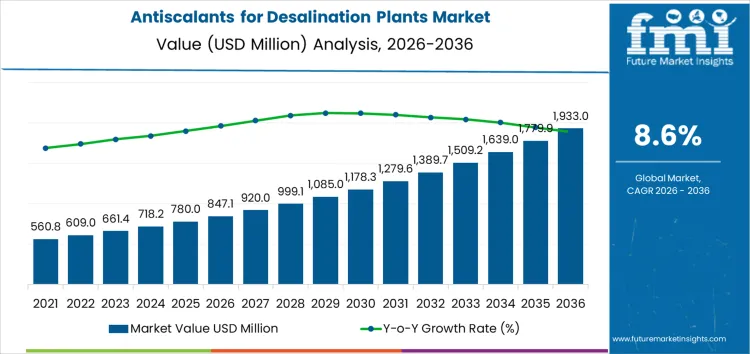
Saudi Arabia and UAE lead demand growth due to large-scale seawater desalination investments, while China, India, and USA reflect rising industrial and municipal adoption. Competitive landscape includes DuPont Water Solutions, Veolia Water Technologies, SUEZ Water Technologies, Avista Technologies, and Applied Membranes Inc., emphasizing membrane-specific formulations, high-recovery performance, and reduced environmental footprint.
Antiscalants for Desalination Plants Market Key Takeaways
| Metric | Value |
|---|---|
| Market Value (2026) | USD 847.1 million |
| Market Forecast Value (2036) | USD 1,933.0 million |
| Forecast CAGR (2026 to 2036) | 8.6% |
Why is the Demand for Antiscalants for Desalination Plants Market Growing Globally?
Demand for antiscalants in desalination plants is growing globally due to expanding reliance on seawater and brackish water desalination to meet freshwater scarcity and industrial supply needs. Desalination processes, including reverse osmosis and thermal technologies, concentrate dissolved salts and minerals, which promotes scale formation on membranes and heat exchange surfaces that degrades performance, increases energy use, and raises maintenance costs. Operators adopt antiscalants to inhibit precipitation of calcium carbonate, sulfate, silica, and other scale precursors, which extends membrane life and supports consistent flux rates.
Growth in arid and water stressed regions, particularly in the Middle East, North Africa, and parts of Asia and Australia, drives investment in large capacity desalination infrastructure. Urbanization and industrial water demand further reinforce deployment of efficient pretreatment chemistries to ensure plant reliability. Regulatory expectations for potable reuse and water quality standards encourage comprehensive treatment trains that include targeted scale control. Innovations in polymeric and environmentally acceptable antiscalant formulations improve efficacy across a range of feed water compositions and operating conditions. Operators benefit from reduced downtime, lower chemical usage, and improved overall water production efficiency. Increased global deployment of desalination technologies sustains demand for advanced antiscalant solutions worldwide.
How Are the Segments Classified in the Antiscalants for Desalination Plants Market?
Demand for antiscalants in desalination plants globally is shaped by membrane fouling risks, water recovery targets, and operating cost control. Plant operators evaluate scale inhibition efficiency, membrane compatibility, dosage stability, and performance under high salinity conditions. Adoption patterns reflect widespread deployment across thermal and membrane-based desalination systems supporting municipal supply and industrial process water needs.
Which Antiscalant Chemistry Represents the Largest Share of Global Demand?
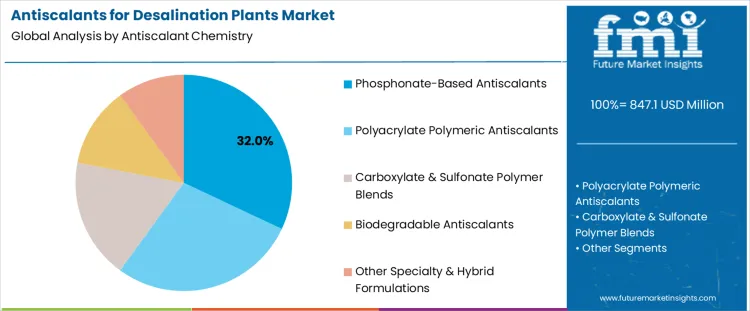
Phosphonate-based antiscalants hold 32.0%, representing the largest share of global demand. These formulations provide strong threshold inhibition and compatibility with high-recovery desalination operations. Polyacrylate polymer antiscalants account for 28.0%, supporting dispersion of sparingly soluble salts and stable membrane performance. Carboxylate and sulfonate polymer blends hold 18.0%, enabling multi-scale control under variable feedwater chemistry. Biodegradable antiscalants account for 12.0%, reflecting environmental compliance considerations. Other specialty and hybrid formulations hold 10.0%. Chemistry distribution reflects preference for proven, high-efficiency inhibition under demanding desalination conditions.
Key Points
- Phosphonate chemistries lead due to strong inhibition performance.
- Polyacrylates support membrane stability and dispersion control.
- Biodegradable options address regulatory and environmental priorities.
Which Desalination Technology Accounts for the Highest Share of Global Adoption?
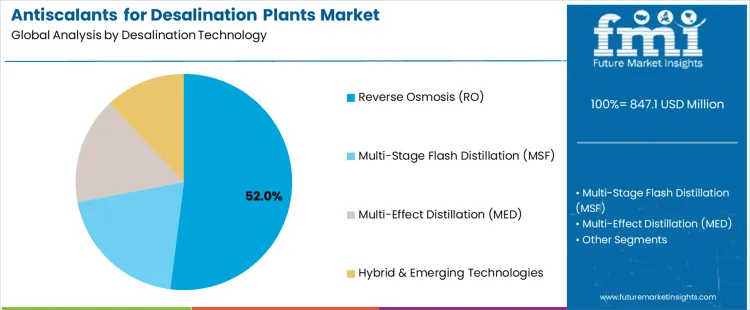
Reverse osmosis holds 52.0%, accounting for the highest share of global adoption. RO systems require continuous antiscalant dosing to protect membranes and maintain recovery rates. Multi-stage flash distillation accounts for 20.0%, addressing scale control under high-temperature operation. Multi-effect distillation holds 16.0%, supporting thermal efficiency and heat transfer protection. Hybrid and emerging technologies account for 12.0%, integrating membrane and thermal approaches. Technology distribution reflects dominance of membrane desalination in new capacity additions worldwide.
Key Points
- Reverse osmosis dominates due to efficiency and scalability.
- MSF and MED rely on antiscalants for heat transfer protection.
- Hybrid systems reflect evolving desalination configurations.
Which End-Use Sector Drives the Largest Share of Global Demand?
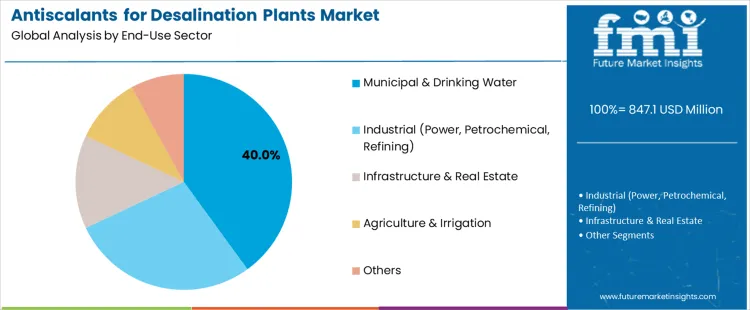
Municipal and drinking water applications hold 40.0%, driving the largest share of global demand. These plants support public water supply in water-stressed regions. Industrial sectors hold 28.0%, including power, petrochemical, and refining operations requiring high-quality process water. Infrastructure and real estate applications account for 14.0%, supporting large-scale developments. Agriculture and irrigation hold 10.0%, addressing saline water use. Other sectors account for 8.0%. End-use distribution reflects priority of desalination for potable supply and industrial reliability.
Key Points
- Municipal water supply drives primary antiscalant consumption.
- Industrial users require consistent process water quality.
- Infrastructure projects support localized desalination demand.
What are the Key Dynamics in the Antiscalants for Desalination Plants Market?
Global demand rises as seawater and brackish water desalination facilities expand to meet freshwater scarcity, urban growth, and industrial demand. Antiscalants prevent scale formation on membranes and heat exchange surfaces, preserving flux, reducing cleaning frequency, and extending equipment life. Adoption aligns with increased investment in reverse osmosis (RO) and multi-stage flash (MSF) desalination technologies across Middle East, North Africa, Asia-Pacific, and coastal regions worldwide. Usage spans municipal water supply, power generation, and industrial desalination installations requiring robust scale control chemistries.
How do desalination capacity growth and water quality targets shape global demand?
Rapid expansion of desalination capacity driven by water scarcity, population growth, and urbanization increases requirement for reliable scale inhibition to support operational efficiency. Facilities adopting RO membranes deploy tailored antiscalants to manage scaling from calcium, magnesium, barium, strontium, and silica species under varied feedwater chemistry. Power sector desalination and industrial reuse projects integrate antiscalants to maintain continuous operation with minimal downtime. Performance expectations emphasize low dosage, broad-spectrum inhibition, and compatibility with downstream treatment and brine disposal protocols. Water quality objectives and regulatory frameworks for potable and process water reinforce demand for antiscalants that support consistent permeate quality and long membrane life.
How do cost pressures, feedwater variability, and process integration influence market scalability?
Antiscalant performance depends on feedwater composition, temperature, and pre-treatment efficacy; optimization often requires site-specific testing and dosing adjustments. Chemistry variability across desalination plants influences antiscalant selection and operational dosing strategies, affecting cost of operation. High cost of advanced antiscalants can impact total water production cost, particularly in regions with energy or budget constraints. Integration with pretreatment systems demands monitoring and control infrastructure to avoid under- or over-dosing that can reduce membrane performance or increase fouling. Supply chain dynamics and raw material sourcing affect pricing and availability. Growth depends on development of cost-efficient, high-performance antiscalants and harmonized formulation guidelines that address diverse desalination conditions and support scalable deployment across global water supply applications.
How Is Demand for Antiscalants for Desalination Plants Evolving?
Demand for antiscalants for desalination plants is increasing globally due to freshwater scarcity, expansion of reverse osmosis capacity, and higher recovery rate requirements. Saudi Arabia leads with a 9.5% CAGR, supported by large-scale seawater desalination investments. UAE follows at 9.2%, driven by capacity additions and efficiency optimization in thermal and membrane plants. China records an 8.8% CAGR, reflecting industrial water reuse and coastal desalination projects. India posts 8.3%, supported by municipal and industrial desalination in water-stressed regions. USA records a 7.5% CAGR, shaped by operational optimization of existing plants and regulatory compliance. Growth reflects sustained reliance on chemical scale control for membrane protection worldwide.
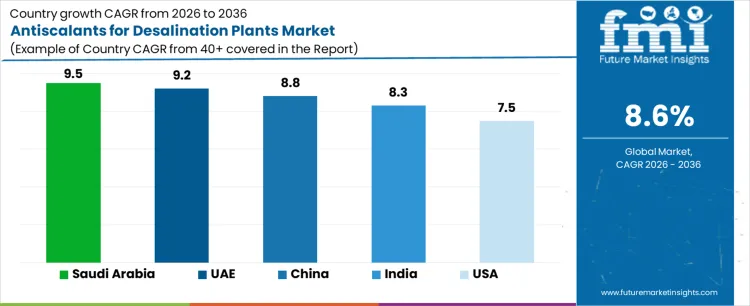
| Country | CAGR (%) |
|---|---|
| Saudi Arabia | 9.5% |
| UAE | 9.2% |
| China | 8.8% |
| USA | 7.5% |
| India | 8.3% |
What factors are driving strong antiscalant demand growth in Saudi Arabia?
Saudi Arabia demand is driven by dominance of desalination in national water supply and continuous expansion of reverse osmosis capacity. CAGR of 9.5% reflects increased use of high-performance antiscalants to control calcium carbonate, sulfate, and silica scaling. Operators target higher recovery rates to reduce energy consumption and brine discharge. Large plant sizes require consistent chemical dosing and long membrane life. Centralized procurement supports standardized antiscalant programs. Growth remains infrastructure-led and efficiency-focused, aligned with long-term water security strategies.
- Expansion of large-scale reverse osmosis capacity
- Need for high recovery rate operation
- Control of carbonate, sulfate, and silica scaling
- Centralized procurement and dosing programs
How is UAE sustaining high growth in desalination antiscalant usage?
UAE demand reflects rapid capacity additions and modernization of desalination infrastructure. CAGR of 9.2% is supported by transition from thermal processes toward advanced membrane-based systems. Operators prioritize antiscalants enabling stable operation under high salinity feedwater. Regulatory focus on minimizing chemical discharge influences formulation selection. Integration with automated dosing and monitoring systems supports consistent consumption. Growth remains infrastructure-driven and performance-focused, aligned with energy efficiency and water reliability objectives.
- Expansion of membrane-based desalination plants
- High salinity feedwater management
- Automated chemical dosing integration
- Focus on energy-efficient operation
What supports continued antiscalant demand growth in China?
China demand is driven by coastal desalination projects, industrial water reuse, and power sector water security. CAGR of 8.8% reflects increased deployment of antiscalants to protect membranes and reduce operational downtime. Industrial desalination plants require flexible formulations compatible with variable feedwater quality. Government planning supports standardized chemical application across facilities. Growth remains scale-driven and policy-aligned, supported by industrial water demand and coastal infrastructure investment.
- Coastal desalination infrastructure expansion
- Industrial water reuse requirements
- Protection of membranes from variable feedwater
- Policy-supported standardized chemical use
Why is India showing rising adoption of desalination antiscalants?
India demand reflects water stress in coastal cities and industrial zones. CAGR of 8.3% is supported by municipal desalination plants and captive industrial systems. Operators rely on antiscalants to improve membrane lifespan and reduce cleaning frequency. Cost sensitivity encourages optimization of dosing efficiency. Regulatory oversight on discharge quality influences chemical selection. Growth remains infrastructure-led and compliance-focused, aligned with urban water supply reliability and industrial continuity needs.
- Coastal municipal desalination projects
- Industrial captive desalination systems
- Focus on membrane lifespan and cleaning reduction
- Discharge quality compliance requirements
What factors shape antiscalant demand growth in the USA?
USA demand is driven by optimization of existing desalination plants and expansion of brackish water reverse osmosis. CAGR of 7.5% reflects use of antiscalants to manage scaling under higher recovery operations. Operators emphasize compatibility with regulatory discharge limits and membrane supplier guidelines. Aging infrastructure favors chemical optimization over capital expansion. Growth remains operations-driven and compliance-focused, aligned with water resilience and cost control objectives.
- Brackish and seawater desalination optimization
- Higher recovery rate operation requirements
- Regulatory compliance for chemical discharge
- Emphasis on extending membrane service life
What is the competitive landscape of demand for antiscalants for desalination plants?
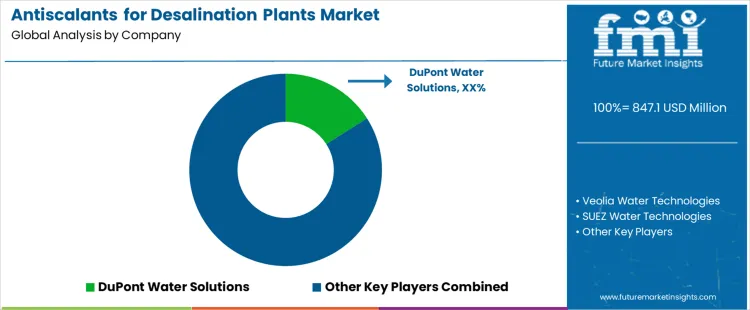
Demand for antiscalants for desalination plants is driven by expansion of seawater and brackish water desalination capacity and rising water scarcity. Applications focus on preventing calcium carbonate, calcium sulfate, barium sulfate, strontium sulfate, and silica scaling in reverse osmosis and nanofiltration systems. Buyers evaluate scale inhibition efficiency at high recovery rates, compatibility with membrane materials, thermal stability, and impact on membrane fouling and cleaning frequency. Procurement teams prioritize consistent performance under variable feedwater chemistry, compliance with potable water standards, and proven effectiveness at low dosage rates. Trend in the global market reflects increasing plant sizes, higher operating recoveries, tighter energy efficiency targets, and stronger emphasis on membrane life extension.
DuPont Water Solutions maintains strong positioning through proprietary antiscalant formulations optimized for high-recovery and high-salinity desalination operations. Veolia Water Technologies supplies antiscalants integrated within comprehensive desalination process solutions and operational support frameworks. SUEZ Water Technologies provides membrane-compatible antiscalants applied across municipal and industrial desalination projects worldwide. Avista Technologies focuses on specialized antiscalant chemistries tailored for challenging feedwater conditions and advanced membrane systems. Applied Membranes Inc. supports demand through antiscalant products aligned with small to mid-scale desalination installations. Competitive differentiation depends on inhibition performance at extreme conditions, membrane compatibility, technical service depth, and ability to support long-term plant reliability.
Key Players in the Antiscalants for Desalination Plants Market
- DuPont Water Solutions
- Veolia Water Technologies
- Suez Water Technologies
- Avista Technologies
- Applied Membranes Inc.
Scope of the Report
| Items | Values |
|---|---|
| Quantitative Units | USD million |
| Antiscalant Chemistry | Phosphonate-Based Antiscalants; Polyacrylate Polymeric Antiscalants; Carboxylate & Sulfonate Polymer Blends; Biodegradable Antiscalants; Other Specialty & Hybrid Formulations |
| Desalination Technology | Reverse Osmosis (RO); Multi-Stage Flash Distillation (MSF); Multi-Effect Distillation (MED); Hybrid & Emerging Technologies |
| End-Use Sector | Municipal & Drinking Water; Industrial (Power, Petrochemical, Refining); Infrastructure & Real Estate; Agriculture & Irrigation; Others |
| Regions Covered | Asia Pacific, Europe, North America, Latin America, Middle East & Africa |
| Countries Covered | Saudi Arabia, UAE, China, USA, India, and 40+ countries |
| Key Companies Profiled | DuPont Water Solutions; Veolia Water Technologies; Suez Water Technologies; Avista Technologies; Applied Membranes Inc. |
| Additional Attributes | Dollar sales by antiscalant chemistry and desalination technology; adoption trends for RO-compatible and biodegradable antiscalant formulations; scale control performance across calcium carbonate, sulfate, and silica systems; compatibility with high-recovery and high-TDS desalination operations; dosing stability, membrane fouling mitigation, and cleaning interval impacts; regulatory acceptance and water quality standards influencing antiscalant selection. |
Antiscalants for Desalination Plants Market by Segment
Antiscalant Chemistry:
- Phosphonate-Based Antiscalants
- Polyacrylate Polymeric Antiscalants
- Carboxylate & Sulfonate Polymer Blends
- Biodegradable Antiscalants
- Other Specialty & Hybrid Formulations
Desalination Technology:
- Reverse Osmosis (RO)
- Multi-Stage Flash Distillation (MSF)
- Multi-Effect Distillation (MED)
- Hybrid & Emerging Technologies
End-Use Sector:
- Municipal & Drinking Water
- Industrial (Power, Petrochemical, Refining)
- Infrastructure & Real Estate
- Agriculture & Irrigation
- Others
Region:
- Asia Pacific
- China
- Japan
- South Korea
- India
- Australia & New Zealand
- ASEAN
- Rest of Asia Pacific
- Europe
- Germany
- United Kingdom
- France
- Italy
- Spain
- Nordic
- BENELUX
- Rest of Europe
- North America
- United States
- Canada
- Mexico
- Latin America
- Brazil
- Chile
- Rest of Latin America
- Middle East & Africa
- Kingdom of Saudi Arabia
- Other GCC Countries
- Turkey
- South Africa
- Other African Union
- Rest of Middle East & Africa
Frequently Asked Questions
How big is the antiscalants for desalination plants market in 2026?
The global antiscalants for desalination plants market is estimated to be valued at USD 847.1 million in 2026.
What will be the size of antiscalants for desalination plants market in 2036?
The market size for the antiscalants for desalination plants market is projected to reach USD 1,933.0 million by 2036.
How much will be the antiscalants for desalination plants market growth between 2026 and 2036?
The antiscalants for desalination plants market is expected to grow at a 8.6% CAGR between 2026 and 2036.
What are the key product types in the antiscalants for desalination plants market?
The key product types in antiscalants for desalination plants market are phosphonate-based antiscalants, polyacrylate polymeric antiscalants, carboxylate & sulfonate polymer blends, biodegradable antiscalants and other specialty & hybrid formulations.
Which desalination technology segment to contribute significant share in the antiscalants for desalination plants market in 2026?
In terms of desalination technology, reverse osmosis (ro) segment to command 52.0% share in the antiscalants for desalination plants market in 2026.
Preview the report firsthand - request a free sample
Get SampleGet the brochure for pricing and purchase details.
Get PDFTable of Content
- Executive Summary
- Global Market Outlook
- Demand-side Trends
- Supply-side Trends
- Technology Roadmap Analysis
- Analysis and Recommendations
- Market Overview
- Market Coverage / Taxonomy
- Market Definition / Scope / Limitations
- Market Background
- Market Dynamics
- Drivers
- Restraints
- Opportunity
- Trends
- Scenario Forecast
- Demand in Optimistic Scenario
- Demand in Likely Scenario
- Demand in Conservative Scenario
- Opportunity Map Analysis
- Product Life Cycle Analysis
- Supply Chain Analysis
- Investment Feasibility Matrix
- Value Chain Analysis
- PESTLE and Porter’s Analysis
- Regulatory Landscape
- Regional Parent Market Outlook
- Production and Consumption Statistics
- Import and Export Statistics
- Market Dynamics
- Global Market Analysis 2021 to 2025 and Forecast, 2026 to 2036
- Historical Market Size Value (USD Million) Analysis, 2021 to 2025
- Current and Future Market Size Value (USD Million) Projections, 2026 to 2036
- Y-o-Y Growth Trend Analysis
- Absolute $ Opportunity Analysis
- Global Market Pricing Analysis 2021 to 2025 and Forecast 2026 to 2036
- Global Market Analysis 2021 to 2025 and Forecast 2026 to 2036, By Antiscalant Chemistry
- Introduction / Key Findings
- Historical Market Size Value (USD Million) Analysis By Antiscalant Chemistry , 2021 to 2025
- Current and Future Market Size Value (USD Million) Analysis and Forecast By Antiscalant Chemistry , 2026 to 2036
- Phosphonate-Based Antiscalants
- Polyacrylate Polymeric Antiscalants
- Carboxylate & Sulfonate Polymer Blends
- Biodegradable Antiscalants
- Other Specialty & Hybrid Formulations
- Phosphonate-Based Antiscalants
- Y-o-Y Growth Trend Analysis By Antiscalant Chemistry , 2021 to 2025
- Absolute $ Opportunity Analysis By Antiscalant Chemistry , 2026 to 2036
- Global Market Analysis 2021 to 2025 and Forecast 2026 to 2036, By Desalination Technology
- Introduction / Key Findings
- Historical Market Size Value (USD Million) Analysis By Desalination Technology, 2021 to 2025
- Current and Future Market Size Value (USD Million) Analysis and Forecast By Desalination Technology, 2026 to 2036
- Reverse Osmosis (RO)
- Multi-Stage Flash Distillation (MSF)
- Multi-Effect Distillation (MED)
- Hybrid & Emerging Technologies
- Reverse Osmosis (RO)
- Y-o-Y Growth Trend Analysis By Desalination Technology, 2021 to 2025
- Absolute $ Opportunity Analysis By Desalination Technology, 2026 to 2036
- Global Market Analysis 2021 to 2025 and Forecast 2026 to 2036, By End-Use Sector
- Introduction / Key Findings
- Historical Market Size Value (USD Million) Analysis By End-Use Sector, 2021 to 2025
- Current and Future Market Size Value (USD Million) Analysis and Forecast By End-Use Sector, 2026 to 2036
- Municipal & Drinking Water
- Industrial (Power, Petrochemical, Refining)
- Infrastructure & Real Estate
- Agriculture & Irrigation
- Others
- Municipal & Drinking Water
- Y-o-Y Growth Trend Analysis By End-Use Sector, 2021 to 2025
- Absolute $ Opportunity Analysis By End-Use Sector, 2026 to 2036
- Global Market Analysis 2021 to 2025 and Forecast 2026 to 2036, By Region
- Introduction
- Historical Market Size Value (USD Million) Analysis By Region, 2021 to 2025
- Current Market Size Value (USD Million) Analysis and Forecast By Region, 2026 to 2036
- North America
- Latin America
- Western Europe
- Eastern Europe
- East Asia
- South Asia and Pacific
- Middle East & Africa
- Market Attractiveness Analysis By Region
- North America Market Analysis 2021 to 2025 and Forecast 2026 to 2036, By Country
- Historical Market Size Value (USD Million) Trend Analysis By Market Taxonomy, 2021 to 2025
- Market Size Value (USD Million) Forecast By Market Taxonomy, 2026 to 2036
- By Country
- USA
- Canada
- Mexico
- By Antiscalant Chemistry
- By Desalination Technology
- By End-Use Sector
- By Country
- Market Attractiveness Analysis
- By Country
- By Antiscalant Chemistry
- By Desalination Technology
- By End-Use Sector
- Key Takeaways
- Latin America Market Analysis 2021 to 2025 and Forecast 2026 to 2036, By Country
- Historical Market Size Value (USD Million) Trend Analysis By Market Taxonomy, 2021 to 2025
- Market Size Value (USD Million) Forecast By Market Taxonomy, 2026 to 2036
- By Country
- Brazil
- Chile
- Rest of Latin America
- By Antiscalant Chemistry
- By Desalination Technology
- By End-Use Sector
- By Country
- Market Attractiveness Analysis
- By Country
- By Antiscalant Chemistry
- By Desalination Technology
- By End-Use Sector
- Key Takeaways
- Western Europe Market Analysis 2021 to 2025 and Forecast 2026 to 2036, By Country
- Historical Market Size Value (USD Million) Trend Analysis By Market Taxonomy, 2021 to 2025
- Market Size Value (USD Million) Forecast By Market Taxonomy, 2026 to 2036
- By Country
- Germany
- UK
- Italy
- Spain
- France
- Nordic
- BENELUX
- Rest of Western Europe
- By Antiscalant Chemistry
- By Desalination Technology
- By End-Use Sector
- By Country
- Market Attractiveness Analysis
- By Country
- By Antiscalant Chemistry
- By Desalination Technology
- By End-Use Sector
- Key Takeaways
- Eastern Europe Market Analysis 2021 to 2025 and Forecast 2026 to 2036, By Country
- Historical Market Size Value (USD Million) Trend Analysis By Market Taxonomy, 2021 to 2025
- Market Size Value (USD Million) Forecast By Market Taxonomy, 2026 to 2036
- By Country
- Russia
- Poland
- Hungary
- Balkan & Baltic
- Rest of Eastern Europe
- By Antiscalant Chemistry
- By Desalination Technology
- By End-Use Sector
- By Country
- Market Attractiveness Analysis
- By Country
- By Antiscalant Chemistry
- By Desalination Technology
- By End-Use Sector
- Key Takeaways
- East Asia Market Analysis 2021 to 2025 and Forecast 2026 to 2036, By Country
- Historical Market Size Value (USD Million) Trend Analysis By Market Taxonomy, 2021 to 2025
- Market Size Value (USD Million) Forecast By Market Taxonomy, 2026 to 2036
- By Country
- China
- Japan
- South Korea
- By Antiscalant Chemistry
- By Desalination Technology
- By End-Use Sector
- By Country
- Market Attractiveness Analysis
- By Country
- By Antiscalant Chemistry
- By Desalination Technology
- By End-Use Sector
- Key Takeaways
- South Asia and Pacific Market Analysis 2021 to 2025 and Forecast 2026 to 2036, By Country
- Historical Market Size Value (USD Million) Trend Analysis By Market Taxonomy, 2021 to 2025
- Market Size Value (USD Million) Forecast By Market Taxonomy, 2026 to 2036
- By Country
- India
- ASEAN
- Australia & New Zealand
- Rest of South Asia and Pacific
- By Antiscalant Chemistry
- By Desalination Technology
- By End-Use Sector
- By Country
- Market Attractiveness Analysis
- By Country
- By Antiscalant Chemistry
- By Desalination Technology
- By End-Use Sector
- Key Takeaways
- Middle East & Africa Market Analysis 2021 to 2025 and Forecast 2026 to 2036, By Country
- Historical Market Size Value (USD Million) Trend Analysis By Market Taxonomy, 2021 to 2025
- Market Size Value (USD Million) Forecast By Market Taxonomy, 2026 to 2036
- By Country
- Kingdom of Saudi Arabia
- Other GCC Countries
- Turkiye
- South Africa
- Other African Union
- Rest of Middle East & Africa
- By Antiscalant Chemistry
- By Desalination Technology
- By End-Use Sector
- By Country
- Market Attractiveness Analysis
- By Country
- By Antiscalant Chemistry
- By Desalination Technology
- By End-Use Sector
- Key Takeaways
- Key Countries Market Analysis
- USA
- Pricing Analysis
- Market Share Analysis, 2025
- By Antiscalant Chemistry
- By Desalination Technology
- By End-Use Sector
- Canada
- Pricing Analysis
- Market Share Analysis, 2025
- By Antiscalant Chemistry
- By Desalination Technology
- By End-Use Sector
- Mexico
- Pricing Analysis
- Market Share Analysis, 2025
- By Antiscalant Chemistry
- By Desalination Technology
- By End-Use Sector
- Brazil
- Pricing Analysis
- Market Share Analysis, 2025
- By Antiscalant Chemistry
- By Desalination Technology
- By End-Use Sector
- Chile
- Pricing Analysis
- Market Share Analysis, 2025
- By Antiscalant Chemistry
- By Desalination Technology
- By End-Use Sector
- Germany
- Pricing Analysis
- Market Share Analysis, 2025
- By Antiscalant Chemistry
- By Desalination Technology
- By End-Use Sector
- UK
- Pricing Analysis
- Market Share Analysis, 2025
- By Antiscalant Chemistry
- By Desalination Technology
- By End-Use Sector
- Italy
- Pricing Analysis
- Market Share Analysis, 2025
- By Antiscalant Chemistry
- By Desalination Technology
- By End-Use Sector
- Spain
- Pricing Analysis
- Market Share Analysis, 2025
- By Antiscalant Chemistry
- By Desalination Technology
- By End-Use Sector
- France
- Pricing Analysis
- Market Share Analysis, 2025
- By Antiscalant Chemistry
- By Desalination Technology
- By End-Use Sector
- India
- Pricing Analysis
- Market Share Analysis, 2025
- By Antiscalant Chemistry
- By Desalination Technology
- By End-Use Sector
- ASEAN
- Pricing Analysis
- Market Share Analysis, 2025
- By Antiscalant Chemistry
- By Desalination Technology
- By End-Use Sector
- Australia & New Zealand
- Pricing Analysis
- Market Share Analysis, 2025
- By Antiscalant Chemistry
- By Desalination Technology
- By End-Use Sector
- China
- Pricing Analysis
- Market Share Analysis, 2025
- By Antiscalant Chemistry
- By Desalination Technology
- By End-Use Sector
- Japan
- Pricing Analysis
- Market Share Analysis, 2025
- By Antiscalant Chemistry
- By Desalination Technology
- By End-Use Sector
- South Korea
- Pricing Analysis
- Market Share Analysis, 2025
- By Antiscalant Chemistry
- By Desalination Technology
- By End-Use Sector
- Russia
- Pricing Analysis
- Market Share Analysis, 2025
- By Antiscalant Chemistry
- By Desalination Technology
- By End-Use Sector
- Poland
- Pricing Analysis
- Market Share Analysis, 2025
- By Antiscalant Chemistry
- By Desalination Technology
- By End-Use Sector
- Hungary
- Pricing Analysis
- Market Share Analysis, 2025
- By Antiscalant Chemistry
- By Desalination Technology
- By End-Use Sector
- Kingdom of Saudi Arabia
- Pricing Analysis
- Market Share Analysis, 2025
- By Antiscalant Chemistry
- By Desalination Technology
- By End-Use Sector
- Turkiye
- Pricing Analysis
- Market Share Analysis, 2025
- By Antiscalant Chemistry
- By Desalination Technology
- By End-Use Sector
- South Africa
- Pricing Analysis
- Market Share Analysis, 2025
- By Antiscalant Chemistry
- By Desalination Technology
- By End-Use Sector
- USA
- Market Structure Analysis
- Competition Dashboard
- Competition Benchmarking
- Market Share Analysis of Top Players
- By Regional
- By Antiscalant Chemistry
- By Desalination Technology
- By End-Use Sector
- Competition Analysis
- Competition Deep Dive
- DuPont Water Solutions
- Overview
- Product Portfolio
- Profitability by Market Segments (Product/Age /Sales Channel/Region)
- Sales Footprint
- Strategy Overview
- Marketing Strategy
- Product Strategy
- Channel Strategy
- Veolia Water Technologies
- SUEZ Water Technologies
- Avista Technologies
- Applied Membranes Inc.
- DuPont Water Solutions
- Competition Deep Dive
- Assumptions & Acronyms Used
- Research Methodology


