

- Market Size (2026)
- USD 221.4 Mn
- Forecast (2036)
- USD 785.6 Mn
- CAGR (2026 to 2036)
- 13.5%
How big is Nitrogen Efficiency Biologics Market in 2026?
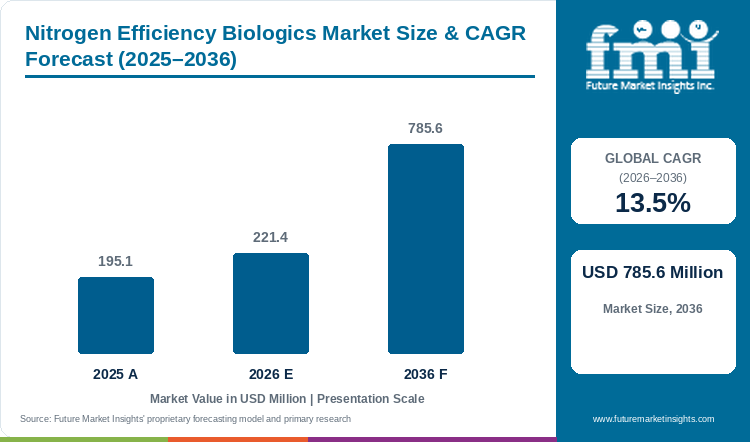
The nitrogen efficiency biologics market is estimated at USD 195.1 million in 2025 and is projected to reach USD 221.4 million in 2026. Demand for nitrogen efficiency biologics is expected to grow at a 13.5% CAGR for the decade to 2036 and reach USD 785.6 million by 2036.
In 2026, sales of nitrogen efficiency biologics are estimated at USD 221.4 million, up from USD 195.1 million a year earlier, and wider corn and soybean use is likely to bring the nitrogen efficiency biologics market up to USD 785.6 million by 2036. Above all, corn growers are adding microbes that supply part of the crop's nitrogen in the root zone, and the products now carry a stated nitrogen credit. For instance, Pivot Bio said in March 2026 that PROVEN 40 and PROVEN G3 deliver 20 to 40 pounds of additional nitrogen as part of a complete nitrogen strategy, and reported results from more than 90 corn silage studies.[1] A stated nitrogen credit gives buyers a cost line to compare with fertilizer, which moves the category from strip trials to whole-field orders.
Across buyers, cereal acres treated through the soil take the largest volumes, as cereals and grains are expected to make up 39% of 2026 crop type sales and soil application 44.4% by method. As an example, Sound Agriculture released INFLECT in September 2026, a planter-box treatment for corn fed with anhydrous ammonia or manure, after 12 trial sites averaged about six more bushels per acre.[2] Corn buyers, in turn, reorder per acre each season, and FMI analysts expect suppliers that prove a yield or nitrogen return per acre to hold most repeat orders.
Key Market Trends & Insights
- Associative nitrogen fixers are expected to be the largest microbe type at 45.2% in 2026, on root-zone bacteria sold for corn and wheat. Behind them, soybean rhizobia follow near 31.6%, and mycorrhizal fungi about 14.1%.
- Cereals and grains come first in 2026 crop type sales, at a likely 39%, as corn and wheat growers buy a nitrogen credit per acre, with inoculated soybean, pea and bean crops at 34.5%.
- Soil application is projected to cover 44.4% of application method sales in 2026, with seed treatment close behind at 38.2%.
- Ag retailers and distributors are estimated at 49.9% of sales channel volume in 2026, as growers buy biologicals alongside seed and fertilizer.
Regional Highlights
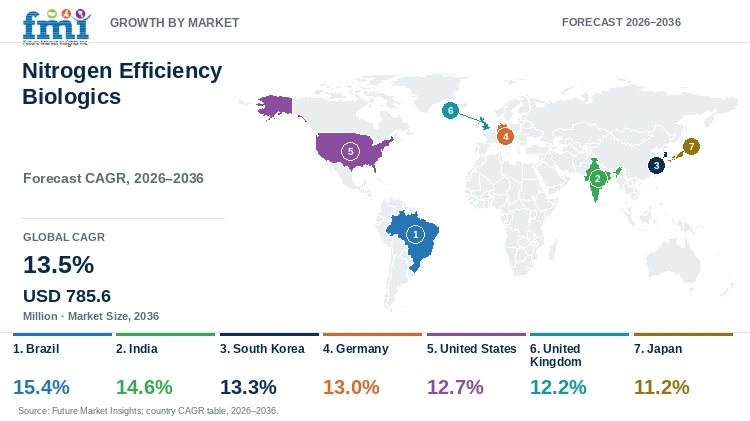
- Brazil leads the FMI growth outlook at 15.4%, as soybean area grows and inoculant use is already routine.
- India, at 14.6%, also grows above the 13.5% global rate, and South Korea, at 13.3%, is close to the nitrogen efficiency biologics market as a whole. Germany is predicted to grow about 13% a year under nitrogen surplus rules, with the United States close behind at 12.7% on corn retail programs. Slower growth is projected for the United Kingdom, at 12.2%, during rule reform, and for Japan, at 11.2%, as cooperatives test products cautiously.
- Mycorrhizal suppliers are building local teams in Brazil. Groundwork BioAg appointed a Brazil Country Manager on 22 December 2025 to grow Rootella sales with distributor Novatero BioAg.[3] A local manager and distributor add competition for established inoculant brands in soybean and corn regions.
Market Size & Forecast
Table 1: Market Size and Forecast for the Nitrogen Efficiency Biologics Market (USD million and percentage), 2025 to 2036
| Metric | Value |
|---|---|
| 2025 Market Size | USD 195.1 million |
| Estimated Market Size in 2026 | USD 221.4 million |
| Projected Market Size by 2036 | USD 785.6 million |
| CAGR, 2026 to 2036 | 13.5% |
| Added Revenue, 2026 to 2036 | USD 564.2 million |
| Market Expansion Multiple | 3.5x |
Growers are widening nitrogen biologicals from test strips to whole fields as yields hold at lower fertilizer rates. Formats are also changing, and Kula Bio launched shelf-stable soluble powders of nitrogen-fixing Xanthobacter autotrophicus in February 2026, removing the cold storage that slowed distribution of liquid products.[4] Shelf-stable powders let retailers stock nitrogen microbes beside dry inputs, which widens the dealer network. By comparison, biofertilizers as a whole grow more slowly, and the biofertilizers market is forecast at an 8.5% CAGR, so nitrogen-fixing products are taking a larger slice of farm biological budgets. FMI projects the nitrogen efficiency biologics market to reach roughly 3.5 times the 2026 base by 2036, gaining close to USD 564.2 million of sales over the decade. On the other hand, a sharp fall in nitrogen fertilizer prices would weaken the cost case.
Corn Nitrogen Products, Soybean Inoculants and Shelf Life
Corn nitrogen products carry most new volume. In this segment, Pivot Bio paired PROVEN 40 and PROVEN G3 data with a multiyear nitrogen price and supply assurance program covering the 2026, 2027 and 2028 seasons.[1] Price assurance moves the decision into the fertilizer budget, so growers can weigh a biological directly against a cut in nitrogen. In addition, treated silage acres in the studies averaged 0.91 more tons per acre and 954 more pounds of milk per acre.[1] As a result, corn growers will judge each product on a per-acre return that includes the fertilizer saved.
Soybean inoculants are the oldest and steadiest line. In Brazil, for example, farmers added about 1.3 million hectares of soybeans in 2025/26, and Conab put soybean output at 180.4 million tonnes, up 5.2%.[5] Rhizobia are applied to almost every new soybean hectare in Brazil, so area growth there turns into inoculant orders without a new adoption step.
Table 2: Product and Crop Indicators for the Nitrogen Efficiency Biologics Market (yield, area and nitrogen), 2025 to 2026
| Indicator | Data Point | Relevance | Source |
|---|---|---|---|
| Pivot Bio additional nitrogen, 2026 | 20 to 40 pounds | Nitrogen credit for corn | [1] |
| Pivot Bio silage studies, 2026 | Over 90 studies; 0.91 tons per acre more | Yield case for corn growers | [1] |
| Sound Agriculture INFLECT trials, 2026 | About six bushels per acre; 11 of 12 sites | Corn on anhydrous ammonia acres | [2] |
| Kula Bio soluble powders, 2026 | Up to 65% higher fixation efficiency claimed | Shelf-stable distribution | [4] |
| Brazil soybean output, 2025/26 | 180.4 million tonnes; up 5.2% | Demand for rhizobia inoculants | [5] |
| Germany nitrogen surplus target | 70 kg per hectare; met in 2023 | Nitrogen loss limits | [6] |
| UK fertilising product reform, 2026 | Consultation from 19 March 2026 | Rules for novel products | [7] |
Analyst Perspective
“Growers pay for a nitrogen biological when the crop holds yield at a lower fertilizer rate, and every season resets that test. Corn and soybean growers in the Americas now have products with stated nitrogen credits and shelf-stable formats, which turns a trial product into a routine input. I expect suppliers that publish per-acre results across several seasons to gain share, giving cereal biologicals a second growth curve after soybean inoculants.”
- Nikhil Kaitwade, Principal Consultant, Future Market Insights.
How is the nitrogen efficiency biologics market segmented?
The market is segmented into microbe type, crop type, application method, sales channel, and region. Associative nitrogen fixers are expected to lead microbe type with 45.2% share in 2026, and cereals and grains lead crop type with 39%.
By microbe type: associative nitrogen fixers, rhizobia, mycorrhizal fungi, and other microbes.
By crop type: cereals and grains, oilseeds and pulses, fruits and vegetables, and other crops.
By application method: soil application, seed treatment, foliar application, and fertigation.
By sales channel: ag retailers and distributors, cooperatives, seed company programs, and direct to farm.
By region: row crop, specialty crop and greenhouse growers in North America, Latin America, Western Europe, Eastern Europe, East Asia, South Asia and Pacific, and Middle East and Africa.
Why do associative nitrogen fixers lead nitrogen efficiency biologics sales by microbe type?
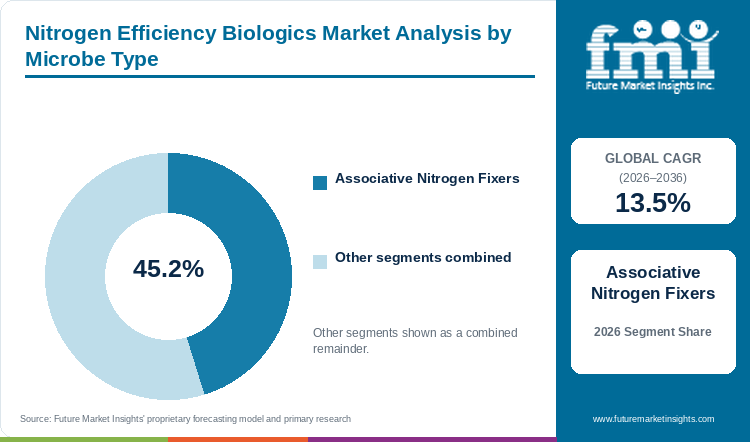
Associative nitrogen fixers are expected to lead microbe type sales with 45.2% share in 2026, ahead of rhizobia at about 31.6% and mycorrhizal fungi at an estimated 14.1%.
Table 3: Microbe Type Share for the Nitrogen Efficiency Biologics Market (percentage share), 2026
| Microbe Type | Estimated Share (2026) |
|---|---|
| Associative Nitrogen Fixers | 45.2% |
| Rhizobia | 31.6% |
| Mycorrhizal Fungi | 14.1% |
| Other Microbes | 9.1% |
| Total | 100.0% |
Table 4: Microbe Type Leadership and Market Growth for the Nitrogen Efficiency Biologics Market (segment and CAGR percentage), 2026 to 2036
| Metric | Value |
|---|---|
| Global CAGR (2026 to 2036) | 13.5% |
| Leading Segment | Associative Nitrogen Fixers |
Bacteria such as Klebsiella, Kosakonia, Azospirillum and Xanthobacter fix nitrogen on or near the roots of corn, wheat and vegetables, so associative nitrogen fixers will lead microbe type sales at 45.2% in 2026. Kula Bio said the Xanthobacter strain in the new powders showed up to 65% greater fixation efficiency than conventional nitrogen-fixing bacteria in comparative studies.[4] Higher fixation per cell strengthens the nitrogen credit that associative fixers can claim on cereal acres. By comparison, rhizobia, near 31.6%, nodulate soybean, pea and bean roots and remain the most proven nitrogen biologics. Root reach for nitrogen and phosphorus is the job of mycorrhizal fungi, about 14.1%, with other microbes at 9.1%. In practice, many of these strains reach the farm on seed, a route followed in the microbial seed treatment market with 12.8% CAGR growth ahead.
- Root-associated bacteria for corn, wheat and sugarcane make up most associative fixer volume.
- Developers are splitting ranges by farming system. Kula Bio markets Kula-NSP for certified organic production and Kula-NextSP for conventional farms.[4] Separate organic and conventional grades let one strain reach both buyer groups, widening the acreage in play.
Why do cereals and grains lead nitrogen efficiency biologics sales by crop type?
Cereals and grains are likely to lead crop type sales with 39% share in 2026, with oilseeds and pulses at about 34.5% and fruits and vegetables at roughly 16.2%.
Table 5: Crop Type Share for the Nitrogen Efficiency Biologics Market (percentage share), 2026
| Crop Type | Estimated Share (2026) |
|---|---|
| Cereals and Grains | 39% |
| Oilseeds and Pulses | 34.5% |
| Fruits and Vegetables | 16.2% |
| Other Crops | 10.3% |
| Total | 100.0% |
Corn and wheat take the largest nitrogen rates per hectare, so cereals and grains are projected to lead crop type sales at 39% in 2026. As a case in point, Pivot Bio reported 954 more pounds of milk per acre from treated corn silage in March 2026, a return that dairy farms can see on the feed bill.[1] Silage growers are therefore a fast route into cereal acres for nitrogen biologicals. Oilseeds and pulses, near 34.5%, instead rely on rhizobia inoculants applied every season in Brazil, Argentina and North America. Fruits and vegetables, about 16.2%, use foliar and fertigation products, and other crops, 10.3%, include sugarcane, cotton and turf.
- Corn grain, corn silage and wheat make up most cereal volume.
- Multi-state trials are now the entry ticket for corn products. Sound Agriculture tested INFLECT on corn at 12 sites in Illinois, Kansas and Missouri.[2] Results across three states give retailers local data to recommend the product on Corn Belt acres.
Why does soil application lead nitrogen efficiency biologics sales by application method?
Soil application is projected to lead application method sales with 44.4% share in 2026, ahead of seed treatment at an estimated 38.2% and foliar application at about 10.1%.
Table 6: Application Method Share for the Nitrogen Efficiency Biologics Market (percentage share), 2026
| Application Method | Estimated Share (2026) |
|---|---|
| Soil Application | 44.4% |
| Seed Treatment | 38.2% |
| Foliar Application | 10.1% |
| Fertigation | 7.3% |
| Total | 100.0% |
In-furrow sprays at planting place microbes beside the young root, so soil application will lead method sales at 44.4% in 2026. Close behind, seed treatment, near 38.2%, covers rhizobia on soybean seed and planter-box powders such as INFLECT.[2] Planter-box formats let growers add microbes without a separate pass, which favours seed treatment on large farms. Leaf-colonising bacteria reach the crop through foliar application, about 10.1% of method sales, and fertigation, 7.3%, delivers microbes through drip lines in vegetables and orchards. Over the forecast period, shelf-stable powders will widen both soil and fertigation use, as Kula Bio designed the new formats to dissolve for root-zone delivery.[4] Soluble formats also open drip and pivot irrigation as a delivery route.
- In-furrow liquid at planting accounts for most soil application volume.
- Suppliers are offering one strain in several formats. Pivot Bio offers PROVEN G3 as a liquid, a seed treatment or a dry planter-box product.[1] Format choice lets the same product move through soil, seed and planter-box routes, which protects share as methods shift.
Why do ag retailers and distributors lead nitrogen efficiency biologics sales by sales channel?
Ag retailers and distributors are estimated to lead sales channel volume with 49.9% share in 2026, ahead of cooperatives at about 21.4% and seed company programs at 17.3%.
Table 7: Sales Channel Share for the Nitrogen Efficiency Biologics Market (percentage share), 2026
| Sales Channel | Estimated Share (2026) |
|---|---|
| Ag Retailers and Distributors | 49.9% |
| Cooperatives | 21.4% |
| Seed Company Programs | 17.3% |
| Direct to Farm | 11.4% |
| Total | 100.0% |
Agronomists at farm retailers recommend biologicals alongside seed and fertilizer, check storage and tank-mix compatibility, and deliver at planting, so ag retailers and distributors will lead channel sales at 49.9% in 2026. Next come cooperatives, near 21.4%, which buy for members in Europe and the Corn Belt. Seed company programs, about 17.3%, bundle inoculants and microbes with seed bags, and direct to farm, 11.4%, serves large growers that buy straight from the developer. Distributor partnerships remain the entry route in new countries. Outside these channels, Groundwork BioAg sells Rootella in Brazil through distributor Novatero BioAg.[3] Even so, retail and seed bundles will keep most volume as products move to routine use.
- Ag retail agronomists handle most product selection and in-season advice.
- Ease of handling now shapes product design. Kula Bio aimed the powders at farmers and distributors that need products easy to adopt at scale.[4] Products built for distributor storage strengthen the retail channel lead.
What are the drivers, restraints, and opportunities in the nitrogen efficiency biologics market?
High nitrogen costs and limits on nitrogen losses push growers toward microbes that supply part of the crop need. Variable field response and short shelf life restrain repeat orders, and shelf-stable and seed-applied formats open wider acreage.
- Driver: Nitrogen is the largest fertilizer cost on cereal farms, and microbes that supply part of the crop need give growers a way to cut rates without losing yield.
- Restraint: Microbial performance changes with soil, weather and crop variety, and live products lose viability in storage and in tank mixes.
- Opportunity: Shelf-stable powders, seed-applied formats and supply programs make biologicals easier to stock and apply on large acreage.
Nitrogen Costs and Loss Limits Push Microbial Trials
Rising fertilizer bills and tighter nitrogen loss rules are moving more growers to nitrogen biologicals. On the rules side, Germany set a target of 70 kg of agricultural nitrogen surplus per hectare for 2026 to 2030, and the five-year average met that level for the first time in 2023.[6] Holding the surplus at that level means growers need better crop use of each kilogram applied, which favours microbes that supply nitrogen at the root. On the price side, Pivot Bio linked PROVEN products to a nitrogen price and supply assurance program for 2026 to 2028.[1] Consequently, each rule or price shock moves more growers from test strips to full fields.
Variable Response and Short Shelf Life Slow Reorders
Field response varies, and in FMI's view inconsistent results hold back reorders more than price. For example, Sound Agriculture reported gains at 11 of 12 INFLECT sites, so even a strong product missed at one site.[2] One miss in twelve is enough for a grower on that site to drop the product, so retailers favour suppliers with broad trial networks. Handling losses added to the problem. Liquid microbes also needed cold storage before Kula Bio and others moved to powders.[4] Therefore, suppliers will need multi-season, multi-site data to keep growers buying.
Shelf-Stable and Seed-Applied Formats Widen Acreage
Formats that survive the retail warehouse and fit the planter open the largest acreage. Among these, Kula Bio said the new soluble powders remove cold storage and extend shelf life.[4] Longer shelf life lets retailers carry stock across seasons, lowering the cost of holding a biological line. Likewise, Pivot Bio sells PROVEN G3 in liquid, seed treatment and dry planter-box forms.[1] Over the next decade, products that ride on seed or dissolve in starter fertilizer will gain the next wave of row crop acres.
Which country CAGRs are profiled in the nitrogen efficiency biologics market?
Table 8: Country CAGR Comparison for the Nitrogen Efficiency Biologics Market (CAGR percentage), 2026 to 2036
| Country | CAGR (2026 to 2036) |
|---|---|
| Brazil | 15.4% |
| India | 14.6% |
| South Korea | 13.3% |
| Germany | 13% |
| United States | 12.7% |
| United Kingdom | 12.2% |
| Japan | 11.2% |
How do country-level CAGRs compare in the nitrogen efficiency biologics market?
Demand for nitrogen efficiency biologics in Brazil is set to rise fastest, at 15.4%, on routine soybean inoculation and fast area growth, and India is next at 14.6% as state programmes promote biofertilizers. Public green-bio projects back microbial products in South Korea, which at 13.3% runs a fraction behind the 13.5% nitrogen efficiency biologics rate. Meanwhile, Germany is forecast at 13% under nitrogen surplus limits, and FMI data indicate 12.7% for the United States, with Corn Belt retailers stocking more microbial products. The United Kingdom is projected at 12.2% during a rewrite of fertilising product law, and Japan grows slowest, at 11.2%, as JA-led testing runs over many seasons.
- Brazilian growers inoculate almost every new soybean hectare, so area growth converts straight into rhizobia orders without a new adoption step. Local distribution partners decide which brands reach those acres.
- Urea subsidies make the national fertilizer bill a policy issue in India, and state departments hand out biofertilizer packets for rice and pulses. Low-cost carrier inoculants dominate, which favours local manufacturers over premium imports.
- South Korea is funding a green bio cluster and fund to 2031, giving local strain developers test sites and capital. Domestic microbe makers selling through cooperatives stand to gain first.
- With the 70 kg surplus target now met, further cuts in Germany require better use of each kilogram applied. Microbial products registered under EU fertilising rules gain a regulatory route to those growers.
- In the United States, Corn Belt retail agronomists decide which biological goes on the planter, and products with per-acre returns spread quickly. Developers with retail partnerships and price assurance gain the most acres.
- The rewrite of UK fertilising product law will set how microbial claims are made. Suppliers are holding back some launches until the rules are final, so British growth picks up once the framework settles.
- Japanese inputs flow mostly through JA cooperatives that test products over several seasons, slowing adoption on small farms. Suppliers that clear JA trials gain steady but gradual volume.
Full report country CAGRs cover: inoculant-heavy Brazil and subsidy-driven India at the top, a tight group of South Korea, Germany and the United States next, the United Kingdom and Japan last, and grouped regional rates for the other standard countries.
Country-wise Analysis
Brazil Nitrogen Efficiency Biologics Market Outlook (2026 to 2036)
Soybean expansion keeps adding inoculant demand in Brazil. Conab estimated 2025/26 soybean output at 180.4 million tonnes, up 5.2%, on 1.3 million more hectares, Revista Cultivar reported in September 2026.[5] Output growth on that scale feeds rhizobia sales directly. Alongside this, Groundwork BioAg named a Brazil Country Manager in December 2025 to grow Rootella sales with Novatero BioAg.[3] A local country manager points to wider competition for Brazilian inoculant buyers. Taken together, sales of nitrogen efficiency biologics in Brazil are forecast to rise at a 15.4% CAGR, the fastest of the seven countries.
Key takeaway: Inoculation of every new soybean hectare sets the Brazilian pace.
India Nitrogen Efficiency Biologics Market Outlook (2026 to 2036)
Indian state agriculture departments distribute biofertilizer packets for rice, pulses and oilseeds, and urea subsidies make the national fertilizer bill a policy concern. At the same time, local manufacturers supply low-cost carrier and liquid inoculants through cooperatives. FMI's forecast places use of nitrogen efficiency biologics in India on a 14.6% path, ahead of the 13.5% global rate as state programmes scale up.
Key takeaway: Public programmes and subsidy pressure raise adoption in India.
South Korea Nitrogen Efficiency Biologics Market Outlook (2026 to 2036)
Public funding is building a domestic microbe industry in South Korea. The agriculture ministry announced the first Basic Plan for Fostering the Green Bio Industry for 2027 to 2031 on 20 July 2026, with a microorganism cluster in Jeongeup and Sunchang and a Green Bio Fund rising from KRW 142.9 billion in 2026 to KRW 242.9 billion in 2031.[8] A fund of that size gives local strain developers capital to scale production. At farm level, rice, vegetable and greenhouse growers there buy microbial products through cooperatives, and local developers test strains in public facilities. With cooperative buying and public test facilities in place, sales of nitrogen efficiency biologics in South Korea are expected to advance 13.3% a year through 2036.
Key takeaway: Green-bio funding builds local microbe supply in South Korea.
Germany Nitrogen Efficiency Biologics Market Outlook (2026 to 2036)
Germany has met the nitrogen surplus target, and the next step is harder. The German Environment Agency said the five-year average agricultural nitrogen surplus fell about 40% since 1994 and met the 70 kg per hectare target for the first time in 2023.[6] Even so, further cuts need better use of each kilogram applied, which favours microbial products under EU fertilising product rules. As growers face tighter surplus checks, German demand for nitrogen efficiency biologics is set for 13% annual growth.
Key takeaway: Surplus checks keep German growers looking for better nitrogen use.
United States Nitrogen Efficiency Biologics Market Outlook (2026 to 2036)
Corn Belt suppliers are launching products for specific nitrogen programmes. Sound Agriculture launched INFLECT in September 2026 for corn on anhydrous ammonia and manure acres in the Corn Belt.[2] A product aimed at anhydrous and manure acres opens a segment that earlier biologicals did not target. Meanwhile, Pivot Bio added a nitrogen price and supply assurance program for 2026 to 2028.[1] Price assurance reduces the risk of moving part of the nitrogen budget to microbes. In this market, corn growers buy through retail agronomists, and products that show a per-acre return spread quickly. FMI expects Corn Belt retail programs to carry US sales of nitrogen efficiency biologics up by 12.7% a year.
Key takeaway: Corn nitrogen products lead adoption in the United States.
United Kingdom Nitrogen Efficiency Biologics Market Outlook (2026 to 2036)
UK rules for fertilising products are being rewritten. The four UK governments opened a consultation on 19 March 2026 to replace fertiliser product law with UK Fertilising Product Regulations, including evidence on newer and novel products.[7] In turn, clear rules for microbial products will help suppliers make claims. Once the new framework is finalised, UK sales of nitrogen efficiency biologics are likely to rise about 12.2% a year.
Key takeaway: New fertilising product law decides how fast British growers adopt.
Japan Nitrogen Efficiency Biologics Market Outlook (2026 to 2036)
Japanese farms are small and growers buy inputs mostly through JA cooperatives, which test new products over several seasons. Besides this, government goals to cut chemical fertilizer use support trials in rice and vegetables. As a result, Japanese adoption of nitrogen efficiency biologics is forecast at an 11.2% CAGR, the lowest rate of the seven countries.
Key takeaway: Small farms and cautious cooperatives slow Japan.
Who are the notable companies in the nitrogen efficiency biologics market?
Pivot Bio, Groundwork BioAg, Locus Agricultural Solutions, Sound Agriculture, Rizobacter (Bioceres), Lallemand Plant Care, Indigo Ag, Kula Bio and BASF are the profiled companies.
FMI analysis shows corn nitrogen developers, rhizobia inoculant makers, mycorrhizal suppliers and crop input groups competing in the market. Among these, Pivot Bio reported more than 90 silage studies for PROVEN 40 and PROVEN G3 in March 2026.[1] Data at that depth sets the bar that rival corn products need to reach. Then, in February 2026, Kula Bio added soluble powders built on Xanthobacter autotrophicus.[4] Shelf-stable powders let a smaller developer compete on handling as much as on strain. Most recently, INFLECT, released by Sound Agriculture in September 2026, became the third product in the company range.[2] Each new launch adds pressure on retailers to narrow the shelf to products with the best data. Groundwork BioAg, Locus Agricultural Solutions, Rizobacter (Bioceres), Lallemand Plant Care, Indigo Ag and BASF complete the group.
- Corn and cereal nitrogen developers: Pivot Bio, Kula Bio and Sound Agriculture.
- Rhizobia inoculant makers and crop input groups: Rizobacter (Bioceres), Lallemand Plant Care and BASF.
- Mycorrhizal and multi-microbe suppliers: Groundwork BioAg, Locus Agricultural Solutions and Indigo Ag.
Competitive Benchmarking: Nitrogen Efficiency Biologics Market
Table 9: Competitive Benchmarking for the Nitrogen Efficiency Biologics Market (qualitative ratings), 2026
| Company | Cereal Nitrogen | Legume Inoculants | Shelf-Stable Formats | Recent Activity |
|---|---|---|---|---|
| Pivot Bio | High | Low | High | High |
| Kula Bio | High | Low | High | High |
| Sound Agriculture | Medium | Low | High | High |
| Groundwork BioAg | Medium | Medium | Medium | High |
| BASF | Low | High | Medium | Low |
Ratings compare the companies on cereal nitrogen, legume inoculants, shelf-stable formats and recent activity.
Key Developments in the Nitrogen Efficiency Biologics Market
- Sound Agriculture launched INFLECT on 24 September 2026, a planter-box microbial seed treatment for high-ammonium corn acres that widens biological use into anhydrous programmes.[2]
- Brazilian soybean output for 2025/26 was estimated at 180.4 million tonnes, up 5.2%, in a Conab revision of 15 September 2026, a gain that adds rhizobia demand on new hectares.[5]
- On 20 July 2026, the South Korean agriculture ministry announced a 2027 to 2031 green bio plan with a microorganism cluster in Jeonbuk, giving domestic microbe makers public backing.[8]
- In the 31 March 2026 release, Pivot Bio reported silage results for PROVEN 40 and PROVEN G3 from more than 90 studies, evidence that dairy growers can set against fertilizer cost.[1]
- The UK governments opened a consultation on new UK Fertilising Product Regulations on 19 March 2026; for microbial suppliers this sets the route to approved claims.[7]
- The German Environment Agency updated the agricultural nitrogen surplus indicator on 5 March 2026, keeping nitrogen efficiency on the policy agenda for German farms.[6]
- Kula Bio launched Kula-NSP and Kula-NextSP soluble powders on 2 February 2026, removing a cold-storage barrier for distributors.[4]
- On 22 December 2025, Groundwork BioAg appointed a Brazil Country Manager, a step toward wider mycorrhizal sales in soybean and corn regions.[3]
Key Players in the Nitrogen Efficiency Biologics Market
Corn and Cereal Nitrogen Developers
- Pivot Bio
- Kula Bio
- Sound Agriculture
Rhizobia Inoculant Makers and Crop Input Groups
- Rizobacter (Bioceres)
- Lallemand Plant Care
- BASF
Mycorrhizal and Multi-Microbe Suppliers
- Groundwork BioAg
- Locus Agricultural Solutions
- Indigo Ag
Nitrogen Efficiency Biologics Market - Report Scope
Table 10: Report Scope for the Nitrogen Efficiency Biologics Market (coverage fields and definitions), 2026 to 2036
| Coverage field | Report scope |
|---|---|
| Market breakdown | Microbe type; crop type; application method; sales channel; region |
| Quantitative units | USD million |
| Market definition | Live microbial products applied to soil, seed, foliage or irrigation water to fix atmospheric nitrogen or improve crop access to nitrogen, including associative nitrogen fixers, rhizobia, mycorrhizal fungi and related microbes. Synthetic fertilizers, non-microbial nitrification and urease inhibitors, carbon credits and services are excluded. |
| Regions covered | North America; Latin America; Western Europe; Eastern Europe; East Asia; South Asia and Pacific; Middle East and Africa |
| Countries covered | United States; Canada; Brazil; Mexico; Argentina; Chile; Germany; France; United Kingdom; Italy; Spain; Benelux; Nordics; Poland; Czech Republic; Romania; Hungary; China; Japan; South Korea; India; ASEAN; Australia and New Zealand; GCC Countries; South Africa; Türkiye; Israel |
| Key companies profiled | Pivot Bio, Groundwork BioAg, Locus Agricultural Solutions, Sound Agriculture, Rizobacter (Bioceres), Lallemand Plant Care, Indigo Ag, Kula Bio, BASF |
| Forecast period | 2026 to 2036 |
Nitrogen Efficiency Biologics Market - Research Methodology
Table 11: Research Methodology for the Nitrogen Efficiency Biologics Market (research methods and approach), 2026 edition
| Method | Approach |
|---|---|
| Data Sources | Company results, industry associations, government statistics and trade publications. |
| Desk Research | Desk research covers microbial nitrogen products, inoculant use, application formats, nitrogen rules and retail channels. |
| Market Sizing and Forecasting | Sizing starts from the 2026 base of USD 221.4 million and the 13.5% CAGR for 2026 to 2036. |
| Data Validation | Figures are cross-checked across company, industry and government sources. |
Nitrogen Efficiency Biologics Market by Segments
Nitrogen Efficiency Biologics Market segmented by Microbe Type:
- Associative Nitrogen Fixers
- Rhizobia
- Mycorrhizal Fungi
- Other Microbes
Nitrogen Efficiency Biologics Market segmented by Crop Type:
- Cereals and Grains
- Oilseeds and Pulses
- Fruits and Vegetables
- Other Crops
Nitrogen Efficiency Biologics Market segmented by Application Method:
- Soil Application
- Seed Treatment
- Foliar Application
- Fertigation
Nitrogen Efficiency Biologics Market segmented by Sales Channel:
- Ag Retailers and Distributors
- Cooperatives
- Seed Company Programs
- Direct to Farm
Nitrogen Efficiency Biologics Market by Region
- North America
- United States
- Canada
- Latin America
- Brazil
- Mexico
- Argentina
- Chile
- Western Europe
- Germany
- France
- United Kingdom
- Italy
- Spain
- Benelux
- Nordics
- Eastern Europe
- Poland
- Czech Republic
- Romania
- Hungary
- East Asia
- China
- Japan
- South Korea
- South Asia and Pacific
- India
- ASEAN
- Australia and New Zealand
- Middle East and Africa
- GCC Countries
- South Africa
- Türkiye
- Israel
Research Sources and Bibliography
- [1] Business Wire. (2026, March 31). Pivot Bio Silage Data Show Strong Tonnage and Milk Gains with PROVEN 40 and PROVEN G3. https://www.businesswire.com/news/home/20260331164875/en/Pivot-Bio-Silage-Data-Show-Strong-Tonnage-and-Milk-Gains-with-PROVEN-40-and-PROVEN-G3
- [2] AgFunderNews. (2026, September 24). Sound Agriculture launches seed-applied biological to preserve yields on high ammonium corn acres. https://agfundernews.com/sound-agriculture-launches-seed-applied-biological-to-preserve-yields-on-high-ammonium-corn-acres
- [3] Groundwork BioAg. (2025, December 22). Groundwork BioAg Expands in Brazil with Appointment of Roberto Gajardoni as Country Manager. https://groundworkbioag.com/groundwork-bioag-expands-in-brazil-with-appointment-of-roberto-gajardoni-as-country-manager/
- [4] Spudman. (2026, February 2). Sustainable nitrogen provider launches soluble powders. https://spudman.com/news/sustainable-nitrogen-provider-launches-soluble-powders/
- [5] Revista Cultivar. (2026, September 15). Conab eleva safra 2025/26 a 361,7 milhões de toneladas. https://revistacultivar.com.br/noticias/conab-eleva-safra-2025-26-a-361-7-milhoes-de-toneladas
- [6] German Environment Agency. (2026, March 5). Indicator: Agricultural nitrogen surplus. https://www.umweltbundesamt.de/en/data/environmental-indicators/indicator-agricultural-nitrogen-surplus
- [7] Department for Environment, Food & Rural Affairs. (2026, March 19). Marketing fertilising products in the UK: regulatory reform. https://www.gov.uk/government/consultations/marketing-fertilising-products-in-the-uk-regulatory-reform
- [8] The Asia Business Daily. (2026, July 20). Ministry of Agriculture Eyes Green Bio Industry Market to Reach 10 Trillion Won by 2031. https://view.asiae.co.kr/en/article/2026072017085050842
This bibliography is provided for reader reference. The full report contains the complete reference list and detailed citations.
This Report Answers
- How big is the nitrogen efficiency biologics market during 2026?
- What market size is projected by 2036?
- Which microbe type holds notable share?
- Which crop type holds notable share?
- Which countries have notable growth?
- Which companies are notable in the market?
Frequently Asked Questions
How large is the nitrogen efficiency biologics market expected in 2026?
In FMI's estimate, the nitrogen efficiency biologics market will reach USD 221.4 million in 2026, from USD 195.1 million in 2025. Sales of nitrogen efficiency biologics are projected to reach USD 785.6 million by 2036.
What CAGR is projected for the nitrogen efficiency biologics market through 2036?
The nitrogen efficiency biologics market is expected to grow at a 13.5% CAGR through 2036. Corn nitrogen products, soybean inoculants and shelf-stable formats carry that growth.
Which microbe type holds a notable market share in 2026?
Associative nitrogen fixers will lead with 45.2% share in 2026. Rhizobia follow at about 31.6%.
Which crop type holds a notable market share in 2026?
Cereals and grains are likely to lead with 39% share. Oilseeds and pulses follow at an estimated 34.5%.
Which country has a notable expansion outlook through 2036?
FMI projects Brazil to grow fastest, at a 15.4% CAGR. India follows at 14.6%.
Who are the key companies in the nitrogen efficiency biologics market?
Pivot Bio, Kula Bio and Sound Agriculture lead the corn and cereal nitrogen developers, and Rizobacter (Bioceres), Lallemand Plant Care and BASF lead legume inoculants. Groundwork BioAg, Locus Agricultural Solutions and Indigo Ag complete the company group.
Preview the report firsthand - request a free sample
Get SampleGet the brochure for pricing and purchase details.
Get PDFTable of Content
- Key Takeaways
- Market Size and CAGR
- Top Growth Driver
- Fastest Growing Segment
- Leading Region
- Key Companies
- Emerging Opportunities
- Executive Summary
- Global Market Outlook
- Demand-side Trends
- Supply-side Trends
- Technology Roadmap Analysis
- Analysis and Recommendations
- Analyst Perspective (What is happening? Why now? What should investors know?)
- Key Questions Answered
- How large is the market?
- What is the CAGR?
- What are key trends?
- Which region dominates?
- Who are the leaders?
- Market Overview
- Market Coverage / Taxonomy
- Market Definition / Scope / Limitations
- Research Methodology
- Chapter Orientation
- Analytical Lens and Working Hypotheses
- Market Structure, Signals, and Trend Drivers
- Benchmarking and Cross-market Comparability
- Market Sizing, Forecasting, and Opportunity Mapping
- Research Design and Evidence Framework
- Desk Research Programme (Secondary Evidence)
- Expert Input and Fieldwork (Primary Evidence)
- Tooling, Models, and Reference Databases
- Data Engineering and Model Build
- Quality Assurance and Audit Trail
- Market Background
- Market Dynamics (Drivers, Restraints, Opportunity, Trends)
- Scenario Forecast (Optimistic, Likely, Conservative)
- Impact Analysis
- AI Impact
- Sustainability Impact
- Regulatory Impact
- Technology Impact
- Consumer / Buyer Analysis
- Purchase Drivers
- Adoption Barriers
- Buyer Journey
- Opportunity Map Analysis
- Product Life Cycle Analysis
- Supply Chain Analysis
- Investment Feasibility Matrix
- Value Chain Analysis
- PESTLE and Porter's Analysis
- Regulatory Landscape
- Regional Parent Market Outlook
- Production and Consumption Statistics
- Import and Export Statistics
- Global Market Analysis and Forecast, 2021 to 2036
- Historical Market Size Value (USD Million) Analysis, 2021 to 2025
- Current and Future Market Size Value (USD Million) Projections, 2026 to 2036
- Y-o-Y Growth Trend Analysis
- Absolute $ Opportunity Analysis
- Global Market Pricing Analysis, 2021 to 2036
- Global Market Analysis and Forecast, By Microbe Type, 2021 to 2036
- Introduction / Key Findings
- Historical Market Size Value (USD Million) Analysis By Microbe Type, 2021 to 2025
- Current and Future Market Size Value (USD Million) Analysis and Forecast By Microbe Type, 2026 to 2036
- Associative Nitrogen Fixers
- Rhizobia
- Mycorrhizal Fungi
- Other Microbes
- Y-o-Y Growth Trend Analysis By Microbe Type, 2021 to 2025
- Absolute $ Opportunity Analysis By Microbe Type, 2026 to 2036
- Global Market Analysis and Forecast, By Crop Type, 2021 to 2036
- Introduction / Key Findings
- Historical Market Size Value (USD Million) Analysis By Crop Type, 2021 to 2025
- Current and Future Market Size Value (USD Million) Analysis and Forecast By Crop Type, 2026 to 2036
- Cereals and Grains
- Oilseeds and Pulses
- Fruits and Vegetables
- Other Crops
- Y-o-Y Growth Trend Analysis By Crop Type, 2021 to 2025
- Absolute $ Opportunity Analysis By Crop Type, 2026 to 2036
- Global Market Analysis and Forecast, By Application Method, 2021 to 2036
- Introduction / Key Findings
- Historical Market Size Value (USD Million) Analysis By Application Method, 2021 to 2025
- Current and Future Market Size Value (USD Million) Analysis and Forecast By Application Method, 2026 to 2036
- Soil Application
- Seed Treatment
- Foliar Application
- Fertigation
- Y-o-Y Growth Trend Analysis By Application Method, 2021 to 2025
- Absolute $ Opportunity Analysis By Application Method, 2026 to 2036
- Global Market Analysis and Forecast, By Sales Channel, 2021 to 2036
- Introduction / Key Findings
- Historical Market Size Value (USD Million) Analysis By Sales Channel, 2021 to 2025
- Current and Future Market Size Value (USD Million) Analysis and Forecast By Sales Channel, 2026 to 2036
- Ag Retailers and Distributors
- Cooperatives
- Seed Company Programs
- Direct to Farm
- Y-o-Y Growth Trend Analysis By Sales Channel, 2021 to 2025
- Absolute $ Opportunity Analysis By Sales Channel, 2026 to 2036
- Global Market Analysis and Forecast, By Region, 2021 to 2036
- Introduction
- Historical Market Size Value (USD Million) Analysis By Region, 2021 to 2025
- Current Market Size Value (USD Million) Analysis and Forecast By Region, 2026 to 2036
- North America
- Latin America
- Western Europe
- Eastern Europe
- East Asia
- South Asia and Pacific
- Middle East and Africa
- Market Attractiveness Analysis By Region
- North America Market Analysis and Forecast, By Country, 2021 to 2036
- Historical Market Size Value (USD Million) Trend Analysis By Market Taxonomy, 2021 to 2025
- Market Size Value (USD Million) Forecast By Market Taxonomy, 2026 to 2036
- By Country
- United States
- Canada
- By Microbe Type
- By Crop Type
- By Application Method
- By Sales Channel
- By Country
- Market Attractiveness Analysis
- By Country
- By Microbe Type
- By Crop Type
- By Application Method
- By Sales Channel
- Key Takeaways
- Latin America Market Analysis and Forecast, By Country
- Historical Market Size Value (USD Million) Trend Analysis By Market Taxonomy, 2021 to 2025
- Market Size Value (USD Million) Forecast By Market Taxonomy, 2026 to 2036
- By Country
- Brazil
- Mexico
- Argentina
- Chile
- By Microbe Type
- By Crop Type
- By Application Method
- By Sales Channel
- By Country
- Market Attractiveness Analysis
- By Country
- By Microbe Type
- By Crop Type
- By Application Method
- By Sales Channel
- Key Takeaways
- Western Europe Market Analysis and Forecast, By Country
- Historical Market Size Value (USD Million) Trend Analysis By Market Taxonomy, 2021 to 2025
- Market Size Value (USD Million) Forecast By Market Taxonomy, 2026 to 2036
- By Country
- Germany
- France
- United Kingdom
- Italy
- Spain
- Benelux
- Nordics
- By Microbe Type
- By Crop Type
- By Application Method
- By Sales Channel
- By Country
- Market Attractiveness Analysis
- By Country
- By Microbe Type
- By Crop Type
- By Application Method
- By Sales Channel
- Key Takeaways
- Eastern Europe Market Analysis and Forecast, By Country
- Historical Market Size Value (USD Million) Trend Analysis By Market Taxonomy, 2021 to 2025
- Market Size Value (USD Million) Forecast By Market Taxonomy, 2026 to 2036
- By Country
- Poland
- Czech Republic
- Romania
- Hungary
- By Microbe Type
- By Crop Type
- By Application Method
- By Sales Channel
- By Country
- Market Attractiveness Analysis
- By Country
- By Microbe Type
- By Crop Type
- By Application Method
- By Sales Channel
- Key Takeaways
- East Asia Market Analysis and Forecast, By Country
- Historical Market Size Value (USD Million) Trend Analysis By Market Taxonomy, 2021 to 2025
- Market Size Value (USD Million) Forecast By Market Taxonomy, 2026 to 2036
- By Country
- China
- Japan
- South Korea
- By Microbe Type
- By Crop Type
- By Application Method
- By Sales Channel
- By Country
- Market Attractiveness Analysis
- By Country
- By Microbe Type
- By Crop Type
- By Application Method
- By Sales Channel
- Key Takeaways
- South Asia and Pacific Market Analysis and Forecast, By Country
- Historical Market Size Value (USD Million) Trend Analysis By Market Taxonomy, 2021 to 2025
- Market Size Value (USD Million) Forecast By Market Taxonomy, 2026 to 2036
- By Country
- India
- ASEAN
- Australia and New Zealand
- By Microbe Type
- By Crop Type
- By Application Method
- By Sales Channel
- By Country
- Market Attractiveness Analysis
- By Country
- By Microbe Type
- By Crop Type
- By Application Method
- By Sales Channel
- Key Takeaways
- Middle East and Africa Market Analysis and Forecast, By Country
- Historical Market Size Value (USD Million) Trend Analysis By Market Taxonomy, 2021 to 2025
- Market Size Value (USD Million) Forecast By Market Taxonomy, 2026 to 2036
- By Country
- GCC Countries
- South Africa
- Türkiye
- Israel
- By Microbe Type
- By Crop Type
- By Application Method
- By Sales Channel
- By Country
- Market Attractiveness Analysis
- By Country
- By Microbe Type
- By Crop Type
- By Application Method
- By Sales Channel
- Key Takeaways
- Key Countries Market Analysis
- United States
- Pricing Analysis
- Market Share Analysis, 2025
- By Microbe Type
- By Crop Type
- By Application Method
- By Sales Channel
- Canada
- Pricing Analysis
- Market Share Analysis, 2025
- By Microbe Type
- By Crop Type
- By Application Method
- By Sales Channel
- Mexico
- Pricing Analysis
- Market Share Analysis, 2025
- By Microbe Type
- By Crop Type
- By Application Method
- By Sales Channel
- Brazil
- Pricing Analysis
- Market Share Analysis, 2025
- By Microbe Type
- By Crop Type
- By Application Method
- By Sales Channel
- Chile
- Pricing Analysis
- Market Share Analysis, 2025
- By Microbe Type
- By Crop Type
- By Application Method
- By Sales Channel
- Germany
- Pricing Analysis
- Market Share Analysis, 2025
- By Microbe Type
- By Crop Type
- By Application Method
- By Sales Channel
- United Kingdom
- Pricing Analysis
- Market Share Analysis, 2025
- By Microbe Type
- By Crop Type
- By Application Method
- By Sales Channel
- Italy
- Pricing Analysis
- Market Share Analysis, 2025
- By Microbe Type
- By Crop Type
- By Application Method
- By Sales Channel
- Spain
- Pricing Analysis
- Market Share Analysis, 2025
- By Microbe Type
- By Crop Type
- By Application Method
- By Sales Channel
- France
- Pricing Analysis
- Market Share Analysis, 2025
- By Microbe Type
- By Crop Type
- By Application Method
- By Sales Channel
- India
- Pricing Analysis
- Market Share Analysis, 2025
- By Microbe Type
- By Crop Type
- By Application Method
- By Sales Channel
- ASEAN
- Pricing Analysis
- Market Share Analysis, 2025
- By Microbe Type
- By Crop Type
- By Application Method
- By Sales Channel
- Australia and New Zealand
- Pricing Analysis
- Market Share Analysis, 2025
- By Microbe Type
- By Crop Type
- By Application Method
- By Sales Channel
- China
- Pricing Analysis
- Market Share Analysis, 2025
- By Microbe Type
- By Crop Type
- By Application Method
- By Sales Channel
- Japan
- Pricing Analysis
- Market Share Analysis, 2025
- By Microbe Type
- By Crop Type
- By Application Method
- By Sales Channel
- South Korea
- Pricing Analysis
- Market Share Analysis, 2025
- By Microbe Type
- By Crop Type
- By Application Method
- By Sales Channel
- Poland
- Pricing Analysis
- Market Share Analysis, 2025
- By Microbe Type
- By Crop Type
- By Application Method
- By Sales Channel
- Hungary
- Pricing Analysis
- Market Share Analysis, 2025
- By Microbe Type
- By Crop Type
- By Application Method
- By Sales Channel
- Türkiye
- Pricing Analysis
- Market Share Analysis, 2025
- By Microbe Type
- By Crop Type
- By Application Method
- By Sales Channel
- South Africa
- Pricing Analysis
- Market Share Analysis, 2025
- By Microbe Type
- By Crop Type
- By Application Method
- By Sales Channel
- United States
- Market Structure Analysis
- Competition Dashboard
- Competition Benchmarking
- Market Share Analysis of Top Players
- By Regional
- By Microbe Type
- By Crop Type
- By Application Method
- By Sales Channel
- Emerging Startups
- Innovation Benchmarking
- Competition Analysis
- Competition Deep Dive
- Pivot Bio
- Overview
- Product Portfolio
- Profitability by Market Segments
- Sales Footprint
- Strategy Overview
- Marketing Strategy
- Product Strategy
- Channel Strategy
- Kula Bio
- Sound Agriculture
- Groundwork BioAg
- BASF
- Rizobacter (Bioceres)
- Lallemand Plant Care
- Locus Agricultural Solutions
- Indigo Ag
- Pivot Bio
- Case Studies
- Success Stories
- Recent Developments
- Competition Deep Dive
- Assumptions & Acronyms Used


