

- Market Size (2026)
- USD 135.6 Mn
- Forecast (2036)
- USD 436.3 Mn
- CAGR (2026 to 2036)
- 12.4%
How big is Drought Recovery Biologics Market in 2026?
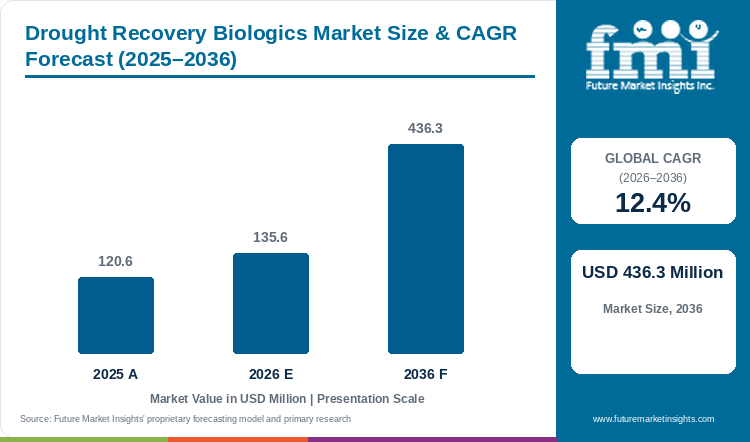
The drought recovery biologics market was worth USD 120.6 million in 2025 and is estimated at USD 135.6 million in 2026. Revenue from drought recovery biologics is projected to reach USD 436.3 million by 2036, growing at a 12.4% CAGR from 2026 to 2036.
Repeated drought across major grain belts is the main reason growers now budget for crop stress protection. In March 2026, the U.S. Department of Agriculture placed 55% of winter wheat area and 46% of corn area in moderate or worse drought [1]. England had only 44% of average rainfall in spring 2025, the driest spring in more than a century [2]. In October 2023, FAO estimated that disasters cost crop and livestock production about USD 123 billion a year, with agriculture taking over 65% of drought losses [3]. As per FMI, osmoprotectant blends lead with 46.8% of 2026 sales, as farms can apply them shortly before heat and water stress reach the crop. Clearer label rules for biostimulants in the EU are helping growers move biostimulants for drought stress from trial plots into fixed seasonal programs through 2036.
Key Market Trends & Insights
- By product type, osmoprotectant blends led the market with a 46.8% share in 2026, as growers time a glycine betaine and proline spray ahead of a forecast dry spell.
- By crop type, cereals and grains account for 45.3% of sales in 2026. In August 2026, the German farmers' association expected a 41.9 million tonne grain harvest, 7% below 2025, after a dry spring and June heatwave [4].
- By application method, soil application leads with 42.2% in 2026, as root-zone products fit the drench, in-furrow and band passes farms already make.
- By farm type, large commercial farms hold 47.3% of sales in 2026, owing to agronomy teams that approve full-season stress programs before planting each year.
- By sales channel, agri-input distributors move 37.7% of volume in 2026, as growers want local advice on dose and spray timing. Suppliers are adding plant capacity to keep these dealers stocked, and Hello Nature began an expansion in June 2025 that will double output at the Novara plant in Italy [5].
Regional Highlights
- Fastest-growing profiled country: South Korea, at an 11.9% CAGR from 2026 to 2036.
- By country: the USA (11.6%) and Germany (11.3%) follow South Korea through 2036, and Japan posts the lowest profiled rate at 10.3% over the same period.
- Korean growers now buy pre-stress products ahead of summer. Gangwon Yeongdong received only 34.2% of normal summer rainfall in 2025, during the worst drought there in 108 years [6].
Market Size & Forecast
Table 1: Market Size and Forecast for the Drought Recovery Biologics Market (USD million and percentage), 2025 to 2036
| Metric | Value |
|---|---|
| 2025 Market Size | USD 120.6 million |
| Estimated Market Size in 2026 | USD 135.6 million |
| Projected Market Size by 2036 | USD 436.3 million |
| CAGR, 2026 to 2036 | 12.4% |
| Added Revenue, 2026 to 2036 | USD 300.7 million |
| Market Expansion Multiple | 3.2x |
Large arable farms and fruit growers with a planned input program buy most drought recovery biologics today. Demand for crop stress products rises in seasons with short irrigation water, as a stress pass can protect yield without extra water. In September 2026, the Environment Agency still had ten areas of England in drought and 467 abstraction licence restrictions in force [7]. Germany received about 126 litres of rain per square metre in spring 2026, against a 1991 to 2020 mean of 171 litres [8]. However, field results vary with crop, stress level and spray date, so many growers trial a product once before reordering. FMI notes that suppliers with registered labels and local trial data will turn first trials into repeat seasonal orders through 2036.
Drought Exposure, Label Readiness and Value Benchmarks
Dry seasons keep returning to the same crop regions, so growers now book drought recovery biologics before flowering and grain fill. The UN Convention to Combat Desertification reported in July 2025 that severe drought impacts from 2023 and 2024 were still continuing [9]. In the USA, winter wheat area in drought reached 55% in March 2026, up from 27% a year earlier [1]. North Dakota stayed dry into summer, with more than 56% of the state in drought by early August 2026 and only 31% of soybeans rated good or excellent [10]. Due to this, input dealers are stocking stress products for corn and soybeans across the country. Germany received about 96 litres of rain per square metre in spring 2025, about 44% below the 1991 to 2020 mean and among the three driest springs since 1881 [11]. Spring 2026 reached only about 74% of that mean, so German buyers faced a second dry season in a row [8]. Korean farms face the same pattern, as southern reservoirs fell to between 43% and 69% of normal levels in July 2026 [12]. Growth in Japan is slower at 10.3% through 2036, as agriculture ministry support in 2025 went mainly to pumps and rotational water sharing for paddy rice [13]. FMI expects two dry springs in a row to turn emergency purchases into planned repeat orders across these markets.
Sales of drought recovery biologics remain small next to the crop losses these products aim to reduce. Disasters cost crop and livestock production about USD 123 billion a year [3], so growers have good reason to budget for stress protection. According to FMI, osmoprotectant blends are worth about USD 63.5 million in 2026, cereals and grains USD 61.4 million and soil application USD 57.2 million. Apart from that, clearer rules are making cautious buyers more willing to try stress products. The Plant Biostimulant Act of 2025, introduced in the U.S. House in June 2025, names tolerance to abiotic stress as a qualifying benefit [14]. In March 2025, Seipasa secured an EU Product Function Category 6(B) registration for SeiZen covering field, horticultural and woody crops [15]. Distributors can now list registered stress products next to crop nutrition ranges in one seasonal order. Paired programs are also raising the number of passes sold per hectare. Rovensa Next launched Biostimulation 360º in May 2025, with Phylgreen before stress and Delfan Plus during and after stress [16]. Acadian Plant Health reports maize yield gains of up to 16% under drought from a stress seed treatment in company trials [17]. Key trends in the drought recovery biologics market point to revenue per farm growing faster than farmed area through 2036.
Table 2: Drought Exposure and Field Readiness Indicators for the Drought Recovery Biologics Market (losses, crop area shares, rainfall, storage, rules and yield results), mixed reporting years from 2021 to 2026
| Indicator | Data Point | Why This Matters | Source |
|---|---|---|---|
| Agricultural disaster losses | About USD 123 billion a year, 1991 to 2021 | Large crop losses give growers a reason to pay for stress protection. | [3] |
| Share of drought losses on farms | Over 65% of drought losses fall on agriculture | Farms carry most drought losses, raising grower spending on stress inputs. | [3] |
| U.S. crop area in drought | Winter wheat 55%; corn 46%; soybeans 47% (March 2026) | Wide row-crop drought raises orders for stress seed treatments and sprays. | [1] |
| England spring rainfall | 44% of average in 2025, driest spring in over a century | UK arable growers started stress planning earlier in the season. | [2] |
| England drought restrictions | 10 areas in drought; 467 abstraction licence restrictions (September 2026) | Short irrigation supply raises demand for stress products that need no extra water. | [7] |
| Germany spring rainfall 2025 | About 96 litres per square metre against 171 for 1991 to 2020 | German growers are booking stress passes before crops reach flowering. | [11] |
| Germany spring rainfall 2026 | About 126 litres per square metre against 171 for 1991 to 2020 | Repeat dry springs push German growers toward planned pre-flowering passes. | [8] |
| Gangwon Yeongdong summer rainfall | 34.2% of normal in 2025, during the worst drought in 108 years | Korean growers now buy pre-stress products before the summer dry spell. | [6] |
| Korean reservoir storage | 62% nationally, 86% of normal (July 2026) | Drought response stays high on the Korean farm policy agenda. | [12] |
| U.S. biostimulant definition | Abiotic stress tolerance named in the bill (June 2025) | Stress claims gain a federal reference point for U.S. labels. | [14] |
| Maize yield under drought | Up to 16% higher with a stress seed treatment (company trials, May 2025) | A yield figure lets growers weigh product cost against crop value. | [17] |
Table 3: Drought Exposure and Market Value Benchmarks for the Drought Recovery Biologics Market (USD million, percentage and rainfall), 2021 to 2026, mixed years
| Indicator | Value | Source |
|---|---|---|
| Global drought recovery biologics market, 2026 | USD 135.6 million | Future Market Insights |
| Value gained between 2026 and 2036 | USD 300.7 million (3.2x) | Future Market Insights |
| Osmoprotectant blends value, 2026 | USD 63.5 million | Future Market Insights |
| Cereals and grains value, 2026 | USD 61.4 million | Future Market Insights |
| Soil application value, 2026 | USD 57.2 million | Future Market Insights |
| Annual crop and livestock disaster losses, 1991 to 2021 | About USD 123 billion | [3] |
| Bavaria spring rainfall 2026 | About 101 litres per square metre, roughly 45% of normal | [8] |
| Germany spring rainfall 2025 vs 1991 to 2020 | 96 vs 171 litres per square metre (about 44% below) | [11] |
| Germany spring rainfall 2026 vs 1991 to 2020 | 126 vs 171 litres per square metre (about 74%) | [8] |
| U.S. winter wheat area in drought, March 2026 vs 2025 | 55% vs 27% | [1] |
| Korean national reservoir storage, July 2026 | 62% (86% of normal) | [12] |
Analyst Perspective
“Demand will move towards drought recovery biologics that come with a clear spray date before heat arrives and a recovery pass once rain returns. Suppliers backing each label claim with local field trials will take most of the repeat orders through 2036.”
- Nikhil Kaitwade, Principal Consultant, Future Market Insights.
How is the drought recovery biologics market segmented?
The drought recovery biologics market is segmented by product type, crop type, application method, farm type, sales channel and region. In 2026, osmoprotectant blends are projected at 46.8%, cereals and grains at 45.3%, soil application at 42.2%, large commercial farms at 47.3% and agri-input distributors at 37.7%.
By product type: osmoprotectant blends (glycine betaine / proline), seaweed-based formulations, amino acid blends, anti-transpirant combos, and others.
By crop type: cereals & grains, fruits & vegetables, oilseeds & pulses, turf & ornamentals, and others.
By application method: soil application, foliar application, fertigation / drip, seed application, and others.
By farm type: large commercial farms, mid-size farms, smallholders, greenhouses & nurseries, and others.
By sales channel: agri-input distributors, cooperatives, agri-retail chains, online / direct-to-farm, and others.
By region: North America, Latin America, Western Europe, Eastern Europe, East Asia, South Asia and Pacific, and Middle East and Africa.
Why do osmoprotectant blends retain the largest product type share?
Osmoprotectant blends of glycine betaine and proline are set to take 46.8% of product type sales in 2026, as growers spray them before a dry spell.
Table 4: Product Type Share for the Drought Recovery Biologics Market (percentage share), 2026
| Product Type | Share (2026) |
|---|---|
| Osmoprotectant blends (glycine betaine / proline) | 46.8% |
| Other Segments Combined | 53.2% |
| Total | 100% |
Table 5: Product Type Leadership and Market Growth for the Drought Recovery Biologics Market (segment and CAGR percentage), 2026 to 2036
| Metric | Value |
|---|---|
| Global CAGR (2026 to 2036) | 12.4% |
| Leading Segment | Osmoprotectant blends (glycine betaine / proline) |
Osmoprotectant blends lead product type with 46.8% of 2026 sales, FMI finds, as growers spray glycine betaine and proline before heat and water stress reach the crop. In September 2025, Atlantica Agricola advised Archer Osmocare at 3 kg per hectare every two weeks when heat or water stress is expected [18]. Demand for these blends follows the weather forecast, so dealers stock them ahead of each dry spell. Seaweed-based formulations rank next, and amino acid blends sell mainly as a recovery pass after rain returns. Pre-stress blends are expected to remain the first product in most new drought programs through 2036.
- Osmoprotectant blends make up 46.8% of product type sales in 2026, as most stress programs begin with a pre-stress osmotic product.
- Growers get the strongest result when the blend goes on before a heatwave, so forecast-based ordering shapes sales.
What anchors cereals and grains in crop type demand?
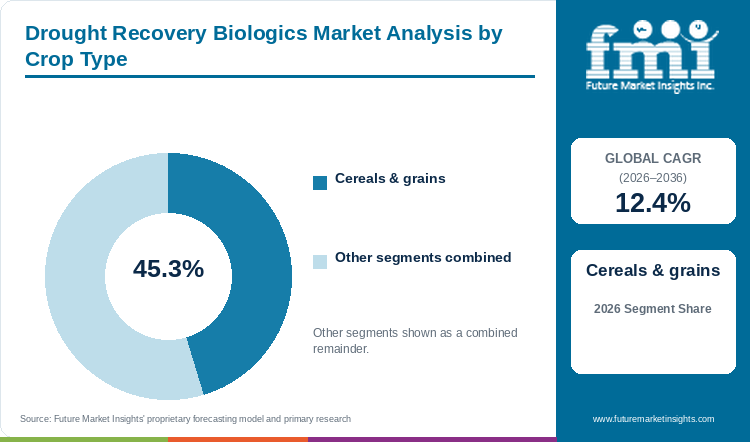
Wide planted areas give cereals and grains an estimated 45.3% of crop type sales in 2026.
FMI analysis shows cereals and grains holding 45.3% of crop type sales in 2026, since a small dose per hectare becomes a large order on wheat and maize farms. Public funds are also backing drought tolerance research in grains. In February 2024, the European Commission reported that BioAtlantis was developing seaweed-based biostimulants and agricultural microbials for drought-hit maize and teff under the EUR 4.9 million BOOSTER project [19]. Fruit and vegetable growers pay more per hectare, yet a smaller planted area keeps that share below cereals. Seed treatments are expected to make stress protection part of planting, keeping cereals in first place through 2036.
- Large wheat and maize areas keep cereals and grains at 45.3% of crop type sales in 2026.
- Wheat and maize growers compare cost per hectare with expected yield loss before adding a stress pass to the program.
Why does soil application stay central to application method demand?
Soil application is set to command 42.2% of application method sales in 2026, as recovery passes target the root zone.
Soil application carries 42.2% of application method sales in 2026, as a crop recovers from drought only once roots take up water again. In May 2025, Global Agriculture reported that Acadian Plant Health's stress seed treatment raised soybean root biomass by 28% to 35% in company trials [17]. Adoption of root-zone products is high, as the pass fits drench, in-furrow and band work already on the calendar. Foliar sprays, often mixed with foliar penetration additives, act faster on a green canopy and rank second. Fertigation is expected to gain share on farms fitted with micro irrigation systems, as the product goes out with the water.
- Soil application holds 42.2% of application method sales in 2026, helped by drench, in-furrow and band passes farms already make.
- Growers add a root-zone pass after rain returns, as the crop then starts taking up water again.
What supports large commercial farms as the leading farm type?
Large commercial farms are expected to make up 47.3% of farm type sales in 2026, owing to in-house agronomy teams.
Large commercial farms account for 47.3% of farm type sales in 2026, FMI estimates, as a product approved on a few fields can then be ordered for every hectare. In February 2025, Acadian Plant Health launched an Abiotic Stress Management portfolio and cited an estimate that abiotic stress costs farmers USD 170 billion a year [20]. Agronomists on these farms test yield gain against crop value at risk before approving a full-season plan. Mid-size farms and smallholders rely more on dealer advice and smaller packs, so orders there stay smaller. Large farms are expected to remain the biggest buyers, as approved protocols repeat on the same fields each season.
- Large commercial farms buy 47.3% of farm type volume in 2026. Agronomy teams on these farms approve a full-season stress plan before planting.
- Approved programs repeat on the same fields each season, keeping reorders steady through 2036.
Why do agri-input distributors lead sales channel demand?
Agri-input distributors are projected to place 37.7% of drought recovery biologics sold in 2026, as growers rely on local advice.
Agri-input distributors move 37.7% of drought recovery biologics sold in 2026, as growers want local stock and field advice before a dry spell. In June 2025, Hello Nature started an expansion to double capacity at the Novara plant, which supplies growers in about 80 countries [5]. Due to this, distributors can hold larger stocks of stress products before spring. Cooperatives stay strong in areas with local advisers running group buying, and online direct-to-farm sales reach smaller accounts. Distributors are likely to stay ahead of other routes, as stocking before a forecast drought needs local warehouses and field staff.
- Growers seeking advice on crop stage and dose give agri-input distributors 37.7% of channel sales in 2026.
- Distributors stock stress products before the dry season, so suppliers need reliable spring delivery to keep listings.
What are the drivers, restraints, and opportunities in the drought recovery biologics market?
Repeated dry seasons push growers to budget for drought recovery biologics, uneven field results slow repeat orders, and paired stress programs offer suppliers the largest new opening.
- Driver: Longer and more frequent droughts in major crop regions are boosting adoption of drought recovery biologics, as growers protect yield between rain events.
- Restraint: Top challenges for drought recovery biologics suppliers include uneven field response. Results change with crop, stress level and spray date, so many growers reorder only after a local trial.
- Opportunity: Key opportunities in the drought recovery biologics market include paired pre-stress and recovery programs, which are expected to add a second paid pass per hectare through 2036.
Repeated Dry Seasons Lift Planned Orders
Dry seasons now return to the same grain regions in back-to-back years. Germany had about 96 litres of rain per square metre in spring 2025, one of the three driest springs since 1881 [11]. In May 2026, the German weather service reported that Bavaria was heading for the driest spring since 1881 [8]. Growers facing a second dry spring in a row are more likely to book stress products before planting. Key drivers of the drought recovery biologics market include these repeat orders from dry regions, which are expected to raise sales through 2036.
Uneven Field Results Slow Reorders
Field results for drought stress products vary with crop, stress level and spray date. Many growers trial a product on a few fields and wait for local results before buying again. In May 2025, the Japanese agriculture ministry issued a biostimulant labelling guideline asking for field trials of at least three replicates, repeated at least twice [21]. Trial costs of this kind can slow new launches by smaller suppliers. Uneven results are likely to keep first-year orders small in markets without local trial data.
Paired Stress Programs Open Repeat Sales
Paired programs give growers one product before a dry spell and another once the crop starts to recover. In May 2025, Rovensa Next launched Biostimulation 360º with Phylgreen for stress preparation and Delfan Plus for damage during and after stress [16]. Distributors can list such programs next to agricultural adjuvants and crop nutrition products in one seasonal order. Two passes per season raise the value of each treated hectare for suppliers and dealers. Suppliers with strong field support are set to gain larger seasonal orders from paired programs through 2036.
Which country CAGRs are profiled in the drought recovery biologics market?
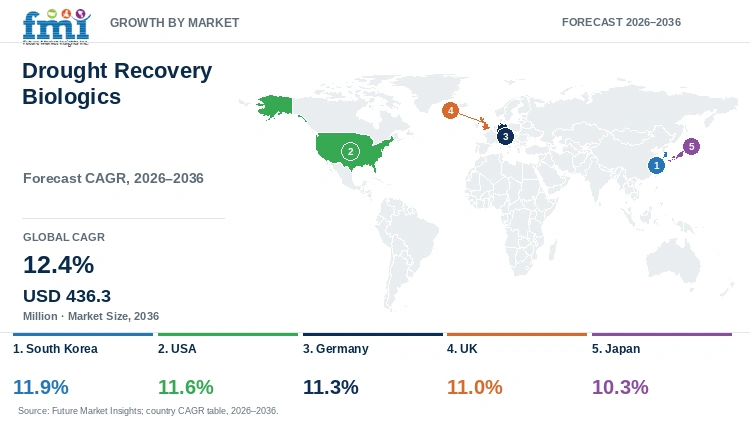
FMI ranks South Korea first among profiled countries, with sales of drought recovery biologics rising at an 11.9% CAGR from 2026 to 2036. Japan grows slowest at 10.3% over the same period, and the USA, Germany and the UK fall in between. Sales in each country rise with the farmland area left short of water in a season and with label rules allowing a drought-tolerance claim.
Table 6: Country CAGRs and Primary Growth Levers for the Drought Recovery Biologics Market (CAGR percentage), 2026 to 2036
| Country | CAGR (2026-2036) | Primary Growth Lever |
|---|---|---|
| South Korea | 11.9% | Ministry-backed nutrient sprays on drought-hit farms |
| USA | 11.6% | Seed treatments for corn and soybeans |
| Germany | 11.3% | Pre-flowering passes on rapeseed and winter wheat |
| UK | 11% | Stress tools that need no irrigation water |
| Japan | 10.3% | Trial-backed labels under the MAFF guideline |
Source: Future Market Insights
South Korea Drought Recovery Biologics Market Outlook (2026-2036)
In August 2026, the agriculture ministry said crop growth councils would support nutrient spraying, pest control and emergency watering on farms hit by heat and drought [22]. Sales of drought recovery biologics in South Korea gain directly from this state-backed spray work. Gangwon Yeongdong had only 34.2% of normal summer rain in 2025 [6]. In July 2026 the shortage moved to southern farms [12], so dealers find stocking by region harder to plan. South Korea is still set for an 11.9% CAGR through 2036, the top rate of the five profiled countries.
Key takeaway: Ministry spray rounds on drought-hit farms give suppliers the quickest route to Korean growers.
USA Drought Recovery Biologics Market Outlook (2026-2036)
American sales of drought recovery biologics are set to grow at an 11.6% CAGR through 2036, ranking second of the five. Budgets for new inputs are tight on row-crop farms, as USDA forecasts 2026 net farm income at USD 158.4 billion, down 2.6% from 2025 [23]. Drought is too wide to ignore, with 46% of corn area and 47% of soybean area in drought in March 2026 [1]. Demand for seed treatments against drought stress in corn and soybeans is growing, as Acadian Plant Health now sells an Abiotic Stress Management seed treatment for maize, soybean and wheat [17]. The Plant Biostimulant Act of 2025, once passed by Congress, would add abiotic stress tolerance to a federal biostimulant definition [14].
Key takeaway: Seed-applied stress products suit American corn and soybean growers watching every dollar of input spend.
Germany Drought Recovery Biologics Market Outlook (2026-2036)
A dry spring and a June heatwave during grain fill cut the German harvest in 2026. The farmers' association DBV expects 41.9 million tonnes of grain, 7% below 2025 [4]. Germany is forecast at an 11.3% CAGR through 2036, third among the five profiled countries. Winter rapeseed yields fell by 20% [4], so suppliers timing a pass before rapeseed and winter wheat flower stand to gain the most. Demand for drought stress products is uneven across the country. Losses were worst in the south and west [4], and Bavaria was heading for the driest spring since 1881 [8].
Key takeaway: German sales follow the timing of a stress pass on rapeseed and wheat before flowering.
UK Drought Recovery Biologics Market Outlook (2026-2036)
The UK has no rules written for plant biostimulants yet, and a Defra consultation on fertiliser rules, opened in March 2026, asked growers and suppliers about biostimulant use [24]. Irrigation is tight in the meantime, with 467 abstraction licence restrictions in force across England in September 2026 [7]. The UK is set for an 11% CAGR through 2036, the fourth-highest profiled rate. Drought stress products needing no extra water are expected to sell well on eastern cereal farms once a clear label route exists.
Key takeaway: A clear UK label route for biostimulants would open the next stage of sales growth.
Japan Drought Recovery Biologics Market Outlook (2026-2036)
Japan's MAFF issued biostimulant labelling guidelines in May 2025 that list tolerance to drought, high heat and salt among the effects a product may claim [21]. Japan follows at a 10.3% CAGR through 2036, last among the five profiled countries. Rice growers still turn first to pumps and rotational water sharing, the measures MAFF supported in the 2025 dry spell [13]. Suppliers need field trials of at least three replicates, repeated at least twice under different crop, climate or soil conditions, to back each claim [21]. Brands already holding Japanese rice trial data will be first to print heat and drought claims on the pack.
Key takeaway: Replicated local field trials set which brands can sell drought claims to Japanese farmers.
Who are the notable companies in the drought recovery biologics market?
UPL (NPP), Rovensa Next (Tradecorp), Acadian Plant Health, BioAtlantis, Hello Nature (Italpollina), Atlantica Agricola, Seipasa and Kimitec are the key companies profiled in this market.
The drought recovery biologics market is moderately fragmented, with crop-input groups, seaweed specialists and plant-based formulators selling different stress products. UPL (NPP), Rovensa Next and Kimitec add drought products to wider nutrition and crop protection ranges, and Acadian Plant Health and BioAtlantis build programs on seaweed extracts. Hello Nature, Atlantica Agricola and Seipasa sell amino acid, peptide and osmoprotectant products for set stress windows. Seed treatments, EU registrations and new plant capacity are the main tools suppliers use to reach more growers [15] [17] [5].
- Integrated biosolutions platforms: UPL (NPP), Rovensa Next (Tradecorp) and Kimitec sell drought products inside wider crop nutrition and crop protection ranges. Kimitec signed a biologicals partnership with Bayer in February 2023 [25], and UPL's NPP unit runs seven R&D field stations [26].
- Marine-based stress specialists: Acadian Plant Health and BioAtlantis build stress programs on seaweed extracts, and Acadian adds a seed treatment for maize, soybean and wheat [17].
- Plant-based recovery specialists: Hello Nature (Italpollina), Atlantica Agricola and Seipasa supply amino acid, peptide and osmoprotectant products for set stress windows.
Competitive Benchmarking: Drought Recovery Biologics Market
Table 7: Competitive Benchmarking for the Drought Recovery Biologics Market (qualitative capability ratings), 2026
| Company | Formulation | Application | Field Trials | Reach |
|---|---|---|---|---|
| UPL (NPP) | Medium | High | High | High |
| Rovensa Next | High | High | High | High |
| Acadian Plant Health | High | Medium | High | High |
| BioAtlantis | High | Medium | High | Medium |
| Hello Nature | High | High | High | High |
| Atlantica Agricola | High | High | Medium | Medium |
| Seipasa | High | Medium | High | Medium |
| Kimitec | Medium | Low | High | Medium |
High marks broad capability in drought or abiotic stress products, Medium marks a narrower product range, and Low marks limited public documentation.
Key Developments in the Drought Recovery Biologics Market
- In September 2025, Atlantica Agricola set out an avocado anti-stress program built on Archer Osmocare, applied ahead of expected heat or water stress [18].
- In June 2025, Hello Nature began expanding the biostimulant plant in Novara, Italy, a project set to double the site's production capacity [5].
- Growers can now buy a paired stress program from Rovensa Next, which launched Biostimulation 360º in May 2025 with Phylgreen before stress and Delfan Plus during and after stress [16].
- In February 2025, Acadian Plant Health launched an Abiotic Stress Management portfolio for crops facing drought, flooding and severe weather [20]. The range is expected to widen seed and foliar options for row-crop growers.
Key Players in the Drought Recovery Biologics Market
Integrated Biosolutions Platforms
- UPL Limited (NPP)
- Rovensa Next (Tradecorp)
- Kimitec Group
Marine-Based Stress-Management Specialists
- Acadian Plant Health (Acadian Seaplants Limited)
- BioAtlantis Ltd.
Plant-Based and Targeted Recovery Specialists
- Hello Nature (formerly Italpollina)
- Atlantica Agricola S.A.
- Seipasa S.A.
Drought Recovery Biologics Market - Report Scope
Table 8: Report Scope for the Drought Recovery Biologics Market (coverage fields and definitions), 2026 to 2036
| Coverage field | Report scope |
|---|---|
| Market breakdown | Product type; crop type; application method; farm type; sales channel; region |
| Quantitative units | USD million |
| Market definition | Revenue at first sale from biologic formulations that protect crops before water deficit or support recovery after drought. Covered products include osmoprotectant blends, seaweed-based formulations, amino acid blends and anti-transpirant combinations. Irrigation equipment, drought-tolerant seed genetics, general fertilizer revenue and crop value are excluded. |
| Regions covered | North America; Latin America; Western Europe; Eastern Europe; East Asia; South Asia and Pacific; Middle East and Africa |
| Countries covered | South Korea; USA; Germany; UK; Japan |
| Key companies profiled | UPL (NPP), Rovensa Next (Tradecorp), Acadian Plant Health, BioAtlantis, Hello Nature (Italpollina), Atlantica Agricola, Seipasa, Kimitec |
| Forecast period | 2026 to 2036 |
| Approach | Bottom-up sizing by treated hectares, passes per season and product price for each crop. Totals are checked against top-down biostimulant sales, drought-affected crop area and distributor sell-through in each profiled country. |
Drought Recovery Biologics Market - Research Methodology
Table 9: Research Methodology for the Drought Recovery Biologics Market (research methods and approach), 2026 edition
| Method | Approach |
|---|---|
| Primary Research | Interviews were held with biostimulant manufacturers, agri-input distributors, cooperative agronomists, crop advisers and farm managers. Discussions covered stress timing, product choice, trial thresholds and reorder patterns. |
| Desk Research | Desk research reviews drought monitor and weather service records, agriculture ministry notices, biostimulant laws and registrations, company product sheets and crop stress research. |
| Market Sizing and Forecasting | The forecast model uses the 2025 base value with segment shares, treated area by crop, passes per season, product price and drought exposure by country. |
| Data Validation | Estimates are checked against weather data, regulatory records, company releases and dealer interviews. Fertilizer, irrigation hardware and seed revenue are excluded, and products sold through two channels are counted once. |
Drought Recovery Biologics Market by Segments
Drought Recovery Biologics Market segmented by Product Type:
- Osmoprotectant blends (glycine betaine / proline)
- Seaweed-based formulations
- Amino acid blends
- Anti-transpirant combos
- Others
Drought Recovery Biologics Market segmented by Crop Type:
- Cereals & grains
- Fruits & vegetables
- Oilseeds & pulses
- Turf & ornamentals
- Others
Drought Recovery Biologics Market segmented by Application Method:
- Soil application
- Foliar application
- Fertigation / drip
- Seed application
- Others
Drought Recovery Biologics Market segmented by Farm Type:
- Large commercial farms
- Mid-size farms
- Smallholders
- Greenhouses & nurseries
- Others
Drought Recovery Biologics Market segmented by Sales Channel:
- Agri-input distributors
- Cooperatives
- Agri-retail chains
- Online / direct-to-farm
- Others
Drought Recovery Biologics Market by Region
- North America
- United States
- Canada
- Latin America
- Brazil
- Mexico
- Argentina
- Chile
- Western Europe
- Germany
- France
- United Kingdom
- Italy
- Spain
- Benelux
- Nordics
- Eastern Europe
- Poland
- Czech Republic
- Romania
- Hungary
- East Asia
- Japan
- South Korea
- South Asia and Pacific
- ASEAN
- Australia and New Zealand
- Middle East and Africa
- GCC Countries
- South Africa
- Türkiye
- Israel
Research Sources and Bibliography
- [1] U.S. Department of Agriculture, Office of the Chief Economist. (2026, March 10). Agriculture in Drought (percent of commodities in D1+ drought).https://www.usda.gov/oce/weather/drought
- [2] Met Office. (2025, June 16). Met Office weather extremes: What are June's current records?.https://www.metoffice.gov.uk/blog/2025/met-office-weather-extremes-junes-current-records
- [3] Food and Agriculture Organization of the United Nations. (2023, October). The Impact of Disasters on Agriculture and Food Security 2023, Executive summary.https://openknowledge.fao.org/server/api/core/bitstreams/19764bec-3b8e-46a6-8680-1dbab43bccaa/content/impact-of-disasters-on-agriculture-and-food-2023/executive-summary.html
- [4] Lebensmittel Praxis (with dpa, reporting Deutscher Bauernverband). (2026, August 18). Erntebilanz 2026: Bauern erwarten deutlich weniger Getreide.https://lebensmittelpraxis.de/industrie-aktuell/49595-erntebilanz-2026-bauern-erwarten-deutlich-weniger-getreide.html
- [5] Hello Nature. (2025, June 26). Hello Nature Announces Major Expansion of Italian Biostimulant Production Facility.https://www.hello-nature.com/int/wp-content/uploads/sites/5/2025/06/PR-EN-Hello-Nature-Announces-Major-Expansion-of-Italian-Biostimulant-Production-Facility.pdf
- [6] Korea Meteorological Administration. (2026, March 25). 2025.https://www.kma.go.kr/kma/news/press.jsp?bid=press&from=2026-02-12&mode=view&num=1194622&page=3&to=2026-05-12
- [7] Environment Agency. (2026, September 18 (updated 2026, October 2)). Dry weather and drought in England, 11 to 17 September 2026.https://www.gov.uk/government/publications/dry-weather-and-drought-in-england-2026-summary-reports/dry-weather-and-drought-in-england-11-to-17-september-2026
- [8] Deutscher Wetterdienst. (2026, May 29). Deutschlandwetter im Frühling 2026 (press release, hosted by DKKV).https://dkkv.org/wp-content/uploads/2026/06/2026-05-29-Deutschlandwetter-Fruehling-2026.pdf
- [9] United Nations Convention to Combat Desertification. (2025, July). Drought Hotspots Around the World 2023-2025.https://www.unccd.int/resources/publications/drought-hotspots-around-world-2023-2025
- [10] DTN/Progressive Farmer. (2026, August 12). 2026 Digital Yield Tour - North Dakota (July drought gripped North Dakota).https://www.dtnpf.com/agriculture/web/ag/crops/article/2026/08/12/july-drought-gripped-north-dakota
- [11] Deutscher Wetterdienst. (2025, May 30). Deutschlandwetter im Frühjahr 2025 (press release, hosted by Rhineland-Palatinate state portal).https://www.wetter.rlp.de/Internet/global/Themen.nsf/0d1b8766d2065806c125812c00399435/b7db38b5856e1438c1258c9d004dec0a/$FILE/2025-05-30%20Deutschlandwetter%20Fru%CC%88hjahr%202025.pdf
- [12] M-Economy News (reporting Ministry of Agriculture, Food and Rural Affairs, Korea). (2026, July 24)..https://www.m-economynews.com/news/article.html?no=69064
- [13] Ministry of Agriculture, Forestry and Fisheries of Japan. (2025, July 30)..https://www.maff.go.jp/j/press/nousin/mizu/250730.html
- [14] U.S. House of Representatives, 119th Congress. (2025, June 5). H.R. 3783, Plant Biostimulant Act of 2025 (introduced).https://www.govinfo.gov/content/pkg/BILLS-119hr3783ih/html/BILLS-119hr3783ih.htm
- [15] Seipasa. (2025, March 28). Seipasa introduces SeiZen as a new biostimulant registered in Europe.https://seipasa.com/en/news/seizen-new-biostimulant-with-european-registration/
- [16] Rovensa Next. (2025, May 12). Rovensa Next launches Biostimulation 360º, a holistic science-driven approach to sustainability maximizing grower profitability.https://www.rovensanext.com/news/biosolutions/rovensa-next-launches-biostimulation-360o-a-holistic-science-driven-approach-to-sustainability-maximizing-grower-profitability/
- [17] Global Agriculture. (2025, May 19). Acadian launches advanced biostimulant seed treatment for abiotic stress management.https://www.global-agriculture.com/biologicals/acadian-launches-advanced-biostimulant-seed-treatment-for-abiotic-stress-management/
- [18] Atlantica Agricola. (2025, September 18). Anti-stress biostimulation strategies for avocado cultivation.https://www.atlanticaagricola.com/en/blog/anti-stress-biostimulation-strategies-for-avocado-cultivation/
- [19] European Commission, European Maritime Forum (EU4Algae). (2024, February 7). How BioAtlantis pioneering technology is helping create climate-resilient cereals under the EU-funded BOOSTER project.https://maritime-forum.ec.europa.eu/news/eu4algae-insiders-perspective-how-bioatlantis-pioneering-technology-helping-create-climate-resilient-2024-02-07_en
- [20] Acadian Plant Health. (2025, February 19). Acadian Plant Health sets new standard for crop resilience with Abiotic Stress Management portfolio.https://acadianplanthealth.com/resources/news/new-abiotic-stress-management-portfolio/
- [21] Ministry of Agriculture, Forestry and Fisheries of Japan. (2025, May 30). https://www.maff.go.jp/j/syouan/attach/pdf/biostimulant-28.pdf
- [22] Financial News (reporting Ministry of Agriculture, Food and Rural Affairs, Korea). (2026, August 6).https://www.fnnews.com/news/202608061309204268
- [23] U.S. Department of Agriculture, Economic Research Service. (2026, September 3). Highlights From the Farm Income Forecast.https://www.ers.usda.gov/topics/farm-economy/farm-sector-income-finances/highlights-from-the-farm-income-forecast
- [24] Department for Environment, Food and Rural Affairs. (2026, March 19). UK fertilisers: regulatory reform (consultation document).https://consult.defra.gov.uk/fertilisers-team/uk-fertilisers-regulatory-reform/supporting_documents/final-fertilisers-english-2026pdf
- [25] Bayer AG. (2023, February 2). Bayer and Kimitec join forces to bring the next generation of Biologicals to millions of growers worldwide.https://www.bayer.com/media/download/1312776/2023-0024e.pdf
- [26] UPL Limited. (2025, July). Sustainability Report 2024-25.https://www.upl-ltd.com/downloads/Sustainability-Reports-2024-25.pdf
This bibliography is provided for reader reference. The full report contains the complete reference list and detailed citations.
This Report Answers
- What is the size of the drought recovery biologics market in 2026?
- By 2036, what value will sales of drought recovery biologics reach?
- Which product type leads sales, and why do growers prefer that product?
- Which crop type takes the most drought stress product orders, and which application method leads?
- Which profiled country grows fastest, and which grows slowest?
- Which biostimulant suppliers lead the market, and on what basis do these suppliers compete?
Frequently Asked Questions
How large is the drought recovery biologics market expected in 2026?
FMI values drought recovery biologics at USD 135.6 million in 2026, up from USD 120.6 million in 2025. Sales will reach USD 436.3 million by 2036 as dry seasons return more often in major crop regions.
What CAGR is projected for the drought recovery biologics market through 2036?
FMI projects a 12.4% CAGR for drought recovery biologics from 2026 to 2036. Paired pre-stress and recovery passes will add value per treated hectare over the forecast period.
Which product type holds a notable market share in 2026?
Glycine betaine and proline blends lead product type with 46.8% of 2026 sales. Growers apply these blends before a forecast dry spell, so the blends will remain the first product in most stress programs.
Which crop type holds a notable share in 2026?
Cereals and grains take 45.3% of crop type sales in 2026. Wide wheat and maize areas will keep turning a small dose per hectare into large orders.
Which country has a notable expansion outlook through 2036?
South Korea will post the fastest growth among profiled countries, at an 11.9% CAGR from 2026 to 2036. Repeated summer droughts and ministry-backed spray work on affected farms will support this pace.
Who are the key companies in the drought recovery biologics market?
Key companies include UPL (NPP), Rovensa Next (Tradecorp), Acadian Plant Health, BioAtlantis, Hello Nature (Italpollina), Atlantica Agricola, Seipasa and Kimitec. These suppliers compete on stress-product range, field trial data and distributor reach.
Preview the report firsthand - request a free sample
Get SampleGet the brochure for pricing and purchase details.
Get PDFTable of Content
- Key Takeaways
- Market Size and CAGR
- Top Growth Driver
- Fastest Growing Segment
- Leading Region
- Key Companies
- Emerging Opportunities
- Executive Summary
- Global Market Outlook
- Demand-side Trends
- Supply-side Trends
- Technology Roadmap Analysis
- Analysis and Recommendations
- Analyst Perspective (What is happening? Why now? What should investors know?)
- Key Questions Answered
- How large is the market?
- What is the CAGR?
- What are key trends?
- Which region dominates?
- Who are the leaders?
- Market Overview
- Market Coverage / Taxonomy
- Market Definition / Scope / Limitations
- Research Methodology
- Chapter Orientation
- Analytical Lens and Working Hypotheses
- Market Structure, Signals, and Trend Drivers
- Benchmarking and Cross-market Comparability
- Market Sizing, Forecasting, and Opportunity Mapping
- Research Design and Evidence Framework
- Desk Research Programme (Secondary Evidence)
- Expert Input and Fieldwork (Primary Evidence)
- Tooling, Models, and Reference Databases
- Data Engineering and Model Build
- Quality Assurance and Audit Trail
- Market Background
- Market Dynamics (Drivers, Restraints, Opportunity, Trends)
- Scenario Forecast (Optimistic, Likely, Conservative)
- Impact Analysis
- AI Impact
- Sustainability Impact
- Regulatory Impact
- Technology Impact
- Consumer / Buyer Analysis
- Purchase Drivers
- Adoption Barriers
- Buyer Journey
- Opportunity Map Analysis
- Product Life Cycle Analysis
- Supply Chain Analysis
- Investment Feasibility Matrix
- Value Chain Analysis
- PESTLE and Porter's Analysis
- Regulatory Landscape
- Regional Parent Market Outlook
- Production and Consumption Statistics
- Import and Export Statistics
- Global Market Analysis and Forecast, 2021 to 2036
- Historical Market Size Value (USD Million) Analysis, 2021 to 2025
- Current and Future Market Size Value (USD Million) Projections, 2026 to 2036
- Y-o-Y Growth Trend Analysis
- Absolute $ Opportunity Analysis
- Global Market Pricing Analysis, 2021 to 2036
- Global Market Analysis and Forecast, By Product Type, 2021 to 2036
- Introduction / Key Findings
- Historical Market Size Value (USD Million) Analysis By Product Type, 2021 to 2025
- Current and Future Market Size Value (USD Million) Analysis and Forecast By Product Type, 2026 to 2036
- Osmoprotectant blends (glycine betaine / proline)
- Seaweed-based formulations
- Amino acid blends
- Anti-transpirant combos
- Others
- Y-o-Y Growth Trend Analysis By Product Type, 2021 to 2025
- Absolute $ Opportunity Analysis By Product Type, 2026 to 2036
- Global Market Analysis and Forecast, By Crop Type, 2021 to 2036
- Introduction / Key Findings
- Historical Market Size Value (USD Million) Analysis By Crop Type, 2021 to 2025
- Current and Future Market Size Value (USD Million) Analysis and Forecast By Crop Type, 2026 to 2036
- Cereals & grains
- Fruits & vegetables
- Oilseeds & pulses
- Turf & ornamentals
- Others
- Y-o-Y Growth Trend Analysis By Crop Type, 2021 to 2025
- Absolute $ Opportunity Analysis By Crop Type, 2026 to 2036
- Global Market Analysis and Forecast, By Application Method, 2021 to 2036
- Introduction / Key Findings
- Historical Market Size Value (USD Million) Analysis By Application Method, 2021 to 2025
- Current and Future Market Size Value (USD Million) Analysis and Forecast By Application Method, 2026 to 2036
- Soil application
- Foliar application
- Fertigation / drip
- Seed application
- Others
- Y-o-Y Growth Trend Analysis By Application Method, 2021 to 2025
- Absolute $ Opportunity Analysis By Application Method, 2026 to 2036
- Global Market Analysis and Forecast, By Farm Type, 2021 to 2036
- Introduction / Key Findings
- Historical Market Size Value (USD Million) Analysis By Farm Type, 2021 to 2025
- Current and Future Market Size Value (USD Million) Analysis and Forecast By Farm Type, 2026 to 2036
- Large commercial farms
- Mid-size farms
- Smallholders
- Greenhouses & nurseries
- Others
- Y-o-Y Growth Trend Analysis By Farm Type, 2021 to 2025
- Absolute $ Opportunity Analysis By Farm Type, 2026 to 2036
- Global Market Analysis and Forecast, By Sales Channel, 2021 to 2036
- Introduction / Key Findings
- Historical Market Size Value (USD Million) Analysis By Sales Channel, 2021 to 2025
- Current and Future Market Size Value (USD Million) Analysis and Forecast By Sales Channel, 2026 to 2036
- Agri-input distributors
- Cooperatives
- Agri-retail chains
- Online / direct-to-farm
- Others
- Y-o-Y Growth Trend Analysis By Sales Channel, 2021 to 2025
- Absolute $ Opportunity Analysis By Sales Channel, 2026 to 2036
- Global Market Analysis and Forecast, By Region, 2021 to 2036
- Introduction
- Historical Market Size Value (USD Million) Analysis By Region, 2021 to 2025
- Current Market Size Value (USD Million) Analysis and Forecast By Region, 2026 to 2036
- North America
- Latin America
- Western Europe
- Eastern Europe
- East Asia
- South Asia and Pacific
- Middle East and Africa
- Market Attractiveness Analysis By Region
- North America Market Analysis and Forecast, By Country, 2021 to 2036
- Historical Market Size Value (USD Million) Trend Analysis By Market Taxonomy, 2021 to 2025
- Market Size Value (USD Million) Forecast By Market Taxonomy, 2026 to 2036
- By Country
- United States
- Canada
- By Product Type
- By Crop Type
- By Application Method
- By Farm Type
- By Sales Channel
- By Country
- Market Attractiveness Analysis
- By Country
- By Product Type
- By Crop Type
- By Application Method
- By Farm Type
- By Sales Channel
- Key Takeaways
- Latin America Market Analysis and Forecast, By Country
- Historical Market Size Value (USD Million) Trend Analysis By Market Taxonomy, 2021 to 2025
- Market Size Value (USD Million) Forecast By Market Taxonomy, 2026 to 2036
- By Country
- Brazil
- Mexico
- Argentina
- Chile
- By Product Type
- By Crop Type
- By Application Method
- By Farm Type
- By Sales Channel
- By Country
- Market Attractiveness Analysis
- By Country
- By Product Type
- By Crop Type
- By Application Method
- By Farm Type
- By Sales Channel
- Key Takeaways
- Western Europe Market Analysis and Forecast, By Country
- Historical Market Size Value (USD Million) Trend Analysis By Market Taxonomy, 2021 to 2025
- Market Size Value (USD Million) Forecast By Market Taxonomy, 2026 to 2036
- By Country
- Germany
- France
- United Kingdom
- Italy
- Spain
- Benelux
- Nordics
- By Product Type
- By Crop Type
- By Application Method
- By Farm Type
- By Sales Channel
- By Country
- Market Attractiveness Analysis
- By Country
- By Product Type
- By Crop Type
- By Application Method
- By Farm Type
- By Sales Channel
- Key Takeaways
- Eastern Europe Market Analysis and Forecast, By Country
- Historical Market Size Value (USD Million) Trend Analysis By Market Taxonomy, 2021 to 2025
- Market Size Value (USD Million) Forecast By Market Taxonomy, 2026 to 2036
- By Country
- Poland
- Czech Republic
- Romania
- Hungary
- By Product Type
- By Crop Type
- By Application Method
- By Farm Type
- By Sales Channel
- By Country
- Market Attractiveness Analysis
- By Country
- By Product Type
- By Crop Type
- By Application Method
- By Farm Type
- By Sales Channel
- Key Takeaways
- East Asia Market Analysis and Forecast, By Country
- Historical Market Size Value (USD Million) Trend Analysis By Market Taxonomy, 2021 to 2025
- Market Size Value (USD Million) Forecast By Market Taxonomy, 2026 to 2036
- By Country
- Japan
- South Korea
- By Product Type
- By Crop Type
- By Application Method
- By Farm Type
- By Sales Channel
- By Country
- Market Attractiveness Analysis
- By Country
- By Product Type
- By Crop Type
- By Application Method
- By Farm Type
- By Sales Channel
- Key Takeaways
- South Asia and Pacific Market Analysis and Forecast, By Country
- Historical Market Size Value (USD Million) Trend Analysis By Market Taxonomy, 2021 to 2025
- Market Size Value (USD Million) Forecast By Market Taxonomy, 2026 to 2036
- By Country
- ASEAN
- Australia and New Zealand
- By Product Type
- By Crop Type
- By Application Method
- By Farm Type
- By Sales Channel
- By Country
- Market Attractiveness Analysis
- By Country
- By Product Type
- By Crop Type
- By Application Method
- By Farm Type
- By Sales Channel
- Key Takeaways
- Middle East and Africa Market Analysis and Forecast, By Country
- Historical Market Size Value (USD Million) Trend Analysis By Market Taxonomy, 2021 to 2025
- Market Size Value (USD Million) Forecast By Market Taxonomy, 2026 to 2036
- By Country
- GCC Countries
- South Africa
- Türkiye
- Israel
- By Product Type
- By Crop Type
- By Application Method
- By Farm Type
- By Sales Channel
- By Country
- Market Attractiveness Analysis
- By Country
- By Product Type
- By Crop Type
- By Application Method
- By Farm Type
- By Sales Channel
- Key Takeaways
- Key Countries Market Analysis
- United States
- Pricing Analysis
- Market Share Analysis, 2025
- By Product Type
- By Crop Type
- By Application Method
- By Farm Type
- By Sales Channel
- Canada
- Pricing Analysis
- Market Share Analysis, 2025
- By Product Type
- By Crop Type
- By Application Method
- By Farm Type
- By Sales Channel
- Mexico
- Pricing Analysis
- Market Share Analysis, 2025
- By Product Type
- By Crop Type
- By Application Method
- By Farm Type
- By Sales Channel
- Brazil
- Pricing Analysis
- Market Share Analysis, 2025
- By Product Type
- By Crop Type
- By Application Method
- By Farm Type
- By Sales Channel
- Chile
- Pricing Analysis
- Market Share Analysis, 2025
- By Product Type
- By Crop Type
- By Application Method
- By Farm Type
- By Sales Channel
- Germany
- Pricing Analysis
- Market Share Analysis, 2025
- By Product Type
- By Crop Type
- By Application Method
- By Farm Type
- By Sales Channel
- United Kingdom
- Pricing Analysis
- Market Share Analysis, 2025
- By Product Type
- By Crop Type
- By Application Method
- By Farm Type
- By Sales Channel
- Italy
- Pricing Analysis
- Market Share Analysis, 2025
- By Product Type
- By Crop Type
- By Application Method
- By Farm Type
- By Sales Channel
- Spain
- Pricing Analysis
- Market Share Analysis, 2025
- By Product Type
- By Crop Type
- By Application Method
- By Farm Type
- By Sales Channel
- France
- Pricing Analysis
- Market Share Analysis, 2025
- By Product Type
- By Crop Type
- By Application Method
- By Farm Type
- By Sales Channel
- ASEAN
- Pricing Analysis
- Market Share Analysis, 2025
- By Product Type
- By Crop Type
- By Application Method
- By Farm Type
- By Sales Channel
- Australia and New Zealand
- Pricing Analysis
- Market Share Analysis, 2025
- By Product Type
- By Crop Type
- By Application Method
- By Farm Type
- By Sales Channel
- Japan
- Pricing Analysis
- Market Share Analysis, 2025
- By Product Type
- By Crop Type
- By Application Method
- By Farm Type
- By Sales Channel
- South Korea
- Pricing Analysis
- Market Share Analysis, 2025
- By Product Type
- By Crop Type
- By Application Method
- By Farm Type
- By Sales Channel
- Poland
- Pricing Analysis
- Market Share Analysis, 2025
- By Product Type
- By Crop Type
- By Application Method
- By Farm Type
- By Sales Channel
- Hungary
- Pricing Analysis
- Market Share Analysis, 2025
- By Product Type
- By Crop Type
- By Application Method
- By Farm Type
- By Sales Channel
- Türkiye
- Pricing Analysis
- Market Share Analysis, 2025
- By Product Type
- By Crop Type
- By Application Method
- By Farm Type
- By Sales Channel
- South Africa
- Pricing Analysis
- Market Share Analysis, 2025
- By Product Type
- By Crop Type
- By Application Method
- By Farm Type
- By Sales Channel
- United States
- Market Structure Analysis
- Competition Dashboard
- Competition Benchmarking
- Market Share Analysis of Top Players
- By Regional
- By Product Type
- By Crop Type
- By Application Method
- By Farm Type
- By Sales Channel
- Emerging Startups
- Innovation Benchmarking
- Competition Analysis
- Competition Deep Dive
- UPL (NPP)
- Overview
- Product Portfolio
- Profitability by Market Segments
- Sales Footprint
- Strategy Overview
- Marketing Strategy
- Product Strategy
- Channel Strategy
- Rovensa Next
- Acadian Plant Health
- BioAtlantis
- Hello Nature
- Atlantica Agricola
- Seipasa
- Kimitec
- UPL Limited (NPP)
- Rovensa Next (Tradecorp)
- Kimitec Group
- Acadian Plant Health (Acadian Seaplants Limited)
- BioAtlantis Ltd.
- Hello Nature (formerly Italpollina)
- Atlantica Agricola S.A.
- Seipasa S.A.
- UPL (NPP)
- Case Studies
- Success Stories
- Recent Developments
- Competition Deep Dive
- Assumptions & Acronyms Used


