

- Market Size (2026)
- USD 110.2 Mn
- Forecast (2036)
- USD 301.7 Mn
- CAGR (2026 to 2036)
- 10.6%
How big is Drought Root Protectors Market in 2026?
Sales in the drought root protectors market are projected to grow at 10.6% CAGR through 2036. Market size rises from USD 99.6 million in 2025 to USD 110.2 million in 2026 and is expected to reach USD 301.7 million by 2036.
FMI estimates drought root protectors market to increase from USD 99.6 million in 2025 to USD 110.2 million in 2026 and reach USD 301.7 million by 2036 at 10.6% CAGR. From a demand outlook, these products support plant water balance around active roots during establishment, flowering and grain-fill stress. Planned crop protection instead of rescue treatment is expected to upkeep demand. USDA reported in January 2026 that irrigation represented 47% of United States freshwater withdrawals during 2010 to 2020, while irrigated farms generated more than 50% of crop sales from less than 17% of harvested cropland.[1] This is likely to support root-zone application across irrigated acreage.
Adoption patterns differ as soil application and fertigation place products near active roots, whereas uncertain response restricts purchases without measured moisture conditions. The USA is projected to expand at 10.2% CAGR during 2026 to 2036, while South Korea follows at 9.9%. Wider crop acreage supports the USA, while water investment will upkeep South Korean adoption. Drought.gov reported in January 2026 that drought covered 35.8% of the United States at the end of 2025.[2] As per FMI analysis, irrigation-compatible formulations are likely to receive preference. Use with agricultural biostimulants can create growth prospects within planned irrigation programs.
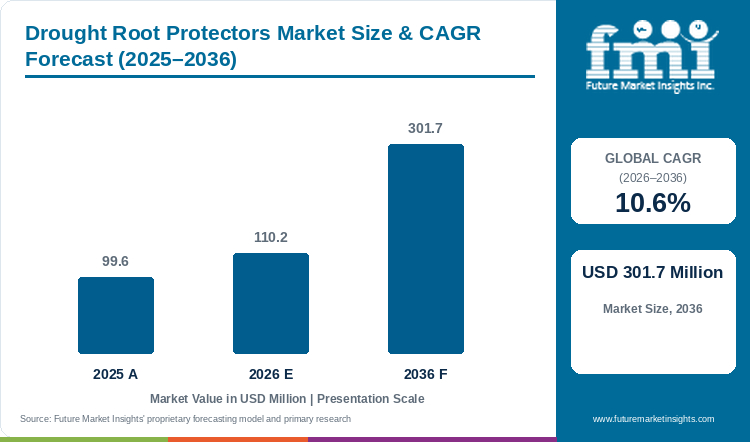
Drought Root Protectors Market Size & CAGR Forecast (2025-2036)
| Year | Basis | Market value (USD million) |
|---|---|---|
| 2025 | Actual | 99.6 |
| 2026 | Estimate | 110.2 |
| 2036 | Forecast | 301.7 |
| CAGR, 2026 to 2036 | 10.6% | |
Source: Future Market Insights proprietary forecasting model and primary research.
Key Takeaways
- Recurring drought and irrigation pressure are shifting drought protection from rescue treatment towards planned crop-stage application.
- Based on product type, osmoprotectant blends are projected to account for 45.3% in 2026, supported by their role in cellular water balance.
- By crop type, cereals and grains are estimated to hold 48.4% in 2026, owing to broad acreage and per-acre treatment planning.
- In 2026, soil application is expected to lead application method with 44.6% share, driven by direct placement around active roots.
- USA is projected at 10.2% CAGR through 2036, while South Korea follows at 9.9% owing to different irrigation and water-investment conditions.
- Key participants include Hello Nature, Atlantica Agricola, Seipasa, Kimitec, Plant Health Care, BRANDT, Biolchim, and Valagro. These companies are focusing on stress-response formulations, field evidence, registration and crop-channel support.
Analyst Perspective
“I see higher adoption where growers can connect root protection with measured water deficit and the right crop stage. Products carrying local field results and simple irrigation use will receive stronger preference across drought-prone farms.”
- Nikhil Kaitwade, Principal Consultant, Future Market Insights.
How is the drought root protectors market segmented?
Drought root protectors market is segmented by five primary commercial axes and region: product type, crop type, application method, farm type, sales channel, and region. In 2026, osmoprotectant blends are projected at 45.3%, cereals and grains at 48.4%, soil application at 44.6%, large commercial farms at 43.7%, and agri-input distributors at 45.1%.
Drought root protectors market is segmented by product type, crop type, application method, farm type, sales channel, and region.
By product type: osmoprotectant blends, seaweed-based formulations, amino acid blends, anti-transpirant combinations, and others.
By crop type: cereals and grains, fruits and vegetables, oilseeds and pulses, turf and ornamentals, and others.
By application method: soil application, foliar application, fertigation or drip, seed application, and others.
By farm type: large commercial farms, mid-size farms, smallholders, greenhouses and nurseries, and others.
By sales channel: agri-input distributors, cooperatives, agri-retail chains, online or direct-to-farm, and others.
By region: North America, Latin America, Western Europe, Eastern Europe, East Asia, South Asia and Pacific, and Middle East and Africa.
Why do osmoprotectant blends hold notable product type demand?
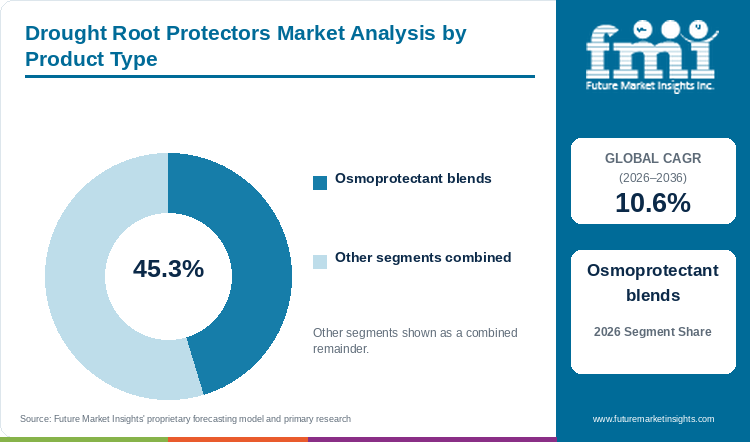
Based on product type, osmoprotectant blends are projected to account for 45.3% in 2026, supported by cellular stress protection.
| Product type | Share (2026) |
|---|---|
| Osmoprotectant blends | 45.3% |
| Other segments combined | 54.7%* |
| Total | 100.0% |
| Metric | Value |
|---|---|
| Global CAGR (2026-2036) | 10.6% |
| Leading segment | Osmoprotectant blends |
Water deficit changes cellular water balance before visible crop injury is noticed, owing to which osmoprotectant blends are gaining preference in drought programs. A 2025 scientific review described glycine betaine as an osmoprotectant supporting cellular homeostasis under drought and related stress.[3] This property is widening the application of blends where growers require a defined stress mechanism and crop-stage guidance. Water-loss management is also supported through heat recovery biologics, although these products should not be included under every root-protection application.
- Osmoprotectant blends are projected to hold 45.3% of product type demand in 2026. Their use is increasing across formulations developed for cellular water balance during drought stress.
- In June 2025, BRANDT reported 10,000 to 20,000 ppm betaines in Seaweed Max. Availability of quantified composition is supporting its use across drought-stress programs.
What supports cereals and grains as a preferred crop category?
By crop type, cereals and grains are estimated to hold 48.4% in 2026, owing to broad acreage exposure.
Cereals and grains are cultivated over broad acreage, which makes per-acre treatment and comparison easier for growers. The UK Department for Environment, Food and Rural Affairs reported in January 2026 that wheat production reached 12 million tonnes in 2025, while barley production declined by 10% to 6.4 million tonnes.[4] Variation across cereal crops is increasing the need for crop-stage treatment and local field results before wider application. Use of seed stress protectors is also increasing during crop establishment where early root growth is exposed to limited soil moisture.
- According to FMI, cereals and grains are estimated to account for 48.4% of crop type demand in 2026. Broad acreage and defined drought periods are supporting repeatable application across commercial farms.
- Broadacre adoption is expected to increase where a treatment fits planting, spraying or irrigation schedules and continues to show results across locations.
How does soil application meet root-zone treatment needs?
In 2026, soil application is expected to lead application method with 44.6% share, driven by direct root placement.
Soil application places drought root protectors near active roots, which supports treatment before visible crop damage begins. Atlántica Agrícola stated in April 2026 that biostimulants are used during establishment, transplanting, flowering, stress prevention and recovery.[5] Wider application across these stages is supporting soil treatment where irrigation and label conditions allow a measured root-zone dose. Root-zone programs are also used with biofertilizers where product labels and compatibility allow combined crop planning.
- FMI research indicates that soil application will account for 44.6% of application-method demand in 2026. Direct placement near active roots supports the main purpose of drought root protectors.
- Irrigation-compatible formulations can remove a separate field pass when product labels permit tank use or integration with the irrigation system.
Why do large commercial farms retain notable farm type demand?
Large commercial farms are likely to capture 43.7% share in 2026, aided by structured field evaluation and protocol scale.
Large commercial farms can compare treated and untreated blocks before applying the same program over wider acreage. BRANDT published third-party soybean trials in June 2025, showing gains of 3.8 bushels per acre at one pint and 3.4 bushels per acre at two pints.[6] Such per-acre results are supporting structured field evaluation, although crop stage, soil moisture and drought intensity continues to change the final response. Biological seed carriers can also support formulation planning where a verified active needs to remain stable through planting.
- As noted by FMI, large commercial farms are projected to hold 43.7% of farm-type demand in 2026. Larger acreage allows repeated treatment protocols and comparison across crop blocks.
- Farm scale supports trial replication, while crop stage, soil moisture and local drought intensity continue to influence the final treatment response.
Which conditions keep agri-input distributors relevant in sales channels?
Agri-input distributors are set to lead sales channel with 45.1% share in 2026, underpinned by local agronomy access.
Drought root protectors require guidance for crop stage, dose, compatibility and stress timing, which is keeping agri-input distributors important in this market. Hello Nature announced in June 2025 that expansion of its Italian facility would double production capacity and support additional countries and distributors.[7] Increasing capacity and country reach is expected to improve seasonal availability where local advisers connect the product with crop requirements. Distributor recommendations can also include agricultural surfactants for approved foliar applications where spray coverage and compatibility are required.
- FMI data suggests that agri-input distributors will hold 45.1% of sales-channel demand in 2026. Local advice and seasonal availability continue to influence the selection of drought products.
- Technical distribution helps growers connect drought conditions with product labels, field timing and their existing crop-input programs.
What are the drivers, restraints, and opportunities in the drought root protectors market?
In the drought root protectors market, the key driver is recurring water deficit, the key restraint is variable field response, and the key opportunity is irrigation integration.
- Driver: Repeated drought changes stress management from a rescue purchase into a planned crop-input decision.
- Restraint: Performance can change with crop stage, soil moisture, formulation, dose, and severity of water deficit.
- Opportunity: Soil and fertigation products can enter repeat programs when timing is linked to measured irrigation.
Recurring Drought Alters Input Timing
Repeated drought is changing the time at which growers consider stress-management inputs. The World Meteorological Organization reported in September 2026 that below-normal river discharge affected over 36% of global basin area during 2025, alongside continuing declines in soil moisture and terrestrial water storage.[8] These measurements show whether establishment, flowering or grain fill is exposed to water deficit, which is creating demand for treatments used before visible crop damage and within an already planned farm operation. Humic and fulvic acid based biostimulants are also used in these programs where the product carries an abiotic-stress application.
Field Conditions Limit Transferability
One drought treatment does not perform under the same soil, crop stage and water-deficit condition across every farm. In March 2025, Seipasa obtained European registration for SeiZen under Product Function Category 6(B) for non-microbial plant biostimulants.[9] Requirement for an accepted product function and local crop results can extend the time required before wider use, which may restrict products carrying only broad drought claims. Microbial seed primers are also relevant where early root establishment and stress timing are connected.
Irrigation Creates Repeatable Treatment Windows
Measured irrigation is creating a clear point for applying drought root protectors instead of using them after crop damage becomes visible. Japan’s agriculture ministry reported in July 2026 that new high-temperature agriculture strategies include crop selection, water management and production measures.[10] Such programs are opening an application opportunity for root-zone products where dose and timing can be connected with an irrigation event. Fertigation microbe carriers can further support this application by scheduling water and approved biological inputs together.
Which country CAGRs are profiled in the drought root protectors market?
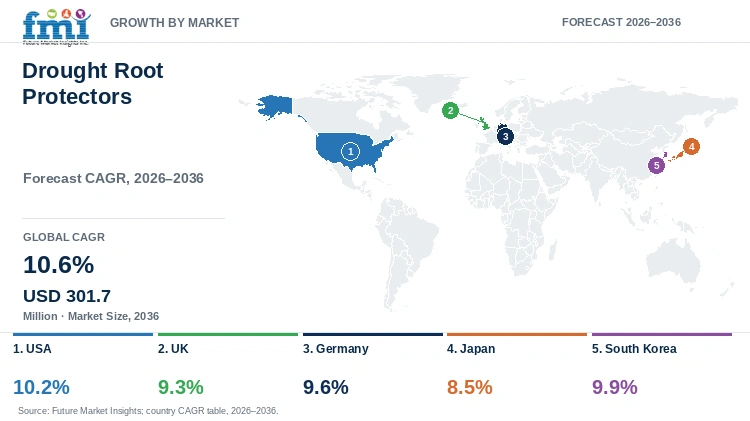
| Country | CAGR |
|---|---|
| USA | 10.2% |
| UK | 9.3% |
| Germany | 9.6% |
| Japan | 8.5% |
| South Korea | 9.9% |
How do country-level CAGRs compare in the drought root protectors market?
As per the analysis from FMI, country growth rates differ through 2036 as drought exposure, water management, crop structure and local agronomy are not uniform across markets.
- USA demand is supported by extensive irrigated acreage, established agronomy channels and recurring drought exposure.
- The UK market is influenced by abstraction limits, reservoir levels and drought planning across agricultural areas.
- Germany requires local crop evidence as rainfall, soil moisture and application conditions vary across regions.
- Japan uses specialty inputs along with tolerant crop varieties, coordinated irrigation and wider crop-adaptation programs.
- South Korea is connecting drought preparation with agricultural water infrastructure and extension support.
Full report country CAGRs cover: North America; Latin America; Western Europe; Eastern Europe; East Asia; South Asia and Pacific; Middle East and Africa.
Country-wise Analysis
- By 2036, the USA is projected to grow at 10.2% CAGR, owing to extensive crop acreage and established agronomy channels. USDA reported in January 2026 that corn production reached a record 17.0 billion bushels in 2025, increasing by 14% from 2024.[11] Large crop programs are creating room for field-scale evaluation, while drought root protectors will require crop-stage guidance and results under water deficit before wider use.
- Drought root protector demand in the UK is forecast to rise at 9.3% CAGR, influenced by abstraction controls and continuing crop water stress. The Environment Agency reported in January 2026 that England witnessed its driest spring since 1893 during 2025.[12] Nearly 9 million people were covered by hosepipe bans and 15 key reservoirs remained below 50% full at the end of September. Limited water availability is increasing planned drought management across farms, although root protectors cannot replace irrigation. Product adoption will depend on permitted water use, crop stage and local agronomy support.
- Germany’s drought root protectors outlook is anticipated to advance at 9.6% CAGR through 2036, supported by dry conditions and technical buying requirements. The German Environment Agency reported that spring 2026 rainfall reached 126 litres per square metre, equal to 74% of the 1991 to 2020 average.[13] Bavaria received only 45% of its usual rainfall and June precipitation remained uneven across the country. These conditions are increasing interest in root and water-stress products, but one field result cannot be applied across every region. Products having local crop evidence and a clear treatment schedule are expected to receive higher preference.
- Adoption of drought root protectors in Japan is estimated to expand at 8.5% CAGR through 2036, supported by crop-adaptation and water-management programs. Japan’s agriculture ministry reported in March 2026 that the 2025 summer averaged 2.36 degrees Celsius above the 1991 to 2020 baseline.[14] Heat-tolerant rice varieties covered 248,000 hectares, accounting for 18.2% of rice grown for staple use. Tolerant varieties and water control will remain the first response, whereas root protectors can be included where crop trials show an added response beside irrigation. Japanese crop programs may also use seed nutrient coatings where the product label supports stress-related application.
- South Korea is estimated to post 9.9% CAGR over the forecast period, backed by drought preparation and agricultural water investment. In March 2026, the Ministry of Agriculture, Food and Rural Affairs reported rainfall of 52.0 millimetres from January 1 to March 16, equal to 57.3% of normal.[15] The ministry also funded new agricultural water-supply facilities for drought-prone areas. Water infrastructure will remain the main response, while root products can support crops under limited-water conditions. Soil and fertigation applications are expected to gain adoption where advisers connect timing with irrigation intervals and crop stage.
Who are the notable companies in the drought root protectors market?
Hello Nature, Atlantica Agricola, Seipasa, Kimitec, Plant Health Care, BRANDT, Biolchim, and Valagro are notable companies profiled in this market.
In the FMI report, drought root protectors market includes peptide-platform providers, root and soil specialists and companies having a wider biological-input portfolio. Hello Nature and Plant Health Care are working through plant-response platforms, while Atlántica Agrícola, Seipasa and Biolchim are focusing on root development, soil use and abiotic stress. BRANDT is supporting products with composition and field-use information, whereas Valagro connects water-productivity products with wider crop programs. Buyers are mainly considering crop evidence, application route, registration, seasonal availability and local technical support before selecting a supplier.
- Plant-response platforms: Hello Nature, Kimitec, and Plant Health Care use peptides, discovery systems, or response-signalling approaches.
- Root-zone and stress-program specialists: Atlantica Agricola, Seipasa, and Biolchim connect rooting with abiotic-stress or soil programs.
- Broad agronomy portfolios: BRANDT and Valagro combine stress products with wider crop programs and international commercial reach.
Competitive Benchmarking: Drought Root Protectors Market
| Company | Stress formulation | Root-zone fit | Current activity | Reach |
|---|---|---|---|---|
| Hello Nature | High | Medium | High | High |
| Atlantica Agricola | High | High | Medium | Medium |
| Seipasa | High | High | High | Medium |
| Kimitec | Medium | Low | High | High |
| Plant Health Care | High | Medium | Medium | Medium |
| BRANDT | High | High | High | High |
| Biolchim | Medium | High | Medium | High |
| Valagro | High | High | High | High |
High indicates wider public evidence for the stated area, Medium indicates narrower evidence and Low indicates limited documented coverage. These ratings describe company capability and not product quality, revenue share or company rank.
Key Developments in the Drought Root Protectors Market
- In June 2025, Hello Nature announced expansion of its Italian biostimulant facility, with an intention of doubling capacity and supporting additional distributors and countries. Wider production availability is expected to support seasonal supply across new crop markets.
- In June 2025, BRANDT published a Seaweed Max bulletin covering betaines, amino acids, root-zone application and multi-state soybean trial results. The bulletin supports product use where growers require composition and per-acre field information.
- In March 2025, Seipasa obtained European registration for SeiZen under Product Function Category 6(B) for non-microbial plant biostimulants. The registration supports its use under a stated biostimulant product function.
- In January 2025, Syngenta announced a collaboration with TraitSeq for using artificial intelligence in biomarker discovery for biostimulant research. The collaboration is expected to support selection of plant-response candidates for further testing.
Key Players in the Drought Root Protectors Market
Plant-response and peptide platforms
- Hello Nature
- Plant Health Care
- Kimitec
Root-zone and stress-program specialists
- Atlantica Agricola
- Seipasa
- Biolchim
Broad agronomy and global biologicals portfolios
- BRANDT
- Valagro
Drought Root Protectors Market - Report Scope
| Coverage field | Report scope |
|---|---|
| Market breakdown | Product type, crop type, application method, farm type, sales channel, and region. |
| Quantitative units | USD million. |
| Market definition | Supplier revenue from crop inputs marketed to support root function or plant resilience under drought and related abiotic water stress. Commodity fertilizers used only for nutrition, irrigation equipment, and drought-tolerant seeds are excluded. |
| Regions covered | North America; Latin America; Western Europe; Eastern Europe; East Asia; South Asia and Pacific; Middle East and Africa. |
| Countries covered | USA, UK, Germany, Japan, South Korea, and additional countries in the full report. |
| Key companies profiled | Hello Nature, Atlantica Agricola, Seipasa, Kimitec, Plant Health Care, BRANDT, Biolchim, Valagro. |
| Forecast period | 2026 to 2036. |
| Approach | The report covers supplier activity, segment structure, delivery routes, and country demand within the stated boundary. |
Drought Root Protectors Market - Research Methodology
| Method | Approach |
|---|---|
| Primary Research | Primary research includes discussions with manufacturers, technology providers, distributors, end users, procurement teams and subject experts. These discussions cover product selection, adoption barriers, approval requirements, pricing and technical support required before regular purchasing. |
| Desk Research | Desk research includes government statistics, regulatory publications, trade data, technical literature, company filings, product information and official company announcements. Sources are selected according to date, relevance, geography and direct connection with drought, root or water-stress applications. |
| Market Sizing and Forecasting | Market sizing considers the 2025 value, historical demand, segment structure, pricing, volume, adoption and company participation. Country conditions, regulation, investment, technology use, purchasing cycles and supply availability are also considered for the 2026 to 2036 outlook. |
| Data Validation | Market values are compared with public data, company activity, trade patterns, industry developments and primary discussions. Adjacent products, overlapping revenues and activities without direct market relevance are excluded from the market scope. |
Drought Root Protectors Market by Segments
Drought Root Protectors Market segmented by Product Type:
- Osmoprotectant blends
- Seaweed-based formulations
- Amino acid blends
- Anti-transpirant combinations
- Others
Drought Root Protectors Market segmented by Crop Type:
- Cereals and grains
- Fruits and vegetables
- Oilseeds and pulses
- Turf and ornamentals
- Others
Drought Root Protectors Market segmented by Application Method:
- Soil application
- Foliar application
- Fertigation or drip
- Seed application
- Others
Drought Root Protectors Market segmented by Farm Type:
- Large commercial farms
- Mid-size farms
- Smallholders
- Greenhouses and nurseries
- Others
Drought Root Protectors Market segmented by Sales Channel:
- Agri-input distributors
- Cooperatives
- Agri-retail chains
- Online or direct-to-farm
- Others
Drought Root Protectors Market by Region
- North America
- United States
- Canada
- Latin America
- Brazil
- Mexico
- Argentina
- Chile
- Western Europe
- Germany
- France
- United Kingdom
- Italy
- Spain
- Benelux
- Nordics
- Eastern Europe
- Poland
- Czech Republic
- Romania
- Hungary
- East Asia
- China
- Japan
- South Korea
- South Asia and Pacific
- India
- ASEAN
- Australia and New Zealand
- Middle East and Africa
- GCC Countries
- South Africa
- Türkiye
- Israel
Research Sources and Bibliography
- [1] U.S. Department of Agriculture, Economic Research Service. (2026, January 27). Irrigation and water use.
- [2] National Integrated Drought Information System. (2026, January 15). Drought in 2025 in 14 graphics.
- [3] Wang, Y., et al. (2025, August 18). Advances in the biosynthetic regulation and functional mechanisms of glycine betaine for enhancing plant stress resilience. International Journal of Molecular Sciences, 26(16), 7971.
- [4] Department for Environment, Food and Rural Affairs. (2026, January 20). Cereal and oilseed production in the United Kingdom 2025.
- [5] Atlántica Agrícola. (2026, April). Agricultural biostimulants: What they are, what they are used for and how they improve crop yield.[5] Atlántica Agrícola. (2026, April). Agricultural biostimulants: What they are, what they are used for and how they improve crop yield.
- [6] BRANDT. (2025, June). BRANDT Seaweed Max high performance biostimulant.[6] BRANDT. (2025, June). BRANDT Seaweed Max high performance biostimulant.
- [7] Hello Nature. (2025, June 26). Hello Nature announces major expansion of Italian biostimulant production facility.[7] Hello Nature. (2025, June 26). Hello Nature announces major expansion of Italian biostimulant production facility.
- [8] World Meteorological Organization. (2026, September 17). WMO: Recent water trends have serious future implications.[8] World Meteorological Organization. (2026, September 17). WMO: Recent water trends have serious future implications.
- [9] Seipasa. (2025, March 28). Seipasa introduces SeiZen as a new biostimulant registered in Europe.[9] Seipasa. (2025, March 28). Seipasa introduces SeiZen as a new biostimulant registered in Europe.
- [10] Ministry of Agriculture, Forestry and Fisheries of Japan. (2026, July). New strategies for high-temperature agriculture.
- [11] U.S. Department of Agriculture, National Agricultural Statistics Service. (2026, January 12). Crop production 2025 summary.
- [12] Environment Agency. (2026, January 26). 2025 drought: How it developed in England.
- [13] German Environment Agency. (2026, August 5). Drought in Germany: Questions and answers.
- [14] Ministry of Agriculture, Forestry and Fisheries of Japan. (2026, March 27). Publication of the 2025 global warming impact survey report.
- [15] Ministry of Agriculture, Food and Rural Affairs, Republic of Korea. (2026, March 17). Pre-emptive development of agricultural water sources in preparation for drought.
- [16] Plant Health Care. (2025, September 3). News and media: H2Copla launch, Portugal distributor, sustainability certifications, and Talc U.S.A. agreement.
This bibliography is provided for reader reference. The full report contains the complete reference list and detailed citations.
This Report Answers
- What is Drought Root Protectors Market worth during 2026?
- What value is Drought Root Protectors Market projected by 2036?
- Which product type holds notable Drought Root Protectors Market share?
- Which crop type holds notable Drought Root Protectors Market share?
- Which countries have notable Drought Root Protectors Market growth?
- Which companies are notable in Drought Root Protectors Market today?
Frequently Asked Questions
How large is the Drought Root Protectors Market expected to be in 2026?
Future Market Insights estimates that the drought root protectors market will reach USD 110.2 million in 2026. The market is projected to expand further and reach USD 301.7 million by 2036.
What CAGR is forecast for the Drought Root Protectors Market through 2036?
As per FMI, the drought root protectors market is projected to grow at a 10.6% CAGR from 2026 to 2036. Growth is supported by planned stress management connected with irrigation timing and crop-stage application.
Which product type holds a notable drought root protectors demand share in 2026?
Future Market Insights projects osmoprotectant blends to hold 45.3% of product type demand in 2026. Their use is increasing across formulations developed for cellular water balance during drought stress.
Which crop type holds a notable drought root protectors share in 2026?
FMI finds that cereals and grains will hold 48.4% of crop type demand in 2026. Demand is supported by broad planted acreage and defined drought periods supporting repeatable per-acre application.
Which country has a notable drought root protectors expansion outlook during the forecast period?
Future Market Insights predicts the USA to expand at a 10.2% CAGR during the 2026 to 2036 assessment period. Growth is supported by broad crop acreage and established distributor agronomy.
Which companies are active in the Drought Root Protectors Market during 2026?
As per FMI analysis, notable companies include Hello Nature, Atlantica Agricola, Seipasa, Kimitec, Plant Health Care, BRANDT, Biolchim, and Valagro. These companies compete through stress-response formulations, field evidence, registration, and crop-channel support.
Preview the report firsthand - request a free sample
Get SampleGet the brochure for pricing and purchase details.
Get PDFTable of Content
- Key Takeaways
- Market Size and CAGR
- Top Growth Driver
- Fastest Growing Segment
- Leading Region
- Key Companies
- Emerging Opportunities
- Executive Summary
- Global Market Outlook
- Demand-side Trends
- Supply-side Trends
- Technology Roadmap Analysis
- Analysis and Recommendations
- Analyst Perspective (What is happening? Why now? What should investors know?)
- Key Questions Answered
- How large is the market?
- What is the CAGR?
- What are key trends?
- Which region dominates?
- Who are the leaders?
- Market Overview
- Market Coverage / Taxonomy
- Market Definition / Scope / Limitations
- Research Methodology
- Chapter Orientation
- Analytical Lens and Working Hypotheses
- Market Structure, Signals, and Trend Drivers
- Benchmarking and Cross-market Comparability
- Market Sizing, Forecasting, and Opportunity Mapping
- Research Design and Evidence Framework
- Desk Research Programme (Secondary Evidence)
- Expert Input and Fieldwork (Primary Evidence)
- Tooling, Models, and Reference Databases
- Data Engineering and Model Build
- Quality Assurance and Audit Trail
- Market Background
- Market Dynamics (Drivers, Restraints, Opportunity, Trends)
- Scenario Forecast (Optimistic, Likely, Conservative)
- Impact Analysis
- AI Impact
- Sustainability Impact
- Regulatory Impact
- Technology Impact
- Consumer / Buyer Analysis
- Purchase Drivers
- Adoption Barriers
- Buyer Journey
- Opportunity Map Analysis
- Product Life Cycle Analysis
- Supply Chain Analysis
- Investment Feasibility Matrix
- Value Chain Analysis
- PESTLE and Porter's Analysis
- Regulatory Landscape
- Regional Parent Market Outlook
- Production and Consumption Statistics
- Import and Export Statistics
- Global Market Analysis and Forecast, 2021 to 2036
- Historical Market Size Value (USD Million) Analysis, 2021 to 2025
- Current and Future Market Size Value (USD Million) Projections, 2026 to 2036
- Y-o-Y Growth Trend Analysis
- Absolute $ Opportunity Analysis
- Global Market Pricing Analysis, 2021 to 2036
- Global Market Analysis and Forecast, By Product Type, 2021 to 2036
- Introduction / Key Findings
- Historical Market Size Value (USD Million) Analysis By Product Type, 2021 to 2025
- Current and Future Market Size Value (USD Million) Analysis and Forecast By Product Type, 2026 to 2036
- Osmoprotectant blends
- Seaweed-based formulations
- Amino acid blends
- Anti-transpirant combinations
- Others
- Y-o-Y Growth Trend Analysis By Product Type, 2021 to 2025
- Absolute $ Opportunity Analysis By Product Type, 2026 to 2036
- Global Market Analysis and Forecast, By Crop Type, 2021 to 2036
- Introduction / Key Findings
- Historical Market Size Value (USD Million) Analysis By Crop Type, 2021 to 2025
- Current and Future Market Size Value (USD Million) Analysis and Forecast By Crop Type, 2026 to 2036
- Cereals and grains
- Fruits and vegetables
- Oilseeds and pulses
- Turf and ornamentals
- Others
- Y-o-Y Growth Trend Analysis By Crop Type, 2021 to 2025
- Absolute $ Opportunity Analysis By Crop Type, 2026 to 2036
- Global Market Analysis and Forecast, By Application Method, 2021 to 2036
- Introduction / Key Findings
- Historical Market Size Value (USD Million) Analysis By Application Method, 2021 to 2025
- Current and Future Market Size Value (USD Million) Analysis and Forecast By Application Method, 2026 to 2036
- Soil application
- Foliar application
- Fertigation or drip
- Seed application
- Others
- Y-o-Y Growth Trend Analysis By Application Method, 2021 to 2025
- Absolute $ Opportunity Analysis By Application Method, 2026 to 2036
- Global Market Analysis and Forecast, By Farm Type, 2021 to 2036
- Introduction / Key Findings
- Historical Market Size Value (USD Million) Analysis By Farm Type, 2021 to 2025
- Current and Future Market Size Value (USD Million) Analysis and Forecast By Farm Type, 2026 to 2036
- Large commercial farms
- Mid-size farms
- Smallholders
- Greenhouses and nurseries
- Others
- Y-o-Y Growth Trend Analysis By Farm Type, 2021 to 2025
- Absolute $ Opportunity Analysis By Farm Type, 2026 to 2036
- Global Market Analysis and Forecast, By Sales Channel, 2021 to 2036
- Introduction / Key Findings
- Historical Market Size Value (USD Million) Analysis By Sales Channel, 2021 to 2025
- Current and Future Market Size Value (USD Million) Analysis and Forecast By Sales Channel, 2026 to 2036
- Agri-input distributors
- Cooperatives
- Agri-retail chains
- Online or direct-to-farm
- Others
- Y-o-Y Growth Trend Analysis By Sales Channel, 2021 to 2025
- Absolute $ Opportunity Analysis By Sales Channel, 2026 to 2036
- Global Market Analysis and Forecast, By Region, 2021 to 2036
- Introduction
- Historical Market Size Value (USD Million) Analysis By Region, 2021 to 2025
- Current Market Size Value (USD Million) Analysis and Forecast By Region, 2026 to 2036
- North America
- Latin America
- Western Europe
- Eastern Europe
- East Asia
- South Asia and Pacific
- Middle East and Africa
- Market Attractiveness Analysis By Region
- North America Market Analysis and Forecast, By Country, 2021 to 2036
- Historical Market Size Value (USD Million) Trend Analysis By Market Taxonomy, 2021 to 2025
- Market Size Value (USD Million) Forecast By Market Taxonomy, 2026 to 2036
- By Country
- United States
- Canada
- By Product Type
- By Crop Type
- By Application Method
- By Farm Type
- By Sales Channel
- By Country
- Market Attractiveness Analysis
- By Country
- By Product Type
- By Crop Type
- By Application Method
- By Farm Type
- By Sales Channel
- Key Takeaways
- Latin America Market Analysis and Forecast, By Country
- Historical Market Size Value (USD Million) Trend Analysis By Market Taxonomy, 2021 to 2025
- Market Size Value (USD Million) Forecast By Market Taxonomy, 2026 to 2036
- By Country
- Brazil
- Mexico
- Argentina
- Chile
- By Product Type
- By Crop Type
- By Application Method
- By Farm Type
- By Sales Channel
- By Country
- Market Attractiveness Analysis
- By Country
- By Product Type
- By Crop Type
- By Application Method
- By Farm Type
- By Sales Channel
- Key Takeaways
- Western Europe Market Analysis and Forecast, By Country
- Historical Market Size Value (USD Million) Trend Analysis By Market Taxonomy, 2021 to 2025
- Market Size Value (USD Million) Forecast By Market Taxonomy, 2026 to 2036
- By Country
- Germany
- France
- United Kingdom
- Italy
- Spain
- Benelux
- Nordics
- By Product Type
- By Crop Type
- By Application Method
- By Farm Type
- By Sales Channel
- By Country
- Market Attractiveness Analysis
- By Country
- By Product Type
- By Crop Type
- By Application Method
- By Farm Type
- By Sales Channel
- Key Takeaways
- Eastern Europe Market Analysis and Forecast, By Country
- Historical Market Size Value (USD Million) Trend Analysis By Market Taxonomy, 2021 to 2025
- Market Size Value (USD Million) Forecast By Market Taxonomy, 2026 to 2036
- By Country
- Poland
- Czech Republic
- Romania
- Hungary
- By Product Type
- By Crop Type
- By Application Method
- By Farm Type
- By Sales Channel
- By Country
- Market Attractiveness Analysis
- By Country
- By Product Type
- By Crop Type
- By Application Method
- By Farm Type
- By Sales Channel
- Key Takeaways
- East Asia Market Analysis and Forecast, By Country
- Historical Market Size Value (USD Million) Trend Analysis By Market Taxonomy, 2021 to 2025
- Market Size Value (USD Million) Forecast By Market Taxonomy, 2026 to 2036
- By Country
- China
- Japan
- South Korea
- By Product Type
- By Crop Type
- By Application Method
- By Farm Type
- By Sales Channel
- By Country
- Market Attractiveness Analysis
- By Country
- By Product Type
- By Crop Type
- By Application Method
- By Farm Type
- By Sales Channel
- Key Takeaways
- South Asia and Pacific Market Analysis and Forecast, By Country
- Historical Market Size Value (USD Million) Trend Analysis By Market Taxonomy, 2021 to 2025
- Market Size Value (USD Million) Forecast By Market Taxonomy, 2026 to 2036
- By Country
- India
- ASEAN
- Australia and New Zealand
- By Product Type
- By Crop Type
- By Application Method
- By Farm Type
- By Sales Channel
- By Country
- Market Attractiveness Analysis
- By Country
- By Product Type
- By Crop Type
- By Application Method
- By Farm Type
- By Sales Channel
- Key Takeaways
- Middle East and Africa Market Analysis and Forecast, By Country
- Historical Market Size Value (USD Million) Trend Analysis By Market Taxonomy, 2021 to 2025
- Market Size Value (USD Million) Forecast By Market Taxonomy, 2026 to 2036
- By Country
- GCC Countries
- South Africa
- Türkiye
- Israel
- By Product Type
- By Crop Type
- By Application Method
- By Farm Type
- By Sales Channel
- By Country
- Market Attractiveness Analysis
- By Country
- By Product Type
- By Crop Type
- By Application Method
- By Farm Type
- By Sales Channel
- Key Takeaways
- Key Countries Market Analysis
- United States
- Pricing Analysis
- Market Share Analysis, 2025
- By Product Type
- By Crop Type
- By Application Method
- By Farm Type
- By Sales Channel
- Canada
- Pricing Analysis
- Market Share Analysis, 2025
- By Product Type
- By Crop Type
- By Application Method
- By Farm Type
- By Sales Channel
- Mexico
- Pricing Analysis
- Market Share Analysis, 2025
- By Product Type
- By Crop Type
- By Application Method
- By Farm Type
- By Sales Channel
- Brazil
- Pricing Analysis
- Market Share Analysis, 2025
- By Product Type
- By Crop Type
- By Application Method
- By Farm Type
- By Sales Channel
- Chile
- Pricing Analysis
- Market Share Analysis, 2025
- By Product Type
- By Crop Type
- By Application Method
- By Farm Type
- By Sales Channel
- Germany
- Pricing Analysis
- Market Share Analysis, 2025
- By Product Type
- By Crop Type
- By Application Method
- By Farm Type
- By Sales Channel
- United Kingdom
- Pricing Analysis
- Market Share Analysis, 2025
- By Product Type
- By Crop Type
- By Application Method
- By Farm Type
- By Sales Channel
- Italy
- Pricing Analysis
- Market Share Analysis, 2025
- By Product Type
- By Crop Type
- By Application Method
- By Farm Type
- By Sales Channel
- Spain
- Pricing Analysis
- Market Share Analysis, 2025
- By Product Type
- By Crop Type
- By Application Method
- By Farm Type
- By Sales Channel
- France
- Pricing Analysis
- Market Share Analysis, 2025
- By Product Type
- By Crop Type
- By Application Method
- By Farm Type
- By Sales Channel
- India
- Pricing Analysis
- Market Share Analysis, 2025
- By Product Type
- By Crop Type
- By Application Method
- By Farm Type
- By Sales Channel
- ASEAN
- Pricing Analysis
- Market Share Analysis, 2025
- By Product Type
- By Crop Type
- By Application Method
- By Farm Type
- By Sales Channel
- Australia and New Zealand
- Pricing Analysis
- Market Share Analysis, 2025
- By Product Type
- By Crop Type
- By Application Method
- By Farm Type
- By Sales Channel
- China
- Pricing Analysis
- Market Share Analysis, 2025
- By Product Type
- By Crop Type
- By Application Method
- By Farm Type
- By Sales Channel
- Japan
- Pricing Analysis
- Market Share Analysis, 2025
- By Product Type
- By Crop Type
- By Application Method
- By Farm Type
- By Sales Channel
- South Korea
- Pricing Analysis
- Market Share Analysis, 2025
- By Product Type
- By Crop Type
- By Application Method
- By Farm Type
- By Sales Channel
- Poland
- Pricing Analysis
- Market Share Analysis, 2025
- By Product Type
- By Crop Type
- By Application Method
- By Farm Type
- By Sales Channel
- Hungary
- Pricing Analysis
- Market Share Analysis, 2025
- By Product Type
- By Crop Type
- By Application Method
- By Farm Type
- By Sales Channel
- Türkiye
- Pricing Analysis
- Market Share Analysis, 2025
- By Product Type
- By Crop Type
- By Application Method
- By Farm Type
- By Sales Channel
- South Africa
- Pricing Analysis
- Market Share Analysis, 2025
- By Product Type
- By Crop Type
- By Application Method
- By Farm Type
- By Sales Channel
- United States
- Market Structure Analysis
- Competition Dashboard
- Competition Benchmarking
- Market Share Analysis of Top Players
- By Regional
- By Product Type
- By Crop Type
- By Application Method
- By Farm Type
- By Sales Channel
- Emerging Startups
- Innovation Benchmarking
- Competition Analysis
- Competition Deep Dive
- Hello Nature
- Overview
- Product Portfolio
- Profitability by Market Segments
- Sales Footprint
- Strategy Overview
- Marketing Strategy
- Product Strategy
- Channel Strategy
- Atlantica Agricola
- Seipasa
- Kimitec
- Plant Health Care
- BRANDT
- Biolchim
- Valagro
- Hello Nature
- Case Studies
- Success Stories
- Recent Developments
- Competition Deep Dive
- Assumptions & Acronyms Used


