

- Market Size (2026)
- USD 116.3 Mn
- Forecast (2036)
- USD 327.4 Mn
- CAGR (2026 to 2036)
- 10.9%
How big is Seed Stress Protectors Market in 2026?
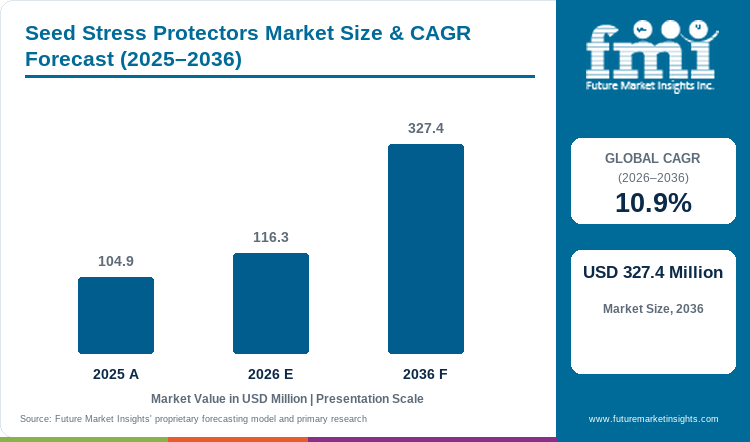
USD 116.3 million in 2026 and USD 327.4 million by 2036, expanding at a 10.9% CAGR.
Sales of seed stress protectors are estimated to rise at 10.9% CAGR through 2036, increasing valuation from USD 104.9 million in 2025 to USD 116.3 million in 2026 and reaching USD 327.4 million by 2036. Seed companies are paying for this function when early-stress control fits the same recipe used for conventional seed treatment without weakening handling performance. Syngenta announced a January 2025 TraitSeq collaboration that uses biomarkers to assess biostimulants applied to seeds or roots for improved abiotic-stress tolerance. Faster efficacy screening is giving developers a clearer path into field testing and compatibility work before a biological treatment reaches commercial seed programs.
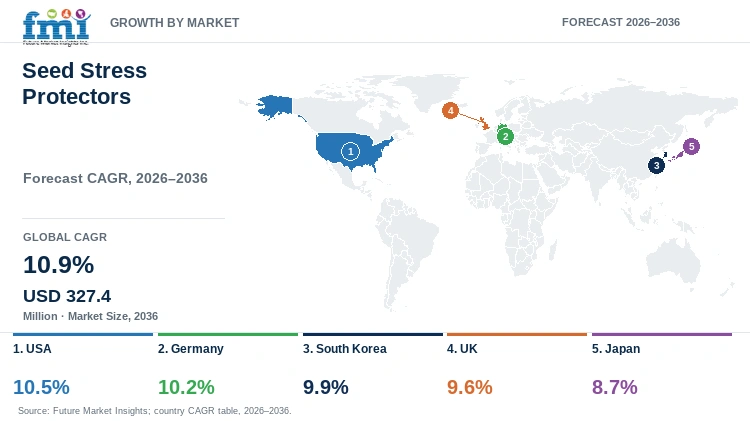
Country conversion differs because national seed-treatment systems impose different proof and authorization steps before commercial use. The USA is forecast at 10.5% CAGR compared with Germany at 10.2% over the assessment period. The small gap does not imply identical commercialization requirements for products entering commercial seed programs. Germany’s Federal Office of Consumer Protection and Food Safety lists Susteed as a biological suspension concentrate authorized specifically for seed treatment through June 2039. That national authorization route makes treatment classification and labeled use part of German commercial qualification. Companies entering both countries therefore need evidence packages that match local treatment practice instead of assuming similar growth rates produce the same route to market.
Key Takeaways
- Commercial demand rises when seed companies can protect establishment without adding a separate field application or disrupting established treatment recipes.
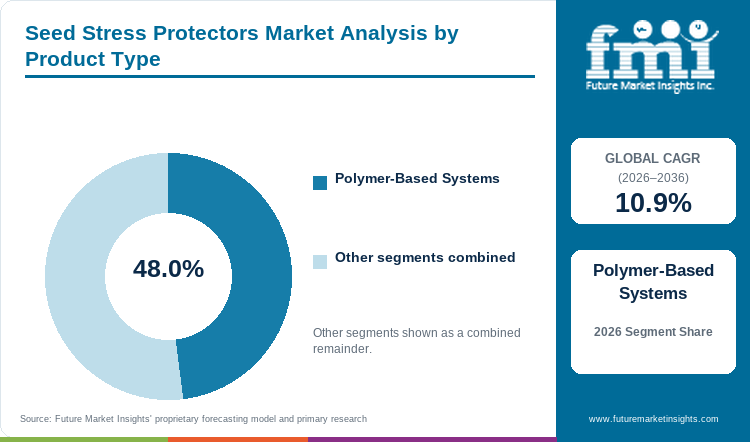
- By product type, polymer-based systems are estimated to hold 48.0% in 2026 because controlled coating layers support uniform placement and handling.
- Corn and cereals are likely to capture 43.6% share of crop type demand in 2026 as high planting volumes support repeatable treatment economics.
- By treatment point, in-plant seed-company treatment is forecast to represent 43.4% in 2026 because centralized lines control dose and drying.
- Qualification slows when biological survival or coating behavior changes during storage and makes field response less repeatable for commercial seed programs.
- Some of the key players in this market include Novonesis, Pivot Bio, Groundwork BioAg, Verdesian Life Sciences, Bayer SeedGrowth, Syngenta, Corteva Agriscience, and BASF.
Analyst Perspective
“Seed stress protectors earn repeat orders only after crop response and treatment-line behavior survive the same commercial qualification process. Commercially viable offers make stress protection measurable without forcing seed companies to rebuild existing recipes or handling procedures.”
- Nandini Roy Choudhury, Principal Analyst at Future Market Insights
How is the seed stress protectors market segmented?
The seed stress protectors market is segmented by product type, crop type, treatment point, formulation, sales channel, and region.
The seed stress protectors market covers product type, crop type, treatment point, formulation, sales channel, and region for the 2026 to 2036 forecast. Product type includes polymer-based systems, biological - microbial systems, nutrient-loaded systems, and others while crop type covers corn and cereals, soybean and pulses, vegetables, and cotton and others. Treatment point includes in-plant seed companies, commercial seed treaters, on-farm treatment, and others while formulation covers liquid slurries, dry powders, film coats and encrusting, and others. Sales channels comprise agri-input distributors, cooperatives, agri-retail chains, online - direct-to-farm routes, and other commercial outlets.
What makes polymer-based systems central to the product type category?
Coating architecture determines whether a stress-protection ingredient stays attached during commercial treatment and remains evenly distributed before planting. Verdesian Life Sciences describes SEED+GRAPHITE as a dry seed-applied formulation that combines planter lubrication with micronutrients and biostimulant technology for stressful conditions. That design explains why seed coating materials matter when commercial treaters need one layer to carry added functions without changing seed flow. Polymer systems also give formulators a controlled surface for integrating biological or nutrient components with existing handling steps. Seed companies therefore compare adhesion and recipe compatibility before accepting a coating architecture for repeated commercial treatment.
- Based on product type, polymer-based systems are projected to account for 48.0% in 2026 because controlled layers keep applied materials positioned on treated seed.
- Seed companies also value coating systems that preserve flow and storage behavior after biological or nutrient functions enter a commercial treatment recipe.
What operating condition supports corn and cereals within the crop type category?
Broad-acre corn and cereal programs turn small establishment gains into material value because treatment is repeated over large planted areas. Groundwork BioAg expanded its Rootella portfolio in February 2025 with liquid and concentrated powder mycorrhizal formats that improve nutrient access and crop resilience. These products address the same early-root decision served by biofertilizer products when growers want biological nutrition before later field applications become necessary. High seed throughput favors formats that fit existing treatment or planting routines with limited extra calibration. Commercial suppliers therefore need crop response and application simplicity to hold together at scale.
- In 2026, corn and cereals are expected to lead the crop type category with 43.6% share because high treated-seed throughput supports repeatable planting programs.
- Commercial suppliers gain scale when early-root performance remains consistent from one seed lot to another during broad-acre planting windows.
How does in-plant seed-company treatment shape the treatment point category?
Seed companies use centralized treatment lines to control dose and drying before finished seed moves into distribution. Bayer SeedGrowth announced Ibisio, Yoalo and Susteed in April 2025 as biological treatments designed for integration with its existing SeedGrowth programs. That model matches demand for seed treatment materials that must work inside existing combinations before branded seed reaches growers. Centralized application shifts calibration and quality control upstream, which gives seed companies greater influence over recipe changes. New ingredients still need to preserve seed safety and equipment performance during commercial throughput before they earn a place in ready-to-plant packages.
- In-plant seed-company treatment is likely to capture 43.4% share of treatment point demand in 2026 because centralized lines control application accuracy and seed quality.
- Ready-to-plant packages shift calibration work upstream and let branded seed programs standardize treatment recipes before distribution to growers.
What supports liquid slurries within the formulation category?
Commercial treating equipment can meter liquid components consistently when formulation properties stay stable during mixing and application. Novonesis states that its liquid Cell-Tech XC ProPort System integrates with soybean treatment equipment and keeps the inoculant sealed until delivery to the seed. The same handling issue applies to soil inoculant systems because living organisms must reach the root zone without losing viability during treatment and storage. Liquid slurries can fit multi-component recipes without adding a separate dry handling step during routine treatment. Commercial treaters therefore compare metering behavior and biological stability together before approving routine use.
- Liquid slurries are projected to hold 42.0% share of formulation demand in 2026 because metered systems support uniform application within multi-component commercial recipes.
- Suppliers still need shelf-life and compatibility data because a liquid format loses value when storage conditions reduce biological activity before planting.
What operating condition supports agri-input distributor demand in the sales channel category?
Specialist biological products need local inventory and agronomic support because crop-input purchases concentrate during planting windows. Pivot Bio expanded its retailer network through Aurora Cooperative in July 2025 for corn-focused microbial nitrogen products in Nebraska and northern Kansas. The route resembles specialty fertilizer products because growers often need application guidance and dependable seasonal availability before changing a current input program. Distributors give smaller technology providers field support without requiring a fully direct sales network. Repeat orders become easier after local performance data and product availability reach growers through the same agronomy relationship.
- The sales channel category is forecast to be led by agri-input distributors at 45.9% share in 2026 because local inventory places technical support close to planting decisions.
- Retail agronomy also gives new seed-applied products a demonstration route before growers commit broader acreage during subsequent planting seasons.
What are the drivers, restraints and opportunities in the Seed Stress Protectors Market?
Early-establishment risk expands seed-applied protection demand, biological qualification slows adoption, and integrated treatment programs provide a practical expansion route.
- Driver: Uncertain early-season conditions increase the value of protecting nutrient access and root development before later field applications can correct establishment losses.
- Restraint: Biological seed treatments need stable on-seed performance and supportable claims before commercial programs accept an added formulation or handling step.
- Opportunity: Integrated biological seed treatments let suppliers place stress-supporting functions inside existing seed-company programs instead of building a separate application route.
Field proof converts early-stress risk into treatment demand
Seed companies need field evidence that early-root functions remain useful under variable growing conditions before they commit broader acreage. Pivot Bio reported in February 2026 that PROVEN G3 was tested in 134 nationwide trials with 129 growers during the 2025 season. Those trials linked a root-associated microbial input with repeated performance under different weather and soil conditions. Comparable proof is important for cold-soil emergence protection because seed companies must separate biological response from location-specific trial effects. Suppliers can shorten qualification when treatment stability and field response remain consistent enough to support repeat use inside commercial seed programs with less retrial work.
Substantiation and stability raise the qualification burden
Living biologicals can lose commercial value when on-seed stability breaks before treated seed reaches the intended planting window. Bayer SeedGrowth reported in August 2025 that tests found Yoalo remained effective for up to two years on treated seed. That stability target explains why biostimulant technologies used on seed need storage evidence alongside crop-response data before industrial treatment programs accept them. Seed companies must also know whether a living organism stays compatible with other recipe components throughout the intended storage and distribution period. Qualification slows whenever biological survival or treatment behavior changes before seed reaches the field during routine storage windows.
Integrated biological recipes give suppliers a commercial route
Seed-company platforms can reduce adoption work by placing biological functions inside treatment programs that already have application controls. Bayer SeedGrowth introduced Susteed in September 2025 after receiving its first registration for oilseed rape and vegetable seed uses in Belgium. The product combines biological disease control with root growth and stress-tolerance functions inside a seed-treatment formulation. This route is relevant to plant growth regulator products because commercial programs still need measurable plant response and reliable application behavior before adding another crop-enhancement function. Integrated suppliers can expand use faster when formulation support and regulatory work arrive with the biological product at commercial scale.
Which country CAGRs are profiled in the Seed Stress Protectors Market?
| Country | CAGR |
|---|---|
| USA | 10.5% |
| Germany | 10.2% |
| South Korea | 9.9% |
| UK | 9.6% |
| Japan | 8.7% |
How do country-level CAGRs compare in the Seed Stress Protectors Market?
The country forecasts form a narrow 1.8 percentage-point range between the USA at 10.5% and Japan at 8.7%. Germany and South Korea stay close to the US pace while the UK records a middle-rate forecast that separates the upper cluster from Japan without implying present market size.
- USA commercialization can move through high-volume seed-company and retail agronomy channels that already coordinate treatment with broad-acre planting programs.
- Germany’s registered biological seed-treatment route gives qualified products a defined path into commercial treating once labeled uses are secured.
- South Korean public-private crop research can move government-developed microbial functions toward commercial partners before suppliers commit broader market programs.
- UK seed businesses operate inside formal marketing and certification rules that make documented seed quality part of routine commercial release.
- Japanese biostimulant guidance gives suppliers a clearer basis for effect claims and supporting information before expanding product communication nationally.
Similar CAGRs can still produce different entry conditions because treatment infrastructure and proof requirements change the route from interest to repeat orders. The full report provides country-level CAGR analysis across North America, Latin America, Western Europe, Eastern Europe, East Asia, South Asia and Pacific, and the Middle East and Africa.
Country-wise Analysis
- US seed companies and commercial treaters operate at volumes that make multi-location field proof a practical requirement before broader treatment adoption. By 2036, the USA is projected to grow at 10.5% CAGR as scalable treatment formats reach corn and other broad-acre programs efficiently. The Independent Professional Seed Association’s 2026 Seed Treatment Trials use eight or twelve locations per region and record stand count plus crop vigor for participating treatments. That structure gives suppliers a repeatable way to compare on-seed performance under several growing conditions before expanding acreage. Seed health programs gain commercial value when field response and treatment handling remain consistent enough for repeat seasonal ordering.
- German commercial treatment facilities operate within documented quality systems that make process control part of market access for treated seed. Germany's seed stress protectors outlook is anticipated to advance at 10.2% CAGR over the assessment period, supported by centralized treating that gives qualified products a repeatable route into branded seed programs. Julius Kühn-Institut guidance updated in 2025 requires trial treatment before a new recipe uses another treatment agent, biostimulant or micronutrient in listed facilities. The same framework uses dust measurements and recurring quality checks before a treatment recipe is released. Suppliers therefore need equipment compatibility and controlled finished-seed behavior before German treaters can accept another stress-protection ingredient.
- South Korea’s public agricultural research network gives biological crop technologies a route from laboratory work into multi-farm field demonstration. Seed stress protector demand in South Korea is forecast to rise at 9.9% CAGR over the forecast period, supported by local validation that reduces uncertainty about root and early-growth performance. The Rural Development Administration reported in May 2025 that its GH1-13 microbe had been demonstrated at 142 sites involving about 700 farms from 2019 through 2023. RDA also reported stronger root development and early growth in paprika seedlings treated with the same microbe. Suppliers of agricultural microbial systems still need stable seed-applied formulations and crop-specific handling instructions before this evidence can support routine treatment programs.
- UK seed businesses rely on licensed testing stations for certification before treated lots enter commercial channels. Adoption of seed stress protectors in the UK is estimated to expand at 9.6% CAGR through 2036, supported by a formal quality-control route that makes treatment documentation part of commercial release. The Animal and Plant Health Agency updated its national list of licensed and official seed testing stations in July 2026 for seed samples used in certification and marketing. That infrastructure gives seed businesses a defined quality-control route before treated seed reaches buyers. Suppliers still need product-specific performance and compatibility records before a stress-protection function becomes routine in commercial seed lots.
- Japanese crop-input companies now work under a national biostimulant guideline that makes effect claims and supporting information part of product communication. Seed stress protector sales in Japan are forecast to expand at 8.7% CAGR by 2036, as suppliers align effect claims with a nationally defined information standard. Japan’s Ministry of Agriculture issued the guideline in May 2025 and requires attention to effect claims, supporting information and safety when companies handle biostimulants. That framework is directly relevant to seed-applied stress products that claim improved nutrient use or abiotic-stress tolerance. Suppliers therefore need Japanese crop evidence and treatment compatibility before commercial seed programs can standardize a new biological function.
Who are the notable companies in the Seed Stress Protectors Market?
Novonesis, Pivot Bio, Groundwork BioAg, Verdesian Life Sciences, Bayer SeedGrowth, Syngenta, Corteva Agriscience, and BASF serve the seed stress protectors market.
Competition splits between microbial specialists and integrated seed-treatment platforms that control different parts of the qualification process. Entry becomes harder when suppliers need both crop-response evidence and treatment-system compatibility before a seed company changes a commercial recipe. After qualification, local agronomy support determines how quickly field results convert into repeat seasonal use for participating seed-treatment suppliers.
- Microbial nutrition and root biology: Novonesis joins Pivot Bio and Groundwork BioAg in providing microbial functions connected to nutrient access or root performance.
- Seed-applied nutrition and treatment programs: Verdesian Life Sciences and Corteva Agriscience address early growth through seed-applied nutrition or treatment systems.
- Integrated seed-treatment platforms: Bayer SeedGrowth joins Syngenta and BASF in pairing biological options with current treatment portfolios and commercial application support.
Competitive Benchmarking: Seed Stress Protectors Market
| Company | Seed-Applied Stress Function | Formulation & Treatment-System Breadth | Commercial Treatment & Channel Integration | Geographic Reach |
|---|---|---|---|---|
| Novonesis | High | High | High | North America and multi-region partner channels |
| Pivot Bio | High | High | Medium | Primarily USA with expanding retailer coverage |
| Groundwork BioAg | High | High | Medium | North America plus Latin America and Europe partnerships |
| Verdesian Life Sciences | High | High | Medium | USA with selected international agricultural markets |
| Bayer SeedGrowth | High | High | High | Global SeedGrowth and branded-seed network |
| Syngenta | High | High | High | Global Seedcare network and regional R&D infrastructure |
| Corteva Agriscience | Medium | High | High | Global agriculture reach with seed-applied technology routes |
| BASF | Medium | High | High | Global Agricultural Solutions and seed-treatment network |
Scoring basis: High seed-applied stress function requires multiple current seed or early-root functions connected to stress response. Medium requires one documented seed-applied function while Low reflects adjacent treatment capability with limited stress support. High formulation breadth requires at least two application routes plus commercial treatment-system support for routine use. Medium requires two routes without broader system support while Low identifies one documented route. High channel integration requires seed-company integration or several commercial routes while Medium requires one commercial route and Low reflects limited channel access.
Key Developments in the Seed Stress Protectors Market
- In June 2026, Novonesis signed a United States distribution agreement with Rovensa Next covering selected biosolutions from seed treatment through post-harvest programs.
- In November 2025, Pivot Bio launched PROVEN G3 Dry for corn as a dry planter-box treatment that applies gene-edited nitrogen-fixing microbes at planting.
- In November 2025, Syngenta introduced VICTRATO after US EPA registration for soybean and cotton seed treatment against nematodes and seedling diseases.
Key Players in the Seed Stress Protectors Market
Microbial nutrition and root-biology specialists
- Novonesis
- Pivot Bio
- Groundwork BioAg
Seed-applied nutrition and treatment specialists
- Verdesian Life Sciences
- Corteva Agriscience
Integrated seed-treatment platforms
- Bayer SeedGrowth
- Syngenta
- BASF
Seed Stress Protectors Market - Report Scope
| Coverage field | Report scope |
|---|---|
| Market breakdown | By product type, crop type, treatment point, formulation, sales channel, and region. |
| Quantitative Units | USD million. |
| Market Definition | Revenue from seed-applied products whose primary commercial purpose improves germination, emergence, root function, nutrient access, moisture response, or early-season resilience. |
| Regions Covered | North America, Latin America, Western Europe, Eastern Europe, East Asia, South Asia and Pacific, and Middle East and Africa. |
| Countries Covered | USA, Germany, South Korea, UK, Japan, and 20+ countries included in the full report. |
| Key Companies Profiled | Novonesis, Pivot Bio, Groundwork BioAg, Verdesian Life Sciences, Bayer SeedGrowth, Syngenta, Corteva Agriscience, and BASF. |
| Forecast Period | 2026 to 2036. |
| Approach | Primary and secondary research with market triangulation. |
Seed Stress Protectors Market - Research Methodology
| Method | Approach |
|---|---|
| Primary Research | Primary research framework covers treatment-line requirements, buying criteria, adoption barriers, approval needs, pricing logic, and technical support expectations. Direct industry input is incorporated only when documented and reconciled with the market definition and quantitative model. |
| Desk Research | Desk research covers government statistics, regulatory publications, industry associations, technical literature, standards, company filings, current product documentation, and official corporate announcements. Sources are screened for date, geography, title fit, and consistency with the defined market scope before factual claims are retained. |
| Market Sizing and Forecasting | The market model combines the authorized baseline with segment structure, pricing and volume indicators, adoption conditions, company participation, and country demand factors. Forecast assumptions account for treatment adoption, biological stability, crop programs, channel access, supply availability, and barriers to wider commercial use. |
| Data Validation | Estimates are checked against public data, company activity, national treatment requirements, model values, and current company evidence. Validation also tests whether products, functions, channels, and company activities fall inside the defined market boundary. Adjacent categories and unsupported claims are excluded before segment and country estimates are reconciled. |
Seed Stress Protectors Market by Segments
Seed Stress Protectors Market segmented by Product Type:
- Polymer-Based Systems
- Biological - Microbial Systems
- Nutrient-Loaded Systems
- Others
Seed Stress Protectors Market segmented by Crop Type:
- Corn & Cereals
- Soybean & Pulses
- Vegetables
- Cotton & Others
Seed Stress Protectors Market segmented by Treatment Point:
- In-Plant (Seed Companies)
- Commercial Seed Treaters
- On-Farm Treatment
- Others
Seed Stress Protectors Market segmented by Formulation:
- Liquid Slurries
- Dry Powders
- Film Coats & Encrusting
- Others
Seed Stress Protectors Market segmented by Sales Channel:
- Agri-Input Distributors
- Cooperatives
- Agri-Retail Chains
- Online - Direct-to-Farm
- Others
Seed Stress Protectors Market by Region:
- North America
- United States
- Canada
- Latin America
- Brazil
- Mexico
- Argentina
- Chile
- Western Europe
- Germany
- France
- United Kingdom
- Italy
- Spain
- Benelux
- Nordics
- Eastern Europe
- Poland
- Czech Republic
- Romania
- Hungary
- East Asia
- China
- Japan
- South Korea
- South Asia and Pacific
- India
- ASEAN
- Australia and New Zealand
- Middle East and Africa
- GCC Countries
- South Africa
- Türkiye
- Israel
Research Sources and Bibliography
- Syngenta. (2025, January 9). Artificial intelligence is speeding up the development of the next generation of biostimulants.
- Bundesamt für Verbraucherschutz und Lebensmittelsicherheit. (n.d.). Datenblatt PSM - Susteed. Retrieved September 16, 2026.
- Verdesian Life Sciences. (n.d.). SEED+GRAPHITE®. Retrieved September 16, 2026.
- Groundwork BioAg. (2025, February 25). Mycorrhizal Inoculant Leader Groundwork BioAg Expands Rootella Portfolio and Rootella Carbon Program at Commodity Classic 2025.
- Bayer SeedGrowth. (2025, April 15). SeedGrowth portfolio takes a step up with biological seed treatments Ibisio®, Yoalo® and Susteed®.
- Novonesis. (n.d.). Cell-Tech® XC ProPort System. Retrieved September 16, 2026.
- Pivot Bio. (2025, July 7). Pivot Bio Expands Retailer Network Through Partnership with Aurora Cooperative.
- Pivot Bio. (2026, February 24). Pivot Bio Releases 2025 Field Performance Data Demonstrating Consistent Yield Gains and Synthetic Nitrogen Displacement While Lowering Fertilizer Costs.
- Bayer SeedGrowth. (2025, August 11). Introducing Bayer's biostimulant Yoalo®, which gives plant performance a biological boost.
- Bayer SeedGrowth. (2025, September 29). Susteed® brings together the best of biologicals and seed treatments.
- Independent Professional Seed Association. (n.d.). IPSA Seed Trials. Retrieved September 16, 2026.
- Julius Kühn-Institut. (2025, March 1). 5-1.1 Verfahren und Anforderungen an Saatgutbehandlungseinrichtungen zur Eintragung in die Liste der Saatgutbehandlungseinrichtungen mit Qualitätssicherungssystemen zur Staubminderung.
- Rural Development Administration. (2025, May 14). 농촌진흥청 개발 복합기능 미생물, ‘파프리카 뿌리 발달’에 효과 커.
- Animal and Plant Health Agency. (2026, July 22). Licensed and official seed testing stations.
- Ministry of Agriculture, Forestry and Fisheries of Japan. (2025, May 30). 「バイオスティミュラントの表示等に係るガイドライン」を策定しました.
- Novonesis. (2026, June 11). Rovensa Next to distribute Novonesis’ biosolutions for Plant Health in the United States.
- Pivot Bio. (2025, November 13). Pivot Bio Expands Weatherproof Nitrogen Portfolio with New Dry Planter Box Treatments for Corn and Cotton.
- Syngenta. (2025, November 10). Syngenta introduces Victrato seed treatment for unrivaled nematode and disease protection.
- Syngenta. (2026, March 17). Syngenta builds world-leading research center for agricultural bioscience - powered by advanced technology and AI.
- Groundwork BioAg. (2025, September 10). Groundwork BioAg Announces First Commercial Insetting Deployment of Durable Carbon Removal.
- Groundwork BioAg. (2026, July 14). Syngenta and Groundwork BioAg enter partnership to bring innovation in biologicals and soil carbon solutions to farmers.
- BASF. (2026, May 11). BASF Agricultural Solutions successfully commissions new fermentation plant for crop protection products in Ludwigshafen.
- Corteva. (2025, February 13). Gates Agricultural Innovations and Corteva Announce New Collaboration to Accelerate Ag Innovation.
- Novonesis. (n.d.). QuickRoots® WP for wheat and small grains. Retrieved September 16, 2026.
- Pivot Bio. (2025, March 17). Pivot Bio Unveils PROVEN G3, with Powerful New Modes of Action and Patent-Protected Gene-Editing Technology.
- Groundwork BioAg. (n.d.). Rootella® L. Retrieved September 16, 2026.
- Verdesian Life Sciences. (n.d.). Take Off ST®. Retrieved September 16, 2026.
- Bayer SeedGrowth. (2026, June 12). How Guardião delivers value to farmers in Brazil - today and tomorrow.
- Syngenta. (n.d.). Epivio Energy Biological. Retrieved September 16, 2026.
- Corteva Agriscience. (2025, June 27). Arable Update June 2025.
- BASF. (2025, November 20). BASF announces Integral® Pro for Sunflowers is registered in France.
This bibliography is provided for reader reference and is not exhaustive. The full report contains the complete reference list and detailed citations
This Report Answers
- How large is the seed stress protectors market in 2026?
- What share do polymer-based systems hold by product type in 2026?
- Why do corn and cereals account for a large crop share?
- How do centralized seed-company treatments change commercial qualification requirements for suppliers?
- Which operating conditions slow biological seed-treatment adoption in commercial seed programs?
- How do country CAGRs differ among the five markets shown here?
- Which companies supply seed-applied stress or early-root functions in this market?
- What recent developments are changing competitive access and formulation choices?
Frequently Asked Questions
How big is the seed stress protectors market in 2026?
The seed stress protectors market is valued at USD 116.3 million in 2026 and is forecast to reach USD 327.4 million by 2036. Buyers add seed-applied stress functions when early establishment protection fits commercial treatment recipes without compromising storage or handling.
What is the CAGR of the seed stress protectors market from 2026 to 2036?
The seed stress protectors market is projected to grow at 10.9% CAGR between 2026 and 2036. Growth depends on products that improve early establishment while remaining compatible with commercial treatment systems and seed handling requirements.
Which product type leads the seed stress protectors market?
The polymer-based systems segment is projected to hold 48.0% share of product type demand in 2026 because controlled coating layers preserve flow and treatment consistency. Commercial treaters use these systems to keep applied functions attached during storage and routine seed handling.
How much value will the seed stress protectors market add between 2026 and 2036?
The seed stress protectors market is expected to add USD 211.1 million in value between 2026 and 2036. Expansion depends on wider use of seed-applied biological and formulation systems that protect establishment before later crop inputs can compensate.
Which companies are active in the seed stress protectors market?
Key companies operating in the seed stress protectors market include Novonesis, Pivot Bio, Groundwork BioAg, Verdesian Life Sciences, Bayer SeedGrowth, Syngenta, Corteva Agriscience, and BASF. Their positions differ by biological function and treatment-system integration plus commercial channel access at commercial scale.
Preview the report firsthand - request a free sample
Get SampleGet the brochure for pricing and purchase details.
Get PDFTable of Content
- Key Takeaways
- Market Size and CAGR
- Top Growth Driver
- Fastest Growing Segment
- Leading Region
- Key Companies
- Emerging Opportunities
- Executive Summary
- Global Market Outlook
- Demand-side Trends
- Supply-side Trends
- Technology Roadmap Analysis
- Analysis and Recommendations
- Analyst Perspective (What is happening? Why now? What should investors know?)
- Key Questions Answered
- How large is the market?
- What is the CAGR?
- What are key trends?
- Which region dominates?
- Who are the leaders?
- Market Overview
- Market Coverage / Taxonomy
- Market Definition / Scope / Limitations
- Research Methodology
- Chapter Orientation
- Analytical Lens and Working Hypotheses
- Market Structure, Signals, and Trend Drivers
- Benchmarking and Cross-market Comparability
- Market Sizing, Forecasting, and Opportunity Mapping
- Research Design and Evidence Framework
- Desk Research Programme (Secondary Evidence)
- Expert Input and Fieldwork (Primary Evidence)
- Tooling, Models, and Reference Databases
- Data Engineering and Model Build
- Quality Assurance and Audit Trail
- Market Background
- Market Dynamics (Drivers, Restraints, Opportunity, Trends)
- Scenario Forecast (Optimistic, Likely, Conservative)
- Impact Analysis
- AI Impact
- Sustainability Impact
- Regulatory Impact
- Technology Impact
- Consumer / Buyer Analysis
- Purchase Drivers
- Adoption Barriers
- Buyer Journey
- Opportunity Map Analysis
- Product Life Cycle Analysis
- Supply Chain Analysis
- Investment Feasibility Matrix
- Value Chain Analysis
- PESTLE and Porter's Analysis
- Regulatory Landscape
- Regional Parent Market Outlook
- Production and Consumption Statistics
- Import and Export Statistics
- Global Market Analysis and Forecast, 2021 to 2036
- Historical Market Size Value (USD Million) Analysis, 2021 to 2025
- Current and Future Market Size Value (USD Million) Projections, 2026 to 2036
- Y-o-Y Growth Trend Analysis
- Absolute $ Opportunity Analysis
- Global Market Pricing Analysis, 2021 to 2036
- Global Market Analysis and Forecast, By Product Type, 2021 to 2036
- Introduction / Key Findings
- Historical Market Size Value (USD Million) Analysis By Product Type, 2021 to 2025
- Current and Future Market Size Value (USD Million) Analysis and Forecast By Product Type, 2026 to 2036
- Polymer-Based Systems
- Biological - Microbial Systems
- Nutrient-Loaded Systems
- Others
- Y-o-Y Growth Trend Analysis By Product Type, 2021 to 2025
- Absolute $ Opportunity Analysis By Product Type, 2026 to 2036
- Global Market Analysis and Forecast, By Crop Type, 2021 to 2036
- Introduction / Key Findings
- Historical Market Size Value (USD Million) Analysis By Crop Type, 2021 to 2025
- Current and Future Market Size Value (USD Million) Analysis and Forecast By Crop Type, 2026 to 2036
- Corn & Cereals
- Soybean & Pulses
- Vegetables
- Cotton & Others
- Y-o-Y Growth Trend Analysis By Crop Type, 2021 to 2025
- Absolute $ Opportunity Analysis By Crop Type, 2026 to 2036
- Global Market Analysis and Forecast, By Treatment Point, 2021 to 2036
- Introduction / Key Findings
- Historical Market Size Value (USD Million) Analysis By Treatment Point, 2021 to 2025
- Current and Future Market Size Value (USD Million) Analysis and Forecast By Treatment Point, 2026 to 2036
- In-Plant (Seed Companies)
- Commercial Seed Treaters
- On-Farm Treatment
- Others
- Y-o-Y Growth Trend Analysis By Treatment Point, 2021 to 2025
- Absolute $ Opportunity Analysis By Treatment Point, 2026 to 2036
- Global Market Analysis and Forecast, By Formulation, 2021 to 2036
- Introduction / Key Findings
- Historical Market Size Value (USD Million) Analysis By Formulation, 2021 to 2025
- Current and Future Market Size Value (USD Million) Analysis and Forecast By Formulation, 2026 to 2036
- Liquid Slurries
- Dry Powders
- Film Coats & Encrusting
- Others
- Y-o-Y Growth Trend Analysis By Formulation, 2021 to 2025
- Absolute $ Opportunity Analysis By Formulation, 2026 to 2036
- Global Market Analysis and Forecast, By Sales Channel, 2021 to 2036
- Introduction / Key Findings
- Historical Market Size Value (USD Million) Analysis By Sales Channel, 2021 to 2025
- Current and Future Market Size Value (USD Million) Analysis and Forecast By Sales Channel, 2026 to 2036
- Agri-Input Distributors
- Cooperatives
- Agri-Retail Chains
- Online - Direct-to-Farm
- Others
- Y-o-Y Growth Trend Analysis By Sales Channel, 2021 to 2025
- Absolute $ Opportunity Analysis By Sales Channel, 2026 to 2036
- Global Market Analysis and Forecast, By Region, 2021 to 2036
- Introduction
- Historical Market Size Value (USD Million) Analysis By Region, 2021 to 2025
- Current Market Size Value (USD Million) Analysis and Forecast By Region, 2026 to 2036
- North America
- Latin America
- Western Europe
- Eastern Europe
- East Asia
- South Asia and Pacific
- Middle East and Africa
- Market Attractiveness Analysis By Region
- North America Market Analysis and Forecast, By Country, 2021 to 2036
- Historical Market Size Value (USD Million) Trend Analysis By Market Taxonomy, 2021 to 2025
- Market Size Value (USD Million) Forecast By Market Taxonomy, 2026 to 2036
- By Country
- United States
- Canada
- By Product Type
- By Crop Type
- By Treatment Point
- By Formulation
- By Sales Channel
- By Country
- Market Attractiveness Analysis
- By Country
- By Product Type
- By Crop Type
- By Treatment Point
- By Formulation
- By Sales Channel
- Key Takeaways
- Latin America Market Analysis and Forecast, By Country
- Historical Market Size Value (USD Million) Trend Analysis By Market Taxonomy, 2021 to 2025
- Market Size Value (USD Million) Forecast By Market Taxonomy, 2026 to 2036
- By Country
- Brazil
- Mexico
- Argentina
- Chile
- By Product Type
- By Crop Type
- By Treatment Point
- By Formulation
- By Sales Channel
- By Country
- Market Attractiveness Analysis
- By Country
- By Product Type
- By Crop Type
- By Treatment Point
- By Formulation
- By Sales Channel
- Key Takeaways
- Western Europe Market Analysis and Forecast, By Country
- Historical Market Size Value (USD Million) Trend Analysis By Market Taxonomy, 2021 to 2025
- Market Size Value (USD Million) Forecast By Market Taxonomy, 2026 to 2036
- By Country
- Germany
- France
- United Kingdom
- Italy
- Spain
- Benelux
- Nordics
- By Product Type
- By Crop Type
- By Treatment Point
- By Formulation
- By Sales Channel
- By Country
- Market Attractiveness Analysis
- By Country
- By Product Type
- By Crop Type
- By Treatment Point
- By Formulation
- By Sales Channel
- Key Takeaways
- Eastern Europe Market Analysis and Forecast, By Country
- Historical Market Size Value (USD Million) Trend Analysis By Market Taxonomy, 2021 to 2025
- Market Size Value (USD Million) Forecast By Market Taxonomy, 2026 to 2036
- By Country
- Poland
- Czech Republic
- Romania
- Hungary
- By Product Type
- By Crop Type
- By Treatment Point
- By Formulation
- By Sales Channel
- By Country
- Market Attractiveness Analysis
- By Country
- By Product Type
- By Crop Type
- By Treatment Point
- By Formulation
- By Sales Channel
- Key Takeaways
- East Asia Market Analysis and Forecast, By Country
- Historical Market Size Value (USD Million) Trend Analysis By Market Taxonomy, 2021 to 2025
- Market Size Value (USD Million) Forecast By Market Taxonomy, 2026 to 2036
- By Country
- China
- Japan
- South Korea
- By Product Type
- By Crop Type
- By Treatment Point
- By Formulation
- By Sales Channel
- By Country
- Market Attractiveness Analysis
- By Country
- By Product Type
- By Crop Type
- By Treatment Point
- By Formulation
- By Sales Channel
- Key Takeaways
- South Asia and Pacific Market Analysis and Forecast, By Country
- Historical Market Size Value (USD Million) Trend Analysis By Market Taxonomy, 2021 to 2025
- Market Size Value (USD Million) Forecast By Market Taxonomy, 2026 to 2036
- By Country
- India
- ASEAN
- Australia and New Zealand
- By Product Type
- By Crop Type
- By Treatment Point
- By Formulation
- By Sales Channel
- By Country
- Market Attractiveness Analysis
- By Country
- By Product Type
- By Crop Type
- By Treatment Point
- By Formulation
- By Sales Channel
- Key Takeaways
- Middle East and Africa Market Analysis and Forecast, By Country
- Historical Market Size Value (USD Million) Trend Analysis By Market Taxonomy, 2021 to 2025
- Market Size Value (USD Million) Forecast By Market Taxonomy, 2026 to 2036
- By Country
- GCC Countries
- South Africa
- Türkiye
- Israel
- By Product Type
- By Crop Type
- By Treatment Point
- By Formulation
- By Sales Channel
- By Country
- Market Attractiveness Analysis
- By Country
- By Product Type
- By Crop Type
- By Treatment Point
- By Formulation
- By Sales Channel
- Key Takeaways
- Key Countries Market Analysis
- United States
- Pricing Analysis
- Market Share Analysis, 2025
- By Product Type
- By Crop Type
- By Treatment Point
- By Formulation
- By Sales Channel
- Canada
- Pricing Analysis
- Market Share Analysis, 2025
- By Product Type
- By Crop Type
- By Treatment Point
- By Formulation
- By Sales Channel
- Mexico
- Pricing Analysis
- Market Share Analysis, 2025
- By Product Type
- By Crop Type
- By Treatment Point
- By Formulation
- By Sales Channel
- Brazil
- Pricing Analysis
- Market Share Analysis, 2025
- By Product Type
- By Crop Type
- By Treatment Point
- By Formulation
- By Sales Channel
- Chile
- Pricing Analysis
- Market Share Analysis, 2025
- By Product Type
- By Crop Type
- By Treatment Point
- By Formulation
- By Sales Channel
- Germany
- Pricing Analysis
- Market Share Analysis, 2025
- By Product Type
- By Crop Type
- By Treatment Point
- By Formulation
- By Sales Channel
- United Kingdom
- Pricing Analysis
- Market Share Analysis, 2025
- By Product Type
- By Crop Type
- By Treatment Point
- By Formulation
- By Sales Channel
- Italy
- Pricing Analysis
- Market Share Analysis, 2025
- By Product Type
- By Crop Type
- By Treatment Point
- By Formulation
- By Sales Channel
- Spain
- Pricing Analysis
- Market Share Analysis, 2025
- By Product Type
- By Crop Type
- By Treatment Point
- By Formulation
- By Sales Channel
- France
- Pricing Analysis
- Market Share Analysis, 2025
- By Product Type
- By Crop Type
- By Treatment Point
- By Formulation
- By Sales Channel
- India
- Pricing Analysis
- Market Share Analysis, 2025
- By Product Type
- By Crop Type
- By Treatment Point
- By Formulation
- By Sales Channel
- ASEAN
- Pricing Analysis
- Market Share Analysis, 2025
- By Product Type
- By Crop Type
- By Treatment Point
- By Formulation
- By Sales Channel
- Australia and New Zealand
- Pricing Analysis
- Market Share Analysis, 2025
- By Product Type
- By Crop Type
- By Treatment Point
- By Formulation
- By Sales Channel
- China
- Pricing Analysis
- Market Share Analysis, 2025
- By Product Type
- By Crop Type
- By Treatment Point
- By Formulation
- By Sales Channel
- Japan
- Pricing Analysis
- Market Share Analysis, 2025
- By Product Type
- By Crop Type
- By Treatment Point
- By Formulation
- By Sales Channel
- South Korea
- Pricing Analysis
- Market Share Analysis, 2025
- By Product Type
- By Crop Type
- By Treatment Point
- By Formulation
- By Sales Channel
- Poland
- Pricing Analysis
- Market Share Analysis, 2025
- By Product Type
- By Crop Type
- By Treatment Point
- By Formulation
- By Sales Channel
- Hungary
- Pricing Analysis
- Market Share Analysis, 2025
- By Product Type
- By Crop Type
- By Treatment Point
- By Formulation
- By Sales Channel
- Türkiye
- Pricing Analysis
- Market Share Analysis, 2025
- By Product Type
- By Crop Type
- By Treatment Point
- By Formulation
- By Sales Channel
- South Africa
- Pricing Analysis
- Market Share Analysis, 2025
- By Product Type
- By Crop Type
- By Treatment Point
- By Formulation
- By Sales Channel
- United States
- Market Structure Analysis
- Competition Dashboard
- Competition Benchmarking
- Market Share Analysis of Top Players
- By Regional
- By Product Type
- By Crop Type
- By Treatment Point
- By Formulation
- By Sales Channel
- Emerging Startups
- Innovation Benchmarking
- Competition Analysis
- Competition Deep Dive
- Novonesis
- Overview
- Product Portfolio
- Profitability by Market Segments
- Sales Footprint
- Strategy Overview
- Marketing Strategy
- Product Strategy
- Channel Strategy
- Pivot Bio
- Groundwork BioAg
- Verdesian Life Sciences
- Bayer SeedGrowth
- Syngenta
- Corteva Agriscience
- BASF
- Novonesis
- Case Studies
- Success Stories
- Recent Developments
- Competition Deep Dive
- Assumptions & Acronyms Used


