

- Market Size (2026)
- USD 139.3 Mn
- Forecast (2036)
- USD 406.5 Mn
- CAGR (2026 to 2036)
- 11.3%
How big is Seed Nutrient Coatings Market in 2026?
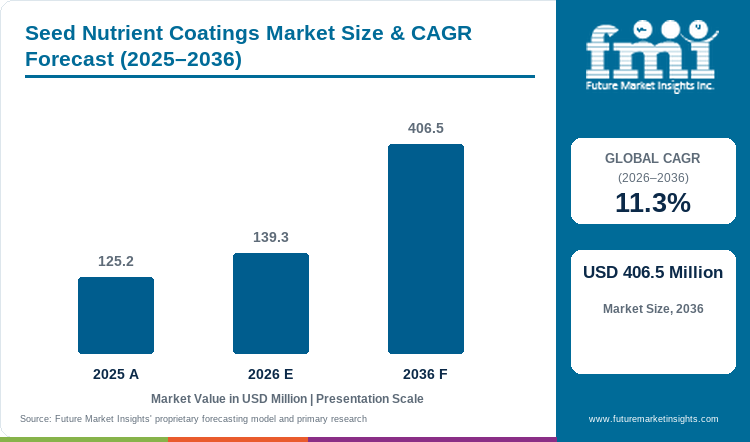
USD 139.3 million in 2026 and USD 406.5 million by 2036 at an 11.3% CAGR.
Demand for seed nutrient coatings is projected to expand at 11.3% CAGR between 2026 and 2036, growing from USD 125.2 million in 2025 to USD 139.3 million in 2026, and escalating to USD 406.5 million by 2036. Seed companies are accepting treatment additions only when field economics justify the added recipe complexity. Pivot Bio reported in February 2026 that 134 PROVEN G3 trials displaced 33 pounds of conventional nitrogen per acre and added 2.1 bushels per acre. Those results provide a measurable return benchmark for microbial technologies competing for treated-seed placement.
Japan is forecast at 9.0% CAGR compared with 11.0% in the USA, and its claim pathway requires a different evidence package before commercial use. MAFF's May 2025 biostimulant guideline requires safety and effectiveness evidence for labeled biostimulant effects. That requirement makes Japanese qualification more documentation-intensive for nutrient-biological claims than a simple global launch sequence. Suppliers serving both countries must separate claim substantiation from agronomic performance before reusing one commercial formulation.
Key Takeaways
- Seed companies add nutrient functions when treated-seed packages support nutrition without requiring extra fieldwork.
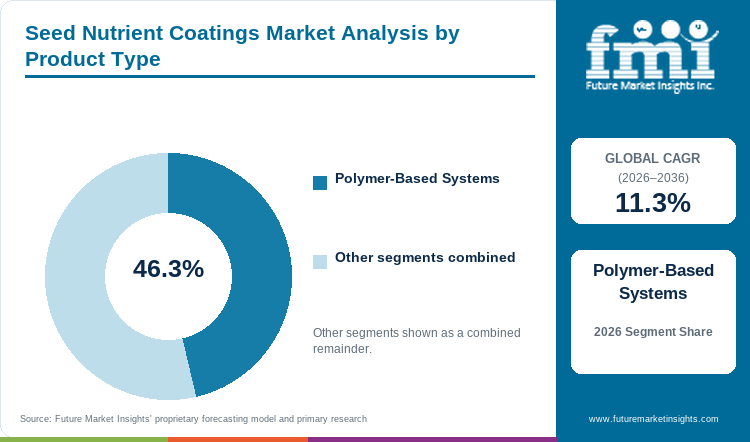
- Based on product type, polymer-based systems are projected to account for 46.3% in 2026, supported by controlled film loading during commercial seed treatment.
- By crop type, corn and cereals are estimated to hold 45.1% in 2026, owing to large treated volumes that spread qualification costs.
- In 2026, in-plant treatment is expected to lead treatment point demand with 48.7% share, driven by seed-company control over recipe qualification.
- Compatibility failures delay adoption when nutrient coatings change slurry behavior or seed flow inside recipes.
- Some of the key players in this market include Pivot Bio, Groundwork BioAg, Verdesian Life Sciences, Bayer SeedGrowth, Syngenta, Corteva Agriscience, BASF, and Germains Seed Technology.
Analyst Perspective
"Seed nutrient coatings earn repeat business when measurable nutrient performance survives commercial treatment and normal planting conditions. Seed companies will favor suppliers that prove recipe compatibility before asking production teams to accept another performance claim."
- Nandini Roy Choudhury, Principal Consultant, Future Market Insights
How is the seed nutrient coatings market segmented?
The seed nutrient coatings market is segmented by Product Type, Crop Type, Treatment Point, Formulation, Sales Channel and Region.
The seed nutrient coatings market is segmented by product type, crop type, treatment point, formulation, sales channel and region. Product types include polymer-based systems, biological - microbial systems, nutrient-loaded systems and others, while crop types cover corn and cereals, soybean and pulses, vegetables, cotton and others. Treatment points include in-plant application, commercial seed treaters, on-farm treatment and others, while formulation and sales-channel categories cover liquid slurries, dry powders, film coats and encrusting, distributors, cooperatives, agri-retail chains, online - direct-to-farm routes and others.
What operating condition supports polymer-based systems within the Product Type category?
Polymer-based systems give formulators a film that keeps low-dose nutrients or biological actives attached during storage and planting. Commercial seed plants evaluate seed coating materials against adhesion and dust behavior before changing a production recipe. The European Commission published implementation guidance for the REACH microplastics restriction in April 2025 and directs affected users toward material-specific compliance decisions. Coating companies therefore need material status and line performance in the same technical file because a film that meets agronomic requirements can still fail qualification when its chemistry creates regulatory or process risk.
- By product type, polymer-based systems are forecast to represent 46.3% in 2026, supported by controlled films that keep active loading uniform.
- European material rules make polymer status part of qualification before seed companies approve commercial coating recipes.
How do corn and cereal programs shape the Crop Type category?
Corn and cereal programs process large seed volumes on fixed seasonal schedules, so crop micronutrients compete on dose efficiency and recipe compatibility that preserve commercial treatment speed and seed handling. Bayer announced in August 2025 that Yoalo would be available exclusively inside Acceleron seed-treatment combinations on DEKALB seed. The Bacillus velezensis treatment improves access to phosphorus and other nutrients after the seed enters soil. That package illustrates why broad-acre crops reward upstream integration because one qualified treatment can be repeated over large commercial seed volumes without adding another farm-level operation.
- Corn and cereals are likely to capture 45.1% share in 2026, attributable to broad-acre volumes that spread seed-treatment qualification costs.
- Bayer placed Yoalo inside a corn seed-treatment package that links nutrient-access biology with seed-company-controlled application.
How does in-plant application influence the Treatment Point category?
Seed-company plants control recipe sequence before treated bags enter commercial channels, making qualification more consistent than decentralized farm mixing. Plant teams compare seed treatment materials on dosing accuracy before adding another component to a production recipe. EPA lists a 27-month decision time under R123 for a new pesticidal active ingredient used only as a seed treatment without a tolerance requirement. Mixed-function treatments still need the specific regulatory route resolved before formal production qualification begins. In-plant suppliers compete on documentation and line compatibility because seasonal factory schedules leave little room for late reformulation.
- In-plant treatment is set to lead the treatment point category with 48.7% share in 2026, driven by centralized recipe control that limits dosing variation.
- Factory recipes let seed companies test plantability and labeling before committing treatments to larger seasonal production runs.
What supports liquid slurries within the Formulation category?
Liquid slurries let commercial treaters meter several compatible ingredients into one documented batch and adjust total loading by crop or seed lot. Modern seed processing equipment makes dosing repeatability important because excess liquid can slow drying and reduce seed flow during high-throughput operation. The American Seed Trade Association released an updated Seed Treatment Stewardship Guide in August 2025 for farmers and treated-seed handlers including commercial applicators. Liquid suppliers therefore need stable suspension behavior and predictable drying because plants cannot trade throughput for a formulation that performs only under laboratory conditions.
- Liquid slurries are projected to hold 50.7% share in 2026, reinforced by metered application that fits high-throughput commercial treatment lines.
- Commercial treaters retain liquid systems when ingredients can be dosed consistently without creating drying or seed-flow problems.
Why do agri-input distributors matter within the Sales Channel category?
Agri-input distributors translate nutrient claims into crop-specific decisions and position seasonal inventory near growers before planting. Many seed additives need local guidance because handling differs between factory treatment and planter-box use. Pivot Bio announced in March 2025 that CERT-N would reach cotton growers through distribution partners before a wider commercial rollout. The company also stated that CERT-N is applied as a seed treatment and supports nitrogen delivery during crop development. That route links local agronomy with physical availability during a short buying window, making distributor execution part of commercial adoption.
- The sales channel category is forecast to be led by agri-input distributors at 42.9% share in 2026, owing to local advice that converts technical claims into crop-specific purchases.
- Distribution partners shorten adoption by pairing application guidance with inventory availability before growers reach planting deadlines.
What are the drivers, restraints and opportunities in the Seed Nutrient Coatings Market?
Fertilizer volatility strengthens the value case for seed-applied nutrition while qualification work delays adoption and integrated seed-treatment programs expand the route to commercial scale.
- Driver: Nutrient-cost volatility raises interest in seed-applied nutrition when field performance can be compared with conventional fertilizer programs.
- Restraint: Recipe compatibility and registration requirements delay commercial use even after agronomic performance has been demonstrated.
- Opportunity: Seed-treatment partnerships can place nutrient functions inside established packages and remove an extra handling step for growers.
Fertilizer Volatility Raises the Value Test
Growers compare a nutrient coating with existing fertilizer spending before accepting another treated-seed premium in the same seasonal budget. Pivot Bio said in March 2026 that it lowered prices and increased US production as nitrogen markets tightened during spring planting. The announcement also linked those changes to corn programs that displaced conventional nitrogen during field use. That purchasing logic puts fertilizer additives and seed-applied nutrition against the same efficiency objective even though the products enter the crop system differently.
Qualification Work Extends the Commercial Timeline
Seed companies rarely qualify nutrient coatings alone because commercial recipes can include protectants and biologicals beside the nutrient function. EPA assigns a 12-month decision time under R273 for an additional seed-treatment use of an already registered pesticidal active ingredient when no new tolerance is required. That defined regulatory interval shows how one added use can delay commercial scheduling before a plant changes an approved recipe. Seed health technologies add another operating requirement because germination and handling must remain stable after treatment.
Integrated Seed-Applied Technology Expands the Revenue Route
Seed-applied nutrition gains reach when suppliers fit the function into established treatment packages and support production-scale application. Corteva said in March 2026 that seed-applied technologies remained an investment priority and identified Ympact as a biostimulant seed treatment containing humic and fulvic acids bonded with key micronutrients. That format lets seed companies add nutrient-supporting functionality during one treatment decision rather than asking growers to make another field application. The same route can support agricultural microbials when formulation and storage preserve biological activity.
Which country CAGRs are included in the Seed Nutrient Coatings Market?
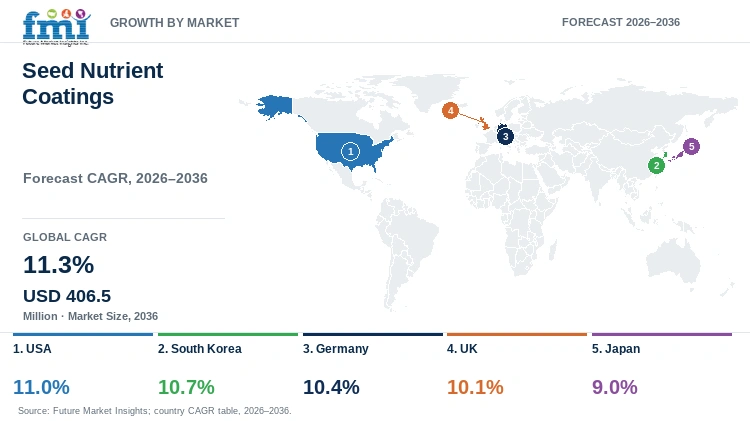
| Country | CAGR |
|---|---|
| USA | 11.0% |
| South Korea | 10.7% |
| Germany | 10.4% |
| UK | 10.1% |
| Japan | 9.0% |
How do country-level CAGRs compare in the Seed Nutrient Coatings Market?
The five country forecasts span two percentage points from the USA at 11.0% to Japan at 9.0%. That narrow range describes forecast pace instead of current revenue because regulation and treatment infrastructure still determine commercial conversion.
- USA growth follows large seed-treatment programs where one qualified recipe can scale over broad-acre crop volumes.
- South Korea combines cooperative input channels with fertilizer rules that recognize soil microbial preparations as regulated categories.
- Germany requires crop-specific treatment authorizations alongside European material rules that affect commercial seed recipes.
- UK commercialization is being shaped by a proposed fertilizing-product framework covering conformity assessment for novel categories.
- Japan applies formal evidence expectations to biostimulant claims before new functions become routine commercial inputs.
The full report provides country-level CAGR analysis across North America, Latin America, Western Europe, Eastern Europe, East Asia, South Asia and Pacific, and the Middle East and Africa.
Country-wise Analysis
- USA commercial seed programs cover volumes where new nutrient functions must fit factory recipes and federal claim boundaries. Seed nutrient coating sales in the USA are forecast to expand at 11.0% CAGR by 2036, driven by microbial seed treatment that can enter planting programs after its registration route is settled. EPA assigns a 31-month decision time under R126 to new pesticidal active ingredients used only as seed treatments when a tolerance is required. That review period can overlap multiple planting cycles for mixed-function products carrying pesticidal claims.
- South Korean fertilizer distribution follows national rules defining which nutrient products can be produced and sold under regulated categories. Adoption of seed nutrient coatings in South Korea is estimated to expand at 10.7% CAGR through 2036, supported by clearer national classification for soil microbial preparations. The Fertilizer Control Act effective October 2025 defines by-product fertilizers to include soil microbial preparations and soil activators. Seed-applied microbial nutrition can use that definition before product-specific registration and application requirements are settled. Cooperative channels can scale repeat orders after suppliers align technical claims and compliance documentation with the applicable fertilizer category for commercial sale.
- German seed companies work under national crop-protection authorizations beside European material rules affecting treated-seed recipes. The German seed nutrient coatings sector is projected to record 10.4% CAGR during the assessment period, attributable to commercial treaters adding biological functions to established processing controls. Germany’s BVL published 2025 emergency authorizations that included Scenic Gold for winter oilseed rape seed treatment during a defined May-to-September period. Crop protection and nutrient coatings follow different claim routes, but commercial plants still follow crop-specific permissions and seasonal schedules. Suppliers must coordinate coating chemistry with treatment documentation before factory programs commit seasonal volume and production capacity each season.
- UK seed-treatment buyers are operating during a fertilizing-product reform process covering conformity routes for novel nutrient and biostimulant claims. In the UK, seed nutrient coating demand is predicted to advance at 10.1% CAGR through 2036, driven by biostimulant inputs moving toward clearer conformity requirements. Defra reported in September 2026 that its proposed UK Fertilising Product Regulations consultation received 83 responses on conformity assessment and novel products. Defra states that further policy work will determine the technical parameters for the proposed national regime. Suppliers can reduce launch friction by preparing claim evidence and formulation documentation for seed-company qualification under the emerging national requirements.
- Japanese buyers apply formal evidence expectations to plant-input claims while seed companies maintain controlled quality systems around treated seed. Japan's seed nutrient coatings outlook is anticipated to advance at 9.0% CAGR over the assessment period, shaped by a national evidence framework for biostimulant functions. MAFF’s May 2025 biostimulant Q&A includes nutrient uptake and nutrient-use efficiency effects and explains when plant-growth-regulator functions require pesticide registration. That distinction makes claim wording part of commercialization before suppliers begin seed-treatment validation and local qualification. Companies entering Japan should settle the claim category first and build crop-specific treatment evidence for storage and application conditions before commercial launch.
Who are the notable companies in the Seed Nutrient Coatings Market?
Pivot Bio, Groundwork BioAg, Verdesian Life Sciences, Bayer SeedGrowth, Syngenta, Corteva Agriscience, BASF, and Germains Seed Technology are active in this market.
Competition separates microbial nutrition specialists from integrated seed-treatment businesses and coating technology companies today. Entry depends on formulation stability because agronomic value does not offset disrupted factory throughput. Buyers compare nutrient function with technical support before approving repeat commercial production programs today.
- Pivot Bio, Groundwork BioAg and Verdesian Life Sciences focus on microbial nitrogen or nutrient-use functions applied at planting.
- Bayer SeedGrowth, Syngenta and Corteva Agriscience connect biological functions with established seed-treatment programs and technical support.
- BASF and Germains Seed Technology provide coating or treatment capabilities supporting commercial application and production control.
Competitive Benchmarking: Seed Nutrient Coatings Market
| Company | Nutrient Delivery Relevance | Formulation Breadth | Industrial Treatment Integration | Geographic Reach |
|---|---|---|---|---|
| Pivot Bio | High | High | Medium | North America |
| Groundwork BioAg | High | High | Medium | 23 commercial markets |
| Verdesian Life Sciences | High | Medium | Medium | North America and international sales |
| Bayer SeedGrowth | High | Medium | High | Global |
| Syngenta | Medium | Medium | High | Global |
| Corteva Agriscience | High | Medium | High | Global |
| BASF | Medium | Medium | High | Global |
| Germains Seed Technology | High | High | High | Europe and North America |
Scoring basis: High nutrient relevance requires direct seed-applied nutrition evidence while Medium covers an adjacent route. High formulation breadth requires multiple documented forms while Medium reflects one established commercial route. High integration requires commercial treatment support while Medium reflects direct use without comparable integration.
Key Developments in the Seed Nutrient Coatings Market
- In March 2026, Pivot Bio launched RETAIN Dry for direct sorghum-seed application with micronutrients supporting microbial nitrogen fixation and seed flow.
- In June 2025, Corteva Agriscience presented Ympact as a cereal growth-nutrition seed treatment using humic and fulvic compounds with micronutrients.
- In February 2025, Groundwork BioAg released Rootella Forte as a concentrated mycorrhizal formulation intended to improve nutrient uptake with lower product volume.
Key Players in the Seed Nutrient Coatings Market
Microbial Crop Nutrition Platforms
- Pivot Bio
- Groundwork BioAg
- Verdesian Life Sciences
Integrated Seed-Treatment Businesses
- Bayer SeedGrowth
- Syngenta
- Corteva Agriscience
Coating and Treatment Technology Specialists
- BASF
- Germains Seed Technology
Seed Nutrient Coatings Market - Report Scope
| Coverage field | Report scope |
|---|---|
| Market breakdown | By product type, crop type, treatment point, formulation, sales channel and region. |
| Quantitative Units | USD million. |
| Market Definition | Seed-applied coating systems that deliver nutrient, micronutrient or biological nutrition functions before or during planting. |
| Regions Covered | North America, Latin America, Western Europe, Eastern Europe, East Asia, South Asia and Pacific, and Middle East and Africa. |
| Countries Covered | USA, South Korea, Germany, UK, Japan, and 20+ countries included in the full report. |
| Key Companies Profiled | Pivot Bio, Groundwork BioAg, Verdesian Life Sciences, Bayer SeedGrowth, Syngenta, Corteva Agriscience, BASF, Germains Seed Technology. |
| Forecast Period | 2026 to 2036. |
| Approach | Primary and secondary research with market triangulation. |
Seed Nutrient Coatings Market - Research Methodology
| Method | Approach |
|---|---|
| Primary Research | The primary research framework covers seed companies, commercial treaters, biological-input developers, coating formulators, distributors and growers. Discussion topics include treatment qualification, compatibility, agronomic value, application routes and the evidence required before a trial develops into repeat purchasing. |
| Desk Research | Desk research reviewed national regulators, government guidance, recognized seed associations, official company newsrooms, filings and current corporate disclosures. Sources were checked for title fit, publication date, geography and the operating mechanism they directly support. |
| Market Sizing and Forecasting | The market model combines the 2026 baseline with the supplied segment structure, country growth rates and company participation. Forecast reconciliation uses the 2036 value and confirms that the ten-year CAGR matches the stated 11.3% rate. |
| Data Validation | Values, shares, country CAGRs, company identities and source claims were checked separately before placement. Evidence covering a broad industry, unrelated product or local geography was excluded from national or exact-market claims. |
Seed Nutrient Coatings Market by Segments
Seed Nutrient Coatings Market segmented by Product Type:
- Polymer-Based Systems
- Biological - Microbial Systems
- Nutrient-Loaded Systems
- Others
Seed Nutrient Coatings Market segmented by Crop Type:
- Corn & Cereals
- Soybean & Pulses
- Vegetables
- Cotton & Others
Seed Nutrient Coatings Market segmented by Treatment Point:
- In-Plant (Seed Companies)
- Commercial Seed Treaters
- On-Farm Treatment
- Others
Seed Nutrient Coatings Market segmented by Formulation:
- Liquid Slurries
- Dry Powders
- Film Coats & Encrusting
- Others
Seed Nutrient Coatings Market segmented by Sales Channel:
- Agri-Input Distributors
- Cooperatives
- Agri-Retail Chains
- Online - Direct-to-Farm
- Others
Seed Nutrient Coatings Market by Region:
- North America
- United States
- Canada
- Latin America
- Brazil
- Mexico
- Argentina
- Chile
- Western Europe
- Germany
- France
- United Kingdom
- Italy
- Spain
- Benelux
- Nordics
- Eastern Europe
- Poland
- Czech Republic
- Romania
- Hungary
- East Asia
- China
- Japan
- South Korea
- South Asia and Pacific
- India
- ASEAN
- Australia and New Zealand
- Middle East and Africa
- GCC Countries
- South Africa
- Türkiye
- Israel
Research Sources and Bibliography
- Pivot Bio. (2026, February 24). Pivot Bio Releases 2025 Field Performance Data Demonstrating Consistent Yield Gains and Synthetic Nitrogen Displacement While Lowering Fertilizer Costs.
- USA Environmental Protection Agency. (2026, April 29). PRIA Conventional Active Ingredient - New Registration - New Active Ingredient - Seed Treatment.
- Ministry of Agriculture, Forestry and Fisheries of Japan. (2025, May 30). 「バイオスティミュラントの表示等に係るガイドライン」を策定しました.
- European Commission. (2025, April 1). Commission helps users to implement the restriction on microplastics under the EU chemical legislation.
- Bayer SeedGrowth. (2025, August 11). Introducing Bayer's biostimulant Yoalo®, which gives plant performance a biological boost.
- USA Environmental Protection Agency. (2026, April 29). R123 PRIA Fee Category.
- American Seed Trade Association. (2025, August 28). Updated Seed Treatment Stewardship Guide Offers Stakeholders Best Practices.
- Pivot Bio. (2025, March 3). Pivot Bio Announces New Product Launch For USA Cotton.
- Pivot Bio. (2026, March 4). Pivot Bio to Increase Production and Lower Price to Meet Historic Nitrogen Demand.
- USA Environmental Protection Agency. (2026, April 29). R273 PRIA Fee Category.
- Corteva Agriscience. (2026, March 17). From pipeline to field: Corteva showcases continued innovation to support UK growers at Cereals 2026.
- USA Environmental Protection Agency. (2026, April 29). R126 PRIA Fee Category.
- National Law Information Center. (2025, October 1). 비료관리법 [Fertilizer Control Act, Act No. 21065].
- German Federal Office of Consumer Protection and Food Safety. (2025, June 27). Zulassungen für Notfallsituationen (letzte Änderung: 27. Juni 2025).
- Department for Environment, Food & Rural Affairs. (2026, March 19; updated September 9, 2026). Marketing fertilising products in the UK: regulatory reform.
- Ministry of Agriculture, Forestry and Fisheries of Japan. (2025, May). 「バイオスティミュラントの表示等に係るガイドライン」に関するQ&A.
- Pivot Bio. (2026, March 11). Pivot Bio Launches RETAIN™ Dry, Expanding Application Options for Sorghum Growers.
- Pivot Bio. (n.d.). Using Pivot Bio. Retrieved September 16, 2026.
- Corteva Agriscience. (2025, June 27). Arable Update June 2025.
- Groundwork BioAg. (2025, February 25). Mycorrhizal Inoculant Leader Groundwork BioAg Expands Rootella Portfolio and Rootella Carbon Program at Commodity Classic 2025.
- Verdesian Life Sciences. (2025, October 21). SEED+GRAPHITE® conventional 25 lb label.
- Verdesian Life Sciences. (n.d.). Take Off ST® - Seed Treatment Product. Retrieved September 16, 2026.
- Syngenta. (2025, June 30). Syngenta to become global leader in biologicals; expanding nature inspired solutions for farmers.
- Syngenta. (n.d.). Syngenta Seedcare is the leader in innovation to protect seeds. Retrieved September 16, 2026.
- Groundwork BioAg. (2026, July 14). Syngenta and Groundwork BioAg enter partnership to bring innovation in biologicals and soil carbon solutions to farmers.
- BASF. (2025, November 20). BASF announces Integral® Pro for Sunflowers is registered in France.
- Pivot Bio. (2026, September 1). Pivot Bio Expands Farmer Support for 2027 Amid Continued Fertilizer Uncertainty.
- Corteva Agriscience. (2026, August 19). Building resilience from the seed up.
- Corteva Agriscience. (n.d.). Ympact® Growth Nutrition Seed Treatment. Retrieved September 16, 2026.
- Corteva Agriscience. (n.d.). Lumidapt™ Growth Nutrition Seed Treatment. Retrieved September 16, 2026.
- Bayer SeedGrowth. (2025, September 29). Susteed® brings together the best of biologicals and seed treatments.
- Groundwork BioAg. (2025, September 10). Groundwork BioAg Announces First Commercial Insetting Deployment of Durable Carbon Removal.
- Groundwork BioAg. (n.d.). Rootella® X. Retrieved September 16, 2026.
- Groundwork BioAg. (n.d.). Rootella® L. Retrieved September 16, 2026.
- Syngenta. (2025, February 20). Sustainability in agriculture gets a boost with global biologicals partnership.
- Bayer SeedGrowth. (2025, April 15). SeedGrowth portfolio takes a step up with biological seed treatments Ibisio®, Yoalo® and Susteed®.
- Bayer SeedGrowth. (n.d.). Yoalo®. Retrieved September 16, 2026.
- Pivot Bio. (2025, November 13). Pivot Bio Expands Weatherproof Nitrogen Portfolio with New Dry Planter Box Treatments for Corn and Cotton.
- BASF. (2026, May 11). BASF Agricultural Solutions successfully commissions new fermentation plant for crop protection products in Ludwigshafen.
- BASF. (2025). BASF Factbook 2025 - Agricultural Solutions.
- BASF Agricultural Solutions. (n.d.). Seed Coatings by BASF. Retrieved September 16, 2026.
- Germains Seed Technology. (2025, August 19). New Xbeet enrich 400 delivers 2% yield uplift.
- European Patent Office. (2025, September 17). A seed treatment composition and method of using the same (EP 4615214 A1). Secondary copy.
- Corteva Agriscience. (2026, July). Arable Update July 2026.
- Syngenta. (2025, February 26). Syngenta strengthens global leadership in agricultural biologicals.
This bibliography is provided for reader reference and is not exhaustive. The full report contains the complete reference list and detailed citations
This Report Answers
- How large is seed nutrient coatings demand in 2026 and 2036?
- Which operating conditions make seed-applied nutrient functions commercially useful for buyers?
- Why do polymer-based systems account for 46.3% of product type demand?
- How do corn and cereal programs change nutrient-coating qualification economics?
- Why does in-plant treatment hold 48.7% of treatment point demand?
- How do national rules change commercialization timing among selected countries?
- Which companies supply microbial nutrition or integrated seed-treatment technology today?
- What qualification limits delay adoption after agronomic performance is demonstrated?
Frequently Asked Questions
How big is the seed nutrient coatings market in 2026?
The seed nutrient coatings market is valued at USD 139.3 million in 2026 and projected to reach USD 406.5 million by 2036. Expansion depends on nutrient functions that remain effective during commercial treatment and planting operations.
What CAGR is projected for seed nutrient coatings through 2036?
The seed nutrient coatings market is projected to grow at 11.3% CAGR between 2026 and 2036. Repeat purchasing depends on seed-applied nutrition that fits commercial recipes without another field operation.
Which product type accounts for 46.3% of demand in 2026?
Polymer-based systems are projected to account for 46.3% of product type demand in the seed nutrient coatings market during 2026. Their position reflects controlled adhesion and repeatable active loading during routine commercial seed-treatment operations.
How do country CAGRs compare in the seed nutrient coatings market?
USA demand is forecast at 11.0% CAGR through 2036 with South Korea at 10.7% and Germany at 10.4%. UK follows at 10.1% and Japan at 9.0% as national regulation and treatment infrastructure shape commercialization speed.
Which companies are active in the seed nutrient coatings market?
Key companies in the seed nutrient coatings market include Pivot Bio, Groundwork BioAg, Verdesian Life Sciences, Bayer SeedGrowth, Syngenta, Corteva Agriscience, BASF, and Germains Seed Technology. Their positions cover microbial nutrition and integrated treatment plus commercial seed-coating technology used commercially.
Preview the report firsthand - request a free sample
Get SampleGet the brochure for pricing and purchase details.
Get PDFTable of Content
- Key Takeaways
- Market Size and CAGR
- Top Growth Driver
- Fastest Growing Segment
- Leading Region
- Key Companies
- Emerging Opportunities
- Executive Summary
- Global Market Outlook
- Demand-side Trends
- Supply-side Trends
- Technology Roadmap Analysis
- Analysis and Recommendations
- Analyst Perspective (What is happening? Why now? What should investors know?)
- Key Questions Answered
- How large is the market?
- What is the CAGR?
- What are key trends?
- Which region dominates?
- Who are the leaders?
- Market Overview
- Market Coverage / Taxonomy
- Market Definition / Scope / Limitations
- Research Methodology
- Chapter Orientation
- Analytical Lens and Working Hypotheses
- Market Structure, Signals, and Trend Drivers
- Benchmarking and Cross-market Comparability
- Market Sizing, Forecasting, and Opportunity Mapping
- Research Design and Evidence Framework
- Desk Research Programme (Secondary Evidence)
- Expert Input and Fieldwork (Primary Evidence)
- Tooling, Models, and Reference Databases
- Data Engineering and Model Build
- Quality Assurance and Audit Trail
- Market Background
- Market Dynamics (Drivers, Restraints, Opportunity, Trends)
- Scenario Forecast (Optimistic, Likely, Conservative)
- Impact Analysis
- AI Impact
- Sustainability Impact
- Regulatory Impact
- Technology Impact
- Consumer / Buyer Analysis
- Purchase Drivers
- Adoption Barriers
- Buyer Journey
- Opportunity Map Analysis
- Product Life Cycle Analysis
- Supply Chain Analysis
- Investment Feasibility Matrix
- Value Chain Analysis
- PESTLE and Porter's Analysis
- Regulatory Landscape
- Regional Parent Market Outlook
- Production and Consumption Statistics
- Import and Export Statistics
- Global Market Analysis and Forecast, 2021 to 2036
- Historical Market Size Value (USD Million) Analysis, 2021 to 2025
- Current and Future Market Size Value (USD Million) Projections, 2026 to 2036
- Y-o-Y Growth Trend Analysis
- Absolute $ Opportunity Analysis
- Global Market Pricing Analysis, 2021 to 2036
- Global Market Analysis and Forecast, By Product Type, 2021 to 2036
- Introduction / Key Findings
- Historical Market Size Value (USD Million) Analysis By Product Type, 2021 to 2025
- Current and Future Market Size Value (USD Million) Analysis and Forecast By Product Type, 2026 to 2036
- Polymer-Based Systems
- Biological - Microbial Systems
- Nutrient-Loaded Systems
- Others
- Y-o-Y Growth Trend Analysis By Product Type, 2021 to 2025
- Absolute $ Opportunity Analysis By Product Type, 2026 to 2036
- Global Market Analysis and Forecast, By Crop Type, 2021 to 2036
- Introduction / Key Findings
- Historical Market Size Value (USD Million) Analysis By Crop Type, 2021 to 2025
- Current and Future Market Size Value (USD Million) Analysis and Forecast By Crop Type, 2026 to 2036
- Corn & Cereals
- Soybean & Pulses
- Vegetables
- Cotton & Others
- Y-o-Y Growth Trend Analysis By Crop Type, 2021 to 2025
- Absolute $ Opportunity Analysis By Crop Type, 2026 to 2036
- Global Market Analysis and Forecast, By Treatment Point, 2021 to 2036
- Introduction / Key Findings
- Historical Market Size Value (USD Million) Analysis By Treatment Point, 2021 to 2025
- Current and Future Market Size Value (USD Million) Analysis and Forecast By Treatment Point, 2026 to 2036
- In-Plant (Seed Companies)
- Commercial Seed Treaters
- On-Farm Treatment
- Others
- Y-o-Y Growth Trend Analysis By Treatment Point, 2021 to 2025
- Absolute $ Opportunity Analysis By Treatment Point, 2026 to 2036
- Global Market Analysis and Forecast, By Formulation, 2021 to 2036
- Introduction / Key Findings
- Historical Market Size Value (USD Million) Analysis By Formulation, 2021 to 2025
- Current and Future Market Size Value (USD Million) Analysis and Forecast By Formulation, 2026 to 2036
- Liquid Slurries
- Dry Powders
- Film Coats & Encrusting
- Others
- Y-o-Y Growth Trend Analysis By Formulation, 2021 to 2025
- Absolute $ Opportunity Analysis By Formulation, 2026 to 2036
- Global Market Analysis and Forecast, By Sales Channel, 2021 to 2036
- Introduction / Key Findings
- Historical Market Size Value (USD Million) Analysis By Sales Channel, 2021 to 2025
- Current and Future Market Size Value (USD Million) Analysis and Forecast By Sales Channel, 2026 to 2036
- Agri-Input Distributors
- Cooperatives
- Agri-Retail Chains
- Online - Direct-to-Farm
- Others
- Y-o-Y Growth Trend Analysis By Sales Channel, 2021 to 2025
- Absolute $ Opportunity Analysis By Sales Channel, 2026 to 2036
- Global Market Analysis and Forecast, By Region, 2021 to 2036
- Introduction
- Historical Market Size Value (USD Million) Analysis By Region, 2021 to 2025
- Current Market Size Value (USD Million) Analysis and Forecast By Region, 2026 to 2036
- North America
- Latin America
- Western Europe
- Eastern Europe
- East Asia
- South Asia and Pacific
- Middle East and Africa
- Market Attractiveness Analysis By Region
- North America Market Analysis and Forecast, By Country, 2021 to 2036
- Historical Market Size Value (USD Million) Trend Analysis By Market Taxonomy, 2021 to 2025
- Market Size Value (USD Million) Forecast By Market Taxonomy, 2026 to 2036
- By Country
- United States
- Canada
- By Product Type
- By Crop Type
- By Treatment Point
- By Formulation
- By Sales Channel
- By Country
- Market Attractiveness Analysis
- By Country
- By Product Type
- By Crop Type
- By Treatment Point
- By Formulation
- By Sales Channel
- Key Takeaways
- Latin America Market Analysis and Forecast, By Country
- Historical Market Size Value (USD Million) Trend Analysis By Market Taxonomy, 2021 to 2025
- Market Size Value (USD Million) Forecast By Market Taxonomy, 2026 to 2036
- By Country
- Brazil
- Mexico
- Argentina
- Chile
- By Product Type
- By Crop Type
- By Treatment Point
- By Formulation
- By Sales Channel
- By Country
- Market Attractiveness Analysis
- By Country
- By Product Type
- By Crop Type
- By Treatment Point
- By Formulation
- By Sales Channel
- Key Takeaways
- Western Europe Market Analysis and Forecast, By Country
- Historical Market Size Value (USD Million) Trend Analysis By Market Taxonomy, 2021 to 2025
- Market Size Value (USD Million) Forecast By Market Taxonomy, 2026 to 2036
- By Country
- Germany
- France
- United Kingdom
- Italy
- Spain
- Benelux
- Nordics
- By Product Type
- By Crop Type
- By Treatment Point
- By Formulation
- By Sales Channel
- By Country
- Market Attractiveness Analysis
- By Country
- By Product Type
- By Crop Type
- By Treatment Point
- By Formulation
- By Sales Channel
- Key Takeaways
- Eastern Europe Market Analysis and Forecast, By Country
- Historical Market Size Value (USD Million) Trend Analysis By Market Taxonomy, 2021 to 2025
- Market Size Value (USD Million) Forecast By Market Taxonomy, 2026 to 2036
- By Country
- Poland
- Czech Republic
- Romania
- Hungary
- By Product Type
- By Crop Type
- By Treatment Point
- By Formulation
- By Sales Channel
- By Country
- Market Attractiveness Analysis
- By Country
- By Product Type
- By Crop Type
- By Treatment Point
- By Formulation
- By Sales Channel
- Key Takeaways
- East Asia Market Analysis and Forecast, By Country
- Historical Market Size Value (USD Million) Trend Analysis By Market Taxonomy, 2021 to 2025
- Market Size Value (USD Million) Forecast By Market Taxonomy, 2026 to 2036
- By Country
- China
- Japan
- South Korea
- By Product Type
- By Crop Type
- By Treatment Point
- By Formulation
- By Sales Channel
- By Country
- Market Attractiveness Analysis
- By Country
- By Product Type
- By Crop Type
- By Treatment Point
- By Formulation
- By Sales Channel
- Key Takeaways
- South Asia and Pacific Market Analysis and Forecast, By Country
- Historical Market Size Value (USD Million) Trend Analysis By Market Taxonomy, 2021 to 2025
- Market Size Value (USD Million) Forecast By Market Taxonomy, 2026 to 2036
- By Country
- India
- ASEAN
- Australia and New Zealand
- By Product Type
- By Crop Type
- By Treatment Point
- By Formulation
- By Sales Channel
- By Country
- Market Attractiveness Analysis
- By Country
- By Product Type
- By Crop Type
- By Treatment Point
- By Formulation
- By Sales Channel
- Key Takeaways
- Middle East and Africa Market Analysis and Forecast, By Country
- Historical Market Size Value (USD Million) Trend Analysis By Market Taxonomy, 2021 to 2025
- Market Size Value (USD Million) Forecast By Market Taxonomy, 2026 to 2036
- By Country
- GCC Countries
- South Africa
- Türkiye
- Israel
- By Product Type
- By Crop Type
- By Treatment Point
- By Formulation
- By Sales Channel
- By Country
- Market Attractiveness Analysis
- By Country
- By Product Type
- By Crop Type
- By Treatment Point
- By Formulation
- By Sales Channel
- Key Takeaways
- Key Countries Market Analysis
- United States
- Pricing Analysis
- Market Share Analysis, 2025
- By Product Type
- By Crop Type
- By Treatment Point
- By Formulation
- By Sales Channel
- Canada
- Pricing Analysis
- Market Share Analysis, 2025
- By Product Type
- By Crop Type
- By Treatment Point
- By Formulation
- By Sales Channel
- Mexico
- Pricing Analysis
- Market Share Analysis, 2025
- By Product Type
- By Crop Type
- By Treatment Point
- By Formulation
- By Sales Channel
- Brazil
- Pricing Analysis
- Market Share Analysis, 2025
- By Product Type
- By Crop Type
- By Treatment Point
- By Formulation
- By Sales Channel
- Chile
- Pricing Analysis
- Market Share Analysis, 2025
- By Product Type
- By Crop Type
- By Treatment Point
- By Formulation
- By Sales Channel
- Germany
- Pricing Analysis
- Market Share Analysis, 2025
- By Product Type
- By Crop Type
- By Treatment Point
- By Formulation
- By Sales Channel
- United Kingdom
- Pricing Analysis
- Market Share Analysis, 2025
- By Product Type
- By Crop Type
- By Treatment Point
- By Formulation
- By Sales Channel
- Italy
- Pricing Analysis
- Market Share Analysis, 2025
- By Product Type
- By Crop Type
- By Treatment Point
- By Formulation
- By Sales Channel
- Spain
- Pricing Analysis
- Market Share Analysis, 2025
- By Product Type
- By Crop Type
- By Treatment Point
- By Formulation
- By Sales Channel
- France
- Pricing Analysis
- Market Share Analysis, 2025
- By Product Type
- By Crop Type
- By Treatment Point
- By Formulation
- By Sales Channel
- India
- Pricing Analysis
- Market Share Analysis, 2025
- By Product Type
- By Crop Type
- By Treatment Point
- By Formulation
- By Sales Channel
- ASEAN
- Pricing Analysis
- Market Share Analysis, 2025
- By Product Type
- By Crop Type
- By Treatment Point
- By Formulation
- By Sales Channel
- Australia and New Zealand
- Pricing Analysis
- Market Share Analysis, 2025
- By Product Type
- By Crop Type
- By Treatment Point
- By Formulation
- By Sales Channel
- China
- Pricing Analysis
- Market Share Analysis, 2025
- By Product Type
- By Crop Type
- By Treatment Point
- By Formulation
- By Sales Channel
- Japan
- Pricing Analysis
- Market Share Analysis, 2025
- By Product Type
- By Crop Type
- By Treatment Point
- By Formulation
- By Sales Channel
- South Korea
- Pricing Analysis
- Market Share Analysis, 2025
- By Product Type
- By Crop Type
- By Treatment Point
- By Formulation
- By Sales Channel
- Poland
- Pricing Analysis
- Market Share Analysis, 2025
- By Product Type
- By Crop Type
- By Treatment Point
- By Formulation
- By Sales Channel
- Hungary
- Pricing Analysis
- Market Share Analysis, 2025
- By Product Type
- By Crop Type
- By Treatment Point
- By Formulation
- By Sales Channel
- Türkiye
- Pricing Analysis
- Market Share Analysis, 2025
- By Product Type
- By Crop Type
- By Treatment Point
- By Formulation
- By Sales Channel
- South Africa
- Pricing Analysis
- Market Share Analysis, 2025
- By Product Type
- By Crop Type
- By Treatment Point
- By Formulation
- By Sales Channel
- United States
- Market Structure Analysis
- Competition Dashboard
- Competition Benchmarking
- Market Share Analysis of Top Players
- By Regional
- By Product Type
- By Crop Type
- By Treatment Point
- By Formulation
- By Sales Channel
- Emerging Startups
- Innovation Benchmarking
- Competition Analysis
- Competition Deep Dive
- Pivot Bio
- Overview
- Product Portfolio
- Profitability by Market Segments
- Sales Footprint
- Strategy Overview
- Marketing Strategy
- Product Strategy
- Channel Strategy
- Groundwork BioAg
- Verdesian Life Sciences
- Bayer SeedGrowth
- Syngenta
- Corteva Agriscience
- BASF
- Germains Seed Technology
- Pivot Bio
- Case Studies
- Success Stories
- Recent Developments
- Competition Deep Dive
- Assumptions & Acronyms Used


