

- Market Size (2026)
- USD 185.6 Mn
- Forecast (2036)
- USD 427.3 Mn
- CAGR (2026 to 2036)
- 8.7%
How big is Nutrient Release Modifiers Market in 2026?
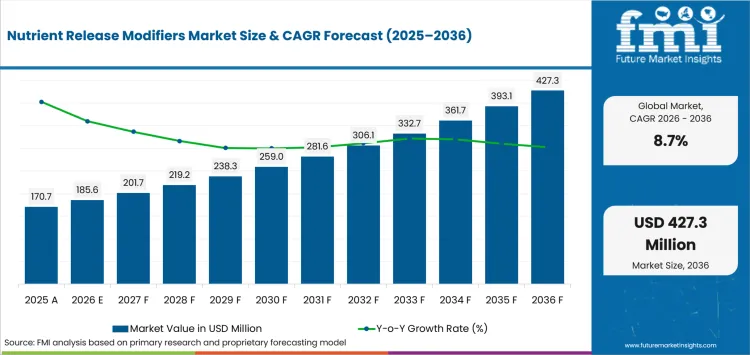
USD 185.6 million in 2026 and USD 427.3 million by 2036 at an 8.7% CAGR.
Demand for nutrient release modifiers is projected to expand at an 8.7% CAGR between 2026 and 2036, increasing valuation from USD 185.6 million in 2026 to USD 427.3 million by 2036 as growers spend more to protect nutrient application from avoidable loss. The purchase case is significant as a modifier improves wetting and nutrient movement without adding another field pass. Suppliers therefore need field evidence that the chemistry protects the value of the scheduled nutrient application under the grower's actual water and equipment conditions.
Country adoption follows different buying paths through nutrient-planning and dosing routines during each season. In the UK, advisor-led nutrient planning creates a regular point for growers to review compatibility and delivered nutrient performance before repeating an additive. South Korean greenhouse operations place greater weight on dosing-system fit, so market entry depends more heavily on equipment compatibility and local validation. These differences affect how suppliers prove value even when the underlying modifier function is similar.
Key Takeaways of Nutrient Release Modifiers Market
- Fertilizer cost exposure and nutrient-loss controls increase the value of modifiers that protect each scheduled nutrient application.
- By product type, the surfactant-based segment is estimated to hold 49.0% in 2026 owing to low-dose wetting and compatibility roles in liquid nutrient systems.
- In 2026, efficacy enhancement is expected to lead the function category with 47.5% share because agronomists prioritize usable nutrient delivery from scheduled applications.
- The cereals & grains segment is likely to capture 41.0% share in 2026 attributable to broad acreage and repeated nutrient decisions during each growing season.
- Field-specific water chemistry and tank compatibility raise trial costs by forcing performance checks against local equipment and mixing sequences.
- Some of the key players in this market include Stepan Company, Evonik, Syensqo, Wilbur-Ellis, Helena Agri-Enterprises, Precision Laboratories, WinField United (Land O'Lakes), and Brandt.
Analyst Perspective
"Nutrient release modifiers earn repeat use only when field trials show that the chemistry protects an expensive nutrient pass without changing equipment or mixing routines. Formulations gain commercial credibility after local water tests confirm stable performance and agronomists can explain the result to growers."
- Nikhil Kaitwade, Principal Consultant, Future Market Insights
How is the Nutrient Release Modifiers Market segmented?
The market is assessed by product type, function, crop type, application method and sales channel.
Product type includes surfactant-based, oil-based, polymer-based, mineral - carrier-based and others, and function covers efficacy enhancement, loss & drift reduction, handling & compatibility and others. Crop type includes cereals & grains, fruits & vegetables, oilseeds & pulses, turf & ornamentals and others, and application method covers foliar tank-mix, granule - dry blend, fertigation and others. Sales channel options include agri-input distributors, cooperatives, agri-retail chains, online - direct-to-farm and other routes.
What makes surfactant-based central to the product type category?
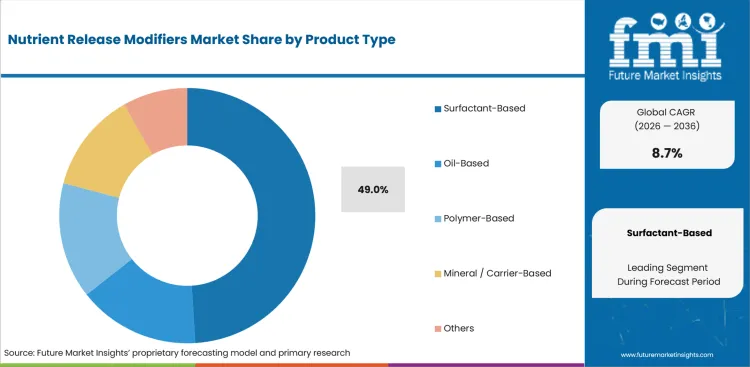
Surfactant-based modifiers address the first physical barrier to nutrient chemistry by improving target wetting and carrier distribution. Agricultural surfactants fit foliar programs that need predictable spreading without changing nutrient dose or application equipment. Oil and polymer systems become more useful where persistence or release control outweighs immediate surface contact.
- Based on product type, the surfactant-based segment is projected to account for 49.0% in 2026 due to low-dose wetting roles that fit liquid nutrient and tank-mix formats.
- Evonik documented in August 2025 that its Break-Thru adjuvant improved droplet spreading and retention in a bioformulation developed for existing farm machinery.
Why does efficacy enhancement lead the function category?
Agronomists buy an efficacy modifier to protect the usable return from an existing nutrient program rather than to raise nutrient mass. Agricultural adjuvants can improve deposition or retention so a planned dose reaches the intended crop surface with less avoidable loss. The value case therefore depends on measurable application performance under real mixing and field conditions.
- By function, efficacy enhancement is forecast to represent 47.5% in 2026 driven by demand for better delivered nutrient utility from scheduled applications.
- In October 2025, Stepan Company partnered with Staphyt to pair formulation development with regulatory strategy and field evaluation for European agricultural programs.
How do cereals & grains anchor the crop type category?
Corn and wheat programs generate repeated modifier decisions over large acreage and several nutrient application windows. Specialty fertilizers gain relevance for micronutrient or efficiency products that must justify their cost within high-volume programs. USDA NASS estimated 95.2 million US corn acres for 2025 in June 2025, establishing the scale of repeated field applications.
- Cereals & grains are projected to hold 41.0% share in 2026 owing to broad acreage and repeated nutrient decisions during each growing season.
- Grower adoption rises for formulations that protect wetting or placement without requiring another field pass during crowded cereal application schedules.
What supports foliar tank-mix within the application method category?
Foliar tank-mix places the modifier inside a field pass that growers already plan for crop nutrition or crop protection. Water-soluble fertilizers increase the need for predictable dissolution and mixing behavior where soluble nutrients enter spray or fertigation programs. The formulation must tolerate local water and tank partners without creating nozzle or compatibility problems.
- By application method, foliar tank-mix is forecast to represent 44.5% in 2026 due to delivery inside a planned spray pass.
- WinField United reported in March 2025 that its Innovation Center evaluates adjuvants through field trials and spray-system analysis to support grower recommendations.
Why do agri-input distributors lead the sales channel category?
Modifier selection depends on crop stage and local water conditions as much as the formulation label itself. Fertilizer additives require compatibility and handling guidance for reliable use within an existing nutrient program. Distributors and agronomists reduce misuse by translating formulation limits into a field recommendation and correcting problems after application.
- The agri-input distributors segment is likely to capture 45.3% share in 2026 attributable to local technical advice and faster resolution of application problems.
- The American Society of Agronomy stated in its 2026 ICCA policy manual that more than 12,000 crop advisors serve farmers and agricultural organizations.
What are the drivers, restraints and opportunities in the Nutrient Release Modifiers Market?
Fertilizer economics and nutrient-loss controls support demand while application-specific qualification raises costs and multi-route formulations broaden repeat-use potential.
- Driver: Expensive nutrient programs increase the value of wetting and retention improvements that protect each scheduled application.
- Restraint: Water chemistry and application rules can require additional testing during qualification for routine field use.
- Opportunity: Multi-route formulations can earn repeat orders if one product family works in foliar, seed and fertigation programs.
Growers pay for nutrients upfront, so field losses directly erode the planned application budget. EPA stated in February 2026 that unused nitrogen and phosphorus can leave fields through runoff or leaching. Controlled-release fertilizers address timing, whereas nutrient release modifiers focus on wetting or placement that keeps more of the intended dose available to the crop.
Nozzle setup and droplet behavior make application rules a qualification task for modifiers used in field programs. EPA's April 2025 Mitigation Menu assigns reduction credits to approved drift-reduction practices, so formulators must test products against label conditions and equipment choices. A modifier that performs well in one tank can still require local evidence for routine distributor recommendation.
Commercial opportunity improves as one modifier serves both soil and liquid nutrient programs without changing basic equipment. Precision Laboratories reported in February 2026 that SeedZone IF had completed a second year of broadcast PROVE trials and could also be used in-furrow or side-dress. Fertigation monitoring makes broader product utility easier to document in irrigation programs, provided each application route has separate field evidence and clear instructions.
Which country CAGRs are profiled in the Nutrient Release Modifiers Market?
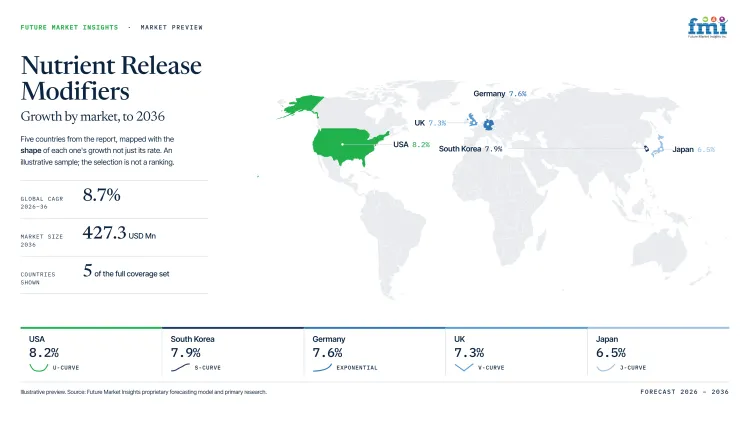
| Country | CAGR |
|---|---|
| USA | 8.2% |
| South Korea | 7.9% |
| Germany | 7.6% |
| UK | 7.3% |
| Japan | 6.5% |
How do country-level CAGRs compare in the Nutrient Release Modifiers Market?
USA at 8.2% and South Korea at 7.9% form the upper group while Germany at 7.6% and UK at 7.3% follow. Japan at 6.5% is 1.1 percentage points below Germany and marks the slower transition. The 1.7-point spread makes local operating conditions decisive during company comparisons of small CAGR differences.
- USA fertilizer-cost exposure keeps loss prevention visible during budgets before modifiers reach broad-acre trials.
- South Korea’s concentrated greenhouse acreage lets distributors service protected-crop clusters with shorter travel distances.
- Germany’s chemical base gives agricultural formulators nearby technical resources for compatibility work before trials.
- UK farm structure rewards low-complexity products distributors can stock without application equipment or service changes.
- Japan forecast permits selective distributor stocking during a more gradual national volume expansion.
The full report extends country analysis through North America, Latin America, Western Europe, Eastern Europe, East Asia, South Asia and Pacific, and the Middle East and Africa.
Country-wise Analysis
- Broad-acre corn programs in the USA give retailer agronomists a large regional testing base for modifiers that must perform with existing sprayers and fertilizer routines. USA is projected to grow at 8.2% CAGR through 2036, with repeat application volume and retailer-led field validation sustaining the forecast. USDA NASS estimated 95.3 million corn acres for 2026 in June 2026, giving manufacturers a large acreage base for trials that compare nutrient placement and application consistency. Crop micronutrients can share the same advisory channel, but water quality and local tank partners still require regional compatibility data before a recommendation reaches multiple distinct regional retailer locations.
- South Korean greenhouse operations increasingly use electronic dosing and environmental controls, which makes equipment compatibility part of the modifier sale. MAFRA's February 2025 master plan targets smart-farm conversion for 35% of 55,000 greenhouse hectares and identifies shortages of specialized companies and technical personnel. Demand in South Korea is forecast to rise at 7.9% CAGR through 2036, supported by dosing systems that can measure water and nutrient delivery more closely. Seed treatment materials offer a related route into controlled crop programs, although local service capacity and validation with specific fertigation hardware can slow adoption outside established commercial greenhouse production clusters.
- German regulators and farm managers still track surplus nitrogen as an environmental indicator and operating concern for national nutrient policy. Germany is estimated to post 7.6% CAGR over the forecast period, shaped by tighter nutrient documentation and strong agronomy services. The German Environment Agency reported in March 2026 that the five-year agricultural nitrogen surplus had fallen about 40% from 1994 levels and cited a federal target of 70 kilograms per hectare for 2026-2030. Biostimulants may share the same evidence-driven sales route, yet field teams still need local data showing that a modifier improves delivery without complicating approved regional application practices.
- UK farms commonly place additive choices inside a written local farm nutrient plan, giving advisors a regular point to compare application efficiency and compatibility. Defra’s 2025 survey found that 77% of self-planning farms seeking professional advice used fertilizer advisors or agronomists. The advisor network gives distributors a familiar route for presenting local water and tank-compatibility evidence during routine seasonal plan reviews. UK demand is forecast to expand at 7.3% CAGR by 2036, with the existing recommendation cycle providing a route into farm plans. Products requiring a separate pass or complex mixing instructions face a harder sell during farm-plan reviews against current practice.
- Japanese growers and cooperatives favor application changes that protect labor time and fit familiar rice or horticultural routines. Adoption of nutrient release modifiers in Japan is estimated to expand at 6.5% CAGR through 2036, supported by demand for formulations that fit established application equipment and seasonal nutrient schedules. Distributors need compatibility evidence that works with familiar machinery and simple mixing instructions because a product requiring new equipment or another field pass will face a slower recommendation cycle.
Who are the notable companies in the nutrient release modifiers market?
Stepan Company, Evonik, Syensqo, Wilbur-Ellis, Helena Agri-Enterprises, Precision Laboratories, WinField United (Land O'Lakes), and Brandt are notable companies serving this market.
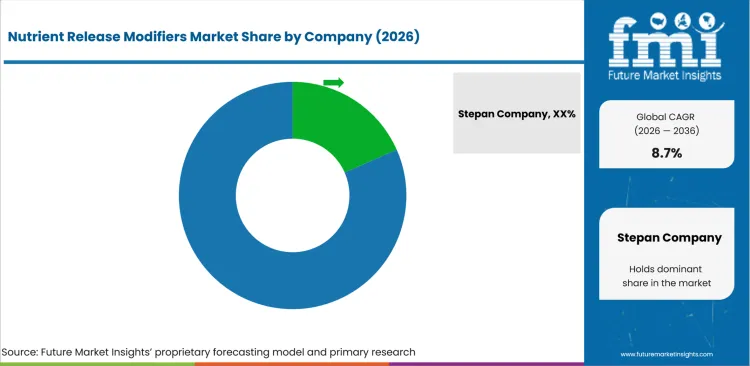
Company roles differ according to the part of application performance each business influences directly. Stepan Company and Evonik concentrate on formulation chemistry while Syensqo supplies dispersant technology for agricultural formulations. Wilbur-Ellis and Helena Agri-Enterprises work closer to field decisions through agronomic distribution and crop advice. Precision Laboratories focuses on tank-mix control whereas WinField United and Brandt extend into retailer or seed-applied programs. Entry requires field evidence that survives local water and equipment conditions plus channel trust during recommendation.
- Formulation chemistry: Stepan Company and Evonik join Syensqo in supplying surfactant and dispersant capabilities for agricultural formulations.
- Agronomic distribution and field support: Wilbur-Ellis and Helena Agri-Enterprises join WinField United (Land O'Lakes) in pairing crop inputs with local advice.
- Specialized delivery platforms: Precision Laboratories and Brandt concentrate on tank-mix control plus nutrient-management or seed-applied functions within crop programs.
Competitive Benchmarking: Nutrient Release Modifiers Market
| Company | Modifier Chemistry Breadth | Nutrient-Application Integration | Agronomic and Channel Support | Geographic Reach |
|---|---|---|---|---|
| Stepan Company | High | Medium | Medium | Global specialty-chemical network with agricultural operations |
| Evonik | High | High | Medium | Global specialty-chemical network |
| Syensqo | High | High | Medium | Global agricultural-specialties network |
| Wilbur-Ellis | Medium | High | High | United States with selected international agribusiness operations |
| Helena Agri-Enterprises | Medium | High | High | United States |
| Precision Laboratories | Medium | High | Medium | United States with distributor and export reach |
| WinField United (Land O'Lakes) | Medium | High | High | United States retailer network |
| Brandt | Medium | High | Medium | North America, Latin America, Europe and broader export markets |
Key Developments in the Nutrient Release Modifiers Market
- In December 2025, Stepan Company established an agriculture laboratory in Piracicaba to support local formulation work and technical collaboration for agricultural specialties.
- In August 2025, WinField United introduced SuperLock adjuvant after wind-tunnel testing that generated more than 3,600 droplet measurements for drift performance.
- In February 2025, Wilbur-Ellis launched NUTRIO N-TUNE as a flexible nitrogen supplement compatible with multiple fertilizer and chemical application timings.
Key Players in the Nutrient Release Modifiers Market
Formulation Chemistry and Agricultural Specialties
- Stepan Company
- Evonik
- Syensqo
Agronomic Distribution and Field Support
- Wilbur-Ellis
- Helena Agri-Enterprises
- WinField United (Land O'Lakes)
Specialized Application and Nutrient Platforms
- Precision Laboratories
- Brandt
Nutrient Release Modifiers Market - Report Scope
| Coverage field | Report scope |
|---|---|
| Market breakdown | By product type, function, crop type, application method, sales channel and region. |
| Quantitative Units | Revenue in USD million and CAGR in %. |
| Market Definition | Revenue from agricultural additives and coatings sold to regulate nutrient release, deposition, retention, compatibility, movement, or uptake in foliar, dry-blend, fertigation, seed, and related application routes. Finished fertilizer nutrient value, crop-protection active ingredients, seeds, equipment, and downstream finished-product revenue are excluded. |
| Regions Covered | North America, Latin America, Western Europe, Eastern Europe, East Asia, South Asia and Pacific, and Middle East and Africa. |
| Countries Covered | USA, South Korea, Germany, UK, Japan, and more than twenty-five additional countries in the full report. |
| Key Companies Profiled | Stepan Company, Evonik, Syensqo, Wilbur-Ellis, Helena Agri-Enterprises, Precision Laboratories, WinField United (Land O'Lakes), and Brandt. |
| Forecast Period | 2026 to 2036. |
| Approach | Primary and secondary research with market triangulation. |
Nutrient Release Modifiers Market - Research Methodology
| Method | Approach |
|---|---|
| Primary Research | FMI analysts gathered input from manufacturers, service providers, technology developers, distributors, end users, procurement teams, and subject-matter experts. Interviews examined purchasing decisions, product or service evaluation, adoption barriers, approval requirements, pricing considerations, and expectations for technical or commercial support. Respondents were also asked what evidence is required before a trial, pilot, or initial order develops into regular purchasing. |
| Desk Research | Desk research covered government statistics, regulatory publications, trade data, industry associations, technical literature, standards, company filings, product information, and official corporate announcements. Sources were reviewed for relevance, publication date, geographic coverage, and consistency with the defined market scope. Claims relating to performance, applications, approvals, capacity, investment, and commercial activity were retained only when supported by credible public evidence. |
| Market Sizing and Forecasting | The market model combined the baseline value with historical performance, segment structure, pricing and volume indicators, adoption levels, company participation, and country-level demand conditions. Forecast assumptions considered economic activity, investment trends, regulatory developments, technology adoption, purchasing cycles, supply availability, and barriers to wider market use. Segment and regional estimates were reconciled before the final market total was calculated. |
| Data Validation | Estimates were checked against multiple independent indicators, including public data, company activity, trade patterns, industry developments, and findings from primary interviews. Validation also tested whether products, services, applications, and company revenues fell within the defined market boundaries. Adjacent categories, unsupported claims, overlapping revenues, and activities without direct market relevance were excluded to reduce double counting and maintain consistency across segments and countries. |
Nutrient Release Modifiers Market by Segments
Nutrient Release Modifiers Market segmented by Product Type:
- Surfactant-Based
- Oil-Based
- Polymer-Based
- Mineral - Carrier-Based
- Others
Nutrient Release Modifiers Market segmented by Function:
- Efficacy Enhancement
- Loss & Drift Reduction
- Handling & Compatibility
- Others
Nutrient Release Modifiers Market segmented by Crop Type:
- Cereals & Grains
- Fruits & Vegetables
- Oilseeds & Pulses
- Turf & Ornamentals
- Others
Nutrient Release Modifiers Market segmented by Application Method:
- Foliar Tank-Mix
- Granule - Dry Blend
- Fertigation
- Others
Nutrient Release Modifiers Market segmented by Sales Channel:
- Agri-Input Distributors
- Cooperatives
- Agri-Retail Chains
- Online - Direct-to-Farm
- Others
Nutrient Release Modifiers Market by Region:
- North America
- United States
- Canada
- Latin America
- Brazil
- Mexico
- Argentina
- Chile
- Western Europe
- Germany
- France
- United Kingdom
- Italy
- Spain
- Benelux
- Nordics
- Eastern Europe
- Poland
- Czech Republic
- Romania
- Hungary
- East Asia
- China
- Japan
- South Korea
- South Asia and Pacific
- India
- ASEAN
- Australia and New Zealand
- Middle East and Africa
- GCC Countries
- South Africa
- Türkiye
- Israel
Research Sources and Bibliography
- Department for Environment, Food & Rural Affairs. (2026, June 11). Nutrient management.
- Evonik Industries. (2025, August 18). Engineering the perfect mix.
- Stepan Company. (2025, October 15). Stepan and Staphyt Announce Strategic Collaboration Agreement to Accelerate Agricultural Innovation in Europe.
- USA Department of Agriculture, National Agricultural Statistics Service. (2025, June 30). Corn planted acreage up 5% from 2024, soybean acreage down 4% from last year.
- WinField United. (2025, March 25). Adjuvant Research That Proves Itself in the Tank.
- American Society of Agronomy. (2026, March). 2026 ICCA Policy Manual.
- USA Environmental Protection Agency. (2026, February 26). Sources and Solutions: Agriculture.
- USA Environmental Protection Agency. (2025, April 30). Mitigation Menu.
- Precision Laboratories. (2026, February 13). SeedZone IF Sees Broadcast Application Success, Touts Best Results Yet in 2025 PROVE Trials.
- USA Department of Agriculture, National Agricultural Statistics Service. (2026, June 30). Corn planted acreage down 3% from 2025, soybean acreage up 5% from last year.
- Department for Environment, Food & Rural Affairs. (2025, June 12). Nutrient management.
- German Environment Agency. (2026, March 5). Indicator: Agricultural nitrogen surplus.
- Ministry of Agriculture, Forestry and Fisheries, Japan. (2026, May 20). 令和8年産水田における作付意向について(令和8年産第2回中間的取組状況(4月末時点)).
- Ministry of Agriculture, Food and Rural Affairs, Republic of Korea. (2025, February 27). S. Korea’s First Master Plan for Promotion of the Growth of the Smart-Farming Industry for the Years 2025-2029.
- Stepan Company. (2025, December 2). Stepan expands agricultural footprint in Brazil with strategic investments.
- WinField United. (2025, August 18). Introducing a Simplified Way to Help Boost Herbicide Performance.
- Wilbur-Ellis Agribusiness. (2025, February 26). Wilbur-Ellis Introduces NUTRIO N-TUNE to Help Growers Fine-Tune Crop Nitrogen Needs.
- Evonik Industries. (2026, March 24). Evonik launches Innovation Factory - building what’s next for the industry.
- Syensqo. (2026, April 8). Syensqo and Shell Chemicals Europe B.V. collaborate to advance low-carbon ethylene oxide (EO) solutions.
- Stepan Company. (2026, February 5). Stepan Agricultural Solutions at CAC 2026.
- Syensqo. (2026, March 17). Syensqo site in Clamecy signs partnership with ENGIE Solutions for a biomass boiler.
- Brandt. (2025, April 15). BRANDT Grows Product Management Team.
- Stepan Company. (2025, August 28). Stepan Expands AFS Through Partnership with SynTech Research Group.
- Evonik Industries. (2025, March 19). Evonik will participate in ISAA 2025 with sustainable solutions and innovations for the agricultural sector.
- Syensqo. (2026, March 10). Syensqo launches Geropon D2566, the next-generation dispersant for complex suspension concentrate formulations.
- Wilbur-Ellis Agribusiness. (2025, February 20). Wilbur-Ellis Introduces BenVireo TerraLux Organic Nitrogen Fertilizer.
- Helena Agri-Enterprises. (2026, January 23). Planning for Profit: Building a More Efficient Fertilizer Program.
- Precision Laboratories. (2025, January 20). The Mix Tank App Expands Functionality To Streamline Spraying Practices.
- WinField United. (2025, July 8). Field Observations: New Biologicals Show Promising Start.
- Brandt. (2025, September 3). Talc USA Fully Integrates Under New Business Name, BRANDT Planting Solutions.
This bibliography is provided for reader reference and is not exhaustive. The full report contains the complete reference list and detailed citations.
This Report Answers
- How large is the nutrient release modifiers market in 2026 and what valuation is projected for 2036?
- Which fertilizer-cost and nutrient-loss conditions make nutrient release modifiers commercially relevant to growers and agronomists?
- Why do surfactant-based products account for 49.0% of the product type category in 2026?
- Why does efficacy enhancement account for 47.5% of the function category in 2026?
- How do crop economics and application methods shape nutrient release modifier selection in commercial programs?
- How do country CAGRs differ among USA, South Korea, Germany, UK and Japan through 2036?
- Which companies participate in formulation chemistry, agronomic distribution and specialized nutrient-delivery applications within this market?
- Which compatibility and validation conditions can delay repeat purchasing for nutrient release modifiers after initial trials?
Frequently Asked Questions
How big is the Nutrient Release Modifiers Market in 2026?
The nutrient release modifiers market is valued at USD 185.6 million in 2026 and is projected to reach USD 427.3 million by 2036. Fertilizer-cost exposure increases spending on modifiers that protect nutrient placement and delivered application performance.
What is the CAGR of the Nutrient Release Modifiers Market from 2026 to 2036?
The nutrient release modifiers market is projected to grow at an 8.7% CAGR between 2026 and 2036. Expansion follows nutrient-loss controls and demand for formulations that fit routine field application practices.
Which product type leads the Nutrient Release Modifiers Market?
The surfactant-based segment is expected to hold 49.0% of the nutrient release modifiers market in 2026, driven by broad wetting and spreading functions in liquid nutrient systems. Tank-mix compatibility keeps the segment practical for growers using existing spray equipment and schedules.
How much value will the Nutrient Release Modifiers Market add between 2026 and 2036?
The nutrient release modifiers market is expected to add USD 241.7 million in value between 2026 and 2036. The increase follows higher spending on products that protect nutrient placement and reduce the financial risk of an ineffective application.
Which countries show the reported growth rates in the Nutrient Release Modifiers Market?
USA is projected to grow at 8.2% CAGR followed by South Korea at 7.9% and Germany at 7.6% through 2036. Fertilizer economics and controlled dosing plus nutrient-efficiency requirements translate into different commercial conditions behind those rates.
Which companies are active in the Nutrient Release Modifiers Market?
Key companies operating in the market include Stepan Company, Evonik, Syensqo, Wilbur-Ellis, Helena Agri-Enterprises, Precision Laboratories, WinField United (Land O'Lakes), and Brandt. Their roles span formulation chemistry and field application support plus nutrient delivery and agronomic distribution.
Preview the report firsthand - request a free sample
Get SampleGet the brochure for pricing and purchase details.
Get PDFTable of Content
- Key Takeaways
- Market Size and CAGR
- Top Growth Driver
- Fastest Growing Segment
- Leading Region
- Key Companies
- Emerging Opportunities
- Executive Summary
- Global Market Outlook
- Demand-side Trends
- Supply-side Trends
- Technology Roadmap Analysis
- Analysis and Recommendations
- Analyst Perspective (What is happening? Why now? What should investors know?)
- Key Questions Answered
- How large is the market?
- What is the CAGR?
- What are key trends?
- Which region dominates?
- Who are the leaders?
- Market Overview
- Market Coverage / Taxonomy
- Market Definition / Scope / Limitations
- Research Methodology
- Chapter Orientation
- Analytical Lens and Working Hypotheses
- Market Structure, Signals, and Trend Drivers
- Benchmarking and Cross-market Comparability
- Market Sizing, Forecasting, and Opportunity Mapping
- Research Design and Evidence Framework
- Desk Research Programme (Secondary Evidence)
- Expert Input and Fieldwork (Primary Evidence)
- Tooling, Models, and Reference Databases
- Data Engineering and Model Build
- Quality Assurance and Audit Trail
- Market Background
- Market Dynamics (Drivers, Restraints, Opportunity, Trends)
- Scenario Forecast (Optimistic, Likely, Conservative)
- Impact Analysis
- AI Impact
- Sustainability Impact
- Regulatory Impact
- Technology Impact
- Consumer / Buyer Analysis
- Purchase Drivers
- Adoption Barriers
- Buyer Journey
- Opportunity Map Analysis
- Product Life Cycle Analysis
- Supply Chain Analysis
- Investment Feasibility Matrix
- Value Chain Analysis
- PESTLE and Porter's Analysis
- Regulatory Landscape
- Regional Parent Market Outlook
- Production and Consumption Statistics
- Import and Export Statistics
- Global Market Analysis and Forecast, 2021 to 2036
- Historical Market Size Value (USD Million) Analysis, 2021 to 2025
- Current and Future Market Size Value (USD Million) Projections, 2026 to 2036
- Y-o-Y Growth Trend Analysis
- Absolute $ Opportunity Analysis
- Global Market Pricing Analysis, 2021 to 2036
- Global Market Analysis and Forecast, By Product Type, 2021 to 2036
- Introduction / Key Findings
- Historical Market Size Value (USD Million) Analysis By Product Type, 2021 to 2025
- Current and Future Market Size Value (USD Million) Analysis and Forecast By Product Type, 2026 to 2036
- Surfactant-Based
- Oil-Based
- Polymer-Based
- Mineral / Carrier-Based
- Others
- Surfactant-Based
- Y-o-Y Growth Trend Analysis By Product Type, 2021 to 2025
- Absolute $ Opportunity Analysis By Product Type, 2026 to 2036
- Global Market Analysis and Forecast, By Function, 2021 to 2036
- Introduction / Key Findings
- Historical Market Size Value (USD Million) Analysis By Function, 2021 to 2025
- Current and Future Market Size Value (USD Million) Analysis and Forecast By Function, 2026 to 2036
- Efficacy Enhancement
- Loss & Drift Reduction
- Handling & Compatibility
- Others
- Efficacy Enhancement
- Y-o-Y Growth Trend Analysis By Function, 2021 to 2025
- Absolute $ Opportunity Analysis By Function, 2026 to 2036
- Global Market Analysis and Forecast, By Crop Type, 2021 to 2036
- Introduction / Key Findings
- Historical Market Size Value (USD Million) Analysis By Crop Type, 2021 to 2025
- Current and Future Market Size Value (USD Million) Analysis and Forecast By Crop Type, 2026 to 2036
- Cereals & Grains
- Fruits & Vegetables
- Oilseeds & Pulses
- Turf & Ornamentals
- Others
- Cereals & Grains
- Y-o-Y Growth Trend Analysis By Crop Type, 2021 to 2025
- Absolute $ Opportunity Analysis By Crop Type, 2026 to 2036
- Global Market Analysis and Forecast, By Application Method, 2021 to 2036
- Introduction / Key Findings
- Historical Market Size Value (USD Million) Analysis By Application Method, 2021 to 2025
- Current and Future Market Size Value (USD Million) Analysis and Forecast By Application Method, 2026 to 2036
- Foliar Tank-Mix
- Granule / Dry Blend
- Fertigation
- Others
- Foliar Tank-Mix
- Y-o-Y Growth Trend Analysis By Application Method, 2021 to 2025
- Absolute $ Opportunity Analysis By Application Method, 2026 to 2036
- Global Market Analysis and Forecast, By Sales Channel, 2021 to 2036
- Introduction / Key Findings
- Historical Market Size Value (USD Million) Analysis By Sales Channel, 2021 to 2025
- Current and Future Market Size Value (USD Million) Analysis and Forecast By Sales Channel, 2026 to 2036
- Agri-Input Distributors
- Cooperatives
- Agri-Retail Chains
- Online / Direct-to-Farm
- Others
- Agri-Input Distributors
- Y-o-Y Growth Trend Analysis By Sales Channel, 2021 to 2025
- Absolute $ Opportunity Analysis By Sales Channel, 2026 to 2036
- Global Market Analysis and Forecast, By Region, 2021 to 2036
- Introduction
- Historical Market Size Value (USD Million) Analysis By Region, 2021 to 2025
- Current Market Size Value (USD Million) Analysis and Forecast By Region, 2026 to 2036
- North America
- Latin America
- Western Europe
- Eastern Europe
- East Asia
- South Asia and Pacific
- Middle East & Africa
- Market Attractiveness Analysis By Region
- North America Market Analysis and Forecast, By Country, 2021 to 2036
- Historical Market Size Value (USD Million) Trend Analysis By Market Taxonomy, 2021 to 2025
- Market Size Value (USD Million) Forecast By Market Taxonomy, 2026 to 2036
- By Country
- USA
- Canada
- By Product Type
- By Function
- By Crop Type
- By Application Method
- By Sales Channel
- By Country
- Market Attractiveness Analysis
- By Country
- By Product Type
- By Function
- By Crop Type
- By Application Method
- By Sales Channel
- Key Takeaways
- Latin America Market Analysis and Forecast, By Country
- Historical Market Size Value (USD Million) Trend Analysis By Market Taxonomy, 2021 to 2025
- Market Size Value (USD Million) Forecast By Market Taxonomy, 2026 to 2036
- By Country
- Brazil
- Mexico
- Chile
- Rest of Latin America
- By Product Type
- By Function
- By Crop Type
- By Application Method
- By Sales Channel
- By Country
- Market Attractiveness Analysis
- By Country
- By Product Type
- By Function
- By Crop Type
- By Application Method
- By Sales Channel
- Key Takeaways
- Western Europe Market Analysis and Forecast, By Country
- Historical Market Size Value (USD Million) Trend Analysis By Market Taxonomy, 2021 to 2025
- Market Size Value (USD Million) Forecast By Market Taxonomy, 2026 to 2036
- By Country
- Germany
- UK
- Italy
- Spain
- France
- Nordic
- BENELUX
- Rest of Western Europe
- By Product Type
- By Function
- By Crop Type
- By Application Method
- By Sales Channel
- By Country
- Market Attractiveness Analysis
- By Country
- By Product Type
- By Function
- By Crop Type
- By Application Method
- By Sales Channel
- Key Takeaways
- Eastern Europe Market Analysis and Forecast, By Country
- Historical Market Size Value (USD Million) Trend Analysis By Market Taxonomy, 2021 to 2025
- Market Size Value (USD Million) Forecast By Market Taxonomy, 2026 to 2036
- By Country
- Russia
- Poland
- Hungary
- Balkan & Baltic
- Rest of Eastern Europe
- By Product Type
- By Function
- By Crop Type
- By Application Method
- By Sales Channel
- By Country
- Market Attractiveness Analysis
- By Country
- By Product Type
- By Function
- By Crop Type
- By Application Method
- By Sales Channel
- Key Takeaways
- East Asia Market Analysis and Forecast, By Country
- Historical Market Size Value (USD Million) Trend Analysis By Market Taxonomy, 2021 to 2025
- Market Size Value (USD Million) Forecast By Market Taxonomy, 2026 to 2036
- By Country
- China
- Japan
- South Korea
- By Product Type
- By Function
- By Crop Type
- By Application Method
- By Sales Channel
- By Country
- Market Attractiveness Analysis
- By Country
- By Product Type
- By Function
- By Crop Type
- By Application Method
- By Sales Channel
- Key Takeaways
- South Asia and Pacific Market Analysis and Forecast, By Country
- Historical Market Size Value (USD Million) Trend Analysis By Market Taxonomy, 2021 to 2025
- Market Size Value (USD Million) Forecast By Market Taxonomy, 2026 to 2036
- By Country
- India
- ASEAN
- Australia & New Zealand
- Rest of South Asia and Pacific
- By Product Type
- By Function
- By Crop Type
- By Application Method
- By Sales Channel
- By Country
- Market Attractiveness Analysis
- By Country
- By Product Type
- By Function
- By Crop Type
- By Application Method
- By Sales Channel
- Key Takeaways
- Middle East & Africa Market Analysis and Forecast, By Country
- Historical Market Size Value (USD Million) Trend Analysis By Market Taxonomy, 2021 to 2025
- Market Size Value (USD Million) Forecast By Market Taxonomy, 2026 to 2036
- By Country
- Kingdom of Saudi Arabia
- Other GCC Countries
- Türkiye
- South Africa
- Other African Union
- Rest of Middle East & Africa
- By Product Type
- By Function
- By Crop Type
- By Application Method
- By Sales Channel
- By Country
- Market Attractiveness Analysis
- By Country
- By Product Type
- By Function
- By Crop Type
- By Application Method
- By Sales Channel
- Key Takeaways
- Key Countries Market Analysis
- USA
- Pricing Analysis
- Market Share Analysis, 2025
- By Product Type
- By Function
- By Crop Type
- By Application Method
- By Sales Channel
- Canada
- Pricing Analysis
- Market Share Analysis, 2025
- By Product Type
- By Function
- By Crop Type
- By Application Method
- By Sales Channel
- Mexico
- Pricing Analysis
- Market Share Analysis, 2025
- By Product Type
- By Function
- By Crop Type
- By Application Method
- By Sales Channel
- Brazil
- Pricing Analysis
- Market Share Analysis, 2025
- By Product Type
- By Function
- By Crop Type
- By Application Method
- By Sales Channel
- Chile
- Pricing Analysis
- Market Share Analysis, 2025
- By Product Type
- By Function
- By Crop Type
- By Application Method
- By Sales Channel
- Germany
- Pricing Analysis
- Market Share Analysis, 2025
- By Product Type
- By Function
- By Crop Type
- By Application Method
- By Sales Channel
- UK
- Pricing Analysis
- Market Share Analysis, 2025
- By Product Type
- By Function
- By Crop Type
- By Application Method
- By Sales Channel
- Italy
- Pricing Analysis
- Market Share Analysis, 2025
- By Product Type
- By Function
- By Crop Type
- By Application Method
- By Sales Channel
- Spain
- Pricing Analysis
- Market Share Analysis, 2025
- By Product Type
- By Function
- By Crop Type
- By Application Method
- By Sales Channel
- France
- Pricing Analysis
- Market Share Analysis, 2025
- By Product Type
- By Function
- By Crop Type
- By Application Method
- By Sales Channel
- India
- Pricing Analysis
- Market Share Analysis, 2025
- By Product Type
- By Function
- By Crop Type
- By Application Method
- By Sales Channel
- ASEAN
- Pricing Analysis
- Market Share Analysis, 2025
- By Product Type
- By Function
- By Crop Type
- By Application Method
- By Sales Channel
- Australia & New Zealand
- Pricing Analysis
- Market Share Analysis, 2025
- By Product Type
- By Function
- By Crop Type
- By Application Method
- By Sales Channel
- China
- Pricing Analysis
- Market Share Analysis, 2025
- By Product Type
- By Function
- By Crop Type
- By Application Method
- By Sales Channel
- Japan
- Pricing Analysis
- Market Share Analysis, 2025
- By Product Type
- By Function
- By Crop Type
- By Application Method
- By Sales Channel
- South Korea
- Pricing Analysis
- Market Share Analysis, 2025
- By Product Type
- By Function
- By Crop Type
- By Application Method
- By Sales Channel
- Russia
- Pricing Analysis
- Market Share Analysis, 2025
- By Product Type
- By Function
- By Crop Type
- By Application Method
- By Sales Channel
- Poland
- Pricing Analysis
- Market Share Analysis, 2025
- By Product Type
- By Function
- By Crop Type
- By Application Method
- By Sales Channel
- Hungary
- Pricing Analysis
- Market Share Analysis, 2025
- By Product Type
- By Function
- By Crop Type
- By Application Method
- By Sales Channel
- Kingdom of Saudi Arabia
- Pricing Analysis
- Market Share Analysis, 2025
- By Product Type
- By Function
- By Crop Type
- By Application Method
- By Sales Channel
- Türkiye
- Pricing Analysis
- Market Share Analysis, 2025
- By Product Type
- By Function
- By Crop Type
- By Application Method
- By Sales Channel
- South Africa
- Pricing Analysis
- Market Share Analysis, 2025
- By Product Type
- By Function
- By Crop Type
- By Application Method
- By Sales Channel
- USA
- Market Structure Analysis
- Competition Dashboard
- Competition Benchmarking
- Market Share Analysis of Top Players
- By Regional
- By Product Type
- By Function
- By Crop Type
- By Application Method
- By Sales Channel
- Emerging Startups
- Innovation Benchmarking
- Competition Analysis
- Competition Deep Dive
- Stepan Company
- Overview
- Product Portfolio
- Profitability by Market Segments
- Sales Footprint
- Strategy Overview
- Marketing Strategy
- Product Strategy
- Channel Strategy
- Evonik
- Solvay (Syensqo)
- Wilbur-Ellis
- Helena Agri-Enterprises
- Precision Laboratories
- WinField United (Land O'Lakes)
- Brandt
- Stepan Company
- Case Studies
- Success Stories
- Recent Developments
- Competition Deep Dive
- Assumptions & Acronyms Used


