

- Market Size (2026)
- USD 260.7 Mn
- Forecast (2036)
- USD 740.3 Mn
- CAGR (2026 to 2036)
- 11.0%
How big is Seed Encapsulation Materials Market in 2026?
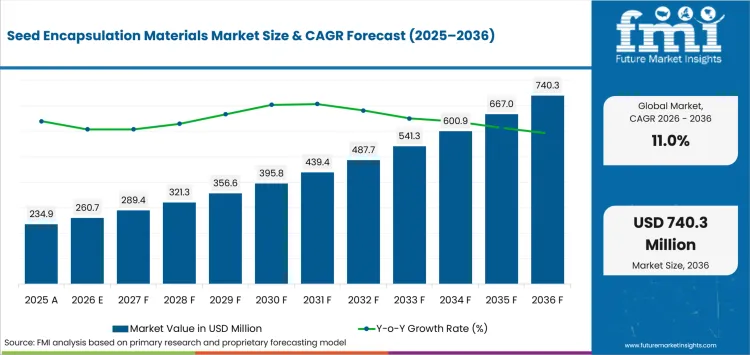
USD 260.7 million in 2026 and USD 740.3 million by 2036 at an 11.0% CAGR.
Demand for seed encapsulation materials is projected to expand at an 11.0% CAGR between 2026 and 2036, increasing valuation from USD 260.7 million in 2026 to USD 740.3 million by 2036. Commercial treatment scale supports that forecast because EPA's June 2026 exposure guidance describes automated facilities handling more than 100,000 pounds of seed. Material qualification therefore has to preserve loading consistency and seed safety under equipment that processes very large commercial lots.
European replacement demand follows a different route as material eligibility now changes before plant-level performance testing begins. In April 2025, the European Commission published implementation guidance for the restriction on intentionally added synthetic polymer microparticles. Affected coating formulators need compliant binders that preserve adhesion and dust control under existing seed-treatment equipment.
Key Takeaways
- Seed companies increasingly use encapsulation materials to retain protection and biological functions on seed without adding separate field application steps.
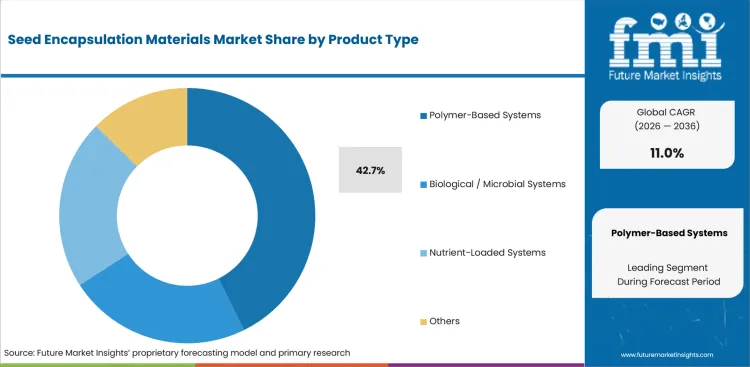
- By product type, polymer-based systems are estimated to hold 42.7% in 2026 owing to their role in adhesion and film formation.
- In 2026, corn & cereals are expected to lead crop type with 49.7% share due to industrial treatment volumes and standardized recipes.
- In-plant treatment is set to lead the treatment point category with 44.2% share in 2026 attributable to centralized recipe and lot control.
- Qualification cycles can slow substitution because new carriers must preserve germination and dust performance alongside chemical or biological treatment compatibility.
- Some of the key players in this market include Verdesian Life Sciences, Bayer SeedGrowth, Syngenta, Corteva Agriscience, BASF, Germains Seed Technology, Incotec (Croda), and Centor Group.
Analyst Perspective
"Seed companies compare encapsulation materials on seed safety and line consistency before unit price becomes decisive. Commercial value concentrates in materials that shorten qualification work without weakening active retention or germination on existing treatment equipment."
- Nikhil Kaitwade, Principal Consultant, Future Market Insights
How is the seed encapsulation materials market segmented?
The market is segmented by Product Type, Crop Type, Treatment Point, Formulation, Sales Channel and Region.
Product type covers polymer-based systems and biological - microbial systems alongside nutrient-loaded systems and other materials used on treated seed. Crop type includes corn & cereals and soybean & pulses together with vegetables and cotton & others. Treatment point separates in-plant seed companies from commercial seed treaters and on-farm treatment plus other treatment points. Formulation covers liquid slurries and dry powders together with film coats & encrusting and other formats. Sales channel distinguishes agri-input distributors from cooperatives and agri-retail chains alongside online - direct-to-farm routes.
What makes polymer-based systems central to the product type category?
Film coats and encrusting recipes need binders that retain treatment components without damaging germination or restricting water exchange. Commercial plants also require low dust and predictable drying during high-volume processing. In April 2026, Incotec launched a microplastic-free cereal film coat that retained seed safety and plant-protection compatibility for commercial seed coating materials.
- By product type, polymer-based systems are estimated to hold 42.7% in 2026 attributable to reliable adhesion during commercial seed treatment and handling.
- Replacement binders qualify after seed plants confirm that lower-microplastic chemistry preserves drying behavior and active retention on existing coating equipment.
Why do corn & cereals account for the largest crop type share in 2026?
Corn and cereal seed moves through industrial lines where uneven loading can reduce throughput and final lot consistency. Large crop volumes make recipe repeatability commercially important for coating materials used in field-crop programs. USDA estimated 95.3 million US corn acres in June 2026, defining the planting scale served by microbial seed treatment and other treated-seed programs.
- Corn & cereals are forecast to represent 49.7% of the crop type category in 2026 driven by large seed volumes and standardized treatment programs.
- Field-crop recipes favor carriers that tolerate long production runs without changing flowability or active loading between commercially treated seed lots.
How does in-plant treatment retain the largest treatment point share in 2026?
In-plant treatment keeps recipe changes close to seed-company quality control and commercial application equipment. Treatment teams need line-level evidence before a new carrier can enter routine production on multiple seed lots. In August 2026, Incotec opened renewed Brazilian laboratories for application testing and customer collaboration on seed treatment materials.
- In-plant treatment is projected to account for 44.2% of the treatment point category in 2026 owing to centralized recipe control and lot-level quality assurance.
- Commercial adoption improves once coating behavior can be tested on representative application conditions before the revised recipe enters full production.
What supports liquid slurries within the formulation category?
Liquid slurries meter binders and treatment ingredients into commercial equipment without requiring a separate dry-application stage. Living organisms make viscosity and moisture control more important for maintaining seed safety during treatment. In November 2025, BASF announced that Integral Pro uses a flowable Bacillus concentrate for sunflower treatment within seed health programs.
- Liquid slurries are estimated to hold 38.4% of the formulation category in 2026 owing to metering accuracy and compatibility with commercial treatment equipment.
- Flowable biological formulations require stable mixing and drying conditions so seed plants can maintain viable organisms without sacrificing treatment throughput.
Why do agri-input distributors hold the largest sales channel share in 2026?
Agri-input distributors reduce the cost of serving dispersed specialty-crop accounts and provide local technical access during treatment selection. In January 2025, DPH Biologicals and Aginnovation formed an exclusive distribution partnership for Companion Maxx ST in North American vegetable and specialty seed treatment. The agreement gives seed biostimulants a defined technical route into local commercial programs.
- Agri-input distributors are expected to hold 35.1% of the sales channel category in 2026 due to local access and application support for fragmented accounts.
- Distribution earns value where regional teams can match biological seed treatments with crop programs and provide application guidance near the customer.
What are the drivers, restraints and opportunities in the Seed Encapsulation Materials Market?
More functions are moving onto treated seed, but formulation qualification and polymer compliance slow change while biological-compatible microplastic-free systems open replacement revenue.
- Driver: Higher functional loading increases demand for carriers that hold chemical, nutrient and biological components in repeatable treatment recipes.
- Restraint: Material changes require fresh seed-safety and processing checks before existing recipes can be replaced at commercial treatment scale.
- Opportunity: Microplastic-free carriers with biological compatibility can capture replacement work where seed companies must update materials without disrupting qualified application systems.
Seed companies are asking each treatment step to carry more agronomic value without increasing handling complexity. Syngenta reported in June 2025 that its expanded United States biologicals facility has 16,000 tons of annual production capacity. Greater biological output increases the number of formulations that may require on-seed delivery or compatibility testing. Encapsulation materials gain value by keeping those ingredients stable during treatment and storage.
Polymer substitution can lengthen validation because legal compliance does not remove adhesion or seed-safety requirements. ECHA opened microplastics-emission reporting under the EU restriction in November 2025 for affected uses. Seed-coating companies must manage polymer documentation beside performance testing before replacing a qualified recipe. Replacement chemistry therefore competes on regulatory fit and processing behavior during the same qualification cycle.
Biological-compatible carriers offer a revenue route as fermentation capacity moves closer to commercial agricultural production. BASF commissioned its Ludwigshafen BioHub in May 2026 for biological crop-protection products that include seed-treatment applications. Added manufacturing capacity can increase the flow of microbial actives needing stable delivery formats. Material companies can capture that work by proving viability retention and process compatibility for biofertilizer technologies.
Which country CAGRs are profiled in the Seed Encapsulation Materials Market?
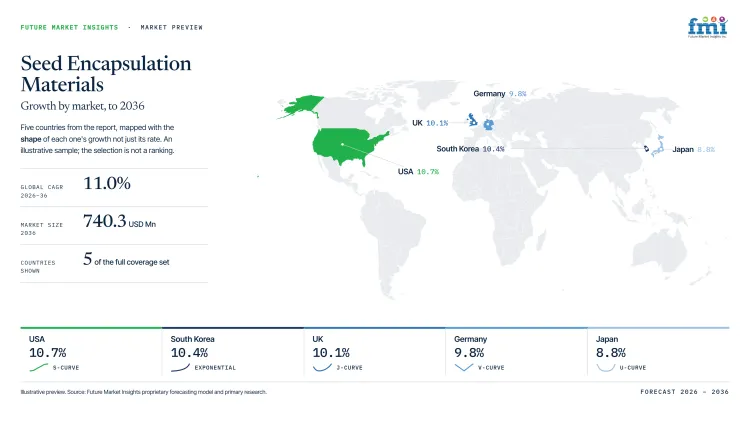
| Country | CAGR |
|---|---|
| USA | 10.7% |
| South Korea | 10.4% |
| UK | 10.1% |
| Germany | 9.8% |
| Japan | 8.8% |
How do country-level CAGRs compare in the Seed Encapsulation Materials Market?
Five country forecasts occupy a 1.9-percentage-point range that separates one upper pair from three slower but commercially distinct markets. USA and South Korea exceed 10% CAGR, while UK and Germany form a second band within 0.3 percentage points. Japan records 8.8%, making qualification routes and treatment infrastructure more useful for entry planning than small headline growth gaps.
- The USA’s large-scale commercial seed-treatment infrastructure supports the efficient processing of high-volume seed lots through automated operations.
- In South Korea, treatment decisions are closely aligned with planting schedules and on-farm disease-management priorities, keeping adoption tied to crop timing.
- The UK is placing greater emphasis on crop-specific approvals and documented sowing requirements when bringing treated seeds to market.
- Germany’s winter-cereal-focused agriculture concentrates industrial seed-treatment activity around seasonal production and distribution cycles.
- Japan’s vegetable-seed sector places a strong premium on disease prevention, seed quality consistency, and dependable treatment performance.
Comparable CAGRs can produce different qualification costs because national crop systems and treatment routes require different evidence before commercial substitution.
Country-wise Analysis
- United States seed companies operate automated treatment lines that handle large commercial lots and demand stable loading behavior from each coating recipe. Seed encapsulation materials demand in the United States is forecast to rise at 10.7% CAGR over the forecast period. EPA guidance updated in October 2025 explains the residue field-trial evidence used to register seed-treatment uses. Commercial scale supports repeat material demand, but each revised recipe must retain seed safety and pesticide compliance under plant conditions. Material companies gain an advantage by supplying application data that reduces repeated testing on existing equipment for USA microbial seed treatments.
- United Kingdom seed-treatment decisions begin with authorization conditions that define acceptable dose and sowing parameters for the complete treated-seed use. HSE updated its specialist seed-treatment requirements in 2025 to address dose expression and the evidence needed for risk assessment. The UK seed encapsulation materials outlook is anticipated to advance at 10.1% CAGR over the assessment period. The authorization route gives formulators a clear basis for qualification, though revised recipes can require additional crop-specific documentation. Commercial entry favors material companies that can supply application data compatible with the approved treatment conditions and existing seed-company equipment.
- German seed processors work with a large cereal base dominated by winter crops and concentrated seasonal treatment demand. Germany is estimated to post 9.8% CAGR over the forecast period as cereal throughput sustains repeat coating volume. Destatis reported in May 2026 that winter cereals represented 82.9% of Germany's total grain area. Concentrated cereal production favors repeatable industrial recipes, but changing polymer specifications can extend reformulation and line-validation work. Companies with qualified low-dust alternatives can compete by documenting processing performance before material changes enter chitosan-based seed coatings.
- Japanese vegetable seed companies manage quality programs that depend on disease control before seed enters domestic or overseas distribution. National support now targets the maintenance of treatment technologies and the registrations needed for stable vegetable seed supply. Adoption of seed encapsulation materials in Japan is estimated to expand at 8.8% CAGR through 2036. MAFF opened that support program in July 2026 for vegetable seed-treatment technology and pesticide registration work. Public support strengthens the technical base, yet crop-specific registration can slow carrier substitution before seed additives enter qualified programs.
- South Korean crop programs keep seed preparation close to disease-control decisions made shortly before sowing. Local treatment choices therefore depend on crop timing and compatibility with registered disinfectants used by growers. The Rural Development Administration advised soybean growers in May 2025 to disinfect seed before planting to reduce disease risk. Seed encapsulation materials demand in South Korea is predicted to advance at 10.4% CAGR through 2036. Commercial entry favors materials that preserve treatment chemistry under local application conditions and can be supported with practical data for biostimulant formulations.
Who are the notable companies in the Seed Encapsulation Materials Market?
Verdesian Life Sciences, Bayer SeedGrowth, Syngenta, Corteva Agriscience, BASF, Germains Seed Technology, Incotec (Croda), and Centor Group are notable companies serving this market.
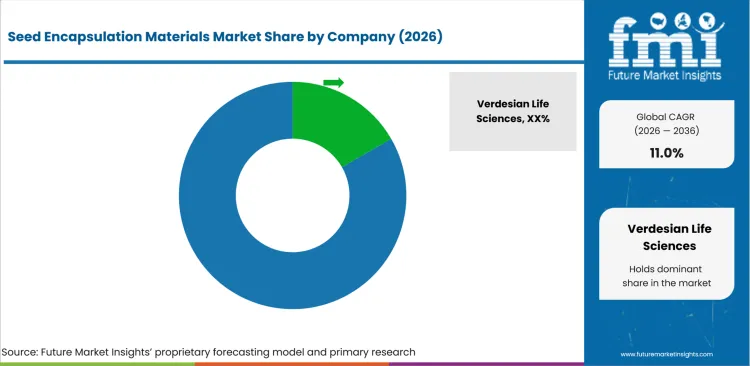
Competition divides between seed-enhancement specialists and integrated agriscience businesses because each controls a different part of the treatment recipe. Germains Seed Technology and Incotec (Croda) focus directly on coating and seed-enhancement work for commercial seed plants. Centor Group supplies coating materials and treatment technology through regional member companies serving seed processors. Bayer SeedGrowth and Syngenta integrate treatment formulation with chemical or biological crop-input programs. BASF also spans coating and treatment functions, while Verdesian Life Sciences and Corteva Agriscience participate through seed-applied nutrient or protection technologies.
- Germains Seed Technology and Incotec (Croda) serve coating programs where material behavior must match commercial seed-processing equipment and qualification procedures.
- Bayer SeedGrowth and Syngenta pair treatment formulation with biological or chemical portfolios that require validated application packages before commercial use.
- BASF spans functional seed coatings and biological treatment, whereas Verdesian Life Sciences and Corteva Agriscience participate through seed-applied technologies.
Competitive Benchmarking: Seed Encapsulation Materials Market
| Company | Coating & Encapsulation Material Breadth | Biological / Nutrient Integration | Commercial Treatment & Application Support | Geographic Reach |
|---|---|---|---|---|
| Verdesian Life Sciences | Medium | High | Medium | North America with selected international markets |
| Bayer SeedGrowth | Medium | High | High | Global SeedGrowth network |
| Syngenta | Medium | High | High | Global Seedcare network |
| Corteva Agriscience | Medium | Medium | High | Global crop markets |
| BASF | High | High | High | Global |
| Germains Seed Technology | High | Medium | High | Europe and North America |
| Incotec (Croda) | High | High | High | Global seed-enhancement network |
| Centor Group | High | Medium | High | Europe, Americas and Asia-Pacific |
Material breadth is High at three documented coating routes, Medium at two verified routes and Low at one documented route. Biological or nutrient integration is High for both functions, Medium for one verified function and Low for a narrow documented role. Application support is High for multiple regions, Medium for one established service route and Low for a documented limited scope.
Key Developments in the Seed Encapsulation Materials Market
- In August 2025, Incotec made its upgraded Argentina film-coating production unit fully operational after expanding the Pergamino site. The fivefold capacity increase gives Latin American seed companies more regional access to commercial film-coating production and technical support.
- In August 2025, Germains Seed Technology introduced Xbeet enrich 400 after commercial farm trials reported a 2% yield uplift. The launch extends seed-enhancement value beyond coating appearance toward repeatable establishment performance in sugar beet programs.
- In March 2026, Corteva Agriscience launched Lumiscend LUXE in Canada as a four-active cereal fungicide seed treatment. The formulation increases loading complexity at the seed surface and raises the qualification burden for compatible carrier systems.
Key Players in the Seed Encapsulation Materials Market
Seed-Enhancement and Coating Specialists
- Germains Seed Technology
- Incotec (Croda)
- Centor Group
Integrated Agriscience Seed-Treatment Platforms
- Bayer SeedGrowth
- Syngenta
- BASF
Seed-Applied Nutrition and Protection Platforms
- Verdesian Life Sciences
- Corteva Agriscience
Seed Encapsulation Materials Market - Report Scope
| Coverage field | Report scope |
|---|---|
| Market breakdown | By product type, crop type, treatment point, formulation, sales channel and region. |
| Quantitative Units | USD million. |
| Market Definition | Commercial materials and formulated systems sold to coat, bind, encrust, pellet, nourish or biologically treat seed within the stated segmentation universe. |
| Regions Covered | North America, Latin America, Western Europe, Eastern Europe, East Asia, South Asia and Pacific, and Middle East and Africa. |
| Countries Covered | USA, South Korea, UK, Germany, Japan, and more than twenty-five additional countries included in the full report. |
| Key Companies Profiled | Verdesian Life Sciences, Bayer SeedGrowth, Syngenta, Corteva Agriscience, BASF, Germains Seed Technology, Incotec (Croda), Centor Group. |
| Forecast Period | 2026 to 2036. |
| Approach | Primary and secondary research with market sizing and validation against official data and current company activity. |
Seed Encapsulation Materials Market - Research Methodology
| Method | Approach |
|---|---|
| Primary Research | FMI analysts gathered input from manufacturers, service providers, technology developers, distributors, end users, procurement teams, and subject-matter experts. Interviews examined purchasing decisions, product or service evaluation, adoption barriers, approval requirements, pricing considerations, and expectations for technical or commercial support. Respondents were also asked what evidence is required before a trial, pilot, or initial order develops into regular purchasing. |
| Desk Research | Desk research covered government statistics, regulatory publications, trade data, industry associations, technical literature, standards, company filings, product information, and official corporate announcements. Sources were reviewed for relevance, publication date, geographic coverage, and consistency with the defined market scope. Claims relating to performance, applications, approvals, capacity, investment, and commercial activity were retained only when supported by credible public evidence. |
| Market Sizing and Forecasting | The market model combined the baseline value with historical performance, segment structure, pricing and volume indicators, adoption levels, company participation, and country-level demand conditions. Forecast assumptions considered economic activity, investment trends, regulatory developments, technology adoption, purchasing cycles, supply availability, and barriers to wider market use. Segment and regional estimates were reconciled before the final market total was calculated. |
| Data Validation | Estimates were checked against multiple independent indicators, including public data, company activity, trade patterns, industry developments, and findings from primary interviews. Validation also tested whether products, services, applications, and company revenues fell within the defined market boundaries. Adjacent categories, unsupported claims, overlapping revenues, and activities without direct market relevance were excluded to reduce double counting and maintain consistency across segments and countries. |
Seed Encapsulation Materials Market by Segments
Seed Encapsulation Materials Market segmented by Product Type:
- Polymer-Based Systems
- Biological - Microbial Systems
- Nutrient-Loaded Systems
- Others
Seed Encapsulation Materials Market segmented by Crop Type:
- Corn & Cereals
- Soybean & Pulses
- Vegetables
- Cotton & Others
Seed Encapsulation Materials Market segmented by Treatment Point:
- In-Plant (Seed Companies)
- Commercial Seed Treaters
- On-Farm Treatment
- Others
Seed Encapsulation Materials Market segmented by Formulation:
- Liquid Slurries
- Dry Powders
- Film Coats & Encrusting
- Others
Seed Encapsulation Materials Market segmented by Sales Channel:
- Agri-Input Distributors
- Cooperatives
- Agri-Retail Chains
- Online - Direct-to-Farm
- Others
Seed Encapsulation Materials Market by Region:
- North America
- United States
- Canada
- Latin America
- Brazil
- Mexico
- Argentina
- Chile
- Western Europe
- Germany
- France
- United Kingdom
- Italy
- Spain
- Benelux
- Nordics
- Eastern Europe
- Poland
- Czech Republic
- Romania
- Hungary
- East Asia
- China
- Japan
- South Korea
- South Asia and Pacific
- India
- ASEAN
- Australia and New Zealand
- Middle East and Africa
- GCC Countries
- South Africa
- Türkiye
- Israel
Research Sources and Bibliography
- USA Environmental Protection Agency. (2026, June 25). Occupational pesticide exposure - seed treatment.
- European Commission, Directorate-General for Internal Market, Industry, Entrepreneurship and SMEs. (2025, April 1). Commission helps users to implement the restriction on microplastics under the EU chemical legislation.
- Incotec. (2026, April 8). New microplastic-free seed coating for cereal.
- USA Department of Agriculture, National Agricultural Statistics Service. (2026, June 30). Corn planted acreage down 3% from 2025, soybean acreage up 5% from last year.
- Incotec. (2026, September 8). Renewed labs in Brazil - hub for customer collaboration.
- BASF Agricultural Solutions. (2025, November 20). BASF announces Integral Pro for Sunflowers is registered in France.
- DPH Biologicals and Aginnovation. (2025, January 27). DPH Biologicals and Aginnovation forge strategic partnership to advance seed enhancement solutions.
- Syngenta. (2025, June 30). Syngenta to become global leader in biologicals; expanding nature inspired solutions for farmers.
- European Chemicals Agency. (2025, November 26). ECHA ready to receive reports on microplastics emissions.
- BASF. (2026, May 11). BASF Agricultural Solutions successfully commissions new fermentation plant for crop protection products in Ludwigshafen.
- USA Environmental Protection Agency. (2025, October 6). Determining the number of field trials required to register seed-treatment uses.
- UK Health and Safety Executive. (2025, May 27). Seed treatments: HSE requirements to address specialist assessments.
- Statistisches Bundesamt. (2026, May 19). Getreideanbaufläche 2026 hat sich nach Tiefststand von 2024 weiter stabilisiert.
- Ministry of Agriculture, Forestry and Fisheries of Japan. (2026, July 21). 令和7年度野菜種子安定供給緊急対策事業のうち種子防除技術の維持・確立事業に係る公募について.
- Rural Development Administration, Republic of Korea. (2025, May 8). 콩 농사, 종자 준비부터 심기까지 이렇게 준비.
- Incotec. (2025, August 28). Upgraded facility in Argentina fully operational.
- Germains Seed Technology. (2025, August 19). New Xbeet enrich 400 delivers 2% yield uplift.
- Corteva Agriscience. (2026, April 1). Corteva locks in end-to-end cereal protection with launch of 4-active powerhouse Lumiscend LUXE.
- Verdesian Life Sciences. (2026, July 7). Verdesian Life Sciences completes strategic buildout of commercial leadership team to support continued growth.
- Bayer SeedGrowth. (2025, September 29). Susteed brings together the best of biologicals and seed treatments.
- Syngenta. (2025, February 26). Syngenta strengthens global leadership in agricultural biologicals.
- Corteva Agriscience. (2025, November 5). Corteva announces nature-inspired solutions to control insects, help farmers effectively protect yield.
- BASF. (2026, April 16). BASF Agricultural Solutions invests 40 million euro in next generation seed processing facilities in Nunhem, Netherlands.
- Germains Seed Technology. (2025, August 10). Addendum to the certificate of organic operation according to National Organic Program.
- Incotec. (2025, November 16). New watermelon priming to overcome abiotic stress.
- Aginnovation. (2025, July 15). Aginnovation acquires Centor Europe to strengthen seed-enhancement portfolio across Europe.
- Syngenta. (2025, January 9). Artificial intelligence is speeding up the development of the next generation of biostimulants.
- Corteva Agriscience. (2025, June 27). Arable Update June 2025.
- Bayer SeedGrowth. (2026, March 29). Rising to new heights: new solutions and systems power Raxil's future in Canada.
This bibliography is provided for reader reference and is not exhaustive because the full report contains the complete source list and detailed citations.
This Report Answers
- How large is the seed encapsulation materials market in 2026 and what value is projected for 2036?
- Which operating conditions are increasing demand for carriers that hold more than one function on treated seed?
- Why do polymer-based systems account for 42.7% of the product type category in 2026?
- Why do corn & cereals represent 49.7% of the crop type category during the 2026 base year?
- How does in-plant treatment at seed companies support recipe control and lot-level quality assurance?
- Which national conditions explain the differences among USA, South Korea, UK, Germany and Japan growth rates?
- Which companies serve coating specialists, integrated seed-treatment platforms and seed-applied nutrient or protection programs?
- How do polymer rules and formulation qualification affect the timing of material replacement decisions?
- Which purchasing and application factors should seed companies test before changing an encapsulation material?
Frequently Asked Questions
How big is the seed encapsulation materials market in 2026?
The seed encapsulation materials market is valued at USD 260.7 million in 2026 and is projected to reach USD 740.3 million by 2036. Growth is tied to greater functional loading on treated seed and replacement work for affected coating chemistry.
What is the CAGR of the seed encapsulation materials market from 2026 to 2036?
The seed encapsulation materials market is projected to grow at an 11.0% CAGR between 2026 and 2036. Expansion is supported by biological integration and industrial treatment requirements that raise carrier performance demands.
Which product type leads the seed encapsulation materials market?
The polymer-based systems segment is expected to hold 42.7% of the seed encapsulation materials market in 2026, attributable to adhesion and film formation requirements. Commercial treatment lines also depend on stable drying and low dust during qualification.
Which crop type holds the additional dominant share in the seed encapsulation materials market?
The corn & cereals segment is projected to represent 49.7% of the seed encapsulation materials market in 2026, driven by high treatment volumes. Repeatable recipes reduce loading variation during industrial field-crop seed processing.
Which countries are projected to record the country growth comparison in the seed encapsulation materials market?
USA is projected to grow at 10.7% CAGR, followed by South Korea at 10.4% and UK at 10.1% through 2036. National treatment infrastructure and authorization routes determine how forecast growth becomes commercial material demand.
Which companies are active in the seed encapsulation materials market?
Key companies operating in the market include Verdesian Life Sciences, Bayer SeedGrowth, Syngenta, Corteva Agriscience, BASF, Germains Seed Technology, Incotec (Croda), and Centor Group. Their roles span coating chemistry and seed enhancement alongside biological or chemical seed-treatment programs.
Preview the report firsthand - request a free sample
Get SampleGet the brochure for pricing and purchase details.
Get PDFTable of Content
- Key Takeaways
- Market Size and CAGR
- Top Growth Driver
- Fastest Growing Segment
- Leading Region
- Key Companies
- Emerging Opportunities
- Executive Summary
- Global Market Outlook
- Demand-side Trends
- Supply-side Trends
- Technology Roadmap Analysis
- Analysis and Recommendations
- Analyst Perspective (What is happening? Why now? What should investors know?)
- Key Questions Answered
- How large is the market?
- What is the CAGR?
- What are key trends?
- Which region dominates?
- Who are the leaders?
- Market Overview
- Market Coverage / Taxonomy
- Market Definition / Scope / Limitations
- Research Methodology
- Chapter Orientation
- Analytical Lens and Working Hypotheses
- Market Structure, Signals, and Trend Drivers
- Benchmarking and Cross-market Comparability
- Market Sizing, Forecasting, and Opportunity Mapping
- Research Design and Evidence Framework
- Desk Research Programme (Secondary Evidence)
- Expert Input and Fieldwork (Primary Evidence)
- Tooling, Models, and Reference Databases
- Data Engineering and Model Build
- Quality Assurance and Audit Trail
- Market Background
- Market Dynamics (Drivers, Restraints, Opportunity, Trends)
- Scenario Forecast (Optimistic, Likely, Conservative)
- Impact Analysis
- AI Impact
- Sustainability Impact
- Regulatory Impact
- Technology Impact
- Consumer / Buyer Analysis
- Purchase Drivers
- Adoption Barriers
- Buyer Journey
- Opportunity Map Analysis
- Product Life Cycle Analysis
- Supply Chain Analysis
- Investment Feasibility Matrix
- Value Chain Analysis
- PESTLE and Porter's Analysis
- Regulatory Landscape
- Regional Parent Market Outlook
- Production and Consumption Statistics
- Import and Export Statistics
- Global Market Analysis and Forecast, 2021 to 2036
- Historical Market Size Value (USD Million) Analysis, 2021 to 2025
- Current and Future Market Size Value (USD Million) Projections, 2026 to 2036
- Y-o-Y Growth Trend Analysis
- Absolute $ Opportunity Analysis
- Global Market Pricing Analysis, 2021 to 2036
- Global Market Analysis and Forecast, By Product Type, 2021 to 2036
- Introduction / Key Findings
- Historical Market Size Value (USD Million) Analysis By Product Type, 2021 to 2025
- Current and Future Market Size Value (USD Million) Analysis and Forecast By Product Type, 2026 to 2036
- Polymer-Based Systems
- Biological / Microbial Systems
- Nutrient-Loaded Systems
- Others
- Polymer-Based Systems
- Y-o-Y Growth Trend Analysis By Product Type, 2021 to 2025
- Absolute $ Opportunity Analysis By Product Type, 2026 to 2036
- Global Market Analysis and Forecast, By Crop Type, 2021 to 2036
- Introduction / Key Findings
- Historical Market Size Value (USD Million) Analysis By Crop Type, 2021 to 2025
- Current and Future Market Size Value (USD Million) Analysis and Forecast By Crop Type, 2026 to 2036
- Corn & Cereals
- Soybean & Pulses
- Vegetables
- Cotton & Others
- Corn & Cereals
- Y-o-Y Growth Trend Analysis By Crop Type, 2021 to 2025
- Absolute $ Opportunity Analysis By Crop Type, 2026 to 2036
- Global Market Analysis and Forecast, By Treatment Point, 2021 to 2036
- Introduction / Key Findings
- Historical Market Size Value (USD Million) Analysis By Treatment Point, 2021 to 2025
- Current and Future Market Size Value (USD Million) Analysis and Forecast By Treatment Point, 2026 to 2036
- In-Plant (Seed Companies)
- Commercial Seed Treaters
- On-Farm Treatment
- Others
- In-Plant (Seed Companies)
- Y-o-Y Growth Trend Analysis By Treatment Point, 2021 to 2025
- Absolute $ Opportunity Analysis By Treatment Point, 2026 to 2036
- Global Market Analysis and Forecast, By Formulation, 2021 to 2036
- Introduction / Key Findings
- Historical Market Size Value (USD Million) Analysis By Formulation, 2021 to 2025
- Current and Future Market Size Value (USD Million) Analysis and Forecast By Formulation, 2026 to 2036
- Liquid Slurries
- Dry Powders
- Film Coats & Encrusting
- Others
- Liquid Slurries
- Y-o-Y Growth Trend Analysis By Formulation, 2021 to 2025
- Absolute $ Opportunity Analysis By Formulation, 2026 to 2036
- Global Market Analysis and Forecast, By Sales Channel, 2021 to 2036
- Introduction / Key Findings
- Historical Market Size Value (USD Million) Analysis By Sales Channel, 2021 to 2025
- Current and Future Market Size Value (USD Million) Analysis and Forecast By Sales Channel, 2026 to 2036
- Agri-Input Distributors
- Cooperatives
- Agri-Retail Chains
- Online / Direct-to-Farm
- Others
- Agri-Input Distributors
- Y-o-Y Growth Trend Analysis By Sales Channel, 2021 to 2025
- Absolute $ Opportunity Analysis By Sales Channel, 2026 to 2036
- Global Market Analysis and Forecast, By Region, 2021 to 2036
- Introduction
- Historical Market Size Value (USD Million) Analysis By Region, 2021 to 2025
- Current Market Size Value (USD Million) Analysis and Forecast By Region, 2026 to 2036
- North America
- Latin America
- Western Europe
- Eastern Europe
- East Asia
- South Asia and Pacific
- Middle East & Africa
- Market Attractiveness Analysis By Region
- North America Market Analysis and Forecast, By Country, 2021 to 2036
- Historical Market Size Value (USD Million) Trend Analysis By Market Taxonomy, 2021 to 2025
- Market Size Value (USD Million) Forecast By Market Taxonomy, 2026 to 2036
- By Country
- USA
- Canada
- By Product Type
- By Crop Type
- By Treatment Point
- By Formulation
- By Sales Channel
- By Country
- Market Attractiveness Analysis
- By Country
- By Product Type
- By Crop Type
- By Treatment Point
- By Formulation
- By Sales Channel
- Key Takeaways
- Latin America Market Analysis and Forecast, By Country
- Historical Market Size Value (USD Million) Trend Analysis By Market Taxonomy, 2021 to 2025
- Market Size Value (USD Million) Forecast By Market Taxonomy, 2026 to 2036
- By Country
- Brazil
- Mexico
- Chile
- Rest of Latin America
- By Product Type
- By Crop Type
- By Treatment Point
- By Formulation
- By Sales Channel
- By Country
- Market Attractiveness Analysis
- By Country
- By Product Type
- By Crop Type
- By Treatment Point
- By Formulation
- By Sales Channel
- Key Takeaways
- Western Europe Market Analysis and Forecast, By Country
- Historical Market Size Value (USD Million) Trend Analysis By Market Taxonomy, 2021 to 2025
- Market Size Value (USD Million) Forecast By Market Taxonomy, 2026 to 2036
- By Country
- Germany
- UK
- Italy
- Spain
- France
- Nordic
- BENELUX
- Rest of Western Europe
- By Product Type
- By Crop Type
- By Treatment Point
- By Formulation
- By Sales Channel
- By Country
- Market Attractiveness Analysis
- By Country
- By Product Type
- By Crop Type
- By Treatment Point
- By Formulation
- By Sales Channel
- Key Takeaways
- Eastern Europe Market Analysis and Forecast, By Country
- Historical Market Size Value (USD Million) Trend Analysis By Market Taxonomy, 2021 to 2025
- Market Size Value (USD Million) Forecast By Market Taxonomy, 2026 to 2036
- By Country
- Russia
- Poland
- Hungary
- Balkan & Baltic
- Rest of Eastern Europe
- By Product Type
- By Crop Type
- By Treatment Point
- By Formulation
- By Sales Channel
- By Country
- Market Attractiveness Analysis
- By Country
- By Product Type
- By Crop Type
- By Treatment Point
- By Formulation
- By Sales Channel
- Key Takeaways
- East Asia Market Analysis and Forecast, By Country
- Historical Market Size Value (USD Million) Trend Analysis By Market Taxonomy, 2021 to 2025
- Market Size Value (USD Million) Forecast By Market Taxonomy, 2026 to 2036
- By Country
- China
- Japan
- South Korea
- By Product Type
- By Crop Type
- By Treatment Point
- By Formulation
- By Sales Channel
- By Country
- Market Attractiveness Analysis
- By Country
- By Product Type
- By Crop Type
- By Treatment Point
- By Formulation
- By Sales Channel
- Key Takeaways
- South Asia and Pacific Market Analysis and Forecast, By Country
- Historical Market Size Value (USD Million) Trend Analysis By Market Taxonomy, 2021 to 2025
- Market Size Value (USD Million) Forecast By Market Taxonomy, 2026 to 2036
- By Country
- India
- ASEAN
- Australia & New Zealand
- Rest of South Asia and Pacific
- By Product Type
- By Crop Type
- By Treatment Point
- By Formulation
- By Sales Channel
- By Country
- Market Attractiveness Analysis
- By Country
- By Product Type
- By Crop Type
- By Treatment Point
- By Formulation
- By Sales Channel
- Key Takeaways
- Middle East & Africa Market Analysis and Forecast, By Country
- Historical Market Size Value (USD Million) Trend Analysis By Market Taxonomy, 2021 to 2025
- Market Size Value (USD Million) Forecast By Market Taxonomy, 2026 to 2036
- By Country
- Kingdom of Saudi Arabia
- Other GCC Countries
- Türkiye
- South Africa
- Other African Union
- Rest of Middle East & Africa
- By Product Type
- By Crop Type
- By Treatment Point
- By Formulation
- By Sales Channel
- By Country
- Market Attractiveness Analysis
- By Country
- By Product Type
- By Crop Type
- By Treatment Point
- By Formulation
- By Sales Channel
- Key Takeaways
- Key Countries Market Analysis
- USA
- Pricing Analysis
- Market Share Analysis, 2025
- By Product Type
- By Crop Type
- By Treatment Point
- By Formulation
- By Sales Channel
- Canada
- Pricing Analysis
- Market Share Analysis, 2025
- By Product Type
- By Crop Type
- By Treatment Point
- By Formulation
- By Sales Channel
- Mexico
- Pricing Analysis
- Market Share Analysis, 2025
- By Product Type
- By Crop Type
- By Treatment Point
- By Formulation
- By Sales Channel
- Brazil
- Pricing Analysis
- Market Share Analysis, 2025
- By Product Type
- By Crop Type
- By Treatment Point
- By Formulation
- By Sales Channel
- Chile
- Pricing Analysis
- Market Share Analysis, 2025
- By Product Type
- By Crop Type
- By Treatment Point
- By Formulation
- By Sales Channel
- Germany
- Pricing Analysis
- Market Share Analysis, 2025
- By Product Type
- By Crop Type
- By Treatment Point
- By Formulation
- By Sales Channel
- UK
- Pricing Analysis
- Market Share Analysis, 2025
- By Product Type
- By Crop Type
- By Treatment Point
- By Formulation
- By Sales Channel
- Italy
- Pricing Analysis
- Market Share Analysis, 2025
- By Product Type
- By Crop Type
- By Treatment Point
- By Formulation
- By Sales Channel
- Spain
- Pricing Analysis
- Market Share Analysis, 2025
- By Product Type
- By Crop Type
- By Treatment Point
- By Formulation
- By Sales Channel
- France
- Pricing Analysis
- Market Share Analysis, 2025
- By Product Type
- By Crop Type
- By Treatment Point
- By Formulation
- By Sales Channel
- India
- Pricing Analysis
- Market Share Analysis, 2025
- By Product Type
- By Crop Type
- By Treatment Point
- By Formulation
- By Sales Channel
- ASEAN
- Pricing Analysis
- Market Share Analysis, 2025
- By Product Type
- By Crop Type
- By Treatment Point
- By Formulation
- By Sales Channel
- Australia & New Zealand
- Pricing Analysis
- Market Share Analysis, 2025
- By Product Type
- By Crop Type
- By Treatment Point
- By Formulation
- By Sales Channel
- China
- Pricing Analysis
- Market Share Analysis, 2025
- By Product Type
- By Crop Type
- By Treatment Point
- By Formulation
- By Sales Channel
- Japan
- Pricing Analysis
- Market Share Analysis, 2025
- By Product Type
- By Crop Type
- By Treatment Point
- By Formulation
- By Sales Channel
- South Korea
- Pricing Analysis
- Market Share Analysis, 2025
- By Product Type
- By Crop Type
- By Treatment Point
- By Formulation
- By Sales Channel
- Russia
- Pricing Analysis
- Market Share Analysis, 2025
- By Product Type
- By Crop Type
- By Treatment Point
- By Formulation
- By Sales Channel
- Poland
- Pricing Analysis
- Market Share Analysis, 2025
- By Product Type
- By Crop Type
- By Treatment Point
- By Formulation
- By Sales Channel
- Hungary
- Pricing Analysis
- Market Share Analysis, 2025
- By Product Type
- By Crop Type
- By Treatment Point
- By Formulation
- By Sales Channel
- Kingdom of Saudi Arabia
- Pricing Analysis
- Market Share Analysis, 2025
- By Product Type
- By Crop Type
- By Treatment Point
- By Formulation
- By Sales Channel
- Türkiye
- Pricing Analysis
- Market Share Analysis, 2025
- By Product Type
- By Crop Type
- By Treatment Point
- By Formulation
- By Sales Channel
- South Africa
- Pricing Analysis
- Market Share Analysis, 2025
- By Product Type
- By Crop Type
- By Treatment Point
- By Formulation
- By Sales Channel
- USA
- Market Structure Analysis
- Competition Dashboard
- Competition Benchmarking
- Market Share Analysis of Top Players
- By Regional
- By Product Type
- By Crop Type
- By Treatment Point
- By Formulation
- By Sales Channel
- Emerging Startups
- Innovation Benchmarking
- Competition Analysis
- Competition Deep Dive
- Verdesian Life Sciences
- Overview
- Product Portfolio
- Profitability by Market Segments
- Sales Footprint
- Strategy Overview
- Marketing Strategy
- Product Strategy
- Channel Strategy
- Bayer SeedGrowth
- Syngenta
- Corteva Agriscience
- BASF
- Germains Seed Technology
- Incotec (Croda)
- Centor Group
- Verdesian Life Sciences
- Case Studies
- Success Stories
- Recent Developments
- Competition Deep Dive
- Assumptions & Acronyms Used


